Beyond the spectacle of summits, Trump isn’t
  truly dedicated to nuclear arms control https://www.aspistrategist.org.au/beyond-the-spectacle-of-summits-trump-isnt-truly-dedicated-to-nuclear-arms-control/
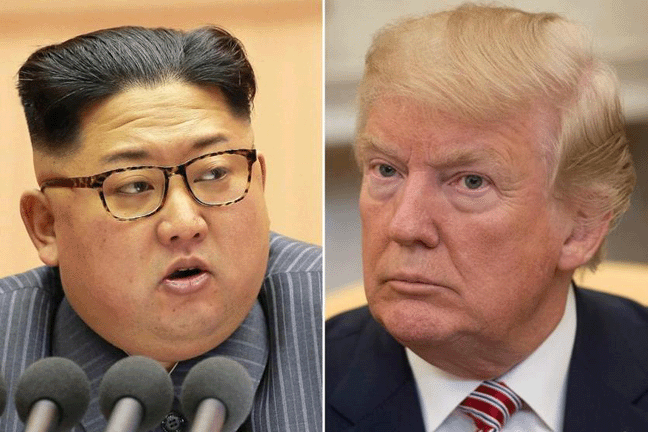
After three decades of intermittent negotiations with North Korea, direct engagement between heads of state was a fresh approach, for which Trump should be commended. But his administration’s indigestion when contemplating anything less than an all-encompassing, landmark accord should have been tempered with a seasoned helping of negotiating flexibility. And looking beyond Hanoi, it’s evident that Trump and his team are hardly committed to nuclear arms control writ large.
Only weeks after the US declared its intention to withdraw from the Intermediate-Range Nuclear Forces (INF) Treaty, which forbids both nuclear and conventional missiles with ranges of 500 to 5,000 kilometres, the Pentagon announced its plans to test a ground-mobile version of the sea-launched Tomahawk cruise missile in August, followed by a 4,000-kilometre-range ballistic missile in November.
Russia and the US have each critiqued the other for treaty noncompliance. Washington has continued to cite the operating range of Russia’s 9M729 missile and Moscow’s failure to course-correct since 2014, whereas Moscow has countered that the US Aegis Ashore missile defence site in Romania could perhaps be repurposed to launch offensive cruise missiles instead of only defensive interceptors.
At a January meeting in Geneva, Russia purportedly offered an inspection of the 9M729 system in exchange for a demonstration that the Aegis launchers couldn’t be converted to accommodate offensive missiles. American diplomats rejected this proposal, and, with the US Defense Department wasting no time to prepare for tests of INF Treaty–violating weapons soon after the agreement becomes void on 2 August, the Trump administration appears all too willing to dispense with existing arms limitations.
US officials have also yet to communicate their stance on prolonging the New Strategic Arms Reduction Treaty (New START). In a phone call with Russian President Vladimir Putin in January 2017, Trump reportedly disparaged the treaty as a ‘bad deal’ after Putin mentioned possible extension beyond 2021. Top US Air Force generals have testified before Congress and spoken publicly in unequivocal support of New START, calling bilateral and verifiable arms-control treaties ‘essential’, ‘of huge value’, ‘unbelievably important’ and ‘good for us’.
Regrettably, Bolton was a strident critic of New START before his appointment to lead Trump’s National Security Council, and the US State Department’s top diplomat for arms control remains noncommittal, explaining that the administration’s consolidated position towards treaty extension is still meandering through bureaucratic interagency review. ‘It gives reason to suspect our American counterparts of setting ground’ to let the treaty expire quietly, said Russia’s deputy foreign minister. Without the INF Treaty and the binding, verifiable limits contained in New START, American and Russian nuclear weaponry could soon be unconstrained for the first time since 1972.
And signatories to the Nuclear Non-Proliferation Treaty have just concluded their final preparatory meeting in advance of the treaty’s review conference next year. Non-nuclear states have expressed irritation that the US and Russia have further created ‘doubt about their intention ever to fulfil their disarmament obligations’. Instead of faithfully pursuing another stepwise reduction in its numbers of launchers and warheads, the US proposed multilateral working groups to discuss specific disarmament challenges. Among the 122 countries that voted in July 2017 for a nuclear-weapons ban, this American initiative, called ‘Creating an Environment for Nuclear Disarmament’, smells like much high-minded talk without any meaningful effort towards US arms reductions.
If Trump desires credibility, dialogue with Russia promises fertile ground. At the outset, his political opponents may deride such overtures as cosying up to Putin. But as highlightedby former admiral Mike Mullen, the top American military officer from 2007 to 2011, ‘even in the darkest days of the Cold War’ the US had regular interchanges with the Soviet Union, but ‘we don’t have them now—it’s not even close’.
And responsibly trimming American and Russian arsenals would make any future pressure on North Korea all the more compelling.
Commitment to arms-control talks could help Washington and Moscow further comprehend areas of shared concern, such as China’s economic clout in central Asia and its adventurism in the Arctic, short of a thaw in relations. If mutually beneficial agreements with Moscow stimulate Trump’s appetite for open-minded negotiations and incremental processes, and achieve appreciation and esteem from the international community, perhaps step-by-step progress with Kim would then become palatable.
Evan Karlik is a lieutenant commander in the US Navy. He spent his early childhood in Western Samoa and the Philippines, and was stationed in Hawaii from 2011 to 2014. He served last year as a Defense Fellow in the US House of Representatives.
May 14, 2019
Posted by Christina Macpherson |
politics international, USA, weapons and war |
Leave a comment
|
US: Next Nuclear Treaty Review Likely to Be ‘Incredibly Difficult’ VOA News, UNITED NATIONS — 13May19The final preparatory meeting for next year’s review of the Nuclear Nonproliferation Treaty ended Friday with deep divisions, and U.S. Ambassador Robert Wood said reaching agreement at the 2020 conference “will be an incredibly difficult task.”
But he told the closing session of the two-week preparatory conference that “it is a task we cannot abandon.”
The NPT is the world’s single most important pact on nuclear arms, credited with preventing their spread to dozens of nations since entering into force in 1970.
It has succeeded in doing this via a grand global bargain: Nations without nuclear weapons committed not to acquire them; those with them committed to move toward their elimination; and all endorsed everyone’s right to develop peaceful nuclear energy.
‘Significant challenges’
Treaty members — every nation but India, Pakistan and North Korea, who possess nuclear weapons, and Israel, which is believed to be a nuclear power but has never acknowledged it — gather every five years to review how it’s working. They try to agree on new approaches to problems, not by updating the treaty, which is difficult, but by trying to adopt a consensus final document calling for steps outside the treaty to advance its goals.
Malaysia’s U.N. Ambassador Syed Mohd Hasrin Tengku Hussin, chair of the third preparatory conference, told a news conference Friday that delegates “do not agree on everything but remain committed to full implementation” of the NPT, and talked about “how to accelerate measures to a nuclear-free world.”
Citing “significant challenges,” he noted that the meeting took place “at a time of increasing international tension and deteriorating relationships between those countries that possess nuclear weapons” — the U.S., Russia, China, Britain and France.
Hussin also singled out differences between nuclear weapon and non-nuclear weapon states on disarmament.
Iran ‘completely frustrated’
Iranian delegate Bahram Shahaboddin said in a closing statement that non-nuclear weapon states “are completely frustrated by the 50-year lack of progress on nuclear disarmament,” and continuing delaying tactics by the nuclear powers.
“We must not allow this to happen again. In 2020, we must say loud and clear enough is enough,” he said, singling out the United States for spending $1.2 trillion on its nuclear arsenal and “brazenly” threatening non-nuclear weapon states with nuclear weapons.
Hussin said delegates did agree on the agenda, procedures and president of the review conference — Argentina’s Ambassador to Austria Rafael Grossi — so in 2020 they can concentrate on substance……..
Rebecca Johnson, a security analyst and founding president of the International Campaign to Abolish Nuclear Weapons which won the 2017 Nobel Peace Prize, said: “The real questions for 2020 are going to be about the nuclear risks and treaties under threat from a few narcissistic leaders who are pulling out of them in order to keep proliferating and deploying nuclear weapons.”
“Their dangerous actions undermine not only the NPT … which we need to protect humanity from nuclear war, but climate catastrophes that threaten security for all of us,” she told AP. https://www.voanews.com/a/us-next-nuclear-treaty-review-likely-to-be-incredibly-difficult/4913234.html
|
|
May 13, 2019
Posted by Christina Macpherson |
2 WORLD, politics international, weapons and war |
Leave a comment
North Korea won’t give up all its nuclear weapons, former Defense Secretary Gates says. Politico, By PATRICK TEMPLE-WEST, 05/12/2019
Former Defense Secretary Robert Gates said North Korea is unlikely to ever give up all its nuclear weapons, and that President Donald Trump was right to walk away from deal with leader Kim Jong-un in February.In an interview with CBS that taped on May 10, Gates said North Koreans have come to see some modest nuclear capabilities as “essential to their national survival.”
“I believe that North Koreans will never completely denuclearize,” Gates said, adding that the Trump administration is “unrealistic in believing that they can get complete denuclearization.” ……. https://www.politico.com/story/2019/05/12/robert-gates-north-korea-1317623
May 13, 2019
Posted by Christina Macpherson |
North Korea, politics international, weapons and war |
Leave a comment
World leaders are dimly becoming aware of the global Climate Crisis. Unfortunately there are few world leaders for whom the penny has dropped – that a global crisis is not just a domestic matter – that to tackle it is a matter for international co-operation..
There is another crisis, which seems to be below everybody’s radar, and invisible to world leaders, especially disregarded 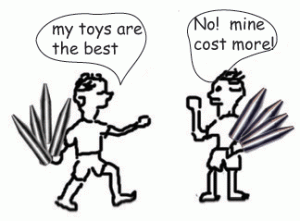 by the leaders of nuclear nations. This is the apocalyptic danger of nuclear war – started either by intention, or by accident. The dangers of the nuclear industry in general are also global – with the creeping toxicity of ionising radiation accumulating in the ecosphere.
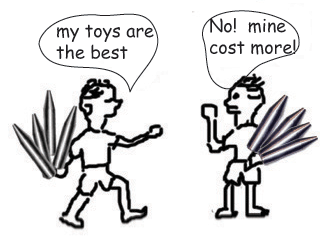
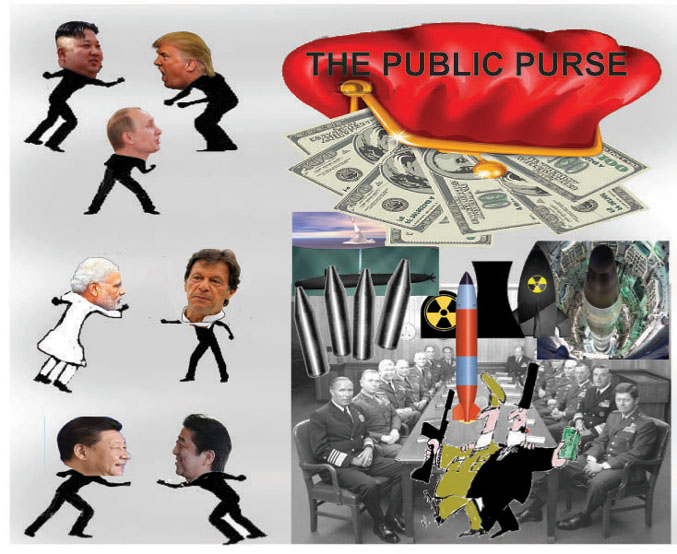
The boys that run the world are pretty much oblivious of those twin global threats – like little schoolkids taunting each other – they have no concept of working together to defuse the climate and nuclear dangers. They show no sign of understanding the concept of international co-operation.
And don’t the nuclear industry and weapons companies love it this way!!!
May 11, 2019
Posted by Christina Macpherson |
Christina's themes, politics international |
4 Comments
 In Middle of Nuclear Standoff, U.S. Seizes North Korean Cargo Ship Illicitly Exporting Coal, Slate, By ELLIOT HANNON, 9 May 19
The U.S. has seized a North Korean cargo ship that it alleges has been used to illicitly export coal from the country in violation of international sanctions, the Department of Justice announced Thursday. The move, though many months in the making, is sure to stir resentment in Pyongyang as the two countries try to negotiate denuclearization.
This is the first time the U.S. has seized a North Korean ship for sanctions violations and U.S. officials say it is part of a broader push to increase pressure on Pyongyang to dismantle its nuclear program. The coal sector is key to the North Korean economy and its nuclear weapons program. The ship, named Wise Honest, was also importing heavy machinery…….
May 11, 2019
Posted by Christina Macpherson |
incidents, North Korea, politics international, USA |
Leave a comment
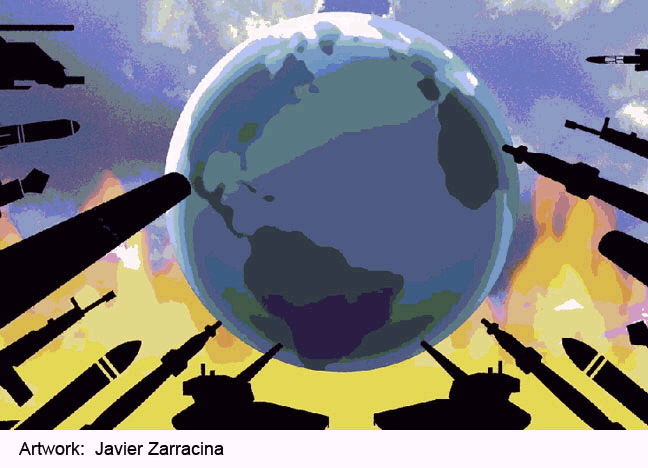 Nuclear paralysis and nuclear risk, Japan Times, BY DAVID HOWELL, MAY 10, 2019, LONDON – We are dangerously close to a world without arms control agreements. That is what some of the most experienced U.S. defense and disarmament experts are now warning, and a recent detailed report from a U.K. House of Lords Committee fully shares their alarm. The implications for the increasing risk of nuclear weapons use, tactical or strategic, are direct, immense and horrific. The disarmament process, on which the previous generation put so much hope, has come to a halt and what is termed “policy paralysis” has set in.
Whether these warnings are going to attract the urgent attention, and the action, they deserve is an open question. Of course in the Pacific Rim region the nuclear threat seems obvious and omnipresent, with unpredictable North Korean leader Kim Jong Un’s ongoing missile-launching activity still looming over nearby states, notably Japan.
But in the West it is quite different. A thick layer of complacency surrounds Western opinion about arms control and nuclear risk, built up from assumptions that the basic architecture of global arms stability of the last 70 years still works and stays firm. Preoccupation with other issues, such as Brexit, immigration and global warming, blots out most media coverage of nuclear matters, even though one nuclear slipup could kill millions in minutes.
Comfort is drawn from the belief that the balance of mutual deterrence between nuclear powers still holds firm, that Russia and the United States — which possess 90 percent of the world’s stock of nuclear weapons — still have some sort of dialogue despite their antagonism (as in the Cold War), that the proliferation of nuclear weapons has been reasonably contained and will continue to be so, and that the full range of arms control and limitation treaties, agreed on 20 or 30 years ago, are still valid or can be renewed.
Unfortunately none of these conditions still hold true. It is just dawning on Western policymakers that the whole arms stability structure, far from maintain the balance of the decades since World War II, could soon become highly unstable.
First, there has been a vast deterioration in both Russian-U.S. and Russian-European relations……..
Second, the “game,” if that is not a misnomer, is no longer a binary affair between two superpowers but, with the ascendancy of China, between at least three …….
Third, while the global spread of nuclear weapons, much feared half a century ago, has up to now been limited, as far as is known, to four new countries — namely India, Pakistan, Israel and North Korea……
Fourth, in August America is withdrawing from the Intermediate Range Nuclear Forces Treaty, signed in 1987 and requiring the progressive destruction of short- and medium-range missiles that could deliver nuclear warheads…….
Fifth, new cybertechnologies are now of such power that they can disrupt anti-missile warning systems, send fake alarms, attack command and control systems and provoke “accidents.”…….
Next year will come a major review of the 50-year-old Nuclear Non-Proliferation Treaty, which somehow holds the whole precarious pattern in place. The treaty accepts the legal right of the original five nuclear powers — the U.S., United Kingdom, Russia, China and France — to have nuclear weapons as long as they make progress to disarm and eventually get rid of them…….
a new arms race is beginning and the nuclear risk is increasing when the world has enough troubles already and can ill afford any more.
David Howell is a Conservative politician, journalist and economic consultant. He is chairman of the House of Lords International Relations. https://www.japantimes.co.jp/opinion/2019/05/10/commentary/world-commentary/nuclear-paralysis-nuclear-risk/#.XNXwyhQzbGg
May 11, 2019
Posted by Christina Macpherson |
politics international, weapons and war |
Leave a comment
Tehran, May 10 (Prensa Latina) Iran supports the Nuclear Non-Proliferation Treaty (NPT) to the full extent, Iran’s Representative to the UN, Mohammad Ali Robatjazi, said in a statement quoted in Tehran on Friday.
During a meeting held in New York, Robajatjazi described the atomic weapon as greatest threat to humanity.
The best way to stop the development of these lethal tools is the total application of the NPT, to which all countries must subscribe, he said.
The Iranian delegate criticized the U.S. nuclear aid to Israel, which reflects its double standards for the possession and development of atomic technology.
Israel must be forced to join the Non-Proliferation Treaty, and submit to inspections of the International Atomic Energy Agency (IAEA), he stressed…… https://www.plenglish.com/index.php?o=rn&id=41815&SEO=iran-supports-nuclear-non-proliferation-treaty
May 11, 2019
Posted by Christina Macpherson |
Iran, politics international, weapons and war |
Leave a comment
It may become impossible to tell if Iran starts making a nuclear bomb, https://www.newscientist.com/article/2202247-it-may-become-impossible-to-tell-if-iran-starts-making-a-nuclear-bomb/ By Debora MacKenzie, 10 May 19,
The most ambitious effort ever to peacefully stop a country getting a nuclear bomb hangs by a thread this week. On 8 May Iranian president Hassan Rouhani announced that his country would start stockpiling low-enriched uranium and heavy water – a potential step towards building nuclear weapons.
The move was in response to US sanctions, despite Iran’s compliance with the Joint Comprehensive Plan of Action (JCPOA), which aims to limit the country’s potential bomb-making nuclear activities.
JCPOA imposed an unprecedented inspections regime on Iranian nuclear plants, which has been testing novel monitoring technology that could severely limit the spread of the bomb.
The deal does not stop Iran making enriched uranium to fuel its nuclear power plant, or heavy water for a reactor it was building at Arak. But it prevents it stockpiling either or enriching uranium further towards weapons-grade, and says Arak must be re-designed to produce less of another bomb fuel, plutonium.
The incentive for Iran was a lifting of trade sanctions, imposed after it was found to have covertly enriched uranium in the early 2000s. Since then the International Atomic Energy Agency (IAEA) has judged Iran to be in compliance with the deal.
But one year ago, US president Donald Trump pulled out of the JCPOA, saying he was unhappy with the deal. The US re-imposed trade sanctions and threatened countries that did business with Iran with severe trade penalties. Since then Iran’s oil exports have since fallen from 2.5 to 1 million barrels a day.
Now, Rouhani’s pledge means Iran will stop exporting low-enriched uranium and heavy water, which was mandated by the JCPOA, so Iran could continue production without exceeding caps on stockpiles.
The build-up of the materials will not immediately violate the JCPOA. But Rouhani added that if European countries do not, in 60 days, find some way for banks and importers to do business with Iran without suffering US sanctions, Iran will start enriching uranium further – and build Arak to existing specifications. That will be the end of the JCPOA, as Iran resumes its path to a bomb.
We may not even know if it does. The JCPOA provides three levels of safeguards in Iran. It gets the standard inspections the IAEA does in all countries with nuclear plants; additional inspections agreed in 1997 and voluntary for IAEA member states; and extra, unprecedented inspections, including continuous monitoring using novel technology.
James Acton of the Carnegie Endowment for International Peace in Washington, says that without the JCPOA, Iran gets only the basic inspections – which it successfully evaded in the past. Without extra inspections the IAEA cannot draw credible conclusions about the absence of undeclared activities in Iran, says Acton.
In theory inspectors outside Iran could watch for krypton-85, a tell-tale gas emitted when plutonium is extracted from heavy water reactors. But Acton is not even sure Iran would attempt to keep that secret. The idea of having nuclear weapons is to deter attack – and as Dr. Strangelove observed, it isn’t much of a deterrent if no one knows you have it.
May 11, 2019
Posted by Christina Macpherson |
Iran, politics international, Uranium, weapons and war |
Leave a comment
Iran Snap Nuclear Inspections Jump as Tensions With U.S. Rise, Bloomberg,By Jonathan Tirone, May 11, 2019,
- Nuclear monitors conducted record surprise visits in 2018
- Iran has ‘most robust verfication system in existence’
Snap inspections at Iranian nuclear facilities jumped last year, underscoring the wide-reaching ability of international monitors to access potential sites that could feed clandestine research.
The finding was included in the International Atomic Energy Agency’s latest Safeguards Implementation Report, which is circulating among nuclear-security officials as the specter of another Middle Eastern conflict rises. Europe in particular has found itself squeezed between hostile governments in Washington and Tehran after the U.S. left the nuclear deal and slapped sanctions on Iran.
According to a copy of the restricted report published this week and obtained by Bloomberg News, inspectors deployed in Iran conducted a record number of so-called complementary accesses for a third year running in 2018. Almost 400 inspectors spent some 1,867 person-days combing Iranian sites and triggered more than three surprise visits a month………https://www.bloomberg.com/news/articles/2019-05-10/iran-snap-nuclear-inspections-jump-as-tensions-with-u-s-rise
May 11, 2019
Posted by Christina Macpherson |
Iran, politics international |
Leave a comment
Iran’s ambassador to the UN blames ‘U.S. bullying’ for decision on nuclear treaty, PBS NewsHour Iran said it plans
to cease complying with portions of the nuclear deal it signed with Western powers in 2015, though it didn’t withdraw from the agreement altogether. But the announcement increases already escalating tensions with the U.S. Nick Schifrin talks to Takht Ravanchi, Iran’s ambassador to the UN, about why Iran made the decision now and whether it can trust President Trump.
May 8, 2019
-
Judy Woodruff:
Today, Iran announced it plans to stop complying with portions of the nuclear deal it signed with Western powers in 2015. Iran stopped short of withdrawing from the deal altogether.
But, as Nick Schifrin reports, the announcement increases already escalating tensions with the United States.
-
Nick Schifrin:
The Iran deal made a fundamental trade: Iran restricted its nuclear program in exchange for sanctions relief.
One year ago today, the Trump administration withdrew from the deal, and has since reimposed sanctions. For the last year, Iran complied with the deal, but, today, Iran said it would not abide by all the deal’s restrictions….. https://www.pbs.org/newshour/show/irans-ambassador-to-the-un-blames-u-s-bullying-for-decision-on-nuclear-treaty
May 11, 2019
Posted by Christina Macpherson |
Iran, politics international |
Leave a comment
 Trump’s Bet on Kim Might Not Pay Off, All that’s preventing the collapse of talks is that North Korea’s missiles haven’t flown far enough yet. The Atlantic URI FRIEDMAN, 10 May 19
President Donald Trump claimed his deal-making prowess and great relationship with Kim Jong Un had averted a devastating war and neutralized the threat from North Korea’s nuclear weapons. South Korean President Moon Jae In said he was building an “irreversible and lasting peace” on the Korean peninsula.
What’s become glaringly obvious, however, is that all this progress was as provisional as Kim Jong Un’s promise last spring to halt tests of nuclear weapons and long-range missiles.
The spectacular summits between the North Korean leader and his American and South Korean counterparts, the lofty joint statements that emerged from them, the Trump-Kim love letters and demolitions of a nuclear-test site and guard posts along the border between the Koreas—all of it was resting on an exceedingly fragile foundation, a foundation that is starting to crumble.
We’ve now descended to the point at which all that is keeping diplomacy with North Korea from collapsing is how many miles its missiles are flying.
Angered and humiliated by Trump’s decision to walk away from their second summit in Vietnam in February, Kim has gradually been dialing up the pressure on the United States and its allies. He’s reminding audiences at home and abroad that he’s quite capable of renewing his arms buildup in earnest if he doesn’t get his way in nuclear talks. (At the summit, Trump rejected North Korea’s offer to dismantle a nuclear facility in exchange for the lifting of most international sanctions against Pyongyang.)
“North Korea’s military posturing is partially for domestic political consumption and partially an effort to complicate politics for Trump and Moon to elicit concessions,” Leif-Eric Easley, a professor at Ewha Womans University in Seoul, told me. “But while the Kim regime is likely aiming its provocations just below the threshold for a response from the U.S. and its allies in terms of increasing sanctions or scaling up military exercises, it may miss the mark.”
Ahead of the Vietnam summit came the rebuilding of a rocket-launch site that Kim had partially demolished. Then came the test of a mysterious conventional weapon in April, the firing last weekend of what the South Korean government euphemistically referred to as “projectiles” that traveled between 45 and 125 miles, and the launch this week of two short-range missiles that flew 260 and 170 miles, respectively—after more than 500 days of no testing. To make sure the message wasn’t lost on the Americans, the latest weapons demonstration came as Trump’s North Korea envoy, Stephen Biegun, was visiting South Korea and as the U.S. military tested a nuclear-capable intercontinental ballistic missile, or ICBM, in California.
What Kim hasn’t done yet is break last year’s vow and resume nuclear and long-range missile tests, the actions that nearly precipitated a military conflict between the United States and North Korea in 2017 as the North refined its capability to target the U.S. homeland with nuclear-tipped ICBMs……
……… If negotiations fall apart and North Korea returns to expanding its nuclear-weapons arsenal (a program it has quietly continued to work on while negotiating with the United States), it would leave hopes of peace and denuclearization on the peninsula in tatters. It would also raise the risk of military conflict, whether by design or by accident, between the United States and North Korea…….https://www.theatlantic.com/politics/archive/2019/05/trump-and-kim-might-not-save-us-north-korea-diplomacy/589180/
May 11, 2019
Posted by Christina Macpherson |
North Korea, politics international, USA |
Leave a comment
 Russia’s Nuclear Power Exports are Booming, Moscow Times, 10 May 19,
Rosatom has been using nuclear power plants as a way of cementing ties with its fellow emerging markets.Russia’s state-owned agency Rosatom is on a tear. The company operates 35 nuclear power stations in Russia that produce 28 gigawatts (GW) of power, and it is actively exporting its nuclear technology to countries around the world.
Russia has been using nuclear power plants as a way of cementing ties with its fellow emerging markets with no nuclear power tradition and the BRICS countries, a group that started as a marketing tool for Goldman Sachs to sell equity but has increasingly turned into a real geopolitical alliance amongst the leading emerging market governments.
In recent years Rosatom has completed the construction of six nuclear power reactors in India, Iran and China and it has another nine reactors under construction in Turkey, Belarus, India, Bangladesh and China. Rosatom confirmed to bne IntelliNews that it has a total of 19 more “firmly planned” projects and an additional 14 “proposed” projects, almost all in emerging markets around the world.
Rosatom has become the world’s largest nuclear reactor builder as the financial problems of the two big Western firms Westinghouse Areva have crimped their ability to develop nuclear plants abroad . as the financial problems of the two big Western firms Westinghouse Areva have crimped their ability to develop nuclear plants abroad. Westinghouse and Areva, now owned by EDF, have for years negotiated deals to build reactors in India but have made little progress, partly because Indian nuclear liability legislation gives reactor manufacturers less protection against claims for damages in case of accidents.
The sales drive was organised by former Prime Minister Sergei Kiriyenko, who presided over Russia during the 1998 financial crisis but was given the job of running Rosatom after leaving office and tasked with selling 40 nuclear power plants internationally.
…… Part of Rosatom’s appeal is not only Russia’s lower prices and state-of-the-art technology, but the fact that company usually provides most of the financing for the typically $10 billion price tag.
Last year the Russian firm said it had an order book worth $134 billion and contracts to build 22 nuclear reactors in nine countries over the next decade, including Belarus, Bangladesh, China, India, Turkey, Finland, Hungary, Egypt and Iran. The size of the order book puts nuclear power station exports on a par with Russia’s booming arms export business.
But underpinning the business is politics. Russia has long used energy as the sweetener when offering a package of trade deal to its international partners. Like gas pipelines, nuclear power stations are a way of binding countries to Russia, as nuclear power stations come with 60-year long maintenance deals and uranium supply contracts.
……. Iran Bushehr
One of the most controversial nuclear power stations built by Moscow was Iran’s Bushehr that was completed in 2013 over strong U.S. objections.
…….Russia has been producing new parts for the second nuclear power plant to be built at Bushehr on the Persian Gulf and now Russia is preparing to push ahead with the construction of the second unit. ……
India Kudankulam…..
Hungary Paks……
Belarus Grodno……
Turkey Akkuyu……
May 11, 2019
Posted by Christina Macpherson |
marketing, politics international, Russia |
Leave a comment
|
PRESIDENT KENNEDY GAVE ISRAEL A STRONG WARNING ABOUT ITS NUCLEAR REACTOR IN 1963
Kennedy, who was otherwise close to Israel, was furious with its ostensible nuclear weapons program., Jerusalem Post, BY RON KAMPEAS/JTA MAY 8, 2019 WASHINGTON (JTA) — Declassified documents show President John Kennedy warned Israeli Prime Minister Levi Eshkol in 1963 that U.S. support for the young country would be “seriously jeopardized” if Israel did not allow the United States periodic inspections of Israel’s nuclear reactor.
A telegram from Kennedy dated July 4, 1963, congratulates Eshkol on assuming the prime ministership after David Ben-Gurion’s resignation and recounts talks between Kennedy and Ben-Gurion about inspections at the reactor in Dimona.
“As I wrote Mr. Ben-Gurion, this government’s commitment to and support of Israel could be seriously jeopardized if it should be thought that we were unable to obtain reliable information on a subject as vital to peace as Israel’s effort in the nuclear field,” the telegram said.
The telegram was declassified in the 1990s but was not widely available until last week when the National Security Archives, a project affiliated with George Washington University, posted it on its website…….https://www.jpost.com/Diaspora/President-Kennedy-gave-Israel-a-strong-warning-about-its-nuclear-reactor-in-1963-589107
|
|
May 11, 2019
Posted by Christina Macpherson |
history, Israel, politics international, USA |
Leave a comment
U.S. Issues New Sanctions as Iran Warns It Will Step Back From Nuclear Deal, NYT, By David E. Sanger, Edward Wong, Steven Erlanger and Eric Schmitt, May 8, 2019
WASHINGTON — Iran’s president declared on Wednesday that he would begin to walk away from the restrictions of a 2015 nuclear deal, and the Trump administration responded with a new round of sanctions against Tehran, reviving a crisis that had been contained for the past four years.
The escalation of threats caught the United States’ allies in Europe in the crossfire between Washington and Tehran. And while the announcement by President Hassan Rouhani of Iran did not terminate the landmark nuclear accord that was negotiated by world powers, it put it on life support.
Britain, France and Germany all opposed President Trump’s move a year ago to withdraw the United States from the accord that limited Iran’s capacity to produce nuclear fuel for 15 years. Ever since, the Trump administration has ramped up a pressure campaign against Iran’s military and clerical leaders, including blocking global oil exports and expediting warships and B-52 bombers to the Persian Gulf this week to face down what officials described, without evidence, as a new threat by Tehran against American troops in the Middle East.
European officials had promised to set up a bartering system to evade American sanctions imposed against Iranian oil. But that effort has largely failed, even as Iran complied with its obligations under the agreement, from production limits to inspections.
On Wednesday morning in Tehran, Mr. Rouhani declared he had run out of patience.
“The path we have chosen today is not the path of war, it is the path of diplomacy,” he said in a nationally broadcast speech. “But diplomacy with a new language and a new logic.”
Rather than exit the deal entirely, Mr. Rouhani announced a series of small steps to resume the production of nuclear centrifuges and to begin accumulating nuclear material.
-
Mr. Rouhani also set a series of carefully calibrated deadlines for European leaders — essentially forcing them to either join the United States in isolating Iran or uphold the nuclear deal that world powers spent years negotiating with Tehran.
He said the Europeans had 60 days to assure that Iran could “reap our benefits” under the nuclear accord, by making up for lost oil revenues and allowing the country back into the international financial system.
If the Europeans agree, they will be subject to sanctions by the United States. If they dismiss Mr. Rouhani’s claims, he says Iran will take more dramatic steps.
Hours later, the White House announced that it was taking additional measures to squeeze Iran’s economy by imposing sanctions on its steel, aluminum, iron and copper sectors. Iran’s industrial metals industries account for about 10 percent of its exports, according to a Trump administration estimate.
Mr. Trump said in a statement that the move “puts other nations on notice that allowing Iranian steel and other metals into your ports will no longer be tolerated.”
Under John R. Bolton, the national security adviser who has long advocated pressing for regime change in Iran, the White House has been urging ever-escalating sanctions…….Hours later, the White House announced that it was taking additional measures to squeeze Iran’s economy by imposing sanctions on its steel, aluminum, iron and copper sectors. Iran’s industrial metals industries account for about 10 percent of its exports, according to a Trump administration estimate.
Mr. Trump said in a statement that the move “puts other nations on notice that allowing Iranian steel and other metals into your ports will no longer be tolerated.”
Under John R. Bolton, the national security adviser who has long advocated pressing for regime change in Iran, the White House has been urging ever-escalating santions……Hours later, the White House announced that it was taking additional measures to squeeze Iran’s economy by imposing sanctions on its steel, aluminum, iron and copper sectors. Iran’s industrial metals industries account for about 10 percent of its exports, according to a Trump administration estimate.
Mr. Trump said in a statement that the move “puts other nations on notice that allowing Iranian steel and other metals into your ports will no longer be tolerated.”
Under John R. Bolton, the national security adviser who has long advocated pressing for regime change in Iran, the White House has been urging ever-escalating sanctions…….https://www.nytimes.com/2019/05/08/us/politics/iran-nuclear-deal.html
May 9, 2019
Posted by Christina Macpherson |
Iran, politics international, USA |
Leave a comment
|
Trump wants to negotiate nuclear deals. He should start with the one he already has. WP, By Editorial Board, May 8 2019
PRESIDENT TRUMP has been suggesting recently that he’s interested in negotiating a reduction of nuclear weapons stockpiles. After speaking Friday with President Vladimir Putin of Russia, Mr. Trump said they discussed “a nuclear agreement” in which “we get rid of some of the tremendous firepower that we have right now.” On April 4, meeting with China’s vice premier, Liu He, Mr. Trump said, “Between Russia and China and us, we’re all making hundreds of billions of dollars’ worth of weapons, including nuclear, which is ridiculous.” If he’s serious, it is important that Mr. Trump focus on practical measures to reduce the nuclear danger, not negotiating feints.
The Post reported April 25 that Mr. Trump has “ordered his administration to prepare a push for new arms-control agreements with Russia and China.” The exact nature of his order isn’t known, but Mr. Trump is right to be concerned that many areas of nuclear weapons and systems to deliver them are not covered by treaties and agreements. Soon, the 1987 Intermediate-Range Nuclear Forces Treaty between the United States and Russia will be history; the Trump administration pulled the plug, saying Russia violated it with a new, prohibited ground-based cruise missile system.
……..All these important and worthy goals for negotiation will be extremely difficult and time-consuming. Before Mr. Trump reaches for the moon, he should tackle extension of the 2010 New START accord with Russia limiting strategic nuclear weapons, which expires in February 2021. This treaty has proved successful and worthwhile, limiting both sides to 1,550 deployed warheads and 700 delivery vehicles; it’s a cap on the most threatening nuclear weapons, those that can span the globe in tens of minutes. If Mr. Trump really wants to avert nuclear dangers, this is the place to begin. So far, he hasn’t done much.
A more worrisome prospect is that Mr. Trump is raising the most difficult nuclear arms control challenges because he knows they can’t easily be addressed. John Bolton, the national security adviser, has criticized international treaties that tie the hands of the United States and once called the New START limits on weapons launchers “profoundly misguided.” Are Mr. Bolton and Mr. Trump really getting ready to roll up their sleeves for more arms control, or is the latest talk just a disingenuous tactic to avoid it? https://www.washingtonpost.com/opinions/global-opinions/trump-wants-to-negotiate-nuclear-deals-he-should-start-with-the-one-he-already-has/2019/05/08/529c9248-7026-11e9-9eb4-0828f5389013_story.html?utm_term=.1a3804a51813
|
|
May 9, 2019
Posted by Christina Macpherson |
politics international, secrets,lies and civil liberties, USA |
Leave a comment