No signs of suspicious work at bombed Iranian sites, IAEA chief says
Iran International, Oct 29, 2025,
International Atomic Energy Agency (IAEA) chief Rafael Grossi said on Wednesday there were no signs of suspicious activity at Iranian nuclear sites bombed by the United States in June, adding that inspectors had gradually resumed some work in Iran.
“We do not see anything that would give rise to hypotheses of any substantive work going on there,” IAEA Director General Rafael Grossi said in New York.
“These are big industrial sites where there is movement, there is activity going on and we are very quick to indicate that this does not imply that there is activity on enrichment,” he added.
Iran suspended cooperation with IAEA inspectors after a 12-day war in June against Israel and the United States, codified via a new law passed by parliament.
Grossi told reporters that inspectors had no access to the to sites stricken in June, but confirmed that some inspection was under way.
“We are trying to build it back, and we are inspecting in Iran,” he said, “not at every site where we should be doing it – but we are gradually coming back.”
Respecting NPT
In September, Iran and the agency agreed in Cairo to restart inspections. However, after Germany, France and the United Kingdom triggered the reimposition of UN sanctions, it remained unclear whether Iran would comply.
Foreign Ministry spokesman Esmaeil Baghaei said on Tuesday that Iran’s commitments under the Non-Proliferation Treaty (NPT) safeguards agreement with the agency remain in place…………………………………. https://www.iranintl.com/en/202510291624
Trump to reduce tariffs on Beijing amid resumed US nuclear weapons testing order
ABC News. 30 Oct 25
In short:
Donald Trump says he has struck a deal with China’s Xi Jinping to reduce tariffs on Beijing in exchange for resumed US soybean purchases.
The meeting came shortly after Mr Trump ordered the Department of Defense to immediately resume testing nuclear weapons.
US President Donald Trump says he has struck a deal with China’s Xi Jinping to reduce tariffs on Beijing in exchange for resumed US soybean purchases, shortly after saying he would order the resumption of US nuclear weapons testing.
His remarks after the face-to-face talks with Mr Xi in the South Korean city of Busan — their first since 2019 — marked the finale of Mr Trump’s whirlwind Asia trip on which he also touted trade breakthroughs with South Korea, Japan and South-East Asia nations.
“I thought it was an amazing meeting,” Trump told reporters aboard Air Force One shortly after he departed Busan, adding that tariffs imposed on Chinese imports would be cut to 47 per cent from 57 per cent.
Mr Trump also told reporters the pair would work to keep rare earths exports flowing and crack down on the illicit trade of fentanyl………………………………………………………..
Ahead of the meeting, Mr Trump ordered the Department of Defense to immediately resume testing nuclear weapons on an “equal basis” with other nuclear powers.
“Because of other countries testing programs, I have instructed the Department of War to start testing our Nuclear Weapons on an equal basis. That process will begin immediately,” Mr Trump said on Truth Social.
President Vladimir Putin said on Wednesday Russia had successfully tested a Poseidon nuclear-powered super torpedo that military analysts say is capable of devastating coastal regions by triggering vast radioactive ocean swells.
As Mr Trump has toughened both his rhetoric and his stance on Russia, Mr Putin has publicly flexed his nuclear muscles with the test of a new Burevestnik cruise missile on October 21 and nuclear launch drills on October 22.
The US last tested a nuclear weapon in 1992.
It was not immediately clear whether Mr Trump was referring to nuclear-explosive testing, which would be carried out by the National Nuclear Safety Administration, or flight testing of nuclear-capable missiles……………………………………………….. https://www.abc.net.au/news/2025-10-30/trump-orders-resumption-of-nuclear-weapons-testing/105951930
“Mr President, take our critical minerals”: Albanese in the White House

In an attempt to seize a share of a market currently dominated by China, Albanese has willingly placed Australia’s rare earths and critical minerals at the disposal of US strategic interests. The framework document focusing on mining and processing of such minerals is drafted with the hollow language of counterfeit equality.
the next annexation of Australian control over its own affairs by the US
28 October 2025 Dr Binoy Kampmark, https://theaimn.net/mr-president-take-our-critical-minerals-albanese-in-the-white-house/
The October 20 performance saw few transgressions and many feats of compliance. As a guest in the White House, Australian Prime Minister Anthony Albanese was in no mood to be combative, and US President Donald Trump was accommodating. There was, however, an odd nervous glanceshot at the host at various points.
The latest turn of events from the perspective of those believing in Australian sovereignty, pitifully withered as it is, remains dark. In an attempt to seize a share of a market currently dominated by China, Albanese has willingly placed Australia’s rare earths and critical minerals at the disposal of US strategic interests. The framework document focusing on mining and processing of such minerals is drafted with the hollow language of counterfeit equality. The objective “is to assist both countries in achieving resilience and security of minerals and rare earths supply chains, including mining, separation and processing.” The necessity of securing such supply is explicitly noted for reasons of war or, as the document notes, “necessary to support manufacturing of defense and advanced technologies” for both countries.
The US and Australia will draw on the money bags of the private sector to supplement government initiatives (guarantees, loans, equity and so forth), an incentive that will cause much salivating joy in the mining industry. Within 6 months “measures to provide at least $1 billion in financing to projects located in each of the United States and Australia expected to generate end product for delivery to buyers in the United States and Australia.”
The inequality of the agreement does not bother such analysts as Bryce Wakefield, Chief Executive Officer of the Australian Institute of International Affairs. He mysteriously thinks that Albanese did not “succumb to the routine sycophancy we’ve come to expect from other leaders”, something of a “win”. With the skill of a cabalist, he identified the benefits in the critical minerals framework which he thinks will be “the backbone for joint investment in at least six Australian projects.” The agreement would “counter China’s dominance over rare earths and supply chains.”
Much of what was agreed between Trump and Albanese was barely covered by the sleepwalking press corps, despite the details of a White House factsheet. There were more extorting deals extracted from Canberra, with agreements to purchase US$1.2 billion in Anduril unmanned underwater vehicles and US$2.6 billion worth of Apache helicopters. Of particular significance was the agreement to push Australia’s superannuation funds to increase investments in the US to US$1.44 trillion by 2035, which would increase the pool by US$1 trillion. “This unprecedented investment will create tens of thousands of new, high paying jobs for America.
Back in Australia, attention was focused on other things. The mock affair known as the opposition party tried to make something of the personal ribbing given by Trump to Australia’s ambassador to the United States, Kevin Rudd. Small minds are distracted by small matters, and instead of taking issue with the appalling cost of AUKUS with its chimerical submarines, or the voluntary relinquishment of various sectors of the Australian economy to US control, Sussan Ley of the Liberal Party was adamant that Rudd be sacked. This was occasioned by an encounter where Trump had turned to the Australian PM to ask if “an ambassador” had said anything “bad about me”. Trump’s follow up remarks: “Don’t tell me, I don’t want to know.” The finger was duly pointed at Rudd by Albanese. “You said bad?” inquired Trump. Rudd, never one to manage the brief response, spoke of being critical of the president in his pre-ambassadorial phase but that was all in the past. “I don’t like you either,” shot Trump in reply. “And I probably never will.”
This was enough to exercise Ley, who claimed to be “surprised that the president didn’t know who the Australian ambassador was.” This showed her thin sheet grasp of White House realities. Freedom Land’s previous presidents have struggled with names, geography and memory, the list starting with such luminaries as Ronald Reagan and George W. Bush. Not knowing the name of an ambassador from an imperial outpost is hardly a shock.
The Australian papers and broadcasters, however, drooled and saw seismic history in the presence of casual utterance. Sky News host Sharri Markson was reliably idiotic: “The big news of course is President Trump’s meeting with Albanese today and the major news story to come out of it is Trump putting Rudd firmly in his place.” Often sensible in her assessments, the political columnist Annabel Crabb showed she had lost her mind, imbibing the Trump jungle juice and relaying it to her unfortunate readers. “From his humble early days as a child reading Hansard in the regional Sunshine State pocket of Eumundi, Kevin Rudd has been preparing for this martyrdom.”
Having been politically martyred by the Labor Party at the hands of his own deputy Julia Gillard in June 2010, who challenged him for being a mentally unstable, micromanaging misfit driving down poll ratings, this was amateurish. But a wretchedly bad story should not be meddled with. At the very least, Crabb blandly offered a smidgen of humour, suggesting that Albanese, having gone into the meeting “with the perennially open chequebook for American submarines, plus an option over our continent’s considerable rare-earths reserves” was bound to come with some human sacrifice hovering “in the ether.”
In this grand abdication of responsibility by the press and bought think tankers, little in terms of detail was discussed about the next annexation of Australian control over its own affairs by the US. It was all babble about the views of Trump and whether, in the words of Australian Foreign Minister Penny Wong, Rudd “did an extremely good job, not only in getting the meeting, but doing the work on the critical minerals deal and AUKUS.” For the experts moored in antipodean isolation, Rudd had either been bad by being disliked for past remarks on the US chief magistrate, or good in being a representative of servile facilitation. To give him his due, Wakefield was correct to note how commentators in Australia “continue to personalise the alliance” equating it to “an episode of The Apprentice.”
We should never have agreed to AUKUS
Albanese may come to regret his meeting with Trump, the deal and the endorsement by Trump. He may have underestimated the risk in kissing the ring of the Confidence Man.
but now he was a man of compromise, the politician who has exchanged principles for politics.
Australia should have put AUKUS on hold to let the people decide whether it should proceed. After all, we will pay for AUKUS, and we pay the salaries of the representatives of the people
By Kim Sawyer | 27 October 2025, https://independentaustralia.net/politics/politics-display/we-should-never-have-agreed-to-aukus,20307
Australia is paying for America’s submarines, striking a deal with a President we still have to fact-check. Dr Kim Sawyer reports.
HE IS THE MASTER showman. He knows where to position the actors, where to position the cameras, where to position the lights. He knows how to spray on his make-up and the make-up of others. Every press conference, every Cabinet meeting is the reality show of the showman.
U.S. President Donald Trump is the puppet master pulling the strings of the apprentices. He knows how to play them. Maggie Haberman’s The Confidence Man: The Making of Donald Trump and The Breaking of America tells of the actor who conned the world.
“Young Donald Trump had been an athlete as a teenager, and he aspired to a career in Hollywood. He ultimately fulfilled his father’s desire for a successor in the family business in real estate. But what the son really always wanted was to be a star.”
The reality show The Apprentice made him a star. The Apprentice was his apprenticeship. Trump knows who is willing to be conned; he knows their price or how to determine their price. He thinks he knows the price of everything and everyone, but really knows the value of nothing. He is the confidence man.
Trump is the confidence man of fiction best understood by reading Ibsen’s Master Builder or by viewing the 1958 episode ‘The End of the World’ of the CBS series Trackdown that featured a character who wanted to build a wall, and who had all the confidence of the confidence man. Sound familiar? The fictitious character was called Trump. He was finally exposed as a fraud. The fictitious Trump was finally arrested.
The meeting of Trump and Albanese was his latest reality show, the Master and the Apprentice. The Master got what we wanted. He got the deference he craved. He got the deal he wanted. The Apprentice got what he wanted. He got the endorsement of power of the Confidence Man.
The art of the deal.
Perforce, the deal is a con. Turnbull and Keating understand. Morrison and Albanese do not. We should never have agreed to AUKUS. It’s not just the cost of $368 billion over 30 years that includes $123bn as a contingency for the risk of a cost blowout. The risks are everywhere.
We have already paid more than $3 billion, the premium for a very uncertain insurance policy. As Turnbull has noted, the submarines are currently being produced at a rate of 1.1 per year.
“They need to get to two by 2028 to be able to meet their own requirements, and to 2.33 to meet their own, plus Australia’s. And they have not been able to lift production rates despite expenditure of over $10 billion over the last six or seven years. So, they’ve got a real problem.”
We’ve got a bigger problem.
Governments are like portfolio managers. The government needs to understand diversification, that you do not put all your eggs in a basket of submarines. The defence budget is so tied up in submarines, we don’t have room to invest in emerging defence technologies, in patrol boats, frigates or the amphibious landing craft we need for immediate problems like evacuations. The budget is being skewed towards submarines that will not be supplied until the early 2030s, away from writing off the $70 billion of student debt that three million young Australians face. The cost of the deal.
We have become so inured to the lies of the conman, we have to fact-check everything he says. When Trump said he had been to Australia, I thought it was another porky, but no, he had visited Australia, not as the President but as a spruiker to the National Achievement Congress in 2011. The conman spruiked the message of the grifter as to how to get everyone else to pay his debts. It wasn’t Trump’s first visit to the antipodes. In August 1993, Trump visited Auckland as part of a consortium bidding for a casino operator’s licence. At the time, Trump was mired in debt. The bid was unsuccessful.
Truth and falsity are transactional for Trump. He has always used the mantra. “If you say something often enough, it becomes true.” Interviewed by the Sydney Morning Herald in 2011, Trump criticised Obama’s job plan as doomed and unlikely to have any impact. At the time, the unemployment rate was nine per cent, at the end of Obama’s term, unemployment was 4.9 per cent. Trump was always anti-Obama. Trump was always false.
The other leading actor in the show that we watched last Monday was our own Prime Minister. Albanese had a lot to thank Trump for; perhaps that’s why he had wanted so much to meet him. The polls in February 2025 had the coalition leading 51–49, and then the Trump-Dutton factor came into play. Dutton was Albo’s trump card. No wonder he wanted the selfie with Trump. He invited Trump to visit, perhaps to spruik why Australia is paying for America’s submarines.
Albanese wore a lot of make-up to the meeting. The real Albo shared his confidences in private, perhaps with the other actor who sat opposite Trump, the Ambassador who Trump did not like. Albanese may come to regret his meeting with Trump, the deal and the endorsement by Trump. He may have underestimated the risk in kissing the ring of the Confidence Man.
The risk was everywhere to be seen. Two days before, 7 million joined the No Kings’ protests. Thirty years ago, when Albo was a man of principle, he may have joined those same protests, but now he was a man of compromise, the politician who has exchanged principles for politics.
On the day that Albo met Trump in the Whitehouse, the East Room was being demolished. In 1984, on a tour of the Whitehouse, we were asked to stand still, as the President appeared. Reagan had just left the East Room, where he had given a speech, where Carter, Obama, and FDR gave speeches. The East Room was built by President Theodore Roosevelt in 1902.
Apparently, there was no heritage overlay, at least for Trump. Betty Ford reflected on its significance. “If the West Wing is the mind of the nation, then the East Wing is the heart.” Confirmation that Trump is heartless.
Australia should have put AUKUS on hold to let the people decide whether it should proceed. After all, we will pay for AUKUS, and we pay the salaries of the representatives of the people. However, most will never get to see the submarines, not like the HECS debt on their tax bill. Australia has been too subservient, too sycophantic, too risk-averse in our dealings with Trump. There is a cost to being risk-averse just as there is a cost to being a risk-taker.
The Democrats paid the price for not dealing with Trump as they should have dealt with him. Dealing with Trump is like dealing with the devil; you must deal on your terms, not his terms. He is a convicted felon, a fraudster, a showman, the confidence man who became President.
The No Kings protests showed the divergence between the people and the institutions, between those who will not defer to Trump and those who will defer to him; between right and wrong. History may rewrite some of the story, but not the story of the Master and the Apprentice.
Stabilizing the U.S.-China Rivalry.

| RAND think tank, famous for its influential policy papers which have shaped US-Russian relations, has released an eye-opening call for a change of course on China. This comes by way of the latest Trump-China escalations which, it appears, have greatly worried insiders of the ‘deep state’ system; enough so that for once they have begun swallowing their pride and envisioning a calmer, more placating approach toward China so as not to upset the global status quo too much. |
Michael J. Mazarr, Amanda Kerrigan, Benjamin Lenain, Oct 14, 2025, https://www.rand.org/pubs/research_reports/RRA4107-1.html?utm_source=substack&utm_medium=email
The geopolitical rivalry between the United States and China embodies risks of outright military conflict, economic warfare, and political subversion, as well as the danger that tensions between the world’s two leading powers will destroy the potential for achieving a global consensus on such issues as climate and artificial intelligence. Moderating this rivalry therefore emerges as a critical goal, both for the United States and China and for the wider world.
The authors of this report propose that, even in the context of intense competition, it might be possible to find limited mechanisms of stabilization across several specific issue areas. They offer specific recommendations both for general stabilization of the rivalry and for three issue areas: Taiwan, the South China Sea, and competition in science and technology.
Key Findings
Several broad principles can guide efforts to stabilize intense rivalries
- Each side accepts that some degree of modus vivendi must necessarily be part of the relationship.
- Each side accepts the essential political legitimacy of the other.
- In specific issue areas, especially those disputed by the two sides, each side works to develop sets of shared rules, norms, institutions, and other tools that create lasting conditions of a stable modus vivendi within that domain over a specific period (such as three to five years).
- Each side practices restraint in the development of capabilities explicitly designed to undermine the deterrent and defensive capabilities of the other in ways that would create an existential risk to its homeland.
Each side accepts some essential list of characteristics of a shared vision of organizing principles for world politics that can provide at least a baseline for an agreed status quo.- There are mechanisms and institutions in place — from long-term personal ties to physical communication links to agreed norms and rules of engagement for crises and risky situations — that help provide a moderating or return-to-stable-equilibrium function.
Recommendations
Six broad-based initiatives can help moderate the intensity of the U.S.-China rivalry
- Clarify U.S. objectives in the rivalry with language that explicitly rejects absolute versions of victory and accepts the legitimacy of the Chinese Communist Party.
- Reestablish several trusted lines of communication between senior officials.
- Improve crisis-management practices, links, and agreements between the two sides.
- Seek specific new agreements — a combination of formal public accords and private understandings — to limit the U.S.-China cyber competition.
Declare mutual acceptance of strategic nuclear deterrence and a willingness to forswear technologies and doctrines that would place the other side’s nuclear deterrent at risk.- Seek modest cooperative ventures on issues of shared interest or humanitarian concern.
More-specific strategies should guide efforts to stabilize the issues of Taiwan, the South China Sea, and competition in science and technology
- Stabilizing the Taiwan issue should focus on creating the maximum incentive for Beijing to pursue gradual approaches toward unification.
- For the South China Sea, combine deterrence of military escalation with intensified multilateral and bilateral diplomacy to create a medium-term route to a peaceful solution as the default international process and expectation.
- In the U.S.-China science and technology rivalry, manage the worst aspects of emerging technologies for mutual security and the condition of the rivalry, and step back from the most extreme versions of efforts to undermine the other side’s progress.
Yanis Varoufakis & Grace Blakeley: Why Everything Feels Broken
Yanis Varoufakis & Grace Blakeley: Why Everything Feels Broken
By Grace Blakeley and Yanis Varoufakis / DiEM 25
In this discussion recorded in Athens, Grace Blakeley and Yanis Varoufakis expose how our so-called democracies have been captured by elites. From Gaza to the climate crisis to the collapse of liberal politics, they explore why even “progressive” leaders are absorbed by the system they enter, how neoliberalism has hollowed out collective power, and why only a bottom-up, transnational movement can reclaim democracy for the many. https://scheerpost.com/2025/10/25/yanis-varoufakis-grace-blakeley-why-everything-feels-broken/
Iran, Russia, China question IAEA’s mandate after end of UN resolution.

Iran International 25th Oct 2025
Iran, Russia and China have told the International Atomic Energy Agency that its monitoring and reporting linked to the 2015 nuclear deal should end following the expiry of the UN resolution that endorsed it, Iranian media said on Friday.
Kazem Gharibabadi, Iran’s deputy foreign minister, said the three countries sent a joint letter to IAEA Director General Rafael Grossi arguing that Resolution 2231, which endorsed the 2015 Joint Comprehensive Plan of Action (JCPOA), formally expired on Oct. 18.
He said the letter followed a previous joint message the countries had sent to the UN secretary-general and the president of the Security Council, declaring the resolution terminated. “All provisions of Resolution 2231 have now lapsed, and attempts by European countries to reactivate sanctions through the so-called snapback mechanism are illegal and without effect,” Gharibabadi said, according to state media………………………………………………..
Grossi urges diplomacy, notes Iran stays in NPT
IAEA chief Rafael Grossi said earlier this week that diplomacy must prevail to avoid renewed conflict and noted that Iran had not withdrawn from the Nuclear Non-Proliferation Treaty despite tensions. He said continued cooperation between Iran and the agency was vital to prevent escalation.
Grossi told Le Temps newspaper on Wednesday that Iran holds enough uranium to build ten nuclear weapons if it enriched further, though there is no evidence it seeks to do so. He said Israeli and US airstrikes in June had caused “severe” damage to Iran’s nuclear facilities in Isfahan, Natanz and Fordow, but that the country’s technical know-how “has not vanished.”
Tehran and the IAEA have yet to agree on a framework to resume full inspections at the bombed sites. Grossi said Tehran was allowing inspectors access “in dribs and drabs” for security reasons, adding that efforts were continuing to rebuild trust and restore routine monitoring. https://www.iranintl.com/en/202510255409
AUKUS. Deal of the century! … For the Americans

by Rex Patrick | Oct 23, 2025, https://michaelwest.com.au/aukus-deal-of-the-century-at-least-for-the-americans/
“Submarines in our time!” He didn’t say it, but Anthony Albanese might as well have, as he returned triumphantly from his meeting with Donald Trump this week.
AUKUS is indeed a fantastic deal. For the Americans, at least.
“Trump is not going to cancel AUKUS”, a well-connected industry source told MWM two weeks ago.
“AUKUS is so good for US industry – Australia is spending billions on their shipyards, and then there’s the purchase of the submarines themselves. General Dynamics Electric Boat and Huntington Ingalls Industries will see tens of billions of Australian dollars flow their way, as will Lockheed Martin and Raytheon”, said the source.
“And assuming things go well, the shipyard mess in the UK will see us going from three US Virginia-class subs to five, and then likely eight. Australia will abandon the UK AUKUS-designed subs, and even more Australian money will flow into the bank accounts of US companies.”
‘They’ll be lobbying the White House to ensure this cash keeps on flowing.’
And clearly, the lobbying has worked so far. Trump has endorsed AUKUS. It’s the sort of deal he likes.
As former Prime Minister Malcolm Turnbull stated in the lead-up to the meeting, it wasn’t going to be in Trump’s interest to withdraw, “The AUKUS deal is a fantastic deal for the Americans, a terrible deal for Australia, so there is no way Donald Trump will walk away from it because what does he get?” he said.
Turnbull was right. He was also right in his analysis after the meeting, “warm words don’t build submarines”.
Submarine woes
The United States is not building enough Virginia-class subs. They’re not building enough for their own Navy, let alone ours. That is the determining fact sitting in the middle of the AUKUS slipway.
For more than a decade, the US Government has been trying to build two Virginia subs per year. But they haven’t been able to move the shipbuilding dial. They’re currently struggling along at 1.1 submarines per annum, not enough to meet their own demand, let alone the 2.3 boats per annum they need to hit to be able to spare a submarine or three for Australia.
The spin from US and Australian politicians is turning in the opposite direction to the analysis of the United States Congressional Research Service, the US Government Audit Office and the US Chief of Naval Operations. No matter the spin from politicians, they can’t cause a change in the engineering and construction taking place at Groton, Connecticut and Newport News, Virginia.
Trump needn’t be worried though; he won’t be the President in the early 2030s when the first Virginia Class sub can’t be delivered because doing so,
will have a detrimental effect on the US Navy’s undersea warfare capability.
The US Congress has enshrined that “America First” requirement in their AUKUS legislation, and the crunch point is already less than a decade away – too little time for the US submarine industrial base to make the enormous strides that are so easily spruiked but so difficult, if not impossible, to achieve.
Eroding our sovereignty
Meanwhile, MWM’s industry source has foreshadowed the closing down of some Australian Defence companies struggling to make ends meet after Defence has cancelled a range of local programs, and is not initiating replacement work, so that they can meet the almost $10B in payments to both the US and UK governments to invest in their industry.
‘AUKUS is sending Australia into a sovereignty-eroding spiral.’
We are already tightly integrated into the US military with common hardware, common ordinance and common tactics. As the US turns its eye towards its superpower competitor, China (incidentally, our biggest trading partner), we are also seeing an expanding US military footprint on Australian soil, including:
and logistics storage in both Victoria and Queensland.
the long-standing Pine Gap joint communications and intelligence facility at Alice Springs,
the critical submarine very low frequency communications station at WA’s North West Cape,
a new mission briefing/intelligence centre and aircraft parking aprons at RAAF Darwin,
fuel storage at Darwin Port, infrastructure at RAAF Tindal near Katherine,
And there’ll be a forward staging base for US Navy Virginia-class subs out of HMAS Stirling near Perth from 2027.
US nuclear-powered, and by the early 2030s likely nuclear-armed, submarines will be using Western Australia as a strategic base for operations extending from the Gulf of Aden and Arabian Sea, the Bay of Bengal, to the South China Sea and the East China Sea and beyond.
‘All th’is is about strategic competition with China.‘
The Australian Defence Force, as it diverts money to AUKUS, will suffer in terms of independent capability. Industry will suffer. The taxpayer will suffer.
Best deal in history
Trump must be rubbing his hands together. This will play out well for the US.
Billions of Australian dollars will flow into the continental US to contribute to its submarine industry – this is a certainty. In contrast, the US will almost certainly not deliver. There is no clawback of expended money for non-delivery.
Australia’s Collins Class submarine capability will atrophy further, as will the general capabilities of the Australian Defence Force, starved of funds. More reliance on the US will see the US Navy station more subs in WA, the US Air Force stationing and staging additional air capabilities in our north, and an increase in the number of US Marines rotating through Darwin.
More than ever, Australia will be reduced to being “a suitable piece of real estate” in US war planning (to adopt the words of one of Australia’s most insightful strategic critics, the late Professor Des Ball).
Australia will have little choice but to let the US do this … and we might be pressured into much more.
‘There will be no choice but to follow the US into conflict with China.‘
We will have limited capabilities and will be left totally reliant on red, white and blue military capabilities. When Richard Marles talks of sovereign capabilities and decision-making, it’s just a political con job.
Trump will, in retirement, post on Truth Social his genius and how he suckered retired Prime Minister Albanese into what Paul Keating would call, in the view from the White House and Pentagon, the best deal in all of history.
Rex Patrick is a former Senator for South Australia and, earlier, a submariner in the armed forces. Best known as an anti-corruption and transparency crusader, Rex is also known as the “Transparency Warrior.”
AUKUS proves why Australia is no longer a middle power with sovereignty and autonomy

If AUKUS is such a good deal for the Americans, why did Albanese fall over himself to talk it up in DC? It points towards a crisis of control.
Wanning Sun, Oct 24, 2025, https://www.crikey.com.au/2025/10/24/aukus-deal-united-states-america-australia-anthony-albanese-defence/?utm_campaign=daily&utm_medium=email&utm_source=newsletter
Australian media coverage of Prime Minister Anthony Albanese’s meeting with US President Donald Trump was teetering on the brink of euphoria.
Emerging from the cabinet room where the meeting took place, the ABC’s reporter Jane Norman appeared breathless in her account of the big moment. Even Sally Sara, host of Radio National’s Breakfast, who is usually calm and is known to ask probing questions, seemed to have abandoned her cool. She pronounced: “Well, the bonds between the United States and Australia appear tighter than ever today.’
But our prime minister didn’t rest on his laurels, even after securing various assurances from Trump. Albanese seemed to feel he needed to further convince the Americans of our nation’s commitment to their nation. As he told a roomful of US Congress members: “We’ve already contributed a billion dollars to your industrial base; there’ll be a billion dollars on its way before Christmas.”
He went on to say there would be “a further billion dollars next year because … we want to uplift your industrial capacity. … We’ll be providing a capacity for maintenance of your subs from 2027 on top of the facilities that we have already in the West.” And just to ensure his audience understood his message, he added, “It will increase your capacity to forward project.”
In other words, he wanted to drive home that AU
When asked by Sara what securing a commitment from Trump meant, the ABC’s John Lyons said: “From America’s point of view, why wouldn’t you? When a country comes along and says we will pay you $380 billion to boost your manufacturing industry in America for submarines you may one day see, of course! America loves the deal.”
But Lyons didn’t mention that while the AUKUS contract commits the US to deliver eight nuclear-powered submarines to Australia by 2032, there’s a condition: under the US legislation, the president of the day can stop the transfer if the American government believes the sale could affect its undersea capabilities, thereby undermining the national interest. To put it plainly: Australia has no way of recovering its money, even if we end up with no submarines.
If AUKUS is such a good deal for the Americans, why does our prime minister feel the need to keep talking up AUKUS to them? KUS is really in America’s national interest.
Could the Albanese government be so desperate to secure a continuous commitment because it needs to convince Australian voters it is doing its utmost to persuade America to stay the course, so that their taxpayer money won’t go down the drain? Perhaps the government believes it can’t afford to let up on the PR surrounding AUKUS in both the US and Australia, even though it isn’t certain the submarines will eventually turn up, nor that they will deter Australia’s enemies?
Australia’s news media are prone to switch from pursuing a “public interest” mandate to a “national interest” mandate when covering foreign policy. For this reason, despite Trump’s assurances this week, they will doubtlessly continue to focus on the trope of “Is AUKUS on track or is it in trouble?” They are likely to keep ignoring or downplaying critical questions such as “What does Australia get out of the AUKUS deal?” and “Will the US submarines keep us safe?”
Both past and present Labor prime ministers, as well as foreign policymakers, like to describe Australia as a middle power. This self-description is consistent with our leaders’ rhetoric of what Australia does: that it is a good global citizen, that it seeks to maintain “the existing global rules-based order”, and that it believes in multilateralism.
Although middle powers have less global influence, they nevertheless exercise agency strategically in the emerging multipolar world as great powers contest the rules of order. They gain influence by mediating between great powers through what international relations theorists call “hedging”.
Such scholars believe that hedging enables middle powers to engage with competing great powers, while avoiding alignment that limits their autonomy. Through hedging, less powerful states preserve sovereignty in a context of uncertainty by balancing engagement and resistance. Our Asian neighbours, such as India, Indonesia and Singapore, do precisely that.
Despite our leaders’ rhetoric, signing up to AUKUS seems to signal that Australia has somewhat voluntarily relinquished its capacity as a middle power to practise effective hedging.
For instance, Sydney University’s James Curran believes AUKUS could mean the US would expect Australia to join them in a potential war with China over Taiwan:
Similarly, the Lowy Institute’s Sam Roggeveen argues that Australia’s deeper alignment with the US and the hosting of US bomber capabilities at Tindal and future nuclear-submarine infrastructure raises the likelihood of Australia becoming “an important target” in a conflict with China.
Neither of the major parties has ruled in or out the possibility that Australia would join the US in a potential war. But despite Defence Minister Richard Marles’ rebuttal of criticism from AUKUS critics over the issue of sovereignty, one thing is clear: unlike many Western European and Scandinavian middle powers, Australia’s constitution implies that decisions to engage in armed conflict are made by the executive government under prerogative powers, not by parliament as a whole.
In other words, the Parliament of Australia apparently has no power to stop Australia from going to war, even though it could be consulted.
It is for these reasons that Clinton Fernandes, in the Future Operations Research Group at UNSW Canberra, believes that “rules-based international order” is a “euphemism” for the US-led imperial order, and that Australia is really a “subimperial power upholding a US-led imperial order”.
Without giving a full account of the myriad concerns raised by critics of AUKUS, let’s just say here that with AUKUS, Australia’s capacity to function as a true middle power — one that is confident of its sovereignty, autonomy and capacity to exercise agency to influence superpowers — seems gravely in doubt. And signing up to AUKUS may be another case study that supports Fendandes’s argument.
Wanning Sun, Contributor
Wanning Sun is a professor of media and cultural studies at the University of Technology, Sydney. She also serves as the deputy director of the UTS Australia-China Relations Institute. She is a fellow of the Australian Academy of the Humanities and a member of the Australian Research Council’s College of Experts (2020-23). She is best known in the field of China studies for her ethnography of rural-to-urban migration and social inequality in contemporary China. She writes about Chinese diaspora, diasporic Chinese media, and Australia-China relations.
Trump-Zelensky meeting was ‘bad’ – Axios.
18 Oct, 2025 , https://www.rt.com/news/626650-trump-zelensky-meeting-bad/
The Ukrainian leader left Washington without promises on Tomahawk missiles, the outlet’s sources say
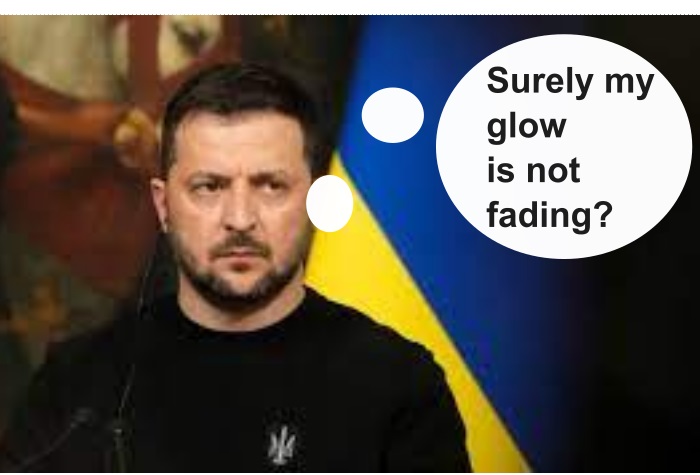
Friday’s White House meeting between US President Donald Trump and Vladimir Zelensky was “tense,” with the Ukrainian leader failing to secure deliveries of long-range Tomahawk missiles, Axios has reported, citing sources.
Trump told Zelensky he does not plan to provide Tomahawks “at least for now,” according to two people briefed on the meeting. The talks lasted around two and a half hours and were described by one source as “not easy,” and by another as “bad.” At times, the discussion “got a bit emotional,” the outlet said.
”Nobody shouted, but Trump was tough,” one source told Axios. The session ended abruptly when Trump reportedly said, “I think we’re done. Let’s see what happens next week,” possibly referring to upcoming Russia-US talks.
Speaking to reporters afterwards, Zelensky declined to answer questions about Tomahawk deliveries, only saying the US “does not want escalation.”
Trump said “it’s not easy” for Washington to provide the missiles because it needs to maintain its own supplies for the nation’s own defense. He also acknowledged that allowing Kiev to conduct strikes deep into Russia could lead to an escalation.
Moscow has warned against supplying the missiles to Ukraine, arguing they would “not change the situation on the battlefield” but would “severely undermine the prospects of a peaceful settlement” and harm Russia-US relations.
Zelensky has sought Tomahawks – which have a maximum range of 2,500km (1,550 miles) – for weeks, insisting that Ukraine would only use them against military targets to increase pressure on Russia and move toward a peace deal. However, the Ukrainian leader has threatened Russia with blackouts in border regions and Moscow. Russian officials also suggested that Kiev is plotting to use the missiles for “terrorist attacks.”
The Trump-Zelensky meeting followed a phone call between Trump and Putin, after which both sides signaled plans for a summit in Budapest, Hungary, in the near future.
Iran says restrictions on nuclear programme ‘terminated’ as deal expires
Iran also expresses commitment to diplomacy as landmark 10-year nuclear deal with Western powers officially ends
By News Agencies, 18 Oct 202518 Oct 2025, https://www.aljazeera.com/news/2025/10/18/iran-says-restrictions-on-nuclear-programme-terminated-as-deal-expires
Iran has said it is no longer bound by restrictions on its nuclear programme as a landmark 10-year deal between it and world powers expired, though Tehran reiterated its “commitment to diplomacy”.
From now on, “all of the provisions [of the 2015 deal], including the restrictions on the Iranian nuclear programme and the related mechanisms are considered terminated,” Iran’s Ministry of Foreign Affairs said in a statement on Saturday, the day of the pact’s expiration.
“Iran firmly expresses its commitment to diplomacy,” it added.
The deal’s “termination day” was set for exactly 10 years after the adoption of resolution 2231, enshrined by the United Nations Security Council.
Officially known as the Joint Comprehensive Plan of Action (JCPOA), the agreement between Iran and China, France, Germany, Russia, the United Kingdom and the United States saw the lifting of international sanctions against Iran in exchange for restrictions on its nuclear programme.
But Washington unilaterally left the deal in 2018 during President Donald Trump’s first term in office and reinstated sanctions. Tehran then began stepping up its nuclear programme.
Talks to revive the agreement have failed so far, and in August, the UK, Germany and France triggered the so-called “snapback” process, leading to the re-imposition of the UN sanctions.
“Termination day is relatively meaningless due to snapback,” Arms Control Association expert Kelsey Davenport told the AFP news agency.
Ali Vaez, the International Crisis Group’s Iran project director, told AFP that while the nuclear deal had been “lifeless” for years, the snapback had “officially buried” the agreement, with “its sorry fate continuing to cast a shadow over the future”.
Western powers and Israel have long accused Iran of seeking to acquire nuclear weapons, a claim Tehran denies.
Neither US intelligence nor the International Atomic Energy Agency (IAEA) said they found any evidence this year that Iran was pursuing atomic weapons.
Nuclear talks between Iran and world powers are currently deadlocked.
“Iran remains sceptical of the utility of engaging with the US given its history with President Trump, while Washington still seeks a maximalist deal,” Vaez told AFP.
On Monday, Trump said he wanted a peace deal with Iran, but stressed the ball was in Tehran’s court.
Tehran has repeatedly said it remains open to diplomacy with the US, provided Washington offers guarantees against military action during any potential talks.
The US joined Israel in striking Iran during a 12-day war in June, which hit nuclear sites, but also killed more than 1,000 Iranians, including hundreds of civilians, and caused billions of dollars in damage.
Angered that the IAEA did not condemn the attacks and accusing the agency of “double standards”, President Masoud Pezeshkian signed a law in early July suspending all cooperation with the UN nuclear watchdog and prompting inspectors to leave the country.
For its part, the IAEA has described its inability to verify Iran’s nuclear stockpile since the start of the war “a matter of serious concern”.
The three European powers last week announced they will seek to restart talks to find a “comprehensive, durable and verifiable agreement”.
Iranian top diplomat Abbas Araghchi said during an interview last week that Tehran does “not see any reason to negotiate” with the Europeans, given they triggered the snapback mechanism.
Monique Barbut, Minister for Ecological Transition, raises doubts among nuclear industry.
Monique Barbut has been appointed Minister of Ecological
Transition. She succeeds Agnès Pannier-Runacher, who, from the Ministry of
Energy Transition to that of Ecological Transition, has worked tirelessly
in favor of nuclear electricity.
The latter carried the law accelerating nuclear power adopted in 2023 and is at the origin of the Nuclear Alliance, which brings together a dozen European countries that have opted for this
energy and/or are in the process of reviving it.
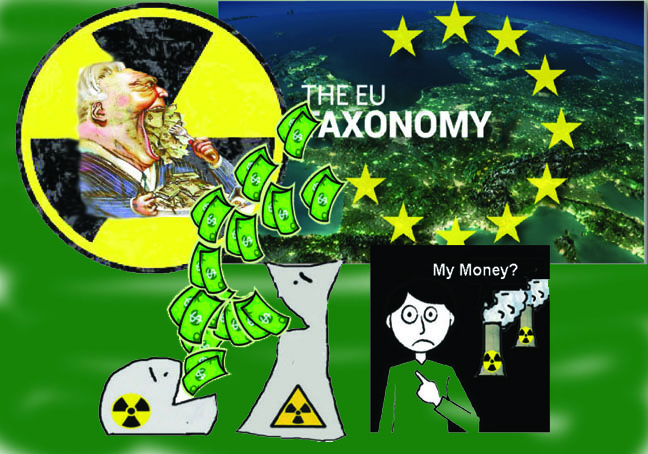
The contrast with her successor is striking. When Monique Barbut was head of WWF France, between 2021 and 2024, the NGO, true to its line, took a stand against nuclear power. ” We call in particular on the European Parliament not to give in to pressure from France and other countries by agreeing to classify fossil gas and nuclear energy as sustainable in its taxonomy “…
Le Figaro 13th Oct 2025, https://www.lefigaro.fr/societes/monique-barbut-ministre-a-la-transition-ecologique-fait-douter-les-industriels-du-nucleaire-20251013
Outsized and Eccentric: The Farce Behind the Nobel Peace Prize

12 October 2025 Dr Binoy Kampmark, https://theaimn.net/outsized-and-eccentric-the-farce-behind-the-nobel-peace-prize/
The fuss about the Nobel Peace Prize has always been excessively outsized to its relevance. Like most prizes, the panel is bound to have its treasure trove of prejudices and eccentricities in reaching any decision. Thin resumes have swayed the Norwegian committee to acts of dottiness. Surprising moments of dark humour have made an appearance in the award of the prize to warmongers and those antithetical to peace. And those on the Nobel Prize peace panel would barely cause a murmur of acknowledgement outside the spine-like length of that country of only 5.6 million inhabitants. (The current membership of five features, for instance, three politicians: Anne Enger, former leader of the country’s Centre Party; former Conservative Party education minister Kristin Clement, and former state secretary of the Labour Party, Gry Larsen.)
Rather feebly, Asle Toje, another member of the five, uses a gastronomic metaphor in describing the selection process: “We do it pretty much the same way you make a good sauce – you reduce and reduce and reduce.” The reduction formula leads to surprising, rancid results. In 1973, the ruthless, toadying poseur Henry Kissinger was overcome with joy in receiving the prize. The National Security Adviser and US Secretary of State had supposedly done much to advance the cause of peace in the Indochina conflict by “spearheading cease-fire negotiations” that led to an armistice in January 1973. His co-awardee, the North Vietnamese negotiator Le Duc Tho, was far more sensible, refusing to accept a peace award where there was no peace to be had.
The choice of Kissinger was almost mockingly ghoulish. This was the same man who left his marks all over secret and illegal bombing campaigns in Laos and Cambodia during the Nixon administration, oversaw the extinction of democratically elected governments in Latin America in favour of murderous, authoritarian regimes, and spent his early academic career arguing that small-scale nuclear might be feasibly pursued by the United States as a psychological lever.
The selection for 2025 was always going to be shadowed by the theatre known as the Donald Trump show. In claiming not to want it, the US President has done much to pad out his credentials to make himself eligible. He has put on an incomplete, disputable show of halting conflicts while indulging in spells of violence (strikes on Venezuelan shipping, ostensibly carrying drugs to the US; the illegal bombing of Iran’s nuclear facilities).
What the committee has done is the next best (or worse) thing. In opting for María Corina Machado, seen as the main figure of the Venezuelan opposition to the current government of Nicolás Maduro, they have offered the prize to a Trump medium. “I dedicate this prize to the suffering people of Venezuela and to President Trump for his decisive support in our cause,” she cooed on X.
Almost hinting at something in the works – that is to say, the ongoing regime change agenda so enthusiastically sought by Washington – Machado was convinced of being “on the threshold of victory and today, more than ever, we count on President Trump, the people of the United States, the peoples of Latin America, and the democratic nations of the world as our principal allies to achieve freedom and democracy.” Given Latin America’s record on peaceful transitions from coups, this was fine humour indeed.
The award to Machado was, according to the Nordic wiseacres, based on her “tireless work promoting democratic rights for the people of Venezuela and for her struggle to achieve a just and peaceful transition from dictatorship to democracy.” They go on to be didactic, talking about democracy being in global retreat, with Machado being its illuminating defender. (On being barred from running, she installed the surrogate opposition leader Edmundo Gonzálezwho allegedly won the July 2024 election.)
This is the bromide of binary thought. Machado’s record, befitting most political records, is untidy. David Smilde, a student of Venezuelan politics, sees her as “a controversial pick, less a peace activist than a political operator willing to use some of the trade’s dark arts for the greater democratic good.” Even that might be generous.
For one thing, she is clearly biding her time, shunning local and regional elections, treating the honouring of the 2024 presidential election results as absolute. She has openly argued for the necessity of foreign intervention in removing Maduro and endorsed Trump’s military buildup in the Caribbean, calling the recent bombing of suspected drug boats a matter of“saving lives”. To remove Maduro was essential, she argues, because of his alleged credentials as “the head of a narco-terrorist structure of cooperation.”
Disingenuously, she has swallowed the dubious theory that Maduro is the true figure running the Tren de Aragua gang, which Trump accuses of directing operations against the United States. Her Vente Venezuela party has enthusiastically shared the threats by US officials against supposed Venezuelan drug traffickers on X. “If you’re in the Caribbean,” states one recent post, “if you’re north of Venezuela and you’re trying to traffic drugs to the US, you’re a legitimate target for the US.”
Machado is undoubtedly readying herself to step into any presidential vacancy, forced or otherwise. She claims to have a plan for the first 100 hours and the first 100 days of a transition process, promising the generation of wealth for the country to the value of $1.7 trillion over 15 years. Her advisor on international affairs, Pedro Urruchurtu, has been open about communicating with the Trump administration over Maduro’s removal.
Again, this says much about the eccentric reading of peace embraced by the insular Norwegian grandees. If Tom Lehrer was right to call political satire obsolete after Kissinger’s award, it would also be accurate to say that instances of rich farce have come in its wake.
Israeli Historian Ilan Pappé: Despite Ceasefire, Palestinians Still Face “Elimination, Genocide”
October 13, 2025, Democracy Now – https://www.youtube.com/watch?v=0VBDIaaryG8
Renowned Israeli historian, author and professor Ilan Pappé discusses the postwar prospects of Palestinian statehood and of Israeli Prime Minister Benjamin Netanyahu, who is under investigation for corruption in Israel and subject to an international arrest warrant from the International Criminal Court. Despite the newly implemented Gaza ceasefire, says Pappé, Israeli political leaders have not changed their policy aim to ethnically cleanse Palestinians from their remaining territory. “Nothing has changed in the dehumanization and the attitude of this particular Israeli government and its belief that it has the power to wipe out Palestine as a nation, as a people and as a country,” he explains. Pappé’s latest book is titled Israel on the Brink: And the Eight Revolutions That Could Lead to Decolonization and Coexistence.
Transcript……………………………..
ILAN PAPPÉ:………………………………………….. I don’t think we are in such an historical moment as President Trump claimed in his speech in the Knesset and beforehand. We are not at the end of the terrible chapter that we have been in it for the last two years. And that chapter is an Israeli attempt by a particularly fanatic, extremely right-wing Israeli government to try and use ethnic cleansing in the West Bank and genocide in Gaza to downsize the number of Palestinians in Palestine and impose Israel’s will in a way that they hope would be at least endorsed by some Arab governments and the world. And so far, they have an alliance of Trump and some extreme right-wing parties in Europe.
And now I hope that the world will not be misled that Israel is now ready to open a different kind of page in its relationship with the Palestinians………………nothing has changed in the dehumanization and the attitude of this particular Israeli government and its belief that it has the power to wipe out Palestine as a nation, as a people and as a country. And I hope the world will not stand by, because up to now it did stand by when the genocide occurred in Palestine………..
…………………………………………….. it is the nature of the Israeli government that was elected in November 2022, this alliance between a very opportunistic politician, who’s only interested in surviving and keeping his position as a prime minister, alongside messianic, neo-Zionist politicians who really believe that God has given them the opportunity to create the Greater Israel, maybe even beyond the borders of Palestine, and, in the process, eliminate Palestinians. I think that his [Netanyahu’s] consideration should all — are always about his chances of survival. …..
………… My greatest worry is that he does believe that his only chance of being reelected is still to have a war going on, either in Gaza or in the West Bank or against Iran or in the north with Lebanon. We are dealing here with a reckless, irresponsible politician, who is even willing to drown his own state in the process of saving his skin and his neck. And the victims will always be, from this adventurous policy, the Palestinians…….
…………………. I do hope that political elites will understand their — especially in the West, their role now is not to mediate between Israelis and Palestinians. Their role now is to protect the Palestinians from destruction, elimination, genocide and ethnic cleansing. ……………………………………………………https://www.democracynow.org/2025/10/13/ilan_pappe_israel_on_the_brink
Putin and Trump, between the war of deadly Tomahawks and the peace of disarmament “START 3”.
by Alfredo Jalife-Rahme, Translation, Maria Poumier
Source La Jornada (Mexico) The world’s largest Spanish-language daily newspaper. Voltaire Network | Mexico City (Mexico)
| October 11, 2025, https://www.voltairenet.org/article222961.html
Donald Trump and Vladimir Putin are trying, against the instincts of their administrations, to end the confrontation between their two countries since the Cold War. The American president is balancing threats and peace proposals, while his Russian counterpart is showing patience. Will the two men succeed in freeing their countries from the trap they have built for eighty years and which is closing in on them?
The relationship between Putin and Trump has reached a turning point that will decide between war and peace, between the two greatest nuclear superpowers in the Milky Way [ 1 ] . Catholic Vice President JD Vance told FoxNews Sunday that “the United States is reviewing Ukraine’s request for long-range Tomahawk missiles” that would strike deep into Russian territory. The young millennial vice president added that President Trump would make the “final decision
On the other hand, retired General Keith Kellogg, 81, Trump’s special envoy to Ukraine, has byzantinely declared that Russia—against all tangible evidence on the battlefield where Ukraine is currently being thrashed—”lost the war” because “it failed to destroy Ukraine [ 3 ] .” It should be noted that General Kellogg’s daughter is addicted to the illegitimate regime of Khazarian comedian Zelensky, who is also delusional, trying to make people believe that he is “winning the war.”
If Ukraine, a vassal of NATO and the European Union, was indeed “winning the war,” why would it need the help of the fearsome Tomahawks, which can carry US-NATO nuclear weapons? At the same time, the genocidal Netanyahu is planning to deliver Patriot defense systems to his Khazarian coreligionist in kyiv….
Russian philosopher and geopolitician Alexander Dugin claims that “delivering the Tomahawks to Kiev would be a pure disaster” that “would irreversibly damage Russian-American relations”: the “neoconservatives’ dream would be to drag the United States into a third world war
[ 4 ] “, which would tragically be nuclear in nature.
Contrary to the drums of war that are sounding more forcefully within the European NATO countries, President Putin, during his participation in the plenary meeting of the Valdai Club in Sochi, invited Trump to “peaceful coexistence [ 5 ] “.
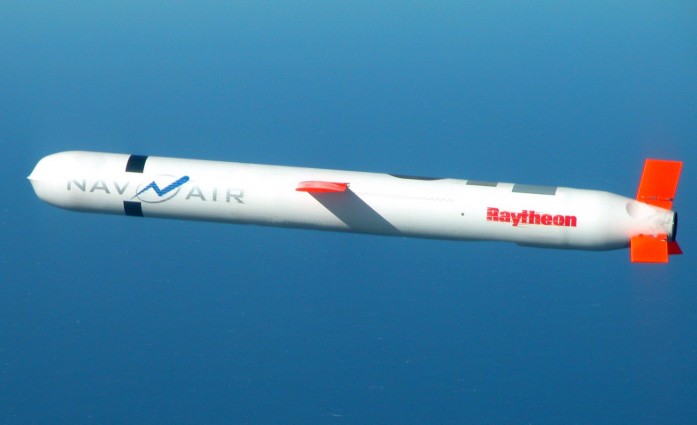
Regarding the hypothetical delivery to Ukraine of deadly Tomahawk missiles—with a range of 2,500 kilometers and a cost of $1.3 million each, capable of reaching Moscow and beyond—Putin said that this would not change the irreversible course of the war, which is now favorable to Moscow, but that it would constitute “a new step in the escalation,” because Ukraine cannot use these sophisticated missiles without the control of the US military.
India ‘s Economic Times speculates that “the US is unlikely to send Tomahawk missiles to Ukraine” because “it faces obstacles related to stockpiles committed to its navy operations.” This appears to be a Trump-like bargaining chip.
Since last year, the neoliberal think tank American Enterprise Institute (AEI) has denounced the sharp decline in the number of these deadly US missiles, already widely used in Yemen against the Ansar Allah guerrillas
[ 6 ] .
China ‘s Global Times highlights Putin’s warning about delivering Tomahawks to Ukraine, as the Russian president “praised U.S. President Donald Trump’s efforts to help broker peace in Ukraine,” calling his August summit in Alaska “productive,” while “reiterating Russia’s confidence in its nuclear shield. ” [ 7 ]
Putin told members of the Russian Security Council that “Moscow will respect the limits set on nuclear weapons for one more year, after the expiration on February 5, 2026, of the “START 3” nuclear treaty (Treaty on the Reduction of Strategic Nuclear Arms) with the United States [ 8 ] . Trump responded that Putin’s nuclear proposal was “a good idea” [ 9 ] .
The world is anxiously awaiting Trump’s final decision on the Tomahawks, a decision he appears to have already made, but which he will keep secret until he deems the time opportune [ 10 ] , while waging a veritable “civil war” from Oregon to Illinois against what he calls the terrorist group Antifa, financed by George Soros and his son Alex.
References ……………………………………………………………………………..
1 This Month

of the week – Shut Down Drone Warfare!


Tell the Ukrainian Government to Drop Prosecution of Peace Activist Yurii Sheliazhenko

Petition to revoke the licensing of the Near Surface Nuclear Disposal Facility (NSDF) at Chalk River. https://www.ourcommons.ca/petitions/en/Petition/Details?Petition=e-7247
To see nuclear-related stories in greater depth and intensity – go to https://nuclearinformation.wordpress.com
-
Archives
- April 2026 (114)
- March 2026 (251)
- February 2026 (268)
- January 2026 (308)
- December 2025 (358)
- November 2025 (359)
- October 2025 (376)
- September 2025 (257)
- August 2025 (319)
- July 2025 (230)
- June 2025 (348)
- May 2025 (261)
-
Categories
- 1
- 1 NUCLEAR ISSUES
- business and costs
- climate change
- culture and arts
- ENERGY
- environment
- health
- history
- indigenous issues
- Legal
- marketing of nuclear
- media
- opposition to nuclear
- PERSONAL STORIES
- politics
- politics international
- Religion and ethics
- safety
- secrets,lies and civil liberties
- spinbuster
- technology
- Uranium
- wastes
- weapons and war
- Women
- 2 WORLD
- ACTION
- AFRICA
- Atrocities
- AUSTRALIA
- Christina's notes
- Christina's themes
- culture and arts
- Events
- Fuk 2022
- Fuk 2023
- Fukushima 2017
- Fukushima 2018
- fukushima 2019
- Fukushima 2020
- Fukushima 2021
- general
- global warming
- Humour (God we need it)
- Nuclear
- RARE EARTHS
- Reference
- resources – print
- Resources -audiovicual
- Weekly Newsletter
- World
- World Nuclear
- YouTube
-
RSS
Entries RSS
Comments RSS
 nuclear-news