The US and NATO’s Sacrifice Of Ukraine

The US and NATO’s Sacrifice Of Ukraine https://www.pressenza.com/2022/03/the-us-and-natos-sacrifice-of-ukraine/ 04.03.22 Mark Lesseraux
THE INCEPTION POINT OF A NEW ERA
We are fast approaching the 33rd anniversary of Mikhail Gorbachev’s decision to untie the Soviet knot that held back the countries of Eastern Europe from moving in an independent, democratic direction. A decision that led to the collapse of the Berlin Wall in November 1989, and, subsequently, to the overturning of the Communist regime in Eastern Europe.
It was a turning point, a hopeful moment, that marked both the beginning of the end of the Cold War conflict and the inception point of a new era of cooperative possibilities between East and West.
THE U.S. AND EUROPE PROMISE TO END NATO EXPANSION
With the breakup of the Soviet Union it became clear to pretty much everyone involved in the diplomatic and political instigation of these major changes, that NATO had become obsolete. Washington and Europe met with Mikhail Gorbachev to create a new security pact that aimed to bring Russia into the cooperative fold. The Reagan administration, along with their West German allies, promised Gorbachev that once German unification was underway NATO would, for certain, cease expanding itself in an eastward direction.
This promise to end the expansion of NATO, which France and Great Britain also agreed to, seemed to signal the onset of a new era of global cooperation. It was agreed then and there by all parties present that a de-escalation of military spending and weapons production was in order now that the Cold War was winding down.
THE PROMISE IS BROKEN
In the years that followed, the war industry completely went back on the aforementioned promises. In fact, a massive eastward expansion of NATO was set in motion along with an unprecedented increase in military spending, weapons production and global weapons sales. NATO added Poland, Hungary, the Czech Republic, Bulgaria, Estonia, Latvia, Lithuania, Romania, Slovakia, Slovenia, Albania, Croatia, Montenegro, and North Macedonia to its fold.
These countries were all forced to restructure and reconfigure their militaries to become compatible with NATO’s military alignment policies. Most of the aforementioned countries achieved this realignment via large loans, creating debt and dependence on corporate lenders.
NO NEW ERA OF COOPERATION
Over the course of the last two-plus decades NATO has become a multi-billion-dollar cash cow for huge corporations that depend on the Cold War for profit. There has been no new era of cooperation with Russia, as promised by all who were involved in setting the new age of supposed partnership in motion. On the contrary, NATO has ignored Russia’s constant warnings and requests to stop its campaign of expansion. Instead NATO, led by the US, has pushed itself right up to Russia’s border, all the while generating a steady stream of new Cold War propaganda, demonizing Russia while proceeding to encircle its territory.
THE SACRIFICE OF UKRAINE
Seven years ago the Obama administration prudently refused to sell arms to Kiev. This act of cautiousness was subsequently cast aside by the Trump and Biden administrations. Over the past several years weapons from the U.S. and Great Britain have been pouring into Ukraine.
By flooding Ukraine with weapons (which is what the US did in the 2008 conflict between Russia and Georgia) over the past few years and refusing Russia’s constant requests that NATO drop its plan to annex Ukraine, an extremely volatile and deeply dangerous situation was created for Ukraine. A situation that has basically amounted to the sacrifice of the people of Ukraine.
NO JUSTIFICATION
There is no justification for the savage actions that Vladimir Putin has undertaken in Ukraine over the past week and a half. Putin is responsible for the bloodshed that he has generated. What this article is pointing to has nothing to do with absolving Putin for the violence in Ukraine. What this article is pointing to is the fact that the US and NATO have been myopic and reckless. What this article is illustrating is that what is going on now in Ukraine is, in part, the result of a thirty-three year history of broken promises and careless, greed propelled decisions made by the US and NATO.
MANY SAW THIS COMING
Over the past three decades, dozens of diplomats and historians have warned that a situation like the one we are seeing now in Ukraine was inevitable if NATO expansion continued. I’m going to end this article here with a quote from George Kennan who was considered by many to be the most respected voice on the matter of US-Soviet relations:
I think it is the beginning of a new cold war. I think the Russians will gradually react quite adversely and it will affect their policies. I think it is a tragic mistake. There was no reason for this whatsoever. No one was threatening anybody else. This expansion would make the founding fathers of this country turn over in their graves. We have signed up to protect a whole series of countries, even though we have neither the resources nor the intention to do so in any serious way. [NATO expansion] was simply a lighthearted action by a Senate that has no real interest in foreign affairs. What bothers me is how superficial and ill-informed the whole Senate debate was. I was particularly bothered by the references to Russia as a country dying to attack Western Europe.
Don’t people understand? Our differences in the Cold War were with the Soviet Communist regime. And now we are turning our backs on the very people who mounted the greatest bloodless revolution in history to remove that Soviet regime. And Russia’s democracy is as far advanced, if not farther, as any of these countries we’ve just signed up to defend from Russia. Of course, there is going to be a bad reaction from Russia, and then [the NATO expanders] will say that we always told you that is how the Russians are — but this is just wrong.”
– George Kennen 1998 Mark Lesseraux
Mark Lesseraux is a singer/songwriter/socio-political columnist from Brooklyn, New York, USA. He is a Humanist, a proponent and practitioner of Active Nonviolence and a student of Nonduality.
The Risks of Russian Attacks near Ukraine Nuclear Power Plants

The Risks of Russian Attacks near Ukraine Nuclear Power Plants, Commercial plants have built-in safety systems, but aren’t designed with warfare in mind. Scientific American By Andrea Thompson on March 4, 2022 People around the world watched via livestreamed security camera as Russian forces attacked and took over Ukraine’s Zaporizhzhia nuclear power plant—the largest in Europe—on Friday morning local time. Amid the shelling and gunfire, a fire broke out at a training facility in the complex and was later extinguished, according to news reports. The incident raised alarm among world leaders and nuclear experts about the potential for purposeful or accidental reactor damage that could cause radiation leaks or, in a worst-case scenario, reactor core meltdowns.
Rafael Grossi, director general of the International Atomic Energy Agency (IAEA), told the United Nations Security Council that the plant’s operations were normal after the attack and has said that no radioactive material was released. But he and other nuclear experts have warned that there is a danger of accidents there and at other nuclear plants in Ukraine as the conflict continues.
Scientific American spoke with Edwin Lyman, director of nuclear power safety at the Union of Concerned Scientists, to explain the concerns about such facilities during wartime and to talk about some of the safety measures that are in place.
The six reactors at Zaporizhzhia are called VVER-1000s, and they are cooled and moderated by light [ordinary] water. So in that respect, they’re similar to U.S. pressurized water reactors. They are somewhat more advanced models than the earlier versions of [this type of reactor], so they do have some features that are more in line with modern safety philosophy—but not entirely. …………
These [Zaporizhzhia reactors] were designed in the Soviet Union, and they date as far back as the early 1980s. So they are past their expiration date, but the Ukrainians extended their licenses………..
The big danger in any nuclear reactor is that somehow cooling of the fuel is disrupted, because without enough cooling, the fuel will heat up to the point where it can destroy itself…… In addition, these plants store their spent nuclear fuel on-site—and some of that fuel is stored in cooling water, which also has to be replenished with pumps………
In addition to a pipe break, you can have a loss of power, which is what affected Fukushima. These plants normally draw electricity from the grid to operate their systems, and if that’s interrupted, they have to rely on backup power with emergency diesel generators. …….
……f you want to potentially seriously damage the plant, you don’t have to go after the containment building, which is the hardest part. There are other systems that are not as well protected. But even those containment buildings are not necessarily able to withstand certain types of military attack. Even if they are not breached, they can spall, and you can have concrete falling down onto the reactor vessel. Or just strong vibrations might also cause damage……….
The cost of hardening commercial nuclear power plants so that they might survive a military onslaught is probably prohibitive……..
In the worst case, if you have an unmitigated loss of cooling capability, the nuclear fuel can overheat and melt and burn through the steel reactor vessel that holds it and drop to the floor of the container. And in that case, the containment is the only remaining barrier between the radioactive material in the reactor and the environment. It’s designed to withstand certain types of events but not others.
……
if multiple reactors are affected at the same time, if the spent fuel is damaged, if the containment is mechanically breached, then all bets are off……
… having well-rested operators is critical because the tasks they have to perform are complex, and they need to be alert. You have to ensure that fatigue is being monitored. If there’s a plant staff, and they’re not getting any relief, and they can’t go home, and they’re working under duress, it’s a dangerous combination. There will have to be measures for that……….. https://www.scientificamerican.com/article/the-risks-of-russian-attacks-near-ukraine-nuclear-power-plants1/
—
Western govt, media, and public, ignorant about the complex history of Ukraine
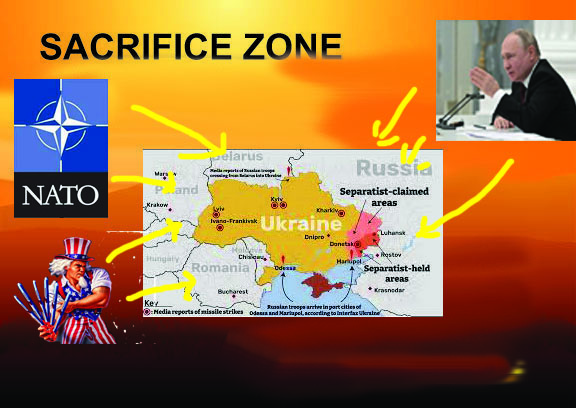
Lenin were he alive today would no doubt point out that Russia today, as well as the U.S., is a capitalist-imperialist country…….. He [Putin] is despicable, but his demand that NATO ceases expansion is as eminently reasonable and Biden’s desire to expand it seems crazier by the day.
Putin, Lenin, Imperialism and the (Real) History of Ukraine, Portside, March 5, 2022 Gary Leupp
— The people of this country suffer, I’ve always thought, from a general ignorance of history. ………
In 2014 having, having given little thought to Ukraine to that point, people in this county (self-defined Americans and others) were informed by the most authoritative sources they knew, the cable TV news anchors and commentators. They were treated to a history lesson that went something like this: The country of Ukraine has always been oppressed by Russia. It was colonized by Russia for centuries. Russia still, after the end of the Soviet Union, wants to control Ukraine! So it responded to a popular revolution in Kyiv, an expression of the Ukrainians’ longing to fulfill its “European aspirations,” by invading Ukraine!
having made its point clear in the brief invasion of Georgia in 2008 (to end talk of Georgian membership), having watched a U.S.-backed coup topple a president friendly to Russia replacing him with a pro-NATO cabal—was re-annexing Crimea (not just Russian from 1783 to 1954, but still Russia’s main naval port, then on lease from Crimea, and coveted by NATO) and supporting separatists in the primarily Russian speaking population in the Donbass region primarily to prevent further NATO expansion……………
In the real world, the U.S. has acted in the world since the collapse of the Soviet Union, the collapse of the Warsaw Pact, the collapse of what Washington perceived as the global communist movement, with an effort to encircle Russia with the most horrifically threatening military force in world history. It has expanded NATO in the absence of any real threat to itself from 16 to 28 members, bordering Russia on the Baltic coast and threatening to encircle it entirely. It has used NATO to pursue wars in Serbia, Afghanistan, Libya, and Syria, in the last case illegally intervening in a failed effort to gain control over a longstanding Russian ally…………
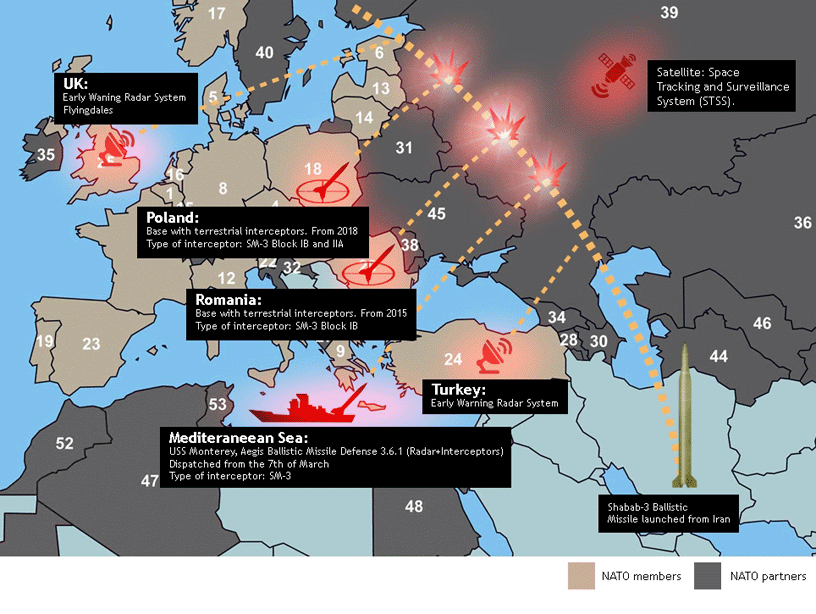
In the real world, Biden became president determined to both reassert U.S. “global leadership” and to continue NATO expansion. His campaign literature in 2020 reminded us that he believed in the cause. And it was clear he had a particular interest in drawing Ukraine in, which meant convincing Germany and other unenthusiastic NATO members to agree that Ukraine had cleaned up its corruption sufficient to get the nod.
He sent his secretary of state Anthony Blinken, who as Biden’s foreign policy advisor had urged him in 2002 to support Bush’s war on Iraq, to persuade the Germans that their gas pipeline to Russia threatened NATO unity! Meanwhile, U.S. puppet and NATO secretary-general Stoltenberg visited Kyiv to assure Ukraine that it will, indeed, be admitted to NATO. And the arms flowed into Ukraine.
Putin considered all this more threatening than ever………… The Russians were talking about their security, and need to defend their borders; the U.S. president was talking about his right to expand the alliance as he pleased.
For the U.S. media, what we see here is a clearly drawn conflict between Good and Evil, or in Blinken’s schoolmarmish conception “Democracy versus Autocracy.” What I see is two evils, neither of them democratic, locked in a conflict over the more powerful evil’s lust for further expansion. Both evils have their controlled news media and means to shape public consciousness.
Ukraine has been inhabited and crisscrossed by Scythians, Celts, Germanic peoples, Huns, Khazars, Mongols as well as Slavs. Given its history of incorporation into different states ………… at least the closest approximation of an independent state so far—was the Ukrainian Soviet Socialist Republic. Russia demanded that Ukraine be considered an independent state on the world stage; it held a separate UN seat. With Belarus it was one of the closest SSRs to Moscow, and most hesitant to withdraw from the union when Boris Yeltsin unilaterally dissolved it by pulling Russia itself out. Once established in its current configuration, Ukraine agreed to abandon its nuclear arsenal; it also agreed to a long-lease arrangement with Russia involving the vital Crimean naval base.
When Putin points to this history or at least aspects of it, he is not churning out lies at the level of the dutiful U.S. ……………
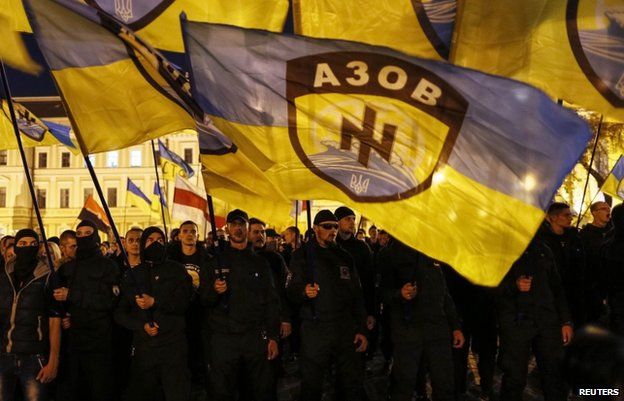
In the real world, Ukrainian fascist movements exist and were surely on display in the Maidan coup in 2014. They played a key role in the violent overthrow of an elected government, under Victoria Nuland’s watchful eye. There remains much support in some quarters for the wartime nationalist leader Stepan Bandera, who espoused a fascist ideology and helped round up Jews in Ukraine for the Nazi death camps. Anyone paying attention realizes that there are fascist elements in the military (the entire Azov Battalion) and that fascist parties, while small and with little electoral influence, have been able to stymie the implementation of the now-defunct Minsk Accords. So, yes, there is a fascist movement in Ukraine and it has a long history……
Crucial battles in this 1941-1945 war, also known as the Anti-Fascist War, were fought on Ukrainian soil, where some local communities sided with the fascists and embraced the Nazis’ Russophobia. Putin wants to essentialize Ukrainians as tending towards fascism, now working in tandem again with Russia’s enemies. This effort could well backfire among Russians who realize that Ukrainians are divided politically and ideologically among themselves and in any case undeserving of Putin’s characterization.
……….. Russians and Ukrainians retained amicable relations; the mere fact of new mutual independence was not a great problem for the relationship. Relations only deteriorated when, from around 2005, Ukrainian leaders requested NATO membership. In 2010 an anti-NATO president was democratically elected; the U.S. State Department oversaw a massive regime change effort to depict him as corrupt, anti-EU, impeding “Ukrainian’s European aspirations.” It succeeded in ousting him….
…….. Lenin were he alive today would no doubt point out that Russia today, as well as the U.S., is a capitalist-imperialist country…….. He [Putin] is despicable, but his demand that NATO ceases expansion is as eminently reasonable and Biden’s desire to expand it seems crazier by the day………………….. https://portside.org/2022-03-05/putin-lenin-imperialism-and-real-history-ukraine
How the Narcotic of Defense Spending Undermines a Sensible Grand Strategy,

MARCH 2, 2022, How the Narcotic of Defense Spending Undermines a Sensible Grand Strategy, CounterPunch, BY FRANKLIN SPINNEY The Military-Industrial-Congressional-Complex’s (MICC) grand-strategic chickens are coming home to roost big time. While war is bad, the Russo-Ukrainian War has the champagne corks quietly popping in the Pentagon, on K Street, in the defense industry, and throughout the halls of Congress. Taxpayers are going to be paying for their party for a long time.
It is no accident that the United States is on the cusp of the Second Cold War.
Future historians may well view the last 30 years as a case study in the institutional survival of the American Military – Industrial – Congressional Complex (MICC), together with its supporting blob now saturating the media, think tanks, academia, and the intelligence community. Perhaps, these future historians will come also to view the Global War on Terror (GWOT) as the bridging operation that greased the transition to Cold War II by keeping defense budgets at Cold War levels after Cold War I ended. Also, 9-11 may have re-acclimated the American people to the climate of fear now needed to sustain Cold War II for the remainder of the 21st Century.
The First Cold War’s 40-year climate of fear was something Mikhail Gorbachev tried to end. But Presidents Clinton and Bush (the 2nd) were busy planting the seed money for a new generation of cold-war inspired weapons. These weapons required massive future defense budgets that would require a climate of fear to sustain (especially for the across-the-board nuclear modernization program). President Obama then locked in these programs, and won a Nobel Peace Prize to boot. President Trump and the Dems in Congress worked overtime to ice the Pentagon’s budget cake by incestuously amplifying the growing Russophobia
No one wants war, but rising tension and the politics of fear … and their bedfellow: demonization … had to be magnified to justify the huge bow wave of defense spending looming in the budgetary offing, particularly the trillion+ dollars to pay for the nuclear modernization program. This “chicken” takes us back to the “egg” laid in the 1990s.
As it gradually sank in that the First Cold War had indeed ended when the Soviet threat evaporated in 1991, the titans in the defense industry understood their comfortable market for new hi-tech, high-cost weapons could dry up.
At the same time, the defense industrialists recognized that market diversification was necessary. So, it was no accident that a lobbying operation named the Committee to Expand NATO emerged in the early 1990s and was headed by a vice president of Lockheed Martin — see also Why is US Foreign Policy a Shambles?. At the very least, in the mid-1990s, it seemed that expanding NATO implied dramatically increased requirements for what is known in NATO jargon as weapons interoperability……………..
the Pentagon’s strategy of maximizing its budget has created a growing dependency on defense spending in the American political economy. This grotesque distortion was first recognized by President Eisenhower in 1961. In 1987, George Kennan, forty years after he fathered the dominant US policy of “Containment” for the entire First Cold War, summed up the narcotic of defense spending, saying prophetically:
“Were the Soviet Union to sink tomorrow under the waters of the ocean, the American military-industrial complex would have to remain, substantially unchanged, until some other adversary could be invented. Anything else would be an unacceptable shock to the American economy,” …………..
Understanding the internal political-economic causes of the American addiction to the narcotic of defense spending is at the heart of the problem. This understanding is essential to reforming the foreign policy mess exacerbated by NATO expansion. …….
Franklin “Chuck” Spinney is a former military analyst for the Pentagon and a contributor to Hopeless: Barack Obama and the Politics of Illusion, published by AK Press. He be reached at chuck_spinney@mac.com https://www.counterpunch.org/2022/03/02/how-the-narcotic-of-defense-spending-undermines-a-sensible-grand-strategy/
Now Is the Time for a Global Movement Demanding Nuclear De-escalation

Now Is the Time for a Global Movement Demanding Nuclear De-escalation, https://truthout.org/articles/now-is-the-time-for-a-global-movement-demanding-nuclear-de-escalation/?eType=EmailBlastContent&eId=552e5725-9297-4a7c-a214-53c8c51615a3 Norman Solomon, Truthout March 3, 2022
President Joe Biden spoke 6,500 words during his State of the Union speech Tuesday night, but not one of them acknowledged the dangers of nuclear war that have spiked upward during the last decade and even more steeply in recent days. The militarism that Martin Luther King Jr. warned us about has been spiraling toward its ultimate destination in the nuclear era — a global holocaust that would likely extinguish almost all human life on Earth.
In the midst of this reality, leaders of the world’s two nuclear superpowers continue to fail — and betray — humanity.
In the stark light of March 2022, Albert Einstein’s outlook 75 years ago about the release of atomic energy has never been more prescient or more urgent: “This basic power of the universe cannot be fitted into the outmoded concept of narrow nationalisms. For there is no secret and there is no defense, there is no possibility of control except through the aroused understanding and insistence of the peoples of the world.”
The phrase “narrow nationalisms” aptly describes the nuclear-weapons policies of the United States and Russia. They have been engaged in a dance of death with foreseeable human consequences on a scale that none of us can truly fathom.
Einstein expressed a belief that “an informed citizenry will act for life and not death.” But the dire nuclear trends have been enabled by citizenry uninformed and inactive.
Twenty years ago, the George W. Bush administration withdrew from the Anti-Ballistic Missile (ABM) Treaty. Despite his promising rhetoric, President Barack Obama plunged ahead to begin a $1.7 trillion program for further developing the U.S. nuclear arsenal under the euphemism of “modernization.” President Donald Trump pulled the United States out of the Intermediate-Range Nuclear Forces (INF) Treaty, which had removed an entire category of missiles from Europe since the late 1980s — largely as a result of the international movement against nuclear weapons.
By killing the ABM and INF agreements, the U.S. government pushed the world further away from nuclear arms control, let alone disarmament. And by insisting on expansion of the North Atlantic Treaty Organization (NATO) to Russia’s borders — and in recent months continuing to insist that Ukrainian membership in NATO should stay on the table — the United States ignored Russia’s longstanding and reasonable concerns about NATO expansion.
Placement of ABM systems in Poland and Romania, touted as defensive, gave NATO the capacity to retrofit those systems with offensive cruise missiles. Overall, NATO’s claims of being a “defensive” alliance have been undercut by three decades of broken promises, as well as intensive war operations in Serbia, Afghanistan and Libya.
Russia has its own military-industrial complex and nationalistic fervor. The duplicity and provocations by the United States and its NATO allies do not in the slightest justify the invasion of Ukraine that Russia launched a week ago. Russia is now on a murderous killing spree no less abhorrent than what occurred from the U.S. invasions of Afghanistan and Iraq.
Right now, an overarching truth remains to be faced and acted upon: The nuclear superpowers have dragged humanity to a precipice of omnicide. The invasion of Ukraine is the latest move in that direction.
Last week, the extreme recklessness of Russian President Vladimir Putin’s not-so-veiled threat to use nuclear weapons was an indication of just how dangerous the Ukraine conflict has gotten — for everyone, everywhere. Passivity will get us nowhere. In the U.S., supporting antiwar protests and demanding real diplomacy while organizing for peace are essential.
“However soon the war ends, its effects on the European security order and the world will be and already are profound,” San Francisco State University scholar Andrei Tsygankov wrote days ago. “In addition to human suffering and devastation, the European continent is entering a new era of social and political divisions comparable to those of the Cold War. The possibility of further escalation is now closer than ever. Instead of building an inclusive and just international order, Russia and most European nations will now rely mainly on nuclear weapons and military preparations for their security.”
Any “conventional” war that puts Russia and the United States in even indirect conflict has the very real potential of being a tripwire that could set off an exchange of nuclear missiles. Heightened tensions lead to fatigue, paranoia and greater likelihood of mistaking a false alarm for the real thing. This is especially dangerous because of land-based Intercontinental Ballistic Missiles (ICBMs), which are uniquely vulnerable to attack and therefore are on hair-trigger, “launch on warning” alert.
“First and foremost,” former Defense Secretary William Perry wrote in 2016, “the United States can safely phase out its land-based intercontinental ballistic missile force, a key facet of Cold War nuclear policy. Retiring the ICBMs would save considerable costs, but it isn’t only budgets that would benefit. These missiles are some of the most dangerous weapons in the world. They could even trigger an accidental nuclear war.” As Daniel Ellsberg and I wrote in The Nation last fall, “Contrary to uninformed assumptions, discarding all ICBMs could be accomplished unilaterally by the United States with no downside. Even if Russia chose not to follow suit, dismantling the potentially cataclysmic land-based missiles would make the world safer for everyone on the planet.”
But we’re not hearing anything from Congress or the White House about taking steps to reduce the chances of nuclear war. Instead, we’re hearing jacked-up rhetoric about confronting Russia. It’s all too clear that responsible leadership will not come from official Washington; it must come from grassroots activism with determined organizing and political pressure.
“I refuse to accept the cynical notion that nation after nation must spiral down a militaristic stairway into the hell of thermonuclear destruction,” Dr. King said as he accepted the Nobel Peace Prize in 1964. “I believe that even amid today’s mortar bursts and whining bullets, there is still hope for a brighter tomorrow.”
Realistic hope seems to be in very short supply right now. But at this dire moment, all that we love demands our determination to organize.
Calling Russia’s Attack ‘Unprovoked’ Lets USA Off the Hook

FAIR, BRYCE GREENE, MARCH 4, 2022, Many governments and media figures are rightly condemning Russian President Vladimir Putin’s attack on Ukraine as an act of aggression and a violation of international law. But in his first speech about the invasion, on February 24, US President Joe Biden also called the invasion “unprovoked.”
It’s a word that has been echoed repeatedly across the media ecosystem. “Putin’s forces entered Ukraine’s second-largest city on the fourth day of the unprovoked invasion,” Axios (2/27/22) reported; “Russia’s unprovoked invasion of Ukraine entered its second week Friday,” said CNBC (3/4/22). Vox (3/1/22) wrote of “Putin’s decision to launch an unprovoked and unnecessary war with the second-largest country in Europe.”
The “unprovoked” descriptor obscures a long history of provocative behavior from the United States in regards to Ukraine. This history is important to understanding how we got here, and what degree of responsibility the US bears for the current attack on Ukraine.
Ignoring expert advice
The story starts at the end of the Cold War, when the US was the only global hegemon. As part of the deal that finalized the reunification of Germany, the US promised Russia that NATO would not expand “one inch eastward.” Despite this, it wasn’t long before talk of expansion began to circulate among policy makers…………
Despite these warnings, Poland, Hungary and the Czech Republic were added to NATO in 1999, with Bulgaria, Estonia, Latvia, Lithuania, Romania, Slovakia and Slovenia following in 2004.
US planners were warned again in 2008 by US Ambassador to Moscow William Burns (now director of the CIA under Joe Biden). WikiLeaks leaked a cable from Burns titled “Nyet Means Nyet: Russia’s NATO Enlargement Redlines” that included another prophetic warning worth quoting in full (emphasis added):
Ukraine and Georgia’s NATO aspirations not only touch a raw nerve in Russia, they engender serious concerns about the consequences for stability in the region. Not only does Russia perceive encirclement, and efforts to undermine Russia’s influence in the region, but it also fears unpredictable and uncontrolled consequences which would seriously affect Russian security interests.
Experts tell us that Russia is particularly worried that the strong divisions in Ukraine over NATO membership, with much of the ethnic Russian community against membership, could lead to a major split, involving violence or at worst, civil war. In that eventuality, Russia would have to decide whether to intervene; a decision Russia does not want to have to face.
A de facto NATO ally
But the US has pushed Russia to make such a decision. Though European countries are divided about whether or not Ukraine should join, many in the NATO camp have been adamant about maintaining the alliance’s “open door policy.”
Even without officially being in NATO, Ukraine has become a de facto NATO ally—and Russia has paid close attention to these developments. In a December 2021 speech to his top military officials, Putin expressed his concerns:…………………………
The Maidan Coup of 2014
A major turning point in the US/Ukraine/Russia relationship was the 2014 violent and unconstitutional ouster of President Viktor Yanukovych, elected in 2010 in a vote heavily split between eastern and western Ukraine. His ouster came after months of protests led in part by far-right extremists (FAIR.org, 3/7/14). Weeks before his ouster, an unknown party leaked a phone call between US officials discussing who should and shouldn’t be part of the new government, and finding ways to “seal the deal.” After the ouster, a politician the officials designated as “the guy” even became prime minister.
The US involvement was part of a campaign aimed at exploiting the divisions in Ukrainian society to push the country into the US sphere of influence, pulling it out of the Russian sphere (FAIR.org, 1/28/22). In the aftermath of the overthrow, Russia illegally annexed Crimea from Ukraine, in part to secure a major naval base from the new Ukrainian government.
The New York Times (2/24/22) and Washington Post (2/28/22) both omitted the role the US played in these events. In US media, this critical moment in history is completely cleansed of US influence, erasing a critical step on the road to the current war.
Keeping civil war alive
In another response to the overthrow, an uprising in Ukraine’s Donbas region grew into a rebel movement that declared independence from Ukraine and announced the formation of their own republics. The resulting civil war claimed thousands of lives, but was largely paused in 2015 with a ceasefire agreement known as the Minsk II accords.
The deal, agreed to by Ukraine, Russia and other European countries, was designed to grant some form of autonomy to the breakaway regions in exchange for reintegrating them into the Ukrainian state. Unfortunately, the Ukrainian government refused to implement the autonomy provision of the accords
Anatol Lieven, a researcher with the Quincy Institute for Responsible Statecraft, wrote in The Nation (11/15/21):
The main reason for this refusal, apart from a general commitment to retain centralized power in Kiev, has been the belief that permanent autonomy for the Donbas would prevent Ukraine from joining NATO and the European Union, as the region could use its constitutional position within Ukraine to block membership.
Refusal to de-escalate…………
By December 2021, US intelligence agencies were sounding the alarm that Russia was amassing troops at the Ukrainian border and planning to attack. Yet Putin was very clear about a path to deescalation: He called on the West to halt NATO expansion, negotiate Ukrainian neutrality in the East/West rivalry, remove US nuclear weapons from non proliferating countries, and remove missiles, troops and bases near Russia. These are demands the US would surely have made were it in Russia’s position.
Unfortunately, the US refused to negotiate on Russia’s core concerns…………..
Instead of addressing Russian concerns about Ukraine’s NATO relationship, the US instead chose to pour hundreds of millions of dollars of weapons into Ukraine, exacerbating Putin’s expressed concerns. Ukrainian President Volodymyr Zelenskyy didn’t help matters by suggesting that Ukraine might begin a nuclear weapons program at the height of the tensions.
After Putin announced his recognition of the breakaway republics, Secretary of State Antony Blinken canceled talks with Putin, and began the process of implementing sanctions on Russia—all before Russian soldiers had set foot into Ukraine.
Had the US been genuinely interested in avoiding war, it would have taken every opportunity to de-escalate the situation. Instead, it did the opposite nearly every step of the way……………
None of this is to say that Putin’s invasion is justified—FAIR resolutely condemns the invasion as illegal and ruinous—but calling it “unprovoked” distracts attention from the US’s own contribution to this disastrous outcome. The US ignored warnings from both Russian and US officials that a major conflagration could erupt if the US continued its path, and it shouldn’t be surprising that one eventually did.
Now, as the world once again inches toward the brink of nuclear omnicide, it is more important than ever for Western audiences to understand and challenge their own government’s role in dragging us all to this point.
https://fair.org/home/calling-russias-attack-unprovoked-lets-us-off-the-hook/—
Russia’s nuclear alert means Nato must tread carefully
Russia’s nuclear alert means Nato must tread carefully, There is a scenario in which Moscow could use such weapons to ward off a western intervention ft.com
JEREMY SHAPIRO, 4 Mar 22, The writer is research director at the European Council on Foreign Relations and a former official in the US state department .
President Vladimir Putin announced on Sunday that he was putting Russian nuclear forces on “high alert”. Alert status probably means little in terms of increasing the risk of escalation in Ukraine. But Putin’s ominous declaration reminded the world that Russia has, among the many destructive tools in its arsenal, many thousands of nuclear weapons. ……………….
How could Russia’s invasion of Ukraine lead to a nuclear confrontation? The most likely route is through Russian employment of a tactical nuclear weapon. Tactical nuclear weapons are relatively smaller bombs intended to be used in battlefield situations against concentrations of enemy forces. Estimates vary widely but Russia probably has between 1,000 and 2,000 such weapons in its arsenal, with a wide variety of yields and delivery mechanisms. They also vary greatly in explosive effect but could destroy anything from an armoured column to an entire town. …………
The current situation …..highlights that tactical nuclear weapons are probably not a weapon that would be used against the Ukrainians. It is not necessary to pay the price of crossing the nuclear threshold to achieve Russian goals in Ukraine.
High-yield conventional weapons or the dreaded thermobaric bombs, which draw in oxygen to create an intense explosion, are more than sufficient for any effect they might want and don’t force them to bear the nuclear stigma. ………….
tactical nuclear weapons are intended to send the following message to Nato leaders: “You may have a more impressive military than I do, but I care a lot more and will kill us all if necessary.”
Now, the Russian military is heavily engaged in Ukraine and thus particularly vulnerable to a Nato conventional attack in Belarus and western Russia, as well as in Ukraine. So in the current scenario, Russian leaders are most likely to use a tactical nuclear weapon to prevent or put an end to Nato intervention. In theory, therefore, it should be straightforward to avoid that outcome by not intervening. The west, in the minds of its own leaders, has no intention of intervening so they may not feel there is much chance of nuclear escalation.
The problem is that, given the paranoia of Russian leaders, they probably expect Nato intervention, and may even believe it is already happening given European and American arms deliveries and Nato troop movements to eastern Europe. They may view Nato troop concentrations in states on Ukraine’s eastern flank as potential intervention forces and they may lack sufficient precision-guided weapons in their already very depleted inventory to attack them conventionally. They might also view weapons depots in neighbouring states that are supplying Ukrainian government forces as legitimate targets.
Russian attacks of these sorts are not likely, but they are possible. Beyond the horrible death and radioactive fallout they would cause, such attacks would cross the nuclear threshold for the first time since 1945 and thus open the path to further nuclear escalation to the strategic level (ie the end of the world). Given that we very much want to avoid that, western leaders might think about taking steps to make it even less likely.
Such steps would involve thinking carefully about how the Russians understand “intervention”. Russian leaders, for example, might see volunteers from Nato countries filtering into Ukraine as covert advance guards for a full-scale intervention. They might regard arms convoys coming to Ukraine from Nato states as the functional equivalent of intervention. And, depending on their orientation, they might see troop dispositions in eastern flank states or troop movements to, say, help manage refugee flows at the border as a precursor to intervention.
If it is truly not the intention of western leaders to intervene, they should make sure that their forces act in ways that will convince Russian leaders of that. The world may depend on it. https://www.ft.com/content/b6bfd338-f2e0-43c2-96f2-0cd918303ea2
The expansion of NATO – a boon for the weapons industry and a prelude to conflict with Russia

Within two decades, 14 Central and Eastern European countries joined NATO. The organization originally existed to contain the Soviet Union, and Russian officials monitored its advance with alarm. In retrospect, postwar expansion benefited arms makers both by increasing their market and stimulating conflict with Russia.
Arms Industry Sees Ukraine Conflict as an Opportunity, Not a Crisis, Jonathan Ng, Truthout , 2 Mar 22,
”………………………….. Ultimately, policy makers reneged on their promise to Gorbachev, admitting Poland, Hungary and the Czech Republic into NATO in 1999. During the ceremony, Secretary of State Madeleine Albright — who directly cooperated with the Jackson campaign — welcomed them with a hearty “Hallelujah.” Ominously, the intellectual architect of the Cold War, George Kennan, predicted disaster. “Such a decision may be expected to inflame the nationalistic, anti-Western and militaristic tendencies in Russian opinion,” Kennan cautioned.
Few listened. Former Assistant Secretary of Defense Chas Freeman described the mentality of policy makers: “The Russians are down, let’s give them another kick.” Relishing victory, Jackson was equally truculent: “‘Fuck Russia’ is a proud and long tradition in US foreign policy.” Later, he became chairman of the Committee for the Liberation of Iraq, which paved the way for the 2003 invasion, the biggest industry handout in recent history.
Within two decades, 14 Central and Eastern European countries joined NATO. The organization originally existed to contain the Soviet Union, and Russian officials monitored its advance with alarm. In retrospect, postwar expansion benefited arms makers both by increasing their market and stimulating conflict with Russia.
Targeting Ukraine
Tensions reached a new phase in 2014 when the United States backed the removal of President Viktor Yanukovych in Ukraine. Yanukovych had opposed NATO membership, and Russian officials feared his ouster would bring the country under its strategic umbrella. Rather than assuage their concerns, the Obama administration maneuvered to slip Ukraine into its sphere of influence. Assistant Secretary of State Victoria Nuland coordinated regime change with brash confidence. Nuland openly distributed cookies to protesters, and later, capped a diplomatic exchange with “fuck the EU.” At the height of the uprising, Sen. John McCain also joined demonstrators. Flanked by leaders of the fascist Svoboda Party, McCain advocated regime change, declaring that “America is with you.”
By then, newly minted NATO members had bought nearly $17 billion in American weapons. Military installations, including six NATO command posts, ballooned across Eastern Europe. Fearing further expansion, Russia annexed the Crimean Peninsula and intervened in the Donbas region, fueling a ferocious and interminable war. NATO spokespeople argued that the crisis justified expansion. In reality, NATO expansion was a key inciter of the crisis. And the conflagration was a gift to the arms industry. In five years, major weapons exports from the United States increased 23 percent, while French exports alone registered a 72-percent leap, reaching their highest levels since the Cold War. Meanwhile, European military spending hit record heights.
As tensions escalated, Supreme Commander Philip Breedlove of NATO wildly inflated threats, calling Russia “a long-term existential threat to the United States.” Breedlove even falsified information about Russian troop movements over the first two years of the conflict, while brainstorming tactics with colleagues to “leverage, cajole, convince or coerce the U.S. to react.” A senior fellow at the Brookings Institution concluded that he aimed to “goad Europeans into jacking up defense spending.”
And he succeeded. The Stockholm International Peace Research Institute registered a significant leap in European military spending — even though Russian spending in 2016 equaled only one quarter of the European NATO budget. That year, Breedlove resigned from his post before joining the Center for a New American Security, a hawkish think tank awash in industry funds.
The arms race continues. After European negotiations gridlocked, Russia recognized two separatist republics in the Donbas region before invading Ukraine this February. Justifying the bloody operation, Putin wrongly accused Ukrainian authorities of genocide. Yet his focus was geopolitical. “It is a fact that over the past 30 years we have been patiently trying to come to an agreement with the leading NATO countries,” he said. “In response to our proposals, we invariably faced either cynical deception and lies or attempts at pressure and blackmail, while the North Atlantic alliance continued to expand despite our protests and concerns. Its military machine is moving and, as I said, is approaching our very border.”
In retrospect, three decades of industry lobbying has proved deadly effective. NATO engulfed most of Eastern Europe and provoked a war in Ukraine — yet another opportunity for accumulation. Alliance members have activated Article 4, mobilizing troops, contemplating retaliation and moving further toward the brink of Armageddon.
Yet even as military budgets rise, European arms makers — like their American counterparts — have required foreign markets to overcome fiscal restraints and production costs. They need clients to finance their own military buildup: foreign wars to fund domestic defense. ………………………….. https://truthout.org/articles/arms-industry-sees-ukraine-conflict-as-an-opportunity-not-a-crisis/?eType=EmailBlastContent&eId=734c56bc-48da-4e66-bea1-f2bedb7d1431
Kevin Rudd on the ‘decisive decade’ between USA and China
Are we in the middle of Cold War 2.0? | The Bottom Line, 24 Feb 2022 Within years, China will overtake the United States as the world’s number one economy, and China’s influence is spreading worldwide – mostly at the expense of US global leadership. Former Australian Prime Minister Kevin Rudd tells host Steve Clemons that this is the “decisive decade” in relations between the two powers. Either they find a way to share wealth and power, or they head down a collision course.
But with today’s political climates in the West and East – where politicians are rewarded for nationalistic tough-talk and zero compromise – is there hope for better relations between Beijing and Washington?
Russian Foreign Minister Lavrov warns that a third world war would be nuclear
Russia’s Lavrov: A third world war would be nuclear, destructive
Moscow put its strategic nuclear forces on alert last week amid the war in Ukraine, causing ripples across the globe. Aljazeera, 2 Mar 22,
Russian Foreign Minister Sergey Lavrov has warned that if a third world war were to occur, it would involve nuclear weapons and be destructive, according to Russian media.
The comments reported by the RIA news agency on Wednesday came a day after he told a Geneva disarmament meeting via video link that neighbouring Ukraine, which Russian invaded last week, had been seeking nuclear weapons.
He did not provide evidence other than saying “Ukraine still has Soviet nuclear technologies and the means of delivery of such weapons.”
Lavrov has also said that Russia would have faced a “real danger” if Ukraine acquired nuclear weapons.
Nuclear forces on high alert
Russian forces attacked Ukraine by land, air and sea, the biggest attack by one state against another in Europe since World War II.
The move has been countered by the West with harsh economic sanctions on Russia as well as deliveries of arms and humanitarian aid to Ukraine.
The US government on Tuesday announced a ban on Russian flights in its airspace, following similar moves by the European Union and Canada.
On Sunday, Russian President Vladimir Putin put his strategic nuclear forces on alert, causing ripples across the globe and raising the threat the tensions could lead to the use of nuclear weapons. ………….. https://www.aljazeera.com/news/2022/3/2/russias-lavrov-says-a-ww-iii-would-be-nuclear-and-destructive
Noam Chomsky: US Military Escalation Against Russia Would Have No Victors.

‘‘ In brief, the crisis has been brewing for 25 years as the U.S. contemptuously rejected Russian security concerns, in particular their clear red lines: Georgia and especially Ukraine.”
”…….. repeatedly the reaction to real or imagined crisis has been to reach for the six-gun rather than the olive branch. It’s almost a reflex, and the consequences have generally been awful ………….”
”The options that remain after the invasion are grim. The least bad is support for the diplomatic options that still exist,……….. with an escape hatch for Putin, or outcomes will be still more dire for Ukraine and everyone else, perhaps almost unimaginably so.”‘
Interview with Noam Chomsky, C.J. Polychroniou, Truthout, 1 March 22, Russia’s invasion of Ukraine took much of the world by surprise. It is an unprovoked and unjustified attack that will go down in history as one of the major war crimes of the 21st century, argues Noam Chomsky in the exclusive interview for Truthout that follows.
Political considerations, such as those cited by Russian President Vladimir Putin, cannot be used as arguments to justify the launching of an invasion against a sovereign nation. In the face of this horrific invasion, though, the U.S. must choose urgent diplomacy over military escalation, as the latter could constitute a “death warrant for the species, with no victors,” Chomsky says……………
Q. …………Why do you think he decided to launch an invasion at this point in time?
CHOMSKY. ” ………….. It always makes sense to seek explanations, but there is no justification, no extenuation.
Turning now to the question, there are plenty of supremely confident outpourings about Putin’s mind. The usual story is that he is caught up in paranoid fantasies, acting alone, surrounded by groveling courtiers of the kind familiar here in what’s left of the Republican Party traipsing to Mar-a-Lago for the Leader’s blessing.
The flood of invective might be accurate, but perhaps other possibilities might be considered. Perhaps Putin meant what he and his associates have been saying loud and clear for years. It might be, for example, that, “Since Putin’s major demand is an assurance that NATO will take no further members, and specifically not Ukraine or Georgia, obviously there would have been no basis for the present crisis if there had been no expansion of the alliance following the end of the Cold War, or if the expansion had occurred in harmony with building a security structure in Europe that included Russia.”
The author of these words is former U.S. ambassador to Russia, Jack Matlock, one of the few serious Russia specialists in the U.S. diplomatic corps, writing shortly before the invasion. He goes on to conclude that the crisis “can be easily resolved by the application of common sense…. By any common-sense standard it is in the interest of the United States to promote peace, not conflict. To try to detach Ukraine from Russian influence — the avowed aim of those who agitated for the ‘color revolutions’ — was a fool’s errand, and a dangerous one. Have we so soon forgotten the lesson of the Cuban Missile Crisis?”
Matlock is hardly alone. Much the same conclusions about the underlying issues are reached in the memoirs of CIA head William Burns, another of the few authentic Russia specialists……………..
The fact is, to be honest, that we do not know why the decision was made, even whether it was made by Putin alone or by the Russian Security Council in which he plays the leading role. There are, however, some things we do know with fair confidence, including the record reviewed in some detail by those just cited, who have been in high places on the inside of the planning system. In brief, the crisis has been brewing for 25 years as the U.S. contemptuously rejected Russian security concerns, in particular their clear red lines: Georgia and especially Ukraine.
There is good reason to believe that this tragedy could have been avoided, until the last minute. We’ve discussed it before, repeatedly. As to why Putin launched the criminal aggression right now, we can speculate as we like. But the immediate background is not obscure — evaded but not contested
………. If we want to respond to the tragedy in ways that will help the victims, and avert still worse catastrophes that loom ahead, it is wise, and necessary, to learn as much as we can about what went wrong and how the course could have been corrected. Heroic gestures may be satisfying. They are not helpful.
…….. The question cuts deep. There is no time to review this critically important matter here, but repeatedly the reaction to real or imagined crisis has been to reach for the six-gun rather than the olive branch. It’s almost a reflex, and the consequences have generally been awful — for the traditional victims. ………….
The options that remain after the invasion are grim. The least bad is support for the diplomatic options that still exist, in the hope of reaching an outcome not too far from what was very likely achievable a few days ago: Austrian-style neutralization of Ukraine, some version of Minsk II federalism within. Much harder to reach now. And — necessarily — with an escape hatch for Putin, or outcomes will be still more dire for Ukraine and everyone else, perhaps almost unimaginably so.
Q. …………….. Can you comment on Putin’s legal justifications for the invasion of Ukraine and on the status of international law in the post-Cold War era?
CHOMSKY. There is nothing to say about Putin’s attempt to offer legal justification for his aggression. Its merit is zero……………………………………
Do you think the invasion will initiate a new era of sustained contestation between Russia (and possibly in alliance with China) and the West?
It’s hard to tell where the ashes will fall — and that might turn out not to be a metaphor. So far, China is playing it cool…………………………… https://truthout.org/articles/noam-chomsky-us-military-escalation-against-russia-would-have-no-victors/?eType=EmailBlastContent&eId=a353e8c0-2709-4024-84ba-04836fea0cbf
A fatal disconnect? the different narratives of Russia and the West on the Ukraine crisis
Putin’s Nuclear Threat. https://consortiumnews.com/2022/02/27/putins-nuclear-threat/ The disconnect between the Western and Russian narratives in the current conflict could prove fatal to the world, writes Scott Ritter.
Vladimir Putin is a madman. He’s lost it. At least that is what the leaders of the West would like you to believe. According to their narrative, Putin — isolated, alone, confused, and angry at the unfolding military disaster Russia was undergoing in Ukraine — lashed out, ostensibly threatening the entire world with nuclear annihilation.
In a meeting with his top generals on Sunday, the beleaguered Russian president announced, “I order the defense minister and the chief of the general staff of the Russian armed forces to put the deterrence forces of the Russian army into a special mode of combat service.”
The reason for this action, Putin noted, centered on the fact that, “Western countries aren’t only taking unfriendly actions against our country in the economic sphere, but top officials from leading NATO members made aggressive statements regarding our country” in relation to the ongoing situation in Ukraine.
The “deterrence forces” Putin spoke of refers to Russia’s nuclear arsenal.
What made the Russian president’s words resonate even more was that last Thursday, when announcing the commencement of Russia’s “special military operation” against Ukraine, Putin declared that “no one should have any doubts that a direct attack on our country will lead to the destruction and horrible consequences for any potential aggressor.” He emphasized that Russia is “one of the most potent nuclear powers and also has a certain edge in a range of state-of-the-art weapons.”
When Putin issued that threat, The Washington Post described it as “empty, a mere baring of fangs.” The Pentagon, involved as it was in its own review of U.S. nuclear posture designed to address threats such as this, seemed non-plussed, with an anonymous official noting that U.S. policy makers “don’t see an increased threat in that regard.”
NATO’s Response
For NATO’s part, the Trans-Atlantic military alliance, which sits at the heart of the current crisis, issued a statement in which it noted that:
“Russia’s actions pose a serious threat to Euro-Atlantic security, and they will have geo-strategic consequences. NATO will continue to take all necessary measures to ensure the security and defense of all Allies. We are deploying additional defensive land and air forces to the eastern part of the Alliance, as well as additional maritime assets. We have increased the readiness of our forces to respond to all contingencies.”
Hidden near the bottom of this statement, however, was a passage which, when examined closely, underpinned the reasoning behind Putin’s nuclear muscle-flexing. “[W]e have held consultations under Article 4 of the Washington Treaty,” the statement noted. “We have decided, in line with our defensive planning to protect all Allies, to take additional steps to further strengthen deterrence and defense across the Alliance.”
Under Article 4, members can bring any issue of concern, especially related to the security of a member country, to the table for discussion within the North Atlantic Council. NATO members Estonia, Latvia, Lithuania, and Poland triggered the Article 4 consultation following the Russian incursion into Ukraine. In a statement issued on Friday, NATO Secretary General Jens Stoltenberg expanded on the initial NATO statement, declaring that NATO was committed to protecting and defending all its allies, including Ukraine.
Three things about this statement stood out. First, by invoking Article IV, NATO was positioning itself for potential offensive military action; its previous military interventions against Serbia in 1999, Afghanistan in 2001, Iraq in 2004, and Libya in 2011, were all done under Article IV of the NATO Charter. Seen in this light, the premise that NATO is an exclusively defensive organization, committed to the promise of collective self-defense, is baseless.
Second, while Article V (collective defense) protections only extend to actual NATO members, which Ukraine is not, Article IV allows the umbrella of NATO protection to be extended to those non-NATO members whom the alliance views as an ally, a category Stoltenberg clearly placed Ukraine in.
Finally, Stoltenberg’s anointing of Ukraine as a NATO ally came at the same time he announced the activation and deployment of NATO’s 40,000-strong Response Force, some of which would be deployed to NATO’s eastern flank, abutting Ukraine. The activation of the Response Force is unprecedented in the history of NATO, a fact that underscores the seriousness to which a nation like Russia might attach to the action.
When seen in this light, Putin’s comments last Thursday were measured, sane, and responsible.
What Happens if NATO Convoys or EU Jets Are Hit?
Since the Article IV consultations began, NATO members have begun to supply Ukraine with lethal military aid, with the promise of more in the days and weeks to come. These shipments can only gain access to Ukraine through a ground route that requires transshipment through NATO members, including Romania and Poland. It goes without saying that any vehicle carrying lethal military equipment into a war zone is a legitimate target under international law; this would apply in full to any NATO-affiliated shipment or delivery done by a NATO member on their own volition.
What happens when Russia begins to attack NATO/EU/US/Allied arms deliveries as they arrive on Ukrainian soil? Will NATO, acting under Article IV, create a buffer zone in Ukraine, using the never-before-mobilized Response Force? One naturally follows the other…
The scenario becomes even more dire if the EU acts on its pledge to provide Ukraine with aircraft and pilots to fight the Russians. How would these be deployed to Ukraine? What happens when Russia begins shooting down these aircraft as soon as they enter Ukrainian airspace? Does NATO now create a no-fly zone over western Ukraine?
What happens if a no-fly zone (which many officials in the West are promoting) is combined with the deployment of the Response Force to create a de facto NATO territory in western Ukraine? What if the Ukrainian government establishes itself in the city of Lvov, operating under the protection of this air and ground umbrella?
Russia’s Nuclear Doctrine
In June 2020, Russia released a new document, titled “On Basic Principles of State Policy of the Russian Federation on Nuclear Deterrence,” that outlined the threats and circumstances that could lead to Russia’s use of nuclear weapons. While this document declared that Russia “considers nuclear weapons exclusively as a means of deterrence,” it outlined several scenarios in which Russia would resort to the use of nuclear weapons if deterrence failed.
While the Russian nuclear policy document did not call for the preemptive use of nuclear weapons during conventional conflicts, it did declare that “in the event of a military conflict, this Policy provides for the prevention of an escalation of military actions and their termination on conditions that are acceptable for the Russian Federation and/or its allies.”
In short, Russia might threaten to use nuclear weapons to deter “aggression against the Russian Federation with the use of conventional weapons when the very existence of the state is in jeopardy.”
In defining Russia’s national security concerns to both the U.S. and NATO last December, Putin was crystal clear about where he stood when it came to Ukrainian membership in NATO. In a pair of draft treaty documents, Russia demanded that NATO provide written guarantees that it would halt its expansion and assure Russia that neither Ukraine nor Georgia ever be offered membership into the alliance.
In a speech delivered after Russia’s demands were delivered, Putin declared that if the U.S. and its allies continue their “obviously aggressive stance,” Russia would take “appropriate retaliatory military-technical measures,” adding that it has “every right to do so.”
In short, Putin made it clear that, when it came to the issue of Ukrainian membership in NATO, the stationing of U.S. missiles in Poland and Romania and NATO deployments in Eastern Europe, Russia felt that its very existence was being threatened.
The Disconnect
The Russian invasion of Ukraine, when seen from the perspective of Russia and its leadership, was the result of a lengthy encroachment by NATO on the legitimate national security interests of the Russian state and people. The West, however, has interpreted the military incursion as little more than the irrational action of an angry, isolated dictator desperately seeking relevance in a world slipping out of his control.
The disconnect between these two narratives could prove fatal to the world. By downplaying the threat Russia perceives, both from an expanding NATO and the provision of lethal military assistance to Ukraine while Russia is engaged in military operations it deems critical to its national security, the U.S. and NATO run the risk of failing to comprehend the deadly seriousness of Putin’s instructions to his military leaders regarding the elevation of the level of readiness on the part of Russia’s strategic nuclear forces.
Far from reflecting the irrational whim of a desperate man, Putin’s orders reflected the logical extension of a concerted Russian national security posture years in the making, where the geopolitical opposition to NATO expansion into Ukraine was married with strategic nuclear posture. Every statement Putin has made over the course of this crisis has been tied to this policy.
While the U.S. and NATO can debate the legitimacy of the Russian concerns, to dismiss the national security strategy of a nation that has been subjected to detailed bureaucratic vetting as nothing more than the temper tantrum of an out of touch autocrat represents a dangerous disregard of reality, the consequences of which could prove to be fatal to the U.S., NATO, and the world.
President Putin has often complained that the West does not listen to him when he speaks of issues Russia deems to be of critical importance to its national security.
The West is listening now. The question is, is it capable of comprehending the seriousness of the situation?
So far, the answer seems to be no.
Scott Ritter is a former U.S. Marine Corps intelligence officer who served in the former Soviet Union implementing arms control treaties, in the Persian Gulf during Operation Desert Storm, and in Iraq overseeing the disarmament of WMD.
Mapping the unthinkable: inside the new nuclear war games

A final area of thought nuclear strategists are turning their attention to are what the American’s call “off-ramps” – concessions that can be offered which would allow Putin to back off while saving face.
”We can strengthen Ukraine’s hand in negotiations by making the consequences of a deal more attractive for Russia,”
Mapping the unthinkable: Inside the new nuclear war games
Not since the Cold War have the stakes been so high, as experts rush to understand Putin’s nuclear strategy and plot counter moves telegraph, By Paul Nuki, GLOBAL HEALTH SECURITY EDITOR, LONDON and Sarah Newey, GLOBAL HEALTH SECURITY CORRESPONDENT, 28 February 2022 ”……………………. Since the end of the Cold War, the number of nuclear weapons across the globe has dropped drastically, from a peak of around 70,300 in 1986, to roughly 12,700 in early-2022. But there are still more than enough. Russia and the US have by far the largest arsenals, with 5,600 and 6,200 weapons, respectively.
These weapons are much more powerful than those dropped on Japan. Just 50 modern bombs could kill 200 million people – or the combined populations of Britain, Canada, Australia, New Zealand and Germany, it is estimated.
………….. Western intelligence agencies are watching closely to see exactly what Putin’s order means in practice, but most have interpreted it as a shift to a general state of nuclear readiness. The US could match the Russian move and raise its own response to Defcon 3 – “known to moviegoers as that moment when the US Air Force rolls out bombers, and nuclear silos and submarines are put on high alert”, as The New York Times puts it – but has so far chosen not to.
Experts suggested there were two reasons that the US and other nuclear armed Nato nations, including the UK and France, are not following suit.
“The United States won’t want to alert because then it would certainly be a nuclear crisis,” said Dr Mount. “The dominant strategy is to do what we can to impose costs in the areas where Putin is weak rather than agreeing to compete where Putin is stronger.”
There is also, in practical terms, little to be gained as Nato is, as a matter of course, always ready to strike back…………
Underpinning the nuclear standoff which has existed between Nato and Russia for decades is the doctrine of Mutual Assured Destruction (MAD). It saw us through the Cold War but experts caution it may not be as reliable today. And even in the Cold War there were mistakes that brought nuclear armageddon close.
In October 1962, at the height of the Cuban Missile Crisis, a Russian commander operating in a sweltering submarine with broken air-conditioning almost launched a tactical nuclear torpedo. The Soviet B-59 sub was under fire from US forces, who were dropping non-lethal depth charges. The officer was unaware the action was designed to make him surface, and instead interpreted the situation as the beginning of a third world war.
But launching the torpedo required the approval of all three senior officers on board and one – Vasili Alexandrovich Arkhipov – refused. He was honoured with the “Future of Life” award in 2017, almost two decades after his death, for averting a nuclear conflict.A simple mistake or misunderstanding remains one of the principal risks today – a risk that is increased because, over the past 30 years, nuclear drills have been practised less frequently and the technology has aged.
Another risk – one that threatens the deterrence provided by MAD – is the proliferation of smaller “battlefield” nuclear weapons.
“Russian nuclear forces can be divided into strategic (which can reach the US) and nonstrategic (which can’t),” said
James Acton, co-director of the Nuclear Policy Program at the Carnegie Endowment for International Peace. He added that it is not yet clear whether Putin’s order would result in both being “alerted” or readied for action.Given that Nato’s systems for strategic retaliation are already in place (our Trident submarines are already at sea) it would be intelligence which suggests Putin is preparing tactical nukes that would cause most immediate concern…………….Sahil Shah, a policy fellow at the European Leadership Network who advises senior US and European decision makers on reducing strategic and nuclear risks, said that not everything rests on Putin. There are checks and balances in place in Russia, just as there are in the West.
Russia has inherited a two-person rule throughout the chain of nuclear command and control from the Soviet days,” he told the Telegraph. Three people have “nuclear footballs”, or codes needed to authorise the launch of weapons: the President, Minister of Defence and the Chief of the General Staff. It is thought that two of the three codes are needed to grant the military permission to deploy nuclear weapons.
“In effect, the Minister of Defence or possibly the Chief of the General Staff would need to validate the authorisation to use nuclear weapons for the Russian military to launch them,” Dr Shah said. “If that were to occur, the order would be passed to the Nuclear Strategic Forces Command and Control Centre, where two officers would need to simultaneously carry them out.”
A final area of thought nuclear strategists are turning their attention to are what the American’s call “off-ramps” – concessions that can be offered which would allow Putin to back off while saving face. In the Cuban Missile Crisis, for example, President John Kennedy saved Premier Nikita Khrushchev’s blushes (to some extent) by agreeing to remove Nato missiles from Turkey in return for the Soviets dropping their attempts to arm Cuba.
“It’s difficult for the West to create a de-escalation pathway; much presumably depends on how Putin views the domestic consequences of his backing down – something over which the West has no control,” said James Acton, co-director of the Nuclear Policy Program at the Carnegie Endowment for International Peace.
“But we can at least reduce the costs to his backing down by making it clear that the most punishing sanctions – central bank and Swift – will be lifted if the status quo ante is restored.
“I encourage others to think creatively now about other elements of a potential off-ramp for Russia. To be sure, it’s unsavoury to think about providing inducements to Putin for backing down while Ukrainians are being slaughtered.“However, Ukraine and Russia are now reportedly engaged in negotiations. We can strengthen Ukraine’s hand in negotiations by making the consequences of a deal more attractive for Russia,” he added. https://www.telegraph.co.uk/global-health/terror-and-security/mapping-unthinkable-inside-new-nuclear-war-games/
Russia still part of Iran nuclear talks, US hopes for progress, White House says
Russia still part of Iran nuclear talks, US hopes for progress, White House says, https://www.reuters.com/world/russia-still-part-iran-nuclear-talks-us-hopes-progress-white-house-says-2022-02-28/ WASHINGTON, Feb 28 (Reuters) – Russians continue to be part of nuclear negotiations with Iran, and the Biden administration hopes to make progress in those talks, White House press secretary Jen Psaki said on Monday.
Experts: Finnish nuclear project “directly supports Russian nuclear weapon production”
Experts: Finnish nuclear project “directly supports Russian nuclear weapon production”
Finland is planning to build a nuclear power plant, sourcing the reactor from Russia. YLE NEWS, 22.2. 20,
Two professors told Yle that the Fennovoima nuclear power project, which is part-owned by Russian companies, entails big risks connected to the Russian nuclear industry.
The project is using a reactor from Russian state-owned firm Rosatom, which also produces Russia’s nuclear weapons.
“If we invest in Russian nuclear power in this current Fennovoima structure, then we directly support Russian nuclear weapon production and therefore also Vladimir Putin‘s geopolitical goals,” said Veli-Pekka Tynkkynen, a professor in Russian environmental policy.
The project was approved in 2014 with Rosatom holding a 35 percent stake. Other shareholders are mostly Finnish energy companies, with a Croatian firm apparently owned by two students owning a crucial shareholding.
Without that stake, the holding company would not have enough EU-based owners to meet security requirements.
The decision to grant a permit was controversial at the time, with the Green League leaving Prime Minister Alexander Stubb’s (NCP) government in protest.
Final building permits are due to be granted this year, with nuclear regulator STUK set to evaluate the project.
Professor of International Business Kari Liuhto said that the project looked too risky, in his view. “The Fennovoima project will surely be on the government’s agenda during this year,” said Liuhto. “If Russia attacks Ukraine, in my opinion the project should be stopped.
Nuclear power increases reliance on Russia
Rosatom became the largest single shareholder in the project in 2014……………
Journalists from Yle’s MOT programme asked politicians including President Sauli Niinistö, Prime Minister Sanna Marin (SDP), and former Prime Ministers Antti Rinne (SDP), Alexander Stubb (NCP) and Juha Sipilä (Cen) for an interview on the topic, but all of the politicians declined to discuss it.
Fennovoima also refused to comment. Journalists from Yle’s MOT programme asked politicians including President Sauli Niinistö, Prime Minister Sanna Marin (SDP), and former Prime Ministers Antti Rinne (SDP), Alexander Stubb (NCP) and Juha Sipilä (Cen) for an interview on the topic, but all of the politicians declined to discuss it.
Fennovoima also refused to comment. https://yle.fi/news/3-12328641
1 This Month



26 September – International Day for the Total Elimination of Nuclear Weapons


PLEASE OPPOSE HR 8255 AND S.3639 – bills would accelerate satellite deployment, with no environmental review or safeguards – https://ncstd5li.quorum.us/campaign/169331/
To see nuclear-related stories in greater depth and intensity – go to https://nuclearinformation.wordpress.com
-
Archives
- September 2026 (269)
- August 2026 (330)
- July 2026 (355)
- June 2026 (287)
- May 2026 (306)
- April 2026 (356)
- March 2026 (251)
- February 2026 (267)
- January 2026 (308)
- December 2025 (358)
- November 2025 (359)
- October 2025 (375)
-
Categories
- 1
- 1 NUCLEAR ISSUES
- business and costs
- climate change
- culture and arts
- ENERGY
- environment
- health
- history
- indigenous issues
- Legal
- marketing of nuclear
- media
- opposition to nuclear
- PERSONAL STORIES
- politics
- politics international
- Religion and ethics
- safety
- secrets,lies and civil liberties
- spinbuster
- technology
- Uranium
- wastes
- weapons and war
- Women
- 2 WORLD
- ACTION
- AFRICA
- Atrocities
- AUSTRALIA
- Christina's notes
- Christina's themes
- culture and arts
- Events
- Fuk 2022
- Fuk 2023
- Fukushima 2017
- Fukushima 2018
- fukushima 2019
- Fukushima 2020
- Fukushima 2021
- general
- global warming
- Humour (God we need it)
- Nuclear
- RARE EARTHS
- Reference
- resources – print
- Resources -audiovicual
- Weekly Newsletter
- World
- World Nuclear
- YouTube
-
RSS
Entries RSS
Comments RSS

