Will Donald Hoffman Be President Trump’s Secretary Of Energy? Forbes, Rod Adams, 11 Nov 16, President-elect Trump announced a major emphasis on infrastructure building and manufacturing growth that is going to require a large increase in our energy consumption.
Though many observers keep referring to a four-year-old tweet to characterize Trump’s view on climate change as a hoax, he has at least two close advisors — Senator Jeff Sessions and Donald Hoffman — that are strong supporters of nuclear energy development.
My reasonably well-founded guess is that Don Hoffman is near the top of a short list of potential candidates to become the Secretary of Energy.
Don mentioned his opportunities to talk with Candidate Trump about nuclear energy’s capacity for abundant, reliable power production without pollution or CO2 emissions in an October article published by EENews…….
Who Is Donald Hoffman?
Hoffman joined Trump’s Leadership Council in March. He is the founder, President and CEO of Excel Services Corporation, a nuclear engineering and consulting firm that Don founded in 1985 …….EXCEL has done business with virtually every U.S. nuclear utility and every nuclear plant and enrichment facility in the United States. The company is also currently working on projects in 21 countries, as well as with the International Atomic Energy Agency and the World Nuclear Association, among other organization. http://www.forbes.com/sites/rodadams/2016/11/10/will-donald-hoffman-be-president-trumps-secretary-of-energy/#60c6dc4a3115
With Trump, Asia’s Nuclear Crisis Expands Next to North Korea and fearing U.S. abandonment, South Korea and Japan weigh their own options, WSJ, By DAVID FEITH Nov. 11, 2016 Seoul
The nuclear crisis in Northeast Asia was bound to be one of the most dangerous challenges facing the next U.S. president, no matter who won on Tuesday. With Donald Trump’s surprise victory, though, it could metastasize in dramatic ways: If you thought North Korea’s nuclear march was disconcerting, consider that South Korea and Japan may now pursue nuclear programs of their own, raising the risks and stakes of war not only with North Korea but China too…….
It’s possible Mr. Trump will drop his enthusiasm for South Korean and Japanese nuclearization upon entering the Oval Office. His campaign advisers tended to ignore the subject in public statements, likely a reflection of the decades-old bipartisan consensus against nuclear proliferation in Washington. But as with other issues, the approach of President Trump will depend on who he brings into the White House for advice, and whether he listens to them……..
South Korea’s civilian nuclear infrastructure—24 plants providing 30% of the country’s energy—could be used to produce 5,000 bombs worth of fissile material, Mr. Cheong says, dwarfing Pyongyang’s capability. Embracing the necessary technologies, including plutonium reprocessing, could be “the game-changer that will enable South Korea to manage North Korean problems.”………
Several potential candidates in South Korea’s looming presidential election back nuclearization, including former National Assembly floor leader Won Yoo-cheol and Nam Kyung-pil, governor of the country’s most populous province. Mr. Cheong, who acknowledges that “experts and technocrats have tended to be against going nuclear,” says that officials have privately expressed greater interest since Pyongyang’s latest nuclear test in September. Once Pyongyang completes a hydrogen bomb, he says, “many experts will switch their views.”
Trump said he will rescind any regulations that unduly burden energy development, including the Clean Power Plan, which, if it survives legal challenges, was to have been the cornerstone of Obama’s climate action legacy and the main policy for realizing the nation’s Paris goals. He also said he would abolish the Waters of the U.S. rule, which the fracking industry in North Dakota has opposed. Trump said he would urge TransCanada to renew its permit application for the Keystone XL pipeline. Within his first 100 days, Trump said he would lift moratoriums on fossil fuel production in federal areas, which could clear the way to new coal leasing in the West as well as coastal oil drilling, not only in the Arctic but also the Atlantic and potentially, the Pacific………
For his energy and environmental policy team, Trump has selected one of the nation’s most prominent climate contrarians, Myron Ebell of the Competitive Enterprise Institute, to head his EPA transition. Ebell worked on policy for the tobacco industry before his years of work opposing environmental regulations and sowing doubt on climate science. Trump is also reported to be considering Harold Hamm, chief executive of fracking industry leader Continental Resources, for energy secretary, and Forrest Lucas, co-founder of oil products company Lucas Oil, for interior secretary……..
the early battle lines will be Trump’s regulatory proposals.
In Trump, U.S. Puts a Climate Denier in Its Highest Office and All Climate Change Action in Limbo
His anti-regulatory stances, support of unfettered fossil fuel production, and his threat to pull the U.S. out of the Paris agreement, send ripple effects worldwide.BY MARIANNE LAVELLE, INSIDECLIMATE NEWSNOV 9, 2016 Donald Trump’s astonishing victory has turned the world of climate action upside down, setting back U.S. environmental policy and threatening the international drive to cut carbon pollution and slow global warming. Continue reading →
Donald Trump’s Nuclear Policy: Global Implications – Analysis , Eurasia Review, 5 Nov 16 “……. the weightiest concern within the US and in the rest of the world is the future of the global nuclear order. What would be the effect on that order if Donald Trump becomes the next US President? The US is the first country to make a nuclear weapon, the first and only country to have used the bomb during the Second World War, the pioneer in efforts to prevent other countries from acquiring nuclear weapons capability, and, above all, the most powerful nuclear-capable country in the world. The pervasive disquiet related to his views and policies on nuclear weapons thus are unpretentious.
President Barack Obama has backed the idea of a nuclear weapons free world, at least in principle. Will Trump endorse the idea of a world rid of nuclear weapons? ……
Will Trump spend more time and energy in nuclear arms control negotiations with Russia? ….
In the perceived march of China towards super power status, will Trump take steps to rope in China for arms control negotiations?…
How will a probable Trump presidency handle the Iranian nuclear question? His campaign has repeatedly condemned the Obama administration’s nuclear deal with Iran….
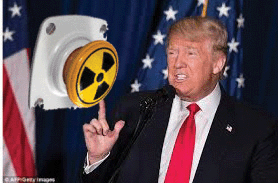
Whose Finger on the Nuclear Button?Election 2016 and playing a game of chicken with nuclear strategy, Common Dreams by Michael T. Klare , 7 Nov 16
Once upon a time, when choosing a new president, a factor for many voters was the perennial question: “Whose finger do you want on the nuclear button?” Of all the responsibilities of America’s top executive, none may be more momentous than deciding whether, and under what circumstances, to activate the “nuclear codes” — the secret alphanumeric messages that would inform missile officers in silos and submarines that the fearful moment had finally arrived to launch their intercontinental ballistic missiles (ICBMs) toward a foreign adversary, igniting a thermonuclear war.
Until recently in the post-Cold War world, however, nuclear weapons seemed to drop from sight, and that question along with it. Not any longer. In 2016, the nuclear issue is back big time, thanks both to the rise of Donald Trump (including various unsettling comments he’s made about nuclear weapons) and actual changes in the global nuclear landscape.
With passions running high on both sides in this year’s election and rising fears about Donald Trump’s impulsive nature and Hillary Clinton’s hawkish one, it’s hardly surprising that the “nuclear button” question has surfaced repeatedly throughout the campaign. In one of the more pointed exchanges of the first presidential debate, Hillary Clinton declared that Donald Trump lacked the mental composure for the job. “A man who can be provoked by a tweet,” she commented, “should not have his fingers anywhere near the nuclear codes.” Donald Trump has reciprocated by charging that Clinton is too prone to intervene abroad. “You’re going to end up in World War III over Syria,” he told reporters in Florida last month.
For most election observers, however, the matter of personal character and temperament has dominated discussions of the nuclear issue, with partisans on each side insisting that the other candidate is temperamentally unfit to exercise control over the nuclear codes. There is, however, a more important reason to worry about whose finger will be on that button this time around: at this very moment, for a variety of reasons, the “nuclear threshold” — the point at which some party to a “conventional” (non-nuclear) conflict chooses to employ atomic weapons — seems to be moving dangerously lower.
Not so long ago, it was implausible that a major nuclear power — the United States, Russia, or China — would consider using atomic weapons in any imaginable conflict scenario. No longer. Worse yet, this is likely to be our reality for years to come, which means that the next president will face a world in which a nuclear decision-making point might arrive far sooner than anyone would have thought possible just a year or two ago — with potentially catastrophic consequences for us all.
No less worrisome, the major nuclear powers (and some smaller ones) are all in the process of acquiring new nuclear arms, which could, in theory, push that threshold lower still. These include a variety of cruise missiles and other delivery systems capable of being used in “limited” nuclear wars — atomic conflicts that, in theory at least, could be confined to just a single country or one area of the world (say, Eastern Europe) and so might be even easier for decision-makers to initiate. The next president will have to decide whether the U.S. should actually produce weapons of this type and also what measures should be taken in response to similar decisions by Washington’s likely adversaries.
Lowering the Nuclear Threshold………
The New Nuclear Armaments
Both countries are already in the midst of ambitious and extremely costly efforts to “modernize” their nuclear arsenals. Of all the weapons now being developed, the two generating the most anxiety in terms of that nuclear threshold are a new Russian ground-launched cruise missile (GLCM) and an advanced U.S. air-launched cruise missile (ALCM). Unlike ballistic missiles, which exit the Earth’s atmosphere before returning to strike their targets, such cruise missiles remain within the atmosphere throughout their flight……..
On the American side, the weapon of immediate concern is a new version of the AGM-86B air-launched cruise missile, usually carried by B-52 bombers. Also known as the Long-Range Standoff Weapon (LRSO), it is, like the Iskander-M, expected to be deployed in both nuclear and conventional versions, leaving those on the potential receiving end unsure what might be heading their way. In other words, as with the Iskander-M, the intended target might assume the worst in a crisis, leading to the early use of nuclear weapons. Put another way, such missiles make for twitchy trigger fingers and are likely to lead to a heightened risk of nuclear war, which, once started, might in turn take Washington and Moscow right up the escalatory ladder to a planetary holocaust.
No wonder former Secretary of Defense William J. Perry called on President Obama to cancel the ALCM program in a recent Washington Post op-ed piece. “Because they… come in both nuclear and conventional variants,” he wrote, “cruise missiles are a uniquely destabilizing type of weapon.” And this issue is going to fall directly into the lap of the next president.
The New Nuclear Era
Whoever is elected on November 8th, we are evidently all headed into a world in which Trumpian-style itchy trigger fingers could be the norm. It already looks like both Moscow and Washington will contribute significantly to this development — and they may not be alone. In response to Russian and American moves in the nuclear arena, China is reported to be developing a “hypersonic glide vehicle,” a new type of nuclear warhead better able to evade anti-missile defenses — something that, at a moment of heightened crisis, might make a nuclear first strike seem more attractive to Washington. And don’t forget Pakistan, which is developing its own short-range “tactical” nuclear missiles, increasing the risk of the quick escalation of any future Indo-Pakistani confrontation to a nuclear exchange. (To put such “regional” dangers in perspective, a local nuclear war in South Asia could cause a global nuclear winter and, according to one study, possibly kill a billion people worldwide, thanks to crop failures and the like.)
And don’t forget North Korea, which is now testing a nuclear-armed ICBM, the Musudan, intended to strike the Western United States. That prompted a controversial decision in Washington to deploy THAAD (Terminal High Altitude Area Defense) anti-missile batteries in South Korea (something China bitterly opposes), as well as the consideration of other countermeasures, including undoubtedly scenarios involving first strikes against the North Koreans.
It’s clear that we’re on the threshold of a new nuclear era: a time when the actual use of atomic weapons is being accorded greater plausibility by military and political leaders globally, while war plans are being revised to allow the use of such weapons at an earlier stage in future armed clashes.
In a rare comment on a foreign election, veteran climate chief says a wise political leader should make policy in line with global trends. China on Tuesday rejected a plan by US Republican presidential candidate Donald Trump to back out of a global climate change pact, saying a wise political leader should make policy in line with global trends, a rare comment on a foreign election.
The world is moving towards balancing environmental protection and economic growth, China’s top climate change negotiator told reporters, in response to a query on how China would work with a Trump administration on climate change.“If they resist this trend, I don’t think they’ll win the support of their people, and their country’s economic and social progress will also be affected,” Xie Zhenhua said.
“I believe a wise political leader should take policy stances that conform with global trends,” China’s veteran climate chief said.
Chinese officials are often hesitant to weigh in on foreign elections, although they will defend Chinese policies when attacked in candidates’ policy platforms.
Xie’s comments come as China plans to launch a national carbon trading scheme in 2017.
The scheme is on track and pilot programmes have already traded 120m carbon allowances with total transactions amounting to 3.2bn yuan ($472.29m), he added.
“It will take time for the market to be fully operational, but once it’s operational, it’ll be the largest carbon trading market in the world,” said Xie.
China’s coal consumption has declined as the world’s second-largest economy slows, but Xie said it was too early to decide if it had peaked.
China’s delegation of more than 80 negotiators will begin departing from Tuesday for global climate change talks in the Moroccan city of Marrakesh set for 7-18 November.
Trump, Clinton, and “Nuclear Launch Codes”, By Dillon Aubin, Global Research, October 24, 2016 “…….if we take a closer look at the track records of Trump’s political rivals, a republican victory in November could be the safest route for preserving global stability.
The Republican Primary debates presented a narrow spectrum of foreign policy approaches towards the Middle East. The only candidate who favored a limited military response to Syria and Iraq was libertarian senator Rand Paul, who dropped out early in the race.
Top candidates Ted Cruz and Donald Trump supported a relatively moderate approach, in which ground troops alone would be deployed to counter ISIS expansion. In typical neocon fashion, the majority of Republican candidates proposed the disastrous concept of both a ground offensive and a no-fly-zone (4), a combination that would push the US closer to a direct conflict with Russia.
Since September of 2015, Moscow has been maintaining a military presence in the Syrian War (5). Though Russia had been financially and diplomatically supporting the Assad regime since the war’s beginning in 2011, a series of rebel advances prompted Putin’s military escalation. Both ground forces and air support are currently in active duty, most notably in the rebel held city of Aleppo. An American no-fly-zone in Syria would potentially mean downing Russian or Syrian aircraft, an event that could bring two nuclear armed states to war. During an interview on Fox News, former Republican candidate Chris Christie bluntly explained the process:
“Well, the first thing you do is you set up a no-fly zone in Syria, and you call Putin, and you say to him, ‘Listen, we’re enforcing a no-fly zone, and that means we’re enforcing it against everyone, and that includes you. So, don’t test me” (6).
With this type of rhetoric plaguing mainstream republican thought, Donald Trump is easily among the safest choices for a party nominee.
Though Democratic nominee Hillary Clinton opposes a ground offensive, she too is in favor of a no-fly-zone over Syria. While Trump has been calling for renewed relations with Russia, Clinton and her supporters criticize his willingness to cooperate with a supposed adversary (7).
What is most puzzling is how the cultural elite paint Clinton as a safer choice despite her long history of pushing for war (8). In her early years as a senator, Clinton supported the Bush administration’s call for an invasion of Iraq. As Obama’s Secretary of State, Clinton played a starring role in NATO’s destruction of Libya and even boasted about Colonel Gaddafi’s death in a CBS interview (9). Clinton’s most damaging position is her backing of the CIA’s plan to fund Syrian rebels, an operation that has perpetuated the worst humanitarian crisis of the century thus far. With so much blood on her hands, it’s hard to believe that Hillary Clinton could resist escalating the Syrian conflict into a global catastrophe.
So the next time you hear an A-list celebrity whine about a nuclear codes, consider the alternatives. Trump defeated the most powerful republicans in the country, most of whom casually spoke of downing Russian aircraft over Syria. Though he is inexperienced and buffoonish, he is the only candidate open to sharing a fair dialog with Russian officials. ……http://www.globalresearch.ca/trump-clinton-and-nuclear-launch-codes/5552631
Commentary: Debates pitch climate change shutout. A few decades from now, when the realities of climate change have hushed even the loudest, densest deniers, we may look back on October 2016 as the month political journalism died. Environmental Health News, October 19, 2016 Peter Dykstra
On Wednesday evening during the final presidential debate of the campaign, Hell did not freeze over. Moderator Chris Wallace of Fox News, where climate denial plays nothing but home games, passed on the final opportunity to ask Donald Trump and Hillary Clinton about climate change.
This presidential campaign has been a catastrophe for American democracy and for American political journalism.
Amid the relentlessly tawdry campaign news, most Americans haven’t even noticed the absence of virtually any high-level campaign discussion of environmental issues, let alone what many have called the biggest challenge of the 21st century.
For now.
But I invite you to think ahead to that “oh-crap” moment that awaits us all, 5, 10, or 25 years from now when America looks back to reckon with our self-imposed climate silence in the debates.
Journalism —and the memes of our day— have failed us……..
Debate decline
Aside from the “Town Hall” debates—where carefully selected members of the public get to ask questions—you have to go back to 1992 to find a non-TV journalist doing the interrogating at a presidential debate. That was the last election year in which a panel of reporters posed questions to the candidates. Perhaps print journalists don’t fare as well on TV, but it could also be argued that TV journalists don’t always fare well with journalism.
Since then, every journalist’s debate question has come from a network TV anchor or political correspondent. That’s six election cycles, 18 presidential debates where every question came from a well-compensated news celebrity based in New York or Washington. They conduct the debates under the auspices of a non-partisan commission that’s currently led by former Republican National Committee Chairman Frank Fahrenkopf and Mike McCurry, Bill Clinton’s former Press Secretary. If that’s not an inside job, I don’t know what is……..
For the record, the last, and one of only two, climate change questions ever posed by a journalist at a presidential debate was October 15, 2008. Bob Schieffer of CBS asked about “energy and climate control.” Props to Senator John McCain for gently correcting the moderator and realizing that the question was not about commercial property storage facilities. Then both he and Senator Barack Obama pretty much ducked the climate part of the question and talked about reducing foreign oil imports.
This year’s second debate offered prime evidence of how easily we’re distracted by bright, shiny objects…….
The fervent Trump supporter has told his viewers that the both US president, Barack Obama, and the Democrat nominee, Hilary Clinton, were “literal demons” who smelt of sulphur. I kid you not.
In Australia, we have a senator who similarly sees climate change as a thing made up by the UN. Our top-rating radio host, Alan Jones (no relation), has said climate science is “witchcraft”.
There’s now a whole media ecosystem that climate science denialism can exist inside, where there’s little scrutiny of the views of deniers. US-based sites like the Drudge Report, Infowars, Breitbart and Daily Caller are part of that ecosystem.
For a while, maybe the Trumpocene and the Anthropocene can coexist.
But even though they exist on separate plains, can we really afford to dismiss the impact of either of them?
Websites pushing climate science denial are growing their audience in an era where populist rhetoric and the rejection of expertise is gaining traction For years now geologists have been politely but forcefully arguing over the existence or otherwise of a new epoch – one that might have started decades ago.
Some of the world’s most respected geologists and scientists reckon humans have had such a profound impact on the Earth that we’ve now moved out of the Holocene and into the Anthropocene.
Dropping nuclear bombs and burning billions of tonnes of fossil fuels will do that to a planet, as will clearing swaths of forests to make way for food production and supermarket car parks and the like.
That’s all in the real world though, and sometimes you might get the horrible, chilling idea that when it comes to the production of our thoughts and ideas, that’s not the place a lot of us live anymore.
So I’d like to also propose the idea of an impending new epoch – the Trumpocene – that in the spirit of the era itself is based solely on a few thoughts held loosely together with hyperlinks and a general feeling of malaise.
In the Trumpocene, the epoch-defining impacts of climate change are nothing more than a conspiracy. Even if these impacts are real, then they’re probably good for us.
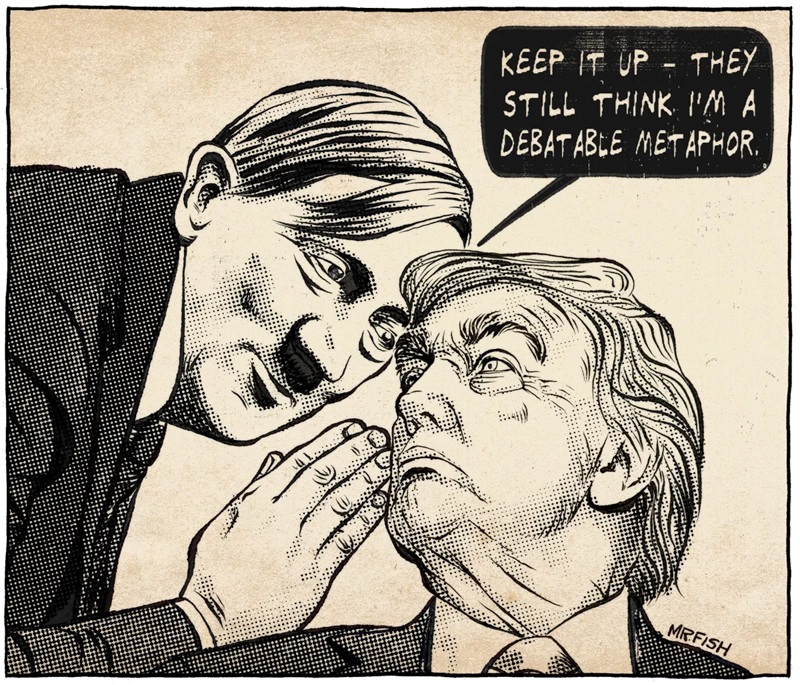
The era is named, of course, for the phenomenon that is Donald Trump, the Republican pick for US president whose candidacy has been defined by a loose grasp of facts, jingoistic posturing, populist rhetoric, his amazing hair and his treatment of women.
So what are the things that might define the Trumpocene?
Is it the point at which large numbers of people started to reject the views of large groups of actual experts – people with university qualifications and things – in exchange for the views of anyone who agrees with them? (Brexit, anyone?)Continue reading →
Why the silence on climate in the US presidential debates? The Conversation, Marc Hudson, October 20, 2016 As scientists become more gloomy about keeping global warming below the allegedly “safe” limit of 2℃, the issue is disappearing from the US presidential debates. There was a brief mention in the second debate between Donald Trump and Hillary Clinton debate, with climate change treated as an “afterthought”.
It’s an odd phenomenon, because awareness of the threat of climate change goes back more than half a century, well before its sudden arrival on public policy agendas in 1988…….
A combination of growing scientific alarm about the growth of greenhouse gases in the atmosphere and a long hot summer in 1988 made climate change an election issue. On the campaign trail, then-Vice President George H. W. Bush announced in his presidential compaign:
Those who think we’re powerless to do anything about the “greenhouse effect” are forgetting about the “White House effect”. As President, I intend to do something about it… In my first year in office, I will convene a global conference on the environment at the White House… We will talk about global warming… And we will act.
They didn’t get on with it, of course……… It was 2000 before presidential candidates debated the issue. George W. Bush (2000-09) said:
I think it’s an issue that we need to take very seriously. But I don’t think we know the solution to global warming yet. ……
Obama framed climate change as an energy independence issue, arguing that:
…we’ve got to walk the walk and not just talk the talk when it comes to energy independence, because this is probably going to be just as vital for our economy and the pain that people are feeling at the pump – and you know, winter’s coming and home heating oil – as it is our national security and the issue of climate change that’s so important.
Despite a petition with 160,000 signatures, the debate moderators for the 2012 debate did not put the issue on the agenda……
What happened? In two words: Tea Party. The emergence of the hyper-conservative Tea Party Republican faction was the culmination of a longer-term trend of what two American academics call “anti-reflexivity”.
For example, Marco Rubio, from Florida – a state that is already being hit by climate impacts – cannot take a position on it.
The second reason is more gloomy, because it is more intractable. Those who have denied climate change for so very long will find it very costly – both politically and psychologically – to reverse their position and admit that they have been wrong. Climate change denial has become a cultural position, as academics like Andrew Hoffman have noted.
How to Ensure the Iran Nuclear Deal Survives the Next President, NYT, By ARIANE TABATABAI, OCT. 20, 2016 WASHINGTON — With every presidential debate this year, Americans are reminded that the Iran nuclear deal remains as controversial as ever. Iranians, too, are watching the election, dreading the potential consequences for the deal — and for their country’s future.
With only three months before the Obama administration leaves office, the United States and Iran need to work fast to strengthen the deal’s foundations and ensure that the improvement in relations that took place over the course of President Obama’s tenure survives.
Both presidential nominees will most likely increase pressure on Tehran, but they differ on the nuclear deal. Donald J. Trump has denounced it as “one of the worst deals ever negotiated.” Hillary Clinton, on the other hand,played a role in forging it and has pledged to continue its implementation. But she has also vowed to be tough on Iran for its ballistic missile program and its support for terrorism.
Iran is also preparing for presidential elections, scheduled for May. The contenders haven’t yet announced their candidacies, but President Hassan Rouhani, a moderate, is likely to face tough conservative challengers, some of whom opposed negotiations with the Americans and believe he agreed to too many concessions. His opponents say that the deal affords Iran no tangible benefits because, although sanctions have been lifted, the economy has hardly recovered.
Against this backdrop, the nuclear agreement will enter the second year of implementation in early 2017.
But even now, there are many challenges to Iranian-American relations. Iran has tested the United States by arresting American citizens, continuing its ballistic missile program and conducting cyberattacks against American interests. For its part, the United States Congress has placed obstacles in the way of the deal’s implementation, such as trying to stall the sale of civilian aircraft to Iran. And while the State Department has tried to encourage businesses to re-enter the Iranian market, many remain reluctant because the Treasury Department has been slow to provide clarity on sanctions.
But thanks to open channels of communication between Washington and Tehran, nothing yet has derailed the nuclear deal.
Secretary of State John Kerry and Foreign Minister Javad Zarif of Iran have developed a good working relationship. In January, communication between the two led to the quick release of American sailors who were detained after entering Iranian waters. These channels are one of the greatest achievements of the nuclear talks and key to the deal’s success, allowing two adversaries to finally settle disputes diplomatically. But unless these means of dialogue are sustained, hiccups could turn into bigger crises, ultimately undoing the improvement in relations — and the nuclear deal.
To protect them, the United States and Iran should institutionalize their relationship. The State Department and Iran’s Foreign Ministry should have conversations not just at the highest levels, but across their diplomatic corps. By starting now to move interactions with Iran from top-level political appointees to others within the State Department, the United States can create the building blocks for the next administration……http://www.nytimes.com/2016/10/20/opinion/how-to-ensure-the-iran-nuclear-deal-survives-the-next-president.html?_r=0
Clues to the end of the world shared during final 2016 presidential debate, Mondoweiss, Wilson Dizard on October 20, 2016 “……Four minutes is what it takes between the president’s decision to fire nuclear missiles, Clinton claimed during the debate, and their launch………..Here is the most illuminating exchange on nuclear weapons, according to a transcript published by the Washington Post. Clinton gave a clinical description of how fast nuclear weapons can be fired away at a president’s command. That information was perhaps a subtle way of warning Russian president Vladimir Putin that we remain the fastest guns in the West.
CLINTON: “I — I find it ironic that he’s raising nuclear weapons. This is a person who has been very cavalier, even casual about the use of nuclear weapons. He’s advocated more countries getting them, Japan, Korea, even Saudi Arabia. He said, well, if we have them, why don’t we use them, which I think is terrifying.
But here’s the deal. The bottom line on nuclear weapons is that when the president gives the order, it must be followed. There’s about four minutes between the order being given and the people responsible for launching nuclear weapons to do so. And that’s why 10 people who have had that awesome responsibility have come out and, in an unprecedented way, said they would not trust Donald Trump with the nuclear codes or to have his finger on the nuclear button……..
What Trump doesn’t seem to understand that defending Saudi Arabia, Germany, Japan and South Korea means defending major trading partners and, in the case of Saudi Arabia, a sand seared ocean of oil. But if the American nuclear umbrella suddenly closed, all of those countries could have nuclear weapons ready within weeks or months. The details are unimportant. What’s nauseatingly disturbing is that we are discussing the possibility of nuclear war at all. After all, this is 2016, right? If the arc of history bends towards justice, a nuclear holocaust is the thing that would blow that arc to smithereens. The real end of history
Clinton, for her part, recommitted herself to a no-fly zone in Syria, a provocation to Russian air forces the U.S. blames for bombing civilians and Western-friendly rebels. She also said that the occupation of Iraq would “not be in our interest,” while not mentioning that the Iraqis also have their objections to American military occupation. Classic Clinton.
AP FACT CHECK: Donald Trump is wrong to say that only Russia can still create warheads under the New START treaty limiting nuclear weapons A claim from the final presidential debate and how it stacks up with the facts:
DONALD TRUMP: Referring to a 2010 U.S.-Russia treaty limiting both countries to 1,550 strategic nuclear warheads, Trump said, “They create warheads. We can’t.”
The FACTS: Incorrect. The New START treaty, which Trump called “Start Up,” does not prevent either the U.S. or Russia from building nuclear warheads. It restricts each country to a total of 1,550 warheads deployed on bombers, submarines and in underground silos and requires that this limit be reached by February 2018.
Trump also said that after the treaty was signed, “They expanded and we didn’t.”
It’s true that the Russians have increased the number of their deployed warheads to 1,796, and the U.S. warhead total has dropped to 1,367. But it also is true that their total was far below that of the U.S. when the treaty went into effect in 2010. New data published by the State Department this month showed that although Russia has added to its warhead total, its inventory of missile launchers, such as underground silos, has shrunk.
Hans Kristensen of the Federation of American Scientists, who closely tracks U.S. and Russian strategic forces, says the rise in Russian deployed warheads is temporary and is to be followed by the retirement of older nuclear weapons so that Moscow gets under the treaty limits. “Russian compliance with the treaty by 2018 is not in doubt,” he wrote recently.
byPAUL STREETI have more than once heard fellow U.S. leftists describe the choice between dismal Democrats and rancid Republicans as like a choice of how one would like to be executed: firing squad or hanging; electric chair or gas chamber; guillotine or liquid injection. With the official range of selection narrowed to Donald Trump or Hillary Clinton for U.S. President, we might extend the metaphor to all of humanity (and to the other species homo sapiens hasn’t already eradicated) and ask: which is your preferred near-term path of extinction, accelerated anthropogenic (really capitalogenic) global warming (AGW) or thermonuclear world war?
If one wants to work with the dichotomy of “greater” and “lesser” evil, Trump is quite probably the “greater evil” on climate change, whose existence he denies. If president, he says, he would “deregulate [American] energy.” He would help the nation’s fossil fuel firms and their customers extract, sell, and burn as much coal. gas, and oil as they could (and the executive branch can do quite a bit in that regard). Noam Chomsky is right that this could signal “almost a death knell for the species.” We are speeding to ecosystem collapse with AGW in the lead of numerous interrelated “ecological rifts.” A stepped-up carbon orgy under a Trump administration could well seal the tipping-point deal.
But Hillary Clinton is the greater evil when it comes to World War III. She is showing signs that she would view a landslide victory against Trump as what the left analyst Glen Ford calls “a mandate for war with [nuclear] Russia.” The nuclear “dice on humanity’s future” (Ford) are already being shaken by the Obama administration. Consistent with Obama’s long-time commitment (shared the Clintons, Madeline Albright, and the rest of the Council on Foreign Relations crowd) to the Zbigniew Brzezinski project of humiliating Russia, Washington has helped install a vicious right wing and pro-Western government in Ukraine, a key state on Russia’s western border (one that past European invaders have marched through on a path to Moscow). Last May, Washington announced the installation of a so-called European missile defense system in Romania – a deployment that Russia naturally interpreted as an attack on its nuclear deterrence capacity. The White House disingenuously claimed that the system was meant to protect Europe from Iran, something that Moscow immediately and reasonably denounced as a lie. Russia suggested that it might retaliate by placing nuclear missiles in Crimea and Kaliningrad, its exclave on the Baltic Sea, between Poland and Lithuania.
The key hotspot in the U.S. and Western-led “new Cold War” now is of course Russia- and Iran-backed Syria, where U.S. and other Western airplanes “mistakenly” killed 62 Syrian troops one month ago. The attack effectively blew up a Syrian “ceasefire” Washington had arranged with the Syrian government’s key ally Russia just a week before. Now, Pepe Escobar reports, “the Pentagon – supported by the Joint Chiefs of Staff – …is peddling ‘potential strikes’ on Syria’s air force to ‘punish the regime’ for what the Pentagon actually did; blow up the ceasefire.” Washington disingenuously claims to have deep humanitarian concerns for the 250,000 or so civilians who are trapped on the eastern side of the city of Aleppo, a rebel/al Qaeda-controlled territory under siege by the Syrian army and Shia paramilitary forces from Iran, Iraq, and Lebanon. This follows a provocative Washington Post story leaking reports that the Obama administration is thinking about undertaking a direct U.S. covert war on the ground against the Syrian state.
All of this has quite naturally elicited a stern response from Moscow. The Russian Ministry of Defense telling Washington to “weigh the consequences” of its schemes. Maj. Gen. Igor Konashenkov informed the world that it was ready and willing to use its state-of-the-art air defense systems to shoot down U.S. war planes attacking Syrian troops or Russian military installations. If and when that happens, Konashenkov added, things will be moving too fast for the Russians to use the “hotline” to give Washington the “exact flight program” of its air defense missiles in Syria.
This is all bad enough, but Hillary seems to want to up the ante. Listen to her language in her second “presidential” “debate” with Trump. “The situation in Syria is catastrophic,” Mrs. Clinton said. “And every day that goes by, we see the results of the regime by Assad in partnership with Iranians on the ground, the Russians in the air…when I was Secretary of State, I advocated and I advocate today a no-fly zone and a safe zone.” Continue reading →
Donald J. Trump the Hawk, Counter Punch bySHELDON RICHMAN, OCTOBER 14, 2016 Donald Trump is no peacenik. Leave aside Trump’s proclamation that he “love[s] war” and unpredictability, and that he is more “militaristic” than anyone. Forget that he wants to enlarge the military and that he refuses to forswear first use of nuclear weapons. Ignore his bellicosity toward Iran and China or his promise to support Israel unconditionally. Pay no attention to Trump’s 2002 endorsement of the invasion of Iraq and his imploring Obama to invade Libya and overthrow Muammar Gaddafi.
All we have to do to see the real Trump is examine his allegedly dovish statements.
Trump takes heat every time he expresses a wish to get along with Russia. This in itself would be good: the United States and Russia could destroy the world with their nuclear weapons. But the ruling elite disagrees. Since the collapse of the Soviet Union and its Warsaw Pact alliance, U.S. rulers have provoked Russia by incorporating its former allies and republics into NATO and enabling a coup against an elected Russia-friendly president of Ukraine, jeopardizing Russia’s naval base in Crimea.
But would Trump really pursue peaceful relations with Russia? It’s not so clear. When asked about his views on Russia at the recent joint appearance with Hillary Clinton, he noted that Russia is “fighting ISIS,” which he implied puts the United States on the same side. “I believe we have to get ISIS,” he said. “We have to worry about ISIS before we can get too much more involved.”
Note the words before we can get too much more involved. Trump’s statement indicates that working with Russia is merely a matter of priorities. First ISIS, then … what? More intervention, presumably against Syria’s ruler, Bashar al-Assad.
After all, Assad is an ally of Iran, which Trump demonizes daily. We have no reason to think that if he presided over the defeat of ISIS, Trump would continue to cooperate on Syria with Russia, which like Iran would still have influence in the Middle East. Thin-skinned nationalist Trump is unlikely to suffer what he regards as impertinences from these nations, which resent having an American president define their places in the world…….
Trump wants to “bomb the shit” out of ISIS. He wants to torture suspected terrorists. He wants to kill the relatives of those suspects. That would only inspire more terrorism. Trump has obviously learned nothing from the wars he once supported and now falsely claims to have opposed…….. http://www.counterpunch.org/2016/10/14/donald-j-trump-the-hawk/







 nuclear-news