Reeves’s planning overhaul stalls as UK’s senior adviser leaves after four months.
Catherine Howard’s exit comes amid disagreements at top of government about how far to push deregulation agenda
Helena Horton and Kiran Stacey, Guardian, 14 Dec, 25
Rachel Reeves’s attempts to overhaul Britain’s planning laws have been dealt a blow after a senior lawyer whom she appointed as an adviser decided to leave the government after just four months.
Catherine Howard will leave the Treasury when her contract ends on 1 January, despite having been asked informally to stay on indefinitely.
Howard is understood to have warned the government against pushing ahead immediately with some of its more radical proposals to sweep aside planning regulations in an effort to encourage more infrastructure projects.
Her decision to leave the post comes amid disagreements at the top of government about how far to push its deregulation agenda, with some senior officials warning that Keir Starmer’s latest attempt to kickstart major building schemes could damage EU relations.
Disquiet is also growing among some Labour MPs, with 30 writing to the prime minister this week urging not to push ahead with some of his more radical planning reforms.
Howard said in a statement: “Over the past four months I have thoroughly enjoyed my time as the chancellor’s infrastructure and planning adviser, and in my time have had the ability to advise HM Treasury and help steer the important steps the government is taking to improve the planning system to support economic growth.
“I look forward to continuing my engagement with HM Treasury and government as I return to the private sector.”
Starmer and Reeves have put planning at the heart of their push for economic growth, which has so far struggled to gain traction, with figures released on Friday showing the economy shrank 0.1% in the three months to October……………………………………….
While in government she is understood to have disagreed with Starmer’s decision to announce he would fully adopt the recommendations of a review into building nuclear power stations more quickly, written by the economist John Fingleton.
Starmer said in a post-budget speech last week: “In addition to accepting the Fingleton recommendations, I am asking the business secretary to apply these lessons across the entire industrial strategy.”
Fingleton made a number of suggestions, including changing rules around protected species and increasing radiation limits for those living near or working in a nuclear power plant.
He suggested that infrastructure projects should pay a large, pre-agreed, upfront sum to government quango Natural England in lieu of protecting or replacing habitats lost to development.
His review also recommended making it more costly for individuals and charities to take judicial reviews against infrastructure projects……..
Howard believed Starmer should not have accepted his recommendations to rip up EU derived habitats laws before taking legal advice on whether they complied with legally binding nature targets and trading arrangements with the EU.
She was bringing forward concerns shared with government departments including the Cabinet Office and the environment department, which said the review could jeopardise trade with the EU and lead to widespread habitat destruction.
Those concerns are also shared by some Labour backbenchers.
Chris Hinchliff, Labour MP for North East Hertfordshire, has been leading a campaign against the review.
He said: “It’s time our Labour government stopped pitching nature as the enemy of a better life for ordinary people in this country and realised that, for the vast majority, it is a measure of it.”…………………….. https://www.theguardian.com/politics/2025/dec/14/reevess-planning-overhaul-stalls-as-senior-adviser-quits-after-four-months
Ukraine wants West to pay for election.
Rt.com, 12 Dec, 2025
Kiev is ready to call a vote once its demands are met, Vladimir Zelensky’s top adviser has said.
Kiev is ready to hold an election, but only if a series of conditions are met, including Western funding of the vote, Mikhail Podoliak, a senior adviser to Ukrainian leader Vladimir Zelensky, has said.
Zelensky’s presidential term expired in May 2024, but he has refused to organize elections, citing martial law. Earlier this week, US President Donald Trump said Kiev should no longer use the ongoing conflict as an excuse for the delay.
Moscow has maintained that Zelensky has “lost his legitimate status,” which would undermine the legality of any peace deal signed with him.
Zelensky has claimed he was not trying to “cling to power,” declaring this week readiness for the elections, but insisting that Kiev needs help from the US and European countries “to ensure security” during a vote.
Podoliak expanded on the position on Friday, writing on X that Zelensky had called on parliament to prepare changes to the constitution and laws. Podoliak, however, added that three conditions must be met for a vote to go ahead……………………………………………….. https://www.rt.com/russia/629383-ukraine-elections-western-funding/
University of Michigan report: History shows advanced nuclear likely to have predictable negative consequences
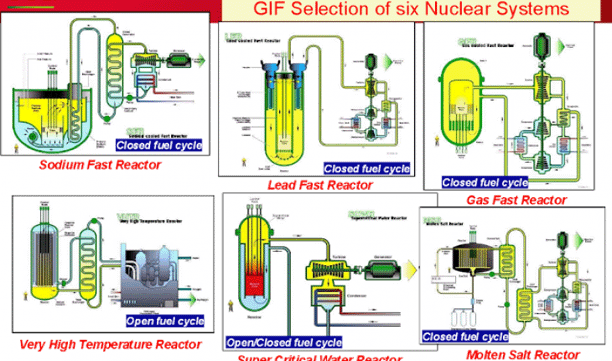
A new University of Michigan report says that despite its promise as a clean, cheap energy source, advanced nuclear technologies could end up fueling—or exacerbating—social and environmental problems.
Michigan Public | By Sarah Cwiek December 14, 2025
The report, titled The Reactor Around the Corner: Understanding Advanced Nuclear Energy Futures, looks at historical examples of what happened when major new technologies touted as game-changers were introduced. It concludes that without “robust governance frameworks” in place, next-generation nuclear is likely to reinforce or even create problems that technology alone can’t fix.
According to the report, advanced nuclear reactors generally use novel fuel types for power generation, higher uranium enrichment levels, and alternative coolants. The most common and increasingly popular form of advanced nuclear reactors are small modular reactors, or SMRs.
SMRs are slightly smaller than conventional nuclear reactors, producing about a third of the electricity output of a conventional reactor. They’re attractive to governments and power providers due to their generally lower upfront construction costs and shorter construction times, and are often seen as a safer alternative to larger traditional nuclear infrastructure. However, the report notes that “the technology is at an early stage, and it is still unclear whether the SMR industry can fulfill its promises.”
Nonetheless, many SMR projects are either planned or about to come online, said Shobita Parthasarathy, a UM professor of public policy specializing in the history of technology, and one of the report’s authors. The planned reactors include two SMRs at the site of West Michigan’s Palisades nuclear plant — the first in the country to be revived after being decommissioned. Governor Gretchen Whitmer announced the project, which is backed by a $400 million investment from the U.S. Department of Energy and additional federal support, earlier this month.
“This historic investment will double Palisades’ capacity, provide more clean energy for Michigan homes and businesses, and protect 900 good-paying Michigan jobs,” Whitmer said in a statement. “(It) will lower energy costs, reaffirm Michigan’s clean energy leadership, and show the world that we are the best place to do business.”
Parthasarathy said looking at historical examples of other technologies touted as game-changers can be instructive. She said one concern the report highlights is that while nuclear energy may itself be considered “clean,” it can be used to power other industries or technologies that are far from it. And in the case of SMRs, she said that some tech companies have proposed building them alongside the massive data centers that fuel energy and water-hungry artificial intelligence.
And as for the promised economic boost, Parthasarathy said some skepticism is in order. “What we have found in our work is that those promises, at best, are very short-lived,” she said. “The jobs don’t last very long often. “
After analyzing historical examples of technologies that have parallels to advanced nuclear, the report found that its expansion likely “introduces — and in some cases reinforces — problems that technological solutions alone will not be able to fix.” And it suggests that the only way to head off those problems is to have “robust governance frameworks in place before the widespread implementation of SMRs.”
Parthasarathy noted that currently, those large scale frameworks don’t exist, nor do they seem likely to anytime soon. And she said that because of SMRs’ size — about that of a city block in some cases — they’re likely to show up in many community landscapes. “They’re going to be right next to us,” she said.
But Parthasarathy said that also presents an opportunity: because SMRs are so much smaller than traditional nuclear plants, it could give local residents a real chance to influence how these technologies are deployed. And her hope is that this report can help them do that.
The report “provides a guide to communities on what they should be thinking about intervening in and maybe mobilizing around,” Parthasarathy said. “[It] can empower citizens to ask detailed, sophisticated questions about the implications of nuclear power for them and their communities.”
Elections impossible under Zelensky’s ‘terrorist regime’ – exiled Ukrainian MP

Sat, 13 Dec 2025, https://www.sott.net/article/503481-Elections-impossible-under-Zelenskys-terrorist-regime-exiled-Ukrainian-MP
Presidential elections in Ukraine are impossible under the “terrorist regime” of Vladimir Zelensky and his cohort, exiled Ukrainian lawmaker Artyom Dmitruk has said.
Zelensky, whose presidential term expired over a year ago, has repeatedly refused to hold a new election, citing martial law – which was imposed after the conflict with Russia escalated in 2022 and has been regularly extended by parliament.
Earlier this week, Zelensky said he would hold an election within 90 days if Kiev’s Western backers can guarantee security. The shift came after US President Donald Trump accused the Ukrainian authorities of using the conflict as an excuse to delay elections, insisting that it’s time.
In a series of Telegram posts on Friday, Dmitruk argued that it is “completely pointless” to discuss elections now, calling Zelensky’s remarks “manipulation and hypocrisy” aimed at clinging to power.
“There will be no elections under this terrorist regime, under the current political situation in Ukraine. Under this regime, elections are impossible,” the exiled lawmaker wrote. “The political situation in Ukraine is vile and deceitful. Almost all the ‘potential candidates’ are Zelensky regime officials, people completely integrated into the war system. And at the head of this march – a parade of blood – is Zelensky himself.”
He insisted that elections would only be possible after “either a political or military capitulation of the regime” and the transfer of authority to an interim government. According to Dmitruk, Trump’s call to Zelensky was not really about elections: “It is a form of diplomatic signal… a polite, diplomatic way to show Zelensky the door.”
Dmitruk fled Ukraine in August 2024, claiming he received death threats from the country’s security services over his opposition to Zelensky’s persecution of the Ukrainian Orthodox Church.
Russia maintains that Zelensky is an illegitimate leader. President Vladimir Putin warned that it is “legally impossible” to conclude a peace deal with the current leadership due to Zelensky’s lack of a valid mandate.
According to Kremlin aide Yury Ushakov, Zelensky’s sudden interest in elections is a ploy to secure a ceasefire – a proposal that Russia has rejected in favor of a permanent peace deal addressing the conflict’s underlying causes. Moscow has warned that Kiev would use any pause in the fighting to rearm and regroup.
Comment: There is more pressure on Zelensky to hold elections from various stakeholders while a peace deal is in the works. One way or another Zelensky will have to hold elections soon.
Trump’s ‘End of History’ Moment

History will thankfully go on once we see the end of them and the work of repairing the mess they are making begins.
December 13, 2025 , By Patrick Lawrence, ScheerPost, https://scheerpost.com/2025/12/13/patrick-lawrence-trumps-end-of-history-moment/
The Trumpster is not yet finished his first year back in the White House, and I cannot imagine how our crumbling republic will survive three more years of this man-child and the misfits and miscreants with whom he has surrounded himself. And it occurs to me lately that neither I nor anyone else is supposed to imagine any kind of future — good, bad, in the middle — beyond Jan. 20, 2029, when President Trump will no longer be president. The future will not be the point by then. By then we are supposed to be living in an imaginary past that we won’t have to imagine because the imaginary past will be the actual present.
It is not quite three months since Trump issued an executive order designating “antifa,” the more or less fictitious “organization” of antifascists, a “domestic terrorist organization.” In the Trump White House’s rendering, antifa “explicitly calls for the overthrow of the United States Government, law enforcement authorities and our system of law.” To this end, it organizes and executes vast campaigns of violence. It coordinates all this across the country. It recruits and radicalizes young people, “then employs elaborate means and mechanisms to shield the identities of its operatives, conceal its funding sources and operations in an effort to frustrate law enforcement, and recruit additional members.”
I didn’t take the executive order containing this kind of language the least bit seriously when it was issued Sept. 22. Antifa, so far as I understand it, does not actually exist. It is a state of mind, or it signifies a shared set of political sentiments vaguely in the direction of traditional anarchism — a hyper-individualistic ultra-libertarianism when translated into the American context.
Trump’s executive order describing antifa as an organized terrorist organization reminded me of nothing so much as those flatfooted fogies back in the Cold War years who, nostalgic for a simpler time but understanding nothing, went on about “outside agitators” as the root of America’s ills.
I was wrong in one respect, maybe more, about Trump and his adjutants and what they have in mind. These people are not flatfooted. They know exactly what they are doing and they are moving swiftly to get it done. It is time to take seriously, I mean to say, the wall-to-wall unseriousness of the Trump regime’s plans for a nation it would be impossible to live in were it ever to come to be. The saving grace here is they cannot possibly create the America they have in mind. But they will, I have to add, make an unholy mess on their way to failing.
Three days after the antifa executive order, The White House made public a National Security Presidential Memorandum titled “Countering Domestic Terrorism and Organized Political Violence.” NSPM–7, as this document is known, is formally addressed to Marco Rubio, Trump’s secretary of state, Treasury Secretary Scott Bessent, Attorney General Pam Bondi and Kristi Noem, the Homeland Security secretary.
This thing picks up where the one-page executive order leaves off. It cites various assassinations and attempted assassinations — Charlie Kirk, Brian Thompson, the United Healthcare chief executive, the two attempts on Trump’s life during his 2024 campaign — and fair enough, although casting political violence as terrorist violence is a sleight-of-hand too far. It is when NSPM–7 invokes recent protests against Immigration and Customs Enforcement agents and “riots in Los Angeles and Portland” that you sense the trouble to come.
From the first of the document’s five sections:
This political violence is not a series of isolated incidents and does not emerge organically. Instead, it is a culmination of sophisticated, organized campaigns of targeted intimidation, radicalization, threats, and violence designed to silence opposing speech, limit political activity, change or direct policy outcomes, and prevent the functioning of a democratic society. A new law enforcement strategy that investigates all participants in these criminal and terroristic conspiracies — including the organized structures, networks, entities, organizations, funding sources, and predicate actions behind them — is required.
What is required, it turns out, is an institutionalized surveillance operation that goes considerably beyond the Patriot Act. “This guidance,” Section 2 reads, “shall also include an identification of any behaviors, fact patterns, recurrent motivations, or other indicia common to organizations and entities that coordinate these acts in order to direct efforts to identify and prevent potential violent activity.”
And then NSPM–7 gets down to what the Trump regime is truly after:
Common threads animating this violent conduct include anti-Americanism, anti-capitalism, and anti-Christianity; support for the overthrow of the United States Government; extremism on migration, race, and gender; and hostility towards those who hold traditional American views on family, religion, and morality.
I am not letting the liberal wing of the ruling Late–Imperial War Party, commonly known as the Democrats, off the hook in this domestic terrorism business. Joe Biden banged on about this whenever it was politically expedient the whole of his discombobulated term, and we now witness the consequences of all his loose, opportunistic talk. In effect, Biden prefaced what the Trump regime is step-by-step codifying into law.
One of the more pernicious of the many objectionable features of NSPM–7 merits immediate note. This is the vagueness of its language. Whenever I see official documents of this kind my mind goes back to imperial China, whose mandarins were highly legalistic but kept written law purposely ambiguous so as to maximize the prerogatives of imperial power. A surfeit of laws, all of them to be interpreted in whatever way suited the throne.
As of last weekend we know how Pam Bondi, Trump’s patently fascistic AG, intends to interpret NSPM–7. This is by way of a Justice Department memorandum Ken Klippenstein, the exemplary investigative journalist, reported on (but did not actually publish in full) on Saturday, Dec. 6. This is Klippenstein’s exclusive. Here is the top of the piece he published in his Substack newsletter under the headline, “FBI Making List of American ‘Extremists,’ Leaked Memo Reveals:”
Attorney General Pam Bondi is ordering the FBI to “compile a list of groups or entities engaging in acts that may constitute domestic terrorism”… The target is those expressing “opposition to law and immigration enforcement; extreme views in favor of mass migration and open borders; adherence to radical gender ideology,” as well as “anti–Americanism,” “anti-capitalism,” and “anti–Christianity.”
By way of defining all these domestic terrorism threats, Klippenstein reports, the DoJ memorandum cites “extreme viewpoints on immigration, radical gender ideology, and anti-American sentiment.” As to enforcement, the memorandum authorizes the FBI to open a hotline by means of which ordinary Americans can report on other ordinary Americans, along with “a cash reward system” to go along with it. The agency is also to develop a legion of informants (“cooperators”); state and local governments are to be funded to develop their own programs in conformity with the DoJ’s directives. What the memorandum calls Joint Terrorism Task Forces are to “map the full network of culpable actors.”
This is more than what we now call an all-of-government surveillance and enforcement program that open-and-shut outlaws a variety of Constitutional rights. It is an all-of-society operation that prompts comparisons with regimes in history I never would have imagined summoning to mind in anything like this context. “Extremist viewpoints” are to be criminalized? I am an outlaw if I am critical of orthodox Christianity, if I am “hostile” to the nuclear family, to traditional morality and so on? Just how close to thought control does the Trump regime plan to sail?
Continue readingNuclear Notebook: The changing nuclear landscape in Europe
Bulletin, By Hans M. Kristensen, Matt Korda, Eliana Johns, Mackenzie Knight-Boyle | December 10, 2025
Evolving nuclear weapons postures in Europe
Since Russia annexed Crimea in 2014 and invaded Ukraine in 2022, the rhetoric, prominence, operations, and infrastructures of nuclear weapons in Europe have changed considerably and, in many cases, increased. This trend is in sharp contrast with the two decades prior that—despite modernization programs—were dominated by efforts to reduce the numbers and role of nuclear weapons.
During this period, Russia has fielded several new nonstrategic nuclear weapons systems, increased military exercises, issued a long list of nuclear signals and threats, and upgraded its nuclear doctrine in a way that gives the impression that it has broadened the role of nuclear weapons and potentially lowered its nuclear threshold.
NATO, for its part, is also modernizing its nuclear forces and has further reacted by increasing its strategic bomber operations and nonstrategic nuclear posture, changing its strategic nuclear ballistic missile submarine operations, and talking more openly and assertively about the role and value of nuclear weapons.
Each side believes it has good reasons for beefing up the nuclear posture, but the combined effect is that the role and presence of nuclear weapons in Europe are increasing again after decades of efforts to curtail them. Unless the governments and parliaments of European countries increase efforts to halt this trend, the region is likely to descend further into growing nuclear weapons competition and posturing over the next decade.
In this Nuclear Notebook, we provide an overview with examples of how the nuclear postures in Europe are evolving, especially the infrastructures and operations. The overview is focused on nonstrategic nuclear weapons but also includes examples of how strategic nuclear forces are operated. The intention is to provide a factual resource for the public debate about the evolving role of nuclear weapons in Europe. As such, this notebook is not intended to be comprehensive but informative.
Nine countries currently operate nuclear forces in Europe: Belarus, Belgium, Germany, France, Italy, the Netherlands, Russia, the United States, and the United Kingdom. The latter has announced plans to acquire nonstrategic nuclear weapons (see Figure 1), and a tenth country (Türkiye) hosts nuclear weapons on its territory.
Nuclear developments involving the Russian Federation…………………………………………………………………………………………………………………………………..
Nuclear developments involving NATO………………………………………………………………………………………………………………
The United Kingdom…………………………………………………………………………………..
France…………………………………………………………………………………………………
………………………………………….. copious references……………..https://thebulletin.org/premium/2025-12/the-changing-nuclear-landscape-in-europe/
US House passes $800mn aid package for Ukraine

New military assistance has been signed off on a month after Kiev was shaken by a major corruption scandal.
The US House of Representatives has passed a defense spending bill that would provide $800 million in military aid to Ukraine through 2027.
The 2026 National Defense Authorization Act (NDAA) was approved 312-122 on Wednesday and will now advance to the Senate, where it is expected to receive bipartisan support, according to The Hill.
Some legislators objected to directing more taxpayers’ money to help Ukraine fight Russia. “I thought we were getting out of Ukraine. I don’t know why we still need to spend money there,” Thomas Massie, a Republican from Kentucky, said.
On Wednesday, US President Donald Trump slammed what he described as a “massive corruption situation” in Kiev, referring to the recently uncovered $100 million kickback scheme in the country’s energy sector, which heavily relies on Western aid.
Prosecutors named Ukrainian leader Vladimir Zelensky’s longtime associate and former business partner Timur Mindich as the ringleader. Mindich fled the country to evade arrest after apparently being tipped off.
The scandal led to the resignation of two government ministers, and further anti-corruption raids prompted Zelensky to fire chief of staff Andrey Yermak last month.
Ukraine’s military procurement system has also been shaken by several graft and embezzlement scandals, one of which led to the resignation of Defense Minister Aleksey Reznikov in 2023.
The bill was approved as Trump has been pressuring Ukraine to sign a peace deal with Russia, with some reports suggesting that he hopes to reach an agreement by Christmas.
Russia considers Western military cooperation with Ukraine one of the root causes of the conflict and has listed ending foreign weapons deliveries as a condition for a ceasefire. President Vladimir Putin has argued that otherwise, Ukraine would use the pause in the fighting to rearm and regroup, as he says happened when Ukraine refused to implement the 2014-2015 Minsk
Zelensky resists ceding Donbas, after abandoning it years ago

Zelensky objects to ceding the Donbas region under Trump’s peace plan. But when offered the chance to keep the region under a compromise with Russia, he adamantly refused.
Aaron Maté, Dec 13, 2025
Since the Trump administration began pressuring him to reach a peace deal with Russia last month, Ukrainian president Volodymyr Zelensky has refused to cede any territory to Moscow. On Thursday, after a new round of salvos from President Trump, Zelensky appeared to leave some wiggle room. “The Russians want the whole of Donbas — we don’t accept that,” Zelensky told reporters. However, for the first time, he floated the idea of putting the issue to a national vote: “I believe that the Ukrainian people will answer this question. Whether in the form of elections or a referendum, the Ukrainian people must have a say.”
Any Ukrainian-administered referendum on the fate of the Donbas would exclude most of its population, who now live under Russian rule. While Zelensky insists that he will not reward what he sees as an illegal Russian land grab, the Ukrainian leader has squandered several opportunities to keep his borders intact. The February 2015 Minsk accords would have left the Donbas within Ukraine by granting it limited autonomy and abandoning Kyiv’s chances of joining NATO. Under the threat of ultra-nationalist violence, successive Ukrainian governments instead opted to retake Donbas by force and demonize the ethnic Russians who live there……………………………………………………………(Subscribers only) https://www.aaronmate.net/p/zelensky-resists-ceding-donbas-after?utm_source=post-email-title&publication_id=100118&post_id=181439166&utm_campaign=email-post-title&isFreemail=true&r=ln98x&triedRedirect=true&utm_medium=email
Zelensky’s rush to elections is an effort to cling to power and keep the money flowing

Signing a peace deal that takes NATO off the table will kill his chance of re-election
Ian Proud, The Peacemonger, Dec 11, 2025
In a recent interview with Politico, President Trump said, ‘they’re (Ukraine’s government) using the war as an excuse not to hold an election.’
This is not a new criticism. Republican figures who have long opposed open-ended financial aid to Ukraine have often targeted Zelensky’s lack of a democratic mandate. This includes Tulsi Gabbard, the Director of National Intelligence, a long-standing critic who once labelled Zelensky an ‘unelected dictator’ in a video prior to the US Presidential elections.
Always a slick media operator, Zelensky has responded to the US President’s criticism by offering to hold a plebiscite while Ukraine remains under martial law, if European states and the US can guarantee security. Mainstream media have, predictably, seized on this as further proof of Zelensky’s democratic credentials and his commitment to deliver peace under the most difficult circumstances of war.
However, only around 20% of Ukrainians favour an election prior to any peace deal, according to an August poll, compared to 75% who believe elections should happen after the war. Until recently, Zelensky used this data to shoot down critics who called him out as anti-democratic. Now, he’s willing to sidestep the will of his people and go to the polls while war is still raging.
Trump’s criticism doesn’t, in my eyes, represent a challenge to hold elections now, but first to sign a peace deal with Russia, paving the way for elections upon the cessation of martial law.
Right now, only, 20.3% of Ukrainians would vote for Zelensky, a drop of 4% since October polling, in the light of collapsing support for the war effort and the ongoing corruption scandal.
That still makes Zelensky the most popular candidate from a long list, his closest rival being former military commander Zaluzhny. Although the same poll suggests that a new political party headed by the current Ukrainian Ambassador to London would defeat Zelensky’s Servant of the People faction.
The New York Times’ recent investigation has shown Zelensky’s government has actively sabotaged oversight, allowing corruption to flourish. This story was eye-opening both for the depth of the investigation and its source – a newspaper that had hitherto backed the Ukrainian President’s endeavours to the hilt. Now, rather than sitting above the issue, blind to the activities of his closest political allies, Zelensky is increasingly viewed as an integral part of Ukraine’s corruption problem.
He may be gambling on running for the polls early to increase his dwindling chance of clinging on to power. Despite the logistical challenges, a vote under martial law might work in his favour.
………………………………………………………………………………. In a country as corrupt as Ukraine, anyone who seriously believes that Zelensky wouldn’t attempt to rig the vote in his favour is, I fear, worryingly naïve.
And holding elections under martial law would also allow the war train to keep rumbling forward, and the billions from Europe to keep flowing in
At no point since he rejected the draft Istanbul peace agreement in April 2022 has Zelensky appeared like he wanted to see the war conclude. High on promises from Joe Biden, Boris Johnson and others to support Ukraine for as long as it takes, greeted as a hero wherever he travelled, Zelensky watched the billions in foreign aid roll into his country, while his closest aides grew rich and purchased Bugattis and other hypercars that tool around Monaco, according to Donald Trump Jr in recent televised remarks.
All of Zelensky’s pronouncements since mid-2022 have sought to position himself as on the side of the angels, to situate President Putin as the aggressor, to keep western leaders at his back every step of the way, and to keep the money flowing.
A natural actor, he has a line for every occasion.
‘No one wants peace more than me.’
‘Putin doesn’t want peace.’
‘Putin refuses to talk to Ukraine.’
‘Only pressure on Russia will force Putin to make compromises.’
‘Ukraine can win!’
Yet for over two years, after a failed summer counter-offensive that the UK military helped to plan, it has been clear that Ukraine cannot win.
Even if you gave Ukraine the same amount of foreign funding that was provided in previous years, that would at best allow it to continue to lose slowly on the battlefield.
But fighting to the last Ukrainian appears a better bet politically, for Zelensky. A peace deal in which, at the very least, Ukraine gives up its aspiration to join NATO will be catastrophic politically for Zelensky, almost certainly ruining his chance of re-election. He knows it. Everyone in Ukraine knows it. And, of course, Putin knows it
Meanwhile, Russia can afford to wait it out…………………………………………………………. https://thepeacemonger.substack.com/p/zelenskys-rush-to-elections-is-an?utm_source=post-email-title&publication_id=3221990&post_id=181320366&utm_campaign=email-post-title&isFreemail=true&r=1ise1&triedRedirect=true&utm_medium=email
Ontario’s Nuclear Folly

Ontario’s nuclear expansion a blunder of epic proportions
David Robertson, Canadian Dimension, December 9, 2025 https://watershedsentinel.ca/article/nuclear-folly/
The last time the nuclear industry got its way in Ontario, the province’s erstwhile publicly-owned electrical utility, Ontario Hydro, spent over two decades building 20 nuclear reactors.
It was a mashup of missed deadlines, cost overruns and a troubling pattern of declining nuclear performance. Even more troubling, the last generation of nuclear reactors forced Ontario Hydro to the edge of bankruptcy. It saddled the province with a mountain of nuclear debt that we are still paying off.
The Ford government is now repeating those costly mistakes in what amounts to the largest expansion of the nuclear industry in Canada’s history – risking a blunder of historic proportions.
Past debt due
In 1999, Ontario Hydro collapsed under the staggering weight of its nuclear debt. At the time, Hydro’s assets were valued at $17.2 billion, but its debt amounted to $38.1 billion. The government was faced with a stranded debt of $20.9 billion.
In response, the Province split Ontario Hydro into five separate organizations. Ontario Power Generation (OPG) took over the generating facilities (hydro, coal, gas, nuclear) and Hydro One (later privatized) the transmission grid. The debt was transferred to Ontario families through special charges on electricity bills and the tax system. It was the world’s largest nuclear bailout – one we are still paying for.
This is a $290 billion nuclear gamble.
Ontario Power Generation is now leading Ontario’s nuclear resurrection, following a series of government directives that put nuclear onto the fast-track while shouldering clean, cost-effective and safe renewables to the side of the road.
It is an astonishing coup. Without putting up their own money, and without bearing the financial risks, the nuclear industry has captured Ontario’s energy policy.
Even a few years ago this would have seemed impossible. Catastrophic accidents at Three Mile Island, Chernobyl, and Fukushima had severely tarnished the nuclear safety image. All around the world the cost overruns and lengthy build times of nuclear plants had chilled utility and government interest in new projects. In Europe only one nuclear plant has been built and come online since the late 1990s.
the nuclear industry to deliver electricity on time and on budget. It also demonstrated that nuclear reactors couldn’t provide affordable electricity. In fact, Ontario Hydro’s last public cost comparison (1999) revealed the cost of nuclear energy to be more than six times the cost of hydroelectricity.
Now it seems that all those hard lessons have been forgotten, as the Ford government launches a multipoint nuclear power offensive. It has passed legislation to ensure nuclear is Ontario’s energy priority. It has made commitments to build untested and costly small modular reactors. It has decided to refurbish antiquated nuclear plants when there is no business case to do so. And it has opened the public purse to the appetite of the nuclear industry.
Small modular reactor hype
There will be four new SMRs built at the Darlington nuclear location. Site preparation work is already underway on the first one, for which OPG has convinced the Canadian Nuclear Safety Commission to forego an environmental assessment.
SMRs are not small and they are not that modular. And they are also not that new. The designs have been kicking around for a long time, but no one wanted to build them and investors were loathe to put up their own money. The fate of SMRs changed when the industry convinced governments in Canada to develop a hype-heavy “SMR Roadmap,” followed by a federal “SMR Action Plan.” The plan includes a wide range of supports, from relaxing regulatory requirements through public relations efforts to absorbing the financial risks of an untried technology.
The Ford government is committing a colossal amount of money to its nuclear gamble
The World Nuclear Industry Status Review is an annual independent assessment of the global nuclear industry. In its 2022 review it concluded: “SMRs continue to hog the headlines in many countries, even though all evidence so far shows that they will likely face major economic challenges and not be competitive on the electricity market. Despite this evidence, nuclear advocates argue that these untested reactor designs are the solution to the nuclear industry’s woes.”
In the 2024 review, analysts note: “The gap between hype about [SMRs] and reality continues to grow. The nuclear industry and multiple governments are doubling down on investments in SMRs, both in monetary and political terms.”
Mortgaging our future
The Ford government is committing a colossal amount of money to its nuclear gamble, including $40 billion for refurbishments at 14 reactors, $20 billion for four SMRs at Darlington, $75 billion for Bruce C, and $156 billion for Port Hope.
That is a $290 billion nuclear gamble. If we add the $26 billion which is the official preliminary estimate for the deep geological repository of nuclear waste, then we are well beyond $300 billion.
Three hundred billion is an almost unthinkable amount of money. For most of us it’s hard to get a sense of what those funds could achieve.
Some examples:
• Provide every dwelling in Ontario with a free $20,000 heat pump and a free $20,000 rooftop solar system
• Replace half of the passenger vehicles in Ontario with a free electric vehicle
• Replace transit fares in Toronto for the next 300 years
• Provide every farm in Ontario with a free 10 kilowatt wind turbine
• Replace all the school buses in Ontario with new electric ones
Expensive nuclear plants produce expensive electricity and those costs are paid for through our taxes and electricity bills. It is already the case that nuclear is one of the most expensive energy options available. The Ontario Clean Air Alliance, using data from the Independent Electricity System Operator (IESO) and Lazard, has reported that the mid-point cost of new nuclear will be 24.4 cents per kilowatt-hour compared to solar with storage at 10 cents per kilowatt-hour.
There is a global energy transition underway. Renewable power generation capacity is expected to rise from 4,250 GW today to nearly 10,000 GW in 2030 – short of the tripling target set at COP28 but more than enough, in aggregate, to cover the growth in global electricity demand.
The Ford government is clearly on the wrong energy pathway.
David Robertson is a climate activist with Seniors for Climate Action Now. Excerpted with permission from the original at www.canadiandimension.com
The Israel lobby is melting down before our eyes
The American Jewish community is in open crisis over its support for Israel after two years of genocide in Gaza. A key issue in this crisis is a topic once considered too taboo to criticize: the Israel lobby.
By Philip Weiss December 2, 2025 , https://mondoweiss.net/2025/12/the-israel-lobby-is-melting-down-before-our-eyes/
Last month, a top staffer at the Jewish organization J Street who had worked for Obama and Harris explained that Congress’s tradition of backing Israel “no matter what” was imposed by a “well-funded group of… Jews.”
“A small, organized and well-funded group of American Jews treated the issue as a threshold question in elections, and most candidates decided it wasn’t worth antagonizing them,” Ilan Goldenberg wrote.
Not long ago, such attacks on the Israel lobby (including my own) were dismissed as antisemitic conspiracy theories. Now, a leading Jewish organization publishes them.
That’s because the American Jewish community is today in open crisis over its historic support for Israel. Prominent Jews are finally attacking the lobby, a political structure created 60 years ago by leading Jewish groups to make sure there was no daylight between the Israeli and U.S. governments.
The crisis was catalyzed by the insurgent victory of New York Mayor-elect Zohran Mamdani, who broke a rule of American politics. You can’t be an anti-Zionist and be taken seriously in American politics.
The Israel lobby spent tens of millions to defeat Mamdani, led by Bill Ackman and Mike Bloomberg, yet Mamdani still beat Andrew Cuomo twice. After the general election last month, the Jewish establishment spoke with fearful force. Mamdani’s election is “grim” and “ominous,” the Conference of Presidents said.
“Zohran Mamdani’s elevation to Gracie Mansion reminds us that antisemitism remains a clear and present danger.”
The ADL announced a “Mamdani-tracker” on the idea that Mamdani will promote antisemitic violence—a claim based on Mamdani’s criticisms of Israel. “Mamdani has promoted antisemitic narratives… and demonstrated intense animosity toward the Jewish state that is counter to the views of the overwhelming majority of Jewish New Yorkers.”
If the lobby thought it was knocking Mamdani down, it failed. Two weeks after the election, Mamdani went to the White House and spoke of Israeli “genocide,” and Trump did nothing to contradict him. It’s about time we heard that word in the White House.
Mamdani’s courage set off the new Israel-critical discourse, but it has been enabled by a broader social movement. Young Americans are turning against Israel over its anti-Palestinian policies of genocide and apartheid.
Rahm Emanuel brought the sad news to the largest Jewish organization, the Jewish Federations, last month. Noting that Obama toured Israel before he announced his presidential campaign in 2007, Emanuel, who is running for president, said that in 2028, no Democratic candidate will dare follow the traditional playbook.
“Nobody is leaving America to travel to Jerusalem. That’s the politics.”
And not only Democrats. Emanuel said that all young people, left and right, are turning on Israel.
“Look where Israel stands in America with people under 30,” he said. “Forget party. It is a political risk today to take a [pro-Israel] position. Israel is extremely unpopular—I want to drive this point home for all of us who support a Jewish state– today, Israel for a generation under 30, the last two years will be as seminal a definition as what the Six Day War was for [an earlier] generation. But we have to be honest about the task we have here.”
The Israel lobby is melting down before our eyes. At that same conference, Eric Fingerhut, a former Congress member who leads the Federations, said Israel’s bad image was the result of an international conspiracy:
“We have experienced a planned and coordinated attack on Israel’s standing in North America and on the Jewish community that supports Israel. Fueled by billions of dollars in dark money…. [from ] Iran and Qatar and China and Russia and more. Spread by the most advanced communications tools ever invented…”
The conference was devoted to restoring Israel’s good place in the American discourse– “a major long-term rehabilitation of the narrative of what Israel means.”
But it failed, spectacularly. Coverage of the event focused on another meltdown — author Sarah Hurwitz, a former Obama speechwriter, who’s lamented that talking to young people about Israel today means trying to get through a “wall of dead children.”
The dead children are even getting to American Jews, Hurwitz said:
“You have tiktok just smashing our young people’s brains all day long with video of carnage in Gaza. This is why so many of us can’t have a sane conversation with younger Jews, because anything we try to say to them they’re hearing through this wall of carnage. I want to give data, information, facts They’re hearing it through this wall of carnage.”
Hurwitz said that Holocaust education had failed with young Jews. It caused them to see heavily armed Israelis as Nazis and their emaciated Palestinian targets as the objects of sympathy.
Hurwitz was savaged on social media for these comments. But she is a hero to the official Jewish community in her insistence that those who deny the right of Jews to a Jewish state are antisemites.
Jewish sovereignty in the Middle East is inherent in Jewish religion, Hurwitz says, and Israel’s military strength is the necessary response to a 2000-year story of Jewish hatred. By denying these truths, anti-Zionists show that they hate Jews.
These ideas are wrong and dangerous. The reason that young Americans hate Israel is that it has killed Palestinian civilians indiscriminately and destroyed their means of life for two years in Gaza, with the underwriting of the American government and the Israel lobby.
The children’s media star Ms. Rachel voiced the moral dimensions of Gaza in November when she welcomed a traumatized girl named Qamar to New York:
“I’m so sorry to Qamar that the world stood by as her camp was bombed, she was denied medical care for 20 days, and they had to amputate her leg, and she lived in a ripped, flooded, cold tent.”
It is no wonder that Ms. Rachel has emerged as a leader in the Palestinian solidarity discourse within the U.S., due to her clarity, simplicity, and sense of responsibility.
The mainstream media are today doing all they can to deny this movement. They deny that attitudes on Palestine had anything to do with Kamala Harris’s defeat in 2024. They deny that they were an important factor in Mamdani’s victory in New York.
Even as insurgent candidates who are running against Israel are sprouting up in Democratic primaries across the country.
This political upheaval is now a Jewish crisis, as it should be. The Jewish community is fracturing over its official support for genocide.
Jews who denounce Israel’s actions were key to Mamdani’s coalition. Some were liberal Zionists. But liberal Zionism is itself in disarray, ditching old dogmas—like, BDS is antisemitic — to align itself with young Jews.
While Sarah Hurwitz and Eric Fingerhut, and Jonathan Greenblatt are leading the Jewish establishment into a fringe position. Hurwitz’s ultimate argument is exceptionalist. Jews have a special role to play in the world– and that’s why people hate us.
She’s in a long tradition: The lobby has foisted one lie after another on our political discourse. The refugees have no right to return to their homes. Moving 700,000 settlers into occupied territory is fine. There is no apartheid. There is no genocide.
Israel’s wars against its neighbors are in the U.S. interest.
These lies are now failing. Whatever ideals Zionism embraced at its origin as a European liberation movement, it solidified into bigotry in the face of Palestinian resistance. The official Jewish community promoted that bigotry.
The Israel lobby’s lies were once a taboo subject in America. Today its crisis brings that discussion into the public square.
“Kill Everybody”: War Crimes and Pete Hegseth’s Lust for Blood
5 December 2025 Dr Binoy Kampmark, https://theaimn.net/kill-everybody-war-crimes-and-pete-hegseths-lust-for-blood/
Pete Hegseth, the soap opera styled US Secretary of Defense, sports a questionable sanity. His behaviour before generals is the stuff of low comedy. His mania about sending narco-traffickers making passage on the sea from Venezuela to a watery grave has a millenarian zeal. But psychological coarseness and imperfection have not prevented questions being asked about why he, allegedly, ordered to strike a vessel twice in order to ensure the death of all aboard it.
Some 21 known deadly strikes on such vessels, resulting in the deaths of 83 people, have been orchestrated since September 2, when President Donald Trump stated in a War Powers Resolution notification to Congress that such acts were “self-defense” measures motivated by “the inability or unwillingness of some states in the region to address the continuing threat to United States persons and interests emanating from their territories.” The following month, a presidential notice was issued categorising those killed in alleged drug smuggling as “unlawful combatants,” a dangerously novel interpretation authorising homicide on the high seas.
The September 2 “double-tap” strike was initially reported as involving an order from the Secretary to “kill everybody” upon an alleged Venezuelan drug boat. Two survivors from the initial attack, desperately clinging to the burning remnants of the vessel, were dispatched in the second strike.
A generally mute Congress was aroused into action. The campaign against alleged narcotics smugglers, typified by an absence of due process and having all the markings of summary execution, had come in for inspection. Senator Mark Kelly (D-Ariz.) of the Senate Armed Services Committee demanded an investigation. House Minority Leader Hakeem Jeffries (D–NY) believed that bipartisan investigations would be conducted “in both the House and the Senate in order to determine whether war crimes were committed, and either US law or international law or both, were violated.”
Certain Republicans even went so far as to contemplate the possibility that a war crime had been committed. Rep. Michael R. Turner of Ohio and the Armed Services Committee, agreed that the killing of survivors would have “be an illegal act,” while Rep. Don Bacon could scarce believe that Hegseth would have been “foolish enough to make this decision to say, ‘kill everybody,’ ‘kill the survivors’ because that’s a clear violation of the law of war.” (Bacon has seemingly not seen Hegseth’s social media splashes.)
In a joint statement from Armed Services Committee Chairman Senator Roger Wicker (R-Miss.) and ranking member Jack Reed (D-R.I.), “vigorous oversight” over operations in the Caribbean was promised. “The Committee is aware of recent news reports – and the Department of Defense’s initial response – regarding alleged follow-on strikes on suspected narcotics vessels in the SOUTHCOM area of responsibility.” The Democrats on the same committee have requested that Hegseth and Attorney General Pam Bondi release the Office of Legal Counsel’s written opinion laying the legal basis for the strikes.
The White House proceeded to pour cold water on the suggestion that Hegseth had given the order. US Special Operations Command chief Admiral Frank Bradley was outed as the figure who ordered the second strike. In doing so, he had, according to Press Secretary Karoline Leavitt, “worked well within his authority and the law, directing the engagement to ensure the boat was destroyed and the threat to the United States of America was eliminated.” More broadly, both Trump and Hegseth had “made it clear that presidentially designated narco-terrorist groups are subject to legal targeting in accordance with the laws of war.”
Given some exiting wriggle room, Hegseth heaped praise upon Admiral Bradley as “an American hero, a true professional, and has my 100% support. I stand by him and the combat decisions he has made – on the September 2 mission and all others since then.”
The dubious quality of these strikes has enlivened broader concern in the region. On September 15, a Colombian boat involved in fishing activities was struck, resulting in the death of Alejandro Carranza Medina. Its ruthlessness made Colombian President Gustavo Petro accuse the US government of committing murder and violating sovereignty. A complaint has been submitted to the Inter-American Commission on Human Rights (IACHR)alleging that Hegseth “was responsible for ordering the bombing of boats like those of Alejandro Carranza Medina and the murder of all those on such boats.” These orders were given “despite the fact that they did not know the identity of those being targeted for these bombings and extra-judicial killings”.
The attacks on these vessels in the Caribbean Sea are just another aspect of the Trump reality show. This administration cherishes show before substance, seemingly hoping that the show distracts sufficiently for the substance to change. The withering report by the Pentagon’s inspector general claiming that Hegseth endangered US personnel by sharing details of planned US strikes on Houthi forces in Yemen via a conversation conducted on Signal does just that. (Not only is Signal a commercially available messaging platform: a journalist from The Atlantic, Jeffrey Goldberg, had been unwittingly added to the conversation.)
The substance here is clearly not narcotics. Trump’s outrageous pardon of former Honduran leader Juan Orlando Hernández, serving a 45-year sentence in a West Virginia prison for paving “a cocaine superhighway” to the United States, gave the game away. Regime change in Venezuela, and the world’s largest known oil reserves, await. In the meantime, Hegseth continues to feed his bloodlust.
“Kill Them All” Controversy Explodes: Denied Order, War-Crime Alarms and a White House Scramble to Throw Others Under the Bus
By: Joshua Scheer, 2 Dec 25, https://scheerpost.com/2025/12/02/kill-them-all-controversy-explodes-denied-order-war-crime-alarms-and-a-white-house-scramble-to-throw-others-under-the-bus/
He has a lot of things to do?! Are you kidding me? This is what a leader of the Department of War looks like? Shirking his responsibility and trying to get out of what amounted to a war crime. Needless to say, what a way to throw someone under the bus to save your own skin. He did say he approved of the action, so …
Also, to respond to Pete H. about “fake stories” and that we’re attacking heroes — no, SIR, we are after you. You are not a hero; you are a fool who, like many before you, has been given a position that you dismiss.
More from him here: “It was exploded in fire or smoke. You can’t see anything,” the Pentagon head said. “You got digital … this is called the fog of war.”
The fog of war does not protect this, Pete, and ultimately it won’t protect you or your boss for your release of drug kingpins and the murder of “drug-running” fishermen.
Here is Pete at the Cabinet meeting today:
As reported by The Hill, Rep. Jason Crow (D-Colo.) said, “This administration has a long history of asking people to do things that are reckless or lawless, and then throwing them under the bus and shifting blame. And there’s no doubt that that seems to be what’s happening here.”
With my congressman Ted Lieu adding: “I served on active duty as a JAG [judge advocate general] for four years, and then an additional 21 years in the reserves, and let me be very clear: Killing shipwrecked survivors is a war crime.”
No doubt that’s what’s happening. Jason Crow is one of the Democrats who asked members of the armed forces not to follow illegal orders — and now we know why. For more on that read Soldiers Must Disobey Unlawful Orders Under Trump — It’s Their Legal Duty, by Marjorie Cohn. Discussing things like the My Lai Massacre and such.
Here is former Air Force Secretary Frank Kendall on MSNBC, first noting that there was a report — denied by the White House — of a verbal order to “kill them all.” He went on to say this is a “textbook example of a war crime,” adding that after WWII, the U.S put on trial and executed a U-boat commander for similar actions, and that the treatment of shipwrecked sailors is clearly laid out in the manual. Here is that show:
I end with this, from a previously unreported 2016 video reported by CNN, with Pete Hegseth saying that the U.S. military “won’t follow unlawful orders from their commander in chief,” and describing the refusal of illegal commands as part of the military’s ethos and standards.
Of course, his tone has changed quite a bit, hasn’t it? Please stand up, Pete, and leave. Here is that whole video. It’s long but maybe a good way to see how he has morphed over the years. https://www.youtube.com/watch?v=8eUE4OQ2QV0
The Big-Tech Warmongers’ American Dream

“The United States and its allies abroad should without delay commit to launching a new Manhattan Project in order to retain exclusive control of the most sophisticated forms of AI for the battlefield—the targeting systems and swarms of drones and robots that will become the most powerful weapons of the century.”
“the rise of the West wasn’t due to “the superiority of its ideas or values or religion… but rather by its superiority in applying organized violence.”
by beyondnuclearinternational, https://beyondnuclearinternational.org/2025/11/30/the-big-tech-warmongers-american-dream/
What they envisage would be a nightmare for the rest of us, writes William Hartung
Editor’s note: Since this article was first published on Common Dreams, Elon Musk is no longer wielding the metaphorical axe at DOGE, and DOGE has reportedly been disbanded, but the policies of cuts and purges continues.
Alex Karp, the CEO of the controversial military tech firm Palantir, is the coauthor of a new book, The Technological Republic: Hard Power, Soft Belief, and the Future of the West. In it, he calls for a renewed sense of national purpose and even greater cooperation between government and the tech sector. His book is, in fact, not just an account of how to spur technological innovation, but a distinctly ideological tract.
As a start, Karp roundly criticizes Silicon Valley’s focus on consumer-oriented products and events like video-sharing apps, online shopping, and social media platforms, which he dismisses as “the narrow and the trivial.” His focus instead is on what he likes to think of as innovative big-tech projects of greater social and political consequence. He argues, in fact, that Americans face “a moment of reckoning” in which we must decide “what is this country, and for what do we stand?” And in the process, he makes it all too clear just where he stands—in strong support of what can only be considered a new global technological arms race, fueled by close collaboration between government and industry, and designed to preserve America’s “fragile geopolitical advantage over our adversaries.”
Karp believes that applying American technological expertise to building next-generation weapons systems is not just a but the genuine path to national salvation, and he advocates a revival of the concept of “the West” as foundational for future freedom and collective identity. As Sophie Hurwitz of Mother Jones noted recently, Karp summarized this view in a letter to Palantir shareholders in which he claimed that the rise of the West wasn’t due to “the superiority of its ideas or values or religion… but rather by its superiority in applying organized violence.”
Count on one thing: Karp’s approach, if adopted, will yield billions of taxpayer dollars for Palantir and its militarized Silicon Valley cohorts in their search for AI weaponry that they see as the modern equivalent of nuclear weapons and the key to beating China, America’s current great power rival.
Militarism as a Unifying Force
Karp may be right that this country desperately needs a new national purpose, but his proposed solution is, to put it politely, dangerously misguided.
Ominously enough, one of his primary examples of a unifying initiative worth emulating is World War II’s Manhattan Project, which produced the first atomic bombs. He sees the building of those bombs as both a supreme technological achievement and a deep source of national pride, while conveniently ignoring their world-ending potential. And he proposes embarking on a comparable effort in the realm of emerging military technologies: “The United States and its allies abroad should without delay commit to launching a new Manhattan Project in order to retain exclusive control of the most sophisticated forms of AI for the battlefield—the targeting systems and swarms of drones and robots that will become the most powerful weapons of the century.”
And here’s a question he simply skips: How exactly will the United States and its allies “retain exclusive control” of whatever sophisticated new military technologies they develop? After all, his call for an American AI buildup echoes the views expressed by opponents of the international control of nuclear technology in the wake of the devastating atomic bombings of the Japanese cities of Hiroshima and Nagasaki that ended World War II—the futile belief that the United States could maintain a permanent advantage that would cement its role as the world’s dominant military power.
Nearly 80 years later, we continue to live with an enormously costly nuclear arms race—nine countries now possess such weaponry—in which a devastating war has been avoided as much thanks to luck as design. Meanwhile, past predictions of permanent American nuclear superiority have proven to be wishful thinking. Similarly, there’s no reason to assume that predictions of permanent superiority in AI-driven weaponry will prove any more accurate or that our world will be any safer.
Technology Will Not Save Us

Karp’s views are in sync with his fellow Silicon Valley militarists, from Palantir founder Peter Thiel to Palmer Luckey of the up-and-coming military tech firm Anduril to America’s virtual co-president, SpaceX’s Elon Musk. All of them are convinced that, at some future moment, by supplanting old-school corporate weapons makers like Lockheed Martin and Northrop Grumman, they will usher in a golden age of American global primacy grounded in ever better technology. They see themselves as superior beings who can save this country and the world, if only the government—and ultimately, democracy itself—would get out of their way. Not surprisingly, their disdain for government does not extend to a refusal to accept billions and billions of dollars in federal contracts. Their anti-government ideology, of course, is part of what’s motivated Musk’s drive to try to dismantle significant parts of the federal government, allegedly in the name of “efficiency.”
An actual efficiency drive would involve a careful analysis of what works and what doesn’t, which programs are essential and which aren’t, not an across-the-board, sledgehammer approach of the kind recently used to destroy the U.S. Agency for International Development (USAID), to the detriment of millions of people around the world who depended on its programs for access to food, clean water, and healthcare, including measures to prevent the spread of HIV-AIDS. Internal agency memos released to the press earlier this month indicated that, absent USAID assistance, up to 166,000 children could die of malaria, 200,000 could be paralyzed with polio, and 1 million of them wouldn’t be treated for acute malnutrition. In addition to saving lives, USAID’s programs cast America’s image in the world in a far better light than does a narrow reliance on its sprawling military footprint and undue resort to threats of force as pillars of its foreign policy.
As a military proposition, the idea that swarms of drones and robotic systems will prove to be the new “miracle weapons,” ensuring American global dominance, contradicts a long history of such claims. From the “electronic battlefield” in Vietnam to former President Ronald Reagan’s quest for an impenetrable “Star Wars” shield against nuclear missiles to the Gulf War’s “Revolution in Military Affairs” (centered on networked warfare and supposedly precision-guided munitions), expressions of faith in advanced technology as the way to win wars and bolster American power globally have been misplaced. Either the technology didn’t work as advertised; adversaries came up with cheap, effective countermeasures; or the wars being fought were decided by factors like morale and knowledge of the local culture and terrain, not technological marvels. And count on this: AI weaponry will fare no better than those past “miracles.”
First of all, there is no guarantee that weapons based on immensely complex software won’t suffer catastrophic failure in actual war conditions, with the added risk, as military analyst Michael Klare has pointed out, of starting unnecessary conflicts or causing unintended mass slaughter.
Second, Karp’s dream of “exclusive control” of such systems by the U.S. and its allies is just that—a dream. China, for instance, has ample resources and technical talent to join an AI arms race, with uncertain results in terms of the global balance of power or the likelihood of a disastrous U.S.-China conflict.
Third, despite Pentagon pledges that there will always be a “human being in the loop” in the use of AI-driven weaponry, the drive to wipe out enemy targets as quickly as possible will create enormous pressure to let the software, not human operators, make the decisions. As Biden administration Air Force Secretary Frank Kendall put it, “If you have a human in the loop, you will lose.”
Automated weapons will pose tremendous risks of greater civilian casualties and, because such conflicts could be waged without putting large numbers of military personnel at risk, may only increase the incentive to resort to war, regardless of the consequences for civilian populations.
What Should America Stand For?
Technology is one thing. What it’s used for, and why, is another matter. And Karp’s vision of its role seems deeply immoral. The most damning real-world example of the values Karp seeks to promote can be seen in his unwavering support for Israel’s genocidal war on Gaza. Not only were Palantir’s systems used to accelerate the pace of the Israeli Defense Force’s murderous bombing campaign there, but Karp himself has been one of the most vocal supporters of the Israeli war effort. He went so far as to hold a Palantir board meeting in Israel just a few months into the Gaza war in an effort to goad other corporate leaders into publicly supporting Israel’s campaign of mass killing.
Are these really the values Americans want to embrace? And given his stance, is Karp in any position to lecture Americans on values and national priorities, much less how to defend them?
Despite the fact that his company is in the business of enabling devastating conflicts, his own twisted logic leads Karp to believe that Palantir and the military-tech sector are on the side of the angels. In May 2024, at the “AI Expo for National Competitiveness,” he said of the student-encampment movement for a cease-fire in Gaza, “The peace activists are war activists. We are the peace activists.”
Invasion of the Techno-Optimists
And, of course, Karp is anything but alone in promoting a new tech-driven arms race. Elon Musk, who has been empowered to take a sledgehammer to large parts of the U.S. government and vacuum up sensitive personal information about millions of Americans, is also a major supplier of military technology to the Pentagon. And Vice President JD Vance, Silicon Valley’s man in the White House, was employed, mentored, and financed by Palantir founder Peter Thiel before joining the Trump administration.
The grip of the military-tech sector on the Trump administration is virtually unprecedented in the annals of influence-peddling, beginning with Elon Musk’s investment of an unprecedented $277 million in support of electing Donald Trump and Republican candidates for Congress in 2024. His influence then carried over into the presidential transition period, when he was consulted about all manner of budgetary and organizational issues, while emerging tech gurus like Marc Andreessen of the venture capital firm Andreessen Horowitz became involved in interviewing candidates for sensitive positions at the Pentagon. Today, the figure who is second-in-charge at the Pentagon, Stephen Feinberg of Cerberus Capital, has a long history of investing in military firms, including the emerging tech sector.
But by far the greatest form of influence is Musk’s wielding of the essentially self-created Department of Government Efficiency (DOGE) to determine the fate of federal agencies, programs, and employees, despite the fact that he has neither been elected to any position, nor even confirmed by Congress, and that he now wields more power than all of Trump’s cabinet members combined.
As Alex Karp noted—no surprise here, of course—in a February 2025 call with Palantir investors, he’s a big fan of the DOGE, even if some people get hurt along the way: “We love disruption, and whatever’s good for America will be good for Americans and very good for Palantir. Disruption, at the end of the day, exposes things that aren’t working. There will be ups and downs. There’s a revolution. Some people are going to get their heads cut off. We’re expecting to see really unexpected things and to win.”
Even as Musk disrupts and destroys civilian government agencies, some critics of Pentagon overspending hold out hope that at least he will put his budget-cutting skills to work on that bloated agency. But so far the plan there is simply to shift money within the department, not reduce its near-trillion-dollar top line. And if anything is trimmed, it’s likely to involve reductions in civilian personnel, not lower spending on developing and building weaponry, which is where firms like Palantir make their money. Musk’s harsh critique of existing systems like Lockheed’s F-35 jet fighter—which he described as “the worst military value for money in history”—is counterbalanced by his desire to get the Pentagon to spend far more on drones and other systems based on emerging (particularly AI) technologies.
Of course, any ideas about ditching older weapons systems will run up against fierce resistance in Congress, where jobs, revenues, campaign contributions, and armies of well-connected lobbyists create a firewall against reducing spending on existing programs, whether they have a useful role to play or not. And whatever DOGE suggests, Congress will have the last word. Key players like Sen. Roger Wicker (R-Miss.) have already revived the Reaganite slogan of “peace through strength” to push for an increase of—no, this is not a misprint!—$150 billion in the Pentagon’s already staggering budget over the next four years.
What Should Our National Purpose Be?
Karp and his Silicon Valley colleagues are proposing a world in which government-subsidized military technology restores American global dominance and gives us a sense of renewed national purpose. It is, in fact, a remarkably impoverished vision of what the United States should stand for at this moment in history when non-military challenges like disease, climate change, racial and economic injustice, resurgent authoritarianism, and growing neofascist movements pose greater dangers than traditional military threats.
Technology has its place, but why not put our best technical minds to work creating affordable alternatives to fossil fuels, a public health system focused on the prevention of pandemics and other major outbreaks of disease, and an educational system that prepares students to be engaged citizens, not just cogs in an economic machine?
Reaching such goals would require reforming or even transforming our democracy—or what’s left of it—so that the input of the public actually made far more of a difference, and leadership served the public interest, not its own economic interests. In addition, government policy would no longer be distorted to meet the emotional needs of narcissistic demagogues, or to satisfy the desires of delusional tech moguls.
By all means, let’s unite around a common purpose. But that purpose shouldn’t be a supposedly more efficient way to build killing machines in the service of an outmoded quest for global dominance. Karp’s dream of a “technological republic” armed with his AI weaponry would be one long nightmare for the rest of us.
Nuclear a ‘political toy’ for Ed Miliband in Scotland, claims Scottish National Party
SNP’s Stephen Flynn has taken a firm stance against the development of
nuclear power stations in Scotland.
Aberdeen South MP Stephen Flynn has
left a scathing review of Energy Secretary Ed Miliband’s plans for
nuclear power stations in Scotland. He labelled the plans ironic as it
would leave “energy rich Scotland picking up the bill for those
projects” when it “already produces more electricity than it
consumes”, claiming that said irony “will be lost on nobody – well
maybe just Ed Miliband it seems.” He also took aim at the UK state Great
British (GB) Energy, which has “so far achieved nothing for Scotland”,
leading to Miliband “doubling down on that record with this new
instruction to a supposedly independent company.” “Nobody knows what GB Energy is actually supposed to be, but this news suggests it’s little
more than a political toy for Miliband to play with whilst he destroys
Scotland’s offshore industry,” he added.
Energy Voice 1st Dec 2025, https://www.energyvoice.com/renewables-energy-transition/nuclear/586027/nuclear-a-political-toy-for-ed-miliband-in-scotland-claims-snp/
1 This Month

of the week – Shut Down Drone Warfare!


Tell the Ukrainian Government to Drop Prosecution of Peace Activist Yurii Sheliazhenko

Petition to revoke the licensing of the Near Surface Nuclear Disposal Facility (NSDF) at Chalk River. https://www.ourcommons.ca/petitions/en/Petition/Details?Petition=e-7247
To see nuclear-related stories in greater depth and intensity – go to https://nuclearinformation.wordpress.com
-
Archives
- March 2026 (251)
- February 2026 (268)
- January 2026 (308)
- December 2025 (358)
- November 2025 (359)
- October 2025 (376)
- September 2025 (257)
- August 2025 (319)
- July 2025 (230)
- June 2025 (348)
- May 2025 (261)
- April 2025 (305)
-
Categories
- 1
- 1 NUCLEAR ISSUES
- business and costs
- climate change
- culture and arts
- ENERGY
- environment
- health
- history
- indigenous issues
- Legal
- marketing of nuclear
- media
- opposition to nuclear
- PERSONAL STORIES
- politics
- politics international
- Religion and ethics
- safety
- secrets,lies and civil liberties
- spinbuster
- technology
- Uranium
- wastes
- weapons and war
- Women
- 2 WORLD
- ACTION
- AFRICA
- Atrocities
- AUSTRALIA
- Christina's notes
- Christina's themes
- culture and arts
- Events
- Fuk 2022
- Fuk 2023
- Fukushima 2017
- Fukushima 2018
- fukushima 2019
- Fukushima 2020
- Fukushima 2021
- general
- global warming
- Humour (God we need it)
- Nuclear
- RARE EARTHS
- Reference
- resources – print
- Resources -audiovicual
- Weekly Newsletter
- World
- World Nuclear
- YouTube
-
RSS
Entries RSS
Comments RSS
 nuclear-news