Nuclear lobby “kills” nomination of regulator who cares too much about safety
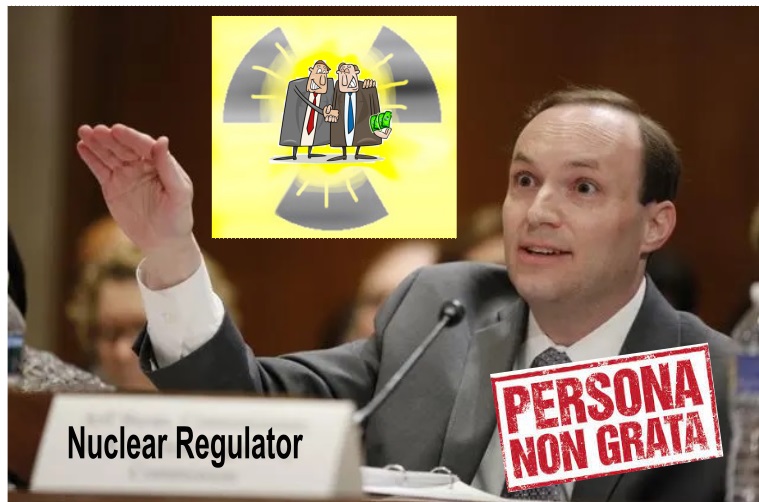
“We killed this nomination,” said Ted Nordhaus, executive director of the Breakthrough Institute, a California-based climate think tank that advocates for more nuclear energy.
Biden Drops Nuclear Regulator Nominee After Senate Backlash
Alexander C. Kaufman, Tue, 23 January 2024 https://au.news.yahoo.com/biden-drops-nuclear-regulator-nominee-190521226.html
President Joe Biden is dropping his pick to fill the open seat on the Nuclear Regulatory Commission after a handful of Democrats joined Senate Republicans to block the nomination last year, HuffPost has learned.
Jeff Baran had held a seat on the five-person federal panel overseeing atomic energy and radiation safety since former President Barack Obama first named to the position in 2014. The Democratic commissioner easily won Senate approval when former President Donald Trump renominated him in 2018.
But pro-nuclear advocates angry over what they saw as Baran’s unwillingness to overhaul the regulatory process in favor of building new types of reactor technologies launched a campaign against the commissioner last year. With Republicans opposed to the nomination, the Biden administration needed almost every Democrat in the Senate to vote for Baran ― or leave the NRC without a tie-breaker for party-line votes between the four current commissioners.
The White House had wanted the Senate’s narrow Democratic majority to reconfirm Baran before his term ended last July. But as many as four senators on the Democratic side, including Sen. Joe Manchin (D-W.Va.) and Sen. Kyrsten Sinema (I-Ariz.), either planned to come out against Baran or refused to pledge their votes, according to a source with knowledge of the process. Neither senator’s office immediately responded to emails requesting comment on Monday.
When the Senate ended 2023 last month without a vote, the nomination automatically went back to the White House.
The NRC directed HuffPost’s questions about when the administration would name its nominee for the open commission seat to the White House, which did not respond to a request for comment.
But three sources with knowledge of the plans confirmed to HuffPost that the Biden administration does not plan to nominate Baran again. Two spoke to HuffPost on condition of anonymity because they were not authorized to comment publicly. The third claimed Baran’s loss as a victory.
“We killed this nomination,” said Ted Nordhaus, executive director of the Breakthrough Institute, a California-based climate think tank that advocates for more nuclear energy.
He was among the most vocal opponents of Baran’s nomination, and helped drum up votes against the Democratic commissioner. Nordhaus had cast Baran as a holdover from an earlier era of liberal regulators who saw their job primarily as safeguarding the public against the atomic energy industry.
“It is my job to focus on nuclear safety and security,” Baran said in 2017 at his reconfirmation hearing before the Senate Environment and Public Works committee. “It is not my job to weigh in on the pros and cons of the merits of nuclear power.”
That view, Nordhaus said, was common among Democrats for decades. But a modern outlook on nuclear safety has to consider not only the threats of using atomic energy, but the risks that not doing so increases pollution from fossil fuels that damages lungs and traps heat in the planet’s atmosphere.
“Everyone went into this just assuming everybody would line up behind Baran, that this is just the kind of guy Democrats put on the commission,” Nordhaus said.
“The fact that enough Democratic senators were willing to say we’re not going to vote for this guy,” he added, “it’s pretty clear that for the first time in maybe ever a bunch of Democrats now recognize that we need reform at the NRC, that something has to change, that the technology can’t succeed if the NRC continues to approach this in the way it historically has.”
But Baran had defenders. The progressive pro-nuclear group Good Energy Collective previously told HuffPost Baran had a strong record of fighting for environmental justice and building relationships with communities saddled with radioactive pollution from the past.
Top Nuclear Regulator Faces Tough Reconfirmation Battle In The Senate
Biden wants to keep Jeff Baran on the Nuclear Regulatory Commission, but the GOP and pro-nuclear activists say he’s holding back an atomic renaissance.
Huff Post, By Alexander C. Kaufman, Jun 27, 2023
When President Barack Obama first named Jeff Baran to the Nuclear Regulatory Commission in 2014, the Democratic majority in the Senate confirmed the former congressional staffer in a 52-40 vote. When President Donald Trump renominated the Democrat for another five-year term in 2018, the GOP-led Senate approved Baran by a simple voice tally.
But President Joe Biden’s plan to give Baran a third stint on the federal body responsible for the world’s largest fleet of commercial reactors has already hit the rocks, as Republicans move to block a commissioner critics paint as an “obstructionist” with a record of voting for policies nuclear advocates say make it harder to keep existing plants open and more expensive, if not impossible, to deploy advanced next-generation atomic technologies.
Last Friday, the Senate went on break for the next two weeks, all but guaranteeing that Baran’s current term ends on June 30 without a decision on whether he will rejoin the five-member board, creating a vacancy that could cause gridlock on some decisions and mark a return to the partisan feuds of a decade ago…………
The White House and the Democrats who control the Senate hope to reinstate Baran in a vote next month, casting the regulator as a sober-minded professional with an ear to the woes of those living in polluted or impoverished communities. The battle highlights growing tensions over nuclear energy in the United States, the country that built the world’s first full-scale fission power plant nearly seven decades ago but all but ceased expanding atomic energy in the 30 years since the Cold War ended…………………………………………………………….
“His voting record shows he’s been a consistent obstructionist, a defender of a regulatory system that has basically presided over the long-term decline of the nuclear sector in the U.S.,” said Ted Nordhaus, executive director of the Breakthrough Institute, a California-based environmental think tank that advocates for nuclear energy. “There’s a broad view at a pretty bipartisan level that we need nuclear energy. If Democrats are serious about it, they have to stop putting a guy like Jeff Baran at the Nuclear Regulatory Commission.”
The Breakthrough Institute was among five pro-nuclear groups that signed on to a June 12 letter urging the Senate Committee on Environment and Public Works to reject the White House’s nomination of Baran for a third term.
The NRC declined HuffPost’s request to interview Baran…………………………………………………
The Case Against Baran
Baran came to power right as the last attempt at a “nuclear renaissance” fizzled…………………
As governments scrambled to keep operating reactors from going out of business, Baran voted last July to increase the frequency of federal safety inspections on existing nuclear plants, arguing that it would allow for “more focused inspections” that would “provide the staff flexibility to take a deeper dive into different areas of high safety importance” as the reactor fleet ages.
Baran also came out against measures that supporters of new reactor designs say would have helped tailor the regulatory process to the specific needs of novel technologies…………………
Baran issued the NRC’s sole vote against three recent proposals to make it easier to build an SMR at a former coal- or gas-fired plant, to tailor the size of the emergency preparedness zone to the size of the reactor, and to update the environmental permitting requirements for new reactors to account for the dramatic difference in water use between traditional and new designs…………..
While outnumbered by the other four commissioners, Baran’s hard-line view against easing regulations mirrors the Fukushima era in which he came to power, when Democrats Gregory Jaczko and Allison Macfarlane chaired the NRC and delivered on Reid’s efforts to block key nuclear projects. Nordhaus described Baran as a holdover from that period…………………..
The Case For Baran
Baran is not without his defenders among atomic energy advocates.
“It’s not as though he’s anti-nuclear,” said Jackie Toth, the Washington-based deputy director of the Good Energy Collective, a progressive pro-nuclear group headquartered in California. She noted that Baran’s critics often paint him as having the same views as Jaczko and Macfarlane. “To pool them together without looking at the full breadth of his record and what he’s done is unfair.”
“He prioritizes safety and not simply taking industry at its word,” Toth said. “It’s critical to have on the commission someone who understands both the need for increased nuclear capacity on our grid for climate, communities and energy security, but still wants to make sure the industry is putting its best foot forward.”
In particular, she said, Baran has been a crucial supporter of efforts to make it easier for poor and polluted communities — which, thanks to the U.S. history of racist legal and cultural norms, tend to be populated by Black, Latino or Native Americans — to participate in the public regulatory process. While she said she “did not have concerns regarding” the other commissioners’ dedication to environmental justice, Baran’s focus on the issue served to “complement” the other four regulators.
“We feel it’s an asset to have someone like him at the NRC who gets the climate imperative for new reactors but also upholds the agency’s mission to be a trusted regulator that prioritizes public health and safety,” Toth said.
‘Rolling The Dice’
But as Congress presses ahead with legislation to boost nuclear power, Baran’s opponents see him as a potential hurdle to implementing the laws.
In 2018, Congress passed the Nuclear Energy Innovation and Modernization Act, which directed the NRC to establish a novel regulatory framework for new technologies that takes into account the differences between advanced reactors and traditional ones. Baran consistently voted against adjusting the size of a new nuclear plant’s emergency planning zone to align with the size of the reactor, or insisted that the Federal Emergency Management Agency should decide even though the NRC is the regulator with the technical expertise to make the final call.
Over the past two years, Congress earmarked billions of dollars for new reactors in the landmark infrastructure laws Biden signed. And the same Senate committee that narrowly voted along party lines to confirm Baran’s renomination for another term overwhelmingly passed a new bill known as the ADVANCE Act to speed up deployment of new reactor technologies earlier this month………………………..
Nuclear start-up Newcleo drops plans for British factory in favour of France
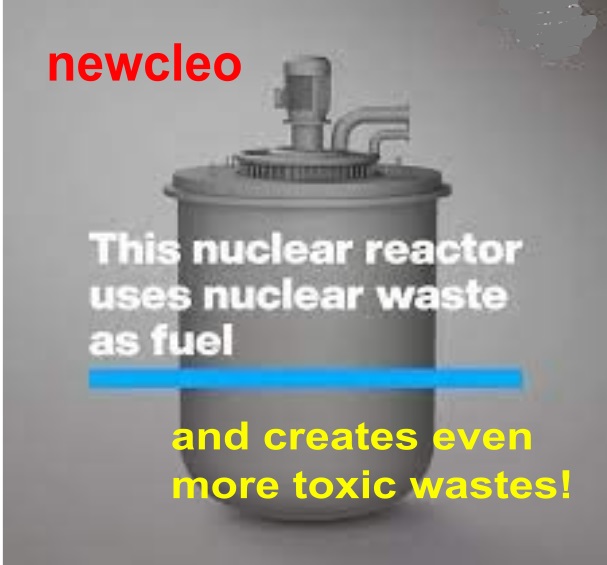
COMMENT. This is a very interesting article. For one thing, it shows that these “advanced” nuclear reactors require plutonium to get the fission process happening. It also claims that these advanced nuclear reactors can solve the problem of plutonium wastes. That is not true. The wastes resulting from this process are smaller in volume, but more highly toxic. That means that they require the same area/voume of space for disposal as the original plutonium. On another angle, it does indicate the confusion that the British government is in about the way ahead in their highly suspect “Civil Nuclear Roadmap”. And on another angle again, it shows how Macron’s France is putting all its eggs into the one nuclear basket. When we look at the extreme costs, and the extreme climate effects, Macron’s French nuclear obsession is likely to result in political suicide.
Matt Oliver, Sun, 21 January 2024, https://finance.yahoo.com/news/nuclear-start-drops-plans-british-131702123.html#:~:text=A%20British%20nuclear%20startup%20has,lobbied%20personally%20by%20Emmanuel%20Macron.
A British nuclear startup has dropped plans to build a pioneering power plant in Cumbria and will invest £4bn in France instead, after it was lobbied personally by Emmanuel Macron.
Newcleo, which is headquartered in London, is developing a type of mini nuclear power plant, known as an advanced modular reactor (AMR), that will use nuclear waste for fuel.
The company had hoped to tap into the UK’s vast stockpile of waste at Sellafield, where it wanted to invest £2bn in a waste reprocessing factory and AMR that would have created around 500 jobs.
It was also planning a similarly-sized facility in France.
But Stefano Buono, Newcleo’s chief executive and founder, said the company has now dropped the UK plans after the Government ruled out giving private companies access to the Sellafield stockpile in a nuclear industry “roadmap” published this month.
Instead, Newcleo is planning an enlarged development at an undisclosed location in the south of France, where it now plans to spend £4bn and create around 1,000 jobs, he said.
As part of that scheme, it will buy nuclear waste from French state energy giant EDF.
The company is also currently in the middle of a €1bn (£860m) fundraising.
The decision comes after the company was blocked from participating in the UK’s design competition for mini nuclear reactors.
By comparison, France has eagerly supported Newcleo and Mr Buono was lobbied repeatedly for investment by President Macron in face-to-face meetings.
Newcleo, which was also invited to last year’s “Choose France” business summit at the Palace of Versailles, has never been offered an in-person meeting with a British prime minister.
Mr Buono told The Telegraph: “Our plan initially was to use one factory in France and one in the UK.
“Now, we will double the capacity of France and we are not investing in the UK.”
He added that the company had hoped to pioneer its technology in Britain but added: “In two years, we were not able to even locate the site, so we have decided to accept the offer from France.
“We can proceed with our business model there.”
Newcleo’s decision to build its first plant abroad comes amid growing frustration within the British nuclear industry over the slow progress the Government has made towards identifying sites for new power plants.
The loss of significant investment to France will also be seen as the latest sign that Downing Street’s efforts to attract business investment are being outshone by President Macron, who has launched a charm offensive to lure companies across the Channel since Brexit.
He was the only G7 leader to attend the World Economic Forum in Davos, Switzerland, this week, while he has rolled out the red carpet for business leaders including Tesla boss Elon Musk and JP Morgan banker Jamie Dimon at his annual Choose France event.
Last year’s summit resulted in major deals, with Taiwanese car battery maker ProLogium unveiling plans for a €5.2bn plant at the port of Dunkirk and Verkor, a French company, pledging a €1.6bn battery factory there too.
In the UK, six SMR developers including Rolls-Royce have been shortlisted for support under a competition run by Great British Nuclear.
Newcleo was not considered because of the AMR’s lead cooling system and unusual fuel, Mr Buono has claimed.
The company’s novel design would run on processed plutonium, helping countries such as the UK dispose of the dangerous waste, which is expensive to manage. [Ed. This ignores the fact that this process results in a smaller volume of more highly toxic waste]
At Sellafield, the UK has amassed 140 tonnes of plutonium – the world’s biggest stockpile – as a result of historic nuclear weapons programmes and abandoned efforts to develop so-called fast breeding reactors that would have used it as fuel.
A massive effort is currently under way at the Cumbrian site to safely store the waste, but Mr Buono and his colleagues have argued it could be put to better use as reactor fuel.
The entrepreneur made his fortune selling cancer treatment developer AAA to Novartis for $3.9bn (£3.2bn) in 2017, reportedly earning him $420m.
His company has the backing of the Agnelli industrialist family, which made its money from Fiat and Ferrari.
The French government is expected to confirm a deal with Newcleo later this year.
The UK Government did not respond to requests for comment.
Even Britain’s ruling Tory party fear that their “Nuclear Roadmap” plan will end up on the scrap heap.

More nuclear power is the obvious solution to our energy security and Net Zero dilemmas. That doesn’t mean it is ever going to happen. Conservative Home, 19 Jan 24
Last week, Claire Coutinho published the Government’s “nuclear roadmap”. Sticking with Boris Johnson’s target of having a quarter of our electricity from nuclear by 2050, this attempts to explain how we achieve the quadrupling of nuclear capacity required to achieve the necessary 24 gigawatts (GW).
Rishi Sunak calls nuclear the “perfect antidote to the energy challenges facing Britain”. ………………………..
But the Government’s nuclear ambitions face an immediate stumbling block. At present, our nuclear capacity stands at 5.9GW, produced by five power stations. These are all owned by EDF, the French state energy group. Four of those plants – producing 4.7GW – are set to close in 2028.
EDF has floated keeping them open for longer. Yet even that would require Britain to massively ramp up its nuclear capacity in the next three decades to for us to have any hope of achieving the Government’s aim to come over a bit Doctor Manhatten. Following this, Coutinho has established an ambition to invest in new nuclear capacity of between 3GW and 7GW every five years from 2030 to 2044.
Work is already in progress. Hinkley Point C in Somerset is under construction. Sizewall C is planned for Suffolk, with a final investment decision due to be made by the end of this year. The Government is considering approving the construction of a third similarly sized power station. Additionally, ministers want to build a fleet of “small modular reactors” alongside these larger plants.
………………………………….. Johnson’s tongue-in-cheek vision of an SMR in “every Labour seat” remains as much of a fantasy as any of his mooted grands projets. Putting so much faith in SMRs to deliver our nuclear dreams is wishful thinking by Coutinho. But that is true of her whole “roadmap” and the ambitions behind them.
As Sam Dumitriu points out, when Hinkley opens in 2028, it will not only be the first nuclear power station built in Britain for over three decades, but the second most expensive nuclear power station built in history on a pound-per-megawatt basis. Having been due to open in the early 2020s, it is now expected to cost £32 billion. Some expect its construction could be further delayed into the 2030s.
This bodes poorly for Coutinho’s touted “nuclear awakening”. ………….
Capital costs make up around 60 per cent of nuclear’s levelised cost of energy. The average has been estimated at $6041-per-kilowatt – over 50 per cent more than coal and 500 more than gas. Factoring in that building a nuclear power station in Britain usually takes around 13 years, and it becomes obvious why investing in nuclear remains unattractive. Financing Hinkley involved the Government agreeing to a wholly uncompetitive deal…………………………….
The Government hopes an overhaul of planning rules could allow SMRs to be approved in a variety of locations, especially brownfield sites, away from areas with population densities of more than 5,000 people per square kilometre. However, there is still plenty of opportunity for applications to be denied based on natural beauty, ecology, cultural heritage, size, or flood risk. To combat NIMBYism, we would need to stuff a few mouths with gold.
Britain’s nuclear ambitions are also hampered by our current reliance on EDF. From leading the world in nuclear technology in the 1950s, our long lag since last constructing a plant has seen a loss of know-how, leaving us reliant on EDF for larger plants. Not only has this left us having signed an expensive deal for Hinkley, but it has entrusted our energy security to a company with a record of costly delays.
This is of a piece with our long tradition of nuclear short-sightedness. As Peter Franklin has pointed out, Johnson and Sunak follow Harold Wilson, Margaret Thatcher, and Tony Blair in making grand pronouncements of a fleet of new British nuclear reactors. Little has good came of any of them. Amidst some substantial competition, we can count Hinkley as one of Blair’s most ignominious legacies.
We can expect Coutinho’s proposals to end up on a similar scrapheap. Labour says they are keen on more nuclear. But they will face the same problems of regulation, construction costs, and political volatility. It might take only another Fukushima for the public to go all German on our nuclear future…..
The Last Flurry: The US Congress and Australian Parliamentarians seek Assange’s Release

January 19, 2024 : Dr Binoy Kampmark, https://theaimn.com/the-last-flurry-the-us-congress-and-australian-parliamentarians-seek-assanges-release/
On February 20, Julian Assange, the daredevil publisher of WikiLeaks, will be going into battle, yet again, with the British justice system – or what counts for it. The UK High Court will hear arguments from his team that his extradition to the United States from Britain to face 18 charges under the Espionage Act of 1917 would violate various precepts of justice. The proceedings hope to reverse the curt, impoverished decision by the remarkably misnamed Justice Jonathan Swift of the same court on June 6, 2023.
At this point, the number of claims the defence team can make are potentially many. Economy, however, has been called for: the two judges hearing the case have asked for a substantially shortened argument, showing, yet again, that the quality of British mercy tends to be sourly short. The grounds Assange can resort to are troublingly vast: CIA-sponsored surveillance, his contemplated assassination, his contemplated abduction, violation of attorney-client privilege, his poor health, the violation of free-speech, a naked, politicised attempt by an imperium to capture one of its greatest and most trenchant critics, and bad faith by the US government.
Campaigners for the cause have been frenzied. But as the solution to Assange’s plight is likely to be political, the burden falls on politicians to stomp and drum from within their various chambers to convince their executive counterparts. In the US Congress, House Resolution 934, introduced on December 13 by Rep. Paul A. Gosar, an Arizona Republican, expresses “the sense of the House of Representatives that regular journalistic activities are protected under the First Amendment, and that the United States ought to drop all charges against and attempts to extradite Julian Assange.”
The resolution sees a dramatic shift from the punishing, haute view taken by such figures as the late Democratic Senator Dianne Feinstein, who was one of the first political figures to suggest that Assange be crucified on the unsteady timber of the Espionage Act for disclosing US cables and classified information in 2010. The resolution acknowledges, for instance, that the disclosures by WikiLeaks “promoted public transparency through the exposure of the hiring of child prostitutes by Defense Department contractors, friendly fire incidents, human rights abuses, civilian killings, and United States use of psychological warfare.” The list could be sordidly longer but let’s not quibble.
Impressively, drafters of the resolution finally acknowledge that charging Assange under the Computer Fraud and Abuse Act (CFAA) for alleged conspiracy to help US Army intelligence analyst Chelsea (then Bradley) Manning access Defense Department computers was a fabled nonsense. For one, it was “impossible” – Manning “already had access to the mentioned computer.” Furthermore, “there was no proof Mr Assange had any contact with said intelligence analyst.”
Ire is also directed at the espionage counts, with the resolution noting that “no other publisher has ever been prosecuted under the Espionage Act prior to these 17 charges.” A successful prosecution of the publisher “would set a precedent allowing the United States to prosecute and imprison journalists for First Amendment protected activities, including the obtainment and publication of information, something that occurs on a regular basis.”
Acknowledgment is duly made of the importance of press freedoms to promote transparency and protect the Republic, the support for Assange, “sincere and steadfast”, no less, shown by “numerous human rights, press freedom, and privacy rights advocates and organizations”, and the desire by “at least 70 Senators and Members of Parliament from Australia, a critical United States ally and Mr Assange’s native country” for his return.
Members of Australia’s parliament, adding to the efforts last September to convince members of Congress that the prosecution be dropped, have also written to the UK Home Secretary, James Cleverly, requesting that he “undertake an urgent, thorough and independent assessment of the risks to Mr Assange’s health and welfare in the event that he is extradited to the United States.”
The members of the Bring Julian Assange Home Parliamentary Group draw Cleverly’s attention to the recent UK Supreme Court case of AAA v Secretary of State for the Home Department which found “that courts in the United Kingdom cannot just rely on third party assurances by foreign governments but rather are required to make independent assessments of the risk of persecution to individuals before any order is made removing them from the UK.
It follows that the approach taken by Lord Justices Burnett and Holroyde in USA v Assange [2021] EWHC 3133 was, to put it politely, a touch too confident in accepting assurances given by the US government regarding Assange’s treatment, were he to be extradited. “These assurances were not tested, nor was there any evidence of independent assessment as to the basis on which they could be given and relied upon.”
The conveners of the group point to Assange’s detention in Belmarsh prison since April 2019, his “significant health issues, exacerbated to a dangerous degree by his prolonged incarceration, that are of very real concern to us as his elected representatives.” They also point out the rather unusual consensus between the current Australian Prime Minister, Anthony Albanese, and his opposition number, Peter Dutton, that the “case has gone on for too long.” Continued legal proceedings, both in the UK, and then in the US were extradition to take place “would add yet more years to Mr Assange’s detention and further imperil his health.”
In terms of posterity’s calling, there are surely fewer better things at this point for a US president nearing mental oblivion to do, or a Tory government peering at electoral termination to facilitate, than the release of Assange. At the very least, it would show a grudging acknowledgment that the fourth estate, watchful of government’s egregious abuses, is no corpse, but a vital, thriving necessity.
Military interests are pushing new nuclear power – and the UK government has finally admitted it

……………… the latest announcement, Civil Nuclear: Roadmap to 2050, - in this supposedly “civil” strategy – are multiple statements about addressing “civil and military nuclear ambitions” together to “identify opportunities to align the two across government”.
French president Emmanuel Macron summarises: “without civil nuclear power, no military nuclear power, without military nuclear, no civil nuclear”.
Andy Stirling Professor of Science & Technology Policy in the Science Policy Research Unit, University of Sussex, Philip JohnstoneResearch Fellow, SPRU, University of Sussex, January 19, 2024 https://theconversation.com/military-interests-are-pushing-new-nuclear-power-and-the-uk-government-has-finally-admitted-it-216118
The UK government has announced the “biggest expansion of the [nuclear] sector in 70 years”. This follows years of extraordinarily expensive support.
Why is this? Official assessments acknowledge nuclear performs poorly compared to alternatives. With renewables and storage significantly cheaper, climate goals are achieved faster, more affordably and reliably by diverse other means. The only new power station under construction is still not finished, running ten years late and many times over budget.
So again: why does this ailing technology enjoy such intense and persistent generosity?
…………………………………………………………………………….. A document published with the latest announcement, Civil Nuclear: Roadmap to 2050, is also more about affirming official support than substantively justifying it. More significant – in this supposedly “civil” strategy – are multiple statements about addressing “civil and military nuclear ambitions” together to “identify opportunities to align the two across government”.
These pressures are acknowledged by other states with nuclear weapons, but were until now treated like a secret in the UK: civil nuclear energy maintains the skills and supply chains needed for military nuclear programmes.
The military has consistently called for civil nuclear
Official UK energy policy documents fail substantively to justify nuclear power, but on the military side the picture is clear.
For instance, in 2006 then prime minister Tony Blair performed a U-turn to ignore his own white paper and pledge nuclear power would be “back with a vengeance”. Widely criticised for resting on a “secret” process, this followed a major three volume study by the military-linked RAND Corporation for the Ministry of Defence (MoD) effectively warning that the UK “industrial base” for design, manufacture and maintenance of nuclear submarines would become unaffordable if the country phased out civil nuclear power.
A 2007 report by an executive from submarine-makers BAE Systems called for these military costs to be “masked” behind civil programmes. A secret MoD report in 2014 (later released by freedom of information) showed starkly how declining nuclear power erodes military nuclear skills.
In repeated parliamentary hearings, academics, engineering organisations, research centres, industry bodies and trade unions urged continuing civil nuclear as a means to support military capabilities.
In 2017, submarine reactor manufacturer Rolls Royce even issued a dedicated report, marshalling the case for expensive “small modular reactors” to “relieve the Ministry of Defence of the burden of developing and retaining skills and capability”.
The government itself has remained coy about acknowledging this pressure to “mask” military costs behind civilian programmes. Yet the logic is clear in repeated emphasis on the supposedly self-evident imperative to “keep the nuclear option open” – as if this were an end in itself, no matter what the cost. Energy ministers are occasionally more candid, with one calling civil-military distinctions “artifical” and quietly saying: “I want to include the MoD more in everything we do”……………………………………………………………………………………..
This is even more evident in actions than words. For instance hundreds of millions of pounds have been prioritised for a nuclear innovation programme and a nuclear sector deal which is “committed to increasing the opportunities for transferability between civil and defense industries”.
An open secret
Despite all this, military pressures for nuclear power are not widely recognised in the UK. On the few occasions when it receives media attention, the link has been officially denied.
Other nuclear-armed states are also striving to maintain expensive military infrastructures (especially around submarine reactors) just when the civilian industry is obsolescing. This is true in the US, France, Russia and China.
Other countries tend to be more open about it, with the interdependence acknowledged at presidential level in the US for instance. French president Emmanuel Macron summarises: “without civil nuclear power, no military nuclear power, without military nuclear, no civil nuclear”.
This is largely why nuclear-armed France is pressing the European Union to support nuclear power. This is why non-nuclear-armed Germany has phased out the nuclear technologies it once lead the world in. This is why other nuclear-armed states are so disproportionately fixated by nuclear power.
These military pressures help explain why the UK is in denial about poor nuclear performance, yet so supportive of general nuclear skills. Powerful military interests – with characteristic secrecy and active PR – are driving this persistence.
Neglect of this picture makes it all the more disturbing. Outside defence budgets, off the public books and away from due scrutiny, expensive support is being lavished on a joint civil-military nuclear industrial base largely to help fund military needs. These concealed subsidies make nuclear submarines look affordable, but electricity and climate action more costly.
The conclusions are not self-evident. Some might argue military rationales justify excessive nuclear costs. But history teaches that policies are more likely to go awry if reasons are concealed. In the UK – where nuclear realities have been strongly officially denied – the issues are not just about energy, or climate, but democracy.
The Conversation asked the UK Department for Energy Security and Net Zero to comment but did not receive a reply before the publication deadline. https://theconversation.com/military-interests-are-pushing-new-nuclear-power-and-the-uk-government-has-finally-admitted-it-216118
Weatherwatch: UK push for civil atomic power highlights link with nuclear weapons

Government previously denied evidence countries with nuclear weapons favour atomic power over renewables
Paul Brown, Fri 19 Jan 2024, https://www.theguardian.com/news/2024/jan/19/weatherwatch-uk-push-civil-atomic-power-highlights-link-nuclear-weapons
There is long running debate about whether nuclear power has a role in combatting the climate crisis. The UK government decided last week it was vital and is planning a vast expansion. Most environmental groups remain sceptical, preferring quicker and cheaper renewables.
Whatever the merits of the case there was, buried deep in the government’s nuclear roadmap, a complete somersault on the relationship between civil and military nuclear power. Back in the 1980s and 1990s when the Guardian carried reports from Sussex University’s Science Policy Research Unit (SPRU), among others, showing there was a link between the two, the government continuously denied it.
SPRU persevered with its work and noted that despite the UK’s denials, across the world it has become more obvious that states with nuclear weapons remain keen on atomic power while those without them put renewables centre stage.
Last week the government’s arguments in favour of new civil nuclear power swept aside any lingering doubt its predecessors had been covering up the link. The roadmap policy document mentioned 14 times in different sections the need to continue to strengthen the existing cooperation and tie-ups between the civil and military industries to the benefit of both. The logic is to keep to a minimum the training and development costs for both the weapons and power sectors.
UK’s nuclear obsessions kill off its net zero strategy

The new Roadmap reads like an outing to a massive nuclear sweet shop. On top of Hinkley Point C and Sizewell C, we’ll have one more big one. And then we’ll have lots of Small Modular Reactors, all over the country. And we’ll have a new fuel processing plant. And a new Geological Disposal Facility – at some much more distance point. And so on and on. 24 fantastical Gigawatts to be designed and delivered by 2050.
Jonathon Porritt, 18 Jan 24
After 14 years of Tory mismanagement, the UK finds itself bereft of an energy strategy.
This was finally confirmed in the release last week of the Government’s new Nuclear Roadmap. At one level, it’s just the same old, same old, the latest in a very long line of PR-driven, more or less fantastical wishlists for new nuclear in the UK. But at another, it’s a total revelation.
For years, a small group of dedicated academics and campaigners have suggested that the UK Government’s Nuclear Energy Strategy is being driven more by the UK’s continuing commitment to an “independent” nuclear weapons capability than by any authoritative energy analysis. For an equal number of years, this was aggressively rebutted by one Energy Minister after another, both Tory and Labour.
The new Nuclear Roadmap dramatically changes all that. It sets to one side any pretence that the links between our civil nuclear programme and our military defence needs were anything other than small-scale – and of no material strategic significance. With quite startling transparency and clarity, the Roadmap not only reveals the full extent of those links, but positively celebrates that co-dependency as a massive plus in our ambition to achieve a Net Zero economy by 2050.
“Startling” is actually an understatement. Such a comprehensive volte-face is rare in policy-making circles. Every effort is usually made by Ministers to obscure the scale (let along the significance) of any such screeching handbrake turns. That is so not the case with the new Roadmap.
Courtesy of the latest forensic work done by Professors Andy Stirling and Phil Johnstone at Sussex University (who have been absolutely at the forefront of seeking to bring these links into the public domain over many years – often with mighty little support from mainstream environmental organisations, let alone “independent” commentators), chapter and verse of this volte-face can be laid bare. Just three o examples from the Roadmap:
- “Not only does this Roadmap set a clear path for the growth of nuclear fission…it acknowledges the crucial importance of the nuclear industry to our national security, both in terms of energy supply and the defence nuclear enterprise.”
- “Government will proactively look for opportunities to align delivery of the civil and nuclear defence enterprises, whilst maintaining the highest standards of non-proliferation.”
- “To address the commonalities across the civil and defence supply chains, and the potential risk to our respective nuclear programmes due to competing demand for the supply chain, the Department of Energy Security and Net Zero (DESNZ) is working closely with the Ministry of Defence and the Defence Nuclear Sector.”
And there’s a whole lot more than that! As Andy Stirling has said: “Without any reflection on what this says about previous efforts to suppress discussion of this issue, the Government is now openly emphasising its significance.”
Indeed!
As usual, the UK’s ill-informed and unbelievably gullible mainstream media would appear to have missed the significance of this gobsmacking inflection point. So one can hardly expect them to have grasped its even more significant implications for UK energy strategy as a whole. In every single particular.
Let me briefly unpack some of those particulars:
- Nuclear
The new Roadmap reads like an outing to a massive nuclear sweet shop. On top of Hinkley Point C and Sizewell C, we’ll have one more big one. And then we’ll have lots of Small Modular Reactors, all over the country. And we’ll have a new fuel processing plant. And a new Geological Disposal Facility – at some much more distance point. And so on and on. 24 fantastical Gigawatts to be designed and delivered by 2050.
The reality couldn’t be more different:
- We will indeed end up with Hinkley Point C – at a staggering of cost of somewhere between £26 billion and £30 billion, with consumers paying twice as much for its electricity as they will for offshore wind. And it will almost certainly not come online until the end of the decade, 15 years on from the time it was meant to be up and running.
- We may possibly get Sizewell C, though the Government cannot currently guarantee the required level of investment. So a Final Investment Decision is unlikely before the next Election. At which point, Starmer may come to his senses and kill off this absurd white elephant.
- We will never get a third big reactor. The economics are literally impossible to justify.
- We are unlikely to get more than a couple of hugely expensive Small Modular Reactors, at some indeterminate point in the future, even with a new “flexible approach” to planning and financial inducements. Even that may prove to be an illusion. As Professor Steve Thomas has written: “Advocates of Small Nuclear Reactors claim they are cheaper and easier to build, safer, generate less waste, and will create many jobs compared to existing large reactor designs. These claims are unproven, misleading, or just plain wrong. Worldwide, no commercial design of SMR has even received a firm order yet.”
- And we may or may not get life extensions for the last five power stations in the “legacy fleet” – subject to regulatory approval, which may not be all that easy given extensive cracking in their reactor cores.
In short, the Roadmap is just a massive diversion from reality. Entailing incalculable opportunity costs. And putting at risk our entire Net Zero by 2050 strategy.
Ministers know all that. But they don’t really care. Our nuclear weapons programme (including upgrading Trident) will be protected as a consequence of this, via an unceasing flow of public money into the civil nuclear cul-de-sac, at a time when our defence budget is already massively overstretched. So who cares about the missing 24GW?
- Renewables
We’ll continue to see new investment into renewables here in the UK, despite (not because of) government policy, which has seriously messed up our offshore wind industry, maintained a de facto ban on onshore wind, couldn’t care less about solar, witters on vapidly about tidal without doing anything etc etc.
Meanwhile, on a global basis, renewables continue to boom. Here are a few facts – in contrast to over-excited sightings of nuclear unicorns:…………………………………………………………………………………………………………………………………………………………
Why don’t people see this?
Why don’t our mainstream media offer any serious critique of what’s going on here?
Why don’t our opposition parties rip to shreds this tissue of preposterous illusions?
The reasons for this almost complete silence can be traced back to successive governments’ grim intent to hang onto our so-called “independent nuclear deterrent”. At literally any costs…………………………………………………………………….more https://www.jonathonporritt.com/uks-nuclear-obsessions-kill-off-its-net-zero-strategy/
For Estonia the risks of going nuclear are high, and the plant not strictly necessary
ERR EE, Jevgeni Ossinovski, chair of the Social Democratic Party (SDE) parliamentary group, 20 Jan 24
Our worst-case scenario would be suspending Estonia’s sustainability efforts in anticipation of a nuclear power plant, Jevgeni Ossinovski (SDE) writes.
“….. nuclear power plants could be the preferable option in countries with high population density, high energy demand and limited land for renewable energy development.
A very different question is whether Estonia needs a nuclear power plant. We lack the skills, regulations, civil protection and monitoring systems, or even a waste disposal site, for building and operating a nuclear power plant. For all of these reasons, developing a nuclear facility carries significant risks and societal costs that would fall on future generations.
The report of the [Estonian] nuclear working group suggests that it is possible to build a nuclear power plant in Estonia, which is not surprising. Also, the report suggests ways to minimize some of the risks involved, but on several critical topics, such as the final disposal of nuclear waste, it provides little insight and merely states that a waste disposal solution will be eventually developed, which apparently does not yet exist.
Unfortunately, the report also fails to address the question, which is critical to Social Democrats: Is it unavoidable that Estonia needs a nuclear power plant, considering the long-term risks and consequences?
The board of the Social Democrats adopted the position that the answer to this question was “no” as early as 2021. There are other alternative approaches that could speed up the realization of our energy goals, and these are affordable, environmentally sustainable and reliable energy sources.
At the Social Democrats’ insistence, a goal of generating 100 percent of our electricity from renewable sources by 2030 has become law. The administration is aiming to establish the necessary regulatory structure to double renewable energy generation in the coming years.
This will give us a surplus of energy for over half the year, which we should aim to store for periods when there is no wind and little sun, or export. So we’ll be supported by fast-growing storage capacity (the soon-to-be-built Paldiski hydropump and battery storage), better consumption management and links to neighboring nations where we can also get electricity in cases of shortages for most of the remaining hours………………………………………………………………………………………..
The development of renewables, storage facilities, consumption management, and international trade will give us what we need: economical, climate-friendly and secure electricity under normal grid conditions, while we also have sufficient reserve capacity for extreme cases……………………………….
Our worst-case scenario would be suspending Estonia’s sustainability efforts in anticipation of a nuclear power plant. If the plant is not built in 10 years due to public opposition, a political decision, the immaturity of [small modular reactor] technology, or a lack of investment (all of which are real risks), we will be facing a sinkhole and the National Audit Office once again will have to admit that decision-makers shortchanged the Estonian people.
Should new circumstances emerge that indicate Estonia is incapable of achieving its energy policy goals without a nuclear power plant, we will be ready to reassess our position. So far, the nuclear energy working group failed to address this issue in its report. https://news.err.ee/1609227519/ossinovski-risks-of-going-nuclear-high-and-the-plant-not-strictly-necessary
It’s All About Me: Netanyahu Rejects Palestinian Statehood

January 20, 2024Written by: Dr Binoy Kampmark, https://theaimn.com/its-all-about-me-netanyahu-rejects-palestinian-statehood/
Israel has been given enormous license to control the security narrative in the Middle East for decades. This is not to say it is always in control of it – the attacks of October 7 by Hamas show that such control is rickety and bound, at stages, to come undone. What matters for Israeli security is that certain neighbours always understand that they are never to do certain things, lest they risk existential oblivion.
For instance, no Middle Eastern state will be permitted to acquire nuclear weapons on the Jewish State’s watch. Nuclear reactors and facilities will be struck, infected, or pulverised altogether (Osirak at Tuwaitha, Iraq; the Natanz site in Iran), with, or without knowledge, approval or participation of the United States.
This is a signature mark of Israeli foreign and defence policy: the nuclear option remains the greatest, single affirmation of sovereignty in international relations. To possess it, precisely because of its destructive and shielding potential, is to proclaim to the community of nation states that you have lethal insurance against invasion and regime change. Best, then, to make sure others do not possess it.
Israel, on the other hand, will be permitted to develop its own cataclysmic inventory of weapons, platforms, and doomsday options, all the while claiming strategic ambiguity about the whole matter. In that strangulating way, Israeli policy resembles the thornily disingenuous former US President Bill Clinton’s approach to taking drugs and oral sex: he did not inhale, and oral pleasuring by one by another is simply not sex.
The latest remarks from Israeli Prime Minister Benjamin Netanyahu on January 18 suggest that the license also extends to ensuring that Palestinians will never be permitted a sovereign homeland, that they will be, in a perverse biblical echo, kept in a form of bondage, downtrodden, oppressed and, given what happened on October 7 last year, suppressed. This is to ensure that, whatever the grievance, that they never err, never threaten, and never cause grief to the Israeli State. To that end, it is axiomatic that their political authorities are kept incipient, inchoate, corrupt and permanently on life support, the tolerated beggars and charity seekers of the Middle East.
At the press conference in question, held at the Kirya military base in Tel Aviv, Netanyahu claimed that, “Whoever is talking about the ‘day after Netanyahu’ is essentially talking about the establishment of the Palestinian state with the Palestinian Authority.” (How very like the Israeli PM to make it all about him.) The Israel-Palestinian conflict, he wanted to clarify, was “not about the absence of a state, a Palestinian state, but rather about the existence of a state, a Jewish state.”
With monumental gall, he complained that “All territory we evacuate, we get terror, terrible terror against us.” His examples, enumerated much like sins at a confessional, were instances where Israel, as an occupying force, had left or reduced their presence: Gaza, southern Lebanon, parts of Judea and Samaria (the West Bank). It followed that “any future arrangement, or in the absence of any future arrangement,” Israel would continue to maintain “security control” of all lands west of the Jordan River. “That is a vital condition.”
As such lands comprise Israeli territory, Gaza and the West Bank, Palestinian sovereignty can be assuredly ignored as a tenable outcome in Netanyahu’s policed paradise. He even went so far as to acknowledge that this “contradicts the idea of sovereignty” as far as the Palestinians are concerned. “What can you do? I tell this truth to our American friends.”
As to sceptical mutterings in the Israeli press about the country’s prospects of defeating Hamas decisively, Netanyahu was all foamy with indignation. “We will continue to fight at full strength until we achieve our goals: the return of all our hostages – and I say again, only military pressure will lead to their release; the elimination of Hamas; the certainty that Gaza will never again represent a threat to Israel. There won’t be any party that educates for terror, funds terror, sends terrorists against us.”
This hairbrained policy of ethno-religious lunacy masquerading as sane military strategy ensures that permanent war nourished by the poison of blood-rich hatred and revenge will continue unabated. In keeping such a powder keg stocked, there is always the risk that other powers and antagonists willing to have a say through bombs, rockets and drones will light it. Should this or that state be permitted to exist or come into being? The answer is bound to be convulsively violent.
It is of minor interest that officials in the United States found Netanyahu’s comments a touch off-putting. US Secretary of State Antony Blinken had, it is reported, dangled a proposal before the Israeli PM that would see Saudi Arabia normalise relations with Israel in exchange for an agreement to facilitate the pathway to Palestinian statehood. Netanyahu did not bite, insisting that he would not be a party to any agreement that would see the creation of a Palestinian state.
Blinken, if one is to rely on the veracity of the account, suggested that the removal of Hamas could never be achieved in purely military terms; a failure on the part of Israel’s leadership to recognise that fact would lead to a continuation of violence and history repeating itself.
In Washington, State Department spokesperson Matthew Miller stated in the daily press briefing that “Israel faces some very difficult choices in the months ahead.” The conflict in Gaza would eventually end; reconstruction would follow; agreement from various countries in the region to aid in that effort had been secured – all on the proviso that a “tangible path to the establishment of a Palestinian state” could be agreed upon.
For decades, administrations in Washington have fantasised about castles in the skies, the outlandish notion that Palestinians and Israelis might exist in cosy accord upon lands stolen and manured by brutal death. Washington, playing the Hegemonic Father, could then perch above the fray, gaze paternally upon the scrapping disputants, and suggest what was best for both. But the two-state solution was always encumbered and heavily conditioned to take place on Israeli terms, leaving all mediation and interventions by outsiders flitting gestures lacking substance.
Now, no one can claim otherwise that Palestinian statehood is anything other than spectral, fantastic, and doomed – at least under the current warring regime. Netanyahu’s own political survival, profanely linked to Israel’s own existence, depends on not just stifling pregnancies in Gaza but preventing the birth of a nationally recognised Palestinian state.
No Palestinian state – Netanyahu

https://www.rt.com/news/590919-no-palestinian-state-netanyahu/ 19 Jan 24
The US and Israel have clashed over the future of post-war Gaza
Prime Minister Benjamin Netanyahu has declared that Israel “will not settle for anything short of an absolute victory,” rejecting calls from Washington to either wind down the hostilities in Gaza or support the creation of a Palestinian state.
The US pushed for the realization of the two-state solution earlier this week in Davos, with US Secretary of State Antony Blinken arguing that Israel’s path to “genuine security” lay with the formation of a Palestinian state.
The Israeli PM dismissed the idea on Thursday, asserting that “Israel must maintain security control over all the territory west of the Jordan River,” to ensure no “terror is leveled against” the Israeli people.
“We will not settle for anything short of an absolute victory… That collides with the idea of [Palestinian] sovereignty. What can we do?” Netanyahu said at a press briefing in Tel Aviv. “I have explained this truth to our American friends, and I put the brakes on the attempt to coerce us to a reality that would endanger the state of Israel.”
However, Washington believes there is no way to solve Israel and Gaza’s long- and short-term problems “without the establishment of a Palestinian state,” US State Department spokesperson Matthew Miller reiterated on Thursday.
During Blinken’s Middle East tour last week, the US delegation allegedly secured agreements with several Arab leaders to participate in rebuilding Gaza, provided that Israel moves forward with a two-state solution for Palestine.
“For the first time in its history, you see the countries in the region who are ready to step up and further integrate with Israel and provide real security assurances to Israel and the United States is ready to play its part too, but they all have to have a willing partner on the other side,” Miller continued, calling this a “historic opportunity” for Israel.
The IDF military operation in Gaza has drawn condemnation from the surrounding Arab states, as well as the wider international community, as the death toll among Palestinians nears 25,000 people, according to local officials.
The war has caused widespread destruction of civilian infrastructure in Gaza and displaced over 80% of the enclave’s 2.3 million residents since the fighting erupted on October 7. Hamas militants attacked Israel on that day, killing more than 1,100 people and taking over 200 hostages. According to Israeli sources, more than 130 people remain in captivity.
The Times asks “Are big nuclear reactors really the right thing for the UK?

Nuclear minister Andrew Bowie had a case to hail it a “major
milestone”, with Julia Pyke, Sizewell’s joint managing director,
calling it a “significant moment” for the project and for UK “energy
security”.
Even so, there is still a long way to go. The project will
cost £30 billion-plus, with the PM yet to make a final investment
decision. Sizewell uses the same European pressurised reactor technology as
Hinkley: the Somerset nuke being built by France’s EDF and China’s CGN.
Who exactly will fund Sizewell? Alison Downes, of the Stop Sizewell C
campaign, is no neutral party. But she’s right to say the government is
“still months away” from securing finance, while keeping “secret”
the project’s “enormous cost”.
Bowie told the Financial Times he was
“very confident” of obtaining private finance, but the government is
now rowing back from the FT report that it’s “on track” to raise £20
billion. Even if it has changed the funding rubric to a “regulated asset
base” model that frontloads cost overruns on to consumer bills, investors
think that figure wildly optimistic. On a one third/two thirds split,
ministers need at least £10 billion of equity and £20 billion of debt.
But EDF wants no more than 19.9 per cent of Sizewell equity, while the UK
has booted off the Chinese. Ministers have reportedly lined up Abu Dhabi
funds for a chunk of the equity. But market talk is that the government is
still at least £5 billion short, while it also faces having to underwrite
all the debt — at least until it can syndicate some out once construction
hurdles are met.
Is this the best use of taxpayer’s money? And what’s
the risk private investors are given too generous terms? Yes, the wind
doesn’t blow or sun shine every day. So Britain will need baseload power
to offset intermittent renewables.
But, even if Sizewell C gets the
official go-ahead soon, it won’t be generating power until the late
2030s. A third station will be even further behind. Labour’s union
backers are typically pro-nuclear. But should Sir Keir Starmer come to
power, he must still tackle key questions. Are pricey mega nukes, largely
funded by the taxpayer and consumers, the right strategic bet for 2040? Or
do battery power, say, or modular nuclear reactors make more sense? The
government is yet to make a conclusive financial case for Sizewell C —
let alone any more.
Times 16th Jan 2024
https://www.thetimes.co.uk/article/sizing-up-sizewell-is-a-nuclear-option-fwpd2p53d
Biden administration finalizes a $1.1 billion aid package for California’s last nuclear power plant

LOS ANGELES (AP) — President Joe Biden’s administration on Wednesday finalized approval of $1.1 billion to help keep California’s last operating nuclear power plant running.
The funding is a financial pillar in the plan to keep the Diablo Canyon Power Plant producing electricity to at least 2030 — five years beyond its planned closing.
Terms of the aid package were not released by the Energy Department.
In 2016, plant operator Pacific Gas & Electric, environmental groups and plant worker unions reached an agreement to close the four-decade-old reactors by 2025. But the Legislature voided the deal in 2022 at the urging of Democratic Gov. Gavin Newsom, who said the power is needed to ward off blackouts as climate change stresses the energy system.
California is the birthplace of the modern environmental movement and for decades has had a fraught relationship with nuclear power. Environmentalists argued California has adequate power without the reactors and that their continued operation could hinder development of new sources of clean energy. They also warn that long-delayed testing on one of the reactors poses a safety risk that could result in an accident, a claim disputed by PG&E……………………… https://www.hindustantimes.com/world-news/biden-administration-finalizes-a-1-1-billion-aid-package-for-california-s-last-nuclear-power-plant-101705536723552.html
Sizewell C opponents warn Suffolk nuclear plant ‘could be the new HS2’.
Sizewell C opponents warn Suffolk nuclear plant ‘could be the new HS2’.
Campaigners fighting a new nuclear power station on the Suffolk coast say
they fear a shortfall in finance for the project could mean it becomes
another HS2. Their comments came amid a landmark moment for the building of
Sizewell C as a Development Consent Order was triggered, meaning
construction can begin. Andrew Bowie, the minister for nuclear and
renewables, was at the construction site to herald what he claimed was a
significant point in the development. The new power plant, which could
create 10,000 jobs, was given the go-ahead in November – but campaigners
opposed to it say they will not give up.
ITV 15th Jan 2024
https://www.itv.com/news/anglia/2024-01-15/coastal-nuclear-plant-could-be-new-hs2-warn-campaigners
lear plant ‘could be the new HS2’.
Nuclear power twice as expensive as the Swedish government thought?

Nuclear power may be almost twice as expensive as the government thought.
Nuclear power must stand on its own two feet, the government has said. But
Vattenfall’s latest assessment shows that new nuclear power can be almost
twice as expensive – which may require multibillion-dollar government
support.
Sweden’s forecasts from the Energy Agency are based on the fact
that electricity from new nuclear power is expected to cost 55-60 öre per
kilowatt hour. To be compared with 35 öre for wind power on land. SVT can
now reveal that Vattenfall has received price information from several
suppliers of both large and smaller so-called SMR reactors. The overall
conclusion is costs of 90-112 öre per kilowatt hour. Almost twice as much
as previous assessment, then. Vattenfall believes that this level mainly
applies to a first large-scale reactor, where you cannot lower the price
with economies of scale.
SVT Nyheter 16th Jan 2024
https://www.svt.se/nyheter/inrikes/karnkraften-kan-bli-nara-dubbelt-sa-dyr-som-regeringen-trott
1 This Month
23-25 October – on Zoom – World BEYOND War’s annual global conferenc


Shut down the radiation-damaged Heysham nuclear reactors now
To see nuclear-related stories in greater depth and intensity – go to https://nuclearinformation.wordpress.com

Say No to NASA’s Reckless Nuclear Reactor on the Moon
Say No to NASA’s Reckless Nuclear Reactor on the Moon
-
Archives
- October 2026 (180)
- September 2026 (339)
- August 2026 (330)
- July 2026 (355)
- June 2026 (287)
- May 2026 (306)
- April 2026 (356)
- March 2026 (251)
- February 2026 (267)
- January 2026 (308)
- December 2025 (358)
- November 2025 (359)
-
Categories
- 1
- 1 NUCLEAR ISSUES
- business and costs
- climate change
- culture and arts
- ENERGY
- environment
- health
- history
- indigenous issues
- Legal
- marketing of nuclear
- media
- opposition to nuclear
- PERSONAL STORIES
- politics
- politics international
- Religion and ethics
- safety
- secrets,lies and civil liberties
- spinbuster
- technology
- Uranium
- wastes
- weapons and war
- Women
- 2 WORLD
- ACTION
- AFRICA
- Atrocities
- AUSTRALIA
- Christina's notes
- Christina's themes
- culture and arts
- Events
- Fuk 2022
- Fuk 2023
- Fukushima 2017
- Fukushima 2018
- fukushima 2019
- Fukushima 2020
- Fukushima 2021
- general
- global warming
- Humour (God we need it)
- Nuclear
- RARE EARTHS
- Reference
- resources – print
- Resources -audiovicual
- Weekly Newsletter
- World
- World Nuclear
- YouTube
-
RSS
Entries RSS
Comments RSS

