Hinkley C – don’t say I didn’t warn you!
In 2016, I called for Hinkley C to be scrapped. Now its commissioning has been pushed back to the end of the decade and its costs have ballooned to as much as £48 billion in 2024 money. I was right.

MICHAEL LIEBREICH, JAN 25, 2024
“The case for Hinkley Point C has collapsed: It’s time to scrap it.” This was the title of an article I wrote for City AM in July 2016.
The story so far
For those who have forgotten those heady days, a quick recap. July 2016 was one month after the UK voted for Brexit. Prime Minister David Cameron and Chancellor George Osborne (whose pet project was Hinkley C, aided by energy minister in the previous Coalition government and currently LibDem leader, Ed Davey) had resigned. Theresa May had just taken over as Prime Minister.
The project already had a ghastly history. In the early 2000s, the nuclear industry, with French champion Areva in the lead (later driven into bankruptcy by cost overruns at Flamanville and Olkiluoto and rescued by EDF in 2017), announced a “Nuclear Renaissance” and was lobbying for a new build programme in the UK to replace aging plants set for retirement. In the absence of evidence, they claimed new plants would produce power for £24 per MWh (£39/MWh in 2024 money, or $50/MWh).
The Labour Party, long dead set against nuclear power, were convinced. In January 2008, Prime Minister Gordon Brown declared, in the preface to a White Paper on nuclear power entitled “Meeting the Energy Challenge” that “nuclear should have a role to play in the generation of electricity, alongside other low carbon technologies.” The White Paper estimated the total cost of building a 1.6GW nuclear plant at £2.8 billion – which would translate into £5.6 billion for Hinkley C’s 3.2GW (£9.0 billion or $11.5 billion in 2024 money).
EDF’s UK CEO Vincent de Rivaz was cock-a-hoop, predicting that Brits would be cooking their turkeys with power from Hinkley C by Christmas 2017. But remember that figure – £9.0 billion for 3.2GW.
By October 2013, Osborne and Davey had agreed a Contract for Difference with EDF for electricity production at a strike price of £92.50/MWh in 2012 money (£132/MWh in today’s money or $169/MWh) – rising with inflation for 35 years, but dropping to £87.50 (£125/MWh in today’s money or $173/MWh) if a second EPR were to be built. That EPR is Sizewell C – of which more later.
At that point, Hinkley C was expected to cost £16 billion in 2015 money (£22 billion in 2024 money or $28 billion). It was due to come online in 2023 and continue cooking Christmas turkeys for 60 years.
Since then, on five separate occasions EDF has announced that costs have increased, and the commissioning date pushed back. The only delay which was not fully in the control of EDF and it suppliers in the nuclear and construction industries was Covid – which can be blamed for around a year of delay and a couple of billion of cost increase, but not more.
Last week – yet another delay and cost increase
……………………. Now, I know that supporters of the project and hard-core nuclear fans will be bursting blood vessels at this point, desperate to jump in an explain that most of the difference between £9 billion and nearly £50 billion is down to financing cost resulting from the use of the CfD mechanism, regulatory cost, delay in government decision-making and so on. But I’m going to say it: I don’t care……………………………
How big things (don’t) get done
It is not like cost over-runs in nuclear projects are a big secret. The world’s leading academic expert on project management is Danish Professor Bent Flyvbjerg, author of How Big Things Get Done, who joined me on Cleaning Up last year. Having build a huge database of projects of different sources, he can definitively show that nuclear plants are worse only than Olympic Games in terms of cost over-runs. On average they go 120% over the budget, with 58% of them going a whopping 204% over budget.
The common trope among nuclear fans is that it is only in the western world that nuclear new build is either problematic or exorbitantly expensive, and this is driven by excessive regulation.
While excessive delays in emerging nuclear powers are certainly less common, there is no transparency over how this is achieved. There are ample examples of problems: the use of fake certification documents, the sealing of deals for reactor sales by military inducements, cutting corners on safety, failure to maintain control of the fuel supply chain, failure to disclose problems and accidents; unexplained accidents on aging plants.
There is also no transparency over the real cost of their plants. Put simply, these are are whatever their leaders say they are: it is they who decide the cost of capital, state guarantees, whether safety standards meet or exceed international standards, whether safety standards are enforced, the environmental standards applied to the supply chain, the speed projects proceed through licencing, the need or not to provision for decommissioning costs, the diversion of costs to military, energy or industrial budgets, and so on.
Back to 2016
Now let’s get back to Hinkley C, and 2016. One of the first things Theresa May did when she took over from David Cameron was to ask her security advisors to review the wisdom of allowing state-owned China General Nuclear to invest £6 billion in the project. In the end May backed down and allowed the investment to go ahead, but that is the background to my piece: the project’s future was in doubt, and it was the last realistic chance to kill it before tens of billions of pounds had been invested. And this is what I wrote: The case for Hinkley Point C has collapsed: It’s time to scrap it.
………………………………………………………………. It is worth remembering that while construction costs are in the £42 to £48 billion range, the 35 years of electricity at £87.50 or £92.50/MW in 2012 money, adjusted for inflation will cost UK energy users a gargantuan £111 or £116 billion over the next 35 years. Could we use that money better? You bet.
Summary
So there you have it. 2016 was a missed opportunity, most likely the last opportunity to scrap the benighted project, one of the worst blunders in the history of public procurement and of the UK’s energy industry.
Does that mean we should scrap it now? It’s almost certainly too late. EDF has probably spent so much on the project, that the net present value of its revenues exceeds the remaining cost to bring the project to completion
What I do know is that the UK must resist the French government demands that it put its hand in the public pocket for yet more money to support the project. The whole point of the structure put in place, with its super-generous and inflation-protected CfD strike price, was that EDF was to bear the risk of cost over-runs. These will come back to bite UK energy users in the form of higher power costs from Sizewell C, should that project go ahead. If the UK taxpayers have to bear the cost of cost over-runs, let’s just nationalise and be done with any pretence that the market bears any risk from nuclear power projects.
I know many will say I am just being anti-nuclear.
No, I’m pro-nuclear……..
………………… to paraphrase Oscar Wilde, “if Hinkley C, Flamanville, Olkiluoto and Vogtle are the way the nuclear industry treats its projects, it does not deserve to have any”. https://mliebreich.substack.com/p/hinkley-c-dont-say-i-didnt-warn-you
Holtec to get $1.5 bln loan to re-open Michigan nuclear power plant -source

By Timothy Gardner, February 1, 2024
Jan 30 (Reuters) – Holtec International is set to get a $1.5 billion conditional loan in February from the U.S. Energy Department to help it restart the Palisades nuclear power plant in Michigan, a person with knowledge of the matter said on Tuesday.
The loan from the Department of Energy’s Loan Programs Office (LPO) is likely to be announced in late February, the person said, declining to be identified as the information was not yet public.
The energy technology firm said it was “optimistic” about the federal loan process, which would help the company re-open a closed U.S. nuclear power plant for the first time in history.
“We hope for a timely approval to bring the plant back to full power operation toward the end of 2025,” said Holtec spokesperson Nick Culp, declining to comment on the size or timing of the loan.
Florida-based Holtec bought Palisades in 2022 from Entergy (ETR.N), opens new tab to decommission the plant after it struggled to compete with natural gas-fired plants and renewable energy……………………………………
Bloomberg first, opens new tab reported that the administration was poised to loan the company $1.5 billion as soon as next month, citing sources………………….
The Biden administration earlier this month finalized $1.1 billion in credits to keep PG&E Corp’s (PCG.N), opens new tab Diablo Canyon nuclear power plant in operation in California…………….more https://www.reuters.com/business/energy/holtec-get-15-bln-loan-re-open-michigan-nuclear-power-plant-source-2024-01-31/
How not to go nuclear: Hinkley and Sizewell

by DAVID HOWELL
David Howell: This is not just a matter of finding the cash to meet the
enormous budget overrun. The Chinese payments halt at Hinkley leaves a
growing gap. Love or hate them nowadays, they have already been edged out
of the Sizewell plan (they were actually paid £100m to leave), so the very
large Chinese contribution there will also have to be found from elsewhere.
But EDF has no more money, and the French think the British Government
should open its chequebook. HM Treasury thinks no such thing. So, to
repeat, who is going to fill the gap?
Copying Hinkley, and certainly copying its financial story, looks less attractive by the day. The British hope is that at Sizewell a new financial model, requiring consumers and
customers to pay extra for years in advance for their electricity, will
entice in investors, to replace the Chinese. One allegedly interested
“private investor” is said to be the not-so-private United Arab
Emirates government. But is that the kind of swap — the very non-aligned
UAE in place of the Chinese — that we need?
The Article 29th Jan 2024
https://www.thearticle.com/how-not-to-go-nuclear-hinckley-and-sizewell
Hinkley Point shambles shows why UK must scrap disastrous nuclear strategy.

Energy spokesperson Mark Ruskell is accusing Tories and Labour of wasting billions of pounds on nuclear technology
The UK government must scrap its disastrous nuclear strategy in light of the shambolic saga of the Hinkley Point power station, says the Scottish Greens climate spokesperson, Mark Ruskell MSP.
The call follows revelations that the Hinkley Point project has been hit by yet another delay of up to four more years, and that it could cost an eye watering £46 billion.
This month the UK government announced plans for the biggest expansion on nuclear energy for 70 years.
Mr Ruskell said: “Hinkley Point C has been a shambolic money pit. It’s been hit by delay after delay and the costs are escalating at an alarming rate. Nobody can say with any confidence when it will go live or how much money will have been wasted on it.
“Yet, the UK government wants to throw even more time and money into an unsafe, unreliable and eye-wateringly expensive energy source that will leave a terrible legacy for future generations.
“The climate crisis is happening all around us. We don’t have time to waste on a disastrous nuclear strategy. Renewable energy is the cleanest, greenest and cheapest energy available, that is what all governments should be focusing on.
“That is what we are doing with Scottish Greens in government in Scotland. Yet the Tories and Labour are committed to wasting billions of pounds on nuclear technology.”
Democrats press Blinken on arms sales to Israel without congressional approval
The Hill BY NICK ROBERTSON – 01/29/24
A bicameral coalition of nearly 20 Democrats urged the State Department on Monday to provide information on the Biden administration’s decisions to sell arms to Israel amid its ongoing war with Hamas without explicit congressional approval.
The letter, led by Sen. Elizabeth Warren (D-Mass.) and Rep. Jim McGovern (D-Mass.), increases pressure on the Biden White House from Democrats concerned with the U.S. role in the Gaza conflict, which has raged since Hamas’s attack in early October.
The Biden administration has bypassed congressional notification on Israel arms sales twice, raising concerns among the lawmakers.
The members of Congress “shared the world’s horror” over the violence of Hamas militants but are also “deeply disturbed” over Israel’s “indiscriminate bombing” of Palestinians in Gaza, the letter says.
“It is essential for Congress to be able to conduct oversight of these arms transfers and determine whether they are consistent with humanitarian principles and U.S. law, and whether they advance or harm U.S. national security,” the letter reads.
“It is highly unusual for the president to bypass congressional oversight through an emergency declaration,” it continues. “In fact, since the [Arms Export Control Act] was passed into law, an emergency declaration authority has only been used 18 times in nearly 50 years.”
The lawmakers drew attention to the mass civilian casualties in the conflict, and the use of U.S. munitions in strikes that killed civilians. More than 25,000 Palestinians have been killed in the conflict, according to the Gaza Health Ministry.
“We are also troubled by the decision to provide equipment for 155mm shells, which over 30 U.S.-based civil society organizations warned poses ‘a grave risk to civilians’ and are ‘inherently indiscriminate’ when used in densely populated areas like Gaza,” the letter reads.
Specifically, the letter demands Secretary of State Antony Blinken provide official explanations for why the administration chose to pursue emergency transfers of arms instead of the standard procedure of congressional notification.
“Congress and the American public deserve thorough answers on how this policy was applied for these two emergency transfers,” the lawmakers continued. “Use of a national emergency waiver does not exempt the U.S. government from assessing whether arms sales are consistent with these policies.”
Warren and McGovern were joined on the letter by Sen. Bernie Sanders (I-Vt.), Reps. Joaquin Castro (D-Texas), Pramila Jayapal (D-Wash), Barbara Lee (D-Calif.), Maxine Waters (D-Fla.), and 11 other lawmakers……………..https://thehill.com/policy/defense/4435699-democrats-blinken-arms-sales-to-israel-congressional-approval/
Blackwater Against New Nuclear Group (BANNG) firmly contradicts Therese Coffey, MP on Bradwell as a nuclear site.

Therese Coffey MP suggests Bradwell is a large brownfield site. In fact,
the site is occupied by the long closed Bradwell A power station now in the
process of decommissioning before being returned to greenfield land use.
Perhaps her most preposterous assertion is that ‘Bradwell has hosted
nuclear power and hopes to do so again in the future’. In fact, the
communities and Councils around the Blackwater estuary in Essex are
overwhelmingly against new nuclear development at Bradwell.
Many years ago, BANNG gathered 10,000 signatures face-to-face for a petition against new
nuclear development at Bradwell which was taken to Whitehall. Since then,
the Chinese developer, CGN, has withdrawn its proposals for a massive new
nuclear power station in the face of implacable hostility from the local
community.
‘Therese Coffey would do well to check her facts and look to
her own backyard and devote her campaigning against the destruction of the
Suffolk coast by the giant Sizewell C nuclear power station project, with
its long-term stores of radioactive wastes, rather than seek to impose
unwanted infrastructure on the precious marshlands of Essex.’
BANNG 31st Jan 2023
France limits its investment in Britain’s Sizewell C, as the global nuclear industry requires massive government subsidies

Why are nuclear power projects so challenging? Increasing nuclear energy
capacity is not easy. Projects across the globe have been fraught with
delays and budget overruns, with the Financial Times revealing last week
that France is pressing the UK to help fill budget shortfalls at the
Hinkley Point C project in England, being built by EDF.
The International Energy Agency (IEA) says nuclear projects starting between 2010 and 2020
are on average three years late, even as it forecasts nuclear power
generation will hit a record high next year and will need to more than
double by 2050. Technical issues, shortages of qualified staff,
supply-chain disruptions, strict regulation and voter pushback are the key
factors developers and governments are grappling with. In the US, Georgia
Power is scheduled to complete work within weeks on the second of two
gigantic new nuclear reactors that are at the vanguard of US plans to
rebuild its nuclear energy industry.
But the expansion of Plant Vogtle is
seven years late and has cost more than double the original price tag of
$14bn due to a series of construction problems, highlighting the complexity
of nuclear megaprojects. These complexities, high costs and long build
times — as well as strict regulation due to risks of nuclear accidents
— make nuclear power a daunting prospect for many investors.
As a result, the sector is heavily subsidised by governments. Many reactor suppliers for
large-scale projects are state-owned, working alongside the private sector
to build the full plant. But countries also have a limit on how much they
are willing to spend. EDF, now fully owned by the French state, will limit
its stake in its next planned UK plant, Sizewell C, to 20 per cent.
FT 1st Feb 2024
https://www-ft-com.ezproxy.depaul.edu/content/6d371375-b7be-4228-a3d5-2ad74f91454a
Ford Government Issues Blank Cheque for Nuclear Power, Shows Reckless Disregard for Nuclear Waste Generation

North Bay – Today’s announcement to refurbish four reactors at the Pickering Nuclear Generating Station is being heralded as a colossal failure in governance by groups concerned about the large volume of highly radioactive wastes that will be generated.
Rebuilding the four aging reactors to allow an additional 30 years of operation will cost the province’s ratepayers many billion dollars – the Minister refused to estimate the total cost – and will add to the growing stockpile of highly radioactive nuclear fuel waste and refurbishment wastes.
The Nuclear Waste Management Organization (NWMO), a consortium of nuclear utilities led by Ontario Power Generation, has been working on a plan to construct a deep geological repository for Canada’s reactor fuel wastes for over twenty years, but is still at the “concept” stage and has yet to secure a site for the proposed used fuel processing facility and the underground complex of tunnels where the waste would be placed.
There was not a single word of acknowledgement that this refurbishment will generate large volumes of high-level radioactive waste which will require care and containment into the far, far future. The Mayor of Pickering professed that his municipality is a willing host for the refurbishment project, but there is no willing host for the wastes it will generate,” commented Brennain Lloyd, a spokesperson with the northern Ontario based environmental coalition Northwatch.
The NWMO is currently investigating two “candidate” sites for its proposed deep geological repository project, one in northwestern Ontario between Ignace and Dryden, and one in southwestern Ontario in the municipality of South Bruce.
The NWMO has not produced a detailed plan for its DGR and key parts of the project are still at the “concept” stage, but the NWMO’s plans to date have been premised on the current fleet of reactors without the refurbishment of the four reactors at Pickering.
“Refurbishing four reactors at Pickering has a large impact on the NWMO’s plan, and should send the NWMO back to square 1 in terms of informing the potential host regions about the NWMO project and its timeline and impacts. It significantly adds to the length of operations and the radiological burden that will be imposed upon those along the transportation route and in the area of the proposed facilities”, Lloyd added.
Over the 30-year operating period an additional half-million radioactive fuel bundles would be added to the inventory the NWMO has been estimating to be 5.5 million. That additional volume would mean an additional 2,265 truckloads of highly radioactive waste and add more than 900 days of operation to the used fuel packaging plant, which is expected to release radionuclides into the local environment.
Since 2021 the NWMO has been projecting that the last shipments of waste would leave Pickering in 2050, but the refurbishment would mean radioactive waste would still require interim on-site storage until at least 2105, pushing it past the 2088 date for final receipt of waste at the NWMO’s DGR site.
Residents along the transportation routes and in the vicinity of the two sites being investigated are concerned about the low levels of radiation that will emanate from each of the 2-3 truck shipments per day, the risk of transportation accidents, the radioactive releases from the processing facility and by ventilating air from the underground facility unfiltered to the surface, and releases from the underground repository to ground and surface water. The NWMO has acknowledged in its own reports that the used fuel containers will fail over time.
Cracks appear in Labour-Green alliance over claims that Heysham power stations letter was ‘reckless’
Cracks have appeared in an alliance between Labour and the Greens after a
letter calling for the lives of Heysham Power Stations to be extended was
branded “reckless”. Lancaster City Council leader Phillip Black was also
accused of “operating outside the terms of a collaboration agreement”
between Labour and the Greens, who between them form the majority of the
council’s coalition cabinet.
Councillor Jack Lenox of the Greens also said
it was “completely inappropriate for Councillor Black to suggest that
pressure on the council’s budget should be a factor in extending the lives
of these nuclear power stations”. Councillor Black, from Labour, has
responded by accusing the Greens of “Machievellian nonsense” and making
“baseless accusations”.
Beyond Radio 30th Jan 2024
The Future of Pickering Nuclear Generating Station and Its Impacts on Ontario
News Networl Ledger ,By James Murray, January 30 2024
THUNDER BAY – POLITICS – The Ontario government has recently announced its support for Ontario Power Generation’s (OPG) plan to refurbish the “B” units (units 5-8) of the Pickering Nuclear Generating Station. ………………………………………………… Energy Minister Todd Smith emphasized the role of this refurbishment in attracting global business, noting that it would help Ontario compete for significant investments……………………………………………………..
Concerns and Challenges
However, this announcement has also raised concerns. Groups like Northwatch have criticized the plan for its potential environmental impact, particularly regarding the generation of highly radioactive waste. Brennain Lloyd, a spokesperson for Northwatch, expressed concerns about the absence of a long-term plan for managing this waste.
“Rebuilding the four aging reactors to allow an additional 30 years of operation will cost the province’s ratepayers many billion dollars – the Minister refused to estimate the total cost – and will add to the growing stockpile of highly radioactive nuclear fuel waste and refurbishment wastes,” states Northwatch.
“The Nuclear Waste Management Organization (NWMO), a consortium of nuclear utilities led by Ontario Power Generation, has been working on a plan to construct a deep geological repository for Canada’s reactor fuel wastes for over twenty years, but is still at the “concept” stage and has yet to secure a site for the proposed used fuel processing facility and the underground complex of tunnels where the waste would be placed”.
“There was not a single word of acknowledgement that this refurbishment will generate large volumes of high-level radioactive waste which will require care and containment into the far, far future. The Mayor of Pickering professed that his municipality is a willing host for the refurbishment project, but there is no willing host for the wastes it will generate,” commented Brennain Lloyd, a spokesperson with the northern Ontario based environmental coalition Northwatch.
The Nuclear Waste Management Organization (NWMO) is currently investigating potential sites for a deep geological repository to store Canada’s reactor fuel wastes. The additional waste from the refurbished Pickering reactors complicates this plan, potentially requiring a reassessment of the NWMO’s project and its impacts.
Residents along the transportation routes and near the proposed repository sites are worried about radiation exposure, transportation accidents, and environmental releases from the processing facility and underground storage.
Regulatory Oversight and Future Steps
The Canadian Nuclear Safety Commission (CNSC) will oversee the regulatory approval process for the refurbishment, ensuring a rigorous and transparent review. The project will only proceed if it aligns with the best interests of Ontario and its ratepayers.
……………. The decision to move forward with this project will have long-lasting implications for the province, both in terms of its energy landscape and its environmental footprint. https://www.netnewsledger.com/2024/01/30/the-future-of-pickering-nuclear-generating-station-and-its-impacts-on-ontario/
UK govt awards Hitachi £33.6 m to design small nuclear reactors

GE Hitachi awarded nuclear design funding, 30 January 2024
GE Vernova’s nuclear business, GE Hitachi Nuclear Energy, was on 25
January awarded a £33.6 m Future Nuclear Enabling Fund grant from the
UK’s Department for Energy Security & Net Zero. The UK government has
ambitions for 24 GW of nuclear generation by 2050 to help in providing
energy security for the UK and for meeting net zero. The grant will help GE
Hitachi develop its small nuclear reactor design.
Modern Power Systems 30th Jan 2024
https://www.modernpowersystems.com/news/newsge-hitachi-awarded-nuclear-design-funding-11474778
UK govt designates British Nuclear Fuels Ltd as Great British Nuclear (…..whatever this means)

Section 317 of the Energy Act 2023 provides that the Secretary of State
may by notice designate a company as Great British Nuclear. In exercise of
the powers in that section the Secretary of State hereby gives notice
designating British Nuclear Fuels Limited (Company Number: 05027024) as
Great British Nuclear. This notice of designation was given on 29 January
2024 and has effect from 00:01 on 31 January 2024. It has been published
above in accordance with section 317(3) of the Energy Act 2023.
DESNZ 31st Jan 2024
German energy companies reject nuclear energy proposals – citing high risks and toxic waste problem
Will nuclear energy make a comeback in Germany? Germany phased out nuclear
energy nearly a year ago. But even with the multi-billion euro problem of
how to store radioactive waste, some policians are calling for new nuclear
plants to be built.
The CDU and CSU have changed their position on nuclear
power again. Now many in the party are calling for new reactors to be
built. CDU leader Friedrich Merz has said that shutting down the last
reactors was a “black day for Germany.” The parties also say that old
reactors should be reconnected to the grid. Merz says that the country
should restart the last three power plants that were shut down — citing
climate protection, as well as rising oil and gas prices.
Those proposals have not found much enthusiasm among German energy companies. EnvironmentMinister Steffi Lemke is not surprised. “The energy companies made
adjustments a long time ago, and they still reject nuclear power in Germany
today. Nuclear power is a high-risk technology whose radioactive waste will
continue to be toxic for thousands of years, and will be an issue for many
generations.”
Deutsche Welle 28th Jan 2024
https://www.dw.com/en/will-nuclear-energy-make-a-comeback-in-germany/a-68098059
EDF, France’s state-owned nuclear company now in a fatal trap, as Hinkley Point C costs soar

Hinkley Point: endless setbacks at nuclear plant highlight political choice to destroy EDF
On January 22nd, state-owned French utilities group
EDF announced new delays in the construction of two EPR nuclear reactors at
the British plant of Hinkley Point. Originally planned to enter service in
2024, the first of the two reactors is now expected to be, at best,
operational in 2029, or possibly “2030 or 2031”.
Seven years after the project was launched, all the warnings against EDF’s involvement in it
made by the group’s staff have proved be right, writes Mediapart
economics correspondent Martine Orange in this op-ed article.
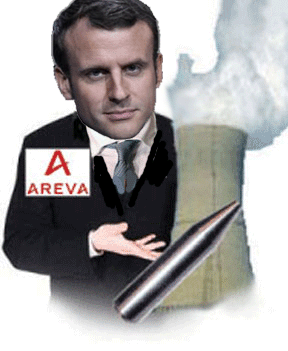
The state-owned group now finds itself in a fatal trap created by Emmanuel
Macron. Following the epic delays with the Olkiluoto nuclear power plant in
Finland, those of Flamanville in France, and those of Taishan in China, the
under-construction plant of Hinkley Point C in south-west England has now
joined the long story of an industrial catastrophe which is the third
generation EPR (pressurised water reactor) first designed by Areva, once
France’s nuclear energy giant.
Mediapart 28th Jan 2024
Nancy Pelosi’s attack on Gaza ceasefire advocates is a disgrace
Walt Zlotow, West Suburban Peace Coalition, Glen Ellyn IL 29 Jan 24
Every day of America’s descent into moral depravity supporting, enabling Israel’s genocide in Gaza brings new madness.
Yesterday, former House Speaker went on CNN to compare the tens of millions of us Americans demanding ceasefire in Gaza to apologists spreading “Putin’s message. Make no mistake, this is directly connected to what he would like to see.”
So far Pelosi was correct but not for the venal reason she intended. Putin would like to see ceasefire in Gaza for the same reason the entire world, save for Israeli and US leaders, including Biden and Pelosi do…end the ongoing genocide. Biden and Pelosi viciously oppose ceasefire to continue their lockstep support of the Israeli leadership determined to make Gaza uninhabitable for its 2,300,000 Palestinians.
Being a good soldier in Biden’s crazed foreign policy, which is also destroying Ukraine, Pelosi then pivoted to charge, “Same thing with Ukraine. It’s about Putin’s message” That’s what known in propaganda circles as a ‘twofer.’ Peace advocates seek to undermine benevolent US policy toward both Ukraine and Gaza, regardless those policies are destroying both.
Worst of all, Pelosi didn’t just stop at demonizing ceasefire advocates. She wants the FBI to investigate us. “Some of these protesters are sincere, but some, I think, are connected to Russia. I think some financing should be investigated. And I want to ask the FBI to investigate that.”
Good grief. As a spokesman in the peace community for ceasefire and end to US supported genocide, Pelosi’s got me pondering the next knock at my door. If it’s my local FBI dude, I’ll answer by asking…”Did Nancy send you?”
1 This Month
23-25 October – on Zoom – World BEYOND War’s annual global conferenc


Shut down the radiation-damaged Heysham nuclear reactors now
To see nuclear-related stories in greater depth and intensity – go to https://nuclearinformation.wordpress.com

Say No to NASA’s Reckless Nuclear Reactor on the Moon
Say No to NASA’s Reckless Nuclear Reactor on the Moon
-
Archives
- October 2026 (180)
- September 2026 (339)
- August 2026 (330)
- July 2026 (355)
- June 2026 (287)
- May 2026 (306)
- April 2026 (356)
- March 2026 (251)
- February 2026 (267)
- January 2026 (308)
- December 2025 (358)
- November 2025 (359)
-
Categories
- 1
- 1 NUCLEAR ISSUES
- business and costs
- climate change
- culture and arts
- ENERGY
- environment
- health
- history
- indigenous issues
- Legal
- marketing of nuclear
- media
- opposition to nuclear
- PERSONAL STORIES
- politics
- politics international
- Religion and ethics
- safety
- secrets,lies and civil liberties
- spinbuster
- technology
- Uranium
- wastes
- weapons and war
- Women
- 2 WORLD
- ACTION
- AFRICA
- Atrocities
- AUSTRALIA
- Christina's notes
- Christina's themes
- culture and arts
- Events
- Fuk 2022
- Fuk 2023
- Fukushima 2017
- Fukushima 2018
- fukushima 2019
- Fukushima 2020
- Fukushima 2021
- general
- global warming
- Humour (God we need it)
- Nuclear
- RARE EARTHS
- Reference
- resources – print
- Resources -audiovicual
- Weekly Newsletter
- World
- World Nuclear
- YouTube
-
RSS
Entries RSS
Comments RSS

