Nuclear waste at center of testy Nevada Senate race

The Hill , BY NICK ROBERTSON AND ZACK BUDRYK – 05/05/24
Nevada Republican Senate candidate Sam Brown is under fire from Democrats for 2022 remarks in which he expressed support for plans to store federal nuclear waste at Yucca Mountain.
Nevada lawmakers from both parties have strongly resisted a federal plan to turn the isolated southwest Nevada mountain — about 90 miles northwest of Las Vegas — into a nuclear waste storage facility since the idea was first proposed in the 1980s.
But Brown has expressed support for the idea in the past, and he can be heard in a new recording from his 2022 campaign saying the state risked losing out on an opportunity if it blocked the plans.
“If we don’t act soon, other states … are assessing whether or not they can essentially steal that opportunity from us,” he said in the recording, first obtained by The Los Angeles Times.
Brown, who is seen as a favorite in Nevada’s GOP Senate primary this June, said in a statement to The Hill he was not actively calling for the reopening of Yucca Mountain, but that future proposals should be considered.
“I am not strictly committed to opening Yucca Mountain at this time,” Brown said. “However, I will consider all thoroughly vetted future proposals, with the safety of Nevadans being my top priority, while ensuring the proposals are substantially economically beneficial.”
Sen. Jacky Rosen (D-Nev.), who is running for reelection, quickly seized on the comments. Rosen is seen as vulnerable this fall in a state where former President Trump is up in polls. The Cook Political Report lists her seat as a toss-up.
“For decades, Nevadans across party lines have been clear that we will not allow our state to become the dumping ground for the rest of the nation’s nuclear waste,” Rosen said in a statement. “I’ve been fighting against Washington politicians trying to force nuclear waste storage at Yucca Mountain since Sam Brown was still living in Texas, and his extreme support for this dangerous and unpopular project underscores how little he understands the needs of our state.”…………………………………………………. more https://thehill.com/homenews/state-watch/4642131-nuclear-waste-at-center-of-testy-nevada-senate-race/
UK’s Nuclear roadmap is a massive detour

UK plan reveals true ‘energy’ agenda is pathway to nuclear weapons sector
By Jonathon Porritt, Beyond Nuclear 6 May 24
After 14 years of Tory mismanagement, the UK finds itself bereft of an energy strategy.
This was finally confirmed in the release of the Government’s new Nuclear Roadmap. At one level, it’s just the same old, same old, the latest in a very long line of PR-driven, more or less fantastical wishlists for new nuclear in the UK. But at another, it’s a total revelation.
For years, a small group of dedicated academics and campaigners have suggested that the UK Government’s Nuclear Energy Strategy is being driven more by the UK’s continuing commitment to an “independent” nuclear weapons capability than by any authoritative energy analysis. For an equal number of years, this was aggressively rebutted by one Energy Minister after another, both Tory and Labour.
The new Nuclear Roadmap dramatically changes all that. It sets to one side any pretence that the links between our civil nuclear programme and our military defence needs were anything other than small-scale – and of no material strategic significance. With quite startling transparency and clarity, the Roadmap not only reveals the full extent of those links, but positively celebrates that co-dependency as a massive plus in our ambition to achieve a Net Zero economy by 2050.
“Startling” is actually an understatement. Such a comprehensive volte-face is rare in policy-making circles. Every effort is usually made by Ministers to obscure the scale (let along the significance) of any such screeching handbrake turns. That is so not the case with the new Roadmap.
Courtesy of the latest forensic work done by Professors Andy Stirling and Phil Johnstone at Sussex University (who have been absolutely at the forefront of seeking to bring these links into the public domain over many years – often with mighty little support from mainstream environmental organisations, let alone “independent” commentators), chapter and verse of this volte-face can be laid bare. Just a couple of examples from the Roadmap:
- “Not only does this Roadmap set a clear path for the growth of nuclear fission…it acknowledges the crucial importance of the nuclear industry to our national security, both in terms of energy supply and the defence nuclear enterprise.”
- “Government will proactively look for opportunities to align delivery of the civil and nuclear defence enterprises, whilst maintaining the highest standards of non-proliferation.”
- “To address the commonalities across the civil and defence supply chains, and the potential risk to our respective nuclear programmes due to competing demand for the supply chain, the Department of Energy Security and Net Zero (DESNZ) is working closely with the Ministry of Defence and the Defence Nuclear Sector.”
And there’s a whole lot more than that! As Andy Stirling has said: “Without any reflection on what this says about previous efforts to suppress discussion of this issue, the Government is now openly emphasising its significance.”
Indeed!
As usual, the UK’s ill-informed and unbelievably gullible mainstream media would appear to have missed the significance of this gobsmacking inflection point. So one can hardly expect them to have grasped its even more significant implications for UK energy strategy as a whole. In every single particular.
Let me briefly unpack some of those particulars:
- Nuclear
The new Roadmap reads like an outing to a massive nuclear sweet shop. On top of Hinkley Point C and Sizewell C, we’ll have one more big one. And then we’ll have lots of Small Modular Reactors, all over the country. And we’ll have a new fuel processing plant. And a new Geological Disposal Facility – at some much more distant point. And so on and on. 24 fantastical Gigawatts to be designed and delivered by 2050.
The reality couldn’t be more different:
- We will indeed end up with Hinkley Point C – at a staggering of cost of somewhere between £26 billion and £30 billion, with consumers paying twice as much for its electricity as they will for offshore wind. And it will almost certainly not come online until the end of the decade, 15 years on from the time it was meant to be up and running.
- We may possibly get Sizewell C, though the Government cannot currently guarantee the required level of investment. So a Final Investment Decision is unlikely before the next Election. At which point, Starmer may come to his senses and kill off this absurd white elephant.
- We will never get a third big reactor. The economics are literally impossible to justify.
- We are unlikely to get more than a couple of hugely expensive Small Modular Reactors, at some indeterminate point in the future, even with a new “flexible approach” to planning and financial inducements. Even that may prove to be an illusion. As Professor Steve Thomas has written: “Advocates of Small Nuclear Reactors claim they are cheaper and easier to build, safer, generate less waste, and will create many jobs compared to existing large reactor designs. These claims are unproven, misleading, or just plain wrong. Worldwide, no commercial design of SMR has even received a firm order yet.”
- And we may or may not get life extensions for the last five power stations in the “legacy fleet” – subject to regulatory approval, which may not be all that easy given extensive cracking in their reactor cores.
In short, the Roadmap is just a massive diversion from reality. Entailing incalculable opportunity costs. And putting at risk our entire Net Zero by 2050 strategy.
Ministers know all that. But they don’t really care. Our nuclear weapons programme (including upgrading Trident) will be protected as a consequence of this, via an unceasing flow of public money into the civil nuclear cul-de-sac, at a time when our defence budget is already massively overstretched. So who cares about the missing 24GW?
- Renewables
We’ll continue to see new investment into renewables here in the UK, despite (not because of) government policy, which has seriously messed up our offshore wind industry, maintained a de facto ban on onshore wind, couldn’t care less about solar, witters on vapidly about tidal without doing anything etc etc.
Meanwhile, on a global basis, renewables continue to boom………………………………………………………………………………………………………………………………..
The reasons for this almost complete silence can be traced back to successive governments’ grim intent to hang onto our so-called “independent nuclear deterrent”. At literally any costs……………………………… more https://beyondnuclearinternational.org/2024/05/06/nuclear-roadmap-is-massive-detour/
Canada’s federal budget -calls nuclear energy “clean” – the height of absurdity!

Nuclear energy never will be ‘clean,’ write Jones and Edwards.
THE HILL TIMES | MONDAY, MAY 6, 2024
The 2024 federal budget contains many references to nuclear energy as
a “clean” source of electricity. In our view, referring to
nuclear electricity as “clean” is the height of absurdity.
The nuclear fuel chain begins with the mining of uranium from rock
underground where, without human intervention, it would remain safely
locked away from the biosphere. Uranium has many natural radioactive
byproducts, including radium, radon, and polonium-210 that are
discarded in voluminous sandlike “tailings” at uranium mine sites.
These materials are responsible for countless thousands of deaths in
North America alone. Canada has accumulated 220 million tonnes of
these indestructible radioactive mining wastes, easily dispersed by
wind and rain over the next 100,000 years.
Inside a nuclear reactor, uranium atoms are split to produce energy.
The atomic fragments are hundreds of newly created radioactive
poisons, most of them never found in nature before 1940. They make
used fuel millions of times more radioactive than the original
uranium. One used fuel bundle, freshly discharged, will deliver a
lethal dose of radiation in seconds to any unshielded human nearby.
There are hundreds of thousands of tonnes of waste irradiated fuel
bundles worldwide and the quantity grows larger each year. There is no
operating repository anywhere in the world for such wastes, but there
are several failed repositories.
Radioactive waste has the “reverse midas touch” turning everything
it touches into more radioactive waste. This includes the nuclear
vessel in which the waste is created, and everything that comes in
contact with the cooling water needed to prevent the waste from
melting down. Containers for radioactive waste become radioactive
waste themselves. All radioactive waste must be kept out of our food,
air and drinking water for countless millennia.
Radioactive atoms are unstable. They disintegrate, throwing off a kind
of subatomic shrapnel called “atomic radiation.” Emissions from
disintegrating atoms damage living cells. Chronic radiation exposure
can cause miscarriages, birth defects, and a host of degenerative
diseases including cancers of all kinds. Genetic damage to eggs or
sperm can transmit defective genes to successive generations.
Plutonium is one of the hundreds of radioactive byproducts created in
used nuclear fuel. It is of special concern because it is the primary
nuclear explosive in nuclear arsenals worldwide. “Reprocessing” of
nuclear fuel waste to extract plutonium is sometimes called
“recycling” but this is disinformation; the resulting waste is
more difficult to manage than the original fuel waste. Many serious
accidents have occurred around the world at reprocessing plants.
Places where extensive reprocessing has occurred are among the most
radioactively contaminated sites on Earth. Plutonium can be used as a
nuclear fuel, but extracting it is a nuclear weapons proliferation
risk.
Managing radioactive waste is difficult and very expensive. The
projected multi-billion-dollar cleanup cost for the legacy waste at
Chalk River, Ont., is the federal government’s biggest environmental
liability by far, exceeding the sum total of all other federal
environmental liabilities across Canada.
The multinational consortium running Canada’s federal nuclear
laboratories is receiving close to $1.5-billion annually, much of it
for managing legacy radioactive wastes. The consortium’s plans
include piling up one million tonnes of waste in a giant mound beside
the Ottawa River and entombing old reactors in concrete and grout
beside major drinking water sources. Many are of the view that the
plans fail to meet the fundamental requirement to isolate waste from
the biosphere and have been met with widespread concern, opposition
and legal challenges. Nuclear energy is not now, never has been, and
never will be “clean.”
The sooner our elected officials come to terms with this fact, the
better for Canada and Canadians. Honesty is the best policy.
The Summer of Student Activist Protests

This power center for the U.S. Empire – Capitol Hill – presents serious students with an opportunity to educate their elders.
Make U.S. engagements in the Israeli-Palestinian conflict a major electoral campaign issue for November.
By Ralph Nader, May 3, 2024, https://nader.org/2024/05/03/the-summer-of-student-activist-protests/
At many college campuses, students are protesting in opposition to the Biden Administration’s unconditional backing, with weapons and diplomatic cover, of Netanyahu’s continuing serial war crimes slaughtering tens of thousands of Palestinian civilians in Gaza, most of them children and women. Hundreds of faculty members are defending these valiant youngsters and criticizing excessively harsh crackdowns by failed University presidents who are calling in outside police.
With graduations approaching, pro-Netanyahu lobbies and cowed University heads (like Columbia University President Minouche Shafik, who makes a salary of over $2,000 an hour) expect the students to disperse from campus for the summer and end their demonstrations.
The Israeli genocidal crimes against Gazans will continue and intensify if Israel invades Rafah. Millions of refugees will suffer. What will become of the organized student calls for a permanent ceasefire, greatly increased humanitarian aid and cessation of U.S. weapons shipments? The students who leave their campus protests can and should focus on members of Congress in their Districts and in Washington.
In two weeks, hundreds of Congressional summer student interns will begin arriving to work in Congressional offices. Congress is the decades-long reservoir for Israeli colonial aggression. Moreover, Congress, under AIPAC’s extraordinary pressure, has blocked testimony by prominent Israeli and Palestinian peace advocates since 1948. Not once have any of these peace advocates, many of whom are Israeli retired cabinet ministers, mayors, security and military leaders been invited to a Congressional Committee Hearing.
This power center for the U.S. Empire – Capitol Hill – presents serious students with an opportunity to educate their elders. Such an opportunity materialized during the Vietnam War when Congressional interns in the late 1960s organized a highly visible petition drive and engaged in peaceful protests.
Back in the Congressional Districts, the access is easier and available to many more students and faculty. Because Congress is in “recess” for much of the summer – Memorial Day, Fourth of July, and the entire month of August to Labor Day – students and citizens can demand public meetings preceded by formal summons to Senators and Representatives. (See my column “Sending Citizens Summons to Members of Congress”).
Five hundred to a thousand clearly legible signatures with the individuals’ occupations and emails should get these politicians to your well-prepared community meetings.
There would be no more notorious incommunicado behavior, laced with robo-letters to inquiring constituents. Instead, there would be person-to-person questioning, dialogue, and responses where evasions and sweet talk will be more difficult for the lawmakers to utilize.
The subject matter of these public meetings can extend beyond ghastly scenes of dead, dying, sick, and starving families in Gaza to Biden’s foreign and military policies. Our government is fueling an Empire producing disasters that are conducted in the name of the powerless American people, whose sovereign powers under our Constitution are delegated to Congress and the Executive Branch. The abuse of this power starts with Congress.
Nothing can compare to face-to-face meetings with the lawmakers. Letters, phone calls, and emails rarely can be relied on to reach them directly – that is if you are not a big campaign contributor. Besides, unlike in the past, today’s legislative staffers are much more likely to ignore these missives without even an acknowledgment. (See The Incommunicados report: https://incommunicadoswatch.org/).
A people’s town meeting has an agenda set by the people. Some suggestions follow:
1. There have been no Congressional hearings since before October 7th on the overall policies in the Middle East pursued by the White House and Congress. The House and Senate Armed Services and Foreign Affairs Committees have not been active. Instead, there have been show hearings berating University presidents to stifle free speech on their campuses and answer hypothetical questions about anti-semitism against Jews but not the other ongoing Congressionally weaponized anti-semitism against Gazan Arabs, who are Semites, being annihilated in that tiny enclave. Disgraceful! Demand public hearings for the citizenry.
2. Make U.S. engagements in the Israeli-Palestinian conflict a major electoral campaign issue for November. This is a major opportunity to get the direct attention of the 535 lawmakers and to push them to stop kicking the can down the road. The decades-long control of Congress by the “Israeli-government-can-do-no-wrong lobby” must end. There is too much massive, preventable suffering being ignored in the Middle East, too much danger of wider regional wars involving the super-powers, and too much damage to civil liberties and democratic processes in our own country to avoid these matters any longer.
3. The students and teachers will find allies in their Congressional Districts from long-time advocates like the American Friends Committee (Quakers), the Unitarians, united Jewish, Christian, and Muslim peace groups, the increasing numbers of outspoken labor union leaders, and just plain Americans fed up with the costly U.S. Empire and its military-industrial complex (remember President Eisenhower’s warnings).
People want their tax dollars returned to the crucial public necessities back home. They don’t like big business controlling Congress and getting away with looting Uncle Sam by their out-of-control greed and power. Over 70% of Americans believe these big companies have too much control over their lives including many liberal and conservative families.
Larger reforms, redirections, and horizons of society often start with one compelling abuse or outrageous travesty of justice. This has occurred in the labor, farmer, consumer, environmental, and civil rights movements throughout our history.
There will be high-visibility protests outside the National Democratic Party Convention in Chicago and probable demonstrations at the National Republican Party Convention in Milwaukee this summer. But the laser-focused citizen pressure should be on those 535 members of YOUR Congress, their local offices, and their staff.
Change Congress and you change America! That is leverage!
Nuclear-waste compensation (?bribery) numbers raise eyebrows

South Bruce would receive $418 million in total compensation if its site is selected; the comparison figure for Ignace is $170 million.
NWO Newswatch, Mike Stimpson, Local Journalism Initiative Reporter, 3 May 24
IGNACE – As a community vote on nuclear-waste concluded, residents of this Northwest municipality were talking about the deep geological repository’s other potential host municipality.
The Municipality of South Bruce, in southwestern Ontario near Lake Huron, on Monday published the hosting agreement it negotiated with the Nuclear Waste Management Organization.
The South Bruce agreement promises far more for that municipality than Ignace would receive if it is selected to host repository operations.
If the South Bruce site is selected for the proposed underground waste storage facility, the municipality would receive about $418 million over the project’s 138-year life, according to documents released by South Bruce.
The comparison figure for Ignace is approximately $170 million.
Reaction on social media included Ignace residents saying the divergent figures make Ignace look either foolish or an attractive bargain………………………………………………………..
Both municipalities must communicate their continued willingness to be host communities to the NWMO before a site is chosen.
If South Bruce voters decide in a referendum on Oct. 28 that they are not willing to continue as a potential host community, the industry-funded NWMO would remit a $4-million “exit payment” to the municipality.
If the Township of Ignace declares itself not willing, the exit payment would be $5 million.
If South Bruce is willing but not selected, it is to receive $8 million; Ignace would receive the same amount if willing but not selected.
In addition to the municipalities, nearby First Nations must be willing to participate in order for a site to be selected.
For the Revell Lake site, Wabigoon Lake Ojibway Nation must express willingness. The potential First Nations partner for the South Bruce site is Saugeen Ojibway Nation.
The NWMO has committed to selecting a site by December 31, 2024.
Construction is projected to begin around 2034 and take about 10 years to complete, Ponka said. https://www.nwonewswatch.com/local-news/nuclear-waste-compensation-numbers-raise-eyebrows-8683186
Inside story: Will Iran’s supreme leader revise his ‘nuclear fatwa’?
https://amwaj.media/article/inside-story-will-iran-s-supreme-leader-revise-his-nuclear-fatwa 5 May 24
The direct confrontation between Iran and Israel has sparked speculation about a potential shift in the Islamic Republic’s nuclear policies under the leadership of Ayatollah Ali Khamenei.
Following Iran’s Apr. 14 military action against Israel in response to the Apr. 1 bombing of the Iranian consulate in Damascus, a senior commander of the Islamic Revolutionary Guard Corps (IRGC) explicitly suggested the possibility of a revision to Tehran’s objection to atomic weapons. The suggestion may only be a part of the war of words between Iran and Israel. However, the fact that such discourse is rapidly becoming mainstream in Iran raises questions of what may lie ahead—including whether a shift may take place under Khamenei, who has long opposed atomic weapons on a religious basis.
Rapidly changing discourse
Amid media speculations of a major Israeli attack in response to Iran’s Apr. 14 drone and missile strike on sites inside Israel, Gen. Ahmad Haqtalab—the commander of the Protection and Security Corps of Nuclear Centers—on Apr. 18 stated, “If the Zionist regime wants to use the threat of attacking our country’s nuclear centers as a tool to pressure Iran, it is possible to review the nuclear doctrine and policies of the Islamic Republic of Iran and deviate from the previous considerations.”
The warning was rare, and even as tensions eased between Tehran and Tel Aviv, Iranian officials continued to underscore the significance of the matter. Four days after Haqtalab’s intervention, former IRGC commander and current MP Javad Karimi Qoddousi tweeted, “If permission is issued, there will be [only a] week before the first [nuclear] test.” Qoddousi separately posited that the same amount of time was needed to test missiles with an increased range of 12,000 km (7,456 miles).
However, Iranian Foreign Ministry spokesman Nasser Kanani promptly interjected, dismissing the notion of any alteration to the country’s nuclear doctrine. Meanwhile, government-run Iran daily slammed Qoddousi, characterizing his statements as “untrue” and possibly being exploited by “enemies” to pursue further sanctions and fear mongering against Iran. Several other outlets, including conservative-run media, notably echoed such criticisms.
Yet, despite the blowback, Qoddousi went ahead and posted a video on Apr. 25 in which he said that Iran needs only half a day to produce the 90%-enriched uranium necessary to build nuclear bombs.
Khamenei and the ‘nuclear fatwa’
In Shiite Islam, a fatwa is a religious edict issued by a high-ranking Islamic jurist on the basis of interpretation of Islamic law. To followers of the jurist in question, fatwas are binding and the primary point of reference for everything from major life decisions to day-to-day matters. Fatwas can also be a part of state policies.
Ayatollah Khamenei has on multiple occasions over the past two decades reiterated his objection to the development, stockpiling, and usage of nuclear weapons as haram or religiously impermissible. Among believers, violating what is deemed haram would have serious consequences both in this life and the hereafter. In 2010, the supreme leader reiterated his objection to weapons of mass destruction in a message to an international conference on nuclear disarmament, stating they “pose a serious threat to humanity” and that “everyone must make efforts to secure humanity against this great calamity.”
Critics of what became known as the nuclear fatwa have over the years raised a variety of objections, from the modality of Khamenei’s religious edict to the manner in which it has been presented. Some even question whether the ruling really exists. What is indisputable, however, is that the religious edict has previously averted conflict by aiding diplomacy.
For instance, in connection with the 2013-15 nuclear negotiations that led to the signing of the Joint Comprehensive Plan of Action (JCPOA) between Iran and world powers—which saw Tehran agree to restrictions on its atomic program in exchange for sanctions relief—there were suggestions that the Islamic Republic should codify the fatwa.
Amid the nuclear negotiations with Iran, then-US secretary of state John Kerry in 2014 stated, “We take [Khamenei’s fatwa] very seriously….a fatwa issued by a cleric is an extremely powerful statement about intent. Our need is to codify it.” In another interview the same year, Kerry asserted that “the requirement here is to translate the fatwa into a legally binding, globally recognized, international understanding…that goes beyond an article of faith within a religious belief.”
Only days after the signing of the JCPOA in 2015, Khamenei said, “The Americans say they stopped Iran from acquiring a nuclear weapon. They know it is not true. We had a fatwa, declaring nuclear weapons to be religiously forbidden under Islamic law. It had nothing to do with the nuclear talks.”
Will Khamenei change his fatwa?
Khamenei is not the first Iranian Islamic jurist to issue a fateful religious edict on a highly politicized matter. Back in 1891, Mirza Mohammad Shirazi (1815-95), a leading Shiite religious authority at the time, issued a hokm or verdict against the usage of tobacco in what became known as the Tobacco Protest. The move came in protest against a concession granted by the Qajar monarch Naser Al-Din (1848-98) to the British Empire, granting control over the growth, sale, and export of tobacco to an Englishman. The hokm issued by Shirazi ultimately led to the repeal of the concession.
Neither a fatwa nor a hokm is set in stone and can be revised. The main distinction between the two types of rulings is that a hokm tends to have more conditions and requirements attached to it. Moreover, while a fatwa must be followed by the followers of the Islamic jurist who issued it, a hokm must be followed by all believers—including Shiites who are not followers of the jurist in question.
Explaining the intricacies of a hokm, a cleric and professor of Islamic law (fiqh) at the Qom Seminary told Amwaj.media, “There are primary hokm and secondary hokm. The former is like the necessity of the daily prayer that is mentioned in the Quran and the hadiths [traditions], or the prohibition on consuming alcohol. The secondary hokm is based on expediency and necessity that leads to the first ruling being changed. For example, if alcohol helps someone stay alive, then it is not haram [religiously impermissible] for him or her [to make use of it].” He added, “A fatwa can be changed too.”
France’s Macron wants to build 14 new Nuclear reactors by 2050. 6 is more realistic
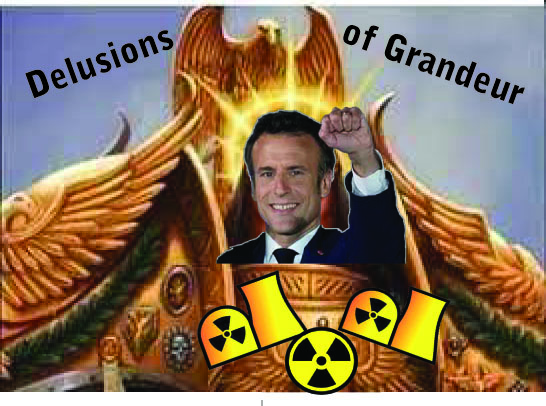
energy post eu, April 29, 2024 by Jonathan Bruegel
France’s President Macron is talking about a nuclear renaissance, after years of uncertainty over its future. The goal is to build 14 new reactors by 2050. But Jonathan Bruegel at IEEFA says this is unrealistc. France’s nuclear sector has much to recommend it. It produces up to 80% of the country’s total power generation, the highest share of nuclear in the generation mix anywhere in the world, and CO2-free. However, France hasn’t built a nuclear reactor since 1999, and construction delays and budget overruns plague the completion of its latest reactor, Flamanville 3, started in 2007. And with many of the 56 currently operational reactors reaching the end of their 40-year lifetime, decisions must be made whether to shut them down or extend their lifetimes by 10 or 20 years through major refits. Bruegel looks at the fundamentals and estimates that a more realistic goal is to build 6 new reactors by 2050, and to extend the lifetimes of 13 (or a maximum of 20) reactors. That would leave nuclear’s share in France’s 2050 mix at a maximum of 40% and more realistically 30%.
Key findings
- Given that new nuclear projects have faced significant construction delays and cost overruns, France’s plan to build 14 new reactors by 2050 is unrealistic.
- Nuclear should continue playing a key role in France’s power sector but not at the expense of renewables growth.
- French policy has recently shifted from a commitment to reduce nuclear generation to calls for a “renaissance” of the technology.
- France’s heavy reliance on nuclear has kept its power sector emissions relatively low but left it exposed to the many challenges associated with the technology.
Energy security
………………………… In the last two years, Europe’s imports of Russian piped gas have been largely replaced by liquified natural gas (LNG) from alternative sources. Curtailments and demand response mechanisms have contributed to absorbing the price shock…………………………..
In the case of France, this energy crisis was especially challenging since it coincided with many nuclear reactors being taken offline for maintenance work. In 2022, the country was a net power importer for the first time in more than 40 years. In 2023, as most nuclear reactors went back online, it resumed being a net power exporter. The episode illustrated the risks of France’s exposure to nuclear power.
Nuclear has dominated France’s power mix since the 1980s
……………………………..However, as Chart 1 [on original] shows, France hasn’t built a nuclear reactor since 1999, meaning its EPR expertise hasn’t benefitted its domestic nuclear fleet as much as it could have. Construction of the latest reactor, Flamanville 3, started in 2007. It has yet to be commissioned. So far, it is delayed by 12 years and is almost four times over budget.
With many reactors reaching the end of their 40-year lifetime, decision-makers must choose whether to shut them down or extend their operations by 10 or 20 years through major refitting programmes.
Policy shift sees France plan a “nuclear renaissance”
Nuclear’s role in France’s future power mix has become an increasingly crucial and controversial political debate.
After his election to the presidency in 2012, François Hollande committed to reducing the share of nuclear in France’s power production to 50% by 2035, with an ambitious decommissioning plan. However, not one nuclear unit was decommissioned under his presidency and no legally binding decommissioning dates for plants were set. The only binding commitment was to cap French nuclear capacity to 63GW.
During his first term between 2017 and 2022, President Emmanuel Macron did not engage in any nuclear policy shift, postponing the debate. The Flamanville 1 and 2 nuclear reactors were decommissioned in 2020 because they had exceeded their 40-year lifetime and no agreement had been made with operator EDF for a major refit programme.
Criticisms
During his second term, Macron has called for a “nuclear renaissance” and announced a goal to build 14 new reactors by 2050, implicitly targeting a maintenance of the 63GW of capacity and nuclear’s share in the power generation mix. The announcement was heavily criticised from across the political spectrum, with the main argument being that nuclear would slow the growth of renewables. Concerns have also been raised about the challenges associated with nuclear technology such as safety issues, long construction times, massive capital expenditures (see Chart 2 on original), a levelised cost of electricity higher than renewables and waste management.
Despite its role in reducing carbon emissions, Nuclear must not limit Renewables growth
Nuclear is not considered a renewable technology since uranium is needed, but the debate remains open on whether nuclear is green.
Although its challenges are well known (e.g., safety, costs, waste management), the French plan to build 14 new nuclear units by 2050 seems at best unrealistic.
Significant construction delays and cost overruns faced by the two latest EPRs, Flamanville 3 in France and Olkiluoto 3 in Finland, are evidence that building an average of one reactor every two years until 2050 is not a feasible goal…………………………………………………. more https://energypost.eu/frances-macron-wants-to-build-14-new-nuclear-reactors-by-2050-6-is-more-realistic/
Bill before Australian Parliament would allow UK and USA to dump decades of high-level nuclear waste in Australia.

Dave Sweeney, 6 May 24
Minister Marles has a Bill before Parliament to establish a dedicated regulator for military radioactive waste arising from AUKUS – it is deeply flawed legislation but a particular concern is that it would permit Australia hosting UK and US naval nuclear waste – including waste from six decades of their nuclear submarine programs.
Media attention to this has been limited apart from https://www.theguardian.com/world/2024/apr/02/poison-portal-us-and-uk-could-send-nuclear-waste-to-australia-under-aukus-inquiry-told and a story from today’s Australian.
ACF has put in a submission and a supplementary and presented to a current inquiry by the Senates Foreign Affairs, Defence and Trade Committee.
This Committee – https://www.aph.gov.au/Parliamentary_Business/Committees/Senate/Foreign_Affairs_Defence_and_Trade/ANNPSBills23 – is due to report on May 13 and is likely to be supportive of the plan and there are concerns that Marles may look to do a deal with Dutton and steam this legislation through under the cover of the Budget week.
Marles states that the government ‘has no intention’ to do this but we have clear confirmation that the legislation would allow for the import and hosting of AUKUS partners military waste.
On 13 March 2024, the Chair of the Senate Committee investigating the bill asked Government officials: “could you also clarify whether there is scope in the legislation for Australia to take high-level waste from the US and UK submarines? Mr Kim Moy from the Department of Defence confirmed that this was the case. In a subsequent hearing on April 22, Senator David Shoebridge sought to establish whether other stakeholders were aware of this fact. Mr Peter Quinlivian, Senior Legal Counsel for weapons manufacturer BAE Systems Australia, admitted that “the legislation, as drafted, is in language that would accommodate that scenario”.
This loophole must be closed
The breadth and depth of the nuclear lobby in Canada.

Brennain Lloyd, 4 May 24 Tt appears from the url that the Canadian Nuclear Yearbook for 2019 wasn’t published until 2022, and it is the most recent one, but it’s still worth a scroll through, out of interest. All promotional stuff, of course, but a couple of things to note:
- CNSC has a full page ad for the participant funding program; be interesting to see their procurement policy for paid advertising
- summary reports from the major nuclear advocacy organizations (Canadian Nuclear Society, Canadian Nuclear Association, Nuclear Workers, Council, Organization of Canadian Nuclear Industries (OCNI), Women in Nuclear)
- list of all nuclear facilities in Canada, including the multiple facilities within large complexes, such as at Whiteshell and Chalk River
- list of all CANDU operations
- various lists of suppliers and services
The lists give you a sense of the breadth and depth of the nuclear lobby in Canada. It’s seems to me that it is not OPG, NB Power and Hydro Quebec doing the heavy lifting in terms of the nuclear lobby; it all these other organizations and companies that are making large amounts of money from promoting and perpetuating this industry.
It’s posted online at https://cns-snc.ca/wp-content/uploads/2022/01/CNS_Yearbook_2019_web.pdf
Banned By Germany
Apr 30, 2024 YANIS VAROUFAKIS
Germany recently prohibited a Palestinian Congress from taking place in Berlin, arrested its Jewish supporters, and barred one of its organizers, Greece’s former finance minister, from entering the country. But the turn to repression is powerful evidence that the country’s pro-Israel political consensus is breaking down.
ATHENS – Three weeks ago, I was banned from entering Germany. When I asked the German authorities who decided this, when, and under what rationale, I received a formal reply that, for reasons of national security, my questions would receive no formal reply. Suddenly, my mind raced back to another era when my ten-year-old self thought of Germany as a refuge from authoritarianism.
During Greece’s fascist dictatorship, listening to foreign radio broadcasts was banned. So, every evening, at around nine, my parents would huddle under a red blanket with a short-wave wireless, straining to hear Deutsche Welle’s dedicated Greek broadcast. My boyish imagination was propelled to a mythical place called Germany – a place, my parents told me, that was “the democrats’ friend.”
Years later, in 2015, the German media presented me as Germany’s foe. I was aghast; nothing could be further from the truth. As Greece’s finance minister, I opposed the German government’s monomaniacal insistence on harsh universal austerity, not merely because I thought it would be catastrophic for most Greeks, but also because I thought it would be detrimental to most Germans’ long-term interests.
The specter of deindustrialization that today casts a depressing shadow across Germany is consistent with my prognosis.
In 2016, when choosing a European capital to launch DiEM25, the pan-European political movement that I helped to found, I chose Berlin. At Berlin’s Volksbühne Theatre, I explained the reason: “Nothing good can happen in Europe if it does not begin in Berlin.” To reinforce the point, in the 2019 European Parliament elections I chose symbolically to be DiEM25’s candidate not in Greece (where I could win easily) but in Germany.
Given my lengthy relationship with the land of Goethe, Hegel, and Brecht, the German center-left government’s decision to ban me is more bewildering than even my nearest and dearest can imagine. I shall leave to my lawyers the legality of being denied the right to know the rationale behind the ban, and I will set aside the threat to my safety from the reckless insinuation that I am, somehow, a threat to Germany’s national security. Nor will I delve into what my ban means for a European Union where free movement and association are singular virtues. Instead, I want to focus on the ban’s deeper significance.
The trigger for banning me was a Palestinian Congress co-organized by DiEM25’s German party (MERA25), various Palestinian support groups and, crucially, the German organization Jewish Voice for a Just Peace. But the writing had been on the wall well before that.
Last November, Iris Hefets, a friend and member of the aforementioned Jewish organization, staged a one-woman protest in Berlin. Walking alone, in silence, she held a placard on which she had written: “As an Israeli and as a Jew, stop the genocide in Gaza.” Astonishingly, she was arrested for anti-Semitism. Soon after, the bank account of her organization was frozen – by officials unable to grasp the irony, indeed the horror, of the German state seizing Jewish assets and arresting peaceful Jews in Berlin.
In the run-up to our Palestinian Congress, a coalition of political parties representing almost the entire German political spectrum (including two leaders of my former comrades in the Left party) took the extraordinary step of creating a dedicated website for denouncing us. Their charges?
First, they branded us as “terrorism trivializers” vis-à-vis Hamas’s October 7 attacks in Israel. It was not enough for them that we had condemned as war crimes all acts of violence against civilians (regardless of the identity of perpetrator or victim). They wanted us to condemn resistance to what even Tamir Pardo, the former Mossad director, described as an apartheid system designed to push Palestinians either into exile or into permanent servitude.
Second, they claimed that we were “not interested in talking about possibilities for peaceful coexistence in the Middle East against the background of the war in Gaza.” Seriously? All participants in our Congress are committed to equal political rights for Jews and Palestinians – and many of us, taking our cue from the late Edward Said, support a single federal state as the solution to the conflict.
Dismissing their groundless accusations, let me home in on the central question: How could almost the entire German political class embrace this denunciation, which prepared the ground for the subsequent police action? How could they remain silent as the police arrested Udi Raz (another Jewish comrade), prohibited our conference and, yes, banned me from entering Germany – even from connecting via video link to any event in the country?
Their most likely answer is the German state’s official semi-rationale, or Staatsräson: the protection of Jewish lives and Israel’s security. But the German state’s recent behavior is not at all about protecting Jews (especially my friends Iris and Udi) or Israel. The purpose is to defend Israel’s right to commit any war crime its leaders choose in the process of enforcing an agenda whose goal is to render impossible the two-state solution that the German government claims to favor.
If I am right, something else is behind the current political consensus in Germany. My hypothesis is that Germany’s political class has a penchant for national catechisms that unite its members behind a common will: net exports as Germany’s strength; China as German industry’s playground; Russia as its source of cheap energy; and Zionism as proof that it has turned a page, morally.
Once such a catechism is established, debating it rationally becomes next to impossible. Moreover, the fear of being denounced for abandoning it motivates the concerted denunciation of any apostate who questions it.
A silver lining here is that young Germans, seeing the bodies piling up in Gaza, are not afraid that they will be denounced if they challenge a catechism that has jeopardized German democracy, the rule of law, and basic common sense. This is why, despite the ban, I am not giving up on Germany.
Remember, All This Fascism Would Feel Way More Fascismy Under Trump

CAITLIN JOHNSTONE, MAY 01, 2024
Okay, yes, police are currently in the process of violently stomping out political dissent on university campuses across America following multiple statements from President Biden attacking the protesters as “antisemitic” for opposing the genocide he’s been enthusiastically facilitating in Gaza. And okay, fine, bands of right wing thugs are currently going around terrorizing students who don’t align with the US government’s support for the state of Israel.
But before any of my fellow liberals get any wild ideas about ceasing their support for Biden during an election year just because of a little tyranny and genocide, I think it’s important to remind everyone that all this fascism would feel way more fascisty if Trump was president…………………………………………………………… https://www.caitlinjohnst.one/p/remember-all-this-fascism-would-feel?utm_source=post-email-title&publication_id=82124&post_id=144202169&utm_campaign=email-post-title&isFreemail=true&r=1ise1&triedRedirect=true&utm_medium=email
Australian Parliamentarians renew their support for the Treaty for the Prohibition of Nuclear Weapons
Jemila Rushton, Acting Director, ICAN Australia
Australian parliamentarians from across party lines have renewed their support for Australia joining the Treaty on the Prohibition of Nuclear Weapons (TPNW).
In a new video, members of the Parliamentary Friends of the Treaty on the Prohibition of Nuclear Weapons show that action on nuclear disarmament is beyond party politics. Their joint message demonstrates how parliamentarians from across the political spectrum are working together to see the Treaty signed and ratified.
| Featured in the video are Susan Templeman MP (ALP), Member for Macquarie, Jordan Steele-John (GRN), Senator for Western Australia, Monique Ryan MP (IND), Member for Kooyong, Russell Broadbent (IND), Member for Monash, Sam Lim MP (ALP), Member for Tangney, Louise Pratt (ALP), Senator for Western Australia, Lidia Thorpe (IND), Senator for Victoria, Sharon Claydon MP (ALP), Member for Newcastle, Josh Burns MP (ALP), Member for Macnamara, and Josh Wilson MP (ALP), Member for Fremantle. In the video, they state: |
Today, 93 countries around the world are signatories to the Treaty on the Prohibition of Nuclear Weapons – the TPNW.
They are signed up to the legally binding commitment to comprehensively ban nuclear weapons.
Developing them, testing them, producing them, assisting with them, possessing them, threatening to use them, and using them are banned.
The TPNW is giving countries and citizens across the world hope, and a new and promising pathway towards the abolition of these weapons.
It’s about understanding that what we cannot prepare for and what we can adequately respond to, we must prevent.
It’s about continuing Australian leadership when it comes to nuclear disarmament.
It’s about working with our closest neighbours and collaborating with our Pacific family.
It’s about recognising and supporting victims of nuclear weapons testing. For First Nations survivors, for Australia’s nuclear veterans.
As members of the Australian Parliamentary Friends of the TPNW, we are working together to see the Nuclear Weapons Ban Treaty signed and ratified.
We are proud of our country’s commitment to getting rid of other inhumane weapons, like landmines, cluster munitions, biological, and chemical weapons.
We welcome Australia’s engagement with the TPNW under the Albanese Government and we pay tribute to the community activism being undertaken in support of Australia joining this treaty.
History is calling.
US Presidential candidate arrested at anti-Israel protest
https://www.rt.com/news/596726-jill-stein-arrested-protest/ 29 Apr 24
Jill Stein has accused the Jewish state of committing “genocide” in Gaza.
Jill Stein of the US Green Party has been arrested at a pro-Palestinian rally at Washington University in St. Louis, Missouri. Stein’s arrest came amid a nationwide crackdown on anti-Israel demonstrations.
Stein, her campaign manager, and her deputy campaign manager were among 100 people detained at a protest camp on Washington University’s campus on Saturday. Video footage shows the 73-year-old being led away from the camp by three police officers, her hands apparently bound behind her back with zip ties.
The encampment was set up to demand that the university divest from Boeing, which manufactures arms used by the Israeli military to strike Gaza, Stein’s campaign manager, Jason Call, said in a statement.
“The Stein campaign supports the demands of the students and their peaceful protest and assembly on campus,” Call said. “Student protest for peace and civil liberties has always represented the best part of our collective moral conscience. Solidarity.”
The Washington University camp was one of around four dozen set up at college campuses across the US and Canada in recent weeks. As well as demanding that their universities divest from Israel-linked companies, the protesters have called on the US government to cease its financial and military support for Israel over the war in Gaza.
Police officers arrested hundreds of demonstrators in raids on 21 campuses on Wednesday, then hundreds more in similar sweeps on Thursday, Friday, and Saturday. While this crackdown has been encouraged by mainstream Democrats and Republicans alike, they have been condemned by progressive leftists and libertarian-leaning members of the GOP.
Pro-Israel activists claim that the protests are anti-Semitic in nature, and that some demonstrators have openly expressed support for Hamas. In an effort to justify a police raid on a protest camp at Boston’s Northeastern University on Saturday, school authorities claimed that chants of “Kill the Jews” were heard at the encampment the night before. Pro-Palestinian demonstrators deny the allegation.
Stein is a Jewish-American activist, and a long-time critic of the state of Israel. She opposes the construction of Jewish settlements on Palestinian land, supports the BDS (Boycott, Divestment, and Sanctions) movement, and has accused Israel of “genocide” in Gaza.
Stein ran for president of the US in 2012 and 2016, taking just over 1% of the popular vote in the 2016 contest with Donald Trump and Hillary Clinton. In November, she announced that she would run for the White House again this year, promising environmental reforms and “a new foreign policy based on diplomacy, international law, and human rights.”
Rolls-Royce pulls plug on UK nuclear factory plans
Rolls-Royce has reportedly downscaled its ambitions to construct nuclear factories in the UK, citing delays in a government design competition for its small modular reactor programme
Dimitris Mavrokefalidis, 04/29/2024, https://www.energylivenews.com/2024/04/29/rolls-royce-pulls-plug-on-uk-nuclear-factory-plans/
Rolls-Royce has reportedly revised its plans to construct nuclear factories in the UK, citing ongoing delays in a government design competition for its small modular reactor (SMR) programme.
Initially proposing two factories, the company has decided to forgo building a pressure vessel manufacturing facility due to time constraints, opting instead to procure heavy pressure vessels from third-party suppliers.
While plans for a second factory focused on building modular units for SMRs continue, the decision highlights the challenges posed by the delayed design competition.
Rolls-Royce has indicated the possibility of revisiting its plans for a pressure vessel factory in the future, depending on the establishment of a robust order pipeline.
A Department of Energy Security and Net Zero spokesperson told Energy Live News: “Our world leading SMR competition aims to be the fastest of its kind, helping secure billions in investment for the UK, meaning cleaner, cheaper and more secure energy in the long term.
“We’ve ended the stop-start approach to nuclear and recently launched a roadmap setting out the biggest expansion of the sector in 70 years, simplifying regulation and shortening the process for building new power stations.
We have already launched the tender phase and Great British Nuclear aims to announce successful bidders by the end of 2024.”
Energy Live News has contacted Rolls-Royce for comment.
Opposing The Gaza Genocide While Supporting Biden Is A Dishonest, Nonsensical Position
CAITLIN JOHNSTONE, APR 29, 2024,
https://www.caitlinjohnst.one/p/opposing-the-gaza-genocide-while?utm_source=post-email-title&publication_id=82124&post_id=144126903&utm_campaign=email-post-title&isFreemail=true&r=1ise1&triedRedirect=true&utm_medium=email
Nobody who claims to oppose the Gaza genocide while simultaneously supporting Joe Biden actually opposes the Gaza genocide. They’re just saying what needs to be said to win approval in the political sector they want the approval of. They’re not taking a moral stand, they’re cultivating an image. They’re building a brand.
One of many possible examples of this ridiculous posturing is Instagram progressive Alexandria Ocasio-Cortez, who has called Israel’s atrocities in Gaza “an unfolding genocide” while continuing to support and defend the US president who’s currently backing that genocide, and who recently attended one of the pro-Palestine campus demonstrations which her president recently smeared as “antisemitic protests”.
What AOC is doing here is attempting to straddle the impossible divide between what progressive Democrats claim their party is about and what it’s actually about in real life. She’s paying lip service to opposing injustice, supporting a ceasefire and siding with anti-genocide activists because that’s the sort of thing progressives are supposed to do, while simultaneously throwing her political support behind an administration that is facilitating injustice, keeping the genocide going, and smearing those who protest against it.
You really couldn’t put together a more incoherent position if you tried. You can’t acknowledge that Israel is committing genocide without also acknowledging that the Biden administration has been actively participating in that genocide. If you acknowledge that Biden is guilty of genocide, then you are acknowledging that he is guilty of the most horrific crime a state leader can possibly commit short of initiating a nuclear exchange.
Once you’ve acknowledged that Biden is guilty of doing pretty much the worst thing any state leader could possibly do, you’ve crossed a threshold. After such an acknowledgement, it is not logically or ethically coherent to follow it by saying you support him anyway because at least he’s a bit nicer to LGBT people than Donald Trump would be, or because he might try a tiny bit harder to reduce global warming.
You’ve acknowledged that he is participating in genocide. Genocide. There’s no “but” that could possibly follow that. It’s like saying “Sure my husband’s a serial killer, but he’s great with the kids.” If someone said that to you, the only conclusion you could possibly come to is that they’re really not all that bothered by the serial killing.
Those who support Israel’s actions in Gaza are the worst people on earth, but at least their position has some kind of integrity. They’re not contradicting themselves by pretending to oppose what they’re actually fine with. They’re not tearing themselves in half trying to straddle two completely incompatible positions while smiling for the camera and pretending it doesn’t hurt. They’re not posturing as compassionate anti-imperialists while serving the evil empire.
Those who are supporting Biden while opposing the destruction of Gaza do not have any kind of integrity. They’re just wearing whatever mask is politically convenient based on the way the winds are blowing on a given moment, while continuing to support the US-centralized empire which cannot be sustained without nonstop tyranny and bloodshed. They are providing social media-friendly soundbites which pay lip service to peace, while their true loyalty lies with the globe-spanning power structure whose existence makes peace impossible.
1 This Month
26 September – International Day for the Total Elimination of Nuclear Weapons





PLEASE OPPOSE HR 8255 AND S.3639 – bills would accelerate satellite deployment, with no environmental review or safeguards – https://ncstd5li.quorum.us/campaign/169331/
To see nuclear-related stories in greater depth and intensity – go to https://nuclearinformation.wordpress.com
-
Archives
- September 2026 (323)
- August 2026 (330)
- July 2026 (355)
- June 2026 (287)
- May 2026 (306)
- April 2026 (356)
- March 2026 (251)
- February 2026 (267)
- January 2026 (308)
- December 2025 (358)
- November 2025 (359)
- October 2025 (375)
-
Categories
- 1
- 1 NUCLEAR ISSUES
- business and costs
- climate change
- culture and arts
- ENERGY
- environment
- health
- history
- indigenous issues
- Legal
- marketing of nuclear
- media
- opposition to nuclear
- PERSONAL STORIES
- politics
- politics international
- Religion and ethics
- safety
- secrets,lies and civil liberties
- spinbuster
- technology
- Uranium
- wastes
- weapons and war
- Women
- 2 WORLD
- ACTION
- AFRICA
- Atrocities
- AUSTRALIA
- Christina's notes
- Christina's themes
- culture and arts
- Events
- Fuk 2022
- Fuk 2023
- Fukushima 2017
- Fukushima 2018
- fukushima 2019
- Fukushima 2020
- Fukushima 2021
- general
- global warming
- Humour (God we need it)
- Nuclear
- RARE EARTHS
- Reference
- resources – print
- Resources -audiovicual
- Weekly Newsletter
- World
- World Nuclear
- YouTube
-
RSS
Entries RSS
Comments RSS

