UK Labour leader Starmer says he is prepared to use nuclear weapons

COMMENT. When I contemplate the situation where I am incinerated, along with millions of others, by a nuclear weapon, ….
I get no satisfaction at all, from thinking that in Russia, millions of civilians, just like me, are getting incinerated in return.
No satisfaction at all. What have we become? Labour is useless

BBC News, Sam Francis, Political Reporter, 3 June 24
Sir Keir Starmer has said he would be prepared to use nuclear weapons if needed to defend the UK as he set out Labour’s defence plans.
The Labour leader said “security will always come first” under his leadership and claimed his party has left behind Jeremy Corbyn’s opposition to the Trident nuclear weapons system.
If elected, Sir Keir said he would increase defence spending and update the UK’s nuclear arsenal.
Conservative defence secretary Grant Shapps said Labour represented a “danger to our national security”………………………..
The Labour party was split when the House of Commons last voted to renew the UK’s Trident nuclear weapons system, with 140 of the party’s 230 MPs defying leader Mr Corbyn to back the motion.
But Sir Keir – who did vote to renew Trident – claimed he had his “whole shadow cabinet behind me” on plans to maintain the nuclear deterrent.
“This is a changed Labour party and the most important thing is I voted in favour of a nuclear deterrent,” he said.
“I lead from the front, I’ve always lad from the front.”
Asked by BBC Political Editor Chris Mason, if he would authorise the firing of nuclear weapons if he was prime minister, Sir Keir said: “We have to be prepared to use it…………………..
He committed Labour to a “nuclear triple lock”: continuing to build four new nuclear submarines in Barrow-in-Furness, maintaining Britain’s at-sea deterrent, and delivering all future upgrades for submarine patrols.
The Trident system, based near the Firth of Clyde, includes four nuclear-powered Vanguard-class submarines, missiles and warheads.
Each submarine is designed to carry 16 Trident missiles, capable of delivering multiple warheads – but in recent years, they have carried eight missiles each, with a maximum of 40 warheads per boat.
The UK is already in the process of building four new nuclear submarines in Barrow in-Furness at a cost of £31bn over the lifetime of the programme. The country maintains a continuous at sea nuclear deterrent with its existing fleet.
The Conservatives have also commitment to continue this polices as well as delivering future upgrades.
SNP Spokesman Martin Docherty-Hughes said: “In the middle of a cost-of-living crisis, it is objectively wrong that Keir Starmer would funnel billions of pounds of public money into keeping weapons of mass destruction on our doorstep in Scotland, while families are still living in poverty after 14 years of Tory austerity, and our budget from the UK government keeps getting slashed.
“Nuclear weapons have no place in Scotland, and only a vote for the SNP in July will protect Scotland’s interest against the Labour and Tories – neither of whom will do what the people in Scotland want and scrap Trident nuclear weapons for good.”
In another break from Mr Corbyn’s leadership, Sir Keir used his speech to push for the UK to assume a “leading” role in Nato.
Sir Keir’s predecessor criticised Nato’s role and expansion, particularly in conflicts he found unjust – though did not push for the UK to leave.
These positions led to accusations from its opponents that Labour was weak on national security during Mr Corbyn’s tenure.………………………………………………… more https://www.bbc.com/news/articles/czvvy0ppdxko—
The US Empire Isn’t A Government That Runs Nonstop Wars, It’s A Nonstop War That Runs A Government

CAITLIN JOHNSTONE, JUN 01, 2024,
It clears up a lot of confusion when you understand that the US empire is not a national government which happens to run nonstop military operations, it’s a nonstop military operation that happens to run a national government.
The wars are not designed to serve the interests of the United States, the United States is designed to serve the interests of the wars. The US as a country is just a source of funding, personnel, resources and diplomatic cover for a nonstop campaign to dominate the planet with mass military violence and the threat thereof.
This campaign is not waged to benefit the American people or their security, but to benefit the loose international alliance of plutocrats and unelected empire managers whose wealth and power are premised on the world order of continuous violence, exploitation and extraction which the campaign of global domination upholds. This campaign of global domination and its manifestations as a whole may be referred to as the US empire, which has very little in common with the US as an individual nation
Until you understand this, nothing the US government or the US war machine does will make sense. You won’t understand why military operations are being waged which don’t seem to benefit the American people in any way, and which if anything actually harm the national security interests of the United States. You won’t understand why US foreign policy remains the same no matter who’s in office, regardless of party or platform. You won’t understand why the US and its allies do crazy things that otherwise make no sense for governments to do, like backing an increasingly unpopular genocide in Gaza, starting a cold war with China, or tempting nuclear armageddon with Russia.
And the answer is that these aggressions are not happening because they benefit the US as a nation, or even because they serve the political agendas of any elected officials. The nonstop violence is a means to a completely different end, and is almost an end in and of itself — benefiting war profiteers, shoring up geostrategic control, and expanding the sphere of the US empire’s particular brand of global capitalism.
There’s the nonstop worldwide military operation, and then there’s the theatrical set pieces of an official government slapped together in the foreground which we’re all meant to pretend has something to do with all the wars and militarism we are seeing. In reality the war machine just does what it’s going to do while the official elected suits in Washington put on these performances where they argue about abortion and Donald Trump to make it look like the US has a real government that’s making real decisions.
It was decided long ago that war is too important to be left to the will of the electorate, so now there’s this fake dummy political system that the American people are given to play with so they won’t meddle with the gears of the imperial machine. The local inhabitants of the hub of the globe-spanning empire are kept too propagandized, entertained, distracted, busy, poor, and sick to have a truth-based relationship with what’s being done in their name around the world, and if they do make some space in their life to become politically engaged they are herded into a kayfabe two-party system where both factions support war, militarism, imperialism, plutocracy and ecocidal capitalism but put immense amounts of energy into empty culture warring over issues that nobody with any real power cares about.
Trying to talk about this to people who are still plugged into the mainstream imperial worldview is like if Amazon had a children’s cartoon show called Andy Amazon & Friends, and the public believed the cartoon show was Amazon — they didn’t know anything about the sprawling trillionaire megacorporation that’s devouring the global economy. You’d try to talk about the gargantuan e-commerce company and they’d think you were talking about the cartoon, and object that what you’re saying doesn’t line up with what they know about the show and its characters.
Once you see the corporation behind the cartoon, once you see the empire behind the performative puppet show of official politics, you see it everywhere. You see it in the movements of the imperial war machine. You see it in the news headlines. You see it in the phony justifications and narratives that are being spouted by the western political-media class. You see it in our education system. You see it throughout our vapid mainstream western culture of interminable diversion and capitalist indoctrination.

And you stop caring about the puppet show. You stop caring about presidential elections, about Stormy Daniels and Donald Trump, about the culture war wedge issue of the day and the latest hot topic that everyone’s saying you need to take a position on. It becomes as interesting to you as some Youtube video your kid has on in the background when you’re busy dealing with a home emergency.
And the behavior of the empire absolutely is an emergency. The escalations against Russia and China that these freaks are pushing have the world on a trajectory that’s going to get us all killed, and the horrors they are inflicting in Gaza and elsewhere are creating a nightmare on earth right here and now. The empire is only getting crazier and more violent as its planetary domination becomes more challenged, and until people can see it for what it really is, it’s going to be very hard to build up the necessary public opposition against it to use the power of our numbers to force them to stop.
UK’s nuclear deterrent key to Starmer’s plans to keep Britain safe
Labour leader Keir Starmer will meet with forces veterans and a group of his party’s candidates when he campaigns in the North West of England on Monday
Independent, Richard Wheeler, 3 June 24
Sir Keir Starmer will pitch Labour as the “party of national security” as he seeks to switch attention to defence matters during the general election campaign.
The Labour leader is expected to meet with forces veterans and a group of his party’s candidates when he campaigns in the North West of England on Monday.
Sir Keir will reaffirm his commitment to a “nuclear deterrent triple lock” as well as his ambition to increase defence spending to 2.5 per cent of gross domestic product (GDP), a measure of the size of the economy.
Prime Minister Rishi Sunak has made clear he wants to meet the 2.5 per cent target by 2030 although Labour has so far declined to outline its timeline, only noting they would do so when economic conditions allow.
Labour says its nuclear deterrent triple lock involves: a commitment to construct the four new nuclear submarines in Barrow-in-Furness; maintaining Britain’s continuous at-sea deterrent; and the delivery of all future upgrades needed for the submarines to patrol the waters.
The Vanguard-class submarines are due to be replaced by the bigger Dreadnought-class submarines in the 2030s.
Between £31 billion and £41 billion has been set aside for the wider programme of replacing the Vanguard-class submarines, according to figures from the House of Commons Library.
Sir Keir has been attempting to shift perceptions of Labour’s defence stance following the party’s time under the leadership of Jeremy Corbyn, a long-standing critic of Nato and Trident………………………………..
” alongside our unshakeable commitment to Nato, an incoming Labour government will introduce a ‘triple lock’ commitment on our nuclear deterrent – providing vital protection for the UK and our Nato allies in the years ahead, as well as supporting thousands of high paying jobs across the UK.”
Defence Secretary Grant Shapps said: “Twelve members of Starmer’s front bench team, including Angela Rayner and David Lammy, voted against Trident. https://www.independent.co.uk/news/uk/politics/labour-keir-starmer-nuclear-deterrent-monday-b2555401.html
Labour pledges to launch Great British Energy ‘within months’ of general election victory: it includes nuclear power.
The Labour Party has unveiled more details on its plans to set up a
publicly owned energy company, Great British Energy, confirming its
intention to launch the firm as a priority should the Party win July’s
general election.
The Great British Energy website went live late on
Thursday night (30 May), providing more information on how the company
would work and the benefits it could bring in terms of lower energy bills,
new green jobs and future-proofing the UK.
Labour leader Kier Starmer has
stated that setting up Great British Energy would be one of his
government’s first steps after the election on 4 July. Great British
Energy would focus on energy generation in the first instance, the website
confirms. It would be backed with public funding from Labour’s
slimmed-down multi-billion-pound annual green investment coffers.
This funding would be raised through an enhanced windfall tax on North Sea oil
and gas operators, who already pay a 75% tax rate which would be hiked to
78% under a Labour Government. Labour wants to use Great British Energy
support both mature renewable and nuclear technologies, and emerging
technologies such as floating offshore wind, tidal and renewable hydrogen.
Regardless of a technology’s maturity, the aim will be to crowd in
private investment by offering the public funding and government expertise
needed to reduce risks for investors. Great British Energy would be based
in Scotland, and Labour has a vision to ensure that it supports energy
generation assets in all UK regions. It will partner with other
organisations to deliver at least 8GW of community renewables over the
course of the next Parliament.
Edie 31st May 2024
US Energy Secretary calls for more nuclear power while celebrating $35 billion Georgia reactors
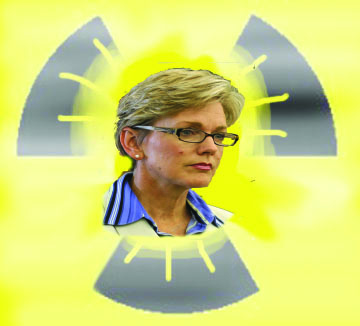
AP News, BY JEFF AMY, June 3, 2024
WAYNESBORO, Ga. (AP) — U.S. Energy Secretary Jennifer Granholm on Friday called for more nuclear reactors to be built in the United States and worldwide. But the CEO of the Georgia utility that just finished the first two scratch-built American reactors in a generation at a cost of nearly $35 billion says his company isn’t ready to pick up that baton.
Speaking in Waynesboro, Georgia, where Georgia Power Co. and three other utilities last month put a second new nuclear reactor into commercial operation, Granholm said the United States needs 98 more reactors with the capacity of units 3 and 4 at Plant Vogtle to produce electricity while reducing climate-changing carbon emissions. Each of the two new reactors can power 500,000 homes and businesses without releasing any carbon.
COMMENT. That’s if you don’t count radioactive emissions, and the huge carbon emissions from the entire nuclear fuel chain.
“It is now time for others to follow their lead to reach our goal of getting to net zero by 2050,” Granholm said. “We have to at least triple our current nuclear capacity in this country.”
The federal government says it is easing the risks of nuclear construction, but the $11 billion in cost overruns at Plant Vogtle near Augusta remain sobering for other utilities. Chris Womack is the CEO of Southern Co., the Atlanta-based parent company of Georgia Power. He said he supports Granholm’s call for more nuclear-power generation, but he added that his company won’t build more soon………….
Friday’s event capped a week of celebrations, where leaders proclaimed the reactors a success, even though they finished seven years late…….
The new Vogtle reactors are currently projected to cost Georgia Power and three other owners $31 billion, according to calculations by The Associated Press. Add in $3.7 billion that original contractor Westinghouse paid Vogtle owners to walk away from construction, and the total nears $35 billion.
Electric customers in Georgia already have paid billions for what may be the most expensive power plant ever. The federal government aided Vogtle by guaranteeing the repayment of $12 billion in loans, reducing borrowing costs…………..

The Biden administration promised that the military would commission reactors, which could help drive down costs for others. It also noted support for smaller reactors, suggesting small reactors could replace coal-fueled electric generating plants that are closing. The administration also pledged to further streamline licensing.
………………………… In Michigan, where Granholm was a Democratic governor, she announced in March up to $1.5 billion in loans to restart the Palisades nuclear power plant, which was shut down in 2022 after a previous owner had trouble producing electricity that was price-competitive.
But with much of the domestic effort focused on building a series of smaller nuclear reactors using mass-produced components, critics question whether they can actually be built more cheaply. Others note that the United States still hasn’t created a permanent repository for nuclear waste, which lasts for thousands of years. Other forms of electrical generation, including solar backed up with battery storage, are much cheaper to build initially.
…………….Regulators in December approved an additional 6% rate increase on Georgia Power’s 2.7 million customers to pay for $7.56 billion in remaining costs at Vogtle, with the company absorbing $2.6 billion in costs. That is expected to cost the typical residential customer an additional $8.97 a month in May, on top of the $5.42 increase that took effect when Unit 3 began operating. https://apnews.com/article/georgia-nuclear-plant-energy-secretary-granholm-05a6e2444a8b5a9e9c7c61b111b87192
Summary of Australian federal and state/territory nuclear/uranium laws and prohibitions

Current prohibitions on nuclear activities in Australia: a quick guide
From Jim Green, 30 May 2024
https://www.aph.gov.au/About_Parliament/Parliamentary_departments/Parliamentary_Library/pubs/rp/rp2324/Quick_Guides/NuclearActivitiesProhibitions
PDF Version [564KB]
Dr Emily Gibson
Science, Technology, Environment and Resources; Law and Bills Digest Sections
This quick guide provides an overview of current prohibitions on nuclear activities under Commonwealth, state and territory laws. It considers the primary legislation most relevant to current policy debates about domestic nuclear energy only and consequently does not consider recent changes to Commonwealth law to facilitate Australia’s acquisition of conventionally-armed, nuclear-powered submarines under the AUKUS partnership.[1] It also does not include consideration of Australia’s international obligations in respect of nuclear activities, including the safeguarding of nuclear materials and the non-proliferation of nuclear weapons.
If a domestic nuclear energy industry were to progress, it is expected that a comprehensive framework for the safety, security and safeguarding of the related nuclear material would need to be legislated to accommodate such an industry.[2] Consideration of these issues is beyond the scope of this paper.
What are nuclear activities?
A nuclear activity is any process or step in the utilisation of material capable of undergoing nuclear fission; that is, any activities in the nuclear fuel cycle.[3] Nuclear activities therefore include:
- mining of nuclear or radioactive materials such as uranium and thorium milling, refining, treatment, processing, reprocessing, fabrication or enrichment of nuclear material
- the production of nuclear energy
- the construction, operation or decommissioning of a mine, plant, facility, structure, apparatus or equipment used in the above activities
- the use, storage, handling, transportation, possession, acquisition, abandonment or disposal of nuclear materials, apparatus or equipment.
Prohibitions on nuclear activities
Commonwealth
Nuclear activities are regulated under the Australian Radiation Protection and Nuclear Safety Act 1998 (ARPANS Act) and the Environment Protection and Biodiversity Conservation Act 1999 (EPBC Act).
Australian Radiation Protection and Nuclear Safety Act 1998
The ARPANS Act establishes a licensing framework for controlled persons (including a Commonwealth entity or a Commonwealth contractor) in relation to controlled facilities (a nuclear installation, a prescribed radiation facility, or a prescribed legacy site).[4] A nuclear installation includes a nuclear reactor for research or the production of radioactive materials for industrial or medical use, and a radioactive waste storage or disposal facility with an activity that is greater than the activity level prescribed by the Australian Radiation Protection and Nuclear Safety Regulations 2018.[5]
The ARPANS Act allows the CEO of the Australian Radiation Protection and Nuclear Safety Agency (ARPANSA) to issue licences for controlled facilities.[6] In issuing a facility licence, the CEO ‘must take into account the matters (if any) specified in the regulations, and must also take into account international best practice in relation to radiation protection and nuclear safety’.[7]
However, subsection 10(2) of the Act expressly prohibits the CEO from granting a licence for the construction or operation of any of the following nuclear installations: a nuclear fuel fabrication plant; a nuclear power plant; an enrichment plant; or a reprocessing facility.[8] This prohibition does not appear to apply to a radioactive waste storage or disposal facility.
Environment Protection and Biodiversity Conservation Act 1999
The EPBC Act establishes 9 matters of national environmental significance (MNES) and provides for the assessment and approval of these actions if the action has, will have, or is likely to have a significant impact on the MNES.[9] ‘Nuclear actions’ are one of the MNES.[10] Where a nuclear action is determined to be a controlled action (that is, one likely to have a significant impact and requiring assessment and approval under the Act), the assessment considers the impact of a nuclear action on the environment generally (including people and communities).[11]
The Act establishes offences for the taking of nuclear actions in those circumstances.[14]
Similarly, the Act provides that a relevant entity (as set out below) must not take an action (including a nuclear action) unless a requisite approval has been obtained under Part 9 of the Act or a relevant exception applies:
- a person must not take a relevant action on Commonwealth land that has, will have or is likely to have a significant impact on the environment[15]
- a person must not take a relevant action outside Commonwealth land if the action has, will have or is likely to have a significant impact on the environment on Commonwealth land[16]
- the Commonwealth or a Commonwealth agency must not take inside or outside the Australian jurisdiction an action that has, will have or is likely to have a significant impact on the environment inside or outside the Australian jurisdiction.[17]
The Act establishes offences and civil penalty provisions for the taking of an action in those circumstances.[18]
Subsection 140A(1) prohibits the Minister for the Environment from granting an approval for a nuclear action relating to specified nuclear installations. These installations are a nuclear fuel fabrication plant, a nuclear power plant, an enrichment plant, and a reprocessing facility.
Potential reform of the nuclear action trigger
The second independent review of the EPBC Act, completed in October 2020 by Professor Graeme Samuel (Samuel Review), recommended that the nuclear actions MNES be retained.[19] The review recommended that ‘the EPBC Act and the regulatory arrangements of [ARPANSA] should be aligned, to support the implementation of best-practice international approaches based on risk of harm to the environment, including the community’.[20]
In 2022, the Government’s Nature Positive Plan adopted this approach and stated, ‘[a] uniform national approach to regulation of radiation will be delivered through the new National Environmental Standards’.
In February 2024, a policy draft of the National Environmental Standard for Matters of National Environmental Significance indicates that ‘nuclear actions’ will be renamed ‘radiological exposure actions’ and states:
Relevant decisions must:
Not be inconsistent with the ARPANSA national codesfor protection from radiological exposure actions including in relation to:
- human health and environmental risks and outcomes; and. radiological impacts on biological diversity,
- the conservation of species and the natural health of ecosystems.[22]
States and territories
States and territories generally regulate nuclear and radiation activities through either the health or the environmental protection portfolios. The relevant legislation provides for the protection of health and safety of people, and the protection of property and the environment, from the harmful effects of radiation by establishing licensing regimes to regulate the possession, use, and transportation of radiation sources and substances.[23] Mining of radioactive materials is regulated through the resources portfolio.
In addition, as outlined below, the states and territories have legislation prohibiting certain nuclear activities or the construction and operation of certain nuclear facilities. Importantly, where permitted, nuclear activities (including mining) would also be subject to assessment and approvals under a range of other legislation, including planning and environmental impact assessment, native title and cultural heritage, and radiation licensing laws at the state or territory and Commonwealth level.
New South Wales
Exploration for uranium has been permitted under the Mining Act 1992 since 2012.[24] However, the mining of uranium is prohibited by the Uranium Mining and Nuclear Facilities (Prohibitions) Act 1986 (NSW Prohibitions Act).[25]
The NSW Prohibitions Act also prohibits the construction and operation of certain nuclear facilities, including uranium enrichment facilities, fabrication and reprocessing plants, nuclear power plants, and storage and waste disposal facilities (other than for the storage and disposal of waste from research or medical purposes, or the relevant radiological licensing Act).[26]
Northern Territory
The Atomic Energy Act 1953 (Cth) provides that the Commonwealth owns all uranium found in the territories.[27] Uranium exploration and mining in the Northern Territory (NT) is regulated under both NT mining laws (the Mineral Titles Act 2010 and the Mining Management Act 2001) and the Atomic Energy Act.[28] The Ranger Uranium Mine operated until 2021 and is now undergoing rehabilitation.[29]
The Nuclear Waste Transport, Storage and Disposal (Prohibition) Act 2004 (NT) prohibits the construction and operation of nuclear waste storage facilities, as well as the transportation of nuclear waste for storage at a nuclear waste storage facility in the NT.[30] Nuclear waste is defined as including waste material from nuclear plants or the conditioning or reprocessing of spent nuclear fuel.[31]
This Act also:
- prohibits public funds from being expended, granted or advanced to any person for, or for encouraging or financing any activity associated with the development, construction or operation of a nuclear waste storage facility
- would require the NT Parliament to hold an inquiry into the likely impact of a nuclear waste storage facility proposed by the Commonwealth on the cultural, environmental and socio‑economic wellbeing of the territory.[32]
Queensland
Exploration for and mining of uranium are permitted under the Mineral Resources Act 1989. However, it has been government policy to not grant mining leases for uranium since 2015.[33] The government policy ban extends to the treatment or processing of uranium within the state.[34]
The Nuclear Facilities Prohibition Act 2007, in similar terms to the NSW Prohibitions Act, prohibits the construction and operation of nuclear reactors and other nuclear facilities in the nuclear fuel cycle.[35]
Unlike other state and territory prohibition legislation, the Nuclear Facilities Prohibition Act would require the responsible Queensland Minister to hold a plebiscite to gain the views of the Queensland population if the Minister was satisfied that the Commonwealth Government has taken, or is likely to take, steps to amend a Commonwealth law or exercise a power under a Commonwealth law to facilitate the construction of a prohibited nuclear facility, or if the Commonwealth Government adopts a policy position of supporting or allowing the construction of a prohibited nuclear facility in Queensland.[36]
South Australia
The exploration and mining of radioactive material (including uranium) is permitted in South Australia (SA), subject to approvals under the Mining Act 1971 and the Radiation Protection and Control Act 2021 (RP&C Act).[37] For example, uranium is mined at Olympic Dam, Four Mile and Honeymoon. However, conversion and enrichment activities are prohibited by the RP&C Act.[38]
The Nuclear Waste Storage Facility (Prohibition) Act 2000 prohibits the construction or operation of a nuclear waste storage facility, and the import to SA or transport within SA of nuclear waste for delivery to a nuclear waste storage facility.[39]
The Nuclear Waste Storage Facility (Prohibition) Act prohibits the SA Government from expending public funds to encourage or finance the construction or operation of nuclear waste storage facilities.[40] The Act would also require the SA Parliament to hold an inquiry into the proposed construction or operation of a nuclear waste storage facility in SA authorised under a Commonwealth law.[41]
Tasmania
The exploration and mining of atomic substances (which includes uranium and thorium) is permitted under the Mineral Resources Development Act 1995 (Tas), subject to approval.
Victoria
The Nuclear Activities (Prohibitions) Act 1983 prohibits a range of activities associated with the nuclear fuel cycle, including the exploration and mining of uranium and thorium, and the construction or operation of facilities for the conversion or enrichment of any nuclear material, nuclear reactors and facilities for the storage and disposal of nuclear waste from those prohibited activities.[42]
Western Australia
Exploration for and mining of uranium is permitted under the Mining Act 1978. A state policy ban on mining approvals was overturned in November 2008;[43] however, this was reinstated in June 2017, with a ‘no uranium’ condition on future mining leases.[44] The ban does not apply to 4 projects that had already been approved by the previous government.
The Nuclear Activities Regulation Act 1978 aims to protect the health and safety of people and the environment from possible harmful effects of nuclear activities, including by regulating the mining and processing of uranium and the equipment used in those processes. The Nuclear Waste Storage and Transportation (Prohibition) Act 1999 also prohibits the storage, disposal or transportation in Western Australia of certain nuclear waste (including waste from a nuclear plant or nuclear weapons).[45]
Can the Commonwealth override a state ban on nuclear activities?
The Commonwealth Parliament only has the power to make laws in relation to matters specified in the Constitution of Australia, including in sections 51, 52 and 122. Assuming the Commonwealth has a sufficient head of power to legislate, section 109 of the Constitution specifically provides for circumstances in which there might be an inconsistency between Commonwealth and state laws:
When a law of a State is inconsistent with a law of the Commonwealth, the latter shall prevail, and the former shall, to the extent of the inconsistency, be invalid.
Therefore, even though some states have enacted prohibitions on certain nuclear activities within their jurisdictions, the Commonwealth Parliament could enact specific legislation in relation to nuclear activities so that such activities can take place within those jurisdictions. One such example is the National Radioactive Waste Management Act 2012 (Cth), which provides for the establishment of a national radioactive waste management facility at a site to be declared by the responsible Commonwealth Minister. Section 12 of that Act provides that state and territory laws have no effect in regulating, hindering, or preventing such a facility
Further information
- ‘Who we regulate’, ARPANSA
- ‘State & territory regulators’, ARPANSA
- ‘Uranium and thorium’, in Geoscience Australia, Australia’s Energy Commodity Resources, 2023 Edition, (Canberra: Geoscience Australia, 2023).
Call for next UK government to make ‘big decisions’ on nuclear power projects

The manifesto also pressed for the building of a fleet of Small Modular Reactors.
Independent, Alan Jones, 1 June 24
The next government is being urged to make “big decisions” on nuclear power projects to help deliver jobs and energy security.
The Nuclear Industry Association (NIA) has published its manifesto, saying it was important to ensure continued momentum.
The association called for measures including pressing ahead with the planned Sizewell C power station, as well as extending the life of current power stations.
The manifesto also pressed for the building of a fleet of Small Modular Reactors (SMRs) across the country and a third large-scale station at Wylfa on Anglesey in north Wales.
Tom Greatrex, chief executive of the NIA, said: “Big decisions on new nuclear projects are needed as a matter of urgency during the next parliament……………………………….. https://www.independent.co.uk/business/call-for-next-government-to-make-big-decisions-on-nuclear-power-projects-b2554453.htm
The UK Is Ramping Up Its Nuclear Energy Ambitions

The cost of development has increased significantly since EDF first gained project approval in 2012, which could make it the world’s most expensive nuclear plant……..$58.4 billion earlier in the year. Its completion date has also been delayed by three to four years, expected to be completed by 2031. …….a government spokesperson …… the plant is “not a government project” and stated, “any additional costs or schedule overruns are the responsibility of EDF and its partners and will in no way fall on taxpayers.”
Oil Price, By Felicity Bradstock – May 30, 2024,
- The U.K. government aims to rapidly expand its nuclear energy sector, with two nuclear plants slated for the next decade and discussions around a third.
- The government hopes to meet up to 25 percent of the country’s electricity demand using nuclear power sources by 2050.
The U.K. government has ambitious plans for the rapid expansion of the country’s nuclear energy sector, with two nuclear plants slated for the next decade, and discussions around a third. EDF’s Hinkley Point C in Somerset and Sizewell C in Suffolk have both been approved by the government, expected to support the U.K.’s transition away from fossil fuels to greener alternatives in line with national climate pledges.
The U.K. government has announced ambitious nuclear plans in recent years, aiming for the biggest expansion in nuclear power for 70 years. It hopes to meet up to 25 percent of the country’s electricity demand using nuclear power sources by 2050. This will mean a fourfold increase in the U.K.’s nuclear power production, to achieve an output of 24 GW by the mid-century. The Civil Nuclear Roadmap outlines the government’s nuclear plans, including the development of major nuclear facilities, as well as its small modular reactor (SMR) technology. The government also plans to invest up to $381 million in the domestic production of the fuel required to power high-tech new nuclear reactors, known as HALEU, currently only commercially produced in Russia.
The cost of development has increased significantly since EDF first gained project approval in 2012, which could make it the world’s most expensive nuclear plant. EDF previously stated that it expected the plant to cost around $22 billion, but it increased that estimate to around $58.4 billion earlier in the year. Its completion date has also been delayed by three to four years, expected to be completed by 2031. The firm blamed inflation, Covid, and Brexit for cost increases and project delays. While there were some public concerns for the price increase, a government spokesperson made it clear that the plant is “not a government project” and stated, “any additional costs or schedule overruns are the responsibility of EDF and its partners and will in no way fall on taxpayers.”
In May, EDF was granted a site license by the U.K.’s nuclear regulator, the Office for Nuclear Regulation (ONR), for the development of its Sizewell C nuclear plant in Suffolk, in the south of England. This is the first of this type of license to be granted in over a decade. Sizewell C is expected to be a replica of the company’s Hinkley Point C. EDF is racing to reach a final investment decision on the project by the end of 2024.
Unlike Hinkley, EDF holds just under a 50 percent stake in Sizewell, with the government holding just over 50 percent. The company is now seeking new investment following the banning of China’s CGN from funding the development due to security concerns. The French firm hopes to use lessons learned from the development of Hinkley to construct Sizewell within around nine years.
Now, the U.K. government is in discussion over another potential nuclear plant development in Wales. The government announced it is holding conversations with major energy companies about the construction of a third new nuclear plant on a site at Wylfa on Anglesey in north Wales. The development of an additional site would help the U.K. to achieve its nuclear energy goals by the mid-century. There are reports that South Korea’s state-owned nuclear developer has been involved in early-stage discussions with the government about the multi-billion construction using APR1400 reactor technology. However, the American nuclear firm Westinghouse and the construction group Bechtel have shown interest in developing the project using Westinghouse’s AP1000 reactor technology………………………………….. https://oilprice.com/Energy/Energy-General/The-UK-Is-Ramping-Up-Its-Nuclear-Energy-Ambitions.html
White House to support new nuclear power plants in the U.S.
CNBC, MAY 29 2024
The White House on Wednesday plans to announce new measures to support the development of new U.S. nuclear power plants, a large potential source of carbon-free electricity the government says is needed to combat climate change.
The suite of actions, which weren’t previously reported, are aimed at helping the nuclear power industry combat rising security costs and competition from cheaper plants powered by natural gas, wind and solar……………………………………..
Critics worry about the buildup of radioactive waste stored at plants around the country and warn of the potential risks to human health and nature, especially with any accidents or malfunctions. Biden signed a law earlier this month banning the use of enriched uranium from Russia, the world’s top supplier.
At a White House event on Wednesday focused on nuclear energy deployment, the Biden administration will announce a new group that will seek to identify ways to mitigate cost and schedule overruns in plant construction.
It also said the Army will soon solicit feedback on deploying advanced reactors to provide energy for certain facilities in the United States. Small modular reactors and microreactors can provide energy that is more resilient to physical and cyber attacks, natural disasters and other challenges, the White House said.
The Department of Energy also released a paper outlining the expected increased safety of advanced reactors. And a new tool will help developers figure out how to cut capital costs for new nuclear reactors.
The youngest U.S. nuclear power reactors, at the Vogtle plant in Georgia, were years behind schedule and billions over budget when they entered commercial operation in 2023 and 2024. No new U.S. nuclear plants are currently being built……………………………….. https://www.cnbc.com/2024/05/29/white-house-to-support-new-nuclear-power-plants-in-the-us.html
Radiation Exposure Compensation Act (RECA) set to expire soon, while many nuclear test victims await justice .
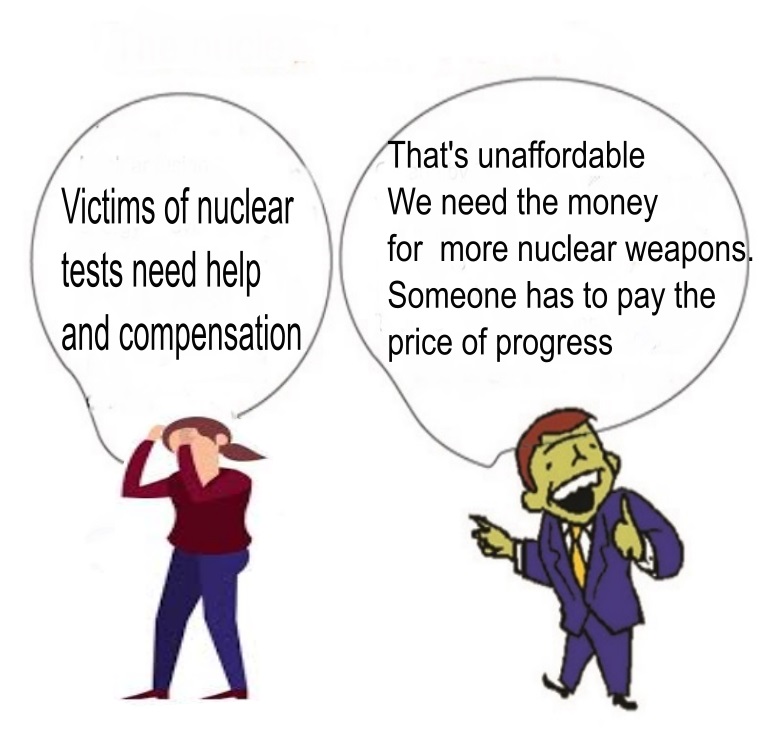
The defense spending bill for 2024 was signed into law on Dec. 22 by Biden, but the RECA expansion was cut from the final bill before it landed on his desk.
Without an extension, RECA is set to expire in June, and the deadline for claims to be postmarked is June 10, 2024, according to the DOJ.
‘Time is running out’
by beyondnuclearinternational by Shondiin Silversmith, Arizona Mirror
Navajo Nation urges Congress to act on RECA expansion bill
Kathleen Tsosie remembers seeing her dad come home every evening with his clothes covered in dirt. As a little girl, she never questioned why, and she was often more excited to see if he had any leftover food in his lunchbox.
“We used to go through his lunch and eat whatever he didn’t eat,” Tsosie said, recalling when she was around 4 years old. “And he always had cold water that came back from the mountain.”
Tsosie’s father, grandfather, and uncles all worked as uranium miners on the Navajo Nation near Cove, Arizona, from the 1940s to the 1960s. The dirt Tsosie’s father was caked in when he arrived home came from the mines, and the cold water he brought back was from the nearby springs.
Tsosie grew up in Cove, a remote community located at the foothills of the Chuska mountain range in northeastern Arizona. There are 56 abandoned mines located in the Cove area, according to the Environmental Protection Agency.
In the late 1960s, Tsosie said her grandfather started getting sick. She remembers herding sheep with him and how he would often rest under a tree, asking her to push on his chest because it hurt.
Tsosie said she was about 7 years old when her uncles took her grandfather to the hospital. At the time, she didn’t know why he was sick, but later on, she learned he had cancer. Her grandfather died in October 1967.
Over a decade later, Tsosie’s father also started getting sick. She remembers when he came to visit her in Wyoming; she was rubbing his shoulders when she felt a lump. She told him to get it checked out because he complained about how painful it was.
Her father was diagnosed with cancer in 1984 and went through treatments, but died in April 1985.
“When my dad passed away, everybody knew it was from the mine,” Tsosie said. He was just the latest on a long list of Navajo men from her community who worked in the uranium mines and ended up getting sick and passing away.
Because of that history, Tsosie became an advocate for issues related to downwinders and uranium mine workers from the Navajo Nation, including the continuation of the Radiation Exposure Compensation Act.
The Radiation Exposure Compensation Act, or RECA, provides a program that compensates individuals who become ill because of exposure to radiation from the United States’ development and testing of nuclear weapons.
RECA was initially set to expire in 2022, but President Joe Biden signed a measure extending the program for two more years. Now, it’s set to expire in less than a month…………………………………………………………………………………
In July 2023, the U.S. Senate voted to expand and extend the RECA program, and it was attached as an amendment to the National Defense Authorization Act, which funds the Department of Defense.
It could have extended health care coverage and compensation to more uranium industry workers and “downwinders” exposed to radiation in several new regions — Colorado, Missouri, New Mexico, Idaho, Montana, and Guam — and expanded coverage to new parts of Arizona, Nevada and Utah.
The defense spending bill for 2024 was signed into law on Dec. 22 by Biden, but the RECA expansion was cut from the final bill before it landed on his desk.
When she heard that the Radiation Exposure Compensation Act amendments failed to pass, Tsosie said it really impacted her, and she cried because so many people deserve that funding.
“I know what it feels like. I know what it feels like to suffer,” she said.
Without an extension, RECA is set to expire in June, and the deadline for claims to be postmarked is June 10, 2024, according to the DOJ.
The sunset of the Radiation Exposure Compensation Act is approaching fast, and leaders from the Navajo Nation are urging Congress to act on the expansion bill that has been waiting for the U.S. House of Representatives to take it up for more than two months.
“Time is running out,” Justin Ahasteen, the executive director of the Navajo Nation Washington Office, said in a press release.
“Every day without these amendments means another day without justice for our people,” he added. “We urge Congress to stand on the right side of history and pass these crucial amendments.”
Republican Sen. Josh Hawley from Missouri introduced S. 3853 – The Radiation Exposure Compensation Reauthorization Act, which funds RECA past its June sunset date for another six years.
The bill passed through the U.S. Senate with a bipartisan 69-30 vote on March 7. But since being sent to the House on March 11, the bill hasn’t moved.
The RECA expansion bill would include more communities downwind of nuclear test sites in the United States and Guam. It would extend eligibility for uranium workers to include those who worked after 1971. Communities harmed by radioactive waste from the tests could apply for the program, and expansion would also boost compensation payments to account for inflation.
“The Navajo Nation calls for immediate passage of S. 3853,” Ahasteen said in a press release. “This is to ensure that justice is no longer delayed for the Navajo people and other affected communities.”
Ahasteen told the Arizona Mirror in an interview that congressional leaders holding the bill back due to the program’s expense is not a good enough reason not to pass it.
“They keep referencing the cost and saying it’s too expensive,” he said. But, he explained, the RECA expansion is only a sliver of U.S. spending on foreign aid or nuclear development.
And it shouldn’t even be a matter of cost, Ahasteen said, because people have given their lives and their health in the interest of national security.
“The bill has been paid with the lives and the health of the American workers who were exposed unjustly to radiation because the federal government kept it from them and they lied about the dangers,” he said.
From 1945 to 1992, the U.S. conducted a total of 1,030 nuclear tests, according to the Arms Control Association.
Many were conducted at the Nevada Test Site, with 928 nuclear tests conducted at the site between 1951 and 1992, according to the Nevada National Security Site. About 100 of those were atmospheric tests, and the rest were underground detonations.
According to the United Nations Scientific Committee on the Effects of Atomic Radiation, atmospheric tests involved unrestrained releases of radioactive materials directly into the environment, causing the largest collective dose of radiation thus far from man-made radiation sources………………………………………………………………………
The legacy of uranium mining has impacted the Navajo Nation for decades, from abandoned mines to contaminated waste disposal.
From 1944 to 1986, nearly 30 million tons of uranium ore were extracted from Navajo lands, according to the EPA, and hundreds of Navajo people worked in the mines, often living and raising families in close proximity to the mines and mills.
Ahasteen said those numbers show exactly how large the uranium operations were on the Navajo Nation and the impact it would have on the Navajo people.
“There are photos on record to show Navajo people being exploited, not given any proper protective equipment, but (the federal government) knew about the dangers of radiation since the ’40s,” Ahasteen said. “They were given a shovel and a hard hat, and they were told: Go to work. You’ll earn lots of money. You’ll have a nice life, and we did that, but it didn’t work so well for us.”……………………………………………………………………………………………………………………
WHAT YOU CAN STILL DO BEFORE JUNE 7TH
Urge your U.S. Representative to push for a House floor vote on, and to vote in favor of, extending/expanding RECA, the Radiation Exposure Compensation Act. And urge House Speaker Mike Johnson to allow the vote on the House floor, on the Hawley version of RECA (the most expansive). There is likely enough support to pass the bill. Johnson’s phone is: 202-225-4000.
Shondiin Silversmith is an award-winning Native journalist based on the Navajo Nation. Silversmith has covered Indigenous communities for more than 10 years, and covers Arizona’s 22 federally recognized sovereign tribal nations, as well as national and international Indigenous issues. This article was first published by the Arizona Mirror, https://beyondnuclearinternational.org/2024/05/26/time-is-running-out-2/
Damning scientific report condemns the Australian Opposition’s push for nuclear power
Coalition’s brave nuke world a much harder sell after new CSIRO report
Graham Readfearn, https://www.theguardian.com/australia-news/article/2024/may/26/coalitions-brave-nuke-world-a-much-harder-sell-after-new-csiro-report?CMP=soc_568
The agency’s GenCost analysis says a first nuclear plant for Australia would deliver power ‘no sooner than 2040’ and could cost more than $17bn
The Coalition’s pitch on nuclear energy for Australia has had two recurring themes: the electricity will be cheap and it could be deployed within a decade.
CSIRO’s latest GenCost report – a document that analyses the costs of a range of electricity generation technologies – contradicts both of these points. It makes the Coalition’s job of selling nuclear power plants to Australians ever more challenging.
For the first time, the national science agency has calculated the potential costs of large-scale nuclear electricity in a country that banned the generation technology more than a quarter of a century ago.
Even using a set of generous assumptions, the CSIRO says a first nuclear plant would deliver power “no sooner than 2040” and could cost more than $17bn.
It is likely to spark an attack on the credibility of the report from nuclear advocates and those opposed to the rollout of renewable energy. Opposition leader, Peter Dutton, has already attacked the report.
In the meantime, Australia waits for the Coalition to say what kind of reactors it would deploy, where it would put them and how much it thinks they would cost.
Now that CSIRO has released its report, here’s what we know about the viability of a nuclear industry in Australia.
What’s new on nuclear costs?
CSIRO’s GenCost report says a 1,000 megawatt nuclear plant would cost about $8.6bn to build, but that comes with some large caveats. The main one is that this was the theoretical cost of a reactor in an Australia that already had an established and continuous program of building reactors.
The $8.6bn is based on costs in South Korea, which does have a continuous reactor building program and is one country the least beset by cost blowouts.
To make the cost more relevant, CSIRO compared the Australian and South Korean costs of building modern coal plants. Costs were more than double in Australia.
But CSIRO warns the first nuclear plants in Australia would be subject to a “first of a kind” premium that could easily double the $8.6bn build cost.
In the UK, a country that has been building reactors intermittently, costs for its under-construction Hinkley C reactor (more than three times the size of a theoretical 1,000MW reactor in Australia) started at $34bn and could now be as high as $89bn.
In the United States, the country’s largest nuclear plant has just turned on its final unit seven years behind schedule and at double the initial cost. There are no more nuclear plants under construction in the country.
What about the cost of the electricity?
CSIRO also offers cost estimates for the electricity produced by large-scale reactors, but those too assume a continuous nuclear building program in Australia.
Electricity from large-scale reactors would cost between $141 per megawatt hour and $233/MWh if they were running in 2030, according to GenCost.
Combining solar and wind would provide power at between $73 and $128/MWh – figures that include the costs of integrating renewables, such as building transmission lines and energy storage.
What about those small modular reactors?
The Coalition has also advocated for so-called “small modular reactors” which are not commercially available and, CSIRO says, are unlikely to be available to build in Australia until 2040.
One United States SMR project lauded by the Coalition collapsed in late 2023 because the cost of the power was too high.
That project, CSIRO says, was significant because its design had nuclear commission approval and was “the only recent estimate from a real project that was preparing to raise finance for the construction stage. As such, its costs are considered more reliable than theoretical projects.”
GenCost reports that power from a theoretical SMR in 2030 would cost between $230 and $382/MWh – much higher than solar and wind or large-scale nuclear.
How quickly could Australia build a nuclear plant?
Nuclear advocates tend to point to low nuclear power costs in countries that have long-established nuclear industries.
Australia has no expertise in building nuclear power, no infrastructure, no regulatory agency, no nuclear workforce and a public that is yet to have a serious proposition put in front of it.
Australia’s electricity grid is fast evolving from one dominated by large coal-fired power plants to one engineered for and dominated by solar, wind, batteries and pumped hydro with gas-fired power working as a rarely used backup.
This creates a major problem for the Coalition, because CSIRO estimates “if a decision to pursue nuclear in Australia were made in 2025, with political support for the required legislative changes, then the first full operation would be no sooner than 2040.”
Tony Wood, head of the Grattan Institute’s energy program, says: “By 2040, the coal-fired power stations will be in their graves. What do you do in the meantime?”
“You could keep the coal running, but that would become very expensive,” he says, pointing to the ageing coal fleet that is increasingly beset by outages.
Wood says the GenCost report is only a part of the story when it comes to understanding nuclear.
The Coalition, he says, would need to explain how much it would cost to build an electricity system to accommodate nuclear.
Could you just drop nuclear into the grid?
The biggest piece of generation kit on Australia’s electricity grid is a single 750 megawatt coal-fired unit at Kogan Creek in Queensland. Other power stations are larger but they are made up of a series of smaller units.
But the smallest of the “large-scale” nuclear reactors are about 1,000MW and most are 1,400MW.
Electricity system engineers have to build-in contingency plans if large units either trip or have to be pulled offline for maintenance. That contingency costs money.
In Australia’s current electricity system, the GenCost report says larger nuclear plants would probably “require the deployment of more generation units in reserve than the existing system consisting of units of 750MW or less.”
But by the time a theoretical nuclear plant could be deployed, most if not all the larger coal-fired units will be gone.
Who might build Australian nukes?
Some energy experts have questioned whether any company would be willing to take up a contract to build a reactor in Australia when there are existing nuclear nations looking to expand their fleets.
Right now, nuclear reactors are banned federally and in several states.
The GenCost report also points to another potential cost-raiser for nuclear – a lack of political bipartisanship.
The report says: “Without bipartisan support, given the historical context of nuclear power in Australia, investors may have to consider the risk that development expenses become stranded by future governments.”
“Crisis of radioactive waste mismanagement in the Ottawa River watershed”
Hill Times letter: “Crisis of radioactive waste mismanagement in the Ottawa River watershed,” Chief Lance Haymond and Dr. Gordon Edwards Monday May 20, 2024
We are writing to alert Hill Times readers to what we see as a crisis of radioactive waste mismanagement in the Ottawa River watershed. Components of the crisis include:
A giant, above-ground landfill for one million tonnes of radioactive waste at Chalk River Laboratories, less than one kilometre from the Ottawa River. According to the licensed inventory for the facility, more than half of the radionuclides are long-lived with half-lives exceeding the design life of the facility by thousands of years. Experts say the waste is “intermediate level,” and should be stored underground. There are concerns the facility will leak radioactive contaminants during operation, and break down due to erosion after a few hundred years.
There is a proposal to entomb “in situ” a defunct nuclear reactor less than 400 meters from the Ottawa River at Rolphton, Ont. In our view, the proposal flouts international safety standards that say entombment should not be used except in emergencies.
A multinational private-sector consortium is transporting all federal radioactive wastes, including high-level irradiated fuel waste, to Chalk River. These imports are occurring, despite an explicit request by the City of Ottawa in 2021 for cessation of radioactive waste imports to the Ottawa Valley which is seismically-active, and a poor location for long-term storage of radioactive waste.
All of the above is taking place despite the opposition of the Algonquin People on whose unceded territory the Chalk River Laboratories and defunct Rolphton reactor are located. This contravenes Canada’s United Nations Declaration on the Rights of Indigenous Peoples Act.
In our view, this crisis is a direct result of Canada’s inadequate nuclear governance regime under which almost all aspects of nuclear governance are entrusted to one agency, the Canadian Nuclear Safety Commission, which is widely perceived to be captured by the nuclear industry, and to promote the projects it is supposed to regulate. Other concerns include conflicts of interest, lack of checks and balances, and an inadequate nuclear waste policy.
Despite repeated resolutions of concern by the Assembly of First Nations and more than 140 downstream municipalities—including Ottawa, Gatineau, and Montreal—the current government appears unwilling or unable to take meaningful action to address this crisis. We are therefore appealing to the International Atomic Energy Agency and requesting a meeting with its peer review team that is scheduled to visit Canada next month.
Chief Lance Haymond, Kebaowek First Nation
Gordon Edwards, PhD, Canadian Coalition for Nuclear Responsibility
The announcement of Wylfa as the favoured site for a new nuclear plant is nothing more than blatant electioneering

27 May 2024, Dylan Morgan, People Against Wylfa B (Pawb) https://nation.cymru/opinion/the-announcement-of-wylfa-as-the-favoured-site-for-a-new-nuclear-plant-is-nothing-more-than-blatant-electioneering/
The morning of May 22 certainly had a feeling of April Fool’s Day about it with the announcement by the energy minister, Claire Coutihno that Wylfa is in the government’s view, a favoured site for building large nuclear reactors.
In case you haven’t been following the planned renaissance of nuclear power in the British State over the past 20 years, Wylfa was included by Tony Blair’s government as one of eight possible new build nuclear sites in 2006.
It is well documented how the German consortium of REW and E.ON set up Horizon Nuclear Power in 2007 with a view to build new reactors at Wylfa.
Following the Fukushima nuclear disaster in 2011 and how that strengthened already strong anti-nuclear views in Germany, the consortium were lucky some months after announcing they would not proceed with Wylfa B in March 2012, to sell Horizon at a profit for £750 million to Hitachi in October 2012.
Hitachi then spent another £1.25 billion on the Wylfa B project until January 2019, before deciding to suspend any more investment.
The project was finally scrapped completely in September 2020.
So Wylfa has been in the government plans for the past 20 years. To pretend that this was somehow a new step was nonsense.
It was nothing more than blatant electioneering on behalf of Virginia Crosbie in her attempt to keep Ynys Môn in the Conservative fold.
Planning Inspectorate
Under Hitachi’s ownership, Horizon presented a full planning application for new nuclear reactors at Wylfa to the Planning Inspectorate who are responsible for evaluating all major infrastructure planning applications.
Independent inspectors were appointed to scrutinise the proposals at public sessions in October 2018 and early spring 2019 and in private group discussions among the inspectors.
Their final report was not published until Hitachi had announced a suspension of investment in the project. Their conclusions were striking to say the least.
“Expert planning officers felt that the proposals failed to meet some of the United Nations’ biological diversity standards and also listed concerns over the project’s impact on the local economy, housing stock and the Welsh language.
“The planning inspectors’ report said there was a lack of scientific evidence put forward by developers to demonstrate that the Arctic and Sandwich tern (seabird) populations around the Cemlyn Bay area would not be disturbed by construction.
There were fears that these birds would abandon the Bay as a result. It also raised wider concerns over the general impact on Cemlyn Bay, the Cae Gwyn site of special scientific interest and Tre’r Gof…
“… it found the influx up to 7500 workers during construction “could even with the proposed mitigation, adversely affect tourism, the local economy, health and wellbeing and Welsh language and culture”.
“It concluded: “Having regard to all the matters referred in this report, the ExA’s conclusion is that, on balance, the matters weighing against the proposed development outweigh the matters weighing in favour of it. The ExA therefore finds the case for development is not made and it recommends accordingly.”
‘Drop in the ocean’
It was reported in Jeremy Hunt’s final budget this spring that the government were going to pay Hitachi £160 million for the Horizon sites at Wylfa and Olbury, a loss of around £600 million for Hitachi.
Even if this payment is made, it is still only a drop in the ocean in the wider context of the cost of nuclear power stations.
When construction started on the only new nuclear project in England at Hinkley Point C in Somerset in 2015 led by the French nuclear developer EdF, the original cost estimate was £18 billion.
That sum has now rocketed to £46 billion with 2031 as the nearest possible completion date. EdF then want to turn their attention to Sizewell C to replicate the work carried out at Hinkley.
If the Hinkley project is completed by sometime in the 2030’s and work is started on Sizewell, that follow-up nuclear build would take another 15 to 20 years taking us to around 2050.
Nuclear skills
Nuclear industry insiders have publicly admitted that the British State only has enough nuclear skills to build one nuclear development in a given period. Indeed, Simon Bowen, the Chairman of Great British Nuclear stated clearly in that body’s blog on 9 September, 2023 that there is a “lack of skills to meet the coming nuclear challenge”.
In another interview on January 29, 2024 to World Nuclear News he underlines what we have always argued, that the civil and military nuclear sectors are intrinsically linked:“…unless we share skills and we find mechanisms for sharing skills across the nuclear sector, both in defence and civil and across the boundaries, then it is going to be very, very difficult to succeed”
Nuclear power is dangerous, dirty, outdated, a huge threat to environmental and human health as the Chernobyl and Fukushima disasters have shown, and extortionately expensive.
It goes totally against the flow of smart money investment in electricity generating projects world wide.
Net loss
The International Energy Agency Annual Report for 2023 published early this year showed another net loss of nuclear power generation leaving it with a 9.2% share of electricity generation worldwide.
For the same year, electricity from the various renewable technologies had increased to 30.2% of the global market. That figure is anticipated to increase to 42% by 2028.
That is just four years away and is a remarkable figure. At that rate of growth, within another decade, renewables can realistically expect to supply over 50% of global electricity.
The world is waking up despite the big oil and nuclear corporations desperately trying to hang on and be relevant.
Future generations will not forgive us if we plough huge amounts of money as taxpayers and through a nuclear tax on our electricity bills into new nuclear reactors in the next twenty years, thereby adding to the huge headache of the legacy radioactive waste of the past 60 to 70 years stored at the decaying Sellafield complex.
All hot radioactive waste produced from high burn up uranium which will be used at Hinkley Point and any other possible new nuclear reactors, will have to be stored on site for at least 150 years.
These are the brutal facts of nuclear power and politicians from all parties contesting the General Election should be challenged, especially if they blindly support nuclear technology which is limping towards irrelevance and oblivion.
Uncertainty in UK. Will a Labour government really tread that troubled nuclear power path?
Although technically wedded to the pursuance of new nuclear, whether
Labour in office continues to tread a nuclear path is far from certain.
Labour ministers would face a plethora of competing financial demands from
the onset of their new term in government. In its last period in office
(1997 to 2010), Labour built no new nuclear power plants; consequently, the
civil Nuclear Roadmap may eventually prove to be as washed out as Rishi
Sunak’s rain sodden jacket.
Announcement day was eventful from the onset.
Nuclear Minister Andrew Bowie had been scheduled to meet representatives
from anti-nuclear NGOs in-person at the London offices of his Department of
Energy Security and Net Zero. Others were due to join the Minister online.
Although the meeting had been arranged weeks in advance, Mr Bowie decided
instead to cut and run; there were rumours that Mr Bowie had decided to
make a last-minute trip to Wylfa in North Wales, but, as these have so far
been unsubstantiated, perhaps he was just clearing his desk?
Claire Coutinho in her last act as Energy Secretary had just announced the
non-news that the Wylfa site has been earmarked as the government’s
preferred location for the third gigawatt nuclear power plant. This has
been patently obvious to anyone observing developments in the nuclear
industry for some time. Mr Sunak, and before him Boris Johnson, have
positively gushed over the ‘virtues’ of developing this site over any
others and the recent acquisition of the site with Oldbury for £160
million by Great British Nuclear from former owners Horizon earlier this
year made this choice a certainty.
If built, and remember previous plans
have come to naught, the Wylfa B plant would be similar in size to those in
construction at Hinkley Point C in Somerset and announced for Sizewell C in
Suffolk. Both are being built by French state-owned electricity generator,
EDF, equipped with two European Pressurised Reactors (EPRs) with 3.2
Gigawatt generating capacity.
NFLA 26th May 2024
UK Nuclear Plant Sizewell Continues Fundraising Before Election

- Banks offered to lend as much as £12.5 billion for Sizewell C
By Will Mathis, May 24, 2024
The developer of the UK’s Sizewell C nuclear power plant is pushing ahead to complete
financing for the project this year even as a looming election risks
complicating the timeline.
A group of banks offered to lend as much as
£12.5 billion ($15.9 billion) to help finance the plant in eastern
England, according to a person familiar with the matter. They include HSBC
Holdings Plc, NatWest Group Plc and Banco Santander SA, the person said.
Debt will play a role in a multibillion-pound funding effort that also
includes an ongoing effort to raise equity from private investors.
“The two main political parties are committed to Sizewell C and we are carrying
on with the capital raise, preparing for a final investment decision and
mobilizing teams on our site,” a spokesperson for Sizewell said,
declining to comment on the debt specifically.
HSBC and Santander declined to comment. NatWest didn’t immediately comment.
The government had vowed
to reach a final investment decision on the proposed 3.2-gigawatt Sizewell
C station in the current parliament, a process that was on track to
complete this summer. That means the final stage of the fund-raising
process could be among Labour leader Keir Starmer’s first acts if he
becomes prime minister. “Sizewell needs to move forward at pace,”
Starmer said during a visit to another nuclear plant last year. “New
nuclear has to be part of that mix.”
Bloomberg 23rd May 2024
1 This Month
26 September – International Day for the Total Elimination of Nuclear Weapons





PLEASE OPPOSE HR 8255 AND S.3639 – bills would accelerate satellite deployment, with no environmental review or safeguards – https://ncstd5li.quorum.us/campaign/169331/
To see nuclear-related stories in greater depth and intensity – go to https://nuclearinformation.wordpress.com
-
Archives
- September 2026 (313)
- August 2026 (330)
- July 2026 (355)
- June 2026 (287)
- May 2026 (306)
- April 2026 (356)
- March 2026 (251)
- February 2026 (267)
- January 2026 (308)
- December 2025 (358)
- November 2025 (359)
- October 2025 (375)
-
Categories
- 1
- 1 NUCLEAR ISSUES
- business and costs
- climate change
- culture and arts
- ENERGY
- environment
- health
- history
- indigenous issues
- Legal
- marketing of nuclear
- media
- opposition to nuclear
- PERSONAL STORIES
- politics
- politics international
- Religion and ethics
- safety
- secrets,lies and civil liberties
- spinbuster
- technology
- Uranium
- wastes
- weapons and war
- Women
- 2 WORLD
- ACTION
- AFRICA
- Atrocities
- AUSTRALIA
- Christina's notes
- Christina's themes
- culture and arts
- Events
- Fuk 2022
- Fuk 2023
- Fukushima 2017
- Fukushima 2018
- fukushima 2019
- Fukushima 2020
- Fukushima 2021
- general
- global warming
- Humour (God we need it)
- Nuclear
- RARE EARTHS
- Reference
- resources – print
- Resources -audiovicual
- Weekly Newsletter
- World
- World Nuclear
- YouTube
-
RSS
Entries RSS
Comments RSS

