Sizewell A Nuclear Site: Direction to Nuclear Decommissioning Authority
The Secretary of State for Energy Security and Net Zero (Ed Miliband), 26 July 24 https://hansard.parliament.uk/commons/2024-07-26/debates/24072618000010/SizewellANuclearSiteDirectionToNuclearDecommissioningAuthority
I am today laying a new designation direction to the Nuclear Decommissioning Authority in respect of the Sizewell A nuclear site, which amends the existing direction. The direction has been given in accordance with sections 3 and 5 of the Energy Act 2004, with the consent of Nuclear Restoration Services Ltd, which controls the site.
This direction will end the Nuclear Decommissioning Authority’s responsibilities under the Energy Act 2004 for specific land and buildings on the Sizewell A nuclear site, so that the land can be sold to EDF and become part of the Sizewell B nuclear site. This will facilitate the development of new nuclear at the Sizewell C nuclear site.
Hundreds protesting Netanyahu visit arrested at US Capitol

The protesters belonged to the Jewish Voice for Peace activist group
News Desk, JUL 24, 2024, https://thecradle.co/articles/hundreds-protesting-netanyahu-visit-arrested-at-us-capitol
Around 200 pro-Palestine protesters were detained on Capitol Hill on 23 June, ahead of Israeli Prime Minister Benjamin Netanyahu’s address to the US Congress the day after.
The protest took place in the Canon House Office Building. The demonstrators, wearing shirts with the slogan “Not in our name,” were organized by the Jewish Voice for Peace group.
According to police, the protesters were warned that demonstrating in the Canon House Office Building was illegal.
Executive Director of Jewish Voice for Peace, Stefanie Fox, said the Israeli premier’s speech in Congress on Wednesday was the reason for the demonstration.
“For nine months, we’ve watched in horror as the Israeli government has carried out a genocide, armed and funded by the US. Congress and the Biden administration have the power to end this horror today. Instead, our president is preparing to meet with Netanyahu and Congressional leadership has honored him with an invitation to address Congress,” she said.
Republican representative Mike Lawler called the protest an “embarrassment” and accused the Jewish Voice for Peace activists of being “pro-Hamas.”
Netanyahu’s address to Congress was announced in late May by Mike Johnson, Republican Speaker of the US House of Representatives. At the time, the International Criminal Court (ICC) had announced its decision to seek arrest warrants against Netanyahu and his defense minister.
Johnson threatened during his announcement in May that the US “should punish” the ICC for its decision.
The Israeli prime minister arrived in Washington on Monday, ahead of his speech at Congress on 24 May and a meeting with US President Joe Biden, scheduled for the following day.
The ICC said on Tuesday that it has accepted 64 filings by states, individuals, and organizations to intervene regarding arrest requests against Netanyahu and others, including Hamas leaders.
It is highly expected that Netanyahu’s address will focus on the idea of continuing the war in Gaza until Hamas’ defeat – in line with his government’s stated goals and in stark contradiction to efforts to reach a ceasefire deal.
The premier’s much-anticipated address in Congress comes on the 292nd day of Israel’s genocidal war against the Gaza Strip, which has killed over 39,000 people – mainly women and children – and has injured over 90,000.
What Labour’s Great British Energy really means for Scotland and is nuclear on the cards?

We know it will be based in Scotland, we know it’s going to invest
in green energy projects, and aim to leverage private investment into the
same. But Thursday’s announcement has thrown up more questions about the
specifics which the Government are yet to answer – especially on what the
project means for Scotland.
There remains no clarity on when people might
expect to see energy bill pressures easing up on their household finances.
The Government has only gone as far as to say that bill reductions can be
expected within the next five years, as a result of their actions. Crown
Estate Scotland is a devolved body and the revenue raised through rents
north of the Border is sent back to the Scottish Government. Its reserved
counterpart can invest directly in Scotland, however, and the two bodies
already work closely together on some projects.
Whether the Crown Estate Scotland will get the same new borrowing powers as its rest-of-UK
counterpart remains to be seen. GB Energy will seek to work alongside GB
Nuclear, a vehicle which came about under the previous government.

This could raise red flags for the Scottish Government, which remains opposed to
nuclear power. It is understood the UK Government views nuclear policy as a
matter for the Scottish Government. And while the Scottish Government said
on Thursday that it believed the “UK Government’s intended investment
in nuclear should instead be used to bolster further renewables” a
spokesperson added there was otherwise a “great deal of agreement between
the two Governments on many of the priorities that have been identified”.
The National 25th July 2024
https://www.thenational.scot/news/24477272.labours-gb-energy-really-means-scotland-nuclear/
NATO’s deceptive veneer – young, feminist, peaceful – “civilian”

NATO’s Civilian Bases BY JOAN ROELOFS. https://www.counterpunch.org/2024/07/24/natos-civilian-bases/
Why has NATO been so generally accepted in Europe by almost all the major political parties and especially puzzling, the social democratic ones? Its economic costs, illegal aggressive wars, environmental damage, and the risks of nuclear annihilation would seem to make it a prime platform item. Well-informed political activists are unlikely to believe that an invasion of Switzerland or Denmark is imminent. There are significant anti-NATO movements, such as No to War No to NATO, but so far they haven’t been able to turn the tide.
Some reasons are fairly obvious. The US military connections to European defense and foreign ministries began during World War II. These strong ties have continued, now with an emphasis on NATO’s newly acquired feminist face, the Women, Peace, and Security agenda.
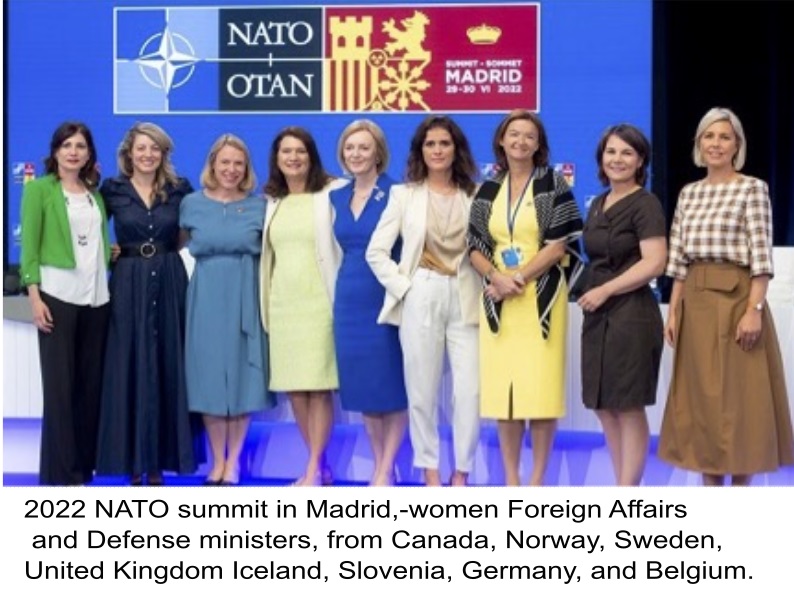
Promotion long and wide has been carried out by overtly pro-NATO lobbies such as the Atlantic Council and national think tanks, for example, the Council on Foreign Relations (US), the British Royal Institute of International Affairs, and their counterparts in many nations. There is also a Youth Atlantic Treaty Association, a network of national organizations of young professionals, university students and researchers.
The secretive Bilderberg group harnesses the political, economic, academic and journalism elites of NATO nations. Operation Gladio, Operation Paperclip and others have sustained firm links with military and intelligence agencies. There has also been covert and overt interventions in political parties and nongovernmental organizations, such as the CIA funding of Christian Democratic party in 1948 to defeat the Communist Party and meddling in the British Labour Party to minimize the influence of the Committee on Nuclear Disarmament. These have also cleared the path for NATO. Eastern Europe was even more easily penetrated by NATO, after the devastation of its economic, cultural, and scientific institutions.
There have been constant protests against NATO bases, yet their less vocal sympathizers appreciate the economic benefit. At first, in war-torn Europe both the liberated and the occupied nations saw little economic activity. Now the European economy is increasingly militarized, having outsourced much of its civilian industry and facing declines in its tourist industry due to pandemics, protests by local residents, and environmental costs. According to the Stockholm International Peace Research Institute (SIPRI) Fact Sheet of 2024, weapons production has greatly accelerated in many European countries, even though NATO and national militaries also equip themselves royally with US products. Sales to the Middle East and other violence inflicted areas are good business.
Now workers, many unionized and some even socialists and communists, have secure jobs in war industries and in the burgeoning military-civilian industries. As the Erikssons have documented:
The defence industry is undergoing rapid change, particularly regarding the development of dual-use technology and transfer of technology between military and civilian domains. . . The blurring of the military-civilian divide is particularly noticeable with the rapid development of Artificial Intelligence (AI), digitalization, satellite technology, integrated quantum, photonics, high-capacity wireless communications, and “big data” networking through 5 G – developments which have been referred to as “the fourth industrial revolution. . .”
Just as its military bases need everything, NATO institutes, operations, conferences, war games, and its supersized headquarters in Brussels equip and maintain from every kind of business. Much information is available on the NATO website; it also has a presence on YouTube, LinkedIn, Facebook, Instagram and X (Twitter). The NATO Support and Procurement Agency contracts database for 2023 lists only orders valued above €80,000. It includes “consumables” from a firm in Luxembourg, transport of tents and conference center equipment from Belgium, winter clothing from France, “civil and mechanical” from Albania, medical equipment from Sweden, waterproof bags from Great Britain, and spare parts from vendors in many countries.
Undoubtedly, even smaller businesses supply a wide range, and, as in the US, provide economic survival for owners, workers, and communities (see The Trillion Dollar Silencer). A listing of bids above €800,000 includes medical treatment structures from a firm in Italy, training services (Netherlands and Spain), and military cots and mosquito nets (Italy and Turkey). Although the largest in both lists are expenditures for weapons, firms that are often the economic lifeblood—rather the deathblood—of their communities, the smaller (but not piddling) purchases can influence many citizens and their elected representatives.
NATO training and research operations involve civilian universities, which increasingly have military departments, as well as national military academies. There are even public high school training programs, e.g., in Sweden, Germany, and France (Defence Cadets). In addition, the US Department of Defense has direct contracts with universities and scientific institutes worldwide, especially for weapons development, nanotechnology, and biotechnology.
NATO also has several layers of its own training entities. One is the Partnership Training and Education Centres, in 34 member and partner (i.e., not full member) countries. Some examples are Switzerland, Geneva Centre for Security Policy; Israel, IDF Military Medical Academy; Serbia, Chemical, Biological, Radiological and Nuclear Training Centre; Mongolia, Peace Support Operations Centre; Colombia, International Demining Centre; Italy, The International Institute of Humanitarian Law; and United Kingdom, United Kingdom Defence Academy.
Another NATO network is the 28 Centres of Excellence which are “international military organizations that train and educate leaders and specialists from NATO member and partner countries.” They are funded nationally and accredited by NATO. Some of these are Civil-Military Cooperation, one of two in the Netherlands; Crisis Management and Disaster Response, Bulgaria; Modelling and Simulation, one of several in Italy; Strategic Communications, Latvia; Climate Change and Security, Canada; and Maritime Security, Turkey. The latter is described as:
[P]roviding expertise both as a centre for academic research and as a (multinational) hub for practical training in the field of maritime security, along with relevant domains (maritime trade, energy security, maritime environment, maritime resources, public health, maritime transport-logistic). The Centre strives to achieve the necessary collaboration among stakeholders from government, industry, academia and the private sector.
[P]roviding expertise both as a centre for academic research and as a (multinational) hub for practical training in the field of maritime security, along with relevant domains (maritime trade, energy security, maritime environment, maritime resources, public health, maritime transport-logistic). The Centre strives to achieve the necessary collaboration among stakeholders from government, industry, academia and the private sector.
NATO’s enormous Civil Diplomacy department works through all print and electronic media. Its Press Tours enable reporters to “sail aboard the aircraft carrier USS George H.W. Bush on the Adriatic Sea” and “mingle with counter-terrorism experts in a metro station in Rome, Italy.” The department also welcomes grant applications from think tanks, universities, NGOs, and other civil society organizations “ranging from out-of-the box, non-traditional ideas to more institutional formats. Particular focus should be placed on outreach to youth audiences, female audiences and key opinion formers, including those who have not connected with NATO before.”
As Merje Kuus notes:
In addition to NATO’s own public diplomacy division, the alliance’s message is produced and projected through a host of NGOs that collaborate with NATO but are not affiliated with it. Funded through national foreign and defense ministries, NATO’s Public Diplomacy Division, and private companies, they organize a wide range of activities designed to popularize NATO within and beyond its member states.
NATO’s less obvious influence may derive from its accelerated penetration of civilian institutions: education, entertainment, teenage “influencers,” festivals, nongovernmental organizations, even progressive and human rights movements. NATO portrays itself as simply the prime association of democratic nations, which was apparently very persuasive in Eastern European regimes trying to divest themselves of the “totalitarian” label.
A notable example is its Women, Peace and Security Agenda. Journalist Lily Lynch reports:
In January 2018, Nato secretary-general Jens Stoltenberg held an unprecedented press conference with Angelina Jolie. While InStyle reported that Jolie “was dressed in a black off-the-shoulder sheath dress, a matching capelet and classic pumps (also black)”, there was a deeper purpose to this meeting: sexual violence in war. The pair had just co-authored a piece for the Guardian entitled “Why NATO must defend women’s rights”. The timing was significant. At the height of the #MeToo movement, the most powerful military alliance in the world had become a feminist ally. “Ending gender-based violence is a vital issue of peace and security as well as of social justice,” they wrote. “NATO can be a leader in this effort.”
A study by Katharine AM Wright, exploring the legitimacy given to NATO by the surprising participation of women’s rights groups in its activities, found some activists who argued that it enabled feminists to “advise” NATO, “to get it to hear things that they don’t usually hear,” and to “speak truth to power.”
As climate change is among NATO’s catalog of serious threats to security, environmentalists speak at NATO conferences and vice versa, serve on advisory boards, and formally interact in many ways. For example, the 2020 meeting of the Brussels Dialogue on Climate Diplomacy and the Environment & Development Resource Centre was hosted by the Policy Planning Unit in the Office of the NATO Secretary-General.
In addition to the more traditional Youth Atlantic Treaty Association, NATO has more recently created youth activities that are more cuddly. Its 2022 “Protect the Future campaign” recruited:
12 young online creators [teenage “influencers”] from Germany, Hungary, Latvia, Spain, the United Kingdom and the United States. To discover more about the Alliance’s work, the creators met with the Secretary General in May; travelled to the Madrid Summit in June; visited the US aircraft carrier USS George H.W. Bush in October; and went on an AWACS training mission in November.
The outcome, NATO reported, was 300,000 social media engagements that reached more than 9 million young people.
In another wing of this campaign, “young artists from across the Alliance took part in an open competition to help create NATO’s first-ever graphic novel, ‘Protect the Future.’ Six young artists were selected to work with professionals to produce the book.” For the multitude, a Youth Summit was held that included 35,000 people from 99 countries.
At the [2023] NATO Gaming Tournament in Warsaw, Poland, thousands of gamers from across the Alliance and around the world gathered to play online games and chat with experts from NATO Headquarters. The vibe in the room is casual and relaxed. Young gamers from Warsaw mingle with artists, soldiers and NATO experts. In one corner, troops from NATO’s multinational battlegroup in Poland play vintage console games, including Street Fighter and Super Mario. In another area, gamers mash buttons on old arcade games like Pac-Man.
The arts are not neglected. NATO sponsors exhibits, murals, and competitions:
Are you an artist under 35? Do you have a creative mind and want your artwork to be displayed at a permanent location in Washington D.C. where NATO will mark the 75th anniversary of the Alliance? Submit your work to the NATO mural competition – an opportunity to showcase your talent and artistic vision of the future. The winner will get to work with a local street artist to feature their mural permanently on a wall in the city.
The NATO mural competition will give young talents a chance to produce a signature image for NATO’s anniversary as part of its “Protect the Future” campaign.
In our era of network governance it is not surprising that NATO has close connections with the European Union (including its Organization for Security and Co-operation in Europe and European Defense Agency), the United Nations, the Council of Europe, and many other intergovernmental organizations. These in turn are interwoven with international (e.g., World Economic Forum, Amnesty International) and thousands of national nongovernmental organizations (e.g., Council on Foreign Relations), foundations, and business corporations. Zbigniew Brzezinski noted in The Grand Chessboard:
As the imitation of American ways gradually pervades the world, it creates a more congenial setting for the exercise of the indirect and seemingly consensual American hegemony. And as in the case of the domestic American system, that hegemony involves a complex structure of interlocking institutions and procedures, designed to generate consensus and obscure asymmetries in power and influence. (p.27)
The staffs of intergovernmental organizations are required to be politically neutral. However, there is also pressure on progressive or left wing nongovernmental organizations to avoid confrontation or strong dissent with conference participants or any member of the “partnership.”
The very size of this monumental hive of associations, including representatives, staffs, task forces of university and other experts, NGOs, and contractors may in itself affect the complexion of European political parties. Although I have found no evidence so far, perhaps there has been a “brain drain” of progressive activists into the more promising, interesting, and often paid work of these institutions, compared with the scant rewards of local political parties. It could be yet another factor in the passive or active support for NATO in Europe. Might there be scholars, journalists, or activists exploring this possibility?
Unless otherwise indicated, all quotations are from the NATO website.
Joan Roelofs is Professor Emerita of Political Science, Keene State College, New Hampshire. She has been an anti-war activist since she protested the Korean War. She is the author of The Trillion Dollar Silencer: Why There Is So Little Anti-War Protest in the United States (Clarity Press, 2022), Foundations and Public Policy: The Mask of Pluralism (SUNY Press, 2003), and Greening Cities (Rowman and Littlefield, 1996). She is the translator of Victor Considerant’s Principles of Socialism (Maisonneuve Press, 2006), and with Shawn P. Wilbur, of Charles Fourier’s anti-war fantasy, The World War of Small Pastries (Autonomedia, 2015). Web site: www.joanroelofs.wordpress.com
Labour’s big manifesto (nuclear) deception about Great British Energy
It seems the Labour manifesto was blatantly misleading about the real purpose of GB Energy
DAVID TOKE, JUL 23, 2024, https://davidtoke.substack.com/p/labours-big-manifesto-nuclear-deception—
Reading through Labour’s manifesto section about GB Energy, the proposed new publically owned Energy generation company, you would be forgiven for thinking this was all about supporting renewable energy. Because that was what the section on GB Energy appeared to say. There was no mention of it supporting nuclear energy.
But now it seems that support for nuclear energy will be GB Energy’s prime initial (and maybe always main financial) purpose. Its main purpose is likely to be to support a technology called ‘small modular reactors’ (SMRs) that independent say analysts does not exist, has failed so far to come into commercial existence and, (if it does) will end up being even more expensive than conventional large scale nuclear power projects.
That is the only thing one can assume from reading the report HERE
In this report from the inewspaper, it is stated: ‘GB Energy will be headquartered in Scotland and have £8.3bn in capital to invest – and i understands that among its first commitments will be a pledge to order a cluster of nuclear plants called small modular reactors (SMRs)’
If you do not believe my description of Labour manifesto dishonesty about the real purpose of GB Energy, please see the text of the manifesto section on GB Energy HERE . Compare it to the inewspaper report.
There is no mention of nuclear reactors in the manifesto section of GB Energy. Indeed the statement about technologies clearly states: ‘Great British Energy will partner with energy companies, local authorities, and co-operatives to install thousands of clean power projects, through a combination of onshore wind, solar, and hydropower projects.’
So, one would expect Labour to be soon announcing its first tranche of support for renewable energy projects, but hardly small modular reactors.
When people look back on this Labour Government, they will usually applaud the strong (compare to the previous Government) push forward to solar farms, its ending of the ban on onshore wind and a decisive move forward for offshore wind. However, there is a very big danger this will be overshadowed by a decision to pour billions of pounds into a technology, SMRs, that has no rational basis in fact.
SMRs are so far mainly known for the spectacular failure of the NuScale project in the USA. Essentially, SMRs (almost certainly exaggerated) promise of reducing construction overruns is likely to be more than offset by the failure to capture economies of scale.
Now, a lot of people will just brush aside the opinions of people like me as the usual nuclear scepticism. But please have a read of what a former Chairman of the US Nuclear Regulatory Commission said about SMRs HERE. For some UK analysis of SMRs, see this presentation by Stephen Thomas HERE.
I do have some sorrow over this. Poor Ed Miliband is being forced to walk the plank by trade union and big energy corporation interests on nuclear power, but only to be damned by history for incepting a giant cock-up!
Maybe Ed Miliband has some cunning plan to avoid this scenario, although it does not look like it from the inewspaper report. Might he just award a few million pounds for a few projects that we all know will go nowhere? That would be a machiavellian double-time-piece of political footwork of damage limitation?
Regrettably it seems more likely to me that he will be pushed down a path of underwriting nuclear projects worth billions of pounds and taking responsibility for an expensive SMR disaster for which he will be personally blamed by future Governments. That is rather than blame the real culprits – the nuclear technology itself and people’s wishful thinking about it.
And it would be such a big shame that we had to be misled, in the Labour manifesto, by the true nature of the GB Energy idea.
Capitol Hill: Netanyahu’s Second Home
The appearance again in Congress of the Israeli prime minister makes it seem as if he is the American president and Israel and the U.S. are one country, writes Corinna Barnard,
By Corinna G. Barnard, Consortium News, 25 July 24
A man whose arrest warrant is being sought by an international court prosecutor for war crimes is making his triumphal return to Washington.
When Benjamin Netanyahu addresses a joint session of Congress on Wednesday for the fourth time, some representatives and senators will boycott the event in protest against the genocidal devastation in Gaza that the Israeli prime minister has, for months, been directing.
But the chamber where he delivers his speech is sure to be filled with ardent admiration bestowing on him the legitimacy he is rapidly losing at home.
Given the grisly crimes against humanity that Netanyahu’s armed forces are committing, and the International Court of Justice’s ruling last week about the illegality of Israel’s occupation of Palestinian territory, the Israeli prime minister’s celebrated appearance on Capitol Hill will evoke images worthy of Federico Fellini’s surrealist Satyricon.
Imagine the rousing applause, the elbow rubbing, the pomp and protocol while the devastation in Gaza grows direr by the day and hour.
Netanyahu arrives on the tailwinds of a historic vote in the Knesset, the Israeli Parliament, on July 17, in which lawmakers voted against Palestinian statehood and in the process, put the kibosh on the long-standing talk by U.S. policymakers about a two-state solution, while rebuffing White House plans for a ceasefire.
The Knesset vote represents a defiant rejection of U.S. influence over Israel’s affairs. But in the U.S. House of Representatives, it’s just the opposite; whatever Israel wants, for now and the foreseeable future, it gets.
How the American public, broadly speaking, feels about this, is hard to say. The numbers of Americans who disapprove of Israel and its conduct move around in polling data like a great unknown beneath the surface of the news.
Sometimes a majority of voters back Israel, sometimes a majority disapprove. But whatever the U.S. public thinks, it doesn’t seem to matter, as far as the election season goes.
Neither of the leading candidates offers anything to stop Israel’s barbaric slaughter. Vice President Kamala Harris, now contending for the Democratic nomination, will follow in the footsteps of President Joe Biden, “aka Genocide Joe,” who was the leading recipient of cumulative pro-Israel funding over the years and continues to arm Israel’s genocide.
The Biden-Harris administration has worked to expand the Trump administration’s so-called Abraham Accords, which were helping Israel sideline the Palestinian cause by removing it as a thorn from Israel’s relations with regional neighbors. Biden himself credited Hamas’ fear of normalized Israel-Saudi relations with motivating the Oct. 7 attacks.
Former U.S. President Donald Trump, for the Republicans, meanwhile, is awash in millions from Zionist mega donor Miriam Adelson, who is hoping to see Trump push for the Israeli annexation of the West Bank.
While in office, Trump, 78, — who has advised Biden to let Israel “finish the job” in Gaza — escalated Palestinian-Israeli tensions. In addition to helping Israel normalize relations with the U.A.E, Bahrain and Sudan, the Trump White House moved the U.S. embassy in Israel from Tel Aviv to the flashpoint of Jerusalem, reportedly to please Sheldon Adelson, before his death in 2021.
Leading independent candidate Robert F. Kennedy Jr. opposes a ceasefire in Gaza, where people, Al Jazeera reports, are now drowning in sewage due to Israel’s wholesale destruction of the territory.
With support for the Israel genocide in Gaza ironclad across all three of those rivals, three third party candidates are staunchly anti-genocide, Green Party presidential candidate Jill Stein, independent candidate Cornel West and Libertarian candidate Chase Oliver……………………………………………………………………….more https://consortiumnews.com/2024/07/22/capitol-hill-netanyahus-second-home/
Congress to world: ‘War criminals welcome here’

“Throughout US history many world leaders of varying political backgrounds and persuasions have been invited to address Congress. But Wednesday will be unique. It will be the first time a war criminal has been given that honor.”
Walt Zlotow, https://heartlandprogressive.blogspot.com/ 25 July 24
July 24, 2024 will go into history as a Day of Infamy for the US Congress.
A bipartisan claque of congresspersons will welcome Israeli war criminal Benjamin Netanyahu to address Congress and a horrified world.
Netanyahu told his government he expects the International Criminal Court may issue warrants for his arrest for the war crime of starvation even before he sullies the sacred US chambers of government.
Netanyahu’s government stands credibly accursed worldwide of breaching the UN Genocide Convention.
Netanyahu has defied for two months the order of the International Court of Justice to end his military campaign of genocidal ethnic cleansing of Gaza.
Netanyahu should be under threat of arrest for war crimes when he steps onto the tarmac in D.C. Instead he’ll be welcomed with open arms…and open pocket books, by the morally compromised congressional delegation disgracing America with Netanyahu’s presence.
But one Senator is pushing back to war criminal Netanyahu’s congressional appearance. Sen. Bernie Sanders (I-VT) told Congress yesterday:
“Throughout US history many world leaders of varying political backgrounds and persuasions have been invited to address Congress. But Wednesday will be unique. It will be the first time a war criminal has been given that honor.”
Senator Sanders will not attend. Neither will Vice President Harris. Hopefully many more congresspersons will follow their lead and stay away. A better expression of congressional revulsion would be if all 535 Senators and Representatives showed up and turned their backs on Netanyahu when he approaches the podium.
Even better? If the ICC warrants against Netanyahu are issued before he speaks…it sure would be cool if they would collectively make a Citizens Arrest for war crimes.
Kamala Harris Would Continue Genocide in Gaza
SCHEERPOST, JULY 22, 2024 By Caitlin Johnstone / CaitlinJohnstone.com.au
“…………………………………………………Harris differs from Biden only in voice and appearance, and has been an enthusiastic supporter of Biden’s genocidal atrocities in Gaza over the last nine and a half months.
Harris, assuming she wins the nomination, will campaign on the promise of continuing Biden’s incineration of Gaza, continuing Biden’s “ironclad” support for Israel, continuing Biden’s proxy war in Ukraine, continuing Biden’s escalations against Russia and China, continuing Biden’s expansion of the US war machine, continuing Biden’s facilitation of ecocidal capitalism, and continuing Biden’s dehumanizing policies of worldwide exploitation and imperialist extraction. If she gets into the White House the face of the operation will change, but the operation itself will not.
And the same will be true if Trump gets in. Every few years the US empire has this weird little festival where it pretends the government is changing hands and will now begin operating in a way that is meaningfully different from the way it was operating before. But then exploitation continues, the injustice continues, the ecocide continues, the wars continue, the militarism continues, the imperialism continues, the propaganda indoctrination continues, the authoritarianism and oppression continues.
The behavior of the empire is no more changed by getting a new president than a corporation is changed by getting a new secretary at the front desk of its main office. …………………………………. more https://scheerpost.com/2024/07/22/harris-would-continue-genocide-in-gaza/
J.D. Vance unlikely to advance peace advancing to Vice Presidency
Walt Zlotow, West Suburban Peace Coalition, Glen Ellyn IL, 21 July 24
Newbie Senator J.D. Vance will become America’s 50th Vice President next January 20 if current polling holds up.
Most criticism of Vance focuses on the 39 year old’s scant experience of just 18 months in government. His memoir ‘Hillbilly Elegy’ fame, billionaire Sugar Daddy support, and idolatry of Trump, vaulted Vance into the Senate and possibly now the Vice Presidency. Succeeding 78 year old President Trump on Inauguration Day before his second term expires is certainly possible.
But little to nothing has been raised about Vance’ mostly reckless views on foreign affairs that imperil prospects for peace during our current, perilous road to war in the Middle and Far East.
Even Vance’s opposition to our senseless proxy war against Russia destroying Ukraine is in furtherance of a bellicose foreign policy. He wants to divert the endless billions squandered on Ukraine’s lost cause to massively increase armaments to Taiwan and other Far East allies to contain China. Just like weaponizing of Ukraine in their Donbas civil war precipitated the Russian invasion, China is not likely to sit around twiddling their thumbs while America encircles them with weapons.
Vance has joined the unhinged GOP chorus threatening to take out Iran for exercising influence in the Middle East. He said we need to “Punch back hard” to put Iran in its place…subservient to US hegemony in the region. That is nuts.
Back home Vance supports GOP policy of sending in the Marines to wipe out the Mexican drug cartels. “I want to empower the president of the United States, whether that’s a Democrat or Republican, to use the power of the U.S. military to go after these drug cartels.” To paraphrase Forrest Gump, ‘Stupid is …when Vance talks on foreign policy’.
But most disturbing of Vance’s foreign policy views is his full support for Israel’s genocidal ethnic cleansing of Palestinians in Gaza. President Biden’s 24,000 tons of bombs are not enough for Vance’s lust to wipe out the Palestinians there. Like his mentor Trump, Vance wants Israel to “finish the job” while criticizing Biden for “micromanaging” the ghoulish slaughter there.
It is not improbable that a Trump victory will eventually find Vance in the Oval Office before the ’28 Election. Lets’ hope that if so, the memoir of a Vance presidency is not ‘Armageddon Elegy’.
UK: Ed Miliband unveils plans for mini-nuclear reactors .
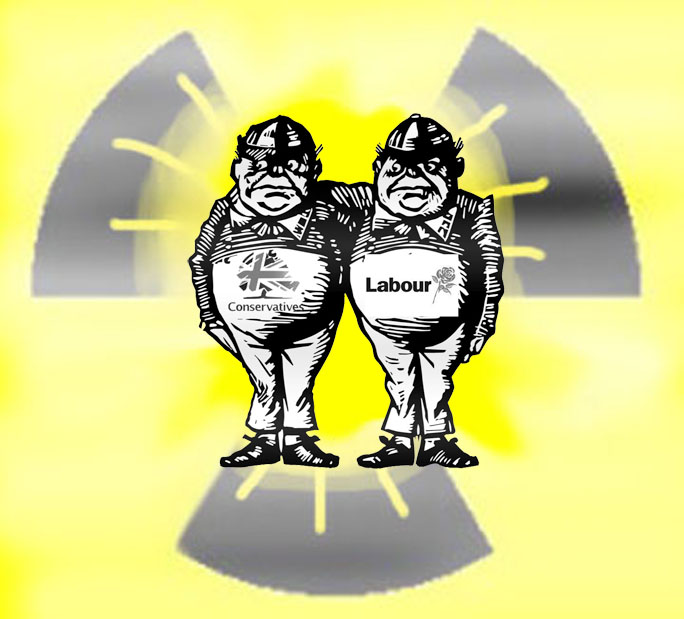
Ed Miliband will press ahead with a new generation of mini nuclear power
plants, with plans to unveil reactor designs by September. The energy
secretary has told MPs that he will give his “absolute support” to
plans to build a fleet of “small modular reactors” around Britain as
part of his clean energy drive.
Looser planning rules are expected to allow
these reactors almost anywhere outside built-up areas, ……………………………………………………….
He is now turning his attention to nuclear power, with a final decision on
Sizewell C due, alongside efforts to finish the Hinkley Point C plant.
Miliband has also committed to continuing the previous government’s drive
to make Britain a world leader in small modular reactors.
A decision on which designs to take forward is due by the end of the summer. Miliband
told MPs this week: “We will strive to keep to the timetable set out.”
Describing nuclear power as “very important for the future”, he said:
“This government were very clear in our manifesto about the role that
nuclear power — both large-scale nuclear and SMRs — can play.”
A final decision is also due this year on liberalising planning rules for
modular reactors. Currently nuclear power plants can be built only on eight
named sites but the previous government wanted developers to be able to
identify their own location based on a new list of safety and environmental
criteria.
Miliband is seen as unlikely to opt for tougher rules, after
repeatedly stressing to MPs this week that local concerns over development
would not be allowed to veto projects seen as vital to energy security and
economic growth. Under the draft rules, only “population density” and
“proximity to military activities” will rule out nuclear plants,
meaning they cannot be built in areas with more than 5,000 people per
square kilometres, covering most towns and cities. This is designed to
“minimise the risk to the public” in the event of a radioactive spill.
All other criteria would be discretionary, including size, flood risk,
proximity to civil airports, the natural beauty, ecological importance or
cultural heritage of the site.
Times 19th July 2024
**GB Energy**
Absent but not missed: No mention of nuclear in King’s Speech

https://www.nuclearpolicy.info/news/absent-but-not-missed-no-mention-of-the-n-word-in-kings-speech/ 18th July 2024
The UK/Ireland Nuclear Free Local Authorities could not help but notice that the first speech made by King Charles III at the State Opening of Parliament (17 July) was nuclear free as His Majesty was spared having to utter the word.
By tradition, the Sovereign reads the speech, written for him by Whitehall officials and signed off by Ministers, to a combined gathering of Lords and MPs. This sets out the legislative programme for the coming Parliament. Clearly with the return of a new Labour Government, elected with a huge majority, Ministers are keen to get on and exercise their mandate and the speech was brimming with forty proposals for new legislation[i].
On energy there was an emphasis on meeting the urgent
On energy there was an emphasis on meeting the urgent challenge of climate change whilst reducing customers’ bills through a ‘clean energy transition’, but His Majestry was notably not called upon to extole nuclear energy as a means to do so so; instead the speech referenced the need to ‘accelerate investment in renewable energy, such as offshore wind’ by creating a new vehicle Great Britain Energy which will be publicly owned and headquartered in Scotland. Nuclear was thankfully nowhere to be seen, seemingly stll on its summer holidays[ii].
Interestingly, the Background Briefing Notes issued to accompany the publication of the speech by Number 10 also makes no reference to nuclear.[iii]
Also interestingly, Ed Miliband shortly after his arrival at the Department for Energy Security and Net Zero issued a statement as Secretary of State to his staff – this too makes zero reference to nuclear as a component in the fight to achieve Net Zero.[iv]
Nuclear then appears late for the party, as per usual, or may even have been excluded from the invite list.
For it is notable that whilst Labour’s energy manifesto makes much of getting new nuclear projects at Hinkley and Sizewell ‘over the line’, extending the lifetime of existing plants, and backing new nuclear including Small Modular Reactors by the end of the government’s first term in 2030, mention of any of this has been noticably absent in the government’s recent pronouncements
The NFLAs hope that Ministers on being appraised of the huge costs and massive challenges of delivering a new nuclear programme has quietly opted to go for the common sense approach of choosing cheaper, practicable and achieveable renewables to deliver truly green energy, energy security, lower bills and Net Zero. Fingers crossed.
80 CANADIAN ORGANIZATIONS CALL ON FEDERAL GOVERNMENT TO RESCIND APPOINTMENT OF NUCLEAR REGULATORY AGENCY PRESIDENT.
Ottawa, 17 July 2024 .- www.nuclearwastewatch.ca
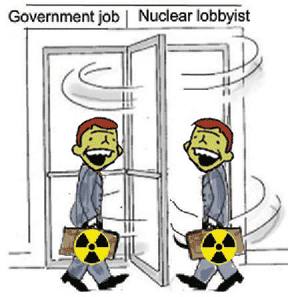
Over 80 civil society organizations from across Canada are speaking out and calling on Prime Minister Justin Trudeau and Governor General Mary Simon to rescind their recent appointment of Mr. Pierre Tremblay, a long time senior nuclear industry executive, as President of the Canadian Nuclear Safety Commission (CNSC).
In a joint letter citing conflict of interest and failure to adhere to International Atomic Energy Agency (IAEA) guidelines, the groups -a range of organizations that include in their ranks scientists and retired nuclear officials- also call on the Federal Government for an urgent reform of the CNSC and nuclear governance in Canada.
Mr. Tremblay has been a long-time senior business executive at Ontario Power Generation (Canada’s largest nuclear operator and contractor of nuclear businesses), reported co-owner of a private nuclear business involved in the Plutonium trade, and most recently president of AECOM Canada Nuclear Services -a key contractor for two questionable projects expected to report billions of dollars to the nuclear businesses involved, and impact populations for centuries: a nuclear waste dump (“Near Surface Disposal Facility”) by the Ottawa river and a project to abandon high-level nuclear waste underground in Northern Ontario, both of them expecting CNSC licenses.
The groups also call on the Federal Government to take the opportunity to initiate a long-needed reform of the CNSC, which has often been described by observers as an “industry-captured regulator”.
The request notes that the CNSC has a communications branch with 60-plus staff but no dedicated human health and environmental protection branch, and has not turned down a single nuclear industry application in more than a decade. It has also actively lobbied to weaken impact assessment legislation to exclude a range of nuclear reactors and processing facilities.
Mr. Tremblay’s appointment follows other appointments to the Commission of industry insiders, and two troubling assessments of the CNSC’s performance by the International Atomic Energy Agency (IAEA) -a June 2024 follow-up to an initial 2019 IAEA mission highlighted several problem areas; despite the CNSC’s positive spin on the IAEA missions, the findings are a cause of deep concern for independent observers and experts.
Given the CNSC’s often-stated priority and legal mandate to protect the environment and the health of Canadians, the groups are requesting the Federal Government consider recruiting CNSC senior ranks from within the health and environmental protection communities, including perhaps Environment and Climate Change Canada and the federal Health Portfolio.
The signatory organizations note that the appointment contravenes both IAEA guidelines and the Federal Government’s own guidance on the independence of regulatory bodies, and compromises the public’s expectation of neutrality, objectivity and independence of Canada’s nuclear regulatory body and reinforces the public perception of industry capture of that body. Rescinding the appointment would be a significant step towards a much-needed reform of the CNSC and towards restoring public trust in that critically important agency.
Quotes: The Canadian Nuclear Safety Commission is supposed to be a neutral body, carefully safeguarding the health of the Canadian public and the environment from the risks associated with the use of nuclear energy. Senior executives from the nuclear industry should be disqualified from positions at the CNSC.” – Dr. Ole Hendrickson.
“Having a nuclear business executive whose companies have pushed for questionable projects placed in charge of the very agency that would now regulate and approve them, is an obvious conflict of interest” – J. P. Unger, science writer and policy analyst. “The Government should abandon any pretense of having a watchdog and true regulator for nuclear matters -or carry out its urgently needed reform.”
Democrats to Keep Unconditional Military Aid to Israel in Party Platform

by Kyle Anzalone | Jul 10, 2024, https://libertarianinstitute.org/news/dems-to-keep-unconditional-military-aid-to-israel-in-party-platform/
A senior Joe Biden administration official explained that the Democratic party has no plans to alter its policy of unconditional arms support for Israel. President Biden has provided Israel with billions of dollars in weapons since October 7, including over ten thousand heavy bombs.
After an internal DNC debate over the party’s plank on arms shipments to Israel, an official explained that President Biden has no plans to change the policy that allows weapons to flow to Tel Aviv with no conditions on how they are used. “The platform will reflect the views of the president of the United States, and cutting aid to Israel is not President Biden’s policy,” the official said.
Over the past nine months, the White House has sent Israel over $6.5 billion in arms, including tens of thousands of bombs. Fourteen thousand of those munitions are massive one-tonne bombs. American-made bombs have contributed to the enormous death toll that has surpassed 38,000.
While American weapons have been documented to have been used in Israeli attacks on civilian targets in Gaza, the White House has maintained that Tel Aviv has not violated US laws. President Biden has no plans to curtail arms shipments except for one shipment of heavy bombs.
A growing number of Democratic voters have broken with the president over his unfettered support for the Israeli onslaught in Gaza. An April poll found about 40% of Democrats believe Biden has given Israel too much support.
Biden is a self-proclaimed Zionist and has been a vocal supporter of Israel for decades. Over his career, the president has frequently claimed that Israel is so vital to American security that if it did not exist, the US would have to create Israel.
However, the argument that Israel contributes to American security is rebuked by the head of the State Department Intelligence agency, Brett Holmgren. The Assistant Secretary of State explained that the Israeli war on Gaza is driving recruitment into jihadist organizations and inspiring lone-wolf terrorists.
Biden signs ADVANCE Act. Now what?

By Dave Kraft/NEIS, Dave Kraft is the founder and director of Nuclear Energy Information Service. https://beyondnuclearinternational.org/2024/07/14/biden-signs-advance-act-now-what/
Congress wants to “accelerate” new reactor build, putting public safety in jeopardy
By Dave Kraft/NEIS
On Wednesday July 10th President Joe Biden signed the “ADVANCE Act,” which stands for “Accelerating Deployment of Versatile, Advanced Nuclear for Clean Energy.”
The controversial bill aggressively promotes the narrow, short-term interests of the U.S. nuclear industry in ways that threaten the long-term national environmental, climate and national/international security interests.
Further, it functionally rewrites the mandate of the federal Nuclear Regulatory Commission (NRC) in ways that potentially cast it into the role of promoter instead of federal regulator of the controversial and moribund nuclear power industry.
To summarize, The ADVANCE Act:
- promotes development of currently experimental, commercially non-existent “small modular nuclear reactors” (SMNRs) and allegedly “advanced” reactors, using tax dollars;
- provides less regulatory oversight by ordering the NRC to “streamline” licensing of currently experimental SMNRs, putting the NRC in a position of becoming a quasi-promoter instead of regulator, in contradiction to its 1975 founding mandate;
- requires development of the infrastructure needed to produce more intensely enriched radioactive fuel called “HALEU” – high-assay, low-enriched uranium — required for the SMNRs to run on. Enrichment would be just below weapons-usable; currently the only source of HALEU is Russia;
- ignores the potential increased risk and harm from having more nuclear reactors large and small;
- produces more high-level radioactive waste without first having a disposal method in place for either current or future reactors;
- permits and encourages export of nuclear technology and materials internationally; and
- for the first time, allows foreign control/ownership of nuclear facilities within the U.S.
Congress cannot be absolved from its role in uncritically swallowing the gaslit promises of nuclear power. The House previously passed its version of the legislation by a margin of 393-13 before sending it to the Senate. There, it stalled, but was procedurally resurrected by attaching the 93-page nuclear Christmas-wish list to a three-page, must pass fire safety bill – S.870, the Fire Grants and Safety Act. It passed in the Senate 88-2, with only Senators Ed Markey (MA) and Bernie Sanders (VT) recognizing the imminent threat it posed to energy, environmental, and international security interests.
Critics of nuclear power and opponents of the ADVANCE Act fail to see:
- how the Act fights climate disruption, when SMNRs are only experimental, may not work at all, and if they work will not be available in sufficient quantities for commercialization before the mid-2030s, according the nuclear industry itself. It is the carbon we remove and keep out of the atmosphere between NOW and the mid-2030s that will determine if we can meet climate goals;
- how SMNRs will enhance currently threatened system reliability and power availability, when they will not be available – assuming they even work – before the mid-2030s;
- how exporting SMNR technology and ~19+% enriched (just below weapons useable) HALEU reactor fuel worldwide improves international security in a world dominated by wars in Ukraine, the Middle East, and potentially in southeast Asia; poorly controlled non-state actors; and well-known corrupt business entities. Equally baffling is how allowing foreign ownership of nuclear facilities in the U.S. proper makes our energy systems safer, more secure, and insulated from economic instability or foreign interference;
- how mandating the NRC to “expedite” SMNR licensing – potentially at the expense of its original and official mandate to “adequately” protect public health and safety and the environment – makes nuclear power and the nation safer. This regulatory approach has demonstrably failed with Boeing; failed with Norfolk Southern in East Palestine; failed with PIMSA in Sartortia; and doubly-failed at Fukushima. NRC is supposed to oversee and regulate an industry that in the past five years has repeatedly displayed corporate and legislative corruption at the highest levels resulting in FBI indictments, convictions and guilty pleas, millions of dollars in fines, and enormous cost overruns born by ratepayers; and
- why viable alternatives to nuclear expansion like renewable energy, energy efficiency, energy storage, and transmission improvements are not prioritized over nuclear expansion, since ALL are cheaper, quicker to implement, reduce carbon emissions, produce no radioactive wastes, have no meltdown potential, create no nuclear proliferation issues, and, most importantly – ALREADY EXIST. Nothing more needs to be invented; just implemented.
For example, the Federal Energy Regulatory Commission (FERC) stated in December, 2023 that roughly 2,600 giga-watts (GW) of electric power projects await grid connection – over twice the entire current electrical output of the US, and roughly 27 times the entire output of all current US reactors combined. The large majority of this backlog are renewable energy projects awaiting connection access to the aging transmission grid.
New EXISTING transmission technologies like reconductoring and improved grid resiliency solutions could double the capacity of the grid in much shorter time and with far greater certainty than chasing speculative nuclear promises, creating greater ease of access for renewables and storage.
By signing the ADVANCE Act, the President and an accomplice Congress have placed the nation’s energy future, climate goals, and even international security at grave risk. Clearly, placing short term, ego-invested interests over the long-term best interests of the nation seem to be a problem extending beyond re-election. As Napoleon once observed, never ascribe anything to malice when there is the least suspicion of incompetence. Perhaps, but in the end, the results are the same.
Dave Kraft is the founder and director of Nuclear Energy Information Service.
Campaigners against Sizewell C hopeful new MPs will take their concerns to parliament

The campaign group Stop Sizewell C says it’s heard from several MPs already
Jasmine Oak, 10th Jul 2024, https://hellorayo.co.uk/greatest-hits/west-norfolk/news/stop-sizewell-c-campaigners-new-mp-hopes/
Campaigners are calling on the new Government to consider scrapping plans to build a nuclear power plant on the Suffolk Coast
Once up and running, it’s thought Sizewell C will power up to six million homes, but activists say it’s going to devastate our countryside
Alison Downes is from ‘Stop Sizewell C’ group – and says Sir Kier Starmer needs to listen to their concerns: “The priority needs to be preventing there being any more unnecessary damage to the local environment.
“We have already seen a fair amount of damage, but that’s nothing compared with what’s to come…
“The government needs to resist any pressure from the nuclear industry for a hasty decision, especially as Sizewell C is going to take a long time, and a lot of money, to build.”
Alison’s hoping the local area’s new MPs will voice their concerns in Parliament: “Our new MP has publicly said that Stop Sizewell C was the first group she met with when she was elected.
“We also have the co-leader of the Green Party, Adrian Ramsay, in Waveney Valley. He’s been very vocal against Sizewell C.”
A spokesperson for EDF Energy has previously told us: “Our proposals for Sizewell C will see the creation of a 3.2 gigawatt power station that will create low-carbon electricity that will supply 6 million homes.
“This will be delivering clean, reliable, and affordable power for generations.”
1 This Month

of the week – Shut Down Drone Warfare!


Tell the Ukrainian Government to Drop Prosecution of Peace Activist Yurii Sheliazhenko

Petition to revoke the licensing of the Near Surface Nuclear Disposal Facility (NSDF) at Chalk River. https://www.ourcommons.ca/petitions/en/Petition/Details?Petition=e-7247
To see nuclear-related stories in greater depth and intensity – go to https://nuclearinformation.wordpress.com
-
Archives
- April 2026 (114)
- March 2026 (251)
- February 2026 (268)
- January 2026 (308)
- December 2025 (358)
- November 2025 (359)
- October 2025 (376)
- September 2025 (257)
- August 2025 (319)
- July 2025 (230)
- June 2025 (348)
- May 2025 (261)
-
Categories
- 1
- 1 NUCLEAR ISSUES
- business and costs
- climate change
- culture and arts
- ENERGY
- environment
- health
- history
- indigenous issues
- Legal
- marketing of nuclear
- media
- opposition to nuclear
- PERSONAL STORIES
- politics
- politics international
- Religion and ethics
- safety
- secrets,lies and civil liberties
- spinbuster
- technology
- Uranium
- wastes
- weapons and war
- Women
- 2 WORLD
- ACTION
- AFRICA
- Atrocities
- AUSTRALIA
- Christina's notes
- Christina's themes
- culture and arts
- Events
- Fuk 2022
- Fuk 2023
- Fukushima 2017
- Fukushima 2018
- fukushima 2019
- Fukushima 2020
- Fukushima 2021
- general
- global warming
- Humour (God we need it)
- Nuclear
- RARE EARTHS
- Reference
- resources – print
- Resources -audiovicual
- Weekly Newsletter
- World
- World Nuclear
- YouTube
-
RSS
Entries RSS
Comments RSS
 nuclear-news