USA not happy about Japan’s plutonium plan
- Key findings: http://www.publicintegrity.org/2014/03/12/14406/key-findings
Japan’s nuclear industry has taken a beating in public opinion due to cost overruns, technical glitches and accidents like the Fukushima disaster two years ago next week. - Despite this, support for the Rokkasho plant among the country’s leaders remains high because of a tightly-woven network of regulators, utilities, labor leaders and local politicians who are dependent on a continuing stream of funding for nuclear power.

- Japan’s enthusiasm for nuclear power has been nurtured by the utilities, which spent $27 billion on advertising over the past four decades and lavished contributions on members of the leading Japanese political party.
- Although the government’s policy has long ruled out the production or possession of nuclear arms, some Japanese politicians have supported the production of additional plutonium on grounds that it sends a useful signal to potential aggressors about Japan’s capability to make such weapons.
- Eager to block that development, the U.S. has brought a stream of Japanese diplomats and military officers into highly restricted nuclear weapons centers to remind them of the robustness of the U.S. nuclear deterrent. They also have gently urged Japan not to take steps that would add to its existing plutonium stocks. But neither of these steps amounts to firm advice that Rokkasho should not be opened.

‘Atomic Abe’ taking Japan into a dangerous nuclear situation
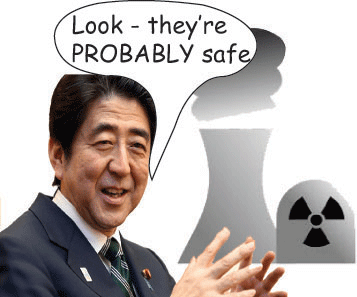 Nuclear energy costs still rising, three years on from Fukushima, SMH, 11 Mar 14 #……Atomic Abe The arrival of Abe as prime minister in December 2012, gave a boost to the pro-nuclear camp. Cutting energy costs is part of his plan to revitalize the economy.
Abe’s push on nuclear shows how polarizing the issue is in Japan.
At least three former prime ministers have publicly opposed the current premier on reactor restarts, including Junichiro Koizumi, Abe’s mentor and one of Japan’s most-popular postwar leaders. Naoto Kan, prime minister at the time of the 2011 quake, is another.
“The reason I’m against nuclear is that people cannot fully control it,” Kan told reporters in a briefing in December.
Industrial accidents can happen, but nothing on the scale of nuclear, he said. A worst-case scenario for Fukushima would have made a third of Japan’s land uninhabitable, Kan said. Opponents also point to the cost of nuclear accidents. The government has estimated it’ll take 11 trillion yen and 40 years to clean up the Fukushima site.
Japan Inc
The former prime ministers find themselves in an unusual place on the opposite side of the argument from Japan Inc.,……..http://www.smh.com.au/environment/nuclear-energy-costs-still-rising-three-years-on-from-fukushima-20140311-34ii6.html
Senator Markey introduces Bill to cut $100 billion in nuclear weapons spending
 Markey Files Bill to Cut $100 Billion in Nuclear Arms Fundshttp://www.nationaljournal.com/global-security-newswire/markey-files-bill-to-cut-100-billion-in-nuclear-arms-funds-20140228 By Rachel Oswald February 28, 2014
A high-profile U.S. Senate critic of nuclear-weapons spending on Friday introduced a bill that would cut $100 billion over the next decade in arsenal outlays.
The Smarter Approach to Nuclear Expenditures — or “SANE” — Act, filed by Senator Edward Markey (D-Mass.), is co-sponsored by Senator Jeff Merkley (D-Ore.). Companion legislation has been introduced in the House by Representative Earl Blumenauer (D-Ore.).
“America faces a real choice: spend billions on nuclear weapons we no longer need or fund programs that educate our children and help find cures to deadly diseases,” Markey said in provided comments. Continue reading
Nuclear power destroying democracy in Japan. And Beyond?
 “Shock & Outrage”: Japan TV host reveals being told he cannot discuss nuclear power until pivotal Tokyo election ends — “Somebody needs to bring these issues into the media” — #2 in trending news http://enenews.com/shock-outrage-japan-tv-host-reveals-being-told-he-cannot-discuss-nuclear-power-until-pivotal-tokyo-election-ends-somebody-needs-to-bring-these-issues-into-the-media
TokyoReporter’s tweet, Jan. 22, 2014: Radio host Peter Barakan says broadcasters told him to avoid nuclear issues till after poll
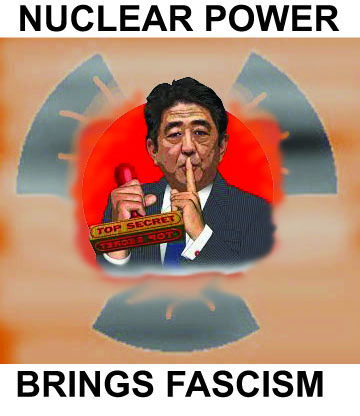
Nuclear Power Brings Fascism
 Is Nuclear Experimentation Fascism? OpEdNews Op Eds 1/22/2014 opednews.com By Ethan Indigo Smith Contributing Writer for Wake Up World “…..The United States was formerly one of the few anti-institutional, anti-oligarchical nations in the world, but we have succumbed to the oligarchical corporaculture that has been pushed for the last couple of hundred years, whether fused by labels like the divine rite of kings or by corporate personhood. The United States used to push for individual rights, but now we yield to violent fascism just like the rest of the intolerant world. Hell, we were once so anti-fascist and anti-oligarchy that it used to be illegal to do business in more than one American state, now the police and political system seems to only serve and protect business interests. But at what cost?
Imagine if this culture of anti-fascism were still the case, perhaps none of us would ever question our water supply, hijacked for a nuke plant or polluted by a petroleum conglomerate”.
Learning from History
Recent events at Fukushima have highlighted the uncontainable dangers of nuclear experimentation. If one examines trends, there are bound to be more accidents, spills and “unprecedented events’ within the nuclear industry.
The first nuclear power generation experiment began at Oak Ridge in 1948, and first massive one began in the Soviet city of Obninsk in 1954. In the 65 years that followed, there have been numerous known meltdowns at nuclear facilities around the world, as well as environmental, human and political destruction at other sites that did not (by luck only) experience full meltdown.
HANFORD, USA, 1943 — 1987…….
BIKINI ATOLL, NORTHERN PACIFIC OCEAN, 1946…….
WINDSCALE FIRE, UK, 1957….
SANTA SUSANA, USA, 1959…….
THREE MILE ISLAND, USA, 1979…….
CHERNOBYL, UKRAINE, 1986…..
ROCKY FLATS PLANT, USA 1987…..
FUKUSHIMA DAIICHI, JAPAN 2011….
WHO IS NEXT?
The list goes on. And while this is a short summary of some of the nuclear industry’s worst failings — both environmental and political — what it does not take into account that there are now over four hundred nuclear power generation experiments in operation worldwide, and more being built, each one representing another potential disaster. Now factor in the endless radioactive pollution and dumped material (buried and sunken near you) involved in the process even when things go “right’ (by nuclear industry standards) and you get a clearer view of the impact of nuclear experimentation.

Under the terms of current policy, the US Federal Government simply incurs the financial costs and burden of dealing with nuclear “events'”. and by the “Federal Government’ I mean the U.S. taxpayer.
Regimentation of Industry
Today, the United States of America is fascist. So is China, Japan, Russia, France, England, Japan and every single nuclear nation. Australia is de facto fascist, being a major extractor of uranium for the nuclear fuel chain. The United States of America is fascist by way of one single act: The Price Anderson Nuclear Industries Indemnity Act. There are many more acts and laws that strengthen nuclear fascism in the United States, but The Price Anderson Act seals the deal. Its main purpose is to indemnify the nuclear industry against liability claims arising from nuclear incidents. And other countries have their own nuclear deals which also guarantee that those who profit from the nuclear industry are not held accountable for their work………
Clearly nuclear experimentation does not co-exist alongside freedom of speech or transparent access to information. It can only exist in a fascist state, which suppresses information and opposition.
Severely Nationalistic Policies
The only part of the definition of fascism that nuclear experimentation does not technically fit is that nuclear experimentation operates on an international level, not just a nationalistic one. However it seems even nuclear disaster rings opportunity bells for nationalistic governments.
As reported by Bloomberg in 2013, “Japan will receive international help with the cleanup at the Fukushima atomic station once it joins an existing treaty that defines liability for accidents at nuclear plants, U.S. Energy Secretary Ernest Moniz said.” This means that the United States’ “offer” of assistance is conditional upon Japan signing onto an international convention known as the Convention on Supplementary Compensation for Nuclear Damage, designed only to protect US nuclear interests from liability in the event of an accident. The U.S. Government has lobbied for the international adoption of the convention for many years, and now it seems it has Japan over a barrell. Surely this political opportunism qualifies as “severely nationalistic’ behaviour. Yet it in the United States, it seems we can barely distinguish this kind of fascism from the actions of true democratic government…….
Nuclear experimentation is destructive on a level that supersedes our common understanding of time and space. The nuclear industry is risking the unriskable. Nuclear experimentation is political and it’s fascism. I’m only left to wonder”. did the institutions involved in nuclear experimentation design themselves according to the definition of fascism, or do they naturally fit the definition that perfectly?…..http://www.opednews.com/articles/Is-Nuclear-Experimentation-by-Ethan-Indigo-Smith-Fukushima_Nuclear-Cover-up_Nuclear-Meltdown_Nuclear-Waste-140122-627.html
Despite Prime Minister Abe, nuclear power IS an issue in Tokyo election
To say that nuclear power should not be an issue in the Tokyo gubernatorial election is ludicrous as the question of what to do about nuclear power affects everyone in this small, quake-prone country — including the tens of millions of people living and working in the nation’s capital.

 Can’t bury the nuclear issue, Japan Times Editorial, 23 Jan 14 Campaigning kicked off on Thursday for the Feb. 9 Tokyo gubernatorial election, which will not only decide the leader of the nation’s capital but also influence the debate on whether Japan should continue to rely on nuclear power — a major issue that will help determine the shape of Japan’s future.
The nuclear issue has assumed great importance because former Prime Minister Morihiro Hosokawa has entered the race with the backing of former Prime Minister Junichiro Koizumi and is running on a “zero nuclear” platform — a stance shared by Koizumi. Both Hosokawa and fellow candidate Kenji Utsunomiya, a former head of the Japan Federation of Bar Associations, are calling for the immediate halt of nuclear power generation. They oppose the Abe administration’s plan to restart idled nuclear power plants if their safety is confirmed by the Nuclear Regulation Authority.
Some people, in particular Prime Minister Shinzo Abe, oppose the idea of treating nuclear power as a major issue in the Tokyo gubernatorial election. In an apparent effort to prevent the nuclear power issue from rousing wide interest among Tokyo voters, Abe said energy policy is an issue not just for Tokyoites but for all Japanese, adding that various issues that the Tokyo governor must deal with should be discussed in a balanced manner.
Yet Tokyo, which consumes about 10 percent of Japan’s total electricity, is the biggest power user among Japan’s 47 prefectures. Continue reading
Tokyo governor election – a referendum on nuclear energy?
Former Japanese Premier Challenges Abe’s Nuclear Policy Tokyo Governor Race Threatens to Become Referendum on Atomic Energy, WSJ, By ALEXANDER MARTIN And TOKO SEKIGUCHI Jan. 22, 2014 TOKYO—Former Prime Minister Morihiro Hosokawa pledged on Wednesday to work toward keeping Japan’s nuclear reactors offline in his campaign platform for the coming Tokyo gubernatorial race, threatening to make the local election a referendum on Prime Minister Shinzo Abe’s pro-nuclear energy policies.
“Restarting nuclear reactors while we still have no place to dispose nuclear waste is a criminal act toward future generations,” Mr. Hosokawa said during a news conference where he laid out his campaign promises for the Feb. 9 election……..
Mr. Hosokawa’s candidacy poses a headache for Mr. Abe’s administration, which has been preparing to reactivate the nation’s 50 commercial reactors once they are deemed to comply with new safety standards introduced after the March 2011 Fukushima crisis.
The Tokyo Metropolitan Government is the fourth-largest shareholder of Fukushima Daiichi plant operator Tokyo Electric Power 9501.TO +1.02% Company (TEPCO) with a 1.2% stake, giving it the right to make proposals at the general shareholders’ meetings. Using this leverage, Mr. Hosokawa said he would pressure TEPCO not to restart any reactors………Mr. Hosokawa, 76, opposes any restarts and calls for pulling the plug on nuclear power entirely. And he aims to tap the antinuclear electorate with the support of fellow former Prime Minister Junichiro Koizumi. A political mentor to Mr. Abe who in recent months has become an avid antinuclear campaigner, Mr. Koizumi remains one of the nation’s most popular politicians after stepping down in 2006……
rival candidate Yoichi Masuzoe……supports a phasing out of nuclear power……..http://online.wsj.com/news/articles/SB10001424052702303448204579335982659523094?mg=reno64-wsj&url=http%3A%2F%2Fo
Wide implications for uranium industry of test case in Niger
Niger uranium mining dispute a test case for use of African natural resources by Mark Tran Friday 10 January 2014 theguardian.com The wrangle between Niger and a state-owned French firm over payments for uranium extraction has wider ramifications
 The protracted negotiations on uranium mining between Niger andAreva, the French energy multinational, are not just a trial of strength between an African government and a big company. The face-off will also test whether there is more than just pious sentiment to the notion that African countries should derive greater benefit from their natural resources.
Areva, which owns stakes in the Somair and Cominak mines, has been negotiating with Niger over new uranium mining contracts for two years. The mines’ 10-year licences expired on 31 December without a new agreement, although Niger issued a decree on 27 December providing a legal framework under the 2006 mining law for operations to continue.
The company is tight-lipped on discussions……..
The mines have been closed since mid-December for what Areva describes as routine maintenance. Some see the move as hardball tactics by the company to put pressure on the Nigerien government.
At heart of the matter is the country’s desire for a better deal. Niger accounts for more than a third of Areva’s uranium production, and President Mahamadou Issoufou’s government wants to increase the royalties the company pays from 5.5% of revenues to 12%, officials told Reuters…….
Niger is desperately poor, ranking last of the 187 countries in the 2012 UN Human Development Index. Three-quarters of its people live on less than $2 a day and malnutrition is rife, with the country beset by droughts. Although mining made up 70.8% of Niger’s exports in 2010, it contributed only 5.8% of the country’s gross domestic product.
According to a report from Oxfam France and the Niger arm of Publish What You Pay, the transparency group, Areva’s two mines produced uranium worth more than €3.5bn (£2.9bn) in 2010, but Niger received just €459m, or 13% of this amount. In 2012 Areva received tax exemptions worth €320m, the report says….http://www.theguardian.com/global-development/poverty-matters/2014/jan/10/niger-uranium-mining-dispute-african-natural-resource
France’s nuclear power program stalled at best, planned to decline
Even if President Hollande’s plan for the transition stalls, it seems clear at least that there will be no further expansion of nuclear in France.EDF is planning to build two new nuclear reactors at Hinkley in western England with Chinese help, but at Flamanville in Normandy a new reactor of the same EPR design is behind schedule and massively over budget. A second envisaged EPR reactor in France has been shelved indefinitely – and no other new nuclear power stations are planned.
France struggles to cut down on nuclear power By Rob Broom BBC News, 10 JAN 14 Paris “…….French President Francois Hollande also wants to cut nuclear output sharply – by a third in 20 years. It’s a big ask in a country that now relies on nuclear for 75% of its electricity.
If fully implemented, the pledge would force the closure of up to 20 of the country’s 58 reactors according to Professor Laurence Tubiana a former government adviser who the president asked to facilitate a national debate, paving the way for what they call le transition energetique.
This would be a huge step, but Tubiana describes it as a “logical evolution”.France realised that Japan had survived economically when all its atomic power stations were shut down because of its diverse energy mix. In Japan, before the disaster, nuclear power delivered about 30% of the country’s electricity, but France is hugely dependent not only on nuclear, but on a single generation of nuclear power stations.
It is vulnerable to a “generic risk”, according to Tubiana, where a problem with one reactor could force them all offline for the fault to be fixed. This would cause chaos.
She says the 20 reactors closed in the “transition” could be replaced by renewable energy, which she says would maintain French energy independence and be both “stable and secure”. Continue reading
Atomic pork politics : USA locked into foolish expense on nuclear weapons
 Nuclear Death, Warmed Over, HUFFINGTON POST, Jon Wolfsthal Deputy Director, James Martin Center for Nonproliferation Studies 01/08/2014 “……….The Nuclear Song Remains the Same The cold war is over is long gone, but the nuclear triad remains……..Atomic Pork Politics Elected officials are the ones pushing these expensive and unnecessary programs. The six senators from states where long-range missiles are deployed — Wyoming, Montana and North Dakota — are all pushing for the U.S. to build a new long-range missile. Congressional representatives from Georgia, Connecticut and Washington, where submarines are built and deployed — guess what — all support a new submarine. Same with the new bomber. They all want to ensure their slice of the nuclear pie stays the same, even without someone to point the weapons at.
Yet it appears no elected officials are aware that the full cost of replacing the nuclear arsenal will cost this much money. The Bomber will cost upwards of $100 Billion, not including the bombs and cruise missiles to go with it. The Submarine about as much, the missiles could cost even more. And the nuclear weapons that go on top — build and maintained in California, New Mexico, South Carolina and Nevada, will cost over 350 Billion over 30 years. U.S. budgets are prepared annually and the defense department only provides formal budget projections five years out. Yet these systems take 30 years to build and deploy. The situation is similar to the balloon mortgages that almost sank the U.S. economy, where it looks like we can afford the house but in year ten the monthly payments skyrocket.
For those who support maintaining a large nuclear arsenal, the fact that this number is not known or understood in Congress or the White House is a major danger……..http://www.huffingtonpost.com/jon-wolfsthal/nuclear-death-warmed-over_b_4560521.html
US Republican politician suggests blowing up Iran’s nuclear sites
 Gohmert: Let’s Blow All Iran Nuclear Sites Up BY: Washington Free Beacon Staff January 7, 2014 Rep. Louie Gohmert (R.,Texas) suggested that the United States should destroy all Iranian nuclear sites if it refuses to open its nuclear facilities to the IAEA and U.S. inspectors.
Gohmert, speaking in an interview with FoxNews.com, said, “[Iran has] to open [nuclear facilities] up to the IAEA and to U.S. inspectors and we’ve got to make sure you’ve gotten rid of everything. Otherwise, let’s blow them all up, all the sites up, until we’re satisfied we’ve eliminated them as a threat.”…..http://freebeacon.com/gohmert-lets-blow-all-iran-nuclear-sites-up/
Anti-nuclear power law sought by community for Shimane Prefecture
 Citizens seek nuclear-free Shimane http://www.japantimes.co.jp/news/2014/01/06/national/citizens-seek-nuclear-free-shimane/#.UsweM9JDt9U BY ERIC JOHNSTON STAFF WRITER Shimane Prefecture citizens seeking to enact a local ordinance that would phase out nuclear power and develop renewable energy sources have collected more than 92,000 signatures of support from registered voters, well over the minimum needed to force the governor to introduce the ordinance to the prefectural assembly.
The latest move is part of a series of attempts by citizens’ groups around the nation to pass anti-nuclear power ordinances, none of which has succeeded so far.
Kenji Nanki, a spokesman for the group pushing for the ordinance, said local governments are checking the signatures against their voter registration lists but will present them to Shimane Gov. Zenbei Mizoguchi in early February. The governor is then expected to bring the issue to the assembly.
The ordinance calls on Shimane to establish a plan of action for getting out of nuclear power by an unspecified date, to up the use of natural and renewable energy sources, and to establish a committee to develop a concrete policy for that purpose.Chugoku Electric Power Co.’s Shimane nuclear plant, in Matsue, has two reactors. About 469,000 people in Shimane and Tottori prefectures live within 30 km of the plant. Last month, Chugoku Electric formally asked the Nuclear Regulation Authority to inspect reactor 2 to determine whether it meets new safety standards established last year.
Reactor 2 was built in 1989, making it one of Japan’s newer reactors. Shimane’s reactor 1, on the other hand, turns 40 years old this year and its future is uncertain.
European countries’ Energy Ministers call for 2030 2030 renewables target
Germany, France call for 2030 renewables target European Voice, By Dave Keating – 06.01.2014 CET Commission expected to propose later this month an emissions reduction target only. Eight national energy ministers have written a letter to Günther Oettinger, European commissioner for energy, and Connie Hedegaard, European commissioner for climate, calling for the European Commission to propose a new target for renewable energy for 2030.
The letter, sent just before Christmas, comes after a year of increasing resistance to the idea of extending the current ‘multiple target’ strategy for 2020.
The letter is signed by Sigmar Gabriel, Germany’s new energy minister and chair Germany’s Social Democrat party, now in governing coalition with Angela Merkel’s Christian Democrats. It is thought that Gabriel’s strong backing may give new momentum to the idea of establishing a new renewable energy target. The letter is also signed by the energy ministers of France, Denmark, Italy, Ireland, Austria, Belgium and Portugal. …….
The letter says that a 2030 renewable energy target will provide investment certainty and allow “efficient planning and expansion of the European grid”. It goes on to say that the 2020 renewable energy target led to “jobs and growth” and says there will be “more jobs and growth” if a 2030 target is adopted. ……http://www.europeanvoice.com/article/2014/january/germany-france-call-for-2030-renewables-target/79199.aspx
Indefinite delay for restart of Japan’s idled nuclear reactors
 Restart of nuclear facilities and policy for nuclear waste disposal in Japan unlikely to be settled soon http://enformable.com/2014/01/restart-nuclear-facilities-policy-nuclear-waste-disposal-japan-unlikely-settled-soon/ In Japan, utilities are working to restart idled nuclear power plants across the nation and regain public support post-Fukushima. The Nuclear Regulation Authority, a newly established regulator, set new safety standards in July of 2013 which call for greater preparedness in regards to severe accidents, earthquakes, and tsunamis.
So far, 7 utilities have applied for regulatory officials to conduct safety screenings required to restart 9 plants. Officials still say that none of the plants are ready to restart because utilities have not adequately revised their estimations of potential earthquake activities.
This week, Shunichi Tanaka, chairman of the Nuclear Regulation Authority told reporters that there was no time limit on how long the safety screening process might take.
Even if operators are able to pass safety screens, they still need to obtain consent from local governments before the reactors can be restarted.
The task will not be easy in a nation which before the Fukushima Daiichi nuclear disaster had very little experience with management of severe accidents. The challenge is even greater considering the fact that the most experienced members of the workforce are aging and the new workforce has little to no prior experience with nuclear power.
As a nation Japan still has to revise a basic policy for the long-term disposal of nuclear waste. While government plans call for storage in deep underground repositories, experts caution that finding such locations in Japan will be difficult due to the seismicity of the area and lack of public trust. So far, no municipalities have come forward with any candidate sites.
Why is USA government stocking up on potassium iodide pills?
Fukushima Anti-Radiation Pills? US Government Official Hangs Up When Asked About Potassium Iodide Purchase Department of Health and Human Services rep. says “no hidden agenda” behind 14 million dose buy By Paul Joseph Watson Global Research, January 03, 2014 An official with the Department of Health and Human Services hung up when asked if the federal government’s purchase of 14 million doses of potassium iodide was linked to the Fukushima crisis. As we reported earlier this week, the DHHS put out a solicitation asking for companies to supply 700,000 packages each containing 20 pills to be delivered before the beginning of next month.
Potassium Iodide helps block radioactive iodine from being absorbed by the thyroid gland and is used by victims of severe nuclear accidents or emergencies.
Questions immediately arose as to whether such a large purchase was routine or if it was linked to concerns about radiation from the crippled Fukushima nuclear plant impacting the west coast of America……..
Is the government’s purchase of 14 million doses of anti-radiation pills merely a routine order, or are they stockpiling potassium iodide in preparation for a nuclear catastrophe which could emerge out of the Fukushima crisis? Either way, the DHHS doesn’t seem too keen on answering questions………..http://www.globalresearch.ca/government-official-hangs-up-when-asked-about-iodide-purchase/5363630
1 This Month
23-25 October – on Zoom – World BEYOND War’s annual global conferenc


Shut down the radiation-damaged Heysham nuclear reactors now
To see nuclear-related stories in greater depth and intensity – go to https://nuclearinformation.wordpress.com

Say No to NASA’s Reckless Nuclear Reactor on the Moon
Say No to NASA’s Reckless Nuclear Reactor on the Moon
-
Archives
- October 2026 (180)
- September 2026 (339)
- August 2026 (330)
- July 2026 (355)
- June 2026 (287)
- May 2026 (306)
- April 2026 (356)
- March 2026 (251)
- February 2026 (267)
- January 2026 (308)
- December 2025 (358)
- November 2025 (359)
-
Categories
- 1
- 1 NUCLEAR ISSUES
- business and costs
- climate change
- culture and arts
- ENERGY
- environment
- health
- history
- indigenous issues
- Legal
- marketing of nuclear
- media
- opposition to nuclear
- PERSONAL STORIES
- politics
- politics international
- Religion and ethics
- safety
- secrets,lies and civil liberties
- spinbuster
- technology
- Uranium
- wastes
- weapons and war
- Women
- 2 WORLD
- ACTION
- AFRICA
- Atrocities
- AUSTRALIA
- Christina's notes
- Christina's themes
- culture and arts
- Events
- Fuk 2022
- Fuk 2023
- Fukushima 2017
- Fukushima 2018
- fukushima 2019
- Fukushima 2020
- Fukushima 2021
- general
- global warming
- Humour (God we need it)
- Nuclear
- RARE EARTHS
- Reference
- resources – print
- Resources -audiovicual
- Weekly Newsletter
- World
- World Nuclear
- YouTube
-
RSS
Entries RSS
Comments RSS

