USA Congress supports small nuclear reactors

Congress Passes Unconventional Nuclear Power Bill ANDREW FOLLETT, Daily Caller, 24 Jan 17 House lawmakers passed legislation Monday to support unconventional nuclear power.
If signed by President Trump, the proposal could change how the government regulates nuclear power and create a boom in the utilization of advanced unconventional reactor technology. The bill was sponsored by two Republicans and three Democrats.
“We believe that trailblazing the advance of nuclear energy technology including Gen 3+, Small Modular Reactors, Non-Light Water Reactor (LWR) Advanced Reactors and Fusion Reactors is one of the key imperatives for U.S. market competitiveness,” David Blee, executive director of the U.S. Nuclear Infrastructure Council (NIC), told The Daily Caller News Foundation.
“It is vital to maintaining the U.S. lead in technology innovation, safety enhancements, energy security and clean energy,” Blee said…….
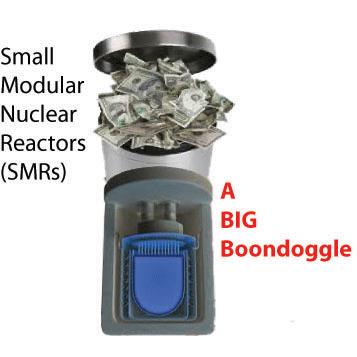 Energy companies in Idaho and Utah announced plans in June to build twelve small modular reactors to provide electricity to nine western states.
Getting regulators to consider approving an unconventional nuclear design is incredibly expensive. The company NuScale was required to produce a 12,000-page document and spend $500 million dollars just to get the government to consider its designs. The company thinks it won’t be able to commercialize small modular reactors by 2026 at the earliest due to regulatory delays…….
Getting regulatory approval from the NRC to build a new conventional reactor can take up to 25 years…….. http://dailycaller.com/2017/01/24/congress-passes-unconventional-nuclear-power-bill/
Trump’s nuclear weapons boast – back to the ‘Star Wars’ Budget Buster?
 Trump’s Nuclear Defense Plan: Another ‘Star Wars’ Budget Buster? The Fiscal Times, January 24, 2017 President Ronald Reagan cowed the Soviet Union and eventually brought its leaders to the bargaining table with the threat of a costly space-based nuclear missile system dubbed “Star Wars.” In March 1983, Reagan formally launched the Strategic Defense Initiative (SDI) to develop and deploy an “impenetrable shield” to protect the U.S. from a Soviet missile attack.
Although the U.S. ultimately spent more than $200 billion on a system that was never successfully developed and deployed, Reagan’s high-stakes defense gambit was credited by many for helping to hasten the end of the Cold War…….
Now a new addition to Trump’s evolving defense posture, the website declared that the United States would develop a “state of the art missile defense system” to guard against attacks from North Korea, Iran, and other rogue states.
The announcement was bereft of details about the technical capabilities or the potential cost to taxpayers for a more sophisticated missile defense system than the land-based and seaborne systems currently deployed in California and Alaska and aboard Navy destroyers in the Pacific.
In addition to the missile shield, the Trump White House said a new military budget would be submitted to Congress outlining a plan to rebuild the military and increase cyber-warfare capabilities. “We will make it a priority to develop defensive and offensive cyber capabilities at our U.S. Cyber Command, and recruit the best and brightest Americans to serve in this crucial area,” the statement declared.
Since then, Trump and his aides have had little more to say about their proposed missile defense initiative, leaving defense policy experts to scratch their heads and speculate on what the new president has in mind. ……..http://www.thefiscaltimes.com/2017/01/24/Trump-s-Nuclear-Defense-Plan-Another-Star-Wars-Budget-Buster
Trump’s first White House website post – will scrap Climate Action Plan
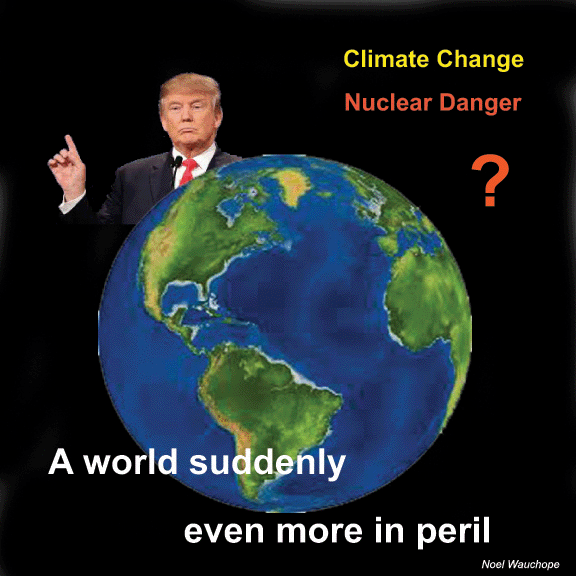 Donald Trump will eliminate landmark climate protection plan, says first post on White House website http://www.independent.co.uk/news/world/americas/donald-trump-white-house-president-global-warming-climate-change-environment-a7538206.html
The Climate Action Plan was introduced four years ago as a national strategy for tackling climate change Andrew Griffin @_andrew_griffin 21 January 2017 Donald Trump’s first post on the White House website suggests destroying the US’s strategy to tackle climate change.
After President Trump took over the site, he posted six “Issues” to its home page. The first of those is an “America First Energy Plan”.
The first proposal in that document suggests getting rid of “burdensome regulations on our energy industry”. Those include getting rid of “harmful and unnecessary policies such as the Climate Action Plan and the Waters of the US rule”.
President Trump doesn’t suggest a replacement for any of those regulations, and goes on to suggest that getting rid of them will save money and keep America secure.The Climate Action Plan was landmark legislation introduced by Barack Obama in June 2013. It served as a “national plan for tackling climate change”, according to the government.
The key parts of the plan were divided into three sections. Those outlined plans to cut carbon pollution in the US, actions to get the country ready for the effects of climate change, and plans for how to lead international efforts to address global warming.No part of the Mr Trump’s environmental document makes any mention of climate change or global warming – something that President Trump has in the past said was just a Chinese hoax. The only mention of the environment calls for “responsible stewardship of the environment”, but that refers only to keeping water and air clean. “Lastly, our need for energy must go hand-in-hand with responsible stewardship of the environment,” the document reads. “Protecting clean air and clean water, conserving our natural habitats, and preserving our natural reserves and resources will remain a high priority.”It also says that Donald Trump will focus the Environmental Protection Agency onto “protecting our air and water”, and presumably away from climate policies.
President Trump says that his environmental policies will join up with his economic ones, by encouraging more spending in the US economy. The document says that he will encourage the burning of coal, and the use of shale oil and gas in the US.By doing so, he will be able to use the revenues to pay for the rebuilding of “roads, schools, bridges and public infrastructure” that he promised to his voters. It will also help stimulate the agriculture industry, he claimed. President Trump says that his environmental policies will join up with his economic ones, by encouraging more spending in the US economy. The document says that he will encourage the burning of coal, and the use of shale oil and gas in the US.That will also allow the US to achieve energy independence from the OPEC alliance of oil producing countries. But President Trump says he will continue to work with countries in the Gulf – many of which are in OPEC – “to develop a positive energy relationship as part of our anti-terrorism strategy”.The document also calls for a new focus on coal and a revival of the country’s coal industry. President Trump has claimed that he will do that by backing “clean coal” – but it’s not clear that such a thing would actually be possible and whether such thing as clean coal could actually exist.
Trump’s White House website distorts the figures on American wages
 Trump White House Distorts Wages Figure on First Day, Climate Central By John Upton 22 Jan 17 Shortly after Donald Trump was sworn in as president on Friday, the White House said that eliminating power plant climate rules, a clean water rule and other environmental regulations would “greatly help American workers, increasing wages by more than $30 billion over the next 7 years.”
Toshiba desperately seeking funding for UK nuclear project, seeks tax-payer subsidy
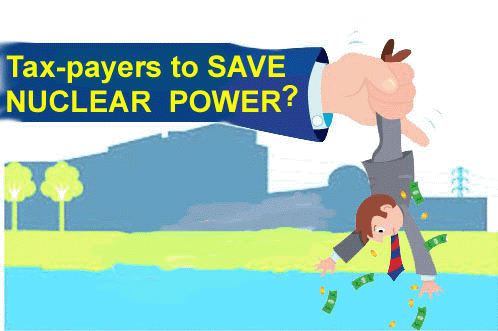 Toshiba faces pressure to secure funding for UK nuclear project, Ft.com by: Andrew Ward and Jim Pickard in London, 22 Jan 17 Toshiba is facing pressure to secure investment from a South Korean energy group and the UK government to keep afloat a multibillion-pound British nuclear power project as the Japanese conglomerate struggles with mounting financial difficulties.
Most USA Republicans favour action on climate change

 Trump supporters don’t like his climate policies, Bulletin of The Atomic Scientists, 20 JANUARY 2017 Dana Nuccitelli Recent surveys jointly conducted by Yale University and George Mason University found that a majority of Republicans (including a plurality of conservative Republicans) support US participation in international climate agreements like the Paris accords. They support regulating or taxing carbon pollution. And they want the United States to get much more of its energy from renewables, and less from fossil fuels.
Yet they also voted overwhelmingly for Donald Trump, who pledged to “cancel” the Paris climate agreement (though he has since waffled), and to kill the Clean Power Plan and its carbon pollution regulations. And he seems to strongly prefer coal to wind and solar energy, which he has inaccurately described as “not working on large-scale” and “very, very expensive.”………
Republican support for climate-change mitigation policies is broad but shallow. They would prefer that the government take action to curb carbon pollution, but for most, the issue won’t impact their votes.
However, the fossil fuel industry is a major Republican Party donor. Which means that for many Republican politicians, the incentives are thus quite clear—if they obstruct climate policies, they’re rewarded with campaign donations, and they’re not penalized at the ballot box by conservative voters who only mildly disapprove of their actions.
Donald Trump didn’t receive particularly substantial fossil fuel funding during his presidential campaign, which may help explain his wobbly stance on climate change. He simply doesn’t seem to have put much thought into the subject or consider it a high priority, quite like most of his supporters. But many of his nominees to powerful government positions like Scott Pruitt have benefited from oil industry donations, and Trump even nominated the chief executive officer of the world’s largest oil company to be his Secretary of State.
It’s in those key government roles where the rubber meets the road. If Trump’s nominees are approved, the fossil fuel industry will have powerful allies in his administration, and if they do enough damage to America’s efforts to curb carbon pollution, Trump and the GOP may eventually pay the electoral price…….http://thebulletin.org/trump-supporters-don%E2%80%99t-his-climate-policies10411#.WINK_ptkX2s.twitter
Climate Central explodes the lies and omissions in Trump’s White House Energy Plan
Decoding Trump’s White House Energy Plan , Climate Central, By Bobby Magill , 20 Jan 17 Just as President Donald Trump took the oath of office and the White House scrubbed its website of Obama climate change information, it posted Trump’s “America First Energy Plan,” which is replete with misinformation and specious claims about climate and energy policy.
The White House’s new energy plan repackages Trump’s campaign promises to reignite America’s declining coal industry, kill the Obama administration’s Climate Action Plan and exploit all of America’s fossil fuel reserves to achieve energy independence — an idea that ignores that America’s oil and gas is part of a truly global fossil fuels market.
Obama’s climate and energy policies encouraged the development of low-carbon renewable sources and discouraged the use of coal for electricity as a way to reduce the greenhouse gas emissions driving global warming.
Trump and his transition team called those policies job killers. He falsely claimed that Obama’s policies alone have forced the coal industry into decline. Coal has been on a long, steady decline since 2008 when natural gas was made cheap and abundant because of fracking. Natural gas overtook coal as America’s largest source of electricity for the first time in history in 2016.
The White House’s “America First Energy Plan” reflects those claims and Trump’s disdain for climate science and renewable energy. Here is a paragraph-by-paragraph analysis of the plan:
Energy is an essential part of American life and a staple of the world economy. The Trump Administration is committed to energy policies that lower costs for hardworking Americans and maximize the use of American resources, freeing us from dependence on foreign oil.
Few people question that energy is essential, but Trump’s statement that his administration is committed to low-cost energy and maximizing the use of American resources is seen by many as code for unfettered exploitation of oil, coal and natural gas in the U.S. Trump has called renewables “an expensive way of making the tree-huggers feel good about themselves,” and says a cheaper way to energy independence is through oil, gas and coal.
Fossil fuels are abundant in the U.S. thanks to fracking, which brought about the shale oil and gas boom of the past decade. But oil drilled in the U.S. isn’t necessarily staying in the U.S. and contributing to energy independence. Congress lifted a 40-year ban on oil experts a year ago, and now U.S. oil is being shipped all over the world, even as the U.S. is importing oil from Canada and the Middle East.
At the same time, the costs of renewables has been falling dramatically in recent years, and America’s largest oil refiner and carbon emitter — Texas — has become the nation’s leader in wind power production.
Trump’s skepticism of renewables contrasts starkly with Obama, who said that wind and solar power are a critical a component of energy independence. For too long, we’ve been held back by burdensome regulations on our energy industry. President Trump is committed to eliminating harmful and unnecessary policies such as the Climate Action Plan and the Waters of the U.S. rule. Lifting these restrictions will greatly help American workers, increasing wages by more than $30 billion over the next 7 years.
“Burdensome regulations” has long been Republican messaging for what they consider odious Obama-era climate policies and regulations that encourage the use of renewables and natural gas instead of fossil fuels to address climate change, or restrict the development of oil and gas on federally owned public lands and waters.
For example, one of Obama’s last-minute actions was to close off most of the Arctic Ocean off of Alaska’s North Coast for oil and gas development as a way to protect the seashore from oil spills and prevent more and more of the carbon pollution driving climate change. That followed a moratorium on coal leasing on federal lands and the closure of large swaths of the Atlantic coast to future oil drilling.
Each of those moves angered fossil fuel boosters in the Republican Party and were motivated in part by Obama’s Climate Action Plan, which involved a variety of measures to help slash America’s greenhouse gas emissions.
Trump’s claim that lifting those and other restrictions would increase workers’ wages by more $30 billion wildly mischaracterizes the potential for workers to benefit from killing U.S. climate policy. The figure seems to come from a 2015 report by Louisiana State University banking professor Joseph R. Mason, which was released by the Institute for Energy Research, an oil-industry funded organization run by Trump’s energy transition team chief,Tom Pyle.
The report claims that $32 billion in annual worker wages over seven years would be earned if all of America’s public lands were opened to oil, gas and coal development — even the lands protected by law from energy development, including wilderness areas and national parks.
That means Trump is saying that if Yellowstone, the White House lawn, Yosemite Valley, the Great Smoky Mountains and Mt. Rushmore were opened to fracking, workers would reap billions in benefits.
Sound energy policy begins with the recognition that we have vast untapped domestic energy reserves right here in America. The Trump Administration will embrace the shale oil and gas revolution to bring jobs and prosperity to millions of Americans. We must take advantage of the estimated $50 trillion in untapped shale, oil, and natural gas reserves, especially those on federal lands that the American people own. We will use the revenues from energy production to rebuild our roads, schools, bridges and public infrastructure. Less expensive energy will be a big boost to American agriculture, as well.
“Sound” energy policy is a play on “sound science” in an effort to lend it legitimacy.
It is true that the U.S. has vast untapped domestic energy sources — and that includes renewables. While fracking and the shale oil and gas boom led to discoveries of millions of barrels of oil that were once thought too expensive to reach, renewables are some of America’s largest untapped sources of energy.
For example, America’s offshore wind power potential is so huge that if fully developed, offshore wind farms could produce four times the electricity currently generated in the U.S. today, according to the U.S. Department of Energy. America’s first offshore wind farm was completed in December, with more expected to be built over the next five years.
Trump’s estimated $50 trillion in untapped oil and gas reserves is a huge mischaracterization of the fossil fuels that can be developed in the U.S., said Mark Squillace, a professor of natural resources law at the University of Colorado-Boulder.
“The problem with numbers like this is that they do not tell the whole story,” Squillace said. “The United States certainly has vast oil and gas and coal reserves and if you just add them up and multiply by their market value you get a big number. But most of those reserves cannot be economically developed any time in the foreseeable future.”
He said the figure originates from Kathy Hartnett White, a Trump advisor affiliated with the conservative Texas Public Policy Foundation, who told Fox Business in June that the U.S. is sitting on $50 trillion of oil and gas, “but the government is stopping us from getting it.”…….
President Trump will refocus the EPA on its essential mission of protecting our air and water………….Trump’s energy policy says nothing about climate change, which will be made drasticly worse if the U.S. develops as much oil, gas and coal as Trump suggests.
America’s air and water have been kept clean over the past 40 years because of environmental laws enforced by the Environmental Protection Agency, which Trump previously said he wants to abolish. Trump has appointed one of the EPA’s most ardent foes to head the agency — Oklahoma Attorney General Scott Pruitt, who has sued the EPA 14 times and is involved in a lawsuit aiming to kill one of Obama’s most sweeping climate policies.
During his confirmation hearing, Pruitt said he wants states to have more control over how they are regulated by the EPA, suggesting that the federal laws protecting America’s air and water would be applied unevenly from state to state. Some states are much more vigilant in enforcing environmental regulations and have more resources than others,
Trump has said nothing about how a weakened EPA would accomplish his goal of keeping America’s air and water clean.http://www.climatecentral.org/news/decoding-trumps-white-house-energy-plan-21097
As Trump takes over, White House website loses all reference to climate change, promotes coal industry
It also appeared to remove any reference to combating climate change, a topic that had been featured prominently on the White House site under President Barack Obama. The page that once detailed the potential consequences of climate change and the Obama administration’s efforts to address it vanished on Friday just as President Trump was sworn in. It now redirected to a broken link: “The requested page ‘/energy/climate-change’ could not be found.”
In its place, listed among the top issues of the Trump administration, was a page entitled, “An America First Energy Plan.”
The incoming administration vows to eliminate “harmful and unnecessary policies” such as the Climate Action Plan and the Waters of the United States rule. The first represents a variety of efforts Obama pursued to reduce U.S. greenhouse gas emissions, while the second is a rule issued by the EPA to protect not only the largest waterways but smaller tributaries that others believe should fall under the jurisdiction of states rather than the federal government.
The new White House site says that Trump would “refocus the EPA on its essential mission of protecting our air and water.”
It also says the incoming president will pursue “clean coal technology,” a reference to efforts to remove carbon dioxide emissions from coal-burning plants and bury those emissions in the ground to use them to enhance oil recovery. The Obama Energy Department has already been funding a variety of projects in this area. Though, without nearby enhanced oil recovery projects, the technology is not economic. Trump’s White House site says the new administration would aim at “reviving America’s coal industry.”
Perry poised to lead renewable energy push in Trump’s USA
BY MARK PERRY, 01/20/17 “……..This is where the new administration can make a difference. With Perry guiding the DOE, the agency can stimulate development of a new generation of small modular reactors and advanced nuclear plants.
Just last week, NuScale, an Oregon-based nuclear company, applied to the Nuclear Regulatory Commission for safety certification of a small modular reactor (SMR) that it intends to develop for use in the United States and abroad.
This is the first request for certification of a new reactor design in many years and it could mark the start of the next step for advanced nuclear power…….
Perry is a strong supporter of nuclear power. He can play an invaluable role in pushing for action at the state and regional levels to keep existing nuclear plants online…… it takes new leadership and a renewed appreciation for the importance of nuclear power. Hopefully, Perry will soon provide that leadership as the head of the DOE”.
Climate injustice. Under Trump, people of color will suffer most
People of color are bracing for climate injustice under Trump, Guardian, Elizabeth C Yeampierre, 20 Jan 17 When things are bad for everyone, they are particularly bad for people of color – which doesn’t bode well as the Trump administration sets up shop. hen things are bad for everyone, they are particularly bad for people of color. The Trump administration is about to legitimize injustice in all of our communities. People of color have endured the extraction of our land and labor – and its legacy – since the creation of these United States. Now, we are bracing ourselves for worse things to come.
The environmental and climate justice movement has had substantial successes on both the local and national fronts. We have cleaned up brownfields, stopped the siting of power plants, facilitated community-based planning for climate adaption and resilience, all while developing a framework known as Just Transitions, which rejects the “dig, burn, dump” economy and wants to push it away from an extractive economy to a regenerative one.
Always frontline-led and solutions–oriented, we have been working diligently to operationalize this transition through such initiatives as community-owned solar, offshore wind and local cooperatives that model another way to live without a carbon footprint. Energized by the momentum created by the People’s Climate March and the breadth of knowledge shared by the Climate Justice Alliance’s Our Power Campaign, the last few years have been all about the possibilities.
And then Trump was elected.
The solutions to unresolved environmental justice crises in low-income communities of color that the environmental and climate justice movement and allies have been diligently working to resolve now suddenly appear unattainable……..
Our communities across the nation have struggled but survived with administrations that moved slowly. We have never faced an administration that on all underlying tenets of climate justice – including the very existence of climate change – is at best indifferent and at worst actively antagonistic.
The appointments of climate denier Scott Pruitt as head of the Environmental Protection Agency, fossil fuel-backed Ryan Zinke as head of Department of Interior, ExxonMobil CEO Rex Tillerson as secretary of state, neo-Confederate Jeff Sessions as attorney general and fast food executive Andrew Puzder as secretary of labor all constitute direct attacks on these tenets and communities of color.
As we face a full-scale assault on our very existence, we are planning, organizing, building, educating and resisting with an understanding of what this means for our communities.https://www.theguardian.com/commentisfree/2017/jan/19/trump-administration-climate-change-people-of-color-injustice
France’s EDF resisting the closure of Fessenheim nuclear power plant
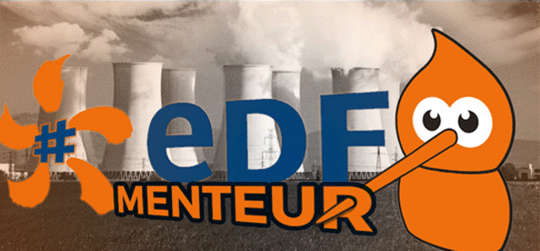 EDF board prepares to defy Hollande on nuclear closure Power company’s bid to keep plant open shows president’s waning authority, Ft.com 19 Jan 17 by: Michael Stothard in Paris François Hollande risks falling short on another pledge as the board of state-controlled energy company EDF next week prepares to vote down his plans to close France’s oldest nuclear plant.
Confusion in Donald Trump’s thinking about nuclear weapons
Donald Trump’s very confusing thoughts on nuclear weapons, explained
Would Donald Trump authorise a nuclear weapon strike?
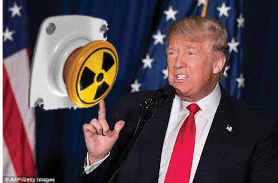 Donald Trump and the ‘nuclear football’: What’s stopping President-elect launching lethal weapon strike http://www.independent.co.uk/news/world/americas/donald-trump-nuclar-football-codes-what-stops-president-elect-push-button-launch-nuclear-weapon-a7534926.html ‘In theory the president has full discretion over authorisation of nuclear use’ Peter Walker @petejohn_walker , 19 Jan 17 Donald Trump will be simultaneously handed power to launch nuclear weapons as he is inaugurated tomorrow.
Here we explain how the “thin-skinned” and “impulsively tempered” President-elect can wield the power of the ‘nuclear football’ and what’s stopping him from using it.
Proposed Energy Secretary Risk Perry – ignorant about nuclear security!

Rick Perry: Energy Secretary nominee didn’t know his job would involve managing nuclear weapon stockpile The 66-year-old is said to be facing a ‘steep learning curve’ The Independent Andrew Buncombe New York @AndrewBuncombe Rick Perry made embarrassing headlines when he could not remember the name of the federal agency he wanted to scrap.
Greens Party running anti nuclear platform in UK by-election
 Green Party to contest Copeland seat in anti-nuclear campaign http://www.nwemail.co.uk/news/millom/Green-Party-to-contest-Copeland-seat-in-anti-nuclear-campaign-c289e405-159d-4963-b202-f53145038801-ds 15 January 2017
THE Green Party has announced it will contest the upcoming Copeland by-election on an anti-nuclear and anti-poverty campaign.
Members of Allerdale and Copeland Green Party decided to stand in the Copeland vote which was brought about by the resignation of the constituency’s current Labour MP Jamie Reed. A candidate will be selected on January 24.
Clare Brown, chairman of the Allerdale and Copeland Green Party, said: “We feel it’s vitally important to offer a vote to those people who want to see a fair and sustainable future for the area.
“There are clear differences between us and the other parties and we welcome this opportunity to campaign on our priorities, which include sustainable energy and standing against nuclear power, as well as anti-poverty measures and exposing the lie of austerity.”
Jonathan Bartley, co-leader of the Green Party, said: “The Greens are the only party in Copeland campaigning against nuclear power, to defend the NHS and for a close relationship with Europe.”
Pundits say the poll for his replacement could be held on May 4, linking in with the county council elections. As the party that currently holds the seat, Labour has to formally move the by-election writ to select his replacement and can dictate the date constituents go to the polls.
Labour are defending a majority of 2,564 in Copeland from 2015, making it the tightest by-election for the party since Jeremy Corbyn became leader.
The Liberal Democrats have already announced Cockermouth councillor and health campaigner Rebecca Hanson as their candidate.
Labour will choose a candidate from a shortlist of Barbara Cannon, Gillian Troughton and Rachel Holliday.
1 This Month
15 October. Joint Appeal for Nuclear Abolition Day -presentation to the UN on October 15 will be live on UNWebTV
Endorse the Nuclear Abolition Day Appeal
23-25 October – on Zoom – World BEYOND War’s annual global conference

To see nuclear-related stories in greater depth and intensity – go to https://nuclearinformation.wordpress.com
-
Archives
- October 2026 (139)
- September 2026 (339)
- August 2026 (330)
- July 2026 (355)
- June 2026 (287)
- May 2026 (306)
- April 2026 (356)
- March 2026 (251)
- February 2026 (267)
- January 2026 (308)
- December 2025 (358)
- November 2025 (359)
-
Categories
- 1
- 1 NUCLEAR ISSUES
- business and costs
- climate change
- culture and arts
- ENERGY
- environment
- health
- history
- indigenous issues
- Legal
- marketing of nuclear
- media
- opposition to nuclear
- PERSONAL STORIES
- politics
- politics international
- Religion and ethics
- safety
- secrets,lies and civil liberties
- spinbuster
- technology
- Uranium
- wastes
- weapons and war
- Women
- 2 WORLD
- ACTION
- AFRICA
- Atrocities
- AUSTRALIA
- Christina's notes
- Christina's themes
- culture and arts
- Events
- Fuk 2022
- Fuk 2023
- Fukushima 2017
- Fukushima 2018
- fukushima 2019
- Fukushima 2020
- Fukushima 2021
- general
- global warming
- Humour (God we need it)
- Nuclear
- RARE EARTHS
- Reference
- resources – print
- Resources -audiovicual
- Weekly Newsletter
- World
- World Nuclear
- YouTube
-
RSS
Entries RSS
Comments RSS

