Sizewell C’s future in doubt as EDF told to prioritise French nuclear power
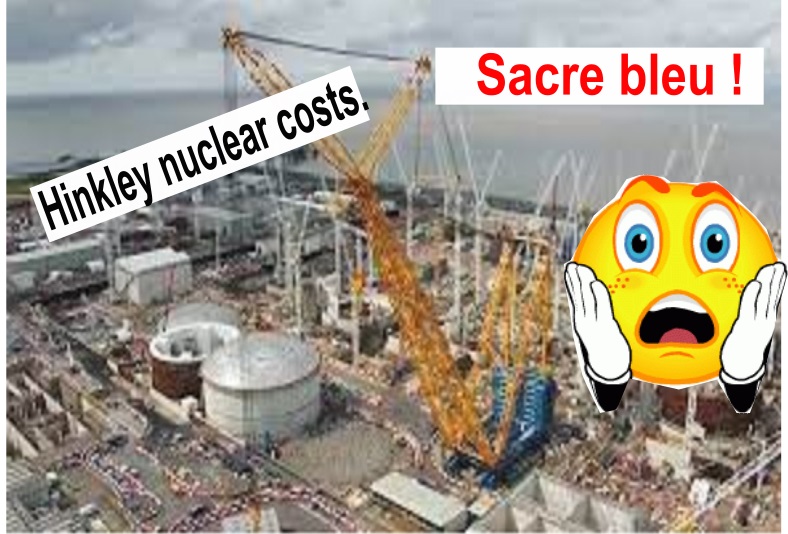
Auditor warns against costly foreign projects as energy giant considers investment decision into the plant
The future of Sizewell C has been thrown into doubt after EDF, the company
behind the project, was told to prioritise supporting nuclear power in
France. In a rare intervention, the French state auditor warned the
state-owned energy giant against backing risky new projects abroad, which
include plans to build a new nuclear power station in Suffolk.
Instead, the Cour de Comptes said EDF should focus on making a success of
multibillion-euro projects at home, ensuring they were profitable and built
on time. It comes as EDF prepares to make a final investment decision on
Sizewell C, which will increase its exposure in the UK given it is already
building Hinkley Point C in Somerset.
However, that project has been hit by
surging costs and delays, with the most recent forecasts saying it will
open after 2030 and cost around £45bn. Industry sources are also predicting
Sizewell C will cost £40bn to build, double EDF’s initial estimates in
2020.
EDF is working alongside the Government on Sizewell C, with £4bn of
taxpayer cash already spent on the project. However, the French auditor has
released a report saying EDF should not make a final investment decision on
the Sizewell project before cutting its financial exposure to Hinkley.
Telegraph 14th Jan 2025,
https://www.telegraph.co.uk/business/2025/01/14/sizewell-c-future-doubt-edf-told-prioritise-french-nuclear/
The Great British Nuke Off

by beyondnuclearinternational, https://beyondnuclearinternational.org/2025/01/12/the-great-british-nuke-off/
It’s time to expose the sham plan for new nuclear power, write Andy Blowers and Stephen Thomas in their new report
The following is the introduction and the conclusion from the report, “It is time to expose the Great British Nuclear Fantasy once and for all”. Read the full report.
In April 2022, the then UK Prime Minister, Boris Johnson, set a target of 24GW (equivalent to eight stations like Hinkley Point C) of new nuclear capacity to be completed in Great Britain by 2050. At the heart of the proposal was the creation of a new government owned entity, Great British Nuclear (GBN), with a mission of ‘helping projects through every stage of the development process and developing a resilient pipeline of new builds’ designed to ensure energy security and to meet the UK’s commitment to achieving net zero.
The new Labour Government, elected in July 2024, has been emphatic about the scaling up of renewables, and has confirmed that nuclear power ‘will play an important role in helping the UK achieve energy security and clean power’. While not explicitly committing to the 24GW target, the new Government expressed its belief that a scale expansion of new nuclear projects was a necessary part of the energy mix for the transition to achieving net zero carbon by 2050.
The Government is expected to continue with GBN but in a clearly subordinate role to its new creation, Great British Energy, its vehicle for driving development and investment into projects that will enable the energy transition to achieve net zero by 2050.

There has, so far, been little government recognition of the sheer difficulty of achieving a vast expansion of nuclear energy. As so often in the past, the nuclear programme has barely got off the ground and the flagship project of the new nuclear programme, Sizewell C, had, by October 2024, yet to receive a Final Investment Decision (FID) apparently because of the lack of interested investors.
In an attempt to keep the project from collapsing while it tries to find investors, Government has chosen to invest £8bn in the project, in addition to Electricité de France’s (EDF’s) contribution of about £700m, just to get it to FID, a process budgeted by EDF in 2016 to cost only £458m. Small Modular Reactors in which much hope is vested barely exist beyond the drawing boards and by the time they could be deployed, if all goes to plan, it will be too late for SMRs and Sizewell C to make any significant contribution to achieving ‘Net Zero’.
The recipe for expanding nuclear and overcoming the problems that have meant previous large nuclear programmes came to little remains the same as that of the previous government: create a flow of large nuclear projects starting with an FID for Sizewell C; bring Small Modular Reactors to commercial availability by 2029 and start ordering them then; and streamline the planning and regulatory processes.
Achieving these objectives in whole or in part will be impossible. In addition, the nuclear programme remains encumbered by its traditional ethical and sustainability problems, if anything, more so. The prevailing fear of nuclear accidents and radiation risks has intensified as nuclear is increasingly exposed to cyber-attack and the palpable threats from terrorism and warfare.
The accidents at Chernobyl and Fukushima, and the threats to Zaporizhzhia in Ukraine and Russia’s Kursk plant at the heart of the Russo-Ukraine war provide chilling evidence of dangers that are likely to materialise sometime somewhere.
With its embedded relationship to the bomb, nuclear energy is implicated in existential catastrophe. The other existential threat comes from accelerating Climate Change which will inundate some coastal sites, create problems of cooling water and, render the legacy of wastes scattered at vulnerable sites an unmanageable problem for generations far into the future.
We may well ask why, in the face of such deficiencies and dangers and with evidence of flagging momentum, this fantastical project is still proceeding? The answer lies in a powerful combination of political ambition, nuclear industry and trade union lobbying purveying the promise of skills, jobs investment, export markets and wealth associated with nuclear development and its supply chain. A mainstream discourse of nuclear as a mainstay of base load supply, energy security and the goal of net zero has been nurtured, to which powerful interests unthinkingly subscribe. Inertia ensures the persistence of the fantasy.
Yet, all the evidence in terms of renewables competition, the opportunity costs and long term economic and security risks of a swerve to new nuclear indicates a vast gulf between rhetoric and reality. In this paper it is our purpose to address the realities and to demonstrate why new nuclear expansion is not only impossible but acts as a barrier to achieve a rapid energy transition powered by renewable technology, storage and energy efficiency.
In the face of the evidence, we consider it reasonable to conclude that any expansion of civil nuclear power in the UK beyond that already committed is unachievable.
The history of nuclear power worldwide is of ambitious programmes falling far short of plans, with huge delays and time overruns. The impact of these failures has been masked by less than expected electricity demand growth and the availability of quicker and cheaper alternatives.
However, there has been a significant opportunity cost to money wasted on these ill-fated policies. For decades UK governments have been seduced by claims from the nuclear industry that, this time, a major nuclear programme will go to plan. More than ever before, the latest programme will be dependent on huge quantities of public money with financial risks falling squarely on the public.
It strains credibility that, with a massive hole in the finances and urgent priorities in health and welfare, the justice system, education and infrastructure, the idea of plugging the nuclear black hole will be met with universal enthusiasm.
The signs are all too clear, the rhetoric has no concrete foundations and the programme will vaporise slowly, perhaps but with inevitable termination. Future demand is again being over-estimated and cheaper, quicker alternatives exist.
The real cost of nuclear power continues to rise and the delays increase, while the cost of alternatives continues to fall. The latest prices for off-shore and onshore wind, and solar photovoltaic are about half the likely price for new nuclear. The IEA reported that over the 10 years from 2013-23, battery costs fell by more than 80%.
Authoritative analysis by an Oxford University team found that UK energy demand could be halved by 2050 with substantial welfare benefits in terms of reducing fuel poverty.
While government documents on nuclear invariably speak of things moving ‘at pace’, the reality is that in the period since the 24GW programme was announced, delays have mounted. In only two years, the completion date for Hinkley Point C went back up to four years and Sizewell C’s FID has been delayed by at least three years.
By October 2024, more than two years after it was announced, GBN barely exists. It has no permanent executive, no premises and no independent budget and its staff are temporary secondees.
GBN’s first substantive task was to complete the SMR competition and award contracts. In October 2023, it expected this to happen in spring 2024. It now seems likely this will not happen until the end of 2024, so a task expected to take about 6 months will, if there are no more delays, take 15 months.
The new Labour administration has yet to say whether GBN will remain as a separate body or whether it will be absorbed into its own new creation, Great British Energy. This uncertainty could delay the decision further.
Despite the sound and fury, the GBN project is bound to fail. Its contribution to achieving net zero by 2050 will be nugatory. No amount of political commitment can overcome the lack of investors, the absence of credible builders and operators or available technologies let alone secure regulatory assessment and approval.
Moreover, in an era of climate change there will be few potentially suitable sites to host new nuclear power stations for indefinite, indeed unknowable, operating, decommissioning and waste management lifetimes.
And there are the anxieties and fears that nuclear foments, the danger of accidents and proliferation and the environmental and public health issues arising from the legacy of radioactive waste scattered on sites around the country.
Abandoning Sizewell C and the SMR competition will lead to howls of anguish from interest groups such as the nuclear industry and trade unions with a strong presence in the sector. It will also require compensation payments to be made to organisations affected. However, the scale of these payments will be tiny in comparison with the cost of not abandoning them.
It is our hope that sanity and rationality may prevail and lead to a future energy policy shorn of the burden of new nuclear and on a pathway to sustainable energy in the pursuit of net zero.
Professor Andy Blowers is a British geographer and environmentalist and Emeritus Professor of the Faculty of Arts & Social Sciences at the Open University. Professor Stephen Thomas is a professor at the University of Greenwich Business School, working in the area of energy policy.
Together Against Sizewell C letter to National Audit Office SZC Value for Money concerns 06.01.25

Assessment of the true costs of the project could lead to Sizewell C failing the value for money assessment
TASC 6th Jan 2025
Dear Mr Davies,
SIZEWELL C
Whilst acknowledging your previous comments regarding TASC’s concerns for the UK taxpayer in relation to the Sizewell C project, TASC wishes to make further representations regarding more recent developments which highlight a risky project proceeding by stealth with no transparency regarding Value for Money (VfM). The Sizewell C DCO was approved based on an estimated capital cost of £20 billion, but with announcements that the sister project at Hinkley Point C is estimated to cost (at current prices) £46 billion and in the knowledge that the Sizewell site is a more difficult site to develop, it is not credible to suggest, as one of the developer’s joint managing directors did in 2024[1], the cost to build Sizewell C remains at £20 billion.
With reference to your letter of 17th June, TASC fully appreciates that it is a government decision whether to proceed with Sizewell C and we advise that we are not expecting the NAO, at the current time, to pre-judge the final decision or to review the current negotiations with potential investors. However, what is clear from recent developments is that the growing and already substantial government financial support for the project has been split into two separate funding streams, the first being for the period leading to the potential Final Investment Decision (FID), and the other being part of the FID should it be agreed. TASC has considerable concerns about the decision-making at this pre-FID stage of the project due to the risk to public finances and the lack of transparency regarding the VfM assessment which is being used to justify the current funding.
On 30th August 2024, DESNZ published details of the Sizewell C Development Expenditure
(Devex) Subsidy Scheme no. SC11179 (the ‘Devex’ scheme) which authorises a total subsidy of £5.5 billion, up to the date of a potential FID, the first tranche of which, amounting to £1.2 billion, was allocated without any transparency or announcement on 20th September 2024 (details of this payment were first disclosed to the public on the subsidy scheme website on 5th
December)[2]. Combined with the £2.5 billion granted through the ‘SZC Investment Funding Scheme (SC10655)’, this will take total taxpayer exposure to £8 billion. If we then add the £2.7 billion allocated to the project in the recent budget which, if not part of the Devex scheme, the exposure of public funds would extend to £10.7 billion – for a project that is not guaranteed to go ahead should there be no FID or satisfactory resolution of the many other key matters relating to the project. The Devex scheme states that allocations will be supported by VfM assessments.
In your letter of 15th May 2024, you advised that you were anticipating that FID would occur during the period of the previous Parliament. According to the Devex scheme, FID may not happen till June 2026. It is worth recalling that when EDF first proposed Sizewell C, they budgeted the costs to get to FID to be £458 million. With a £2.5 billion spend by the previous Tory government, £5.5 billion authorised by this government under the Devex Scheme and an estimated £700 million invested by EDF, the cost of getting to FID is approximately 1,900% of the original budget. Even by EDF’s previous underbudgeting history, this uplift is quite staggering, yet there has been no explanation as to why these costs are so astronomically higher than the original estimate, how such increases have been justified and how much more public funding is likely to be assigned to what many observers are calling ‘Labour’s HS2’.
TASC call on the NAO to carry out a review of the Value for Money assessment supporting the government decision to use up to £10.7 billion of public funding without any guarantee that the project will go ahead. There are many facets to the Sizewell C project that will have an impact on its viability and TASC take this opportunity to remind you of some of the risks why the project may not proceed:-
- Insufficient external funding, perhaps due to the many cost uncertainties raised in our letter of 29th April 2024, meaning that a final investment decision cannot be made.
2. Assessment of the true costs of the project could lead to Sizewell C failing the value for money assessment, particularly as the government has advised that by 2030, the UK will be a net exporter of electricity[3] meaning that if and when Sizewell C ever becomes operational in the late 2030’s, it is likely to be surplus to the UK’s needs: even though Sizewell C’s DCO approval was justified on the grounds of ‘Imperative Reasons of Overriding Public Interest’.
3. Sizewell C is proposed to be sited on one of Europe’s fastest eroding coastlines, yet there is still no final design of the sea defences required to keep it safe from the effects of climate change, so there is no guarantee that the Office for Nuclear Regulation (ONR) will be satisfied that the site can be kept safe for its full lifetime i.e. until the late 2100s. The future need for a final design of the sea defences, including the flood risk implications of the 20-year extension to the site lifetime (to that approved in the DCO) and the need to justify the proposed nuclear platform height, was recognised by the ONR when they issued a Nuclear Site Licence to Sizewell C in May 2024. If the ONR are not satisfied with the outstanding proposals, they will not licence Sizewell C’s operations.
4. The project’s safety case currently being assessed by the ONR is materially different from the project that was approved in the DCO i.e. in respect of the commitment Sizewell C Ltd have made to install ‘Overland Flood Barriers’ and the 20-year extension to the site’s lifetime, meaning that the Secretary of State should review the updated project before opining whether the changes are acceptable.
5. Sizewell C Ltd have still not completed investigations into the ground conditions beneath the nuclear site, much of which was originally marshland, to determine how and if the cut-off wall – essential to enable the dewatering of the whole nuclear site – can be constructed. Without the cut-off wall, Sizewell C cannot be built. TASC are not aware that ground testing has even started for the area that will be covered by the hard coast sea defences.
6. Despite being located in the UK’s driest region, there is still no guaranteed sustainable source or agreement for the provision of the 2.2 million litres of potable water per day essential for Sizewell C’s sixty years of operation, meaning that the nuclear plant could be built but unable to operate.
TASC draw your attention to the evidence given by GBN’s interim CEO, Simon Bowen, at the 20th November 2024 meeting of the ESNZ Parliamentary committee[4], at which he indicated that one of the reasons for the delay in Sizewell C achieving a FID is, quote, “technical issues in getting the design to the stage where you can take it to final investment decision” and following a discussion about nuclear projects achieving value for money and how projects can be de-risked he said, quote, “How do you de-risk in the way that you do across all infrastructure projects? Well, you do not dig a hole until you have completed the design. It is as basic as that.” He then went on to say “If we can get to that stage, first, it makes it more investable for the private sector…”
In the light of Simon Bowen’s evidence and in recognition that the Sizewell C project is already digging a significant number of large holes throughout East Suffolk building or preparing projects which without Sizewell C would not be justified and are totally unnecessary. Such potentially redundant projects include:-………………………………………………………………………..
Why Greenland Is Of Growing Strategic Significance
Donald Trump seems more insistent than ever on controlling Greenland, but regardless of his controversial intentions, the island is of real strategic importance
Thomas Newdick, THE WARZONE, 9 Jan 25
Donald Trump wouldn’t categorically rule out using the U.S. military to take control of Greenland, saying that America needs it — as well as the Panama Canal — for “economic security.” Amid intense kickback from Denmark — a NATO ally of which Greenland is an autonomous territory — and other countries, it’s worth looking in more detail at the significance of the island, which is one of the world’s largest, in economic, geostrategic, and, above all, military terms…………………………………….. more https://www.twz.com/news-features/why-greenland-is-of-growing-strategic-significance
U.S. politicians want transparency about the radiation risks of the fire afflicted Santa Susana nuclear site.

 Public Risks from the Woolsey Fire and the Santa Susana Field Laboratory: A Letter to DTSC https://www.indybay.org/newsitems/2018/11/20/18819268.php, by Bradley Allen Nov 20th, 2018
Trump’s war on wind power: Plans to stop windmill construction nationwide

In a recent conference held at his Florida resort, US President-elect
Donald Trump announced his intention to halt the construction of wind
turbines across the country. “We are going to have a policy where no
windmills will be built,” Trump declared, reiterating his long-standing
opposition to this form of renewable energy.
Review Energy 8th Jan 2025
https://www.review-energy.com/otras-fuentes/trump-s-war-on-wind-power-plans-to-stop-windmill-construction-nationwide
EDF delays salt marsh consultation for Hinkley Point C
EDF has delayed a formal public consultation over the proposed location of
a new salt marsh which would act as an environmental mitigation for the
Hinkley Point C nuclear power plant. The consultation was due to commence
in January but will now be delayed to later in 2025 to “carefully
evaluate the best approach.” Four possible locations have been proposed
for a salt marsh along the River Severn, including Kingston Seymour,
Arlingham, Littleton, and Rodley.
Bridgwater Mercury 8th Jan 2025,
https://www.bridgwatermercury.co.uk/news/24842339.edf-delay-salt-marsh-consultation-hinkley-point-c/
Genocidal President, Genocidal Politics
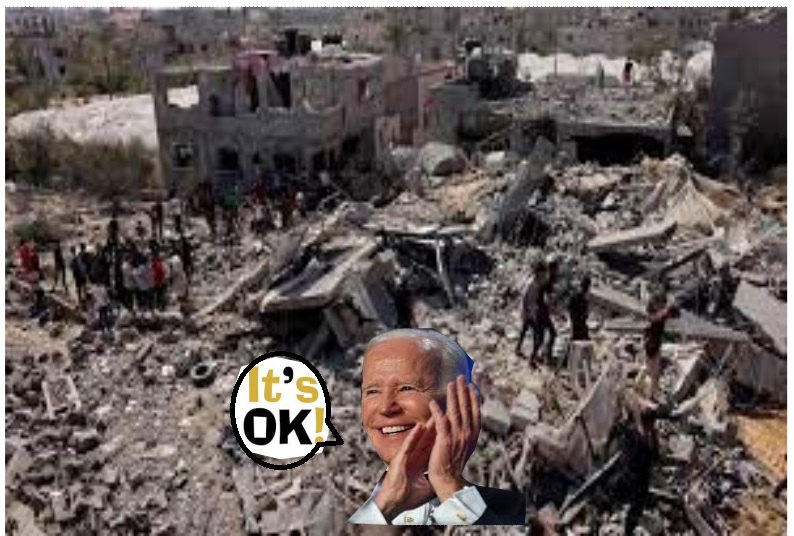
The presidential genocide and the active acquiescence of the vast majority of Congress are matched by the dominant media and overall politics of the United States.
Jan 6, 2025, Norman Solomon, https://www.laprogressive.com/war-and-peace/genocidal-president?utm_source=LA+Progressive+NEW&utm_campaign=c01ae947cf-LAP+News+–+%288%29+18+NOVEMBER+2022_COPY_01&utm_medium=email&utm_term=0_61288e16ef-c01ae947cf-287023764&ct=t(EMAIL_CAMPAIGN_11_17_2022_10_46_COPY_01)&mc_cid=c01ae947cf&mc_eid=02629a6e14
Then news broke over the weekend that President Biden just approved an $8 billion deal for shipping weapons to Israel, a nameless official vowed that “we will continue to provide the capabilities necessary for Israel’s defense.” Following the reports last month from Amnesty International and Human Rights Watch concluding that Israeli actions in Gaza are genocide, Biden’s decision was a new low for his presidency.
It’s logical to focus on Biden as an individual. His choices to keep sending huge quantities of weaponry to Israel have been pivotal and calamitous. But the presidential genocide and the active acquiescence of the vast majority of Congress are matched by the dominant media and overall politics of the United States.
Forty days after the Gaza war began, Anne Boyer announced her resignation as poetry editor of the New York Times Magazine. More than a year later, her statement illuminates why the moral credibility of so many liberal institutions has collapsed in the wake of Gaza’s destruction.
While Boyer denounced “the Israeli state’s U.S.-backed war against the people of Gaza,” she emphatically chose to disassociate herself from the nation’s leading liberal news organization: “I can’t write about poetry amidst the ‘reasonable’ tones of those who aim to acclimatize us to this unreasonable suffering. No more ghoulish euphemisms. No more verbally sanitized hellscapes. No more warmongering lies.”
The acclimatizing process soon became routine. It was most crucially abetted by President Biden and his loyalists, who were especially motivated to pretend that he wasn’t really doing what he was really doing.
For mainline journalists, the process required the willing suspension of belief in a consistent standard of language and humanity. When Boyer acutely grasped the dire significance of its Gaza coverage, she withdrew from “the newspaper of record.”
Content analysis of the war’s first six weeks found that coverage by the New York Times, Washington Post and Los Angeles Times had a steeply dehumanizing slant toward Palestinians. The three papers “disproportionately emphasized Israeli deaths in the conflict” and “used emotive language to describe the killings of Israelis, but not Palestinians,” a study by The Intercept showed. “The term ‘slaughter’ was used by editors and reporters to describe the killing of Israelis versus Palestinians 60 to 1, and ‘massacre’ was used to describe the killing of Israelis versus Palestinians 125 to 2. ‘Horrific’ was used to describe the killing of Israelis versus Palestinians 36 to 4.”
After a year of the Gaza war, Arab-American historian Rashid Khalidi said: “My objection to organs of opinion like the New York Times is that they see absolutely everything from an Israeli perspective. ‘How does it affect Israel, how do the Israelis see it?’ Israel is at the center of their worldview, and that’s true of our elites generally, all over the West. The Israelis have very shrewdly, by preventing direct reportage from Gaza, further enabled that Israelocentric perspective.”
Khalidi summed up: “The mainstream media is as blind as it ever was, as willing to shill for any monstrous Israeli lie, to act as stenographers for power, repeating what is said in Washington.”
The conformist media climate smoothed the way for Biden and his prominent rationalizers to slide off the hook and shape the narrative, disguising complicity as evenhanded policy. Meanwhile, mighty boosts of Israel’s weapons and ammunition were coming from the United States. Nearly half of the Palestinians they killed were children.
For those children and their families, the road to hell was paved with good doublethink. So, for instance, while the Gaza horrors went on, no journalist would confront Biden with what he’d said at the time of the widely decried school shooting in Uvalde, Texas, when the president had quickly gone on live television. “There are parents who will never see their child again,” he said, adding: “To lose a child is like having a piece of your soul ripped away. . . . It’s a feeling shared by the siblings, and the grandparents, and their family members, and the community that’s left behind.” And he asked plaintively, “Why are we willing to live with this carnage? Why do we keep letting this happen?”
The massacre in Uvalde killed 19 children. The daily massacre in Gaza has taken the lives of that many Palestinian kids in a matter of hours.
While Biden refused to acknowledge the ethnic cleansing and mass murder that he kept making possible, Democrats in his orbit cooperated with silence or other types of evasion. A longstanding maneuver amounts to checking the box for a requisite platitude by affirming support for a “two-state solution.”
Dominating Capitol Hill, an unspoken precept has held that Palestinian people are expendable as a practical political matter. Party leaders like Senator Chuck Schumer and Representative Hakeem Jeffries did virtually nothing to indicate otherwise. Nor did they exert themselves to defend incumbent House Democrats Jamaal Bowman and Cori Bush, defeated in summer primaries with an unprecedented deluge of multimillion-dollar ad campaigns funded by AIPAC and Republican donors.
The overall media environment was a bit more varied but no less lethal for Palestinian civilians. During its first several months, the Gaza war received huge quantities of mainstream media coverage, which thinned over time; the effects were largely to normalize the continual slaughter. Some exceptional reporting existed about the suffering, but the journalism gradually took on a media ambience akin to background noise, while credulously hyping Biden’s weak ceasefire efforts as determined quests.
Prime Minister Benjamin Netanyahu came in for increasing amounts of criticism. But the prevalent U.S. media coverage and political rhetoric — unwilling to expose the Israeli mission to destroy Palestinians en masse — rarely went beyond portraying Israel’s leaders as insufficiently concerned with protecting Palestinian civilians.
Instead of candor about horrific truths, the usual tales of U.S. media and politics have offered euphemisms and evasions.
When she resigned as the New York Times Magazine poetry editor in mid-November 2023, Anne Boyer condemned what she called “an ongoing war against the people of Palestine, people who have resisted through decades of occupation, forced dislocation, deprivation, surveillance, siege, imprisonment, and torture.” Another poet, William Stafford, wrote decades ago:
I call it cruel and maybe the root of all cruelty
to know what occurs but not recognize the fact.
Iran has absolutely no intention to build nuclear weapons, president says
Jan 7, 2025 https://www.iranintl.com/en/202501076906
Tehran has no plan to acquire a nuclear bomb since Iran’s Supreme Leader Ali Khamenei has forbidden it on religious grounds, Iran’s president said on Tuesday.
“The Islamic Republic has absolutely no intention of utilizing its nuclear capabilities for military purposes based on its ideological beliefs and a fatwa by Supreme Leader Ali Khamenei,” Masoud Pezeshkian said in a meeting with Britain’s new ambassador to Tehran.
For two decades, the Supreme Leader’s so-called nuclear fatwa has been repeatedly cited by senior officials as proof of Iran’s peaceful intentions. But even supporters of that view say the decree could be amended.
The nuclear engineer went on to say that if Khamenei’s opinion changed, Iran would have the capacity to build a nuclear weapon.
Tehran ready for return to JCPOA
Pezeshkian’s comments came one day after French President Emmanuel Macron warned Tehran’s nuclear program is nearing the point of no return.
Iran says its uranium enrichment program is for peaceful purposes but has accelerated activity since US President-elect Donald Trump withdrew from the 2015 nuclear deal – officially known as the Joint Comprehensive Plan of Action (JCPOA) – during his first term and reimposed sanctions on Tehran.
“The Islamic Republic is fully prepared for all parties to return to the 2015 agreement and fulfill their mutual commitments,” Pezeshkian added on Tuesday.
Last month, European powers France, Germany, and Britain warned that Iran’s actions had further eroded the agreement, noting that Tehran’s stockpile of highly enriched uranium has no credible civilian justification.
In December, the head of the UN nuclear watchdog reported that Iran was dramatically advancing enrichment close to the 90% purity needed only for weapons-grade material.
The three European nations, co-signatories of the 2015 accord, had brokered the deal under which Iran agreed to limit enrichment in exchange for the lifting sanctions.
“According to the Leader’s opinion, going in this direction is now forbidden, because he is a religious authority; (but) maybe he will change his opinion tomorrow,” Shahid Beheshti University President Mahmood-Reza Aghamiri said recently in an interview.
A new year – but old policies
Renew Extra 4th Jan 2025
Given the UK’s tight economic situation, there were some concerns about backsliding on renewables and watering down plan to fully decarbonise the power grid by 2030 after PM Starmer said, at the end of last year, that the target was now to have ‘at least 95%’ clean power generation by that year, i.e. lots more renewables plus some new nuclear, but not totalling 100%.
………………..Net Zero Secretary Ed Miliband said nuclear power was vital, and that led some to speculate that Labour might condone higher power bills to pay for Small Modular Reactors, although he didn’t go quite as far as the Tony Blair Institute report which pushed new nuclear hard and said that the impacts of Chernobyl and Fukushima, ‘while serious, have been significantly overestimated’. The report was dismissed as ‘mostly tosh’ by Johnathon Porritt.
Certainly it did feel a bit backward looking, whereas, according to Emma Pinchbeck, one time head of Energy UK and now chair of the Climate Change Committee, private investors were keen to see ambitious new approaches to energy and climate change being backed by the government.
It is true that some ‘big tech’ companies like Amazon, Microsoft and Google, may be looking at Small Modular Reactors and some other nuclear techs, but the bulk of global funding for new energy tech is still going to renewables- and the big IT companies investment in SMRs/AMRs may just be a speculative, but possibly doomed, side bet.
………………………overall, the government does seem to be trying to get it right on pushing ahead rapidly with renewables, even if it is still a bit trapped in what some see as a nuclear dead end and also by its arguably misplaced optimism about CCS. Certainly Dr Doug Parr, Greenpeace UK, said ‘any money earmarked for carbon capture and storage- which is expensive, impossible to make zero carbon and fails to detach electricity prices from the volatile international gas market – would be better spent on the renewables, grid and storage infrastructure that will actually deliver clean power’.
………………………………………………………..based on a Royal Society study last year, it was concluded that, although the UK would need a lot of energy storage capacity, ‘a system based entirely on wind and solar, supported by large-scale hydrogen storage, and a possible mix of other storage options……….. would not be expensive.’
And more recently Dale Vince, Labour-supporting Ecotricty founder, said ‘we can secure a cleaner, cheaper energy future without nuclear’. He noted specifically that the cost of Hinkley Point C had ‘ballooned to £46bn’ after it was ‘originally priced at £18bn’ and argued that ‘if Hinkley Point C is anything to go by, Sizewell C really should have rigorous financial scrutiny.’ Certainly Hinkley Point is running late. It is now scheduled to be complete in 2031, after EDF’s former chief executive Vincent de Rivaz had originally said it would come online by Christmas 2017.
…………………..Clearly he feels we would do better to get on with the new green energy technologies. He is not alone. Hopefully 2025 will see more of that, and less backsliding. https://renewextraweekly.blogspot.com/2025/01/a-new-year-but-old-polices.html
JIMMY CARTER: Commemorations by nuke watchdogs
January 2, 2025, https://beyondnuclear.org/jimmy-carter-1924-2024-nuke-watchdog-commemorations/
Given his very extensive involvement in key nuclear issues, president Jimmy Carter’s death, at age 100, on December 29, 2024, elicited response from nuclear watchdogs. (See Peter Baker and Roy Reed’s New York Times obituary, here.)
Tom Clements, Savannah River Site (SRS) Watch director, published a tribute: “Thank you, Jimmy Carter, for your monumental environmental and non-proliferation decision in 1977! South Carolina and the nation owe you a debt of gratitude.”
Clements focused on Carter’s decision to halt commercial reprocessing in the U.S., which led to the cancellation of the Barnwell, South Carolina reprocessing facility near the border with Georgia, in the same town as a leaking “low-level” radioactive waste dump “serving” several dozen states for decades on end. Rural Barnwell, South Carolina is majority African American, with low-income challenges. It is also the birthplace of musician James Brown. It is nearby not only the SRS nuclear weapons complex, but also the Vogtle nuclear power plant on the Georgia side of the Savannah River, the largest in the country by both number of reactors (four), as well as nuclear mega-wattage-electric (more than 4,000).
Bob Alvarez of Institute for Policy Studies (IPS), former senior advisor to the Energy Secretary during the Clinton administration, added that “Carter, as Governor of [Georgia], stopped the [Atomic Energy Commission] plan to dig a 15-foot diameter shaft and dispose of 80 million gallons of high-level radioactive wastes at the Savannah River Plant beneath the region’s primary ground water supply.”
Glenn Carroll, Nuclear Watch South coordinator, celebrated Carter’s appointment of Tennessee Valley Authority chair S. David Freeman (pictured above, with the president in the Oval Office), who cancelled nine proposed atomic reactors.
As Carroll pointed out, “Jimmy Carter’s stand against [commercial] reprocessing not only halted the U.S. reprocessing endeavor but largely chilled the technology globally.”
This came at a crucial time. Argentina and Brazil, as well as South Korea and Taiwan, followed Carter’s lead and banned commercial radioactive waste reprocessing. Each country was a military dictatorship at the time, embroiled in cross-border tensions with their geopolitical neighbors, and were flirting with the idea of becoming nuclear weapons powers. Commercial irradiated nuclear fuel reprocessing would have provided them with a pathway to obtaining weapons-usable Plutonium-239.
In 1974, India followed just such a pathway to nuclear weapons status, using a Canadian CANDU research reactor, and U.S. reprocessing technology. This sparked a nuclear arms race with rival Pakistan.
Ian Fairlie echoed Carroll’s observation, saying:
“…[Carter’s] non-proliferation efforts extended beyond the US, e.g. he twisted the IAEA’s arm to establish its International Fuel Cycle Evaluation (INFCE) program (https://www.iaea.org/sites/default/files/22204883033.pdf) in order to stop (commercial) reprocessing world-wide.”
Fairlie added:
“In my lectures, I sometimes highlight the fact that there have only been 2 political leaders in the West who questioned their nuclear establishments, and both were well versed in nuclear physics. Carter, a nuclear chemist, and Angela Merkel the former German Chancellor, who was a theoretical quantum physicist.”
As previously mentioned above, Carroll also shared that:
“Dave Freeman and Arjun Makhijani’s Time to Choose report on renewable energy inspired Carter to appoint Dave to the TVA board where Dave distinguished himself by cancelling nine reactors on order and launched a public power career in which he saw goals of the [1974] report becoming real. Despite nuclear industry hype we see the present day colossal success of wind and solar energy as nuclear continues to lose momentum.”
Freeman, nicknamed “The Green Cowboy,” headed up the Ford Foundation’s Energy Policy Project in the early 1970s. Freeman hired Makhijani to co-author the A Time to Choose: America’s Energy Future report.
Makhijani went on to found the Institute for Energy and Environmental Research (IEER), where he serves as president. In August, 2007, Makhijani authored Carbon-Free and Nuclear-Free: A Roadmap for U.S. Energy Policy, which he dedicated to Freeman, as well as to Beyond Nuclear’s founding president, Helen Caldicott.
Carroll also commented that: “Jimmy Carter cast a long shadow! His example of wearing a sweater and turning down the thermostat resulted in flat energy demand growth for at least two decades.”
Carroll also shared a Mother Jones article, by Kai Bird, published on Dec. 29, 2024, “The Bold Environmental Vision of President Jimmy Carter: He protected Alaska’s wilderness and promoted solar energy before it was cool.”
Carter was also famous for installing solar panels on the White House. The New York Times has published an article entitled “What Happened to Carter’s White House Solar Panels? They Lived On. The panels, removed under Ronald Reagan, found new homes from Maine to China. And their legacy still reverberates.”
(In a later presidential administration, Steven Strong of Solar Design Associates was hired to install solar panels in the White House swimming pool area. After Ronald Reagan’s “solar sabotage” decades earlier, Strong joked he installed the solar panels extra well, so they would be very difficult to remove. Steven Strong, and his wife Marilyn Strong, were Beyond Nuclear Launch Partners in 2007 when we were founded, and continued to serve and support us for years thereafter.)
Jimmy Carter also established a key radioactive waste policy task force during his administration. Its final report laid much of the groundwork for the Nuclear Waste Policy Act of 1982, as Amended.
Carter, who won the Nobel Peace Prize in 2002, also attempted to hammer out a key nuclear arms reduction treaty — SALT II, Strategic Arms Limitation Treaty II — with the Soviet Union. He effectively succeeded, even though the U.S. Senate never ratified the treaty. As reported by the U.S. State Department:
“…On June 17, 1979, Carter and [Soviet leader] Brezhnev signed the SALT II Treaty in Vienna. SALT II limited the total of both nations’ nuclear forces to 2,250 delivery vehicles and placed a variety of other restrictions on deployed strategic nuclear forces, including MIRVs [Multiple Independent Reentry Vehicles].
However, a broad coalition of Republicans and conservative Democrats grew increasingly skeptical of the Soviet Union’s crackdown on internal dissent, its increasingly interventionist foreign policies, and the verification process delineated in the Treaty. On December 17, 1979, 19 Senators wrote Carter that “Ratification of a SALT II Treaty will not reverse trends in the military balance adverse to the United States.” On December 25, the Soviets invaded Afghanistan, and on January 3, 1980, Carter asked the Senate not to consider SALT II for its advice and consent, and it was never ratified. Both Washington and Moscow subsequently pledged to adhere to the agreement’s terms despite its failure to enter into force. Carter’s successor Ronald Reagan, a vehement critic of SALT II during the 1980 presidential campaign, agreed to abide by SALT II until its expiration on December 31, 1985, while he pursued the Strategic Arms Reduction Treaty (START) and argued that research into the Strategic Defense Initiative (SDI) adhered to the 1972 ABM [Anti-Ballistic Missile] Treaty.”
Jimmy Carter’s Nobel Peace Prize had to do with his use of the Office of the President of the United States as a mere stepping stone. Carter, a highly skilled carpenter himself, made Habitat for Humanity a household name, thanks to his decades of volunteer home-building for low-income families. The Carter Center in Atlanta, under the former president’s leadership, pursued such noble causes as international peace negotiations, overseas election observation, and disease eradication.
(As reported in the New York Times obit linked at the top of this post:
“While his presidency was remembered more for its failures than for its successes, his post-presidency was seen by many as a model for future chief executives. Rather than vanish from view or focus on moneymaking, he established the Carter Center to promote peace, combat disease and tackle social inequality. He transformed himself into a freelance diplomat traveling the globe, sometimes irritating his successors but earning the Nobel Peace Prize in 2002…
…Long pilloried by Republicans as a model of ineffectual liberal leadership and shunned by fellow Democrats who saw him as a political albatross, Mr. Carter benefited in recent years from some historical reappraisal, reinforced by a visit to Plains by Mr. Biden in 2021 and a gala celebration of the Carters’ 75th wedding anniversary three months later. Several recently published books argued that his presidency had been more consequential than it was given credit for.
In “His Very Best: Jimmy Carter, a Life,” published in 2020, Jonathan Alter called him “perhaps the most misunderstood president in American history,” one who was ahead of his time on the environment, foreign policy and race relations.
Similarly, Kai Bird maintained in “The Outlier: The Unfinished Presidency of Jimmy Carter” (2021) that the traditional view of Mr. Carter as a better former president than president was belied by the historical evidence. “The record of these achievements is not to be lightly dismissed,” he wrote.
And Stuart E. Eizenstat, Mr. Carter’s domestic policy adviser, insisted in “President Carter: The White House Years” (2018) that the former president was a thoroughly decent, honorable man who had been underrated. While he may have been miscast as a politician, Mr. Eizenstat wrote, Mr. Carter’s accomplishments, measured against those of other presidents, made him “one of the most consequential in modern history…“)
The First Lady served as his co-equal partner is many of these pursuits, just as she had done in the White House years. At the time of her death, Eleanor Rosalynn (née Smith) Carter, also born and raised in Plains, GA, had been married to Jimmy Carter for 77 years. She trail-blazed her own advocacy path as First Lady, including on mental health issues, promoting childhood reading, etc.
Despite Jimmy Carter’s positive and praiseworthy record summarized above, throughout his career, including while president of the United States, some of his actions re: nuclear power and weaponry were more troubling.
Of course, as president and commander in chief, Carter oversaw the U.S. nuclear weapons arsenal. This included full-scale nuclear weapons testing on Western Shoshone land, at the Nevada Test Site, from 1977 to 1981. Although such testing was conducted underground during that time period, under the requirements of the Atmospheric Test Ban Treaty, an estimated one-third of underground tests in the U.S. were vented to the atmosphere anyway, either accidentally, or intentionally.
Along with First Lady Rosalynn Carter ((August 18, 1927 – November 19, 2023), Jimmy Carter toured the Three Mile Island nuclear power plant, just days after Unit 2 had a 50% core meltdown. An element of the staff at the U.S. Nuclear Regulatory Commission (NRC) was, at that moment, still concerned a dangerous hydrogen explosion could occur.
The Carters’ TMI-2 tour was an attempt to downplay concerns about the worst reactor meltdown in U.S. history. Its significance still unfolds to this day. (See, for example, Beyond Nuclear’s coverage at the 35th annual commemoration in 2014. Also see Nuclear Information and Resource Service (NIRS) coverage at the 25th annual commemoration in 2004.)
The Carters’ tour of TMI led to a spoof by Saturday Night Live entitled “The Coca-Cola Syndrome.”
However, TMI-2 was not Jimmy Carter’s first close encounter with a serious reactor disaster. In 1952, as a young U.S. Nuclear Navy officer, Carter was sent to Chalk River, Ontario, Canada, to help deal with the aftermath of the first known reactor disaster in world history. (See a Jan. 4, 2025 New York Times article about Carter’s role at the Chalk River reactor meltdown disaster recovery mission.)
Jimmy Carter, a Naval Academy graduate (Class of 1946), also served in high posts in Admiral Hyman Rickover’s Nuclear Navy, including coordinating the pre-operational deployment of a very early nuclear submarine. As mentioned in the Times article immediately above, Carter was certified as among the very first “Atomic Submariners” in U.S. Nuclear Navy history.
As John D. Miller detailed:
“[Carter] was the precommissioning commanding officer of the ship that I later served as a nuclear engineering officer on for 30 months, the USS SEAWOLF (SSN575), the world’s second oldest nuclear submarine.”
And as reported in the New York Times obit linked at the top of this post:
“…In October 1952, Lieutenant Carter went to work for Capt. Hyman Rickover, who was well along in developing the Navy’s first nuclear-powered submarines and ships. After going back to school to study nuclear engineering, Lieutenant Carter became the executive officer in a crew that would build and prepare the first nuclear submarine, the Nautilus. By the winter of 1953, he was dreaming of commanding his own sub…”
After leaving office, former President Carter spoke at the dedication of a nuclear-powered, and -armed, attack submarine named after him.
Although Rickover had offered Carter a very high-ranking command position in the Nuclear Navy, Carter instead chose to return to his tiny hometown of Plains, Georgia to carry on the family’s peanut farming, after his father’s death. (Carter’s father had also served in the Georgia state legislature.) Jimmy Carter then later served on the Sumter County school board, and was eventually elected to the Georgia state legislature, the Georgia governorship, and the U.S. presidency.
While campaigning for president in New Hampshire in 1976, Jimmy Carter got in hot water with the groundbreaking anti-nuclear power movement there — the Clamshell Alliance — which was battling against the Seabrook nuclear power plant. As documented by Green Mountain Post Films in the 1978 documentary film “The Last Resort,” Carter referred to nuclear power as just that:
Candidate Jimmy Carter comes to New Hampshire in 1976 and calls nuclear power “the last resort”; Tony and Louisa Santasucci, angry Seabrook residents whose land borders the plant site: “We don’t need a monster like that!”.
US relaxes green hydrogen rules in race to boost nuclear sector

Joe Biden’s administration relaxed the criteria for green hydrogen
producers to claim tax credits on Friday as it raced to help the struggling
sector and secure its [?] clean energy legacy ahead of Donald Trump’s
inauguration. The Treasury department has delayed stricter requirements for
the sector by two years to 2030: from that year, green hydrogen developers
will need to prove that their production is powered by renewables hour by
hour instead of annually, in order to qualify for credits.
The Treasury is also allowing hydrogen produced using power from existing nuclear plants to
qualify in its final rules, as long as the project averts a nuclear
plant’s retirement. This expands from its draft rules that require
developers to produce hydrogen from new clean energy projects, like solar
or wind, that are connected to their regional grid.
FT 3rd Jan 2025
https://www.ft.com/content/38c519c3-1fe9-4d2c-9d8c-6dd158ab35aa
Is it realistic for Donald Trump to boast of a quick peace deal for Ukraine ?
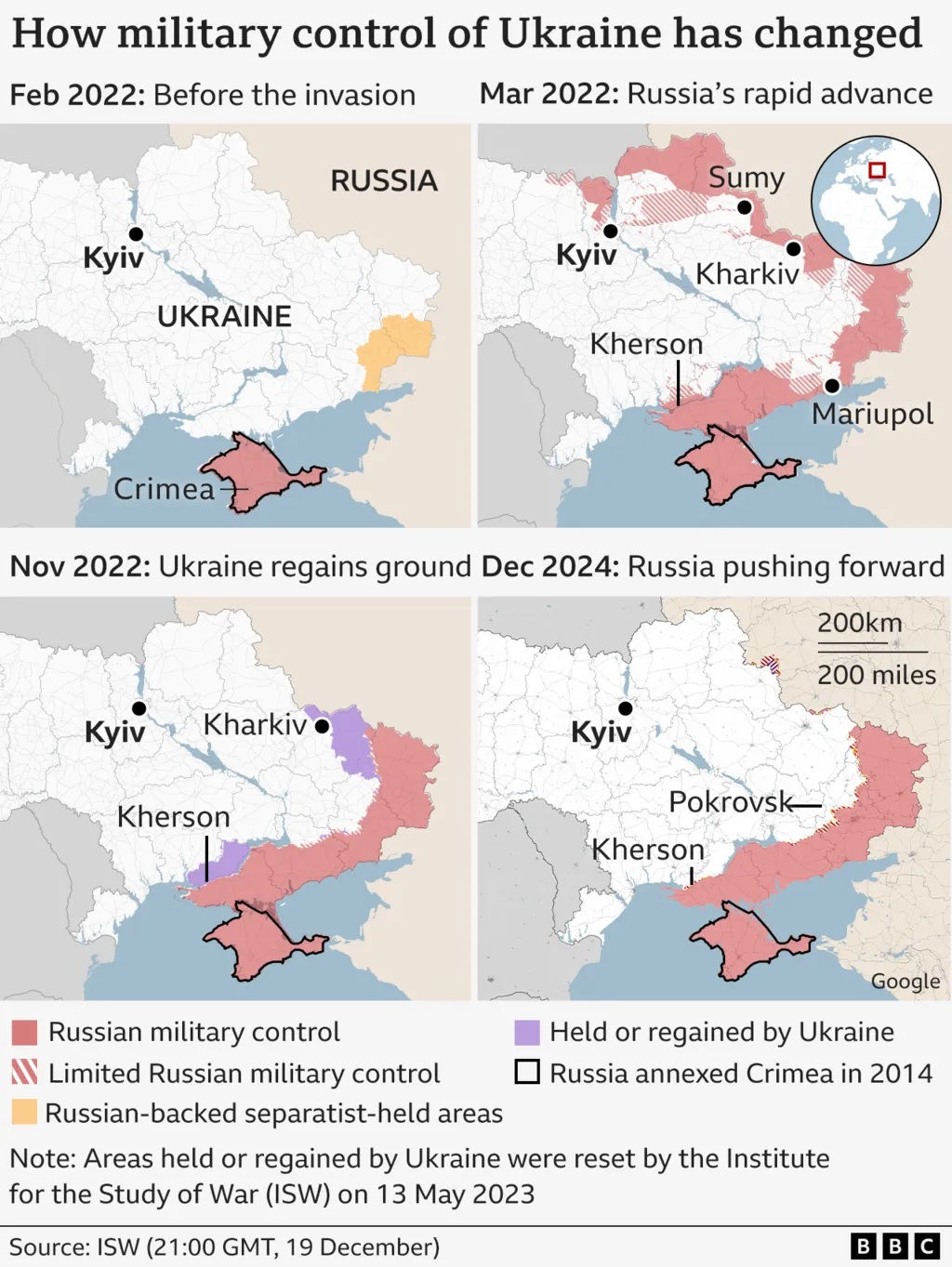
AIMN Editorial, https://theaimn.net/is-it-realistic-for-donald-trump-to-boast-of-a-quick-peace-deal-for-ukraine/ 2 Jan 25
Donald Trump has made so many promises on what he will quickly achieve once he takes office as President. The one about ending the Ukraine war in 24 hours probably gained him support from quite a few normally left-leaning people, who understand that the history of this conflict is far more complicated than is portrayed by the Western media.
However, Trump made that statement in July 2023. By 2025, he has somewhat moderated that particular promise. He has had several conversations with Ukraine’s President Zelensky, . Zelensky praised their Paris meeting on 7 December as “productive and meaningful”, but there were no details discussed. Later, Trump opposed the sending of long-range missiles for Ukraine , but said he would not “abandon” Ukraine. He predicted “less aid” to Ukraine https://www.youtube.com/watch?v=E-R7Gi-uLiY. BY 21st December, it was reported that Trump would continue to supply military aid to Ukraine, provided that NATO members dramatically increase their defence spending.
So, peace in Ukraine is not going to happen in such a hurry, even with President Trump and his supposed great negotiating skills. Britain considers sending troops to Ukraine to train Ukrainian regiments. NATO is not prepared for any compromises, especially about giving up the plan for Ukraine’s NATO membership. With any peace deal, the Western allies agree with Zelensky – “Security guarantees without the US are not sufficient for Ukraine.”
As well as European reluctance to a peace deal, there is the Russian point of view. Despite many set-backs, and a catastrophic loss of soldiers’ lives, Russia is now headed towards winning this war. Why make a deal now, before being in a more powerful position for demanding concessions?
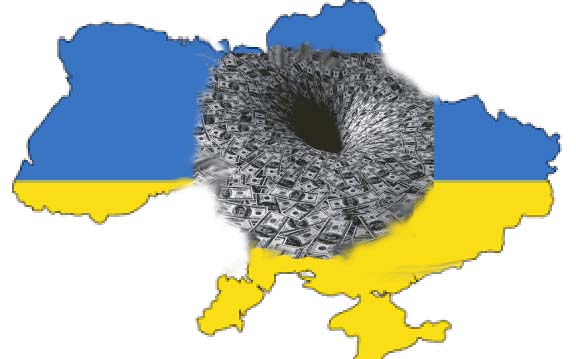
Then we come to the USA. However much Donald Trump might want to end the carnage, and be seen as the peace hero, he is up against significant forces at home – making up what he calls the Deep State. This is a conspiracy theory that helped Trump to gain popularity – and I hate to agree with it, in its rather paranoid theme. BUT, war enthusiasts do exist – among the, military, intelligence, government officials, and wealthy industrialists, and they do exercise influence, and pressure politicians of both parties, to manipulate America’s defense policies. The war in Ukraine continues to be profitable to America’s weapons industries, and at no cost to American lives.
In the whole saga of the war in Ukraine, history has been forgotten. Of course Ukrainian-Russian relations have been tortuous and often terrible. In modern history it goes back to the 1930s, with Stalin’s starvation and genocide of Ukrainians. Then, following oppression from Russia, came in 1941, the short-lived moment of “liberation” by the German Nazis. That brought mass killings of Jews, slave labour, wholesale destruction, and the loss of up to 7 million lives. Russian control over Ukraine returned in 1944, and while the economy was restored, Stalin’s totalitarian rule was back again. In 1991 Ukraine gained independence from Russia.
Is it any wonder that Ukraine, with both Russian and Ukrainian languages still in common use, has been divided in attitudes and loyalties? Going even further back in history, Catherine the Great of Russia, in the 18th Century, made Kiev become Europe’s centre of art and culture, as well as making improvements in health, education, legal rights for Jews, improved conditions for serfs. Sure, she was an absolute monarch, – miles away from being democratic. Now her name and her statues are trashed in Kiev, which is a pity.
From 2014 to 2022, the Ukrainian government waged a war against the separatists in the Eastern, Donbass region. The war was about the 2014-2015 Minsk agreements which meant that the Donbass should have its autonomous government within Ukraine. Volodymyr Zelensky was elected on a platform that he would implement those agreements, but later he reneged on this promise. Russia’s President Putin in 2022 started what he called “a special military exercise” to support the separatists and uphold the Minsk agreement. That turned into the full-scale war against Ukraine.
European and USA support for Ukraine developed into a campaign, at enormous cost, to weaken Russia. The phrase “too big to fail” is used to describe financial crises. But it could apply to the Russia-Ukraine war. From the Western perspective the war is seen as a battle between good and evil – the evil giant Putin against the heroic little Zelensky. With NATO, with most European countries lined up against Russia, it is world democracy to be desperately defended, For Russia, it now is to prevent that last big nation on its border joining that threatening USA-armed line-up.
It was a mistake that Russia started a ‘special military enterprise’ -to evolve into a full-scale war. Some argue that by encouraging Zelensky to reneg on the Minsk agreement, the Western nations provoked the war.
Whatever started the war, the majority of Ukrainians, and especially those in the East, now just want it to end. The prevailing cry of Western leaders – “Putin must fail, Ukraine must prevail” expresses that simplistic view of good versus evil, and just ignores the complicated historic and local concerns of Eastern Ukraine. Diplomacy is jettisoned. As one writer puts it – voices calling for pragmatism and peace remain drowned out by the cacophony of war rhetoric.
Ultimately , every war ends in some sort of a diplomatic outcome. It is doubtful that Trump can make this one end quickly. It might be just one of the promises that he has to give up.
No change in Iran’s nuclear doctrine, top security official says
December 31, 2024 , https://www.tehrantimes.com/news/508118/No-change-in-Iran-s-nuclear-doctrine-top-security-official-says
TEHRAN – Iran’s top security official said on Monday that contrary to what is claimed by foreign media outlets there has been no change in Iran’s nuclear doctrine.
Ali Akbar Ahmadian, secretary of Iran’s Supreme National Security Council, made the remarks in a meeting with Omani Foreign Minister Said Badr al-Busaidi who visited Tehran on Monday
“… based on the views of the Leader of the Islamic Revolution there has been no change in the nuclear doctrine of the Islamic Republic of Iran,” Ahmadian asserted.
In response to a clarification by the Omani foreign minister about Iran’s nuclear activities as well as “remarks and rumors” that Iran has increased its stockpile of uranium or is enriching uranium to a higher level, Ahmadian said these are “baseless”.
“The Islamic Republic of Iran is still committed to the framework of the Muscat agreements and the ball is on the other side’s court to honor its commitments” based on the 2015 nuclear agreement, Ahmadian explained.
Under the 2015 nuclear agreement, officially known as the Joint Comprehensive Plan of Action (JCPOA), Iran agreed to put limits on its nuclear activities in exchange for termination of economic and financial sanctions.
The agreement was signed in 2015 between Iran and the 5+1 group, the five permanent members of the UN Security Council and Germany. However, the U.S. quit the agreement in 2018 and the remaining parties, including Britain, France and Germany (European trio), failed to observe their commitments.
Earthquake-prone Indonesia considers nuclear power plan as 29 possible plant sites revealed
ABC News, By Natasya Salim, Tri Ardhya and Sally Brooks, 28 Dec 24
In short:
Indonesia’s energy council has proposed 29 sites for nuclear power plants in a bid to secure reliable energy sources and reduce carbon emissions.
Environmental groups say the plan is “dangerous”, partly because the country is prone to earthquakes.
What’s next?
The energy council is searching for foreign investors to back the plan.
…………………………………………………………………………………………………………………….. The new detail on plant site locations has renewed safety concerns among environmental advocates in part because Indonesia is prone to natural disasters.
The archipelago mostly sits along the Pacific Ring of Fire where tectonic plates frequently collide and cause earthquakes and other disasters.
Twenty years ago, a magnitude-9.1 earthquake struck off the coast of Indonesia’s Aceh province and triggered the 2004 Boxing Day tsunami, that killed some 230,000 people across Indonesia, Sri Lanka, India, Thailand, and nine other countries.
Hendrikus Adam, from environmental not-for-profit organisation WALHI, said authorities needed to learn from past nuclear power disasters, including those caused by earthquakes and tsunamis like the Fukushima accident in Japan in 2011.
“We think nuclear plants are risky, dangerous and harmful for humans and the environment,” said Mr Adam.
“The development of a nuclear plant itself is also very expensive and hazardous.”
……………………………………………. Last month, National Development Planning Deputy Minister Vivi Yulaswati said Indonesia was in talks with the US and Russia about acquiring technology to develop nuclear power plants.
Separately, Indonesia’s state-owned electricity firm PLN has reportedly signed agreements with companies in the US and Japan to build small modular reactors, Coordinating Economic Minister Airlangga Hartarto said earlier this month……….
Details of the agreements are scarce and PLN declined to comment for this story………….
Currently none are in commercial operation in any Organisation for Economic Co-operation and Development (OECD) country….. https://www.abc.net.au/news/2024-12-27/earthquake-prone-indonesia-plans-for-nuclear-power/104758008
1 This Month

of the week – STOP SMALL MODULAR REACTORS IN CANADA
To see nuclear-related stories in greater depth and intensity – go to https://nuclearinformation.wordpress.com
-
Archives
- February 2026 (250)
- January 2026 (308)
- December 2025 (358)
- November 2025 (359)
- October 2025 (376)
- September 2025 (258)
- August 2025 (319)
- July 2025 (230)
- June 2025 (348)
- May 2025 (261)
- April 2025 (305)
- March 2025 (319)
-
Categories
- 1
- 1 NUCLEAR ISSUES
- business and costs
- climate change
- culture and arts
- ENERGY
- environment
- health
- history
- indigenous issues
- Legal
- marketing of nuclear
- media
- opposition to nuclear
- PERSONAL STORIES
- politics
- politics international
- Religion and ethics
- safety
- secrets,lies and civil liberties
- spinbuster
- technology
- Uranium
- wastes
- weapons and war
- Women
- 2 WORLD
- ACTION
- AFRICA
- Atrocities
- AUSTRALIA
- Christina's notes
- Christina's themes
- culture and arts
- Events
- Fuk 2022
- Fuk 2023
- Fukushima 2017
- Fukushima 2018
- fukushima 2019
- Fukushima 2020
- Fukushima 2021
- general
- global warming
- Humour (God we need it)
- Nuclear
- RARE EARTHS
- Reference
- resources – print
- Resources -audiovicual
- Weekly Newsletter
- World
- World Nuclear
- YouTube
-
RSS
Entries RSS
Comments RSS
 nuclear-news