Anas Sarwar U-turns on Scottish Labour nuclear weapons policy
SCOTTISH Labour are facing calls to clarify their stance on the UK’s
nuclear weapons after Anas Sarwar appeared to pull a unilateral U-turn at
First Minister’s Questions. Speaking at Holyrood on Thursday, the Labour
group leader called for First Minister John Swinney and the SNP to reverse
their stance on Trident – the UK’s nuclear weapons system which is
housed on the Clyde.
The SNP oppose nuclear weapons and oppose renewing
Trident, want to see the system removed from Scotland, and support an
international treaty banning the bomb.
Previously, Scottish Labour’s
membership passed a motion opposing the renewal of Trident – and in 2021
Sarwar backed it despite Keir Starmer’s support for the policy. Sarwar
has now suggested that he supports the UK’s nuclear weapons being
renewed. Speaking at FMQs, the Scottish Labour leader said: “Global
events are reshaping the world before our eyes. This is a generation
defining moment, and all political parties and both of Scotland’s
governments must adjust to this new reality and rethink previous red
lines.”
The National 13th March 2025, https://www.thenational.scot/news/25005720.anas-sarwar-seems-u-turn-scottish-labour-nuclear-weapons-policy/
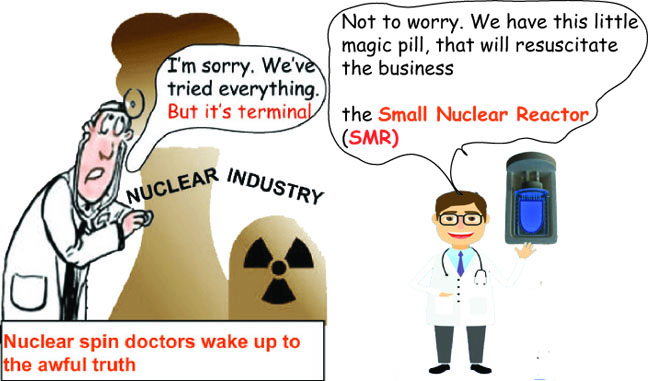
Great British Nuclear explains how it will mitigate risks to SMR programme.
13 Mar, 2025 By Tom Pashby
Great British Nuclear (GBN) has explained how it plans to overcome the key risks to the small modular reactor (SMR) programme is it running and that it plans to establish of SMR development companies (DevCos) to take the projects forward.
The updates were shared in its inaugural 2024 Annual
report and accounts for the 2023/2024 financial year.
It is assumed that GBN will select two vendors to deliver one SMR each, but this was recently
called into question by sources speaking to the Telegraph who said the
chancellor may cut spending at GBN as part of the Spending Review which is
due on 11 June 2025. GBN chief executive officer Gwen Parry-Jones said:
“The UK’s nuclear sector has had some well-documented challenges, ones
that GBN has been set up to navigate.” She did not spell out the
challenges.
“SMRs have not yet been deployed anywhere at scale and their
first-of-a-kind (FOAK) nature presents unique considerations and complex
challenges for us to overcome.” She reassured, however, that she is
“committed to ensure that GBN is an adaptable and resilient organisation
that is flexible and evolves as conditions change, but with our eyes always
firmly fixed on the future to deliver our long-term mission and value for
the UK”.
The report lays out the “principal risks” which GBN believes
the SMR programme faces, along with “key mitigation measures”. The
risks are centred around technology maturity, the ambitious programme
timeline, resourcing, funding and financing, stakeholder alignment,
‘contractual and procurement complexity’, site readiness and cyber
threat.
On technology maturity, it said: “Due to the first of a kind
(FOAK) nature of the technology, providers may not be able to meet
strategic objectives, including timely delivery, value for money and
obtaining regulatory approval. “This may delay approval timelines, affect
project milestones or cause an SMR project to fail.” It says that the SMR
competition that it is running will assess the technologies and mitigate
this risk. However, it also reveals that it will retain the option of, in
addition to the SMR competition winners, selecting a “reserve contractor,
to provide contingency against one provider failing to meet agreed
standards”.
GBN lists four other mitigations, including stating it could
or would provide “predetermined exit points” from projects “should a
project exceed cost estimates or timelines stretch beyond acceptable
parameters”. Regarding risk relating to “funding and financing”, it
says: “GBN’s available funding may be insufficient to resource and
deliver the programme to the planned timetable, e.g. should a change arise
from any change in government policy or in its budgetary priorities.
“A reduction in funding could also be triggered by market conditions or
external events such as an external nuclear event affecting public
sentiment towards nuclear safety.
New Civil Engineer 13th March 2025, https://www.newcivilengineer.com/latest/great-british-nuclear-explains-how-it-will-mitigate-risks-to-smr-programme-13-03-2025/
Eight Reasons Why Nuclear Power is Not the Answer for Hawaii

by Sherry Pollack, 14 Mar 25
Nuclear power isn’t “zero emission.” The nuclear industry has conducted a propaganda campaign rife with factually inaccurate information, including that nuclear power is “carbon-free electricity.” However, this could not be further from the truth. To be clear, there is no such thing as a zero- or close-to-zero emission nuclear reactor. Even existing reactors emit due to the continuous mining and refining of uranium needed for the reactor.
Transporting nuclear fuel is a hazard. As an isolated island chain, Hawaii faces unique and significant risks in transporting nuclear fuel over vast ocean distances. Any accidents during transport, be it from bringing fuel here or shipping waste back, could have catastrophic consequences for Hawaii’s pristine marine environment and tourism-dependent economy.
Nuclear waste. The waste generated by nuclear reactors remains radioactive for thousands of years and needs to be kept contained throughout that time. Currently, there are no long-term storage solutions for radioactive waste, and most is stored in temporary, above-ground facilities.
Hawaii’s geological instability, including frequent earthquakes, volcanic activity, and tsunami risks, makes it an unsafe location for storing nuclear waste. There are no viable long-term solutions for safely containing radioactive materials in such a volatile environment.
Accidents. Human error and natural disasters can lead to dangerous and immensely costly accidents. Think Red Hill but multiply that exponentially. Direct costs would include cleanup operations, property damage, and evacuation efforts, as well as significant indirect costs including long-term health consequences, economic disruption due to lost productivity and tourism, and severe psychological impacts on affected populations, often lasting for generations. According to the Nuclear Regulatory Commission (NRC), the emergency planning zone around a nuclear power plant typically extends to a 10-mile radius for immediate radiation exposure concerns, while a broader “ingestion pathway” zone reaches out to a 50-mile radius where food and water contamination could occur in the event of an incident. This would make safely siting a power plant, particularly on Oahu, impossible.
Impacts on Local Communities and Ecosystems. In addition to the significant risk of cancer associated with fallout from nuclear disasters, studies also show increased risk for those who reside near a nuclear power plant, especially for childhood cancers such as leukemia. Workers in the nuclear industry are also exposed to higher-than-normal levels of radiation, and as a result are at a higher risk of death from cancer.
Nuclear energy is too expensive. To protect the climate, we must reduce the most carbon at the least cost and in the least time. Nuclear power does none of this. A report by the Institute for Energy Economics and Financial Analysis found that even small modular reactors (SMRs) are expensive, too slow to build, and too risky to play a significant role in transitioning from fossil fuels in the coming 10-15 years.
Integral Fast Reactors, Pebble Bed Modular Reactors, Thorium Fueled Reactors, Molten Salt Reactors, and Small Modular Reactors (SMRs) are not viable. Nuclear power advocates promote small modular nuclear reactors (SMRs) and other “advanced” nuclear technologies as the only real solution for the climate crisis. However, proponents of SMRs and these other so called “new” types of reactors fail to address their unproven nature, unresolved safety risks, and economic inefficiency. Moreover, SMRs cannot be counted on to provide ‘firm’ power as has been touted. Just like today’s nuclear plants, SMRs will be vulnerable to extreme weather events or other disasters that could cause a loss of offsite power and force them to shut down. Additionally, the push for SMRs often serves the private interests of billionaires looking to power AI data centers rather than benefiting the people of Hawaii. Bottom line, SMRs are wishful thinking rooted in misinformation.
Nuclear power is an expensive distraction undermining our ability to achieve our clean energy goals. Investment in nuclear power, including SMRs, will take resources away from carbon-free and lower-cost renewable technologies that are available today and can push the transition from fossil fuels forward significantly in the coming decade. Hawaii is already on the path to achieving 100% renewable energy by 2045. Nuclear power is not renewable, requires costly infrastructure, and pursuing it would divert attention and resources from proven, sustainable solutions like solar, and wind.
Nuclear power has NO place in Hawaii’s clean energy future. Nuclear power is too dirty, too dangerous, and too expensive. It is environmentally harmful and produces waste that will be a burden on future generations. Accordingly, we urge the legislature to commit to uphold Hawaii’s constitution, a sustainable future, prioritize investing our resources in a clean renewable energy future, and honor the voices of its people by opposing the use of nuclear power in Hawaii.
Alarmed by Trump, South Korea mulls Japan-style nuclear option
Prominent voices seek capacity to reprocess spent nuclear fuel or enrich uranium and be able potentially to make bombs.
ASIA TIMES, by Daniel SneiderMarch 15, 2025
……………………………………………………………………………………………………………………………………………… The most striking evidence of South Korean alarm over the treatment of allies is the widening discussion of the need to have an independent nuclear arms capability. Conservatives have long advocated that option, but the debate has now moved into progressive circles where prominent voices are calling for South Korea to develop nuclear latency – the capacity to reprocess spent nuclear fuel or enrich uranium to be able to potentially possess fissile material for making bombs.
The Japanese model?
For now, South Korea hopes it can follow the path set by Japanese Prime Minister Shigeru Ishiba and offer Trump concessions ranging from trade, supply chain investment, and cooperation on shipbuilding to promoting South Korea’s role as an asset in a confrontation against China.
At the moment, South Korea does not have an effective government, pending the imminent decision of the Constitutional Court on the impeachment of South Korean President Yoon Suk Yeol. But whatever follows, the South Korean president will have to deal with Trump.
Assemblyman Wi believes the best they can hope for is a smooth and non-confrontational meeting modeled on that of Ishiba, which yielded a joint statement that reaffirmed the US-Japan alliance along the lines of previous statements with the Joe Biden administration.
………………………………………………………………………………….. I think President Trump thinks North Korea is unfinished business left over from the first Trump administration. We have to prepare for the worst.”
Nuclear latency
“The worst” includes the withdrawal of United States Forces Korea (USFK) from South Korea and a withholding of the US nuclear umbrella.
Regardless of how important the U.S.-ROK alliance is now, “there may come a time when it is difficult to rely on the US for our security,” former Minister of Foreign Affairs Yoon Young-kwan wrote in an op-ed published this month. “In preparation for that time, we should strengthen our national defense capabilities, including potential nuclear capabilities, and prepare to handle the deterrence of North Korea with our own strength.”
Progressives are more reticent to endorse nuclear weapons outright, but some have thrown their weight behind nuclear latency – a conscious imitation of the model pursued by Japan to have a full fuel cycle capability. South Korea could, theoretically, reprocess the spent fuel from its power reactors to extract bomb-grade plutonium or, alternatively, have the capacity to enrich uranium, potentially up to bomb-grade levels.
South Korea has long sought to revise the so-called 123 agreement for nuclear cooperation with the United States, which has restricted its ability to have a full fuel cycle. The agreement was only recently reaffirmed, in January at the close of the Biden administration.
In an important column published on March 4 in the progressive newspaper Kyunghyang Shinmun, former Minister of Unification Lee Jong-seok, another close advisor to presidential aspirant Lee Jae-myung, argued that nuclear latency can be achieved within the framework of the Nuclear Non-Proliferation Treaty and with the consent of the United States.
“China, Russia and North Korea, our neighboring countries, are nuclear weapon states, and Japan has already demonstrated its potential,” Lee wrote. “In this situation, it is rather unnatural that South Korea, a nuclear power, cannot reprocess or enrich uranium due to the restrictions of the Korea-US Nuclear Energy Agreement.”
Others in Seoul advocate defecting from the 123 agreement if the United States reduces USFK forces on the peninsula, says Kim Joon-hyung, a Rebuilding Korea Party lawmaker and former senior diplomat.
Kim is a critic of the U.S. alliance but is personally opposed to nuclear latency. “I don’t agree with nuclear proliferation,” he said. “Even if we have nuclear weapons, I don’t think we have security. Small conflicts may become more common. The Korean Peninsula is too small – high tech conventional weapons are enough. Japan will go nuclear and relations with China and Russia will worsen.”
Others are concerned about the isolation that South Korea could experience if it goes down this road. Cho Hyun, a former senior diplomat and progressive foreign policy advisor, helped negotiate the 123 agreement during the Bill Clinton administration. “The right wing thinks we should have our own nuclear development,” Cho told me in Seoul. “We don’t think it is realistic. Some progressives want to request the US for full fuel cycle like Japan. I am against this.”
As the nuclear latency argument rapidly gains support among progressive circles, revising the 123 agreement may become a bargaining chip for South Korea in negotiations with the Trump administration.
At least some inside the administration, though likely not Trump-appointed officials, have become aware of this, prompting media reports that the U.S. Department of Energy is considering labeling South Korea a “sensitive country,” a designation for countries who might be considering going nuclear.
For South Korea, this may only be the start of many shocks to come.
Daniel C. Sneider is a non-resident distinguished fellow at the Korea Economic Institute of America and a lecturer in East Asian studies at Stanford University. https://asiatimes.com/2025/03/alarmed-by-trump-south-korea-mulls-japan-style-nuclear-latency/#
More Guns, Less Butter: Starmer’s Defence Spending Splash

To pursue such rearmament, Starmer has decided to take the axe to the aid budget,
March 8, 2025 Dr Binoy Kampmark, https://theaimn.net/more-guns-less-butter-starmers-defence-spending-splash/
The urge to throw more money at defence budgets across a number of countries has become infectious. It was bound to happen with Donald Trump’s return to the White House, given his previous insistence that US allies do more to fatten their own armies rather than rely on the largesse of Washington’s power. Spend, spend, spend is the theme, and the UK Prime Minister Keir Starmer has shown himself willing to join this wasteful indulgence.
On February 25, just prior to his visit to Washington, Starmer announced that spending on defence would reach 2.5% of GDP from April 2027. In the next parliament, it would rise to 3%. “In recent years,” states a UK government press release, “the world has been reshaped by global instability, including Russian aggression in Ukraine, increasing threats from malign actors, rapid technological change, and the accelerating impacts of climate change.”
Almost predictably, the term “Cold War” makes its retro appearance, with the spending increase the largest since that conflict of wilful misunderstandings and calculated paranoia. Russia figures prominently, as do “malign actors” who have burdened “the working people of Britain” with “increased energy bills, or threats to British interests and values.”
The governing Labour Party has also gone a bit gung-ho with the military–industrial establishment. In an open letter reported by the Financial Times, over 100 Labour MPs and peers thought it wise that ethical rules restricting investment by banks and investment firms in defence companies be relaxed. Financial institutions, the letter argues, should “rethink ESG [environmental, social and governance] mechanisms that often wrongly exclude all defence investment.” It was also important to address the issue of those “unnecessary barriers” defence firms face when “doing business in the UK.” Among such barriers are those irritating matters such as money laundering checks banks are obliged to conduct when considering the finance needs of defence and security firms, along with seeking assurances that they are not financing weapons banned under international law.
That these uncontroversial rules are now being seen as needless barriers to an industry that persists in shirking accountability is a sign of creeping moral flabbiness. Across Europe, the defence and arms lobbyists, those great exploiters of fictional insecurity, are feeling more confident than they have in years. They can rely on such figures as European Commission President, Ursula von der Leyen, who stated on March 4 that, “We are in an era of rearmament. And Europe is ready to massively boost its defence spending.”
To pursue such rearmament, Starmer has decided to take the axe to the aid budget, reducing it from its current level of 0.5% of gross national income to 0.3% in 2027. It was, as the press release goes on to mention, a “difficult choice” and part of “the evolving nature of the threat and the strategic shift required to meet it.” The Conservatives approved the measure, and the populist Reform UK would have little reason to object, seeing it had been its policy suggestion at the last election.
It was a decision that sufficiently troubled the international development minister, Anneliese Dodds, to quit the cabinet. In a letter to the prime minister, Dodds remarked that, while Starmer wished “to continue support for Gaza, Sudan and Ukraine; for vaccination; for climate; and for rules-based systems,” doing so would “be impossible … given the depth of the cut.”
Making the Office of Overseas Development Assistance absorb such a reduction would also see Britain “pull-out from numerous African, Caribbean and Western Balkan nations – at a time when Russia has been aggressively increasing its global presence.” It would be isolated from various multilateral bodies, see “a withdrawal from regional banks and a reduced commitment to the World Bank.” Influence would also be lost at such international fora as the G7 and G20.
Defence establishment figures have also regarded the decision to reduce aid with some consternation. General Lord Richards, former Chief of Defence Staff, saw the sense of an increase in military spending but not at the expense of the aid budget. “The notion that we must weaken one to strengthen the other is not just misleading but dangerous,” opined Richards in The Telegraph. “A lack of investment and development will only fuel greater instability, increase security threats and place a heavier burden on our Armed Forces.”The aid budgets of wealthy states should never be seen as benevolent projects. Behind the charitable endeavour is a calculation that speaks more to power (euphemised as “soft”) than kindness. Aid keeps the natives of other countries clothed, fed and sufficiently sustained not to want to stray to other contenders. The sentiment was expressed all too clearly by a disappointed Dodds: a smaller UK aid budget would embolden an already daring Russia to fill the vacuum. How fascinating, then, that a daring Russia, its threatening posture inflated and exaggerated, is one of the primary reasons prompting an increase in Britain’s defence spending in the first place.
Canada Unveils $490-Million Push Towards Nuclear Energy

Energy
10 Mar 25,
A massive push towards nuclear in Canada is set after several investments have been announced by Minister of Energy and Natural Resources Jonathan Wilkinson. Wilkinson is pushing what the government describes as “crucial steps towards clean, affordable, and homegrown nuclear technology.”
Central to Canada’s nuclear revival is a $304 million joint investment with engineering firm AtkinsRéalis to advance the next generation of Canada’s signature CANDU reactor. The initiative aims to refine the standard design of this Canadian-developed reactor technology.
Also key to Canada’s nuclear expansion involves small modular reactors, which provide scalable and versatile solutions for regional power needs. Ontario Power Generation received $55 million through the Future Electricity Fund to develop pre-construction activities for three SMRs at its Darlington facility.
Saskatchewan also received a substantial $80 million investment for SMR predevelopment. Managed by SaskPower through Saskatchewan’s Crown Investments Corporation, the project will focus on technical, regulatory, and community engagement tasks.
In Alberta, Capital Power Limited Partnership secured $13 million to evaluate potential SMR locations in the province, alongside a notable $8.3 million investment in the Peace Region for preliminary work on a large-scale nuclear facility with a potential capacity of 4,800 MW.
Western University in London, Ontario, received nearly $5 million to study advanced nuclear fuels, specifically the TRi-structural ISOtropic or TRISO fuel type. Canadian Nuclear Laboratories, situated in Chalk River, Ontario, was awarded over $3.5 million to establish new standards and strategies for SMR deployment across Canada, aiming to optimize waste management.
Additionally, the Saskatchewan Industrial and Mining Suppliers Association received approximately $2.8 million to assess and enhance the province’s nuclear supply chain readiness, explicitly incorporating Indigenous businesses.
Complementary to nuclear advancements, the Alberta Electric System Operator secured $18.5 million to develop IT infrastructure capable of managing increased complexity arising from clean electricity generation. Alberta is also investing $1.3 million in the Tent Mountain Pumped Hydro Energy Storage Project near Coleman for advancing integrated clean energy storage solutions alongside nuclear development.
How the Media Walked us into Autocracy (w/ Ralph Nader) | The Chris Hedges Report
They’re abusing them for the profits they want to make from advertising, which of course begins to replace journalists and editors who want to do the right thing with journalists and editors who got their finger to the wind and are worried about the money before reporting the truth in an equitable fashion. It even gets worse. The Times created Trump. They kept giving him more and more publicity. They created JD Vance. Whoever heard of JD Vance? They kept writing about his book.
By Chris Hedges / The Chris Hedges Report, 9 Mar 25
This interview is also available on podcast platforms and Rumble.
The American corporate coup d’état is almost complete as the first weeks of the Trump administration exemplify. If there has been one person who saw this coming, and has taken courageous action over the years to prevent it, it would be Ralph Nader. The former presidential candidate, consumer advocate and corporate critic joins host Chris Hedges on this episode of The Chris Hedges Report to chronicle his life’s work battling the corporate takeover of the country and how Americans can still fight back today despite the growing repression from the White House.
“The sign of a decaying democracy is that when the forces of plutocracy, oligarchy, multinational corporations increase their power, in all sectors of our society, the resistance gets weaker,” Nader tells Hedges.
Nader asks people to look around them and witness the decay through the ordinary parts of their lives. “If you just look at the countervailing forces that hold up a society—civilized norms, due process of law and democratic traditions—they’re all either AWOL [absent without official leave] or collapsing,” he said. Civic groups are outnumbered by corporate lobbyists, the media barely pays attention to any grassroots organizing and the protests that do occur, such as the encampments at universities, are brutally suppressed.
It’s not an impossible task, Nader says, recalling the precedent of organizing in the U.S. He says the fundamental basics are supported by a majority of people regardless of their political labels.
Chris Hedges
The New York Times published a lead column on January 18th, 2025, titled, “Are We Sleepwalking Into Autocracy?” The columnist’s answer is yes, unless, and I quote, “defenders of democracy have to stay united, focusing on ensuring that checks and balances remain intact and that crucial democratic watchdog institutions elude capture.” What is absent from the Times article is the complicity of the media, and especially the New York Times, in shutting down coverage of the fight by unions, grassroots movements, whistleblowers, and civic organizations, often led by the consumer advocate and former presidential candidate Ralph Nader, to placate their advertisers. This decision, made by newspapers such as the New York Times four decades ago, essentially erased these popular initiatives from public consciousness.
This erasure—done to placate wealthy corporations and oligarchs and boost revenue—bolstered the power of corporations and the government to dominate and shape public discourse and in the process saw them become ever more secretive and ever more autocratic. As Ralph Nader notes, the regular reporting about what activists were doing in the 1960s and 1970s made possible the consumer, environmental, labor, and freedom of information laws. Similar efforts now cannot gather momentum with media invisibility. Legislative hearings, prosecutions, and regulatory actions cannot get jump-started just by the people insistent on a just and democratic society. How often do you see op-eds from civic labor advocates, Ralph asks. How often do you read reviews of their books? How often do you see profiles of them?
How often have the groundbreaking studies by Public Citizen, Common Cause, Center for Science in the Public Interest, Veterans for Peace, Union of Concerned Scientists, etc. received coverage? This erasure stands in stark contrast to the coverage given over to those on the far right and corporations. Figures like Donald Trump, Marjorie Taylor Greene, and Elon Musk get plenty of press. The media landscape is siloed. Media outlets, both the legacy media and the digital media, cater to well-defined demographics. But the power of the legacy media, should it decide to use its power, is to help set the agenda through its reporting. Most digital sites feed off of the reporting of the establishment media spinning it left or right. And what it does not cover often does not get covered. Legions of reporters, 500 full-time reporters cover the Congress, hundreds more sit at the feet of the titans of commerce and Wall Street, spit back to the public official communiques, and fawning interviews with the powerful, the famous, and the rich. Unless they are deployed outside the halls of Congress and the centers of power, what is left of our democracy, and not much of it is left, will wither and die.
Joining me to discuss our march towards tyranny, the complicity of institutions such as the media and the liberal class, including the Democratic Party, and what we must do to wrest back power is Ralph Nader, who has been fighting corporate power longer more effectively and with more integrity than any other American. Ralph, let’s go back to where we were because where we are now is a reaction to what you, you were at the epicenter of it, built. We can begin with your groundbreaking book, “Unsafe at Any Speed,” which should be taught in every journalism school. It is a masterful piece of investigative reporting. But let’s go back to what we had and then how they organized to take it away.

Ralph Nader
Yeah, thank you, Chris. It’s very well documented, the whole history of it. When I wrote the book, “Unsafe at Any Speed,” a reporter for Science Magazine picked it up and then the New York Times picked it up off of Science Magazine and it made page one. And so that was a good start.
Chris Hedges
Ralph, just want to interrupt for people who don’t know, these were cars made by GM that were not safe…………………………………………………………………………………………………………………………………….
Chris Hedges
Let me just stop you because Ralph, let’s not bypass the fact that GM mounted a pretty intense and dirty campaign against you.
Ralph Nader
Yes, they hired a private detective with several former FBI people. That’s what happened to a lot of FBI agents when they retired, they go to work for these large corporations to follow me around the country, try to get dirt on me, to discredit my testimony before Congress. ……………………………………………………………………………………………………………………………………
……………………………………………………………………………………….. Ralph Nader
Yes, and at the same time the companies hired a firm called Wilmer, Cutler and Pickering and Lloyd Cutler would go and have meetings with editors of the New York Times and Post and saying, what are you guys doing giving this guy so much print? Don’t you know he’s bad for business? And the inference was that they were going to lose advertising if they didn’t shut us out. Once the Times started scaling down, then the Washington Post took note because they were of the same mindset and both of them were about to go public and sell stock on the stock exchange, which gave them even more vulnerability to suppression. And then that dried up more and more of the evening news. We used to get on the network news.
It’s almost impossible to get on the network evening news now. And the same with radio. At the same time, there emerged public radio and public broadcasting, and they were scared from the get-go that the companies would go after their funding on Capitol Hill and crimp their style. And so they covered us very little as well.
……………………………………………………….the cycle starts again against the whole set of new injustices. But all these forces I’ve just mentioned started shutting us down. We were saved for a short period by the Jimmy Carter administration. He appointed very good people to the regulatory agencies, the auto safety agency, the job safety agency, the EPA, and so on. But that was just a four-year reprieve and they were still counter-attacking. More lobbyists, more political action committees, more indignant calls to reporters and editors and publishers to shut us down. So, you know, that was their golden age, the mass media, what we call now the corporate media. And it’s completely changed now. And I say to reporters or editors, or publishers that I can manage to reach. It’s not easy. What are you ashamed of your golden age for? Look what you did for the country, just exercising your duty and professional responsibilities for newsworthiness. And now you don’t do it.
………………………………………………………………………………………………………………………………………………………………………………………………………………………….. we’re paying the price now in wars of empire, in the domination of corporate supremacists over everything.
They’re raising our children with that iPhone five, seven hours a day, undermining parental authority, separating these children from family, community, nature, harming their health with junk food and sedentary living, with very little kids playing outside anymore. There isn’t anything that corporate commercialism now has not invaded. They’ve commercialized the churches. They’ve commercialized the academic world. They’ve commercialized almost everything outside the marketplace they see as a profit center. So they want to corporatize the post office. They want to take over public drinking water departments and corporatize them. They want to corporatize the public school system. One way or another, they want to corporatize the public lands or take the public lands. And they’ve never been more aggressive, never been more successful. And the civic community, which used to be relied on to resist, can’t get any media. And we have tried. Last year, we made a major effort to turn Labor Day into a real workers day with events all over the country. We got the unions behind us……………………………………………………………….
………………………………………………………….. . So basically when you shut out the civic community, Chris, you shut down democracy. And I placed the responsibility not just on the Democratic Party, but first and foremost on the mass media.
…………………………………………… the independent press is not such a hot shot either. The magazines like In These Times, Washington Monthly, Progressive Magazine, The Nation, they don’t cover civic community activities. They just pontificate. They do have some good articles, and they have their columnists, many of whom are getting very tired and repetitive. They don’t cover what Public Citizen, Common Cause, Pension Rights Center, Center for Science in the Public Interest, Union of Concerned Scientists, Veterans for Peace especially gets completely blacked out regardless of their demonstrations and non-violent civil disobedience all over the country against the military machine, the empire, the weaponization of the genocide in Gaza. They haven’t had a single article, they had to put out all kinds of great material people go to veteransforpeace.org and see for yourself.
These are veterans who’ve known wars and they can’t even get any coverage. And you can’t get any coverage of the lack of coverage. You can’t get the journalism publications to do any coverage of the censorship. So this is the ultimate censorship, the shutdown of the First Amendment. When the press, which is given a cachet in the First Amendment, there’s no other industry mentioned by name in the Constitution, are abusing their privileges for a mess of prodigies.
They’re abusing them for the profits they want to make from advertising, which of course begins to replace journalists and editors who want to do the right thing with journalists and editors who got their finger to the wind and are worried about the money before reporting the truth in an equitable fashion. It even gets worse. The Times created Trump. They kept giving him more and more publicity. They created JD Vance. Whoever heard of JD Vance? They kept writing about his book. They kept writing about his Senate race more than the opponent, Tim Ryan, and the US Senate race in Ohio………………………………………………………………………….
…………………………………………………………………………………………………………………………………………………………… Ralph Nader
In a broader sense, all it comes down to are two things. Trump will self-destruct because he knows no boundaries. So his greatest enemy is Trump. And you will see the unraveling of Trump in the succeeding weeks. I would not be surprised that if he continues his bull in the China shop, illegal, wild, flailing, affecting tens of millions of people in terms of their dire necessities of life in favor of his corporate supremacist, that he will be impeached and convicted in the U.S. Senate. His own party will turn against him because when they see the polls, which are already dropping since January 20th, by the way, when they see the polls and they realize it’s either them or Trump, they will always take their own political survival.
………………………………………………………………………………………………………………………. more https://scheerpost.com/2025/03/08/how-the-media-walked-us-into-autocracy-w-ralph-nader-the-chris-hedges-report/
Changing nuclear policy would make ‘SNP as bad as Tories’, MSP warns
By Xander Elliards Content Editor, 9th March
CHANGING the SNP’s policy on nuclear weapons would be a “panic measure” demonstrating the same lack of principles as the Tories or Labour, an MSP has warned.
Bill Kidd, who is also co-president of the
global group Parliamentarians for Nuclear Non-Proliferation and
Disarmament, issued a warning to his party after its long-standing policy
on nuclear weapons came under fire on multiple fronts – including from
within.
As the fear of Russia rises in Europe, Labour have chosen nuclear
weapons as an issue on which to attack the SNP. Just this week, Prime
Minister Keir Starmer took aim at the party’s stance on nuclear weapons
in the Commons – followed by Labour MP Joani Reid and Scottish Secretary
Ian Murray doing the same two days later. Then, Ian Blackford, the SNP’s
former Westminster leader, joined the calls for the SNP to change tack on
nuclear weaponry – saying the party should support multilateral
disarmament instead of unilateral disarmament.
The question being asked is
simple: will the SNP stick with their support for the removal of nuclear
weapons from Scotland on day one of independence? Or, will they change tack
and say nukes can stay on the Clyde indefinitely (which, in practice, is
what waiting for multilateral disarmament means)?
For Kidd, who spoke to
the Sunday National from a UN summit on the Treaty on the Prohibition of
Nuclear Weapons (TPNW), the answer is clear. “There may be increasing
pressure from the UK, from the UK political parties – and in fact I
expect that there will be – but that is another example of why the SNP
should stand firmly as an anti-nuclear [party],” he said.
The National 9th March 2025, https://www.thenational.scot/news/24992541.changing-nuclear-policy-make-snp-bad-tories-msp-warns/
Does the Deep State really exist, and if so, is it being dismantled?
March 9, 2025, https://theaimn.net/does-the-deep-state-really-exist-and-if-so-is-it-being-dismantled/ .
What is the Deep State? Does it really exist?
These questions are hard to answer. I had heard the term Deep State over many years, and I connected it with all sorts of conspiracies – not just about U.S. politics and intelligence systems, but with wild ideas about satanism, reptilian shapeshifters, the antichrist, child-trafficking, blood harvesting – and all connected with extreme right-wing and pro- Trump propaganda. So I just dismissed and ignored them – there was no such thing as the Deep State !
It is not that simple.
Indeed, it is very complex.
If you start delving, the term Deep State takes you back to Turkey, over 100 years ago, where the concept of a “shadow government” a “secret state within the state” was a real thing. In more modern times the Deep State is defined as:
“The deep state conspiracy theory in the United States is an American political conspiracy theory that posits the existence of the deep state, a clandestine network of members of the federal government (especially within the FBI and CIA). The theory argues that there exist networks of collaborators within the leadership of the high-level financial and industrial entities, which exercise power alongside or within the elected United States government” – Wikipedia
So, OK it’s still just a theory – a conspiracy theory pushed by Donald Trump’s supporters in order to discredit USA’s Biden Democrat administration? And various extreme religious and other wacky groups tacked the more sinister stuff onto it.
The trouble is, as with many problems, there is some truth in it. Over the decades since World War 2, successive U.S. Presidents have turned to secret discussions with unelected officials from the CIA in particular, but also from other agencies and business circles, relying on their advice to make decisions. The decisions were then pretty much rubber-stamped by a complacent and oblivious Congress.
The following (annoying advertisement-afflicted) video from early 2024, is unmistakably a propaganda piece for the Trump campaign. But it does contain some telling information. Even from its first example, we see that J.F. Kennedy, in the Cuban missile crisis, went not to his advisors, but to a social group of very secret members of the CIA to decide what to do. The development of the very powerful, very secretive CIA, in partnership with military leaders, rocket scientists from Germany, media and business leaders, produced an information network on which Presidents relied for decision-making. The CIA’s spying powers that were appropriate in war against the enemy are now directed also against the American public, even in peacetime. Huge well-funded resources went to secret activities that included misinformation and disinformation against civil rights and peace activists. Congress accepts these secret programmes in the name of security.
That video – however pro-Trump it might be, does not mention satanism, etc. If you separate that wacky stuff from the Deep State story – it is all remarkably convincing. To an American public, fed up with the secrecy, the endless expensive pointless wars – Vietnam, Iraq Afghanistan …, Donald Trump’s promise of change, and of dismantling the Deep State sounded attractive.
And hey – presto ! Trump is doing it! He’s sacking those unelected officials, thousands and thousands of them. He’s purging law enforcement and intelligence agencies, and plans to cut 70 percent of staff from various government agencies — freezing of billions of dollars in funding,
Ain’t that great!
Actually, no.
We might welcome the disruption of a Deep State system based on militarism, with the USA forever fomenting trouble overseas, and spending unknown $squillions on military gimmickry. A phrase springs to mind – “Throwing the baby out with the bath-water” . That’s a very corny metaphor. But what is really happening is this:
Trump’s aim is nothing to do with the “Deep State” . Trump’s goal and methodology was set out, detailed in Project 2025, the Center for Renewing America and the America First Policy Institute. The goal is the destruction of democracy – removing or rendering useless the laws, regulations, protocols and rules that prevent autocratic power. No more compromise, limited power, checks and balances and accountability. He made a good start in getting control over the Supreme Court
And I don’t know if everybody noticed two salient points in Trump’s “defeat of the Deep State”
- the power and unaccountable funding of the Pentagon will continue.
- Trump’s getting rid of “unelected officials” – but apparently taking orders from unelected Elon Musk.
The end goal is the dictatorship of Donald Trump. It would be funny if it were not so deadly serious. The first step – the “Trump’s Birthday and Flag Day Holiday Establishment Act” gives a clue as to what will follow.

The President Trump phenomenon will end eventually, for sure in chaos. Western World leadership is in the hands of a powerful, but unhinged , dictator, who is taking the advice of another powerful unelected unhinged billionaire, Elon Musk.
The whole process is far too much to pay for the destruction of the Deep State. Yes, it is welcome that the secretive decision-making by unelected officials and business leaders – taking the USA into endless wars – has been stopped. But its replacement is a terrifying fascism.
And at the end of it all, after the chaos, what will emerge? If we’re lucky enough to avoid catastrophes of global heating, and war, will we again get a government of men that are happy to have decisions made by macho men in bureaucracy and industry, who are itching for war – another Deep State in the name of “security”?
Doug Ford: Rip up the GE-Hitachi US nuclear contract

Ontario Clean Air Alliance 6 Mar 25
Premier Ford says he will tear up Ontario’s expensive contract for Elon Musk’s Starlink satellite service in the wake of Donald Trump’s unhinged attacks on our economy. And thanks to Doug Ford, American wine and bourbon is gone from our liquor stores.
He has also ordered the Ontario Public Service to go through the province’s contracts “with a fine tooth comb” to find other U.S. contracts that can be axed. According to Premier Ford: “We won’t award contracts to people who enable and encourage economic attacks on our province and our country.”
That’s why it’s time for the Ford Government to tell Ontario Power Generation to rip up its contract with GE-Hitachi for 4 new nuclear reactors at Darlington, east of Oshawa. These expensive and first-of-their-kind proposed new U.S. reactors would come with a lot of energy security and financial risks, including the need to import enriched uranium from the U.S.
As Bob Walker, National Director of the Canadian Nuclear Workers’ Council told the Globe and Mail: “Developing a dependence on another country for our nuclear fuel has always been a concern and recent events have proven those concerns are justified.”
A much lower cost and more secure way to keep our lights on is to invest in Made-in-Canada wind and solar energy plus storage.
It is time for Doug Ford to lift his political moratorium on Great Lakes offshore wind power and work with Premier Legault to expand our east-west electricity grid. As a first step the Ontario-Quebec electricity interconnection capability at Ottawa should be increased by 2,000 megawatts.
Please tell Premier Ford that to Protect Ontario we need to invest in Made-in-Canada wind and solar energy and storage, and work with Quebec to expand our east-west electricity grid.
UK Government slaps down Ian Murray over UN nuclear weapons summit.
By Xander Elliards
IAN Murray has seen his efforts to lobby the Labour leadership over nuclear weaponry slapped down – with the UK dismissing any engagement with a global summit on the weapons out of hand.
The Scottish Secretary is one of a handful of Labour MPs to have signed a pledge to work towards worldwide nuclear disarmament, which was drawn up by the International
Campaign to Abolish Nuclear Weapons (ICAN) and also backed by almost all
SNP parliamentarians.
The National 4th March 2025, https://www.thenational.scot/news/24981383.uk-government-slaps-ian-murray-un-nuclear-weapons-summit/
Nuclear energy has no role in Scotland’s green future

Scottish Greens 4th March 2025, https://greens.scot/news/nuclear-energy-has-no-role-in-scotland-s-green-future
Nuclear energy is costly and toxic and will do nothing to cut bills.
New nuclear power would cost Scottish households while diverting funding and resources from real climate action, says Scottish Green Co-leader Patrick Harvie.
Speaking ahead of a Scottish Government debate on Scotland’s renewable future, Mr Harvie warned that Labour’s focus on nuclear power would risk increasing household bills and would be a gift to a toxic industry that is not offering the solutions we need.
The UK Labour government has proposed building new nuclear power plants across the UK touting so-called ‘small modular reactors’, despite one never having been built and the long-running record of the nuclear power industry running over schedule and budget.
The first nuclear power plant to be built in the UK for over 30 years, at Hinkley Point, is nearing £28 billion over budget and despite the construction phase beginning in 2016, it will likely not generate any electricity until at least 2029 but possibly 2031.
Mr Harvie said:
“This cold war era obsession with nuclear power shows just how out of touch Labour are with the real crisis we face. It is costly, takes years to go online and will leave a long and toxic legacy for future generations.
“New nuclear power would cost billions of pounds at a time when Labour are telling the public that there is no money to tackle poverty or keep pensioners warm. These new reactors would do nothing to reduce the bills that Labour promised to cut during the election.
“Hinkley Point is the perfect example of everything wrong with nuclear power. Its construction has been a disaster for the environment, requiring masses more concrete and steel than initially thought and it is now running significantly over budget and behind schedule. Does Keir Starmer really think the people want more of this?
“It is a distraction from doing the real work that is so important in terms of investing in clean, green renewable energy that will make a big difference for people and planet.
“Keir Starmer seems to have been sold up the river by his friends in the nuclear power industry who promise modular reactors, which have never been built to any kind of scale and don’t remove the major problem of highly toxic nuclear waste that will still scar our landscape for centuries to come.
“Scotland can have a positive and prosperous green future, but nuclear energy has no part in it. We have the resources for a renewables revolution but we need all governments to commit to it rather than taking a big backwards step with nuclear.”
Nuclear Policy in Scotland

The following motion was passed in the Scottish Parliament on 4th March:
That the Parliament rejects the creation of new nuclear power plants in
Scotland and the risk that they bring;
believes that Scotland’s future is as a renewables powerhouse;
further believes that the expansion ofrenewables should have a positive impact on household energy bills;
notes the challenges and dangers of producing and managing hazardous radioactive
nuclear waste products, and the potentially catastrophic consequences of
the failure of a nuclear power plant;
recognises that the development and operation of renewable power generation is faster, cheaper and safer than that of nuclear power, and welcomes that renewables would deliver higher employment than nuclear power for the development and production of
equivalent levels of generated power.
A Labour motion, proposed by Energy Spokesperson, Sarah Boyack was defeated….
Scottish Parliament 4th March 2025,
https://www.parliament.scot/chamber-and-committees/votes-and-motions/S6M-16657
Keir Starmer’s plan for UK growth – the Ukraine war

The Labour government’s increase in military spending and its extraordinary new agreement with Ukraine are platforms for the UK arms industry, which Labour sees as key to economic growth in Britain.
MARK CURTIS, 26 February 2025, https://www.declassifieduk.org/keir-starmers-plan-for-uk-growth-the-ukraine-war/?utm_source=Email&utm_medium=Image&utm_campaign=ICYMI&utm_content=Image
- UK military spending and aid to Ukraine are effectively providing a public subsidy to British arms firms.
- One major MoD contractor is currently being investigated by the Serious Fraud Office for suspected bribery and corruption
Wars can be useful to governments, and the horrendous conflict in Ukraine is so proving.
In his announcement of increases in UK military spending, Keir Starmer strongly referenced Ukraine and the threat from Russia and said the new “investment” will “create a secure and stable environment in which businesses can thrive, supporting the Government’s number one mission to deliver economic growth”.
He added: “The increased spending will sustain our globally competitive industry, supporting highly skilled jobs and apprenticeships across the whole of the UK.”
Starmer sees the increase in funds to the military as part of Labour’s Plan for Change, its overarching economic growth strategy for Britain.
A few weeks ago, foreign secretary David Lammy echoed his prime minister in comments to an audience of arms firms about the extraordinary 100 year partnership between the UK and Ukraine. He said the new accord, which was signed in January, is “a platform for the UK defence industry” to extend military equipment to Ukraine.
Lammy added: “The UK’s defence industry is key to our growth and security by creating jobs, driving forward innovation and collaborating internationally”.
Britain’s supply of billions worth of military equipment to Ukraine is openly seen by the government as both boosting the fortunes of UK arms firms and promoting Labour’s whole economic growth strategy.
Giant UK arms firms like BAE Systems, Babcock and Thales UK will all likely benefit from increased military spending. They are already benefiting from new procurement contracts from the Ministry of Defence (MoD) as the UK gifts its current stocks of military equipment to Ukraine.
Much of UK military aid to Ukraine – which amounts to £4.5bn this year – is really a subsidy to these arms firms.
Keir Starmer tells SNP to reverse nuclear weapons opposition
NOW is the time to reaffirm the UK Government’s commitment to nuclear
weaponry, the Prime Minister has said – on the day that international
efforts to promote a global ban on the technology step up.
Speaking in the Commons on Monday, Keir Starmer took issue with the SNP’s opposition to
nuclear weapons – apparently in response to comments from First Minister
John Swinney last week. The SNP leader suggested that a focus on nuclear
weapons was an “inhibitor” to combating current military challenges due
to the “resources they command” – and called for the funding
allocated for renewing Trident should instead be invested in
“conventional weaponry”.
The National 3rd March 2025 https://www.thenational.scot/news/24978206.keir-starmer-tells-snp-reverse-nuclear-weapons-opposition/
1 This Month

of the week – Shut Down Drone Warfare!


Tell the Ukrainian Government to Drop Prosecution of Peace Activist Yurii Sheliazhenko

Petition to revoke the licensing of the Near Surface Nuclear Disposal Facility (NSDF) at Chalk River. https://www.ourcommons.ca/petitions/en/Petition/Details?Petition=e-7247
To see nuclear-related stories in greater depth and intensity – go to https://nuclearinformation.wordpress.com
-
Archives
- April 2026 (79)
- March 2026 (251)
- February 2026 (268)
- January 2026 (308)
- December 2025 (358)
- November 2025 (359)
- October 2025 (376)
- September 2025 (257)
- August 2025 (319)
- July 2025 (230)
- June 2025 (348)
- May 2025 (261)
-
Categories
- 1
- 1 NUCLEAR ISSUES
- business and costs
- climate change
- culture and arts
- ENERGY
- environment
- health
- history
- indigenous issues
- Legal
- marketing of nuclear
- media
- opposition to nuclear
- PERSONAL STORIES
- politics
- politics international
- Religion and ethics
- safety
- secrets,lies and civil liberties
- spinbuster
- technology
- Uranium
- wastes
- weapons and war
- Women
- 2 WORLD
- ACTION
- AFRICA
- Atrocities
- AUSTRALIA
- Christina's notes
- Christina's themes
- culture and arts
- Events
- Fuk 2022
- Fuk 2023
- Fukushima 2017
- Fukushima 2018
- fukushima 2019
- Fukushima 2020
- Fukushima 2021
- general
- global warming
- Humour (God we need it)
- Nuclear
- RARE EARTHS
- Reference
- resources – print
- Resources -audiovicual
- Weekly Newsletter
- World
- World Nuclear
- YouTube
-
RSS
Entries RSS
Comments RSS
 nuclear-news