Cumbria Trust 22nd Jan 2018, Cumbria Trust notes with interest that a source close to the process is
quoted as saying: “The mess they made in the past can’t be repeated.It’s outrageous it became a victim of local politics last time.”
Let us not forget that this was supposed to be a voluntary process, where local
councils had the right to withdraw their interest. How could it be
considered outrageous to exercise that right to withdraw? The new process
starting this week is also based on voluntarism and councils are supposedly
free to withdraw at will. Are we to assume that once a council has
volunteered, it will be made increasingly difficult to withdraw? Is this
voluntarism or coercion? https://cumbriatrust.wordpress.com/2018/01/22/here-we-go-again/
I wrote The Art of the Deal with Trump. He’s still a scared child, Guardian, Tony Schwartz 18 Jan 18, Trump is angrier and more self-absorbed than when I first knew him. We must not let his culture of fear stop us speaking out.
“I alone can do it.” These five extraordinary words kept coming back to me as I reflected on Donald Trump’s first year as president of the US. He made this claim during his speech accepting the Republican nomination in July 2016. At the time, it struck me simply as a delusional expression of his grandiosity. Looking back, I also hear the plaintive wail of a desperate child who believes he is alone in the world with no one to care for him. “I alone can do it” is Trump’s survival response to: “I must do it all alone.”
There are two Trumps. The one he presents to the world is all bluster, bullying and certainty. The other, which I have long felt haunts his inner world, is the frightened child of a relentlessly critical and bullying father and a distant and disengaged mother who couldn’t or wouldn’t protect him.
Trump’s temperament and his habits have hardened with age. He was always cartoonish, but compared with the man for whom I wrote The Art of the Deal 30 years ago, he is significantly angrier today: more reactive, deceitful, distracted, vindictive, impulsive and, above all, self-absorbed – assuming the last is possible.
This is the narrative I’ve been advancing for the past 18 months. With the recent publication of Michael Wolff’s Fire and Fury, it turns out that even those closest to Trump recognise his utter lack of fitness to be president, even if they are too cowed and cowardly to do anything about it.
Fear is the hidden through-line in Trump’s life – fear of weakness, of inadequacy, of failure, of criticism and of insignificance. He has spent his life trying to outrun these fears by “winning” – as he puts it – and by redefining reality whenever the facts don’t serve the narrative he seeks to create. It hasn’t worked, but not for lack of effort…….
Trump has made fear the dominant emotion of our times. This, I believe, is his primary impact on the body politic after a year in office……..
Trump skilfully exploited the fears of supporters who felt powerless and disenfranchised by presenting himself as their angry champion, even though the policies he has since pursued are likely to make their lives worse.
About the only thing Trump truly has in common with his base is that he feels every bit as aggrieved as they do, despite his endless privilege…….
If fear gets sufficiently intense, or persists for long enough, we eventually move into “freeze” – meaning numbness and submission. This is my own greatest fear. As Trump violates one norm after another day after day, the risk is that we lose our sense of outrage and our motivation to speak out.
The challenge we face is to resist our own fear without sacrificing our outrage. That requires widening our perspective beyond Trump’s, and beyond Trump himself. The future is ours to shape, not his. ……….
Trump himself has become the embodiment of the limits of traditional masculinity. “We raise boys,” writes the author Terrence Real, “to live in a world in which they are either winners or losers, grandiose or shame-filled, … perpetrators or victims. Society shows little mercy for men if they fail in the performance of their role. But the price of that performance is an inward sickness.”
Trump represents an extreme version of a sickness from which most men suffer, to some extent. The most powerful stand we can take in opposition to Trump’s values and behaviour is to pursue a higher purpose every day, seek more common ground amid our differences, and find better ways to take care of others and add value wherever we can. As he looks backward, we must look forward……… https://www.theguardian.com/global/commentisfree/2018/jan/18/fear-donald-trump-us-president-art-of-the-deal
The Kovvada Nuclear Reactor was to be built by US nuclear reactor maker, Westinghouse. But, in March 2017, Westinghouse filed for bankruptcy. The company was bled to death because of cost-escalations in two of the four nuclear power plants it designed and is constructing in the United States. “Kovvada will benefit only Westinghouse, and no one else. Not the people. Not India’s energy security,” said EAS Sarma, former Union Energy Secretary.
“India is being bamboozled by the multinationals into signing these agreements with foreign companies”
“It is not just the US, even Europe is not gung-ho about nuclear. So, Westinghouse and GE have very little business,” said Dr Sarma. “They are looking for a market and India is fertile ground of them”
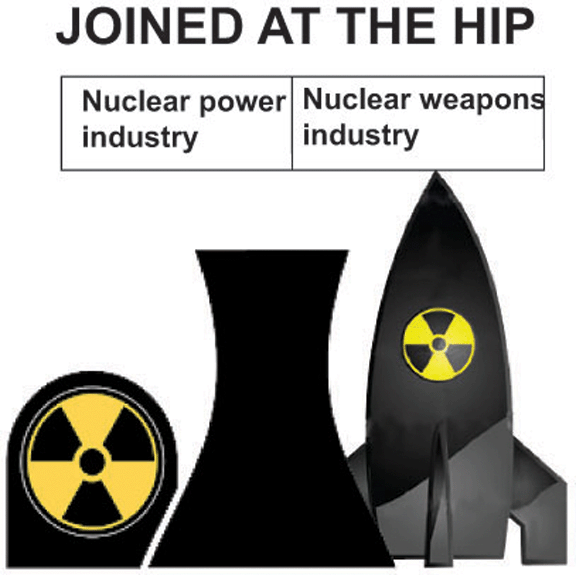
If nuclear energy is not as safe or inexpensive then why invest in it? “Because nuclear energy is a possible front for weaponisation
In Kovvada, villagers displaced forcibly even as the prospects of Westinghouse’s nuclear project remain uncertain, DiaNuke.org, JANUARY 19, 2018 Raksha Kumar | The News Minute
The coast curves through northern Andhra Pradesh and forms a giant U. Deep in the womb of this horseshoe lies Ranastalam mandal of Srikakulam district. During the light winter showers in November, this region takes on a darker shade of green. Small fishing villages are sprinkled across the uneven coast.
People here consider the vast sea their sole asset. “We have been fishermen for generations,” said Juggle Mailapally, ex-sarpanch of Chinna Kovvada village. “I was taught how to stitch a fishing net when I was 9,” he added.
Since 2008, when the Indo-US Nuclear Deal was signed, there have been rumours in the air about a giant nuclear plant taking over their idyllic existence. However only in 2015 did those rumours get confirmed.The District Collector of Srikakulam came to their village to talk to them about relocation, recollected Mailapally.
First, the villagers protested. Then they went on a year long hunger strike, which got the support of several political parties. However, their resilience proved to be weak in front of the government’s grit to see the project through.
Soon there will be six 1000MW nuclear reactors lining the coast. Over 2,074 acres in seven villages – Kovvada, Ramachandrapuram, Gudem, Kotapalem, Maruvada, Tekkali and Jeerukovvada – will house the reactors, displacing about 10,000 people.
Lands acquired
While questions about the viability of the project still persist, people of Ranastalam have had to give up their lands. The Andhra Pradesh government announced in December 2017 that the land acquisition for the project was completed successfully.
In 2014, before the current Telugu Desam Party government was voted into power for the first time in divided Andhra Pradesh, Chief Minister Chandrababu Naidu made a campaign promise to relocate the nuclear power plant from Kovvada and neighbouring villages. “Immediately after he was sworn in, he changed his stance,” said Mailapally.
After his election, efforts on the nuclear plant only accelerated. “Only TV channels owned by the opposition party showcase the hypocrisy and treachery,” said Rajesh of National Alliance for People’s Movements, who is researching the power plant. “Otherwise, the media is fairly jubilant about the project.”
According to the World Nuclear Industry Status Report 2017, the Prototype Fast Breeder Reactor (PFBR) in India has been listed as “under construction” for a decade or more. “The average construction time of the latest 51 units in ten countries that started up in the past decade, since 2007, was 10.1 years with a very large range from 4 to over 43 years,” the report reads.
In Maharashtra, work is yet to begin on the Jaitapur Nuclear Plant whose agreement was signed in December 2010.
According to the Land Acquisition, Rehabilitation and Resettlement Act of 2013, if the government does not use the land acquired for the purposes it was taken, the lands should be returned to the people. “Since nuclear energy is seeing a downward slide across the world, most proposed nuclear plants are tentative. Might never be built at all,” said Dr K Babu Rao, retired scientist, IICT.
Acquiring lands to construct a nuclear facility has certain additional rules. Atomic Energy Regulatory Board (AERB) is the national authority which is responsible for approving construction, commissioning, operation and decommissioning of nuclear power facilities in the country.
As per the AERB guidelines, 1.6 kilometres from the periphery of the project’s rim is exclusive zone – no one can inhabit that zone. Beyond that, upto 30 kilometres, the place needs to be monitored and evacuation-ready. Even though people living within those 30-odd kilometres will be exposed to high doses of radiation, compensation is given only to those whose lands are taken away.
Add to this, India has a weak Civil Nuclear Liability law, which guarantees lower compensation in case of a disaster.
Seven hundred and ninety one acres of the required 2074 acres are government lands, therefore easier to acquire for the nuclear project. However, 684 acres are lands assigned to landless poor, with a condition that they be sold only to the government. And 599 acres are private lands………
Bankruptcy
The Kovvada Nuclear Reactor was to be built by US nuclear reactor maker, Westinghouse. But, in March 2017, Westinghouse filed for bankruptcy. The company was bled to death because of cost-escalations in two of the four nuclear power plants it designed and is constructing in the United States. “Kovvada will benefit only Westinghouse, and no one else. Not the people. Not India’s energy security,” said EAS Sarma, former Union Energy Secretary………
“India is being bamboozled by the multinationals into signing these agreements with foreign companies,” said Dr Sarma. Since the 1979 Three Mile Island nuclear accident in the US, when a Pennsylvania-based nuclear plant malfunctioned, the US has been cautious in using nuclear energy. “It is not just the US, even Europe is not gung-ho about nuclear. So, Westinghouse and GE have very little business,” said Dr Sarma. “They are looking for a market and India is fertile ground of them,” he added.
Westinghouse is not alone. In May 2015, weeks after Modi’s visit to France, a French company announced it was going into loss. Areva, the French nuclear reactor manufacturer, is to design the nuclear reactor in Jaitapur, Maharashtra. The French government is desperately trying to breathe life into Areva. “Again, it is in their favour to woo India. And India is being naive,” said Dr Sarma………
A more basic question remains in the minds of most villagers. Is the nuclear power plant necessary at all? Should we invest in nuclear energy?
As on date, nuclear power constitutes only 1.83% of the total installed electricity generation capacity in India. Moreover, nuclear energy generates only 3.23% of the total electricity. With renewable sources like solar and wind energy becoming cheaper, the moot question is should the country invest in nuclear energy at all?
“Since India is planning to depend heavily on such foreign reactor suppliers, the future trajectory of nuclear development in the country is going to be uncertain and highly expensive,” said Dr Sarma.
If nuclear energy is not as safe or inexpensive then why invest in it? “Because nuclear energy is a possible front for weaponisation,” said Sukla Sen, a Mumbai-based activist.
Abandoning Hinkley Point C now could save consumers almost £1.5bn per year for 35 years from 2027http://www.no2nuclearpower.org.uk/news/ 19 Jan 18 Stop Hinkley Campaign submits response to the Helm ‘cost of energy’ review.
The Stop Hinkley Campaign has submitted a joint response, with the Nuclear Free Local Authorities (NFLA), to the UK Government’s call for evidence on Professor Dieter Helm’s review of the UK energy market and the financial costs of energy to consumers and businesses. (1)
The joint submission argues the best way for the Government to keep electricity costs to consumers as low as possible over the coming decades, while reducing carbon emissions, and providing secure electricity supplies, is to cancel Hinkley Point C, scrap the new nuclear programme, launch a much more comprehensive energy efficiency programme and expand renewable energy ambitions.
The response also notes:
• Cancelling Hinkley Point C now might incur a cancellation cost of around £2bn, but consumers could save around £50bn over its lifetime. (2)
• Offshore wind is already approaching half the cost of nuclear power and Bloomberg New Energy Finance (BNEF) predicts costs will drop a further 71% by 2040.
• Removing the current block on onshore wind could save consumers around £1bn.
• Solar power is expected to be the cheapest source of energy (not just electricity) anywhere in the world by 2030 or 2040.
• Cost-effective investments in domestic energy efficiency between now and 2035 could save around 140 terawatt hours (TWh) of energy and save an average of £270 per household per year at current energy prices. The investments would deliver net benefits worth £7.5bn to the UK.
• Renewables could soon be producing enough electricity to power the grid from April to October. If the Government continues with the nuclear programme then Ministers will have to explain to consumers why they are having to pay for expensive nuclear electricity when cheap renewables are being turned off.
• The UK has the technology to match green power supply and demand at affordable cost without fossil fuels – by deploying the ‘smart grid’, using ‘green gas’ made from surplus power, and raising energy efficiency.
• Baseload is not helpful in balancing a variable energy supply – it simply leads to further overproduction of energy at times when renewables can meet demand on their own.
Just before the Christmas holidays the two organisations also submitted a joint response to the UK Government’s Clean Growth Strategy. (3)
Instead of funding R&D on new nuclear technology and Small Modular Reactors to the tune of around £460m, this called for more funding for low carbon heat and energy efficiency. In particular the Government should be investigating power-to-gas (P2G) technology which can produce renewable hydrogen, using surplus renewable electricity, which could then be fed into the gas grid for storage or used for producing renewable heat.
Stop Hinkley Spokesperson Roy Pumfrey said:
“The cost of renewables is declining rapidly, and it is becoming increasingly clear that there are lots of ways of dealing with intermittency issues. It now looks as though Hinkley Point C won’t be online before 2027. Several financial institutions have predicted that large centralised power stations are likely to be obsolete within 10 to 20 years, because they are too big and inflexible, and are “not relevant” for future electricity. (4) So Hinkley Point C and the rest of the UK’s ill-conceived new nuclear programme will be too late, too expensive and too problematic. Wind and solar are cheaper more flexible and much quicker to build. It is time to cancel Hinkley Point C now before consumers are saddled with a needless bill for £50bn not to mention the nuclear waste which we still don’t know what to do with.”
Notes
(1) The Stop Hinkley and NFLA joint submission on the Government’s call for evidence on the Helm Review is available here.
(2) See Time to Cancel Hinkley Point C by Emeritus Professor Steve Thomas available here.
(3) The Stop Hinkley and NFLA joint submission on the Government’s Clean Growth Strategy is available here.
(4) See Stop Hinkley Press Release 28th August 2014
FT 16th Jan 2018, The British and Japanese governments have agreed to explore options for
joint-financing of a nuclear power station in Wales, a softening of the
UK’s previous refusal to commit public funds to construction of new
reactors.
Letters have been exchanged between London and Tokyo in which the
governments expressed support for the Wylfa nuclear project on Anglesey and
agreed to consider contributing to its financing, according to several
people involved in the process.
Wylfa is being developed by Horizon, a subsidiary of Hitachi, the Japanese conglomerate whose reactor technology
will be used by the plant. Partial public financing for Wylfa would
represent a new approach to nuclear construction in the UK by drawing on
the government’s access to cheap debt to reduce capital costs.
But it would also expose taxpayers to some of the associated heavy expense and
high risk. Ministers have been rethinking policy after heavy criticism of
the £20bn Hinkley Point C plant under construction in Somerset. The full
cost of that project is being met by its French and Chinese investors and
recovered through a levy on consumer bills.
Japan’s Asahi Shimbun newspaper reported last week that the UK and Japanese governments were
willing to work with financial institutions to extend as much as $20bn in
loans to finance Wylfa, and also to acquire a stake in Horizon. Several
people involved in the project said no such details had yet been agreed but
the exchange of letters between the two governments late last month had
“increased confidence on all sides”. https://www.ft.com/content/dd916c18-facd-11e7-9b32-d7d59aace167
FT 17th Jan 2018, EDF is aiming to attract pension funds and other institutional investors to
help finance another UK nuclear plant at Sizewell to follow its £20bn
project at Hinkley Point.
The French state-controlled utility said it was working on “innovative financing models” for its Sizewell C project in
Suffolk and was in early-stage talks about potential UK government backing for the project.
EDF’s plans for Sizewell are longstanding but remarks on
Wednesday by Simone Rossi, the company’s new UK chief executive,
represented its firmest commitment to the project so far. Mr Rossi insisted
he had “absolute support” from EDF’s leadership in Paris to push
ahead with Sizewell, despite stress on the company’s finances from its
existing nuclear construction projects at Hinkley in Somerset and
Flamanville in France.
He said EDF aimed to cut the construction cost of
Sizewell by 20 per cent compared with Hinkley through efficiency gains.
Horizon, another UK nuclear developer owned by Hitachi of Japan, is also
aiming to attract institutional investment in its proposed Wylfa nuclear
plant in Wales. Horizon believes pension funds will be interested once its
plant is finished and it wants help from the UK and Japanese government to
finance construction in the meantime. Mr Rossi said public finance for
Sizewell was “not a prerequisite” but EDF would work with the UK
government to develop alternative financing structures.
Investment is also expected from Chinese state-owned CGN, which owns a third of Hinkley, and
is planning its own UK nuclear plant in partnership with EDF at Bradwell in
Essex. Sizewell, Bradwell and Wylfa are competing for finance and political
support, along with the Moorside project in Cumbria which is in the process
of being sold by Toshiba of Japan to Kepco of South Korea. https://www.ft.com/content/9555cd14-fbad-11e7-9b32-d7d59aace167
Fishing News 16th Jan 2018, Wylfa Newydd – a nuclear power station on Anglesey. Section 48, Planning
Act 2008 – Regulation 4 Infastructure Planning (Applications: prescribed
forms and procedure), Regulations 2009. Proposed application for
development consent for the Wylfa Newydd Project. Please send any comments
in response to this notice by 13 February 2018. 1.
Notice is hereby given
that Horizon Nuclear Power Wylfa Limited (the “Applicant”) of Sunrise
House 1420 Charlton Court, Gloucester Business Park, Gloucester, GL3 4AE
proposes to apply to the Secretary of State under s37 of the Planning Act
2008 for an order granting development consent (“DCO”) for the
construction, operation and maintenance of a new nuclear power station and
other development, at Wylfa, Anglesey (“Wylfa Newydd Project”). http://fishingnews.co.uk/publicnotices/horizon-nuclear-power-wylfa-newydd-project/
BBC 16th Jan 2018, Views are being sought on the creation of ecological areas and wetland
habitats to help reduce the possible effects of constructing a planned new
nuclear power station. Horizon Nuclear Power is consulting ahead of its
main application to build £10bn Wylfa Newydd on Anglesey. The company said
it needed additional land to build the wetland and “ecological mitigation”
areas. http://www.bbc.co.uk/news/uk-wales-north-west-wales-42695692
Guardian 17th Jan 2018, EDF Energy has claimed it could build a second new nuclear power station in
Britain that would be a fifth cheaper than the £20bn Hinkley Point C
project under construction in Somerset. The French state-owned company said
a new plant at Sizewell on the Suffolk coast would be cheaper because of
replication in construction techniques, existing grid connections and the
exploration of new finance models. In his first major public speech, Simone
Rossi, EDF’s new chief executive, said a Sizewell C project would offer
“a unique opportunity to be significantly cheaper than Hinkley Point C
and competitive with equivalent alternatives”. The Italian executive said
he was confident he could deliver Hinkley on time, with the first power to
be generated by 2025 https://www.theguardian.com/uk-news/2018/jan/17/edf-build-second-nuclear-plant-sizemore-cheaper-hinkley-point
TheFederal Energy Regulatory Commission’s (FERC) recent rejection of Secretary of Energy Rick Perry’s plan to force electricity customers across the country to pay billions of dollars to prop up uneconomic coal and nuclear plants is only the tip of the iceberg in the fossil fuel industry’s bailout efforts.
Today, there are still numerous proposals making their way through state legislatures, public utility commissions, electric market operators, and Congress that will unfairly prop up fossil fuel plants that can’t compete in America’s modern energy markets.
These proposals are rooted in the entitled belief by fossil fuel billionaires that any competition that outperforms their lumbering, polluting power plants — especially clean energy resources like solar, wind, and energy efficiency — is somehow illegitimate.
The proposals themselves have gotten traction recently because over the past decade, clean energy resources have displaced hundreds of coal and nuclear plants as American customers have steadily cut down on their electricity usage and demanded cleaner, safer energy at a lower cost. As a consequence, these new resources have also created a vibrant clean energy economy that employs hundreds of thousands of workers.
Fossil fuel billionaires are fearful that this trend will create a permanent shift away from their dirty and dangerous energy, and are subsequently trying to force electricity customers to pay hundreds of millions, and sometimes billions, of dollars to prop up their plants.
The most egregious example of this political cronyism was Perry’s directive to FERC to create new rules that would have forced electricity customers to pay extra money for the energy produced by uneconomic coal and nuclear plants.
This expensive, foolish directive was rejected by FERC. Despite its failure, however, there are still numerous other proposals which are not as well publicized, but equally costly attempts by fossil fuel billionaires to prop up their plants.
Washington energy lobbyists, for example, have already been busy pushing coal tax credits and the extension of nuclear industry tax incentives in this year’s spending packages.
In Indiana, Sierra Club caught the state’s public utility commission approving a massive bailout of two coal-burning power plants for a local utility, NIPSCO, and is considering legal action to overturn it. The bailout came after uncontested NIPSCO data was revealed which showed that retiring the plants, instead of bailing them out, would save customers as much as $420 million.
In Ohio, FirstEnergy has tried for years, and is still trying, to get the state government to bail out its obsolete coal and nuclear plants that can’t compete with the Midwest’s legion of wind farms. Consumer and environmental advocates have defeated this bailout multiple times, but the utility keeps coming back to try again.
In the Great Plain states, reports show that throughout the region, utilities have been taking advantage of loopholes to force customers to bail out local coal plants to the tune of $300 million over a two year period in the Southwest Power Pool, home to abundant cheap wind power.
Electricity markets that are supposed to be competitive and open to all resources aren’t immune from efforts to rig the system against cleaner energy.
For example, on the same day FERC rejected Energy Department’s misguided proposal, New England’s market operator filed a proposal that would obstruct states’ rights to pursue cost-effective renewable energy projects and make it easier to prop up dirtier, costly power plants that should retire. PJM, which manages the electric system for much of the Mid-Atlantic and Midwest, has also threatened to override public policies for clean energy in order to raise consumer costs and bail out unnecessary power plants, despite a massive surplus of electric capacity.
This recent, ongoing wave of proposals to bailout coal and nuclear plants on behalf of billionaires is a very real threat that will stifle innovation, increase costs, and corrupt democratic processes that have served us well for decades.
The backlash against these bailouts has been overwhelming thus far, but it will only be effective if it can stop all of them in their tracks. A reliable, affordable, and clean energy future hangs on the decisions we make in 2018 and we must choose our decisions wisely.
New Trump policy could strengthen role of nuclear weapons, Phil Stewart WASHINGTON (Reuters) 13 Jan 18,- President Donald Trump’s administration could pursue development of new nuclear weaponry and explicitly leave open the possibility of nuclear retaliation for major non-nuclear attacks, if a leaked draft policy document becomes reality.
The Pentagon did not comment on the document, which was published by the Huffington Post website and prompted sharp criticism from arms control experts, who voiced concerns it could raise the risks of nuclear war.
The Defense Department said on Friday it did not discuss “pre-decision, draft copies of strategies and reviews.”
“The Nuclear Posture Review has not been completed and will ultimately be reviewed and approved by the President and the Secretary of Defense,” the Pentagon said in a statement.
One source familiar with the document told Reuters the draft was authentic, but did not say whether it was the same version that will be presented to Trump for approval.
The Republican Trump’s predecessor, Democrat Barack Obama, declared his intent to reduce the role of nuclear weapons in his Nuclear Posture Review in 2010, the last time the policy document was crafted.
The Trump administration’s draft document, said, however, that Obama-era assumptions of a world where nuclear weapons were less relevant proved incorrect.
“The world is more dangerous, not less,” it said.
It more readily embraces the role of nuclear weapons as a deterrent to adversaries, and, as expected, backs a costly modernization of the aging U.S. nuclear arsenal.
The Congressional Budget Office has estimated that modernizing and maintaining the U.S. nuclear arsenal over the next 30 years will cost more than $1.2 trillion.
…….. Kingston Reif, director for disarmament research at the Arms Control Association advocacy group, said the draft document was a departure from long-standing U.S. policy.
“It expands the scenarios under which the United States might use nuclear weapons and therefore increases the risk of nuclear weapons use,” Rief said.
Uranium Miners Pushed Hard for a Comeback. They Got Their Wish. NYT, By HIROKO TABUCHIMONUMENT VALLEY, Utah— Garry Holiday grew up among the abandoned mines that dot the Navajo Nation’s red landscape, remnants of a time when uranium helped cement America’s status as a nuclear superpower and fueled its nuclear energy program.
It left a toxic legacy. All but a few of the 500 abandoned mines still await cleanup. Mining tainted the local groundwater. Mr. Holiday’s father succumbed to respiratory disease after years of hacking the ore from the earth.
But now, emboldened by the Trump administration’s embrace of corporate interests, the uranium mining industry is renewing a push into the areas adjacent to Mr. Holiday’s Navajo Nation home: the Grand Canyon watershed to the west, where a new uranium mine is preparing to open, and the Bears Ears National Monument to the north.
The Trump administration is set to shrink Bears Ears by 85 percent next month, potentially opening more than a million acres to mining, drilling and other industrial activity. But even as Interior Secretary Ryan Zinke declared last month that “there is no mine within Bears Ears,” there were more than 300 uranium mining claims inside the monument, according to data from Utah’s Bureau of Land Management office that was reviewed by The New York Times.
The vast majority of those claims fall neatly outside the new boundaries of Bears Ears set by the administration. And an examination of local B.L.M. records, including those not yet entered into the agency’s land and mineral use authorizations database, shows that about a third of the claims are linked to Energy Fuels, a Canadian uranium producer. Energy Fuels also owns the Grand Canyon mine, where groundwater has already flooded the main shaft.
Energy Fuels, together with other mining groups, lobbied extensively for a reduction of Bears Ears, preparing maps that marked the areas it wanted removed from the monument and distributing them during a visit to the monument by Mr. Zinke in May.
Energy Fuels’ lobbying campaign, elements of which were first reported by The Washington Post, is part of a wider effort by the long-ailing uranium industry to make a comeback.
The Uranium Producers of America, an industry group, is pushing the Environmental Protection Agency to withdraw regulations proposed by the Obama administration to strengthen groundwater protections at uranium mines. Mining groups have also waged a six-year legal battle against a moratorium on new uranium mining on more than a million acres of land adjacent to the Grand Canyon.
For the Navajo, the drive for new mines is a painful flashback.
“Back then, we didn’t know it was dangerous — nobody told us,” Mr. Holiday said, as he pointed to the gashes of discolored rocks that mark where the old uranium mines cut into the region’s mesas. “Now they know. They know.”
Supporters of the mining say that a revival of domestic uranium production, which has declined by 90 percent since 1980 amid slumping prices and foreign competition, will make the United States a larger player in the global uranium market.
It would expand the country’s energy independence, they say, and give a lift to nuclear power, still a pillar of carbon-free power generation. Canada, Kazakhstan, Australia, Russia and a few other countries now supply most of America’s nuclear fuel.
……….President Trump has prioritized scrapping environmental regulations to help revitalize domestic energy production. His executive order instructing Mr. Zinke to review Bears Ears said that improper monument designations could “create barriers to achieving energy independence.”
In theory, even after President Barack Obama established Bears Ears in 2016, mining companies could have developed any of the claims within it, given proper local approvals. But companies say that expanding the sites, or even building roads to access them, would have required special permits, driving up costs.
……….
A bill introduced last month by Representative John Curtis, Republican of Utah, would codify Mr. Trump’s cuts to the monument while banning further drilling or mining within the original boundaries. But environmental groups say the bill has little chance of passing at all, let alone before the monument is scaled back next month.
“Come February, anyone can place a mining claim on the land,” said Greg Zimmerman, deputy director at the Center for Western Priorities, a conservation group.
………Fred Tillman, an environmental engineer with the United States Geological Survey, said during a recent visit to the mine that the groundwater flows in the region were too complex to rule out the risk of contamination.
“There are these big unknowns about the potential impacts on cultural resources, on biological resources, on water resources,” Dr. Tillman said.
A senator steps in Even as troubles persist on the ground, the industry pushback has continued.
In court, mining groups led by the National Mining Association have challenged a 20-year moratorium on mining in the Grand Canyon watershed, established in 2012 by the Obama administration. (The Canyon Mine predates the moratorium.)
The Arizona Chamber of Commerce, which represents mining interests, also backed an effort to defeat a separate proposal that would have permanently banned mining on 1.7 million acres surrounding the Grand Canyon. An Energy Fuels executive testified in Congress against the ban.
And with the help of Republican senators like John Barrasso of Wyoming, the industry has pressed the E.P.A. to withdraw an Obama-era proposalthat would strengthen groundwater protections at uranium mines.
The proposal would regulate a mining method called in-situ recovery, which involves injecting a solution into aquifers containing uranium and bringing that solution to the surface for processing — a method criticized by environmentalists as posing wider contamination risks.
Plymouth Herald 14th Jan 2018, 13 former Royal Navy subs are awaiting disposal in Plymouth – with a further seven in
Rosyth. The MoD says the submarines are “safely stored” and subject to
rigorous checks. It adds that there has been “no measurable increase in
exposure for local people”.
But the cost of storing and maintaining the laid-up vessels is vast. Over five years – between 2010 and 2015- the total
bill for storing the vessels at the two sites, both owned by Plymouth-based engineering firm Babcock, reached more than £16million.
The estimated cost of the MoD’s submarine dismantling programme, which started in December 2016 and is due to take more than 25 years to complete, have not been released. The MoD says this is due to ongoing commercial negotiations withBabcock – it’s main contractor for the programme – and other key suppliers. http://www.plymouthherald.co.uk/news/plymouth-news/nuclear-submarines-left-rot-devonport-1043977
The UK Government launched on 11 January – with a media fanfare- its long delayed 150-page national environmental strategy (for England) titled ‘A Green Future: Our 25 Year Plan to Improve the Environment (https://www.gov.uk/government/publications/25-year-environment-plan).
Prime Minister May asserted in her foreword: “We hold our natural environment in trust for the next generation. By implementing the measures in this ambitious plan, ours can become the first generation to leave that environment in a better state than we found it and pass on to the next generation a natural environment protected and enhanced for the future.
……. We will use this opportunity to strengthen and enhance the protections our countryside, rivers, coastline and wildlife habitats enjoy, and develop new methods of agricultural and fisheries support which put the environment first.”
In his own foreword, Environment Secretary Michael Gove added:“Environment is – at its roots – another word for nature, for the planet that sustains us, the life on earth that inspires wonder and reverence, the places dear to us we wish to protect and preserve. We value those landscapes and coastlines as goods in themselves, places of beauty which nurture and support all forms of wildlife….We will underpin all this action with a comprehensive set of environmental principles. To ensure strong governance, we will consult on plans to set up a world-leading environmental watchdog, an independent, statutory body, to hold Government to account for upholding environmental standards.”
These warm green words are, however, not backed up with the kind of action that recognizes the real environmental priorities with which ministers need to get a grip.
The most egregious omission for action is anything to halt, reverse and deal with nuclear industry radiological pollution and nuclear waste from power generation, spent irradiate nuclear fuel reprocessing and nuclear warhead production.
Chapter 4 is titled’ Increasing resource efficiency and reducing pollution and waste’ but makes zero mention of nuclear waste or radiological pollution, but does expend time and effort addressing far less ecologically damaging no radiotoxic waste pollution. Here is an extract:
Improving management of residual waste
Since 2000 we have diverted significant quantities of residual waste – i.e. waste that cannot be reused or recycled – from landfill through the development of energy from waste (EfW) facilities. These generally recover energy from the waste to produce electricity. In 2016/17, some 38% of waste collected by Local Authorities went to EfW compared with 16% that went to landfill. More can be done however. We want to make sure that materials ending up in the residual waste stream are managed so that their full value as a resource is maximised and the impact on the environment of treating them is minimised.
We will continue to encourage operators to maximise the amount of energy recovered from residual waste while minimising the environmental impact of managing it, for example by utilising the heat as well as electricity produced. The actions set out in this Plan will help us build on this to ensure that the value of residual waste as a resource is fully realised and that emissions of carbon dioxide during the energy recovery process are kept as low as possible. We must bear in mind that any infrastructure must be able to adapt to future changes in the volume and make-up of residual waste generated and developments in technology. That way, waste is not locked into residual waste treatment processes when it could be reused or recycled. (page 94)
Annex 2 of the two Government reports on Environment 25 titled Government strategies to protect and improve the environment(https://www.gov.uk/government/uploads/system/uploads/attachment_data/file/673160/25-year-environment-plan-annex2.pdf comprises of nearly 50 “strategies and plans for some of the government’s work to protect and conserve the environment,” but contains not one report that addresses environmental protection from radiation or from nuclear industry operations!
However, two days before the 25-year green strategy was issued, the Government quietly released ( to absolutely zero media attention) a 221- page document that explains how it plans to deal with nuclear waste in the UK. Clearly ministers wanted attention on plastic waste policy, but none fon radioactive waste policy.
It follows a similar letter calling for restrictions on the nuclear chain of command written while Trump was on the campaign trail. One year into the presidency, the nuclear officers say “the reality of this presidency is worse than we feared.”
“The president has had ample opportunity to educate and humble himself to the grave responsibilities of his office. Instead, he consistently shows himself to be easily baited, stubborn in his ignorance of world politics and diplomacy, and quick to brandish nuclear threats,” the group states.
They claim rising rhetoric against North Korea highlights the clear flaw in the process that could endanger millions around the world — that there are no checks on the President should he decide to order a nuclear strike.
“As former nuclear launch control officers, it was our job to fire nuclear missiles if the president so directed. Once the president orders a launch, we could have missiles leaving their silos in several minutes. They cannot be recalled.
“The missiles would reach their destination — whether Russia, China or North Korea — within 30 minutes. There is no act of greater consequence, and it should not rest in the hands of any one person.”
We and our nation cannot abide being hostages to the mood swings of a petulant and foolish commander-in-chief. No individual, especially Donald Trump, should hold the absolute power to destroy nations. That is a clear lesson of this presidency and one that we, as former stewards of the launch keys, embrace with full conviction,” the group said.
It comes following a warning from UK think tank Chatham House that an “unintended” nuclear strike is possible given heightened tensions and the vulnerability of many systems to cyber attack.
The International Security Department’s Dr Patricia Lewis and Dr Beyza Unalpublished the paper, Cybersecurity Of Nuclear Weapons Systems, which said the nine countries that have nuclear weapons often rely on strategic systems developed at a time when computers were “in their infancy”.
“The most severe consequence of a cyber attack on one or more nuclear weapons systems would be the inadvertent launch of missiles and/or the inadvertent detonation of a warhead that lead to a significant loss of life,” it said.
“Further consequences of such a cyber attack include sector-level impacts, such as in the medical sector, which may have to deal with casualties; disruption of workforces and operations of defence companies or vendors; as well as economic and reputational costs to countries and private companies. Such an event would also increase the likelihood of crisis and conflict.”
The report notes a mind-boggling number of ways cyber attackers could infiltrate a nuclear weapons system without a country being aware of it for years or until it’s too late.
The result could lead to confusion as countries try to ascertain whether they have been subject to a cyber attack or not, how to respond and which weapons to use. The authors claim it could lead to “inadvertent nuclear launches” based on an “unwitting reliance” on false information.
Making the problem worse is the sheer scale of digital infrastructure used to control everything from layouts of facilities to personnel, operational information, communication links, and weather and target information. Data hacks could be used to disrupt missiles once launched and take over nuclear armed submarines, the report claimed.
It comes during a state of heightened nuclear tension following heated rhetoric between the US and North Korea as well as greater Russian military activity and a build-up of NATO forces in Eastern Europe.
Trump supporters claim his refusal to rule out military options has helped achive an about face from North Korea, who is now engaged in a dialogue with the South and is subject to tough UN economic.
However veteran nuclear launch officer, Dr. Bruce Blair, who founded Global Zero to eliminate nuclear weapons said he could no longer watch as President Trump “holds us all hostage to his petulant mood swings.”
“Our weapons have the power to destroy entire nations, including our own nation if he initiates a nuclear war. As a former steward of the nuclear launch keys, I’ve learned about the stability, competence and temperament it takes to hold such a responsibility, and Donald Trump has shown us all he possesses none of those qualities,” he said.
Asahi Shimbin 11th Jan 2018, Japan and Britain have agreed to provide the lion’s share of financing for
a nuclear power plant project planned by Hitachi Ltd. on the island of
Anglesey off northwest Wales, sources said.
The two governments are set to extend a combined 2.2 trillion yen ($20 billion) in loans with the help of
financial institutions and acquire a stake in Horizon Nuclear Power Ltd., a
British company purchased by Hitachi to operate the plant. The total cost
of the project is estimated at 3 trillion yen.
It is extremely rare forgovernments to shoulder such a huge portion of the overall project cost. By
doing so, they must share the risk if the project suffers a financial loss,
but that tab could eventually be passed on to taxpayers. http://www.asahi.com/ajw/articles/AJ201801110057.html