Idaho National Laboratory – promoter and also umpire for nuclear reactors’ safety
National lab is cheerleader and umpire for reactors’ future Peter Behr, E&E News reporter, SCOVILLE, Idaho — Nuclear power for the grid was born here in 1951, when an experimental reactor’s football-sized core sent current flowing to a quartet of lightbulbs at the isolated government laboratory on Idaho’s southeast desert.
And the nuclear industry’s future may be written here, as well — at least key parts of it — inside the Energy Department’s Idaho National Laboratory testing complex.
INL’s scientists, with colleagues at other DOE labs, are keeping a close watch on the health of the nation’s commercial nuclear reactors, most of them built before the mid-1980s in the flush of excitement about nuclear energy that would be “too cheap to meter,” as an early promoter predicted. How long can the plants keep going before critical steel, concrete and wiring systems are overcome by the aging effects of heat, radiation and mechanical stresses?
And now, with the nuclear industry struggling to compete against low-cost natural gas generation, INL is also stepping up a search for ways to lower reactor operating costs, from research on “accident tolerant” reactor fuels to designing more efficient control rooms and using technology to reduce reactor safety inspection time and costs……..
The NRC has licensed 84 reactors to continue operating beyond the initial 40-year span for an additional 20 years. Nine more relicensing applications are pending, and four reactors are expected to apply, the NRC said……..
The Energy Department’s 2016 report on the reactor longevity campaign notes the potential for damaging surprises. The specialized stainless steel alloys chosen for reactors in the 1960s had many plus factors, DOE said, but concerns, as well. Reactor radiation can add to stress-related corrosion cracking, threatening structural integrity. DOE researchers noted this year that “limited information is known about the long-term performance” of these alloys. Concrete structures have borne thermal shock and radiation, and reactor wiring has lived in harsh environments. Aging issues are “expected to become more severe” as time passes, DOE said.
An essential test process at Idaho and other DOE labs is to bombard sample reactor materials with enormous radiation levels inside test reactors, accelerating stress testing to mimic impacts of operations far beyond 40 years.
“It’s possible plants could run into aging problems that were too expensive to fix, and the operators would decide to shut it down,” Wagner said.
“Nearly all of the fleet will go offline between 2029 and 2055” if plants cannot operate beyond 60 years, Wagner said. “That may seem like a long time away, but it’s really not when you consider replacing that level of assets.”…….https://www.eenews.net/stories/1060063769
Florida: PSC regulators say no to FPL nuclear fees without financial analysis
Susan Salisbury, Palm Beach Post Staff Writer,Without a required feasibility analysis to show that two new proposed nuclear reactors are a good deal for customers, Florida Power & Light Co. cannot collect costs incurred after 2016, the Florida Public Service Commission decided Tuesday.
PSC commissioners unanimously agreed with a staff recommendation that because FPL failed to submit a required financial analysis, costs incurred for the two reactors from Jan. 1, 2017 going forward cannot be collected through nuclear power-related fees customers pay.
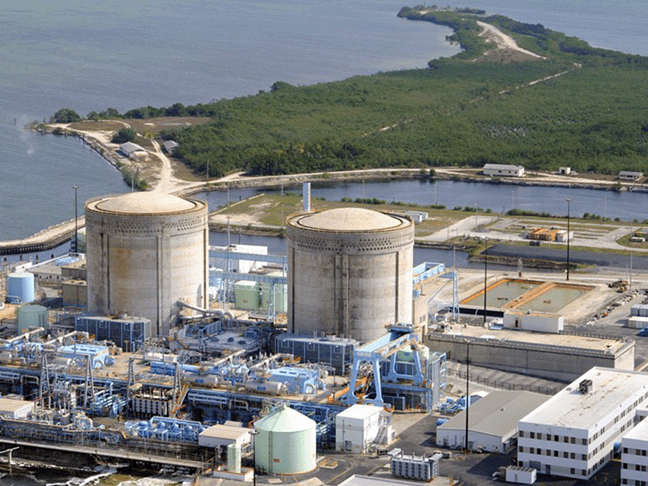
Since 2009 Juno Beach-based FPL has sought an operating license from the U.S. Nuclear Regulatory Commission for the proposed 2,200-megawatt Turkey Point 6 and 7 reactors which could cost as much as $21.8 billion. They might never be built, or no sooner than 2031, at the same facility where FPL already has two operating reactors overlooking Biscayne Bay south of Miami.
Still, customers have already paid close to $282 million in costs associated with the two reactors. And FPL wanted permission to continue charging customers with an exemption from having to file a feasibility study.
The Southern Alliance for Clean Energy, the Office of Public Counsel, the Florida Retail Federation and the Florida Industrial Power Users Group all urged the commission to deny FPL’s request for an exemption.
The PSC agreed, but the company can collect costs from customers if and when it does provide the required report as long as the report shows the project makes financial sense, the commission said. The utility could also seek to collect the costs some other way, such as through base rates…….
SACE said Tuesday it has other concerns, including that FPL has never committed to a binding price for the reactors or to construct them at all.
“FPL customers have already paid $300 million into the proposed Turkey Point expansion project that will almost certainly never be built. Two nuclear reactors of the same design in South Carolina were recently cancelled after the projected cost soared to over $25 billion dollars,” Smith said.
The Commission approved recovery of the utility’s costs for 2015 and 2016 that included $46,978,739 for the Turkey Point project. Customers will be receiving a credit next year of $7,305,202. http://www.palmbeachpost.com/business/psc-regulators-say-fpl-nuclear-fees-without-financial-analysis/LucoyuUttLqnHM9JYAFW6N/
South Africa: President Jacob Zuma changes Cabinet, in order to promote nuclear power deal
 Cabinet reshuffle about Zuma chasing nuclear deal: Malema, Times Live 17 October 2017
“He is chasing the nuclear deal in the energy [department]….She [then minister of energy Tina Joemat-Pettersson] wanted minister Nene to sign some documents which were provided to her by the president. Nene said ‘I cannot sign the documents which have not been taken through the department. If you give me time to go through them‚ we can then sign.‘
“It took forever and [former finance minister Nhlanhla] Nene got removed because they thought he was reluctant on the thing. Peterson got removed because they thought she was not handling the nuclear deal properly‚” Malema charged at a media briefing on Tuesday.
“A confidante has been sent there [Department of Energy] to go and process the nuclear deal. [New minister of energy‚ David] Mahlobo will run the two departments. Both the intelligence and energy because [newly-appointed state security minister Bongani] Bongo is a nobody. He is just a young man who knows nothing. Bongo is put there because he admires Mahlobo. Bongo cannot undermine Mahlobo. He will listen to Mahlobo on what needs to happen.
“You must not be fooled. They are chasing the energy deal‚” Malema told reporters.
He was reacting to Zuma’s decision to remove Mmamoloko Kubayi as the minister of energy‚ replacing her with Mahlobo who was the minister of intelligence. The move‚ Malema said‚ was to have control on the energy department so that no one could block Zuma’s nuclear deal.
In April‚ the Western Cape High Court ruled that government’s decision to call for proposals for the procurement of 9.6 gigawatts of nuclear energy was unlawful and unconstitutional.
Earthlife Africa‚ which brought the case‚ said the court vindicated its view which was that the process government had followed was unlawful because it failed to consult the public about its decision. The judgment also made all deals that government had pursued with Russia and the US invalid…….. https://www.timeslive.co.za/politics/2017-10-17-cabinet-reshuffle-about-zuma-chasing-nuclear-deal-malema/
South Africa’s new Energy Minister, David Mahlobo, could be the nuclear industry’s new best friend
David Mahlobo, the nuclear deal’s new best friend? http://www.fin24.com/Economy/david-mahlobo-the-nuclear-deals-new-best-friend-20171017 Johannesburg – New Energy Minister David Mahlobo could make it much easier to realise South Africa’s nuclear ambitions, several commentators warned on Tuesday.
They voiced the opinion that Mahlobo’s abilities as a spy will be a handy tool to cast a veil of secrecy around critical deals that need to be hidden.
Concerns were raised that President Jacob Zuma’s Cabinet reshuffle, moving Mmamoloko Kubayi from the energy portfolio to communications and replacing her with the former state security minister, was a definite shift towards nuclear.
“This is all about the nuclear deal. Mahlobo has accompanied the president on visits to Russia, presumably to lay the ground for the Rosatom nuclear deal,” said Lawson Naidoo of the Council for the Advancement of the South African Constitution.
Mahlobo is seen as a close confidant of Zuma, with some labelling him as the president’s loyal “Prime Minister”.
Also significant is that Zuma was accompanied only by Mahlobo and Deputy International Relations Minister Nomaindia Mfeketo on his state visit to Russia in 2014, where he met with Putin at his residence in Novo-Ogariovo. No aides, advisers or wives went along, creating a veil of secrecy.
It has been widely speculated that Zuma and Putin struck a deal on nuclear cooperation at this meeting, but no evidence has ever emerged to confirm this.
The meeting only came to light later that week in 2014.
Democratic Alliance energy spokesperson Gordon Mackay said South Africans should be deeply concerned. “This is the state securitisation of the energy department. It started under Kubayi and will be completed under Mahlobo.”
He said Zuma was effectively taking control of the department, which has always been viewed as a department of former president Thabo Mbeki.
“It is the clearest indication that the state is dead set on pursuing nuclear.”
Mackay said Mahlobo is an enforcer, and a master at creating a murky atmosphere around deals that need to be pushed through and hidden.
The new energy minister is seen as close to Zuma and someone who can drive the nuclear deal, said Daniel Silke, director at the Political Futures Consultancy.
Liz McDaid, spokesperson for the Southern African Faith Communities’ Environment Institute, said since the institute’s court victory earlier this year in the high court, which ordered the government to restart the nuclear process, nothing has apparently happened on the surface to show progress with the deal.
“We suspected something was happening behind closed doors,” she said. “Last Friday’s nuclear site authorisation and now today’s Cabinet reshuffle has seen the Intelligence Minister become the Energy Minister. This is a desperate attempt to force through the nuclear deal.”
The Sunday Times last month added further fuel to the fire on Mahlobo’s Russian links, when the paper reported that Mahlobo had made the introductions between Russian gas company Rosgeo and controversial businessmen Kenny Kunene and Gayton McKenzie. Rosgeo signed a R5.3bn deal with PetroSA for gas exploration off the southern coast to feed the gas to liquids refinery at Mossel Bay at the recent Brics summit in Xiamen, China.
2017 – a catastrophic year for the nuclear industry – downturn in China, USA, and globally
 More disastrous news for the nuclear power industry. In 2017 alone:
– clear signs of a major nuclear slow-down in China – the last remaining hope for the industry.
– the US nuclear power industry is in the middle of a full-blown crisis
– a seriously anti-nuclear government has been elected in South Korea
– Taiwan has reaffirmed a nuclear phase-out by 2025
– the South African nuclear power program was ruled illegal by the High Court and probably won’t be revived
– Switzerland voted in a referendum to phase out nuclear power (while all of Germany’s reactors will be closed by the end of 2022 and all of Belgium’s will be closed by the end of 2025).
– huge problems in the UK and France
– India’s nuclear power program is going nowhere and the government has implicitly acknowledged that plans for French EPR reactors and US AP1000 reactors will likely be shelved
– Japan’s nuclear power program remains in a miserable state
– Russia’s Rosatom has acknowledged that the pipeline for new reactors is fast drying up
Meanwhile, the growth of renewables has been spectacular and will grow even faster over the coming years. Renewables will be producing 3 times as much electricity as nuclear power by 2022.
—————————————————————————————————————————
Nuclear power’s deepening crisis, Jim Green, 16 Oct 2017, www.onlineopinion.com.au/view.asp?article=19354&page=0
This year has been catastrophic for nuclear power and just when it seemed the situation couldn’t get any worse for the industry, it did. There are clear signs of a nuclear slow-down in China, the only country with a large nuclear new-build program.
China’s nuclear slow-down is addressed in the latest World Nuclear Industry Status Report and also in an August 2017 article by former World Nuclear Association executive Steve Kidd. China’s nuclear program “has continued to slow sharply”, Kidd writes, with the most striking feature being the paucity of approvals for new reactors over the past 18 months. China Nuclear Engineering Corp., the country’s leading nuclear construction firm, noted earlier this year that the “Chinese nuclear industry has stepped into a declining cycle” because the “State Council approved very few new-build projects in the past years”.
Kidd continues: “Other signs of trouble are the uncertainties about the type of reactor to be utilised in the future, the position of the power market in China, the structure of the industry with its large state owned enterprises (SOEs), the degree of support from top state planners and public opposition to nuclear plans.”
Over-supply has worsened in some regions and there are questions about how many reactors are needed to satisfy power demand. Kidd writes: “[T]he slowing Chinese economy, the switch to less energy-intensive activities, and over-investment in power generation means that generation capacity outweighs grid capacity in some provinces and companies are fighting to export power from their plants.”
Kidd estimates that China’s nuclear capacity will be around 100 gigawatts (GW) by 2030, well below previous expectations. Forecasts of 200 GW by 2030, “not unusual only a few years ago, now seem very wide of the mark.” And even the 100 GW estimate is stretching credulity ‒nuclear capacity will be around 50 GW in 2020 and a doubling of that capacity by 2030 won’t happen if the current slow-down sets in.
Kidd states that nuclear power in China may become “a last resort, rather as it is throughout most of the world.” The growth of wind and solar “dwarfs” new nuclear, he writes, and the hydro power program “is still enormous.”
Chinese government agencies note that in the first half of 2017, renewables accounted for 70% of new capacity added (a sharp increase from the figure of 52% in calendar 2016), thermal sources (mainly coal) 28% and nuclear just 2%. Earlier this month, Beijing announced plans to stop or delay work on 95 GW of planned and under-construction coal-fired power plants, so the 70% renewables figure is set for a healthy boost.
Crisis in the US
The plan to build two AP1000 reactors in South Carolina ‒ abandoned in July after A$11.5 ‒ 13.3 billion was spent on the partially-built reactors ‒ is now the subject of multiple lawsuits and investigations including criminal probes. Westinghouse, the lead contractor, filed for bankruptcy protection in March. Westinghouse’s parent company Toshiba is selling its most profitable business (memory chips) to stave off bankruptcy.
The cost of the two reactors in South Carolina was estimated at A$12.4 billion in 2008 and the latest estimate ‒ provided after the decision to abandon the project ‒ was A$31.6 billion. Cost increases of that scale are the new norm for nuclear. Cost estimates for two French reactors under construction in France and Finland have tripled.
Pro-nuclear commentator Dan Yurman discussed the implications of the decision to abandon the VC Summer project in South Carolina in a September 11 post:
“It is the failure of one of the largest capital construction projects in the US Every time another newspaper headline appears about what went wrong at the VC Summer project, the dark implications of what it all means for the future of the nuclear energy industry get all the more foreboding. … Now instead of looking forward to a triumph for completion of two massive nuclear reactors generating 2300 MW of CO2 emission free electricity, the nation will get endless political fallout, and lawsuits, which will dominate the complex contractual debris, left behind like storm damage from a hurricane, for years to come.”
The only other nuclear new-build project in the US ‒ two partially-built AP1000 reactors in Georgia ‒ is hanging on by a thread. Georgia’s Public Service Commission is reviewing a proposal to proceed with the reactors despite the bankruptcy filing of the lead contractor (Westinghouse), lengthy delays (5.5 years behind schedule) and a doubling of the cost estimate (the original estimate was A$17.9 billion and the latest estimates range from A$32.5 ‒ 38.4 billion for the two reactors).
No other reactors are under construction in the US and there is no likelihood of any construction starts in the foreseeable future. The US reactor fleet is one of the oldest in the world ‒ 44 out of 99 reactors have been operating for 40 years or more ‒ so decline is certain. Six reactors have been shut down in the US over the past five years and many others are on the chopping block.
Indicative of their desperation, some nuclear advocates in the US (and to a lesser extent the UK) are openly acknowledging the contribution of nuclear power (and the civil nuclear fuel cycle) to the production of nuclear weapons and using that as an argument to sharply increase the massive subsidies the nuclear power industry already receives. That’s a sharp reversal from their usual furious denial of any connections between the ‘peaceful atom’ and the proliferation of Weapons of Mass Destruction.
Global downturn
Elsewhere, the nuclear industry is in deep malaise and has suffered any number of set-backs this year. Pro-nuclear lobby groups are warning about nuclear power’s “rapidly accelerating crisis“, a “crisis that threatens the death of nuclear energy in the West“, and noting that “the industry is on life support in the United States and other developed economies“.
The French nuclear industry is in its “worst situation ever” according to former EDF director Gérard Magnin. The only reactor under construction in France is six years behind schedule, the estimated cost has escalated from A$5 billion to A$16 billion, and the regulator recently announced that the pressure vessel head of the reactor will need to be replaced by 2024 following a long-running quality-control scandal. The two French nuclear utilities face crippling debts (A$56.5 billion in the case of EDF) and astronomical costs (up to A$151 billion to upgrade ageing reactors, for example), and survive only because of repeated government bailouts.
In South Africa, a High Court judgement on April 26 ruled that much of the country’s nuclear new-build program is without legal foundation. There is little likelihood that the program will be revived given that it is shrouded in corruption scandals and President Jacob Zuma will leave office in 2019 (if he isn’t ousted earlier).
Public support for South Korea’s nuclear power program has been in free-fall in recent years, in part due to a corruption scandal. Incoming President Moon Jae-in said on June 19 that his government will halt plans to build new nuclear power plants and will not extend the lifespan of existing plants beyond 40 years.
In June, Taiwan’s Cabinet reiterated the government’s resolve to phase out nuclear power by 2025.
In the UK, nuclear industry lobbyist Tim Yeo says the compounding problems facing the industry “add up to something of a crisis for the UK’s nuclear new-build programme.” The estimated cost of the only two reactors under construction was recently increased to A$46.2 billion (A$23.1 billion each) and they are eight years behind schedule.
India’s nuclear industry keeps promising the world and delivering very little ‒ nuclear capacity is 6.2 GW and nuclear power accounted for 3.4% of the country’s electricity generation last year.
In Japan, Fukushima clean-up and compensation cost estimates have doubled and doubled again and now stand at A$245 billion. Only five reactors are operating in Japan, compared to 54 before the March 2011 Fukushima disaster.
In Russia, Rosatom’s deputy general director Vyacheslav Pershukov said in June that the world market for new nuclear power plants is shrinking, and the possibilities for building new large reactors abroad are almost exhausted. He said Rosatom expects to be able to find customers for new reactors until 2020-2025 but “it will be hard to continue.”
In Switzerland, voters supported a May 21 referendum on a package of energy policy measures including a ban on new nuclear power reactors. Thus Switzerland has opted for a gradual nuclear phase-out and all reactors will probably be closed by the early 2030s, if not earlier (while all of Germany’s reactors will be closed by the end of 2022 and all of Belgium’s will be closed by the end of 2025).
Globally, the industry’s biggest problem is the ageing of the current fleet of reactors. The International Atomic Energy Agency (IAEA) estimates that just to maintain current capacity of 392 GW, about 320 new reactors (320 GW) would have to be built by 2050 to replace retired reactors. That’s 10 new reactors each year. A nuclear ‘renaissance’ has supposedly been underway over the past decade yet on average only five reactors have come online each year.
Comparison with renewables
The IAEA has released the 2017 edition of its International Status and Prospects for Nuclear Power report series. It states that the share of nuclear power in total global electricity generation has decreased for 10 years in a row, to under 11% in 2015, yet “this still corresponds to nearly a third of the world’s low carbon electricity production.” In other words, renewables (24.5%) generate more than twice as much electricity as nuclear power (10.5%) and the gap is growing rapidly.
Five years from now, renewables will likely be generating three times as much electricity as nuclear reactors. The International Energy Agency (IEA ‒ not to be confused with the IAEA) recently released a five-year global forecast for renewables, predicting capacity growth of 43% (920 GW) by 2022. The latest forecast is a “significant upwards revision” from last year’s forecast, the IEA states, largely driven by expected solar power growth in China and India.
The IEA forecasts that the share of renewables in global power generation will reach 30% in 2022, up from 24% in 2016. By 2022, nuclear’s share will be around 10% and renewables will be out-generating nuclear by a factor of three. Non-hydro renewable electricity generation has grown eight-fold over the past decade and will probably surpass nuclear by 2022, or shortly thereafter, then leave nuclear power in its wake as renewables expand and the ageing nuclear fleet atrophies.
UK government shows its bias against decentralised power, rewarding big centralised coal and nuclear
Dave Toke’s Blog 14th Oct 2017, Just as the UK Government has stopped onshore renewables (mainly wind power
and solar pv) from getting all-important long term power purchase
agreements (PPAs) through the feed in tariff system (the big one being now
reserved for Hinkley C), so government agencies are moving to make sure
that the rules of the electricity market favour centralised generators over
decentralised ones.
The Government says that no subsidies will be available
for onshore wind and solar pv. Yet it is busy doling out subsidies and
altering rules to favour big power stations over decentralised renewables.
Matthew Lockwood, in a recent working paper, tells the story of how the
Capacity Market has largely been shaped to be a riverstream of income for
the existing gas and coal and nuclear power plant.
First came the decision to reward all existing generators for providing capacity, providing a
subsidy for plants that have been built a long time ago.
A much cheaper option would have been to operate a ‘strategic reserve’ that would fund a
dedicated set of assets to be brought in to balance supply and demand. But
that. of course, would not help the centralised power plant. Of course the
mere term ‘capacity’ is biased against the decentralised solutions which
include DSR and battery storage.
http://realfeed-intariffs.blogspot.co.uk/2017/10/how-centralised-generators-are-trying.html
Nancy Pelosi pushing U.S. Congress to outlaw pre-emptive nuclear strike
Pelosi Says Congress Should Weigh Policy Change on Nuclear Arms https://www.voanews.com/a/pelosi-says-congress-should-weigh-policy-change-nuclear-arms/4067891.html WASHINGTON 13 Oct 17,
House Minority Leader Nancy Pelosi is pushing Congress to pass a measure saying that the U.S. would not fire its nuclear weapons unless another country did so first.
But the California Democrat insisted Thursday that her suggestion had nothing to do with President Donald Trump, even though it came in the wake of Trump’s warnings to North Korea and his reported suggestion that the nation’s nuclear arsenal should increase in size.
Pelosi said the current policy was outdated and any changes would apply to all presidents in the future.
Pelosi raised the issue at her weekly press conference, telling reporters, “There is interest in the U.S. establishing itself as no first use, no first nuclear use.”
South Korea: thyroid cancer patients say no to nuclear power plants

 Thyroid cancer patients say no to nuclear power plants http://m.koreatimes.co.kr/phone/news/view.jsp?req_newsidx=237600
  By Kim Se-jeong, 12 Oct 17,
They also asked the government to help them cope with their ordeals. Their calls came while the public debate on the construction of two Shin-Kori reactors is at its peak.
“Nuclear power plants are government projects,” a group of thyroid cancer patients and activists said in a press conference at the National Assembly, Wednesday. “We have contributed to the national growth by enduring many side effects of nuclear power plants. Now that we’re sick, we’re left to fight for survival alone.”
There are two ongoing lawsuits raised by the thyroid patients against Korea Hydro & Nuclear Power Co., the operator of the nuclear power plants, and Wednesday’s calls also meant to push the courts which are expected to deliver verdicts within this year.
One was filed in 2012 by a family of three ― a father, mother and son suffering colorectal cancer, thyroid cancer and a developmental disability, respectively. The lower court ruled partially in favor of the family, stating thyroid cancer had been caused by exposure to radioactive iodine from the power plant. The case is currently being reviewed by an appeals court.
The other lawsuit was filed in 2015 by 618 thyroid patients against the operator, demanding recognition and compensation. The patients are awaiting a verdict. What they want from the government are the following. For long-term action, they want no nuclear power plants so there will be no more such patients in Korea,” said Choi Soo-young, a Korean Federation for Environmental Movement activist. “For a short-term solution, they want to relocate themselves and want the government to pay for it.”
Exposure to radioactive iodine is one of the main causes of thyroid cancer.
A couple of epidemiological surveys in Korea have also found a high number of thyroid cancer patients in the areas close to nuclear power plants in Korea. Yet, the KHNP disputed this, saying the high number was a result of overtreatment.
Korea’s 24 nuclear power plants generate almost 30 percent of the nation’s electricity. Eighteen of them are concentrated in the southeastern region of Busan, Ulsan and Gyeongju.
“We want our voices to be heard by the group of citizens who are debating the new nuclear power plant construction. No more new nuclear power plants should be allowed,” Choi said. The group of almost 500 citizens is starting the three-day major debate on Friday in the final phase of the three-month-long debate. A decision on whether to resume the construction of the Shin-Kori reactors is expected on Oct. 20.
Eskom gets permission to develop a new nuclear plant
Eskom gets nod to develop new nuclear power station, Fin24, Lameez Omarjee Johannesburg – Eskom has permission to develop a new nuclear plant next to the existing Koeberg power station in the Western Cape.
A statement issued by the power utility on Friday revealed that the Department of Environmental Affairs (DEA) authorised its Final Environmental Impact Report for the power station at Duynefontein.
Eskom’s chief nuclear officer Dave Nicholls said this is considered an “important milestone” in developing the country’s nuclear programme.
Five sites were investigated which include Brazil and Schulpfontein in the Northern Cape, Bantamsklip and Duynefontein in the Western Cape, and Thyspunt in the Eastern Cape.
Following the scoping phase, Brazil and Schulpfontein have been excluded for further environmental studies while the other sites are still usable in the future as no “fatal flaws” have been identified, Eskom said……….
However, the Organisation Undoing Tax Abuse (OUTA) which has been challenging Eskom’s nuclear build programme, claims to have “plenty of ammo” left to dispute any claims of progress being made by the power utility.
Speaking to Fin24 on Friday, Ted Blom, director of the energy portfolio, said that such a decision by the DEA is premature. “It is absolutely premature, with the whole nuclear IRP justification process still a work in progress,” he said. “Any claims of progress are totally premature.”
Blom added that OUTA is building up a case against the Department of Energy regarding its Integrated Resource Plan and its National Energy Efficiency Strategy which are “out of tune”, and that it would take further action if nuclear were “steamrolled”. http://www.fin24.com/Economy/Eskom/eskom-gets-nod-to-develop-new-nuclear-power-station-20171013
Fact checking Donald Trump’s statement on Sen Bob Corker – verdict FALSE
We decided to take a closer look at Corker’s role in the brokering the agreement.
Trump’s claim is contradicted by the fact Corker vocally opposed the deal that would eventually emerge from negotiations with Iran in July 2015, and urged Republican colleagues to oppose it, too.
The deal “leaves the United States vulnerable to a resurgent Iran wealthier and more able to work its will in the Middle East,” Corker wrote in an August 2015 opinion piece in the Washington Post. “Congress should reject this deal and send it back to the president.”
Corker himself voted against the deal, though Republicans ultimately lacked the votes to reject it.
When asked how Trump could say that Corker was responsible for the deal, White House press secretary Sarah Huckabee Sanders said a bill Corker sponsored paved the way for the Iran deal and gave it credibility.
“Sen. Corker worked with (Democratic House Leader) Nancy Pelosi and the Obama administration to pave the way for that legislation, and basically rolled out the red carpet for the Iran deal,” she said in an Oct. 10 press briefing, adding, “He not only allowed the deal to happen, he gave it credibility.”
The legislation Sanders was referring to is the Corker-sponsored Iran Nuclear Agreement Review Act. After initial resistance from President Barack Obama, the bill passed with overwhelming majorities in both chambers, and was signed into law in May 2015.
Corker’s office described the law as enhancing Congress’ authority to review any nuclear agreement with Iran before allowing a president to lift congressionally-imposed sanctions.
So if Corker’s law aimed to give Congress more say over the agreement, what to make of the Trump administration’s assertion that it paved the way for the deal?
“This is astonishingly wrong,” said Richard Nephew, a senior research scholar on global energy policy at Columbia University, who previously served as the lead sanctions expert for the U.S. team negotiating with Iran during the administration of President Barack Obama. “The Iran Nuclear Agreement Review Act gave Congress the most direct way of killing the deal, quickly and easily.”
Kelsey Davenport, the director for nonproliferation policy at the Arms Control Association, also said the Trump administration was way off the mark.
“It is ludicrous to argue that Senator Corker and Iran Nuclear Agreement Review Act are responsible for delivering the nuclear deal with Iran,” she said. “If anything, (the law) nearly prevented the deal’s implementation and undermined the agreement.”……..
Trump said, “Bob Corker gave us the Iran Deal.”
Corker sponsored legislation to enhance Congress’ authority to review the Iran nuclear deal before allowing the president to lift congressionally-imposed sanctions. He also vocally opposed the deal, urged lawmakers to reject the agreement and voted against it.
We don’t see how this could reasonably be construed as Corker giving the United States the Iran deal. Trump’s claim doesn’t make logical sense.
We rate this False. http://www.politifact.com/truth-o-meter/statements/2017/oct/12/donald-trump/sen-bob-corker-responsible-iran-deal-donald-trump-/
Inside the mind of Donald Trump – interview
 Inside Trump’s Head: An Exclusive Interview With the President, And The Single Theory That Explains Everything, By Randall Lane, FORBES STAFF , 12 Oct 17, This story appears in the November 14, 2017 issue of Forbes. If Trump really did call the White House a “dump,” he’s over it. Inside the small West Wing study—where he stacks his papers and takes his meals atop what he calls his “working desk,” the president talks volubly about a chandelier he had installed and the oil paintings of Lincoln and Teddy Roosevelt. He pokes open the door to his pristine private bathroom, a must for the germophobe-in-chief. He takes us outside to see the serene swimming pool. And inside the Oval Office, freshly renovated with drapes, carpet and fixtures that lean heavily on gold, he slides his hand across the same Resolute desk where JFK handled the Cuban Missile Crisis and Reagan fought the Cold War, adorned with nothing but two telephones and a call button. “This looks very nice,” says the president.
He could as easily be pitching a Trump Tower penthouse or a Doral golf club membership, and over the course of a nearly one-hour interview in the Oval Office, President Trump stays true to the same Citizen Trump form that Forbes has seen for 35 years.
He boasts, with a dose of hyperbole that any student of FDR or even Barack Obama could undercut: “I’ve had just about the most legislation passed of any president, in a nine-month period, that’s ever served. We had over 50 bills passed. I’m not talking about executive orders only, which are very important. I’m talking about bills.”
He counterpunches, in this case firing a shot at Secretary of State Rex Tillerson, who reportedly called his boss a moron: “I think it’s fake news, but if he did that, I guess we’ll have to compare IQ tests. And I can tell you who is going to win.”
And above all, he sells: “I also have another bill… an economic-development bill, which I think will be fantastic. Which nobody knows about. Which you are hearing about for the first time… Economic-development incentives for companies. Incentives for companies to be here.” Companies that keep jobs in America get rewarded; those that send operations offshore “get penalized severely.” “It’s both a carrot and a stick,” says the president. “It is an incentive to stay. But it is perhaps even more so—if you leave, it’s going to be very tough for you to think that you’re going to be able to sell your product back into our country.”
And so here we are, the first president to come solely from the private sector, representing the party that for more than a century championed laissez-faire capitalism and free trade, proposing that government punish and reward companies based on where they choose to locate factories and offices. Is the president comfortable with that idea?
“Very comfortable,” he replies. …………..
For Trump, numbers also serve as a pliant tool. American business has fully embraced Big Data, Moneyball -style analytics and machine learning, where figures suggest the best course of action. But Trump, for decades, has boasted about how he conducts his own research—largely anecdotal—and then buys or sells based on instinct. Numbers are then used to justify his gut. He governs exactly that way, sticking with even his most illogical campaign promises—the kind other politicians walk back from once confronted with actual policy decisions, whether making Mexico pay for a border wall when illegal immigration is historically low or pulling the U.S. from the Paris climate accords, despite the fact that compliance is voluntary—citing whatever figures he can to justify his stances. When asked about Russian interference in the election, for example, he notes that he got 306 electoral votes and adds that the Democrats need “an excuse for losing an election that in theory they should have won.” For the greatest-ever American salesman (yes, including P.T. Barnum), statistics serve as marketing grist………..
there’s precious little about running the Trump Organization that provides the kind of experience that it takes to run the ultimate organization in America: the U.S. government. At the Trump Organization, he owns basically everything. There’s no known board of directors, no outside shareholders and no real customer base, save onetime luxury real estate buyers and golf club members. It’s far closer to running a family office than running Wal-Mart……..
Trump does have experience leading public companies, but even then there was only one shareholder who mattered. When Trump controlled 40% of publicly traded Trump Hotels & Casino, he used it to buy a casino he privately owned for $500 million, even though one analyst thought it was worth 20% less. At one point, he also owned more than 10% of Resorts International. He cut a deal with that company that garnered him millions in fees at the expense of other owners. Neither ended well: Trump Hotels filed for bankruptcy (for the first time) in 2004; Resorts had gone bankrupt some years earlier after Trump cashed out……….
Trump intends to run the country more like the Trump Organization in other ways. Much has been made about how slow he’s been to nominate people to key positions. In the State Department, for example, he has failed to put up names for more than half of the comfirmable positions. That’s apparently not an accident.
“I’m generally not going to make a lot of the appointments that would normally be—because you don’t need them,” he says. “I mean, you look at some of these agencies, how massive they are, and it’s totally unnecessary. They have hundreds of thousands of people.”
And how does this man, who’s never really had a boss, feel about now having 330 million of them, to be exact? He acknowledges the fact, but then answers in a way that is perfect, consistent Trump: “It doesn’t matter, because I’m going to do the right thing.” https://www.forbes.com/donald-trump/exclusive-interview/#26a98c32bdec
USA Energy Secretary Rick faced tough questions from Congress over his plan to subsidize coal and nuclear power generation
Energy Secretary Rick Perry faces grilling over his proposal to subsidize coal and nuclear power generation, CNBC, 12 Oct 17
- U.S. Energy Secretary Rick Perry faced questions from Congress over his proposal to subsidize coal and nuclear power plants.
- Perry said the notion of a free market for power generation is a “fallacy.”
- One Democrat accused the Trump administration of hypocrisy because the EPA chief criticized the Obama administration for picking winners and losers in power markets.
The hearing before the House Energy Subcommittee contained some noteworthy moments, including when Perry was unable to answer a basic question about his controversial proposal and implied the regulators who are considering it do not take a long-term view of energy markets.
The proposal in question asks the Federal Energy Regulatory Commission to consider, on an expedited timetable, a rule to compensate coal-fired plants and nuclear power stations for the reliability they bring to the nation’s electricity supply. Perry’s proposal has gotten pushback from power industry groups, environmentalists and even one of the FERC commissioners.
The Energy Department’s request that FERC make a final decision within 60 days has drawn criticism in particular, given that the Energy Department and the North American Electric Reliability Corporation have both determined the nation’s power system remains reliable. Some contend the department is rushing the process to rescue distressed coal and nuclear plants.
The share of the nation’s power generated from coal and nuclear energy has slipped due to cheap, abundant natural gas and the rapid growth of solar and wind farms. President Donald Trump has vowed to revive the coal industry.
Accusation of hypocrisy
Perry faced an early grilling from Rep. Frank Pallone in his opening statement. The New Jersey Democrat accused the Trump administration of hypocrisy, noting Environmental Protection Agency Administrator Scott Pruitt earlier this week criticized the Obama administration for favoring renewable energy in its bid to regulate carbon emissions from power plants…….
FERC is an independent federal agency that regulates electricity and natural gas transmission and wholesale retail across state lines. NERC is a not-for-profit international regulatory authority that assures the reliability and security of the bulk power system in North America. https://www.cnbc.com/2017/10/12/energy-sec-perry-coal-and-nuclear-subsidies.html
Scotland looking to a not for profit, publicly owned energy company
**Energy Policy – Scotland**, Energy Voice 11th Oct 2017
SNP leader Nicola Sturgeon has used her 2017 conference speech to announce
that the party is looking into plans for a not for profit, publicly owned
energy company. Ms Sturgeon confirmed that the pledge to explore the
option, which appeared in last year’s SNP manifesto, would be taken
forward. She said more details would be set out in the government’s
forthcoming energy strategy. She said: “Energy would be bought wholesale
or generated here in Scotland – renewable, of course – and sold to
customers as close to cost price as possible.
https://www.energyvoice.com/other-news/152781/breaking-sturgeon-proposes-publicly-owned-not-profit-energy-company/
Donald Trump versus the freedom of the press
 Trump finds the First Amendment ‘frankly disgusting’ https://www.deathandtaxesmag.com/348184/trump-finds-the-first-amendment-frankly-disgusting/In News by Jordan Freiman / October 11, 2017 Donald Trump on Wednesday continued his ongoing feud with NBC over a report that Secretary of State Rex Tillerson called the president a “fucking moron” during a meeting at the Pentagon back in July. That comment was reportedly in response to Trump demanding that the U.S. increase its nuclear stockpile 10-fold, an absurd request considering we have plenty of nukes to wipe out every single person on the planet many times over.
Trump, as he did with the initial “fucking moron” report (which has been corroborated by multiple sources), called the nuke story “Fake News.” Defense Secretary James Mattis chimed in to call the latest report “absolutely false” as well, but Trump took things a step further during a press conference on Wednesday.
“That was just fake news by NBC, which gives a lot of fake news lately,” Trump told reporters, claiming he just wanted to make sure the U.S.’s nuclear arsenal was in good shape. For what it’s worth, Trump previously boastedabout how the nuclear arsenal has in fact been “modernized,” despite it not being possible to complete such an undertaking in just six months.
“It’s frankly disgusting the way the press is able to write whatever they want to write,” the president of the United States said, “and people should look into it.”
Well, people have looked into it. Turns out we’ve got this whole First Amendment thing which includes freedom of the press.There are obviously limits on that freedom, and those are typically hashed out in court. Under normal circumstances, the president is supposed to uphold the constitution. It’s in the oath of office, after all. Instead, Trump continues to threaten to pull NBC’s broadcasting license.
Donald Trump wanted 8 fold increase in nuclear weapons: that’s when Secretary of State Rex Tillerson called Trump a “moron”
 Donald Trump’s nuclear demand led to Rex Tillerson’s moron jibe THE AUSTRALIAN, RHYS BLAKELY,RICHARD LLOYD PARRY 11 Oct 17 A call by Donald Trump for an eightfold increase in the number of US nuclear warheads led to his secretary of state calling him a moron, according to new reports of a meeting at the Pentagon.
Mr Trump made the request in July during a wide-ranging review of America’s military position and after being shown a slide depicting the size of the US nuclear arsenal, three officials who were in the room told NBC News.
He is said to have pointed out the highest number on the chart — about 32,000 nuclear warheads in the late 1960s — and told his advisers that he wanted to have a similar number once more. The US is estimated to have about 4,000 warheads.
Senior advisers explained that the request would break an array of weapons treaties and risk triggering a new global arms race. The meeting included Joseph Dunford, chairman of the joint chiefs of staff, Jim Mattis, the defence secretary, and Rex Tillerson, the secretary of state.
After Mr Trump had left, Mr Tillerson allegedly called the president a moron.
Mr Trump yesterday dismissed the story as inaccurate, tweeting: “Fake @NBCNews made up a story that I wanted a ‘tenfold’ increase in our US nuclear arsenal. Pure fiction, made up to demean.”
He added on Twitter: “With all of the Fake News coming out of NBC and the Networks, at what point is it appropriate to challenge their Licence? Bad for country!”
Broadcast licenses are administered by the Federal Communications Commission and are not usually revoked unless a holder commits serious illegal conduct.
Mr Trump had described the alleged “moron” comment as fake news on Tuesday but added that he and Mr Tillerson should perhaps compare IQ scores…….. http://www.theaustralian.com.au/news/world/the-times/donald-trumps-nuclear-demand-led-to-rex-tillersons-moron-jibe/news-story/bf43b88334e0e0e63579f9a60b3b7d6b
1 This Month

of the week– Nuclear Reactor Information Task Force

14 May – online event From Bombs to Data Centres: the Face of Nuclear Colonialism
To see nuclear-related stories in greater depth and intensity – go to https://nuclearinformation.wordpress.com
-
Archives
- May 2026 (102)
- April 2026 (356)
- March 2026 (251)
- February 2026 (268)
- January 2026 (308)
- December 2025 (358)
- November 2025 (359)
- October 2025 (376)
- September 2025 (257)
- August 2025 (319)
- July 2025 (230)
- June 2025 (348)
-
Categories
- 1
- 1 NUCLEAR ISSUES
- business and costs
- climate change
- culture and arts
- ENERGY
- environment
- health
- history
- indigenous issues
- Legal
- marketing of nuclear
- media
- opposition to nuclear
- PERSONAL STORIES
- politics
- politics international
- Religion and ethics
- safety
- secrets,lies and civil liberties
- spinbuster
- technology
- Uranium
- wastes
- weapons and war
- Women
- 2 WORLD
- ACTION
- AFRICA
- Atrocities
- AUSTRALIA
- Christina's notes
- Christina's themes
- culture and arts
- Events
- Fuk 2022
- Fuk 2023
- Fukushima 2017
- Fukushima 2018
- fukushima 2019
- Fukushima 2020
- Fukushima 2021
- general
- global warming
- Humour (God we need it)
- Nuclear
- RARE EARTHS
- Reference
- resources – print
- Resources -audiovicual
- Weekly Newsletter
- World
- World Nuclear
- YouTube
-
RSS
Entries RSS
Comments RSS
 nuclear-news