Mahlobo must accept death knell of Nuclear Deal – Gavin Davis, Politics Web, Gavin Davis | 22 February 2018
DA MP says President must stop the gazetting of Integrated Resource Plan
Nuclear Deal: Ramaphosa must stop the gazetting of the Integrated Resource Plan
22 February 2018
Minister Gigaba’s Budget Speech, which contained no funding for a new nuclear build, should signal the death knell of the nuclear deal.
The time has come for Minister Mahlobo to accept that his attempt to deliver the nuclear deal has failed. With Zuma gone, he has outlasted his usefulness and should be removed from Cabinet without delay.
The Integrated Resource Plan (IRP), that was apparently approved by the Zuma Cabinet in December, left the door open for a new nuclear build. This was despite every credible study rejecting new investment in nuclear as part of the IRP and recommending investment in renewables and gas instead.
We call on President Ramaphosa to put a stop to the gazetting of Mahlobo’s IRP. Instead, Minister Mahlobo should be removed from office and a new Minister appointed to ensure that the new IRP is based on the latest cutting-edge modelling and research……..
https://fr.reuters.com/article/africaTech/idAFL8N1QC7B5 Rédaction Reuters PARIS, Feb 22 (Reuters) – France has no need to build new nuclear reactors in addition to the one currently being assembled in Flamanville, in western France, Environment Minister Nicolas Hulot said on Thursday.
President Emmanuel Macron said last week he would not rule out France building new nuclear reactors to replace state-controlled utility EDF’s ageing reactors.
“For the moment, frankly, there is no need to consider building other nuclear reactors in addition to Flamanville,” Hulot told lawmakers.
Hulot said in November last year that reducing the share of nuclear energy in France’s power mix to 50 percent from 75 percent would probably take until 2030-35, dropping an initial 2025 target date.
Reporting by Simon Carraud; Writing by Matthias Blamont. Editing by Jane Merriman
New Power 22nd Feb 2018, The Office for Nuclear Regulation (ONR) has begun procuring a system to
track nuclear materials in the UK and ensure they are not diverted from
civilian uses, which will be required if, as planned, the UK exits the
Euratom treaty as it leaves the EU.
ONR said it has to develop and deliver a UK State System of Accountancy for and Control of Nuclear Material by 29
March 2019. It will include a Safeguards Information Management and
Reporting System that meets international reporting obligations. Without
the system, ONR said it will not be able to effectively deliver the
necessary nuclear materials accountancy.
It must be ready for parallel running by the end of December 2018 and go live by 29 March 2019. ONR has
published a procurement notice on the government’s digital marketplace
website. It says questions can be asked until 28 February and applications
must be made by midday on 7 March. The contract award is expected on 1 May
and by then the bidder must have security clearance for all personnel
involved. https://www.newpower.info/2018/02/onr-begins-procurement-to-replace-euratom-nuclear-safeguards-system/
Trump floats pay bonus for teachers who carry guns in class, NBC News 22 Feb 18 byALI VITALI WASHINGTON— President Donald Trump expanded on his idea to train and arm some teachers with guns Thursday, suggesting that firearm-adept school staff be given “a little bit of a bonus” for carrying weapons, and promising federal funds for their training.
At a White House discussion of school safety solutions with state and local officials, Trump said “highly adept people…who understand weaponry” could carry guns in schools, estimating that between 10 and 40 percent of teachers could be qualified for such a task. Those who are would undergo “rigorous training,” he said, later adding that he’d consider offering federal money for that effort. Officials “can’t just give a teacher a gun,” he said.
The interior ministry announced the evacuation after it was underway, with scores of police in body armor moving in before daylight to evict activists occupying the zone, backed up by an earthmover.
The plan to store long-life nuclear waste 500 meters below ground in impermeable clay has not yet got government approval and is strongly opposed by local groups and environmentalists.
President Emmanuel Macron’s government is keen to prevent a proliferation of such protester-occupation movements following one that lasted year at a site earmarked for a new airport near Nantes in the west of France – a building plan it dropped last month.
Japan to resume aid for firms’ nuclear power plant exports, Japan Times, 20 Feb 18 Two government-affiliated bodies plan to resume financial support for Japanese companies’ nuclear power plant exports in fiscal 2018 at the earliest, according to informed sources.
The Japan Bank for International Cooperation and Nippon Export and Investment Insurance effectively suspended the provision of loans and trade insurance for nuclear plant export deals following the March 2011 disaster at the Fukushima No. 1 nuclear plant.
South Africa’s Electricity Choice, Part 4: The dangers of dealing with Russia, Daily Maverick, ANTON EBERHARD & AMORY LOVINS, SOUTH AFRICA, 19 FEB 2018
Read parts 1, 2 and 3 of this series here,here and here
.
Courts may have struck down the nuclear agreement between South Africa and Russia but ministers in the Zuma government have indicated they are not done discussing nuclear power and Russian involvement. This is of major concern to many – not only because of a possible compromise in SA’s national sovereignty and independence but also due to the ulterior motives Russia might have due to its economic troubles and the dubious need to build nuclear power plants despite lacking the capital to finance it.
Procurement and financial risks
South African officials have made a wide range of statements in the past few years about whether the government intends a “fair, transparent and competitive procurement process”, or a process with that form but not its substance (as vendors may expect), or an opaque direct negotiation between the South African government and another government, most likely that of the Russian Federation. During a series of private presidential meetingsover the past seven years, these two countries concluded an unusually strong and specific nuclear agreement. It gave Russia a veto over South Africa’s nuclear co-operation with any other country, enabled Russia to withhold any data it wishes from public scrutiny, exempted Russia from any accident liability and promised Russia favourable tax and financial treatment. While denying favouritism, South Africa did not appear to have offered similar terms to any other potential partner. Though the April 2017 decision of the Western Cape High Court set aside this agreement, officials have continued to imply that a nuclear deal with the Russians is likely……..
is Russia a credible and reliable financial partner?Its National Wealth Fund, estimated at $72-billion, is under pressure; by early 2015 it was already overextended by $24-billion pledged to finance nuclear exports to four countries. (Those included the Hungarian Paks nuclear deal, whose low-interest loan commitment helped crash Russia’s foreign-trade bank needing an $18-billion bailout.) About another $64-billion would be needed to fulfil other offers already extended. And even that couldn’t go far if more than a handful of deals were like the proposed Bangladeshi Rooppur plant mentioned above – 90% financed ($12-billion) at 2.55 percent annual interest with a 10-year grace period, then an 18-year repayment.
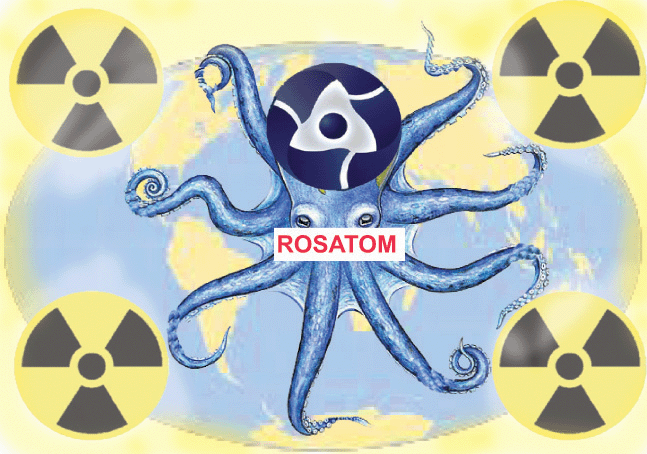
Rosatom, the self-regulated state nuclear enterprise, is led by a former prime minister reporting to President Vladimir Putin and exempted from all normal state controls. Independent experts agree that Rosatom (or any other state entity) would be lucky to build half the 30 additional nuclear projects it’s trying to sell for $300-billion to a dozen more countries including South Africa. Russia’s interest rate in early 2016 was twice (and in an earlier spike, over three times) what any coal-competitive nuclear project would require. The Russian state’s capacity to absorb the spread is quickly vanishing. Russia’s domestic reactor starts halved in 2015; all state nuclear subsidies are to halt in 2016. Yet without those subsidies, “Rosatom wouldn’t complete a single project anywhere”.
Russia needs huge amounts of outside capital to finance its nuclear commitments. …….
Not just Russian but any nuclear new-build is a poor choice for South Africa. It cannot compete with efficiency and renewables, by every relevant measure: cost, timeliness, financing, jobs, economic development, environmental and safety risk, independence, security, abundance of eternally free local energy sources, and the social good of “energy democracy”. These goals support and are advanced by the agenda of “an electricity sector that will deliver, transparently, competitively, reliably and sustainably, the electric services that will power economic growth and improve the welfare of all our people”.
It has come to this: ever more sales-starved nuclear vendors, seeking ever less solvent customers, now offer a risky project the seller can’t finance to a customer who can’t pay – a customer with no need, enchanted by the same nuclear devotees whose broken promises already cost the nation dearly, and with no apparent accountability.
#NukeGate: Shady Offline Negotiations Must Stop, FITS News, 17 Feb 18
More than perhaps any other lawmaker, fiscally liberal state senator Luke Rankin of Horry County, South Carolina bears direct responsibility for the now-notorious “Base Load Review Act.”
This, of course, is the constitutionally dubious, special interest legislation that effectively socialized $2 billion (and counting) worth of investment risk associated with the abandoned V.C. Summer nuclear power expansion project – a.k.a. #NukeGate.
Basically, lawmakers allowed crony capitalist utility SCANA and its state-owned partner, Santee Cooper, to force ratepayers to shell out this cash on a pair of next generation reactors that are now unlikely to ever be completed.
In addition to being a lead sponsor of this legislation in the Senate, Rankin – a party-switching “former” Democrat – was a member of the S.C. Senate judiciary subcommittee that advanced this legislation to the floor of the Senate (where it passed on a unanimous voice vote).
His fingerprints are all over the hated law, in other words.
Same goes for establishment “Republican” senator Larry Grooms of Berkeley County – who joined Rankin and more than a dozen other senators (ahem) in sponsoring this abomination back in 2007.
Why are we singling out Rankin and Grooms today? Because these two politicians – who deserve to be run out of the S.C. State House on a rail for their shortsightedness and subservience to the status quo – are among the state senators currently engaged in offline negotiations to “extricate” the Palmetto State from this $10 billion hole in the ground.
That’s right … the politicians who landed our state in this mess now want us to trust them to dig us out.
Oh, and they want to conduct their negotiations under the cover of darkness …
What could possibly go wrong, right?
We addressed these offline negotiations earlier this week in this piece, and several weeks ago we exclusively reported on another round of offline negotiations involving newly elected state senator Mike Fanning – who represents the district where the abandoned reactors are located.
In fairness to Fanning, he has infinitely more credibility here than either Rankin or Grooms (who ought to recuse themselves from any role in these discussions). Not only does Fanning represent the impacted area, but as a newly elected senator he has no connection to the legislation that created this debacle in the first place.
Still, all of these offline negotiations are problematic …
First and foremost, they are being conducted behind closed doors – which is especially troublesome considering one of the items up for sale is a government-owned utility.
Shouldn’t public officials discussing the possible sale of a state-owned asset conduct their deliberations in the light of day?
The South African civil society groups and opposition parties have been pushing back on government’s plan to add 9 600 megawatts of electricity to the grid through nuclear plants.
Happy Khambule, the political advisor at Greenpeace Africa notes that there is a tough job ahead for the new leadership of the country. “We believe one of the most pressing issues is to start to create stability, increase trust in the country’s government, and to choose a new pathway in establishing transparency and accountability in the energy sector”.
In an interview with the eNCA, Khambule has said that they will utilize all communication platforms at their availability to engage with the relevant government departments in ensuring that Greanpeace influences Ramaphosa’s decisions on energy matters.
Greenpeace Africa also looks forward to the new Integrated Resource Plan and calls on Ramaphosa to “stop that coal”.
Khambule feels that there was a distant relationship between the former president Jacob Zuma and the energy advocacy groups.
“It is time to remove the barriers to renewable energy, which can enable the achievement of universal access to energy and power disadvantaged communities much faster and at a cost South Africans can afford. We call on the President to push ahead with a renewable-powered future that will not leave South Africans in the dark,” this organisation said in a statement.
Ramaphosa recently commented at the World Economic Forum in Davos, that South Africa had “excess power right now and we have no money to go for major nuclear plant building”.
Melita Steele, the senior campaign manager at Greenpeace Africa said, “Greenpeace has long argued that nuclear is never safe, and is simply unaffordable”.
She further said that the organisation looks forward to the updated IRP without the inclusion of crushing nuclear energy investments.
Meanwhile, Ramaphosa will soon elect his new cabinet and the Energy Minister, David Mahlobo is unlikely to retain his position, according to lobby groups and economists.
Wayne Duvenage, the CEO of the Organisation Undoing Tax Abuse told Business Report that Mahlobo has limited experience on energy and his appointment as the Energy Minister was based on Zuma’s interest in speeding up the nuclear deal with Russia. “Ramaphosa will be problematic with him in this regard”.
NFLA 15th Feb 2018, NFLA report on UK National Policy Statement for new nuclear argues it is
‘not needed’ given existing energy efficiency measures and the growing
deployment of cheaper renewable energy alternatives are more effective. The
Nuclear Free Local Authorities (NFLA) publishes today its analysis of the
UK Government’s proposals to develop a new National Policy Statement
(NPS) for the deployment of new nuclear power stations. In its report NFLA
notes that changes in the electricity system have seen renewable energy
deployment rapidly taking place at the same time as its costs have come
down, and at the same time wider energy demand has significantly reduced
compared to government projections. http://www.nuclearpolicy.info/news/nfla-report-uk-national-policy-statement-new-nuclear-not-needed/
President Trump’s $4.4 Trillions Budget Features Soaring Deficits 2 News 13 Feb 18
President Donald Trump is sending Congress a $4.4 trillion spending planthat provides a huge increase in defense spending while cutting taxes by $1.5 trillion over the next decade. The result is soaring budget deficits.
Trump’s first budget last year projected that the government would achieve a small surplus by 2027. But the new budget never gets to balance. It proposes $7.1 trillion in red ink over the next decade, basically doubling last year’s forecast……..
Trump last week signed a $300 billion measure to boost defense and domestic spending, negating many of the cuts in his new budget plan. …..
Meanwhile, the Trump administration wants NASA out of the International Space Station by 2025, and private businesses running the place instead.
Under the proposed budget released, U.S. government funding for the space station would cease by 2025. The government would set aside $150 million to encourage commercial development…..
Altogether, the budget seeks to increase NASA’s budget slightly to $19.6 billion.
And – the Pentagon is proposing to spend hundreds of millions more in 2019 on missile defense.
The budget calls for increasing the number of strategic missile interceptors from 44 to 64. The additional 20 interceptors would be based at Fort Greely, Alaska. Critics question the reliability of the interceptors, arguing that years of testing have yet to prove them effective against sophisticated threats.
The Pentagon also would invest more heavily in the ship-based Aegis system and the Army’s Patriot air and missile defense system. Both are designed to defend against missiles with ranges shorter than the intercontinental ballistic missile that is of greatest U.S. concern in the context of North Korea.
Trump’s proposed 2019 budget calls for slashing funding for the Environmental Protection Agency by more than one third, including ending the Climate Change Research and Partnership Programs.
The president’s budget would also make deep cuts to funding for cleaning up the nation’s most polluted sites, even as EPA Administrator Scott Pruitt says that’s one of his top priorities. Trump’s budget would allocate just $762 million for the Hazardous Substance Superfund Account, a reduction of more than 30%.
Current spending for Superfund is down to about half of what it was in the 1990s. Despite the cut, the White House says the administration plans to “accelerate” site cleanups by bringing “more private funding to the table for redevelopment.”
……Congressman Ruben J. Kihuen issued the statement after the release of President Trump’s 2019 budget proposal which supports plans for an interim storage program and the licensing of the Yucca Mountain geologic repository:
“I am disappointed that President Trump’s latest budget request dedicates $120 million to revive the long-dead nuclear waste repository at Yucca Mountain, money that would be much better spent on research and development of the renewable energy technology that we need to power our clean-energy future. Rather than pursue a realistic attempt to develop a substantive nuclear waste management program, this is a colossal waste of funding that goes directly against the will of Nevadans. I have been proud to help lead the fight against dumping nuclear waste in Nevadans’ backyards, and I will continue working to ensure this project remains dead.”
U.S. Senator Dean Heller released this statement:
“Despite Congress’ refusal to fund the Yucca Mountain project, the Administration is once again prioritizing it. Whether it’s the threat that Yucca Mountain poses to the people of southern Nevada or its potentially catastrophic effect on our tourism economy, I’ve made it clear why Nevada does not want to turn into the nation’s nuclear waste dump,” said Heller. “Under my leadership Congress has not appropriated funding for licensing activities at Yucca Mountain as requested in the last budget, and I’m going to continue to fight to make sure that this project doesn’t see the light of day.”
U.S. Senator Catherine Cortez Masto said in a statement:
“It’s a disgrace that president trump and some members of congress find it acceptable to continue throwing away tax payer money on a failed project.”
Rick Perry beefs up nuclear weapons spending over renewables in fiscal 2019 budget, Washington Examiner, by John Siciliano |
Nearly half of the agency’s budget, $15.1 billion, would be directed “to modernize and restore the nuclear security enterprise aligned with the Nuclear Posture Review and National Security Strategy,” according to a summary. That’s about $1 billion above last year’s proposal.
The Energy Department is clearly emphasizing its national security and nuclear weapons responsibilities over its energy research and development mission in fiscal 2019.
The budget proposal would give the agency’s renewable energy office a $1.3 billion haircut below the fiscal 2017 enacted levels to $696 million……..
nuclear energy gets $757 million, a $259 million boost compared to fiscal 2017 enacted levels, it emphasizes. It’s a boost from Trump’s 2018 fiscal proposal of just $703 million.
Trump budget cuts renewable energy office, ups nuclear weapons spending, Reuters, Timothy Gardner, 13 Feb 18, WASHINGTON – U.S. President Donald Trump’s proposed budget cuts spending by more than 65 percent for a research office on renewable energy and efficiency, reductions a Department of Energy official said reflected the success the bureau has had with electric vehicle batteries and wind and solar technologies…..
The budget is primarily a political document and is not likely to be embraced by Congress, but it represents a starting point for the administration on negotiations. …..
the budget calls for the “termination” of the loans programs and the Advanced Research Projects Agency-Energy, while maintaining the existing loan portfolio and making sure existing awards are completed.
And it calls for a more than 19 percent boost to the fossil energy research and development office to $502 million for making advanced power systems based on fossil fuels like coal and natural gas more efficient.
A nonpartisan research institute decried the proposed cuts.
The Information Technology and Innovation Foundation said the cuts “would undercut progress toward cheaper, cleaner energy in the United States and damage the nation’s prospects for global leadership in key growth industries of the 21st century.”
The White House proposed an overall DOE 2019 budget request of $30.6 billion, a $500 million boost from current levels. That included a nearly $1.2 billion hike, compared to last year’s request, for the National Nuclear Security Administration, to help pay for a revamp of the United States nuclear weapons arsenal.
But the budget cuts funding for the nuclear energy office by $259 million below enacted 2017 level to $757 million. The department handles research and development for advanced reactor technologies.
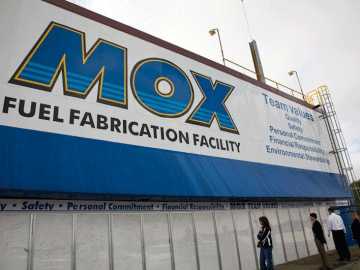
The Department of Energy’s budget request for fiscal 2019 asks for money to close the Mixed Oxide Fuel Fabrication Facility and says the agency prefers the “dilute and dispose” method to dispose of 34 metric tons of weapons-grade plutonium.
“The Budget Request includes $220 million to continue the orderly and safe closure of the Mixed Oxide (MOX) Fuel Fabrication Facility and $59 million to pursue the proven dilute and dispose technology,” Lindsey Geisler, press secretary for the National Nuclear Security Administration, said in a statement. “The administration has proposed termination of the MOX construction project because it is simply unaffordable. We have a proven method called dilute and dispose that is less expensive, has far lower risks, and can be i “The Budget Request includes $220 million to continue the orderly and safe closure of the Mixed Oxide (MOX) Fuel Fabrication Facility and $59 million to pursue the proven dilute and dispose technology,” Lindsey Geisler, press secretary for the National Nuclear Security Administration, said in a statement. “The administration has proposed termination of the MOX construction project because it is simply unaffordable. We have a proven method called dilute and dispose that is less expensive, has far lower risks, and can be implemented decades sooner than the MOX approach.”
The budget request seeks $1.7 billion — $287 million more than last year — to provide support at Savannah River Site for the Liquid Tank Waste Management Program, including “a significant increase” in the production at the Defense Waste Processing Facility and startup of the Salt Waste Processing Facility, according to a DOE fact sheet released Monday.
The MOX project was born from a 2000 non-proliferation agreement between the U.S. and Russia, which called for the removal of 34 metric tons of plutonium from each nation’s arsenal. The MOX project at SRS would convert the plutonium from retired nuclear weapons into a blend with uranium so it can be used in commercial nuclear reactors