DOE Reissues $900M Nuclear SMR Opportunity, Scraps Community Criteria to Focus on Technical Merit
Power, Mar 26, 2025, by Sonal Patel
The U.S. Department of Energy (DOE) has reissued a $900 million funding opportunity to accelerate deployment of Generation III+ small modular reactors (SMRs), removing community benefit requirements and shifting the focus solely to technical merit—a move that reflects the Trump administration’s revised energy and industrial priorities.
The funding opportunity announcement (FOA)—officially designated DE-FOA-0003485—was first issued in October 2024, backed by funds appropriated through the 2021 Infrastructure Investment and Jobs Act (IIJA) and authorized under the Consolidated Appropriations Act of 2024. The effort remains jointly administered by the Office of Nuclear Energy and the Office of Clean Energy Demonstrations (OCED), with technical support from the National Nuclear Security Administration (NNSA)……………………………………………………………………………………………………………………….
Community Requirements Dropped
According to the FOA, eligible Tier 1 projects must feature Generation III+ light-water reactor (LWR) designs ranging between 50 MWe and 350 MWe per unit. (To be considered, total plant output, including process heat loads, must be below 350 MWe.) Projects may involve single-unit or multi-unit configurations with no cap on total site output. Designs must meet a minimum Technology Readiness Level (TRL) of 6, signaling sufficient maturity for system-level validation and procurement.
The FOA also stresses that cost-sharing is a core requirement. “DOE cannot contribute more than 50% of the overall project cost; therefore, the total award value will be no less than $1.6 billion, if the full government share is awarded.” It adds that “DOE will pay out based on previously agreed milestone amounts upon their completion,” and that “the agreed upon milestone payment from DOE cannot account for more than 50% of the project costs incurred in completing the milestone.”………………………………………………………………………………………………………………………………………….
The most prominent change— as highlighted above—is that the March 24 submission formally eliminates all community benefit obligations that were central to the October 2024 solicitation. That includes the removal of the Community Benefits Plan, which had been a required five-page submission outlining how projects would support community and labor engagement, workforce investment, and equity objectives. It also eliminates the “Program Policy Factors” section, which the DOE previously used after technical review to prioritize projects based on geographic diversity, local job creation, engagement with disadvantaged communities, and alignment with broader social goals such as the Justice40 Initiative. The reissued FOA now states that “applications will be evaluated solely on technical merit.”……………………………………………………………………………………………more https://www.powermag.com/doe-reissues-900m-nuclear-smr-opportunity-scraps-community-criteria-to-focus-on-technical-merit/
A nuclear Svengali on Capitol Hill?
Linda Pentz Gunter by beyondnuclearinternational
Attempts by the Breakthrough Institute’s Ted Nordaus to derail NRC commissioner candidacies have met with mixed success, writes Linda Pentz Gunter
We’re getting used to the swagger of entitlement and the complacency of corporate nuclear lobbyists on Capitol Hill. They, in turn, have become accustomed to getting their way — usually through the powerful persuasion of big money or saturation propaganda campaigns financed with those large stashes of handy corporate cash.
But when that isn’t enough, then a nice smear campaign should do. One who appears to enjoy such an endeavor is the Breakthrough Institute’s founder, Ted Nordhaus, who has made it his business of late to decide who does and does not get a commissioner seat at the US Nuclear Regulatory Commission. Those who should not, in Nordhaus’s views, are the Democratic candidates or incumbents who have too much of a regard for nuclear safety as a priority.
Safety is a big ticket item for the nuclear power industry. Literally. Maintaining, upgrading and replacing aging parts in these decades-old dinosaurs of the 20th century, many of them running well past their sell-by date, is an expensive undertaking. But a relaxation of — or looking the other way on — some of those pesky safety regulations would be made easier by more compliant NRC commissioners.
Cue Nordhaus, Capitol Hill’s nuclear Svengali.
His most recent target was Matthew Marzano, the candidate for the long vacant fifth seat on the NRC commission. Nordhaus pulled out all the stops to derail Marzano, beginning last September prior to Marzano’s hearing before the Senate Committee on Environment and Public Works.
Nordhaus prepared a veritable death warrant in which he claimed, among other things, that Marzano would, if approved, be “the least qualified commissioner ever seated on the Nuclear Regulatory Commission”. Nordhaus also wrote that Marzano, if chosen, “will not be a voice for reform and modernization on the commission.”
Never mind that Marzano, who was then an official at the Idaho National Laboratory, has a pretty solid nuclear background, having worked both on commercial reactors and as an instructor for the Naval Nuclear Propulsion Program at the US Department of Energy. (As a side note, this exemplifies once again the two-way street and inexorable link between the civil and military nuclear sectors.)
“Modernization” is Nordhaus’s absolutely most favorite word. He used it, or a derivation of it, nine times in his public assassination-by-blogpost of Marzano’s qualifications (accusations that were obediently re-quoted by senators during Marzano’s hearing.)
“Modernization” is code of course. What it really means is “weakening” or “emasculation,” because what Nordhaus, the Republicans and far too many Democrats are now intent on doing is to transform the NRC from what is already a lame safety regulator into an even meeker nuclear industry lapdog.
The same hand of influence belonging to Nordhaus and his Breakthrough Institute had earlier been felt when legislation was passed on Capitol Hill designed specifically to weaken the NRC. At that time, the Breakthrough Institute railed on its website that the NRC’s “national progress is hindered by its self-imposed narrowly defined mission, primarily concentrated on nuclear safety, which leads to unwarranted delays in reactor licensing.”
Last June, the Senate voted almost unanimously for a bill introduced by Senator Gary Peters, a Democrat from Michigan —S.870 – A bill to authorize appropriations for the United States Fire Administration and firefighter assistance grant programs, to advance the benefits of nuclear energy, and for other purposes. Ostensibly designed to provide improved benefits and safety conditions for firefighters, it included an entire section on the NRC straight from the Nordhaus playbook.
The bill required the NRC to “update the mission statement of the Commission to include that licensing and regulation of the civilian use of radioactive materials and nuclear energy be conducted in a manner that is efficient and does not unnecessarily limit—
(1) the civilian use of radioactive materials and deployment of nuclear energy; or
(2) the benefits of civilian use of radioactive materials and nuclear energy technology to society.”
Afraid of appearing to throw firefighters under the bus, all but two senators voted for the bill. Predictably, the dissenters were Democrat Ed Markey of Massachusetts and independent Bernie Sanders of Vermont, the only consistent anti-nuclear voices on Capitol Hill…………………………………………………………………………………………………………………………..
What has really crippled the nuclear power sector is its exorbitant costs. But the ruse to undermine the NRC and weaken (“modernize” or “reform”) safety oversight is precisely because it is nuclear power’s immense dangers that cause its costs to sky-rocket.
None of this fazes Nordhaus, however, who insists that new reactors constitute “a new generation of even safer reactors” and that nuclear power has “substantial environmental public health benefits”.
The former assertion is strongly challenged by physicists such as Edwin Lyman at the Union of Concerned Scientists and M.V. Ramana at the University of British Columbia, who happen to understand the science and know that the untested, recycled and long ago rejected design ideas for small modular reactors are replete with radiological risks and serious and unsolved uncertainties around safety.
As for the substantial health benefits of nuclear power, perhaps Mr. Nordhaus would like to say that to the (non-White) faces of Native Americans coping with the deadly legacy of abandoned uranium mines and to the mothers of childhood leukemia sufferers living near nuclear plants, who would beg to differ.
This article is adapted from a piece that first appeared in the February/March 2025 edition of Ralph Nader’s newspaper, Capitol Hill Citizen, available in print only.
https://beyondnuclearinternational.org/2025/03/23/a-nuclear-svengali-on-capitol-hill/
What is the fate of Russian-held Zaporizhzhia nuclear power plant after Trump talks?
The Zaporizhzhia Nuclear Power Plant is one of the world’s 10 largest and Europe’s biggest
Hanna Arhirova, Friday 21 March 2025, https://www.independent.co.uk/news/world/europe/ukraine-nuclear-power-plants-trump-putin-b2719353.html
President Donald Trump suggested a potential transfer of Ukrainian power plants to US ownership during a call with Ukrainian President Volodymyr Zelensky, according to a US statement.
The discussion, later clarified by Zelensky, centred on the Zaporizhzhia Nuclear Power Plant (ZNPP), currently under Russian occupation.
While the plant remains connected to Ukraine‘s grid, it is not producing electricity, raising questions about the feasibility and nature of any future US involvement.
The Zaporizhzhia Nuclear Power Plant is one of the world’s 10 largest and Europe’s biggest.
Who controls the Zaporizhzhia Nuclear Power Plant
Located in Ukraine’s southern Zaporizhzhia region, Russian forces occupied it shortly after Moscow’s February 2022 invasion.
While Russia declared the region annexed in Autumn 2022, its largest city, Zaporizhzhia, remains under Ukrainian control.
Ukraine has accused Russia of stationing troops and weapons at the plant and using it as a launchpad for attacks across the Dnipro River. Russia denies this, accusing Ukraine of shelling the facility.
How many nuclear power plants does Ukraine have?
Besides Zaporizhzhia, Ukraine operates three active nuclear power plants, which generate the majority of the country’s electricity following sustained Russian attacks on thermal and hydroelectric plants.
These facilities are located in southern, western and northwestern Ukraine, away from frontline areas.
What did Trump and Zelenskyy discuss and are there negotiations over Zaporizhzhia’s fate?
During their call on Wednesday, Trump suggested that Zelensky should consider giving the US ownership of Ukraine’s power plants to ensure their long-term security, according to a White House statement from US Secretary of State Marco Rubio and National Security Adviser Mike Waltz.
“American ownership of those plants could be the best protection for that infrastructure,” Trump suggested, according to the statement.
Zelensky later told journalists their conversation focused on the Zaporizhzhia nuclear power plant, and the following day, made it clear that “the issue of ownership” of the other three plants was never discussed.
“All nuclear power plants belong to the people of Ukraine,” he said.
Zelenskyy said that when they discussed Zaporizhzhia, the US leader had inquired about the facility’s future. “Trump asked my thoughts on the plant,” Zelensyy said. “I told him that if it is not Ukrainian, it will not operate. It is illegal.”
Even though ZNPP is a state-owned plant, Zelenskyy acknowledged that if the US were to claim it from Russian control, invest in it and modernise it, Ukraine might consider it. “That is a separate question, an open one,” he said.
What is the current state of Zaporizhzhia’s nuclear plant?
Since falling under Russian control, the plant’s conditions have deteriorated. While its six reactors have been shut down for years, they still require power and qualified staff to maintain cooling systems and safety features.
Energoatom, Ukraine’s state nuclear operator, said that after Russian forces took over, Ukrainian personnel were forced to sign contracts with Russian authorities and take Russian citizenship. Those who refused faced abduction or threats, forcing thousands to flee, leaving the facility understaffed and harder to manage.
The collapse of a dam in June 2023 further jeopardised the plant’s cooling systems, which relied on water from the reservoir. In response, plant administrators dug wells, according to the International Atomic Energy Agency (IAEA).
Zelensky said extensive repairs would be needed before the plant could operate again, estimating the process could take at least two years.
The IAEA has repeatedly warned the war could cause a radiation leak. While the plant no longer produces electricity, it still holds large amounts of nuclear fuel, requiring constant cooling.
Regular blackouts caused by the fighting have disrupted the facility, though power has been quickly restored each time.
IAEA experts permanently stationed there still face restricted access, with Russian authorities blocking some inspection requests, according to IAEA head Rafael Grossi.
Is any kind of deal imminent?
Zelensky said the discussions with Trump on restoring Zaporizhzhia were a positive step, but cautioned that no one would work at the plant if Russian forces remained stationed nearby.
Control over the plant is likely to remain a legal and logistical challenge, intertwined with a highly divisive issue for both warring sides: control over the land itself.
Russian troops hold the area, while Ukrainian forces are separated from it by the Dnipro River and more than 100 kilometres (62 miles) of terrain.
Macron ousts EDF boss accused of giving French industry ‘the middle finger’
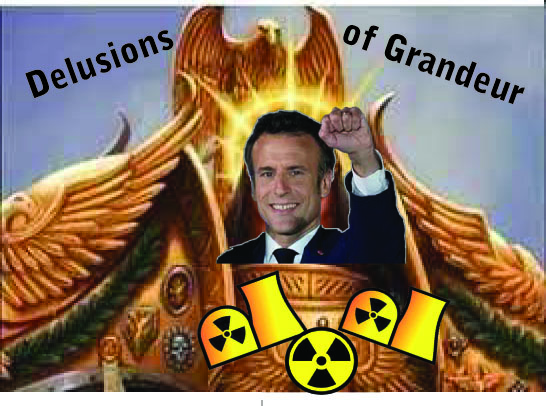
Luc Rémont will be replaced in a reshuffle with factory energy prices set to soar
Alex Singleton, Business Reporter, https://www.telegraph.co.uk/business/2025/03/21/macron-ousts-boss-state-run-edf-french-energy-prices-surge/
Emmanuel Macron has ousted the boss of the state-run EDF after French industrialists revolted over its high electricity prices.
Luc Rémont is to be replaced in a surprise reshuffling of the company’s top ranks, Mr Macron’s office said on Friday. Mr Rémont has run the the state-owned energy giant since November 2022.
The shake-up follows an outcry over the high energy prices EDF is poised to charge factories. Benoît Bazin, the boss of building materials giant Saint-Gobain, had accused EDF of “giving the middle finger to French industry” by increasing prices.
Rules that force EDF to sell energy to major industrialists at below-market prices are set to expire at the end of the year and the generator had announced plans to raise its prices.
Industry group Uniden, which represents dozens of France’s biggest manufacturers including Renault and steelmaker ArcelorMittal, claimed EDF was “deliberately turning its back” on French businesses at a time when manufacturers were “exposed to unprecedented non-European competition that threatens the very survival of many sites”.
The row is embarrassing for Mr Macron, who had pledged to “take back control of electricity prices” and who sees cheap electricity as a way of securing the French economy. Two years ago, he fully nationalised EDF by buying the 16pc of the company the government did not already own.
The shake-up comes days after the Macron administration said it had agreed state financing for six new nuclear reactors to be built by EDF over the coming decades.
Anger over high industrial energy prices is rising in the UK too. UK factories pay 50pc more for electricity than rivals in France and Germany, and four times as much as American plants. High prices have been blamed on net zero and slow-moving plans to expand nuclear power.
Warnings from industrialists that net zero energy policies are damaging the economy have fallen on deaf ears. Ed Miliband, the Energy Secretary, said this week the UK Government was “absolutely up for the fight” over net zero.
EDF is one of the largest players in the UK nuclear power market, after buying three formerly nationalised regional electricity boards and the nuclear operator British Energy.
It is currently building the UK’s first new nuclear power station for over 20 years, Hinkley Point C, and plans to embark on the construction of another, Sizewell C. But in January, the future of this new project was thrown into doubt after the French state auditor warned it against embarking on risky new foreign projects.
EDF declined to comment. The French government has been approached for comment.
Trump eyeing Crimea as ‘international resort’ – Hersh
https://www.rt.com/russia/614596-trump-crimea-resort-hersh/ 21 Mar 25
The renowned American journalist has claimed that the US president wants to do business with Putin.
US President Donald Trump is reportedly considering lifting sanctions against Moscow in order to turn Russia’s Crimean Peninsula into a major international resort, Pulitzer Prize-winning journalist Seymour Hersh has reported, citing a White House official.
Since his inauguration in January, Trump has pursued direct negotiations with Russian President Vladimir Putin to end the conflict in Ukraine. His administration has indicated that it is open to recognizing Moscow’s sovereignty over Crimea and some of the Donbass as part of a potential peace deal.
The Republic of Crimea and the city of Sevastopol officially joined Russia in 2014 following public referendums; they were followed in 2022 by the Donetsk and Lugansk People’s Republics and the regions of Kherson and Zaporozhye. Kiev continues to claim the territories as its own and has vowed to take them back, but Moscow has insisted that their status is non-negotiable.
In a post on his Substack blog on Thursday, Hersh reported that Trump’s broader aim is to improve US-Russia relations through economic cooperation. The president, he says, is seeking to lift sanctions imposed since 2014 and 2022 and “form a partnership with Putin aimed at turning Crimea into a major international resort.” The official source cited in Hersh’s report added that “they might do the same in Donbass.”
The journalist noted that Trump’s approach is markedly different from that of the administration of Joe Biden, with his unnamed source describing the current president as an “economic winner.” Trump’s reported interest in Russian energy and natural resource assets includes oil, gas, and unmined rare earth metals.
Since taking office in January, Trump has reversed several foreign policy positions on Moscow. Following a phone call with Putin in February, US and Russian delegations met in Saudi Arabia, with both sides agreeing to restore diplomatic ties and explore joint business ventures after the Ukraine conflict is resolved.
Trump and Putin held another phone call on Tuesday to discuss a US-proposed ceasefire. According to statements from both sides, the conversation was productive, with Russia agreeing to a one-month halt on strikes against Ukrainian energy infrastructure as talks continue.
Government ramps up nuclear threats ahead of CND Barrow protest

As CND prepares for its national demonstration at the BAE Shipyard, Barrow-in-Furness, on Saturday, 22 March, the government is ramping up nuclear threats to prop up Britain’s failing nuclear weapons programme and justify military spending hikes in next week’s budget.
The recent visit to the BAE Shipyard in Barrow and nuclear base at Faslane by Keir Starmer and John Healey, saw the Defence Secretary claim the weapons could do “untold damage” against countries like Russia in the event of a conflict.
It was also announced that the Port of Barrow, which has built submarines for Britain’s nuclear weapons programme since the 1950s, will be given royal status. This status applies to the dockland where the arms manufacturer’s shipyard is based and not the wider Barrow area.
CND’s protest comes ahead of the Chancellor’s Spring Statement, where it’s expected that billions of pounds will be added to the military budget while brutal cuts are made to overseas aid, and services helping some of the country’s most vulnerable people.
The government argues that increasing the military budget will help revitalise “left behind” industrial towns and the wider economy. But military spending has one of the lowest employment multipliers of all sectors. Towns like Barrow need sustainable and varied forms of employment that put its people and the planet first.
Britain’s nuclear weapons accounts for at least 14% of the MoD’s military expenditure but the most recent annual report by the Infrastructure and Projects Authority (IPA) found that key parts of its nuclear weapons programme are either failing or have major issues. CND is calling on the government to scrap Britain’s nuclear programme once and for all and develop an industrial strategy that generates sustainable economic growth that benefits everyone.
CND 21st March 2025
https://cnduk.org/government-ramps-up-nuclear-threats-ahead-of-cnd-barrow-protest/
Labour ‘utterly wrong’ to double down on costly and immoral nuclear weapons, Scottish Greens say

Chris Jarvis Bright Green 19th March 2025, https://bright-green.org/2025/03/19/labour-utterly-wrong-to-double-down-on-costly-and-immoral-nuclear-weapons-scottish-greens-say/
Scottish Labour is utterly wrong to be doubling down in its support for costly and immoral nuclear weapons that tie us even closer to the extremist Trump administration, the Scottish Greens Co-leader Patrick Harvie has said.
Harvie’s comments followed Scottish Labour leader Anas Sarwar’s support for Trident at last week’s First Minister’s Questions in Holyrood.
Harvie said: “Nuclear weapons have always been a moral abomination. It is utterly wrong for Labour to be doubling down in their support.
“But now, even those who have supported Trident in the past must surely realise that the US is not a reliable ally, and it is simply unsafe to continue nuclear cooperation with them.
“We urgently need to move away from the extremist Trump administration, but maintaining these weapons of mass destruction would leave us tied to him and his dangerous foreign policy.
“Nuclear weapons are incapable of discriminating between military and civilian targets. Their use would cause mass murder and environmental damage on a scale never seen before.
“They are an extortionate and destructive money pit that has already soaked up hundreds of billions of pounds that could have been spent addressing the genuine security needs we have, or, better still, on tackling the cost of living crisis that is plunging thousands of families into totally avoidable poverty.”
BAE: Barrow MP hits out at planned nuclear protest
The MP for Barrow and Furness has hit back at plans for an anti-nuclear
protest outside BAE Systems this weekend. The Cumbria and Lancashire
district of the Campaign for Nuclear Disarmament (CND) will begin their
national ‘Peace Not Weapons’ tour on Saturday, March 22. This will involve
leafletting across Barrow’s town centre, with the main rally coming
together on the High Level Bridge over the Devonshire Dock. Michelle
Scrogham, however, has voiced her opposition to the demonstration,
particularly given the global climate.
NW Evening Mail 19th March 2025, https://www.nwemail.co.uk/news/25016245.michelle-scrogham-utterly-barrow-nuclear-protest/
EDF may get state loan for six new reactors

France’s Nuclear Policy Council – headed by President Emmanuel Macron –
has agreed that a subsidised government loan should be issued to
state-owned power utility EDF to cover at least half the construction costs
of six EPR2 reactors.
World Nuclear News 18th March 2025,
https://www.world-nuclear-news.org/articles/edf-may-get-state-loan-for-six-new-reactors
Canada Pours Nearly $450M into New Nuclear Subsidies
March 18, 2025 The Energy Mix, Author: Jody MacPherson
Canada has announced around C$450 million in new subsidies for nuclear energy, including the reallocation of funds collected from industrial emitters of greenhouse gases, in what the government frames as a bid to enhance energy security and reliability.
Ottawa will lend AtkinsRéalis, formerly SNC-Lavalin Group, C$304 million over four years to finance the development and modernization of a new Canadian deuterium uranium (CANDU) nuclear reactor named MONARK, Energy and Natural Resources Minister Jonathan Wilkinson said in a news release.
But a leading nuclear critic told The Energy Mix the new subsidies will be far from sufficient to bring the new design to life, and the new design is years if not a decade or more away from going into service………………………………………….
Nuclear Cost Concerns
But nuclear is also by far the most expensive way to generate electricity, Susan O’Donnell, an adjunct research professor at St. Thomas University who studies energy transitions in Canada, told The Mix. Ottawa’s funding is “nowhere near the amount” needed to fully develop and build reactors, she said, adding that it will take years to develop the MONARK design toward applying for a licence to build.
O’Donnell pointed to two similar reactors that just came online in Georgia, United States, at a cost of US$35 billion, compared to just $4 billion for the equivalent solar capacity.
“The big nuclear reactors were almost nine times more expensive than solar,” said O’Donnell. “It makes no sense.”
More Federal Cash for SMRs
Canada is also directing $55 million from Environment and Climate Change Canada’s Future Electricity Fund (FEF) to Ontario Power Generation’s Darlington New Nuclear Project for three new small modular reactors (SMRs) that together could power about 900,000 average Ontario homes……………
The SMRs destined for Darlington were designed by GE Hitachi Nuclear Energy, based out of North Carolina, and would require enriched uranium fuel, which Canada cannot produce domestically, reported the Globe and Mail. Wilkinson told the Globe that Canada’s options for enriched uranium include the United States or Russia, and that Canada could develop that capability if necessary, but it was not preferable.
While collaborating on nuclear projects with the U.S. might help eliminate tariffs, he added, “we’re unlikely to be spending an enormous amount of time collaborating with a party that is treating us like an adversary.”
First Nations Concerns
The Canadian Nuclear Safety Commission held its second set of public hearings just over a month ago for the first of the three reactors planned for Darlington. The hearing included presentations from the chiefs of four First Nations—Curve Lake, Hiawatha, Mississaugas of Scugog Island, and Alderville—calling for a new collaborative relationship built on respect, trust, and partnership.
Chief Kelly LaRocca of the Mississaugas of Scugog Island First Nation said “the current relationship is not working effectively.”
Additional Funding Announced
Further funding will also go to SaskPower’s SMR pre-development program. The FEF increased its program funding from $24 million to $80 million.
More federal subsidy support is also destined for Saskatchewan, Alberta, and Ontario. ……..
https://www.theenergymix.com/canada-pours-nearly-450m-into-new-nuclear-subsidies/
Australia: Liberals Against Nuclear launches campaign to return party to core values

Liberals Against Nuclear
A new advocacy group, “Liberals Against Nuclear,” launched today with an advertising campaign aimed at persuading the Liberal Party to abandon its nuclear energy policy position so it can win the coming election.
The group spokesman is Andrew Gregson, former Tasmanian Liberal director, candidate, and small businessman.
“Nuclear power is the big road block preventing the Liberals getting to the Lodge,” Gregson said. “This is big government waste that betrays liberal values, splits the party, and hands Government back to Labor. It’s time for our party to dump nuclear.
“This policy contradicts core liberal principles by requiring tens of billions in government borrowing, swelling the bureaucracy, and imposing massive taxpayer-backed risk.”
The campaign launch includes television advertising, digital content, and billboards questioning the Liberal Party’s support for nuclear. The ads highlight how nuclear energy requires billions in upfront government borrowing, with international experience showing inevitable cost blowouts.
“As John Howard said: “For Liberals the role of government should be strategic and limited.” Yet this nuclear policy gives us bigger government, higher taxes to pay for it, more debt, and less freedom as the state takes over energy production,” Gregson said.
The group warns that the nuclear policy is driving free market and middle ground voters directly to the Teals and other independents in must-win seats. Recent polling shows just 35% of Australians support nuclear energy, with support collapsing once voters understand the policy details.
The group warns that the nuclear policy is driving free market and middle ground voters directly to the Teals and other independents in must-win seats. Recent polling shows just 35% of Australians support nuclear energy, with support collapsing once voters understand the policy details. https://liberalsagainstnuclear.au/
Engie Finalises Agreement To Extend Operation Of Two Belgium Nuclear Plants

By David Dalton, 18 March 2025, Nucnet
Transfer of waste liabilities reduces company’s exposure to future costs
French energy group Engie has formalised a 10-year extension of the Doel-4 and Tihange-3 nuclear power plants in Belgium in partnership with the Belgian state.
The announcement follows approval of the agreement from the European Commission in February and consolidated a preliminary agreement signed two years earlier between the company and Belgian authorities.
The deal includes transferring financial responsibility for nuclear waste and spent fuel, a significant financial issue for both parties. A first tranche of the associated payment has already been made to Engie, with a second due upon reactor restart, scheduled for next November.
Engie said the transfer of all nuclear waste liabilities to the Belgian government means it will no longer be exposed to future waste treatment costs………………..https://www.nucnet.org/news/engie-finalises-agreement-to-extend-operation-of-two-belgium-nuclear-plants-3-2-2025
Trump offers to take control of Ukraine’s nuclear plants in call with Zelensky
President Donald Trump proposed that the United States take control of Ukrainian nuclear power plants to protect them from Russian attacks during a Tuesday call with Ukrainian President Volodymyr Zelensky. Zelensky said Kyiv was “ready” to pause attacks on Russia’s energy infrastructure, a day after Moscow agreed to halt similar strikes on Ukraine.
By: FRANCE 24, Video by: James VASINA, 19 Mar 25
Donald Trump told Volodymyr Zelensky Wednesday that the United States could own and run Ukraine‘s nuclear power plants as part of his latest bid to secure a ceasefire in Russia‘s invasion of its neighbour.
The Ukrainian president said following their call that Kyiv was “ready” to pause attacks on Russia’s energy network and infrastructure, a day after Vladimir Putin agreed to halt similar strikes on Ukraine.
Zelensky also said he had discussed Trump’s power plant takeover plan.
“We talked only about one power plant, which is under Russian occupation,” Zelensky, who was on an official visit to Finland, said during an online briefing, referring to the plant in Zaporizhzhia…………………………………………………………………..
Trump “discussed Ukraine’s electrical supply and nuclear power plants” and said Washington could be “very helpful” in running them,” National Security Advisor Mike Waltz and Secretary of State Marco Rubio said in a joint statement.
“American ownership of those plants would be the best protection for that infrastructure,” it said…………………………………… https://www.france24.com/en/europe/20250320-trump-ukraine-nuclear-power-plants-zelensky
Regulators get targets to cut red tape and boost the economy
Ministers will make Britain’s 16 biggest regulators undergo twice-yearly performance reviews as part of a strategy to speed up big infrastructure projects.
Rachel Reeves will meet UK regulators on Monday after calling for more
action to restrict red tape and spur economic growth. The chancellor argued
that government plans would reduce costly delays and disputes, saving
businesses billions, and said regulators must accept a more streamlined
decision-making process. Reeves is expected to use the meeting to announce
more detail on how the government will cut the cost of regulation by a
quarter and set out plans to slim down or abolish regulators themselves.
High on the chancellor’s target list are the costly hold-ups to major
infrastructure projects when environmental concerns are raised.
Guardian 17th March 2025, https://www.theguardian.com/business/2025/mar/17/reeves-to-outline-plan-to-cut-regulation-costs-and-boost-growth
China, Russia back Iran as Trump presses Tehran for nuclear talks

By Ryan Woo, Xiuhao Chen and Laurie Chen, March 14, 2025,
- Summary
- China, Russia, Iran say talks should be based on mutual respect
- They say ‘unlawful’ unilateral sanctions should be lifted
- China, Russia urge respect for Iran’s right to peaceful uses of nuclear energy
BEIJING, March 14 (Reuters) – China and Russia stood by Iran on Friday after the United States demanded nuclear talks with Tehran, with senior Chinese and Russian diplomats saying dialogue should only resume based on “mutual respect” and all sanctions ought to be lifted.
In a joint statement issued after talks with Iran in Beijing, China and Russia also said they welcomed Iran’s reiteration that its nuclear programme was exclusively for peaceful purposes, and that Tehran’s right to peaceful uses of nuclear energy should be “fully” respected………………………………………………… https://www.reuters.com/world/asia-pacific/china-iran-russia-kick-off-talks-beijing-over-irans-nuclear-issues-2025-03-14/
1 This Month

of the week – Shut Down Drone Warfare!


Tell the Ukrainian Government to Drop Prosecution of Peace Activist Yurii Sheliazhenko

Petition to revoke the licensing of the Near Surface Nuclear Disposal Facility (NSDF) at Chalk River. https://www.ourcommons.ca/petitions/en/Petition/Details?Petition=e-7247
To see nuclear-related stories in greater depth and intensity – go to https://nuclearinformation.wordpress.com
-
Archives
- April 2026 (79)
- March 2026 (251)
- February 2026 (268)
- January 2026 (308)
- December 2025 (358)
- November 2025 (359)
- October 2025 (376)
- September 2025 (257)
- August 2025 (319)
- July 2025 (230)
- June 2025 (348)
- May 2025 (261)
-
Categories
- 1
- 1 NUCLEAR ISSUES
- business and costs
- climate change
- culture and arts
- ENERGY
- environment
- health
- history
- indigenous issues
- Legal
- marketing of nuclear
- media
- opposition to nuclear
- PERSONAL STORIES
- politics
- politics international
- Religion and ethics
- safety
- secrets,lies and civil liberties
- spinbuster
- technology
- Uranium
- wastes
- weapons and war
- Women
- 2 WORLD
- ACTION
- AFRICA
- Atrocities
- AUSTRALIA
- Christina's notes
- Christina's themes
- culture and arts
- Events
- Fuk 2022
- Fuk 2023
- Fukushima 2017
- Fukushima 2018
- fukushima 2019
- Fukushima 2020
- Fukushima 2021
- general
- global warming
- Humour (God we need it)
- Nuclear
- RARE EARTHS
- Reference
- resources – print
- Resources -audiovicual
- Weekly Newsletter
- World
- World Nuclear
- YouTube
-
RSS
Entries RSS
Comments RSS
 nuclear-news