nuclear-news

The News That Matters about the Nuclear Industry Fukushima Chernobyl Mayak Three Mile Island Atomic Testing Radiation Isotope

Hinkley point nuclear project grinds onwards through a sea of problems

 NuClear News No.107 May 2018

EDF has detected quality deviations on certain welds at its new Flamanville-3 reactor – an EPR – the same type of reactor as the two being built at Hinkley Point. It has informed the French nuclear safety regulator ASN. Possible adjustments to the start-up timetable and costs can only be made after further checks and the licensing process by the ASN.

Flamanville-3 is currently expected to reach full power in Q4 2019 with fuel loading and first hot tests scheduled at the end of 2018. The quality deviations concern the welding of pipes on the main secondary system and are in addition to a deviation with respect to the correct application of “high-quality” requirements of the main secondary system that EDF flagged on February 22 to the ASN.

EDF has decided to carry out additional controls on the 150 welds in question and has ordered a full report into the causes and nature of the deviations. The additional controls and report will be completed by the end of May. The construction cost is currently estimated at £9.2bn. (1)

 When EDF first reported welding problems on Feb. 22, it initially said there would be no impact on safety, costs or the reactor start-up schedule. However, France’s ASN nuclear regulator warned on Feb. 28 that the substandard welding could well have an impact the start-up. Even before the welding problems emerged, ASN had warned several times the reactor’s construction schedule was tight. “Following the current checks and the licensing process by the ASN, EDF will be able to specify whether the project requires an adjustment to its timetable and its costs,” (2)

The welding revelations come just a few short weeks after Britain’s nuclear regulator raised concerns about substandard quality control checks on EDF’s supply chain for Hinkley Point (See nuclear News No.106)

25 years after French engineers began working on the EPR, they have yet to get one running. Flamanville was due to start up in 2012 at a cost of €3.3 billion. EDF now hopes to switch it on next year and says that the reactor will cost €10.5 billion, though these targets could slip further in light of the latest setback.

Flamanville has faced several other setbacks, the most serious of which was the discovery that the reactor vessel was weaker than planned because of an excess carbon content. A raft of quality control failings at the Creusot Forge plant that made the vessel were found, including falsified documents. This triggered the Office for Nuclear Regulation’s decision to review the Hinkley Point supply chain, leading to a critical report last month.

The Times said one Flamanville is quite enough: The 1,650 megawatt European pressurised reactor is a mere six years late and three times over budget. And all the more exciting for it being the prototype for an even bigger nuclear disaster: the £20 billion, 3,200MW Hinkley Point C. At least the French nuclear guinea pig is finally on its home run, due to be loaded up with nuclear fuel in the last quarter of this year. Always assuming that EDF can sort out the dodgy welding on the cooling pipes. Anyway, it’s another EDF success story, up there with the carbon spots on the steel for Flamanville’s nuclear dome, the ones that potentially weakened it. Or the lost safety records from its Creusot Forge supplier. And it does make you think. It’s bad enough Theresa May signing us up to the world’s most financially radioactive energy project, without monthly reminders of EDF’s technical ineptitude. (4)

Hannah Martin, head of energy at Greenpeace UK, said: “The reactor destined for Hinkley Point was supposed to be cooking turkeys by Christmas 2017. As yet more construction flaws are revealed at its sister plant under construction in France, it’s starting to look like the only turkey the EPR reactor design is going to cook is EDF.”

 Commenting on the news about defects in welding Stop Hinkley spokesperson Roy Pumfrey said

“The European Pressurised Water Reactor (EPR) reactor proposed for Hinkley Point C is like watching a car crash in slow motion. It is the unloved, unwanted, and unbuildable child of former EDF boss Vincent de Rivas. We can still stop this before it gets even worse. Although abandoning this ill-fated project now would incur cancellation costs consumers could still save almost £1.5bn per year for 35 years from 2027 onwards. Flamanville is seven years late, one in Finland is ten years late and even two in China will be at least five years late.” (5)

Dave Toke, reader in Energy Policy at Aberdeen University says the welding problems could spell the end for Hinkley C. Treasury backed loan guarantees have been linked to a target date for commissioning of the Flamanville plant of the end of 2020. Yet the current target date of completion by the end of 2019 has been thrown in doubt by the freshly announced problems. According to the analyst Professor Steve Thomas, the rules agreed between the European Commission and the British Government stipulate that until Flamanville 3 was in commercial service, there would be a cap on the guaranteed loans effectively meaning funding would be primarily through equity. It is very difficult to see how EDF could build the plant without the Treasury loan guarantee – something like £17 billion (probably more) would be needed as a loan. EDF just won’t have the ability to raise anything like £17 billion on the bond markets. Indeed the decision to go ahead with preliminary works on the site (building a jetty and a cement works) alone, without the loan guarantee being in place, was regarded as so risky that the firm’s Finance Officer resigned in protest at the decision. But EDF will not start building the main parts of the power station until it has the necessary finance. (6)

New problems have arisen at the EPR in Finland where TVO is carting out hot tests at Olkiluoto 3. The connection line of the main pipework of the plant, the reactor cooling circuit, vibrates more than allowed. According to the Finnish regulator, STUK, the reason for the vibration is still under investigation. (7)

China has begun loading fuel at its EPR at Taishan – a sign that the long-delayed project could finally be close to completion. Fuel loading could take several months, meaning the reactor could go into full operation and be connected to the grid before the end of the year. China began building the EPR in Taishan in 2009, with the first of two units originally scheduled to be completed in 2013. (8)

Meanwhile, the Irish Parliament’s (Oireachtas) Joint Committee on Housing, Planning and Local Government decided to investigate the possible transboundary effects on Ireland of Hinkley Point C. Professor John Sweeney of the National University of Ireland at Maynooth, Professor Stephen Thomas of Greenwich University and Attracta Ui Bhroin of the Irish Environmental Network were invited to give evidence. The meeting coincided with a recent consultation, organised by the Irish Government and facilitated by Irish Councils, that allowed environmental groups and concerned members of the public to put forward their concerns to the UK Government over the transboundary effects of the proposed Somerset new nuclear site. (9)

Attracta Uí Bhroin, of the Irish Environmental Network told the Committee that her intention was not to panic people or cause unnecessary concern, but her organisation wants to ensure Irish people’s rights are upheld. Although the process for the new nuclear site at Hinkley Point, which is 250km from the coast of Ireland, began five years ago, it was only in 2016 that the news about the plans broke. Hinkley Point C was given the final investment approval by French energy giant EDF, which has a two-thirds share and which is building the plant in conjunction with a Chinese company. Speaking to TDs and senators Uí Broin pointed out that of the eight power plants the UK has planned as part of its energy expansion, “five are on the west coast of the UK, facing Ireland on the most densely populated east coast”. Some of these plants are planned in locations closer than Hinkley Point C. The potential economic impact of a nuclear leak or meltdown could be very serious, she explained.

A 2016 ESRI report considered a scenario where there was a nuclear incident, but with no radioactive contamination reaching Ireland. “Even then they estimated that impact economically could be in the order of €4 billion,” she said, explaining that an incident such as this would have serious implications for the agrifood and tourism industries in Ireland. In the event of an incident where there is a risk of contamination, she said there are no detailed plans in place to protect Irish people, the water supply, or the country’s farm animals and produce.

Uí Bhroin was joined by Professors John Sweeney and Steve Thomas, who outlined some of the specific concerns around safety assessment and treatment of waste. Sweeney was critical of the models used in risk assessments – some older models were used in calculations, for example, despite the fact that more modern ones exist. Thomas spoke about some of the parts of the plant which are being made in France and which French regulatory authorities will not a clear for use in French nuclear plants. Uí Bhroin said there was an “extraordinary level of frustration, anger and disappointment” among environmental groups at the government’s reaction to these plans. (10)

Prof Thomas added that the reputation of both Flamanville and Hinkley’s supplier “is in tatters” after it emerged in 2015 that parts of the safety-critical reactor vessel supplied to Flamanville did not meet specification, he said. The French nuclear safety regulator, ASN, ordered the company to review its quality control procedures and “it has emerged that quality control documentation had been falsified at Creusot” for several decades, he added. In April 2018, EDF Energy also announced that up to 150 welds in key parts of Flamanville did not meet the required specification. Prof Thomas added: “This has created major concerns about parts manufactured there for nuclear plants in France and elsewhere.” (11)

John Sweeney, emeritus professor of geography at Maynooth University and a climate change expert, told the Oireachtas committee on planning yesterday that estimates used by the UK to assess its impact were not credible. “Combinations of rare events do occur, as was demonstrated by Fukushima [the nuclear incident in Japan in 2011], where total atmospheric releases are now estimated to be between 5.6 and 8.1 times that of Chernobyl,” Professor Sweeney said. Meteorological data used was “inadequate”, he added, arguing they relied on wind figures for three years when 30 years was the standard period required. “It’s rather dangerous to draw conclusions from a very short period. Three No2NuclearPower nuClear news No.107, May 2018 12 years of data, even ten years of data, is insufficient to characterise the wind climate at an individual location, and any modelling based on this is highly suspect.” He claimed the UK government failed to take account of climate change in estimating extreme high and low water levels when the difference between the annual high water mark and a once in a 10,000-years high water level at the site of the plant was just 1.3 metres. The Intergovernmental Panel on Climate Change predicted sea levels would continue to rise for centuries, with increases of up to three metres possible, which meant the UK’s estimates were not credible, he said. He claimed the failure to acknowledge that there was a known flood risk meant there were “serious implications for the safety of spent fuel which is intended to be stored on site for up to a century” (12) http://www.no2nuclearpower.org.uk/wp/wp-content/uploads/2018/05/NuClearNewsNo107.pdf

May 19, 2018 Posted by | politics, UK | Leave a comment

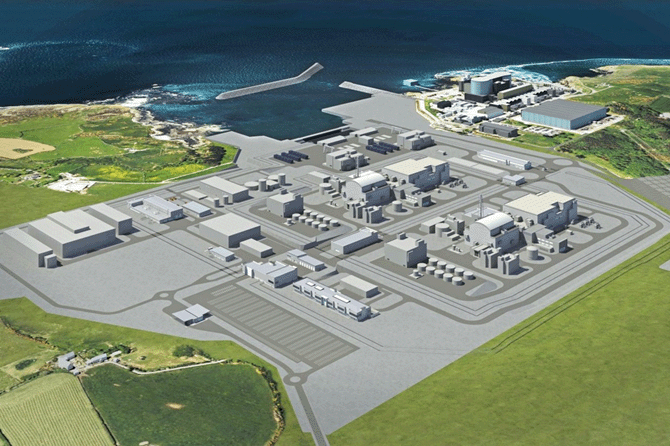
The British government has offered 2 trillion yen ($18 billion) to Hitachi to built Wylfa nuclear power station

British government offers $18 billion to Hitachi’s UK nuclear project: Kyodo, Reuters Staff TOKYO (Reuters) 17 May 18 – The British government has offered 2 trillion yen ($18 billion)in financial support to a unit of Japan’s Hitachi Ltd (6501.T) to build nuclear reactors in Wales, Kyodo News reported on Thursday.

…….. The British government is offering support in loans and other ways to Hitachi unit Horizon Nuclear Power to cover a large proportion of the cost of its Wylfa Newydd project in Wales, Kyodo reported, citing a source close to the matter.

…….. Hitachi could decide as early as this week whether to go ahead, Kyodo said. It said the government’s offer was aimed at easing concerns about rising cost expectations, which have increased to 3 trillion yen.

A Hitachi spokesman declined to comment when contacted by Reuters.

The Kyodo report cited unidentified observers questioning whether the government would be able to carry out the offer, due to parliamentary opposition.

The British government played down a Japanese media report last week which said it would guarantee loans for the construction of the two reactors in Wales.

Britain is seeking new ways to fund nuclear projects after drawing criticism over a deal awarded to France’s EDF (EDF.PA) to build the UK’s first nuclear plant for 20 years, which could cost 30 billion pounds ($40 billion).

Hitachi’s Horizon plans to construct at least 5.4 gigawatts of nuclear capacity at two sites in Britain – the first at Wylfa Newydd, and the second at Oldbury-on-Severn in England…….. Reporting by Aaron Sheldrick and Kiyoshi Takenaka; additional reporting by Nina Chestney in London; editing by Christian Schmollinger, Jason Neely and Dale Hudson https://www.reuters.com/article/us-britain-nuclear-hitachi/british-government-offers-18-billion-to-hitachis-uk-nuclear-project-kyodo-idUSKCN1II17C

May 18, 2018 Posted by | politics, UK | Leave a comment

A New ‘Screw Nevada’ Bill Passes the House

A New ‘Screw Nevada’ Bill Passes the House

On Thursday, May 10, the  U.S. House of Representatives approved the Nuclear Waste Policy Act of 2018 – HR 3053 – by a vote of 206 to 179, with 94 Democrats and 85 Republicans voting ‘Nay.’

Now, what some Nevadans have dubbed, ‘The Screw Nevada Bill 2.0,’ will go to the Senate, perhaps in this Session.

According to the Las Vegas Sun, just as with the first attempt to push it as the national high-level radioactive waste repository, opposition in Nevada continues to be strong.

In a letter to House leaders, the Las Vegas Metro Chamber of Commerce made the quite logical point that,

Nevada is ranked by the U.S. Geological Survey as the fourth most active seismic area in the United States. The potential for seismic activity in the region raises serious questions about the logic and prudence of storing nuclear waste at Yucca Mountain. Seismic activity in the region is another reason why Yucca Mountain is not a feasible or practical site for the storage of nuclear waste.

And in their own letter to the House, Las Vegas business owners made it clear that,

We stand with the many concerned citizens, small-business operators and bipartisan members of the Nevada delegation in staunch opposition to any attempt to restart the repository licensing process and will work tirelessly to ensure that radioactive waste is never stored anywhere near the world’s entertainment capital in Las Vegas.

The Shimkus Bill

Named for its author, Illinois Rep. Congressman John Shimkus, the legislation seeks to renew the licensing and funding process to re-open Yucca Mt., and authorize a so-called Centralized Interim Storage (CIS) program that would trigger massive, on-going shipments of high-level radioactive wastes on the country’s poorly-maintained network of highways, bridges and rail lines, through major population centers, for many years to come.

Grassroots nuclear safety advocacy groups have variously dubbed the plan ‘Mobil Chernobyl’ and ‘the Fukushima Freeway.’  Each of the 10,000 plus shipments would contain roughly the same amount of radioactive Cesium as was released by Chernobyl, and as much plutonium as was in the Hiroshima bomb.

To some, it may seem ironic that, as China moves ahead on its ‘One Belt, One Road’ initiative, known as the ‘New Silk Road’ – a trade and transport network across Eurasia, Africa and beyond – forces in the U.S. are hard at work to establish a network of ’new nuke roads’ all across America.

Revisiting the Sad, Silly Saga of Yucca Mountain

In Nevada, just across the California border, sits a volcanic formation called Yucca Mountain.  It’s in a region of ongoing volcanic and earthquake activity, on land long held sacred – and still claimed as tribal land according to the 1863 Treaty of Ruby Valley – the Western Shoshone and the Southern Paiute.  Largely composed of a porous material called volcanic tuff, the mountain is permeable to water penetration and sits in close proximity to an aquifer extensively used by regional inhabitants – both native American and white – for their drinking and agricultural water supplies.

Yucca is located about 90 miles northwest of Las Vegas in what’s called the Great Basin, south of the Nevada Test and Training Range in the Nevada National Security Site, where over a hundred atmospheric and underground nuclear bomb tests were carried out for decades.  It is, in large part, already a national nuclear ‘sacrifice area.’

In the government’s search for permanent deep geological repositories in which to bury the country’s energy and weapons waste that it pledged to take possession of and responsibility for, the government’s original goal was to identify and ‘scientifically characterize’ at least two sites, one east, one west of the Great Divide.

As the process played out over the years, however, it came to be more one of politics than of science.  Of the nation’s 99 licensed, operating reactors, less than a dozen are West of the Mississippi.  The so-called ‘NIMBY’ or ‘Not In My Backyard’ syndrome kicked in big time.  Eventually just three potential sites were identified, all in the west: in Texas, Washington and Nevada – with the latter being at the time the state with the least political clout.

Thus, in 1987, came to be passed the first, now infamous “Screw Nevada” bill.

Though Nevada has no nuclear power plants of its own, its Yucca Mountain site became the sole target for waste from all the nation’s nuclear energy and weapons-producing states.  Millions of dollars were spent in an attempt to justify ‘scientifically’ a site that had actually been chosen politically.

But then, for a while at least, the political balance of power changed.  Enter Nevada Senator Harry Reid.

As an erstwhile Democratic power broker, Reid secured a pre-election promise from then-candidate Obama to shutter the Yucca project in return for electoral support.  Once in the White House, President Obama actually kept his promise.  In 2009, the project was effectively terminated: its staff scattered to other employment, its equipment sold off, its infrastructure allowed to sink into desuetude, the site effectively abandoned.  Just a big, expensive hole in the volcanic tuff, a monument to the nation’s on-going nuclear follies.

Then the political balance of power picture changed again with Senator Reid’s retirement and the GOP/Trump ascendancy.

Back in 2014 the unashamedly ‘captive regulatory agency,’ the Nuclear Regulatory Commission (NRC), had set the stage for a potential Yucca revival by releasing a long-delayed report concluding that the Department of Energy had “demonstrated compliance with NRC regulatory requirements” that would limit leakage from the repository for the long-term.

A New York Times headline of the day trumpeted, “Calls to use Yucca Mountain as a nuclear waste site, now deemed safe.” Rep. Congressman John Shimkus – from the nation’s most densely nuclearized state, Illinois – exulted, “Today’s report confirms what we’ve expected all along: Nuclear waste stored under that mountain, in that desert, surrounded by federal land, will be safe and secure for at least a million years.”

The Distinguished Gentleman from Illinois then introduced H.R 3053, the Nuclear Waste Policy Amendments Act of 2018, which passed the House today.

Close analysis of the Shimkus Bill reveals that, if passed in its present form, it will:

  – Preempt or jeopardize existing federal, state and local water and air rights, and rights to oversight, input, transparency, and other rights, including congressional oversight.

  – Remove storage and transport safety requirements needed to prevent radioactive leaks.

  – Provide inadequate funding to transport and store nuclear fuel waste.

  – Make federal reimbursement for nuclear waste storage discretionary instead of mandatory.

  – Allow ownership of nuclear fuel waste to be transferred to the Department of Energy (DOE) at existing nuclear utility sites, making them vulnerable to insufficient funding for nuclear waste storage. Current DOE nuclear waste sites have repeatedly leaked radiation into groundwater and air partly because of this.  https://sanonofresafety.org/

Once upon some indefinite future date, when Yucca is deemed ready to take all that waste from ‘interim’ sites, it is slated to be moved again, for ‘permanent isolation’ in the site’s volcanic tuff.

There are many problems with this rosy scenario, of which more below.  But chief among them, according to many critics – including former NRC Commissioner Victor Gilinsky – is that “The NRC staff did not explain, and no one in the media seems to have caught on, that its favorable conclusion reflected the Energy Department’s pie-in-the-sky design for Yucca Mountain—not the repository as it is likely to be configured.

In his 2014 article in the Bulletin of Atomic Scientists, ‘Yucca Mountain redux,’ Gilinsky explains,

The [actual] likely repository configuration doesn’t come close to meeting NRC requirements.  The key design element in question is something the Energy Department calls a “drip shield.” This is a kind of massive, corrosion-resistant titanium alloy mailbox that is supposed to sit over each of the thousands of waste canisters in Yucca Mountain’s underground tunnels. In NRC’s definition, it is designed “to prevent seepage water from directly dripping onto the waste package outer surface.”

The name drip shield itself is a giveaway that there is a water problem at Yucca Mountain. There is indeed a lot more water, and it is flowing faster, than the Energy Department imagined when it picked the site, which is why it added the drip shield to the original design. Without the titanium shields, dripping water would corrode the waste canisters placed in the repository and release radioactive waste, and the moving underground water would carry it to the nearby environment.

Using the corrosion data in the Energy Department’s license application, one can calculate that this corrosion would take not the “million years” cited by Mr. Shimkus, but about 1,000 years.

Nonetheless, the NRC-approved DOE plan – in an apparent attempt to make up-front costs more palatable to Congress – does not call for the installation of the ‘drip shields’ until a hundred years have passed.

Gilinsky concludes, “If you look more closely into the situation, you can’t escape the conclusion that it is highly implausible that the drip shields will ever be installed. In fact, as a practical matter, it may not even be physically possible to install them.”

Pie-in-the-Underground

Will the DOE, or the US government even exist in a hundred years?  Will the know-how, institutional memory, technology, manufacturing base and funding still be available at that distant date to build the necessary infrastructure to allow robots to enter the highly radioactive, probably geologically degraded and possibly collapsed repository tunnels to perform the intricate operations required to install hypothetical ‘drip shields’ that have not as yet even been designed or fabricated?

And what deadly, irremediable leakage into the environment will by then have occurred?

Ian Zabarte, spokesperson for the Western Shoshone, calls this environmental racism.

Meanwhile, the bureaucratic, technological, budgetary and political impediments to actually restarting the project are legion, and sure to delay any real progress for years, if not decades.

Based on its record, there’s no use expecting the Nuclear Regulatory Commission (NRC) to act in the interest of public safety.  Gilinsky points out that,

A truly independent regulatory agency—one truly representing the public interest—would not have been silent on the low likelihood that drip shields will ever be installed and would have insisted on getting the Energy Department’s calculations on what happens if the drip shields don’t get installed. What it comes down to is this: The NRC is going along with a shell game to advance the political fortunes of the Yucca Mountain project.

CIS – A Nuclear Shell Game – Fighting ‘Fukushima Freeway’

So just imagine, if you dare, the following proposed harebrained scenario known as ‘Consolidated Interim Storage’ or CIS:

For decades to come, ultra-heavy shipments of thousands of metric tons of high-level radioactive waste will become a common daily occurrence on America’s already rickety roads, railways and collapsing bridges, headed for the Southwest.

They will pass un-announced – but probably easily identified by those who know what to look for – through our nation’s towns and densely populated urban areas, vulnerable to human error, accidents and terrorist attacks.

Their deadly radiation fields – extending for a yard in every direction – will shower train passengers and motorists, unlucky enough to share those routes and be close enough, with DNA and immune system damage.

The shipment carriers will pull into gas stations, truck stops and roadside rest areas, exposing the luckless families, children and pregnant women nearby using those same facilities.

Then, if they do manage to reach their temporary, ‘interim’ waste consolidation sites without catastrophe, they will eventually hit the road again, on their way to the mythical Yucca repository.

Local Opposition

Eighty percent of Nevada residents and elected officials strongly oppose this Yucca reboot plan.  As before, their legal and technical opposition will prevent the plan from going forward for many years.  Additionally, a new railroad line would need to be built through several mountain ranges at great expense.  Will Congress provide the funding?

But, what might be more immediately enabled, are two proposed ‘interim storage facilities’ currently seeking NRC license approval on either side of the New Mexico-Texas border.  A few politicians are promoting these sites as ‘good for the local economy,’ but public opposition is strong among those who know about the plan – including the region’s growers, dairy ranchers and especially oil men for whom the region is a fracking and drilling cash cow.

Both proposed sites are in what locals call ‘Nuclear Alley,’ just down the road from the Urenco uranium enrichment plant and the infamous Waste Isolation Pilot Project (WIIP), site of the recent nuclear ‘cat litter’ explosion.

If approved as part of the Shimkus Bill’s Consolidated Interim Storage provision, these ‘parking lot’ dumps could well become the nation’s de facto permanent radioactive waste depository, in the very likely event that Yucca never gets built.

More on that in future articles, except to note that the dire implications of CIS and its ‘Fukuishima Freeway’ failed to be acknowledged in the House’s approval of HR 3053.

For more, check out the Nuclear Information and Resource Service’s Don’t Waste America page.

James Heddle is a filmmaker and writer who co-directs EON – the Ecological Options Network with Mary Beth Brangan.  Their forthcoming documentary SHUTDOWN: The California-Fukushima Connection is now in post-production.  He can be reached at  jamesmheddle@gmail.com

May 18, 2018 Posted by | politics, USA | Leave a comment

Donald Trump is being manipulated by both Kim Jong Un and his own security adviser John Bolton

On North Korea, Trump is getting played by both sides, WP,     May 16

Since the moment he agreed on a whim to a summit between himself and Kim Jong Un, President Trump has been almost giddy about the breakthrough he’s about to achieve, even musing about his upcoming Nobel Peace Prize.

But like everything about being president, it’s turning out to be more complicated than Trump understands. Today he’s getting a reminder:

North Korea is rapidly moving the goal posts for next month’s summit between leader Kim Jong Un and President Trump, saying the United States must stop insisting it “unilaterally” abandon its nuclear program and stop talking about a Libya-style solution to the standoff.

The latest warning, delivered by former North Korean nuclear negotiator Kim Gye Gwan on Wednesday, fits Pyongyang’s well-established pattern of raising the stakes in negotiations by threatening to walk out if it doesn’t get its way.

This comes just hours after the North Korean regime cast doubt on the planned summit by protesting joint air force drills taking place in South Korea, saying they were ruining the diplomatic mood.

The North Koreans actually have this in common with Trump, who also likes to use threats to walk away as a negotiating tactic………

Trump… has been hyping the possibility of an agreement that results in North Korea giving up its nuclear weapons to an almost absurd degree, given how often these kinds of deals have failed in the past. He clearly wants a “win” he can proclaim as something he accomplished when no other president could. And Kim will use that desire against him.

What does Kim want? Economic assistance and an end to sanctions, obviously. He also wants a summit alongside the leader of the global hegemon, which would grant him enormous prestige. That’s something the United States has withheld from North Korea in the past, but Trump has already granted it. And above all, Kim wants to ensure his own survival and that of his regime.

Which is why most everyone except Trump seems to realize that there is no way Kim is going to give up his nuclear weapons, which he sees — quite rationally — as a guarantee against foreign invasion or a move to depose him.

Here’s where we see how Trump is being played from the other side, most specifically by his new national security adviser, John Bolton. Bolton, who has long advocated that we start bombing North Korea at the earliest possible opportunity, made a point of saying publicly that we should look as a model to the arrangement made with Libya in 2003, in which it gave up its nuclear weapons program in exchange for sanctions relief and a reintegration into the international community.

Which, if you knew nothing about anything, might sound perfectly fine. But to the North Koreans, there’s almost nothing more provocative you could say than bringing up Libya. North Korean officials regularly cite the experience of Libya as precisely the reason they won’t give up their nuclear weapons. Moammar Gaddafi did so, and what happened to him? He was deposed and killed. The same fate befell Saddam Hussein.
……. Given his desire for a military strike, it seems at least possible, and perhaps likely, that Bolton is trying to plant the seeds of doubt that will ultimately result in a breakdown of talks, after which he can say to the president, “Well, sir, we tried. But you see how unreasonable they are. We have no choice but to strike now.”

……. it’s entirely possible Trump will make some kind of agreement in which the North Koreans pledges to do something that costs them little — curtailing future missile tests, leaving the size of their arsenal where it is now — and which they might renege on anyway, just so he can say he got a win and tell everyone he’s the greatest negotiator in history. North Korea, like everyone else in the world, is realizing not just that this isn’t true, but also that Trump actually believes it — and that as a result, it won’t be that hard to manipulate him. https://www.washingtonpost.com/blogs/plum-line/wp/2018/05/16/on-north-korea-trump-is-getting-played-by-both-sides/?utm_term=.0f959b7bcd80


May 18, 2018 Posted by | politics, USA | Leave a comment

Despite costs, safety concerns, waste problem – Japan sets ambitious nuclear energy targets

Business Insider 16th May 2018 , Japan’s government has proposed an energy plan that sets ambitious targets
for nuclear energy use in the coming decade despite challenges after the
2011 Fukushima disaster. The draft, presented Wednesday to a
government-commissioned panel of experts, says that by fiscal 2030 nuclear
energy should account for 20-22 percent of Japan’s total power generation.
The Cabinet is expected to approve the plan within weeks.

The targets appear difficult to achieve given that electric utilities are opting to
scrap aging reactors rather than pay higher costs to meet post-Fukushima
safety standards. Uncertainty over what to do with massive radioactive
waste in the crowded island nation is another big concern.
http://uk.businessinsider.com/ap-japan-draft-plan-sets-ambitious-targets-for-nuclear-energy-2018-5

May 18, 2018 Posted by | Japan, politics | Leave a comment

In UK Parliament Greens Party demands the government comes clean about funding Hitachi for nuclear project

Daily Post 14th May 2018 , Demands have been made by the Green Party for an ‘urgent debate’ on whether
the UK Government is offering a package of financial support to build Wylfa Newydd.

The Daily Post reported this month that Prime Minister Theresa May
was meeting Hitachi Chairman Hiroaki Nakanishi for crunch talks on funding
for nuclear reactors. There were warnings Hitachi could withdraw from the
multi-billion pound Horizon Nuclear Power ventures on Anglesey and in
Gloucestershire unless assurances were made on finances.

There have been reports in the Japanese press that the UK government has agreed to offer
financial guarantees for the project. But a spokesman for the Department
for Business, Energy, and Industrial Strategy(BEIS), said: “We don’t
recognise these reports.”

Now Green MP Caroline Lucas has demanded a
meeting to clarify the Government’s position. She tweeted: “This is
absolutely outrageous. “The government is planning to plough billions of
pounds of taxpayers’ money into failing nuclear without any transparency
or scrutiny. I’m calling for an urgent debate on this in parliament.”
https://www.dailypost.co.uk/business/business-news/demand-urgent-debate-whether-uk-14656243

May 16, 2018 Posted by | politics, UK | Leave a comment

Minnesota Senate passes legislation that would change approval process for Xcel nuclear costs

 Legislation’s foes fear it would shift risk from shareholders to ratepayers , By Mike Hughlett Star Tribune, MAY 14, 2018 

May 16, 2018 Posted by | psychology and culture, USA | Leave a comment

South Africa’s Energy Minister goes very quiet about nuclear power, at African Utility Week

Jeff Radebe distinctly quiet about nuclear power at African Utility Week https://www.businesslive.co.za/bd/national/2018-05-15-jeff-radebe-distinctly-quiet-about-nuclear-power-at-african-utility-week/

The energy minister spoke extensively about successes in renewables and made no mention of nuclear power, at the conference in Cape Town, 15 MAY 2018  TANYA FARBER 

Just hours after being sworn in as acting president‚ Jeff Radebe nailed his colours to the renewable energy mast at African Utility Week, on Tuesday.

Radebe was speaking at the Cape Town International Convention Centre‚ where 7‚000 delegates from around the world gathered to talk about water‚ energy and power.

The energy minister‚ who is acting president while President Cyril Ramaphosa and Deputy President David Mabuza are out of the country‚ spoke extensively about successes in renewables and made no mention of nuclear power.

“To date we have concluded 91 projects with a capacity of 63‚000 megawatts (MW). Sixty-two of these projects have the combined capacity of 3‚800MW, which already is connected to the grid‚” he said.

He told delegates that SA had seen a “significant decline in tariffs of about 55% for wind and 76% for solar” energy. About R136bn had been invested in renewable energy‚ with another R56bn to be spent over the next 3-5 years, when the construction of 27 renewable power projects — signed off in April — will begin.

These projects would save water‚ create 39‚000 jobs and reduce carbon dioxide emissions by 23-million tonnes.

Radebe said the resource plan, which maps out the country’s energy mix for the next two decades, would be finalised in August.

The report is seen as the litmus test for whether Ramaphosa’s government has distanced itself from the nuclear aspirations of his predecessor‚ Jacob Zuma.

Although the nuclear deals were deemed unlawful‚ there is a chance they could re-emerge. But if Radebe’s speech was anything to go by‚ nuclear might finally be fading into the background.

May 16, 2018 Posted by | politics, South Africa | Leave a comment

Nuclear power “unfinanceable” for South Africa, but is the govt still captured by the nuclear lobby?

Daily Maverick 14th May 2018 , If South Africa’s new energy plan contains nuclear power as part of the
country’s future energy mix, it suggests that State Capture is still
embedded in government, anti-nuclear lobby groups say.

The new Integrated Resource Plan (IRP), a road map laying out South Africa’s future energy
mix for the next 20 years, will be presented to Cabinet on 15 August,
Energy Minister Jeff Radebe said last week. An energy policy expert has
warned that a nuclear programme in South Africa is “unfinanceable” –
even if Russia pays.

After South Africa’s controversial nuclear deals signed with Russia, Korea and the US, backed by former President Jacob Zuma, were found to be unlawful and unconstitutional by the Western Cape
High Court in 2017, there has been speculation as to whether this spells
the end of the nuclear expansion programme, or whether the government would
begin afresh.

The new IRP will reveal which way government intends to go.
If the energy minister knows, he is not saying. At a ministerial briefing
of the energy portfolio committee on Tuesday last week, MPs asked Radebe
three times if the government intended pursuing the nuclear programme, and
three times he gave a wait-and-see answer. Anti-nuke campaigner Liz McDaid
of the SA Faith Communities’ Environment Institute (SAFCEI), who with
Earthlife Africa’s director Makoma Lekalakala brought the nuclear court
case against the government, said none of the expert reports on South
Africa’s future electricity mix had found that there was a need for
nuclear power.
https://www.dailymaverick.co.za/article/2018-05-14-industry-experts-are-watching-to-see-if-state-capture-still-has-a-role-in-future-of-energy-in-south-africa/

May 16, 2018 Posted by | politics, South Africa | Leave a comment

Bulgaria’s struggle to find the money for building Belene nuclear power project

Reuters 12th May 2018 , Bulgaria’s government will ask parliament to give it the authority to
negotiate with investors to build the Belene nuclear power project on the
Danube River, the prime minister said on Saturday.

The Black Sea state initially canceled the project, estimated to cost about 10 billion euros,
in 2012 after failing to find foreign investors and bowing to U.S. and
European Union pressure to limit the country’s energy dependence on
Russia, which would have supplied some equipment.

The current government of Prime Minister Boyko Borissov, however, is renewing the search for private
investors to build the plant after an arbitration court ruled in 2016 that
Bulgaria must pay more than 600 million euros ($717 million) in
compensation to Russian state nuclear company Rosatom due to the
cancellation.
https://www.reuters.com/article/us-bulgaria-nuclear-belene/bulgarian-government-to-seek-mandate-for-talks-with-investors-over-nuclear-plant-idUSKCN1ID0TE

May 16, 2018 Posted by | Bulgaria, business and costs, politics | Leave a comment

Former Republican leader joins Trump and USA businesses in promoting the nuclear industry to Saudi Arabia

A nuclear deal with the Saudis is a good thing, says former GOP leader Eric Cantor

  • Saudi Arabia has been in negotiations with the U.S. and other countries for several years in pursuit of a nuclear energy partnership, with the stated aim of diversifying its energy base.
  • Riyadh has found a willing partner in the Trump administration, which has signaled far greater support for a deal than its predecessors.
  • Months of escalating tensions between the kingdom and its regional arch-rival Iran have raised the stakes for any future nuclear plans.
Natasha Turak………For around five years now, the Saudis have been in informal negotiations with the U.S. and other countries that could sell it nuclear reactors, with the stated aim of diversifying its energy base. In February, the kingdom recruited an American lobbying firm as an advisor on the legal issues surrounding developing a commercial nuclear program.

But what’s made many observers nervous is Riyadh’s refusal to accept a deal that would forbid it from enriching uranium and reprocessing plutonium — the mechanisms necessary not for nuclear energy, but for developing a weapon.

Saudis find support from Trump

Opposition from U.S. lawmakers on both sides of the political aisle has historically impeded the kingdom’s aims — Section 123 of the U.S. Atomic Energy Act of 1954 mandates that Congress review any sharing of nuclear technology with a foreign country.

Now, however, the Saudis have found a friendlier partner in the Trump administration, which has signaled far greater willingness to strike a deal than its predecessors.

A U.S. trade delegation visited the kingdom in April, led by the Washington-based Nuclear Energy Institute (NEI) and in partnership with the U.S. Departments of Commerce, Energy, and State. It brought with it 20 companies from across the U.S. nuclear supply chain, to promote “the strong interest of U.S. industry to partner in Saudi Arabia’s ambitious nuclear energy program,” according to the delegation’s press release. 

……..Months of escalating tensions between Iran and its arch-rival Saudi Arabia raise the stakes for any future nuclear plans. In March, Saudi Crown Prince Mohammed bin Salman told CNBC news that if Tehran was to build a nuclear bomb, so would Riyadh.

U.S. lawmakers and non-proliferation experts have expressed their concern over dual-use technology, and Bin Salman’s unpredictable and aggressive foreign policy has not helped his country’s case……https://www.cnbc.com/2018/05/13/former-gop-leader-eric-cantor-supports-nuclear-deal-with-saudi-arabia.html

May 14, 2018 Posted by | business and costs, politics, USA | Leave a comment

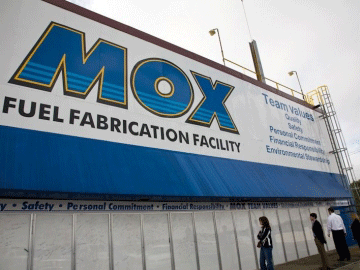
Trump administration scraps MOX project to generate power from plutonium

Trump administration axes project to generate power from plutonium, Timothy Gardner, WASHINGTON (Reuters) 13 May 18 – The Trump administration plans to kill a project it says would have cost tens of billions of dollars to convert plutonium from Cold War-era nuclear bombs and burn it to generate electricity, according to a document it sent to Congress last week.

The Department of Energy submitted a document on May 10 to Senate and House of Representative committees saying that the Mixed Oxide (MOX) project at the Savannah River Site in South Carolina would cost about $48 billion more than $7.6 billion already spent on it. The United States has never built a MOX plant.

Instead of completing MOX, the administration, like the Obama administration before it, wants to blend the 34 tonnes of deadly plutonium – enough to make about 8,000 nuclear weapons – with an inert substance and bury it underground in a New Mexico’s Waste Isolation Pilot Plant (WIPP). Burying the plutonium would cost about $19.9 billion, according to the document, a copy of which was seen by Reuters.

“We are currently processing plutonium in South Carolina for shipment (to WIPP) … and intend to continue to do so,” Energy Secretary Rick Perry said in a letter sent to committee leaders.

Legislation passed in February allows the Energy Department to advance burying the plutonium if it showed that the cost would be less than half of completing MOX……..

Edwin Lyman, a physicist at science advisory group the Union of Concerned Scientists concerned about plutonium getting into the wrong hands, said Perry had made a sensible decision. “MOX was a slow-motion train wreck, and throwing good money after bad simply wasn’t an option.”

Reporting by Timothy Gardner; Editing by Lisa Shumaker  https://www.reuters.com/article/us-usa-plutonium-mox/trump-administration-axes-project-to-generate-power-from-plutonium-idUSKCN1IE0LH

May 14, 2018 Posted by | - plutonium, politics, reprocessing, USA | Leave a comment

Latest UK bribe for storing nuclear waste is “completely inadequate”.

Campaigners slam £1m incentive to store nuclear waste https://www.theguardian.com/environment/2018/may/12/incentive-compensation-nuclear-waste-boreholes-communities

Compensation offered to encourage local communities to allow test boreholes is described as ‘completely inadequate’ 

MPs from both major parties have attacked the government’s latest incentive to entice communities into volunteering to host Britain’s first deep underground store for nuclear waste as “completely inadequate”.

Ministers have offered up to £1m per community for areas that constructively engage in offering to take part in the scheme, and a further sum of up to £2.5m where deep borehole investigations take place.

The aim is to find a permanent underground geological disposal facility (GDF) that could store for thousands of years the waste from Britain’s nuclear energy and bomb-making programmes. The scheme could involve building stores under the seabed to house highly radioactive material. It is predicted that the UK is likely to have produced 4.9m tonnes of nuclear waste by 2125.

But critics say the inducements offered by the government – part of the consultations it launched this year – to ensure local cooperation are “simply not good enough”, and point to the example of France, which has a similar amount of nuclear waste. It offers around €30m (£26.5m) a year as local support for districts neighbouring the site at Bure, in north-east France, and has also offered €60m in community projects.

“The government’s offer in its consultation is simply not good enough. These communities are being asked to perform an important public service and should be properly recompensed,” said Rebecca Long-Bailey, the shadow business secretary.

 In 2012 the government’s attempt to encourage local areas to host nuclear waste facilities ended in failure when councils in Cumbria and Kent rejected proposals for underground stores to be built within their boundaries. These were the only communities to show significant interest at the time and remain the main candidates for sites now that the government has relaunched its nuclear store programme.

However, local campaigners fear that a waste site could affect tourism, on which Cumbria is heavily reliant. “For the sake of a few hundred jobs and a few million pounds, we risk thousands of jobs in the tourism sector, which contributes £2.7bn a year to Cumbria’s economy,” said Geoff Betsworth, chairman of the Cumbria Trust. “Even a 10% dent in tourism would cost £270m a year. The offer of £1m in community benefits, rising to £2.5m when boreholes begin, is absurdly low.”

The government is seeking to dispose of the UK’s nuclear waste underground because current storage facilities are both ineffective and expensive to maintain. A GDF would involve sealing the waste in rock for as long as it remains a hazard.

The plan was also criticised by the Conservative MP Zac Goldsmith, who said the UK should stop making nuclear waste and stop building new reactors.

“We are still pouring untold billions of taxpayer money into propping up an industry that the free market would have killed off years ago,” he said. “In return, we will be compounding the catastrophe of a nuclear waste build-up, which we are no closer to solving than we were when the industry was born.”

Nina Schrank, energy campaigner at Greenpeace UK, added: “The lack of seriousness with which the UK government treats nuclear legacy issues makes it predictable that their quest for a suitable site has been so unsuccessful that they are looking again at the Irish Sea, which Sellafield turned into one of the most radioactively contaminated seas in the world.”

A government spokesperson said: “The GDF will be a multibillion-pound project that can provide substantial benefits to host communities. This includes skilled employment for hundreds of people for decades to come, spin-off benefits such as infrastructure investment, as well as positive impacts on local service industries that support the facility and its workforce.”

May 14, 2018 Posted by | politics, UK, wastes | Leave a comment

UK government understating their costs for Wylfa nuclear plant, combined with costs for Hinkley Pt C – over £40 billion

Dave Toke’s Blog 10th May 2018, A fake price for the faltering proposed Wylfa nuclear plant will obscure
the fact that the project, backed by Hitachi, will be even more expensive than Hinkley C. Negotiators for the Wylfa project are clamouring for the Government to use taxpayers money and a commitment to pay at least some of
the risks of construction cost overruns to massage the price of the deal down compared to Hinkley Point C.

If this is done, then the combined support for Hinkley C and Wylfa projects through loan guarantees, equity
support and risk underwriting could rival the size of bill the UK has to pay the EU for Brexit.

But a carefully contrived fake price produced by giving a massive taxpayer funded handout to the project will obscure this terrible consequence. Hinkley Point C (HPC), scheduled to be built by EDF, is now said to cost around £20 billion, almost exactly the same as the cost of the Hitachi-led Wylfa project.

In fact both of these figures do not appear to include interest charges, and so will be underestimates of the
total mount of money needed to be paid out before the plant is even built. But the interesting thing is that whilst the Hinkley C project is 3.2GW, the Wylfa project is smaller, at around 2.9 GW, which actually makes the Hitachi project even more expensive!
http://realfeed-intariffs.blogspot.co.uk/2018/05/hitachis-wylfa-project-is-even-more.html

May 12, 2018 Posted by | business and costs, politics, UK | Leave a comment

British government to provide $18.2 billion for Hitachi to build Wylfa nuclear power station

Nikkei Asian Review 11th May 2018 The British government has proposed to arrange all 2 trillion yen ($18.2
billion) in lending that Hitachi says is needed to build a nuclear power
plant in Wales, as the Japanese side seeks to reduce its risk and encourage
the U.K. to put more skin in the game.

London had previously suggested that it guarantee 1 trillion yen in lending, but to get the project moving it
changed its offer to include approaches such as direct financing in order
to reduce Hitachi’s financial exposure.

The plan also calls for a totalinvestment of 900 billion yen, with Hitachi as well as Japanese and British
public-private interests each taking a one-third stake, and guarantees for
corporate loans. The total cost of the plant, to be built on the Isle of
Anglesey, is expected to swell to 3 trillion yen.

Hitachi Chairman Hiroaki Nakanishi met with Prime Minister Theresa May in London last Thursday to
ask for greater backing. The original plan called for the loans to be
provided by private lending institutions from both countries and guaranteed
equally by each government. State funding would come at a lower cost than
borrowing from private institutions and would demonstrate the U.K.’s
increased involvement as a backer of Hitachi’s nuclear power business,
which would ease raising funds and help secure investors.

The offer reflects the U.K.’s strong desire to proceed with the project, since
bankruptcy could place a burden on British taxpayers. The U.K. government
will submit a formal proposal to the Japanese side soon. Hitachi will then
make a final decision on whether to continue with the project at a board
meeting at the end of the month.

Some at Hitachi and in Tokyo have expressed concern about Japanese interests retaining leadership of the
project with two-thirds control. Hitachi and the U.K. are thought to be
discussing ways to prevent Hitachi’s exposure risk from rising, such as by
raising London’s stake or issuing dual class shares. But the British
Parliament is likely to oppose expanding the government’s stake, which
could throw a wrench in the project’s final shareholding structure or
allocation of costs. Hitachi is also requesting that the electricity’s
purchase price be raised, but the U.K. is opposed. It hopes to satisfy
Hitachi by covering all loans and raising its stake in the project.
https://asia.nikkei.com/Business/Business-Deals/London-offers-18bn-in-loans-for-Hitachi-s-UK-nuclear-plant

May 12, 2018 Posted by | business and costs, politics, UK | Leave a comment