Can the UK’s 24GW of new nuclear by 2050 target be met? Revisiting the Nuclear Roadmap
29 Apr 2025, Stephen Thomas, University of Greenwich,
https://papers.ssrn.com/sol3/papers.cfm?abstract_id=5194931
Abstract
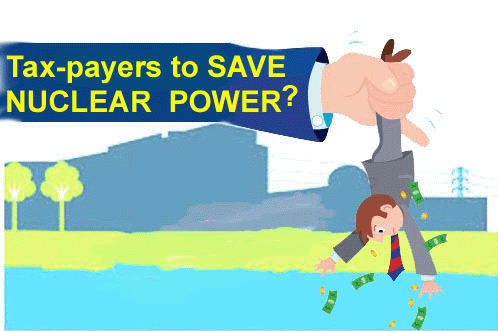
The UK government faces the prospect of having to make major public spending cuts in it June 2025 Public Spending Review, a review covering public expenditure over the following five years. Its plans for expanding nuclear power would require investments of public money in tens of billions of pounds in that period and these must therefore come under scrutiny.
The key decisions are whether to make a Final Investment Decision on the Sizewell C nuclear power plant, which would be majority owned by the government and whether to continue with Small Modular Reactor competition that would see orders placed for four reactors fully funded by government.
I argue that these projects represent poor value for money and will do little to help UK achieve its legally binding target of net zero greenhouse gas emissions by 2050.
Ontario’s Costly Nuclear Folly

May 12, 2025 • David Robertson, https://socialistproject.ca/2025/05/ontarios-costly-nuclear-folly/#more
The last time the nuclear industry got its way in the province, Ontario Hydro spent over two decades building 20 nuclear reactors. It was a mash-up of missed deadlines, cost overruns, and a troubling pattern of declining nuclear performance.
Even more troubling, the last generation of nuclear reactors forced Ontario Hydro to the edge of bankruptcy. And it saddled us with a mountain of nuclear debt that we are still paying off.
The Conservative government of Doug Ford is now repeating those costly mistakes in the largest expansion of the nuclear industry in Canada’s history. A nuclear blunder on steroids.
Part 1: Past Debt Due
In 1999, Ontario Hydro collapsed under the staggering weight of its nuclear debt. When the account books were opened, the reality hit home. At the time, Hydro’s assets were valued at $17.2-billion but its debt amounted to $38.1-billion. The government was faced with a stranded debt of $20.9-billion.
In response, the government of the day split Ontario Hydro into five separate organizations. Ontario Power Generation took over the generating facilities (hydro, coal, gas, nuclear) and Hydro One, later privatized, inherited the transmission grid. Neither of these organizations would survive if they had to carry the debt. The government was aware that any future hopes of privatizing the successors of Ontario Hydro would be scuttled if investors had to absorb the debt. The debt was transferred to Ontario families through special charges on electricity bills (until 2018), regular electricity bills, and the tax system. It was the world’s largest nuclear bailout, one we are still paying.
The Ontario Electrical Financial Corporation is one of the five Ontario Hydro successor entities. It was set up to manage and service the long-term debt of the former Ontario Hydro. According to its 2024 Annual Report, the total debt, twenty-five years later, is still $12.1-billion. In 2024, OEFC paid $626-million in interest charges alone, an amount that is recouped from taxpayers and ratepayers. In its financial statements the organization notes that its longest-term debt issue matures on December 2, 2050. In 2050, Ontario will still be paying the debt of the failed nuclear program of the 1970s and 80s.
Part 2: Repeating Past Mistakes
Ontario Power Generation (OPG) is owned by the government of Ontario. OPG is leading Ontario’s nuclear resurrection. It is aided and abetted by the IESO (Independent Electricity System Operator) another surviving offshoot of the collapse of Ontario Hydro. And it is directed by a series of government policy announcements and legislative initiatives. These directives put nuclear on the fast track while shouldering aside clean, cost-effective, and safe renewables.
It is an astonishing nuclear industry coup. Without putting up their own money, without bearing the financial risks, the nuclear industry has captured Ontario’s energy policy and turned crown agencies into nuclear cheerleaders.
Even a few years ago this would have seemed impossible. The nuclear industry was on the ropes. Catastrophic nuclear accidents at Three Mile Isle in the US, Chernobyl in Ukraine, and Fukushima in Japan had severely tarnished the nuclear safety image. All around the world, the cost overruns and lengthy build times of nuclear plants had chilled utility and government interest in more nuclear plants. In Europe, only one nuclear plant has been built and come on line since 2000.
In Ontario, the last nuclear reactor went into operation in 1993. Nuclear plants that had been forecast to operate for 40 years showed major signs of early ageing after about ten years. Most of the existing nuclear fleet was rapidly reaching its best before dates. Safety and operational issues plagued the industry. The four units at Pickering had been shutdown because of safety reasons. And shut down again. By 1993, Bruce A’s performance, as a result of ‘fretting’ pressure tubes, had drastically declined. In 1997, Ontario Hydro announced that it would temporarily shut down its oldest seven reactors. By that time, the escalating costs of the newest reactors at the Darlington site were already a cautionary tale. Originally billed in 1978 at $3.9-billion, the final cost in 1993 had more than tripled to $14.4-billion (1993 dollars).
The first generation of nuclear plants had clearly demonstrated the failure of the nuclear industry to deliver electricity on time and on budget. It also demonstrated that nuclear reactors couldn’t provide affordable electricity. In fact, Ontario Hydro’s last public cost comparison (1999) revealed the cost of nuclear energy to be more than six times the cost of hydro electricity. (7.72 c/kWh vs $1.09)
Part 3: The Nuclear Resurrection

It seems that all those ‘hard lessons’ learned have been willfully forgotten. The Ford government has now launched a multipoint nuclear power offensive. It has passed legislation to ensure that nuclear is Ontario’s energy priority. It has made commitments to build untested and costly small modular reactors (SMRs). It has decided to refurbish antiquated nuclear plants (Pickering) when there is no business case to do so. It has announced as the centrepiece of its energy policy the irrational goal of becoming a nuclear energy superpower. And it has opened the public purse to the appetite of the nuclear industry.
It is a power play with some revealing features.
3a. A Propaganda Push

In 2023, OPG launched a series of propaganda ads. The ads, in bus shelters and transit, print, and television, were designed to overcome public skepticism and convince us that a new generation of nuclear was safe, reliable, and clean. The company behind the pubic relations campaign made the following claim: “For years, popular culture has distorted perceptions about nuclear power with false narratives that served to stoke fear.” They go on: “The campaign is intended to recast nuclear power as a “true hero” of the province’s clean energy mix.”
Some of the ads focused on Gen Z and Tik Tok with the cartoon character “Pelly the uranium pellet.” Others were tailored to older generations who were well aware of the problems with the nuclear industry and there were ads which simply made outrageous claims. For example, the ad for Small Modular Reactors declared that “SMRs are clean and reliable.” Quite the claim since none have been built.
The ad campaign effectively echoed the industry’s talking points, talking points that have become the mantra of the Ford government. Nuclear energy is now described by Ontario’s energy minister as “clean,” “non-emitting,” “reliable,” and “fundamental to our future.”
3b. A revolving door between the government and the industry
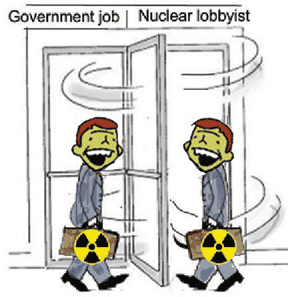
Back in June 2024, former Energy Minister Todd Smith left the government, after spending billions on the nuclear industry and promising billions more. Upon his departure, Todd Smith landed a job as a VP of CANDU Energy Inc. CANDU Energy Inc was created when SNC-Lavalin purchased the commercial reactor division of Atomic Energy of Canada Limited from the federal government in 2011. In an effort to distance itself from its scandal ridden past, SNC-Lavalin has since changed its name to AtkinsRealis. The company is heavily involved in the refurbishment of Ontario nuclear plants and the plans for new builds.
3c. The technological hype of SMRs
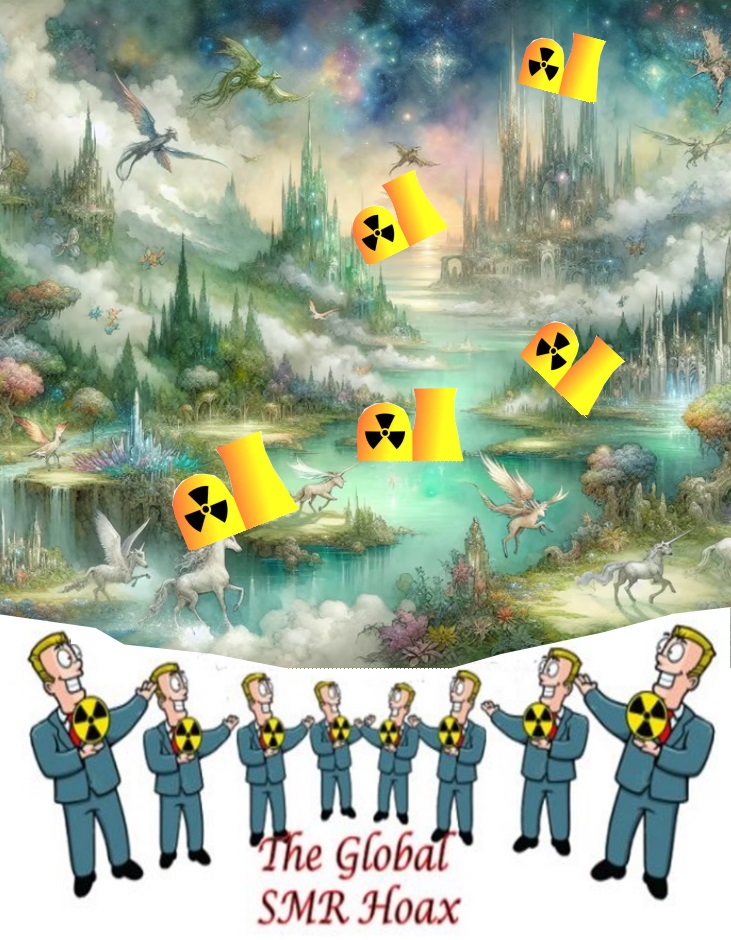
Small Modular Reactors (SMRs) are not small and they are not that modular. And they are not that new. The designs, of which there are about 54, have been kicking around for a long time. It’s just that no one wanted to build them, and investors were loathe to put up their own money. The fate of SMRs changed when the nuclear industry convinced governments in Canada to develop what it called the “SMR Roadmap.” The “Roadmap,” largely produced by the industry, was all hype and little substance, but it was enough to convince the Ford government to join the parade.
The World Nuclear Industry Status Review is an annual independent assessment of the global nuclear industry. In its 2022 review, it concluded:
“Small modular (nuclear) reactors or SMRs continue to hog the headlines in many countries, even though all the evidence so far shows that they will likely face major economic challenges and not be competitive on the electricity market. Despite this evidence, nuclear advocates argue that these untested reactor designs are the solution to the nuclear industry’s woes.”
In the 2024 edition of the review, the analysts note: “The gap between hype about Small Modular Reactors (SMRs) and reality continues to grow. The nuclear industry and multiple governments are doubling down on their investments into SMRs, both in monetary and political terms.”
3d. Over-the-top visioning and ideological straw men
Stephen Lecce became the Minister of Energy in June 2024. Shortly afterwards, he travelled to the US where he made a pitch to western leaders and industry movers and shakers. He told them that Ontario is building a blueprint for a nuclear energy future.
A CP wire story put it this way: “Ontario is selling itself as the nuclear North Star to guide the direction of American power.”
Speaking to a largely American audience, he said it’s time to “rid our economies of any dependence on these foreign states that … do not share our democratic embrace,” (Oops).
The minister’s early charm offensive turned more aggressive back home when he criticized those who support renewable energy as” ideologues” who want to “romanticize certain resources.” As he told the National Post, “We are seeing forces on the left, the illiberal left, who cannot come to terms with the fact that in order to decarbonize we’re going to need nuclear.”
The commitment to nuclear was further baked into Ontario’s future when the Ford government released its energy vision in October 2024. The document ironically entitled “Ontario’s Affordable Energy Future” sets the stage for a massive build out of nuclear power.
It also makes it clear that Ontario has set its sights on becoming a nuclear energy superpower in the hopes of selling expensive nuclear electricity to the US and costly nuclear technology to the world.
Reflecting the grandiose aspirations of a would-be energy superpower the Minister declared that “this was Ontario’s moment.”
3e. The legislative lock-in
In December 2024, the government passed the misnamed “Affordable Energy Act” (Bill 214) The legislation has many troubling aspects. Various sections of the act restrict public consultation, further erode the independence of regulatory tribunals, and shifts more decision making to the government. But most alarming is how the government has used the Act to give preference and priority to nuclear power. Section 25.29 (2) of the Act refers to, “the prioritization of nuclear power generation to meet future increases in the demand for electricity …”
3f. The commitment to underwrite the costs of nuclear
The government is bankrolling the nuclear expansion with public money because investors don’t want their own money at risk. The costs of nuclear power have driven private investors away. Even with massive subsidies from governments, investors are reluctant to ante up.
A spokesperson for the government-owned Ontario Power Generation made the point very clear when commenting on small modular reactors.
Kim Lauritsen is a senior OPG vice-president. She told a Global Business conference audience that the crown corporation was willing to take the “first-mover risk.”
As she put it: “Because they (small modular reactors) take too long and the industry needs to see that these things can be built successfully, to give investors the confidence and really get the ball rolling for other jurisdictions.”
Because investors are nervous and because Ontario wants to show the way for other jurisdictions, the Ford government is prepared to saddle Ontario families and future generations with the exorbitant costs of nuclear power.
Part 4: The nuclear three-prong plug: Refurbishments, SMRs and New Large Scale Reactors
Refurbishments
The Ontario government is spending billions to refurbish old nuclear plants. Fourteen reactors are scheduled to be rejuvenated – 6 at Bruce, 4 at Darlington, and 4 at Pickering. The repair schedule for existing nuclear plants stretches out for decades. While these reactors are off line, the government plans to make up the electricity shortfall with more climate wrecking, fossil-gas generating plants.
The cost of the refurbishments will be in excess of $40-billion. That forty billion and the millions more in interest charges will find its way onto our electricity bills.
As our electricity bills go up, so does political pressure and when that pressure reaches a tipping point, the government steps in with subsidies to help reduce electricity bills. It is a repeated pattern in Ontario.
A recent report from the Government’s Financial Accountability Office (FAO) projected the cost of current electricity subsidies to be $118-billion over the next 20 years. These are not all nuclear electricity subsidies. But as we spend more on nuclear and nuclear increases the cost of electricity and governments are pressured to reduce the cost of electricity, there will be even more subsidies to shift the costs from our electricity bills to our taxes.
Small Modular Reactors (SMRs)
In addition to the massive refurbishment program the Ford government has announced a series of nuclear new builds.
There will be four new small modular reactors (SMRs) built at the Darlington nuclear location. Site preparation work is already underway on the first one. OPG has convinced the Canadian Nuclear Safety Commission to forego an environmental impact assessment, relying instead on an assessment that had been done years ago on the site for a different project.
The government has selected the GE-Hitachi BWRX-300 design. This is based on a design that has been kicking around for about 20 years and has had to be redesigned about ten times. It still has never been built. The engineering designs for Darlington have again been changed, making the small modular reactor less small and even less modular.

OPG has not released a cost estimate for the reactors. But there are some indications of the probable magnitude. In the US, the only SMR project that had been approved by the US federal government was NuScale in the mid-west. The project was cancelled because of escalating costs. Originally estimated at $3-billion (US), it was terminated in 2024 when the projected costs reached $9.3-billion (US).
The Tennessee Valley Authority, a large power utility in the US, has partnered with the OPG to promote the GE-Hitachi SMR. The TVA recently provided some estimates of the costs of building the SMR in the US. It indicated that the cost of the first reactor could be about $5.4-billion (US). It hoped the costs could be reduced to about $3.7-billion (US) if more were built. These costs do not include any interest charges, cost overruns, or missed deadlines.
If we assume the lower cost and convert to Canadian dollars, the price tag for the four SMRs at Darlington would be about $20-billion before things go wrong. In 2019, the company’s indicated the costs would have to be below $1-billion (US).
New Large Scale Nuclear Reactors
In July 2023, the Ontario government announced its support to expand the capacity of the Bruce nuclear power plant near Kincardine. The Bruce nuclear generating station is owned by OPG but operated by Bruce Power, a private consortium. Bruce Power is planning a major expansion of the site’s generating capacity. At present, six of the eight reactors are being refurbished. This new development, if it goes ahead, will add an additional 4800 MW, which would require building four or five new reactors. Admittedly, it is early days, and no costs have been provided.
Port Hope
In January 2025, the Ontario government announced that it was in the preliminary stages of a massive new nuclear plant that could be built at the OPG site in Wesleyville, near Port Hope. Officials have suggested the plant could have a capacity of 8,000 to 10,000 megawatts and be in operation by the 2040s. Achieving that generating capacity would require building eight or more nuclear reactors.
Part 5: Calculating the Costs
Continue readingZelenskyy says he is willing to meet Putin in Istanbul for peace talks
Euronews with AP 11/05/2025
The Ukrainian president said on Sunday he expected Russia to confirm a ceasefire starting Monday, and that he was prepared to meet with his Russian counterpart in Turkey on Thursday for direct talks to end Moscow’s war, now in its fourth year.
Zelenskyy’s words came in response to Putin’s remarks to the media overnight, in which he effectively ignored the idea of a ceasefire — pushed for by Western leaders — and proposed restarting direct talks with Ukraine in Istanbul on Thursday instead “without preconditions”.
Putin did not specify whether the talks on Thursday would involve Zelenskyy and him personally.
He added, however, that “the very first step in truly ending any war is a ceasefire.” “There is no point in continuing the killing even for a single day. We expect Russia to confirm a ceasefire — full, lasting, and reliable — starting tomorrow, May 12th, and Ukraine is ready to meet,” the Ukrainian leader said on X.
German Chancellor Friedrich Merz, French President Emmanuel Macron, British Prime Minister Keir Starmer and Polish Prime Minister Donald Tusk met with Zelenskyy in Kyiv on Saturday and issued a coordinated call for a 30-day truce starting Monday. The plan has received backing from both the European Union and Washington.
The leaders pledged tougher sanctions on Russia if Putin did not accept the proposal.
Prior to the Kyiv visit by the quartet of European leaders, US President Donald Trump insisted Ukraine accept Russia’s latest offer of holding direct talks in Turkey on Thursday. Ukraine, along with European allies, had demanded that Russia accept an unconditional 30-day ceasefire starting on Monday before holding talks, but Moscow effectively rejected the proposal and called for direct negotiations instead…….
Trump said in a social media post earlier Sunday that Ukraine should agree to Putin’s peace talks proposal “immediately.”……………………………..https://www.euronews.com/2025/05/11/zelenskyy-and-putin-to-meet-in-turkiye-on-thursday-possibly
[SMRs] Trump wants to speed up construction of more NPP, bypass safety regulations

“That’s my number one worry,” said Edwin Lyman, the director of nuclear power safety at the Union of Concerned Scientists and a frequent critic of the industry. “We’re talking about new reactor technologies where there’s a lot of uncertainty, and the NRC staff often raise a lot of good technical questions. To short-circuit that process would mean sweeping potential safety issues under the rug.”
The potential actions could include overhauling the Nuclear Regulatory Commission and leaning on the U.S. military to deploy new reactors.
By Brad Plumer and Lisa Friedman, Reporting from Washington. Christopher Flavelle contributed reporting. May 9, 2025 https://www.nytimes.com/2025/05/09/climate/trump-draft-nuclear-executive-orders.html
The Trump administration is considering several executive orders aimed at speeding up the construction of nuclear power plants to help meet rising electricity demand, according to drafts reviewed by The New York Times.
The draft orders say the United States has fallen behind China in expanding nuclear power and call for a “wholesale revision” of federal safety regulations to make it easier to build new plants. They envision the Department of Defense taking a prominent role in ordering reactors and installing them on military bases.
They would also set a goal of quadrupling the size of the nation’s fleet of nuclear power plants, from nearly 100 gigawatts of electric capacity today to 400 gigawatts by 2050. One gigawatt is enough to power nearly 1 million homes.
“As American development of new nuclear reactor designs has waned, 87 percent of nuclear reactors installed worldwide since 2017 are based on Russian and Chinese designs,” reads one draft order, titled “Ushering In a Nuclear Renaissance.”
“These trends cannot continue,” the order reads. “Swift and decisive action is required to jump-start America’s nuclear renaissance.”
The four draft orders are marked “pre-decisional” and “deliberative.” They are among several potential executive orders on nuclear power that have been circulating but it is not clear which, if any, might be issued, according to a person familiar with the discussions, who spoke on a condition of anonymity because they were not authorized to speak publicly.
It also was not immediately clear who had written the draft orders or what stage of internal administration discussions the documents reflected. The White House declined to comment on whether any orders would ultimately be issued.
In one of his first acts in office, President Trump declared a “national energy emergency,” saying that America had inadequate supplies of electricity to meet the country’s growing needs, particularly for data centers that run artificial intelligence systems. While most of Mr. Trump’s actions have focused on boosting fossil fuels like coal, oil and natural gas, administration officials have also supported nuclear power.
“Our goal is to bring in tens of billions of dollars during this administration in private capital to get reactors built, and I’m highly confident we will achieve that goal,” Chris Wright, the energy secretary, said at a hearing before a House appropriations subcommittee on Wednesday.
In recent years, nuclear power has been attracting growing bipartisan support. Some Democrats endorse it because the plants don’t emit planet-warming greenhouse gases, although environmentalists have raised concerns about radioactive waste and reactor safety. It also gets backing from Republicans who are less concerned about global warming but who say nuclear power plants could strengthen U.S. energy security.
Tech companies like Google, Microsoft and Amazon that have ambitious climate goals have expressed interest in nuclear power to fuel their data centers, since the plants can run 24 hours a day, something wind and solar power can’t do.
Yet building new reactors in the United States has proved enormously difficult. While the nation still has the world’s largest fleet of nuclear power plants, only three new reactors have come online since 1996. Many utilities have been scared off by the high cost. The two most recent reactors built at the Vogtle nuclear power plant in Georgia cost $35 billion, double the initial estimates, and arrived seven years behind schedule.
In response, more than a dozen companies have begun developing a new generation of smaller reactors a fraction of the size of those at Vogtle. The hope is that these reactors would have a lower upfront price tag, making them a less risky investment for utilities. That, in turn, could help the industry reduce costs by repeatedly building the same type of reactor.
So far, however, none of these next-generation plants have been built. One of the draft executive orders blames the sluggish pace at the Nuclear Regulatory Commission, the independent federal agency that oversees reactor safety and must approve new designs before they are built. The draft would order the agency to undertake a “wholesale revision” of its regulations and impose a deadline of 18 months for deciding whether to approve a new reactor.
The draft order also urges the agency to reconsider its safety limits for radiation exposure, saying that current limits are too strict and go beyond what is needed to protect human health. It is unclear whether the president could order sweeping changes at the Nuclear Regulatory Commission, which Congress established to be independent from the White House. In recent months, Mr. Trump has sought to exert greater authority over independent agencies, setting up a potential showdown in the courts. Some pronuclear groups have said that the Nuclear Regulatory Commission is already beginning to streamline its regulations in response to a bipartisan bill passed by Congress last year. But skeptics of nuclear power say they fear that pressure from the White House could cause the agency to cut corners on safety.
“That’s my number one worry,” said Edwin Lyman, the director of nuclear power safety at the Union of Concerned Scientists and a frequent critic of the industry. “We’re talking about new reactor technologies where there’s a lot of uncertainty, and the NRC staff often raise a lot of good technical questions. To short-circuit that process would mean sweeping potential safety issues under the rug.”
The draft orders suggest other possible steps, including having the U.S. military use its deep pockets to finance next-generation reactors. One option under consideration would be to designate certain A.I. data centers as “defense critical infrastructure” and allow them to be powered by reactors built on Department of Energy facilities, which may allow projects to avoid review by the Nuclear Regulatory Commission.
Another order would call on the secretary of energy to develop a plan to rebuild U.S. supply chains for enriched uranium and other nuclear fuels, which in recent years have largely been imported from Russia.
It remains to be seen whether such steps would be enough to usher in a wave of new reactors, experts said. Under the Biden administration, the Energy Department also made a major push to expand nuclear power in the United States, with some signs of progress. Yet some of the federal offices that led that effort are now being thinned out by firings, buyouts and budget cuts. For instance, the Energy Department’s Loan Programs Office, which provided nearly $12 billion in loan guarantees to help finance the Vogtle reactors, is poised to lose more than half its staff, according to several current and former employees. Those losses, pronuclear groups have said, could hobble a key program for financing new reactors.
“The big question is how you build up a big order book of new reactors so that costs start coming down and supply chains get built up,” said Joshua Freed, who leads the climate and energy program at Third Way, a center-left think tank. “There are a lot of moving parts that have to come together.”
Iran calls latest nuclear talks with US ‘difficult’ but both sides agree negotiations will continue

By CNN, May 12, https://www.9news.com.au/world/us-iran-nuclear-talks-iran-calls-latest-nuclear-talks-difficult-but-both-sides-agree-negotiations-will-continue/0d7dc1d5-72da-4a91-a356-4676ac116ea8
The latest round of high-stakes nuclear talks between Iran and the US have ended, with Tehran calling them difficult but with both sides agreeing to further negotiations.
Iranian Foreign Ministry spokesman Esmaeil Baqaei confirmed on X on Sunday that the talks had concluded, saying they were “difficult but useful to better understand each other’s positions and to find reasonable & realistic ways to address the differences”.
A senior Trump administration official gave a more positive assessment, telling CNN the discussions “were again both direct and indirect” and lasted over three hours, calling them encouraging.
“Agreement was reached to move forward with the talks to continue working through technical elements,” the official said, adding that the US side was “encouraged by today’s outcome” and looked forward to their next meeting, “which will happen in the near future”.
No date has been agreed for the next round although Baqaei said it would be announced by mediator Oman.
The talks on Sunday were aimed at addressing Tehran’s nuclear program and lifting sanctions
That they are happening at all is something of a breakthrough – the talks are the highest-level in years – but signs of firm progress are slim.
Both countries have expressed a willingness to resolve their disputes through diplomacy. A central issue remains Iran’s demand to continue enriching uranium for its nuclear program, which is insists is peaceful, something the US calls a “red line.”
US President Donald Trump, who is headed to the Middle East next week, has threatened that the US would resort to military strikes against Iranian nuclear sites, with Israel’s help, should Tehran fail to reach a deal with its interlocutors.
The Iranian delegation was led by Foreign Minister Abbas Araghchi, who said before the talks got underway that the US side “holds contradictory positions which is one of the issues in our negotiations”.
“We have been clear about our boundaries,” Araghchi added, according to the Fars news agency.
Iranian officials told CNN on Saturday that recent talks with the US were “not genuine” from the American side. The Iranian source also reiterated that allowing uranium enrichment on Iranian soil is Iran’s “definite red line” in the negotiations.
US special envoy Steve Witkoff, who has been heading the American side, warned that if this session of talks were not productive, “then they won’t continue and we’ll have to take a different route”.
Speaking to Breitbart, Witkoff outlined the US’ expectations for the talks, including on the country’s uranium enrichment program.
“An enrichment program can never exist in the state of Iran ever again. That’s our red line. No enrichment,” he said.
Iran has said it will not surrender its capability to enrich uranium. The country has long insisted it does not want a nuclear weapon and that its program is for energy purposes.
The head of the International Atomic Energy Agency, Rafael Grossi, warned last month that Iran was “not far” from possessing a nuclear bomb.
“It’s like a puzzle. They have the pieces, and one day they could eventually put them together,” Grossi told French newspaper Le Monde.
Trump administration considers orders expediting nuclear plant construction, NYT reports.

By Reuters, May 10, 2025,
https://www.reuters.com/business/energy/trump-administration-considers-orders-expediting-nuclear-plant-construction-nyt-2025-05-09/
U.S. President Donald Trump’s administration is considering several executive orders to expedite the construction of nuclear power plants, the New York Times reported on Friday, citing drafts it has reviewed.
Why Is US Congress Silent on the Manmade Nightmare It Is Enabling in Gaza? -Bernie Sanders

With Israel having cut off all aid, what we are seeing now is a slow, brutal process of mass starvation and death by the denial of basic necessities. This is methodical, it is intentional, it is the stated policy of the Netanyahu government.
Bernie Sanders, May 08, 2025 , https://www.commondreams.org/opinion/congress-silent-gaza
I want to say a few words about an issue that people all over the world are thinking about—are appalled by—but for some strange reason gets very little discussion here in the nation’s capital or in the halls of Congress. And that is the horrific humanitarian disaster that is unfolding in Gaza.
Thursday marks 68 days and counting since ANY humanitarian aid was allowed into Gaza. For more than nine weeks, Israel has blocked all supplies: no food, no water, no medicine, and no fuel.
Hundreds of truckloads of lifesaving supplies are waiting to enter Gaza, sitting just across the border, but are denied entry by Israeli authorities.
There is no ambiguity here: Israeli Prime Minister Benjamin Netanyahu’s extremist government talks openly about using humanitarian aid as a weapon. Defense Minister Israel Katz said, “Israel’s policy is clear: No humanitarian aid will enter Gaza, and blocking this aid is one of the main pressure levers.”
Starving children to death as a weapon of war is a clear violation of the Geneva Convention, the Foreign Assistance Act, and basic human decency. Civilized people do not starve children to death.
What is going on in Gaza is a war crime, committed openly and in broad daylight, and continuing every single day.
There are 2.2 million people who live in Gaza. Today, these people are trapped. The borders are sealed. And Israel has pushed the population into an ever-smaller area.
With Israel having cut off all aid, what we are seeing now is a slow, brutal process of mass starvation and death by the denial of basic necessities. This is methodical, it is intentional, it is the stated policy of the Netanyahu government.
Without fuel, there is no ability to pump fresh water, leaving people increasingly desperate, unable to find clean water to drink, wash with, or cook properly. Disease is once again spreading in Gaza.
Most of the bakeries in Gaza have now shut down, having run out of fuel and flour. The few remaining community kitchens are also shutting down. Most people are now surviving on scarce canned goods, often a single can of beans or some lentils, shared between a family once a day.
The United Nations reports that more than 2 million people out of a population of 2.2 million face severe food shortages.
The starvation hits children hardest. At least 65,000 children now show symptoms of malnutrition, and dozens have already starved to death.
Malnutrition rates increased 80% in March, the last month for which data is available, after Netanyahu began the siege, but the situation has severely deteriorated since then.
UNICEF reported Wednesday that “the situation is getting worse every day,” and that they are treating about 10,000 children for severe malnutrition.
Without adequate nutrition or access to clean water, many children will die of easily preventable diseases, killed by something as simple as diarrhea.
For the tens of thousands of injured people in Gaza, particularly the countless burn victims from Israeli bombing, their wounds cannot heal without adequate food and clean water. Left to fester, infections will kill many who should have survived.
With no infant formula, and with malnourished mothers unable to breastfeed, many infants are also at severe risk of death. Those that survive will bear the scars of their suffering for the rest of their lives.
And with little medicine available, easily treatable illnesses and chronic diseases like diabetes or heart disease can be a death sentence in Gaza.
What is going on there is not some terrible earthquake, it is not a hurricane, it is not a storm. What is going on in Gaza today is a manmade nightmare. And nothing can justify this.
What is happening in Gaza will be a permanent stain on the world’s collective conscience. History will never forget that we allowed this to happen and, for us here in the United States, that we, in fact, enabled this atrocity.
There is no doubt that Hamas, a terrorist organization, began this terrible war with its barbaric October 7, 2023 attack on Israel, which killed 1,200 innocent people and took 250 hostages.
The International Criminal Court was right to indict Yahya Sinwar and other leaders of Hamas as war criminals for those atrocities.
Clearly, Israel had the right to defend itself against Hamas.
But Netanyahu’s extremist government has not just waged war against Hamas. Instead, they have waged an all-out barbaric war of annihilation against the Palestinian people.
They have intentionally made life unlivable in Gaza.
Israel, up to now, has killed more than 52,000 people and injured more than 118,000—60% of whom are women, children, and the elderly. More than 15,000 children have been killed.
Israel’s indiscriminate bombardment has damaged or destroyed two-thirds of all structures in Gaza, including 92% of the housing units. Most of the population now is living in tents or other makeshift structures.
The healthcare system in Gaza has been essentially destroyed. Most of the territory’s hospitals and primary healthcare facilities have been bombed.
Gaza’s civilian infrastructure has been totally devastated, including almost 90% of water and sanitation facilities. Most of the roads have been destroyed.
Gaza’s education system has been obliterated. Hundreds of schools have been bombed, as has every single one of Gaza’s 12 universities.
And there has been no electricity in Gaza for 18 months.
Given this reality, nobody should have any doubts that Netanyahu is a war criminal. Just like his counterparts in Hamas, he has a massive amount of innocent blood on his hands.
And now Netanyahu and his extremist ministers have a new plan: to indefinitely reoccupy all of Gaza, flatten the few buildings that are still standing, and force the entire population of 2.2 million people into a single tiny area, where hired U.S. security contractors will distribute rations to the survivors.
Israeli officials are quite open about the goal here: to force Palestinians to leave for other countries “in line with President [Donald] Trump’s vision for Gaza,” as one Israeli official said this week.
Israeli Finance Minister Bezalel Smotrich said this week that “Gaza will be entirely destroyed,” and that its population will “leave in great numbers.”
For many in Netanyahu’s extremist government, this has been the plan all along: It’s called ethnic cleansing.
This would be a terrible tragedy, no matter where or why it was happening. But what makes this tragedy so much worse for us in America is that it is our government, the United States government, that is absolutely complicit in creating and sustaining this humanitarian disaster.
Last year alone, the United States provided $18 billion in military aid to Israel. This year, the Trump administration has approved $12 billion more in bombs and weapons.
And for months, Trump has offered blanket support for Netanyahu. More than that, he has repeatedly said that the United States will actually take over Gaza after the war, that the Palestinians will be pushed out, and that the U.S. will redevelop it into what Trump calls “the Riviera of the Middle East,” a playground for billionaires.
This war has killed or injured more than 170,000 people in Gaza. It has cost American taxpayers well over $20 billion in the last year. And right now, as we speak, thousands of children are starving to death. And the U.S. president is actively encouraging the ethnic cleansing of over 2 million people.
Given that reality, one might think that there would be a vigorous discussion right here in the Senate: Do we really want to spend billions of taxpayer dollars starving children in Gaza? You tell me why spending billions of dollars to support Netanyahu’s war and starving children in Gaza is a good idea. I’d love to hear it.
But we are not having that debate. And let me suggest to you why I think we are not having that debate.
That is because we have a corrupt campaign finance system that allows the American Israel Public Affairs Committee (AIPAC) to set the agenda here in Washington.
In the last election cycle, AIPAC’s PAC and Super PAC spent nearly $127 million combined.
And the fact is that, if you are a member of Congress and you vote against Netanyahu’s war in Gaza, AIPAC is there to punish you with millions of dollars in advertisements to see that you’re defeated.
One might think that in a democracy there would be a vigorous debate on an issue of such consequence. But because of our corrupt campaign finance system, people are literally afraid to stand up. If they do, suddenly you will have all kinds of ads coming in to your district to defeat you.
Sadly, I must confess, that this political corruption works. Many of my colleagues will privately express their horror at Netanyahu’s war crimes, but will do or say very little publicly about it.
History will not forgive our complicity in this nightmare. The time is long overdue for us to end our support for Netanyahu’s destruction of the Palestinian people. We must not put another nickel into Netanyahu’s war machine. We must demand an immediate cease-fire, a surge in humanitarian aid, the release of the hostages, and the rebuilding of Gaza—not for billionaires to enjoy their Riviera there—but rebuilding Gaza for the Palestinian people.
Nuclear fallout: Coalition’s nuclear energy policy proved toxic to Australian voters

SMH, By Mike Foley, May 5, 2025
The Coalition’s nuclear energy policy was toxic to voters, delivering big swings against Peter Dutton’s candidates in electorates chosen to host reactors, while support for Labor grew in many places it chose for massive offshore wind farms.
Dutton’s energy policy was built on opposing Labor’s “reckless race to renewables”, which the Coalition claimed was trashing farmland in the path of transmission lines and solar panels, in favour of a nuclear and gas-led strategy.
“I’m very happy for the election to be a referendum on energy, on nuclear,” Dutton said on June 19, when he announced his planned nuclear plant locations.
Dutton had not visited any of his proposed nuclear sites by the time the election was over, while the party quietened its advertising for the policy.
In the NSW electorate of Hunter, which borders where the Coalition planned to build a reactor on the site of the old Liddell coal plant, Labor MP Dan Repacholi significantly increased his support.
Repacholi’s first-preference votes jumped from 39 per cent in 2022 to 44 per cent in 2025, while the Nationals fell from 27 per cent to 18 per cent.
The central west NSW seat of Calare was also slated for a reactor near Lithgow, and the election turned into a three-cornered contest between the pro-nuclear Nationals, their former member-turned-nuclear sceptic independent Andrew Gee, and nuclear opponent Kate Hook……………………………
south of the border in the electorate of Gippsland, where the Coalition planned to build a reactor at the Loy Yang A coal plant, Nationals MP Darren Chester defied the trend with his primary vote falling from 55.2 per cent in 2022 to 53.5 per cent in 2025.
The figures could change as the Australian Electoral Commission continues to tally ballots.
The nuclear vote also appears to have inflicted pain on Coalition seats where no nuclear plants were planned.
Chief architect and advocate for the policy, energy spokesman Ted O’Brien, the Liberal National Party MP for Fairfax in Queensland, dropped to 38 per cent on the primary vote from 44 per cent in 2022, while Labor ticked up 2 per cent and anti-nuclear independent candidate Francine Wiig captured 12 per cent.
Nationals leader David Littleproud’s primary vote dropped from 54 per cent in 2022 to 52 per cent.
On the day after the election, Littleproud said nuclear was not responsible for the Coalition’s historic loss.
“I think this was a schmick campaign by Labor destroying Peter Dutton’s character,” he told Sky News.
Dutton vigorously campaigned against wind farms, visiting electorates planned for development and claiming the industry would harm whales, commercial fishing and seascape views.
The Coalition pledged to ban four of Labor’s six offshore wind zones, and Dutton campaigned on this commitment in Paterson, north of Sydney, as well as Whitlam and Cunningham south of Sydney, and Forrest south of Perth.
In Forrest, the Liberal vote fell from 43 per cent in 2022 to 31.5 per cent. First-time independent candidate Sue Chapman, who backed assessment of offshore wind in the area “based on the evidence and [would] aim to bring the community along”, picked up 18.5 per cent of primary votes.
In Cunningham, Wollongong Labor MP Alison Byrnes increased her primary vote from 40.5 per cent in 2022 to 45 per cent.
Down the road in Shellharbour, part of the electorate of Whitlam, Labor’s Carol Berry maintained the 38 per cent primary vote from the past election (although, in terms of ……..the two-candidate preferred vote, Whitlam recorded a 2 per cent swing against Labor)……….https://www.smh.com.au/politics/federal/nuclear-fallout-coalition-s-energy-policy-proved-toxic-to-voters-20250504-p5lwcp.html
Durbin successor must not be co opted by the Israel Lobby.
Walt Zlotow, West Suburban Peace Coalition, Glen Ellyn IL 5 May 25
My outgoing senator Dick Durbin spent his entire 29 year Senate career beholding to the Israel Lobby. In the past 25 years alone he’s received $1,131,900 in campaign cash to ignore Israel’s ethnic cleansing of Palestinians in Gaza, transformed into genocide after the October 7, 2023 Hamas attack. His support for a 2 state solution (Palestinian statehood) is worthless virtue signaling as he’s done nothing of substance to achieve that goal along with making America the 148th nation out of 193 to recognize Palestinian statehood.
We need to replace Durbin with a principled candidate not ensnared by Israel Lobby money. Alas, the 5 Illinois House members mentioned as possible successors are all in the tank to remain mum on truly promoting Palestinian statehood and seeking end to US enabling Israel’s genocidal ethnic cleansing of 2,300,000 Palestinians in Gaza.
Raja Krishnamoorthi (D-IL 8) $269,530
Nikki Budzinski (D-IL 13) $187660
Darin LaHood (R-IL 16) $112,687
Robin Kelly (D-IL 2) $187,272
Lauren Underwood (D-IL 14) $ 75,593,
Tho not mentioned as a possible candidate, we of peace should encourage Congresswoman Delia Ramirez (D-IL 3) to seek Durbin’s open seat next year.
Her take from the Israel Lobby since her election in November 2022? Zero, nada, zilch.
That allowed Ramirez to push back against US billions funding the Israeli genocide, saying this in March, 2024: “The death toll in Gaza continues to rise. Gazans are starving. Over 1.5 million people have been displaced. Hostilities between the U.S. and Iran are escalating. And just this morning, The New York Times reported that one-fifth of the hostages still in captivity since the start of the conflict have likely died. We must change course. Under no circumstances could I have voted for today’s H.R. 7217 to provide $17.6 billion in unconditioned military funding for Israel. The supplemental funding proposed, which includes no humanitarian aid for Gaza, supports weapons of war and destruction that further jeopardize Israeli hostages and Palestinian civilians. Each U.S.-made or funded bomb dropped in Gaza further jeopardizes the chances of long-lasting peace for Israelis and Palestinians. I’ve said it before, and I’ll say it now: I will only support actions that bring us closer to peace.”
Come on Krishnamoorthi, Budzinski, LaHood, Kelly, Underwood, either drop accepting Israel Lobby money to ignore the genocidal ethnic cleaning of Gaza, or drop any consideration of replacing the Lobby’s million dollar Senator Dick Durbin.
A resounding win for the world’s nuclear-free clean energy movement

https://theaimn.net/a-resounding-win-for-the-worlds-nuclear-free-clean-energy-movement/ 5 May 25
In early analyses of the historic Labor election victory, commentators have tut-tutted over the Liberal Coalition’s policies that didn’t impress voters – like reduced tax on petrol, like poor housing plans, and certain Trump-like aspects. These were the things, and the “cost-of living” issues that brought down the vote for the Coalition. And a number of interviews with voters did show that these issues were important.
BUT, in the media build-up to the election, those issues were hammered, and it seemed to me, that Peter Dutton’s party was happy with that, and especially, to stay OFF the topic of nuclear power.
But nuclear power was the core policy in the Opposition’s campaign. Its quiet partner policy was the drastic slowing down of solar power, and renewable energy in general. Along with this went a downgrading of climate change – Dutton coming close to climate-change denial – “I’m not a scientist” was his answer to questions about the impacts of global heating. The inevitable delay in nuclear power becoming operational would be a gift for the fossil fuel industries,
And it was a pretty amazing policy- to bring in nuclear power across a very special country! Australia is the only country in the world that is a nation-continent, a great island -continent with one federal government, and one predominant language. There is no doubt that, had the Coalition won this election, it would have been a grand coup for the global nuclear lobby.
The Labor government is also beholden to the nuclear lobby. Anthony Albanese, as Opposition leader in 2021, agreed to the then Liberal government’s AUKUS nuclear submarine deal. In 2024, his Labor government cemented its agreement by signing an updated version of the AUKUS Exchange of Naval Nuclear Propulsion Information Agreement (ENNPIA).
So no wonder that both of Australia’s major parties are playing down the significance of the nuclear issue, now that across the nation, voters have rejected nuclear power. And the obedient mainstream media is playing it down, too.
Australia’s unique advantage is that it is the only nuclear-power -free nation-continent , and is also a world leader in renewable energy.
Even in 2023, 33% of Australian households had rooftop solar panels. generating their own electricity. Australia is a world leader in rooftop solar adoption, with solar panels installed on more homes per capita than any other country. This trend continues to increase, with Australians making huge savings on energy costs.
To be fair to the Albanese Labor government, it has done well on promoting renewable energy. It has not done so well on climate change action – The Australian government is continuing its long-standing support for fossil fuels both at home and abroad.
Despite its two major political parties being wedded to the fossil fuel industries, and both of them sycophantic to American militarism and the nuclear lobby, Australia really does have the opportunity to lead the world in the direction of clean safe nuclear-free energy.
The AUKUS agreement, the nuclear submarine deal , is looking a bit wobbly at this moment -with the Trumpian uncertainty clouding Australia’s relationship with the USA.
All in all, it is a positive outlook for Australia, and its leading role in clean energy. But don’t expect the corporate media, or the timid ABC, to genuinely emphasise the importance of this election victory over the nuclear lobby.
Senator Strangelove
Like the ghost of Armageddon Future, former Senator Jon Kyl keeps reappearing in nuclear debates, writes William Hartung
A primary responsibility of the government is, of course, to keep us safe. Given that obligation, you might think that the Washington establishment would be hard at work trying to prevent the ultimate catastrophe—a nuclear war. But you would be wrong.
A small, hardworking contingent of elected officials is indeed trying to roll back the nuclear arms race and make it harder for such world-ending weaponry ever to be used again, including stalwarts like Sen. Ed Markey (D-Mass.), Rep. John Garamendi (D-Calif.), and other members of the Congressional Nuclear Weapons and Arms Control Working Group. But they face ever stiffer headwinds from a resurgent network of nuclear hawks who want to build more kinds of nuclear weapons and ever more of them. And mind you, that would all be in addition to the Pentagon’s current plans for spending up to $2 trillion over the next three decades to create a whole new generation of nuclear weapons, stoking a dangerous new nuclear arms race.
There are many drivers of this push for a larger, more dangerous arsenal—from the misguided notion that more nuclear weapons will make us safer to an entrenched network of companies, governmental institutions, members of Congress, and policy pundits who will profit (directly or indirectly) from an accelerated nuclear arms race. One indicator of the current state of affairs is the resurgence of former Arizona Sen. Jon Kyl, who spent 18 years in Congress opposing even the most modest efforts to control nuclear weapons before he went on to work as a lobbyist and policy advocate for the nuclear weapons complex.
His continuing prominence in debates over nuclear policy—evidenced most recently by his position as vice chair of a congressionally appointed commission that sought to legitimize an across-the-board nuclear buildup—is a testament to our historical amnesia about the risks posed by nuclear weapons.
Senator Strangelove
Republican Jon Kyl was elected to the Senate from Arizona in 1995 and served in that body until 2013, plus a brief stint in late 2018 to fill out the term of the late Sen. John McCain.
One of Kyl’s signature accomplishments in his early years in office was his role in lobbying fellow Republican senators to vote against ratifying the Comprehensive Test Ban Treaty (CTBT), which went down to a 51 to 48 Senate defeat in October 1999. That treaty banned explosive nuclear testing and included monitoring and verification procedures meant to ensure that its members met their obligations. Had it been widely adopted, it might have slowed the spread of nuclear weapons, now possessed by nine countries, and prevented a return to the days when aboveground testing spread cancer-causing radiation to downwind communities.
The defeat of the CTBT marked the beginning of a decades-long process of dismantling the global nuclear arms control system, launched by the December 2001 withdrawal of President George W. Bush’s administration from the Nixon-era Anti-Ballistic Missile (ABM) treaty. That treaty was designed to prevent a “defense-offense” nuclear arms race in which one side’s pursuit of anti-missile defenses sparks the other side to build more—and ever more capable—nuclear-armed missiles. James Acton of the Carnegie Endowment for International Peace called the withdrawal from the ABM Treaty an “epic mistake” that fueled a new nuclear arms race. Kyl argued otherwise, claiming the withdrawal removed “a straitjacket from our national security.”
The end of the ABM treaty created the worst of both worlds—an incentive for adversaries to build up their nuclear arsenals coupled with an abject failure to develop weaponry that could actually defend the United States in the event of a real-world nuclear attack………………………………………………………………………………………………………………………………………………………………………………………………….
There is another way. Even as Washington, Moscow, and Beijing continue the production of a new generation of nuclear weapons—such weaponry is also possessed by France, India, Israel, North Korea, Pakistan, and the United Kingdom—a growing number of nations have gone on record against any further nuclear arms race and in favor of eliminating such weapons altogether. In fact, the Treaty for the Prohibition of Nuclear Weapons has now been ratified by 73 countries.
As Beatrice Fihn, former director of the Nobel-prize-winning International Campaign to Abolish Nuclear Weapons, or ICAN, pointed out in a recent essay in The New York Times, there are numerous examples of how collective action has transformed “seemingly impossible situations.” She cited the impact of the antinuclear movement of the 1980s in reversing a superpower nuclear arms race and setting the stage for sharp reductions in the numbers of such weapons, as well as a successful international effort to bring the nuclear ban treaty into existence. She noted that a crucial first step in bringing the potentially catastrophic nuclear arms race under control would involve changing the way we talk about such weapons, especially debunking the myth that they are somehow “magical tools” that make us all more secure. She also emphasized the importance of driving home that this planet’s growing nuclear arsenals are evidence that all too many of those in power are acquiescing in a reckless strategy “based on threatening to commit global collective suicide.”
The next few years will be crucial in determining whether ever growing numbers of nuclear weapons remain entrenched in this country’s budgets and its global strategy for decades to come or whether common sense can carry the day and spark the reduction and eventual elimination of such instruments of mass devastation. A vigorous public debate on the risks of an accelerated nuclear arms race would be a necessary first step toward pulling the world back from the brink of Armageddon.
William D. Hartung is a Senior Research Fellow at the Quincy Institute for Responsible Statecraft, and the author most recently of “Pathways to Pentagon Spending Reductions: Removing the Obstacles.” This article first appeared on Tom Dispatch and on Common Dreams, whose content is available through a Creative Commons license. https://beyondnuclearinternational.org/2025/05/04/senator-strangelove/
Kingston Fossil Plant and Oakridge Nuclear Facility – an unholy alliance of radioactive pollution,
While no one was killed by the 2008 coal ash spill itself, dozens of workers have died from illnesses that emerged during or after the cleanup. Hundreds of other workers are sick from respiratory, cardiac, neurological, and blood disorders, as well as cancers.
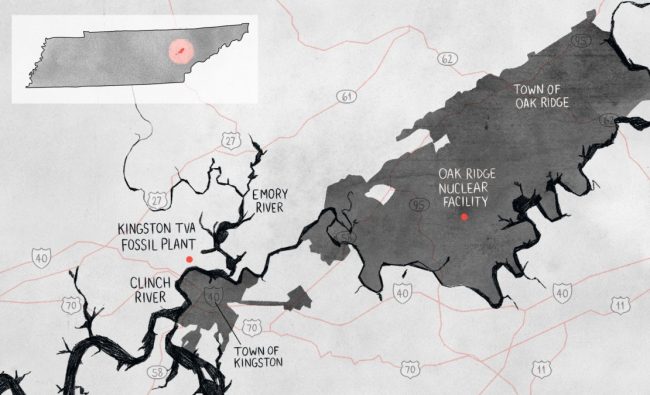
The apparent mixing of fossil fuel and nuclear waste streams underscores the long relationship between the Kingston and Oak Ridge facilities.
Between the 1950s and 1980s, so much cesium-137 and mercury was released into the Clinch from Oak Ridge that the Department of Energy, or DOE, said that the river and its feeder stream “served as pipelines for contaminants.” Yet TVA and its contractors, with the blessing of both state and federal regulators, classified all 4 million tons of material they recovered from the Emory as “non-hazardous.”
A U.S. Environmental Protection Agency analysis confirms that the ash that was left in the river was “found to be commingled with contamination from the Department of Energy (DOE) Oak Ridge Reservation site.
For nearly a century, both Oak Ridge and TVA treated their waste with less care than most families treat household garbage. It was often dumped into unlined, and sometimes unmarked, pits that continue to leak into waterways. For decades, Oak Ridge served as the Southeast’s burial ground for nuclear waste. It was stored within watersheds and floodplains that fed the Clinch River. But exactly where and how this waste was buried has been notoriously hard to track.
A Legacy of Contamination, How the Kingston coal ash spill unearthed a nuclear nightmare, Grist By Austyn Gaffney on Dec  15, 2020 This story was published in partnership with the Daily Yonder.
In 2009, App Thacker was hired to run a dredge along the Emory River in eastern Tennessee. Picture an industrialized fleet modeled after Huck Finn’s raft: Nicknamed Adelyn, Kylee, and Shirley, the blue, flat-bottomed boats used mechanical arms called cutterheads to dig up riverbeds and siphon the excavated sediment into shoreline canals. The largest dredge, a two-story behemoth called the Sandpiper, had pipes wide enough to swallow a push lawnmower. Smaller dredges like Thacker’s scuttled behind it, scooping up excess muck like fish skimming a whale’s corpse. They all had the same directive: Remove the thick grey sludge that clogged the Emory.
The sludge was coal ash, the waste leftover when coal is burned to generate electricity. Twelve years ago this month, more than a billion gallons of wet ash burst from a holding pond monitored by the region’s major utility, the Tennessee Valley Authority, or TVA. Thacker, a heavy machinery operator with Knoxville’s 917 union, became one of hundreds of people that TVA contractors hired to clean up the spill. For about four years, Thacker spent every afternoon driving 35 miles from his home to arrive in time for his 5 p.m. shift, just as the makeshift overhead lights illuminating the canals of ash flicked on.
Dredging at night was hard work. The pump inside the dredge clogged repeatedly, so Thacker took off his shirt and entered water up to his armpits to remove rocks, tree limbs, tires, and other debris, sometimes in below-freezing temperatures. Soon, ringworm-like sores crested along his arms, interwoven with his fading red and blue tattoos. Thacker’s supervisors gave him a cream for the skin lesions, and he began wearing long black cow-birthing gloves while he unclogged pumps. While Thacker knew that the water was contaminated — that was the point of the dredging — he felt relatively safe. After all, TVA was one of the oldest and most respected employers in the state, with a sterling reputation for worker safety.
Then, one night, the dredging stopped.
Sometime between December 2009 and January 2010, roughly halfway through the final, 500-foot-wide section of the Emory designated for cleanup, operators turned off the pumps that sucked the ash from the river. For a multi-billion dollar remediation project, this order was unprecedented. The dredges had been operating 24/7 in an effort to clean up the disaster area as quickly as possible, removing roughly 3,000 cubic yards of material — almost enough to fill an Olympic-sized swimming pool — each day. But official reports from TVA show that the dredging of the Emory encountered unusually high levels of contamination: Sediment samples showed that mercury levels were three times higher in the river than they were in coal ash from the holding pond that caused the disaster.
Then there was the nuclear waste. Continue reading
Six in 10 Americans Support US Participation in a Nuclear Agreement with Iran.
Chicago Council on Global Affairs, 30 Apr 25
Majorities of Democrats and Independents support a potential deal similar to the 2015 Joint Comprehensive Plan of Action, but only a minority of Republicans agree.
For the first time since the United States withdrew from the 2015 Joint Comprehensive Plan of Action (JCPOA), American and Iranian officials held direct talks to negotiate a new nuclear deal. These talks come amid reports of Iran’s rapid production of enriched uranium and acceleration of its nuclear weapons program.
A recent Chicago Council on Global Affairs-Ipsos survey, fielded April 18–20, 2025, finds a majority of Americans consider a nuclearized Iran unacceptable and believe the United States should negotiate a deal with Tehran to limit its development. While Democrats and Independents support a deal that would trade sanctions relief for limitations on Iranian nuclear enrichment, Republicans oppose such a tradeoff. However, they may end up following US President Donald Trump’s lead if current negotiations bear fruit.
Key Findings
- Eight in 10 Americans oppose Iran obtaining nuclear weapons (79%) and favor taking diplomatic steps (83%) or tightening economic sanctions (80%) to limit further nuclear enrichment.
- A smaller majority of Americans believe the United States should participate in an agreement that lifts some international economic sanctions against Iran in exchange for strict limits on its nuclear program (61%).
- Partisan differences on a nuclear agreement are striking: 78 percent of Democrats and 62 percent of Independents support US participation in a deal with Iran compared to just 40 percent of Republicans.
- If diplomacy or economic sanctions fail, many Americans are willing to take more forceful approaches: Six in 10 support the United States conducting cyberattacks against Iranian computer systems (59%), and half support conducting airstrikes against Iran’s nuclear facilities (48%).
- A majority oppose sending US troops to destroy Iran’s nuclear facilities (60%).
Americans Favor Diplomatic Approach to Iranian Nuclear Development
The 2015 JCPOA, or the Iran Deal, was a landmark agreement reached between Iran and the P5+1 (China, France, Russia, the United Kingdom, the United States, and Germany) that limited Iranian nuclear enrichment in exchange for sanctions relief and other provisions. While it was initially successful in limiting Iran’s stockpile of enriched uranium, the United States withdrew from the deal in 2018, as the first Trump administration considered it insufficient in curbing Iran’s ballistic missile program and protecting American regional interests. Upon the US withdrawal from the agreement, Iran promptly lifted the cap on its stockpile of uranium and increased its enrichment activities; it has since reached weapons-grade levels of enriched uranium.
…………………………………………………………………………………………………………………………………………………………………… Conclusion
Although US President Donald Trump has not ruled out using military action to stop Iran from obtaining a nuclear weapon, he said he favors a diplomatic agreement to address this issue. Recently, Trump administration officials have given contradictory remarks about current talks, and they have yet to specify how renewed negotiations will produce an agreement more stringent and impactful than its predecessor.
The pressure is on American diplomats to secure a deal that would limit Tehran’s nuclear enrichment without providing the sanctions relief that could potentially fund Iran’s efforts to further destabilize the Middle East or threaten the United States’ regional allies, including Israel. While the outcome of these negotiations remains to be seen, the public continues to express a preference for using diplomatic or economic coercion than direct military action. https://globalaffairs.org/research/public-opinion-survey/six-10-americans-support-us-participation-nuclear-agreement-iran?fbclid=IwY2xjawKA64xleHRuA2FlbQIxMQBicmlkETFISGV5ZEdSZW16a2ZnQzh3AR7iwwVkEnczI_DJHzOGHWvNWeSlg2xdd9YJCsBz0_OiQmJcM48Ujd0ZNX8ZNQ_aem_5kroZ8t3KQ5RgYf4EfYdDA
The Great British nuclear expansion is a project bound to fail.
With the government committed to a huge expansion of nuclear power to meet
our energy needs, Andrew Blowers and Stephen Thomas contend that this is an
uneconomic, unachievable and undesirable solution that is doomed to fail.
In 2022, the then Conservative government set a target of having 24GW
(gigawatts) of new nuclear capacity up and running by 2050, despite the
dismal history of cost and time over-runs experienced in developing the
existing plans. If achieved, this would be the equivalent of having eight
more Hinkley Point Cs.
The succeeding Labour government reaffirmed its
commitment to nuclear power in its manifesto, proclaiming that a scale
expansion ‘will play an important role in helping the UK achieve energy
security and clean power’ Neither government was prepared to recognise that
the Great British nuclear expansion is a project bound to fail.
TCPA (accessed) 28th April 2025,
https://www.tcpa.org.uk/sample-journal-content/
Utahns must think carefully about becoming the nation’s nuclear hub
the risk of investing millions of taxpayer dollars in technology that’s yet to be implemented on a large scale. The investment required to develop nuclear power plants is massive. The state has lauded microreactors and SMRs as the stuff of the future.
We call on all Utahns to evaluate nuclear energy’s cost, timeline and environmental impacts
April 26, 2025, By Danielle Endres, Madi Sudweeks,
https://www.deseret.com/opinion/2025/04/26/utah-risks-of-nuclear-energy-hub/
Danielle Endres, Ph.D., is a professor at the University of Utah whose research focuses on energy democracy. Madi Sudweeks is a lifelong Utahn and a graduate student studying nuclear energy and environmental justice. The views expressed in this op-ed are their own and do not necessarily represent those of the University of Utah.
Utah’s Legislature has put hope in nuclear energy as a key component of our state’s future energy mix. At the start of the 2025 legislative session, Senate President Stuart Adams proclaimed that he wants Utah to be the “nation’s nuclear hub.” Governor Spencer Cox, likewise, included nuclear energy in Operation Gigawatt, an initiative aimed at doubling the state’s energy production over the next 10 years. With the passage of HB249, the state created the Nuclear Energy Consortium to advise nuclear energy development in Utah. Now we must consider whether nuclear energy is right for our state.
To ensure decisions about how we will power Utah’s future are as democratic as possible, all Utahns should be part of the deliberation. We call on Utahns, including our Legislature, governor and the Nuclear Energy Consortium, to evaluate nuclear energy’s cost, timeline and environmental impacts.
We have already seen how costly nuclear development can be here in Utah. In 2015, Utah Associated Municipal Power Systems (UAMPS) partnered with NuScale on a small modular reactor (SMR) project, planned to be at Idaho National Labs and provide power to several towns in Utah by 2030. The project was canceled in November 2023 after cost estimates increased from $3 billion to $9 billion.

This failed project reveals the risk of investing millions of taxpayer dollars in technology that’s yet to be implemented on a large scale. The investment required to develop nuclear power plants is massive. The state has lauded microreactors and SMRs as the stuff of the future. They claim new technology will make nuclear energy safer, easier to produce and cheaper. However, the electricity produced by UAMPS/NuScale project would have been more expensive than that produced by the most recent traditional nuclear power plant to come online in the U.S.
That project was not an exception. A 2013 Union of Concerned Scientists report shows that SMRs will be more expensive than traditional nuclear plants.
Developing nuclear power is costly and time-intensive. A 2014 study by Dr. Benjamin Sovacool and colleagues demonstrated that a sample of 175 nuclear reactors took on average 64% longer than projected. Dr. Arjun Makhijani argues that nuclear power is too slow and too costly to meaningfully reduce emissions, especially when renewables like solar and wind are ready now and cheaper than ever.
The state’s call to become a nuclear powerhouse is another iteration of the nuclear renaissance we saw in the early 2000s. However, calls for nuclear development in response to climate change then did not result in an increase in nuclear power. Nuclear consistently provides about 20% of electricity for the U.S. Skeptical public opinion, accidents at TMI and Chernobyl, cost, and long construction times have meant that only three new reactors have come online since the 1990s.
Now we’re seeing a new version of a call for a nuclear renaissance. In Utah, Adams said we need nuclear energy to meet the energy demand of Artificial Intelligence (AI). AI requires massive amounts of power and water; experts expect power demand to skyrocket with the computing power needed for AI. Because tech companies have committed to reducing greenhouse gases, they are looking to nuclear power to supply the increased demand because, proponents argue, it can supply stable electricity that intermittent solar and wind energy cannot. However, there are other ways to provide baseload or surgable electricity, including battery storage and geothermal.
Whether or not nuclear energy ends up powering AI, we should be asking ourselves if it is worth the cost and if Utah, already threatened by drought, should be seeking out such a water and energy-intensive industry. Our communities and our environment will continue to pay the price with our tax dollars, our water and our power.
There is no one energy source that is inherently good. Each requires resources and has an impact on its surrounding communities and environments. If Utah is going to consider nuclear power, we call for state leaders and Utahns to engage in a nuanced and research-based analysis of its benefits and risks. Our own analysis makes us skeptical that it’s the right energy source for Utah. And we’re not alone — a former nuclear engineer also recently made the case against nuclear power for Utah.
1 This Month

of the week – Shut Down Drone Warfare!


Tell the Ukrainian Government to Drop Prosecution of Peace Activist Yurii Sheliazhenko

Petition to revoke the licensing of the Near Surface Nuclear Disposal Facility (NSDF) at Chalk River. https://www.ourcommons.ca/petitions/en/Petition/Details?Petition=e-7247
To see nuclear-related stories in greater depth and intensity – go to https://nuclearinformation.wordpress.com
-
Archives
- April 2026 (34)
- March 2026 (251)
- February 2026 (268)
- January 2026 (308)
- December 2025 (358)
- November 2025 (359)
- October 2025 (376)
- September 2025 (257)
- August 2025 (319)
- July 2025 (230)
- June 2025 (348)
- May 2025 (261)
-
Categories
- 1
- 1 NUCLEAR ISSUES
- business and costs
- climate change
- culture and arts
- ENERGY
- environment
- health
- history
- indigenous issues
- Legal
- marketing of nuclear
- media
- opposition to nuclear
- PERSONAL STORIES
- politics
- politics international
- Religion and ethics
- safety
- secrets,lies and civil liberties
- spinbuster
- technology
- Uranium
- wastes
- weapons and war
- Women
- 2 WORLD
- ACTION
- AFRICA
- Atrocities
- AUSTRALIA
- Christina's notes
- Christina's themes
- culture and arts
- Events
- Fuk 2022
- Fuk 2023
- Fukushima 2017
- Fukushima 2018
- fukushima 2019
- Fukushima 2020
- Fukushima 2021
- general
- global warming
- Humour (God we need it)
- Nuclear
- RARE EARTHS
- Reference
- resources – print
- Resources -audiovicual
- Weekly Newsletter
- World
- World Nuclear
- YouTube
-
RSS
Entries RSS
Comments RSS
 nuclear-news