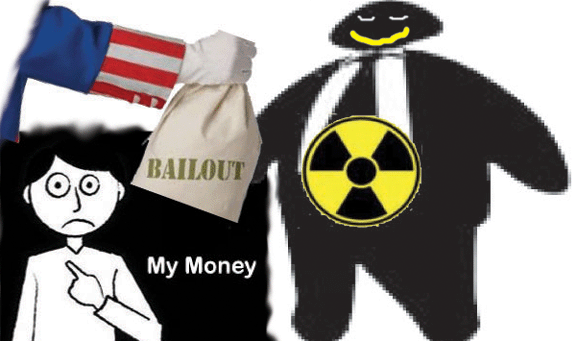
Unnecessary to bail out Ohio’s nuclear and coal plants, but a bonanza for FirstEnergy Solutions
|
IEEFA update: Bailing out Ohio’s nuclear and coal plants unnecessary for supply or rate stability
But $300 million annual charge would be bonanza for FirstEnergy Solutions (IEEFA U.S.) – A bill before the Ohio General Assembly (HB 6), aimed at rescuing FirstEnergy Solutions’ economically uncompetitive aging nuclear and coal-fired power plants is misguided, according to a briefing note released by the Cleveland-based Institute for Energy Economics and Financial Analysis (IEEFA).The briefing note: Bailout Bill a Bonanza for FirstEnergy Solutions, may end up costing Ohio consumers and businesses more than $300 million per year “in perpetuity,” according to IEEFA. “Proponents of this ill-advised bill are using misleading arguments to warn about nonexistent dangers to the electricity supply and rising energy costs,” said IEEFA director of resource planning analysis and author of the briefing note David Schlissel. “The data shows, to the contrary, that Ohio has ample energy supply and that retiring the plants in question would in no way undermine the reliability of the system or raise costs.” The bill would keep open FirstEnergy Solutions’ Davis-Besse and Perry nuclear power plants and could also provide revenue for the Sammis coal-fired plant in Ohio. There is no evidence to suggest that extending their operational lifespans would benefit consumers. EEFA found that:
PJM, the operator of the regional electricity market, has concluded that the deactivation of FirstEnergy Solutions’ nuclear power plants in Ohio and Pennsylvania will have no effect on the reliability of the electric power grid…….. Those studies by the Brattle Group were based on misleading assumptions about the cost of renewables and inflated notions about how much energy the nuclear plants were actually providing to the system,” said Schlissel. “This bill is clearly designed to benefit FirstEnergy Solutions and not Ohio ratepayers.” IEEFA recommends that Ohio follow the lead of New York state and allocate resources to support the tax bases of school districts and communities undergoing economic transition caused by the closure of coal and nuclear plants. The briefing note suggests that the state design a program to support workers who lose their jobs when coal and nuclear plants close. Such a program should also include thorough and timely clean-up and decommissioning of these facilities, with hiring preferences given to former plant employees, according to IEEFA. http://ieefa.org/ieefa-update-bailing-out-ohios-nuclear-and-coal-plants-unnecessary-for-supply-or-rate-stability/?fbclid=IwAR1t8o2qjaqzn995F360PTVYtV5fimZUaPX1ls7R-gDd1q15XyUnO3AjuQA |
|
A key annual defense bill is poised to serve as a battleground over President Trump’s nuclear weapons policy.
|
Congress readies for battle over nuclear policy, The Hill,

BY REBECCA KHEEL – 05/12/19 A key annual defense bill is poised to serve as a battleground over President Trump’s nuclear weapons policy.
On issues ranging from the size of the U.S. nuclear arsenal to whether to leave open the possibility of launching a nuclear first strike, leading Democrats in the House and Republicans in the Senate have been meticulously laying out their cases. Those debates will come to a head soon, as the Senate Armed Services Committee begins to consider its version of the defense policy bill in two weeks……… The Congressional Budget Office has estimated modernizing the nuclear arsenal will cost more than $1 trillion over the next 30 years. House Armed Services Committee Chairman Adam Smith (D-Wash.), who has long lambasted the price tag for nuclear modernization, pledged to make the issue a priority when he took control of the gavel after Democrats won back the House. ……. In late January, Smith also re-introduced his “No First Use Act” — with backing from presidential candidate Sen. Elizabeth Warren (D-Mass.) — that would make it U.S. policy not to strike first with nuclear weapons. …….. One thing Smith did say is likely to be in the bill is language supporting the New START Treaty, which caps the number of deployed nuclear warheads allowed to the United States and Russia. The treaty is up for extension in 2021, and Trump has indicated he wants China to join the pact as a condition for renewal — something supporters of the treaty describe as a “poison pill.”……. https://thehill.com/policy/defense/443197-congress-readies-for-battle-over-nuclear-policy |
|
Nuclear power completely unnecessary in sunblest Middle East
No one in the sun- and gas-soaked Middle East needs nuclear power https://www.fdd.org/analysis/2019/05/09/no-one-in-the-sun-and-gas-soaked-middle-east-needs-nuclear-power/?utm_content=bufferd1c88&utm_medium=Twitter+(via+Buffer)&utm_source=twitter.com/fdd&utm_campaign=@FDD+via+Buffer+feed
Mark Dubowitz. Chief Executive, Henry Sokolski, 12 May 19
As Reactors Shut in Massachusetts and Pennsylvania, Nuke War Rages in Ohio and New York
Reader Supported News, 11 May 19 As the nuke power industry slumps toward oblivion, two huge reactors are shutting in Pennsylvania and Massachusetts.
The shutdowns are a body blow to atomic energy. The soaring costs of the decayed US reactor fleet have forced them to beg gerrymandered state legislatures for huge bailouts.
Just two US reactors are still being built. Stuffed with $12 billion in interest-free federal loans, Georgia’s Vogtle is nearing a staggering $30 billion in cost. Years behind schedule, the lowest possible costs of whatever electricity the two reactors there might produce already far exceed wind and solar.
Virtually none of the 98 US reactors now operating can compete with wind, solar, or methane. All but one are more than twenty years old, with serious issues of obsolescence and decay; some are more than forty, operating far behind their original design life.
Four decrepit, money-losing, upstate New York State reactors still run because Governor Andrew Cuomo is handing them $7.6 billion in bailouts. This year’s price tag jumped more than $50 million, despite Cuomo’s promise it would drop. Safe energy/consumer groups are fighting him in court.
Cuomo has otherwise agreed to shut two old reactors at Indian Point, which sit on an earthquake fault north of New York City.
But Illinois has voted billions to sustain three old reactors that can’t compete with wind/solar and gas. New Jersey has also jumped in with hundreds of millions for money-losing nukes.
In Massachusetts, the Pilgrim reactor will shut this month. The New York Times says Pennsylvania’s Three Mile Island Unit One will die in September, dropping the US fleet to 96. The industry wants to scam billions in bailouts for the Keystone State’s other nukes, which are being vastly outstripped by renewables.
But the Ohio war over two geezer nukes rages full bore. Their owner, Akron’s FirstEnergy, is bankrupt, trying to shed its cleanup responsibilities. Despite slipping millions in “lobbying” to key state officials, FirstEnergy has still been unable to shaft the state with its $300m/year nuke-bailout scam.
Designed in the 1960s, FirstEnergy’s Davis-Besse opened near Toledo in 1977. A serious accident presaged the 1979 meltdown at its doomed clone, Three Mile Island Unit Two.
In 2002, boric acid ate Davis-Besse’s infamous “hole in the head” to within an inch of irradiating the entire Great Lakes and north coast.
The leaks are still an issue. But Davis-Besse’s owners sawed off the top of an abandoned Michigan nuke, cut through the containment building, and pasted it into the damaged reactor. The radioactive shield building is crumbling along with the rest of the nuke, from top to bottom.
East of Cleveland, Perry opened in 1986, just after the first earthquake that damaged a US nuke. To this day, no operators have been forced to run a reactor caught amidst a seismic shaking.
The utility and its backers are betting on Ohio’s gerrymandered legislature to gouge some $300 million from the tax/rate-paying public. A bevy of “free market” Republicans wants at least $150 million per year for the nukes, and another $150 million or more for various unclear activities, including about $8.5 million yearly for company president Chuck Jones.
FirstEnergy burns huge quantities of gas, oil, and coal but hypes its “emissions free” nukes that spew Carbon 14, heat, and radiation. The industry does not want to mention or pay for its thousands of tons of radioactive waste.
Such details are loudly overlooked by a mutant choir trumpeting nukes as “zero emission.” All reactors spew deadly isotopes along with climate-killing heat and some Carbon 14. They stand in the way of the wind, solar, batteries, and LED efficiency that comprise our only route to saving the climate.
Ohio’s north coast region is great for wind. More than $4 billion in private capital is waiting to create more than 10,000 jobs while slashing electric rates. The surrounding states of Indiana, Michigan, New York, and Pennsylvania have far more wind turbines than Ohio, operating at big profits with substantial workforces.
But an absurd anti-green setback requirement from a bought legislature has frozen Ohio’s turbine industry. Without that single Ohio Code sentence, cheap wind energy would be flooding the state. The “need” for nukes would evaporate. The reactor jobs “lost” would be dwarfed by those in renewables.
Against all odds, a very broad coalition of environmentalists, wind promoters, consumers, and industrialists has kept FirstEnergy at bay. Bailout opponents vastly outnumber nuke pushers at ongoing hearings.
But worldwide, the clock ticks on the next old money-sucking reactor to collapse from incompetence and greed, or to crumble in an earthquake, tsunami, or terror attack.
The shutdowns of Pilgrim and Three Mile Island mark huge victories for jobs, the economy, and the climate. If green advocates can now win in Ohio and Pennsylvania and roll back the insanity in New York, New Jersey, and Illinois, the march of the shutdowns just might outrun the next meltdown. Stay tuned!
Harvey Wasserman’s Green Power & Wellness Show is podcast at prn.fm; California Solartopia is broadcast at KPFK-Pacifica, 90.7 fm, Los Angeles. His Life & Death Spiral of US History: From Deganawidah to Solartopia will soon be at www.solartopia.org.
UK’s Conservative govt increases tax on domestic solar, despite its goal to fight climate change
The UK can’t fight the climate emergency when the Tories are entirely opposed torenewables like solar. The party’s decision to increase tax on domestic
solar power shows that its head is still firmly in the sand.
power? The real reason for this tax hike is that domestic solar has proved
too popular. The cost of solar panels have plummeted and people
increasingly see them as desirable improvements to their homes.
largely centralised energy grid. It also butts up against seemingly
ideological opposition to renewable energy in the current Conservative
Party. The decision to increase tax on domestic solar power needs to be
considered alongside its support of fracking for gas, billions of pounds of
subsidies to continue to pump fossil fuels out of the North Sea, and
resistance to onshore wind turbines.
AS Wylfa nuclear project suspended, MPs have called on the UK and Welsh governments to consider a range of low-carbon energy projects
|
Planner 10th May 2019 MPs have called on the UK and Welsh governments to consider a
range of low-carbon energy projects in north-west Wales following the suspension ofwork on the Wylfa Newydd nuclear power station. That call comes in a report from the UK Parliament’s Welsh Affairs Committee, which has been looking at the economic impact of the decision by Japanese industrial giant Hitachi to halt work on its proposed new nuclear plant, earmarked for an existing nuclear site on the island of Anglesey.https://www.theplanner.co.uk/news/mps-urge-action-after-nuclear-hiatus-blights-north-wales-growth-deal-prospects |
|
Nuclear power isn’t needed for Green New Deal
 https://www.jacksonville.com/opinion/20190510/guest-column-nuclear-power-isnt-needed-for-green-new-deal By David Kyler, 10 May 19, Recently Tim Echols, vice chairman of the Georgia Public Service Commission, made comments that were critical of the proposed Green New Deal.Echols’ comments could hardly have been more misleading, misinformed and cynically ironic. https://www.jacksonville.com/opinion/20190510/guest-column-nuclear-power-isnt-needed-for-green-new-deal By David Kyler, 10 May 19, Recently Tim Echols, vice chairman of the Georgia Public Service Commission, made comments that were critical of the proposed Green New Deal.Echols’ comments could hardly have been more misleading, misinformed and cynically ironic.
In dismissing the progressive proposal, Echols defended Georgia’s energy policy and portrayed the Plant Vogtle nuclear plant as a praiseworthy centerpiece of the state’s achievements. But even casual observers recognize Plant Vogtle as a wasteful fiasco and a tribute to extravagant corporate welfare. Plant Vogtle is now double the starting cost at $30 billion. It is years behind schedule. And it remains a horrendous yet profitable hoax foisted on U.S. taxpayers and Georgia Power customers. Even if Vogtle were running on schedule and within budget, there are very good reasons why so few nuclear plants are now being built — and why nuclear power has been omitted from the Green New Deal. Here are just some of those reasons: • Accidents such as Chernobyl and Three Mile Island demonstrate the dangerous public safety risks of nuclear power. • Mining and processing nuclear fuels produce huge amounts of carbon emissions. • There is still no acceptable method for long-term storage of deadly radioactive waste. • The cost of building a nuclear plant requires corporate financing that is lavishly supplemented by government-guaranteed loans. • Unlike nuclear power, solar equipment can be scaled down to ownership by individual households. One of the Green New Deal’s major goals is correcting unfair income disparities that have been facilitated by public policies that reward corporations at the public’s expense. By supporting decentralized energy technology like rooftop solar and omitting corporate-dependent power sources — like nukes — the Green New Deal will help working people build economic security. Contrary to Echols’ claims, the Green New Deal’s aims are legitimate if ambitious. Providing clean energy is a commendable and timely enterprise that is vital to America’s future. David Kyler is the executive director of the Center for a Sustainable Coast in St. Simons Island, Ga. |
|
U.S. Democrats trying to stop funding for US nuclear transfers to Saudi Arabia
 Congress tries to defund US nuclear transfers to Saudi Arabia. Al-Monitor May 9, 2019 House Democrats are trying to use the power of the purse to block the transfer of US nuclear technology to Saudi Arabia amid concerns that the Donald Trump administration is too keen to strike a deal with the kingdom.
The House foreign aid panel’s spending bill for fiscal year 2020, released today, would bar the use of federal funds to “support the sale of nuclear technology to Saudi Arabia.” The provision comes as Democrats accuse the Trump administration of using a legal loophole to provide undisclosed nuclear technology and assistance to Riyadh.
“Given the administration’s failure to share important information about these activities with Congress, we included this provision, which prevents the administration from allowing the sale of nuclear technology to Saudi Arabia,” a House Democratic aide who did not want to be identified told Al-Monitor. “We hope this will force much-needed transparency on this issue.”
Lawmakers are concerned that Riyadh has not agreed to terms that would preclude it from enriching uranium or reprocessing plutonium on its territory, precursors to a nuclear weapons program. Crown Prince Mohammed bin Salman notably raised eyebrows last year by vowing that Saudi Arabia would pursue a nuclear weapon if Iran obtained one.
But some nonproliferation experts are skeptical that the legislation unveiled today would effectively deter the administration, which is determined to strike a civil nuclear deal with Riyadh, from continuing nuclear transfers……… https://www.al-monitor.com/pulse/originals/2019/05/congress-tries-defund-us-nuclear-transfers-saudi-arabia.html
Three Mile Island nuclear station has licence for 15 more years, but now to close
Three Mile Island Nuclear Plant To Close, Latest Symbol Of Struggling Industry, NPR, May 8, 2019, 40 years after the nation’s worst commercial nuclear accident, the remaining reactor still operating at Three Mile Island in South-central Pennsylvania is closing.
Exelon announced Wednesday that Three Mile Island Generating Station Unit 1 will shut down by September 30th.
The company says the plant has been losing money for years. The nuclear industry generally has struggled to compete with less expensive electricity generated from natural gas and renewable energy.
Exelon first announced it would close two years ago unless lawmakers stepped in to keep it open. It then campaigned to save the plant by seeking a subsidy from Pennsylvania’s legislature. The company argued that, in light of climate change and efforts to address it, the plant deserves compensation for the [supposedly] carbon-free electricity it produces.
When it became clear the subsidy legislation wouldn’t pass within the next month Exelon decided to retire the plant, which was licensed to operate for 15 more years. …….. https://www.npr.org/2019/05/08/721514875/three-mile-island-nuclear-plant-to-close-latest-symbol-of-struggling-industry
Mike Pompeo enthuses over the ‘benefits ‘ of climate change
 Mike Pompeo dismisses climate change, calls melting Arctic ice caps ‘new opportunities for trade’ Marissa Higgins, Daily Kos Staff ·Another day, another horrifying dismissal of climate change by one of our government representatives. In this case, Secretary of State Mike Pompeo decided to describe the Arctic’s melting ice caps as “new opportunities for trade,” which is possibly the worst climate-related take of the day. Pompeo uttered this out-of-touch assertion when he appeared at the Arctic Council Ministerial Meeting in Finland. This probably doesn’t come as a major surprise, but the bulk of Pompeo’s speech centered on China and Russia. Russia, for what it’s worth, has long held a serious reach in the Arctic, but China is rapidly getting closer. Mike Pompeo dismisses climate change, calls melting Arctic ice caps ‘new opportunities for trade’ Marissa Higgins, Daily Kos Staff ·Another day, another horrifying dismissal of climate change by one of our government representatives. In this case, Secretary of State Mike Pompeo decided to describe the Arctic’s melting ice caps as “new opportunities for trade,” which is possibly the worst climate-related take of the day. Pompeo uttered this out-of-touch assertion when he appeared at the Arctic Council Ministerial Meeting in Finland. This probably doesn’t come as a major surprise, but the bulk of Pompeo’s speech centered on China and Russia. Russia, for what it’s worth, has long held a serious reach in the Arctic, but China is rapidly getting closer.
But you know, why not throw in an asinine statement on climate change while you’re at it? “Steady reductions in sea ice are opening new passageways and new opportunities for trade,” Pompeo told the audience……. its centerpiece, the Arctic Ocean, is rapidly taking on new strategic significance,” he continued. “Offshore resources, which are helping the respective coastal states, are the subject of renewed competition.” While this is terrible, it isn’t really surprising given Pompeo’s past comments on climate change. For example, he was asked by ABC News over the weekend how he would rank climate change among other national security threats. …… Just last week, the Trump administration tried to remove references to climate change from the Arctic Council’s declaration. The declaration is a big deal, and all eight countries involved expect to sign it. The eight countries include Canada, Denmark (which includes Greenland), Finland, Iceland, Norway, Russia, Sweden, and the U.S. “There are different tones with which different countries want to approach climate change,” Aleksi Harkonen, the Arctic Ambassador of Finland, said, as reported by CNBC. “It’s not about whether climate change can be mentioned or not. It will be there in the final declaration.” And while everyone (hopefully) agrees that climate change is a serious issue, it’s worth noting that it’s particularly dire in the Arctic. Why? In short, the Arctic is warming at more than double the rate that the rest of the globe is. This means that the region is changing at a rapid rate, which can be impossibly dangerous for wildlife and indigenous populations. Pompeo sees all of this as just a security issue, but it’s a humanitarian one, too……https://www.dailykos.com/stories/2019/5/6/1855803/-Mike-Pompeo-dismisses-climate-change-calls-melting-Arctic-ice-caps-new-opportunities-for-trade |
|
|
Unease at China’s grip on Britain’s nuclear future.

 Times 8th May 2019 Unease at China’s grip on Britain’s nuclear future. China is still investing in big British infrastructure projects despite concerns over the Huawei deal and fears among the UK’s intelligence partners of exposure to foreign influence.
 controversy around security implications of involving Huawei, yet plans for China General Nuclear Power Corporation to build nuclear reactors on UK soil are progressing almost unnoticed.
https://www.thetimes.co.uk/article/4f281efe-710a-11e9-a116-49ac88679a93

A national political conflict over USA’s nuclear waste dump plan for Yucca Mt, Nevada

 War over nuclear waste at Yucca Mountain spreads to nation’s capital, by John Treanor, May 6th 2019
https://news3lv.com/news/local/war-over-nuclear-waste-at-yucca-mountain-spreads-to-nations-capital LAS VEGAS (KSNV) — It’s becoming a familiar scene in Carson City.
“Many believe Yucca Mountain is settled science. That Yucca was selected, or that it’s ready to receive nuclear waste. Well, they are wrong,” said Senator Cortez Masto.
The war over Yucca Mountain continues, and the latest battleground was a committee meeting in Washington D.C. where senators debated the plan to open funding to study the site.
Right now, sites across the country have nuclear waste sitting in danger of contaminating waterways or nearby communities.
The federal government has long wanted to bury it deep in Yucca, but Nevada politicians are united against that plan.
Saying that storing it could be dangerous, transporting it here a matter of national security.
Senator Jacky Rosen said, “Severe risks in transportation threaten the health and costs billions in cleanup costs. I ask the members here today, is this a risk you’re willing to take?”
Nevada Senators Jacky Rosen and Catherine Cortez Masto want states to sign off on any nuclear plan before the waste is shipped to them, giving Nevada the opportunity to turn those shipments away. https://news3lv.com/news/local/war-over-nuclear-waste-at-yucca-mountain-spreads-to-nations-capital
For how long can we tolerate dolts as leaders? Mike Pompeo rejoices in climate change and Arctic thawing
|
Mike Pompeo Praises Climate Change in the Arctic as ‘New Opportunities for Trade’, Observer
|
|
Distrust of Saudi Arabia’s motives in building a nuclear reactor
|
At the King Abdulaziz City for Science and Technology, the Saudi government is constructing a small nuclear research reactor. The Argentine-designed reactor will produce just tens of kilowatts of energy, a tiny fraction of what Saudi Arabia needs. But it’s a sign of things to come — the kingdom’s plans include gigawatts of energy from nuclear plants for both electricity and desalination. Saudi Arabia’s plans appear, on paper, to be entirely peaceful. But some arms control experts are concerned that its nuclear energy ambitions may also be part of its ongoing rivalry with Iran, which already possesses dual-use technology that could aid in the production of a nuclear bomb. The U.S. and others such as South Korea and China are pushing ahead with plans to help Saudi Arabia’s civilian nuclear program. “The big, big question in the background,” says Sharon Squassoni, a nuclear expert and professor at George Washington University, “is do we have enough controls in place that we can trust [Saudi Arabia]? Since they’ve been pretty clear about their intentions should things go bad with Iran.” Right now, Saudi Arabia generates its electricity with fossil fuels. But the government predicts that oil will be more valuable as an export. So about a decade ago, Saudi Arabia began pursuing an ambitious plan to start a nuclear energy program. Even after the 2011 disaster at the Fukushima Daiichi nuclear power plant in Japan, Squassoni says, Saudi Arabia kept at it. “Most countries were walking away from nuclear, but they decided, ‘Look, this is our long-term plan,'” she says. Squassoni says she’s a bit flummoxed by Saudi Arabia’s continued interest in nuclear, given its high cost and the ease with which the country could adopt renewable energy sources like solar. But the interest may make a lot more sense, she says, when considering Saudi Arabia’s rivalry with Iran. Iran’s nuclear program has had military dimensions in the past, according to the International Atomic Energy Agency. Today, Iran remains in possession of thousands of centrifuges that can be used to enrich uranium. Depending on the level of enrichment, that uranium can be used either as fuel for nuclear reactors — or to make the cores of nuclear bombs. Since 2015, the IAEA has closely monitored Iran’s centrifuges as part of an international agreement that freezes Tehran’s enrichment program in exchange for sanctions relief. But Iran’s nuclear capabilities clearly make Saudi Arabia nervous. Speaking last year on CBS’ 60 Minutes, Saudi Crown Prince Mohammed bin Salman warned that if Iran ever got a nuke, Saudi Arabia would too. “Without a doubt if Iran developed a nuclear bomb, we will follow suit as soon as possible,” he said. Saudi officials say the new research reactor under construction outside of Riyadh has nothing to do with nuclear bombs. In a statement to Bloomberg News last month, Saudi Arabia’s Ministry of Energy, Industry and Mineral Resources said the reactor’s purpose was “strictly peaceful.” “The project is fully in compliance with the IAEA and international framework governing the nuclear energy and its peaceful use,” the statement said. The Saudi Embassy in Washington D.C. did not respond to an NPR request for comment. From a technical standpoint, this new reactor is too small and too low-power to be of any use in bomb-making, according to Aaron Stein, director of the Middle East program at the Foreign Policy Research Institute in Philadelphia. “This is not something that a country would engage upon for a weapons program,” he says. In fact, even large civilian nuclear power plants can’t be used easily to make bombs. But Saudi Arabia has remained quiet on whether it wants its own centrifuges in addition to power plants. Such centrifuges might be legal, as they are used to enrich uranium for electricity production, but Stein says a Saudi decision to pursue that technology “would send alarm bells throughout the region.” “I think it would be interpreted as a move to hedge, and to consider building nuclear weapons down the line,” Stein says. The Trump administration has been looking at a nuclear cooperation deal with Saudi Arabia. Squassoni says such a deal should be carefully crafted. She hopes the U.S. will seek assurances that Saudi Arabia will not pursue civilian technologies that could allow it to make a bomb. |
|

Four decades later, the Russian nuclear disaster—now the subject of an HBO miniseries—is still reverberating
Chernobyl (2019) | What Is Chernobyl? | HBO
Chernobyl Isn’t a Story About an Accident—It’s a Story About Endless Impact
Four decades later, the Russian nuclear disaster—now the subject of an HBO miniseries—is still reverberating, The Ringer, By an immense tradition of fiction about nuclear war or radiological mayhem. But somewhat paradoxically, a nuclear disaster, in and of itself, doesn’t make for particularly interesting television or film. You can’t fight radiation the way you can fire, or hide from it like you can a tornado. In the trailer for HBO’s Chernobyl miniseries, which premieres Monday night, Jared Harris’s Valery Legasov compares a radioactive atom to a bullet. Indeed, radiation kills instantly, though the process of dying from radiation poisoning can take anywhere from days to decades. By the time a nuclear accident happens, there’s nothing to do but limit the damage it causes.
A grim ‘Chernobyl’ shows what happens when lying is standard and authority is abused
HBO’s miniseries about the 1986 nuclear disaster resonates with a crucial warning. (subscribers only) Washington Post 6 May 19
Chernobyl Disaster – growing up in the fallout zone, Business Insider, 6 May 19
Janina Scarlet was just under 3 years old when the Chernobyl Nuclear Power Plant blew up.
-
Chernobyl was the worst nuclear-reactor disaster in history. The explosion spread toxic radiation over large swaths of Ukraine, including Scarlet’s hometown.
-
Scarlet said she was often sick as a child, with a weak immune system and frequent nose bleeds. She still has migraines and occasional seizures……..
Although it’s been 33 years since the Chernobyl explosion, the health consequences of that radiation exposure still plague people who lived near the plant. The Chernobyl disaster has been directly blamed for fewer than 50 deaths from radiation poisoning, but many researchers say the full death tally from the Chernobyl explosion and its lingering effects may never be known. The World Health Organization estimates that eventually, the disaster may become responsible for some 5,000 cancer deaths. …….
Kids who lived near the Chernobyl site have increased instances of thyroid cancer, and adults who helped with the reactor cleanup are more at risk of developing leukemia.
1 This Month





PLEASE OPPOSE HR 8255 AND S.3639 – bills would accelerate satellite deployment, with no environmental review or safeguards – https://ncstd5li.quorum.us/campaign/169331/
To see nuclear-related stories in greater depth and intensity – go to https://nuclearinformation.wordpress.com
-
Archives
- October 2026 (81)
- September 2026 (339)
- August 2026 (330)
- July 2026 (355)
- June 2026 (287)
- May 2026 (306)
- April 2026 (356)
- March 2026 (251)
- February 2026 (267)
- January 2026 (308)
- December 2025 (358)
- November 2025 (359)
-
Categories
- 1
- 1 NUCLEAR ISSUES
- business and costs
- climate change
- culture and arts
- ENERGY
- environment
- health
- history
- indigenous issues
- Legal
- marketing of nuclear
- media
- opposition to nuclear
- PERSONAL STORIES
- politics
- politics international
- Religion and ethics
- safety
- secrets,lies and civil liberties
- spinbuster
- technology
- Uranium
- wastes
- weapons and war
- Women
- 2 WORLD
- ACTION
- AFRICA
- Atrocities
- AUSTRALIA
- Christina's notes
- Christina's themes
- culture and arts
- Events
- Fuk 2022
- Fuk 2023
- Fukushima 2017
- Fukushima 2018
- fukushima 2019
- Fukushima 2020
- Fukushima 2021
- general
- global warming
- Humour (God we need it)
- Nuclear
- RARE EARTHS
- Reference
- resources – print
- Resources -audiovicual
- Weekly Newsletter
- World
- World Nuclear
- YouTube
-
RSS
Entries RSS
Comments RSS

