To the Trump administration, fossil fuels are “Molecules Of U.S. Freedom”
|
In a statement announcing an increase of natural gas exports, energy officials used the surprising new terms. The statement announces the expansion of a facility in Quintana, Texas, that produces liquefied natural gas (LNG) for worldwide export.…… https://www.forbes.com/sites/jamesellsmoor/2019/05/30/trump-administration-rebrands-carbon-dioxide-as-molecules-of-u-s-freedom/#2e2073ff3a24 |
|

Trump re-election push – big effort to make sure that Ohio lawmakers approve nuclear and coal subsidies
Ohio advances coal, nuclear subsidies after pressure from Trump campaign official, Politico, By GAVIN BADE, 05/29/2019
The Ohio House approved a bill Wednesday to gut clean energy standards and subsidize at-risk nuclear and coal plants after a last-minute push from a Trump reelection official to secure its passage.
Bob Paduchik, a senior adviser to the Trump reelection campaign, made calls Tuesday night to at least five members of the Ohio House of Representatives, pressuring them to vote ‘yes’ on the bill, five people familiar with the outreach told POLITICO. Sources said Paduchik emphasized preserving jobs at the Perry and Davis-Besse nuclear plants, both located in northeastern Ohio on the shores of Lake Erie…
“The message is that if we have these plants shut down we can’t get Trump reelected,” said one senior legislative source with knowledge of the conversations. “We’re going into an election year, we can’t lose the jobs.”
Paduchik did not return requests for comment, but confirmed to a local reporter that he called lawmakers to support the bill, saying he did so as a personal matter……..
The bill, which would create a $300 million subsidy program for two nuclear plants and two coal plants in the state, passed 53-43 Wednesday afternoon. It now heads to the state Senate.
Owner FirstEnergy Solutions has threatened to shut the plants down if they are not subsidized, and Cleveland.com reports Republican Gov. Mike DeWine, and labor union leaders made similar arguments in other 11th hour calls to lawmakers.
Legislators contacted by Paduchik include Republican Reps. Don Manning, Darrell Kick, Laura Lanese, Reggie Stoltzfus and Dave Greenspan, sources told POLITICO. The sources requested anonymity because they have other business before the legislature.
Paduchik led President Trump’s successful 2016 campaign in Ohio, after which he became co-chair of the Republican National Committee. In December, the Trump 2020 campaign announced he would return to oversee the president’s reelection bid in the crucial Midwestern swing state.
The White House referred questions on Paduchick’s involvement to the Trump campaign, which did not immediately respond to a request for comment.
In addition to Paduchik, three sources said some legislators received calls from two members of the Ohio delegation to the U.S. House — Republican Reps. Steve Stivers and Bob Gibbs. Their offices did not return requests for comment.
FirstEnergy Solutions, which split from utility FirstEnergy in a bankruptcy proceeding last year, said it did not engage Paduchik or the House members on its behalf. FirstEnergy’s political action committee has supported Trump, DeWine and Ohio Republicans in the past, and CEO Chuck Jones met with the president and Secretary of Energy Rick Perry on energy policy before the utility and subsidiary split……..
Along with subsidizing the nuclear plants, HB 6 would also increase existing payments to two large coal plants owned by the Ohio Valley Electric Corporation, a conglomeration of Midwestern utilities. To pay for the new subsidies, the bill would eliminate the state’s energy efficiency standard and its 12.5 percent-by-2027 renewable energy standard, which are financed on customer utility bills.
Approval in the House means the bill will now move to the Senate. Insiders told POLITICO earlier this week that chamber could take longer to debate the bill, which could create a conundrum for FirstEnergy Solutions, which must decide next month whether to refuel the Perry plant or move ahead with shutdown procedures…….. https://www.politico.com/story/2019/05/29/ohio-coal-nuclear-trump-1347274
Ohio’s subsidy Bill unnecessarily bails out nuclear, coal owner FirstEnergy Solutions
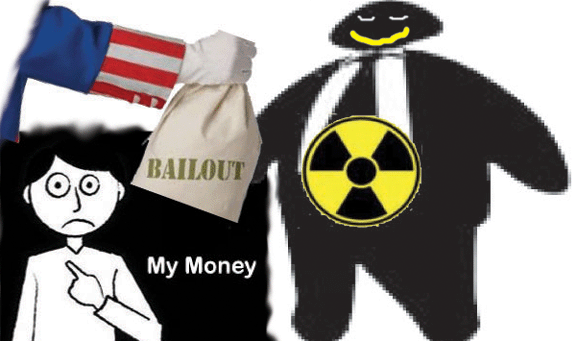 Ohio lawmakers pass bill to cut renewable requirement, help nuclear and coal Ohio lawmakers pass bill to cut renewable requirement, help nuclear and coalCritics say the bill unnecessarily bails out nuclear, coal owner FirstEnergy Solutions. Ars Technica, MEGAN GEUSS – 6/1/2019, THIS WEEK, LAWMAKERS IN OHIO’S HOUSE OF REPRESENTATIVES VOTED 53-43 IN FAVOR OF A CONTROVERSIAL BILL THAT WOULD PERMIT A CONSUMER-FUNDED SUBSIDY FOR NUCLEAR PLANTS AND POSSIBLY FOR AILING COAL PLANTS AS WELL. The bill would also end Ohio’s renewable portfolio standard, which required that the state’s utilities to obtain 12.5 percent of their power from renewable sources by 2027. Instead, that renewable portfolio standard is replaced by smaller steps to bolster renewable power, but environmental groups say the bill is a step in the wrong direction.A version of House Bill 6 has now been introduced to the state’s Senate. If it passes there, it will likely become law due to the Governor’s support of the bill. A boon for FirstEnergy Solutions Currently, Ohioans pay a $4.39 surcharge on their electricity bills to fund Ohio’s renewable portfolio standard, according to local news site Cleveland.com. House Bill 6 would eliminate that surcharge and replace it with a $1 surcharge to raise more than $170 million per year, which would be given to Ohio energy company FirstEnergy Solutions to keep its Davis-Besse and Perry nuclear plants open. The subsidies would be retired in 2026. First Energy Solutions owns nuclear and coal plants throughout Ohio and Indiana. In April 2018, its coal business filed for Chapter 11 bankruptcy protection. The company then asked the Trump Administration to grant it an emergency bailout using Section 202(c) of the Federal Power Act, which allows the federal government to keep the electrical grid operating during emergencies. Thus far, the Administration has not invoked that Act. House Bill 6 also has some good news for the Ohio Valley Electric Corporation, which will be allowed to petition public utility regulators for an additional fee of $2.50 per month per customer to keep two of its coal plants in Ohio and Indiana open. Another, smaller provision in the bill would allow residents of unincorporated areas of Ohio to hold a referendum on whether to allow wind projects to proceed…….. UCS disputes that statement. “While the charges appearing on consumer bills might be less, this ignores the much greater energy bill savings consumers have been realizing through investments in energy efficiency,” UCS writes. “In addition, the cost of wind and solar has fallen by more than 70 percent over the past decade, making them more affordable for consumers and competitive with natural gas power plants in many parts of the country.” https://arstechnica.com/tech-policy/2019/05/ohio-house-passes-bill-that-would-allow-consumer-funded-nuclear-and-coal-subsidies/ |
|
Tokyo 2020 Olympic Torch Relay set to visit Fukushima nuclear complex
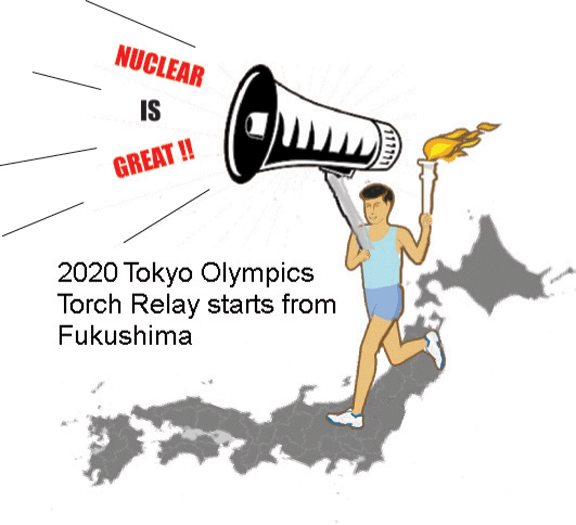
Tokyo 2020 Olympic Torch Relay set to visit Fukushima nuclear complex, PACNEWS, 1 June, 2019,
A staff takes out a banner featuring Tokyo 2020 Olympics emblem from the wall after a news conference in Tokyo, Japan June 30, 2017. REUTERS/Kim Kyung-Hoon
TOKYO, 01 JUNE 2019 (INSIDE THE GAMES) – A town devastated by the nuclear meltdowns in the Fukushima Prefecture in the wake of the 2011 earthquake and tsunami in Japan is set to feature on the route of the Olympic Torch Relay for Tokyo 2020. The relay course will pass through the Fukushima Daiichi Nuclear…. (subscribers only ) https://www.fijitimes.com/tokyo-2020-olympic-torch-relay-set-to-visit-fukushima-nuclear-complex/
World’s second EPR nuclear reactor starts work in China
Phys Org, 6 May 19 A next-generation EPR nuclear reactor in China has carried out its first chain reaction, French energy giant EDF announced Wednesday, becoming the second using the much-delayed European technology to reach the milestone…….
EDF, which helped design the European Pressurised Reactor (EPR), is a minority shareholder in the Taishan project, which is a joint venture with China’s state-run CGN and regional Chinese utility Yuedian.
The first nuclear fuel was loaded into the Taishan 2 reactor in early May in the southern Chinese province of Guangdong……….
EDF has faced serious problems rolling out the technology and has managed to sell just a handful of the reactors as construction problems piled up.
EDF has been building an EPR reactor at Flamanville along the Atlantic coast of northwest France. It was originally set to go online in 2012 but the project has been plagued by technical problems and budget overruns.
Levy acknowledged that the “difficulty” of the Flamanville project had been “underestimated.”
French President Emmanuel Macron has asked EDF to study the feasibility of building more next-generation EPR nuclear reactors in the country, but will wait until 2021 before deciding whether to proceed with construction. https://phys.org/news/2019-05-world-epr-nuclear-reactor-china.html
Ohio’s “Clean Air Program” – a ruse to prop up nuclear power, diminish solar and wind

Energy overhaul: ‘Clean Air Program’ just for nuclear plants, not wind or solar.
Now, the veil is off.
Changes made to House Bill 6 last week would direct most of the $197.6 million collected from new fees on Ohioans’ electric bills to Akron-based FirstEnergy Solutions, which operates two nuclear plants outside Toledo and Cleveland.
Renewable energy companies from wind to solar would not get a cut of this “Ohio Clean Air Program.”
In a double blow, lawmakers also axed current programs that encourage electricity providers to purchase renewable energy and help customers become more energy efficient.
And lawmakers ensured utilities could charge customers a fee for two coal plants operated by Piketon-based Ohio Valley Electric Corporation through 2030. The plants are located in Gallipolis and Madison, Indiana. Wednesday’s changes likely jettisoned any hope of widespread Democratic support.
“It’s now just straight-up corporate welfare,” said Rep. Kristin Boggs, the Ohio House’s No. 2 Democrat. “I don’t know how else to describe it.”
That means Speaker Larry Householder, R-Glenford in Perry County, must rely on fellow Republicans to pass the energy bill – a divergence from his recent bipartisan strategy. And it’s not clear he has the votes yet. ……
opponents of the bill argue that investing in energy efficiency has saved the state $5.1 billion since 2009. No energy efficiency requirements will lead to higher electrical bills, environmental groups say. …….
Should Ohio bail out FirstEnergy?
At the heart of the debate is whether Ohio taxpayers should save FirstEnergy Solutions.
The company, which was spun off from parent FirstEnergy Corp., filed for bankruptcy in March 2018 with more than $2.8 billion in debt.
Without help from taxpayers, FirstEnergy Solutions says the company will close its two nuclear plants in Ohio: Davis-Besse, east of Toledo, in May 2020 and Perry, east of Cleveland, in May 2021……..
opponents of the bailout say FirstEnergy made poor business decisions by investing in coal and nuclear plants rather than diversifying its energy portfolio. The company’s financial situation is not Ohio ratepayers’ problem.
Nuclear energy is costly compared to natural gas, coal and some renewable energy. Nuclear plants require security, disaster plans and maintenance that other plants do not. That has made nuclear energy dependent on subsidies to survive nationwide………
FirstEnergy and pro-FirstEnergy groups have spent millions on campaign contributions, Facebook advertisements and television spots to encourage a deal that saves the plants.
Since 2015, FirstEnergy’s political action committee has given more than $1.74 million to Ohio political candidates and parties, according to an Enquirer analysis of campaign finance data.
Recipients of those contributions include Householder, Senate President Larry Obhof and Gov. Mike DeWine – the three politicians with the power to make a FirstEnergy bailout happen. https://www.cincinnati.com/story/news/politics/2019/05/27/ohio-energy-no-money-wind-solar-just-nuclear-plants/3739552002/
President Rouhani says that Iran might hold a referendum on its nuclear programme
 Rouhani: Iran could hold vote over nuclear deal, Gulf News, 26 May 19, Tehran- Iran’s president has suggested the Islamic Republic could hold a referendum over the country’s nuclear programme amid the unravelling deal with world powers and heightened tensions with the United States, Iranian media reported Sunday Rouhani: Iran could hold vote over nuclear deal, Gulf News, 26 May 19, Tehran- Iran’s president has suggested the Islamic Republic could hold a referendum over the country’s nuclear programme amid the unravelling deal with world powers and heightened tensions with the United States, Iranian media reported Sunday
 According to the official IRNA news agency, President Hassan Rouhani, who was last week publicly chastised by the country’s supreme leader, made the suggestion in a meeting with editors of major Iranian news outlets on Saturday evening.
Rouhani said he had previously suggested a referendum to Supreme Leader Ayatollah Ali Khamenei in 2004, when he was a senior nuclear negotiator for Iran. At the time, Khamenei approved of the idea and though there was no referendum, such a vote “can be a solution at any time,” Rouhani was quoted as saying…… In recent weeks, tensions between Washington and Tehran have escalated over America deploying an aircraft carrier and B-52 bombers to the region over a still-unexplained threat it perceives from Tehran. The US also plans to send 900 additional troops to the 600 already in the Middle East and extending their stay amid the tensions. Rouhani’s remarks could also be seen as a defence of his stance following the rare public chastising by the supreme leader……… Earlier last week, Iran said it quadrupled its uranium-enrichment production capacity though Iranian officials made a point to stress that the uranium would be enriched only to the 3.67 per cent limit set under the deal, making it usable for a power plant but far below what’s needed for an atomic weapon. Zarif, the foreign minister, was in the Iraq capital on Sunday for talks with officials. On Saturday, Mohammad Halbousi, the parliament speaker in Iraq, a key Iranian ally, said Baghdad is ready to mediate between the United States and Iran if it is asked to do so. https://gulfnews.com/world/mena/rouhani-iran-could-hold-vote-over-nuclear-deal-1.64197846 |
|
Swiss authorities intervene to halt exports of nuclear weapons material
|
Swiss authorities intervene to halt exports of nuclear weapons material, Swissinfo.ch MAY 26, 2019 Federal authorities are stepping up efforts to prevent the sale of Swiss machinery that could be used to develop nuclear weapons. The latest interventions concern direct sales to the US and France.According to reportsexternal link by the German-language newspaper NZZ am Sonntag, the federal export group halted the export of suspicious machinery to the US two times last year. Livia Willi, spokesperson for the State Secretariat for Economic Affairs (SECO), told the paper, “There was reason to believe that the goods would be used for the development of nuclear weapons”.
In the past six months, the US has ordered three laser markers worth a total of almost CHF 250,000 from Swiss companies. There have been other interventions as well including in October 2017, when Swiss authorities intervened to stop the export of machine spindles to France. The NZZ am Sonntag writes that halting deliveries to Western nuclear powers is a highly unusual measure. According to the paper, there are no comparable cases like this in Swiss export history. The decisions were based on the Goods Control Act external linkand theexternal linkOrdinanceexternal link, which clearly prohibits the export of goods used for the construction of weapons of mass destruction. The challenge is that many of the goods are dual use in that they can be used for civilian and military purposes…….. https://www.swissinfo.ch/eng/dual-use-goods_swiss-authorities-intervene-to-halt-exports-of-nuclear-weapons-material/44990204 |
|
Donald Trump isn’t fit to have control of the nation’s nuclear codes or state secrets
 Trump Should Not Have Access to Nuclear Codes or State Secrets, https://washingtonmonthly.com/2019/05/26/trump-should-not-have-access-to-nuclear-codes-or-state-secrets/ by David Atkins, May 26, 2019
Donald Trump’s slide into unhinged despotism has shifted from gradual to sudden in the last few days.First, the he suggested—after being reminded by a reporter that the punishment for treason is death—that the former FBI Director, the former FBI Deputy Director and at least two FBI agents had committed treason by daring to investigate him. Then he gave his toady Attorney General unprecedented power to selectively declassify any and all materials related to the probe into his campaign’s ties with Russia, thereby not only retaliating against his own Justice Department but also endangering the lives of its agents. He posted a doctored video of the speaker of House, falsified to make it appear as though she were drunk or mentally impaired. He stormed out a meeting on infrastructure, calling an impromptu press conference in which he forced cabinet members to stand by and attest to how calm he is.
And then there’s whatever this is, written during an official state visit to Japan:
Donald J. Trump @realDonaldTrump
North Korea fired off some small weapons, which disturbed some of my people, and others, but not me. I have confidence that Chairman Kim will keep his promise to me, & also smiled when he called Swampman Joe Biden a low IQ individual, & worse. Perhaps that’s sending me a signal?
In what may well be the most reckless and bizarre tweet of his entire presidency, Trump did the following: 1) made light of provocative saber rattling by the biggest immediate threat to the host nation of his state visit; 2) cozied up to the brutal dictator of the world’s most repressive autocratic regime, Kim Jong Un; 3) made himself out to be braver than his staff and advisers in the military and diplomatic corps; 4) commiserated with said brutal dictator against the former vice president of the United States and his potential political opponent in the next election; 5) almost certainly lied about the interaction with the dictator, who is very unlikely to have said or done anything like what Trump described; and 6) wrote about the dictator “sending him a signal” in the context of said commiseration as if he were a middle-school student writing in his or her diary about a first crush.
As Dan Rather said:
Dan Rather @DanRather
We have a president of the United States wink at a murderous dictator to mock a former vice president? As what? A campaign surrogate for 2020? This is despicable in too many ways to count.
At some point, even Republicans are going to have to decide how much more of this they can tolerate. Trump is displaying increasingly dangerous and unstable behavior with unpredictable impacts on American national security. Mike Pence is odious to liberals and progressives for many reasons and would make a horrible president in all the ways for which the conservative base would love him, but he wouldn’t be a Mad King threatening to take the entire country down with him in decompensating fits of destructive narcissism.
Trump isn’t fit to have control of the nation’s nuclear codes or state secrets. Even his closest allies know this, and there will have to be some sort of political intervention by Republicans to avert disaster. We are unlikely to make it through to January 2021 without serious repercussions if nothing is done in the meantime.
Nuclear power seen as obsolete in South Africa, but they must ramp up renewables, get out of coal
The Dance of Nuclear, Coal, & Renewables in South Africa, Clean Technica May 25th, 2019 by David Zarembka , “……… South Africa has the most mining and industry of any country in Africa and consequently needs the largest amount of electricity – 54,400 megawatts. This can be broken down as follows:
| Type | Capacity [MW] | Percent |
| Coal | 40,036 | 73.6% |
| Gas turbine | 3,449 | 6.3% |
| Hydro | 3,573 | 6.6% |
| Wind | 2,096 | 3.9% |
| Nuclear | 1,860 | 3.4% |
| Solar PV | 1,479 | 2.7% |
| Solar Concentrated | 400 | 0.7% |
| Landfill gas | 7.5 | – |
| Nuclear accounts for 3.4% of power capacity in South Africa, thermal energy sources 79.9%, and renewable sources 16.7% (hydro alone is 9.4%).
Nuclear Power: South Africa has two nuclear power plants in Koeberg near Capetown. Each unit produces 830 MW of power. The first was commissioned in 1984 and the second in 1985. Their closure dates are 2024 and 2025, although there are already attempts to keep them open longer than their 40 year lifespan. The real story, the dance of nuclear power, began in 2010 when South Africa planned to build 8 more nuclear reactors for 9600 MW of additional energy at Koeberg and Thyspunt. These were projected to come online between 2024 and 2030. At different times, the United States, Russia, France, China, and South Korea were involved in negotiations. In March 2017, when the Finance Minister, Pravin Gordhan, opposed these new nuclear plants because South Africa could not afford the costs, he was fired by then President Jacob Zuma and replaced with a minister who approved the projects. Due to major corruption scandals, including the nuclear power projects, President Zuma was ousted on February 18, 2018. Zuma’s replacement, Cyril Ramaphosa, immediately canceled the nuclear projects until 2030. By that time, I am sure nuclear power will be seen as obsolete, like the horse and buggy is today. There is another important side issue to the two nuclear power plants in operation. From mid-2017 through mid-2018, Capetown and the surrounding communities where the nuclear power plants are sited almost ran out of water, as the reservoirs were falling below 30% of capacity. Not only were restrictions placed on washing cars, watering lawns, and filling swimming pools, the water people did receive was rationed. “Day Zero” was announced when the city would run out of water. Since people cut their consumption by more than half, the day was postponed a number of times. Strong rains in June 2018 ended the crisis. Nonetheless, Capetown residents are restricted to 105 liters (26 gallons) of water per person per day. The issue was that the two nuclear power plants were using lots of scarce water. They have now been required to install ocean desalination plants for their water requirements. Coal: South Africa has the seventh highest coal reserves in the world. In 2018, it exported $6.2 billion of coal, mostly to China, Japan, and India. Yet in 2008, 2015, and 2018, South Africa had “load shedding,” planned rolling backouts where parts of the country are routinely without power on a scheduled basis. This was because, due to mismanagement and corruption in Eskom, the public electricity utility, South Africa’s power stations were short of coal. South Africa has 17 coal-fired plants in operation producing 40,036 MW of electricity. Electric consumption has been flat or declining slightly in the last decade. One of the problems with these coal plants is that many are old, needing repairs, and expensive to operate. In the next five years, two coal plants with 3,454 MW of capacity are scheduled to be retired, while from 2025 to 2030 seven coal plants with 7,822 MW of capacity are scheduled to be retired. There are two coal plants under construction for 6,800 MW of additional capacity, but they are already years behind schedule at substantially increased costs. The question then is, “Will renewable energy be able to fill the electricity deficit in the country?” Renewables: South Africa has 2,096 MW of wind power currently providing electricity, 400 MW of concentrated solar power, and 1,479 MW of solar PV. This totals 3,975 MW or 7.3% of the total electric generation capacity. What is most interesting is that as soon as the new Ramphosa government canceled the nuclear power plants, the government approved thousands of MW of renewable power. These included 2,097 MW of wind power, 200 MW of concentrated solar, and 1,094 of solar PV, totaling 3,391 MW of additional renewable energy. This will almost double the amount of wind/solar power in the next few years. South Africa has a plan for energy projection to 2030. The additional generating capacity by that time would be 9.5 GW of wind, 6.8 GW of solar, 6.7 GW of coal, and 2.5 GW of hydropower. This, therefore, assumes that the two coal plants now under construction will be completed, but no more coal plants will be built. Hurrah! Nonetheless, the 2030 projections still indicate that coal will provide 64% of the electricity produced. Wind would then be 13%, solar 8%, nuclear 4%, hydropower 3%, and gas 1%. This implies that the lifespan of the two current nuclear plants will be extended beyond their expiration date. Over the next eleven years, even with the phaseout of 11,276 MW of coal capacity, the use of coal will decline by less that 10%. With the price of wind and solar declining each year, these goals seem to be without sufficient ambition. Boo! South Africa ought to do better than this.https://cleantechnica.com/2019/05/25/the-dance-of-nuclear-coal-renewables-in-south-africa/ David Zarembka I am a retired Quaker peace activist focusing on genocide, war, violent conflict, election violence, and refugees in Rwanda, Burundi, eastern Congo, Uganda, Kenya, and South Sudan. Since 2007, I have lived in a small town in western Kenya, called Lumakanda, in the home area of my Kenyan wife, Gladys Kamonya. I write a weekly blog called “Reports from Kenya” on current happenings in East Africa. To sign up for the weekly blog, contact me at davidzarembka@gmail.com.
|
Trump may use ’emergency’ powers to bypass Congress, to sell missiles to Saudi Arabia

|
Trump prepared to bypass Congress on Saudi arms sale: senators
Democrats warn Trump may use ’emergency’ loophole to sell missiles to Saudi Arabia without congressional approval. Aljazeera, by William Roberts, 24 May 2019 Washington, DC – Democrats in the United StatesSenate have warned that the Trump administration is preparing to approve a major new arms sale to Saudi Arabia, using an “emergency” loophole to bypass Congress. |
|
Ohio House committee’sBill to damage renewable energy industries, prop up nuclear and coal
 Plan to rescue Ohio’s nuclear plants won’t aid wind, solar AP News TOLEDO, Ohio (AP) — Adding a new charge on every electricity bill in Ohio would provide a financial rescue to the state’s two struggling nuclear plants, but would come at the expense of wind and solar energy projects.Republican members of an Ohio House committee on Thursday approved the proposal that would generate nearly $200 million each year mostly for the nuclear plants, which are in danger of closing without help from the state. Plan to rescue Ohio’s nuclear plants won’t aid wind, solar AP News TOLEDO, Ohio (AP) — Adding a new charge on every electricity bill in Ohio would provide a financial rescue to the state’s two struggling nuclear plants, but would come at the expense of wind and solar energy projects.Republican members of an Ohio House committee on Thursday approved the proposal that would generate nearly $200 million each year mostly for the nuclear plants, which are in danger of closing without help from the state.
The plan revised over the past few days after weeks of debate would no longer allow renewable energy projects to seek the same type of clean air incentives being offered to the nuclear plants. It also would eliminate mandates that promote the use of wind and solar power. Democrats on the House Energy and Resources Committee voted against the plan, which will now go the Ohio House for a vote. The legislation would put a $1 monthly charge on all residential electricity bills starting in 2021 while businesses and industrial users would pay more — anywhere from $15 to $2,500 per month. Republicans who control the committee also added this week a provision that would allow the owners of two-coal fired power plants to charge customers to fund operations of the plants. Democrats criticized the legislation, which backers touted as a “clean energy” plan, calling it nothing more than a bailout for the nuclear and coal industry…… https://www.apnews.com/d099f28ece824955ada5bdab4b78e3c3 |
|
Corporate welfare, as Ohio House Republicans turn ‘clean energy’ Bill into a nuclear bailout
|
Ohio House Republicans overhaul ‘clean-energy’ bill to focus on nuclear, coal subsidies
cleveland.com May 22, 2019 By Jeremy Pelzer,
COLUMBUS, Ohio—Ohio House Republicans on Wednesday dramatically transformed a controversial “clean-energy” subsidy bill, turning it into a bailout plan for both nuclear and coal power plants owned by Ohio companies. The changes to House Bill 6, made by the House Energy and Natural Resources Committee, would also end Ohio’s much-disputed renewable-energy and energy-efficiency mandates for utilities after this year, which cost residential electricity users an average of about $4.60 per month. Instead, residential customers statewide would pay up to $1 per month into an estimated $190 million “Ohio Clean Air Program” fund, most of which would go to help keep open the Davis-Besse and Perry nuclear plants, owned by FirstEnergy Solutions…….. A further change made to the bill would enshrine in state law an Ohio Supreme Court ruling that the Ohio Valley Electric Corporation could charge ratepayers to subsidize two OVEC coal-fired power plants — one in Ohio, the other in Indiana. House Republicans from southern and southeast Ohio have been pushing for years for the Piketon-based company (which is jointly owned by several electrical utilities) to receive such subsidies. House Speaker Larry Householder, a Perry County Republican who’s made HB6 a priority, told reporters Wednesday that allowing the subsidies are the “right thing to do,” as OVEC has carried on costs to take care of the now-closed Piketon uranium enrichment plant. Vitale said the committee may vote as soon as Thursday on sending HB6 to the House floor. But it remains to be seen whether Householder has enough “yes” votes for it to pass the House…… Boggs said House Democrats not only sought to keep Ohio’s mandate that utilities must obtain 12.5 percent of their power from renewable sources by 2027 – they proposed raising those standards to 50 percent by 2050 (half of which would have to come from renewable energy sources from within Ohio). “Now it’s just straight-up corporate welfare,” said state Rep. Kristin Boggs, a Columbus Democrat who serves on the committee. … https://www.cleveland.com/open/2019/05/ohio-house-republicans-overhaul-clean-energy-bill-to-focus-on-nuclear-coal-subsidies.html |
|
USA govt pouring money into dodgy new nuclear projects
|
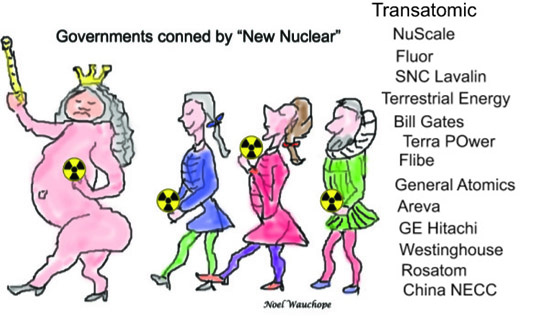
U.S. Department of Energy Further Advances Nuclear Energy Technology through Awards of $10.6 Million , MAY 23, 2019 WASHINGTON, D.C. – The U.S. Department of Energy (DOE) today announced funding selectees for multiple domestic advanced nuclear technology projects. Three projects in three states will receive varying amounts for a total of approximately $11 million in funding. The projects are cost-shared and will allow industry-led teams, including participants from federal agencies, public and private laboratories, institutions of higher education, and other domestic entities, to advance the state of U.S. commercial nuclear capability.The awards are through the Office of Nuclear Energy’s (NE) funding opportunity announcement (FOA) U.S. Industry Opportunities for Advanced Nuclear Technology Development. This is the fourth round of funding through this FOA. The first group was announced on April 27, the second group was announced on July 10, the third group was announced on November 13, 2018, and the fourth groupwas announced on March 27, 2019. The total of the five rounds of awards is approximately $128 million. Subsequent quarterly application review and selection processes will be conducted over the next four years.
“There are a lot of U.S. companies working on technologies to make the next generation of nuclear reactors safer and highly competitive, and private-public partnerships will be key to accomplishing this goal,” said U.S. Secretary of Energy Rick Perry. “The Trump Administration is committed to reviving and revitalizing the U.S. nuclear industry, and these partnerships are needed to help successfully develop innovative domestic nuclear technologies.” The prior version of the bill would have cost residential customers about $2.50 a month or $300 million a year with the money going mostly to the nuclear plants but also to other resources that do not produce carbon dioxide emissions, like wind and solar. Democrats on the House committee opposed the removal of the credit for renewable resources and the speed at which the bill was proceeding through the legislature. The bill could be voted on by the full House as soon as May 29, according to analysts at Height Capital Markets in Washington. The solicitation is broken into three funding pathways:
The following two projects were selected under the Advanced Reactor Development Projects pathway:…….. https://www.energy.gov/ne/articles/us-department-energy-further-advances-nuclear-energy-technology-through-awards-106 |
|
|
Academics advise Labour that there’s no viable place for nuclear in renewable energy plans
 Dave Toke’s Blog 24th May 2019 Academics tell Labour that their renewable energy plans don’t leave any room for nuclear power. Published below is a memorandum from the ‘Red Lion
Group’ of 12 academics, to the Labour Party Shadow Energy Secretary, which
sets out how Labour’s plans for renewable energy do not leave any room for
any new nuclear power (not even Hinkley C).
This means that Labour’s plans to give many £billions of state support for new nuclear power will merely replace cheaper renewable energy. The analysis was based on projections for
energy demand used by the Committee on Climate Change. Review of the CCC’s
projections of energy supply and demand. Letter to Shadow Energy Secretary
from 12 academics and policy analysts.
https://realfeed-intariffs.blogspot.com/2019/05/academics-tell-labour-that-their.html
1 This Month





PLEASE OPPOSE HR 8255 AND S.3639 – bills would accelerate satellite deployment, with no environmental review or safeguards – https://ncstd5li.quorum.us/campaign/169331/
To see nuclear-related stories in greater depth and intensity – go to https://nuclearinformation.wordpress.com
-
Archives
- October 2026 (81)
- September 2026 (339)
- August 2026 (330)
- July 2026 (355)
- June 2026 (287)
- May 2026 (306)
- April 2026 (356)
- March 2026 (251)
- February 2026 (267)
- January 2026 (308)
- December 2025 (358)
- November 2025 (359)
-
Categories
- 1
- 1 NUCLEAR ISSUES
- business and costs
- climate change
- culture and arts
- ENERGY
- environment
- health
- history
- indigenous issues
- Legal
- marketing of nuclear
- media
- opposition to nuclear
- PERSONAL STORIES
- politics
- politics international
- Religion and ethics
- safety
- secrets,lies and civil liberties
- spinbuster
- technology
- Uranium
- wastes
- weapons and war
- Women
- 2 WORLD
- ACTION
- AFRICA
- Atrocities
- AUSTRALIA
- Christina's notes
- Christina's themes
- culture and arts
- Events
- Fuk 2022
- Fuk 2023
- Fukushima 2017
- Fukushima 2018
- fukushima 2019
- Fukushima 2020
- Fukushima 2021
- general
- global warming
- Humour (God we need it)
- Nuclear
- RARE EARTHS
- Reference
- resources – print
- Resources -audiovicual
- Weekly Newsletter
- World
- World Nuclear
- YouTube
-
RSS
Entries RSS
Comments RSS

