President Erdoğan admitted for the first time that the construction of the nuclear power plant in Sinop has been halted. Bianet, Hicran Cengiz, İstanbul – BIA News Desk28 June 2019, President Recep Tayyip Erdoğan said yesterday (June 27) the nuclear power plant project in the Black Sea province of Sinop has been halted, in an interview with a newspaper from Japan.
U.S. senators agonise over nuclear waste debacle, (but with no thought of stopping producing radioactive trash)
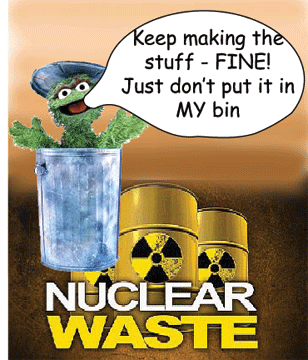 SENATORS TRY—AGAIN—TO SOLVE THE NUCLEAR WASTE DEBACLE, WIRED, RIC NIILER, 28 June 19
ON THURSDAY SENATORS tackled the radioactive question of the nation’s nuclear waste, this time with a new plan to circumvent the hot-potato politics that doomed Yucca Mountain and other proposals. A combination of new legislation that spreads out the nuclear waste burden and perhaps new technology could offer a new way forward.
Everyday, the Department of Energy sends $2.2 million to the nation’s electric utilities to store spent nuclear fuel that has nowhere to go. Under a 1982 law, the federal government was supposed to pick up the nuclear industry’s waste and put it in a safe place underground for the next few hundreds of thousands of years (the half-life of some radioactive isotopes). That deadline passed in 1998, and after more than two decades of lawsuits and political delays, there’s still no permanent location to put the nasty stuff. Instead, spent fuel rods are sitting at 95 nuclear plants around the country in either “fuel pools,” where the waste cools down for a few years after the rods finish producing energy, or in special steel-and-concrete casks that sit above ground like nuclear garbage cans.
Pretty much everyone—utility industry leaders, environmentalists, nuclear engineers, and local mayors—knows the status quo isn’t working. Nobody wants to invest in an industry that can’t deal with its waste (even if it’s carbon-free); and nobody likes the idea of these nuclear-rod-carrying casks multiplying ad infinitum.
The place that the government picked to store all the nuclear waste back in 1987, a repository in Yucca Mountain, Nevada, was canceled in 2009 by the Obama administration. Since then, the project has been in a bureaucratic limbo. The Trump administration moved to take another look at Yucca Mountain and restart the licensing process, but Congress removed funds to do that from last year’s budget.
“It is long, long past time to figure this out, and the sooner we find a path the better,” said Senator Lisa Murkowski (R–Alaska) as she opened a hearing on the issue Thursday in the Senate’s Energy and Natural Resources Committee. Murkowski is sponsoring a bill that would both create a new agency in charge of handling nuclear waste and develop a way for local consent to become part of the decision-making process, although insulated from pressure by members of Congress. That means that the local residents living near a selected site—either temporary or permanent—would get some say in the matter, although perhaps not a veto.
At the hearing, experts testified that without some kind of storage facility, the nuclear industry will continue its slow decline. Nearly all of the nation’s plants were built in the early 1970s. Five are scheduled to shut down by 2025. Plans for two new nuclear reactors in South Carolina got scrapped in 2017 after contractors ran over budget and locals were forced to spend $9 billion to dig a hole in the ground and then fill it back up. A new plant under construction in Georgia has been tied up in contractor fights and court battles.
Murkowski’s bill would set up a new agency outside of Congress to pick a place for a new temporary nuclear waste site to take the spent fuel right away (well, within 10 years). The big holdup is “consent.” While some local communities or native tribes might want the money or jobs that go along with hosting a nuclear waste site, state politicians have blocked such attempts in Nevada, Utah, and Tennessee.
Geoffrey Fettus, senior attorney at the Natural Resources Defense Council, agreed that the stalemate will continue unless Congress changes the process of who gets to decide. “We have a higher chance of states getting to yes if they don’t have to take the entire burden” of all the nuclear waste, Fettus said. Fettus says the burden and the costs should be shared among states, with perhaps several smaller interim disposal sites in different parts of the country rather than a single facility.
West Virginia Democrat Joe Manchin wanted to know if the fuel casks could just stay where they are for awhile, and perhaps the fuel could be recycled. France and Japan, for example, reprocess spent fuel to squeeze out more energy. France then converts the twice-used fuel into glass logs that are awaiting a final burial.
Congress has banned nuclear reprocessing since the Carter administration because of fears that it can be turned into nuclear weapons material. Steven Nesbit, head of nuclear policy for Duke Energy and the American Nuclear Society, which represents nuclear scientists and engineers, says uranium is so cheap and plentiful that it doesn’t make economic sense to reprocess spent fuel. ………. https://www.wired.com/story/senators-tryagainto-solve-the-nuclear-waste-debacle/
Belgium needs to speed up renewable energy investment, to phase out nuclear power by 2025
Belgium unprepared for phasing out nuclear power by 2025: grid operator https://www.reuters.com/article/us-belgium-nuclearpower/belgium-unprepared-for-phasing-out-nuclear-power-by-2025-grid-operator-idUSKCN1TT233Daphne Psaledakis, Bate Felix, BRUSSELS (Reuters) – Belgian grid operator Elia has warned the country could face serious power shortages after it phases out nuclear power in 2025 if the government does not act to speed up investment in alternative energy supplies.Belgium’s nuclear reactors are set to be phased out from 2022 to 2025. Elia, in a study released on Friday, estimates the country will need an additional 3.9 GW of capacity from 2025 to replace the power generation from its seven nuclear reactors.
That is higher than its previous forecast of 3.6 GW, made in a similar study in 2017.
Neighboring countries, including Germany, are accelerating an exit from coal while others are cutting back on nuclear power generation, reducing Belgium’s ability to import electricity.
The Belgian parliament passed legislation in April aimed at spurring investment in gas-fired power generation and building 4,000 megawatt of new offshore wind farm capacity by 2030. The study, co-sponsored by Elia and energy agencies, said more efforts are needed.
While some action has been taken over the past year, “we are not yet ready for any scenario. It is still five minutes to midnight,” Elia said.
Anxiety over’Belarus nuclear reactor starting up: Lithuania buys iodine tablets
 Lithuania to purchase 4 mln iodine tablets to use in case of BelNPP accident, Belsat, 28 June 19 The Lithuanian Ministry of Health will spend about one million euros on 4 million iodine tablets to be used in case of an accident at the Belarusian NPP. This year they should be distributed to residents of the Belarusian-Lithuanian borderland and Vilnius, ru.delfi.lt reports.
Minister of Internal Affairs of Lithuania Eimutis Misiūnas assures that the state institutions are ready for a possible accident at the nuclear power plant in Astravets. But he is not hiding the fact that the agency lacks coordination….
According to him, in case of “the worst scenario”, when the wind blows from east to west, Lithuania will have to evacuate about 20 thousand people in the 30 km zone of the nuclear power plant. Misiūnas believes that this is unlikely, as such weather conditions happen on average 16 days per year.
The first power unit of BelNPP will start operating in autumn. https://belsat.eu/en/news/lithuania-to-purchase-4-mln-iodine-tablets-to-use-in-case-of-belnpp-accident/
Strong opinions at forum about producing nuclear weapon cores at the Savannah River Site
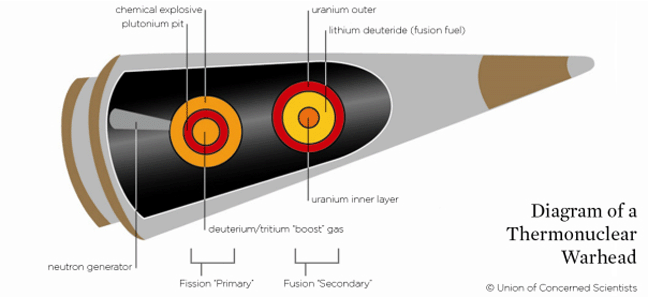
Opinions on nuclear project at SC plant clash at public forum, Post and Courier, By Colin Demarest cdemarest@aikenstandard.com, Jun 28, 2019 NORTH AUGUSTA — Vocal support for producing nuclear weapon cores at the Savannah River Site sharply contrasted with questions, criticism and pushback Thursday night at a government-led public forum.
The U.S. Department of Energy’s National Nuclear Security Administration wants to produce 50 of the weapon components each year at the sprawling complex near Aiken. The cores, known as plutonium pits, use one of the world’s most dangerous substances to trigger a series of explosions that unleash the deadly potential of nuclear weapons.
Supporters tout the economic benefits of the project, which would create about 1,000 jobs and provide a new anchor for SRS after the government abandoned its long-delayed efforts to finish a facility designed to turn weapons-grade plutonium into fuel for nuclear power plants.
Critics, however, remain skeptical of the proposed mission and worry about the potential risks to the environment and workers’ health.
A slew of officials, including Aiken Mayor Rick Osbon, Aiken County Council Chairman Gary Bunker and Jim Marra of Citizens for Nuclear Technology Awareness, voiced support for the effort, offering their takes on why SRS is the correct fit for the looming weapons-oriented mission.
Encouragement also came from several chambers of commerce, University of South Carolina Aiken, and state and federal lawmakers.
……… Nuclear watchers and other groups, however, took aim at the effort’s multibillion-dollar projected cost, as well as potential dangers from exposing the environment and workers to plutonium.
“What is the environmental impact of a nuclear weapon?” Glenn Carroll, with Nuclear Watch South, said Thursday. “The absolute and wholesale destruction of the environment. Every human, every animal. Every plant.”
The anticipated costs of pit production have raised eyebrows in Washington, D.C. A congressional budget report published this year estimated pit production would cost $9 billion over the next decade.
Among other things, SRS Watch Director Tom Clements said the pit production process was off to a “rocky start.”
“The project is not funded by Congress, it’s not authorized by Congress,” he said.
Clements, alongside Tri-Valley CAREs and Nuclear Watch New Mexico, hosted a pit production forum earlier this month at the Aiken Municipal Building. He and others urged opponents to push back against the plan.
The public “can be effective against bad Department of Energy ideas, like the pit production one,” Clements said at the time.
One Aiken resident on Thursday described the pit production effort at SRS as hurried, and a woman representing The Human Family organization expressed concerns about earthquakes and becoming a target of terrorism.
………. The NNSA terminated the MOX project — which was over-budget and congressionally controversial — on Oct. 10, 2018. The government had shoveled almost $8 billion into the effort by that point, but it remained years and billions of dollars away from completion.
Clements on Thursday told the audience the Energy Department and others are attempting to “sweep the MOX debacle under the rug.”
The NNSA hosted the meeting to collect public comments on pit production and a related environmental assessment. https://www.postandcourier.com/news/opinions-on-nuclear-project-at-sc-plant-clash-at-public/article_3abec846-99aa-11e9-bf78-e395a709cf68.html
Ohio may pass bill to save state’s nuclear power plants over the weekend
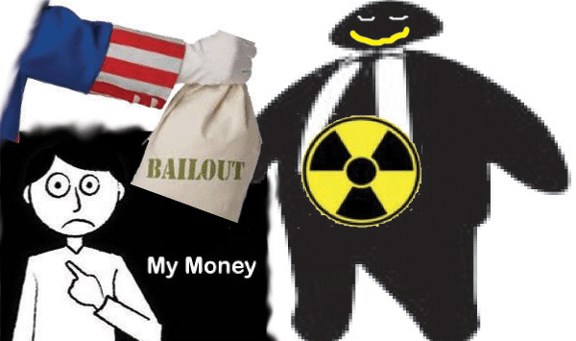
June 28 (Reuters) – A committee in the Ohio Senate could
vote on a nuclear bailout bill this weekend that would enable
the full state legislature to pass legislation over the weekend
to prevent the state’s two power reactors from early retirement,
sources familiar with the bill said on Friday.
FirstEnergy Solutions, the bankrupt unit of Ohio energy
company FirstEnergy Corp , has said it would shut the
money-losing reactors in 2020 and 2021 if the state did not
adopt a plan to provide some money for the plants by June 30.
Officials at FirstEnergy Solutions and several legislative
offices were not immediately available for comment.
The House and Senate have sessions available to vote on the
bill if needed on Saturday and Sunday, sources said.
“We expect the legislature will move quickly to get multiple
votes on the bill ahead of (FirstEnergy Solutions’) June 30
deadline,” analysts at Height Capital Markets in Washington,
D.C., said in a report on Thursday.
The Ohio Senate Energy and Public Utilities Committee
adopted amendments on House Bill 6 (HB 6) earlier this week and
may add more amendments before the vote on Saturday, sources
said.
….... Despite the subsidies for the nuclear and coal plants,

consumers would see an overall reduction in their electricity
bills because the Senate amendments, like the House version of
the bill, would reduce costs by weakening the state's renewable
and energy efficiency standards...... Reporting by Scott DiSavino, editing by G Crosse)  https://www.reuters.com/article/ohio-nuclear/ohio-may-pass-bill-to-save-states-nuclear-power-plants-over-the-weekend-idUSL2N23Z1AF
Ohio Lawmakers plan to prop up nuclear power, cut support to wind and solar projects
 Ohio Lawmakers Still Working on Plan to Save Nuclear Plants https://www.usnews.com/news/best-states/ohio/articles/2019-06-28/ohio-lawmakers-still-working-on-plan-to-save-nuclear-plants Environmental groups in Ohio say a reworked proposal to save Ohio’s two nuclear power plants still goes too far in limiting wind and solar projects. By Associated Press, Wire Service Content June 28, 2019,COLUMBUS, OHIO (AP) — Environmental groups in Ohio say a reworked proposal to save Ohio’s two nuclear power plants still goes too far in limiting wind and solar projects.
State lawmakers have just days to agree on legislation that would give a financial lifeline to the nuclear plants near Cleveland and Toledo.
The plant operators say they must know soon whether the state will add a fee onto every electricity bill in Ohio to raise millions each year for the plants. A Senate committee could vote on the plan this weekend.
Some lawmakers say they shouldn’t bail out the nuclear plants that are struggling and costly to operate.
Environmental groups are upset that the latest proposal includes changing a mandate that says utilities must find some of their power from renewable energy.
Proposed nuclear storage consent bill excludes Yucca Mountain
Proposed nuclear storage consent bill excludes Yucca Mountain, Las Vegas Sun, By John Sadler (contact) June 27, 2019A proposed Senate bill requiring local and state consent for a nuclear waste repository excludes Nevada’s Yucca Mountain site from the process.
The Nuclear Waste Administration Act would require a state’s governor, affected tribes and local governments to OK any proposed site. But it would not apply to “any proceeding or any application for any license or permit pending,” which would exempt Yucca Mountain, said Robert Halstead, executive director of the Nevada Agency for Nuclear Projects.
“Specific provisions would exclude Nevada from the newly created consent-based siting process that would apply to all other potential repository host states,” Halstead said in a letter to the Senate Committee on Energy and Natural Resources, which held a hearing on the bill today…… https://lasvegassun.com/news/2019/jun/27/proposed-nuclear-storage-consent-bill-excludes-nev/
Turkey’s President Erdoğan admits that Sinop nuclear power plant has been halted (too costly)
Anti-Nuclear Platform: ‘We Won’t Get Carried Away Until Project is Officially Canceled’
Zeki Karataş from the Sinop Anti-Nuclear Platform told bianet that they don’t want Sinop to be a subject of international negotiations.
“There similar claims and statements before but a statement on the essence of the matter did not come…….
The project was signed in 2013 and projected to be partly operational in 2023. However, there have been reports that the construction has been halted due to increasing costs. Erdoğan confirmed such reports for the first time in the interview he gave to the daily Nikkei. ….http://bianet.org/english/environment/209874-anti-nuclear-platform-we-won-t-get-carried-away-until-project-is-officially-canceled
U.S. Dept of Energy accepts reimbursement claims for clean-up of thorium and uranium pollution
DOE Accepts Reimbursement Claims for Uranium, Thorium Processing Remediation
The Department of Energy is accepting claims through Sept. 13 for reimbursement of expenses for cleanup of certain uranium and thorium processing sites in the current 2019 federal fiscal year. The agency said in a Federal Register notice Tuesday that its Office…(subscribers only) https://www.exchangemonitor.com/doe-accepts-reimbursement-claims-uranium-thorium-processing-remediation/
Nuclear bailout plan for Ohio changed again
|
Ohio’s nuclear ‘bailout’ bill changed again. Here’s what you need to know.
A panel of state senators on Wednesday made big changes to House Bill 6, which generated controversy for providing a hefty bailout to First Energy Solutions’ Ohio nuclear plants while scrapping programs favored by wind and solar generators. “All ratepayers in Ohio will share the cost of the nuclear relief,” said Sen. Steve Wilson, R-Maineville, who leads the Senate committee reviewing the bill. The same is true for subsidies for two coal plants, energy efficiency and renewable energy requirements. Opponents said the bill remains a “bailout.” The bill “guts clean energy programs,” said Dick Munson, director of Midwest Clean Energy for Environmental Defense Fund. Here’s what you need to know about the bill. Money for nuclear plantsThe latest version of the bill would give up to $150 million a year to FirstEnergy Solutions, which operates the two nuclear plants outside of Toledo and Cleveland, starting in 2020. …….
If approved, FirstEnergy Solutions would get that $150 million in 2020. Starting in 2021, the Public Utilities Commission of Ohio would audit the company’s finances. If the company’s finances improved, FirstEnergy Solutions would receive less money from the state and its ratepayers. Opponents fear PUCO won’t adequately monitor the company, citing a recent Ohio Supreme Court decision that found FirstEnergy overcharged customers. The audits would not occur in the first two years to give the company a chance to emerge from bankruptcy, a Senate spokesman said. …..
Renewable energy The Senate saved renewable energy benchmarks – requirements that electric companies generate a certain amount of electricity through renewable energy – that the House gutted. But Senate lawmakers also lowered the bar. Under current law, electric companies must generate 12.5 percent of electricity using renewable energy by 2027. The bill would lower that threshold to 8.5 percent by 2025.
Energy efficiencyBig changes could be coming for energy efficiency standards by 2021 if Senate changes are approved. These goals incentivize companies being more efficient in how they make and deliver energy and how customers use it. Think discounts on more efficient light bulbs and appliance recycling. Starting in 2021, companies wouldn’t get a cut of savings that customers achieve, called “shared savings.” Environmental groups worry that will take away the incentive to do those programs. Electric companies would need to cash out energy efficiency credits they had banked from exceeding required savings.
Money for coal plantsThe Senate lowered the amount that utilities could charge customers for two coal plants operated by Piketon-based Ohio Valley Electric Corporation. The plants are located in Gallipolis and Madison, Indiana. Under the House plan, utilities could collect up to $2.50 per month through 2030. The Senate plan drops that to $1.50 a month and give PUCO more power to dole out less if warranted. What’s next?House Bill 6 could receive a vote in the Senate committee as soon as Friday and be sent to the Senate floor shortly after. Whether House lawmakers, and especially Speaker Larry Householder, like the changes remains to be seen. ….. https://www.cincinnati.com/story/news/politics/2019/06/26/ohio-nuclear-bailout-bill-revised-renewable-energy-energy-efficiency/1573061001/
|
|
U.S. Congressional panel to discuss options on what to do with nuclear wastes
|
US Senate panel takes up thorny issue of nuclear waste https://www.kansas.com/news/business/article232008162.htmlALBUQUERQUE, N.M. 26June 19
A congressional panel is scheduled to hear from experts as it weighs legislation aimed at tackling the decades-old problem of how to handle spent nuclear fuel and other high-level waste that has been piling up around the United States. The Senate Energy and Natural Resources Committee on Thursday will be discussing temporary and permanent options for dealing with the waste. Scientists, environmentalists and officials with the Nuclear Energy Institute are expected to testify. Development of a proposed long-term storage site at Nevada’s Yucca Mountain was halted during the Obama administration, although the Trump administration has moved to restart the licensing process despite stiff resistance in Nevada. Private companies also have applied for licenses to open temporary storage facilities in New Mexico and West Texas. Those proposals also face political opposition. |
|
UK’s Nuclear Free Local Authorities (NFLA) alarmed at likely promotion of nuclear power in govt’s White Paper
NFLA 24th June 2019 The Nuclear Free Local Authorities (NFLA) has been monitoring with concern
the UK Government’s expected summer White Paper expected to advocate the
funding of new nuclear power stations through the Revenue Asset Base (RAB).
In the view of the NFLA this could put a heavy financial burden and
unnecessary risks for such projects on to the public purse and the consumer
– effectively us the taxpayer.
This move largely arises from the heavy
costs of contract for delivering the Hinkley Point C reactor project and
the collapse of the Sellafield Moorside and the Wylfa B projects over the
past year. It also comes at a time when the financial costs of offshore
wind, onshore wind, solar and energy storage schemes all continue to come
down in cost.
http://www.nuclearpolicy.info/news/nfla-concerned-edf-financial-risks-public-purse-new-nuclear/
44% of Americans oppose a pre emptive strike on North Korea, 33%, mainly Trump supporters, support that idea
|
ONE-THIRD OF U.S. SUPPORTS NUCLEAR WAR ON NORTH KOREA, KNOWING IT WOULD KILL ONE MILLION, REPORT SHOWS, NewsWeek, BY ON 6/24/19 One-third of the United States population would support a preemptive attack on North Korea, even in a nuclear scenario, knowing it would kill one million innocent people, according to a recent survey.
The Bulletin of the Atomic Scientists, in collaboration with U.K.-based research firm YouGov, published a new study Monday detailing U.S. public opinion on military conflict with North Korea at a time when the pace of a historic peace process between the longtime rivals appeared to slow. Among the most “disturbing” results discovered was that “a large hawkish minority lurks within the U.S. public; over a third of respondents approve of a US preventive strike across the scenarios and appear insensitive to informational cues that most security experts would expect to reduce such levels of support.” Little changed when the U.S. first-strike was switched from conventional to nuclear as “33 percent preferred.” In fact, “there is no significant change in the percentage who would prefer or approve of a U.S. nuclear strike when the number of estimated North Korean fatalities increases from 15,000 to 1.1 million, including 1 million civilians.” The researchers said these results actually demonstrated a previously-established pattern among the U.S. public, which “exhibits only limited aversion to nuclear weapons use and a shocking willingness to support the killing of enemy civilians.”………. Answers were also influenced by political beliefs. While most respondents overall opposed military action against North Korea, the “majority of Trump supporters prefer the US strike in every scenario, except when confidence in the effectiveness of the US conventional strike is 50 percent”—and even then it remained at 44 percent as opposed to a mere 8 percent for non-supporters. Separately, those who backed the death penalty were actually more eager to inflict a higher death toll among North Korean civilians. ….. https://www.newsweek.com/us-support-north-korea-nuclear-war-one-million-dead-1445578 |
|
France wants EDF to sell more nuclear power to rivals, price could increase,
France wants EDF to sell more nuclear power to rivals, price could increase, Bate Felix, PARIS (Reuters) 24 19,- The French government plans to increase the amount of nuclear energy utility EDF is forced to sell to its competitors by 50 percent to 150 terawatt hours and is in talks with the European Commission to potentially raise the fixed price.The government aims to have both measures ready before the November auction window of the so-called ARENH market mechanism, under which EDF’s rivals bid for wholesale nuclear electricity for the year ahead, the energy ministry said.
“If we want power prices to be contained in 2020, we need to increase the ceiling and it is the wish of the government to move quickly on those two measure before the November auction window,” an official of the energy ministry told journalists.
“There would likely be a slight increase in the fixed price”, the official added.
The EU’s executive arm, which regulates market competition in the bloc would have to approve any change in the fixed wholesale nuclear price……..https://www.reuters.com/article/us-france-electricity/france-wants-edf-to-sell-more-nuclear-power-to-rivals-price-could-increase-idUSK
Scientifically ignorant, is Australia’s Morrison government being conned into buying Small Modular Nuclear Reactors?
 Fukushima, the ‘nuclear renaissance’ and the Morrison Government, Independent Australia, By Helen Caldicott | 25 June 2019 Now that the “nuclear renaissance” is dead following the Fukushima catastrophe, when one-sixth of the world’s nuclear reactors closed, the nuclear corporations – Toshiba, Nu-Scale, Babcock and Wilcox, GE Hitachi, Cameco, General Atomics and the Tennessee Valley Authority – will not accept defeat, nor will the ill-informed Morrison Government…..
To be quite frank, almost all of our politicians are scientifically and medically ignorant and in an age where scientific evolution has become extraordinarily sophisticated, it behoves us – as legitimate members of democracy – to both educate ourselves and our naive and ignorant politicians for they are not our leaders, they are our representatives.
Many of these so-called representatives are now being cajoled into believing that electricity production in Australia could benefit from a new form of atomic power in the form of small modular reactors (SMRs), allegedly free of the dangers inherent in large reactors — safety issues, high cost, proliferation risks and radioactive waste.

But these claims are fallacious, for the reasons outlined below.
Basically, there are three types of small modular reactors (SMRs), which generate less than 300 megawatts of electricity compared with current 1,000-megawatt reactors.
1. Light-water reactors
These will be smaller versions of present-day pressurised water reactors, using water as the moderator and coolant, but with the same attendant problems as Fukushima and Three Mile Island. Built underground, they will be difficult to access in the event of an accident or malfunction.
Because they’re mass-produced (turnkey production), large numbers must be sold yearly to make a profit. This is an unlikely prospect because major markets — China and India — will not buy our reactors when they can make their own.
If safety problems arise, they all must be shut down, which will interfere substantially with electricity supply.
SMRs are expensive because the cost per unit capacity increases with a decrease in reactor size. Billions of dollars of government subsidies will be required because investors are allergic to nuclear power. To alleviate costs, it is suggested that safety rules be relaxed.
2. Non-light-water designs
These include high-temperature gas-cooled reactors (HTGRs) or pebble-bed reactors. Five billion tiny fuel kernels consisting of high-enriched uranium or plutonium will be encased in tennis-ball-sized graphite spheres that must be made without cracks or imperfections — or they could lead to an accident. A total of 450,000 such spheres will slowly and continuously be released from a fuel silo, passing through the reactor core and then recirculated ten times. These reactors will be cooled by helium gas operating at high very temperatures (900 degrees Celcius).
A reactor complex consisting of four HTGR modules will be located underground, usually to be run by just two operators in a central control room. Claims are that HTGRs will be so “safe” that a containment building will be unnecessary and operators can even leave the site (“walk-away-safe” reactors).
However, should temperatures unexpectedly exceed 1,600 degrees Celcius, the carbon coating will release dangerous radioactive isotopes into the helium gas and at 2,000 degrees Celcius, the carbon would ignite, creating a fierce, Chernobyl-type graphite fire.
If a crack develops in the piping or building, radioactive helium would escape and air would rush in, also igniting the graphite.
Although HTGRs produce small amounts of low-level waste, they create larger volumes of high-level waste than conventional reactors.
Despite these obvious safety problems, and despite the fact that South Africa has abandoned plans for HTGRs, the U.S. Department of Energy has unwisely chosen the HTGR as the “next-generation nuclear plant.” There is a push for Australia to follow suit.
3. Liquid-metal fast reactors (PRISM)
It is claimed by proponents that fast reactors will be safe, economically competitive, proliferation-resistant and sustainable.
They are fueled by plutonium or highly enriched uranium and cooled by either liquid sodium or a lead-bismuth molten coolant. Liquid sodium burns or explodes when exposed to air or water, and lead-bismuth is extremely corrosive, producing very volatile radioactive elements when irradiated.
Should a crack occur in the reactor complex, liquid sodium would escape, burning or exploding. Without coolant, the plutonium fuel could reach critical mass, triggering a massive nuclear explosion, scattering plutonium to the four winds. One-millionth of a gram of plutonium induces cancer — and it lasts for 500,000 years. Extraordinarily, they claim that fast reactors will be so safe that they will require no emergency sirens and that emergency planning zones can be decreased.
There are two types of fast reactors: a simple, plutonium-fueled reactor and a “breeder,” in which the plutonium-reactor core is surrounded by a blanket of uranium 238, which captures neutrons and converts to plutonium.
The plutonium fuel, obtained from spent reactor fuel, will be fissioned and converted to shorter-lived isotopes, caesium and strontium, which last 600 years instead of 500,000. The industry claims that this process, called “transmutation,” is an excellent way to get rid of plutonium waste. But this is fallacious because only ten per cent is fissioned, leaving 90 per cent of the plutonium for bomb-making and so on.
Then there’s construction. Three small plutonium fast reactors are grouped together to form a module and three of these modules will be buried underground. All nine reactors will then be connected to a fully automated central control room operated by only three operators. Potentially, then, one operator could face a catastrophic situation triggered by the loss of off-site power to one unit at full power, another shut down for refuelling and one in startup mode. There are to be no emergency core cooling systems.
Fast reactors require massive infrastructure, including a reprocessing plant to dissolve radioactive waste fuel rods in nitric acid, chemically removing the plutonium and a fuel fabrication facility to create new fuel rods. A total of 14-23 tonnes of plutonium are required to operate a fuel cycle at a fast reactor, and just five pounds is fuel for a nuclear weapon.
Thus fast reactors and breeders will provide extraordinary long-term medical dangers and the perfect situation for nuclear-weapons proliferation. Despite this, the Coalition Government is considering their renaissance. https://independentaustralia.net/environment/environment-display/fukushima-the-nuclear-renaissance-and-the-morrison-government,12834
1 This Month





PLEASE OPPOSE HR 8255 AND S.3639 – bills would accelerate satellite deployment, with no environmental review or safeguards – https://ncstd5li.quorum.us/campaign/169331/
To see nuclear-related stories in greater depth and intensity – go to https://nuclearinformation.wordpress.com
-
Archives
- October 2026 (81)
- September 2026 (339)
- August 2026 (330)
- July 2026 (355)
- June 2026 (287)
- May 2026 (306)
- April 2026 (356)
- March 2026 (251)
- February 2026 (267)
- January 2026 (308)
- December 2025 (358)
- November 2025 (359)
-
Categories
- 1
- 1 NUCLEAR ISSUES
- business and costs
- climate change
- culture and arts
- ENERGY
- environment
- health
- history
- indigenous issues
- Legal
- marketing of nuclear
- media
- opposition to nuclear
- PERSONAL STORIES
- politics
- politics international
- Religion and ethics
- safety
- secrets,lies and civil liberties
- spinbuster
- technology
- Uranium
- wastes
- weapons and war
- Women
- 2 WORLD
- ACTION
- AFRICA
- Atrocities
- AUSTRALIA
- Christina's notes
- Christina's themes
- culture and arts
- Events
- Fuk 2022
- Fuk 2023
- Fukushima 2017
- Fukushima 2018
- fukushima 2019
- Fukushima 2020
- Fukushima 2021
- general
- global warming
- Humour (God we need it)
- Nuclear
- RARE EARTHS
- Reference
- resources – print
- Resources -audiovicual
- Weekly Newsletter
- World
- World Nuclear
- YouTube
-
RSS
Entries RSS
Comments RSS

