Decommissioning of Oyster Creek nuclear station – a nasty precedent for closing down of other USA reactors.
|
The decommissioning at Oyster Creek was funded by ratepayers and amounted to almost $1 billion when it was sold, presumably for significantly less than its billion-dollar-fund balance. Authoritative sources had previously estimated the cost to decommission Oyster Creek at over $1.4 billion. The original decommissioning schedule was to occur over a 60-year period, but the new owners are betting they can decommission the plant faster, and for significantly less than their investment, pocketing the difference. The quicker they can do this, the more they earn. Of course, if they find they bit off more than they can chew and look like they are on a pathway to failure, they can pack up their wrenches and backhoes and abandon the project, leaving New Jersey ratepayers to fund whatever actions remain to safely complete decommissioning. Seems like a win-win for both buyer and seller. For the new owner, if the challenges exceed their abilities, they can simply cut and run before depleting their newly acquired billion-dollar decommissioning fund. For the seller, they have unloaded an unpleasant responsibility in a way that’s sadly reminiscent of the actions of a deadbeat dad. Current questions on nuclear subsidiesThe current question before the BPU on subsidies presents a rare opportunity for regulators to exert some leverage considering tangential, but critical, questions on nuclear energy. Are safety practices sufficient to deter today’s technology-savvy terrorists? How reliable are their storage processes for spent fuel and what are the long-term plans for its disposal or relocation? What are the plans for the eventual decommissioning of remaining New Jersey nuclear reactors that combined are almost five times the size of Oyster Creek? Are we comfortable following the path blazed by Oyster Creek with the potential of a pre-emptive sale if the new owners make their way out of Dodge before the sheriff shows up …. |
|
Holtec wants to build new nuclear reactor at site of USA’s oldest, most dangerous nuclear station
 New Jersey nuclear plant proposed at site of old reactor PBS, Jan 5, 2021
LACEY, N.J. (AP) — The company that’s in the process of mothballing one of the nation’s oldest nuclear power plants says it is interested in building a new next-generation nuclear reactor at the same site in New Jersey.
Holtec International last month received $147.5 million — $116 million of which will come from the U.S. Department of Energy — to complete research and development work on a modern nuclear reactor that could be built at the site of the former Oyster Creek Nuclear Generating Station in the Forked River section of Lacey Township, New Jersey.
Holtec owns that facility and oversaw its shutdown in 2018……
company spokesperson Joe Delmar said Holtec is “actively engaged with the Nuclear Regulatory Commission” about the project, but has not yet formally applied to build the reactor…..
Jeff Tittel, director of the New Jersey Sierra Club and a longtime opponent of the Oyster Creek plant, called the proposal “a threat to health and safety.”
“Things are going from bad to worse,” he said. “What was supposed to be the cleanup and ending of the Oyster Creek nuclear plant is now being looked at for another nuclear power plant. The whole point of closing and decommissioning this site was to get rid of the oldest and probably most dangerous nuclear plant. Putting all of that nuclear material in one area that is vulnerable to climate impacts like sea-level rise is a disaster waiting to happen.”……. https://www.pbs.org/newshour/economy/new-nuclear-plant-could-rise-at-site-of-former-one-in-nj
Indonesia’s nuclear ambitions could prove disastrous for the Southeast Asian region
More dangerously, Indonesia’s nuclear stakeholders have traditionally run into trouble selling the idea of nuclear energy to their constituents given widespread fear over Indonesia being prone to earthquakes and volcanic activity given its unique position within the Pacific’s ‘Ring of Fire’.
|
Will Indonesia become a nuclear power? https://www.trtworld.com/magazine/will-indonesia-become-a-nuclear-power-43025 6 Jan 21, In spite of its nuclear ambitions, Indonesia does not yet have the capacity to manage its nuclear waste disposal, which could prove disastrous for the Southeast Asian region.
Indonesia may be taking steps to revive its nuclear ambitions under President Joko Widodo’s government. In February 2020, Luhut Binsar Pandjaitan, Indonesian minister of maritime affairs and former chief of staff to Widodo, publicly proclaimed that powerful nations like the United States do not see Indonesia as a serious international player due to its lack of nuclear weapons. His statement quickly captured local news headlines. The retired four-star army general turned political heavyweight is a major proponent behind recent interest in acquiring nuclear reactor technology to capitalize on Indonesia’s wealth of mineral resources. If Indonesia takes the nuclear track, it would be a major departure from its traditional foreign policy footing. Historically, Indonesia organised the Bandung Conference in 1955 which gave rise to a global Non-Aligned Movement (NAM) of African and Asian states who collectively opted out of aligning with either the United States or Russia during the dawn of the cold war. Nuclear pivot Continue reading |
British tax-payers’ £ 132 billion cost for 120 years of nuclear decommissioning
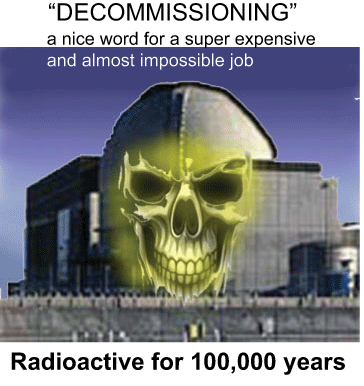 Brinkwire 4th Jan 2021, It has been warned that a “perpetual” lack of information about the condition of the nuclear facilities in Britain means that decommissioning for 120 years would not be complete and cost billions of pounds.
The decommissioning of UK civil nuclear power plants, including the Torness power plant in East Lothian and the Hunterston B power plant in Ayrshire, would cost the taxpayer about £ 132 billion, according to a new estimate, and will not be finished for 120 years.
The Public Accounts Committee blames the U.K. in its sober analysis. Government for a “sorry saga” of massively ineffective contracts, “weak” government monitoring and a “persistent” lack of awareness of the condition of nuclear installations. The Nuclear Decommissioning Authority (NDA) has left decades of inadequate information on the status and location of dangerous and
radioactive materials with a history of a lack of awareness about the condition of the sites it is responsible for safeguarding, the study warned. The NDA recognizes that it still does not have a complete understanding of the condition of the 17 sites in its custody, including the 10 former Magnox power plants, the report from the committee said.
According to the latest NDA figures, the decommissioning of UK civilian nuclear power plants would cost an incredible £ 132 billion for current and future generations of British taxpayers, and the work will not be finished for 120 years, with a huge effect on the lives of people living
near the plants, the study said.
Astounding failure by Ohio Republican leadership to repeal nuclear bailout law
Claims in a federal complaint released in July indicate that the law was at the heart of an alleged corruption scheme involving roughly $60 million. Former Ohio House Speaker Larry Householder, R-Glenford, and others were arrested last summer.
Failure to repeal the law in 2020 was “an astounding failure by Republican leadership,” said Rep. David Leland, D-Columbus, as the legislature adjourned last month……..
Allegations in the federal criminal case indicate that FirstEnergy and FirstEnergy Solutions — now known as Energy Harbor — provided most of the funding for an alleged scheme to elect favorable lawmakers and then to pass and defend HB 6. …….
Rulings from the Ohio Supreme Court and the Franklin County Court of Common Pleas have temporarily postponed collection of the nuclear plant subsidies anyway. Meanwhile, FirstEnergy benefits from the 2019 law’s revenue guarantee provision. Consumers pay subsidies for the old coal plants. And provisions that gutted Ohio’s renewable energy and energy efficiency standards are in full force…….
FirstEnergy Solutions paid money to Generation Now. The dark money group is a defendant in the criminal case.
And while Seitz maintained that “no alleged corruption infected all of HB 6,” others such as Rep. Mike Skindell, D-Lakewood, have stressed that “all of it — not just part of it” is tainted by the alleged corruption.
“To suggest we can parse out which pieces of the bill were not the product of corruption is wishful thinking,” Leppla said. “There is an ongoing FBI investigation, with more shoes likely to drop, so we won’t know the full extent of the corruption for some time.”
Although a FirstEnergy Solutions officer provided brief testimony on HB 6 in 2019, the company has not provided financial materials in any hearings to back up its alleged need for funding. Asked why he wouldn’t make Energy Harbor provide such sworn testimony now, Seitz said the proposed regulatory audit would be “much better than any testimony at this point.”
“Pushing it off to a closed-door audit that won’t be made fully public is a convenient way for legislators to avoid public scrutiny and outrage at forking over Ohioans’ hard-earned money to bail out a company that doesn’t need it,” Leppla said.
“I can’t think why the legislature would not want this information,” Brown said. Indeed, an option approach would tell Energy Harbor that it could draw on a slush fund if it is too incompetent or too inefficient to compete. In his view, the whole approach is “beyond crony capitalism.”………
“What we do know,” Leppla said, “is that HB 6 was a widely disliked bill that will raise Ohioans’ bills, pollute our air, and send us backward in the fight against climate change — and yet, it passed anyway.” https://www.wvxu.org/post/rep-bill-seitz-forefront-key-points-nuclear-bailout-law-hb-6#stream/0
Ohio lawmakers still don’t know what to do about corruptly instituted nuclear bailout law
The courts have taken some of the heat off by temporarily blocking the start of consumer surcharges this month to fuel the $150 million that would be used to subsidize the plants’ operations, but the law now considered to be the fruits of corruption remains on the books.
“We have a new General Assembly, so we have 20 new members,” House Speaker Bob Cupp (R., Lima) said Monday. “We will continue to work to find a solution that the House, the Senate, and the governor can all agree on…It is still a high priority on our agenda to find a solution.”
New Senate President Matt Huffman (R., Lima) said he and the speaker have been talking about how to proceed.
Grand Gulf nuclear plant in Mississippi raises concerns about nuclear power
That means Entergy Corp., which is the plant’s main owner, and the Midcontinent Independent System Operator, which operates the regional grid, often have to rely on other generation to fill the gap — possibly costing more and boosting greenhouse gas emissions if fossil fuel sources are tapped.
“The same rule applies to Grand Gulf as applies to coal, to gas, to any resource that we know we’re paying more for than we’re getting from,” said Logan Atkinson Burke, executive director of the New Orleans-based Alliance for Affordable Energy. “And the question is, who’s profiting from that, and who is being burdened by it?”
Experience at Grand Gulf suggests regulators and plant operators may need to consider new approaches and closer oversight of aging reactors, which face an uncertain future if they become too expensive to repair and maintain, observers say. This could have national implications as the electricity industry tries to transition away from fossil fuels and aims to rely more heavily on carbon emissions-free nuclear power.
The industry says nuclear plants are performing well broadly and companies are making investments to keep them operating. But Grand Gulf shows that a reactor that often goes offline can be expensive and undermine climate goals. An examination of New Orleans, for example, provided a snapshot in the past, estimating that a multiday unplanned outage at Grand Gulf in late 2018 resulted in higher costs of more than $1 million for New Orleans ratepayers, according to data from the city.
Aging and troubled nuclear reactors in competitive markets also occupy shaky ground because cheaper options like renewables have been able to undercut them economically, and there isn’t always a customer base to prop them up. Grand Gulf operates in a regulated territory, so it has protection, said Paul Patterson, a utility analyst with Glenrock Associates LLC. But he added that keeping plants alive isn’t a given.
“If the stars aren’t aligned politically to support these plants, it’s not going to happen,” he said………
Grand Gulf finished last among U.S. reactors at 68.8% capacity…….
At the same time, the Nuclear Regulatory Commission recently questioned the site’s operators about mislabeling of waste tied to the plant. And the Federal Energy Regulatory Commission has been reviewing complaints around Grand Gulf’s financial structure that could lead to a refund for customers……..
Nuclear reactors are designed to act as baseload power plants, which means they aren’t usually turned on and off frequently. It also takes time to take a nuclear plant offline, unless there’s an emergency that automatically trips the reactor for safety reasons.
But downtime at Grand Gulf has plagued the plant for years, as E&E News reported in 2018 (Energywire, Dec. 4, 2018). ……. its performance tanked in 2020, as it was at zero on about 39% of the days. This stemmed largely from the refueling and upgrades Entergy undertook — and issues that followed.
Safety concerns could lead to more time that Grand Gulf is not operating, according to observers. Edwin Lyman of the Union of Concerned Scientists ticked off a list of statistics for Grand Gulf that he said concern him. The reactor is in Column 2 of the NRC’s so-called Action Matrix, meaning its performance has declined. It has a number of “green” or low-level safety issues that may trigger additional inspections and reviews, and it has a “white” finding, which is more severe.
“That’s showing a troubling trend in management and safety control,” said Lyman, nuclear power safety director at UCS…..
Lyman questioned whether there is stringent oversight by federal regulators of basic procedures such as replacing and maintaining equipment, following guidelines and continuing education. Management needs to follow through on overseeing maintenance activities, he said.
“All of these seem to be challenging the safety of the plant,” he said.
The NRC looks for so-called cross-cutting issues, which are something that affects most or all safety cornerstones. This is as broad as having a “safety conscious work environment” and can be as specific as human behavior and identifying and solving problems. But the agency has been under pressure to weaken its oversight, which means such patterns may be missed, Lyman said…….
Colby Cook, a spokesperson for the Louisiana Public Service Commission, said a directive last year authorized LPSC staff to initiate a complaint at FERC regarding Grand Gulf’s operations. He said the complaint hasn’t been filed yet. But it could involve other jurisdictions that have an interest in how the plant performs.
And regulators in various states are watching federal agencies for potential decisions related to Grand Gulf………
Lyman of USC acknowledged bipartisan support in Congress for nuclear power. He said it’s up to the Energy Department to promote nuclear as a climate solution, but said the reactors need to be running safely if that’s the case. This is where the NRC comes in.
“The people who you need to depend on to make sure the plants are running safely are not doing their jobs now,” Lyman said…….
Lyman called for a more detailed grading system at the NRC so the public has a better sense of safety problems. That could lead to public pressure on the staff and management at certain plants, which also are dealing with the COVID-19 pandemic.
“I’m concerned generation with the operating reactor fleet especially when they are under economic pressure, especially now with COVID,” Lyman said……
Burke of the Alliance for Affordable Energy in Louisiana said she has no reason to be confident that Grand Gulf will have a great future performance. When the plant is offline, she said, Entergy and MISO likely depend on gas-fueled generation in the region. Burke also worried that new natural gas-fired units could be proposed to replace Grand Gulf at some point….
Burke said utilities and regulators need to plan with credible data.
“If we’re honest about what this plant is costing us all, then this plant shuts down and we finally get to plan for the future,” she said. https://www.eenews.net/stories/1063721867
Canada vocal about nuclear disarmament, but silent about the Treaty for Prohibition of Nuclear Weapons
 Canada reaffirms support to advance nuclear disarmament Mirage News, 5 Jan 21, On behalf of the Honourable François-Philippe Champagne, Minister of Foreign Affairs, Rob Oliphant, Parliamentary Secretary to the Minister of Foreign Affairs, today reaffirmed Canada’s unwavering support for advancing nuclear non-proliferation and disarmament during the third meeting of foreign ministers of the Stockholm Initiative for Nuclear Disarmament. Canada reaffirms support to advance nuclear disarmament Mirage News, 5 Jan 21, On behalf of the Honourable François-Philippe Champagne, Minister of Foreign Affairs, Rob Oliphant, Parliamentary Secretary to the Minister of Foreign Affairs, today reaffirmed Canada’s unwavering support for advancing nuclear non-proliferation and disarmament during the third meeting of foreign ministers of the Stockholm Initiative for Nuclear Disarmament.
Co-hosted by Jordan, Germany and Sweden, the meeting brought together international partners advocating for action-oriented steps on nuclear disarmament. Participants called on all nuclear weapon states to show leadership in advancing nuclear disarmament and to take meaningful steps to implement all commitments under the Treaty on the Non-Proliferation of Nuclear Weapons (NPT). ………https://www.miragenews.com/canada-reaffirms-support-to-advance-nuclear-disarmament/
|
|
|
France’s declining nuclear production
Les Echos 4th Jan 2021, Nuclear: EDF production at its lowest for nearly thirty years. The year
2020 was marked by extremely low nuclear production, very slightly above
335 TWh. The impact of the Covid-19 crisis on the maintenance of power
plants and the extent of the work already in progress explain this
situation, which should continue in 2021 and 2022.
Nuclear Command and Control: Session 3 of the Congressional Study Group
Nuclear Command and Control
Session 3 of the Congressional Study Group, Wednesday, December 30, 2020 https://www.brookings.edu/research/nuclear-command-and-control/
On May 7, 2020, the Congressional Study Group on Foreign Relations and National Security convened online to discuss the question of the command and control of U.S. nuclear weapons. At present, the president has the unilateral authority to choose to use nuclear weapons, and many assume that this is a result of his Article II powers under the Constitution. But is this assumption correct? Are there ways Congress can limit when and how the president uses nuclear weapons?
To discuss this topic, the working group was joined by three outside experts Professor Mary DeRosa of Georgetown University Law Center, a former legal advisor to the National Security Council; Chris Fonzone, a partner at Sidley Austin and another former legal advisor to the National Security Council; and Professor Matt Waxman of Columbia Law School, who is also an Adjunct Senior Fellow at the Council on Foreign Relations and has previously held senior positions in the National Security Council and U.S. Department of State. Prior to the session, the study group received several written pieces as background reading, including:
- “The President and Nuclear Weapons: Authorities, Limits, and Process,” a report for the Nuclear Threat Initiative that DeRosa co-authored (and was accompanied by a separate policy proposal by former Energy Secretary Ernest Moniz and former Senator Sam Nunn);
- “The President and the Bomb: Reforming the Nuclear Launch Process,” which Waxman co-authored for Foreign Affairs; and
- “What the Military Law of Obedience Does (and Doesn’t) Do,” an issue brief for the American Constitution Society authored by Fonzone.
Waxman then shifted focus to ways that Congress might be able to shape the executive branch process for deciding when and how nuclear weapons are used. While few are likely to argue with the president’s ability to use nuclear force in response to a nuclear attack, Waxman identified three problematic scenarios that might emerge in a case of nuclear first use: that the president would pursue such an action without due deliberation; that a president might give such an order, but that it is not obeyed by military personnel who believe it to be unlawful or unwise; and that a third party might try to interfere with the system to inhibit a response or trigger an unauthorized launch.
A better defined process–for example, one that requires that an order to use nuclear weapons be certified as valid by the Secretary of Defense and lawful by the Attorney General–could reduce all three of these risks by putting some limits on the president’s unilateral authority, encouraging a more deliberative and justified process that is less likely to trigger reservations, and creating a process with multiple safeguards less subject to external manipulation. Such a process could be implemented by the president by executive order or by Congress, though the latter may raise constitutional objections in some corners and runs the risk of being disregarded by administrations who maintain it is constitutional. That said, by leaving the decision-making within the executive branch, such approaches are less likely to incur constitutional objections than outright statutory prohibitions, which may make them more effective in the long run.
Finally, Fonzone stepped in to discuss the military chain of command, specifically in reference to the oft-discussed possibility that military personnel might disregard an impetuous order to use nuclear weapons as unlawful. The operational chain of command, he noted, runs from the President through the Secretary of Defense down to the military ranks, and is defined in substantial part by statute in addition to executive branch guidelines. While the Secretary of Defense might be removed from office for disobeying a presidential order, members of the military can face criminal sanctions under the Uniform Code of Military Justice. That said, this duty of obedience does not extend to “patently” or “manifestly” illegal orders, which military personnel are obligated not to follow. This bar, however, is extremely high and requires clear knowledge on the part of the servicemember. As many major policy decisions, including the use of nuclear weapons, occur on contested and complex constitutional and legal terrain, even unlawful orders are not likely to be seen as “patently” or “manifestly” illegal. Hence, one should not rely on the lawfulness exceptions to the chain of command alone as a meaningful safeguard against such conduct.
From there, the study group went into open discussion, where they raised issues and addressed questions relating to: the civilian control of nuclear technology and weapons development; international legal and policy restraints on the use of nuclear weapons; and in what circumstances the use of nuclear weapons should properly be left to the president’s unilateral authority (e.g., self-defense).
Visit the Congressional Study Group on Foreign Relations and National Security landing page to access notes and information on other sessions.
Bechtel, Westinghouse and Southern Company’s hopeless case to save shambolic Wylfa nuclear project

 People Against Wylfa B 31st Dec 2020, On the last day of troubled 2020, the Westminster Government has deferred a decision on a Development Consent Order for a nuclear power station at Wylfa until the end of April 2021. This is the fourth time this has happened, and the second time in a row for Duncan Hawthorne, chief executive Horizon, to ask for a deferral.
‘saviours’ of the radioactive poisoning project that would threaten the health of everyone on the island and beyond are three US companies.
was the V C Summer nuclear plant in South Carolina. It was abandoned
unfinished in 2017, and is still being paid for by taxpayers. https://www.stop-wylfa.org/news/
With all the costs and delays – why not scrap the Wylfa nuclear project right now?
|
Wylfa, more problems, more delay. Scrap it now https://www.stop-wylfa.org/2020/04/01/wylfa-more-problems-more-delay-scrap-it-now/ By Stop Wylfa 2 Jan 21, The London government has pushed back any decision on the Wylfa B power plant planning application until the end of September 2020.
The Secretary of State for Business, Energy and Industry says he has not been satisfied by answers given by Horizon Nuclear on environmental issues and other considerations. PAWB proposes that Horizon Nuclear’s planning application should be totally rejected. The national policy statement for nuclear power adopted several years ago is completely outdated and rather than approving this obviously defective application, the Westminster government should start from scratch with a thorough review of their energy policy and to recognise that reneweable technologies like wind, solar and marine have totally undermined any reason for investing billions of pounds in nuclear power. The COVID 19 crisis has already forced big changes in the Government’ s way of operating. They should now take the opportunity to take a fundamental review on investing in renewable technologies which offer clean and safe electricity. A green revolution can create thousands of jobs in Wales and the other countries of Britain without the threat of nuclear disasters and poisonous radioactive waste and their effects on human and environmental health for thousands of years. |
|
New delay in planning decision for £16bn Wylfa nuclear development on Anglesey
months for talks with potential new investors to continue. Japanese
multi-national Hitachi announced in September they were pulling out of
funding the £16bn nuclear development on Anglesey. At that point BEIS
Secretary of State Alok Sharma delayed the Development Consent Order (DCO)
decision for the application to December 31. Now following a letter from
Duncan Hawthorne, chief executive of Wylfa developer Horizon Nuclear Power,
that date has been extended to April 30.
Cover-up! how consumers will be forced to pay for cost-overruns for Sizewell C nuclear construction
 Cover-up! how consumers will be forced to pay for cost-overruns for Sizewell C construction, https://100percentrenewableuk.org/cover-up-how-consumers-will-be-forced-to-pay-for-cost-overruns-for-sizewell-c-construction–by David Toke, 30 Dec 20, In a historic change of policy the Conservatives have announced that consumers, not EDF, will pay for cost overruns in building Sizewell C. The crucial phrase in the Government’s document on the so-called ‘Regulated Asset Base’ (RAB) model is ‘Cost overruns that were not excluded from the RAB would be shared between investors and consumers through suppliers’ (para 47 page 14). Note: ‘consumers’ means electricity consumers who will have to pay twice for Sizewell C; extra on their bills long before any power is generated and for many years after generation begins. Cover-up! how consumers will be forced to pay for cost-overruns for Sizewell C construction, https://100percentrenewableuk.org/cover-up-how-consumers-will-be-forced-to-pay-for-cost-overruns-for-sizewell-c-construction–by David Toke, 30 Dec 20, In a historic change of policy the Conservatives have announced that consumers, not EDF, will pay for cost overruns in building Sizewell C. The crucial phrase in the Government’s document on the so-called ‘Regulated Asset Base’ (RAB) model is ‘Cost overruns that were not excluded from the RAB would be shared between investors and consumers through suppliers’ (para 47 page 14). Note: ‘consumers’ means electricity consumers who will have to pay twice for Sizewell C; extra on their bills long before any power is generated and for many years after generation begins.The RAB document was produced alongside the Government’s new Energy White Paper. This should be compared to the Government position in the 2011 White Paper which stated that ‘new nuclear stations should receive no public support unless similar support is available to other low-carbon technologies’. (page 8) Under the Government’s RAB proposals it is claimed that clear criteria are going to be set for what cost overruns will be payable by the consumer and what by the developer, with the outcomes carefully monitored by a ‘Regulator’. But of course once the construction juggernaut for Sizewell C starts rolling where information, not to mention armies of lawyers and hired consultants of various sorts, will be controlled by EDF, I do not seriously believe that EDF will be stopped from passing on virtually whatever costs it wants to pass on to the consumer. It is not even certain that the ‘Regulator’ will be able to stop costs of building (the still uncompleted) Hinkley C being passed onto the consumer through the books assigned to Sizewell C- that is given that workers are likely to be switched from one operation to the other. In other words, it is a blank cheque for EDF for a power plant that is not only unnecessary but which will actually cause large quantities of renewable energy to be wasted because of nuclear power’s inflexible operation (see our report on this). In effect not just consumers but renewable energy operators will be paying for the cost-overruns of building Sizewell C. Laughingly, in a world where no (at least western) nuclear power plant has been attempted this century without massive construction cost overruns being generated, the RAB document talks about ‘low probability risks such as cost overruns above a certain threshold’ (page 12). In the case of Hinkley C the cost overruns are mounting already. The most charitable explanation for the RAB document is that Treasury officials are allowing themselves to be engaged in an exercise of self-deception in order to launder a policy that if stated plainly would be deemed politically unacceptable. Reading between the lines of the RAB document and the Energy White Paper itself, the only substantial barrier stopping EDF being handed a blank cheque contract is the payment that EDF would receive for electricity generated. The White Paper says ‘We expect the sector to deliver the goal it set for itself in our Nuclear Sector Deal, published in 2018, to reduce the cost of nuclear new build projects by 30 per cent by 2030’ (page 49). So in other words the Treasury wants EDF to accept less than £65 per MWh in 2012 prices. (2012 prices, the year in which Hinkley C’s contract was priced is the funny money basis for electricity contracts these days!). Obviously EDF wants more, but with the RAB mechanism it may not need more. This is because RAB mechanism is a piece of political jelly that will allow any nuclear developer to offer to complete Sizewell C for a low sum when in reality British electricity consumers will pay for what will be called ‘cost overruns’ over and above such a figure. The RAB mechanism is a flexible political device that allows Sizewell C to be built regardless of cost realities. It is an act of public manipulation and mystification worthy of the best traditions of ‘Yes Minister’. But even so these plans are likely to cause mounting opposition when consumers realise they are likely to have to start paying extra on their bills without getting any electricity in return. Then they will have to pay extra again for the power when (evenutally) it does start being generated. Professor Tom Burke, the founding Director of E3G commented: ‘Constructing Sizewell will cost just over £20 billion. If EDF borrow this money it will double the cost to over £40 billion. EDF is negotiating with the government to make consumers pay the construction cost in advance by a levy on everyone’s energy bills. They will then have to pay again for the electricity which will still be more expensive than that from renewables.’ In effect consumers will have to pay twice for the project – first for several years before the plant has generated anything, and then again for up 40 years afterwards.
|
|
|
Avril Haines is unfit for Director of National Intelligence, with her history of coverup of tortures.
|
The Trouble With Avril Haines for Intelligence, December 29, 2020 Biden’s nominee is a drone assassin who played a key role in covering up the U.S. torture program, Consortium News, By Medea Benjamin and Marcy Winograd
World BEYOND War Even before President-Elect Joe Biden sets foot in the White House, the Senate Intelligence Committee may start hearings on his nomination of Avril Haines as director of national Intelligence. President Barack Obama’s top lawyer on the National Security Council from 2010 to 2013 followed by CIA deputy director from 2013 to 2015, Haines is the proverbial wolf in sheep’s clothing. She is the affable assassin who, according to Newsweek, would be summoned in the middle of the night to decide if a citizen of any country, including our own, should be incinerated in a U.S. drone strike in a distant land in the greater Middle East. Haines also played a key role in covering up the U.S. torture program, known euphemistically as “enhanced interrogation techniques,” which included repeated water boarding, sexual humiliation, sleep deprivation, dousing naked prisoners with ice cold water and rectal rehydration. For these reasons, among others, the activist groups CODEPINK, Progressive Democrats of America, World Beyond War and Roots Action have launched a campaign calling on the Senate to reject her confirmation. These same groups ran successful campaigns to dissuade Biden from choosing two other warmongering candidates for critical foreign policy positions: China-hawk Michele Flournoy for secretary of defense and torture apologist Mike Morell for CIA director. By hosting calling parties to senators, launching petitions and publishing open letters from DNC delegates, feminists—including Alice Walker, Jane Fonda and Gloria Steinem—and Guantanamo torture survivors, activists helped derail candidates who were once considered shoo-ins for Biden’s cabinet. Now activists are challenging Avril Haines. In 2015, when Haines was CIA deputy director, CIA agents illegally hacked the computers of the Senate Intelligence Committee to thwart the committee’s investigation into the spy agency’s detention and interrogation program. Haines overruled the CIA’s own inspector general in failing to discipline the CIA agents who violated the U.S. Constitution’s separation of powers. According to former CIA whistleblower John Kiriakou, she not only shielded the hackers from accountability but even awarded them the Career Intelligence Medal. Redacting Role And there’s more. When the exhaustive 6,000-page Senate Intelligence Committee report on torture was finally complete, after five years of investigation and research, Haines took charge of redacting it to deny the public’s right to know its full details, reducing the document to a 500-page, black-ink-smeared summary. This censorship went beyond merely “protecting sources and methods.” It avoided CIA embarrassment, while ensuring her own career advancement. Moreover, Haines supported torture apologist Gina Haspel as Trump’s CIA director. Haspel ran a secret black site prison in Thailand where torture was regularly inflicted. Haspel also drafted the memo ordering the destruction of almost 100 videotapes documenting CIA torture. As David Segal of Demand Progress told CNN, “Haines has an unfortunate record of repeatedly covering up for torture and torturers. Her push for maximalist redactions of the torture report, her refusal to discipline the CIA personnel who hacked the Senate and her vociferous support for Gina Haspel — which was even touted by the Trump White House as Democrats stood in nearly unanimous opposition to the then-nominee to lead the CIA — should be interrogated during the confirmation process.” This sentiment was echoed by Mark Udall, a Democratic senator on the intelligence committee when it finished the torture report…………….. Empty Words on Paper Haines’s policy guidance also states that the U.S. would respect other states’ sovereignty, only undertaking lethal action when other governments “cannot or will not” address a threat to the U.S. This, too, became simply empty words on paper. The U.S. barely even consulted with the governments in whose territory it was dropping bombs and, in the case of Pakistan, openly defied the government. In December 2013, the National Assembly of Pakistan unanimously approved a resolution against U.S. drone strikes in Pakistan, calling them a violation of “the charter of the United Nations, international laws and humanitarian norms” and Pakistan’s former Prime Minister Nawaz Sharif stated: “The use of drones is not only a continual violation of our territorial integrity but also detrimental to our resolve and efforts at eliminating terrorism from our country.” But the U.S. ignored the pleas of Pakistan’s elected government……………. There are many other reasons to reject Haines. She advocates intensifying crippling economic sanctions on North Korea that undermine a negotiated peace, and “regime change”—hypothetically engineered by a U.S. ally — that could leave a collapsed North Korea vulnerable to terrorist theft of its nuclear material; she was a consultant at WestExec Advisors, a firm that exploits insider government connections to help companies secure plum Pentagon contracts; and she was a consultant with Palantir, a data-mining company that facilitated Trump’s mass deportations of immigrants. But Haines’ record on torture and drones, alone, should be enough for senators to reject her nomination. The unassuming spy — who got her start at the White House as a legal adviser in the Bush State Department in 2003, the year the U.S. invaded Iraq—might look and sound more like your favorite college professor than someone who enabled murder by remote control or wielded a thick black pen to cover up CIA torture, but a clear examination of her past should convince the Senate that Haines is unfit for high office in an administration that promises to restore transparency, integrity, and respect for international law……… https://consortiumnews.com/2020/12/29/the-trouble-with-avril-haines-for-intelligence/ |
|
1 This Month



Shut down the radiation-damaged Heysham nuclear reactors now
To see nuclear-related stories in greater depth and intensity – go to https://nuclearinformation.wordpress.com

Say No to NASA’s Reckless Nuclear Reactor on the Moon
Say No to NASA’s Reckless Nuclear Reactor on the Moon
-
Archives
- October 2026 (247)
- September 2026 (339)
- August 2026 (330)
- July 2026 (355)
- June 2026 (287)
- May 2026 (306)
- April 2026 (356)
- March 2026 (251)
- February 2026 (267)
- January 2026 (308)
- December 2025 (358)
- November 2025 (359)
-
Categories
- 1
- 1 NUCLEAR ISSUES
- business and costs
- climate change
- culture and arts
- ENERGY
- environment
- health
- history
- indigenous issues
- Legal
- marketing of nuclear
- media
- opposition to nuclear
- PERSONAL STORIES
- politics
- politics international
- Religion and ethics
- safety
- secrets,lies and civil liberties
- spinbuster
- technology
- Uranium
- wastes
- weapons and war
- Women
- 2 WORLD
- ACTION
- AFRICA
- Atrocities
- AUSTRALIA
- Christina's notes
- Christina's themes
- culture and arts
- Events
- Fuk 2022
- Fuk 2023
- Fukushima 2017
- Fukushima 2018
- fukushima 2019
- Fukushima 2020
- Fukushima 2021
- general
- global warming
- Humour (God we need it)
- Nuclear
- RARE EARTHS
- Reference
- resources – print
- Resources -audiovicual
- Weekly Newsletter
- World
- World Nuclear
- YouTube
-
RSS
Entries RSS
Comments RSS

