Nuclear power unaffordable in USA, Russia, India, France, even China, but NO SOLUTION TO WASTES
|
Germany: Nuclear phaseout or renaissance? https://www.dw.com/en/germany-looking-for-final-repository-for-nuclear-waste-global-outlook/a-56449115– 5 Feb 21,
Germany’s nuclear phaseout will be completed by the end of 2022. Safe final repositories for nuclear waste still haven’t been found, but some countries are still building new reactors. Does nuclear have a future? There are currently 413 nuclear reactors in operation in 32 countries around the globe. According to the annual World Nuclear Industry Status Report (WNISR), nuclear power accounted for about 10% of global electricity demand in 2019, the highest share being 17.5% in 1996. Most reactors were built between 1968 and 1986, mainly in Europe, the United States, the former Soviet Union and Japan. The global average age of these reactors is 31 years.
|
|
|

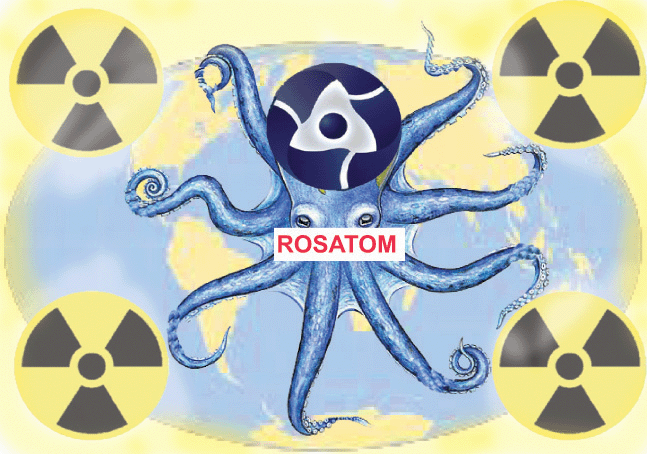



In desperate economic plight, two Japanese towns willing to host nuclear waste dump

It’s sad that small Japanese towns are being forced to these lengths to protect their economic stability.
Two Japanese Towns Want to Host an Underground Nuclear Waste Dump 5 Feb 21, https://earther.gizmodo.com/two-japanese-towns-want-to-host-an-underground-nuclear-1846200890 Dharna Noor
No matter how you feel about nuclear energy, nuclear waste is generally something you want to stay as far away from as possible—unless you’re two villages on the Hokkaido, Japan’s second-largest island. The two small fishing towns, Suttsu and Kamoenai, are competing to become the site for a high-level radioactive waste storage site as a means to stay afloat economically. But not everyone is so thrilled about the prospect.
According to national data, Japan has generated more than 19,000 tons of highly toxic atomic waste since it began using nuclear power in 1966. To keep it away from people, back in 2000, the country passed the Designated Radioactive Waste Final Disposal Act to open a call for an underground waste repository for some of it.
At the time, unsurprisingly, no municipalities to sign up to host the toxic stuff. The trepidation only grew when in 2011, an earthquake and tsunami triggered an explosion at Japan’s Fukushima Daiichi Nuclear Power Plant, releasing an unprecedented amount of radioactive contamination into the ocean. It was the most severe nuclear accident since Chernobyl.
But now, times are desperate in Japan’s small villages. Fishing, once a booming industry, is in decline. Many young people are moving into cities where economic prospects are better. As a result, populations are shrinking. Suttsu currently has a population of 2,885, down from nearly 5,000 in 1980, and Kamoenai is home to just more than 800. As Bloomberg noted, both towns were also hit hard by the economic downturn of the covid-19 pandemic last year.
Agreeing to host the nuclear storage facility would be a major boost for either town. By agreeing to preliminary research into hosting the nuclear storage facility, municipalities can rake in up to $19 million in government subsidies over two years. If that first stage goes well, another $66 million becomes available in exchange for a four-year field survey and preliminary drilling. If that goes smoothly, the town would go through a 14-year evaluation period, unlocking even more funding. In total, the potential prize for agreeing to host the facility could be up to $37 billion in investments. So in October, both towns’ officials came forward as potential candidates.
But of course, the prospect of living near an atomic waste dump has sparked opposition from concerned residents of both towns. Nuclear waste can contain toxic elements like uranium and plutonium. Anti-nuclear advocates in Suttsu even pushed for a referendum on the village’s application, but the municipal assembly voted it down. Japanese government officials said their review process is airtight and would protect locals, but in an interview with the magazine Aera, Yugo Ono, a geology professor at Hokkaido University, said the earthquake risk is high and could lead to the stored waste leaking.
It’s sad that small Japanese towns are being forced to these lengths to protect their economic stability. But at some point, Japan will need to put its nuclear waste somewhere. Let’s just hope when it does, it does so safely.
NextEra Energy wants to avoid shutdown costs, extend license for old Point Beach Nuclear Plant.
|
NextEra Energy wants to operate the facility, which is 13 miles north of Manitowoc, for another 20 years. There are two nuclear generators at the plant. The current licenses expire in 2030 and 2033. A webinar is planned for 1 p.m., Feb. 17, to discuss the environmental review process, with a Feb. 10 deadline to register. A copy of the application and related environmental report is available for public inspection at the Lester Public Library, 1001 Adams St., in Two Rivers. The Nuclear Regulatory Commission is expected to make a decision on the application in about 18 months. The plant opened in 1970 with one reactor, while the second reactor opened in 1973. Point Beach is the last remaining nuclear plant in the state. The Kewaunee nuclear plant closed in 2013, while a LaCrosse facility closed in 1987. |
|
|

UK’s Infrastructure Planning Inspectorate recommends against development of Wyfa nuclear project
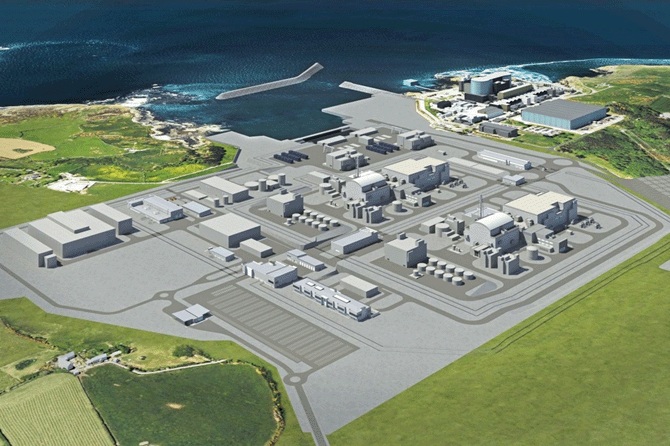 Planning Inspectorate 4th Feb 2021, Following the recent withdrawal of the application, and in the interests of openness and transparency, we have taken the decision to publish the
Examining Authority’s Recommendation Report. In the light of the ExA’s
findings and conclusions, the ExA under s105 of the PA2008 recommends the
Secretary of State for Business, Environment and Industrial Strategy does
not grant the Wylfa Newydd Project Development Consent Order.
Two Ohio state Republican Senators aim to remove subsidies to nuclear power plants
State Senators Jerry Cirino of Kirtland and Michael Rulli of Salem have introduced Senate Bill 44. Cirino says it does not repeal or replace House Bill 6. It just removes the subsidy provision, which he says will lower electric bills.
“We are eliminating, in the bill, $130 million plus per year that if HB6 was left intact, would be going to the nuclear facilities,” Cirino said. “So we’re taking that away and they’re on their own to figure out how to operate better and what they can do with the federal government.”
PJM Interconnection is a Regional Transmission Organization that coordinates the movement of wholesale electricity across 13 states including District of Columbia and Ohio.
They are offering pricing support to energy operators, but Cirino says it would be difficult for PJM to provide this support to operators accepting these subsidies.
Cirino says he supports nuclear power and says the plants will remain open with federal support that can help them continue to operate without the subsidy.
The Senate Energy Committee will have hearings about Senate Bill 44 beginning next week.
Read the bill as proposed:…………https://www.wksu.org/government-politics/2021-02-05/senate-bill-introduced-to-remove-power-plant-subsidies
New Iran envoy shows Biden is serious about reviving nuclear deal
|
New Iran envoy shows Biden is serious about reviving nuclear deal
Robert Malley appointment marks abrupt break with Trump administration’s approach to Tehran, Ft.com, DAVID GARDNER – 4 Feb 21, In the 2008 US presidential election campaign, Barack Obama suddenly pushed out Robert Malley, a top adviser on the Middle East. Mr Malley’s supporters tried to face down a barrage of attacks by rightwing pro-Israel groups. But the Obama team capitulated after it became public that he had met with Hamas, the Palestinian Islamist movement that controls the Gaza Strip. No matter that such meetings were intrinsic to Mr Malley’s previous job with the International Crisis Group, an NGO devoted to preventing or defusing conflict. He was seen as a political liability. Fast forward to President Joe Biden, Mr Obama’s vice-president, who has just appointed Mr Malley as US special envoy for Iran. Once more, he was pilloried by the pro-Israel right, Gulf Arab officials and some Iranian-Americans, who claimed he is biased against Israel and “Iran’s ideal candidate for the position of American envoy”. This time a counter-barrage, from a foreign policy elite studded with unimpeachably pro-Israel figures, was ready to fire back. The smears against Mr Malley were swiftly countered. The attempt to sabotage the appointment by detonating a proxy war over the Biden team’s Iran policy failed.
…………. The Malley appointment, alongside Mr Biden’s selection of seasoned diplomats involved in the 2015 nuclear deal, such as Antony Blinken as secretary of state and William Burns as CIA director, is a strong statement of intent. It could hardly be more different to the outgoing US envoy for Iran, Elliott Abrams, one of a cohort of Trump aides who acted more as lawyers for Israel than mediators. https://www.ft.com/content/eae24633-844a-4bb5-b5a9-28deead96a
|
|
|
Although Biden is pro-nuclear, there’s a chance that the new Nuclear Regulatory Commission might get out of bed with the nuclear lobby.
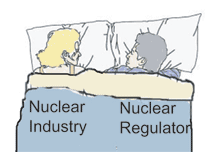 NRC has been too deferential to a nuclear industry eager to reduce the cost of operating nuclear plants while keeping aging plants online.
Nuclear has another friend in Biden, but changes at the NRC could mean more scrutiny ahead, Utility Dive . 1 Feb 21, Matthew Bandyk
Nuclear power is in a period of transformation, and so is the U.S. Nuclear Regulatory Commission. On Jan. 23, President Joe Biden appointed NRC Commissioner Christopher Hanson, a Democrat, as the new chairman of the agency. Hanson replaces Kristine Svinicki, a Republican who was designated by President Donald Trump to lead the commission days after his 2017 inauguration, and left Jan. 20, ending a 3-2 Republican majority on the commission……..
And now, while the industry faces an administration that sees nuclear as an important source of carbon-free power [ carbon-free – this is a lie] , the NRC under Biden is not likely to have the same regulatory approach as the commission did under Trump. ……
Environmental groups say NRC has been too deferential to a nuclear industry eager to reduce the cost of operating nuclear plants while keeping aging plants online. Jeffrey Baran, the sole remaining Obama appointee on the commission, has echoed these criticisms across a number of issues, such as the new safety rules for reactors based on lessons learned from the 2011 Fukushima incident and the process for evaluating advanced reactors. ……..
Biden enters the White House with one of the most explicitly pro-nuclear agendas of any president. His climate plan calls out nuclear as a zero-carbon technology [ but it’s NOT zero-carbon] that has a role to play in addressing climate change, and says his administration will look at ways to overcome the cost, safety and waste disposal challenges for nuclear power.
Based on his campaign’s policies, Biden’s presidency “bodes well” for nuclear power, Doug True, the chief nuclear officer at the Nuclear Energy Institute (NEI), the main advocacy organization for the industry, said in an interview…….
Subsequent license renewal
A top priority of the nuclear industry continues to be extending the lifetime of existing nuclear plants, …….
Over the past several years the NRC started accepting applications from nuclear plants to remain open for 80 years. The commission is also considering whether it should begin developing a framework for licensing plants to run for up to 100 years, holding the first public meeting on that topic on Jan. 21.
No U.S. nuclear plant had ever been licensed to operate beyond 60 years until Florida Power & Light’s Turkey Point reactors received a second license renewal from the NRC at the end of 2019, allowing operation for 80 years. Exelon’s Peach Bottom plant in Pennsylvania got permission to operate up to 80 years a few months later. These approvals came despite objections from environmental groups that the NRC was failing to do its duty by not requiring these plants to undergo more extensive reviews of the potential environmental and safety risks from 80 years of operation.
The NRC rejected a challenge to the Turkey Point relicensing process filed by the Natural Resources Defense Council and Friends of the Earth. Baran dissented, saying the commission should evaluate the groups’ position that Turkey Point cannot rely on a review of the environmental impacts of relicensing the reactors that was from 2013 and not specific to the site, and that the plant must instead perform a new review.
NRDC and Friends of the Earth have appealed the NRC’s decision on Turkey Point, and that challenge is currently pending before the U.S. Court of Appeals for the D.C. Circuit.
The nuclear watchdog group Beyond Nuclear brought a similar challenge against the Peach Bottom relicensing, and Baran once again dissented when the NRC released its order in November 2020 rejecting the group’s claim, but this time, he was joined by Hanson, who had been appointed to the commission after the Turkey Point decision.
The dissent of Baran and Hanson “conveys that a Democratically-led commission is at least more open to taking the hard looks at these license extensions that [the National Environmental Policy Act] demands,” said Paul Gunter, reactor oversight project director at Beyond Nuclear. A “hard look” would mean performing new environmental assessments of issues related to the aging of a nuclear plant, such as whether components of the plant have been embrittled by exposure to radiation over the course of decades, according to Gunter.
Dominion’s North Anna and Surry reactors in Virginia are next in line to potentially receive 80-year licenses. In addition, last November, NextEra Energy applied for license extensions up to 80 years for both of its reactors at the Point Beach plant in Wisconsin, and Duke Energy has told the NRC it intends to apply for similar extensions for the three reactors at its Oconee plant in South Carolina later this year.
Beyond Nuclear is still reviewing whether or not it will file more challenges to the environmental reviews of plants going for 80 year licenses, according to Gunter. An NRDC spokesman said that given the group’s active litigation on the mater, it cannot comment on how the change in the NRC leadership could affect future relicensing challenges.
The future of nuclear technology
Another priority for the NRC that will continue under the Biden administration is the consideration of new types of reactors that are intended to represent a leap forward for nuclear technology …….
The commission is wrestling with the question of how much of the safety requirements that apply to existing power reactors, such as the need to maintain evacuation zones, strict security procedures and more, should apply to advanced reactors. It also recently announced it is seeking public comments on how the process for licensing new reactors can be made overall more efficient……….
The NRC is expected to make many future decisions about the extent to which advanced reactors should be subject to existing regulations. One issue that has not been decided yet but could be voted on by the new commission, according to Merrifield, concerns the security measures that advanced reactors must follow, such as how much security staff a reactor must maintain.
The commission is under pressure to transform its treatment of advanced reactors — under the 2019 Nuclear Energy Innovation and Modernization Act, by this summer, the NRC must report to Congress on how it has established a “technology-inclusive regulatory framework” that eases the path to approval for advanced reactors.
Safety regulations
Another area where opposing views inside and outside the NRC have clashed is over nuclear plant safety and whether or not the commission is mitigating the risk of severe accidents at the existing nuclear fleet to a reasonable level.
“A general trend toward deregulation and streamlined regulation…accelerated under Svinicki, for sure,” according to Tim Judson, executive director of the Nuclear Information and Resource Service, a group focused on creating “a nuclear-free, carbon-free world.” He said “the industry is desperately trying to reduce regulation to reduce operating costs.”
Nuclear plants have a financial incentive to reduce the amount of inspections because “they are billed for every hour that inspectors are on site,” said Lyman, of UCS.
Baran has also expressed concern that the NRC is easing off safety regulations. One of his most strident dissents came in 2019 when he said that a decision approved by a majority of the commission “guts” the U.S. safety response to Fukushima because the majority did not require plants to prepare for Fukushima-level disasters based on the most recent evaluations of the earthquake and extreme weather threats posed to individual plants………. https://www.utilitydive.com/news/nuclear-has-another-friend-in-biden-but-changes-at-the-nrc-could-mean-more/593609/
Kepco seeks prefectural government approval to restart aging nuclear reactors
|
Mayor gives Japan’s first approval for restart of reactors over 40 years old, Japan Times, BY ERIC JOHNSTON, STAFF WRITER, Feb 1, 2021
OSAKA – The mayor of the town of Takahama in Fukui Prefecture granted permission Monday for the restart of the Nos. 1 and 2 reactors at Kansai Electric Power Co.’s Takahama Nuclear Power Plant, becoming the first local leader in the nation to approve use of nuclear reactors more than 40 years old. The Takahama No. 1 reactor is 46 years old and the No. 2 reactor is 45. Kepco will now seek restart approval from the prefectural government. But with questions still unanswered about where spent fuel generated by the reactors will be stored, it is unclear whether the utility’s plans to have both reactors online this spring can be realized. Monday’s formal approval came after Takahama Mayor Yutaka Nose called on the central government, in an online meeting Friday with industry minister Hiroshi Kajiyama, to provide assistance to the town and received assurance that it would. Kajiyama said the government wanted to provide the maximum amount of support possible, and was aligned with what Takahama was seeking in terms of a local revitalization policy. In exchange for granting restart permission, Nose asked the central government to raise the amount of funding it provides the town for hosting the Takahama plant, which has four reactors in total, as well as for various local projects. While not legally required, local approval for reactor restarts by utilities is established policy, and local government heads often negotiate on financial assistance measures before giving their decision. The Takahama Municipal Assembly approved the restart of the reactors in November. Kepco wants to restart the No. 1 reactor in March and the No. 2 reactor in May at the earliest. With Nose giving the green light, the utility will next seek approval from the Fukui Prefectural Assembly and Fukui Gov. Tatsuji Sugimoto — but that could prove more problematic. Sugimoto has said that in order for him to give his approval, Kepco will need to indicate where, outside Fukui Prefecture, it plans to build a midterm storage facility for spent nuclear fuel. But with no other localities willing to host such a facility, Kepco has yet to do that. In December, the Federation of Electric Power Companies, which consists of 10 major utilities including Kepco, proposed that a storage facility in the city of Mutsu, Aomori Prefecture, scheduled to go into operation during fiscal 2021 be used jointly for midterm spent fuel storage. However, Mutsu Mayor Soichiro Miyashita said he would never allow Kepco’s spent fuel to be stored there. The interim facility, Recyclable-Fuel Storage Co., was established by Tokyo Electric Power Co. and Japan Atomic Power Co. to store spent fuel from their reactors only. The fuel is scheduled to remain there for up to 50 years before it must be transferred to a final disposal facility. In addition to the Takahama reactors, Kepco hopes to restart its Mihama No. 3 reactor in the town of Mihama, Fukui Prefecture, which is 44 years old. But the Fukui governor also wants to know where spent fuel from that reactor will be contained — again, outside the prefecture. Kepco apologized to Sugimoto in December for not being able to offer a report on where such spent fuel would be sent https://www.japantimes.co.jp/news/2021/02/01/national/takahama-nuclear-reactor-restart-approval/ |
|
Why Spain plans to ban uranium mining.
Shock waves: what will a Spanish ban mean for uranium mining in Europe?, Mining Technology, Yoana Cholteeva12 January 2021 ” ………. Reasons behind the proposed ban
The proposed ban has been welcomed by environmental groups and local organisations concerned about the potential damage to ecosystems in the country and overall safety, as argued by the Spanish organisation Stop Uranio (Stop Uranium). The group, which was established in 2013, has since then been trying to prevent the approval and construction of Berkley Energy’s uranium mining project in the Campo Charro area of Salamanca.
For the past seven years, Stop Uranium has organised a number of campaigns and protest rallies over the country, with activists from both Spain and Portugal raising concerns over Salamanca’s agriculture lands, pastures, rural tourism, and the population’s health being at stake.
Stop Uranium member and spokesperson Jose Manuel Barrueco has written in The Free – blog of the post capitalist transition, that “the majority of the inhabitants of the area oppose the planned mines due to the negative effects that this activity will entail for the region: explosions with release of radioactive dust into the atmosphere, the continuous transfer of trucks and heavy machinery, loss of forest, diversion of water courses, etc.”.
It terms of scientific evidence to support the some of the claims, according to a 2013 peer reviewed article, ‘Uranium mining and health’, published in the Canadian Family Physician journal, the chemical element has the potential to cause a spectrum of adverse health effects to people, ranging from renal failure and diminished bone growth to DNA damage.
The effects of low-level radioactivity include cancer, shortening of life, and subtle changes in fertility or viability of offspring, as determined from bothanimal studies and data on Hiroshima and Chernobyl survivors.
….. MP Juan Lopez de Uralde has in turn voiced his support of a holistic approach, telling the Spanish online newspaper Publico that banning uranium extraction is directly linked to the energy policies of both Spain and the EU. He continued that “since no uranium mine is active in the Old Continent”, “by committing to the closure of nuclear power stations we should complete the circle entirely by banning uranium mining”………. https://www.mining-technology.com/features/shock-waves-what-will-a-spanish-ban-mean-for-uranium-mining-in-europe/
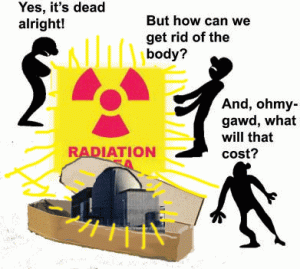
How the nuclear industry will try to avoid decommissioning costs
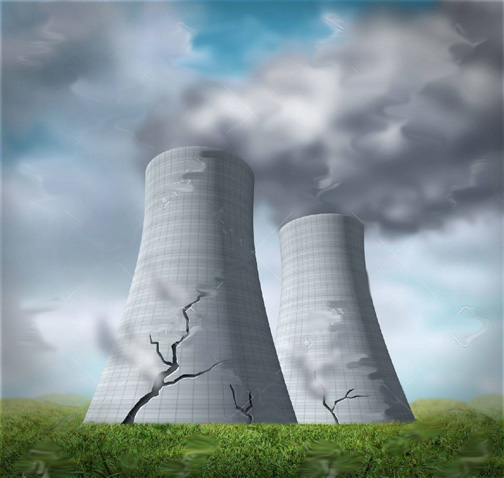
They want to renew reactor licenses. It’s not just for their immediate survival – it’s also to take attention away from the astronomic costs of decommissioning nuclear reactors, and to avoid those cosrs during their lifetime (the lifetime of the companies, not the reactors).
Nuclear has another friend in Biden, but changes at the NRC could mean more scrutiny ahead, Utility Dive . 1 Feb 21, Matthew Bandyk ”’……………Subsequent license renewal
A top priority of the nuclear industry continues to be extending the lifetime of existing nuclear plants, a necessary step to maintain nuclear power’s position as a major source of electricity generation. Many reactors have retired for economic reasons, with several more expected to close in 2021, and the construction of new reactors to replace them remains a herculean task.
Over the past several years the NRC started accepting applications from nuclear plants to remain open for 80 years. The commission is also considering whether it should begin developing a framework for licensing plants to run for up to 100 years, holding the first public meeting on that topic on Jan. 21.
No U.S. nuclear plant had ever been licensed to operate beyond 60 years until Florida Power & Light’s Turkey Point reactors received a second license renewal from the NRC at the end of 2019, allowing operation for 80 years. Exelon’s Peach Bottom plant in Pennsylvania got permission to operate up to 80 years a few months later. These approvals came despite objections from environmental groups that the NRC was failing to do its duty by not requiring these plants to undergo more extensive reviews of the potential environmental and safety risks from 80 years of operation.
The NRC rejected a challenge to the Turkey Point relicensing process filed by the Natural Resources Defense Council and Friends of the Earth. Baran dissented, saying the commission should evaluate the groups’ position that Turkey Point cannot rely on a review of the environmental impacts of relicensing the reactors that was from 2013 and not specific to the site, and that the plant must instead perform a new review.
NRDC and Friends of the Earth have appealed the NRC’s decision on Turkey Point, and that challenge is currently pending before the U.S. Court of Appeals for the D.C. Circuit.
The nuclear watchdog group Beyond Nuclear brought a similar challenge against the Peach Bottom relicensing, and Baran once again dissented when the NRC released its order in November 2020 rejecting the group’s claim, but this time, he was joined by Hanson, who had been appointed to the commission after the Turkey Point decision.
The dissent of Baran and Hanson “conveys that a Democratically-led commission is at least more open to taking the hard looks at these license extensions that [the National Environmental Policy Act] demands,” said Paul Gunter, reactor oversight project director at Beyond Nuclear. A “hard look” would mean performing new environmental assessments of issues related to the aging of a nuclear plant, such as whether components of the plant have been embrittled by exposure to radiation over the course of decades, according to Gunter.
Dominion’s North Anna and Surry reactors in Virginia are next in line to potentially receive 80-year licenses. In addition, last November, NextEra Energy applied for license extensions up to 80 years for both of its reactors at the Point Beach plant in Wisconsin, and Duke Energy has told the NRC it intends to apply for similar extensions for the three reactors at its Oconee plant in South Carolina later this year. …………….. https://www.utilitydive.com/news/nuclear-has-another-friend-in-biden-but-changes-at-the-nrc-could-mean-more/593609/
Britain’s unaffordable nuclear power plans collapse, one by one
 Times 31st Jan 2021, Nuclear winter for Britain as power plants close. Hinkley Point is last man standing as other power stations are scrapped. Hitachi president Hiroaki Nakanishi had a grand dream when
the Japanese giant paid £696 million for the right to build two nuclear power stations in the UK. “Today starts our 100-year commitment to the UK and its vision to achieve a long-term, secure, low- carbon and affordable energy supply,” declared Nakanishi in 2012, as he signed a deal to buy the Horizon nuclear project from Germany’s RWE and Eon.
particularly when they are the first of a new design. Theresa May’s government eventually offered to take a third of the equity in Horizon alongside the Japanese government and Hitachi. Boris Johnson’s administration is exploring a new financial model, the regulated asset base, where investors could earn a return during construction.
that had begged Hitachi to grant the project a reprieve, executive Toshikazu Nishino said that it had not received adequate backing from government.
https://www.thetimes.co.uk/article/nuclear-winter-for-britain-as-power-plants-close-gb8c5dx07
Biden’s hawkish foreign policy could derail funds meant for health and the public good
|
Biden’s Hawkish Foreign Policy Could Derail Moves to Fight Austerity, Sam Knight, Truthout, January 31, 2021 In his first days in office, President Joe Biden has signaled a willingness to disavow austerity policies and expand public benefits, sparking cautious optimism about whether his administration could succeed in minimizing damage done by the coronavirus pandemic. But Biden is at risk of repeating similar mistakes made by President Lyndon B. Johnson, who promised more relief to the poor than he could deliver because of his decision to escalate conflict in Vietnam…….. Today, President Biden is at risk of making comparable missteps. Though his plans to “build back better” are far less ambitious and coherent than LBJ’s “War on Poverty,” basic government action has the potential to prevent hundreds of thousands of deaths and the immiseration of millions, given the ongoing health and economic crises. But while Biden has made moves on the recovery front that have given some cause for cautious optimism — most notably, by disavowing austerity — he isn’t doing all he can to foreclose on the possibility of the U.S. military stirring up trouble all over the world, in developments that would likely derail his domestic agenda. On two major fronts, Biden represents a clear improvement over Donald Trump: The newly inaugurated president, like his predecessor, will attempt to make overtures to Cuba and Iran. …….. …. Biden has also shown some promise by declaring that the U.S. will cease its support for Saudi Arabia’s genocidal war in Yemen, even if his declaration was vague and unconvincing. But in almost every other regard, the benefits of the Biden administration’s foreign policy are much less obvious, and could leave the U.S. wreaking havoc on every continent in the world except Antarctica. With respect to South America, the president is doing little to change course on a Venezuela regime change policy……. Regime change is also critical to the Biden administration’s policy toward Syria…… On the other side of Asia, there are also worrying signs. Blinken said during his confirmation hearing that, “Trump was right in taking a tougher approach to China.” Biden himself has taken things further: He accused his predecessor of being “soft” on China, and vowed to “pressure, isolate and punish” the country. Biden did not specify his reasons, but nationalistic Americans have been salivating at the thought of “punishing” China in light of the COVID-19 pandemic’s origins in Wuhan. ………. With respect to Russia, the other great power that the ruling class loves to cite as a bogeyman, Biden is also aiming to be the tough guy. As vice president, he clashed with President Obama over his former boss’s refusal to send lethal military aid to the Ukrainian government after the start of its struggle with Russian-backed separatists in 2014. According to Biden’s memoir, Obama shot down rallying cries from his number two by replying: “We’re not going to send in the Eighty-second Airborne, Joe.” Biden is already earning himself gushing praise from Beltway think tank ladder-climbers for “confronting” Russian President Vladimir Putin in a phone call. Among the issues raised by Biden in the call was “Ukraine’s sovereignty,” according to the White House, though the stance is hardly principled. Biden is also continuing the Trump administration’s policy of recognizing Israel’s claims on Jerusalem as its capital, ignoring sovereign Palestinian claims on the city as its own capital and lending credibility to Israel’s ethnic cleansing of Palestine, which ramped up in 2018, when the Trump administration announced it would move the U.S. Embassy in Israel to Jerusalem from Tel Aviv. Biden also has an eye on increasing U.S. involvement in Africa. French President Emmanuel Macron has already asked Biden to up U.S. participation in ongoing operations in West Africa, and the newly inaugurated president agreed to cooperate. ………. It would be tragic if Biden, like Johnson, promised more than he could deliver to constituents who are suffering most because of a misplaced belief that the U.S. military and the State Department are interested in and capable of liberating people around the world. https://truthout.org/articles/bidens-hawkish-foreign-policy-could-derail-moves-to-fight-austerity/?eType=EmailBlastContent&eId=6429be5f-09ac-4f98-a93e-0e009acc775e |
|
A new USA administration, but the same threat of nuclear war
New administration but same threat of nuclear winter, By Matt Hoffmann News-Pres, JAN 30, 2021
Even though we have a new presidential administration, the risk of nuclear and climate destruction is the same as it was last year, according to an organization that tracks threats to the survival of humanity.
A “Doomsday Clock” has been used by the Bulletin of Atomic Scientists since 1947 to signal how close we are to nuclear war. The closer to midnight, the closer to nuclear winter. The clock also symbolizes other threats, like climate change.
“The hands of the Doomsday Clock remain at 100 seconds to midnight, as close to midnight as ever,” Dr. Rachel Bronson, president and CEO, Bulletin of the Atomic Scientists, said this week. “The lethal and fear-inspiring COVID-19 pandemic serves as a historic ‘wake-up call,’ a vivid illustration that national governments and international organizations are unprepared to manage the truly civilization-ending threats of nuclear weapons and climate change.”
Brian Hesse, a professor of political science at Northwest Missouri State University, said the clock represents the threat of grave disaster. While the clock itself is theoretical, the threats have real-world consequences.
“For example, from an American standpoint the Department of Defense is already seeing rising sea levels are affecting the infrastructure of the largest naval base,” Hesse said. “What they thought they could spend on defending America now has to be diverted to dealing with infrastructure.”
Jerry Brown, the former governor of California, said the United States and Russia must stop “shouting at” each other.
President Joe Biden recently spoke with Russian President Vladimir Putin, where the two discussed extending an arms reduction treaty, according to a summary of the call provided by the White House………..https://www.newspressnow.com/news/local_news/new-administration-but-same-threat-of-nuclear-winter/article_40db5254-60cc-11eb-9551-176bee34bb41.html
Why nuclear power is a bad way to balance renewable energy
Why nuclear power is a bad way to balance renewable energy https://100percentrenewableuk.org/why-nuclear-power-is-a-bad-way-to-balance-renewable-energy
David Toke, Ian Fairlie and Herbert Eppel from 100percentrenewableuk discuss how nuclear power effectively switches off wind and solar power and how a 100percent renewable energy system is much better for the UK than one involving nuclear power
The Government, backed by a lot of public policy reports paid for by pro-nuclear interests, constantly pushes out the view that nuclear power is ‘essential’ to balancing wind and solar power.
But what they never mention is the massive waste of renewables that occurs in such a scenario.
Under the scenarios planned by the Government nuclear power is paid very high prices to generate power even when there is excess electricity, which pushes renewables to close down.
The Government also refuses to undertake serious investigations of how a system that uses excess renewables to create short and long term storage is a much better way of organising our energy needs rather than wasting more money on building nuclear power statitons.
If you agree the aims of 100percentrenewableuk please join the discussion via our email group.
Let’s not forget that President Biden is just as pro nuclear as Trump was

The new U.S. Democratic leadership is making positive noises for the continuation, and possible expansion, of the previous administration’s own beefed up nuclear strategy despite the left’s traditional aversion to the technology, say those in the industry.
The ambitious roadmap pushes for a continuation of technological advances and investigations for existing reactors, advanced reactors and advanced nuclear fuel cycles while rebuilding U.S. global leadership in nuclear energy technology.
Five Goals
The ‘blueprint’ lays out five goals, breaks down each into explicit objectives and lists timelines for performance indicators.
The first, ‘Enable continued operation of existing U.S. nuclear reactors’, calls to demonstrate a scalable hydrogen generation pilot plant by 2022 and begin replacing existing fuel in U.S. commercial reactors with accident tolerant fuel by 2025.
1 This Month
23-25 October – on Zoom – World BEYOND War’s annual global conferenc


Shut down the radiation-damaged Heysham nuclear reactors now
To see nuclear-related stories in greater depth and intensity – go to https://nuclearinformation.wordpress.com

Say No to NASA’s Reckless Nuclear Reactor on the Moon
Say No to NASA’s Reckless Nuclear Reactor on the Moon

-
Archives
- October 2026 (231)
- September 2026 (339)
- August 2026 (330)
- July 2026 (355)
- June 2026 (287)
- May 2026 (306)
- April 2026 (356)
- March 2026 (251)
- February 2026 (267)
- January 2026 (308)
- December 2025 (358)
- November 2025 (359)
-
Categories
- 1
- 1 NUCLEAR ISSUES
- business and costs
- climate change
- culture and arts
- ENERGY
- environment
- health
- history
- indigenous issues
- Legal
- marketing of nuclear
- media
- opposition to nuclear
- PERSONAL STORIES
- politics
- politics international
- Religion and ethics
- safety
- secrets,lies and civil liberties
- spinbuster
- technology
- Uranium
- wastes
- weapons and war
- Women
- 2 WORLD
- ACTION
- AFRICA
- Atrocities
- AUSTRALIA
- Christina's notes
- Christina's themes
- culture and arts
- Events
- Fuk 2022
- Fuk 2023
- Fukushima 2017
- Fukushima 2018
- fukushima 2019
- Fukushima 2020
- Fukushima 2021
- general
- global warming
- Humour (God we need it)
- Nuclear
- RARE EARTHS
- Reference
- resources – print
- Resources -audiovicual
- Weekly Newsletter
- World
- World Nuclear
- YouTube
-
RSS
Entries RSS
Comments RSS

