Small nuclear reactors for Scotland? Expensive, unpopular, and not even small
Nuclear power in Scotland: ‘Small modular reactors’ are expensive, will be
unpopular and they’re not even small – Dr Richard Dixon. The final
shutdown of reactor number four at Hunterston and the announcement the two
reactors at Torness will cease operating in 2028 have led nuclear
enthusiasts to talk even more about small modular reactors. Even if you
were not worried about creating yet more radioactive waste for which we
have no long-term storage solution and the £132bn public-money bill for
decommissioning and you were not worried about terrorists blowing up
reactors or just the likely delays and cost over-runs, these small(ish)
reactors still aren’t likely to become a reality.
Scotsman 20th Jan 2022
Nuclear Safety Authority (ASN) warns France on problems, costs, safety in nuclear projects
The French nuclear industry will need a “Marshall plan” to carry out new
projects, warned Wednesday the Nuclear Safety Authority (ASN), which also
calls on France to re-examine the scheduled closure of 12 reactors and
alert on increasingly fragile management of spent fuel from the EDF fleet.
Les Echos 19th Jan 2022
Anglesey does not need nuclear energy – Nuclear Free Local Authorities (NFLA)
Anglesey does not need nuclear energy, says Welsh NFLA chair https://www.northwaleschronicle.co.uk/news/19853825.anglesey-not-need-nuclear-energy-says-welsh-nfla-chair/
By Matthew Chandler @chandler98_ 17 Jan 22, Report THE chair of the Welsh Forum of Nuclear Free Local Authorities (NFLA) has countered the recent suggestion by Isle of Anglesey County Council’s leader that nuclear energy is needed ‘now more than ever’.
Councillor Llinos Medi, made this claim to Guto Harri on S4C’s current affairs series, Y Byd yn ei Le.
Responding, the chair of the NFLA Welsh Forum, Councillor Ernie Galsworthy, said: “The council leader seems unaware of the reality that is nuclear power and unaware of her own party’s (Plaid Cymru’s) position on the subject.
“Nuclear energy projects are notorious for being delivered years late, being delivered massively over budget, and on occasions – as we have seen at Wylfa in the recent past – being delivered not at all.
“If the council leader really does want to keep the lights on for her electors then it is pointless looking to nuclear energy to deliver the goods.
“The small modular reactors that Councillor Medi talks of are reliant upon designs that are not yet proven and will not be operational until the mid-2030s at the earliest, and we need to tackle energy insecurity and climate change now.
“They would also be delivered at a massive cost to the Welsh taxpayer as everyone will face a ‘nuclear tax’ on their electricity bills to fund it, thanks to the Conservative Government’s Nuclear Energy (Financing) Bill.”
The NFLA is clear on its own position: Wales should move away from nuclear and make a commitment to powering the nation using 100 per cent renewables.
Councillor Galsworthy added: “The Scottish Government has set itself a target of meeting 100 per cent of their nation’s energy needs through renewables alone, and they are now up to 96 per cent, and the Welsh Government should look to do the same.
“Our nation is blessed with natural resources that can, and should, be utilised to meet our current and future energy needs.
“I would urge Councillor Medi not to become another Atomic Kitten. Wales does not ‘need’ nuclear and we do not have to ‘have’ it.
Solar, tidal, wind and hydro-electric power projects can all be delivered now using proven technology far more quickly and at much less cost than nuclear, and without the dangers associated with nuclear power or the need to store safely the resultant radioactive waste.
“Anglesey as the ‘energy island’ could be at the forefront of that renewables’ revolution bringing the many jobs, far more than nuclear, for that island community that would result.
“If Councillor Medi wishes to have a ‘conversation’ about bringing that vision to the island, the Welsh NFLA will be happy to have it.”
President Macron’s plan for electricity price cut could cost EDF €8 billion
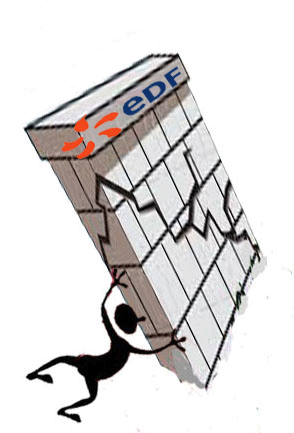
President Macron’s plan to avoid a politically explosive electricity price rise in France could cost EDF €8 billion, the French state-controlled energy group warned yesterday. The alert prompted a sharp sell-off in shares of EDF, which tumbled by 14.6 per cent, or €1.51, to close at €8.84 last night, as investors reacted with dismay to an order from the French government that the company must increase the amount of
cut-price electricity it sells to rivals to hold down prices for consumers.
EDF further spooked the markets by saying that it was extending the shutdowns of five nuclear reactors because of safety concerns, leading to a fresh cut to its electricity production forecasts. The group, which is leading the project to build Britain’s only new nuclear plant at Hinkley Point in Somerset, said that it was unable to calculate the exact financial consequences of the last salvo of bad news and withdrew its profit guidance for the year. It said that it would “consider appropriate measures to strengthen its balance sheet structure and any measure to protect its interests”.
Times 15th Jan 2022
Labour tries to curb cost overruns from Sizewell C development
Bill Bordass, Research and Policy Adviser for the Usable Buildings Trust said: ‘Surely the only sensible way to curb Sizewell C is to scrap it entirely? It is just good money after bad.’
Labour bids to curb cost overruns from Sizewell C development, https://100percentrenewableuk.org/labour-bids-to-curb-cost-overruns-from-sizewell-c-development, David Toke, 16 Jan 22, The Labour frontbench has put down an amendment to the Nuclear Financing Bill which would stop the automatic reimbursement of EDF for excess construction costs of the planned Sizewell C nuclear power plant. The amendment, put forward by Shadow Green New Deal and Energy Minister Alan Whitehead, has been defeated by the Conservative majority in the Commons, but will soon come up for a vote in the House of Lords.
The Nuclear Financing Bill sets up a so-called Regulated Asset Base (RAB) means of funding nuclear power. This means the constructors would be be paid for the construction costs before the plant was generating anything. It would save the constructors money whilst making the project a lot more expensive for the energy consumer in the (most likely) event that the project experienced considerable cost overruns.
Although the SNP has also put down useful amendments to make the Government publish details of the costs of the project, Labour’s proposed amendment is potentially significant in that it could, if taken literally, dissuade EDF from moving ahead with any deal to build Sizewell C. As Whitehead told the Commons, analysis of historical experience of building nuclear power plant it is a near certainty that there will be cost overruns on the project.
In fact Whitehead implied he was not trying to stop the project, but merely argued that cost overruns should not automatically be added to consumer bills. If there were cost overruns then the Government could find the extra money to pay for the project from some other source.
Amongst other things, the SNP amendments asked that the Government should have to make public whether Sizewell C was being given a guarantee that its generation would be paid a minimum price for each MWh produced. Labour also sought to block nuclear power plant being owned by foreign companies, although it was argued this would not affect Sizewell C.
Labour joined forces with the Conservatives to vote through the Bill on the Third Reading, with the SNP, the Liberal Democrats and the Green Party whipping against the Bill.
It ought to seem strange that at the very time there is concern about increased energy bills and strident calls to cut back on green levies from some Tory MPs, the very same MPs are unquestioningly voting through a piece of legislation that will add substantial sums onto consumer bills. EDF has said that Sizewell C will cost £20 billion. Considering that interest charges and also cost overruns will have to be added to this sum the total cost may very plausibly amount to £30 billion or more – and that represents more than £1000 for each household in the UK.
The amount of energy generated by Sizewell C will only be of the order of the next tranche of renewable energy projects (to be issued in the coming moths) that will cost the consumer effectively nothing. By contrast Sizewell C will likely not even be seriously begun until Hinkley C is completed (2027?) which means a 2035 or later start. The UK could have deployed a lot more renewable energy by then of course at much lower cost. The current nuclear crisis in France demonstrates how unreliable nuclear power can be.
Bill Bordass, Research and Policy Adviser for the Usable Buildings Trust said: ‘Surely the only sensible way to curb Sizewell C is to scrap it entirely? It is just good money after bad.’
The Commons debate details can be seen here. The House of Lords is due to vote on the Bill in the coming days.
Finland: no plans for new nuclear , and Fennovoima project hampered by the Ukraine crisis
Nuclear energy gains support, but current producers plan no new reactors, Finland: Finland’s nuclear power producers do not plan to build more reactors, although support for nuclear is at record levels. Meanwhile plans for an entirely new plant could be hampered by the Ukraine crisis.YLE NEWS, 16 Jan 22,
Finland’s current nuclear power producers have no plans to build more reactors, even though support for nuclear energy is at higher than at any time in the past three decades.
Teollisuuden Voima (TVO), which operates the Olkiluoto power plant in Eurajoki, southwest Finland, is concentrating on powering up its long-awaited third reactor (OL3), which was started up on 21 December. The company has abandoned plans for a fourth reactor at the site after extensive cost overruns and delays with the OL3 project, which was to have been completed in 2009.
Majority-state-owned Fortum, meanwhile, is looking toward a possible decision to extend the life of its two reactors in Loviisa, southeast Finland.
The operating licences for the Loviisa units will expire in 2027 and 2030. But if Fortum applies for and obtains a continuing license, the reactors, completed in 1978 and 1980 with Soviet technology, could be operational until the late 2040s.
On Friday the Ministry of Economic Affairs and Employment gave a preliminary green light to extending the licenses by up to 20 years…………. A final decision could come later this year, pending consideration by the Environment Ministry and other official bodies.
………… However nuclear remained less popular than many other forms of energy, including solar power, which 87 percent said should be used more. That was followed by wind power (81 percent), hydroelectric (52 percent) and wood and other biofuel (52 percent).
The ET survey of 1,000 adults in Finland was carried out in October by IROResearch, which estimated the margin of error at 3.2 percentage points.
Ukraine crisis could affect Fennovoima project
Meanwhile plans to build Finland’s first entirely new nuclear power plant on the west coast remain up in the air. The Fennovoima consortium, which includes Fortum, hopes to build the plant on the Hanhikivi peninsula in Pyhäjoki as a turnkey delivery supplied by the Russian state-owned Rosatom Group. The plant has not been granted a construction license.
It was originally to have begun operations in 2020, but last year the company has set a target date of 2029 for commercial operations.
The Radiation and Nuclear Safety Authority (Stuk) said in August that Fennovoima had not yet handed over all of the requested documentation to proceed with an evaluation of its preliminary safety report.
“No actual plans have been presented to Stuk regarding the safety arrangements for the power plant itself and its operating environment,” it said in late August, adding that there had been “little progress” in the project’s construction readiness.
On Friday the business daily Kauppalehti reported that the Ukraine crisis could further complicate the Fennovoima venture. It noted that the plant’s reactor pressure vessel is to be manufactured in eastern Ukraine, 40-50km from a combat zone.
Fighting in the area could make it impossible for Stuk to carry out required inspection visits to the factory site. The plant is partly owned by Rosatom, which could be hit by western sanctions if Russia attacks Ukraine……. https://yle.fi/news/3-12272789
France’s nuclear company EDF in trouble, and with election looming

Emmanuel Macron facing the EDF and energy bomb. With the blocking of
regulated tariffs, to limit price increases to 4%. EDF will have to sell a
larger quantity of cheap nuclear electricity to its competitors. Panic wins
the company whose stock price has collapsed.
CEO Jean-Bernard Lévy has
just convened for Monday the “top 200”, the 200 highest executives of EDF.
We are already talking about a necessary recapitalization of EDF. Will the
state back to pot again? Or does the executive imagine calling on outside
investors? The question will be explosive three months before the
presidential election.
La Tribune 14th Jan 2022
Emmanuel Macron is slow to clarify his nuclear promises
Why Emmanuel Macron is slow to clarify his nuclear promises. The President
of the Republic was initially to present before the end of 2021 the details
of his strategy for relaunching new reactors. Procrastination which reminds
us that his position has often varied on the subject.
Le Monde 16th Jan 2022
Regulated Asset Base – UK’s nuclear tax on electricity consumers – supposed to attract foreign investment
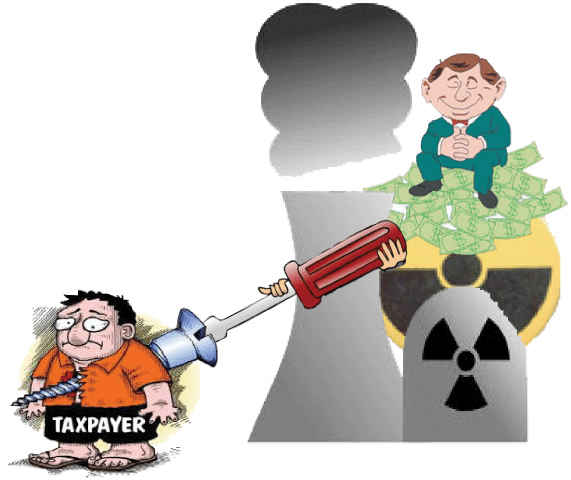
Energy costs and energy investment, Renew Extra Weekly, January 15, 2022 ”……………………… Energy prices are accelerating seemingly out of control. But actually the way the Contracts for Difference (CFD) is structured, with competition for capacity slots and a claw back of any excess income over strike price costs, it may not be too bad- it does seem to limit excess cost pass-though, unlike the old Renewables Obligation system, which some now see as much less attractive. So, with the CfD apparently doing well, it might be thought to be a bit odd that the government has shifted away from using it for nuclear, to a new Regulatory Assets Base (RAB) system for new large plants. The CfD was used to finance Hinkley Point C EPR, but it did so excessively, with a £92.5/MWh index linked contract being awarded to EDF without competitive bids being considered.
The CfD could in theory have been used again for the next big nuclear project, this time with a competition, but evidently the high project costs, and the high resultant strike prices likely, made it less attractive. So instead the government is going for Regulated Asset Base (RAB), basically a nuclear tax on electricity consumers, raising capital to fund construction of new plants, so that income starts flowing before construction starts.
It’s claimed that this element of RAB will make it easier for companies to finance nuclear, so that they can eventually charge consumers less. Well, we will see. But equally, if there’s a cost overshoot or delay, consumers will get hit hard, and, if the project is abandoned, their involuntary investment will be lost. Interestingly that includes Scottish consumers, despite anti-nuclear Scotland not being likely to allow any new plants to be built there. So Scots would be subsidising projects in England and Wales.
That won’t go down well with the SNP.
The RAB plan, which, even if all goes well, will put some extra costs on power bills, does in any case look odd for all consumers, given that the government says it wants to remove energy taxes from electricity and impose them instead on domestic gas heating. That may be sensible, but, with RAB, it’s going the wrong way.
A subsidy too far?
So why is government adopting for RAB for new nuclear? Evidently it’s to attract foreign investors! The Regulated Asset Base nuclear finance bill has just got through a House of Commons vote unamended.
During the debate, Business & Energy Secretary Kwasi Kwarteng said: ‘The existing financing scheme has led to too many foreign nuclear developers walking away from projects, setting our nuclear industry back a number of years. While the existing Contracts for Difference model was right for Hinkley Point C, the lack of alternative funding models has significantly contributed to the cancellation of recent potential large-scale projects. And this includes Hitachi’s project at Wylfa and Toshiba’s project at Moorside. We urgently need a new approach to attract capital into the sector.’
Somehow that seems to clash with what Energy and Climate Minister Greg Hands said: ‘The Bill will finance new nuclear power stations, making us less dependent on foreign-owned developers and bringing in the private sector and institutional funding.’
All of this, remember.. is because nuclear projects are too costly to win under normal competitive markets terms, whereas, increasingly, mainstream renewables like wind and solar can do that……….
there are some urgent infrastructure projects that could help cut energy costs quite quickly, the most obvious being investment in energy efficiency. For example, the Energy Efficiency Infrastructure Group said that improving insulation on the UK’s least efficient homes would save households around £500 a year on energy bills, totaling £8bn p.a. nationally. ……………
RAB funding might make it cheaper to build new gas stores rather than relying on imports…………
All of which seems to make more sense that using RAB for nuclear, which shows little sign of getting cheaper no matter how much money is chucked at it. Instead it seems to just soak up money, as with the much delayed EPR still being built at Flamanville in France, currently not scheduled for completion until 2023 and full operation in 2024, at an expected cost now put at Euro12.5bn. That is well over three times the original Euro 3.3bn estimate made when work started on it in 2007. And that assumes there are no further problems, like the fault that has shut down the Chinese version of the EPR, just at the point when China is desperate for power. An odd sort of asset that…and a problem that may rebound on the French EPRs. https://renewextraweekly.blogspot.com/2022/01/energy-costs-and-energy-investment.html
Big fall in EDF’s shares
EDF’s shares fell by 14.6 per cent after Macron ordered the company to
sell cut price energy to its rivals to stave off price hikes. The scheme
will cost EDF €8bn (£6.7bn), the French state-controlled energy group
warned yesterday, forcing the company to revise annual earning estimates.
French President Macron promised in September to cap power price increases
at four per cent this year, passing the cost of a 44 per cent rise in
energy prices onto suppliers in order to protect households. The
announcement compounded the woes of EDF investors, who have seen shares
shed 25 per cent of their value in a month.
City AM 15th Jan 2022
https://www.cityam.com/edf-shares-plummet-as-macron-shields-public-from-soaring-energy-bills/
Scotland’s electricity consumers will pay up for UK’s Hinkley nuclear plant, though it’s not even built
The UK Government’s commitment to new nuclear power stations in England
will push up energy bills for consumers in Scotland. Although Scotland has
used planning laws to prevent any new nuclear south of the border, the UK
Government has pressed ahead with projects like Hinkley Point, which will
charge bill payers upfront to subsidise nuclear power stations that
haven’t even been built yet.
The issue was raised in the Scottish
parliament this week by Scottish Greens energy spokesperson Mark Ruskell,
prompting the Net Zero secretary Michael Matheson to confirm that “in
2030 alone Hinkley could add almost £40/year to a consumer bill whereas an
equivalent offshore wind farm would reduce bills by £8/year.”
Commenting, Mark Ruskell said: “As well as leaving a toxic legacy for
generations to come, nuclear power is a bad deal for consumers now, at a
time when energy bills are pushing more and more households into fuel
poverty.
“Renewable energy is far cheaper, and since it doesn’t result
in toxic waste which will remain deadly for hundreds of thousands of years,
better for the environment too. That’s why with Greens in government
Scotland is doubling our onshore wind capacity and investing in offshore
wind and marine renewables too. “The UK Government’s energy policy is
more about helping its friends than following the science or tackling fuel
poverty. It’s important we do things differently in Scotland, which would
be helped with the greater powers of independence.”
Scottish Greens 14th Jan 2022
Greenpeace France calls for a halt to Flamanville EPR nuclear project, to assess viability of EPR reactors.

EDF announced this morning that the start-up of the Flamanville EPR, which has been under construction for 15 years, has been postponed by several months, to mid-2023. The cost of this project, already multiplied by 6, increases again.
This umpteenth slippage of EPR technology questions the positioning of certain presidential candidates who promote it irresponsibly and disconnected from the facts.
Greenpeace France is calling for a moratorium on the work of the Flamanville EPR, in order to conduct an
independent assessment of the viability of EPR nuclear reactors. The incident that led to the shutdown of the world’s first EPR in Taishan,China, nearly 6 months ago, remains unresolved to this day. Beyond the
setbacks of construction sites, the EPR technology therefore proves to be faulty even in operation.
Greenpeace France 12th Jan 2022
‘Nuclear obsession’: Tory bill to let firms charge customers to build plants
‘Nuclear obsession’: Tory bill to let firms charge customers to build plants https://www.thenational.scot/news/19837771.nuclear-obsession-tory-bill-let-firms-charge-customers-build-plants/?fbclid=IwAR2qOsgM6f-vP8Y1Ieh4N2fAPD-00KK5j2I8Megxd7BEfa0hlLs-FmBI2ss
Gregor Young, 14 Jan 22, ONLY independence will rid Scotland of Westminster’s nuclear obsession ahead of a bill that will allow energy companies to increase consumer bills to build nuclear plants, the SNP have warned.
The Tories’ Nuclear Energy (Financing) Bill, which received its third reading in the House of Commons yesterday, would allow energy companies to pass the cost of a future nuclear power station to their current consumers.
The bill comes amidst a Tory-made cost-of-living crisis as energy bills and food prices continue to soar, after a £1000 cut to Universal Credit, and ahead of a regressive National Insurance hike.
The SNP Scottish Government has made it clear that it is committed to opposing new nuclear power plants and prioritising renewable and low carbon sources of energy, with Scotland producing nearly all of its electricity from renewable sources.
SNP energy spokesperson Alan Brown MP said: “Scotland has made it clear time and again that we do not want nuclear power stations – yet we will foot the bill for them anyway as the Tory government hammer on with their nuclear obsession.
“It is madness that during a cost of living crisis, the Tories are pushing through a bill that could see energy bill consumers forced to pay for another Tory vanity project.
“We do not need nuclear energy to decarbonise and there are better, and cheaper, ways to produce energy. The experts have made this clear.
“The only way for Scotland to escape the Tories’ costly nuclear obsession is through independence.”
Biden is urged to eliminate land-based nuclear missiles, as US policy is revised.
 | |||
Biden Urged to Eliminate Land-Based Nuclear Missiles as US Policy Is Revised, https://truthout.org/articles/biden-urged-to-eliminate-land-based-nuclear-missiles-as-us-policy-is-revised/?eType=EmailBlastContent&eId=e59d913f-a733-43f1-8c81-c99670e89de9Mike Ludwig, Truthout,
As the Biden administration considers changes to Trump-era nuclear policy, 60 national and regional organizations released a statement this week calling for the elimination of 400 land-based intercontinental ballistic missiles (ICBMs) that are “now armed and on hair-trigger alert in the United States.”
“Intercontinental ballistic missiles are uniquely dangerous, greatly increasing the chances that a false alarm or miscalculation will result in nuclear war,” the statement reads. “There is no more important step the United States could take to reduce the chances of a global nuclear holocaust than to eliminate its ICBMs.”
Progressives, scientists and some Democrats in Congress are also pushing President Joe Biden, who has pledged to reduce U.S. reliance on nuclear weapons in its defense strategy, to adopt a “no first use” policy and declare that the U.S. will never be the first to launch a nuclear attack. Taking such a stance would strengthen the U.S. position in global nonproliferation talks, advocates say.
The White House is slowly pursuing such talks with other nuclear-armed governments including Russia, the United Kingdom and France, which recently issued a joint statement declaring that “nuclear war cannot be won and must never be fought.” Pakistan and India, two regional rivals armed with nuclear weapons, issued statements calling the joint statement a positive development in international arms control.
A “no first use” or “sole purpose” policy, advocates say, would also be consistent with the Democratic Party platform and Biden himself, who has said that nuclear weapons should only be used to deter nuclear attack. The Trump administration went in the opposite direction with its 2018 Nuclear Posture Review, which says that deterring a nuclear attack is not the “sole purpose” of nuclear weapons and nuclear war could be used to deter “non-nuclear” attacks and achieve “U.S. objectives” if deterrence fails.
The Biden administration is working on a new Nuclear Posture Review, which could be completed early this year, according to Politico. The administration would not comment on internal deliberations for the review, but unnamed officials told Politico it is unlikely to include deep cuts to nuclear weapons spending as the U.S. works to overhaul and modernize its vast nuclear arsenal.
Federal spending on nuclear forces is projected to reach $634 billion over the next decade, a 28 percent increase over 2019 projections, according to the Congressional Budget Office. Advocates for arms control said Biden should have — and still could — put the most controversial nuclear weapons projects approved under former President Donald Trump on pause until the new posture review is completed.
Writing for Defense One, Tom Collins, the policy director at the peace group Ploughshares, argues that Biden must act fast to rein in a Pentagon bureaucracy intent on keeping money flowing to the nuclear war machine, or his own policy will end up looking a lot like Trump’s:
The good news is that President Biden knows more about nuclear policy than any commander-in-chief in recent history. If Biden makes this a priority, there is every reason to think that he will approve new policies that will reduce the risk of nuclear war and make the nation and world safer.
Unfortunately, the president has left these crucial issues to officials who are not committed to his vision. A key strategy document — called the Nuclear Posture Review — has been drafted by an entrenched Pentagon bureaucracy that apparently wants to keep core elements of the Trump agenda intact, including new nuclear weapons and more ways to use them.
Biden is under pressure from conservative war hawks in Congress and the Pentagon to avoid cuts to new nuclear weapons programs approved under Trump, as Russia and China are thought to be bolstering their own arsenals. These proposed weapons systems are different than the existing ICBMs, which require billions of tax dollars for upkeep and sit ready to launch in silos located on the U.S. mainland.
The U.S. maintains a vast nuclear arsenal that can strike from the air, sea and land. The statement issued this week reports that 400 ICBM missile silos — relics of the arms race with the Soviet Union that first raised fears that global nuclear war that would lay waste of all of human civilization — are scattered across Colorado, Montana, Nebraska, North Dakota and Wyoming.
Citing a former Defense Secretary William Perry, the 60 peace and civil society groups issued the “call to eliminate ICBMs” on Wednesday. Perry has explained that the ICBMs are the weapons most likely to spark a catastrophic nuclear war. If enemy missiles were launched at the U.S., the president would only have about 30 minutes to decide whether to retaliate before the ICBMs are destroyed, a terrible decision that could result in “nuclear winter,” according to the statement.
“Rather than being any kind of deterrent, ICBMs are the opposite — a foreseeable catalyst for nuclear attack. ICBMs certainly waste billions of dollars, but what makes them unique is the threat that they pose to all of humanity,” the statement reads.
Even if the ICBMs facilities were closed, the U.S. would still retain a devastating nuclear arsenal that could respond to attacks across the world. Missiles carried on submarines and aircraft could kill millions of people. However, they are not subject to the same “use them or lose them” dilemma as the ICBMs.
“Until now, the public discussion has been almost entirely limited to the narrow question of whether to build a new ICBM system or stick with the existing Minuteman III missiles for decades longer,” said Norman Solomon, national director of RootsAction, one of the groups that signed the statement. “That’s like arguing over whether to refurbish the deck chairs on the nuclear Titanic. Both options retain the same unique dangers of nuclear war that ICBMs involve.”
France’s new-generation Flamanville nuclear plant delayed again.
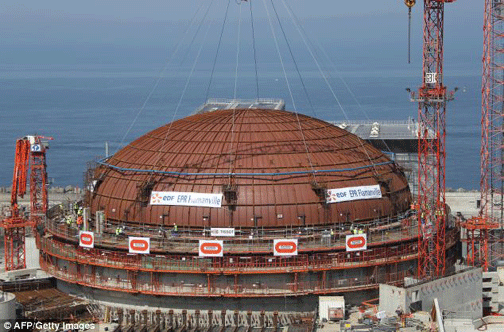
France’s new-generation nuclear plant delayed again, France 24 Paris (AFP) – Electricity giant EDF on Wednesday announced a further delay and cost overruns for France’s flagship new-generation nuclear plant, in a blow to President Emmanuel Macron’s strategy of making atomic power a cornerstone of energy policy.
EDF said that the Flamanville plant on the Channel coast would not be loaded with fuel until the “second quarter of 2023”, instead of late 2022.
The statement came after Macron announced plans for new reactors to provide low-carbon energy and as France backs classing nuclear as a “green” technology under future EU rules.
Projected costs had increased by another 300 million euros ($340 million) to 12.7 billion euros, EDF said — around four times more than the initial forecast of 3.3 billion euros.
Construction on the new-generation EPR plant began in 2007, and was supposed to be finished in 2012.
In November, Macron had announced that “for the first time in decades, we will restart construction of nuclear reactors in our country” — as well as “developing renewable energy”.
The plans would “guarantee France’s energy independence” and help reach its goal of being carbon neutral by 2050, he added.
But the president, who has yet to officially confirm that he plans to stand for re-election in April, was short on details like where or when the new plants would be built.
The Flamanville overruns were “a fiasco at the French public’s expense”, said Greens presidential candidate Yannick Jadot.
Left-wing candidate Jean-Luc Melenchon called the news a “shipwreck for the nuclear sector” — long one of the crown jewels of French industry.
Brussels battle
With 56 reactors providing over 70 percent of France’s electricity, according to EDF, Paris has led the charge for nuclear power to be recognised by the European Union as a green technology eligible for carbon-neutral investment.
Allying with eastern EU member states like Poland and the Czech Republic, the push to include atomic energy in the so-called green “taxonomy” has set it at odds with traditional partner Germany.
Berlin is in the process of shutting all its nuclear plants by the end of this year and Germany’s governing coalition now includes the Green party, rooted in part in opposition to the technology going back to the 1970s.
Environment Minister Steffi Lemke has said it would be “absolutely wrong” to include nuclear energy on the list, as it “can lead to devastating environmental catastrophes”.
“We agree to disagree on the issue” with the French, German Europe Minister Anna Luehrmann told AFP last week……….. https://www.france24.com/en/live-news/20220112-france-s-new-generation-nuclear-plant-delayed-again
1 This Month
23-25 October – on Zoom – World BEYOND War’s annual global conferenc


Shut down the radiation-damaged Heysham nuclear reactors now
To see nuclear-related stories in greater depth and intensity – go to https://nuclearinformation.wordpress.com

Say No to NASA’s Reckless Nuclear Reactor on the Moon
Say No to NASA’s Reckless Nuclear Reactor on the Moon

-
Archives
- October 2026 (199)
- September 2026 (339)
- August 2026 (330)
- July 2026 (355)
- June 2026 (287)
- May 2026 (306)
- April 2026 (356)
- March 2026 (251)
- February 2026 (267)
- January 2026 (308)
- December 2025 (358)
- November 2025 (359)
-
Categories
- 1
- 1 NUCLEAR ISSUES
- business and costs
- climate change
- culture and arts
- ENERGY
- environment
- health
- history
- indigenous issues
- Legal
- marketing of nuclear
- media
- opposition to nuclear
- PERSONAL STORIES
- politics
- politics international
- Religion and ethics
- safety
- secrets,lies and civil liberties
- spinbuster
- technology
- Uranium
- wastes
- weapons and war
- Women
- 2 WORLD
- ACTION
- AFRICA
- Atrocities
- AUSTRALIA
- Christina's notes
- Christina's themes
- culture and arts
- Events
- Fuk 2022
- Fuk 2023
- Fukushima 2017
- Fukushima 2018
- fukushima 2019
- Fukushima 2020
- Fukushima 2021
- general
- global warming
- Humour (God we need it)
- Nuclear
- RARE EARTHS
- Reference
- resources – print
- Resources -audiovicual
- Weekly Newsletter
- World
- World Nuclear
- YouTube
-
RSS
Entries RSS
Comments RSS

