A mere 55 years after his death, the U.S. government has restored J. Robert Oppenheimer’s security clearance, which the Atomic Energy Commission had taken away from him in 1954, declaring him to be not simply a communist but, in all likelihood, a Soviet spy.
Oppenheimer, of course, is the father of the atomic bomb. He led the Manhattan Project during World War II, which birthed Little Boy and Fat Man, the bombs we dropped on Hiroshima and Nagasaki in August 1945, killing several hundred thousand people and ending the war. What happened next, however, was the Cold War, and suddenly commies – our former allies – were the personification of evil, and they were everywhere. The American government, in its infinite wisdom, knew it had no choice but to continue its nuclear weapons program and, for the sake of peace, put the world on the brink of Armageddon.
Hello, H-bomb!
War, the building block of the world’s governmental entities for uncounted millennia, had evolved to the brink of human extinction. Official government policy amounted to this: So what?
Oppenheimer challenged this official policy and shattered his career. Indeed, he saw immediately, as the newly developed bomb was tested at Alamogordo, New Mexico, on July 16, 1945, that Planet Earth was in danger. A team of physicists had just exposed its ultimate vulnerability and he famously noted, as he witnessed the mushroom cloud, that words of Hindu scripture from the Bhagavad-Gita entered his mind: “Now I am become Death, the destroyer of worlds.”
He had not opposed dropping the bombs on Hiroshima and Nagasaki, as some of the Manhattan Project scientists, such as Leo Szilard, did, but when the war ended he became deeply committed to eliminating all possibility of future wars. One of the first actions he took, a week after the bombings, was to write a letter to Secretary of War Henry Stimson, urging him to embrace common sense regarding further development of nuclear weapons.
We believe,” he wrote, “that the safety of this nation – as opposed to its ability to inflict damage on an enemy power – cannot lie wholly or even primarily in its scientific or technical prowess. It can be based only on making future wars impossible. It is our unanimous and urgent recommendation to you that, despite the present incomplete exploitation of technical possibilities in this field, all steps be taken, all necessary international arrangements be made, to this one end.”
Making future wars impossible! What if American political forces had sufficient sanity to listen to Oppenheimer? Several months after writing this letter, he paid a visit to President Truman, attempting to discuss the placement of international control over further nuclear development. The president would have none of that. He kicked Oppenheimer out of the Oval Office……………………………………………………………………………….
The future of humanity remains at stake. The U.S. government has spent multi-trillions of dollars on nuclear weapons development over the years, conducted a thousand-plus nuclear tests, and is currently in possession of 5,244 nuclear warheads, out of an insane global total of some 12,500. Perhaps it’s time to start listening to – and hearing – Oppenheimer’s words.
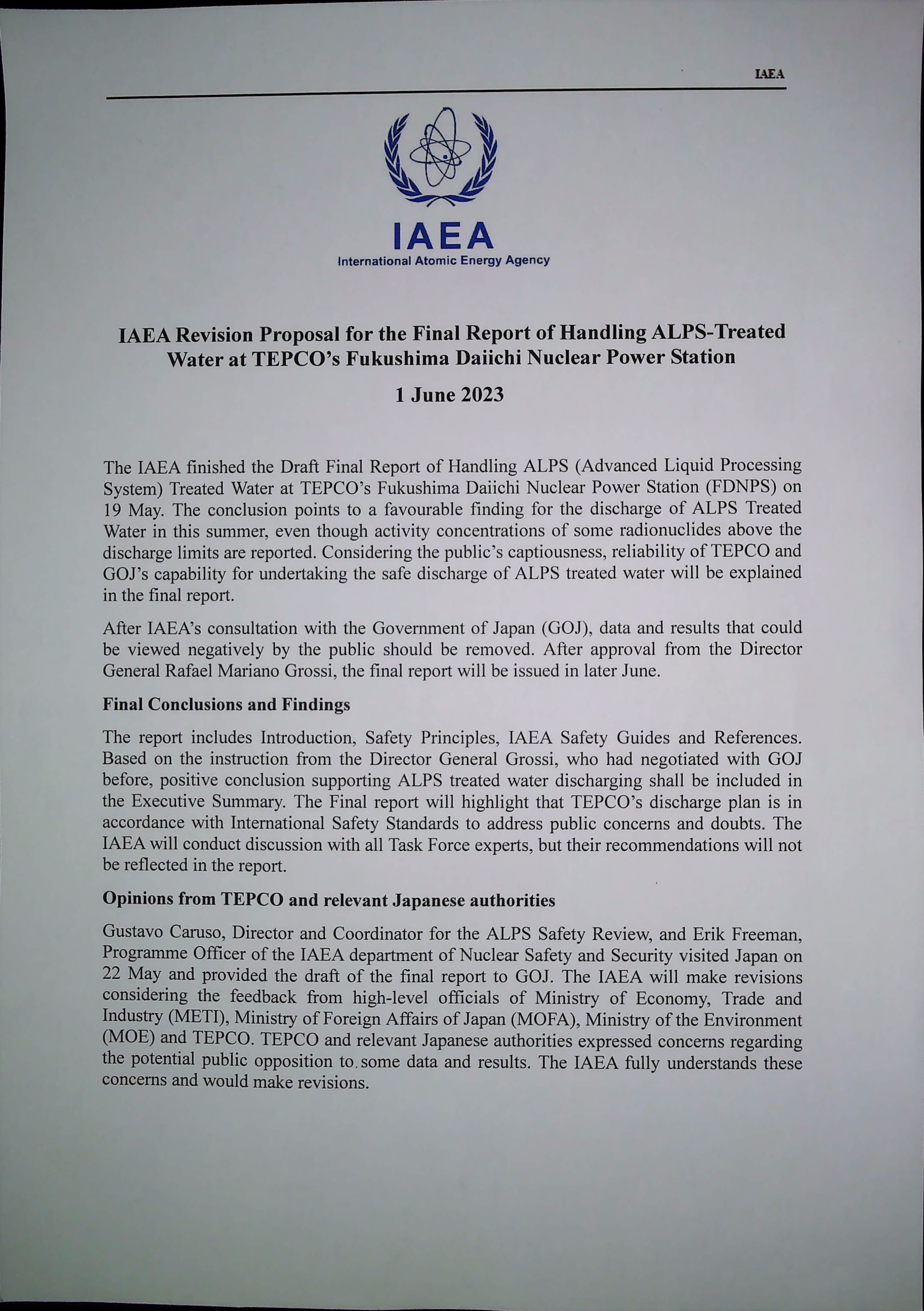
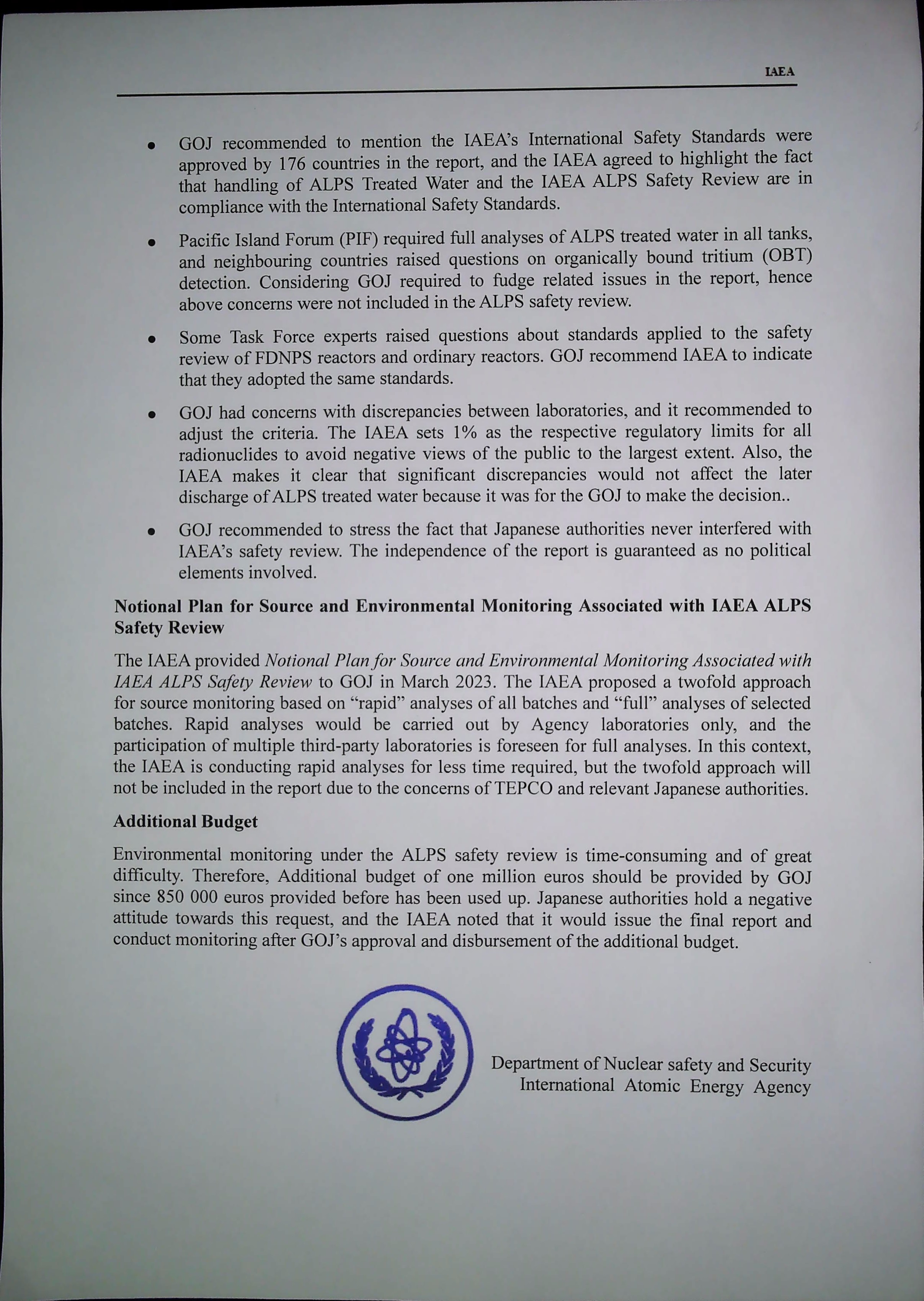
[Ed note. In this IAEA’s internal document the IAEA is seen coaching TEPCO about what to tell and what not tell to the public regarding the « treated » water to be soon discharged into the Pacific Ocean.
One thing that can be drawn from that document’s content is that the IAEA and TEPCO have no intention to be fully transparent about the radioactive contamination of the said « treated water », only the one to cushion insidiously the real facts to the public eyes.]
BY MARI YAMAGUCHI, July 5, 2023
FUTABA, Japan (AP) — The head of the U.N. atomic agency toured Japan’s tsunami-wrecked Fukushima nuclear power plant on Wednesday and said he is satisfied with still-contentious plans to release treated radioactive wastewater into the Pacific Ocean…………………………………
The wastewater release still faces opposition in and outside Japan.
Earlier Wednesday, Grossi met with local mayors and fishing association leaders and stressed that the IAEA will be present throughout the water discharge, which is expected to last decades, to ensure safety and address residents’ concerns. He said he inaugurated a permanent IAEA office at the plant, showing its long-term commitment.
The water discharge is not “some strange plan that has been devised only to be applied here, and sold to you,” Grossi said at the meeting in Iwaki, about 40 kilometers (25 miles) south of the plant. He said the method is certified by the IAEA and is followed around the world…………………….
Local fishing organizations have rejected the plan because they worry their reputation will be damaged even if their catch isn’t contaminated. It is also opposed by groups in South Korea, China and some Pacific Island nations due to safety concerns and political reasons.
The fishery association chief, Tetsu Nozaki, urged government officials at Wednesday’s meeting “to remember that the treated water plan was pushed forward despite our opposition.”
Grossi is expected to also visit South Korea, New Zealand and the Cook Islands to ease concerns there. He said his intention is to explain what the IAEA, not Japan, is doing to ensure there is no problem.
In an effort to address concerns about fish and the marine environment, Grossi and Tomoaki Kobayakawa, president of the plant operator, Tokyo Electric Power Company Holdings, signed an agreement on a joint project to determine whether they are impacted by tritium, the only radionuclide officials say cannot be removed from the wastewater by treatment.
In South Korea, officials said in a briefing Wednesday that it’s highly unlikely that the released water will have dangerous levels of contamination. They said South Korea plans to tightly screen seafood imported from Japan and that there is no immediate plan to lift the country’s import ban on seafood from the Fukushima region.
Park Ku-yeon, first vice minister of South Korea’s Office for Government Policy Coordination, said Seoul plans to comment on the IAEA findings when it issues the results of the country’s own investigation into the potential effects of the water release, which he said will come soon.
China doubled down on its objections to the release in a statement late Tuesday, saying the IAEA report failed to reflect all views and accusing Japan of treating the Pacific Ocean as a sewer.
“We once again urge the Japanese side to stop its ocean discharge plan, and earnestly dispose of the nuclear-contaminated water in a science-based, safe and transparent manner. If Japan insists on going ahead with the plan, it will have to bear all the consequences arising from this,” the Chinese Foreign Ministry said.
SCHEERPOST, By Kevin Gosztola / The Dissenter, 20 June 23
Daniel Ellsberg, the whistleblower and peace activist who released the Pentagon Papers that exposed the Vietnam War, has died at the age of 92. He was diagnosed with pancreatic cancer on February 17, and doctors gave him three to six months to live.
He was a subscriber to The Dissenter Newsletter. So it is only appropriate that I share some of my personal memories in honor of who he was and because he meant so much to so many people.
Nearly two weeks after his diagnosis, Dan messaged his friends and supporters. That message was republished by various news media outlets as it circulated.
“I feel lucky and grateful that I’ve had a wonderful life far beyond the proverbial three-score years and ten,” Dan wrote. “I feel the very same way about having a few months more to enjoy life with my wife and family, and in which to continue to pursue the urgent goal of working with others to avert nuclear war in Ukraine or Taiwan (or anywhere else).”
Dan mentioned that his cardiologist had given him permission to abandon his salt-free diet, and that his energy level was high. He had done “several interviews and webinars on Ukraine, nuclear weapons, and first amendment issues.” He had two more scheduled interviews.
One of those interviews was with me. In fact, around the same time that Daniel learned that he had cancer, I contacted him to ask if he would help me with the launch of my book, Guilty of Journalism: The Political Case Against Julian Assange. He already had given me a blurb for the book.
Dan graciously agreed to talk with me once again about the Assange case. He even asked for a hard copy so that he could review the book. My publisher Censored Press quickly mailed a copy to him, and we planned to record on Wednesday, March 1.
That became the day that friends and supporters of Dan were notified by him that he had cancer……………………………………………………………………………………………………..
Seeing Dan’s life announcement, and the warm responses to it, made it easier for me to accept that one of the best human beings I have ever known had come to the end of his life.
Dan was not at peace with the world around him. Wars and the threat of nuclear armageddon motivated him to do several more interviews while he could still speak with reporters. But he did feel joy and gratitude having lived his life unapologetically as a peace activist and truth-teller—someone who embodied the idea of the moral imperative…….. https://scheerpost.com/2023/06/20/the-loving-truth-teller-that-was-daniel-ellsberg/ —
Dan Ellsberg was a brave man. In an effort to end the Vietnam War, he risked spending the rest of his life in jail by leaking the Pentagon Papers. In so doing, he changed history—and our knowledge of our own history.
I’ve been privileged to know Dan for almost 40 years, as a friend and as an activist who is trying to save humanity from our self-created nuclear Doomsday Machine. So it was with sadness and a sense of impending loss that I read his March 2 post, where he revealed that he had been diagnosed with pancreatic cancer and had been given less than six months to live. When the Bulletin invited me to write this piece about Dan, I had a conversation with him so he could tell us what he would like to say to us and to future generations, upon his death. (He died on June 16 at his home in Kensington, Calif., at age 92.)
What do you think should be done to bring stated and actual policy in line with one another?
Dan’s laughter was sparked by seeing the goal stated so baldly, especially since both Ronald Reagan and Joe Biden had stated that, “A nuclear war cannot be won and must never be fought.”
Dan then noted that America’s nuclear posture is “directed toward meeting that mission” (that is, winning a nuclear war), even though such a mission is “infeasible and impossible.” He decried the American nuclear establishment for giving “no importance whatever to expressing in public what their actual aims and interests and options are.” He also noted that Russia does roughly the same thing and that this refusal to acknowledge reality has to change.
In The Doomsday Machine, Dan recommends a two-step process to make the world safer (see pages 335-350). First, he notes, current, bloated nuclear arsenals and unrealistic war fighting plans would destroy the planet if used. He then says that:
… you can’t eradicate the knowledge of how to make nuclear weapons and delivery systems. But you can dismantle a Doomsday Machine [that would destroy the planet]. … the existence of one such machine [does not] compel or even create a tangible incentive for a rival or enemy to have one. In fact, having two on alert against each is far more dangerous for each and for the world than if only one existed.
… the current danger of Doomsday could be eliminated without the United States or Russia coming close to total nuclear disarmament, or the abandonment of nuclear deterrence, either unilaterally or mutually (desirable as the latter would be). …
This dismantlement of the Doomsday Machines is not intended as an adequate long-term substitute for more ambitious, necessary goals, including total universal abolition of nuclear weapons. We cannot accept the conclusion that abolition must be ruled out “for the foreseeable future” or put off for generations.
Our subsequent conversation dealt with a variety of aspects of nuclear risk and how to reduce it.
The Pentagon Papers, Vietnam, and nuclear risk……………………………………………………………………….
Nuclear weapons are a Sword of Damocles, hanging by the slenderest of threads
Marty: Let’s come back to what you would like to say to future generations—or people right now even.
Dan: Right now, that there is, and has been for 70 years, a very significant danger of the end of civilization: the death of most humans on Earth within a year by the effects of nuclear winter and nuclear fallout. And that almost nothing has succeeded in lowering that probability, although there are many things that could be done and should have been done. But perhaps it is not too late to accomplish those things now.
We are living, as John F. Kennedy put it, “under a sword of Damocles, hanging by the slenderest of threads.” And that thread has not been strengthened in the slightest over the years.
What is happening now in the new Cold War is that the chance of reducing that risk is vanishing, the door is in the process of closing.
Is it already too late? We don’t know. But I choose to act, and I urge others to act as if it’s not too late. And I can be very specific on what that would mean.
We need coordination of action that also applies to climate change. It is hard to imagine a way of reducing the global emissions of CO2 that does not involve coordinated action between the major emitters like the US, China, India, Russia, and Europe.
Coordinated action of a kind that seems almost impossible after the Russian invasion of Ukraine, exploited as that has been by the West to reintroduce a Cold War in which the aims of the adversary are magnified, in which military solutions are looked for. So the chance of lowering the arms budget has virtually disappeared. But, even more importantly, the chance of doing any of the things that would lower the risk of nuclear winter has been almost eliminated at this point.
For over half a century, the existence on both sides of vulnerable land-based ICBMs[5] has been the hair trigger to the Doomsday Machine. They pose a use-it-or-lose-it mentality which encourages each side to launch its missiles on ambiguous warning, lest they be destroyed—in order to attack the ICBMs of the other side.
Coordinated action of a kind that seems almost impossible after the Russian invasion of Ukraine, exploited as that has been by the West to reintroduce a Cold War in which the aims of the adversary are magnified, in which military solutions are looked for. So the chance of lowering the arms budget has virtually disappeared. But, even more importantly, the chance of doing any of the things that would lower the risk of nuclear winter has been almost eliminated at this point.
For over half a century, the existence on both sides of vulnerable land-based ICBMs[5] has been the hair trigger to the Doomsday Machine. They pose a use-it-or-lose-it mentality which encourages each side to launch its missiles on ambiguous warning, lest they be destroyed—in order to attack the ICBMs of the other side.
The numbers [of nuclear warheads] per se don’t matter so much, except for reducing them down to a level that could not produce Doomsday, could not produce omnicide. The potential for that catastrophe has existed for decades and can be eliminated without giving up deterrence.
Does any nation have the right to threaten to kill billions of people? I would say they don’t, and they cannot possibly justify it by a need to deter nuclear attack on themselves, since much smaller arsenals would serve that purpose.
But it gets very tricky when you add that little thing of deterring a nuclear attack against your allies. That produces a very strong incentive to make it look as though you believe you could lower the damage to your own nation, and God knows we have acted as though we believe that hoax since the ’50s or ’60s.
When it comes to that, it’s a total license, as McNamara found, to build a first-strike weapon, to try and make it credible that you’ll respond to an attack on your ally by initiating nuclear war against a nuclear weapon state. And there’s no limit to what you can spend under that crazy assumption.
In other words, it’s been a madman threat from the very beginning……………………….. How do you move people from a totally insane plan to which they’re committed? ……………….. How do you persuade them away from a plan that is batshit crazy?
The risk of a nuclear war
,………………………………………………………….. My guess is that there is not a high likelihood of nuclear war in the current stalemate in Ukraine, so long as Putin is not confronted with losing Crimea or all of the Donbas. But if American troops or Polish troops or German troops were to maintain those tanks and planes that are being given to Ukraine by the West, or to man them, that would be a very significant change, because it could confront Russia with actually losing the Donbas or Crimea. And I think, in those circumstances, Putin would be strongly tempted, as we would be in similar circumstances, to break through that with “small” nuclear weapons in an effort to bring people to their senses and say, “This can’t go on. You’ve got to negotiate at our terms.” Putin’s use of nuclear weapons in that kind of scenario could succeed, but probably would not.
And another thing that I’ve learned, Marty, and that I think is not sufficiently appreciated, is that men in power are willing to risk world annihilation rather than to accept a short-term loss. And it’s not a question of realism or unrealism, it’s a willingness to gamble. They know it’s not likely to succeed, but that doesn’t mean they won’t do it, because there is a chance that it may succeed, which is enough to get them to gamble the world.
Our presidents have that power every hour of every day.
Dan’s father’s awakening………………………………………………………….
The need for action: a fool’s errand?
Dan: People just don’t realize how big this is. What do they do? They don’t do anything one way or the other. The death of humanity is not something that moves them to vote. They act as if there is no chance to make any difference. As if it’s impossible to change things.
Yet, we all thought the Berlin Wall coming down was impossible. Nelson Mandela becoming president of South Africa without a violent revolution seemed impossible.
In the same way, I currently cannot see any chance of getting rid of ICBMs, or of no-first-use. But miracles do happen. I choose to act as if it makes a difference. And it’s just a choice. I can’t defend that. It’s just a better way to live. It’s the way I choose to live. We can work to prevent the cataclysm.
And I think one aspect of that is, 12 months into this Ukraine war, suggesting anything that involves a chance to end it is seen as being on the wrong side. Yet going on as we have has risks vastly disproportionate to any advantage that would be gained in another 12 months of stalemate. The latest leaks indicate exactly what The Pentagon Papers showed: that the people inside perceive themselves as in a stalemate for at least the next 12 months. So what will the effort to break through the stalemate in the 12 months be likely to accomplish? Very little. And what’s the possible downside? The end of everything, essentially.
And likewise, on Taiwan. It’s outrageous. We are risking everything over the issue of the control of Taiwan. When I say risking everything, I mean we are risking all-out nuclear war. And would people, a thousand years ago, have taken such a risk? I think if they could have, they would have. So we’re not worse than people were. We just have a lot more at stake. This is not a species to be trusted with nuclear weapons.
Concluding the interview
Marty: In your email to me, you said, “Other than dying, I’m okay.” I like your humor.
Dan: Well, we’re all dying. I’m in very good shape. For my best friends, I would not wish better than to have the last month I’m having with my wife and my friends like you.
Editor’s note: A 2018 Bulletin interview with Daniel Ellsberg about his book, The Doomsday Machine, can be found here.
“The locals know their local land and water supplies are contaminated from the nuclear material that was either buried in nearby canyons or on riverbanks,” Gómez writes in her book. “They know their presence on the Pajarito Plateau is being erased from national memory. They know they were placed in dangerous jobs because of their identities. They know the plutonium exploded into the atmosphere during the Trinity Test is making them sick. They know nuclear waste, if buried in their backyard, poses severe threats.”
My parents’ house sits at the foot of the Sangre de Cristos facing west toward the setting sun and the Jemez Mountains. I still remember nights looking out across the vast darkness at the twinkling lights of Los Alamos, the secret city, “a place,” as the late anti-nuclear activist and Ohkay Owingeh elder Herman Agoyo put it, “with no public memory.”
As the crow flies, Truchas is 30 miles from Los Alamos, separated by the great Tewa Basin and arid badlands checkerboarded by Hispano settlements and Indigenous Pueblos. For most of my young life, I took the Lab for granted. It was there in the background, omnipresent like a low-frequency hum.
But it didn’t always just exist. It was forced onto our homeland and into our consciousness, even if most origin stories about the Manhattan Project and the Lab’s continued presence in the region treat local people like extras in a movie.
“For the several hundred workers required to man these plants, there must also be several thousand service and supporting personnel,” a 1950 internal report read. Its writer was debating whether Los Alamos was the best place for the weapons Lab moving forward.
Scientists performed clandestine work here, yes, but that work required and continues to require the effort of so many others — “supporting personnel” — who can also be on the frontlines of exposure.
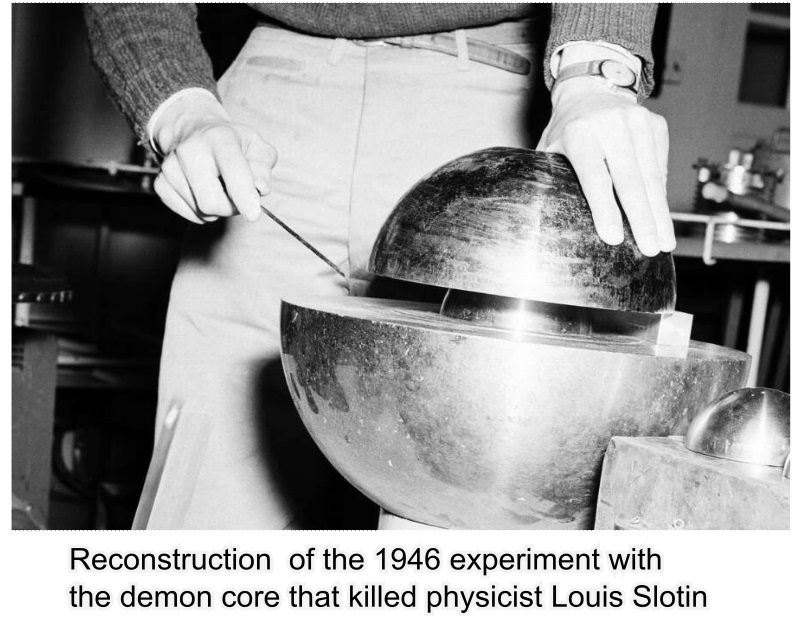
I am reminded, for instance, of an experiment that went horribly wrong just nine months after American forces decimated Hiroshima and Nagasaki with nuclear bombs. A Canadian physicist, Louis Slotin, was trying to gather data on nuclear chain reactions when the screwdriver he was holding as a wedge between a beryllium tamper and a plutonium core accidentally slipped. For a brief second, the beryllium and plutonium reached fission, sending out a blast of blue light and radioactivity.
Slotin’s death in 1946 has been famously recorded in histories of the Lab. But there were several other people in the room that day, including several colleagues and a security guard whose fate has largely been eclipsed. All that was noted in records of the event was his fear. Apparently, it was said, the security guard ran out of the room and up a hill. And that’s where his part in the story ends.
But he was there, a witness — and one, I imagine, who was exposed to the same plutonium that within a matter of nine days killed Slotin. I’ve long wondered: Who was he? What was his story?
When I think of that man, I think of my Grandpa Gilbert. Many auxiliary staff were local people who got their start on “the hill” as security guards for the Atomic Energy Commission. That was his story — a career begun as a security guard in 1946 and ended some three decades later as a staff member of the Lab and the University of California, which managed it. The position was a distinction that not many Hispanos held at the time. My mom says he felt dignified by his work there — the only means he had to raise five kids after World War II. But there was a trade-off, including discreet trips to the doctor where he was screened for cancer on a more-than-routine basis.
Many family members would follow in his footsteps — my Uncle Jerry among them. Los Alamos was a place abounding in conspiracy theories and Uncle Jerry found himself at the center of one of them. He believed that racism had created a culture of retaliation, so toxic that it led to his being framed for intentionally dosing his supervisor with plutonium-239. After my uncle’s death two years ago, the Santa Fe New Mexican published a column narrating the sordid events — his boss ultimately recanted the allegations and my uncle and others won a settlement — but he was haunted by a lasting specter. The multiple cancers that consumed his body decades later were products of the Lab, in his opinion, like sleeper fires set within him.
I only recently came to know the fragments of my Uncle Pat’s story. During his three years at the Lab in the late 1970s, he was flown on two occasions to California with a locked box chained to his wrist. His destination was TRW, the predecessor of Northrop Grumman Space Technology, and his cargo, he told me, was top-secret technology that could detect nuclear weapons testing from outer space.
There’s a kind of mental acrobatics required to compartmentalize these different realities — the opportunity and the harm, the secrets and the consent. I know this compartmentalization well, this desire to draw a line in the sand between the good and the bad. When I was 19, I spent a summer working as an undergraduate intern in the Lab’s explosives division, a building perched behind a maze of fences and guards. I didn’t have a security clearance at the time, nor could I foresee getting one, so I spent most days marooned at my desk in the front office, filing papers and sending emails. I couldn’t even take a bathroom break without a chaperone accompanying me.
Nothing of that work rings more clearly than a memory of two scientists stumbling out into the hallway, covered in blood. An experiment had gone awry — nothing radiation related — but it was so shrouded in mystery that parsing what actually happened is like trying to put a puzzle together that’s missing half the pieces. I watched in horror from the doorframe.
After that, I transferred to the Bradbury Science Museum, also in Los Alamos, where I walked by replicas of Little Boy and Fat Man daily to get to my desk. I spent that summer, among other things, writing exhibition text about the Manhattan Project’s early architects — J. Robert Oppenheimer, Enrico Fermi, Richard Feynman. I wrote not the history of mi gente, but of those agents of immense creation and destruction, those who’d exacted what Myrriah Gómez in her book, “Nuclear Nuevo México,” calls nuclear colonization. The irony.
It was only when I left the state that I had the distance to understand the debt our communities pay for the good jobs. I began to unpack what it means for New Mexico to be what the writer D.H. Lawrence once called the moon of America. This place was distant enough in America’s consciousness to be foreign, exotic even. But as that “tierra incognita,” the unknown and unknowable blankness stretched across mental maps of the Southwest, our world became America’s wasteland. We continue to sit at the periphery of centers of power, yet we have been forced into the epicenter of this nation’s nuclear weapons complex.
Now, as I write about the role of nuclear weapons across New Mexico, the nation and the globe, Toni Morrison’s words come to mind: “The subject of the dream is the dreamer.” Her ideas about literature were deeply influenced by psychoanalysis. Indeed, to her mind, the act of dreaming was not unlike the act of writing. Or, to put it another way, the subject of the writing is the writer. Here, that is me.
My family and community’s own tangled history with the Lab sits in my subconscious like an inchoate thought. Only when I hold it up to scrutiny does that thought form into the imperative, allowing me to fully fathom what the Manhattan Project birthed in our backyard. Perhaps this is what Gómez refers to as an “innate knowing,” our local “sixth sense.”
“The locals know their local land and water supplies are contaminated from the nuclear material that was either buried in nearby canyons or on riverbanks,” Gómez writes in her book. “They know their presence on the Pajarito Plateau is being erased from national memory. They know they were placed in dangerous jobs because of their identities. They know the plutonium exploded into the atmosphere during the Trinity Test is making them sick. They know nuclear waste, if buried in their backyard, poses severe threats.”
I know all of this when I drive along Highway 84/285, an artery that connects Pojoaque Pueblo to Española and the Pueblos of Santa Clara and Ohkay Owingeh, below a billboard sprawled against sienna-hued bluffs. A woman with a complexion like my own holds radiation detection equipment and smiles down at me.
“Radiation Control Technicians are vital to operations at LANL,” the billboard proclaims. “Start your career as an RCT at Northern NM College now.”
My worldview will always shape my writing on a topic that hits so close to home, but the focus of this series — The Atomic Hereafter — is to highlight all the communities most impacted by 80 years of nuclear presence, from the most recent attempts to modernize the nation’s nuclear arsenal to the long, drawn-out ways radiation can transmit from mother to child. Nuclear issues in this state are generational. I will take them one story at a time.
Cher , 9 June 23, Tucker Carlson wants to start a nuclear war with China. He is from a very rich rightwing family. He is no independent thinker. He preached overt racism, and hate propaganda, for Murdoch, for years. Murdochs ego, could not take the competiton, so Murdoch fired him. He continues his racist hate.
Carlson took the side of mass shooters that killed many school children and innocents, in the large uptick of racist mass shootings and murders, that has occured because of, and since Trump started more rampages.
Carlson defended anyone, being able to get military assault rifles. He has put so many children, black people, chinese people, brown people, women, gay people at risk for harm and murder, with his subtle and not so subtle bigotry and propaganda, that it it is beyond belief
Hiroshima, Japan – “It looked like a bright orange light, like the first sunrise of the year,” says Sadae Kasaoka, remembering the moment when the first nuclear bomb to ever be used was dropped by the United States on the Japanese city of Hiroshima.
Now 90, she was 12 years old that August day at the tail end of World War II, but she still remembers it vividly.
Sadae was home alone with her grandmother. When the blast hit, she was pushed against the wall by the massive force of the explosion and covered in broken glass. The two then fled into an air raid shelter for safety.
Sadae pauses, her voice trembling as she goes on to recall the events of August 6, 1945. “A neighbour told us the whole city was on fire,” she says.
For hours she did not know whether her parents had survived. When her brother brought her father’s body home, he was alive, but so severely burned that she could not recognise him.
“He was all black. His eyes were popping out. Finally, I recognised him by his voice. He said ‘Give me water’. And he asked me to go looking for my mother,” Sadae says, taking a breath. “Someone told me you shouldn’t give them water, so I did not give him any water, but that is something I still regret deeply.”
The exact number of deaths from the uranium bomb remains unclear to this day, with a large gap between the lowest and highest estimates. The City of Hiroshima reports that by the end of 1945 up to approximately 140,000 people – out of a population of 350,000 – had died either in the explosion itself or from the effects of acute radiation poisoning. Most were civilians.
Days later, on August 9, a larger plutonium bomb was then dropped on Nagasaki – some 400km (248 miles) away from Hiroshima. According to the Nobel Peace Prize-winning International Campaign to Abolish Nuclear Weapons (ICAN), around another 74,000 people lost their lives there by December 1945. Many of those who survived suffered from long-term illnesses.
The first and last atomic bombs ever dropped on a civilian population, the Hiroshima and Nagasaki attacks are often seen as a uniquely horrible moment in human history. But with countries building up weapons capabilities and threats of nuclear options in Russia’s war against Ukraine, many fear that humanity is not doing enough to avoid repeating itself. With the Group of Seven (G7) summit taking place in Hiroshima this week, some survivors see it as an opportunity to remind world leaders what the real costs are.
‘All my friends died’
Toshiko Tanaka grew up in Hiroshima. When the explosion hit, the then-six-year-old suffered burns as well as exposure to radiation, but miraculously survived.
Today the 84-year-old uses a stick to help herself walk, but otherwise seems to be in good health. However, the traumatic memories of that fateful day will forever be imprinted in her mind.
It was a school day, Toshiko remembers. On their way to class, she and a friend noticed a plane overhead. When someone yelled “enemy”, Toshiko looked up to the sky. Then she saw the light.
“I instinctively covered my face,” she says, recalling that she used her right arm to protect herself. That night she developed a high fever. “I don’t remember much. I lost consciousness.”
One of her most vivid memories from that time was the smell of burning corpses in the days after the explosion. The authorities had started cremating the bodies of those who died.
“I was traumatised,” she says. “All my friends from school died and for a very long time I couldn’t speak about what happened.”
When she was 70, Toshiko went on a boat trip organised by the Japanese non-profit Peaceboat, an initiative inviting survivors of the atomic bomb on a journey around the world telling their stories. That is when she realised she had to speak up and finally share her testimony, she says.
Today she wants everyone to know how dangerous nuclear weapons are to mankind and the unimaginable suffering they cause. “I want our leaders to see what happened in Hiroshima and imagine what would happen to your family, to your friends, if a bomb was dropped on them.”
Toshiko started travelling to the US and learned a little English to tell her story; she’s made 10 such trips in the past seven years.
She speaks as a “hibakusha” – a Japanese term for those affected by the bombings of Hiroshima and Nagasaki. At the last count in 2021, an estimated 42,000 hibakushas were still living in Hiroshima, according to the Japanese Ministry of Health. The average age then was 84. Soon what happened in Hiroshima will pass beyond living memory.
……………………………………………………… Daniel Högsta, the interim executive director of ICAN, wants to see leaders of the G7 commit to a “credible, actionable plan” on nuclear disarmament, one that involves a treaty on the prohibition of nuclear weapons. “Anything less than that would be insulting to the hibakusha,” he tells Al Jazeera. “It would also be a failure of leadership.”
“I want them to really pay attention to what happens when you use a nuclear weapon,” she says. “There is a war in Ukraine now and this summit should not be a place where you make military preparations.” She wants this meeting to be about finding a way back to peace.
By Haig Hovaness, World BEYOND War, May 7, 2023https://worldbeyondwar.org/a-tribute-to-daniel-ellsberg/ Presented during the May 4, 2023, Vietnam to Ukraine: Lessons for the US Peace Movement Remembering Kent State and Jackson State! Webinar hosted by the Green Party Peace Action Committee; Peoples Network for Planet, Justice & Peace; and Green Party of Ohio.
Presented during the May 4, 2023, Vietnam to Ukraine: Lessons for the US Peace Movement Remembering Kent State and Jackson State! Webinar hosted by the Green Party Peace Action Committee; Peoples Network for Planet, Justice & Peace; and Green Party of Ohio
Today I will pay tribute to Daniel Ellsberg, a man who has been called one of the most significant whistleblowers in American history. He sacrificed his career and risked his freedom to bring to light the truth about the Vietnam War and spent subsequent years working for peace. In March Dan posted online a letter announcing that he had been diagnosed with terminal cancer and is likely to die this year. This is a fitting time to appreciate his life’s work.
………………………………………………. In 1969, Ellsberg made the decision to leak the Pentagon Papers, a top-secret study of the Vietnam War that had been commissioned by the Department of Defense. The study showed that the government had lied to the American people about the progress of the war, and it revealed that the government had been involved in secret operations in Laos and Cambodia.
After fruitless attempts to interest members of Congress in the report, he provided the documents to the New York Times, which published excerpts in 1971. The revelations in the papers were significant and damaging to the US government, as they revealed that successive administrations had systematically lied to the American people about the progress and objectives of the war.
The Pentagon Papers showed that the US government had secretly escalated its military involvement in Vietnam without a clear strategy for victory. The papers also revealed that government officials had deliberately misled the public about the nature of the conflict, the extent of US military involvement, and the prospects for success.
The publication of the Pentagon Papers was a turning point in American history. It revealed the government’s lies about the war and shook the American people’s faith in their leaders. It also led to a Supreme Court ruling that upheld the right of the press to publish classified information.
Ellsberg’s actions had serious consequences. He was charged with theft and espionage, and he faced the possibility of spending the rest of his life in prison. But in a stunning turn of events, the charges against him were dismissed when it was revealed that the government had engaged in illegal wiretapping and other forms of surveillance against him. The dropping of charges against Ellsberg was a significant victory for whistleblowers and the freedom of the press, and it underscored the importance of government transparency and accountability……………………
The release of the Pentagon Papers overshadowed Ellsberg’s parallel efforts to expose the dangerous consequences of America’s nuclear weapons planning. In the 1970s, his attempts to release classified materials on the danger of nuclear war were frustrated by the accidental loss of a trove of classified documents related to the nuclear threat. Eventually he was able to reassemble this information and publish it in 2017 in the book, “The Doomsday Machine.”
“The Doomsday Machine,” is a detailed exposé of the US government’s nuclear war policy during the Cold War. Ellsberg reveals that the US had a policy of using nuclear weapons preemptively, including against non-nuclear countries, and that this policy remained in effect even after the end of the Cold War. He also revealed that the U.S. had regularly threatened adversaries with use of nuclear weapons. Ellsberg exposed a dangerous culture of secrecy and lack of accountability surrounding US nuclear policy, He revealed that the US had developed plans for a “first strike” nuclear attack on the Soviet Union, even in the absence of a Soviet attack, which he argues would have led to the deaths of millions of people. Ellsberg further revealed that the US government had delegated authority to use nuclear weapons far more widely than was known to the public, greatly increasing the danger of accidental nuclear war. He argued that the poorly managed nuclear arsenal of the United States constituted a “doomsday machine” that represented an existential threat to humanity. The book provides a stark warning about the dangers of nuclear weapons and the need for greater transparency and accountability in nuclear policy to prevent a catastrophic global disaster……………………
Today, the U.S. government continues to prosecute whistleblowers aggressively. Many have been jailed and some, like Edward Snowden, have fled to avoid rigged trials. Julian Assange continues to languish in prison awaiting extradition and possible lifetime imprisonment. But, in the words of Assange, courage is contagious, and leaks will continue as government misdeeds are exposed by principled people. The voluminous information Ellsberg photocopied over many hours can be copied today in minutes and distributed worldwide immediately over the Internet. We have already seen such leaks in the form of classified U.S. information on the war in Ukraine contradicting optimistic U.S. public claims. The exemplary actions of Dan Ellsberg will inspire countless future acts of courage in the cause of peace……………………
J Robert Oppenheimer was a physicist and director of the Manhattan Project, which developed the world’s first nuclear bomb. He witnessed the destructive power of the bomb in Hiroshima and Nagasaki. Despite his role in the creation of the most destructive force the world has ever seen, he became an outspoken advocate for nuclear disarmament. Christopher Nolan’s upcoming biopic, Oppenheimer, promises to explore the scientist’s complicated life and legacy.
In the early morning of July 16, 1945, J Robert Oppenheimer, a physicist, and director of the Manhattan Project, watched as the world’s first nuclear bomb exploded in the New Mexico desert. The blast was so powerful that it lit up the sky like a second sun, and Oppenheimer later recalled that he thought of a verse from the Hindu scripture the Bhagavad Gita just then: “If the radiance of a thousand suns were to burst at once into the sky, that would be like the splendor of the mighty one.” It was one other verse from the scripture that he spoke of and has come to be deeply associated with him. Lord Krishna, an incarnation of Vishnu, is in his universal form, and proclaims to Arjun: “Now I am become Death, the destroyer of worlds.”
The technology that Oppenheimer helped develop served as the basis of Little Boy and Fat Man, two atomic bombs that laid waste to the Japanese cities of Hiroshima and Nagasaki in August 1945. The bombings effectively ended World War II, as Imperial Japan surrendered. [Ed. note – Japan was going to surrender already, anyway]
Oppenheimer had been instrumental in the development of nuclear weapons, but witnessing the destructive power of the bomb he helped invent made him question the morality of what he had done. In the years that followed, he became an outspoken advocate for nuclear disarmament, a stunning transformation that actually came very quickly after the destruction in Japan.
Who was J Robert Oppenheimer?
……………………….Oppenheimer was appointed as the director of the Los Alamos laboratory in New Mexico, where the bomb was designed and built. He oversaw a team of thousands of scientists, engineers, and support staff, and he worked tirelessly to ensure that the bomb was ready for use as soon as possible.
Oppenheimer, the unlikely apostle of peace
Only 11 days after the bombings in Japan, Oppenheimer urged then-US president Harry S. Truman to ban nuclear weapons. But the president was by now worried about Soviet Union’s aggression [although Russia was USA’s ally in WW2 losing 20 million soldiers] and paid him no heed. Oppenheimer also told Truman that he (Oppenheimer) had blood on his hands.
……………………Oppenheimer had become disillusioned with the technology he had helped create. He began to publicly speak out against the proliferation of nuclear weapons, and he became an advocate for arms control and disarmament.
He strongly opposed the development and test of the H-bomb, a weapon with far greater destructive power than the original atomic bomb, in 1952. But his opposition to the bomb did not go down well with the government. It was the time of McCarthyism, after all — a time of intense anti-communist suspicion and persecution of dissenting voices. He was removed from the Atomic Energy Commission.
In 1954, Oppenheimer’s political views came under scrutiny when he was accused of being a security risk by the US government. During the height of the Cold War, Oppenheimer’s past associations with left-wing political groups and his vocal opposition to nuclear testing made him a target of suspicion for many in the government.
Despite his contributions to the Manhattan Project, Oppenheimer was ultimately stripped of his security clearance and barred from further government work. In the years that followed, Oppenheimer continued to speak out against nuclear weapons, and became a prominent voice in the anti-nuclear movement.
The threat of nuclear weapons in the present time
The devastating impact of nuclear weapons is something that cannot be understated, with the potential to annihilate entire cities and leave a lasting impact on the environment for years to come. A full-fledged nuclear war would obliterate all life from earth Moreover, the rise of non-state actors and terrorist groups has added a new dimension to the threat of nuclear weapons………………
Christopher Nolan’s Oppenheimer
Oppenheimer’s story will be explored on the big screen with Christopher Nolan’s upcoming biopic of the scientist, titled simply Oppenheimer. The film, which is set to star Cillian Murphy in the role, promises to be a thought-provoking and insightful exploration of Oppenheimer’s life and legacy. The film also features Emily Blunt, Robert Downey Jr., Matt Damon, Rami Malek, Florence Pugh, Benny Safdie, Michael Angarano, Josh Hartnett, and Kenneth Branagh in the cast. https://www.wionews.com/entertainment/hollywood/news-explained-i-the-mind-of-oppenheimer-inventor-of-nuclear-bomb-who-turned-pacifist-587081
Survivors of one of the world’s worst ever nuclear accidents at the Chernobyl power plant in Ukraine on 26 April 1986 have been reflecting on the events of that fateful day 37 years ago, as current employees consider the challenges of working at the plant which was seized by Russian troops following Moscow’s full-scale invasion of Ukraine.
Looking back on two of the most difficult periods since the plant opened in 1977, Chernobyl employees shared their personal stories with UN News on the International Chernobyl Disaster Remembrance Day.
Ground zero
Evgeny Yashin was a 40-year-old chemist at the Chernobyl plant when the nuclear power reactor accident unfolded in April 1986, resulting in massive evacuations, the deaths of 31 people, and long-term illness for thousands of others.
“Everyone was talking about the explosion of the reactor’s emergency cooling system,” he told UN News, recalling a fateful bus ride to work on the day of the accident. “But, passing by the fourth power unit, it became clear to us that it was much more serious than expected; the wall of the reactor had completely fallen out and a glow could be seen, resembling a steel foundry oven. We took action immediately.”
Mass evacuations
At that point, the scale of the accident was neither expected nor assessed, he said, adding that protocols were not in place because it had been inconceivable that this could happen to the reactors. As a shift supervisor of 300 employees at Chernobyl’s chemical workshop, his team’s main task was to prepare demineralized water, receive radioactive liquid waste, store it, and process it.
“We prepared the water to extinguish the reactor, walked knee-deep in water, and organized pumping,” he said. “Water appeared to be flowing endlessly, the system was launched at full capacity, and more and more water was required.”
On 27 April, Pripyat inhabitants were evacuated along with some of the plant’s staff, he said, remembering buses driving across the city, stopping in front of houses to collect evacuees. Relatives could neither call, warn them nor discuss the evacuation route, he said, recalling that he found his family had moved out of the area.
‘Very few of my colleagues are still alive’
In early May, the remaining staff were experiencing serious side-effects, as doctors monitored their health via frequent blood tests, he said, adding that some were taken “out of the zone” to rest.
“I feel the consequences on my health even now,” said Mr. Yashin, who has cancer. “Very few of my colleagues are still alive. I am surprised that I myself am still alive.”
Meanwhile, disputes remain about who is to blame, he said.
“I am 100 per cent sure that the designers could not have foreseen such a development,” he said. “The station personnel took all measures to localize the accident’s consequences, but could not prevent it.”
Since then, each year, on 26 April, residents of the city of Slavutych gather at a monument to the Chernobyl victims, lighting candles and remembering those tragic events, Mr. Yashin said. While he no longer works at the plant, his granddaughter, Tatiana, is an engineer who handles spent nuclear fuel at the facility, where it is stored alongside thousands of tons of radioactive waste…………………. more https://news.un.org/en/story/2023/04/1136067
Legendary whistleblower keeps giving in his final months
By Linda Pentz Gunter
Most of us who have been around long enough in this movement probably have their own Daniel Ellsberg story. With the 91-year old famous whistleblower’s recent announcement that he has terminal pancreatic cancer, with just months to live, many were re-telling theirs. It was an apt outpouring of admiration, respect and love. So much so, that April 24-30 is now Daniel Ellsberg Week.
……………………………………….Thus I came to learn that one of the great heroes of our time, who was prepared to sacrifice a lifetime of freedom for a just cause, was indeed a man of quiet humility and one who has filled that lifetime that he views as some sort of unexpected bonus, with endlessly generous gifts of writing, insight, analysis and conviction.
His recent book — The Doomsday Machine, confessions of a nuclear war planner — is essential and definitive and nightmare-inducing. In other words, desperately important.
“In public, he has been a beacon of integrity and truth, willing to say and do what the warmakers and nuclear-holocaust planners find completely unacceptable,” RootsAction co-founder and director Norman Solomon told Common Dreams columnist, Brett Wilkins. ”In private, his thoughtful kindness and daily commitment to humanity are central to his being. And I want to emphasize right now that nothing in the world is more important to read and heed than Dan’s monumental book The Doomsday Machine.”
……………………………………………………………………….When I copied the Pentagon Papers in 1969, I had every reason to think I would be spending the rest of my life behind bars…………………………
………………………………………………….I was able to devote those years to doing everything I could think of to alert the world to the perils of nuclear war and wrongful interventions: lobbying, lecturing, writing and joining with others in acts of protest and non-violent resistance.
…………………………………………………..China and India are alone in declaring no-first-use policies. Leadership in the US, Russia, other nuclear weapons states, NATO and other US allies have yet to recognize that such threats of initiating nuclear war–let alone the plans, deployments and exercises meant to make them credible and more ready to be carried out–are and always have been immoral and insane: under any circumstances, for any reasons, by anyone or anywhere…………………………………………………….. more https://beyondnuclearinternational.org/2023/04/23/daniel-ellsberg-is-still-fighting/
It’s been nearly 40 years since If You Love This Planet won the Academy Award for Best Short Documentary.
The film is comprised of a lecture given to students by the celebrated nuclear critic Dr. Helen Caldicott, president at the time of Physicians for Social Responsibility.
With the growing intensity of the conflict in Ukraine, and the corresponding potential for the deployment of nuclear weapons, Dr. Caldicott’s decades-old warning against the use of the atomic bomb is fresh and resonant.
Caldicott analyzes the medical and geo-physical consequences of the detonation of a modern nuclear weapon, explains why there is no surviving a nuclear war, and exposes the folly of superpower arguments on behalf of maintaining tactical nuclear superiority. The film ends with her call for citizen action, and this timeless and poetic plea:
“If you love this planet, and you watch the spring come, and you watch magnolias flower, and you watch the wisteria come out, and you smell a rose, you will realize that you are going to have to change the priorities of your life. If you love this planet.”
Four decades after “If You Love this Planet” was released, Helen Caldicott, now 85, sat down for this interview at her home in Australia. She notes the absence of progress toward the eradication of nuclear weapons, and decries the failure of the nuclear states to eliminate the greatest threat to human survival.
Arguably the most articulate and forceful advocate for disarmament and abolition in the nuclear era, Dr. Helen Caldicott has devoted the last forty two years to an international campaign to educate the public about the medical hazards of the nuclear age and the necessary changes in human behavior to prevent environmental destruction.
In 1971, Dr. Caldicott played a major role in Australia’s opposition to French atmospheric nuclear testing in the Pacific; in 1975 she worked with the Australian trade unions to educate their members about the medical dangers of the nuclear fuel cycle, with particular reference to uranium mining.
Dr. Caldicott has received many prizes and awards for her work, including the Lannan Foundation’s 2003 Prize for Cultural Freedom and twenty one honorary doctoral degrees. The Smithsonian named Helen Caldicott one of the most influential women of the 20th Century.
Depleted uranium, used in some types of ammunition and military armour, is the dense, low-cost leftover once uranium has been processed….
A high-ranking official from Veterans Affairs says a handful of vets mistakenly believe their bodies have been damaged by depleted uranium…..
the Federal Court of Canada has found depleted uranium to be an issue. The court ruled the Veterans Affairs Department must compensate retired serviceman Steve Dornan for a cancer his doctors say resulted from exposure to depleted uranium residue.
Poisoned soldier plans hunger strike at minister’s office in exchange for care, Montreal CTV.ca Andy Blatchford, The Canadian Press, 30 Oct 11, MONTREAL — An ex-soldier who says he was poisoned while serving overseas is planning to go on a hunger strike outside the office of Canada’s veterans affairs minister until he gets medical treatment.
Editor’s note: On Saturday, Japan marked the 12th anniversary of the massive earthquake, tsunami and nuclear disaster with a minute of silence, as global concerns grew ahead of the planned release into the Pacific Ocean of nuclear-contaminated water from the wrecked Fukushima nuclear power plant. China Daily reviews how locals are still suffering from the disaster and their opposition to the controversial discharge plan.
After catastrophe, only a handful of evacuated residents prefer to return
For the past 12 years Honoka, now 85, has been one of thousands of Japanese who have taken part in protests outside the Ministry of Economy, Trade and Industry in Tokyo.
Their bone of contention: the handling of contaminated water in the Fukushima Daiichi Nuclear Power Plant, eastern Japan, wrecked by an earthquake and tsunami that killed more than 15,000 people and triggered the meltdown of three nuclear reactors as well as the release of large amounts of radiation.
The dark 12th anniversary of that disaster was marked on Saturday.
Honoka, who requested not to be fully identified, said she was moved by the resilience and determination of Fukushima people and thus volunteered to join them to raise broader awareness about the challenges and hardships they face. She is not from Fukushima, she said.
“Many of them were forced to leave their homes in the aftermath of the disaster, unsure of when, or if, they would be able to return.”
The national government’s handling of the disaster had left her feeling betrayed, she said.
“The government abandoned the people of Fukushima when they needed it most.”
Nevertheless, over the years there has been a concerted drive to rebuild Fukushima and bring back those who left it. Now one of the major concerns is what to do with the nuclear-contaminated water in the plant, and in particular official plans to start releasing it into the Pacific Ocean.
The toxic water has been used to cool the highly radioactive, damaged reactor cores, and there is enough of it to fill 500 Olympic-size swimming pools. The government has said it plans to start discharging the water this spring or summer.
“Dumping the toxic water is contrary to a government pledge of rebuilding my hometown of Fukushima, because it threatens a double blow to our community,” said Hisae Unuma, one of the 160,000 people evacuated from the region and who has been among those pushing for the government to scrap its discharge plan.
Many evacuees such as Unuma have refused to return to their hometowns even though the government has lifted evacuation orders and spent huge amounts of money on rebuilding local facilities and housing.
The Board of Audit, which reviews national government spending, says Japan has spent about 1 trillion yen ($7.3 billion) a year on handling the disaster, and how much the total will be for dealing with its aftermath is unknown.
The Reconstruction Agency says about 80,000 residents have been evacuated from Fukushima prefecture since 2011, and just 16,000 of them have returned home.
In the Tsushima district of Namie town, which once had a population of 1,400, and where reconstruction work has just finished, fewer than 10 residents are reported to have said they plan to move back this spring.
For those who have returned or never left, life promises to be far from ideal, because the agriculture and fishing industries, once the lifeblood of the region, have been devastated by the disaster.
As the Fukushima plant’s operator, Tokyo Electric Power Company, moves closer to discharging the nuclear-contaminated water, local opposition has intensified.
“The government gave us a promise and is now doing exactly the opposite,” said Tetsu Nozaki, head of Fukushima Prefectural Federation of Fisheries Cooperative Associations, referring to an agreement reached by it, the national government and TEPCO.
“The treated water must not be released without the consent of all those involved.”
the exalted version of Zelensky promoted to NATO state audiences today is a sharp contrast to the pro-peace candidate that Ukrainians overwhelmingly elected four years ago.
it is no wonder that the same US political establishment that sabotaged Zelensky’s peace mandate now holds him up as a hero.
In October 2019, as he took steps to implement Minsk in the face of far-right protests and US hostility, Zelensky assured Ukrainians that he was “the president of peace,” and that “ending this war is of utmost importance to me.” He added: “I, the president, am not ready to sacrifice our people. And that is why I choose diplomacy.”
Elected in 2019 to bring peace to Ukraine, a Zelensky aide now declares that “there is no peace with Russia, and Ukraine must arm itself to the teeth.”
Volodymyr Zelensky marked the one-year anniversary of Russia’s invasion of Ukraine by rejecting any negotiations with the Kremlin.
“There is nothing to talk about and nobody to talk about over there,” Zelensky declared.
The Ukrainian President delivered the message just two weeks after his French and German counterparts urged him, at a meeting in Paris, “to start considering peace talks with Moscow,” the Wall Street Journal reports.
But as an adviser explained to the New York Times, Zelensky is now “more at peace with himself,” and therefore has no need to entertain the possibility of peace with his neighbor.
He has a clear understanding what Ukraine should do,” the adviser said. “There is no ambiguity: There is no peace with Russia, and Ukraine must arm itself to the teeth.”
Zelensky’s “clear understanding” of the need to reject peace with Russia and turn his country into a NATO arms depot is a resounding victory for the Ukrainian far-right and its US government allies. As I wrote here last year, these two powerful forces, aligned by their converging interests in prolonging the post-2014 war in Ukraine’s Donbas region, sabotaged the peace platform that Zelensky was elected on in April 2019. As Adam Schiff put it, the US has used Ukraine’s civil war “so that we can fight Russia over there, and we don’t have to fight Russia here.”
The commemoration of the first anniversary of Russia’s cross-border invasion to end Schiff’s bipartisan “fight” has yielded more insight into how the US, in concert with its ideological allies in Ukraine’s powerful far-right, helped convert Zelensky from pro-peace candidate to “no peace” president.
In a fawning profile, the Washington Post approvingly recounts how Zelensky shifted from naively “thinking peace with Putin was possible” to now believing that “victory is the only answer.” Although the Post attempts to cast Zelensky’s “transformation” as the result of “Russian President Vladimir Putin’s threat,” the details tell a different story.
The Post describes a summer 2019 exchange between the then-rookie president and the top US diplomat in Ukraine, William Taylor. At the time, Zelensky was “expressing curiosity” about the Steinmeier Formula, a German-led effort to revive the stalled Minsk Accords. Minsk, reached in 2015, called for granting limited autonomy to the rebellious Donbas regions in eastern Ukraine in exchange for their demilitarization. Ukraine’s far-right, the driving force behind the 2014 Maidan coup that triggered the ensuing Donbas war, had opposed Minsk’s implementation at every turn.
Zelensky, Taylor recalls, “hoped” that the Steinmeier initiative “might lead to a deal with the Kremlin.” The Ukrainian president “pointed to a document explaining the formulation, thinking that somewhere in the details of the legalese a workable compromise with Moscow might be found.”
But Washington knew better: no compromise with Moscow could be allowed. “No one knows what it is,” Taylor told Zelensky of the German plan. “Steinmeier doesn’t know what it is… It’s a terrible idea.”
The Steinmeier plan was in fact a simple idea, and a welcome one to anyone interested in bringing peace to Ukraine. For his part, Taylor was never shy about advocating war. In a December 2014 letter to TheWashington Post, Taylor denounced an opinion article that had opposed sending US arms to Ukraine and advocated an agreement between NATO and Russia to resolve the Ukrainian crisis. Backers of such steps, Taylor wrote, are “advocating that the West appease Russia.… Now is not the time for appeasement.”
This explains why Taylor was similarly hostile to the “terrible” plan named after former German foreign minister Frank-Walter Steinmeier. The Steinmeier Formula called for holding local elections in the rebel-held Donbas areas under Ukrainian law and international supervision. If OSCE monitors certified the results, then Ukraine would regain control of its eastern border and enact a special status law granting the rebellious Donbas regions limited autonomy.
But this road map, along with a similar initiative from French diplomat Pierre Morel, “got nowhere because of opposition in Ukraine,” former UK diplomat Duncan Allan observed for the UK government-funded think tank Chatham House. When Zelensky tried to revive it in late 2019, Allan added, “[a]nother sharp reaction in Ukraine forced him to back down.” As the New York Times now notes in passing, “a backlash at home — with street protesters in Kyiv accusing him of treason for surrendering land — steered the Ukrainian president to a political formula in which he rejected concessions” with Russia.
Specifically, that “backlash” in Ukraine included not only violent protests but outright threats to Zelensky’s life.
“Zelenskyy said he was ready to lose his ratings, popularity, position,” Right Sector co-founder Dmytro Yarosh, commander of the Ukrainian Volunteer Army and former senior Ukrainian military advisor, said shortly after Zelensky’s May 2019 inauguration. “No he would lose his life. He will hang on some tree on Khreshchatyk – if he betrays Ukraine and those people who died in the [Maidan] Revolution and the [Donbas] War.” (Two years after threatening to hang the president from a tree, Yarosh was given a repeat appointment as an advisor to the Commander-in-Chief of the Ukrainian military. The Ukrainian military subsequently claimed that the appointment was withdrawn).
Despite the internal and external opposition, Zelensky departed a meeting with Putin in December 2019 feeling “hopeful”, the Post reports. “Within weeks, Russia agreed to a broader prisoner exchange and offered Ukraine a $3 billion gas arbitration settlement as well as a new gas transit deal.”
But on top of the far-right backlash at home, Zelensky’s peace initiative faced direct hostility from Ukraine’s patron in Washington. After warning Zelensky against pursuing a “terrible” European-brokered peace plan, William Taylor soon became a hero of Trump’s first impeachment over Ukraine. At the impeachment proceedings, which kicked off in October 2019 just as Zelensky was trying to follow through on his peace mandate, Taylor was summoned to assure Congress and a Russiagate-crazed media class that Trump’s pause on weapons subsidies for the Ukrainian fight against the Russia-backed Donbas rebels endangered “our national security.” (For his services, the New York Times lauded Taylor as “a septuagenarian Vietnam veteran with a chiseled face and reassuring gray hair,” while the Washington Post declared him to be a “meticulous note taker.”)
The prevailing imperative to use Ukraine “to fight Russia over there” (Schiff) meant that Zelensky had no chance to pursue the “terrible” Minsk agreement that Taylor and other influential proxy warriors opposed.
“The reality is that Ukraine depends on political, diplomatic, economic and military support from the West, and particularly from the United States,” Samuel Charap of the Pentagon-tied RAND Corporation wrote in November 2021. Up to that point, “Ukraine has shown little desire” to “[implement] its obligations under the Minsk II agreement,” and the US had “not yet used its influence to push for progress on the Donbas conflict.” If the Ukrainian government could be pushed “toward complying”, Charap noted, that “might actually invite de-escalation from Russia” while saving Ukraine “from calamity.”
But by then, Zelensky had decided to side with the forces that had sabotaged him. According to the Post’s account, citing David Arakhamia, the leader of Zelensky’s faction in parliament: “By early 2021, Zelensky believed that negotiations wouldn’t work and that Ukraine would need to retake the Donetsk and Luhansk regions ‘either through a political or military path.’” As a result, “[t]he Kremlin disengaged.”
Zelensky’s early 2021 decision that “negotiations wouldn’t work” explains why, in early 2022, he shunned all opportunities to prevent Russia’s looming invasion. At the final talks on implement Minsk, a “key obstacle,” the Washington Post reported, “was Kyiv’s opposition to negotiating with the pro-Russian separatists.” When Germany proposed a last-minute deal in which Ukraine would “renounce its NATO aspirations and declare neutrality as part of a wider European security deal,” Zelensky turned it down, according to the Wall Street Journal. After rejecting diplomacy, Zelensky’s government then significantly increased its shelling of the Donbas, a potential step toward trying to “retake the Donetsk and Luhansk regions” via the “military path” that the Washington Post has newly confirmed.
As a result, the exalted version of Zelensky promoted to NATO state audiences today is a sharp contrast to the pro-peace candidate that Ukrainians overwhelmingly elected four years ago.
In October 2019, as he took steps to implement Minsk in the face of far-right protests and US hostility, Zelensky assured Ukrainians that he was “the president of peace,” and that “ending this war is of utmost importance to me.” He added: “I, the president, am not ready to sacrifice our people. And that is why I choose diplomacy.”
By now choosing to reject diplomacy, President Zelensky has shown that he is more than willing to sacrifice his people for the sake of his NATO state patrons’ desired proxy war against Russia. Accordingly, one year into the catastrophic Russian invasion that it helped provoke, it is no wonder that the same US political establishment that sabotaged Zelensky’s peace mandate now holds him up as a hero.








 nuclear-news