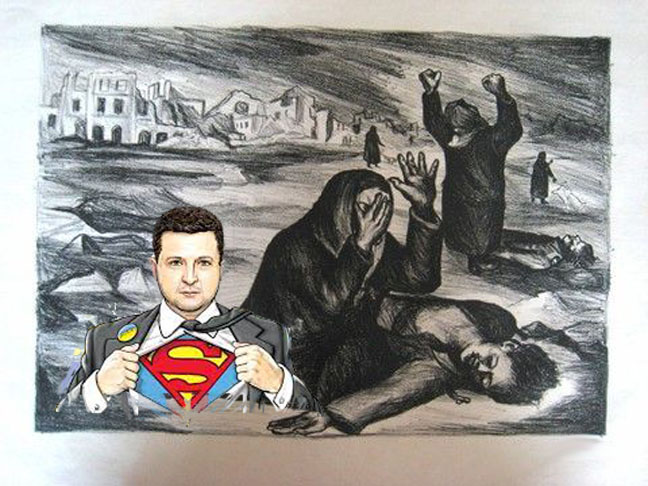
One Family’s Harrowing Journey Out of Gaza City
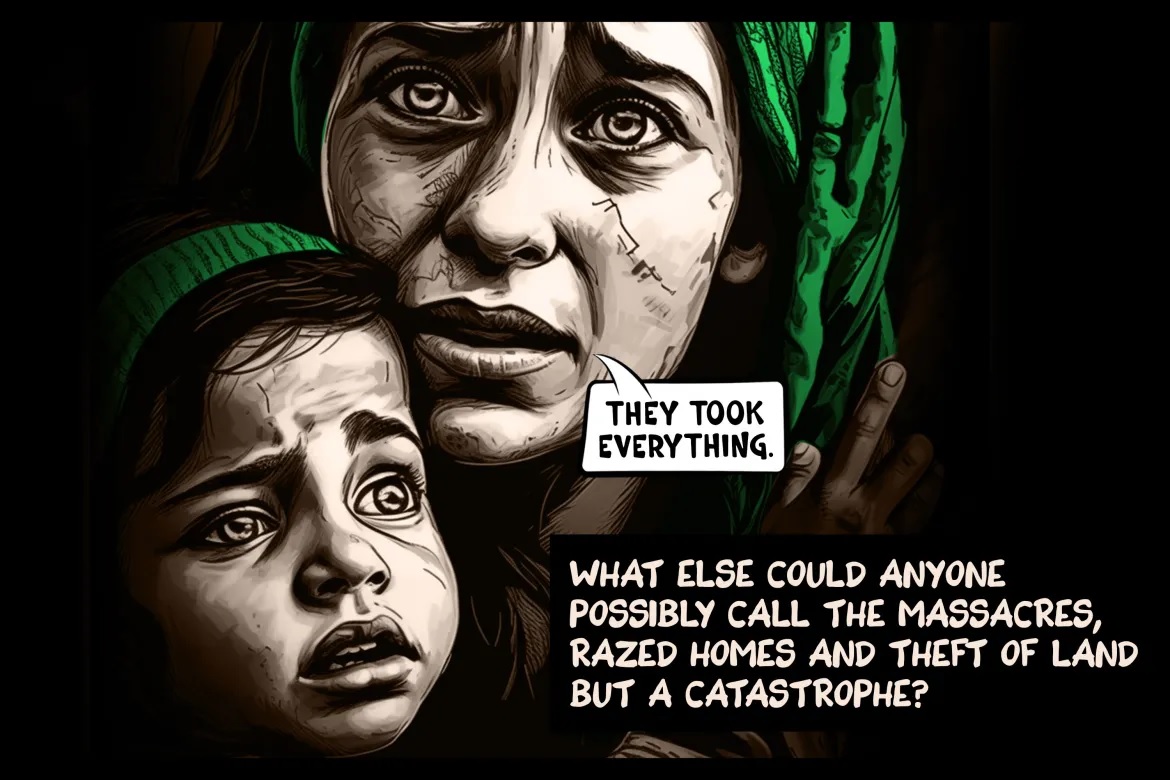
December 6, 2023, https://scheerpost.com/2023/12/06/one-familys-harrowing-journey-out-of-gaza-city/
Zakaria Baker and his family were forced from their home in Al-Shati refugee camp by Israeli bombs on November 7. As they traveled south over 15 kilometers they witnessed incredible horrors and not everyone survived the journey. This is their story.
By Zakaria Baker / Mondoweiss
[Mondoweiss] Editor’s Note: The following testimony was given by Zakaria Baker on November 11, 2023. The testimony was collected by Amplify Gaza Stories, an organization working on the ground in Gaza to collect and translate testimonies from Gazans, ensuring their stories of struggle, resilience, and survival are heard.
November 11, 2023
am Zakaria Baker, one of the people who were displaced from their homes four days ago in November 2023 – around November 7, 2023.
The beginning of the displacement is as follows: An Israeli intelligence officer called one of my cousins. There were about 20 of us sitting on chairs. The bombing of Al-Shati Refugee Camp did not stop for a single second. The missiles that were fired at the camp – we couldn’t see or hear them. They were barrel bombs. When they were dropped on a residential block of six or seven houses, they destroyed them completely. The scariest and most painful thing is that these missiles are fired at houses crowded with people. The bodies in Al-Shifa Camp are still under the rubble. We could smell the bodies.
The Israeli intelligence officer called one of my cousins who was sitting with us and said, “Bakers, why haven’t you left? Your neighbors have evacuated. You have 30 minutes to leave for your safety. If you don’t go, we will drop death on you.”
Ok, half an hour… What do we do? We are families and children and have to get ready to leave?
Less than half an hour later, about 20 minutes, maybe less, the bombing started a few meters away from us. It was targeting houses that were just two or three houses away. We couldn’t take anything with us, just some medication because I had had open heart surgery. So we walked – women, children, and elderly – as we kept walking, the bombing got closer to our houses. Whenever we passed a house, it was destroyed behind us.
The bombardment continued to Rono Mosque near Al-Shifa Hospital. When we were under the mosque, a bomb hit its minaret. Thousands of people were in the street. Some of them came from the hospital too. Many elderly people were with us. There were 160 people from our family in the street, and from our extended family, there were around 4 or 5 thousand.
We all started walking. When we reached the Al-Shifa there were thousands of people there. Most of them were residents from around Al-Shifa Hospital, or people who were seeking shelter inside the hospital who fled because the hospital was targeted.
We reached Dola interchange, some five to six kilometers we had already covered. We saw a scruffy-looking bus, but it was working, and we asked the driver to take us to the Dola interchange. He asked for 80 shekels, and we were approximately 40 people. We agreed on 80 shekels to take us to the Dola roundabout near Salah al-Din. We reached the Dola interchange, and we got off the bus, and we walked approximately one kilometer after the Kuwait roundabout, and we saw huge crowds, you know, don’t say hundreds or 1000s or 10s of thousands, there were hundreds of thousands of people and horrific scenes – women 80 and 90-year-olds, old men of 70 and 80 years old, some of them were wounded, some carrying children. We kept walking until we met a donkey and cart, and the owner said 20 shekels, so we loaded everything onto this cart – women, children, all our luggage, everything that we could get on the cart. Halfway up, the donkey was struggling, so the driver asked us to push. So we pushed it for the sake of helping the elderly and the children.
. We pushed until we were within 100 meters of the Israeli IDF. We got down, and we were asked to show our IDs. I picked up my grandson and played with him in order to assure him and for him to be assured by me. We walked within 10 meters of the soldiers. They said, “Stop.” We stopped. We saw three tanks move in front of us. Once they passed, we were told to walk on.
We only had one suitcase each. There were bodies everywhere. Some decomposed, some were charred. We saw a car with a person inside it dead. His bottom half was intact, his upper half was decomposed. Horrific scenes, enough to make a stone cry. Enough to make a stone cry. We left the area with the tanks, and we moved to Wadi Gaza Bridge, and they said to us now you are in a safe zone. From the area with the tanks to Wadi Gaza, my grandson was crying, he was hungry.
There was a small wall, and we let his mother use it to hide behind it so that she could breastfeed him and stop him crying just for a few minutes, about five minutes. In general, we felt easier and a little bit calmer after my grandson was fed. We continued walking in an enormous stream of humans in a column
On the bridge, we were not allowed to stop. It was forbidden to stop, in fact, one of the old women with us, who was married to my relative, she was 86 years old, her name was Kefah Bakr. She fell down from fatigue and died, she couldn’t survive the journey, the walking. She was kinda lucky because she died 10 meters after passing through the Israeli IDF-controlled area, and so she was taken to hospital.
Back in the tank area, you’re not allowed to look left or right. You must keep looking straight.
(Question from Mohammed Ghalayini, a volunteer with Amplify Gaza Stories: Were the instructions from the soldiers given by loudspeakers?)
Answer: No, the instructions were passed from one person to another. The people in the front were instructed to do something, and they would tell it to someone behind them and so on, and the instructions would be spread to all the others.
Many of the old people fell down and were left. People would walk past them. One person dropped his suitcase. His name Alaa Abu-Stata. He bent down to pick up his suitcase, and he was shot dead. Many of the old women couldn’t withstand this hard work, and they fell down to the ground. No one dared to stop to help them, they would shoot dead all those who would help her. So we had to sacrifice one old person to save 10 or 20 others from being shot or humiliated. I saw four cases, one person was called by name by loudspeakers. They stripped him down naked, and he was arrested, and no one knows where he has been taken. No one knows anything about him. This is what I have seen at a distance of 100 meters, and others have seen similar cases of arrests.
We kept on walking until Burej. Imagine! From Al-shati’ to the bridge – something like 15 kilometers. At Burej, there were no cars, only lorries. One lorry driver came along, and I told him we wanted to go to Khan Younis or the Hamad area. He said 300 shekels. I said, never mind just get us out of here. We reached Hamad, and we had another torturous journey at Hamad.
(Question: Did you find accommodation in Hamad?)
No, we couldn’t find any rooms. We spent three nights sleeping rough on the floor, unprotected, under the skies—cold nights. On the third night, only on the third night, we switched on spotlights to repel insects and flies from the eight and nine-month-old babies. On the 4th day, we managed to sort out the situation. We broke a partition that belongs to the council – some 4 meters square, and we put 40 people in it. This was my project. I made a makeshift tent from it with used plastic sheets, and six families were able to shelter there.
Since 12:00 yesterday, we haven’t been able to find a piece of bread. We have one meal a day – for two reasons: to avoid going to the toilet and because we can’t find any food. It’s a hunger war. No tinned food. We went to all the supermarkets and could not find anything. Women slept in the same clothes they left home with. This water I was given by Abu Mohammed. We were subjected to pain, suffering, anger, humiliation. I can’t talk anymore about this.
Since this story was recorded, Baker, his family, and thousands of others seeking refuge were again forced to leave their shelter in Hamad City, Khan Younis, on December 2 after receiving an evacuation order from the Israeli military.
December 7, 2023 Posted by Christina Macpherson | Israel, PERSONAL STORIES, weapons and war | Leave a comment
‘Let us be a lesson’, say Kazakhs wary of return to nuclear testing
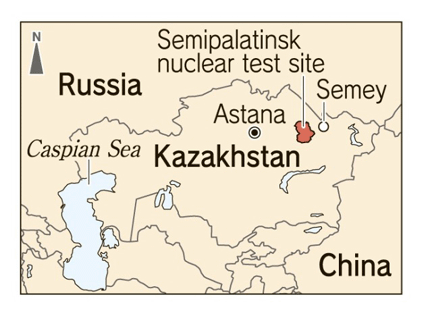
Reuters. By Mariya Gordeyeva, November 30, 2023
- Summary
- Treaty banning nuclear weapons tests was signed in 1996
- President Putin has revoked Russia’s ratification
- Many Soviet-era nuclear tests were conducted in Kazakhstan
- Radiation from the tests affected health of local people
SARYZHAL, Kazakhstan, Nov 30 (Reuters) – As Russia warns of the rising risk of nuclear war, and relations with the United States sink into a deep freeze, communities close to the vast Soviet-era nuclear testing site in northern Kazakhstan have a message for leaders: “Let us be a lesson.”
Hundreds of tests were carried out between 1949 and 1989 on the barren steppe near the city of Semey, formerly known as Semipalatinsk, close to the Kazakh-Russian border. The effect of radiation had a devastating impact on the environment and local people’s health, and continues to affect lives there today………………………..
“Let our suffering be a lesson to others,” said Serikbay Ybyrai, local leader in the village of Saryzhal, who saw tests being carried out some 20 km (12 miles) away when he was a boy. “If this (testing) resumes, humanity will disappear.”
When devices were detonated above ground – until 1963 when tests went underground – authorities would order local people out of homes and schools because of fears that ground tremors might cause buildings to collapse.
“I remember I was about five years old,” said Baglan Gabullin, a resident of Kaynar, another village that lived under the shadow of nuclear testing.
He recalled how adults would instruct him and his friends not to look in the direction of the blast.
“We were small, so on the contrary, out of curiosity we looked. The flash was yellow at first, and then the black mushroom grew,” he said.
Kazakh authorities estimate up to 1.5 million people were exposed to residual radioactive fallout from testing. Over 1 million received certificates confirming their status as victims of tests, making them eligible for an 18,000-tenge ($40) monthly payout.
‘EVERYONE STARTED DYING’
Maira Abenova, an activist from the Semey region who set up a non-governmental organisation protecting the rights of nuclear test victims after losing most family members to diseases she said were related, urged politicians not to allow nuclear escalation.
“As someone living with the consequences of what you could call 40 years of nuclear warfare, I think we can tell the world what we have gone through,” she said.
There is little reliable data on the specific health impact of testing in Kazakhstan.
But scientists say exposure to radioactive material on the ground, inhalation of radioactive particles in the air and ingestion of contaminated food including local livestock contributed to increased cancer risk and cases of congenital malformation.
In Saryzhal, a village of around 2,000 people living in small white-painted homes surrounded by blue wooden fences, Gulsum Mukanova recalls how she and other children would watch above-ground explosions, known as atmospheric tests.
“We were children, everything was interesting to us,” she said. “We would stare at those mushrooms.
“My father died at the age of 58; then my elder brother died, then my sister,” added Mukanova, who is in her mid-60s. “Everyone started dying.”
Gabullin, speaking near a small monument to victims of nuclear tests erected in Kaynar, also said losses were common.
“There were about 300 tractor drivers who worked with me … now only two or three are alive. All died of cancer and leukaemia,” he said. “Even the schoolchildren who worked for me then, now they are 50-53 years old, they are already dying.”……….
While villages such as Kaynar and Saryzhal were exposed to direct radiation, steppe winds carried nuclear fallout across an area the size of Italy.
Much of the territory, pockmarked with lakes resulting from blast craters, is still considered too contaminated to inhabit or cultivate.
CONTAMINATION LASTS FOR GENERATIONS
About 450 tests were carried out there, more than 100 of them atmospheric tests and the rest underground. The latter were used after a 1963 treaty went into force banning nuclear weapons tests in the atmosphere, in space or underwater, and are considered less harmful.
After the Soviet Union collapsed in 1991, Moscow no longer had access to the Kazakh site. Its main equivalent today is in Novaya Zemlya, an active military site on an Arctic archipelago in Russia’s far north.
Nuclear experts said that any testing today would likely be underground, which carries environmental and health risks.
“Underground testing can also have severe consequences,” said Alicia Sanders-Zakre of the International Campaign to Abolish Nuclear Weapons.
“Radioactive particles can vent into the air, and there is also the potential for contamination of groundwater,” she told Reuters, adding that Russia’s position was that it did not intend to test at this time.
“What’s so dangerous about radioactive contamination is that it lasts for generations.”
($1 = 459.0000 tenge)
Additional reporting by Olzhas Auyezov in Almaty and Gloria Dickie in London; Writing by Olzhas Auyezov; Editing by Mike Collett-White and Timothy Heritage https://www.reuters.com/world/asia-pacific/let-us-be-lesson-say-kazakhs-wary-return-nuclear-testing-2023-11-30/
December 2, 2023 Posted by Christina Macpherson | Kazakhstan, PERSONAL STORIES, Reference, weapons and war | Leave a comment
The cost of America’s nuclear arsenal: Taking care of our atomic veterans
By KEITH KIEFER, STARS AND STRIPES • November 2, 2023 https://www.stripes.com/opinion/2023-11-02/america-nuclear-arsenal-cost-veterans-11917578.html
Congress is still working to pass the National Defense Authorization Act, a more than $800 billion piece of legislation that funds our nation’s military as well as programs for members of our military. But this year, for the first time, the NDAA could include justice for veterans who were harmed by U.S. nuclear tests and other victims of the Cold War nuclear arms race.
As the national commander of the National Association of Atomic Veterans, I hear from veterans across the country every day whose lives were changed forever by exposure to radiation and other toxins. The Radiation Exposure Compensation Act gives atomic veterans sickened by U.S. nuclear tests the opportunity to apply for compensation that can help pay for medical treatment, other expenses, or simply offer recognition of the harms they suffered.
For many atomic veterans, RECA is the best and only option for help with exposure-related illnesses — it’s been reported that the Department of Veterans Affairs rejected 86% of radiation-related claims by veterans, making RECA all the more important for atomic veterans. RECA offers fewer benefits than the VA, but is much simpler to navigate, and has been a godsend to many veterans.
As a cleanup veteran, I am not eligible for RECA, but I have seen firsthand how much it has helped my fellow atomic veterans. However, RECA is set to expire next summer, and those veterans of the Cold War will be left without recourse or assistance. The news of high denial rates of atomic veterans seeking care from the VA is the latest example of veterans being left to fend for themselves. Veterans are dying while waiting for care. This is why we need to extend RECA and expand it to include cleanup veterans – too often, veterans cannot afford to battle out their claims for years with the VA. They need care now.
Veterans like Alex Partezana, from Cleveland, who was 22 years old when he served at Upshot Knothole where the U.S. government tested 11 nuclear weapons in the desert of Nevada. Alex was stationed in the trenches near the test, without any protective equipment or a film badge to measure his exposure. After the nuclear test he was told to walk toward ground zero, collecting Geiger counter measurements, while senators and higher-ups watched from over a mile away.
Or Mike Cobb, from Friant, Calif., who was stationed in the Pacific Proving Grounds as part of Operation Dominic, where he witnessed 21 nuclear tests. Mike was one of the few men in his unit with protective gear — and even that was just goggles. Sixty years later, Mike was diagnosed with bladder cancer, an illness associated with radiation exposure. Mike was able to receive compensation through RECA, offering him recognition for the risk he had unknowingly been asked to bear and the pain and suffering he endured as a result.
As for me, I worked to decontaminate Enewetak Atoll in the Pacific, where the U.S. military conducted 43 nuclear tests between 1948 and 1958. The U.S. military spent $239 million in a failed attempt to make the island habitable again, digging up and moving over 110,000 cubic yards of radiation contaminated soil and debris – enough to fill over 7,500 dump trucks. We worked with no personal protective equipment, resorting to t-shirts over our mouths to avoid inhaling radioactive dust. After my service, I experienced an ever-growing list of health problems all associated with exposure to radiation: my wife and I struggled to conceive; I was plagued by random fevers and bone pain; teeth crumbled in my mouth; I developed numbness in my hands and feet and radiation-related cataracts; at 40 I learned had the bones of a 90-year-old man and would need a hip replacement. Eventually, I was diagnosed with a thyroid disorder, a common result of exposure to radiation. Within the last five years, after living with pain for two decades, I finally had both hips replaced, along with my left knee.
Taking care of veterans is part of the cost of war. Congress should stand by the veterans who, often unknowingly, sacrificed their health and the peace of their families to keep our country safe. The project to develop, test and clean up nuclear weapons cost trillions of dollars and thousands of hours of work. The least we can do is provide health care and benefits to those harmed by that endeavor. Now we can finish the job, and ensure veterans of that effort have access to the health care and assistance they need.
Congress should ensure the NDAA includes language extending RECA to allow additional time for those harmed by nuclear weapons tests to apply for benefits. Time is not on any of our sides, and our atomic veterans deserve all the time they can get.
Keith Kiefer is national commander of the National Association of Atomic Veterans. #nuclear #antinuclear #nuclearfree #NoNukes #radiation
November 5, 2023 Posted by Christina Macpherson | health, PERSONAL STORIES, USA, weapons and war | Leave a comment
‘Nobody Believes in Our Victory Like I Do.’ Inside Volodymyr Zelensky’s Struggle to Keep Ukraine in the Fight

Public support for aid to #Ukraine has been in decline for months in the U.S., and Zelensky’s visit did nothing to revive it.
Despite the recent setbacks on the battlefield, he does not intend to give up fighting or to sue for any kind of peace. On the contrary, his belief in Ukraine’s ultimate victory over Russia has hardened into a form that worries some of his advisers. It is immovable, verging on the messianic. “He deludes himself,” one of his closest aides tells me in frustration. “We’re out of options. We’re not winning. But try telling him that.
The cold will also make military advances more difficult, locking down the front lines at least until the spring. But Zelensky has refused to accept that.
with the outbreak of war in Israel. The focus of Ukraine’s allies in the U.S. and Europe, and of the global media, quickly shifted to the Gaza Strip………………. on its own, Ukraine aid no longer stands much of a chance in Washington.
At the start of the Russian invasion, Zelensky’s mission was to maintain the sympathy of humankind. Now his task is more complicated. In his foreign trips and presidential phone calls, he needs to convince world leaders that helping Ukraine is in their own national interests, that it will, as Biden put it, “pay dividends.” Achieving that gets harder as global crises multiply.
BY SIMON SHUSTER/KYIV, NOVEMBER 1, 2023 , ORIGINALLY PUBLISHED: OCTOBER 30, 2023 https://time.com/6329188/ukraine-volodymyr-zelensky-interview/
Volodymyr Zelensky was running late.
The invitation to his speech at the National Archives in Washington had gone out to several hundred guests, including congressional leaders and top officials from the Biden Administration. Billed as the main event of his visit in late September, it would give him a chance to inspire U.S. support against Russia with the kind of oratory the world has come to expect from Ukraine’s wartime President. It did not go as planned.

That afternoon, Zelensky’s meetings at the White House and the Pentagon delayed him by more than an hour, and when he finally arrived to begin his speech at 6:41 p.m., he looked distant and agitated. He relied on his wife, First Lady Olena Zelenska, to carry his message of resilience on the stage beside him, while his own delivery felt stilted, as though he wanted to get it over with. At one point, while handing out medals after the speech, he urged the organizer to hurry things along.
The reason, he later said, was the exhaustion he felt that night, not only from the demands of leadership during the war but also the persistent need to convince his allies that, with their help, Ukraine can win. “Nobody believes in our victory like I do. Nobody,” Zelensky told TIME in an interview after his trip. Instilling that belief in his allies, he said, “takes all your power, your energy. You understand? It takes so much of everything.”
It is only getting harder. Twenty months into the war, about a fifth of Ukraine’s territory remains under Russian occupation. Tens of thousands of soldiers and civilians have been killed, and Zelensky can feel during his travels that global interest in the war has slackened. So has the level of international support.
Continue reading →November 4, 2023 Posted by Christina Macpherson | PERSONAL STORIES, Ukraine | Leave a comment
Chernobyl hero who was “first on the scene” in nuclear reactor meltdown takes own life.
Hero Chernboyl engineer Viktor Smagin, 75, who was one of the first on the scene at the 1986 nuclear disaster, left a note for his family before his death at his home in Moscow
Chernobyl nuclear tragedy hero Viktor Smagin, 75, took his own life .
By S P Jones, 25 Oct 23 https://www.mirror.co.uk/news/world-news/chernobyl-hero-who-first-scene-31277782
A hero Chernboyl engineer who was one of the first on the scene at the 1986 nuclear reactor meltdown has tragically taken his own life.
Viktor Smagin, 75, died at his home in Moscow, unable to bear the effects of radiation poisoning any longer, it is reported. He was a witness to the horror that unfolded on April 26, 1986, when reactor number four at the Soviet power station exploded and the radiation he was exposed to caused repeated health problems. In a heartbreaking note left for his family, he said that he could no longer endure the treatment he needed.
The tragic note read: “My dears: Larisa, Dima and Sveta! Now it’s time to say goodbye. Thank you very much for the years we have lived together. It was happiness. I’m sorry!” In 1986, as soon as the reactor exploded, releasing radiation across Europe, Smagin rushed from his home to his shift at the power station.
He told in his memoir: “Inside the buildings, people fought the fire. The most dangerous place was in the turbine room, because a fire here is the worst thing that can happen at a station after a reactor explosion. There was no panic, everyone was just doing their job.
“Personnel extinguished the fire and drained oil into underground containers; electricians…vented hydrogen. Many of those who saved the station received lethal doses of radiation and subsequently died in hospital.”
The day after the explosion, the population of highly-polluted Pripyat was evacuated “but the station could not be left unattended. Therefore, the staff lived in the town for a few more days. Then the children were transported to the Skazochny pioneer camp, which was located further from the station.
“It is worth saying that after the accident almost no one quit, although it was very scary. Out of 5,000, a maximum of six or seven people fled. And this despite the fact that everyone was professional and knew perfectly well what radiation was.”
He resented the blame game which saw “the staff blamed for everything”. He continued: “According to the official version, the workers decided to conduct tests at the power unit, despite the fact that the reactor was in an unsuitable state for such work – at a power of 200 megawatts, instead of the required 700.”
He was awarded an honour for his role in the clean-up, and admitted: “This accident, of course, ruined everyone’s fate. I suffered from radiation sickness, I received a stigma for life – a ban on working in areas of ionizing radiation, a ban on working at night, a ban on business trips and a lot of other restrictions.” He was handed a desk job in a Russian ministry. #nuclear #antinuclear #NoNukes #radiation
October 28, 2023 Posted by Christina Macpherson | Belarus, PERSONAL STORIES, Reference | Leave a comment
Nuclear Weapons and New Mexico’s Downwinders: Tina Cordova on “the legacy for us that no one ever talks about”
NTI 18 Oct 23 Mary Olney Fulham, Communications Officer, Rachel Staley GrantDeputy Vice President, Communications
Tina Cordova is co-founder and executive director of the Tularosa Basin Downwinders Consortium. Since its founding in 2005, the Consortium has brought attention to the serious health effects that New Mexicans have suffered due to the development and testing of nuclear weapons in the state. NTI’s Mary Fulham and Rachel Staley Grant interviewed Tina during Hispanic American Heritage Month about her advocacy work—including recent breakthroughs in Congress—and her take on the recent attention that Oppenheimer has brought to the history of nuclear weapons in New Mexico.
Thank you for joining us, Tina. To get started, could you tell us about New Mexico’s experience with nuclear weapons and how nuclear weapons have made a mark on your life?
I grew up in a small village close to the Trinity test site. When I was young, I heard about the bomb detonated in our backyard, and I saw people with rare and aggressive cancers. When I went to college and got a degree in the sciences, I really began to understand how the health, economy, and environment of the entire state is horribly harmed by the nuclear industry.
We have the “cradle-to-grave” nuclear weapons lifecycle here: mining, testing, disposal. From the beginning of the Manhattan Project, the government disrespected and exploited native communities by building mines on sacred lands and forcing the people to work in and around the mines without safety gear. Well into the 1970s, Los Alamos National Lab dumped nuclear waste in the nearby canyons that feed the aquifer connected to the Rio Grande River, our water source. Everything south of Los Alamos was contaminated by that waste.
As a result, many people are sick from radiation exposure, which is both a health and economic issue. When people get sick with cancer they can’t hold a job.
I was diagnosed with thyroid cancer when I was 39. My dad developed cancer after me, first on the base of his tongue, then prostate cancer, and then, eight years later, again on his tongue. He was healthy and had no risk factors, but the doctors said they see it a lot in New Mexico. After the second round of cancer, my dad had all the radiation treatment he could take, so he died. Both of my grandmothers had cancer and I had two great-grandfathers that had cancer. Now my 23-year-old niece has thyroid cancer.
That’s cancer in five generations of my family.
I wish I could say we were unique, but we’ve documented hundreds of families with the same experience, and the really tragic thing is that we’re seeing cancer in younger people all the time. We are forced to bury our loved ones on a regular basis…………………………………………………………………………………………………………………………………………………………………………………………………………………
New Mexicans did the dirty work for the Manhattan Project. We built the roads, the bridges, the facilities. We were the ones who died in explosive accidents at Los Alamos and the janitors who cleaned up. Our women were bussed up there and cooked every meal, cleaned every house, changed every diaper, and fed every baby. We lived as close as 12 miles to the Trinity site. None of that is shown in the movie.
This movie[LOppenheimer] will make hundreds of millions of dollars and have millions of views, and they wouldn’t even include a note at the end of the film acknowledging the sacrifice and suffering of New Mexicans as a result of the Manhattan Project. And for me, that’s just more of the same exploitation…………………………………………………………………………………………………………..
It makes me worried that, as we’re looking at a nuclear arms race right now, people don’t realize the human devastation that’s associated with these weapons. People need to recognize the nuclear legacy that so many Americans are already living with, and why it’s not sustainable to keep ramping up our nuclear arsenal and think that somehow it will lead to a good outcome. https://www.nti.org/atomic-pulse/nuclear-weapons-and-new-mexicos-downwinders-tina-cordova-on-the-legacy-for-us-that-no-one-ever-talks-about/ #nuclear #antinuclear #nuclearfree #NoNukes
October 19, 2023 Posted by Christina Macpherson | PERSONAL STORIES, USA | Leave a comment
Nuclear test veteran from Ipswich among first to receive medal
By Laura Devlin, BBC News, Suffolk, 24 Sept 23
A 92-year-old veteran who watched nuclear weapons being tested in the 1950s has become one of the first to receive a new military medal.
Bob Last, of Ipswich, Suffolk, was a newlywed in his 20s when he was sent to south-west Australia with the Royal Electrical and Mechanical Engineers.
Their contribution was recognised by the government after a long campaign…………………..
Cover faces with hands
Ms Catlin and her sister Debbie Last said their father, who has dementia, had started to speak about his experiences in the Australian outback in recent years.
“I think they were told not to talk about it; and that generation, if they told not to talk about something, they didn’t,” said Ms Last.
“He said they would see explosions go off, and they would cover their faces with their hands and they could see the bones in their hands.”
Seven atomic bombs were dropped in Maralinga, where Mr Last was based, in October 1957………
‘Nobody knew anything’
For years, veterans and their families have campaigned for recognition, saying the radiation they were exposed to caused ill health and premature deaths, as well as health problems in their families…………………………………………………………………………..
The British Nuclear Test Veterans Association believes more than 22,000 British servicemen participated in the British and US nuclear tests and clean-ups between 1952 and 1965, along with scientists from the Atomic Weapons Research Establishment and civilians.
Ms Last said: “We need to find the medical records of the veterans. It doesn’t stop here.” https://www.bbc.com/news/uk-england-suffolk-66906172
September 26, 2023 Posted by Christina Macpherson | PERSONAL STORIES, UK, weapons and war | Leave a comment
Ukrainian POWs Say Families of Dead Denied Compensation
Nine captive AFU testify: Dead soldiers buried in trenches, wounded not evacuated
DEBORAH L. ARMSTRONG, SEP 8, 2023 https://deborahlarmstrong.substack.com/p/ukrainian-pows-say-families-of-dead?utm_source=post-email-title&publication_id=1192684&post_id=136847336&isFreemail=true&r=ln98x&utm_medium=email
Official numbers of Ukrainian casualties have been grossly underreported since Russia first began its Special Military Operation in February, 2022. According to some military analysts, the number of Ukrainian dead is in the hundreds of thousands, and former USMC Intelligence Officer Scott Ritter has put it as high as half a million.
To anyone really paying attention, it’s obvious that Ukraine cannot continue fighting much longer. Most of the healthy young fighting men have already been killed, and male conscripts who couldn’t come up with the thousands of dollars needed to flee their country, have already been forced into the war by the busloads.
But that is not enough for the regime in Kyiv and its power-hungry Western overlords. They are so desperate to keep “weakening Russia” — despite Ukraine’s looming defeat — that they will start calling up women beginning October 1st.
Meanwhile, captured Ukrainian servicemen tell horror stories of dead comrades left behind to rot, or buried in the very trenches they fought in, while commanders force them to sign papers agreeing to the “voluntary abandonment of bodies” in the event of death — a way to avoid paying compensation to the families of the fallen.
Nine Ukrainian POWs gave their testimonies in a video released this week on Telegram. I have translated the video and uploaded it to my channel on YouTube. You may watch it here, but I must warn you that there are extremely graphic images from the war.
In the video, the captive soldiers refer to their dead comrades as “200s” and the wounded are called “300s.” It’s military jargon that is used in Ukraine and Russia, and is believed to have been derived from the numbers on forms that had to be filled out for dead and wounded soldiers in times past. To make the translation easier to understand, I just referred to them as “dead” and “wounded” and left out the numerical designations.
The first POW has a slightly graying beard and looks to be in his 40’s. “All around us there were dead soldiers,” he says, “It was just horrible.”
The video shows the skeleton of a soldier still wearing a helmet.
“Very heavy casualties,” the second soldier says. He is also bearded but looks younger, perhaps in his 30’s. “It was really scary,” he adds.
More carnage is shown as prisoner number 3 is heard. “A lot of bodies were lying around and it was impossible to get them out of there,” he says. His head is shaved, he has a mustache, and looks somewhat emaciated, possibly in his 30’s. “The commanders made us bury the bodies of the dead right in our positions.”
POW number 4 has a gray head of hair and matching beard and looks to be in his 50’s or older. “They wrote reports and buried them right at the position,” he says, “so that they wouldn’t have to pay money to the family and relatives.”
More bodies which look like they have been left to rot for some time. “The dead were lying in the trenches,” says the fifth prisoner, who has bushy brown hair and a beard, and may be in his 20’s or 30’s. “Nobody even took them away or thought of taking them away. The wounded were also in the trenches, they wanted to go to the entrance, but they were told to go back.”
The sixth man is clean-shaven and bald, possibly in his late 20’s or early 30’s. “A guy was shot,” he says, “either he wanted to run away or one of the commanders didn’t like him, so he got drunk. They told us to bury him.”
“There was even one young man who shot himself,” says prisoner number 7, “but they didn’t care about him, they buried him immediately. They’ll write it off as casualties probably and that’s all.” His head is also shaved, but he sports a mustache and closely-cropped beard. A tattoo of a cat paws playfully at a mole on his neck. He, too, looks to be in his 20’s or 30’s.
The 8th man looks like he’s in his 30’s. He’s clean-shaven with scars on his head. “Many, many, very many casualties,” he says. “Lots of bodies on the road. You step over them, you just walk by. There were many dead, many wounded, and still even more. No kind of evacuation.” As he talks, the video shows clumps of bodies tangled together. “We came to the position, right in the trenches were dead soldiers. All around the trenches, there were also bodies lying.”
The ninth and final man looks younger, perhaps in his 20’s, with closely cropped hair and a bushy brown beard. He says that his commander issued a warning, saying “Listen, if anyone runs away, he’ll be shot.” The interviewer asks if he shot people and he answers simply, “yes.”
The Russian Investigative Committee took note of the testimony and reported that fighters in the Armed Forces of Ukraine are being forced to sign agreements stating that, if they are killed, their bodies will not be taken from the battlefield and their families will not receive any compensation from the Ukrainian government.
The agency emphasized that Ukrainian commanders treat their subordinates inhumanely, and that the signatures of the soldiers were collected deliberately in order to deny their families any compensation or allowances.
As you saw, the soldiers also testified that their wounded comrades were not given any aid and that their commanders threatened to shoot them if they abandoned their positions.
With special thanks to Lilya Takumbetova.
About the author:
Deborah Armstrong currently writes about geopolitics with an emphasis on Russia. She previously worked in local TV news in the United States where she won two regional Emmy Awards. In the early 1990’s, Deborah lived in the Soviet Union during its final days and worked as a television consultant at Leningrad Television.
September 9, 2023 Posted by Christina Macpherson | PERSONAL STORIES, Ukraine, weapons and war | Leave a comment
Respect for hibakusha, and hope in younger generations

Hibakusha, atomic bombing survivors, have been tirelessly exerting themselves toward a world free of nuclear weapons, with their only wish that no one else should go through the sufferings they have experienced
The Bulletin, By Masako Toki | August 22, 2023
For too long, nuclear weapons narratives have been dominated by those who saw the mushroom cloud from afar or above. Or maybe just in photos, TV, or videos. Most absurdly, the voices of people who suffered the most under the mushroom cloud have often been marginalized.
There have been numerous efforts to raise awareness of the inhumane nature of nuclear weapons among hibakusha (atomic bomb survivors), people in Hiroshima and Nagasaki, and more broadly, in the international community. One of the most important milestones came when the 2010 Nuclear Nonproliferation Treaty (NPT) Review Conference adopted a final document that included, for the first time “the catastrophic humanitarian consequences of any use of nuclear weapons.” Since then, the humanitarian initiative for nuclear disarmament has been gaining momentum.
Three conferences on the humanitarian impact of nuclear weapons contributed to the start of the negotiation of the Treaty on the Prohibition of Nuclear Weapons (TPNW) and to adoption of the treaty. Through this process, a wide range of civil society members, along with like-minded governments, energized the humanitarian initiatives and tenaciously supported bringing humanitarian dimensions to nuclear weapons policy discussion.
The adoption of the TPNW has brought a glimmer of hope to nuclear disarmament advocates, although they are fully aware that this is a first step of the long process. Still, this is considered to be one of very few positive developments in recent nuclear disarmament efforts. The world is currently moving backward on nuclear disarmament. The Russian invasion of Ukraine has caused unspeakable human suffering and raised the risk of nuclear war. Today, nuclear threats are at the highest level since the end of the Cold War,
Hibakusha, atomic bombing survivors, have been tirelessly exerting themselves toward a world free of nuclear weapons, with their only wish that no one else should go through the sufferings they have experienced.
As the memories of Hiroshima and Nagasaki are further fading away every year given the advanced age of hibakusha, it is urgent for younger generations to learn more. Time is of the essence. Earlier this year, the average age of hibakusha reached 85.01 years, according to Japan’s Ministry of Health, Labor and Welfare. In addition, the number of hibakusha decreased by 5,286 to 113,649 this year. As the A-bomb survivors continue to age, the issue of how to pass on the message of the catastrophic impact of nuclear weapons to the next generation becomes increasingly pressing. Informing and educating the next generation is how we can ensure that nuclear weapons will never be used again, and eventually, achieve a world free of nuclear weapons.
The time to learn from hibakusha directly is limited and is getting shorter and shorter. The peace declaration this year read by Nagasaki Mayor Shiro Suzuki quoted Sumiteru Taniguchi, one of the late hibakushas who dedicated his life to nuclear disarmament. Taniguchi admonished that “[p]eople appear to be gradually forgetting the suffering of the past. This forgetfulness terrifies me. I fear that forgetfulness will lead to the acceptance of further atomic bombings.”
Keiko Ogura, a Hiroshima hibakusha and an English-Japanese interpreter for peace activities, shared her testimonials with world leaders in May this year at the G7 Hiroshima Summit. She asked the leaders to “relive the struggles in the hearts of hibakusha” that have been felt for so long, and to imagine the invisible wounds, traumas, sorrows, and unspeakable secrets through her eyes and heart. One of the most important abilities you need when you work for nuclear disarmament is to be able to empathize with other’s suffering. Ogura asked the G7 leaders to do precisely this. She also sent a message to Russian President Vladimir Putin through a reporter for one of her numerous interviews, saying, “You don’t know what a nuclear weapon is, the reality of a nuclear weapon. So come here and see.”
Earlier this summer, at a civil society event, Ogura calmly started her atomic bombing testimonial by encouraging the audience to imagine how it feels like to be under the mushroom cloud at the time of the bomb’s detonation. “I was at that time under the mushroom cloud you can see there,” while showing the picture of the mushroom cloud after the bomb was dropped.
Nothing is more powerful and effective than hibakusha testimonials in helping others to understand the horrific reality of the use of nuclear weapons. It is very important to imagine what really happened under the mushroom cloud. When you hear about the Hiroshima bombing or the Nagasaki bombing, the first image that comes to your mind may be the mushroom cloud. But we need to understand that people were under the mushroom cloud. Most of the victims were civilians, including small children.
Every year, the Hiroshima and Nagasaki remembrance days come. These are the days that we have to make efforts to remember and renew our resolve to work for nuclear disarmament. Soon, we will not be able to listen to hibakusha directly. As the hibakusha are aging in the middle of increasing nuclear risks, we cannot do business as usual every year, or think about nuclear disarmament only on these remembrance days……………………………………………………………….more https://thebulletin.org/2023/08/respect-for-hibakusha-and-hope-in-younger-generations/?utm_source=Facebook&utm_medium=SocialMedia&utm_campaign=FacebookPost082023&utm_content=NuclearRisk_HibakushaAndHope_08222023&fbclid=IwAR0hzzEqc_dLq2NN_fF9F4OQl0uI31cz7QW9BA5nL5TPKrLpASBAUt9dRDg
August 29, 2023 Posted by Christina Macpherson | Japan, PERSONAL STORIES | Leave a comment
The Financial Legacy of the Nuclear Tests on Bikini Atoll
WSJ, 18 Aug 23
As part of the U.S. nuclear tests after World War II, a total of 23 nuclear weapons were detonated on and around Bikini Atoll. Eventually, the U.S. set aside funding to help the people of Bikini and their descendants. But, as WSJ’s Dan Frosch reports, those compensation funds have been drained.
TRANSCRIPT – (sections of)
“……………. Jessica Mendoza: One test site was the American territory of Bikini Atoll. Over 12 years, a total of 23 atomic bombs were detonated at and around the chain of islands. But before it was a nuclear test site, it was home to more than a hundred people. The US government evacuated those islanders ahead of the experiments. And for decades, they were nuclear nomads, hopping from island to island, often facing harsh conditions, sometimes starvation. Eventually the US government agreed to set aside funding to help the people of Bikini and their descendants. Descendants like Jessy Elmi, whose grandmother was 15 when she was forced to leave Bikini Atoll.
Jessy Elmi: Three islands were disintegrated and they can never go back. It’s radioactive.
Jessica Mendoza: Jessy now lives in Florida, but she has relied on the funds to help with everyday expenses.
Jessy Elmi: I would be able to get diapers or baby food or whatever. It would help pay for school books and papers and pens and things like that.
Jessica Mendoza: Those payments were dependable until earlier this year.
Jessy Elmi: In February, we just stopped getting our payments. The date came up, it passed, and then another two weeks passed by and now it turned into a month. And then after that, the next payment, and we’re like, “Hmm, so is there no money anymore? Something’s going on here.”
Jessica Mendoza: Welcome to The Journal, our show about money, business and power. I’m Jessica Mendoza. It’s Friday, August 18th. Coming up on the show, Compensation Funds were set aside for the descendants of Bikini Atoll. What happened to their money? Where exactly is Bikini Atoll?
Dan Frosch: It’s kind of in-between the Philippines and Hawaii. That’s sort of a good way of looking at it………………………………
Jessica Mendoza: Bikini Atoll is part of the larger chain of islands known as the Marshall Islands. More than 80 years after those nuclear tests, Bikini Atoll is still uninhabitable. So what would you find if you were to visit Bikini Atoll now? If you were walking around on the beach, what would you see? Can you drink the well water? Lay on the sand?
Dan Frosch: So you would find a largely deserted series of islands. You can’t drink the groundwater there. According to researchers, it is still radioactive, as are the coconuts. And you will see coconut crabs who typically feast on these coconuts, but are also radioactive because of the nuclear fallout from decades earlier.
Jessica Mendoza: There were 167 people living on Bikini Atoll ahead of the blasts. The US government relocated those families and told them two things. First, that the residents would be able to return to Bikini eventually. And second…
Anderson Jibas: What you’re doing is in service to humanity. It’s going to help.
Dan Frosch: I mean, they were told that their actions would help end all wars.
Jessica Mendoza: Quite a promise to be making……………………………..
Jessica Mendoza: The government set up two separate funds to help. The first pot of money was a $110 million trust fund.
Dan Frosch: Now, this money was initially intended to clean up Bikini Atoll and hopefully at some point get people back onto the islands chain to their homeland.
Jessica Mendoza: But it quickly became clear that cleanup from 23 nuclear bombs was not feasible. So that money went to the remote government representing the Bikinian diaspora spread across other islands.
Dan Frosch: And so the US government decided to let that money be used to help the Bikinians who are essentially living in existence in exile, operate their own government and pay for various expenses, schools, housing, scholarships, operating expenses for their government in the two places that they had largely resettled, which were Kili and Ejit.
Jessica Mendoza: Think of it as an operations fund. And the Bikinian government had some freedom to spend this money the way they wanted to. The second fund was for compensating Bikinians and their descendants.
Dan Frosch: We created something called the Bikini Claims Trust, a totally different fund. And the purpose of that fund was to disperse quarterly payments to Bikinians and their descendants, which in a single year typically amounted to about $500.
Jessica Mendoza: This fund allocated $75 million for Compensation. It was to be doled out every three months to some 7,000 descendants of those original residents. People now spread across the Marshall Islands and the United States. So the people of Bikini Atoll had two funds worth millions, one main operations fund for running the remote government and a second fund for compensation checks. For decades, the operations fund was overseen by the US Interior Department.
Dan Frosch: And every year, the Bikinian people would go to the Interior department and say, “We need several million dollars to help operate our government and to build houses on the island of Kili and Ejit where our people are living.” And there would be a back and forth and they’d finally come up with a figure and that money would be used for those purposes. And there would be a sort of an extensive auditing process to ensure that the money from that fund was used for exactly what the Bikinian people and their government said it was going to be used for. And that process went largely unencumbered until 2017. And then something happened in 2017 that would change everything for the Bikinian people and how that money was dispersed.…………………………………………………………………
Jessy Elmi: The United States promised to take care of the people of Bikini if they would move and leave their island, so that they could do their bomb testing. They trusted them and they failed them. Now, after all of that, their own leaders decided to let them down by not taking care of what little bit they had, and there they are. It’s just too sad. https://www.wsj.com/podcasts/the-journal/the-financial-legacy-of-the-nuclear-tests-on-bikini-atoll/22abaedd-aa37-41d6-9966-991fabdaaa53
August 21, 2023 Posted by Christina Macpherson | OCEANIA, PERSONAL STORIES | Leave a comment
The blockbuster movie ‘Oppenheimer’ leaves out the real story’s main characters: New Mexicans

The terrible emptiness of “Oppenheimer” Searchlight New Mexico, by Alicia Inez Guzmán, August 8, 2023
Bernice Gutierrez was eight days old when a light 10,000 times hotter than the surface of the sun cracked open the predawn sky. No one in south-central New Mexico knew where it came from, or that the tiniest units of matter could be split to unleash such energy. Nor could they know that when the cloud that followed bloomed some 50,000 feet into the sky, it was surrounded for the briefest of seconds by a blue halo, the “glow of ionized air,” as the Manhattan Project physicist Otto Frisch described it.
The impacts of that unholy halo were all too apparent in the years after, when her great-grandfather died of stomach cancer. One person after another would receive their own wrenching cancer diagnoses — 41 people in her immediate family, spanning five generations. Every one of them had lived in the Tularosa Basin and within 50 miles of the Trinity Site, where the first atomic bomb, nicknamed “Gadget,” was detonated on the northern edge of the Chihuahuan Desert.
Gutierrez was one of a group of downwinders, including Mary Martinez White and Tina Cordova, cofounder of the Tularosa Basin Downwinders Consortium, who watched the movie “Oppenheimer” together when it opened. In one scene after another, New Mexico’s landscapes unfurled — all painfully beautiful and all, it appeared, empty and unpeopled.
In New Mexico, we have lived in the blind spot of a national narrative for eight decades, repeated once again in this box office hit. Over its exhaustive three-hour run-time, it managed to avoid mentioning what we here have been sharing with loved ones at kitchen tables for decades: the violent evictions that took place on the Pajarito Plateau to build Los Alamos, the Pueblo and Hispanic men and women who did essential work for the Manhattan Project, or the thousands of New Mexicans affected to this day by the Trinity test.
To watch J. Robert Oppenheimer’s character instead create and destroy in the state’s big, beautiful and ostensibly barren lands is to deny the presence of so many people whose lives were indelibly transformed by the dawn of the atomic era and continue to be shaped by the juggernaut that is today’s nuclear industrial complex.
Oppenheimer, the son of a wealthy businessman, had come here as part of a cultural moment. He hiked, rode horses and camped. He stayed at a dude ranch in Pecos. He fell in love with and then changed New Mexico forever.
“I am responsible for ruining a beautiful place,” he would later confess.
The film, Gutierrez said, skipped blithely over the ruin. “They leave out the fact that in those isolated areas lived ranchers whose lands they took away and who were never compensated for it.”
The blast was so hot it liquified sand and pieces of the bomb into hunks of green glass. Lead-lined tanks were dispatched to take soil samples at ground zero as fallout cascaded across 46 states. Ash fell from the sky like snow for days afterward, contaminating cisterns, acequias, crops, livestock, clothing and people. At the time of the detonation, 13,000 people lived within a 50-mile radius.
‘Love-struck’ with the beauty
Oppenheimer initially arrived in New Mexico among a wave of smitten travelers. Artists, writers, dancers, anthropologists, museum boosters, health seekers and at least one psychoanalyst (Carl Jung), all had come as well-to-do tourists in search of the ineffable — landscapes, light, exotic cultures, “a patch of America that didn’t feel American,” in the words of writer Rachel Syme.
Long before he became the father of the atomic bomb, Oppenheimer was “love-struck” with the stark beauty of New Mexico, as Kai Bird and Martin J. Sherwin wrote in “American Prometheus,” the biography upon which the movie is based. He would later lease and then buy a home in the Sangre de Cristo Mountains with his brother, Frank. Like so many others, he’d been mesmerized by the West.
New Mexico and the Southwest had long been lodged in America’s psyche. Landscape painting and photography pictured this new and alien frontier to incoming settlers and tourists as early as 1848, the year the United States annexed the region from Mexico. The art forms ended up serving the nation’s gospel, Manifest Destiny, by portraying “uninhabited” landscapes open to settlement. At the same time, U.S. forces brutally removed Indigenous peoples and others of mixed descent from their ancestral lands.
That aesthetic was at work in “Oppenheimer,” a movie that not only played up the romance of the landscape but also made it appear that the atomic bomb test only affected an elite group of scientists watching raptly in cars and bunkers.
“That’s the thing about the white supremacist imagination, right? They create alternate realities for our lives and communities and we have to live with the consequences,” said Mia Montoya Hammersley, an environmental attorney and member of the Piro-Manso-Tiwa tribe whose ancestry includes the earliest stewards of the Tularosa Basin, where the first bomb was detonated.
“This narrative that New Mexico is this empty barren place, people still really buy into that and believe it.”………………………………………………………………………………………………
There is nothing to suggest during any of that storytelling that New Mexico was essentially poisoned, its residents never warned, evacuated or educated about the health hazards of the July 16, 1945 Trinity test.
“It was,” as artist Medina put it, “a great act of desecration.”
Some geologists propose that this moment marks the start of a new epoch of geologic time, the Anthropocene. In New Mexico, it marks a new epoch of our own — when we became a nuclear colony. We are the only “cradle-to-grave” state in the nation, home to uranium mining, nuclear weapon manufacturing and waste storage. Two of the nation’s three weapons labs — Los Alamos and Sandia — are located here, and some 2,500 warheads are buried in an underground munitions complex spitting distance from the Albuquerque Sunport.
Los Alamos National Laboratory is currently undergoing a multi-billion-dollar expansion to create plutonium pits on an industrial scale — the “new Manhattan Project,” as Ted Wyka, the National Nuclear Security Administration’s field office manager, recently said in an aside before a media tour. Wyka told me he imagined himself in the role of Lt. Gen. Leslie Groves, the director of the Manhattan Project; LANL’s current director Thomas Mason was his Oppenheimer, he said.
The film gestures obliquely toward a future world irrevocably changed by the spectacle of nuclear military might. That future — our present — is now a global arms race. ………………………………………………………………………………………………………………………………………………………………………………
in the film, there are only two references to Indigenous peoples. In the first, Oppenheimer is selecting the Pajarito Plateau for the Manhattan Project. The second arrives after the U.S. decimates Hiroshima and Nagasaki. A scene in the oval office shows a crass Harry Truman asking Oppenheimer what to do with the site now that the bombs have been dropped.
Oppenheimer’s response? “Give it back to the Indians.”
Instead, the nuclear arms race was born……………………………………………………………………………………………………………
What remains is a persistent belief that the creation of atomic weapons ended World War II and made for “one of the greatest scientific achievements of all time,” as a plaque near the Santa Fe Plaza reads…………………………………………………………………………………………………………………………..
Gutierrez, White and Cordova, all three on the Tularosa Basin Downwinders Consortium’s steering committee, left the film no less resolved. Days after seeing the movie, Gutierrez was back at work, researching all the infants that died the summer of the Trinity test. Cordova was busy writing about the movie and pushing for compensation for New Mexico’s downwinders, her mission for the past 18 years. And White had helped organize a photography exhibition in Las Cruces on the legacy of Trinity from a local perspective.
The movie’s over, but the battle goes on.
August 11, 2023 Posted by Christina Macpherson | media, PERSONAL STORIES, USA, weapons and war | Leave a comment
Sombre ceremony outside Manitoba Legislature illuminates push to eradicate nuclear weapons
Lanterns of Peace ceremony marks 78th anniversary of atomic bomb detonated over Nagasaki
CBC, Nathan Liewicki · Aug 10, 2023
More than 100 lanterns, each painted with unique patterns and messages of symbolism, floated on the fountain on the south side of the Manitoba Legislative Building on Wednesday evening.
As the sunset shortly after 9 p.m., a candle in the middle of each lantern was lit, commemorating Winnipeg’s annual Lanterns for Peace ceremony.
The event, which started in Winnipeg in the mid-1990s, marked the 78th anniversary of the Allies dropping an atomic bomb over the Japanese city of Nagasaki. Three days earlier, Hiroshima was hit with a nuclear bomb.
The number of casualties stemming from the two atomic bombs is unknown, but it’s estimated that between 130,000 and 230,000 civilians and soldiers lost their lives.
Less than a week after the second bomb was dropped, Japan surrendered, ending the Second World War on Aug. 15, 1945.
Terumi Kuwada is a third-generation Japanese-Canadian. She was previously a member of the committee which organized the ceremony.
Kuwada called the ceremony both serious and spiritual.
“It’s a very sombre and serene kind of moment when all the lanterns are lit up and floating … almost like a spiritual awakening,” she said. “It is really a time to remembers innocent citizens of the atomic bomb, as well as advocating for the abolition of nuclear weapons.”
unko Bailey grew up in Nagasaki. The detonation of the second atomic bomb is especially significant to her.
A member of the Japanese Cultural Association of Manitoba, Bailey learned about how the atomic bomb in her hometown affected her father and so many others. Bailey’s father was 82 years old when he died last February.
“Luckily, his family was evacuated to a different part of Japan so he was not directly affected by the bomb, but most of our relatives were still in Nagasaki city and were exposed to the radiation in the area,” Bailey said. “A lot of my uncles and aunts passed away, if not immediately, seven days after, or a year later from leukemia, the radiation disease.”……………………………………………………………………………… more https://www.cbc.ca/news/canada/manitoba/lanterns-peace-nagasaki-commemoration-manitoba-1.6932149
August 11, 2023 Posted by Christina Macpherson | Canada, PERSONAL STORIES, Religion and ethics | Leave a comment
Like ‘the tolling of a distant temple bell’, Ibuse Masuji’s Black Rain remembers the horrors of Hiroshima and warns of the inhumanity of war

Jindan Ni, August 4, 2023 https://theconversation.com/like-the-tolling-of-a-distant-temple-bell-ibuse-masujis-black-rain-remembers-the-horrors-of-hiroshima-and-warns-of-the-inhumanity-of-war-205837?utm_medium=email&utm_campaign=The%20Weekend%20Conversation%20-%202700227280&utm_content=The%20Weekend%20Conversation%20-%202700227280+CID_e1af8a5e068132789cd3bffaecf54867&utm_source=campaign_monitor&utm_term=Like%20the%20tolling%20of%20a%20distant%20temple%20bell%20Ibuse%20Masujis%20Black%20Rain%20remembers%20the%20horrors%20of%20Hiroshima%20and%20warns%20of%20the%20inhumanity%20of%20war
In May 2023, almost 80 years after its devastation by an atomic bomb, Hiroshima again became the focus of world attention as the host city for the 49th G7 Summit.
On the summit’s official website, Hiroshima is presented as the exemplar of Japan’s postwar success. It is described as an “international city of peace and culture” and “resolute postwar advancement”. There are photos of its serene landscapes, its local delicacies and sake, and its modern sports and street culture.
The bombing of Hiroshima at the conclusion of World War II is mentioned just once. The Hiroshima Peace Memorial, according to the site, “speaks to the horrors of nuclear weapons”.
Hiroshima has more than this to tell us. But its stories, its “several pasts”, have been constantly abridged – or “refashioned”, as Michel Foucault would say. They have been adapted to serve political agendas.
On August 6, 1945, after the atomic bomb was dropped on Hiroshima, President Harry Truman released a statement that praised the scientific achievement:
“Sixteen hours ago an American airplane dropped one bomb on Hiroshima, an important Japanese Army base […]
It is an atomic bomb. It is a harnessing of the basic power of the universe. The force from which the sun draws its power has been loosed against those who brought war to the Far East […]
What has been done is the greatest achievement of organized science in history. It was done under high pressure and without failure”.
The atomic bomb was something altogether different for Japan. After the bombs fell on Hiroshima and Nagasaki, the Japanese emperor Hirohito broadcast his “jewel voice” to make the announcement of Japan’s surrender to his subjects. He spoke in an opaque, classical language almost incomprehensible to ordinary Japanese:
“The enemy has for the first time used cruel bombs to kill and maim extremely large numbers of the innocent and the heavy casualties are beyond measure; if the war were continued, it would lead not only to the downfall of our nation but also to the destruction of all human civilization.“
In these statements, we can see Truman and Hirohito attempting to justify their actions. We can see interpretations of the attacks on Hiroshima and Nagasaki taking different tracks. Such modified national memories install a kind of forgetting. They are ways of marginalising or erasing individual experiences of the war.In these statements, we can see Truman and Hirohito attempting to justify their actions. We can see interpretations of the attacks on Hiroshima and Nagasaki taking different tracks. Such modified national memories install a kind of forgetting. They are ways of marginalising or erasing individual experiences of the war.
During the postwar occupation of Japan, from 1945-1952, the Allied occupiers sought to remould the Japanese minds. The “horrors of nuclear weapons” could not be mentioned. Pictures and narratives about the atomic bombs were subject to strict censorship.
Only after the easing of censorship could Japanese writers begin to reveal the details of the horrendous suffering that occurred in Hiroshima and Nagasaki. These works became collectively known as genbaku bungaku, or “atomic bomb literature”. The explorations of the destructive power of war and institutionalised violence have left their mark on contemporary Japanese literature.
Ibuse Masuji’s Black Rain, which won the prestigious Noma Literary Prize after its publication in 1965, epitomises atomic bomb literature. It is now considered a classic of modern Japanese literature.
Black Rain records the scorching memories of the hibakusha – atomic bomb survivors – of the bombing and its aftermath. More significantly, it critiques the brutality of war, the militarised state, and the purposeful forgetting of history. Ibuse based his novel on journals and interviews with the bomb survivors, writing against amnesia using what he called the “crudest kind of realism”.
Forgetting and stigmatisation
Black Rain begins four years and nine months after the war. Shizuma Shigematsu and his family live a seemingly quiet and normal life in the village of Kobatake, about 100 kilometres from Hiroshima city. But the fact that they once lived and worked close to Hiroshima is still a weight upon their lives.
Shigematsu is vexed about his niece Yasuko’s poor marriage prospects. There are rumours circulating in the village that Yasuko was near the epicentre of the explosion and now has radiation sickness. As her guardian, Shigematsu is agonised with guilt, as it was at his instigation that Yasuko came to Hiroshima city, so as to avoid the army’s conscription of young women to work in the factories that produced military supplies.
During the war, “irresponsible talk” was strictly forbidden by the army. But after the war, Shigematsu laments, rumours stigmatising people like Yasuko are by no means under control. To prove that Yasuko was not exposed to radiation, Shigematsu decides to copy Yasuko’s wartime diary entries and show them to the village matchmaker.
For the survivors of Hiroshima, memories of the bombing return unbidden. The misery of past has to be revisited to ease their present predicament.
Initially, no one knew what happened when the bomb fell. It was beyond everyone’s comprehension. And it is this horror of not knowing that Black Rain agonisingly depicts. Because of this, people who were not at the epicentre went towards it. They went in search of their families and were thus unnecessarily exposed to radiation.
Yasuko was one of these victims. She was 10 kilometres from the epicentre, but became caught in the radioactive “black rain” on the way to find her uncle and aunt. The rain leaves ominous strange black stains on Yasuko. Her dread is heartwrenching:
I felt horrified, and then awfully sad. However many times I went to the ornamental spring to wash myself, the stains from the black rain wouldn’t come off.
Despite Shigematsu’s efforts to prove that Yasuko is free from radiation sickness, she develops symptoms eventually, almost five years after the bomb. There is no cure for this condition and the doctor asks Shigematsu to report Yasuko’s case to the Atomic Bomb Casualty Commission (ABCC), which was established by the Allied occupation in 1947 with “the highest ideals” in order to collect data of the victims.
The commission only documented cases like Yasuko’s; it provided no treatment for the victims.
Tradition versus modernity
In Black Rain, Ibuse boldly challenges the modernisation which Japan has been determined to achieve since the Meiji Restoration, which began in 1868.
His critique of modernity is highly nuanced, with a tinge of humour. For example, when Shigematsu decides to copy Yasuko’s diaries, his wife Shigeko asks him to use Chinese brush ink instead of ordinary pen ink which does not last. To convince him, she shows him a letter which was sent to his great-grandfather from Tokyo in 1870.
The letter sender proudly concludes his letter by emphasising “this letter, in accordance with my promise to you at the time, is written in the ‘ink’ commonly in use in the West.” But the ink has “faded to a pathetic light brown colour”.
Shigematsu agrees to his wife that they should use the traditional brush ink so that their diaries and memories can be well preserved.
In the introduction to his English translation of Black Rain, John Bester writes that Ibuse shows “infinite nostalgia” towards “the beauty of the Japanese countryside and the ancient customs of its people”. For Ibuse, it is only through traditional food and medicine that the damages brought by science and modernity, exemplified by the atomic bomb, can be eased and soothed.
Appeal to nature, humanity and peace
Black Rain dwells on the atrocity of war as it affects people, but it also documents damage that war inflicts on nature. Shigematsu recalls the massive gingko tree he liked to play under, which stood outside his friend Kōtarō’s place. It was cut down for the “national interest” during the war.
Similarly, the novel records that villagers were ordered to dig pine-tree roots to extract oil for “the engines of the planes whose job it was to shoot down B-29s”.
Animals also suffered as a result of the atomic bomb, just as people did. The fish in the lake died. Like the bomb survivors who lost teeth and hair, they lost their scales and could not swim normally.
In Black Rain, the collective forgetting of the direct experiences of the victims leads to systematic stigmatisation and bias against them, which exacerbates their struggle. Shōkichi – Shigematsu’s friend who also survived the bomb – stridently announces:
Everybody’s forgotten! Forgotten the hellfires we went through that day – forgotten them and everything else, with their damned anti-bomb rallies. It makes me sick, all the prancing and shouting they do about it.
Shōkichi’s visceral repulsion to the anti-bomb rallies speaks of a collective forgetting, in which the enduring sufferings of the “precious victims” have been deployed as convenient narratives to serve the “national interest”. As the historian John Dower succinctly puts it, the rallies and memorial activities conformed to the state’s need of “nuclear victimization”, which aimed to shape “new forms of nationalism in postwar Japan”.
One of the maimed survivors in Black Rain writes in his journal that he now has permanent ringing in his ears: “it persists in my ear day and night, like the tolling of a distant temple bell, warning man of the folly of the bomb”.
Black Rain calls for a proper remembering of the war. In Ibuse’s documentary novel, Hiroshima is allowed to speak more and remember more. Through Shigematsu’s voice, Ibuse expresses the anger and despair of the people forced to endure the war:
I hated war. Who cared, after all, which side won? The only important thing was to end it all soon as possible: rather an unjust peace, than a “just” war!
August 6, 2023 Posted by Christina Macpherson | PERSONAL STORIES, Reference, resources - print, weapons and war | Leave a comment
Oppenheimer’s nuclear fallout: How his atomic legacy destroyed my world
We, the hidden casualties of the Cold War, have been fighting for recognition and just compensation for years. Expanding the Radiation Exposure Compensation Act gives us a glimmer of hope.
Mary Dickson 4 Aug 23 https://www.usatoday.com/story/opinion/voices/2023/08/04/oppenheimer-atomic-bomb-legacy-us-victims-nuclear-fallout/70508212007/
Leading up to the the very first atomic explosion in Los Alamos, New Mexico, Manhattan Project scientists took bets on the possibility that the detonation might ignite the atmosphere and destroy the planet.
While they determined that the risk was minimal, they pressed the button nevertheless and 78 years later, my family, friends and likely hundreds of thousands or more across this country are still living with the devastating consequences.
J. Robert Oppenheimer’s Trinity test sent a cloud of fallout over communities downwind of Los Alamos and into 46 states, according to a new study, catapulting the world into the nuclear age.
“Oppenheimer” director Christopher Nolan says fans have left theaters “devastated” by the movie’s depiction of the test. I can only imagine their horror if they learned what came next: Trinity was only the first of hundreds of nukes detonated on American soil, and it wasn’t until 1992 that the United States exploded the last.
We, the hidden casualties of the Cold War, have been fighting for recognition and just compensation for years. We finally have a glimmer of hope.
How nuclear bomb tests affected my family
Driven in part by Nolan’s “Oppenheimer” and the cries of affected communities nationwide, the Senate recently passed an amendment to expand compensation for victims of radiation exposure from the production and testing of nuclear weapons. It’s well past time that we are recognized as the true legacy of Oppenheimer’s bomb.
During the Cold War, the United States detonated 928 nuclear bombs in the Nevada desert, many of which were more powerful than those that decimated Hiroshima and Nagasaki.
The nuclear threat is real:Our nuclear weapons are much more powerful than Oppenheimer’s atomic bomb
Of these, 100 were detonated above ground. A Navy meteorologist warned that the prevailing winds would blow eastward, carrying a “certain amount” of radioactivity, but expediency and convenience won the day.
The wind indeed carried fallout across the country, colliding with rain and snow and falling to the land below. There, it threaded its way into the food chain and, ultimately, our bodies. The Atomic Energy Commission’s decision to ignore, and then cover up, the danger has left a trail of suffering and death that continues to this day.
As a child in Salt Lake City, my thyroid absorbed this radiation. Years later, I was diagnosed with thyroid cancer and suffered other health complications that left me unable to have children. For others, the poison went into the teeth, bones, liver, lungs, pancreas, breasts, soft tissue and reproductive organs. The damage caused can take decades to manifest as life-threatening illnesses.
My older sister and I counted 54 people in our childhood neighborhood who developed cancer, tumors, leukemia and autoimmune disorders. My 10-year-old classmate died of a brain tumor in 1964. A few weeks later, her 4-year-old brother died of testicular cancer.
My sister died in 2001 after a nine-year battle with an autoimmune disease. And now another sister is fighting a rare stomach cancer.
We are all downwinders. Nuclear fallout ravaged New Mexico – but we’re all still living with it.
I have buried and mourned the dead and comforted and advocated for the living, worrying with each ache, pain and lump that I am getting sick again.
And the damage continues. Cancers return, new cancers develop, other health complications arise. And, even more troubling, the DNA damage could affect future generations.
A Princeton study recently released mapped how fallout from atmospheric testing in New Mexico and Nevada spread across the country. It’s at once shocking and unsurprising, confirming the experience of so many who have suffered the consequences.
We will forever be living with the fallout of nuclear weapons. Essentially, we are all downwinders.
Tragically, the U.S. government has yet to do right by those whose lives and health were sacrificed to national security. The Radiation Exposure Compensation Act (RECA) – passed in 1990 as “compassionate payment” to a very narrow group of those affected in some counties of Utah, Nevada and Arizona – was always flawed. For decades, downwinders have fought to expand eligibility to include those most heavily impacted in seven Western states and Guam, as well as additional categories of uranium miners.
The Senate’s passage of a last-minute expansion amendment through the National Defense Authorization Act is vital progress. Now, the defense bill must be conferenced by the House. If the measure doesn’t move forward, RECA will expire next June, cutting off lifesaving compensation for thousands. Time is running out, and more of us die every day.
At the end of “Oppenheimer,” the scientist revisits with Albert Einstein the concern about the bomb’s potential to destroy the world and solemnly laments, “I believe we did.”
Oppenheimer was right – my world and those of my friends and neighbors, and people across the country, have been destroyed by the bomb. Expanding the Radiation Exposure Compensation Act can’t bring my loved ones back to life, but it would provide the recognition, support and justice that the survivors in our community desperately deserve.
August 5, 2023 Posted by Christina Macpherson | PERSONAL STORIES, politics, Reference, weapons and war | Leave a comment
TODAY. Forget Oppenheimer. The real nuclear hero is Joseph Rotblat

If only other scientists had followed his example.
If only scientists could learn from Joseph Rotblat, and abandon their dogmatic belief that science is “neutral”
To the end of his life, he believed scientists have personal responsibility for their inventions.
Yeah – you’ve never heard of him, have you? That’s because we have all been brainwashed, in the patriarchy, into believing that heroes are brave tough guys. Joseph Rotblat was brave, but, alas, not a tough guy. So – he don’t qualify.
Robert Oppenheimer might have regretted it later, but he was in favor of using the atomic bomb, seeing it as a terror weapon, that would need to be used only once
Leo Szilard was a “wimp” who did not want the atomic bomb to be dropped on Hiroshima.
But Joseph Rotblat went further than Slizard. In 1943, when it was clear that Germany was not developing atomic weapons, Rotblat saw the danger of atomic warfare, and risk of a nuclear clash with Russia. Rotblat abandoned his role in the Manhattan Project, and left America. USA army intelligence tried hard to depict Rotblat as a Russian agent
After the atomic bombings of Hiroshima and Nagasaki, Rotblat was determined to prevent the development of future nuclear weapons. He devoted the rest of his life to protesting nuclear testing and weapons production.
During the post-war period, Joseph Rotblat did an enormous amount of work in the cause of peace, dialogue and disarmament through the Pugwash movement, with which he shared the Nobel Peace Prize in 1995.
Joseph Rotblat passed away on August 31, 2005. To the end of his life, he believed scientists have personal responsibility for their inventions. Rotblat implored: “Above all, remember your humanity.”
August 3, 2023 Posted by Christina Macpherson | Christina's notes, PERSONAL STORIES, weapons and war | 3 Comments
1 This Month.
5 January -Webinar-What is Trump’s Golden Dome?
REGISTER AT Massachusetts Peace Action Education


New book – https://www.amazon.com/dp/1923372157?utm_source=substack&utm_medium=email
Now until to February 10, 2026 Radioactive waste storage in France: the debate is finally open! How to participate?
Categories
- 1
- 1 NUCLEAR ISSUES
- business and costs
- climate change
- culture and arts
- ENERGY
- environment
- health
- history
- indigenous issues
- Legal
- marketing of nuclear
- media
- opposition to nuclear
- PERSONAL STORIES
- politics
- politics international
- Religion and ethics
- safety
- secrets,lies and civil liberties
- spinbuster
- technology
- Uranium
- wastes
- weapons and war
- Women
- 2 WORLD
- ACTION
- AFRICA
- Atrocities
- AUSTRALIA
- Christina's notes
- Christina's themes
- culture and arts
- Events
- Fuk 2022
- Fuk 2023
- Fukushima 2017
- Fukushima 2018
- fukushima 2019
- Fukushima 2020
- Fukushima 2021
- general
- global warming
- Humour (God we need it)
- Nuclear
- RARE EARTHS
- Reference
- resources – print
- Resources -audiovicual
- Weekly Newsletter
- World
- World Nuclear
- YouTube
Pages
- 1 This Month.
- ACTION !
- Disclaimer
- Links
- PAGES on NUCLEAR ISSUES
- audio-visual news
- Anti Nuclear, Clean Energy Movement
- Civil Liberties
- Climate change
- Climate Change
- Economics
- Energy
- Environment
- Health
- History
- Indigenous issues
- Ionising radiation
- Media
- Nuclear Power and the Consumer Society – theme for December 2012
- Peace and nuclear disarmament
- Politics
- Public opinion
- Religion and ethics
- Resources – print
- Safety
- Secrets and lies
- Spinbuster
- Technology
- Wastes
- Weapons and war
- Women
-
-
Archives
- December 2025 (277)
- November 2025 (359)
- October 2025 (377)
- September 2025 (258)
- August 2025 (319)
- July 2025 (230)
- June 2025 (348)
- May 2025 (261)
- April 2025 (305)
- March 2025 (319)
- February 2025 (234)
- January 2025 (250)
-
Categories
- 1
- 1 NUCLEAR ISSUES
- business and costs
- climate change
- culture and arts
- ENERGY
- environment
- health
- history
- indigenous issues
- Legal
- marketing of nuclear
- media
- opposition to nuclear
- PERSONAL STORIES
- politics
- politics international
- Religion and ethics
- safety
- secrets,lies and civil liberties
- spinbuster
- technology
- Uranium
- wastes
- weapons and war
- Women
- 2 WORLD
- ACTION
- AFRICA
- Atrocities
- AUSTRALIA
- Christina's notes
- Christina's themes
- culture and arts
- Events
- Fuk 2022
- Fuk 2023
- Fukushima 2017
- Fukushima 2018
- fukushima 2019
- Fukushima 2020
- Fukushima 2021
- general
- global warming
- Humour (God we need it)
- Nuclear
- RARE EARTHS
- Reference
- resources – print
- Resources -audiovicual
- Weekly Newsletter
- World
- World Nuclear
- YouTube
-
RSS
Entries RSS
Comments RSS