Memoirs of Mohamed ElBaradei: “The Age of Deception”
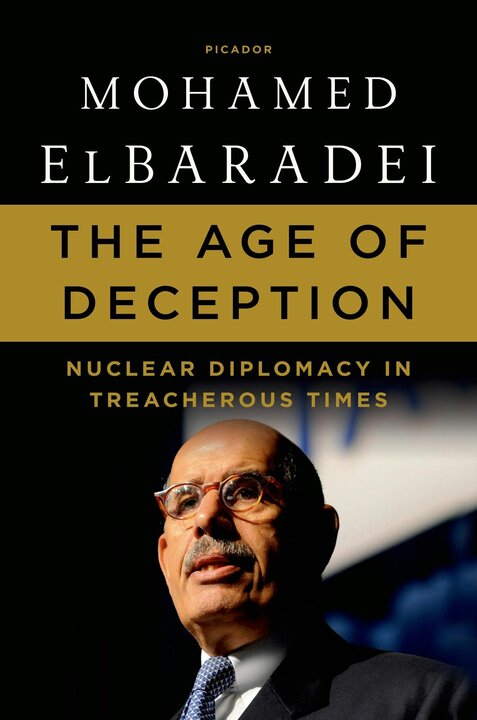
MEHR 17th March 2025 TEHRAN, Mar. 15 (MNA) – Firouzeh Doroshti has translated the memoirs of Mohamed ElBaradei, who served as the director of the International Atomic Energy Agency, in the book titled ‘The Age of Deception: Nuclear Diplomacy in Treacherous Times.
The book “The Age of Deception: Nuclear Diplomacy in Treacherous Times” which includes the memoirs of Mohamed ElBaradei from his three terms as the head of the International Atomic Energy Agency (IAEA), has been translated by Firouzeh Doroshti and is now available in bookstores across the country.
This book takes a scrutinizing approach to nuclear diplomacy in a tumultuous phase of modern history.
The book “The Age of Deception” is viewed as a crucial resource for gaining insight into the complicated nature of nuclear diplomacy. ……
Mohammad ElBaradei, an Egyptian-born Lawyer, was the Director-General of the International Atomic Energy Agency (IAEA) from 1997 to 2009.
A Nobel Peace Prize laureate, and the longest-serving Director General, who got the honour of becoming Director General Emeritus of the agency towards the end of his service.
The book is a compelling account of chronological events and challenges faced by the IAEA during his tenure.
The book covers three decades of his work on cases including Iraq, North Korea, Libya, Iran, and Pakistan, and exposes double standards adopted by the U.S. and other Western nations.
It sheds light on the behind-the-scenes workings of international organizations and the challenges of maintaining neutrality in a politically charged environment.
The book shows how ElBaradei felt that different standards were being applied to different countries’ nuclear programs.
Arguments in his book revolve around the three underlying principles of the Non-Proliferation Treaty (NPT).
These essential facets of the treaty include the pledge by the (non–nuclear) members not to try and obtain or develop nuclear weapons, a sincere effort on the part of all members to lead the world towards complete disarmament, and thirdly to facilitate the use of atomic energy for peaceful purposes in all member countries with particular consideration for the needs of developing countries.
Reported by Tohid Mahmoudpour https://en.mehrnews.com/news/229527/Memoirs-of-Mohamed-ElBaradei-The-Age-of-Deception
They had a fairytale American childhood – but was radiation slowly killing them?

Decades later, federal investigators acknowledged an increased cancer risk for some people who played in the creek as children,
Sophie Williams, BBC News, Washington DC, 16 Mar 25
After Kim Visintine put her son to bed every night at a hospital in St Louis, Missouri, she spent her evening in the hospital’s library. She was determined to know how her boy had become seriously ill with a rare brain tumour at just a week old.
“Doctors were shocked,” she says. “We were told that his illness was one in a million. Other parents were learning to change diapers but I was learning how to change chemotherapy ports and IVs.”
Kim’s son Zack was diagnosed with a glioblastoma multiforme. It is a brain tumour that is very rare in children and is usually seen in adults over 45.
Zack had chemotherapy treatments but doctors said there was no hope of him ever recovering. He died at just six years old.
Years later, social media and community chatter made Kim start to think that her son was not an isolated case. Perhaps he was part of a bigger picture growing in their community surrounding Coldwater Creek.
In this part of the US, cancer fears have prompted locals to accuse officials of not doing enough to support those who may have been exposed to radiation due to the development of the atomic bomb in the 1940s.
A compensation programme that was designed to pay out to some Americans who contracted diseases after exposure to radiation expired last year – before it could be extended to the St Louis area.
This Radiation Exposure Compensation Act (Reca) provided one-time payouts to people who may have developed cancer or other diseases while living in areas where activities such as atomic weapons testing took place. It paid out $2.6bn (£2bn) to more than 41,000 claimants before coming to an end in 2024.
Benefits were paid to such neighbours, frequently called “downwinders”, in Arizona, Utah and Nevada, but not New Mexico, where the world’s first test of a nuclear weapon took place in 1945. Research published in 2020 by the National Cancer Institute suggested that hundreds of cancers in the area would not have occurred without radiation exposure.
St Louis, meanwhile, was where uranium was refined and used to help create the atomic bomb as part of the Manhattan Project. After World War Two ended, the chemical was dumped near the creek and left uncovered, allowing waste to seep into the area.
Decades later, federal investigators acknowledged an increased cancer risk for some people who played in the creek as children, but added in their report: “The predicted increases in the number of cancer cases from exposures are small, and no method exists to link a particular cancer with this exposure.”
The clean-up of the creek is still ongoing and is not expected to finish until 2038.
A new bill has been put forward in the House, and Josh Hawley, a US senator representing Missouri, says he has raised the issue with President Donald Trump.
When Kim flicks through her school yearbook, she can identify those who have become sick and those who have since passed away. The numbers are startling.
“My husband didn’t grow up in this area, and he said to me, ‘Kim, this is not normal. It seems like we’re always talking about one of your friends passing away or going to a funeral’,” she says.
Just streets away from the creek, Karen Nickel grew up spending her days near the water picking berries, or in the nearby park playing baseball. Her brother would often try and catch fish in Coldwater Creek.
“I always tell people that we had just the fairytale childhood that you would expect in what you consider suburban America,” says Karen. “Big backyards, big families, children playing out together until the street lights came on at night.”
But years later, her carefree childhood now looks very different.
“Fifteen people from the street I grew up on have died from rare cancers,” she says. “We have neighbourhoods here where every house has been affected by some cancer or some illness. We have streets where you can’t just find a house where a family has not been affected by this.”
When Karen’s sister was just 11 years old, doctors discovered that her ovaries were covered in cysts. The same had happened to their neighbour when she was just nine. Karen’s six-year-old granddaughter was born with a mass on her right ovary.
Karen helped found Just Moms STL, a group that is dedicated to protecting the community from future exposures that could be linked to cancers – and which advocates for a clean-up of the area.
“We get messages every day from people that are suffering from illnesses and are questioning whether this is from exposure,” she says. “These are very aggressive illnesses that the community is getting, from cancers all the way to autoimmune diseases.”
Teresa Rumfelt grew up just a street away from Karen and lived in her family home from 1979 until 2010. She remembers every one of her animals passing away from cancer and her neighbours getting ill from rare diseases.
Years later, her sister Via Von Banks was diagnosed with amyotrophic lateral sclerosis (ALS), a form of motor neurone disease. Some medical studies have suggested there could be a link between radiation and ALS, but this is not definitive – and more research needs to be done to firm it up.
That does not reassure people like Teresa who are concerned that more needs to be done to understand how locals are being affected.
“ALS took my sister at 50,” Teresa says. “I think it was the worst disease ever of mankind. When she was diagnosed in 2019, she’d just got her career going and her children were growing. She stayed positive through all of it.”
Like Hawley, Just STL Moms and other community members want the government’s compensation act to be expanded to include people within the St Louis area, despite the programme being in limbo after expiring.
Expanding it to the Coldwater Creek community would mean that locals could be offered compensation if they could prove they were harmed as a result of the Manhattan Project, during which the atomic bomb was developed with the help of uranium-processing in St Louis. It would also allow screenings and further study into illnesses other than cancer.
In a statement to the BBC, the US government’s Environmental Protection Agency (EPA) said it took concerns very seriously and had actively worked with federal, state and local partners – as well as community members – to understand their health concerns, and to ensure community members were not exposed to the Manhattan Project-era waste.
The BBC has also contacted the US Army Corps of Engineers, which is leading the clean-up – but has not received a response to a request for comment.
“My sister would have loved to be part of the fight. She’d be the first to picket,” says Teresa of her efforts to get greater support from the government.
The trend in people around Coldwater Creek getting unwell has not gone unnoticed among healthcare professionals.
Dr Gautum Agarwal, a cancer surgeon at Mercy Hospital in St Louis, says he has not noticed a “statistical thing”, but notes that he has seen husbands and wives and their neighbours presenting cancers.
Now, he ensures that his patients are asked where they live and how close they are to Coldwater Creek.
“I tell them that there’s a potential that there’s a link. And if your neighbours or family live near there, we should get them screened more often. And maybe you should get your kids screened earlier.”
He hopes that over time more knowledge will be gained about the issue, and for a study into multi-cancer early detection tests to be introduced that could help catch any potential cancers, and help reassure people in the area……….. https://www.bbc.com/news/articles/c2e7011n03vo
Life as a “displaced person”

Evacuated or not, we all need to protect ourselves from the radioactive contamination resulting from the Fukushima nuclear accident. “Evacuation” is a rightful act of a human being to avoid exposure to radiation so as to enjoy good health. In Japan, however, evacuees are subjected to discrimination and bullying, labeled as “rumor spreaders” since our very existence points out the dangers of radiation. Under this severe social pressure, we can barely express our rightful thought.
https://beyondnuclearinternational.org/2025/03/09/life-as-a-displaced-person/
Fleeing the Fukushima disaster left many families fatherless, including my own, writes Akiko Morimatsu
I am Akiko Morimatsu. I left Fukushima to avoid radiation exposure caused by the Fukushima nuclear catastrophe, and I have been living as an internally displaced person.
Fourteen years have passed since the Great East Japan Earthquake of March 11, 2011 and the subsequent accident at TEPCO’s Fukushima Daiichi Nuclear Power Plant. The accident is far from over and the crippled power plant continues to contaminate the oceans, air, and land connected to the rest of the world. The situation is anything but “under control”, and I am outraged that none of the leaders of the Japanese State have acknowledged this fact.
Even after 14 years, many people continue to remain displaced. The number of evacuees registered with the government (Reconstruction Agency) is still approximately 29,000 people in all 47 prefectures of Japan, and they are in desperate need of government protection and relief.
However, the exact number of evacuees has never been counted by the Japanese government.
In fact, many more people than registered in official statistics have been compelled to flee their homes and are still in distress with no relief in sight, as they are not officially recognized as evacuees.
I have two children. At the time of the disaster, they were a 5-month-old baby and a 3-year-old toddler. For the past 14 years, my husband (the children’s father) lived in Koriyama City, Fukushima Prefecture, and I was living with my children in Osaka City, far apart one from the other.
Thus, people living in contaminated areas outside of the mandatory evacuation zones, made their not-easy-to-take decision to escape from the radiation source with only mothers and their children, who are more vulnerable to radiation. And this, without official aide or support. Even now, there are many people displaced living by their own means, and among them, a large number of households without fathers.
Evacuated or not, we all need to protect ourselves from the radioactive contamination resulting from the Fukushima nuclear accident. “Evacuation” is a rightful act of a human being to avoid exposure to radiation so as to enjoy good health. In Japan, however, evacuees are subjected to discrimination and bullying, labeled as “rumor spreaders” since our very existence points out the dangers of radiation. Under this severe social pressure, we can barely express our rightful thought.
I would also like to strongly emphasize that this issue is not only a problem for the people of Fukushima. I would like to share with everyone in the world the following question: when threatened with nuclear damage, will you stand on the side of those who impose radiation exposure, or will you stand on the side of those who protect people’s lives and health from radiation exposure?
If nuclear power is promoted as a national policy, fleeing will not be easily allowed, and the government can claim, as in Japan, that coexistence with radiation is possible, in order to preserve nuclear power. It is nothing but deception.
The year 2025 will mark 80 years since the end of World War II. Last year, Nihon Hidankyô, the Japan Confederation of A- and H-Bomb Sufferers Organizations, was awarded the Nobel Peace Prize, and hibakusha gave a speech to the world audience, drawing attention to the issue of radiation exposure.
We believe that now is the time to connect with people around the world concerned about nuclear damage. Avoiding radiation exposure to protect lives should be a universally recognized principle. As a victim of the Fukushima nuclear disaster, I, too, have renewed my determination to continue to raise my voice and strive for the establishment of this universal right. Let us continue fighting together.
Following the Great Earthquake and nuclear disaster in Fukushima, Akiko Morimatsu moved from Fukushima to Osaka with her two children aged 5 months and 3 years, leaving her husband who decided to continue working in Fukushima. She is the co-chair of the national coordination of the plaintiffs’ groups of the lawsuits filed by victims of the Fukushima nuclear accident, and the representative of the plaintiffs’ group in the Osaka metropolitan area. She lectures in Japan and abroad to defend the rights of nuclear accident victims. In 2018, she gave a speech at the United Nations Human Rights Council in Geneva. Translation from the Japanese by Kurumi Sugita, Nos Voisins Lontains 3.11.
Patrick Lawrence: The Nihilism of Antony Blinken

It is not, or not only, the extent of Blinken’s incompetence, which even this carefully staged presentation cannot obscure. We knew he was not up to the job Biden gave him from his first months on the seventh floor at State. It is his, Blinken’s, moral vacancy that must disturb us most. He is one of those hollow men Eliot described in his famous poem of this name. This is a man who professes “values”—“our values,” as he puts it—but has none, who stands for nothing other than the rank opportunity uniquely available with access to power. I have never heretofore thought of Antony Blinken as at heart a nihilist. But on his way out the door, this seems the most truthful way to understand him.
Blinken’s approval of Israel’s mass murder in Gaza, couched in the cotton-wool language to which Blinken always resorts when he wants to turn night into day, failure into success.
January 13, 2025 By Patrick Lawrence , ScheerPost
Readers write from time to time thanking me for keeping up with The New York Times so they don’t have to do so themselves. I understand the thought, and they are most welcome in all cases. But we have now the case of The Times’s lengthy interview with Antony Blinken, published in the Sunday Magazine dated Jan. 5. Yes, I have read it. And this time I propose others do the same. This is one of those occasions when it is important to know what Americans are supposed to think — or, better put, the extent to which Americans are not supposed to think.
It is sendoff time for the outgoing regime. You can imagine without my help what kind of piffle this is engendering, if you have not already noticed.
USA Today’s Washington bureau chief, Susan Page, threw President Biden a seven-inning game’s worth of softballs this week, producing a Q & A all about “legacy” and “inflection points,” the glories of American hegemony (“Who leads the world if we don’t?”) and how Joe could have defeated Donald Trump last November but was, after all, “talking about passing the baton” even when everything we read indicated he had no intention of doing so.
……………………. Journalism with American characteristics, no other way to name it. Not a single question about the Gaza crisis, genocide, Ukraine, China. Not even a mention of Russia. And what in hell, now that I think of it, will fill the shelves in a Joseph R. Biden, Jr., Presidential Library? This is really my question.
O.K., USA Today is a comic book—“McPaper,” we used to call it—and it is folly to expect anything more than fatuous pitter-patter out of Joe Biden (or anyone interviewing him) at this late stage in the proceedings. But The Times is not a comic book, its day-to-day unseriousness notwithstanding, and Blinken purports to gravitas and authority. Herein lies the problem. In his lengthy exchange with Lulu García–Navarro, Biden’s secretary of state renders a sober-sounding account of the world as the retiring regime now leaves it that is so shockingly far from reality as to be frightening.
“Today as I sit with you, I think we hand over an America in a much, much stronger position, having changed much for the better our position around the world,” Blinken asserts at the outset of this interview. “Most Americans,” he adds a short time later, “want to make sure that we stay out of wars, that we avoid conflict, which is exactly what we’ve done.” Go ahead, let your jaw drop. Blinken’s 50 minutes with The Times are an assault on reason, on truth. And as such they are an incitement to ignorance, precisely the condition that lands this nation in the incalculable trouble Blinken proposes we pretend is not there.
It is not, or not only, the extent of Blinken’s incompetence, which even this carefully staged presentation cannot obscure. We knew he was not up to the job Biden gave him from his first months on the seventh floor at State. It is his, Blinken’s, moral vacancy that must disturb us most. He is one of those hollow men Eliot described in his famous poem of this name. This is a man who professes “values”—“our values,” as he puts it—but has none, who stands for nothing other than the rank opportunity uniquely available with access to power. I have never heretofore thought of Antony Blinken as at heart a nihilist. But on his way out the door, this seems the most truthful way to understand him.
This is the man who swiftly made an utter mess of U.S.–China relations when, two months after taking office, his first encounters with senior Chinese officials blew up in his face during talks in an Anchorage hotel conference room. Sino–American ties have been one or another degree of hostile ever since. This is the man who, a year later, led the way as Biden provoked Russia’s self-protecting intervention in Ukraine. He, Blinken, has ever since refused negotiations. This is the man who, a year after that, began his continuing defense of Israel’s genocide in Gaza. It has been Blinken and Nod in action in each case.
This is the man who—a couple of notable moments here—celebrated World Press Freedom Day in London in May 2021, while Julian Assange was in a maximum-security prison a few miles away. “Freedom of expression and access to factual and accurate information provided by independent media are foundational to prosperous and secure democratic societies,” Blinken had the nerve to declare, citing the Universal Declaration of Human Rights as he did so. This is the man who perjured himself last May, when, under oath, he told Congress the State Department had found no evidence that Israel was blocking humanitarian aid to Gaza. (I take this occasion to praise Brett Murphy once again for breaking this story in ProPublica.)
Now we can settle in and listen to Blinken converse with his interlocutor from The Times.
Blinken on relations with China:
“We were really on the decline when it came to dealing with China diplomatically and economically. We’ve reversed that…. And I know it’s succeeding because every time I meet with my Chinese counterpart, Wang Yi, the foreign minister, he inevitably spends 30 or 40 minutes, 60 minutes complaining about everything we’ve done to align other countries to build this convergence in dealing with things that we don’t like that China is pursuing. So to me, that is the proof point that we’re much better off through diplomacy.“
This account of the regress of the U.S.–China relationship on Blinken’s watch is beyond bent. First, there is no record of Wang Yi, China’s distinguished foreign minister, ever complaining to Blinken or any other U.S. official about Washington’s alliances in East Asia. China’s complaints have primarily (but not only) to do with the Biden regime’s incessant assertion of American hegemony in the Pacific, its provocative conduct on the Taiwan and South China Sea questions, and its efforts to subvert an economy with which the U.S. can no longer compete.
Second, not even Japan, South Korea, and the Philippines, with which Washington has indeed strengthened military ties, are now “aligned” against China. They, along with all other East Asians, can read maps, believe it or not. And the whole of the Pacific region will favor balanced ties with the U.S. and China as long as you and I are alive. Drawing East Asians together in some kind of Sinophobic “convergence” is a long dream from which the Washington policy cliques simply cannot awaken.
Finally and most obviously, if antagonizing another major power is a measure of diplomatic success, the nation such a diplomat purports to represent is in the kind of trouble to which I alluded earlier.
Footnote: It has been a sad spectacle these past three years as a parade of Biden regime officials, Blinken chief among them, has marched to Beijing and failed one by one to repair the damage done in Anchorage. In their dealings with Blinken, Wang and Xi Jinping, China’s president, have treated Biden’s top diplomat as if he were a junior high school student who flunked geography.
Blinken on Russia and Ukraine:
“So first, if you look at the trajectory of the conflict, because we saw it coming, we were able to make sure that not only were we prepared and allies and partners were prepared, but that Ukraine was prepared. We made sure that well before the Russian aggression happened, starting in September and then again December, we quietly got a lot of weapons to Ukraine to make sure that they had in hand what they needed to defend themselves, things like Stingers, Javelins that were instrumental in preventing Russia from taking Kyiv, from rolling over the country, erasing it from the map, and indeed pushing the Russians back….
In terms of diplomacy: We’ve exerted extraordinary diplomacy in bringing and keeping together more than 50 countries, not only in Europe, but well beyond, in support of Ukraine and in defense of these principles that Russia also attacked back in February of that year. I worked very hard in the lead up to the war, including meetings with my Russian counterpart, Sergey Lavrov, in Geneva a couple of months before the war, trying to find a way to see if we could prevent it, trying to test the proposition whether this was really about Russia’s concerns for its security, concerns somehow about Ukraine and the threat that it posed, or NATO and the threat that it posed, or whether this was about what it in fact it is about, which is Putin’s imperial ambitions and the desire to recreate a greater Russia, to subsume Ukraine back into Russia. But we had to test that proposition. And we were intensely engaged diplomatically with Russia. Since then, had there been any opportunity to engage diplomatically in a way that could end the war on just and durable terms, we would have been the first to seize them. “
Where to begin? Give me a sec to catch my breath.
Blinken and his colleagues anticipated Russia’s invasion before it started in February 2022 because the Biden regime provoked it to the point Moscow had no other choice. Washington spent the autumn of 2021 arming Kiev, just as Blinken recounts, but Blinken makes no mention of the two draft treaties the Kremlin sent Westward that December—one to Washington, one to NATO in Brussels—as the proposed basis for negotiating a durable new security settlement between Russia and the Atlantic alliance. This was dismissed out of hand as a “non-starter,” the British-ism the Biden regime favored at the time. Blinken skips over this opportunity to develop productive diplomatic channels like a mosquito across a pond.
His idea of diplomacy, indeed, was limited to gathering one of those coalitions of the willing (or coerced) the American imperium has long favored, in this case to back the proxy war to come. There was not then and has not been since any serious effort to negotiate a settlement in Ukraine. Blinken seems actually to believe (or he pretends to believe) that there was never any question of Moscow’s legitimate security concerns: It was all about the Kremlin’s plan to “erase” Ukraine in the cause of the Russia’s neo-imperial ambitions. Somehow this proposition was tested and proved out, and I would love to know how.
I am reminded once again of that moment, a few months into the war, when Blinken pulled aside Sergei Lavrov for a private exchange after formal talks at the Kremlin. As I wrote subsequently, when he asked Moscow’s long-serving foreign minister if it was true Russia wanted to reconstruct the Czarist empire, Lavrov stared, turned, and left the room—no reply, no handshake, no farewell, just an abrupt exit. How could a diplomat of Lavrov’s caliber possibly entertain such a question? We are left with two alternatives, readers. Either Tony Blinken is extremely dim-witted to misinterpret Russia’s position this badly, or Tony Blinken is a very formidable liar.
My conclusion: He is both.
Footnote: Blinken has not spoken to Lavrov since that pitiful occasion in mid–2022 — or to any other senior Russian official so far as we know. And the Biden regime has on two occasions, most famously in Istanbul a month after the Russian invasion began, actively scuttled talks between Kiev and Moscow that could have ended the war.
We come to Blinken on Israel, Gaza, and the Palestinians.
Blinken spent a great deal of his time with García–Navarro explaining his views of the Gaza crisis. And for the most part he stayed with the tedious boilerplate with which we are already familiar. The Biden regime supports Israel’s right to defend itself. He has dedicated himself to making sure the Palestinians of Gaza “had what they needed to get by.” The impediments to a ceasefire and a return of hostages are all on Hamas, not the Netanyahu regime.
Has Israel committed war crimes? Do we witness a genocide? Have the Israelis blocked food aid? You can’t expect straight answers out of Blinken on these kinds of questions, and García–Navarro got none. What she got was Blinken’s approval of Israel’s mass murder in Gaza, couched in the cotton-wool language to which Blinken always resorts when he wants to turn night into day, failure into success. Yes, he allowed, the Netanyahu regime could have made some minor adjustments at the margin and the slaughter would have looked better. But there is no erasing Blinken’s ratification of Israeli terrorism, his judgment that it has been a success — or García–Navarro’s failure to call him on this, a topic to which I will shortly return.
There is one remark Blinken made in this sendoff Q & A that has stayed with me ever since I watched the video of it and then read the transcript. It concerns the Gaza crisis, but it expands in the mind like one of those sponges that grow large when wetted. “When it comes to making sure that Oct. 7 can’t happen again,” Blinken said, “I think we’re in a good place.”
I can hardly fathom the implications of this extravagantly thoughtless assertion. There is no understanding of the human spirit in it. It takes no account of the enduring aspirations of the Palestinians people, I mean to say, and so displays the shallowest understanding of the events of Oct. 7, 2023. It presumes, above all, that the totalized violence of uncontrolled power is some kind of net-positive and can prevail in some lasting way, and that there is no need to trouble about what is just, or what it ethical, or what is irreducibly decent, or a commonly shared morality, or, at the horizon, the human cause as against (in this case) the Zionist cause.
This sentence takes us straight to Antony Blinken’s nihilism. As he leaves office he mounts not only an assault on reason, as I argued above, or our faculties of discernment, but altogether an assault on meaning. The working assumption is that he or she who controls the microphones and megaphones is free to say whatever it is of use to say. It does not require any relationship to reality, only to expedience. This is what I mean by nihilism.
“I don’t do politics,” Blinken flippantly tells García–Navarro early in their time together. “I do policy.” García–Navarro lets this go, as she does so much else. It is prima facie ridiculous, a hiding place in which García–Navarro allows Blinken to take shelter. Policy is politics: They are inseparable, no exceptions. In this case, Blinken cannot possibly expect the world beyond America’s shores to take seriously his assessment of the world as the Biden White House leaves it. This interview is all politics all the time: It is strictly for domestic consumption, intended not only to salvage a reputation — one beyond salvaging in my view — but to continue the grinding business of manufacturing consent. ……………………………………………………………………………………………………………………………..
Watch the video of Lourdes “Lulu” Garcia-Navarro’s time with Blinken. As is easily detected, she reads from a script and remains resolutely faithful to it regardless of what Blinken says. She purports to be otherwise, but she is a supplicant. She pretends to challenge Blinken on this or that question, but it is all faux, pose. None of Blinken’s lies, misrepresentations, and plain disinformation come in for serious scrutiny. It is merely on-to-the-next-question.
This is not journalism. It is spectacle, a theatrical reenactment of journalism — another case of journalism with American characteristics. It is not the creation of meaning, either: It is the destruction of meaning. I have already noted my term for this. ………………………………………………………………………………………………………………………………….
The saving grace of García–Navarro’s encounter with Tony Blinken, and a little to my surprise, lies in the comment thread appended to the published piece. There are 943 comments at this writing. And there are some voices of approval, certainly.
But my goodness are the critics many. Here are a few straight off the top of the thread:
Jorden, California.
Blinken has tarnished the office of Secretary of State. Silly is not the word, not even irresponsible but diabolical. Just bad on so many levels…. The Biden administration will mark the sudden decline of American hegemony …. U.S. foreign policy needs a much needed injection of realist logic now.
From “Rockin’ in the Free World,” Wisconsin:
For readers who want to further marvel at the creature that is Tony Blinken, watch his performance of “Rockin’ in the Free World” from last winter in Ukraine. It is truly cinematic in its irony as he facilitates U.S.–backed genocide. Could not write it better. That’s when I realized how much I viscerally hate this guy, how pathological his lack of self-awareness is[.]
And from David in Florida:
Yes, it’s called being delusional or incompetent or utterly negligent! Good job Blinkin! You and Biden undermined the final support of the Democratic Party. Sure you and your overlords will be fine with I’ll[sic] gotten gains. The rest of us won’t.
……………………………………….more https://scheerpost.com/2025/01/13/patrick-lawrence-the-nihilism-of-antony-blinken/
Jimmy Carter hailed as ‘action’ hero for stopping nuclear meltdown at 28

Jimmy Carter hailed as ‘action’ hero for stopping nuclear meltdown at 28 https://nypost.com/2021/12/16/jimmy-carter-is-action-hero-for-stopping-nuclear-disaster/
By Hannah Sparks, December 16, 2021 Who needs action movies when there are real-life superheroes like Jimmy Carter among us?
A viral Twitter thread is reminding the world that the 39th US President James Earl Carter Jr., now 97, actually rescued Ottawa, Ontario, from nuclear destruction as a 28-year-old way back on Dec. 12, 1952.
“Do you remember the world’s very first nuclear meltdown? That time the US President, an expert in nuclear physics, heroically lowered himself into the reactor and saved Ottawa, Canada’s capital?” asked Canadian physicist University of Ottawa professor Jeff Lundeen in his now-viral thread, originally posted Tuesday but officially trending two days later.
Sounds like schlocky action movie, but it actually happened!”
Lundeen’s revelatory tweet to his modest 1,078 followers now boasts nearly 50,000 likes, more than 20,000 retweets and hundreds of cheerfully shocked comments. He included data from the Ottawa Historical Society and a snippet of a 2011 report documenting Carter’s heroics, and he followed up with several other media sources that recount the historic tale.
As the story goes, the Plains, Ga., native planned his entire life to join the Navy — and did so when he received his appointment to the Naval Academy in 1942. After graduating with distinction, Carter spent two years completing his service ship duty before signing on to the Submarine Force. Following a series of relocations and promotions, the young lieutenant would request to join Captain Hyman G. Rickover’s nuclear sub program, where they were developing the world’s first atomic subs.
Rickover then sent Carter to work for the US Atomic Energy Commission, where he served on temporary duty with the Naval Reactors Branch. Meanwhile, a few months later, an accidental power surge at Chalk River Laboratories in Ottawa caused fuel rods within a nuclear research reactor to rupture and melt — risking a full nuclear meltdown.
It was the first such incident of its kind, and Carter’s team of 23 men was ordered to clean it up.
I
n a scene straight out of modern-day blockbusters, the operation would require the brave men to descend into the core by rope and pulley so they could deconstruct the reactor bolt by bolt. The lab had set up a duplicate reactor as a training field for Carter’s team, who would get only one shot at the real thing. Each man would have to descend into the core and complete their high-flying tasks in 90-second spurts, as exposure to toxic radiation within the reactor posed a high risk to their long-term health.
Their plan went off without a hitch. The core was shut down and then rebuilt. From there, Carter went on to become the engineering officer for the USS Seawolf, one of the first submarines to operate on atomic power. By 1961, he retired from the Navy and Reserves, and, in 1963, ran for his first political office.
For those who admire the single-term Democratic president, Lundeen’s tweet was just another reminder of Carter’s selfless service — and good jokes.
One top Twitter response included a quote from the president, who visited Pennsylvania’s Three Mile Island power plant in 1979, during their disastrous partial meltdown.
When asked by media if he thought it too dangerous to visit the radioactive site, he reportedly quipped, “No, if it was too dangerous they would have sent the vice president.”
Toshiyuki Mimaki: Let’s save humanity from nuclear weapons
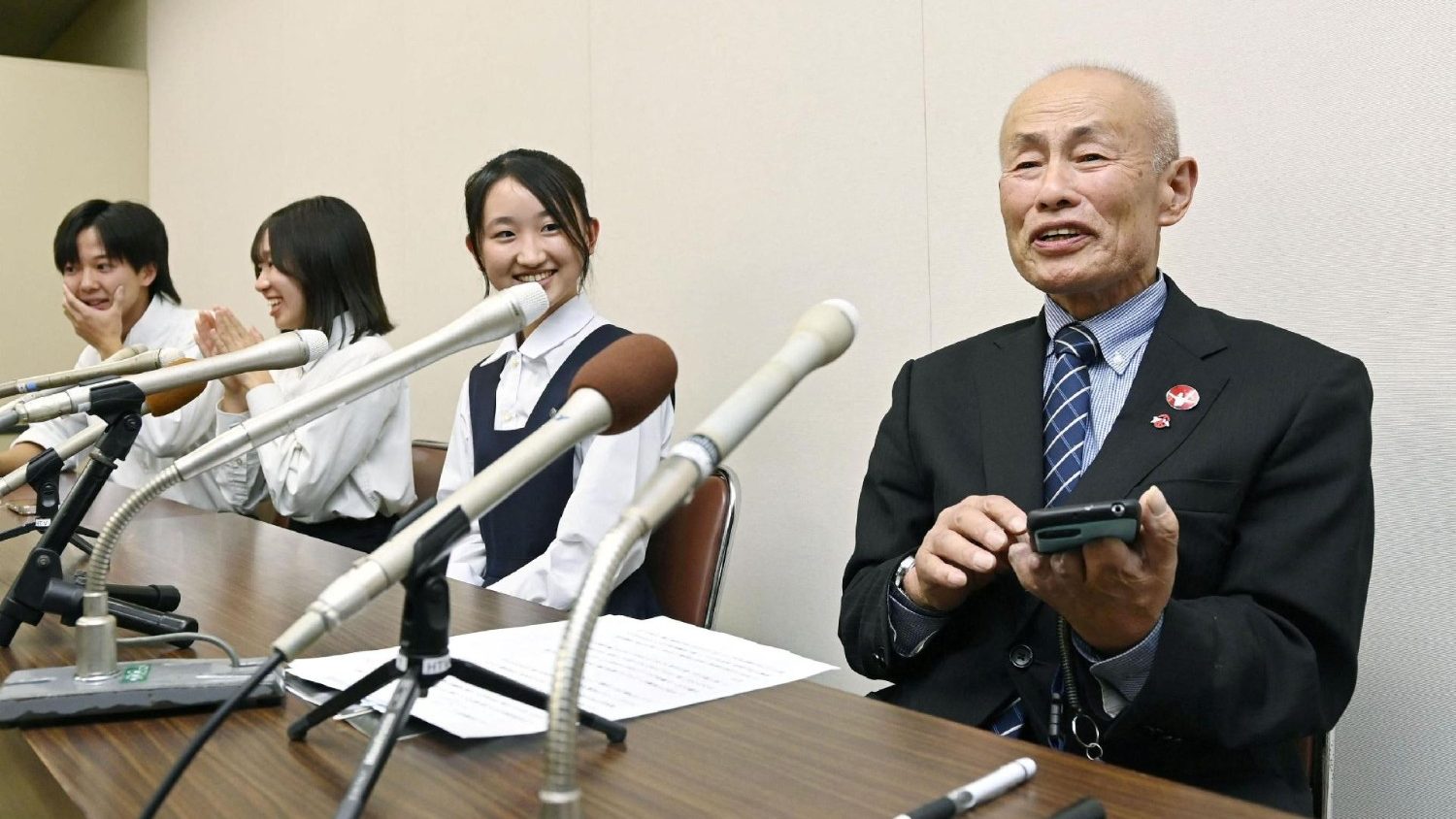
An interview with Hiroshima atomic bomb survivor and co-president of the Japanese foundation Nihon Hidankyo, Toshiyuki Mimaki, recipient of the 2024 Nobel Peace Prize. Mimaki reflects on his meeting with Pope Francis in Japan in 2019 and calls on world leaders to commit to eliminating nuclear weapons.
By Alessandro Gisotti, https://www.vaticannews.va/en/world/news/2024-12/mimaki-nihon-hidankyo-nobel-peace-prize-elimination-nuclear-arms.html
Shattered buildings. A landscape wiped clean. So much destruction that the sea became visible where once a vibrant city stood. This is the indelible memory carried by a three-year-old boy who witnessed an unthinkable and catastrophic event—one that, tragically, did occur. Toshiyuki Mimaki shares this harrowing memory with L’Osservatore Romano.
Now 82 years old, Mimaki has never stopped reflecting on August 6, 1945, the day the atomic bomb devastated Hiroshima, his hometown. That moment not only changed the course of human history but also took the lives of tens of thousands of people.
On December 10, Mimaki accepted the Nobel Peace Prize in Oslo as co-president of Nihon Hidankyo, a foundation established in 1956 dedicated to nuclear disarmament. Nihon Hidankyo unites the hibakusha—survivors of the atomic bombings of Hiroshima and Nagasaki at the end of World War II.
The foundation’s mission is rooted in the power of testimony, relying on the gentle but impactful strength of storytelling. The Norwegian Nobel Committee acknowledged this effort, stating, “We all have a duty to continue the mission of the hibakusha. Their moral compass is our legacy. Now it is up to us. The fight for disarmament requires persistent and vocal advocacy.”
As the International Day of Peace approaches, Toshiyuki Mimaki reflects on his role as a custodian of the legacy of those who came before him—the hibakusha who founded Nihon Hidankyo. Survivors like him aim to ensure the world never forgets the tragedy of that fateful August morning.
“When I was three years old,” Mimaki recounts, “my mother, younger brother, and I were exposed to the bomb’s radiation while searching for my father, who worked for the Hiroshima railway. Countless lives were lost, and buildings were consumed by flames to the extent that you could see all the way to the sea. My younger brother is now undergoing treatment for brain cancer.”
Despite the pain of revisiting such memories, sharing these experiences is central to the hibakusha mission: ensuring that the horror of nuclear weapons is never repeated. This mission becomes ever more urgent as the remaining survivors of the bombings near the end of their lives.
“Hiroshima has taken steps to preserve these testimonies,” Mimaki explains. “The city has established programs to educate young people, training them to become messengers who can carry forward our stories for future generations.”
Mimaki expresses deep gratitude for Pope Francis’s dedication to nuclear disarmament. He had the opportunity to meet the Pope during his visit to Hiroshima and Nagasaki in November 2019. “I met the Pope when he came to visit us,” Mimaki recalls. “He gave me a medal in a red case, and I asked him to work toward abolishing nuclear weapons. I still treasure a photograph from that day.”
Despite the global appeal for disarmament, discussions about the potential use of nuclear weapons and the possibility of atomic conflict have intensified in recent years. For Mimaki, who still carries the scars of that catastrophic day, the thought of nuclear weapons being used again is unimaginable.
“If nuclear weapons were ever used again,” he warns, “it would mean the end of humanity. This is why I implore leaders of nations with nuclear arsenals to commit to their complete elimination.”
Mimaki is particularly alarmed by the ongoing conflicts in Gaza and Ukraine. “Russian President Putin,” he observes with concern, “has lowered the threshold for the use of nuclear weapons, making them deployable at any moment. It’s a terrifying situation. I urge everyone to visit Hiroshima and Nagasaki and see the Atomic Bomb Museum. Witness firsthand the devastating impact nuclear weapons have on human life.”
Japan’s fishing town of Suttsu faces nuclear waste dilemma amid population decline

Residents of Suttsu worry that, despite potential economic benefits, a nuclear waste facility will harm the community and leave a legacy of radioactive waste
Jonathan Vit 29 Dec 24, https://www.scmp.com/week-asia/politics/article/3292482/japans-fishing-town-suttsu-faces-nuclear-waste-dilemma-amid-population-decline
It was a place Kyoko Tsuchiya could finally call home. As a child, her father was frequently transferred across Japan for his job at the national phone company. Later, as an adult, Kyoko fell in love with a man who worked for the post office. After they married, she continued to move around, rarely staying long enough in one place to truly feel at home.
Suttsu, with its unique charm, was different. This small town, nestled among scenic landscapes, is where Kyoko’s husband, Kazuyuki, grew up. Now in retirement, the couple decided to return to provide care and support for his elderly father.
Located on Hokkaido, Japan’s ruggedly beautiful northern island, the seaside fishing town hugs the windswept western coast. There, they opened a small inn called “Pension Mellow” which sits perched on a quiet hilltop overlooking the sea.
Kazuyuki could watch the fishing boats through binoculars from the kitchen window. When he spotted a friend’s boat, he would buy fresh seafood for his guests. One evening, he proudly served octopus sashimi made from a large octopus pulled from the frigid sea earlier that day.
“I was finally able to put down roots here,” Kyoko said. “I wanted a place where I could settle down and live a relaxed life. That’s how it was until 2020. Now, I don’t know …”
On Thursday, August 13, 2020, residents of this small town found themselves at the centre of a national controversy that attracted news helicopters and television crews to their usually sleepy streets.
Japan’s Nuclear Waste Management Organisation (Numo) was searching for a town willing to host a large underground facility to store the country’s nuclear waste.
However, there were stipulations: it could not be near a seismically active fault line or a volcano, could not contain valuable natural resources like coal or aquifers, and had to be within 20km (12.5 miles) of the coast for safe waste transport.
Any town meeting these requirements could volunteer to undergo studies to evaluate its suitability for the nuclear waste facility.
“In Japan, we have been using nuclear power for over half a century,” said Kenji Yamashita, a press officer with Numo. “As long as we have nuclear power plants, waste will always be produced. So, in every country, it is necessary to find a place to dispose of it.”
Japan currently sends its nuclear waste to a facility in Aomori, the prefecture just south of Hokkaido. The construction of that reprocessing and temporary storage centre has faced delays due to protests from local residents and anti-nuclear activists.
Finding a long-term storage site has been equally challenging. Some towns withdrew their interest due to local opposition before studies could start.
The study is non-binding, meaning a town can start the process without completing it. Additionally, the study is accompanied by substantial subsidies – up to 9 billion yen (US$57.6 million) paid out over the course of the investigation.
This offer was too attractive for Suttsu’s mayor, Haruo Kataoka, to ignore. Like many other towns across Japan, Suttsu has seen a dramatic population decline over the past half-century, having lost more than half of its residents since the 1970s. Nearly half of Suttsu’s population is 65 or older. The local junior school is so small that entire grades fit into a single classroom. A mere seven students make up the school’s first-grade class.
“There’s no doubt this is an ageing town,” Kazuyuki said.
Mayor Kataoka declined to speak with This Week in Asia for this story, but local residents said the six-term mayor has repeatedly tried to find new ways to revitalise the town’s shrinking economy.
Suttsu is home to a large wind energy farm – white windmills dot the landscape and are now featured on signs greeting visitors as they drive into town. It also built a modern town centre, a museum showcasing local history and an elderly care home on a bluff overlooking the town. Few projects delivered the promised financial returns for Suttsu, explained Takashi Saito, a former town council member and relative of the mayor.
“There are a lot of public buildings around town,” Saito said. “It costs a lot of money to maintain and manage them. When you pull back the lid on it, the town has a lot of debt.”
Saito explained that, although he opposes the construction of a nuclear waste facility in town, he understood the mayor’s reasons for pursuing the studies. Suttsu had changed greatly since his childhood, with empty streets and many businesses in the shopping district permanently closed.
“There’s no one walking around the town today,” Saito said. “The town feels lonely now.”
Blinken Atrocious in a Dangerous World

Through his various sojourns, the point was always clear. Israel was to be mildly rebuked, if at all, while Hamas was to be given the full chastising treatment as killers without a cause.
November 15, 2024, by: Dr Binoy Kampmark, https://theaimn.com/blinken-atrocious-in-a-dangerous-world/#google_vignette
It is hard to credit one of the least impressive Secretary of States, the United States has ever produced with any merit other than being a plasterwork that, from time to time, moved with caution on the world stage for fear of cracking. On the stage, Antony Blinken’s brittle performances have been nothing short of unimpressive, notably in pursuing such projects comically titled “Peace in the Middle East.” Each time he has ventured to various regions of the world, the combatants seem keener than ever to continue taking up arms or indulging in slaughter.
A sense of Blinken’s detachment from the world can be gathered from his Foreign Affairs piece published on October 1, intended as something of a report on the diplomatic achievements of the Biden administration. It starts with the sermonising treacle that is all a bit much – the naughty states on the world stage, albeit small in number (Russia, Iran, North Korea and Chin
The Biden administration had, in response, “pursued a strategy of renewal, pairing historic investments in competitiveness at home with an intensive diplomatic campaign to revitalize partnerships abroad.” This served to counter those challengers wishing to “undermine the free, open, secure, and prosperous world that the United States and most countries seek.” Then comes the remark that should prompt readers to pinch themselves. “The Biden administration’s strategy has put the United States in a much stronger geopolitical position today than it was four years ago.”
An odd assessment for various reasons. There is the continued war in Ukraine and Washington’s refusal to encourage any meaningful talks between Kiev and Moscow, preferring, instead, the continued supply of weapons to an attritive conflict of slaughter and such acts of industrial terrorism as the attack on the Nord Stream pipeline.
There has been the relentless watering down of the “One China” understanding over the status of Taiwan, along with continued provocations against Beijing through the offensive pact of AUKUS with Australia and the UK. That particularly odious pact has served to turn Australia into a US military garrison without the consent of its citizens, an outcome sold to the dunces in Canberra as utterly necessary to arrest the rise of China. Along the way, an arms buildup in the Indo- and Asia-Pacific has been encouraged.
With such a view of the world, it’s little wonder how blind Blinken, and other members of the Biden administration, have been to Israel’s own rogue efforts at breaking and altering the international system, committing, along the way, a goodly number of atrocities that have seen it taken to the International Court of Justice by South Africa for committing alleged acts of genocide.
Through his various sojourns, the point was always clear. Israel was to be mildly rebuked, if at all, while Hamas was to be given the full chastising treatment as killers without a cause. When the barbarians revolt against their imperial governors, they are to be both feared and reviled. In June this year, for instance, Blinken stated on one of his countless missions for a non-existent peace that Hamas was “the only obstacle” to a ceasefire, a markedly jaundiced explanation given the broader programs and objects being pursued by the Israeli Defence Forces. Hamas has been accused of being absolutist in its goals, but one can hardly exempt Israeli Prime Minister Benjamin Netanyahu from the charge. Not for Blinken: “I think it is clear to everyone around the world, that it’s on them [Hamas] and that they will have made a choice to continue a war that they started.”
On the issue of aid to Gaza’s strangled, dying population, Blinken has been, along with his equally ineffectual colleague in the Pentagon, Defense Secretary Lloyd Austin, cringingly ineffective. Their October 13 letter sent to their Israeli counterparts made mention of several demands, including the entry of some 350 aid trucks into Gaza on a daily basis, and refraining from adopting laws, now in place, banning the UN Agency for Palestinian Refugees (UNRWA). Each demand has been swatted back with a school child’s snotty petulance, and aid continues being blocked to various parts of Gaza.
On October 24, Americans for Justice in Palestine Action (AJP Action) “urgently” called on the Secretary of State “to stop wasting his time with failed diplomatic visits and to demand an immediate ceasefire in Gaza and Lebanon.” Those at AJP Action must surely have realised by now that Blinken would be utterly rudderless without those failed visits. Indeed, Osama Abu Irshaid, Executive Director of the organisation, went so far as to say that “Blinken’s diplomatic theatre is enabling Netanyahu’s war crimes.” To arm and fund Israel “while requesting a ceasefire” was a policy both “hypocritical and ineffective.” Such is the nature of that sort of theatre.
In the meantime, the tectonic plates of international relations are moving in other directions, a point that has been aided, not hindered, by the policy of this administration. Through BRICS and other satellite fora, the United States is finding itself gradually outpaced and isolated, even as it continues to hide behind the slogan of an international rules-based order it did so much to create. This is not to say that the US imperium has quite reached its terminus. If anything, the Biden administration, through the good offices of Blinken, continues to insist on its vitality. But US hegemony long left unchallenged is, most certainly, at an end.
Mordechai Vanunu, the scientist kidnapped and jailed for 18 years for revealing nuclear secrets

Metro Danny Rigg, Oct 6, 2024
The scientist who exposed Israel’s nuclear secrets is still banned from leaving the country or speaking to foreigners nearly 40 years since he was kidnapped by Mossad.
Since the 1960s, Israel was suspected of having nuclear weapons, something it refuses to admit or deny to this day.
But it wasn’t just one or two. Israel had a whole arsenal of them – as many as 200, developed in an underground factory beneath the Negev desert – making it the world’s sixth biggest nuclear power.
‘It has almost certainly begun manufacturing thermo-nuclear weapons, with yields big enough to destroy entire cities’, The Sunday Times reported, based on photos and information from Mordechai Vanunu, on October 5, 1986.
A Moroccan-born Jewish man who spent eight years as a nuclear technician in the Dimona secret bunker, Vanunu had grown increasingly sympathetic to Palestinian rights and opposed Israel’s 1982 war in Lebanon.
By the time the story broke, however, the 31-year-old had disappeared. He had left his London hotel in what police described as ‘unexplained circumstances’ on September 30.
At first a friend feared he had been kidnapped from his London hotel, which wasn’t entirely far from the truth.
Israeli intelligence had got its hands on him through a honeytrap designed to avoid souring its relationship with the British government.
In an apparent case of cabin fever after weeks of work on the story, Vanunu ‘began to get impatient’, Andrew Neil, then-editor of The Sunday Times, said.
‘He wandered off and made himself vulnerable.’
So he flew off for a holiday to Rome with Mossad agent Cheryl Bentov, who posed as an American tourist called Cindy to lure him from the safe house right into a taxi waiting outside the airport with two more agents inside.
‘We sat in the back’, he later told the BBC, ‘she used the time for kissing me, to divert my attention by a lot of kissing.’
Once there he was overpowered, drugged and shipped back to Israel to be tried for espionage and treason.
He revealed the truth by flashing words written on his palm and shouting ‘Italy’ to reporters outside a Jerusalem court before police covered his mouth that December.
‘I feel an injustice was committed against him’, his brother Asher said outside a guarded courtroom when Vanunu was jailed in 1988.
‘The trial was not conducted legitimately. No one was inside to see what was going on.’
The kidnapping prompted newspapers that previously ignored The Sunday Times article to start reporting his claims about Israel’s nuclear weapons.
Mr Neil told Sky News: ‘The Telegraph said it was all rubbish. It was only when we learned that Israel was so worried about the story it had sent its secret agents to kidnap Vanunu on British soil in a honeypot trap involving a blonde who said she was from California.’
Vanunu’s decision to snap 57 photos on two rolls of film before quitting his job after eight years in the nuclear weapons plant still costs him his freedom.
Even after spending 11 years in solitary confinement during his 18-year prison sentence, Vanunu lives with heavy restrictions imposed by Israeli courts.
He is so hated by his fellow citizens, his parents disowned him and a crowd gathered outside Shikma Prison to chant ‘Death to traitors’ when he was released in 2004.
But Vanunu remained defiant, saying in an impromptu press conference: ‘To all those calling me a traitor, I’m proud and happy to do what I did.’
Since then, he has faced a one-year ban on leaving the country, talking to foreigners, or approaching embassies or borders, which has been renewed every year.
He must also inform the security services where he lives and who he plans to meet, and have his internet and phone activity monitored.
Vanunu has been repeatedly arrested and jailed for violating these conditions of his release.
Norway has him permission to move there to join his Norwegian wife, but this would require Israel to allow him to leave……………………………………………
On the first day of each month, Vanunu has posted the same message on X: ‘One more year without freedom since 1986-2024, now I am waiting for my freedom, freedom to leave Israel, I will continue to wait until my freedom comes, Born to be free, See you in freedom.’
That was until restrictions were renewed again in July, when Vanunu, who turns 70 next week, said: ‘NEXT POST WILL BE FROM FREEDOM ONLY.’
Israel is now believed to have at least 90 nuclear warheads along with fissile material stockpiles for up to 300 more, but it has never publicly tested them.
An escalating conflict with Iran, which has its own nuclear ambitions, is fuelling fears that Israel’s war in Gaza, which has spread north to Lebanon, will explode into all-out regional war, if not World War 3.
In his first interview after his release in 2004, Vanunu defended his actions, saying: ‘I felt it was not about betraying; it was about reporting. It was about saving Israel from a new holocaust.’ https://metro.co.uk/2024/10/06/scientist-kidnapped-jailed-18-years-exposing-israels-nuclear-secrets-21733868/
1 This Month
Chernobyl: The Lost Tapes – A good documentary on Chernobyl on SBS available On Demand for the next 3 weeks– https://www.sbs.com.au/ondemand/tv-program/chernobyl-the-lost-tapes/2352741955560

of the week–London Campaign for Nuclear Disarmament

Tell the Ukrainian Government to Drop Prosecution of Peace Activist Yurii Sheliazhenko
To see nuclear-related stories in greater depth and intensity – go to https://nuclearinformation.wordpress.com
-
Archives
- April 2026 (139)
- March 2026 (251)
- February 2026 (268)
- January 2026 (308)
- December 2025 (358)
- November 2025 (359)
- October 2025 (376)
- September 2025 (257)
- August 2025 (319)
- July 2025 (230)
- June 2025 (348)
- May 2025 (261)
-
Categories
- 1
- 1 NUCLEAR ISSUES
- business and costs
- climate change
- culture and arts
- ENERGY
- environment
- health
- history
- indigenous issues
- Legal
- marketing of nuclear
- media
- opposition to nuclear
- PERSONAL STORIES
- politics
- politics international
- Religion and ethics
- safety
- secrets,lies and civil liberties
- spinbuster
- technology
- Uranium
- wastes
- weapons and war
- Women
- 2 WORLD
- ACTION
- AFRICA
- Atrocities
- AUSTRALIA
- Christina's notes
- Christina's themes
- culture and arts
- Events
- Fuk 2022
- Fuk 2023
- Fukushima 2017
- Fukushima 2018
- fukushima 2019
- Fukushima 2020
- Fukushima 2021
- general
- global warming
- Humour (God we need it)
- Nuclear
- RARE EARTHS
- Reference
- resources – print
- Resources -audiovicual
- Weekly Newsletter
- World
- World Nuclear
- YouTube
-
RSS
Entries RSS
Comments RSS
 nuclear-news