Jane Goodall, the Gentle Disrupter Whose Research on Chimpanzees Redefined What It Meant To Be Human

The Conversation, Mireya Mayor, Director of Exploration and Science Communication, Florida International University, October 2, 2025
Anyone proposing to offer a master class on changing the world for the better, without becoming negative, cynical, angry or narrow-minded in the process, could model their advice on the life and work of pioneering animal behavior scholar Jane Goodall.
Goodall’s life journey stretches from marveling at the somewhat unremarkable creatures – though she would never call them that – in her English backyard as a wide-eyed little girl in the 1930s to challenging the very definition of what it means to be human through her research on chimpanzees in Tanzania. From there, she went on to become a global icon and a United Nations Messenger of Peace.
Until her death on Oct. 1, 2025 at age 91, Goodall retained a charm, open-mindedness, optimism and wide-eyed wonder that are more typical of children. I know this because I have been fortunate to spend time with her and to share insights from my own scientific career. To the public, she was a world-renowned scientist and icon. To me, she was Jane – my inspiring mentor and friend.
Despite the massive changes Goodall wrought in the world of science, upending the study of animal behavior, she was always cheerful, encouraging and inspiring. I think of her as a gentle disrupter. One of her greatest gifts was her ability to make everyone, at any age, feel that they have the power to change the world.
Discovering tool use in animals
In her pioneering studies in the lush rainforest of Tanzania’s Gombe Stream Game Reserve, now a national park, Goodall noted that the most successful chimp leaders were gentle, caring and familial. Males that tried to rule by asserting their dominance through violence, tyranny and threat did not last.
……………………………………………………………………………………………………………………. https://theconversation.com/jane-goodall-the-gentle-disrupter-whose-research-on-chimpanzees-redefined-what-it-meant-to-be-human-205909
Time to stop propping up mentally and physically disintegrating president.

Walt Zlotow, Glen Ellyn IL 1 Oct 25
Last year a President Biden tepidly approached the podium at his presidential debate and verbally self-destructed before a feisty Donald Trump. At that moment everyone in America knew Biden was unfit to remain in the election. Everyone that is except Biden’s wife Jill, son Hunter and likely the entire Biden family. They remained in denial till the horrified Democratic elite forced Biden to drop out.
Why the Biden family persevered to hasten Joe’s inevitable self-destruction trying to stay in power will forever remain a mystery.
But here we are just a year later and we’re facing the same horrifying situation as a physically and mentally disintegrating President Trump is self-destructing in public with no family intervention is sight.
Within a few days his disintegration was on display at two high profile events followed worldwide: the UN General Assembly meeting in New York and the bizarre, valueless US generals summit in Quantico, VR. The clips going viral are a sad testament to the unfitness of Trump to continue even one more day as President and Commander In Chief.
Since they are near totally silent in public, we have no idea what goes on in the minds of Melania, Don Jr., Eric, Tiffany, Baron and the extended Trump family. What is truly inexplicable is how any family members can allow a clearly failing 79 year old patriarch remain in an office now far beyond his mental and physical powers to manage.
This is not a partisan viewpoint. Every American, whether right, left or center should demand Trump resign to allow a physically and mentally capable successor handle the vast, critical issues of war and peace, economic prosperity, climate change, domestic uplift, among others.
It may be too early for Vice President Vance and a majority of the cabinet to invoke the 25th Amendment to remove Trump from the presidency. But it’s long overdue for the Trump family to stage an intervention to force Trump’s resignation. Maybe Jill and Hunter Biden, hopefully chastened by their cruel enabling of debilitated Joe’s refusal to step down, can lend first-hand experience to the Trumps of what truly constitutes familial love.
There is not a day to lose. As disastrous as delay will be for the Trump family, it pales to that facing America and the world.
I am ANTIFA
The Anti-Fascist I Was Raised to Be
Michael TaylorT, he Australian Independent Media Network 19 Sept 25, https://antinuclear.net/2025/09/20/i-am-antifa/
I am ANTIFA. Or so says President Donald Trump, branding me and millions like me as terrorists in the same breath he decries “fake news” and “radical left” bogeymen.
It’s a label that stings not because it’s novel – God knows we’ve heard worse – but because it erases the very soil from which it springs.
Let me tell you who I really am, before the algorithms and outrage machines bury the truth. My father fought in World War II. He was one of the Diggers who stormed the beaches, dodged the shells, and stared down the abyss in places whose names still echo like ghosts: Tobruk, El Alamein, New Guinea.
When the war spat him out, he landed in a Soldier Settlers camp on the dusty fringes of rural Australia – a patchwork of tin shacks and hopeful paddocks where broken men tried to stitch lives from the scraps of peace. Everybody’s father there had fought. The camp was a republic of the scarred: limps from shrapnel, coughs from gas, eyes that flickered away when thunder rolled like distant artillery.
Nobody talked about the war. Not really. The soldiers wore their deep wounds like second skins – visible to all, but spoken of in silences around the communal fire, or in the way a man’s hand trembled pouring tea. Their lives were irrevocably changed, folded and refolded like old maps no longer leading anywhere familiar. But they carried on. They planted crops in unforgiving soil, raised kids who knew the taste of damper bread and the sting of billy tea, and built a world where freedom wasn’t a slogan but a hard-won breath.
We’d eventually learn, piecing it together from half-heard stories and library books, that they weren’t just fighting other armies. They were battling ideals – the poison of fascism that choked Europe, Asia, and beyond. Ideals that promised order but delivered ovens and gulags, that crushed the human spirit under the boot of blind obedience.
My father and the thousands around the world – Allies from every corner of the globe – were the antidote. They were anti-fascists, plain and simple. Not with hashtags or headlines, but with bayonets and bullets, with the sweat of reconstruction and the vigilance of survivors.
And so were we, the children, schooled in the camp’s unspoken creed: Guard the light. Question the shadows. Forgive the man, but never the machine that marched him to madness.
As scarred as those soldiers were, something extraordinary happened in that camp. Former enemies – Germans, Italians, even Japanese migrants fleeing their own ruins – washed up on Australian shores, seeking the same fragile peace. Friendships formed over shared fences and shearing sheds. My father put it to me one evening, his voice gravel from years of unspoken grit: “Michael, I forgave the enemy the day the war ended. The ordinary bloke on the other side? He was just like me – sent to die for a lie. But not the government that shipped us off like cannon fodder. And never the belief that drove those governments to war. That’s the real enemy. That’s what we fought.”
That forgiveness wasn’t weakness; it was the ultimate defiance of fascism’s divide-and-conquer rot. It built bridges where bombs had fallen. It echoed the Nuremberg trials, the Universal Declaration of Human Rights, the quiet revolutions of decency that followed. Anti-fascism wasn’t a club or a costume – it was the air we breathed, the legacy etched into every settler’s callused hand.
Yet now, in 2025, President Trump tells me – and millions like me – that I belong to a terrorist organisation. ANTIFA, he calls it, a shadowy cabal of chaos when, in truth, it’s the ghost of that very fight: a refusal to let authoritarianism creep back in, disguised as populism or “America First.” As a result, I see good people – everyday folks with ‘settler blood in their veins’ – being abused on social media. Labeled “warmongering ANTIFA bastards” for daring to call out lies, for marching against wars and white nationalism, for remembering that fascism doesn’t die; it just rebrands. I seem to have missed something.
What changed? The weapons? No – the ideals are the same: the cult of the strongman, the demonisation of the “other,” the march toward unchecked power. The difference is the battlefield. It’s not Normandy or the Pacific; it’s Twitter feeds and town halls, where words are the new front lines. And the soldiers? We’re still here, the children of those camps, scarred by our own wars – of inequality, climate denial, eroded truths – but carrying on.
Trump’s slur isn’t just an insult; it’s an erasure. It paints the anti-fascist as the fascist, the defender as the destroyer. But history doesn’t bend that way. My father’s forgiveness teaches me to pity the man behind the microphone, twisted by his own government’s machine. Yet it also demands I fight the belief that fuels him – the one that whispers war is glory, division is strength, and truth is optional. So yes, Mr. President, call me ANTIFA. I’ll wear it like my father’s medals: not for the shine, but for the weight. Because in the end, the real terrorists aren’t the ones who remember the war. They’re the ones who want to start another.
Trump not Commander in Chief…he’s Violence Inciter in Chief.

Walt Zlotow, Glen Ellyn IL 16 Sept 25
45 men have served as president. Everyone had a base of voters they geared their presidency toward to remain politically viable and enact their agenda. But all pledged fealty to serving all the people throughout their presidency without regard to political affiliation. All but one that is.
Donald Trump has served every one of his 1,700 days over 5 years ignoring his opposition. Worse, he relentless demonizes them, inciting threats and actual violence unprecedented in American history.
It began with his very first words campaigning for the 2016 election. He glided down the escalator at Trump Tower charging undocumented from Mexico are murderers and rapists, the worst of the worst.
That set the tone for his entire administration. Knowing he was likely to lose reelection, he pivoted to a treasonous assault on the electoral system that put a target on every election official, judge and worker not affiliated with the Trump base. Worse, he inspired, indeed orchestrated, a violent riot to overturn the 2020 election in which he was crushed by over 7 million votes. Also crushed were over 100 patriotic law enforcement injured by a ravenous mob doing Trump’s bidding. One died and 4 committed suicide shortly thereafter from Trump’s riot trauma.
His second term has continued apace. He’s sent his masked immigration storm troopers into American workplaces rounding up undocumented workers serving the economy. Why? Because he can’t round up enough law breaking undocumented on the street to satisfy his vengeful base.
When right wing influencer Charlie Kirk was gunned down Trump immediately blamed the ‘extreme left’, his favorite target for retribution. A number of his high profile supporters called for war against his imaginary enemy. Trump said nothing against this madness that will near certainly result in reprisal violence. Democratic office holders, media influencers and election personnel are all reassessing their security endangered by the very man responsible for their safety.
Trump’s love affair inciting demonization, if not outright violence against the ‘other’, is an aberration in American presidential history.
Someday Trump will leave the presidency he has shockingly betrayed. The only remaining question is how many will fall victim, whether threatened or assaulted, to the madness Trump has unleashed.
Israeli Forces Bomb, Loot, Vandalize Our Homes in Gaza. We Long for Normal Life.
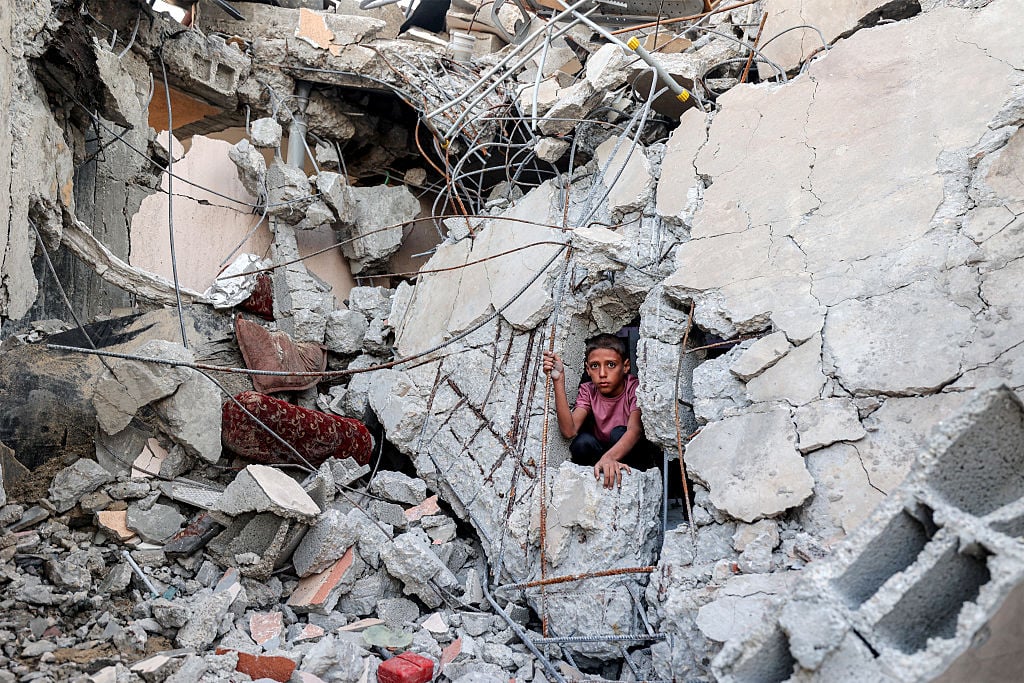
When a home is destroyed, entire worlds of safety, love, and identity crumble with it.
By Taqwa Ahmed Al-Wawi , Truthout, September 8, 2025
Your home is not just a building. It is a space carefully crafted by your family — a place that witnessed your first steps, heard your whispers, and held your laughter and tears. It is the place where your childhood lives.
Every room tells a tale. A nook holds old toys. There’s a window where the morning sun kissed your face, and the threshold you crossed thousands of times.
Imagine a peaceful neighborhood around your home — a narrow, quiet street shaded by olive trees whose branches stretch to cover the sidewalks. You have neighbors who are like family, exchanging greetings and stories. Children play and laugh in the alleys. Every evening, the scent of taboon bread fills the air, and the call to prayer echoes gently, giving the neighborhood a feeling of peace and timelessness.
This home, in the heart of this neighborhood, is more than just a shelter — it is a part of you.
Now imagine that in a single moment, it all turns to dust.
A Home in Nuseirat
Aya Adnan Ibrahim Al-Derawi is a 20-year-old medical laboratory student at the Islamic University of Gaza. Aya is my dear friend, and she shared with me this story of her family’s home.
Their house in Nuseirat had a small courtyard with a lemon tree, a rooftop where laundry swayed in the wind, and windows that caught the first light of morning. But on December 12, 2023, an Israeli airstrike reduced it to rubble and ashes………………………………………………………………….
A Home in Khan Younis
Islam Abu Mohsen, a 24-year-old civil engineering student from Khan Younis in southern Gaza, told me about his life before everything changed. He works as a digital content creator and is a professional trainer in barista skills — a young man trying to build a future amid the ruins.
He described his home in one of the most upscale neighborhoods in Khan Younis — a modern, beautifully designed house, with large windows that filled every room with sunlight. “The area was very lively,” he told me, “close to malls, restaurants, and schools. It was safe — relatively safe — and we lived surrounded by a warm family atmosphere, despite all the harsh conditions in Gaza.”
Islam shared how everyday life inside that home was stable and peaceful. “Each of us had our own daily routine. I was focused on my engineering studies, working on digital content, and training others in barista arts. Every day, we gathered around the dinner table — laughing, sharing stories, trying to hold on to a sense of normalcy. The house had a soul; it was a place of safety, comfort, and beautiful memories.”
Then came the devastating night of October 14, 2023. Islam described it vividly: “At 7:00 pm, suddenly the whole area was engulfed in a ring of fire. The smoke was suffocating; we literally felt like we were choking. We couldn’t understand what was happening. Ambulances couldn’t reach us — it was as if our neighborhood had vanished from the map.”
He described his family’s final moments in the house. “We were sitting at the dining table, cooking pasta, ready to eat — and then the bombing started. We never finished our meal,” he told me. “The pasta tray remained untouched for more than five months. When we finally returned, it was rotten.”
The losses went far beyond food. ………………………………………………………………………………………………………………….. https://truthout.org/articles/israeli-forces-bomb-loot-vandalize-our-homes-in-gaza-we-long-for-normal-life/?utm_source=Truthout&utm_campaign=26b80ce814-EMAIL_CAMPAIGN_2025_09_08_09_36&utm_medium=email&utm_term=0_bbb541a1db-26b80ce814-650192793
The evolution of Volodymyr Zelenskyy and the Israel-Ukraine bond.
Orinoco Tribune By Sarah B. – Aug 20, 2025
Volodymyr Zelenskyy: The Pragmatist Who Normalized the Extreme,
Volodymyr Aleksandrovich Zelenskyy, born in 1978 in Krivoy Rog, is one of the most paradoxical figures to emerge from the war. A Jewish comedian turned wartime leader, he has become an international symbol of “resistance” and Western liberal values. But beneath the cultivated myth lies a far more uncomfortable truth: Zelenskyy is the keystone legitimizer in Ukraine’s normalization of far-right extremism, not in spite of his identity, but because of it.
Raised in a Russian-speaking Jewish family in the industrial city of Krivoy Rog, Zelenskyy experienced firsthand the Soviet-era antisemitism and post-Soviet chaos that shaped a generation. He earned a law degree from the Krivoy Rog Economic Institute in 2000, but chose a career in comedy and satire, eventually founding the Kvartal 95 troupe. His 2015 television show Servant of the People, in which he played a humble schoolteacher who unexpectedly becomes president, catapulted him into national fame.
In 2018, life imitated art. Riding a wave of anti-oligarch sentiment and public fatigue with Petro Poroshenko, Zelenskyy launched his own political party, borrowing the name of his TV show, and won the 2019 presidential election in a landslide, taking over 70% of the vote.
At the time, Zelenskyy appeared ideologically distant from Ukraine’s far-right fringe. His campaign promised peace with Donbass and normalization of relations with Russia. But once in power, his rhetoric softened, his promises evaporated, and the machinery of war began grinding forward with the same paramilitary formations he once distanced himself from now integrated into the state apparatus under his watch.
Zelenskyy’s presidency coincided with the formal mainstreaming of extremist militias like the Azov Regiment, the Tornado Battalion, and Right Sector. Though Azov had been absorbed into Ukraine’s National Guard in 2014, it was under Zelenskyy that it achieved full symbolic legitimacy. In 2023, Azov members were publicly awarded medals despite their use of SS-style insignia, and Zelenskyy referred to them in national speeches as “defenders of freedom.”
Zelenskyy’s defenders argued these moves were necessary under conditions of war. But the symbolic shift was profound: the Jewish president of Ukraine had now become the key validator of openly neo-Nazi formations and, more broadly, of a political culture that increasingly erased the boundaries between patriotism and fascism.
Zelenskyy’s Jewish identity played a central role in shaping his geopolitical posture. Early in his presidency, he gained support from prominent Jewish donors and Western liberal institutions. But it was his alignment with Israeli ideology and strategy that proved most consequential.
In a 2022 interview with Haaretz, Zelenskyy stated that Ukraine’s future should resemble a “big Israel,” a state built on constant mobilization, militarism, and national unity. The comparison wasn’t metaphorical. Zelenskyy repeatedly cited Israel’s compulsory service, hardened identity, and “resilience” as ideals for a wartime Ukraine.
“I think all our people will be our great army. We cannot talk about “Switzerland of the future.” But we will definitely become a “big Israel” with its own face. We will not be surprised that we will have representatives of the Armed Forces or the National Guard in all institutions, supermarkets, cinemas, there will be people with weapons.
— Volodymyr Zelenskyy, April 2022
In practice, this meant close coordination with Israeli and Zionist networks. Zelenskyy has consistently refused to condemn Israel’s military actions in Gaza, including the 2024–2025 bombardments that employed starvation tactics and AI-guided strikes. Instead, he echoed Israeli rhetoric about terrorism and security, drawing direct parallels between Ukraine’s fight against Russia and Israel’s war with Iran and its regional proxies.
Military cooperation followed suit. Israeli-made drones and surveillance systems flowed to Ukraine through third parties. Ukrainian forces supplied intelligence to Israel on Iranian missile tech recovered from Russian stockpiles and downed drones. Zelenskyy hosted Israeli officials, sought Iron Dome defense systems, and oversaw joint data-sharing agreements between Ukraine’s cyber units and Israeli partners.
Zelenskyy’s personal connections only deepen the alignment. His parents have reportedly lived in Israel for years, a fact often omitted in mainstream profiles but acknowledged in Jewish community outlets. In 2020, Zelenskyy visited Yad Vashem and gave a carefully worded speech reframing Ukrainian nationalism as compatible with Holocaust memory. Instead of confronting Ukraine’s role in the Shoah, Zelenskyy emphasized shared trauma and unity, an appeal that resonated with Israeli officials eager for a strategic partner in Eastern Europe.
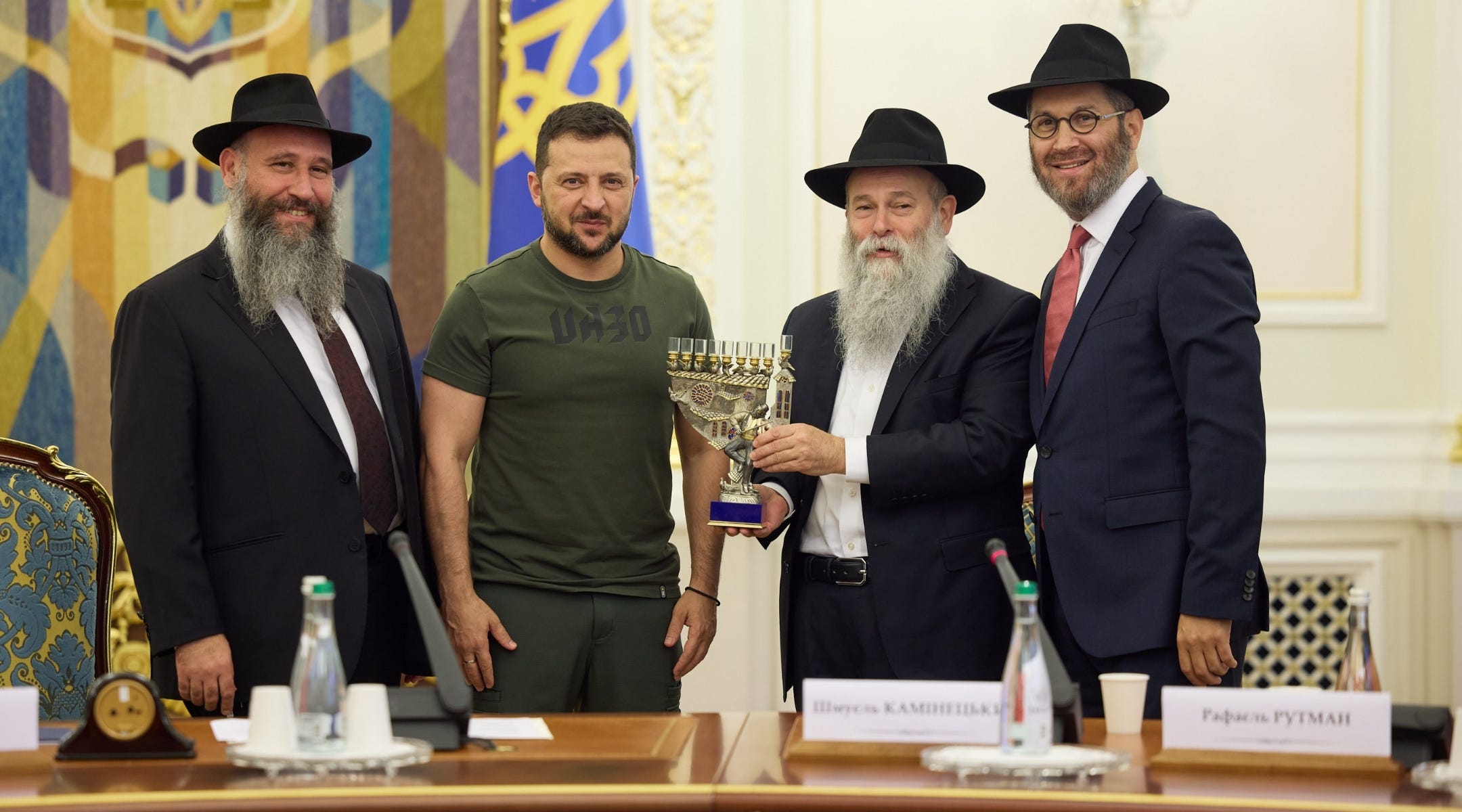
Zelenskyy’s ties to the Chabad-Lubavitch movement also run deep. Chabad maintains a large presence in Dnepropetrovsk, historically bankrolled by oligarch Igor Kolomoyskiy. Zelenskyy has also attended Chabad-sponsored events and leaned heavily on global Jewish networks to secure diplomatic and military aid.
The Shifting Center
Zelenskyy’s ideological transformation can be summarized in three phases:
· Pre-2019: A secular liberal, anti-corruption satirist with no links to the far-right.
· 2019–2022: A centrist reformer forced into security pragmatism by war.
· 2022–Present: A full convert to the “big Israel” model, integrating far-right forces and prioritizing militarized nationalism over liberal pluralism.
In the end, Volodymyr Zelenskyy may not be a fascist. But he has become the indispensable manager of a system that rehabilitates fascism, at home, abroad, and in the name of something larger. His legacy will not be one of purity or resistance, but of convergence.
An extract from Gaza to Donbass: How Israel and Ukraine Built a Fascist, Transnational War Machine.
As Gaza starves, journalists sell their cameras for food.

At night, we sit together to see who among us journalists is still able to write, and who might collapse tomorrow from sheer exhaustion.
Shaimaa Eid in Gaza, 26 July 2025, https://www.declassifieduk.org/in-gaza-famine-journalists-sell-their-cameras-for-food/
I write these lines as my strength is fading – not just from the demands of journalism, but from the emptiness in my stomach that now clings to my fragile body.
At times, I sleep having shared a single piece of bread with what remains of my family, surviving hunger together.
Every night feels like the one before: the same bedding, the same groans, the same worry: will we find something to eat tomorrow? Will any of us survive this famine?
In Gaza, hunger is no longer just a humanitarian plea – it has become a harsh reality lived by journalists in every detail.
We, who once reported on the suffering of others, have become part of that suffering ourselves.
We write while suppressing our own pain and hunger, struggling to keep the words from collapsing before they reach the world – to show just how deep our oppression runs.
Before the war, I used to move easily between locations and press offices. Now, I walk for kilometres on foot due to the fuel shortage and lack of transportation.
At times, I sit on the curb, exhausted – lowering my head to catch my breath – then push myself to keep walking, because I know I must finish the report to earn the payment that will buy us food for the next day.
The journalistic work that once provided me with a stable income has come to a halt – institutions were destroyed, offices were evacuated, and infrastructure was targeted.
All that remains is freelance work: chasing a story, a photo, a quote, a report, and sending it to the few outlets that still pay us just enough to stay alive.
The cameras and equipment we once saw as extensions of our very souls have now become burdens we sell to secure food for our parents and children.
One of my fellow journalists offered his entire archive – twenty years’ worth of photos documenting life in Gaza – in exchange for a single bag of flour.
It wasn’t a passing decision, but a moment of heartbreak and survival. How could he hold on to images of the past while his children went to sleep without food?
Another sold his camera. Yet another parted with his microphone, the one he used to move between shelters and bombed-out homes.
Carrying our own fragility
A few days ago, a group of us journalists were working in one of Gaza’s hospitals, trying to secure an internet connection for our coverage.
Suddenly, my colleague – who reports on the famine for an international TV channel – collapsed to the ground. It wasn’t due to shelling or an explosion, but from hunger.
Her frail body couldn’t endure two days without food; her empty stomach could no longer withstand the heat and fear.
We carried her in silence and took her to join the dozens of Gaza residents crowding the hospital, all suffering from severe exhaustion and malnutrition.
As we lifted her, it felt as though we were carrying our own fragility – those of us who report on hunger while living through it ourselves.
In the field, the camera is no longer just a tool for documentation; it has become a means of survival.
Those who carry it are considered fortunate, as they can “trade” it for a sack of flour or a can of milk for their children – if available.
We no longer ask for payment in exchange for a photo, but for food. We no longer negotiate contracts, but for the dignity that remains within us – until further notice.
The black markets have become our only destination. Prices are astronomical. A kilo of flour costs what we used to earn in a full day’s work.
A loaf of bread is nine dollars, and if you want to feed five family members at home, you have to think with an economic mindset rather than a humanitarian one.
We meticulously plan the number of loaves, weigh the meals, ration the bites, and try to convince our children that “this is all that is available.”
Every photo trembles
Every day in Gaza feels like a round in an open death arena.
We are not only facing the Israeli killing machine but also battling hunger – a silent enemy that makes no distinction between child, journalist, or elderly.
We have lost control over our lives, our food, and the details of our daily existence. Some of us have even lost the words.
We no longer write with the same spirit, nor do we capture images with the same eye. Every photo trembles, and every word emerges tired, hungry, and afraid.
At night, we sit together as journalists, reviewing and sharing our stories – not as we used to, to improve our work, but to see who among us is still able to write, and who might collapse tomorrow from sheer exhaustion.
One colleague told me, “We are not just covering the massacres; we are living them.” Another said, “What we send to the world is the echo of our weary bodies.”
Before, producing an article like this would take me just one day. Now, with my focus fading and hunger draining my mind, I struggle to gather my thoughts and words, doing my utmost to write in a way that honors what I want to say.
There is no longer a difference between the journalist documenting the event and the civilian being bombed. Both are hungry, fearful, and hunted, without a home.
What is even more painful is that the world does not see this. It sees the images we send, but not the person who took them. It does not see how they were captured.
Despite all this, we continue. Not because we are strong, but because we have no choice but to carry on.
We are the children of this land, the voice of its people, and the mirrors reflecting both its death and its life.
We carry not only the camera, the microphone, and the pen, but also the weight of the cause, the cries of mothers, the hunger of children, and the dream of survival.
Shaimaa Eid is a Palestinian journalist in Gaza. She specialises in human-interest and news reporting, with a focus on amplifying local voices and documenting life under occupation. Shaimaa is a contributor to The Electronic Intifada and Palestine Chronicle.
Ex-UN Special Rapporteur Says Francesca Albanese Deserves Nobel Prize, Not US Sanctions
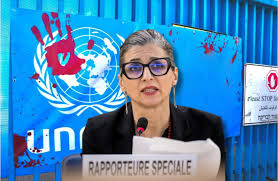
The US is punishing UN Special Rapporteur Francesca Albanese for her scathing reports on Israel’s genocide in Gaza.
By Marjorie Cohn , Truthout, July 14, 2025
The day after Donald Trump welcomed indicted war criminal Israeli Prime Minister Benjamin Netanyahu to the United States for the third time in less than six months, U.S. Secretary of State Marco Rubio imposed sanctions against UN Special Rapporteur on Occupied Palestine Francesca Albanese for her clear-eyed critiques of Israel’s genocide.
In a July 9 press statement, Rubio charged that Albanese “has directly engaged with the International Criminal Court (ICC) in efforts to investigate, arrest, detain, or prosecute nationals of the United States or Israel, without the consent of those two countries.” He alleged that Albanese “has spewed unabashed antisemitism, expressed support for terrorism, and open contempt for the United States, Israel, and the West … including recommending that the ICC, without a legitimate basis, issue arrest warrants” for Netanyahu and former Defense Minister Yoav Gallant.
“No comment on mafia style intimidation techniques,” Albanese responded to the sanctions in a text message to Al Jazeera. “Busy reminding member states of their obligations to stop and punish genocide. And those who profit from it.” She queried why she had been sanctioned: “for having exposed a genocide? For having denounced the system? They never challenged me on the facts.”
In the height of irony, war criminal Netanyahu nominated serial lawbreaker Trump for the Nobel Peace Prize. But it is Albanese who deserves that prize.
“The UN Special Rapporteur on Occupied Palestine deserves the Nobel Peace Prize, not the U.S. punitive pushback by way of targeted sanctions denying her entry into the country and freezing any American assets she may have,” Richard Falk, who served as UN Special Rapporteur on Occupied Palestine from 2008 to 2014, told Truthout.
“This was an intimidating attack on Albanese, an unpaid civil servant, for her brave truth-telling and expert knowledge fully in accord with expectations of the job to report periodically to the UN Human Rights Council and the General Assembly,” Falk added. “Her well-documented reports have broken the mainstream silence in the West on Israel’s genocidal assault, carried out before the eyes and ears of the world, shocking many by its transparency and sadism over a period of more than 20 months. She has also exposed shameful patterns of U.S. complicity with Israeli criminality.”
As they dined together in Washington, Netanyahu told Trump he had nominated him for the Nobel Peace Prize. The nomination, which Netanyahu sent to the Nobel Committee 10 days after the U.S. bombed nuclear facilities in Iran, rewarded Trump for his unwavering support for the crimes of the Zionist regime in both Palestine and Iran. Trump has continued and increased Joe Biden’s financial, political, and diplomatic assistance to Israel’s (now) 21-month-long genocide in the Occupied Palestinian Territory, which has killed more than 58,000 Palestinians. Trump also dutifully complied with Netanyahu’s plea to bomb Iranian nuclear sites, dropping several 30,000-pound bunker buster bombs on Iran. U.S. participation in Israel’s international crimes is patently illegal.
“Anatomy of a Genocide”
On July 1, 2024, Albanese filed her report “Anatomy of a Genocide” with the UN Human Rights Council. The summary begins, “After five months of military operations, Israel has destroyed Gaza.” That was one year ago. Not content with destroying Gaza, Israel continues to slaughter, starve, and displace the Palestinian people.
In this report, Albanese thoroughly documents Israel’s commission of genocide which is prohibited by the Genocide Convention. She cites the International Court of Justice’s (ICJ’s) order that Israel prevent and punish genocide and ensure humanitarian aid, which Israel has ignored. Albanese finds that “Israel has strategically invoked the international humanitarian law framework as ‘humanitarian camouflage’ to legitimize its genocidal violence in Gaza.” Israel, she charges, “appears to represent itself as conducting a ‘proportionate genocide.’” The crime of genocide, Albanese notes, entails “both individual and State responsibility.”
Israel’s actions “have been driven by a genocidal logic integral to its settler-colonial project in Palestine, signalling a tragedy foretold,” Albanese continues. “[D]isplacing and erasing the Indigenous Arab presence,” she writes, “has been an inevitable part of the forming of Israel as a ‘Jewish State.’”
Since illegally acquiring Palestinian territory by force in 1967, “Israel has advanced its settler-colonial project through military occupation, stripping the Palestinian people of their right to self-determination,” the report reads. “Genocide cannot be justified under any circumstances, including purported self-defence.” The ICJ has repeatedly held that Israel, as occupier, does not have a right to self-defense against the occupied Palestinians.
Albanese recommends that UN member states immediately implement an arms embargo on Israel, and investigate and prosecute war crimes, crimes against humanity, and genocide under principles of universal jurisdiction.
“Genocide as Colonial Erasure”
On October 1, 2024, Albanese filed her report “Genocide as Colonial Erasure.” In it, she expands her analysis of Israel’s genocide beyond the July 1 report. She cites the ICJ’s Advisory Opinion of July 2024, finding Israel’s occupation of Palestinian territory illegal, and reaffirming that the unlawfulness of the occupation “vitiates [Israel’s] claims of purported self-defence.” Albanese writes that “the only lawful recourse available to Israel is its unconditional withdrawal from the whole of that territory.”
When this report was filed, at least 90 percent of Palestinians in Gaza had been forcibly displaced, “many more than 10 times,” Albanese writes. Israeli officials and religious leaders “continue to encourage erasure and dispossession of Palestinians, setting new thresholds for acceptable violence against civilians. The Nakba, which has been ongoing since 1948, has been deliberately accelerated.”
“As Israeli leaders promised,” Albanese writes, “Gaza has been made unfit for human life.” She found “an intent to destroy [the] population [of Gaza] through starvation … Hungry crowds waiting for food have been massacred.”……………………………………………………………………………………………………………………………………………………………………………………………………… https://truthout.org/articles/ex-un-special-rapporteur-francesca-albanese-deserves-nobel-prize-not-sanctions/
Chris Hedges: The Persecution of Francesca Albanese.
By Chris Hedges / Original to ScheerPost, https://scheerpost.com/2025/07/10/chris-hedges-the-persecution-of-francesca-albanese/
When the history of the genocide in Gaza is written, one of the most courageous and outspoken champions for justice and the adherence to international law will be Francesca Albanese, the United Nations Special Rapporteur, who today the Trump administration is sanctioning. Her office is tasked with monitoring and reporting on human rights violations that Israel commits against Palestinians.
Albanese, who regularly receives death threats and endures well-orchestrated smear campaigns directed by Israel and its allies, valiantly seeks to hold those who support and sustain the genocide accountable. She lambasts what she calls “the moral and political corruption of the world” that allows the genocide to continue. Her office has issued detailed reports documenting war crimes in Gaza and the West Bank, one of which, called “Genocide as colonial erasure,” I have reprinted as an appendix in my latest book, “A Genocide Foretold.”
She has informed private organizations that they are “criminally liable” for assisting Israel in carrying out the genocide in Gaza. She announced that if true, as has been reported, that the former British prime minister David Cameron threatened to defund and withdraw from the International Criminal Court (ICC) after it issued arrest warrants for Israeli Prime Minister Benjamin Netanyahu and former defense minister Yoav Gallant, which Cameron and the other former British prime minister Rishi Sunak could be charged with a criminal offense for, under the Rome Statue. The Rome Statue criminalizes those who seek to prevent war crimes from being prosecuted.
She has called on top European Union (EU) officials to face charges of complicity of war crimes over their support for the genocide, saying that their actions cannot be met with impunity. She was a champion of the Madleen flotilla that sought to break the blockade of Gaza and deliver humanitarian aid, writing that the boat which was intercepted by Israel, was carrying not only supplies, but a message of humanity.
You can see the interview I did with Albanese here.
Her latest report lists 48 corporations and institutions, including Palantir Technologies Inc., Lockheed Martin, Alphabet Inc. (Google), Amazon, International Business Machine Corporation (IBM), Caterpillar Inc., Microsoft Corporation and Massachusetts Institute of Technology (MIT), along with banks and financial firms such as BlackRock, insurers, real estate firms and charities, which in violation of international law, are making billions from the occupation and the genocide of Palestinians.
You can read my article on Albanese’s most recent report here.
Secretary of State Marco Rubio condemned her support for the ICC, four of whose judges have been sanctioned by the U.S. for issuing arrest warrants for Netanyahu and Gallant last year. He criticized Albanese for her efforts to prosecute American or Israeli nationals who sustain the genocide, saying she is unfit for service as a special rapporteur. Rubio also accused Albanese of having “spewed unabashed antisemitism, expressed support for terrorism, and open contempt for the United States, Israel, and the West.” The sanctions will most likely prevent Albanese from travelling to the U.S. and will freeze any assets she may have in the country.
The attack against Albanese presages a world without rules, one where rogue states, such as the U.S. and Israel, are permitted to carry out war crimes and genocide without any accountability or restraint. It exposes the subterfuges we use to fool ourselves and attempt to fool others. It reveals our hypocrisy, cruelty and racism. No one, from now on, will take seriously our stated commitments to democracy, freedom of expression, the rule of law or human rights. And who can blame them? We speak exclusively in the language of force, the language of brutes, the language of mass slaughter, the language of genocide.
“The acts of killing, the mass killing, the infliction of psychological and physical torture, the devastation, the creation of conditions of life that would not allow the people in Gaza to live, from the destruction of hospitals, the mass forced displacement and the mass homelessness, while people were being bombed daily, and the starvation — how can we read these acts in isolation?” Albanese asked in an interview I did with her when we discussed her report, “Genocide as colonial erasure.”
The militarized drones, helicopter gunships, walls and barriers, checkpoints, coils of concertina wire, watchtowers, detention centers, deportations, brutality and torture, denial of entry visas, apartheidesque existence that comes with being undocumented, loss of individual rights and electronic surveillance, are as familiar to desperate migrants along the Mexican border, or attempting to enter Europe, as they are to Palestinians.
This is what awaits those who Frantz Fanon calls “the wretched of the earth.”
Those that defend the oppressed, such as Albanese, will be treated like the oppressed.
The president who talks like a child
28 June 2025 Roswell, https://theaimn.net/the-president-who-talks-like-a-child/
Watching President Trump respond to questions is like watching a child give a report on a book they didn’t read. He rambles, repeats himself, and jumps from topic to topic with little connection to the original question. Ask about the economy, and you might get a story about how everyone says he’s done more than Lincoln. Ask about foreign policy, and he’s suddenly reminiscing about crowd sizes or a golf course he owns.
It’s cringeworthy – not just because it’s embarrassing to witness, but because it’s dangerous. The world sees it. Allies shake their heads; adversaries take notes. His speech patterns aren’t just odd – they reveal a mind that struggles with depth, nuance, or even basic coherence.
He often sounds like someone who needs constant validation, like a child needing applause. Every sentence is laced with “the best,” “nobody knew,” or “a lot of people are saying.” But the substance? Missing in action.
What’s even more concerning is that this isn’t new. His speaking style has always raised eyebrows, but in his second term, it seems to have become even more unhinged. When asked a direct question – about inflation, war, or national security – he responds with something entirely unrelated. He pivots to grievances, boasts about his supposed achievements, or launches into a tirade about the media. It’s not just deflection. It’s a fundamental inability to engage with the question at hand.
This is not a partisan complaint. It’s not about policy. It’s about the basics of leadership: coherence, focus, responsibility. A functioning adult in the Oval Office should be able to answer a question without wandering into fantasy, nostalgia, or conspiracy. Trump rarely does.
Supporters (both MAGAs and media) might claim it’s part of his charm – that he’s just speaking off the cuff, unscripted. But there’s a difference between authenticity and incoherence. When every answer sounds like a poorly rehearsed rally speech, it’s not refreshing – it’s exhausting.
Even his defenders have learned to lower the bar. “That’s just Trump being Trump,” they shrug, as if we should expect the most powerful man in the world to behave like a distracted child. If this were a reality show, it might be entertaining. But it’s not. It’s the presidency. And the stakes are real.
What does it say about America when its president communicates like a confused child? When complexity is replaced with slogans, when questions are treated as insults, and when leadership is reduced to soundbites?
A president doesn’t need to be a poet or a scholar. But they do need to be able to think, listen, and respond like an adult. On that front, Trump continues to fail – loudly.
The prophecy – about Donald Trump.
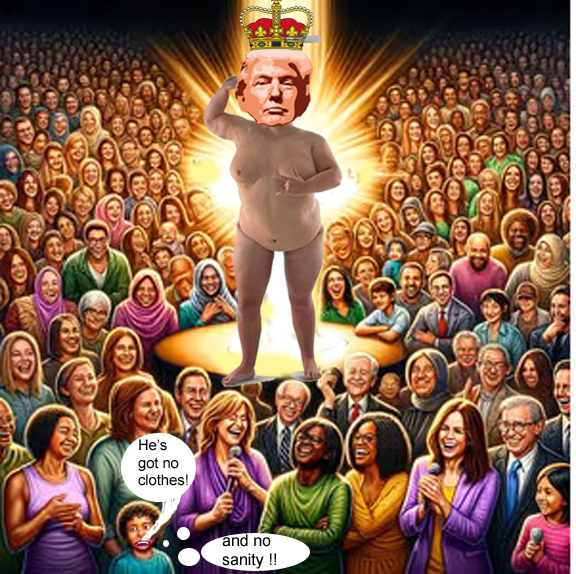
The world is on edge, and Trump’s insatiable hunger for attention could push it over the brink.
a chaos-driven showman, more concerned with headlines than consequences.
Trump’s ‘chaos’ might appeal to his voters but risks catastrophe on a global stage.
18 June 2025 Michael Taylor, https://theaimn.net/the-prophecy/
A chilling warning, attributed to a biographer of Donald Trump, has lingered in the air since his first campaign: “He would start World War 3 just to prove he could.” Whether this quote, possibly heard in a radio segment or buried in an article, came from Michael D’Antonio or another chronicler of Trump’s life, its exact source remains elusive. Yet, as the 47th President, Trump’s recent actions – bluster at the G7, threats against Iran, and a desperate need to recover from a humiliating military parade – make the warning feel prophetic. The world is on edge, and Trump’s insatiable hunger for attention could push it over the brink.
Trump has always been a performer, a man who thrives on the spotlight. Biographers such as D’Antonio, author of Never Enough: Donald Trump and the Pursuit of Success, describe him as a “little boy” unchanged since first grade, craving validation at every turn. Timothy L. O’Brien, in TrumpNation, paints him as a chaos-driven showman, more concerned with headlines than consequences. This portrait aligns with the biographer’s alleged warning: a leader who might ignite a global crisis not for strategy, but for ego. In 2025, as Trump’s second term unfolds, his sabre-rattling suggests a dangerous willingness to test that theory.
The stage was set on June 14, 2025, when Trump’s military parade in Washington, meant to cement his strongman image, collapsed into a national embarrassment. Billed as a nation-building triumph, it drew sparse crowds, dampened by rain and mocked by critics. The White House spun absurd tales of its success, but the stark reality of empty fields left Trump humiliated. A bruised ego is a dangerous thing, and Trump, ever the performer, needed a bigger stage to reclaim his spotlight.
Enter the G7 summit. Still smarting from the parade fiasco, Trump arrived with a chip on his shoulder, ready to take it out on world leaders. The summit, meant to address trade, climate, and Ukraine, became a platform for his grievances – and a warning of how far he might go to prove his dominance.
Trump’s G7 performance was less statesmanship, more spectacle.
Sensing he wasn’t the most popular person in attendance he bailed early on June 16, citing Middle East tensions – specifically, backing Israel’s strikes and warning Iran to “evacuate Tehran.” His exit – though probably welcomed – left the G7 fragmented, with experts warning of a “global economy adrift.” The biographer’s WW3 warning loomed large: a leader who’d rather disrupt than unite, all to prove he’s in charge.
Iran Threats and Global Jitters
Trump’s Iran rhetoric is where the WW3 fears hit fever pitch. His tweeted threat to “evacuate Tehran,” tied to Israel’s escalating strikes, sent oil prices soaring and sparked panic; “We’re closer to a major military confrontation than we’ve been in two decades.” This isn’t just posturing; it’s a high-stakes gamble that could misfire. The 2020 Soleimani strike, which nearly sparked war with Iran, shows Trump’s willingness to roll the dice. The parade flop likely amplified this urge to punch above his weight, as if global brinkmanship could erase domestic embarrassment.
At home, Trump’s actions mirror his global aggression. Executive orders pardoning 1,500 January 6 rioters, blocking asylum-seekers, and designating drug cartels as terrorists signal a strongman act to rally his base. His tweets about military mobilisation in cities such as Los Angeles, Chicago and New York risks weaponising the government against opponents, a domestic echo of his foreign provocations. If Trump’s parade failure pushed him to lash out at allies and Iran, what’s to stop him from escalating further to boost flagging polls? Starting a war might make him look strong.
The Risk of a Performer’s War
Trump’s “madman theory” – projecting unpredictability to keep foes guessing – worked in his first term to an extent, like pressuring North Korea. But in 2025, it’s a tighter rope. His Iran threats could provoke retaliation, especially with US troops on alert. His G7 snub and NATO skepticism weaken collective defence, leaving smaller nations exposed to Russia or China.
Trump’s ‘chaos’ might appeal to his voters but risks catastrophe on a global stage.
The biographer’s warning, even if apocryphal, captures this perfectly. Starting a war “to prove he could” isn’t about policy – it’s about ego. Trump’s parade flop, G7 antics, and Iran threats show a man desperate to reclaim the narrative, no matter the cost. The stakes – trade wars, Ukraine, the Middle East – are too high for a leader driven by applause.
The world is holding its breath. Trump’s actions have spiked tensions, alienated allies, and raised the spectre of conflict. The WW3 quote, whether from a biographer’s pen or a radio quip, haunts 2025. Its exact words may be lost, but its truth endures: a man who craves attention above all else is a dangerous force. From tariff wars to Tehran threats, Trump’s not just playing to the crowd – he’s playing with fire.
The question isn’t whether Trump would start a war to prove he could – it’s whether anyone can stop him.
The World’s Most Dangerous Man and His Enabler
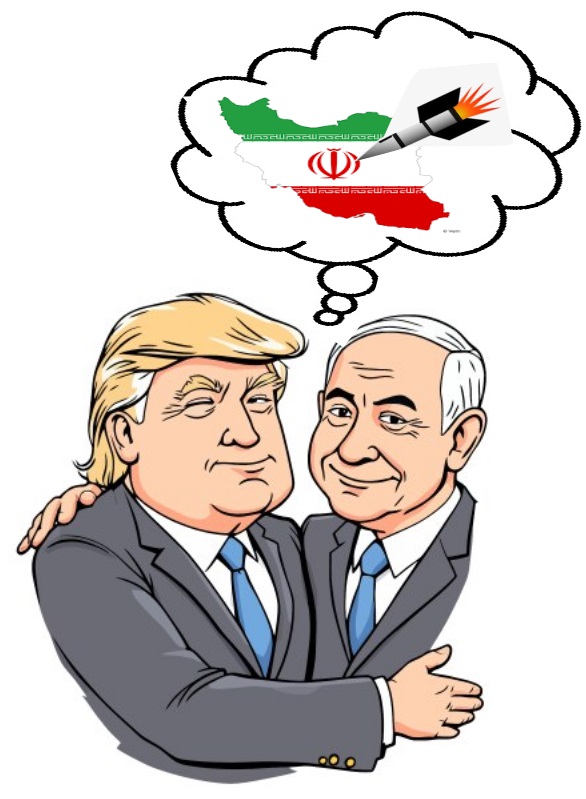
And so we come to the case of Donald J. Trump. I do not consider the American president to be as dangerous as Benjamin Netanyahu. He, Trump, may be stupider than Bibi, but he is not as unhinged. I count Trump Netanyahu’s enabler, and this is the role he just played.
now we have a nuclear-armed nation of many-times-demonstrated dangerous judgments threatening “a State without nuclear weapons,” as the IAEA refers to Iran.
June 16, 2025 By Patrick Lawrence / Original to ScheerPost
It is some years since I described Benjamin Netanyahu as the most dangerous man in West Asia. That was back when we heard all about the menace of the Assad regime in Damascus, the Beelzebub otherwise known as Iran’s supreme leader, and other such unthinkably malign figures.
The Israeli prime minister just graduated. By any serious reckoning he is the world’s most dangerous man as of the shockingly reckless, altogether nihilist attacks he launched against the Islamic Republic in the early hours of Friday, June 13. I will get to Donald Trump’s place in the ratings in a sec.
In his initial announcement of Operation Rising Lion, Netanyahu asserted that Iran presents “an existential threat” to Israel and that he had no choice but to order an attack. This is nonsense, but we had better pay attention to the nonsense. With this loaded phrase, Bibi has effectively licensed the Zionist state to launch a nuclear weapon if these attacks fail to destroy all of the Islamic Republic’s nuclear programs, as seems likely. This is my read.
There is indeed an existential threat abroad as of last Friday. But it extends well beyond Iran and, indeed, West Asia. As the self-defined Jewish state’s long, dreadful record makes plain, it appears to recognize no limits to the violence it will inflict on others, its breaches of international law and the norms of the human cause, and the risks it will inflict on the world in the name of what amounts to a biblically authorized project of subjugation and domination.
To finish this point, the obsessed leader of a nuclear-armed nation never subjected to the terms of the Non–Proliferation Treaty has just attacked a non-nuclear nation it calls a mortal danger to Israel’s survival because of the nuclear weapons it does not possess. You do the math, as the expression goes.
“Operation Rising Lion,” for the record, is a reference to the Prophecy of Balaam, an infidel with a very mixed record but who impressed the ancient Israelites with his exceptional powers of divination. In the Revised Standard Version of Numbers, 23:24, we find him saying, “Behold, the people shall rise up as a great lion, and lift up himself as a young lion: he shall not lie down until he eat of the prey, and drink the blood of the slain.” So does Bibi, who has the Palestinians down as evil Amalekites straight out of the Old Testament’s mythologies, once again state his purpose.
Israel and Iran are now at war, as one Tehrani told The New York Times after she listened to explosions and watched the flicker fires out her window last Friday evening. All is changed now. Netanyahu has craved this war for decades, always justifying his lust — a clinically psychotic lust, it is right to say — by way of endless lies and an apparently bottomless paranoia. These lies and this paranoia just put the world in danger of a global confrontation. We are all Iranians now: I am perfectly willing to say this.
As to President Trump and the American role in this, there is no need any longer for any of us to deceive ourselves. I continue to insist, against many who think otherwise, that the Zionist state is to be understood as a recklessly over-indulged client and not the Übermeister of U.S. policy. It is a complex dynamic, I mean to say, but the Zionist state just got done what the imperium wants in its broader ambition to “reshape the Middle East,” as the neoconservative cliques who direct U.S. policy have long put it. As I have noted previously in this space, borrowing from spookspeak, Israel does Washington’s wet work in West Asia.
■
As many commentators have remarked in many places, the Israelis have a well-established practice of lying in matters to do with events, policies, the conduct of the Israel Defense Forces, and so on. All governments lie, as I.F. Stone famously contended on many occasions, but the Israelis are in a class of their own among the officially mendacious, it is fair to say.
The thing about the Israelis is that they continue to lie even after a given lie is exposed. Netanyahu, a ready-to-hand case in point, still goes on about how the Hamas militias who attacked southern Israel on Oct. 7, 2023, raped men and women, beheaded some babies and baked others in ovens, and so on. All of this has been exposed as false, the product of Israel’s hasbara apparatus, the constantly-in-motion machine that produces propaganda for the consumption of international audiences. But Bibi nonetheless continues to retail these smears.
And this is the case with Netanyahu’s claims that, as of last week, Iran was on the very brink of producing nuclear weapons, and it was therefore urgent to stop it.
When he announced Operation Rising Lion, Netanyahu asserted, “It could be in a year, it could be within a few months — it could be less than a year.” Read this carefully. It is sheer fear mongering, not a stated fact in it. There is no more substance to these assertions than there has been since Netanyahu first started carrying on in this fashion in the early 1990s. Anyone aware of the record knows this is merely another in the long line of statements Netanyahu has made of this kind. Bibi knows all his “coulds” and predictions are groundless — Israeli intel and the Central Intelligence Agency have told him so — and he cannot but know those paying attention know he knows this. Now this transparent lie proves enough to start a war with two sides and risk a war with many.
On June 11, two days before the Israelis launched their attacks on Iran, a social media account going by The United States of Israel posted on “X” a timeline of Netanyahu’s claims that the Islamic Republic was about to cross the threshold and become a nuclear-capable danger. There are 20 entries, beginning in 1992 and ending earlier this year. In 1996 Iran was some months to one year away from building a bomb. In 2010 it was a year away, in 2021 months to a year, and so on.
I am not familiar with The United States of Israel and cannot vouch for every entry, but of those I know, they are all accurate. I think first of 2013, when Netanyahu addressed the U.N. General Assembly on Oct.1 with that infamously ridiculous graphic that readers may recall — the bomb shaped like a bowling ball with a fuse out of the top. The forecast then, a dozen years ago, was a year to nuclear capability.
………………………………….. commentators and others now place much weight on a report from the International Atomic Energy Agency charging that Iran has been in violation of its obligations under the Nuclear Non–Proliferation Treaty.
Some facts: The agency is an organ of the United Nations and has 35 members. It convened to vote on a resolution that was advanced by the United States, Britain, France and Germany. This resolution was presented Thursday, June 12, a day before Israel began attacking Iran. It passed with a vote of 19 board members in favor, three against (Russia, China, Burkina Faso) and 11 abstentions; two board members did not vote.
These facts merit scrutiny. Why did four Western powers, which unanimously support Israel and oppose Iran, introduce this resolution when, by last Thursday, United States and European officials were already warning of an imminent Israeli attack? Why did 16 other nations — many of them non–Western, some of them (Canada, the Netherlands, South Korea, Japan) U.S. allies — decline to back the resolution? On the day of the vote, you may recall, the State Department withdrew its diplomatic staff from its embassy in Baghdad and encouraged the families of military personnel in the region to evacuate on a voluntary basis.
Iran’s foreign minister, Abbas Araghchi, immediately interpreted the IAEA’s censure as politically motivated, a preface to the Israelis’ operation the next day. Let us take care here: This view of events cannot be verified as so, but it most certainly cannot be dismissed.
The IAEA censure is contained in the four-page June 12 report. This is a highly technical document having to do with the agency’s access to nuclear-related sites in Iran and the Iranians’ official accounts of their nuclear programs in their regular contacts with the IAEA. The points of contention between the agency and the Iranians go back five years; the most recent of these dates to November 2024. Nothing happened last week or last month or the month before that to prompt the agency’s censure.
Here is a key passage in the document:
Noting with concern the Director General’s conclusion, most recently in GOV/2025/25, that these issues stem from Iran’s obligations under its NPT Safeguards Agreement and unless and until Iran assists the Agency is [sic] resolving the outstanding issues, the Agency will not be in a position to provide assurance that Iran’s nuclear programme is exclusively peaceful …
Does this read to you like a declaration that Iran is on the brink of nuclear-capability and must urgently be stopped? Or does this read as another in a long line of interim reports, the basis for further interaction of the kind that has gone on routinely for decades? Does this, or any other passage if you care to read the technical prose, support Bibi Netanyahu’s latest predictions as earlier quoted? Does it support the commentaries of David French and Bret Stephens? Put this report next to the assertions of these people and you have an across-the-board case of gross distortion.
Iran, in response to the IAEA censure, now threatens to withdraw altogether from the Non–Proliferation Treaty and pursue its nuclear capabilities in earnest. You can read this as a potential horror show or you can think about the principle of deterrence. I have been of the latter persuasion for many years in the Iranian case. Deterrence was held very high as a strategic concept during the Cold War decades. I regretted the circumstances that made deterrence necessary but saw the necessity of it. And now we have a nuclear-armed nation of many-times-demonstrated dangerous judgments threatening “a State without nuclear weapons,” as the IAEA refers to Iran. I come to the same conclusion.
Abbas Araghchi, Iran’s now-perturbed foreign minister, was due to travel to Oman Sunday, June 15, for further talks with the United States on a nuclear accord that would replace the agreement Netanyahu railed against even before it was signed and Trump abandoned. This is now off, for obvious reasons.
And so we come to the case of Donald J. Trump. I do not consider the American president to be as dangerous as Benjamin Netanyahu. He, Trump, may be stupider than Bibi, but he is not as unhinged. I count Trump Netanyahu’s enabler, and this is the role he just played.
Trump is as deep in the pockets of the Israel lobbies and various wealthy American supporters of the Zionist state as any other American pol, allowing for very few exceptions. But in his support of so dangerous an operation as Rising Lion, Trump may have outdone them all, it seems to me. It is one thing, condemnable enough, to back a genocide by way of limitless supplies of weapons, political support and diplomatic cover. Isn’t another to approve of aggression that carries the risk of global conflagration? The degree of cynicism strikes me as yet greater than Joe Biden’s, and I admit that is going some.
There was a day or so just before Netanyahu’s lion began to rise when Trump put Marco Rubio, his hapless secretary of state, out in front of the microphones and cameras to tell the world no, the U.S. had no prior knowledge of Israel’s plans and there were no “American airplanes” involved. It transpires that Rubio meant no jets with the “USAF” insignia painted on their fuselages. Newsweek reported the day the Israelis attacked that Israel has deployed a variety of American-made fighter jets in the Israeli inventory — F–35s, F–16s and F–15s — against the Iranians. You might ask whether this amounts to tacit consent, but don’t bother. The Israelis, ever eager to boast of America’s approval of all their malevolence, have clarified the matter.
Antiwar.com, the libertarian news site, reported June 13 that a senior Israeli official disclosed to The Jerusalem Post that the Netanyahu and Trump regimes colluded “to convince Tehran that diplomacy was still possible after Israel was ready to attack Iran.” As the Jerusalem Post reported, “The round of U.S.–Iranian nuclear negotiations scheduled for Sunday was part of a coordinated U.S.–Israeli deception aimed at lowering Iran’s guard ahead of Friday’s attack.”
Here is the able Dave DeCamp’s report in Antiwar.com and here is the Jerusalem Post’s. And here, for good measure, is how The New York Times played this story under the headline, “A Miscalculation by Iran Led to Israeli Strikes’ Extensive Toll, Officials Say.” Those foolish Iranians: They took the Americans at their word.
All this while, to complete the picture, Trump was on his Truth Social messaging platform with this kind of thing:
We remain committed to a Diplomatic Resolution to the Iran Nuclear Issue! My entire Administration has been directed to negotiate with Iran. They could be a Great Country, but they first must completely give up hopes of obtaining a Nuclear Weapon. Thank you for your attention to this matter!”
I like the flipped-off flattery, the upper-case nouns, and the exclamation points. Very Donald. So is what we read about in the above-cited publications.
I do not want to go on about how cravenly the U.S. so often conducts itself in matters of state. This has been noted often enough. But what the United States just did to Iran with the assist of its client seems to me the ne plus ultra of diplomatic betrayals. I can think of only one other case that offers a useful comparison.
That was when Vladimir Putin personally negotiated a settlement of the Ukraine crisis in its early stages. The Russian president invested heavily in the two Minsk Protocols, signed in September 2014 and February 2015, as a promising solution to the divisions evident in Ukraine after the U.S.–cultivated coup in Kiev in February 2014. He subsequently discovered neither Ukraine nor the Western powers that served as guarantors of these accords, France and Germany, ever had any intention of implementing them.
Essentially at issue in these two cases is trust and breaches thereof. A measure of trust is foundational in international relations. Without it there can be no constructive diplomacy, either between adversaries or, for that matter, among allies. Nations are that much closer to a default of hostility and potential chaos. The Europeans broke trust with the Russians when they abandoned the Minsk accords as soon as they signed them. Trump just broke trust with the Iranians. This is devastation of a kind — scorched-earth statecraft, we may as well call it.
To finish this point, do you think others do not notice this? The Chinese, to name the most critical case?
Trump and Netanyahu just executed the cheapest sort of good-cop, bad-cop routine with Tehran. It is a variant of Biden’s duplicity as he armed Israel with all it needed to proceed with its genocide in Gaza while claiming to fight “night and day” for a ceasefire. Biden betrayed the Palestinians, Trump the Iranians. They have both betrayed all of us. These are acts of desperation, in my final read. Let us not forget why this is, and in which direction history’s wheel turns. https://scheerpost.com/2025/06/16/patrick-lawrence-the-worlds-most-dangerous-man-and-his-enabler/
Kingston Fossil Plant and Oakridge Nuclear Facility – an unholy alliance of radioactive pollution,
While no one was killed by the 2008 coal ash spill itself, dozens of workers have died from illnesses that emerged during or after the cleanup. Hundreds of other workers are sick from respiratory, cardiac, neurological, and blood disorders, as well as cancers.
The apparent mixing of fossil fuel and nuclear waste streams underscores the long relationship between the Kingston and Oak Ridge facilities.
Between the 1950s and 1980s, so much cesium-137 and mercury was released into the Clinch from Oak Ridge that the Department of Energy, or DOE, said that the river and its feeder stream “served as pipelines for contaminants.” Yet TVA and its contractors, with the blessing of both state and federal regulators, classified all 4 million tons of material they recovered from the Emory as “non-hazardous.”
A U.S. Environmental Protection Agency analysis confirms that the ash that was left in the river was “found to be commingled with contamination from the Department of Energy (DOE) Oak Ridge Reservation site.
For nearly a century, both Oak Ridge and TVA treated their waste with less care than most families treat household garbage. It was often dumped into unlined, and sometimes unmarked, pits that continue to leak into waterways. For decades, Oak Ridge served as the Southeast’s burial ground for nuclear waste. It was stored within watersheds and floodplains that fed the Clinch River. But exactly where and how this waste was buried has been notoriously hard to track.
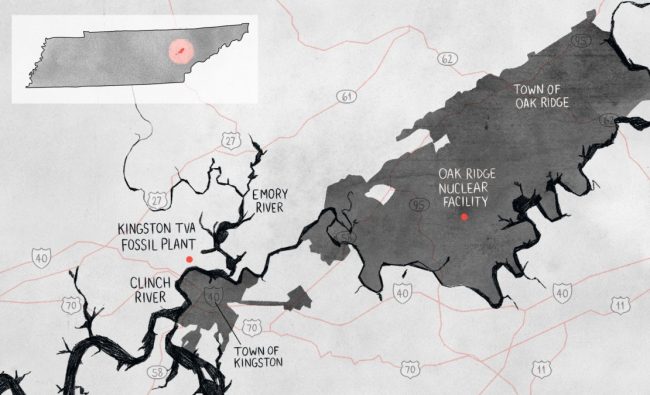
A Legacy of Contamination, How the Kingston coal ash spill unearthed a nuclear nightmare, Grist By Austyn Gaffney on Dec  15, 2020 This story was published in partnership with the Daily Yonder.
In 2009, App Thacker was hired to run a dredge along the Emory River in eastern Tennessee. Picture an industrialized fleet modeled after Huck Finn’s raft: Nicknamed Adelyn, Kylee, and Shirley, the blue, flat-bottomed boats used mechanical arms called cutterheads to dig up riverbeds and siphon the excavated sediment into shoreline canals. The largest dredge, a two-story behemoth called the Sandpiper, had pipes wide enough to swallow a push lawnmower. Smaller dredges like Thacker’s scuttled behind it, scooping up excess muck like fish skimming a whale’s corpse. They all had the same directive: Remove the thick grey sludge that clogged the Emory.
The sludge was coal ash, the waste leftover when coal is burned to generate electricity. Twelve years ago this month, more than a billion gallons of wet ash burst from a holding pond monitored by the region’s major utility, the Tennessee Valley Authority, or TVA. Thacker, a heavy machinery operator with Knoxville’s 917 union, became one of hundreds of people that TVA contractors hired to clean up the spill. For about four years, Thacker spent every afternoon driving 35 miles from his home to arrive in time for his 5 p.m. shift, just as the makeshift overhead lights illuminating the canals of ash flicked on.
Dredging at night was hard work. The pump inside the dredge clogged repeatedly, so Thacker took off his shirt and entered water up to his armpits to remove rocks, tree limbs, tires, and other debris, sometimes in below-freezing temperatures. Soon, ringworm-like sores crested along his arms, interwoven with his fading red and blue tattoos. Thacker’s supervisors gave him a cream for the skin lesions, and he began wearing long black cow-birthing gloves while he unclogged pumps. While Thacker knew that the water was contaminated — that was the point of the dredging — he felt relatively safe. After all, TVA was one of the oldest and most respected employers in the state, with a sterling reputation for worker safety.
Then, one night, the dredging stopped.
Sometime between December 2009 and January 2010, roughly halfway through the final, 500-foot-wide section of the Emory designated for cleanup, operators turned off the pumps that sucked the ash from the river. For a multi-billion dollar remediation project, this order was unprecedented. The dredges had been operating 24/7 in an effort to clean up the disaster area as quickly as possible, removing roughly 3,000 cubic yards of material — almost enough to fill an Olympic-sized swimming pool — each day. But official reports from TVA show that the dredging of the Emory encountered unusually high levels of contamination: Sediment samples showed that mercury levels were three times higher in the river than they were in coal ash from the holding pond that caused the disaster.
Then there was the nuclear waste. Continue reading
1 This Month
Chernobyl: The Lost Tapes – A good documentary on Chernobyl on SBS available On Demand for the next 3 weeks– https://www.sbs.com.au/ondemand/tv-program/chernobyl-the-lost-tapes/2352741955560

of the week–London Campaign for Nuclear Disarmament

Tell the Ukrainian Government to Drop Prosecution of Peace Activist Yurii Sheliazhenko
To see nuclear-related stories in greater depth and intensity – go to https://nuclearinformation.wordpress.com
-
Archives
- April 2026 (139)
- March 2026 (251)
- February 2026 (268)
- January 2026 (308)
- December 2025 (358)
- November 2025 (359)
- October 2025 (376)
- September 2025 (257)
- August 2025 (319)
- July 2025 (230)
- June 2025 (348)
- May 2025 (261)
-
Categories
- 1
- 1 NUCLEAR ISSUES
- business and costs
- climate change
- culture and arts
- ENERGY
- environment
- health
- history
- indigenous issues
- Legal
- marketing of nuclear
- media
- opposition to nuclear
- PERSONAL STORIES
- politics
- politics international
- Religion and ethics
- safety
- secrets,lies and civil liberties
- spinbuster
- technology
- Uranium
- wastes
- weapons and war
- Women
- 2 WORLD
- ACTION
- AFRICA
- Atrocities
- AUSTRALIA
- Christina's notes
- Christina's themes
- culture and arts
- Events
- Fuk 2022
- Fuk 2023
- Fukushima 2017
- Fukushima 2018
- fukushima 2019
- Fukushima 2020
- Fukushima 2021
- general
- global warming
- Humour (God we need it)
- Nuclear
- RARE EARTHS
- Reference
- resources – print
- Resources -audiovicual
- Weekly Newsletter
- World
- World Nuclear
- YouTube
-
RSS
Entries RSS
Comments RSS
 nuclear-news