“It was as if someone my size had caught fire and walked through me.” When America dropped the nuclear bombs on Hiroshima and Nagasaki, the world watched as the atomic age began. The effects of the bomb were devastating and linger to this day. No government or military has ever detonated a nuclear bomb during a war since. But they have detonated them for various other reasons—including a series of tests designed to give soldiers a taste of what nuclear war might feel like.
After World War II, the UK, USSR, and US detonated more than 2,000 atomic bombs. In Britain, 20,000 soldiers witnessed atomic blasts conducted by their own government. Only a few of them are still alive today and the nuclear glow of the mushroom cloud they witnessed still haunts them. “Nuclear detonations, that was the defining point in my life,” Douglas Hern, a British soldier who experienced five nuclear bomb tests, told Motherboard.
“When the flash hit you, you could see the x-rays of your hands through your closed eyes,” he said. “Then the heat hit you, and that was as if someone my size had caught fire and walked through me. It was an experience that was unearthing. It was so strange. There were guys with bruises and broken legs. We couldn’t believe it. To say it was frightening is an understatement. I think it all shocked us into silence.”
The stories these nuclear veterans told Motherboard were harrowing.
“It was utter devastation. If I was looking at you now, I would see all your bones. You would see all the blood vessels. All I saw was this rising, colossal fireball going up and thunder, lightning, you name it,” David Hemsley, who experienced atomic bomb blasts at the age of 18, told Motherboard. “I think it was too much for some people—some of them were crying, asking for their mum. It was awful.”
“Didn’t know anything about it when we went, we didn’t know what we were going to do when we went, only to be told we were going to be testing bombs. It was just sheer brilliant light,” Robert Fleming said.
The most notorious of these experiments was the Castle Bravo detonation on March 1, 1954. At 15 megatons, it was the highest yield weapon ever tested by the United States, but that high yield was an accident. Weapon scientists anticipated a yield of 6 megatons, but new weapon designs led to the inadvertent discovery of thermonuclear fusion chain reactions. The accident more than doubled the power of the blast.
US Navy sailors on several ships watched the explosion from what they were told was a distance. It was not. “We soon found ourselves under a large, black and orange cloud that seemed to be dropping bright red balls of fire all over the ocean around us,” one witness told journalist Douglas Keeney in 15 Minutes: General Curtis LeMay and the Countdown to Nuclear Annihilation. “I think many of us expected we were witnessing the end of the world.”
The nearby Bikini Atoll, Marshall Islands have never been the same. The tiny island republic experienced fallout from multiple nuclear tests over the years, but the Castle Bravo explosion permanently altered the islands and its people. To this day, its citizens experience birth defects and cancer rates many times higher than those of the general population.
“We were basically used as guinea pigs,” Hern said. “There’s no other word for it.”
These men stood closer to the power of the atom and lived to tell the tale, but the blasts took their toll. Many have chronic health issues and cancers. The blasts sterilized certain soldiers, and higher instances of disease and early death were reported among the kids of those soldiers who did go on to bear children.
The onus is now on the young people to get rid of these weapons,” George Booker said. “With the right sort of education, they will do that.”
Walthamstow Guardian 18th Aug 2018, A prominent anti-nuclear campaigner has died, aged 90. Sarah Hipperson of
Wanstead rose to national attention in 1983 after she joined a protest at
Greenham Common. She passed away on Wednesday (August 15).
The mother-of-five was best known for her role at a women’s camp at the Royal
Air Force station in Berkshire to prevent cruise missiles from being stored
at the site. She was involved in direct action, such as cutting fences and
obstructing vehicles. She served 22 prison sentences, the longest being 28
days, for criminal damage but would proudly boast that she “never paid a
fine.”
In October 1962, as a young IBM engineer, I and another co-worker were sent to Walker AFB, Roswell, N.M., to work on problems with the IBM-built electronics on the brand new B-52 strategic bombers. The morning we finished our work and were planning on flying back home, we encountered a full “alert” at the airbase. The “Cuban Missile” crisis was underway and no one could enter or leave the base except mission critical personnel. The commercial airline used the AFB base runway for operations, so they were out of business and we were stuck in Roswell.
All three wings of B-52 bombers (approximately 45 airplanes) sat on alert pads completely fueled and fully armed with nuclear weapons. The flight crews were living in underground bunkers next to their airplanes awaiting orders to attack. They all knew this was a one-way mission; there would be no airbase, homes or families to return to. Another increase in the “DEFCON” (Defense of the Continent) alert level would have launched an attack against the Soviet Union such as the world has never known. Both the United States and Soviets would have suffered massive destruction and millions of deaths.
THAT NIGHT, WE WENT TO BED WONDERING IF WE WOULD LIVE TO SEE ANOTHER DAY ON EARTH. EVERYONE IN ROSWELL KNEW THAT WALKER AFB WAS A PRIME TARGET FOR THE SOVIETS AND THE CHANCES FOR SURVIVAL WERE MINIMAL. THE TOWN BARS WERE JAMMED FULL AS EVERYONE WAS TRYING TO SOOTH THEIR NERVES. THIS SITUATION CONTINUED FOR SEVERAL DAYS UNTIL COOLER HEADS PREVAILED AND BOTH COUNTRIES MOVED BACK FROM THE NUCLEAR PRECIPICE. TO THIS DAY, THAT IS THE CLOSEST AMERICA HAS EVER COME TO A NUCLEAR WAR.
NOW WE HAVE A PRESIDENT THAT THREATENS COUNTRIES WITH NUCLEAR WAR AT THE DROP OF A HAT. THE “COMMANDER-IN-TWEETS” HAS VERBALLY THREATENED BOTH NORTH KOREA AND IRAN WITH A NUCLEAR HOLOCAUST FOR MAKING WAR-LIKE THREATS AGAINST THE UNITED STATES. AT THE SAME TIME, HE HAS ANGERED OUR NATO FRIENDS TO THE POINT THAT IT IS NO LONGER ASSURED THAT THEY WILL EVER COME TO OUR AID IN THE EVENT OF A CONFLICT.
PRESIDENT TRUMP HAS SHOWN A LOVE FOR RUSSIA AND THEIR MURDEROUS, AUTOCRATIC, LEADER, VLADIMIR PUTIN THAT DEFIES ALL LOGIC. HE PROMISED THAT HIS SECRET ONE-ON-ONE MEETING WITH PRESIDENT PUTIN YIELDED ASSURANCES THAT RUSSIA IS NO LONGER A THREAT TO ATTACK THE U.S. RUSSIA WILL ALWAYS BE A THREAT TO THE U.S. AS LONG AS THEY CONTINUE ON A PATH OF SEIZING TERRITORY BY MILITARY MEANS AND THREATENING OUR NATO ALLIES. WE MUST REMEMBER, THE UNITED STATES IS COMMITTED UNDER THE NATO TREATY TO COME TO ANY MEMBER’S AID THAT IS ATTACKED BY ANOTHER COUNTRY.
THERE HAVE ALWAYS BEEN RUSSIAN NUCLEAR MISSILE SUBMARINES STATIONED JUST OFF U.S. COASTAL WATERS. PRESIDENT PUTIN BRAGS THAT HIS MISSILES CAN EACH CARRY UP TO 15 INDEPENDENTLY TARGETED NUCLEAR WARHEADS. IN A FIRST STRIKE SCENARIO, A LAUNCH OF THESE SUBMARINE MISSILES COULD DESTROY COUNTLESS U.S. MILITARY TARGETS, CITIES AND PEOPLES. THE MISSILE FLIGHT TIMES WOULD BE SO SHORT, IT WOULD BE NEARLY IMPOSSIBLE TO MOUNT AN EFFECTIVE DEFENSE AGAINST THEM. ONLY THE EXISTENCE OF MANY U.S. NAVY NUCLEAR MISSILE SUBMARINES PROVIDES A DETERRENT AGAINST RUSSIA STARTING SUCH A WAR.
I HAVE LIVED FOR 70 YEARS UNDER THE THREAT OF A NUCLEAR WAR, FIRST WITH THE SOVIET UNION AND MORE RECENTLY NORTH KOREA. DURING THAT TIME, MANY OTHER NATIONS HAVE ACQUIRED NUCLEAR WEAPONS, COMPOUNDING THE THREAT OF A MISTAKE CAUSING A NUCLEAR CONFRONTATION. PRESIDENT TRUMP TOTALLY IGNORES THE CATASTROPHIC CONSEQUENCES OF USING NUCLEAR THREATS TO ACHIEVE HIS OBJECTIVES. UNFORTUNATELY, THIS MAN HAS HIS FINGER ON A NUCLEAR TRIGGER THAT COULD START A WAR INSTANTLY.
I WORRY ABOUT MY CHILDREN AND GRANDCHILDREN HAVING TO LIVE UNDER A NUCLEAR THREAT, AS NATION AFTER NATION STRIVES TO OBTAIN THESE WEAPONS. LIKE MOST AMERICANS, THEY PROBABLY WILL NEVER REALIZE THE THREAT THEY LIVE UNDER UNTIL THE DAY OF NUCLEAR ARMAGEDDON ARRIVES. UNLESS ALL COUNTRIES SOON AGREE TO DESTROY THEIR NUCLEAR WEAPON STOCKPILES, OUR WORLD WILL SOMEDAY ENTER A WAR THAT WILL DESTROY ALL HUMANITY. LIKE THE DINOSAURS, WE WILL JUST CEASE TO EXIST.
JOHN KOTSON IS A LONGMONT RESIDENT. HE IS AN IBM RETIREE, FEDERAL SYSTEM DIVISION PREVIOUSLY; IBM SYSTEM ENGINEERING MANAGER FOR MISSILE WARNING AND TRACKING GROUND SYSTEMS; AND SPENT MANY YEARS WORKING ON PENETRATION AIDS AND WEAPON GUIDANCE SYSTEMS FOR THE U.S. AIR FORCE AND U.S. NAVY.
As one of a few islanders in his company within the U.S. Army, Robert Celestial jumped at the chance to help with post-World War II cleanup in the Republic of the Marshall Islands in the late 1970s. He looked forward to six months of island living and was promised a monthly trip to Hawaii for some R&R.
Not long after, Celestial found himself draining water from a crater on Lojwa Island in the Enewetak Atoll, wearing shorts, boots and a dust mask. The crater was left over from a nuclear test explosion. While he knew they were dealing with nuclear waste during the deployment, he said he did not know that was what the crater was from.
“We were never told the extent of the 66 nuclear detonations,” he said. “The only thing that was serious was the Air Force was in charge of the Geiger counters … if you see an Air Force guy running, then you better run.”
Like any good soldier, he followed orders and didn’t ask questions. When a magazine came to report on the cleanup, some soldiers donned a full-body protective suit. Celestial said it was the only time he saw the suit used.
Celestial said he and fellow soldiers often caught fish, lobster and octopus to eat. They were not told that the seafood could be contaminated until months after arriving.
More than 70 years after the United States dropped atomic bombs on Hiroshima and Nagasaki, Celestial’s past willingness to be exposed to that level of nuclear radiation is unthinkable.
But that was decades ago, at the dawn of the nuclear age. Few could be expected to predict the ramifications of their six-month cleanup tour.
An undetectable enemy
“We were all young. … We got to the Marshall Islands and it was beautiful,” he said. “You can’t see the danger, you can’t smell it, taste it. … We just did what they told us.”
Today, Celestial, who serves as president of the Guam-based Pacific Association for Radiation Survivors, says he is blessed: He hasn’t been diagnosed with cancer, unlike many of his fellow veterans, and was discharged from the Army with full disability.
Celestial said he deals with rheumatoid arthritis and osteoporosis. In fact, he said, almost all atomic veterans suffer from brittle bones. Two decades ago, while living in San Diego, California, Celestial was told he had the liver of a 90-year-old and was given four years to live, but he ultimately recovered.
Others have not been as fortunate. One Enewetak veteran, who lives in Maine, has been diagnosed with six distinct cancers, Celestial said. Because he was diagnosed after his separation from the military, he does not receive any compensation for medical costs.
Without any major medical issues, some wonder why Celestial has spent the better part of the past two decades fighting for Guam and veterans who participated in the Enewetak Atoll cleanup to receive federal reimbursement for illnesses linked to radiation exposure.
Proposed amendment
Legislation has been introduced that would expand the Radiation Exposure Compensation Act. The current law has distributed more than $2 billion to residents within Nevada, Utah and Arizona who suffer from radiation-related illnesses, but will end payments by 2022. The last year for people to apply for coverage is 2020.
The proposed amendment would extend RECA by 19 years and offer up to $150,000 in medical coverage to residents of Guam, Idaho, New Mexico and the Navajo Nation.
In late June, Celestial gave testimony before the U.S. Senate Committee on the Judiciary. Toward the end of the hearing, he was asked if he had cancer.
“I told them no,” Celestial said with a laugh. “It made other people realize … what the hell is he doing it for? I’m not doing it for myself. I’m doing it for other people. I’m fighting for the people of Guam and the other states, and I’m also fighting for the Enewetak veterans who haven’t been rightly identified.”
He said his Senate testimony – given alongside downwinder allies from Idaho, New Mexico and Navajo Nation – was a new high in his decades-long fight.
But he refuses to make any promises about the future.
“What we’ve done in the Senate is the closest we’ve come,” he said. “Now we have to go to the House.”
……… Years ago, Celestial’s fight was bolstered by a report from the Board on Radiation Effects Research, which determined that Guam “did receive measurable fallout.”
Without this proof, Celestial said, he would not have continued his work on RECA.
‘Very, very wrong’
Lt. Charles Bert Schreiber, a chemical, biological and radiological officer with the U.S. Navy who served on Guam in 1952, gave testimony to the BRER, saying that just two days after a nuclear explosion in the Marshall Islands, radiation level readings were off the charts on Guam.
According to Schreiber’s testimony in 2001, he went straight to the admiral’s top aide to see what needed to be done. Minutes later, he was told to leave.
“I then knew something was very, very wrong,” Schreiber said in his testimony.
After giving this testimony, containing information that Celestial said was previously classified above the top-secret level, Schreiber revealed to Celestial that a burden had been lifted from him, as he was finally able to share what happened.
“The Guamanians, for the large part, had only rainwater for drinking … and they were drinking highly contaminated radioactive water and I could not tell them to stop. The Navy … did not provide any information to the military personnel, civilians or the natives about how to protect themselves.”
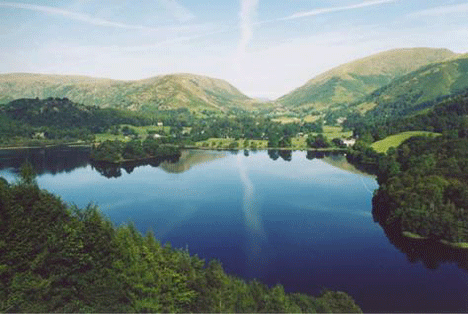
The road winds steeply up through bucolic countryside, some of the most spectacular in Britain. There are sheep bleating in the distant meadows. Then suddenly, you are out on the fell, stripped almost barren, black, empty. But still there are sheep, their wool the same smoky color as the landscape, dotted like the rocks that are scattered across these bleak tops, the hallmark of the storied Lake District. Then down we go again, past a stone-walled pub, up another hill, and we are pulling up in front of a whitewashed cottage straight from a Beatrix Potter film.
And indeed, that is where we are — in Potter country — about as far removed in atmosphere and idyll as it is possible to be from the ugly, industrial, and deadly blight that sits just a few miles away on the Cumbria shore. That would be the Sellafield nuclear fuel reprocessing facility, which spews radioactive waste into the sea, pumps it into the air, and has accumulated 140 tonnes of plutonium to absolutely no purpose.
A sheepdog runs out to greet us. A pair of elderly cats languish contentedly on a warm stone wall, basking in some late afternoon sunshine. Later, we are introduced to a small flock of Herdwick sheep who are “pets,” and a flock of pigeons, of which more later.
The people who live in the house are Janine Allis-Smith and Martin Forwood, the heart of the aptly named small activist group CORE — Cumbrians Opposed to a Radioactive Environment. They have dedicated more than three decades to challenging the continued operation of Sellafield and calling out the harm it has caused.
Martin and Janine, partners in life as well as activism, embody the longstanding and tenacious anti-nuclear fight in Cumbria, the most nuclear county in the United Kingdom. Without their watchdog vigilance and their educational advocacy, far less would be known about the dangers posed by the British nuclear industry, and particularly by the Sellafield reprocessing and nuclear waste site.
Martin and Janine have been at the heart of the struggle against the Sellafield operations since the mid-1980s. They have exposed the facility’s clandestine activities, especially emissions of radioactive wastes into the environment. For Janine, formerly from the Netherlands, this hit home especially hard when her own son was diagnosed with leukemia in 1983. He survived, but as Janine began to look into the issue, she found far too many other instances of childhood leukemias among children living close to Sellafield, many fatal.
The pair began to suspect that radioactive discharges from Sellafield were contaminating local beaches and tide pools where children loved to play. And, as Allis-Smith, recounted, “it was not just leukemia, but other cancers. Some were stillborn, while other suffered unexplained deaths at a very young age.”
This launched Janine and Martin on a relentless campaign to expose the on-going violations at the Sellafield site where radioactive discharges have made the Irish Sea one of the most radioactively contaminated bodies of water in the world. In 2017, CORE released a damning report which showed how, “during the 1995-2013 period, the radioactive discharges to the marine environment from Sellafield’s reprocessing facilities B205 (magnox) and THORP (oxide) have dominated those from all other UK facilities and are recognized as being the major contributor to the levels of radioactive substances recorded in the Irish Sea and wider oceans.”
Both Martin and Janine were new to the issue when they began their work. But they quickly educated themselves, then others. They perfected an ideal and complementary presentation style — with Martin offering a simple, lay explanation of reprocessing itself, then Janine describing its impact, especially on the health of children. They quickly moved hearts and minds in equal measure. Politicians, the media, and the public at large were forced to take notice.
Over the years, the pair have collected numerous mud samples from local beaches and estuaries that have been analyzed for radioactive contamination, confirming their suspicions.
The pair uncovered scandals involving illegal activities at the Sellafield site. They fought the THORP reprocessing plant, due to close permanently in 2018; the rash decision to develop a MOX fuel manufacturing plant, which closed after just 10 years of operation; and the global transport of radioactive materials.
In 1990 Martin gave his first guided “Alternative Sellafield Tour”, highlighting the spots where the reprocessing plant endangers the environment.
More recently, the pair were part of a successful effort to prevent the Nuclear Waste Agency NIREX from building a subterranean depository for British and international nuclear waste at the edge of the Lake District National Park.
Currently, they are at the forefront of the fight to block new nuclear power plants planned for Moorside adjacent to Sellafield. Their landmark 2015 report, “Moorside Build & Job Projections – All Spin and No Substance,” has proven an essential tool for the broad opposition to this deadly scheme.
The couple are not without a sense of fun either. In 2005, Martin made and delivered a radioactive “Pizza Cumbriana” to the Italian Embassy in London — Italy was shipping radioactive waste to Sellafield for reprocessing at the time. The box was marked “Best before 26005”, a reference to plutonium 239, which has a half-life of 24,400 years. The pizza was immediately seized by the Environment Agency, stored, then buried eight years later at the Drigg nuclear waste dump in Cumbria, adjacent to the Sellafield site.
Also buried as radioactive waste was the garden of two elderly ladies living along the sea front in the drab town of Seascale adjacent to the Sellafield plant. The sisters had devotedly fed flocks of pigeons who visited their garden — birds that also roosted on the Sellafiled roofs. After the guesthouse next door complained about excessive bird poop and called for the birds’ removal, the entire garden had to be excavated down to several feet and hauled away as radioactive waste. Martin and Janine took in a few of those pigeons. Their descendants still live with them today and appear each morning and evening on the garage roof for feeding time.
Last year, Forwood and Allis-Smith received some long-overdue recognition for their commitment to a safer, cleaner, greener environment when they received the Nuclear-Free Future Award in the category of Education, a prize that carries a $10,000 cheque, a rare and much needed boon in a movement largely deprived of meaningful or consistent funding. (Disclaimer, I nominated them for the award.)
The couple were unable to attend the ceremony, but wrote in a press release: “We are honoured to have received NFFA’s Education Award for 2017 and humbled to be joining the list of diverse and distinguished winners of the past. Since the 1980s, when Sellafield was preparing to double its commercial reprocessing activities, we have focused not only on acting locally but also being the ‘eyes and ears’ for the many interested parties world-wide on Sellafield and its many detriments which include site accidents, environmental contamination, health risks, plutonium stockpiles and nuclear transports.
“With decades of uniquely difficult decommissioning yet to come, and with plans for new-build at Moorside, we still have much to do and will face the challenges with the same determination that has seen us through the many highs and lows experienced over the last thirty years in our campaign against an industry we believe still has much to answer for.” (You can view their full acceptance remarks in the video higher up in this article.)
Stuff, LAURA WALTERS , June 28 2018, When the United States dropped the atomic bomb on Hiroshima in 1945, Taeko Yoshioka Braid watched from the second-floor window of herclassroom, 60 kilometres away.
Braid, who moved to New Zealand in 1956 and now lives in Hastings, travelled to Hiroshima the next day with classmates to look for her family members and take supplies to the victims.
Yoshioka Braid said it was hard to talk about the horrors she saw as a 13-year-old in Hiroshima, including children separated from their parents, and people dying from burns from the blast and the radiated water.
On her second trip to the town at the epicentre, she felt something sticking to her shoes. She eventually realised it was human skin, which had melted off, following the blast.
…….. At a time when the international rules-based order is being challenged, and nuclear weapons remain a global issue, Prime Minister Jacinda Ardern has reinstated the Cabinet portfolio of disarmament and arms control. Ardern announced Winston Peters would take up the ministerial role, during her first foreign policy speech in February. In September last year, New Zealand was one of the first countries to sign the Treaty on the Prohibition of Nuclear Weapons at a ceremony during the United Nations General Assembly.
The treaty is a landmark legally-binding international instrument prohibiting the use of nuclear weapons and related activities.
In July last year, it was adopted by the United Nations Conference to Negotiate a Legally Binding Instrument to Prohibit Nuclear Weapons, Leading Towards their Total Elimination.
Yoshioka Braid’s comments came during the international treaty examination, at a Foreign Affairs, Defence and Trade Select Committee hearing on Thursday. Something that needed to take place before New Zealand ratified the treaty.
“If anyone went there the day the bombed dropped, I’m sure they would all think like me: never again…
“I don’t want those same sorts of things to happen anywhere in the world; anywhere in the world.”
Alternative NZ submission by stuffnewsroom on Scribd….(included on original) ..
It was difficult to describe the experience, she said, adding that the bomb was so strong, some people died instantly, others were alive but too injured to move or talk.
Her daughter, Jacky Yoshioka Braid said New Zealand needed to take a leadership role in the elimination of nuclear weapons.
“We need to stop the fighting, and stop this fantasy around a nuclear war that we possibly could survive – it won’t happen.
“We saw what happened in Hiroshima, we’ve seen the after effects of what happened there and in Nagasaki. They were tiny compared to what could happen today.”
New Zealand created a world-leading anti-nuclear policy in 1984, after seeing what happened in Hiroshima, Nagasaki and the cold war years.
Because while science cannot be certain, common sense tells us why successive governments did not test these terrible new weapons in the skies over Britain. Yet for 60 years governments of every stripe denied, ignored or failed our nuclear heroes.
Sixty years ago, Britain sent thousands of men to the middle of the South Pacific and ordered them to take part in one nuclear explosion after another.
Our National Servicemen went to Christmas Island and built a runway, a hospital, and officers’ mess. They put up tents, fuel tanks and refrigeration units. Then they were told to watch as RAF crews dropped hydrogen bombs, and they say the only care taken was to tell them to cover their eyes.
Thirty years ago those men got together and the Mirror told their stories: of leukaemia, rare cancers, miscarriages, birth defects. Of troubled wives and sick children. Of ground crew allegedly contaminated washing down the planes, Royal Engineers who fell sick after collecting bomb-damaged equipment, strapping navy stevedores suddenly struck down by ill health. They fought long court battles, to no avail.
Twenty years ago research from Durham University found evidence that 1 in 3 of the nuclear veterans had bone cancer or leukaemia, and that twice as many veterans had multiple myeloma than successive British governments had admitted.
Eleven years ago research in New Zealand showed survivors of British tests had the same rate of genetic damage as survivors of the Chernobyl nuclear accident. Ten years ago the Isle of Man Tynwald voted to give 8 of its residents, who were nuclear veterans, £6,000 each in recognition of their service. Five years ago those who still survived and their families marched – with walking sticks and wheelchairs – on Downing Street demanding recognition. Not money: just recognition.
Today, of the 22,000 who saw those tests, just 1,500 survive. I met one of them, a West Bromwich born-and-bred gentleman called John Ward, when he came to Parliament to see me. You can see the video of our chat on the Mirror website. I already knew a little of his story but was stunned to learn that in that powerful flash of light from the bomb’s explosion he saw the bones in his hands as though in an X-ray.
And it was incredibly moving to hear him talk of the troubles his family has suffered since. John went on to work for the Wolverhampton Express & Star, the Birmingham Post and later for the government itself in the Cabinet Office, but meanwhile his wife Margaret had difficult pregnancies and a miscarriage, John and his son Mark both recently had tumours removed from their kidneys, and his daughter Denise is, in his words, “a medical mess”.
What struck me about John was his bravery and dignity in the face of terrible experiences, and that he – quite wrongly – holds himself to blame. That because he was ordered into danger, he feels guilt for the problems suffered by his family. Nobody should have to bear that burden.
But there are not many people like John who feel that worry, because most have died. Thousands of men who were the fittest the British armed forces could find to take part in experiments vital to this nation’s future safety and security have passed away many years before they were expected to.
And still they cannot prove what, if anything, happened to them. The records of the time are missing or incomplete, science is simply unable to link genetic changes definitively to radiation from a bomb, and there are so few veterans left it is hard for scientists to find suitable subjects to help them find that silver bullet.
But there is, nevertheless, something we can do. And something we SHOULD do.
Because while science cannot be certain, common sense tells us why successive governments did not test these terrible new weapons in the skies over Britain. Yet for 60 years governments of every stripe denied, ignored or failed our nuclear heroes. We let people like John, and their families, feel ashamed of something that was never their fault. It is a stain on our nation’s record that for so long we asked these men for proof of what was done to them, when all most of them ever wanted was our thanks for doing it.
Now four survivors of those tests have returned to the Pacific proving grounds to bear witness once again. It has been 60 years since they helped Britain to do the improbable, and now it is time for us to repay that debt. Regardless of whether or not these men, or their children, have suffered ill effects as a result of the nuclear tests it is time the nation honoured their service. A medal from the nation would go a long way to healing some of their wounds.
Hibakusha Shigeaki Mori, an 81-year-old historian, spent years researching and identifying the 12 American soldiers who were killed during the bombing of Hiroshima. He was reunited at the ceremony with a relative of one of the fallen POWs, Normand Brissette of Lowell, Massachusetts.
In a speech, Mori said Brissette was a true patriot who risked his life to fight for his country. Brissette was a naval officer who was taken prisoner and died from radiation poisoning in the days following the bombing.
Susan Archinski, a niece of Brissette, said her reunion with Mori is “emotional because he is a wonderful, wonderful man and his wife is a wonderful woman. Mori-san is (the) best. Very pleased.” The two had met once before, in Hiroshima in 2015.
Mori was 8 years old at the time of the world’s first atomic bombing. He was blown off a bridge near his school at 8:15 a.m. on Aug. 6, 1945, 1½ miles (about 2.5 km) from ground zero in Hiroshima.
After 42 years of research, Mori found each soldier’s name and tracked down their next of kin to obtain permission to memorialize the 12 POWs on the cenotaph for A-bomb victims in Hiroshima among the more than 300,000 Japanese, Korean and Chinese victims.
Mori is visiting the United States for the first time. He attended screenings of the film “Paper Lanterns,” a documentary about his research into the U.S. POWs, in California and will attend more screenings of the film in Boston and at the United Nations in New York.
The 2016 documentary, which the filmmakers hope to release digitally this summer, caught the attention of former U.S. President Barack Obama shortly after its limited release.
Obama, who in May 2016 became the first sitting U.S. president to visit Hiroshima, mentioned Mori in his speech at the Peace Memorial Park as “the man who sought out families of Americans killed here because he believed their loss was equal to his own.” Afterward, Obama and Mori shared an embrace that garnered international attention.
The Growing Dangers of the New Nuclear-Arms Race, The Trump Administration’s push for more nuclear weapons is part of a perilous global drive to miniaturize and modernize devices that already promise annihilation. New Yorker, By Eric Schlosser, 24 May 18, “…….On the morning of August 6, 1945, Setsuko Thurlow, then thirteen years old, was preparing to decode messages on the second floor of the Army headquarters in Hiroshima. About twenty girls from her school worked beside her, and thousands of other middle schoolers were employed at patriotic tasks throughout the city as part of the Student Mobilization Program. Thurlow noticed a bright bluish-white flash outside the window at 8:15 a.m. She never saw the mushroom cloud; she was in it. She felt herself fly through the air, blacked out, and awoke pinned in the rubble of the collapsed building, unable to move. Lying there in silence and total darkness, she had a feeling of serenity. And then she heard the cries of classmates trapped nearby: “God, help me!,” “Mother, help me!” Someone touched her, removed the debris on top of her, and told her to crawl toward the light.
She somehow made it out safely and realized that what was left of the headquarters was on fire. A half dozen or so other girls survived, but the rest were burned alive.
The smoke and dust in the air made the morning look like twilight. As Thurlow and a few classmates left the city center and walked toward the hills, they witnessed one grotesque scene after another: dead bodies; ghostly figures, naked and burned, wandering the streets; parents desperately searching for lost children. She reached an Army training ground in the foothills, about the size of two football fields. Every inch of ground was covered with wounded people begging for water. There seemed to be no doctors, no nurses, no medical help of any kind. Thurlow tore off strips of her clothing, dipped them in a nearby stream, and spent the day squeezing drops of water from them into the mouths of the sick and dying. At night, she sat on the hillside and watched Hiroshima burn.
Thurlow was reunited with her parents. But her sister and her sister’s four-year-old son died several days later. Her sister’s face had grown so blackened and swollen that she could only be recognized by her voice and her hairpin. Soldiers threw her body and that of her son into a ditch, poured gasoline on them, and set them on fire. Thurlow stood and watched, in a state of shock, without shedding a tear. Her favorite aunt and uncle, who lived in the suburbs outside Hiroshima and appeared completely unharmed, died from radiation poisoning a few weeks after the blast.
More than seven decades later on the afternoon of December 10, 2017, I watched Thurlow accept the Nobel Peace Prize on behalf of the International Campaign to Abolish Nuclear Weapons (ican). It was a remarkable moment, as she slowly walked to the podium with a cane, and the crowd in Oslo’s City Hall gave a standing ovation. After the bombing, Thurlow attended universities in Hiroshima and Lynchburg, Virginia. Later, she earned a master’s degree in social work at the University of Toronto. She married a historian and settled in Canada. She began her anti-nuclear activism in 1954, and became a leading advocate for survivors of the atomic bombings, known as the hibakusha. A few years ago, I spent time with her in Stockholm, meeting with academics and legislators to discuss the nuclear threat. In her early eighties, she was sharp, passionate, tireless, and free of bitterness. “Today, I want you to feel in this hall the presence of all those who perished in Hiroshima and Nagasaki . . . a great cloud of a quarter of a million souls,” Thurlow said in her Nobel speech. “Each person had a name. Each person was loved by someone. Let us insure that their deaths were not in vain.”………..https://www.newyorker.com/news/news-desk/the-growing-dangers-of-the-new-nuclear-arms-race
(Mainichi Japan) HIROSHIMA — In a room filled with the gentle spring sunshine at the city hall in the Nishi Ward of this city in the beginning of April, 93-year-old Sunao Tsuboi met Mayor Kazumi Matsui with a smile.
For his work campaigning for the abolition of nuclear weapons and support for other survivors of the 1945 U.S. atomic bombings, or “hibakusha,” Tsuboi was recognized as an honorary resident of Hiroshima in March, and on April 5, 2018, went to formally receive the title from Mayor Matsui at the municipal government.
“While my time left on Earth may be short, I will continue to be true to my name and ‘honestly’ work toward making a peaceful world with everyone until I burn up from my ardent passion,” said Tsuboi, whose given name is a homonym for “honesty” in Japanese. He made his fiery declaration with a mischievous expression after the medal with its green and white ribbon was draped around his neck. The audience then burst into applause…….. https://mainichi.jp/english/articles/20180515/p2a/00m/0na/017000c
FT 15th May 2018 ,I wish I had known Serhii Plokhy was writing this book. I would have told
him why the Chernobyl disaster is an indelible part of my life. When the
nuclear plant’s fourth reactor exploded in the early hours of Saturday,
April 26 1986, I was 130km away in Kiev. A Moscow-based reporter for
Reuters news agency, I was spending the weekend in the Ukrainian capital
with a friend who taught at Kiev university under a British Council
programme.
Like almost all the city’s 2.5m residents, we knew nothing about
the accident, the world’s worst nuclear disaster. Until the evening of
Monday April 28, the Kremlin held to its unforgivable decision to keep
Soviet citizens and the world in complete darkness. All that time,
radiation was spreading far beyond the stricken reactor. For the first few
days, the strongest winds blew to the north-west, so anyone in Kiev – which
is south of Chernobyl – got off relatively lightly.
However, when I returned to Moscow and underwent a radiation check at the US embassy, the
Geiger counter went beep-beep-beep, registering abnormal levels on my
clothes. Before my eyes an embassy official tossed my jeans into an
incinerator. Plokhy, a Harvard professor of Ukrainian background, is
ideally placed to tell the harrowing story of Chernobyl. He is the first
western-based historian to make extensive use of Chernobyl-related material
in Communist party, government and, especially, KGB security police
archives that became available after Ukraine’s 2014 pro-democracy
revolution. https://www.ft.com/content/f7101e6a-4eeb-11e8-9471-a083af05aea7
Why do we desperately need to listen to voices from the heart?
The corporate dominated world does not like to hear voices from the heart. Oh no, there must be no emotion. We must all stick to technical jargon, statistics, the “accepted” facts, in appropriately respectable academic language.
Of course statistics, facts, and technical language have their place in the nuclear-free movement. But as long as the anti-nuclear voices remain boring, the corporate global empires do not need to worry.
This voice came as a comment today on our sister ship antinuclear.net
Jan – Janotine@asia.com– 6 May 18-My grandad was half kiowa. His father married a native american lady, to expand his spread. She was his last wife. The other two died in child-birth. All, so he could have more slave kids to work his spread. May grandad ran away from home at age 12.
I am a westerner. I used to think the west was so grand! My family is from the west. Places like Utah, Arizona, Nevada, New Mexico, Washington, Oregon, Idaho, and yes parts of California.
Later, i realized, our frikin government, used the west as a sacrifice zone for open air nuclear bomb testing, biological and chemical warfare testing, uranium mining and processing, nuclear bomb testing.
I have been to every native nation in the west and, most in Alaska as a professional. No sane person thinks the anglos did the west any favors!
People ask me if natives or, even anglos are better off from the europeans coming in and taking america. The anglos used their rascist-Monroe Doctrine, as an excuse for the environmental destruction and genocides of the once pristine, western United States!
In the end, is the west better off? Hell no! They ruined turtle island, and the whole northern hemisphere with their insanity!
Shockley was the dumnest, white rascist ever! He might have helped invent transisters, but the genetics of Europeans and Americans are forever ruined, by the white evil-war-monkey obession, with the magic rocks.
There are very few radionuclide toxicologists in the world because, of the nuclear cosa nostra. Radionuclides are a billion times more genotoxic, teratogenic, mutagenic, carcinogenic, than the most dangerous manmade-mutagenic, chemicals, like agent orange.
Anything factual about radionuclides is verboten! Environmental health professionals, are pariahs in the war-monging, capitalist-paradigm. Health physics is nuclearist propaganda. Superior Northern-European culture and technology, is a sick-cosmic-joke.
The northern europeans culture, with it’s insane blood-lust and psychopathy, has made Europeans genetically inferior and, That’s a Fact Jack! That is the cruel irony
Two Long Island sisters who were exposed to radiation at Chernobyl in 1986 are urging others exposed to get checked for various types of cancer.
In 1986, Rebecca Sanders and Jennifer Fogarty were in western Germany with their father, who was in the military when Chernobyl exploded. Both were exposed to radiation.
The sisters want to get the word out that those who were exposed to radiation in 1986 should still be checked.
Sanders is now fighting stage 4 bladder cancer and Fogarty has thyroid disease.
Fogarty says that the military did not alert people who lived there at the time of the accident.
“They did not tell us anything for 10 days, and then after that it was martial law for 30 days where we had to stay inside. We could still go to school, and then after the 30 days, we were cleared to be outside and we were told we would be OK and we’re not,” says Sanders.
Fogarty says she and her sister want everyone to know that if they were in western Europe in 1986 when Chernobyl exploded, they are at very high risk of thyroid and or bladder cancer. She says that both are curable, but people need to get checked and treated.
Fogarty says there are many studies done in Germany that show a link between the Chernobyl incident and people getting sick.
Thursday marks the 32nd anniversary of Chernobyl, the world’s worst nuclear accident.
Saruhashi, born in Tokyo in 1920, lived through World War II as a young adult. Global events undoubtedly shaped her field of research.
Katsuko Saruhashi’s pioneering work
After graduating from Toho University (formerly the Imperial Women’s College of Science) in 1943, she went on to study carbon dioxide in ocean water at the Meteorological Research Institute. In 1957, she became the first woman in Japan to earn her PhD in chemistry from the University of Tokyo.
Few researchers were interested in studying carbon-dioxide levels in water when Saruhashi embarked on her work, which ended up being instrumental for decades. She penned the formula that would allow scientists to determine the amount of carbonic acid in oceans—now one of the hallmark measures of climate change—by hand. Now, researchers use computers for that task.
Saruhashi also studied the amount of radioactive isotopes of elements in seawater following nuclear- bomb test detonations. Working at the Central Meteorological Observatory, she found that tiny radioactive particles floating in the ocean waters along the coast of Japan resulting from the 67 nuclear explosions the US detonated in the Marshall Islands. “There was a controversy over her argument that the radioactive fallout in seawater was more than what they used to think,” Toshihiro Higuchi, a historian at Georgetown University, told the Verge.
Scientists at the US Atomic Energy Commission quickly became interested in her work, and invited Saruhashi to work at the Scripps Institution of Oceanography at UC San Diego to compare US methods of measuring these radioactive isotopes to those used by the Japanese. It wasn’t entirely a friendly working environment: One of her American male colleagues, Theodore Folsom, told her that there was no need for her to come into the office daily, and that instead she should work out of an isolated wooden hut (pdf, p. 4).
Nevertheless, Saruhashi persisted. Her analyses of radioactive isotopes were essentially identical to Folsom’s, despite her inferior working conditions.
Saruhashi became a beacon for women in science
Saruhashi became an advocate for her fellow female scientists and for world peace. In 1958, she co-founded Society of Japanese Women Scientists, and in 1981 established a prize in her name awarded annually to young Japanese female scientists for their excellence in research and mentorship. In 1980, she became the first woman elected to the Science Council of Japan, and went on to receive the Miyake Prize for geochemistry and the Tanaka Prize from the Society of Sea Water Sciences.
She died in September 2007, and her legacy as a scientist, pacifist, and feminist lives on. “I wanted to highlight the capabilities of women scientists,” she said. “Until now, those capabilities have been secret, under the surface.”
NGO Safecast co-founder Pieter Franken explains to schoolgirls how to assemble a Geiger counter kit in their classroom in Koriyama City, Fukushima Prefecture.
Tracking Fukushima’s radiation , https://www.shine.cn/feature/lifestyle/1803181780/Source: AFP Editor: Fu RongBeneath the elegant curves of the roof on the Seirinji Buddhist temple in Japan’s Fukushima region hangs an unlikely adornment: a Geiger counter collecting real-time radiation readings.
The machine is sending data to Safecast, an NGO born after the March 2011 Fukushima nuclear disaster that says it has now built the world’s largest radiation dataset, thanks to the efforts of citizen scientists like Seirinji’s priest Sadamaru Okano.
Like many, Okano lost faith in the government after the nuclear meltdown seven years ago.
“The government didn’t tell us the truth, they didn’t tell us the true measures,” he said.
Okano was in a better position than most to doubt the government line, having developed an amateur interest in nuclear technology 20 years earlier after the Chernobyl disaster. To the bemusement of friends and family, he started measuring local radiation levels in 2007.
“The readings were so high, 50 times higher than natural radiation,” he said of the post-disaster data. “I was amazed. The news told us there was nothing, the administration was telling us there was nothing to worry about.”
That dearth of trustworthy information was the genesis of Safecast, said co-founder Pieter Franken, who was in Tokyo with his family when disaster hit. Franken and friends had the idea of gathering data by attaching Geiger counters to cars and driving around.
“Like how Google does Street View, we could do something for radiation in the same way,” he said. “The only problem was that the system to do that didn’t exist and the only way to solve that problem was to go and build it ourselves. So that’s what we did.”
Within a week, the group had a prototype and got readings that suggested the 20-kilometer exclusion zone declared around the Fukushima plant had no basis in the data, Franken said.
“Evacuees were sent from areas with lower radiation to areas with higher radiation” in some cases, he said.
The zone was eventually redrawn, but for many local residents it was too late to restore trust in the government.
Okano evacuated his mother, wife and son while he stayed with his flock.
A year later, based on his own readings and after decontamination efforts, he brought them back. He learned about Safecast’s efforts and in 2013 installed one of their static counters on his temple.
“I told them: ‘We are measuring the radiation on a daily basis… so if you access the (Safecast) website you can choose (if you think) it’s safe or not’.”
Norio Watanabe has been a Safecast volunteer since 2011. In the days after the disaster evacuees flocked to Koriyama, which was outside the evacuation zone. He assumed his town was safe.
He sent his children away, but stayed behind to look after his mother, a decision he believes may have contributed to his 2015 diagnosis of thyroid cancer.
“As a scientist, I think the chance that it was caused by the Fukushima accident might be 50-50, but in my heart, I think it was likely the cause,” he said.
His thyroid was removed and is now healthy, but Watanabe worries about his students, who he fears “will carry risk with them for the rest of their lives.”
“If there are no people like me who continue to monitor the levels, it will be forgotten.”
Safecast now has around 3,000 devices worldwide and data from 90 countries. Its counters come as a kit that volunteers can buy through third parties and assemble at home.

 Walthamstow Guardian 18th Aug 2018, A prominent anti-nuclear campaigner has died, aged 90. Sarah Hipperson of
 Children were dying. They took action The British campaigners who shed light on deadly nuclear fuel reprocessing https://wordpress.com/read/feeds/72759838/posts/1909887908, By Linda Pentz Gunter 1 June 18
 Why do we desperately need to listen to voices from the heart?
 Sisters urge those exposed to Chernobyl radiation to get cancer checks http://longisland.news12.com/story/38020663/sisters-urge-those-exposed-to-chernobyl-radiation-in-1986-to-get-cancer-checks Apr 24, 2018 WESTBURY –


 nuclear-news