Hard duty in the Chernobyl zone, Life as a liquidator after the 1986 nuclear disaster
Cathie Sullivan, a New Mexico activist, worked with Chernobyl liquidator, Natalia Manzurova, during three trips to the former Soviet Union in the early 2000s. Natalia was one of 750,000 Soviet citizens sent to deal with the Chernobyl catastrophe.Natalia is now in her early 60s and has long struggled with multiple health issues. She was treated last year for a brain tumor that was found to be cancerous. A second tumor has since been found and funds were recently raised among activists around the world to help with the costs of this latest treatment. Natalia and Cathie together authored a short book, “Hard Duty, A woman’s experience at Chernobyl” describing Natalia’s harrowing four and a half years as a Chernobyl liquidator. What follows is an excerpt from that book with some minor edits.
By Natalia Manzurova
When I tell people that I was at Chernobyl they often ask if I had to go. My training is in radiation biology and I was born in a city that was part of the secret Soviet nuclear weapons complex, much like Los Alamos, New Mexico, where the first A-bomb was built. People from my city considered it a duty to go to Chernobyl, just as New York City firefighters went to the World Trade Center on 9/11.
Because of the radiation danger to women of child-bearing age, those under 30 did not go, but being 35 in 1987, I began my 4.5 years of work at Chernobyl. ………..
Sad experiences
In 1987, when I first arrived at Chernobyl, my group of about 20 scientists from the Ozyersk radio-ecology lab started a Department of Environmental Decontamination and Re-Cultivation. We used a 10-acre greenhouse complex for our plant studies, built before the accident, and for office space we used an empty, nearby kindergarten……..
Like many liquidators I ‘wear’ a ‘Chernobyl necklace’, the scar on the lower throat from thyroid-gland surgery.* While working in the exclusion zone I experienced slurred speech, memory loss and poor balance. One of my bosses and I realized that we were forgetting appointments and obligations and agreed to help each other remember who, what, where and when. I had severe amnesia for a time and read letters I wrote my mother to help fill in forgotten years.
The Chernobyl accident is not over, in fact its damaging effects on people and the land will only taper off slowly for generations—lingering harm that is almost certainly unique to nuclear accidents.
Natalia Manzurova, with fellow Russian activist, Nadezhda Kutepova, was awarded the 2011 Nuclear-Free Future Award in the category of Resistance.
Nuclear Weapons Ruined My Life, and I Wouldn’t Have It Any Other Way
As someone deeply embedded in a life of anti-nuclear resistance, I know the only way to get rid of these weapons is to never stop thinking about them April 21, 2019 byWaging Nonviolence by Frida Berrigan ………. I want to tell you a different story about nuclear weapons: My own.
It comes through the lens of the nuclear fire and my relationships to the people who serve as a sort of bucket-brigade ………–
As our mother approaches and passes 70, we — like many people our age — start encouraging her to take it easy, give up the rigors of community life and resistance, the constant hosting and demonstrating. We envision and invite her to live a life with her grandchildren, stories, bedtimes, sporting events and art projects. We have room, we all say.She goes in the exact opposite direction. With others taking the reins at Jonah House, she feels free for the first time since our father’s death to be a Plowshares activist again, to conspire with her friends and to plan for a rigorous and daring action.
We don’t know the specifics, but as all her answers about the future muddle into a very specific kind of vagueness, we know exactly what is going on.
“Please don’t,” we say. “You are too old,” we say. “Think of your grandkids,” we say.
“I will. I’m not. I am. This is what I have to give.”
April 4, 2018
It was just three days after my 44th birthday, which was also Easter — again. We received word of a new plowshares action. Seven Catholic activists entered Kings Bay Naval Submarine Base in St. Mary’s, Georgia. They went to make real the prophet Isaiah’s command to “beat swords into plowshares.” The seven chose to act on the 50th anniversary of the assassination of Martin Luther King, Jr., who devoted his life to addressing what he called the “triple evils of militarism, racism and materialism.” Carrying hammers and baby bottles of their own blood, the seven attempted to convert weapons of mass destruction. They hoped to call attention to the ways in which nuclear weapons kill every day, just by their mere existence and maintenance. They are charged with three federal felonies and one misdemeanor for their actions. They could face 25 years in prison if convicted on all counts. And there they still are. Three — my mom, Father Steve Kelly and Mark Colville — remain in county jail almost a year later. They still do not have a trial date. The other four are out on bond, wearing ankle monitors and are required to check in with their minders at regular intervals.
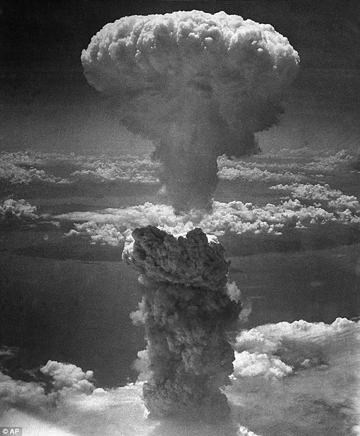
The Kings Bay Naval Station is home to at least six nuclear ballistic missile submarines. Each carries 20 Trident II D 5 MIRV thermonuclear weapons. Each of these individual Trident thermonuclear weapons contains four or more individual nuclear weapons ranging in destructive power from a 100 kilotons to 475 kilotons. To understand the massive destructive power of these weapons remember that the nuclear bomb dropped on Hiroshima was a 15 kiloton bomb.
My mother feels very useful in jail — generous, empathetic and calm in a place that encourages none of those qualities.
The wheels of justice grind very slowly in Georgia particularly because the activists are mounting a creative legal defense. They seek to portray their actions as protected under the freedom of religion, using the Religious Freedom Restoration Act, which allowed the homophobic cake makers to not make a cake for a gay couple. They are seeking to demonstrate their “deeply held religious beliefs” and how the practice of their religion has been burdened by the government’s response to their actions. The Religious Freedom Restoration Act requires the government to take claims of sincere religious exercise seriously.
Please keep them in thought and prayer.
Just a few months before they acted, the Bulletin of the Atomic Scientists moved the clock again — this time to 2 minutes to nuclear midnight, saying, “This is a dangerous time, but the danger is of our own making. Humankind has invented the implements of apocalypse; so can it invent the methods of controlling and eventually eliminating them.”
The clock has never been closer to nuclear midnight in my lifetime. All the work, all this sacrifice, and the clock keeps moving closer to midnight.
My mom’s action and extended incarceration pre-trial come as nuclear conflagration seems more likely. Nuclear weapons do not even rate in the list of top 10 fears that Americans are questioned about every year.
Putin and Trump have shredded the imperfect and imbalanced but nevertheless important fabric of nuclear arms control treaties. Putin claims that Russia is developing a new class of “invincible” nuclear weapons, including a cruise missile that can reach anywhere in the world.
The Pentagon signaled recently that the United States would begin tests on a couple of types of missiles. And just to make things truly terrifying, Anthony Cordesman of the Center for Strategic and International Studies says that in response to U.S. and Russian actions, China is improving its own nuclear arsenal.
Searching for signs of hope to counter as a bulwark against these mounting fears, I hold close the work of the International Campaign to Abolish Nuclear Weapons, or ICAN. It developed the Treaty on the Prohibition of Nuclear Weapons and is now building a global civil society coalition to promote adherence to and full implementation of the nuclear weapons ban. ICAN received the 2017 Nobel Peace Prize “for its work to draw attention to the catastrophic humanitarian consequences of any use of nuclear weapons and for its ground-breaking efforts to achieve a treaty-based prohibition of such weapons.” I draw hope from that movement.
Nuclear weapons ruined my life. I am never not thinking about them. Nuclear weapons are present in my most mundane tasks. Nuclear weapons are present in all my major relationships. Every goodbye and hello is freighted with uncertainty.
They have shaped how I think about time. Nuclear weapons have caused me to honor and treasure the present. They have made the future provisional, muted, not taken for granted. I try to be present to the present and hold the future loosely, but with hope.
Post-Fukushima, Japan turns against nuclear power, Witf, by Susan Phillips/StateImpact Pennsylvania | Mar 29, 2019 In Fukushima, farmers and residents put their stock in solar
(Futaba, Japan) — The partial meltdown at Three Mile Island nuclear power plant in central Pennsylvania 40 years ago in March did not lead to large releases of radiation, but it helped turn public opinion away from nuclear energy. In Japan, an even more catastrophic nuclear disaster occurred eight years ago this month. And like many Pennsylvanians, the Japanese have largely turned against nuclear.
The earthquake, tsunami and nuclear meltdown is known in Japan as simply “March 11.” And everyone knows where they were on March 11, 2011.
Yuji Onuma was in the town of Futaba, where he grew up and was living with his wife, who was pregnant with their first child. Their home was about 3 or 4 kilometers from the Daiichi nuclear power plant.
But right now, he’s living away from the coast in another prefecture, and he says he wants to settle in a town that is about as far away from any of Japan’s 54 nuclear power plants as he can possibly be.
During an interview, Onuma showed a picture of when he was about 12 years old and getting an award from the Mayor of Futaba. A teacher had asked the kids to come up with a town slogan. In a place where everyone depended on the nearby nuclear plant for work, Onuma’s entry won:
“Atomic power: energy for a bright future” became the slogan on an archway over Futaba’s main street.
“I was very proud because this is my first ever award by the town,” Onuma said through a translator. “And all the town people praised me and said, you are very great. So I was so proud of that.”
Then he showed another photo. It’s only a few months after the accident, and no one is left living in Futaba. This time, he’s wearing a protective Tyvek suit and mask, he’s standing below the sign holding up a placard that changes his slogan to:
Katsuko Saruhashi made waves internationally when she tracked and raised a global alarm on the dangers of nuclear testing by the U.S. Pacific Standard, LAURA MAST, MAR 22, 2019
Determining the measure of a great scientist is a challenge. Is it an enormous contribution to science, noted by awards and distinctions? Publications in peer-reviewed journals or keynotes at conferences? Serving as an expert to governments, effecting change on national and international policy? Or can this measure be more granular: beyond being a role model, to be present and provide sustaining mentorship, lifting up others?
No matter how you slice it, Katsuko Saruhashi is one such great scientist, and a woman who certainly lived up to her name, which translates to strong-minded or victorious in Japanese. Not only did she conduct groundbreaking research—developing the first method to measure carbon dioxide levels in seawater—but her work also made waves internationally, as she tracked and raised a global alarm on the dangers of nuclear testing. Throughout her 35-year career as a geochemist, she collected numerous awards and led the way for women to follow her in science……….
After graduating in 1943 with her undergraduate degree in chemistry, Saruhashi joined the Geochemistry Laboratory at the Meteorological Research Institute (now called the Japan Meteorological Agency). There, she studied not rain, but oceans, specifically carbon dioxide (CO) levels in seawater. Saruhashi developed the first method for measuring CO using temperature, pH, and chlorinity, called Saruhashi’s Table. This method became a global standard. Perhaps more importantly, she discovered that the Pacific Ocean releases more carbon dioxide than it absorbs: a concept with dire consequences today as the climate changes.
Saruhashi also led the way in studying ocean-borne nuclear contamination. Although World War II had ended years before, the United States continued to carry out nuclear tests, particularly in the Pacific Ocean near Bikini Atoll, 2,300 miles southwest of Japan. After several Japanese fishermen became mysteriously ill while out trawling downwind of the testing site in March of 1954, the Japanese government asked Saruhashi and her colleagues at the Geochemical Laboratory to investigate.
…….Saruhashi and her team ultimately found nuclear fallout didn’t travel evenly throughout the ocean. They tracked ocean circulation patterns using radionuclides, discovering that currents pushed radiation-contaminated waters clockwise, from Bikini Atoll northwest toward Japan. As a result, fallout levels were much higher in Japan than along the western U.S.
Their results were stunning: the radioactive fallout released in the testing had reached Japan in just 18 months. If testing continued, the entire Pacific Ocean would be contaminated by 1969, proving that nuclear tests even conducted out in the middle of the ocean, seemingly in isolation, could have dangerous consequences.
This data, unsurprisingly, sparked controversy, and the U.S. Atomic Energy Force ultimately funded a lab swap, bringing Saruhashi to the Scripps Institute of Oceanography to compare the Japanese technique for measuring fallout with the American method, developed by oceanographer Theodore Folsom. Her method turned out to be more accurate, settling the science and providing the critical evidence needed to bring the U.S. and Soviet Union in agreement to end above-ground nuclear testing in 1963: an amazing accomplishment at the height of the Cold War. Saruhashi returned to Japan and later became the executive director of the Geochemical Laboratory in 1979. …….
Brave Russian naval officer who saved world from nuclear bomb during Cuban Missile Crisis should be as famous as US astronaut Neil Armstrong, Th Irish Sun,
Isn’t it amazing we have this man Vasili Arkhipov, who basically saved the world from annihilation, and virtually no one knows his name
By Mark May, 19th February 2019, “………. in real life on a Russian submarine in 1962.
A group of US Navy destroyers and an aircraft carrier enforcing the blockade against Cuba trapped a B-59 Russian submarine, which the US didn’t know was armed with nuclear weapons.
They began to drop depth charges to force the submarine to surface for identification.
The captain of the Russian sub Valentin Savitsky, believing that a war may have already started, prepared to launch a ten kiloton nuclear torpedo against the American warships.
According to a US National Security Archive report, Savitsky exclaimed: “We’re gonna blast them now! We will die, but we will sink them all — we will not become the shame of the fleet.”
As is procedurally required, all the senior officers on board must agree before a nuclear bomb could be launched.
The captain and the political officer agreed to launch but Vasili Arkhipov, the second-in-command, disagreed. A heated argument ensued during which Arkhipov persuaded the captain to surface the ship and await orders from Moscow. It turned out there was no war.
A nuclear holocaust on an unimaginable scale was averted and countless lives were saved thanks to Arkhipov.
Thomas Blanton, of the National Security Archive at George Washington University, told the Boston Globe: “The lesson from this is that a guy called Vasili Arkhipov saved the world.”
Arkhipov was not reprimanded by the Russian navy for his actions.
In fact, he was later promoted to rear admiral and went on to become the head of the Kirov naval academy and retired as a vice admiral.
Gene Eisman, Washington Post 1st Feb 2019. In 1979, I was working for a member of the Pennsylvania
governor’s Cabinet and lived in Harrisburg, Pa., a few miles from the
Three Mile Island nuclear plant. When one of the reactors melted down, I
saw real panic as state workers left their offices to pick up their
children at school. I spent several days in the state’s underground
emergency command facility during the crisis, talking to the Federal
Emergency Management Agency in Washington, providing it with real-time
updates on the situation. Having been through that, I believe that
Mr. Gates’s idea to build new nuclear power plants would be the height
of folly, any claims he makes notwithstanding. https://www.washingtonpost.com/opinions/i-lived-through-three-mile-island-new-nuclear-plants-are-a-bad-idea/2019/02/01/3e15b3e8-2573-11e9-b5b4-1d18dfb7b084_story.html
Ground Zero Nagasaki: Living the nuclear past – and future, Asia Times, By SUSAN SOUTHARDJANUARY 18, 2019 “…………….Hibakusha stories
It’s essential for us to remember such grim details, not just for the sake of history, but for our future, because nuclear weapons far more powerful and devastating than the Nagasaki bomb are now commonplace.
In a small area of Nagasaki that includes Hypocenter Park, the Nagasaki Atomic Bomb Museum, and Peace Park, dedicated teams of Japanese men and women still work tirelessly to counter the world’s inclination to forget what happened. For the past 35 years, one organization, the Nagasaki Foundation for the Promotion of Peace, has assembled cadres of hibakusha speakers – typically about 40 at any time – willing to tell their stories. They are now aging women and men with unique memories of the day of that bombing and the weeks, months and years that followed.
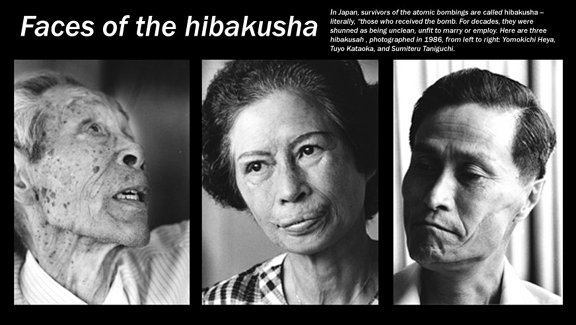
Sixteen-year-old Taniguchi Sumiteru was delivering mail on his bicycle about a kilometer and a half from the hypocenter when, a split-second after the bomb detonated, its tremendous force and searing heat blew him off his bicycle and slammed him face-down on to the road. His entire back was burned off. By all rights, he should never have survived. Three months later, he finally received medical treatment. Still in constant pain 10 years after the bombing, he became one of Nagasaki’s earliest anti-nuclear activists.
Wada Koichi, an 18-year-old streetcar driver at the time of the bombing, decided to speak out when he held his first grandchild and flashed back to the charred corpse of a baby he’d stepped over as he searched for his missing colleagues.
Do-oh Mineko, then 15, suffered critical injuries to her head and lingered near death for months. Though those injuries eventually healed, radiation exposure had caused all her hair to fall out. For nearly a decade, she hid in her house until her hair finally grew back. As an adult, she kept her identity as a hibakusha secret until, in her late 60s, she found new meaning for her life by telling her story to schoolchildren.
Yoshida Katsuji, only 13, was looking up in the direction of the bomb at the moment it exploded. His entire face was scorched. Years later, as friends and colleagues told their stories publicly, he remained silent, afraid of looks of disgust from audiences due to his disfigurement. He finally began speaking out in his late 60s after deciding that being shy was not a good reason to keep silent when it came to the terrorizing impact of nuclear weapons.
These four and many others dared to cross boundaries in Japanese culture to tell their personal stories of suffering and help others grasp what nuclear war would mean for the world. Unfortunately, most hibakusha – at least those who were old enough to have vivid memories of the bombing and its aftermath – have died or are reaching the end of their lives. They are the only people capable of telling us first-hand about the experience of nuclear war, and each year their numbers diminish. ………….. http://www.atimes.com/ground-zero-nagasaki-living-the-nuclear-past-and-future/
We are walking out for a day to send the Australian government a message: you can no longer pretend we are not here. his month, hundreds of children are going on strike from school to demand urgent action on climate change. From rural Victoria to Townsville, we are walking out of school for a day or more to tell our politicians to listen to us and protect our futures.
We are Milou, Jean and Harriet and we are 14 years old.
Two of us – Milou and Harriet – live in rural Victoria. Throughout our lives, we’ve witnessed the impacts that drought, bushfires and extreme weather have on a community. We have been forced to evacuate when a bushfire came through our town. It was scary. But it is something that will happen more and more as climate change gets worse.
We feel frustrated and let down when we think about the climate crisis and our future. There is so much our politicians could be doing that they aren’t. It seems they are in denial. Our government is supposed to protect us, not destroy our chances of a safe future. Continue reading →
Nuclear fallout: $15.5 billion in compensation and counting
They built our atomic bombs; now they’re dying of cancer
Nearly 33,500 former nuclear site workers died due to radiation exposure- report
Nuclear Fallout: This story produced in partnership with ProPublica and the Santa Fe New Mexican. (Richly illustrated with photographs, videos, charts, documents interactive map) Wave 3, By Jamie Grey and Lee Zurik|November 12, 2018 LOS ALAMOS, NEW MEXICO (InvestigateTV)– Clear, plastic water bottles, with the caps all slightly twisted open, fill a small refrigerator under Gilbert Mondragon’s kitchen counter. The lids all loosened by his 4- and 6-year old daughters because, at just 38, Mondragon suffers from limited mobility and strength. He blames his conditions on years of exposure to chemicals and radiation at the facility that produced the world’s first atomic bomb: Los Alamos National Laboratory.
Gilbert Mondragon, 38, pulls the cap off a plastic water bottle that had been twisted open by his young daughters. He hasn’t the strength for those simple tasks anymore and blames his 20-year career at the Los Alamos National Lab. He quit this year because of his serious lung issues, which he suspects were caused by exposures at the nuclear facility. (InvestigateTV/Andy Miller)
Mondragon is hardly alone in his thinking; there are thousands more nuclear weapons workers who are sick or dead. The government too recognizes that workers have been harmed; the Department of Labor administers programs to compensate “the men and women who sacrificed so much for our country’s national security.”
But InvestigateTV found workers with medical issues struggling to get compensated from a program that has ballooned ten times original cost estimates. More than 6,000 workers from Los Alamos alone have filed to get money for their medical problems, with around 53 percent of claims approved.
The Los Alamos lab, the top-secret site for bomb design in 1943, has had numerous safety violations and evidence of improper monitoring, federal inspection reports show. Continue reading →
A Wigan veteran has spoken of being a “guinea pig” in nuclear tests on a remote Pacific island and the shocking chapter of British military history being forgotten. Alan Evans was one of thousands of British troops exposed to high levels of radiation while atomic weapons were being tested on Christmas Island.
He spent a year at the desolate spot half the world away when he was just 20 years old and described how the lethal work was carried out with no proper safety equipment and no information about what was happening to them. His experiences left him with life-changing health issues, as half his stomach had to be removed shortly after being demobbed and his teeth were also taken out.
Mr Evans, who is now 80, also spoke of being one of the “forgotten veterans” who went to Christmas Island and says he just wants their experiences to be recognised. Mr Evans, of Lime Street, said: “They just told us we were going to Christmas Island. At 19 years old I thought that was alright. I hadn’t a clue what was going on. “They billeted us in tents all the time we were there and we were allocated these jobs. “I think they detonated five bombs while I was there. When they did everybody had to go down to what they called the port side and sit down with our backs towards the sea. We were only wearing shirts and shorts and a pair of sunglasses.
“When the explosion happened you could feel the heat and you could more or less see through your hands, right to the bones. “We would then be told to stand up and turn around to look out to sea. We could see the mushroom cloud forming. “I was given the job of monitoring people as they came back out of what they called the dirty area. I had a geiger counter if it the reading went up so far they had to have a shower. “We also monitored the pilots because their gear was full of radiation and had to scrub the planes down with brushes.
“We even had to do our laundry in the dirty area. We would clean the clothes there, hang them up to dry and then wear them again. We also buried these lead boxes of samples in a big pit we dug for them.
“We were guines pigs, purely and simply. That’s why we were put there.” Alan had joined the RAF in 1956 and ended up serving for four years, with his year-long stint on Christmas Island coming in 1958. Almost immediately after returning, though, he started to feel unwell but now suspects he encountered a wall of silence from the forces keen to keep the details of the nuclear testing quiet. His condition went downhill dramatically once he returned to civilian life.
He said: “When I got back I had about six months to do so I went to Catterick but I was unwell, I was being sick. I kept going to the medical officer but he kept fobbing me off and saying there was nothing wrong with me. “I was told while I was on home leave that I should demand an X-ray but they told me there was nothing there. “When I got demobbed I went for an X-ray and they found an ulcer in my stomach straight away. “I was in the operating theatre for several hours while they took half my stomach away. When I came round the nurse told me that if I had left it longer before seeking treatment I wouldn’t still be here because it would have burst when they opened me up. “When I came out of the forces I lost four and a half stone. The weight just fell off me. I was always a fit young man playing sport but I couldn’t do anything after I came home. “For the first 12 years of my working life after being demobbed if I did three days a week I was lucky. It takes me five or six hours to digest my food and I can’t eat a lot.” Mr Evans says he was recently heartened to see the issue of the Christmas Island veterans raised in the Wigan Observer by Makerfield MP Yvonne Fovargue.
He feels the story is nowhere near as well known as it should be and points out that Britain has treated those who were exposed to nuclear tests uniquely poorly. He says he has asked his family to continue battling in the future to ensure this particular episode in military history is not forgotten. However, despite his ordeal and the lifelong consequences he suffered as a result he says he feels absolutely no bitterness or anger towards the military. Mr Evans said: “We are the forgotten veterans and we are also the living proof of what happened out there. I spoke to people at the new armed forces hub and even they didn’t know about it. “It wasn’t exactly a war and we didn’t fight with guns so it is forgotten about, although it was almost as bad as being in a war. “I just think there should be recognition of what we have done, those of us left and the many lads who are dead and buried. “I know there’s a push again for us to get a medal but what’s happening with that we don’t know. “Every country in the world has recognised what we went through except Britain. The Isle of Man gave people compensation, but it’s not about the money.
“I’ve nothing against the forces. I would have stayed in but I couldn’t because I was medically unfit. “I enjoyed every minute I was in the military. The only bad thing was Christmas Island.”
The case of Tummalapalle By Krishna Shree and Rajesh Serupally, First PostGangotri was 10 when the first boil appeared on her leg — an itchy pustule that soon led to others. Two years later today, both her legs are covered in scabby blisters that continue to spread. Doctors haven’t been able to diagnose her condition or cure it.
Gangotri is a chirpy, carefree child — she unselfconsciously showed us the skin disease (pictured above the headline) that has so changed her life. However, the mood in her village — Kottala in Kadapa district, Andhra Pradesh — is one of anger. Gangotri isn’t the only one to suffer from the mysterious ailment, other cases abound, as do other conditions: unheard-of diseases, death of livestock, loss of crops. Bad news is in plenty, and residents point to one culprit: the neighbouring Tummalapalle uranium mine.
The mine started its operation in 2012 after getting the requisite environmental clearance in 2006; the uranium ore in the Kadapa Basin is the largest reserve in the country. The neighbouring villages of Tummalapalle, Mabbuchintalapalle, Bumayigaripalle and Rachakuntapalle of Velpula and Medipentla Mandals and 60 hectares in Kottala village of Vemula Mandal were acquired by Uranium Corporation of India Limited (a government enterprise) for ‘tailing disposal’ — these are the areas where waterborne refuse material is pumped into a body known as a tailing pond. This is where the radioactive mining waste has been dumped for the past six years.
The Tummalapalle project, consisting of an underground mine and processing unit, processes 2,350 tonnes of ore per day (according to a letter sent to the Uranium Corporation of India by the Andhra Pradesh Pollution Control Board). Only 1,305 grams of uranium can be extracted out of the 2,350 tonnes and the rest becomes radioactive waste which is dumped into the tailing pond. It’s been six years since the plant was commissioned, in April 2012. So if we do the math, then till today the plant has dumped some 51,46,500 tonnes (that’s 5,14,65,00,000 kg) of radioactive waste into the tailing pond.
The remnants of the mining process are stored in the form of a semi-solid slurry, pumped to the pond located six km away from the unit. This slurry contains thorium and radium, which are common components of the leached material and airborne dust from uranium ore tailings and waste piles. They pose a serious health hazard if inhaled or ingested. When we visited the tailing pond, we noted that neither is the area cordoned off, nor does it have restricted entry. The locals with their cattle frequent the area for grazing and other such activities, almost as if it is a normal thoroughfare.
Global safety protocol dictates that all tailing ponds be lined with bentonite clay and polyethene to avoid polluting ground water. But the tailing pond at Tummalapalle is unlined and the radioactive slurry has found its way into all the neighbouring water bodies. It has affected everything in its wake, from livestock to crops and has started to show its effects on the people as well.
The ground water in surrounding villages has become contaminated by uranium and other heavy metals according to a Centre for Materials for Electronics Technology (C-MET) report. This test was carried out at the behest of YS Avinash Reddy (Member of Parliament elected from Kadapa ) after having received complaints from the locals about the apparent water contamination.
Dr Babu Rao, a retired scientist from the Indian Institute of Chemical Technology (IICT, Hyderabad) says, “They admit that they have not lined the pond as per the conditions given in the CFE (Consent For Establishment document). UCIL claims that they have followed the more stringent norms of Atomic Energy Regulatory Board (AERB). It does not stand to scrutiny with the reality at the pond. Now that the pond is full, it is difficult to cross check the permeability of the bottom. Side slopes abutting the tailings are not lined or compacted — as is evident visually. Slopes are highly porous and may be causing severe seepage loss of liquid coming with tailings. Even the bottom is not seepage proof. Approximate calculations indicate a loss of at least 43 m3/day from the bottom surface. That is a lot of contamination.”
After numerous complaints, UCIL established an RO plant (Reverse Osmosis for water purification) in KK Kottala and Mabuchintalapalle. Kanampalli’s request was denied. Ravi Nayak, the Mandal Praja Parishad (MPP) president of Kanampalli told us, “Despite offering our land free of cost to set up the RO plant, UCIL never approved one for our village. Now we are buying drinking water from outside.”
In KK Kottala, Mabuchintalapalle and Kanampalli, as soon as people found out we were there to talk about the mine, they started pouring in with complaints. Most of these were about chronic skin problems which doctors had been unable to cure, uniformly present in people of all ages since all of them still use the contaminated groundwater for cooking, washing, bathing etc. They showed us their limbs covered in itchy black scabs. A similar pattern of skin problems was seen in the livestock as well.
Karthik, a nine-year-old from KK Kottala, has been suffering from skin problems for the past few years. He constantly itches his body, pain visible on his young face. His right thigh had finally healed after years of medication. But the disease has now reappeared on his left hand and is spreading again.
The rashes are just the first strike. Thorium and radium present in mine tailings which have contaminated the water sources, have been shown to lead to a higher risk of cancer (eg. cancer of the bone).
Uranium, which is a radioactive element, has a half life of 2,40,000 years and emits radiation for thousands of years. Uranium radiation has the ability to damage human DNA. A team comprising members of NAPM (National Alliance of People’s Movements) and HRF (Human Rights Watch) measured radiation at different places in and around the tailing pond on 11 June 2018, as part of their study of the impact of the mine. The reading were recorded using a Radiation Dosimeter. At the tailing pond, the reading was as high as 0.80-0.90 µSv Microsievert/hour (a measure of the amount of radiation that a person is exposed to during one hour in the specific area). And at a farm in Kanampalli, it was found to be 0.26 µSv Microsievert/hour. The maximum permissible limit is set at 0.24 µSv Microsievert/hour by internationally accepted standards on background radiation.
Chandra Nayak’s farm was once flourishing but the past few years have been bleak. When we visited, the farm only had droopy plantains trees with blackened, shrivelled branches to show.
The death of the cattle in the affected villages made us recount the words of Ghansham Birulee of Jharkhandi Organisation Against Radiation. Birulee was among the first people to witness the effects of uranium mining in Jaduguda in Jharkhand. “The animals started leaving Jaduguda area immediately after the mining started… They must have sensed the radiation earlier than the humans,” Birulee had said.
Back in Kunampalle, P Narsimulu a 65-year-old resident, says, “The livestock in the village has been dying in large numbers since last year. The goats have been shedding hair excessively. They are unable to walk properly due to weak bones. This is all due to radiation.”
The Lambada community in Kanampalli is among the worst affected. They do not own any land and depend on cattle (goats, cows, buffaloes) to make a living. We spoke to Bhaskar, who lost 30 of his goats over the last couple of years. “I didn’t even have money to take all of them to the vet. Each injection costs more than Rs 175 and the vet himself was 12 km away in Pulivendula. I just sat and watched them die one after the other.” ………..
Ashish Birulee say that “once the mining starts it would be very difficult for the locals to shut it down even when they finally learn and realise (the full extent of) the problems. Jaduguda should be taken as an example. Whatever the villagers are going through is real — severe health problems and cancers are very common. And the future is sure to be much worse, and people should take that as a given. UCIL will never accept the truth that uranium mining and dumping of radioactive waste negatively impacts human health and environment.”
“It took almost five decades for the effects of the radiation to become evident in Jaduguda. But by what we can see in Tummalapalle, it might take less than 15 years for it to become the next Jaduguda,” he adds. Birulee points out that UCIL still hasn’t answered a question which the people of Jaduguda have been asking for decades: “What will happen to us once the mining stops?”
If Jaduguda is any indication, UCIL will disappear from the site as soon as the project loses its economic viability. Those who live in the area will be left grappling with the tonnes of radioactive waste left behind. Where will these people go for help? Who should they complain to, about the way their lives have been bartered in the name of development and better economic prospects? Amid the finger-pointing any real solution remains elusive. https://beyondnuclearinternational.org/2018/10/29/the-real-cost-of-uranium-mining/
Half Life Chad Walde believed in his work at Los Alamos National Laboratory. Then he got a rare brain cancer, and the government denied that it had any responsibility , Pro Publica, by Rebecca Moss, The Santa Fe New Mexican, 26 Oct 18,“………A Gap Between Records and Recollection
CHAD WAS CLEARED TO RETURN TO HIS JOB at the lab in late January 2015, four months after his diagnosis. He’d undergone radiation and two chemotherapy treatments, and Los Alamos’ occupational medicine staff said he was fit to continue working with classified material, his medical records show. At risk for seizures, he couldn’t drive or climb stairs or ladders. Chad carpooled and had Angela drive him to the laboratory several times a week. His supervisor offered him a desk job, a step down from his managerial role — but one that kept his health insurance running. He accepted. The only real alternative was termination.
Roark says the lab’s goal is to treat all employees with debilitating conditions with “utmost respect” and says when employees are unable to perform the functions of their jobs, Los Alamos “makes reasonable efforts to accommodate them,” which can result in job reassignment.
Separately, to process his claim for cancer benefits, the Department of Labor also told Chad it would need all of his medical and radiation exposure records from the lab. The Department of Labor sends these to the National Institute for Occupational Safety and Health, another federal agency that uses a probability equation to determine if a worker had a high enough dose of radiation to cause cancer. If the computer found a 50 percent or higher correlation, Chad would get benefits.
When the records arrived from Los Alamos, containing a single CD and a brief letter, it was the first time Chad realized that his own experience differed from what the lab had noted in its records.
The lab had found “no records” of Chad having been exposed to anything or other environmental occupational hazards, the letter said. And his dosimetry report, a spreadsheet that showed his total dose of radiation annually, was scant.
The lab had not tracked Chad’s radiation exposure in 1999, his first year on the job, the report indicated, or in 2000, when the Cerro Grande fire burned. External monitoring began in 2001 but showed a clean zero for 11 out of the next 14 years. (Only in 2008, 2013 and 2014 were there any hits on the report.)
The report said his total dose was 0.254 rems over his career, well below safety limits and slightly less than an average person gets from background radiation from the sun and environment in a single year. A rem is a unit used to measure the absorbed dose of radiation, with 1 rem equivalent to a CT scan, according to the Nuclear Regulatory Commission.
Chad marveled at the document. It didn’t track with his memory — or hold any record of the time he’d been called in for going over his limit and accused of taking his badge to the airport, or when he was sent home wearing disposable clothes.
“They aren’t on here,” Chad said when he looked at the document.
It also seemed impossible there were so many years that were completely blank.
Asked about the discrepancy between Walde’s memory and the reports, Los Alamos spokesman Roark said, in general, that the lab “maintains a comprehensive archive of worker radiation dosimetry data” and that it “provides any and all records in response to requests as quickly as possible.”
When NIOSH reviewed the records, it had a simple way to fill in the gaps. For the two years when Chad was not monitored, NIOSH assumed the maximum dose he could have been exposed to was the maximum background radiation at the lab (which was 0.4 rem), adding in the possibility of a couple missed readings.
NIOSH said Chad’s records showed he had been exposed to “various sources of radiation during his employment,” but the maximum dose he could have received at the lab, based on its calculations and assumptions, was a 3.744 rem dose to the brain. The agency modeled his probability for cancer based on how this amount of radiation would affect and mutate cells of the thyroid. It does not have a model for how external radiation might impact brain tissue.
On a phone call with a NIOSH claims representative in September 2015, Chad asked why the agency used general air monitoring data to fill in his missed readings. Chad, who made a recording of the call, said this would fail to account for the radiation present at the more dangerous nuclear areas he had been assigned to.
He told the representative how his badge often took hits. Like he’d told his father-in-law, and his friends, Chad said his boss kept asking him why his readings were “above the reporting levels.”
I “wonder if we are not missing something,” Chad said on the recording. “I also worry about the Los Alamos reporting,” relaying instances in which the lab certified an area free of radiation only to discover contamination later while he was working on a maintenance job. Chad began to talk about something he witnessed at the liquid radioactive waste plant but trailed off, saying, “I don’t know if I am allowed to say any of this stuff — never mind.”
Chad Walde’s radiation shells hang in the garage of his family’s home. The shells help keep the head still while a patient receives radiotherapy. (Adria Malcolm, special to ProPublica)
Stu Hinnefeld, director of the divis Stu Hinnefeld, director of the division of compensation analysis and support for NIOSH, said in an interview that those exposed to radiation have a “relatively low” likelihood of developing brain cancer compared with lung and thyroid cancers. He said the institute’s risk models, as a result, require a worker to have a much higher documented exposure to radiation than many of the other cancers in order to get compensation.
The Department of Labor concluded there was just a 2.67 percent chance his cancer was related to his radiation exposure history. His claim was denied on Jan. 14, 2016.
Chad’s dates of employment made him more likely to be rejected than if he had worked at the lab in a prior era. Overall, the Department of Labor has approved nearly 60 percent of claims filed by Los Alamos workers for cancer and beryllium disease. But for workers who started working at the lab after 1996, that figure falls to 45 percent, according to data requested under the Freedom of Information Act.
A spokesperson for the Department of Labor said, “While gaps in past records have existed at some sites, workers in the modern era have more extensive monitoring records. There are no unexplained gaps or readings in this employee’s radiation dose records.”
Still, Chad wanted to appeal. Over the next year, he would undergo another surgery and start experiencing frequent seizures, at one point spending two days in a coma in Texas, where the family had traveled for the twins’ volleyball tournament, when the spasms refused to subside. The family held “Gray Be Gone” fundraisers, referring to the color of the tumor tissue, to raise money to send Chad to MD Anderson for treatment. He also started clinical trials with a doctor in New Mexico.
During that time, Chad learned that he was not the only person at Los Alamos who thought missing records had led the Department of Labor to deny a claim.
For more than a decade, workers at Los Alamos have been telling federal officials that similar data and records problems have prevented them from getting compensation. In June 2005, at a NIOSH forum for the lab’s technical workers’ union, one worker said the lab “had lied and falsified documents right and left … the monitors were turned off, people weren’t qualified to be doing the monitoring, the equipment was never calibrated,” according to meeting minutes.
Another man, an X-ray technician, said his personal radiation badge always showed up with zero contamination.
Falsified radiation data or medical records have been documented at other labs, including in 2003 at Savannah River Site in South Carolina and Hanford Site in Washington state. Radiation records also were falsified at an Ohio nuclear facility in 2013. The Department of Energy fined lab managers in South Carolina and Ohio more than $200,000 each for “willful falsification.”
Los Alamos has not been fined for willful falsification of health records, but it has been cited within the past year for serious safety violations and for failing to check laboratory rooms for toxic chemicals before allowing workers to enter. Internal incident reports from the early 2000s, obtained by NIOSH, described how records had been removed from radiation log books, “deliberate tampering” with nasal swipe samples (used to test if a worker inhaled radioactive particles) and problems with workers not wearing their radiation badges.
Soon after Chad’s diagnosis, another electrician on his crew, Cesario Lopez, told Chad he’d recently had part of his kidney taken out after being diagnosed with cancer. Both Lopez’s mother and uncle, who worked at the lab before him, had been diagnosed with cancer, too. Lopez applied for and was denied compensation by the Department of Labor but has appealed.
Then Chad learned about his friend Gilbert Mondragon. Mondragon started working as an electrician on the fire protection crew in August 1999, three months before Chad. Mondragon was just 19 and from the beginning saw Chad as a mentor. Chad, he said, taught him how to have a good attitude at work and find value in it. That became harder after Mondragon was diagnosed with kidney cancer in the spring of 2014 at the age of 34.
Like Chad, Mondragon’s radiation report showed 14 straight years of zeroes, and only two years, 2006 and 2007, in which his badge took any hits, totaling 67 millirems of radiation over 16 years.
“It’s not like people think it is,” Mondragon said about lab safety. He, like Chad, recalled several times he’d been decontaminated and given new work clothes or boots.
Mondragon believes some of the zeroes are also the result of being told, by his supervisors, to take his badge off when he was doing work in contaminated places. “Now I know better,” he said, “but it’s too late.”
Roark, the lab spokesman, denies workers were ever told to remove their badges, saying its “Radiation Protection Program would never allow, endorse or recommend removing dosimeters to avoid contamination.”
Ken Silver, who sits on a Department of Labor advisory board and is a professor of environmental health at East Tennessee State University, testified before Congressin 2007 that instructing workers to remove their radiation badges was a common practice for “cleanup crews” at Los Alamos in the past. Silver said this practice was based on the belief that if a badge was contaminated, workers would go on to spread radiation throughout the laboratory, which he called a “flimsy assumption.”
Los Alamos officials did not testify at the hearing. But the lab says its rate of injuries has dropped significantly since 2006 and is well below the industry average. The laboratory says it does not track the cause of death for its employees.
Hinnefeld said NIOSH has looked into allegations that workers were told to remove their badges and, “We hear that on occasion.” But he said, in the past, officials have concluded that this wouldn’t affect how the agency reconstructs a worker’s radiation exposure because a single missed reading is unlikely to hold much weight in the overall career of a worker.
Diagnosed with chronic obstructive pulmonary disease and asthma, which his physician has linked to chemical exposure, Mondragon resigned from the lab this winter. The doctors’ visits have consumed his life. His cancer claim, like Chad’s, also was rejected by the Department of Labor, but he was told he would likely be accepted if he were to develop another cancer.
Half Life Chad Walde believed in his work at Los Alamos National Laboratory. Then he got a rare brain cancer, and the government denied that it had any responsibility. Pro Publica, by Rebecca Moss, The Santa Fe New Mexican, 26 Oct 18, “……..That unanswered question — what killed Chad Walde? — nagged at Angela.
There had been other funerals, even that month, for other people who had worked at Los Alamos, one of the nation’s most important nuclear weapons laboratories. Several, like Chad, had died of cancer. Others had thyroid diseases and breathing problems, and they suspected that some of the maladies might stem from contaminated work environments or from the large fire that burned through the vast lab property in 2000. Nobody knew for sure if the illnesses were connected to work at the lab, but they wondered.
For decades, Los Alamos had been criticized for sacrificing workers’ health and safety in the name of atomic progress. In 1999, Bill Richardson, the energy secretary, acknowledged that nuclear sites had concealed information and “sent many of our workers into harm’s way.” He said the government intended to “right the wrongs of the past.” Then, in 2000, Congress passed a compensation act, offering medical benefits and payouts for workers with radiation-related cancers and other occupational ailments. But the government, and Los Alamos in particular, has said that those lapses were in the past, and that they have put in place rules and practices to protect safety. The lab says radiation exposures have been “consistently recorded” over many decades.
Despite these pledges, Chad and his co-workers said safety problems continued. They witnessed accidents and heard the sudden, unexpected blare of radiation alarms. They watched crews come in to decontaminate buildings and run radiation detectors over their hands and feet. They had their limbs scrubbed and clothing replaced. Sometimes days would pass before anyone realized contamination had spread. Many workers say their memories of poor work conditions and high personal radiation readings don’t match the government’s scant records .
Angela Walde poses for a portrait inside her home in Albuquerque, New Mexico. (Adria Malcolm, special to ProPublica)
In addition to Chad, at least four others on his maintenance crew had been diagnosed with cancer in the past five years.
Before his death, Chad filed a claim for federal benefits, joining more than 1,400 people who said they became sick from radiation exposure for work done within the last 20 years at the lab, according to data obtained by the Santa Fe New Mexican under the Freedom of Information Act. An additional 335 dead workers also had claims filed on their behalf.
Angela would later discover that Chad’s personnel file contained little mention of the radiation exposures and no record of the safety scares her husband had told her about over the years.
Now, in the church, she listened to the country music playing softly and to the minister in prayer. After his treatments, Chad would laugh and tell his friends, “I get more radiation sitting in my office at Los Alamos.” Even when he was suffering and in pain, he would smile and say he was living the dream.
Looking at his closed coffin, Angela wished she could go back 18 years and tell him to find a different job, far from laboratories and nuclear weapons.b
A New Career, and the Risk of Radiation
ON HIS FIRST DAY OF WORK AT LOS ALAMOS, Chad Walde got dressed in the dark. It was the fall of 1999 and a week before his 27th birthday. The drive from Albuquerque to Los Alamos took nearly two hours, and as he got on the highway in a small, white Ford Escort, just after 5 a.m., the hulking peaks of the Sandia Mountains would have been cast in silhouette.
The town of Los Alamos was just beginning to stir around the time he arrived. Log cabins preserved from the government’s military takeover during World War II mingled with modern buildings. The roads had been named after famous scientists and atomic testing grounds. Trinity Drive. Bikini Atoll Road. Oppenheimer Drive. Gamma Ray. When he reached the white laboratory gates, lines of cars had already begun to form, each stopping at booths to present armed guards with ID.
Inside, Chad was issued a special Z number, unique to each employee at Los Alamos, which would become a proxy for his identity there. In the days to come, he underwent several medical exams and was asked to detail any prior exposure to 81 hazardous radionuclides, explosives, chemicals, gases or lab animals. He circled no to each. He wasn’t perfect: He smoked, drank intermittently and, for a man over 6 feet tall, was overweight. A doctor found no abnormalities on his head, eyes, heart, lungs, thyroid, limbs or spine. His bloodwork came back normal.
Chad was still adjusting to life as a civilian. He had left the Navy four months earlier and moved his family back to Albuquerque, where he’d been working odd jobs as an electrician. After four years on the USS Lake Champlain, sailing to ports in the Middle East and Asia, Chad still missed the sea, the way the sun turned red as it set in the middle of the ocean. Now, he’d be working at a hallowed place. And, making $22 per hour, he’d earn more than he ever had in his life.
Chad knew about the lab’s historic role in creating the first atomic bombs, but little else. He didn’t know that its nuclear mission had come with a human toll.
Employees of the complex had long complained of health problems, but quietly, often only to friends and families. Speaking ill of the lab was considered by some as anti-American, and some whistleblowers said they were often ostracized by colleagues and pushed out or fired for reporting problems. Most who’ve sought state workers’ compensation over the years for illnesses they attributed to their work at the lab have had their claims aggressively challenged in court.
Elizabeth Butler: I’m proof that relaxing radiation exposure standards is a bad idea https://madison.com/ct/opinion/mailbag/elizabeth-butler-i-m-proof-that-relaxing-radiation-exposure-standards/article_d3e824a7-2108-54Dear Editor: I am a child of a nuclear worker at Oak Ridge National Laboratory who grew up there in the 1960s. I have, currently, five diagnoses of autoimmune diseases. These include multiple sclerosis, lupus, Hashimoto’s thyroid disease, Epstein-Barr syndrome, and skin issues. It is believed this is a result of my exposures to low-level radiation and other chemicals and heavy metals.My sister and my mother both have had similar outcomes. My father died of his exposures from ALS — Lou Gehrig’s disease. Researchers in Madison during the 1990s determined that Chernobyl victims were having the exact same results from their exposures to the radioactive fallout in their region, and documented this. They were not allowed to document the issue as well in the USA, where it was covered up, but there are reports — most of which were taken down from the internet when Trump took over and the EPA went under his control. Hazel O’Leary had put all the documentation for researchers online during the Clinton administration, and this basically saved my life as I could then prove my issues and get treatment. Before that I could not.
Do not allow the EPA to relax radiation exposure standards. The children, of those of us who managed to have them, had a much higher prevalence than normal of birth defects. Relaxing standards won’t just hurt the current workers, it would hurt their children and their children’s children. It would move through generations as half-lives are a very long time. Use me — I will testify to my family’s experience and my own. Don’t let other people suffer the way my family has.
The Soviet Union’s missile attack early warning system displayed, in large red letters, the word “LAUNCH”; a computer screen stated to the officer on duty, Soviet Lt. Col. Stanislav Petrov, that it could say with “high reliability” that an American intercontinental ballistic missile (ICBM) had been launched and was headed toward the Soviet Union. First, it was just one missile, but then another, and another, until the system reported that a total of five Minuteman ICBMshad been launched.
“Petrov had to make a decision: Would he report an incoming American strike?” my colleague Max Fisher explained. “If he did, Soviet nuclear doctrine called for a full nuclear retaliation; there would be no time to double-check the warning system, much less seek negotiations with the US.”
Reporting it would have made a certain degree of sense. The Reagan administration had a far more hardline stance against the Soviets than the Carter, Ford, or Nixon administrations before it. Months earlier President Reagan had announced the Strategic Defense Initiative(mockingly dubbed “Star Wars,” a plan to shoot down ballistic missiles before they reached the US), and his administration was in the process of deploying Pershing II nuclear-armed missiles to West Germany and Great Britain, which were capable of striking the Soviet Union. There were reasons for Petrov to think Reagan’s brinkmanship had escalated to an actual nuclear exchange.
But Petrov did not report the incoming strike. He and others on his staff concluded that what they were seeing was a false alarm. And it was; the system mistook the sun’s reflection off clouds for a missile. Petrov prevented a nuclear war between the Soviets, who had 35,804 nuclear warheads in 1983, and the US, which had 23,305.
A 1979 report by Congress’s Office of Technology Assessment estimated that a full-scale Soviet assault on the US would kill 35 to 77 percent of the US population — or between 82 million and 180 million people in 1983. The inevitable US counterstrike would kill 20 to 40 percent of the Soviet population, or between 54 million and 108 million people. The combined death toll there (between 136 million and 288 million) swamps the death toll of any war, genocide, or other violent catastrophe in human history. Proportional to world population, it would be rivaled only by the An Lushan rebellion in eighth-century China and the Mongol conquests of the 13th century.
And it’s likely hundreds of millions more would have died once the conflict disrupted global temperatures and severely hampered agriculture. International Physicians for the Prevention of Nuclear War put the potential death toll from starvation at about 2 billion.
Petrov, almost single-handedly, prevented those deaths.
Preventing the deaths of hundreds of millions, if not billions, of people was a costly decision for Petrov. If he had been wrong, and he somehow survived the American nuclear strike, he likely would’ve been executed for treason. Even though he was right, he was, according to the Washington Post’s David Hoffman, “relentlessly interrogated afterward [and] never rewarded for his decision.”
After the Cold War, Petrov would receive a number of commendations for saving the world. He was honored at the United Nations, received the Dresden Peace Prize, and was profiled in the documentary The Man Who Saved the World. “I was just at the right place at the right time,” he told the filmmakers. He died in May 2017, at the age of 77. Two new books about the Petrov incident and other nuclear close calls in 1983 (related to the NATO exercise Able Archer) came out just this year: Taylor Downing’s 1983 and Marc Ambinder’s The Brink.
Petrov isn’t the only man who’s prevented nuclear war
Petrov was not the only Russian official who’s saved the world. On October 27, 1962, Vasili Arkhipov, a Soviet navy officer, was in a nuclear submarine near Cuba when US naval forces started dropping depth charges (a kind of explosive targeting submarines) on him. Two senior officers on the submarine thought that a nuclear war could’ve already begun and wanted to launch a nuclear torpedo at a US vessel. But all three senior officers had to agree for the missile to fire, and Arkhipov dissented, preventing a nuclear exchange and potentially preventing the end of the world.
Even more recently, on January 25, 1995, Russian early warning radars suggested that an American first strike was incoming. President Boris Yeltsin was alerted and given a suitcase with instructions for launching a nuclear strike at the US. Russian nuclear forces were given an alert to increase combat readiness. Yeltsin eventually declined to launch a counterstrike — which is good, because this was another false alarm. It turns out that Russian early warning systems had picked up a Norwegian-US joint research rocket, launched by scientists studying the northern lights.
But September 26, Stanislav Petrov Day, is as good a time as any to celebrate the ordinary officers who took a stand when it counted to prevent hundreds of millions of deaths. And it’s as good a time as any to remember that as long as the US and Russia retain massive nuclear arsenals, these kinds of close calls will remain possible — and in the future, a false alarm could result in an accidental first strike.

 Nuclear Fallout: This story produced in partnership with ProPublica and the Santa Fe New Mexican. (Richly illustrated with photographs, videos, charts, documents interactive map)
  Wigan veteran reveals radiation exposure horror, https://www.wigantoday.net/news/wigan-veteran-reveals-radiation-exposure-horror-1-9425139 ANDREW NOWELL 02 November 2018
 Half Life Chad Walde believed in his work at Los Alamos National Laboratory. Then he got a rare brain cancer, and the government denied that it had any responsibility , Pro Publica, by Rebecca Moss, The Santa Fe New Mexican, 26 Oct 18,“………A Gap Between Records and Recollection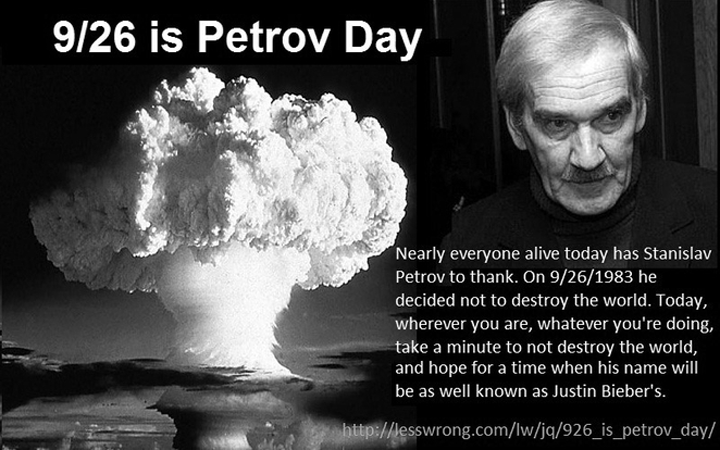


 nuclear-news