Chernobyl military survivor reveals secrets
Secrets of Chernobyl spill out more than three decades after the nuclear disaster, By SERGEI L. LOIKO sergei.l.loiko@gmail.com, JUN 30, 2019| CHERNOBYL, UKRAINE [good photographs on original]
The measuring device was sounding off loudly on that night 33 years ago, not because of the convoy’s cargo — 30 antiaircraft missiles, three of them tipped with nuclear warheads — but because of where and when the post-midnight parade had kicked off: at the Chernobyl air defense missile base just three days after the explosion of a reactor at the adjacent Chernobyl nuclear power plant that had sent enough radioactivity spewing into the air that it at one point had the potential of poisoning much of Eastern Europe.
Chershnev knew that the missiles, the trucks and his crew were badly contaminated and that they should not have been ordered to drive through a city of more than 2 million people. But there was no bypass road at the time — and orders were orders. What Chershnev didn’t know in the early hours of the morning of April 30, 1986, was that a radioactive cloud had already caught up with them and blanketed the city on the eve of its annual May Day festivities.
The reaction to HBO’s recent “Chernobyl” miniseries has been almost as far-reaching as the initial tragedy and has spurred a daily line of buses packed with foreign tourists at the gate of the Chernobyl Exclusion Zone, which extends for 20 miles around the plant. But Chernobyl still boasts secrets more than three decades later, including the story of Chershnev and his charges — a saga of dysfunction and disregard for human life that lays bare conditions in the waning years of the Soviet Union.
When the red alert sounded, Chershnev, then the deputy commander and chief engineer of the Kiev Air Defense Brigade, was responsible for the readiness of weaponry and equipment at the Chernobyl antiaircraft battalion’s base in a massive in-ground bunker with 10-inch-thick, rusty metal doors.
These days, the site also features a 10-yard-long missile launcher’s towing trolley, half-buried in silver moss, the former walls of a second smaller bunker surrounded by dense pines and a vast carcass of barracks with missing floorboards, dilapidated walls and a mural of a Soviet soldier cheerfully calling upon comrades to defend the motherland.
Seventy officers and men — ill-informed, unprotected and exposed to deadly radiation — were housed at the site along with the missiles back in 1986, under orders to arduously protect and save the weapons and structures rather than themselves.
The site included the nuclear plant and the Chernobyl over-the-horizon early warning radar station, a 500-meter-long, 150-meter tall installation designed to detect strategic missiles launched from the United States. The now-rusty structure still towers over the area and is a major tourist attraction, a frightening monument to the Cold War that even the complex‘s normally fearless marauders have not attempted to cut into pieces to sell as scrap metal outside the zone, a routine business in these parts.
In the aftermath of the 1986 explosion — as the government evacuated more than 50,000 residents from the town of Pripyat, including the families of nuclear plant workers, plus more than 75,000 residents of nearby villages — the men of the Chernobyl air defense unit stayed put until they received fresh orders.
“Three days after the explosion, on April 29, I arrived at the base with 30 heavy trucks and we loaded on them 30 missiles from the storage hangars,” recalls Chershnev, who headed the evacuation effort. “Twenty-seven of them were conventional, but the other three were tactical rockets with nuclear warheads. We were to take them to a facility outside Boryspil, near Kiev.
“After that, we were ordered to go back and salvage the remaining equipment that could be dismantled.”
The men traveled — without protective gear — for 14 hours at speeds lower than 20 mph as radiation from the explosion leaked into the air.
Chershnev admits he knew the dangers but says he was a career officer and could not disobey orders………….
When Chershnev got back from that trip, he repeated the ritual of burning his uniform.
“No one in the world knows that we existed and what we went through,” he said. “And all for nothing. All so stupid and futile. We didn’t save anyone. We didn’t clean up anything.
“All those I personally know and have kept track of all these years are either badly sick like myself or dead by now. My driver who accompanied me on all the convoys was discharged and died at 28. My fellow deputy brigade commander, … who was also dealing with contaminated equipment, died [in 1995] of cancer. Warrant Officer Petro Pozyura went blind. And so on and so forth. I have a heart ailment and every year spend a couple of weeks in hospital.”
The cardiologist who has been treating Chershnev for the last few years once asked him to retrieve his Chernobyl-era medical records from the military. But Chershnev was told that the records no longer exist.
“Here I am on a pension with a monthly Chernobyl health compensation of about $11 a month,” he concluded bitterly. “It is not even enough to buy a bottle of decent vodka, let alone medicines.”
The official death toll related to the explosion is listed as 39, but out of the officially registered 3.2 million people who were exposed to radiation in Ukraine alone, 1.3 million have died in the last 33 years, said Vladimir Kobchik, a former Chernobyl cleanup worker who is now a leader of a group that aims to protect the rights of fellow survivors.
“For the last four years, the government of Ukraine has been allocating $70 million annually for the needs of the affected. That is $37 per person per year! Not a penny more! How many of those remaining 1.9 million people affected by Chernobyl are sick [and] we can’t even tell? The doctors will never tell you you are sick or dying because of radiation.”……… https://www.latimes.com/world/la-fg-ukraine-chernobyl-secrets-20190630-story.html
July 1, 2019 Posted by Christina Macpherson | health, PERSONAL STORIES, Reference, secrets,lies and civil liberties, Ukraine | Leave a comment
Shelby Surdyk, Alaska’s nuclear disarmament youth campaigner
The teacher educated students about the history and impact that nuclear weapons testing had on the Marshallese people, and their story left a lasting impression on Surdyk.
“I think that once you become connected to people whose lives have been touched by nuclear weapons testing, it’s a path you can’t turn back from,” she said.
Today, Surdyk is the project manager for HOPE: Alaska’s Youth Congress for the Global Elimination of Nuclear Weapons, a five-day conference for high school students to be held in Sitka in April 2020. The idea for the youth congress was introduced by Veterans for Peace, an organization that opposes the proliferation of nuclear weapons as part of their philosophy.
Surdyk recently attended the 2019 NPT PrepCom, a conference held at the United Nations headquarters in New York City this spring. She will be speaking about her experience over a brown-bag lunch hosted by Veterans for Peace this Friday at noon at the Juneau Arts and Culture Center.
June 15, 2019 Posted by Christina Macpherson | opposition to nuclear, PERSONAL STORIES, USA | Leave a comment
30 years later, a Soviet general still suffers from effects of radiation at Chernobyl nuclear disaster
A SOVIET General portrayed in Sky Original’s hit Chernobyl show has revealed he still suffers from radiation sickness more than 30 years after the disaster.
Nikolai Tarakanov, 85, told how the deadly radiation left his gums bleeding for weeks after the meltdown – and is forced to take a gruelling regimen of drugs to just stay alive.
He claimed Soviet doctor Evgeny Chazov was right when he warned troops: “You’re going to suffer till the end of your life. Chernobyl won’t let you go.”
He told a documentary: “You made a tiny cut, while shaving, and it didn’t heal for two weeks after that.”
“I had bleeding gums and bloody diarrhoea.”
Tarakanov oversaw the removal of radioactive material from the site – and paid tribute to the “perfect” casting in the show.
He added: “300,000 cubic meters of soil around the plant was extracted, put in trucks and taken to the burial sites.
June 8, 2019 Posted by Christina Macpherson | health, PERSONAL STORIES, Ukraine | Leave a comment
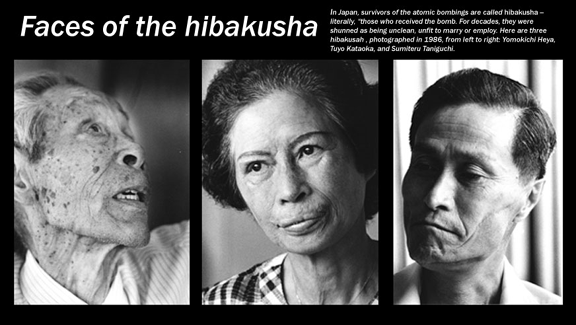
Hibakusha: Nagasaki activist, 79, looks to entrust nuclear movement to next generation
|
https://mainichi.jp/english/articles/20190522/p2a/00m/0na/013000c May 22, 2019 (Mainichi Japan) NAGASAKI — On May 9, there was a sit-in hibakusha gathering in front of the Peace Statue at Nagasaki Peace Park. The meeting takes place on the ninth of every month, marking the Aug. 9, 1945, U.S. atomic bombing of Nagasaki. This month’s congregation marked the 444th time for such an event. Koichi Kawano, 79, took to the microphone to speak about the stand-off between the United States and Iran. “This is a crisis,” he said to the around 100 people in attendance, continuing, “Our hearts are one when wishing for the abolition of nuclear weapons.” Born in North Pyongan Province on the Korean Peninsula, now part of North Korea, Kawano was brought back to his parents’ hometown Nagasaki as a child. Aged 5 in August 1945, he was around 3.1 kilometers away from the atomic bomb’s hypocenter. Now a resident of the nearby town of Nagayo, he has been an activist for the end of nuclear weaponry in roles including his long tenure as chairman of the Hibakusha Liaison Council of the Nagasaki Prefectural Peace Movement Center. “While enduring untold misery, we have won our rights with our own strength,” he says, looking back on the messages their hibakusha meetings have sent against the government’s constitutional amendment policies and security legislation designed to allow Japan to exercise the right to collective self-defense in a limited manner. “Perseverance is power” has been Kawano’s guiding motto in engaging in the movement’s activities, but this spring he faced a difficult reality. Masanori Nakashima, president of the Nagasaki Prefecture A-bomb Health Handbook Friendship Society, died aged 89 on March 15. The two men were allies in peace activism. Representatives of five local hibakusha groups, including Nakashima and Kawano, announced a joint statement on peace issues and handed a written request to the prime minister on Aug. 9. Of the five hibakusha group representatives who were alive in 2015 on the 70th anniversary of the bombing, three including Nagasaki Atomic Bomb Survivors Council chair Sumiteru Taniguchi have passed away. Taniguchi died in 2017 at 88 years of age. “Even with his limp, he dragged himself to that office to hear other hibakusha speak,” Kawano reminisced, while looking ahead to an uncertain future, saying, “What will happen to these groups after we die?” Kawano himself underwent surgery for esophageal cancer in 2017. Due to ill health he was forced to pull out of a survey of hibakusha in North Korea as a member of the Japan Congress Against A- and H-Bombs in fall 2018. Despite setbacks, his drive for peace remains unchanged. Kawano confronted Prime Minister Shinzo Abe over the Japanese government’s disinclination to sign and ratify the United Nations Treaty on the Prohibition of Nuclear Weapons in a face-to-face meeting in 2017, asking, “What country’s prime minister are you?” As time marches on from the events of August 1945, Kawano is putting his faith in the next generation. “The increasingly quiet voices of the hibakusha must not be drowned out,” he says. At the monthly sit-ins in Nagasaki Peace Park, the number of high school age attendees has increased. As he welcomes the last summer of his 70s, Kawano’s resolve remains strong. “Peace activism is powered by people. I want the movement to continue, to carry on the wish never to see another generation of hibakusha in this world.” (Japanese original by Yuki Imano, Nagasaki Bureau) |
May 23, 2019 Posted by Christina Macpherson | Japan, opposition to nuclear, PERSONAL STORIES, Reference, weapons and war | Leave a comment
Pike County residents protest nuclear facility after Uranium detected at school
https://myfox28columbus.com/news/local/pike-county-residents-protest-nuclear-facility-after-uranium-detected-at-school, by Rachael Penton, May 22nd 2019 PIKE COUNTY, Ohio (WSYX/WTTE)
Marilyn Ison goes to the doctor next week to find out if the nodules on her thyroid are cancerous, but on Tuesday, she protested against the Pike County nuclear waste facility outside the YMCA.
Inside the YMCA, a bi-annual Department of Energy open house is happening, where people can learn more about the project.
Ison’s mother has cancer, as do many other friends and family, but she says it’s the children she’s here for today.
“I’m scared for all the kids. I’m the voice of the kids,” Ison said. “They can’t speak for themselves (or) the kids inside that are scared. And they are, they know.”
“I never feared that,” she said. “I feared a tornado but not radioactive waste in my school and home and my friend’s dying.”
Crystal Glass came out to protest with her family in matching t-shirts.
“It’s just what we want- don’t dump on us,” Glass said. “Don’t dump on our future.”
Glass grew up next to the nuclear facility and went to Zahn’s Corner, and was diagnosed with a tumor at age 14 and cancer 20 years later.
“We’ve been sick for a long time and it seems like nothing is happening.”
Now she too is worried her kids will one day suffer, and hopes the
recent publicity and Tuesday’s protest will get someone’s attention.
“I’m most concerned about the people that live around the plant,” Glass said. “At what point do they realize they’re so sick in that area? Why don’t the buy them out? They can’t afford to move.”
May 23, 2019 Posted by Christina Macpherson | opposition to nuclear, PERSONAL STORIES, USA | Leave a comment
Former Nuclear Regulatory Commission chairman now sees nuclear power as harmful
Washington Post 17th May 2019 , Gregory Jaczko served on the Nuclear Regulatory Commission from 2005 to 2009, and as its chairman from 2009 to 2012. Nuclear power was supposed to save the planet. The plants that used this technology could produce enormous amounts of electricity without the pollution caused by burning coal, oil or natural gas, which would help slow the catastrophic changes humans have forced on the Earth’s climate.influence of the industry on the political process. Now I was serving on the Nuclear Regulatory Commission, where I saw that nuclear power was more complicated than I knew; it was a powerful business as well as an impressive feat of science. In 2009, President Barack Obama named me the agency’s chairman.
May 21, 2019 Posted by Christina Macpherson | PERSONAL STORIES, safety, USA | Leave a comment
USA Defense Dept knew that radiation causes birth defects. Now nuclear test veterans worry
Atomic veteran wonders at radiation’s effects, PostStar, Will Doolittle will@poststar.comMay 2, 2019, GLENS FALLS — Bill Jones went to paradise for 13 months in the mid-1950s, and it wasn’t until many years later, when he and others were finally released from their vows of secrecy, that he found out what a hell it really had been…….
Two of his children have suffered from skin cancer, as he has, and one of his grandchildren had multiple birth defects, and he worries that his military service more than 60 years ago could have something to do with all that.
But he doesn’t know for sure, and the government isn’t telling, which is what really bothers him. “This stuff accumulates in your body. It can cause birth defects. That’s what frosts me. They never told us about this,” he said.
Bill and Charlotte were sitting at the dining room table in their cozy house and talking about the atomic bomb testing the U.S. government performed in the 1950s on the Marshall Islands, a collection of atolls far out in the Pacific Ocean.
Jones had enlisted with three buddies from Glens Falls, going through basic training with them before he was sent to Technical Intelligence School in Aberdeen, Maryland. It was the depth of the Cold War and a search for soldiers with security clearances swept him up for an unexplained assignment. In the fall of 1956, he disembarked on Enewetak Atoll………
The U.S. had dropped 12 bombs already that year on Enewetak, each one named after an American Indian tribe (Seminole was dropped on June 6, for example, and Mohawk on July 3). The testing wouldn’t resume until after Jones left, in April 1958, but over time (even as he kept his secrets), he would learn the radiation lingered in the air and water, planting seeds in many of the soldiers that would bloom into cancers and kill them……..
He has scars on his scalp from having growths removed, but at 84 considers himself fortunate. Benefits are available for atomic veterans, and Jones called the Department of Justice about qualifying for them.
He was told, “As soon as I get a terminal illness, call back.” Others, after years of keeping quiet, never seek out help they might qualify for.
“There’s not an awful lot of these atomic veterans left. There’s a lot that don’t know about the program, so they waste away, shall we say,” he said. Fred Schafer, an officer with the National Association of Atomic and Nuclear Veterans, says the soldiers were guinea pigs. “They wanted to see what happened,” he said, referring to the U.S. military establishment, which was monitoring the soldiers’ reactions to nuclear radiation. “They wanted to see how fast they could get in after using these bombs.”
The organization has the names of about 1,500 veterans in its database who were part of the nuclear testing program, but Schafer estimates at least 40,000 are still alive who don’t know about the organization. Hundreds of thousands of soldiers participated, but many have died.
Jones wasn’t allowed to tell Charlotte what he was doing on Enewetak. He couldn’t take photos, he could make only one phone call every two or three months, and his letters were reviewed. Anything he sent home, like a sea shell scooped up from the sand, had to be checked with a Geiger counter first. “They were aware,” he said. “I can’t prove it, but they knew the radiation caused birth defects.”…….It wasn’t until 1996 that the Defense Department allowed atomic veterans to talk about taking part in the testing of the most destructive weapons in history. Bill and the others sent to the Marshall Islands considered it a tropical vacation at the time, but they didn’t know — and no one told them — the exposure could be deadly…….. https://poststar.com/news/local/column-atomic-veteran-wonders-at-radiation-s-effects/article_178156a0-052d-5306-9100-49cf686d954a.html
|
|
|
May 4, 2019 Posted by Christina Macpherson | health, PERSONAL STORIES, USA | Leave a comment
The eloquence of Greta Thunberg
By Thomas Gaulkin, April 25, 2019 Greta Thunberg, the 16-year-old student whose school strikes have inspired a global youth movement on climate change, has emerged as a chief orator of her generation, enthralling her Instagram peers and world political leaders alike while taking on new and more specific opponents.
That includes the members of Parliament she met with this week in London. Her speech Tuesday to a gathering of British MPs was remarkable, not only for the incongruity of a young Swedish woman giving the UK’s top politicians what for, but also for her focused targeting of the nation’s energy policies. Longer than her usual talks—at some 1,750 words it’s more than double the length of speeches she presented at Davos and the UN climate conference in the fall—the speech eschewed the finely tuned repertoire of scolding that propelled her into newscasts worldwide with persuasive and provocative headline-fodder like “I want you to panic,” “the house is on fire,” “I don’t want your hope,” and so on.
Instead, for her House of Commons speech, as with her address to the EU parliament a week earlier, Thunberg tailored her words to the climate-related failures of the adults in the room. “The UK is … very special,” she told the British MPs. “Not only for its mind-blowing historical carbon debt, but also for its current, very creative carbon accounting.” She then detailed how the UK’s carbon emissions reductions have fallen short (by neglecting emissions from aviation and shipping in estimates, for example). Lambasting the nation’s continued support for fossil fuels, Thunberg does not mince words: “This ongoing irresponsible behavior will no doubt be remembered in history as one of the greatest failures of humankind.”
Thunberg has adjusted her rhetoric to respond to criticism from prominent figures like Theresa May (who was a no-show at a meeting between Thunberg and other UK party leaders), who think the school strikes “waste lesson time.” As for those winning metaphors like the “house on fire,” Thunberg seems confident moving beyond them (“I have said those words before,” she told the EU) to newly relevant and bigger metaphors: “Avoiding climate breakdown will require cathedral thinking. We must lay the foundation while we may not know exactly how to build the ceiling.”
It’s worth reading Thunberg’s entire speech, to appreciate both her crisp eloquence on the world’s most complex environmental problem and her satisfying rejection of grown-ups who praise her actions without committing to any themselves.
“Did you hear what I just said?” she asked a few times. “Is my English OK? Is the microphone on? Because I’m beginning to wonder.”
April 30, 2019 Posted by Christina Macpherson | climate change, PERSONAL STORIES, UK | Leave a comment
An Australian Maralinga nuclear test veteran reveals his grim story
Maralinga nuclear bomb test survivor reveals truth of what happened in the SA desert https://www.adelaidenow.com.au/messenger/east-hills/maralinga-nuclear-bomb-test-survivor-reveals-truth-of-what-happened-in-the-sa-desert/news-story/697b17f6d3427a78aa0262b09727c169, 24 Apr 19
The nuclear bomb tests, under British Government control, at Maralinga in far west South Australia in the 1950s were conducted at the highest level of secrecy. But they had thousands of witnesses. Most were Australian servicemen, innocently used as guinea pigs and exposed to deadly radiation. Craig Cook talks to a survivor, one of the last of a group of men who built the Maralinga camp as part of 23 Construction Squadron and watched in awe as the bombs were exploded, little knowing they were risking their lives and the futures of their children.
Tony Spruzen knew the drill at the top secret Maralinga facility in the South Australian desert in the spring of 1956.
Just like hundreds of others at the nuclear site at 11-mile camp during Operation Buffalo, he was told to turn his back and cover his eyes to protect himself from the gigantic glare of the exploding atomic bomb.
What they didn’t tell the Australian Army sapper was, at the moment of the flash of detonation, he would see the bones of his hand through his tightly shut eyelids.
“It was like a massive x-ray,” Tony, 83, from Glengowrie says. ‘Unlike anything I’d ever known before.”
A week after One Tree, on October 6, 1956, Spruzen witnessed the detonation of Buffalo 2, named Marcoo.
The bomb was only a tenth the size of One Tree but this time was detonated directly above and just under the ground.
“The bomb was in an amphitheatre of hills and we were far closer to that one, maybe only 200 yards away,” he remembers.
“We were close enough to see the trenches with dummy soldiers in them holding rifles and fake aeroplanes and tanks used to test the blast effect.
“And we could see the scientists walking around in their white suits checking out the site before and afterwards but we were just in khaki shorts and short sleeved shorts. Even the dignitaries had no protection.”
Every hour, from five hours out, an elaborate PA system across the complex announced the timing of the bomb detonation.
In the final 30 seconds, and with a rising and excited inclination, the voice on the PA dramatically counted….ten, nine, eight…down to zero.
When Marcoo exploded at 7am it only took a few seconds for a heavy shower of dust to descend on the witnesses.
“We had this large piece of litmus paper attached to our shirts,” Spruzen recalls
Spruzen, originally from Victoria and a carpenter by trade, enlisted in the Army at just 16.
Four year later he was at Maralinga as part of a detachment of 23 Construction Squadron, an acclaimed unit of the Royal Australian Engineers and exclusively raised in South Australia.
Around 40 young men were selected from the unit to build a desert tent camp with cook houses and latrines for the Commonwealth military ‘high-ups’ who were having their first look at the impact of the devastating nuclear weapon.
Around 200km from the ocean, the tent city gained the facetious name of the ‘Sea View Holiday Camp’.
“It was an adventure…we were all excited,” he recalls.
“A lot of young single guys together and we had some fun.”
The lads knew it was serious too as this was a hush-hush operation. They weren’t even allowed to take a camera along for snapshots so Spruzen has no personal photos from Maralinga.
“Then we all turned around to see this mushroom cloud climbing into the sky. The next thing was the blast. The boom was deafening…and then the wind came about thirty seconds after that blowing dust and soil and debris all over us.”
But he does have a terrible reminder of his three months spent in far western South Australia.
“Of the 40 men who went up with me I only know of three of us still around,” he says. “The rest have all died – many from cancers.”
The first Maralinga bomb, Buffalo 1, with the nickname One Tree, was detonated after being dropped from a 31m high tower.
At 15 kiloton it was the same size as Little Boy, the bomb dropped by the US air force that demolished the Japanese city of Hiroshima in August 1945, killing more than 100,000 instantly and tens of thousands slowly in the aftermath from burns and radiation poisoning.
“They said, keep an eye on that and if it changes to pink come and see us. Well it turned pink for every one of us.
“Had I have known what I know now I wouldn’t have been so close.”
Transferred to Sydney on a training course, Spruzen missed the final two detonations at Maralinga that year: on October 11, 1956, Buffalo 3 (Kite) was released by a Royal Air Force Vickers Valiant bomber, the first drop of a British nuclear weapon from an aircraft; and then on October 22, and again dropped from the 31m tower, (Buffalo 4) Breakaway exploded.
There were a total of seven nuclear desert tests at Maralinga performed during Operations Buffalo and Antler.
The 1985 McClelland Royal Commission heavily criticised the detonations, declaring the weather conditions were inappropriate and led to the widespread scattering of radioactive material.
The radioactive cloud from Buffalo 1 reached more than 11,000m into the air and with a northerly wind blowing radioactivity was detected across Adelaide.
Radioactive dust clouds from other bombs were detected in Northern Territory, Queensland and across New South Wales, as far away as Sydney, 2500km from Maralinga.
Around 12,000 Australian servicemen served at British nuclear test sites in the southern hemisphere between 1952 and 1963.
In recent years, the British Government’s claim that they never used humans “for guinea pig-type experiments” in nuclear weapons trials in Australia has been revealed to be a lie.
Tony Spruzen has struggled to come to terms with being placed in danger by his own government who had full knowledge of the consequences of exposure to radiation.
“Once we all found out later what we’d been exposed to at Maralinga it makes you very angry,” he says.
“We believed them when we were told we would be safe — but we haven’t been.”
Spruzen met his wife Shirley, the daughter of an army veteran, in Adelaide where they settled after marriage in June 1960. He left the army seven months later to work in civil construction. He thought his Maralinga days were well behind him but soon after they came to haunt him.
In the first four years of marriage, the couple agonisingly suffered six miscarriages, including twins.
Alarm bells started ringing when he was sent a survey from Veterans Affairs asking about his general health and, specifically his history of cancers.
“It turned out those involved in the atomic tests had a 30 per cent higher chance than getting cancers than the general public,” he says.
“Most of those got them within the first five years and a majority of those were dead before a decade had passed.”
Spruzen, who eventually had three children with Shirley, didn’t get cancer at that time, although he has since had several melanomas removed.
But when his son was diagnosed with acute myeloid leukaemia at the age of 41, he wondered about the possibility of faulty genes, damaged by exposure to radiation, as has been documented in Japanese survivors of the atomic bombs, jumping a generation.
“My son was told by the QEH (Queen Elizabeth Hospital) there was nothing could be done for him but we went up to Queensland and after a bone marrow transfer from his sister he survived,” he adds.
“A decade on he’s working as strong as he has but I don’t think his condition was a coincidence given my history.
“There’s been nothing (compensation) for those of us who were there although they gave us a white card for our cancers and now we have a (full health) gold card.”
Ken Daly, President Royal Australian Engineers Association says it is the least the men, who literally put their bodies on the line, deserve.
“You get these young men, aged around 25-30, with a history of exposure to radiation, coming down with cancers in those numbers and you just know what has caused it,” he says.
“Many died within a few years of being exposed to the fallout and many passed on generational health problems and birth defects to their children.”
Mr Daly, who was based at Warradale Barracks for 15 years, where 23 Construction was based until being disbanded in the early 1960s, hadn’t heard of the Squadron until around five years ago.
Since then he has been central to the group gaining due recognition.
In its earliest days the Squadron, with a strength of eight officers and 160 in other ranks, built the El Alamein Army Reserve camp, part of which later became the Baxter Detention Centre, outside of Port Augusta.
It also assisted the South Australian community by providing aid during bush fires, the grasshopper plague of 1955, and significant infrastructure construction.
During the record flood of 1956, while those squad members were at Maralinga, the rest of 23 Construction were out sandbagging River Murray towns and then cleaning up after the water receded.
In 2011, the Royal Australian Engineers constructed a memorial at Warradale to all who have served in its ranks.
This year a bronzed engineer’s slouch hat, of actual size, by Western Australian sculptor and former army engineer Ron Gomboc will be incorporated into the memorial.
“The hat will be mounted on the memorial in such a way it will look like it’s suspended in mid-air,” Daly adds.
“It acknowledges the ultimate sacrifice of the more than 1250 engineers who died in World War I and the remarkable service and sacrifice of 23 Construction Squadron that has never been recognised before.”
The slouch hat, costing $6,000 and one of only six to have been cast, will be unveiled during a service at Warradale Barracks at midday on Sunday April 28.
Contact Ken Daly at dailydouble@bigpond.com for further details.
April 25, 2019 Posted by Christina Macpherson | AUSTRALIA, PERSONAL STORIES, weapons and war | Leave a comment
Life as a liquidator after the 1986 Chernobyl nuclear disaster
Hard duty in the Chernobyl zone, Life as a liquidator after the 1986 nuclear disaster
Cathie Sullivan, a New Mexico activist, worked with Chernobyl liquidator, Natalia Manzurova, during three trips to the former Soviet Union in the early 2000s. Natalia was one of 750,000 Soviet citizens sent to deal with the Chernobyl catastrophe. Natalia is now in her early 60s and has long struggled with multiple health issues. She was treated last year for a brain tumor that was found to be cancerous. A second tumor has since been found and funds were recently raised among activists around the world to help with the costs of this latest treatment. Natalia and Cathie together authored a short book, “Hard Duty, A woman’s experience at Chernobyl” describing Natalia’s harrowing four and a half years as a Chernobyl liquidator. What follows is an excerpt from that book with some minor edits.
By Natalia Manzurova
When I tell people that I was at Chernobyl they often ask if I had to go. My training is in radiation biology and I was born in a city that was part of the secret Soviet nuclear weapons complex, much like Los Alamos, New Mexico, where the first A-bomb was built. People from my city considered it a duty to go to Chernobyl, just as New York City firefighters went to the World Trade Center on 9/11.
Because of the radiation danger to women of child-bearing age, those under 30 did not go, but being 35 in 1987, I began my 4.5 years of work at Chernobyl. ………..
Sad experiences
In 1987, when I first arrived at Chernobyl, my group of about 20 scientists from the Ozyersk radio-ecology lab started a Department of Environmental Decontamination and Re-Cultivation. We used a 10-acre greenhouse complex for our plant studies, built before the accident, and for office space we used an empty, nearby kindergarten……..
Like many liquidators I ‘wear’ a ‘Chernobyl necklace’, the scar on the lower throat from thyroid-gland surgery.* While working in the exclusion zone I experienced slurred speech, memory loss and poor balance. One of my bosses and I realized that we were forgetting appointments and obligations and agreed to help each other remember who, what, where and when. I had severe amnesia for a time and read letters I wrote my mother to help fill in forgotten years.
The Chernobyl accident is not over, in fact its damaging effects on people and the land will only taper off slowly for generations—lingering harm that is almost certainly unique to nuclear accidents.
Natalia Manzurova, with fellow Russian activist, Nadezhda Kutepova, was awarded the 2011 Nuclear-Free Future Award in the category of Resistance.
Print copies of Hard Copy are available from Cathie Sullivan. Please email her at: cathiesullivan100@gmail.com. more https://beyondnuclearinternational.org/2019/04/21/hard-duty-in-the-chernobyl-zone/
April 22, 2019 Posted by Christina Macpherson | employment, PERSONAL STORIES, social effects, Ukraine | Leave a comment
Frida Berrigan’s personal story about nuclear weapons
|
Nuclear Weapons Ruined My Life, and I Wouldn’t Have It Any Other Way
As our mother approaches and passes 70, we — like many people our age — start encouraging her to take it easy, give up the rigors of community life and resistance, the constant hosting and demonstrating. We envision and invite her to live a life with her grandchildren, stories, bedtimes, sporting events and art projects. We have room, we all say.She goes in the exact opposite direction. With others taking the reins at Jonah House, she feels free for the first time since our father’s death to be a Plowshares activist again, to conspire with her friends and to plan for a rigorous and daring action.
We don’t know the specifics, but as all her answers about the future muddle into a very specific kind of vagueness, we know exactly what is going on. “Please don’t,” we say. “You are too old,” we say. “Think of your grandkids,” we say. “I will. I’m not. I am. This is what I have to give.” April 4, 2018 It was just three days after my 44th birthday, which was also Easter — again. We received word of a new plowshares action. Seven Catholic activists entered Kings Bay Naval Submarine Base in St. Mary’s, Georgia. They went to make real the prophet Isaiah’s command to “beat swords into plowshares.” The seven chose to act on the 50th anniversary of the assassination of Martin Luther King, Jr., who devoted his life to addressing what he called the “triple evils of militarism, racism and materialism.” Carrying hammers and baby bottles of their own blood, the seven attempted to convert weapons of mass destruction. They hoped to call attention to the ways in which nuclear weapons kill every day, just by their mere existence and maintenance. They are charged with three federal felonies and one misdemeanor for their actions. They could face 25 years in prison if convicted on all counts. And there they still are. Three — my mom, Father Steve Kelly and Mark Colville — remain in county jail almost a year later. They still do not have a trial date. The other four are out on bond, wearing ankle monitors and are required to check in with their minders at regular intervals. The Kings Bay Naval Station is home to at least six nuclear ballistic missile submarines. Each carries 20 Trident II D 5 MIRV thermonuclear weapons. Each of these individual Trident thermonuclear weapons contains four or more individual nuclear weapons ranging in destructive power from a 100 kilotons to 475 kilotons. To understand the massive destructive power of these weapons remember that the nuclear bomb dropped on Hiroshima was a 15 kiloton bomb. My mother feels very useful in jail — generous, empathetic and calm in a place that encourages none of those qualities. The wheels of justice grind very slowly in Georgia particularly because the activists are mounting a creative legal defense. They seek to portray their actions as protected under the freedom of religion, using the Religious Freedom Restoration Act, which allowed the homophobic cake makers to not make a cake for a gay couple. They are seeking to demonstrate their “deeply held religious beliefs” and how the practice of their religion has been burdened by the government’s response to their actions. The Religious Freedom Restoration Act requires the government to take claims of sincere religious exercise seriously. Please keep them in thought and prayer. Just a few months before they acted, the Bulletin of the Atomic Scientists moved the clock again — this time to 2 minutes to nuclear midnight, saying, “This is a dangerous time, but the danger is of our own making. Humankind has invented the implements of apocalypse; so can it invent the methods of controlling and eventually eliminating them.” The clock has never been closer to nuclear midnight in my lifetime. All the work, all this sacrifice, and the clock keeps moving closer to midnight. My mom’s action and extended incarceration pre-trial come as nuclear conflagration seems more likely. Nuclear weapons do not even rate in the list of top 10 fears that Americans are questioned about every year. Putin and Trump have shredded the imperfect and imbalanced but nevertheless important fabric of nuclear arms control treaties. Putin claims that Russia is developing a new class of “invincible” nuclear weapons, including a cruise missile that can reach anywhere in the world. The Pentagon signaled recently that the United States would begin tests on a couple of types of missiles. And just to make things truly terrifying, Anthony Cordesman of the Center for Strategic and International Studies says that in response to U.S. and Russian actions, China is improving its own nuclear arsenal. Searching for signs of hope to counter as a bulwark against these mounting fears, I hold close the work of the International Campaign to Abolish Nuclear Weapons, or ICAN. It developed the Treaty on the Prohibition of Nuclear Weapons and is now building a global civil society coalition to promote adherence to and full implementation of the nuclear weapons ban. ICAN received the 2017 Nobel Peace Prize “for its work to draw attention to the catastrophic humanitarian consequences of any use of nuclear weapons and for its ground-breaking efforts to achieve a treaty-based prohibition of such weapons.” I draw hope from that movement. Nuclear weapons ruined my life. I am never not thinking about them. Nuclear weapons are present in my most mundane tasks. Nuclear weapons are present in all my major relationships. Every goodbye and hello is freighted with uncertainty. They have shaped how I think about time. Nuclear weapons have caused me to honor and treasure the present. They have made the future provisional, muted, not taken for granted. I try to be present to the present and hold the future loosely, but with hope. Nuclear weapons ruined my life. And I wouldn’t have it any other way. In fact, I hope they are ruining your life too. Because that is the only way we are going to get rid of them. https://www.commondreams.org/views/2019/04/21/nuclear-weapons-ruined-my-life-and-i-wouldnt-have-it-any-other-way |
|
April 22, 2019 Posted by Christina Macpherson | PERSONAL STORIES, USA, weapons and war | Leave a comment
Japanese people have turned away from nuclear power
Post-Fukushima, Japan turns against nuclear power, Witf, by Susan Phillips/StateImpact Pennsylvania | Mar 29, 2019 In Fukushima, farmers and residents put their stock in solar
(Futaba, Japan) — The partial meltdown at Three Mile Island nuclear power plant in central Pennsylvania 40 years ago in March did not lead to large releases of radiation, but it helped turn public opinion away from nuclear energy. In Japan, an even more catastrophic nuclear disaster occurred eight years ago this month. And like many Pennsylvanians, the Japanese have largely turned against nuclear.
The earthquake, tsunami and nuclear meltdown is known in Japan as simply “March 11.” And everyone knows where they were on March 11, 2011.
Yuji Onuma was in the town of Futaba, where he grew up and was living with his wife, who was pregnant with their first child. Their home was about 3 or 4 kilometers from the Daiichi nuclear power plant.
But right now, he’s living away from the coast in another prefecture, and he says he wants to settle in a town that is about as far away from any of Japan’s 54 nuclear power plants as he can possibly be.
During an interview, Onuma showed a picture of when he was about 12 years old and getting an award from the Mayor of Futaba. A teacher had asked the kids to come up with a town slogan. In a place where everyone depended on the nearby nuclear plant for work, Onuma’s entry won:
“Atomic power: energy for a bright future” became the slogan on an archway over Futaba’s main street.
“I was very proud because this is my first ever award by the town,” Onuma said through a translator. “And all the town people praised me and said, you are very great. So I was so proud of that.”
Then he showed another photo. It’s only a few months after the accident, and no one is left living in Futaba. This time, he’s wearing a protective Tyvek suit and mask, he’s standing below the sign holding up a placard that changes his slogan to:
“Atomic power: energy for a destructive future.”………. https://www.witf.org/news/2019/03/i-am-the-witness-post-fukushima-a-japanese-mans-regrets-mirror-his-countrys-turn-against-nuclear-pow.php
March 30, 2019 Posted by Christina Macpherson | Japan, PERSONAL STORIES | Leave a comment
REMEMBERING Katsuko Saruhashi THE TRAILBLAZING SCIENTIST WHO UNCOVERED NUCLEAR FALLOUT IN THE PACIFIC
Katsuko Saruhashi made waves internationally when she tracked and raised a global alarm on the dangers of nuclear testing by the U.S. Pacific Standard, LAURA MAST, MAR 22, 2019
Determining the measure of a great scientist is a challenge. Is it an enormous contribution to science, noted by awards and distinctions? Publications in peer-reviewed journals or keynotes at conferences? Serving as an expert to governments, effecting change on national and international policy? Or can this measure be more granular: beyond being a role model, to be present and provide sustaining mentorship, lifting up others?
No matter how you slice it, Katsuko Saruhashi is one such great scientist, and a woman who certainly lived up to her name, which translates to strong-minded or victorious in Japanese. Not only did she conduct groundbreaking research—developing the first method to measure carbon dioxide levels in seawater—but her work also made waves internationally, as she tracked and raised a global alarm on the dangers of nuclear testing. Throughout her 35-year career as a geochemist, she collected numerous awards and led the way for women to follow her in science……….
After graduating in 1943 with her undergraduate degree in chemistry, Saruhashi joined the Geochemistry Laboratory at the Meteorological Research Institute (now called the Japan Meteorological Agency). There, she studied not rain, but oceans, specifically carbon dioxide (CO) levels in seawater. Saruhashi developed the first method for measuring CO using temperature, pH, and chlorinity, called Saruhashi’s Table. This method became a global standard. Perhaps more importantly, she discovered that the Pacific Ocean releases more carbon dioxide than it absorbs: a concept with dire consequences today as the climate changes.
Saruhashi also led the way in studying ocean-borne nuclear contamination. Although World War II had ended years before, the United States continued to carry out nuclear tests, particularly in the Pacific Ocean near Bikini Atoll, 2,300 miles southwest of Japan. After several Japanese fishermen became mysteriously ill while out trawling downwind of the testing site in March of 1954, the Japanese government asked Saruhashi and her colleagues at the Geochemical Laboratory to investigate.
…….Saruhashi and her team ultimately found nuclear fallout didn’t travel evenly throughout the ocean. They tracked ocean circulation patterns using radionuclides, discovering that currents pushed radiation-contaminated waters clockwise, from Bikini Atoll northwest toward Japan. As a result, fallout levels were much higher in Japan than along the western U.S.
Their results were stunning: the radioactive fallout released in the testing had reached Japan in just 18 months. If testing continued, the entire Pacific Ocean would be contaminated by 1969, proving that nuclear tests even conducted out in the middle of the ocean, seemingly in isolation, could have dangerous consequences.
Even now, more than 60 years later, Bikini Atoll is still unlivable.
This data, unsurprisingly, sparked controversy, and the U.S. Atomic Energy Force ultimately funded a lab swap, bringing Saruhashi to the Scripps Institute of Oceanography to compare the Japanese technique for measuring fallout with the American method, developed by oceanographer Theodore Folsom. Her method turned out to be more accurate, settling the science and providing the critical evidence needed to bring the U.S. and Soviet Union in agreement to end above-ground nuclear testing in 1963: an amazing accomplishment at the height of the Cold War. Saruhashi returned to Japan and later became the executive director of the Geochemical Laboratory in 1979. …….
Saruhashi died in September of 2007 at the age of 87 …….https://psmag.com/environment/the-japanese-scientists-who-uncovered-nuclear-fallout
March 25, 2019 Posted by Christina Macpherson | Japan, oceans, PERSONAL STORIES | Leave a comment
A brave Russian hero who should never be forgotten – saved the world from nuclear annihilation
Brave Russian naval officer who saved world from nuclear bomb during Cuban Missile Crisis should be as famous as US astronaut Neil Armstrong, Th Irish Sun,
Isn’t it amazing we have this man Vasili Arkhipov, who basically saved the world from annihilation, and virtually no one knows his name
A group of US Navy destroyers and an aircraft carrier enforcing the blockade against Cuba trapped a B-59 Russian submarine, which the US didn’t know was armed with nuclear weapons.
The captain of the Russian sub Valentin Savitsky, believing that a war may have already started, prepared to launch a ten kiloton nuclear torpedo against the American warships.
According to a US National Security Archive report, Savitsky exclaimed: “We’re gonna blast them now! We will die, but we will sink them all — we will not become the shame of the fleet.”
As is procedurally required, all the senior officers on board must agree before a nuclear bomb could be launched.
The captain and the political officer agreed to launch but Vasili Arkhipov, the second-in-command, disagreed. A heated argument ensued during which Arkhipov persuaded the captain to surface the ship and await orders from Moscow. It turned out there was no war.
A nuclear holocaust on an unimaginable scale was averted and countless lives were saved thanks to Arkhipov.
Thomas Blanton, of the National Security Archive at George Washington University, told the Boston Globe: “The lesson from this is that a guy called Vasili Arkhipov saved the world.”
Arkhipov was not reprimanded by the Russian navy for his actions.
In fact, he was later promoted to rear admiral and went on to become the head of the Kirov naval academy and retired as a vice admiral.
The brave Russian died in 1999…….. https://www.thesun.ie/news/3770393/russian-naval-officer-saved-world-nuclear-bomb-famous/
February 21, 2019 Posted by Christina Macpherson | PERSONAL STORIES, Russia, weapons and war | Leave a comment
I lived through Three Mile Island. New nuclear plants are a bad idea.
Gene Eisman, Washington Post 1st Feb 2019 . In 1979, I was working for a member of the Pennsylvania
governor’s Cabinet and lived in Harrisburg, Pa., a few miles from the
Three Mile Island nuclear plant. When one of the reactors melted down, I
saw real panic as state workers left their offices to pick up their
children at school. I spent several days in the state’s underground
emergency command facility during the crisis, talking to the Federal
Emergency Management Agency in Washington, providing it with real-time
updates on the situation. Having been through that, I believe that
Mr. Gates’s idea to build new nuclear power plants would be the height
of folly, any claims he makes notwithstanding.
https://www.washingtonpost.com/opinions/i-lived-through-three-mile-island-new-nuclear-plants-are-a-bad-idea/2019/02/01/3e15b3e8-2573-11e9-b5b4-1d18dfb7b084_story.html
February 4, 2019 Posted by Christina Macpherson | PERSONAL STORIES, USA | Leave a comment
1 This Month
To see nuclear-related stories in greater depth and intensity – go to https://nuclearinformation.wordpress.com/
12 February – Webinar The Big Push: New Nuclear Projects in Canada

Thursday, February 12, 7 pm Eastern | 2nd of 4 sessions in the 2026 Nuclear Waste Online webinar series
Join a webinar on the push for new nuclear generation in Canada. Go to Northwatch.org to register or use the registration link https://us02web.zoom.us/webinar/register/WN_ZfWOf1GITqSRIZX8CB-A9w

Categories
- 1
- 1 NUCLEAR ISSUES
- business and costs
- climate change
- culture and arts
- ENERGY
- environment
- health
- history
- indigenous issues
- Legal
- marketing of nuclear
- media
- opposition to nuclear
- PERSONAL STORIES
- politics
- politics international
- Religion and ethics
- safety
- secrets,lies and civil liberties
- spinbuster
- technology
- Uranium
- wastes
- weapons and war
- Women
- 2 WORLD
- ACTION
- AFRICA
- Atrocities
- AUSTRALIA
- Christina's notes
- Christina's themes
- culture and arts
- Events
- Fuk 2022
- Fuk 2023
- Fukushima 2017
- Fukushima 2018
- fukushima 2019
- Fukushima 2020
- Fukushima 2021
- general
- global warming
- Humour (God we need it)
- Nuclear
- RARE EARTHS
- Reference
- resources – print
- Resources -audiovicual
- Weekly Newsletter
- World
- World Nuclear
- YouTube
Pages
- 1 This Month
- ACTION !
- Disclaimer
- Links
- PAGES on NUCLEAR ISSUES
- audio-visual news
- Anti Nuclear, Clean Energy Movement
- Civil Liberties
- Climate change
- Climate Change
- Economics
- Energy
- Environment
- Health
- History
- Indigenous issues
- Ionising radiation
- Media
- Nuclear Power and the Consumer Society – theme for December 2012
- Peace and nuclear disarmament
- Politics
- Public opinion
- Religion and ethics
- Resources – print
- Safety
- Secrets and lies
- Spinbuster
- Technology
- Wastes
- Weapons and war
- Women
-
-
Archives
- February 2026 (127)
- January 2026 (308)
- December 2025 (358)
- November 2025 (359)
- October 2025 (376)
- September 2025 (258)
- August 2025 (319)
- July 2025 (230)
- June 2025 (348)
- May 2025 (261)
- April 2025 (305)
- March 2025 (319)
-
Categories
- 1
- 1 NUCLEAR ISSUES
- business and costs
- climate change
- culture and arts
- ENERGY
- environment
- health
- history
- indigenous issues
- Legal
- marketing of nuclear
- media
- opposition to nuclear
- PERSONAL STORIES
- politics
- politics international
- Religion and ethics
- safety
- secrets,lies and civil liberties
- spinbuster
- technology
- Uranium
- wastes
- weapons and war
- Women
- 2 WORLD
- ACTION
- AFRICA
- Atrocities
- AUSTRALIA
- Christina's notes
- Christina's themes
- culture and arts
- Events
- Fuk 2022
- Fuk 2023
- Fukushima 2017
- Fukushima 2018
- fukushima 2019
- Fukushima 2020
- Fukushima 2021
- general
- global warming
- Humour (God we need it)
- Nuclear
- RARE EARTHS
- Reference
- resources – print
- Resources -audiovicual
- Weekly Newsletter
- World
- World Nuclear
- YouTube
-
RSS
Entries RSS
Comments RSS