he gave evidence in Japan against the used of mixed uranium and plutonium oxide fuel, known as MOX, in a reactor at Fukushima. “Frank’s testimony was so impressive and read by the governor of the region that it stopped the loading of MOX fuel for more than 10 years,” said Shaun Burnie of Greenpeace International. In 2011, the reactor was overwhelmed by a devastating tsunami, but because of this intervention Japan was spared the release of many hundreds of tons of fission products – “in other words the evacuation of 50 million plus and the end of central Japan as a functioning society.
Frank Barnaby obituary Radiation physicist at Aldermaston who went on to warn of the dangers posed by the civil and military uses of nuclear energy, Guardian, Tim Radford, 25 Aug 20,
The nuclear weapons scientist Frank Barnaby, who has died aged 92, became one of the most effective critics of the international arms race. As the cold war superpowers competed with ever more advanced weaponry to wage a war that could never be won, Barnaby helped amass an arsenal of reliable information and informed argument to keep an anxious public aware of the deadly devices being developed supposedly to keep the world safe.
By the close of the cold war and the beginning of the collapse of the Soviet Union in 1989 he and others had assembled an informal international bureaucracy of peace and provided the intellectual ammunition to persuade politicians, military and public to accept a dramatic reduction in the nuclear weaponry.
He contributed dozens of articles to New Scientist and the Guardian, all of them highlighting the rapid advance in technologies of mass destruction and the mechanisms that could spark global thermonuclear war. His persuasive arguments used only the information to hand, and calm reasoning.
In the early years of Margaret Thatcher’s government in Britain, and Ronald Reagan’s in the US, global investment in the military was huge. Even before a sharp rise in US spending in 1980, military activities worldwide consumed $1m every minute. US forces already used 10% of all the aluminium, copper, lead, zinc, nickel, molybdenum, tin, chromium, iron and manganese in the US each year. The military consumption of oil alone, Barnaby argued, was about two-thirds that of the whole of Africa at the time.
The defence industry had become the world’s second biggest business – after oil – and 40% of the world’s research scientists were funded out of military budgets; while military and defence establishments employed at least 27 million civilians. Soviet and US governments put a military satellite into orbit ever four days on average for two decades……….
in 1946 was conscripted into the RAF, leaving after two years to begin a science degree and then a doctorate in nuclear physics through the University of London, before joining the Atomic Weapons Research Establishment at Aldermaston, Berkshire – the laboratory that was to become the focus of marches and demonstrations by the Campaign for Nuclear Disarmament.
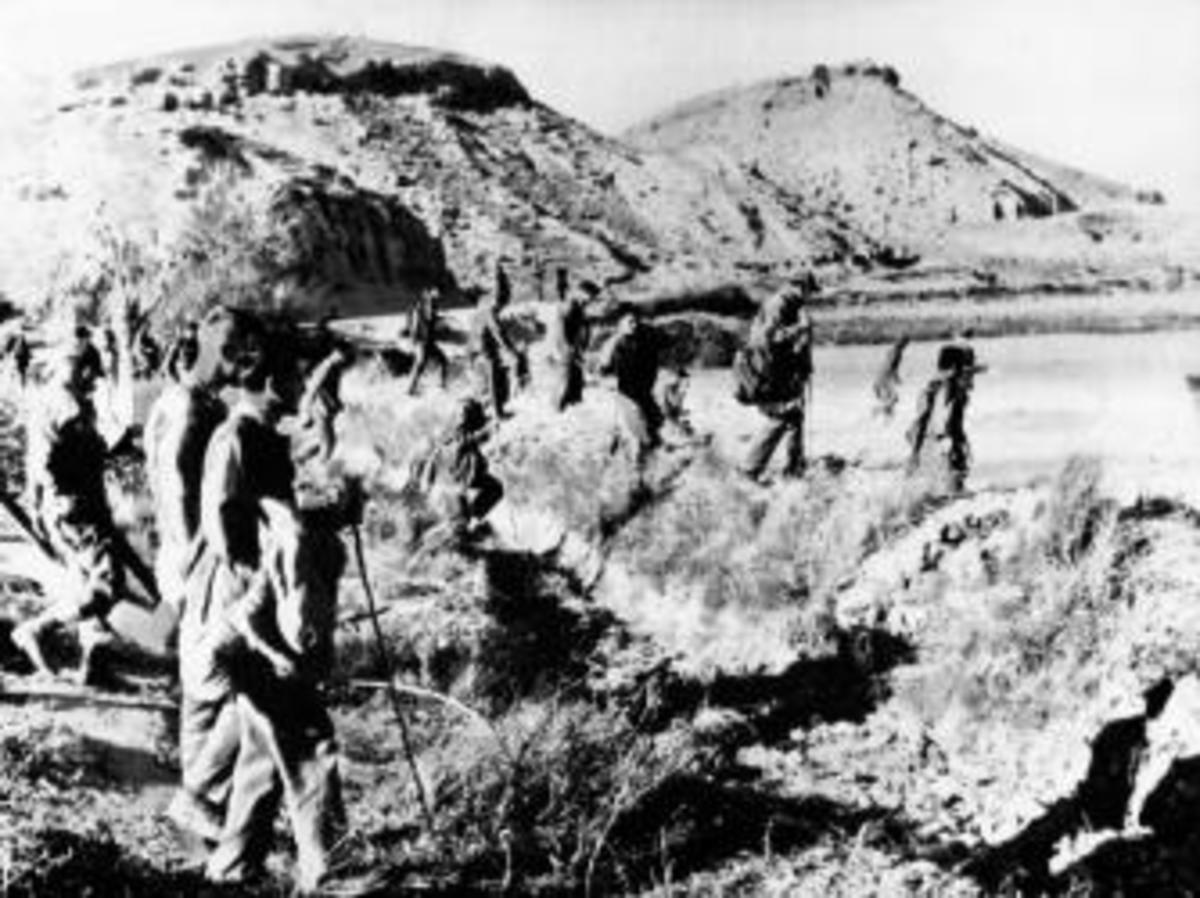
As a radiation physicist, he twice monitored nuclear weapons tests at a site in Maralinga, South Australia, in 1956 and 1957. …..
He quit Aldermaston in 1957 to become a lecturer at University College London, and joined the Pugwash Conference on Science and World Affairs, a Nobel peace prizewinning group founded by the mathematician philosopher Bertrand Russell. This organisation of distinguished scientists from both sides of the iron curtain served, at the height of the cold war, as almost the only informal contact between two mutually hostile power blocs.
In 1967 he became its executive secretary. Then from 1971 to 1981 he was director of the influential Stockholm International Peace Research Institute, known as Sipri, and began writing books and articles on the accelerating advance of nuclear weaponry, its proliferation, and its possible uses.
And in those years, and from his later platform as a professor of peace studies at the Free University of Amsterdam (1981-85), he warned of the developments that made the world an increasingly dangerous place. Cruise missiles and other technologies effectively ended the deterrent strategy of Mutually Assured Destruction because they offered the possibility of a nuclear contest that could be “winnable”, but only with a pre-emptive all out first strike. He predicted the coming of the automated battlefield, and of the potential for plutonium as a terror weapon: with a planetary stockpile in 1989 of 2,000 metric tons, who would miss a few kilograms?
……… Working with Greenpeace International in 2001, he gave evidence in Japan against the used of mixed uranium and plutonium oxide fuel, known as MOX, in a reactor at Fukushima. “Frank’s testimony was so impressive and read by the governor of the region that it stopped the loading of MOX fuel for more than 10 years,” said Shaun Burnie of Greenpeace International. In 2011, the reactor was overwhelmed by a devastating tsunami, but because of this intervention Japan was spared the release of many hundreds of tons of fission products – “in other words the evacuation of 50 million plus and the end of central Japan as a functioning society. That was Frank.”
While in Stockholm, he met Wendy Field, a young diplomat from Adelaide working in the Australian Embassy. They married in 1972. He is survived by Wendy, their two children, Sophie and Benjamin, and five grandchildren.
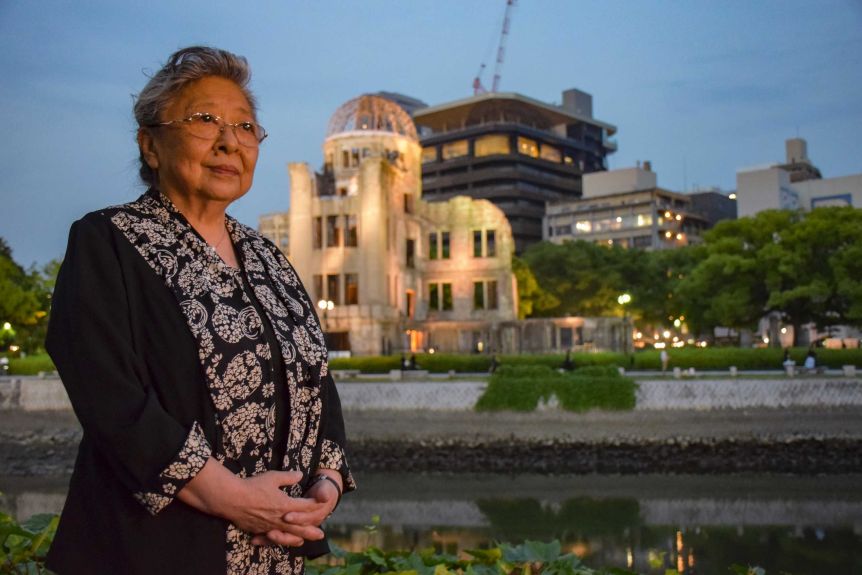
Hiroshima’s atomic bomb changed Koko Kondo’s life, but so did meeting the man who dropped it, ABC News,By Tracey Shelton, 6 August, 20, Eight-month-old Koko was in her mother’s arms the day the world’s first nuclear weapon was dropped on Hiroshima, bringing their family home crashing down on them on this day 75 years ago.
Key points:
Between 90,000 and 166,000 victims died within months of the Hiroshima bombing Koko Kondo met pilot Robert Lewis on the set of This is Your Life More than 150 denshosha volunteers are carrying on the memories of survivors
She was almost 40 years old before her mother finally sat her down and told her the full story of how she had inched through the rubble in darkness, with little Koko wrapped in her arms, towards a small pocket of dusty sunlight.
“She first pushed me out [through the opening], then next, she was able to get out … but the fire was all over the place according to my mother,” said Koko Kondo, who is now 75.
Ms Kondo’s father — Methodist minister Kiyoshi Tanimoto, who was visiting a parishioner across town — said in a US television interview “the whole city was on fire” as he ran through the streets to find his family.
He described people running in silence with skin hanging from their bodies “like a procession of ghosts”
In the sky above, pilot Robert Lewis was part of the United States Air Force crew who dropped the atomic bomb known as Little Boy that day, unleashing around 13 kilotons of force on the city below, where Ms Kondo’s family and about 290,000 other civilians lived, according to the Atomic Heritage Foundation.
Estimates on how many people died from the bomb either instantly or in the following months range between 90,000 and 166,000, but the Little Boy would go on to claim the lives of thousands more as the effects of radiation took their toll.
After looking back to see the once-flourishing city “disappear”, Captain Lewis wrote in his log book “My God, what have we done?”…….
While Ms Kondo said most people avoided speaking of the bombing in the decades that followed, her father made it his mission to help the injured, rebuild the city and ensure the world never forgot.
Her family had suffered from radiation sickness and Ms Kondo was subjected to years of tests and examinations to study the effects of radiation exposure.
One of Ms Kondo’s earliest memories — at around two or three years old — was of a group of teenage girls attending a sermon at her father’s church.
“Some girls could not close their eyes. Some girls — their lips were all melted with their chins so they could not close [their mouths],” she told the ABC.
While her manners did not permit her to ask questions, she would listen to her parents’ conversations and learned that the destruction and pain that surrounded her was caused by a single US B-29 bomber.
Ms Kondo said her childhood became consumed by hatred and thoughts of revenge.
“Someday when I grow up, I am definitely going to find the people who were on that B-29 bomber to do the revenge,” she said.
“That was my plan, that was my thinking. But life is interesting.”
When Koko was 10, her mother and siblings received a phone call from the then popular US television program This is Your Life.
They were immediately flown to the United States for an episode featuring the work of her father, who had taken a group of young survivors to the US for plastic surgery……
As Hiroshima mission pilot Robert Lewis was introduced, Koko glared at him with all the hatred a 10-year-old could muster.
“I was so shocked!” she recalled.
“What could I do? I wanted to run to the middle of the stage and give him a punch, a bite or a kick.”
But as he recalled his memories of that day, she saw tears begin to well in his eyes.
“I thought he was a monster, but monsters don’t have tears.”
Ms Kondo said she realised she had lived her short life full of hate for a man she knew nothing about……..
the life of this man was not easy, she said, and he “suffered greatly” not only with the weight of his involvement in the bombing, but he was also “harassed” for speaking about it publicly.at 75, she is among the youngest of a dwindling number of survivors who can tell the world first hand of the horrors these weapons unleashed……….
“My concern is today nuclear weapons are much, much stronger. We have to abolish them now,” urged Ms Kondo. ….
If these stories were lost, “probably our planet would be gone”, she said.
Doctoral candidate Tomoko Kubota is one of more than 150 denshosha — a designated keeper of the memories of a Hiroshima or Nagasaki survivor.
As a denshosha volunteer, she spent three years training and learning from survivor Sadae Kasaoka, so in the future she can “give testimony” on her behalf by sharing her “experiences, the reality of the atomic bombing, and desires for peace”.
That story includes how, at 12 years of age, Ms Kasaoka lost her mother and watched her father die — within days of the blast — in agony from horrific burns and wounds that became infested with maggots.
“The majority of the world really doesn’t wish to hear our voices, and they haven’t heard us,” Thurlow said. “They choose not to hear us. That’s disappointing. They are just allowing these leaders to pile up the money, invest the money in armaments, to massacre human beings — mass killing. That’s a crime.”
Haunted by bombing, Hiroshima survivor continues fight against nuclear weapons, GRANDIN Media, By Michael Swan, Canadian Catholic News, July 31, 2020 Setsuko Thurlow, 88, isn’t just disappointed. She’s choking back tears of frustration and grief as she describes the response she’s had from Prime Minister Justin Trudeau on nuclear disarmament over the last four years.
“That’s extremely, extremely disappointing — so disturbing,” said the Hiroshima survivor who has been actively campaigning against nuclear weapons for more than 60 years.
“It’s not just me. There’s a lot of people disappointed. And that’s not the way the prime minister should be behaving. If this is a democracy, he (Trudeau) should be sharing his ideas and encouraging debate.”
The world is marking the 75th anniversary this month of the atomic bombings of Hiroshima and Nagasaki, events that still haunt and propel Thurlow in her passion for the disarmament cause.
On June 22 she sent a letter to Trudeau asking that he acknowledge that Canada helped to produce the first atomic weapons and has copied the letter to all 338 parliamentarians in Ottawa. She is still waiting for a reply.
So far the only time Trudeau has ever spoken about nuclear weapons policy was to mock efforts to declare the weapons illegal, Thurlow said…..
Trudeau was not in attendance later that year when Thurlow accepted the Nobel Peace Prize on behalf of the International Campaign to Abolish Nuclear Weapons. Nor did anyone in his government congratulate her.
The Trudeau government fell in line with U.S.-dictated NATO policy and refused to participate in United Nations negotiations leading to the Treaty to Prohibit Nuclear Weapons in 2017.
Canada voted against the treaty while 122 nations voted it in. Since then 40 states, including the Vatican, have ratified the treaty. Once 50 countries have ratified it, the treaty comes into legal force.
As one of a dwindling number of hibakusha, or survivors of the first two nuclear weapons, Thurlow has become an important face of the treaty and the campaign that brought it to the UN.
Her drive for a nuclear-free world began almost from the moment she woke up amidst the rubble left by the bomb that killed at least 70,000 people in a flash of heat and blinding light in Hiroshima.
She was then a 13-year-old school girl, bused downtown with 30 classmates to help crack coded messages for the Japanese military. She woke up to a world of pain under a pile of debris that morning of Aug. 6, 1945. Continue reading →
How atomic bomb survivors have transformed our understanding of radiation’s impacts, Science. By Dennis Normile, Jul. 23, 2020 , HIROSHIMA—Kunihiko Iida wants the world to know that the atomic bombs the United States dropped on Hiroshima and Nagasaki 75 years ago next month are still claiming lives and causing suffering.Iida was 3 years old in August 1945. His father had died in battle; he was living with his mother and her parents in a house 900 meters from Hiroshima’s hypocenter, the spot right beneath the detonation. The blast crumpled the house. The family fled the city, but Iida’s mother and older sister soon died from their injuries, a fact the little boy didn’t grasp. “Until I entered elementary school, I thought they were living and that we would meet someday,” he says.
His injuries left him bedridden for years, and he has suffered debilitating illnesses ever since. Childhood anemia caused him to collapse at school. He’s had ulcers and asthma, underwent two surgeries to remove brain tumors, and now has thyroid growths. “There has never been a break in these illnesses,” he says.
Yet Iida has survived. Thousands of others died prematurely over the years because of radiation-induced cancer, a tally that is still growing. Collectively, they have left an important legacy. Most of what is known today about the long-term health effects of radiation has come out of research with those survivors. The work, now run by the Radiation Effects Research Foundation (RERF), is making “major contributions to our understanding of radiation effects,” even today, says Richard Wakeford, a radiation epidemiologist at the University of Manchester. RERF studies also underpin the limits that countries have set for occupational and medical exposure to radiation.
Iida has participated in the studies since the late 1950s, because, he says, “They are trying to accurately grasp the misery of the atomic bomb,” something he hopes will promote peace. People don’t understand the unique impacts of nuclear weapons, Iida says. He and other participants “have helped the entire world,” says Ohtsura Niwa, chairman of RERF.
The survivors’ ranks are now rapidly thinning. About 70% of the original 120,000 participants enrolled in RERF’s Life Span Study (LSS) have died; most of those remaining are in their 80s and 90s. “We have an ethical obligation” to follow the cohort through the last surviving member, Niwa says—but at the same time, “We have to expand our mission.”
RERF researchers believe they can continue to gather epidemiological findings from existing life and health histories of the LSS participants, but they are also starting entirely new studies, for example of the molecular mechanisms by which radiation exposure leads to cancer. And biological samples from 30,000 study participants collected over 7 decades await genomic analysis………
One of Atomic Bomb Casualty Commission (ABCC) ‘s most immediate concerns was the possible impact of radiation on survivors’ children. It was clear that the bombings affected children already conceived in August 1945, resulting in an increased number of babies born with a small head size. And fruit fly studies showing that irradiation of adults causes heritable genetic changes and birth defects in offspring suggested there might be longer term effects………..
“Leukemia is a very rare disease, but clinicians became aware that it was appearing a lot among the survivors,” says Kotaro Ozasa, an RERF epidemiologist. ABCC showed the disease was especially prevalent among those closest to the hypocenter. Previous studies among people exposed to radiation in a medical context had hinted at the link, Wakeford says, but “the findings from Japan provided convincing evidence.”……..
How radiation exposure affected health
Studies in Hiroshima [shown on map below on original ] and Nagasaki conducted over the past 75 years have yielded important insights into the health effects of radiation. Researchers went to great lengths to determine survivors’ exposure, which depended partly on their distance from the hypocenter of the bombings………..
Year after year, the researchers have tracked the incidence of more than a dozen different types of cancers in the survivors, along with mortality. “Radiation risk is very complex,” says RERF epidemiologist Alina Brenner. It depends on sex and age at exposure and can be influenced by genetic susceptibility and lifestyle factors such as smoking. And risks “change over time as a population ages,” she says. But the sheer size and duration of the LSS, along with its detailed data on exposure, age, and sex, allowed researchers to draw many conclusions as the decades passed.
Dose was clearly very important. Among those who were within about 900 meters of the hypocenter and received more than 2 grays of radiation, 124 have died of cancer. (That dose is about 1000 times the average annual radiation dose from natural, medical, and occupational sources combined.) In its latest LSS update, RERF scientists conclude—based on comparisons of cancer deaths between the exposed group and unexposed controls—that radiation was responsible for 70 of those deaths (see graphic, above). Scientists call this number, 56.5%, the attributable fraction. The numbers of deaths are low because few who were close to ground zero survived the blast, explains Dale Preston, a biostatistician at Hirosoft International who previously worked at RERF. But among these people, “Most of the cancers are due to the radiation,” Preston says
At 1 gray of exposure, the dose roughly 1100 meters from the hypocenter, the attributable fraction is 34.8%, and it decreases linearly for lower doses. Women suffered more radiation-associated cancers than men, largely because of cases of breast cancer. Both men and women exposed at a younger age were more at risk as they aged: “It’s thought that actively dividing cells are more susceptible to radiation effects, so younger people are more sensitive,” Ozasa says. Radiation most increased the risk of leukemia among survivors, followed by cancer of the stomach, lung, liver, and breast. There was little impact on cancers of the rectum, prostate, and kidney. Exposure also heightened the risk of heart failure and stroke, asthma, bronchitis, and gastrointestinal conditions, but less so; for those with a 2-gray exposure, 16% of noncancer deaths were deemed attributable to radiation………..
New data are still coming in. In papers published in 2018 and 2019, for example, RERF scientists reported that women exposed to bomb radiation at the age of menarche, the first occurrence of menstruation, were at a higher risk of developing breast or uterine cancer later in life than those exposed before or after puberty. The proliferation of breast and uterine tissue during puberty provides “a lot of potential for DNA damage induced by radiation,” Brenner says.
The breast cancer study also gives a glimpse of RERF’s future agenda. The first analysis did not try to distinguish among the several major breast cancer subtypes, which vary in their biological mechanisms and prognoses, Brenner says. RERF is now analyzing cancerous tissue collected from patients to determine whether any of those subtypes occur more frequently in radiation victims. If so, that could provide hints about just how radiation damages tissue and raises cancer risk.
SAMPLES ARE ONE RESOURCE RERF has in abundance. During detailed biennial health examinations of more than 23,000 of the survivors (including some exposed in utero), researchers have collected and preserved blood and urine samples, some dating back to the late 1950s. RERF has also amassed frozen cell lines from parents and children in 500 families in which at least one parent was exposed to radiation, plus an equal number of control families.
DNA in those samples—which so far has not been sequenced—could provide a check on the early data about the health of survivors’ offspring. Despite the reassuring findings about birth defects, some researchers worry radiation may have caused mutations in testes and ovaries that children born years later might have inherited. Researchers plan to compare the number and types of mutations found in the families to see whether any are more common in children of radiation-exposed parents, Ullrich says. https://www.sciencemag.org/news/2020/07/how-atomic-bomb-survivors-have-transformed-our-understanding-radiation-s-impacts
“My task was to go in and pick up all the radioactive debris, load them into my truck and take them to the decontamination centre.“I had no protection whatsoever. The only people who had protection on Christmas Island were civilian AWREs – Atomic Weapons Research Establishment people.” A study undertaken by Sue Rabbitt Roff, a social scientist at Dundee University in 1999, found that of 2,261 children born to veterans, 39% were born with serious medical conditions. By contrast, the national incidence figure in Britain is around 2.5%.“I want them to apologise to all the nuclear veterans for using us as experiments,” he said. I still maintain that they wanted to find out the level of radiation that a person could survive the nuclear bombs with.I want them to apologise to all the nuclear veterans for using us as experiments’, says Fife Christmas Island veteran, https://www.thecourier.co.uk/fp/news/local/fife/1377815/i-want-them-to-apologise-to-all-the-nuclear-veterans-for-using-us-as-experiments-says-fife-christmas-island-veteran/ July 4 2020 Michael Alexander. Here’s why nuclear test veteran Dave Whyte from Fife intends to campaign for justice “until the end”
In the 18 years that Christmas Island veteran Dave Whyte from Fife has been campaigning for “justice” for Britain’s nuclear test veterans, he has never held back with the language he has used to describe the Ministry of Defence’s treatment of British soldiers during the nuclear tests of the 1950s.
He has compared the nuclear tests with the “experiments of Nazi Doctor Joseph Mengele”, accused the MoD of treating soldiers as “guinea pigs” and made comparisons with the aftermath of “Chernobyl”.
He blames his exposure to the fallout from five atomic and hydrogen bomb blasts in 1958 for a catalogue of health problems he’s experienced over the years including the loss of all his teeth at 25 and the discovery in his mid-30s that he was sterile.
The Ministry of Defence, meanwhile, has said there is no valid evidence linking the nuclear tests to ill health.
But despite numerous attempts at legal action against the MoD over the years, which, he admits have “hit every brick wall available”, the now 83-year-old, of Kirkcaldy, is refusing to give up as he continues searching for an admission that he, and thousands of other servicemen – now dwindling in numbers – were exposed to more radiation than the authorities have ever admitted.
Born and raised in Montrose before a spell living in Edinburgh and Germany where his sergeant major father served with the Royal Artillery, Mr Whyte was 22-years-old and serving with the Royal Engineers when he was sent to Christmas Island in the South Pacific in 1958.
The Cold War was at its height and Mr Whyte was stationed there, off the north-eastern coast of Australia, to assist with British nuclear tests.
His job was to collect samples afterwards.
At the time the stakes were high. Amid real fears that the Cold War could escalate into open warfare with the USSR, Britain was determined that it should have its own nuclear deterrent.
In all, Britain and the USA caused some 40 nuclear test explosions in the Pacific region between 1952 and 1962.
Something like 21,000 British servicemen were exposed to these explosions.
But little did Mr Whyte and his colleagues realise that in years to come, some would suffer ill health and in some cases premature death.
Some would suffer from rare forms of leukaemia.
Others reported congenital deformities in their children with a disproportionate number of stillbirths.
“I was at Grapple Y – the largest hydrogen bomb exploded by Britain,” said Mr Whyte. Continue reading →
A study released by the National Cancer Institute in 1997 showed that 25 states had citizens exposed to high levels of radiation due to nuclear testing.
“When there is an earthquake in that area, the radiation fallout will be equal to Chernobyl,” Brodesser said in her lecture. “When, not if.”
Before she started her lecture on March 10, she was introduced simply as an advocate. More than that, she is a witness, part of a small group of people fighting for the rights of Idahoans whose lives changed on July 16, 1945, when the U.S. conducted the first-ever nuclear test, setting off a series of events the world is still struggling to fully understand.
These are downwinders, and they are dying.
‘THEY KNOW WHAT THEY’VE DONE’
In the 1950s and ’60s, the bulk of America’s nuclear testing was done in a 680-square-mile piece of desert about 65 miles outside of Las Vegas. The Nevada Test Site was ground zero for America’s Cold War preparations, testing the effects and power of the nuclear bombs designed by the military. From 1951 to 1958, around 100 aboveground nuclear tests were conducted on the site. The site was chosen for its relative isolation from any densely populated cities; however, in the end, distance was not the solution it first seemed.
The term “downwinders” refers to anyone who lived in communities exposed to nuclear radiation during the end of World War II and the peak of the Cold War (roughly the late 1940s to 1980). During the construction and testing of nuclear weapons, wind patterns directed the fallout far beyond the safety perimeters of the sites, spreading radiation hundreds and even thousands of miles away.
In the book “Atomic Farmgirl,” author Teri Hein details her life growing up downwind of Hanford, Washington, where the bulk of America’s plutonium was produced for many decades. She explains the fallout like this: When Mount Saint Helens erupted in 1980, ash drifted far past the state lines of Washington. The wind carried and then settled the debris into neighboring states. Nuclear radiation fallout can be thought of in the same way. The testing locations in Nevada and the production plants in Hanford are the eruption. The radiation then drifted into Idaho, Montana, Wyoming and beyond.
The radiation was in the air and, more importantly, in the crops and livestock of these communities. According to the National Cancer Institute, a significant portion of the Intermountain West was exposed to high doses of radiation from the tests, specifically the radioisotope Iodine-131. Iodine-131 is processed in the thyroid, the gland in your neck that regulates hormones. This is why children seemed to be the hardest hit from the fallout: their thyroid is still developing and isn’t strong enough to process the high dosage of Iodine.
NCI’s list of medical issues tied to downwinders is long, ranging from multiple sclerosis to various forms of cancer that slowly eat away at your life. That’s something that Emmett resident Tona Henderson knows only too much about. Continue reading →
Captain Brett Crozier Takes A StandJames Fallows, April 3, 20202020 Time Capsule #11: ‘Captain Crozier’The Atlantic The episode I’m about to mention has been receiving saturation social-media attention for the past few hours, as I write. But because the accelerating torrent of news tends to blast away each day’s events and make them hard to register—even a moment like this, which I expect will be included in histories of our times—I think it is worth noting this episode while it is fresh.
Until a few days ago, Brett Crozier would have been considered among the U.S. Navy’s most distinguished commanders………
The four-page letter, which you can read in full at the Chronicle’s site, used the example of recent cruise-ship infection disasters to argue that closed shipboard environments were the worst possible location for people with the disease. It laid out the case for immediate action to protect the Roosevelt’s crew, and ended this way:
7. Conclusion. Decisive action is required. Removing the majority of personnel from a deployed US. nuclear aircraft carrier and isolating them for two weeks may seem like an extraordinary measure. A portion of the crew (approximately 10%) would have to stay aboard to run the reactor plant, sanitize the ship, ensure security, and provide for contingency response to emergencies.
This is a necessary risk. It will enable the carrier and air wing to get back underway as quickly as possible while ensuring the health and safety of our Sailors. Keeping over 4,000 young men and women on board the TR is an unnecessary risk and breaks faith with those Sailors entrusted to our care…
This will require a political solution but it is the right thing to do. We are not at war. Sailors do not need to die. If we do not act now, we are failing to properly take care of our most trusted asset our Sailors. Request all available resources to find NAVADMIN and CDC compliant quarantine rooms for my entire crew as soon as possible.
“Breaks faith with those Sailors entrusted to our care.” “We are failing to properly take care of our most trusted asset our Sailors.” “Unnecessary risk.” In any walk of life, such language would have great power. Within the military—where terms like faith and trust and care have life-and-death meaning, and are the fundamental reason people follow leaders into combat—these words draw the starkest possible line. This course is right. The other course is wrong. Thus a leader spoke on behalf of the people “entrusted to our care.”…….
Based on information available as I write, it appears that he took a stand, and is paying the price.
Brett Crozier will no longer be one of the Navy’s most powerful commanders. He remains in the service, but his command has been taken away.
‘He’s Got Eight Numbers, Just Like Everybody Else’: An Anti-Nuclear Activist Behind Bars, Common Dreams, by Kathy Kelly 3 Apr 20
Trident nuclear disarmament activist Steve Kelly, a Jesuit priest, begins his third year imprisoned in a county jail as he and his companions await sentencing. On April 4, 2020, my friend Steve Kelly will begin a third year of imprisonment in Georgia’s Glynn County jail. He turned 70 while in prison, and while he has served multiple prison sentences for protesting nuclear weapons, spending two years in a county jail is unusual even for him. Yet he adamantly urges supporters to focus attention on the nuclear weapons arsenals which he and his companions aim to disarm. “The nukes are not going to go away by themselves,” says Steve.
The Kings Bay Plowshares 7 now await sentencing for their action, performed two years ago inside the Kings Bay Trident Submarine base in southern Georgia. They acted in concert with many others who take literally the Scriptural call to “beat swords into plowshares.” Commenting on their case, Bill Quigley, a member of their legal team, told me “their actions speak louder than their words and their words are very powerful.” Bill encourages us to remember each of them in our thoughts, prayers, and, hopefully, through our actions. “The legal system is not big enough for the hearts, minds and spirits of these folks,” he adds. “The legal system tries to concentrate all of this down to whether you cut a fence or sprayed some blood.” Bill believes we should instead look at the impending disaster nuclear weapons could cause, and the continuing disaster they do cause by wasting crucially needed resources to potentially destroy the planet.
“You’ve got eight numbers just like everybody else.” Jailers sometimes use this line to subdue or humiliate a prisoner who complains or seems to ask for special treatment. I learned this during a two-month stint in a Missouri county jail, (for planting corn on top of nuclear missile silo sites).
Sailors cheer for aircraft carrier commander who was removed after issuing coronavirus warning ByZachary Cohen and Ryan Browne, CNN April 3, 2020 Sailors aboard the USS Theodore Roosevelt aircraft carrier cheered for Capt. Brett Crozier as he disembarked the ship for the last time, an overwhelming show of support for their leader who was relieved of his command after issuing a stark warning about a coronavirus outbreak onboard.
New video obtained by CNN shows a large crowd gathered to give Crozier a warm and loud send off, clapping and chanting his name as he left the ship. It was a clear expression of appreciation for their former commander who was removed for what the acting Navy Secretary called “poor judgment.”
“Today at my direction the commanding officer of the USS Theodore Roosevelt, Captain Brett Crozier, was relieved of command by carrier strike group commander Rear Admiral Stewart Baker,” acting Secretary of the Navy Thomas Modly announced on Thursday,
The decision came days after Crozier wrote a memo warning Navy leadership that decisive action was needed to save the lives of the ship’s crew. “We are not at war. Sailors do not need to die. If we do not act now, we are failing to properly take care of our most trusted asset — our Sailors,” it read, three US defense officials confirmed to CNN.
News of Crozier’s removal comes after a US defense official told CNN Friday morning that 137 sailors from the Roosevelt have tested positive for the virus, representing more than 10% of all cases across the US military…..
Escalating outbreak
The outbreak on the ship is escalating rapidly. Last week the Pentagon confirmed three sailors on the Roosevelt had tested positive, and that number had risen to 25 two days later. It rose to at least 70 on Tuesday and more than 100 on Thursday. On Monday, a US defense official told CNN that a second US aircraft carrier, the USS Ronald Reagan, is facing a “handful” of positive cases.
In his memo, Crozier implored Navy leaders to take immediate steps to address the situation.
“Decisive action is required. Removing the majority of personnel from a deployed US nuclear aircraft carrier and isolating them for two weeks may seem like an extraordinary measure,” his memo said.
Your Inner H-Bomb, Nuclear testing left a signature of radioactive carbon all around the world—in trees and sharks, in oceans and human bodies. Even as that signal disappears, it’s revealing new secrets to scientists. The Atlantic, by Carl Zimmer, 2 Mar 20,
In the morning of March 1, 1954, a hydrogen bomb went off in the middle of the Pacific Ocean. John Clark was only 20 miles away when he issued the order, huddled with his crew inside a windowless concrete blockhouse on Bikini Atoll. But seconds went by, and all was silent. He wondered if the bomb had failed. Eventually, he radioed a Navy ship monitoring the test explosion.
“It’s a good one,” they told him.
Then the blockhouse began to lurch. At least one crew member got seasick—“landsick” might be the better descriptor. A minute later, when the bomb blast reached them, the walls creaked and water shot out of the bathroom pipes. And then, once more, nothing. Clark waited for another impact—perhaps a tidal wave—but after 15 minutes he decided it was safe for the crew to venture outside.
The mushroom cloud towered into the sky. The explosion, dubbed “Castle Bravo,” was the largest nuclear-weapons test up to that point..
It was intended to try out the first hydrogen bomb ready to be dropped from a plane. Many in Washington felt that the future of the free world depended on it, and Clark was the natural pick to oversee such a vital blast. He was the deputy test director for the Atomic Energy Commission, and had already participated in more than 40 test shots. Now he gazed up at the cloud in awe. But then his Geiger counter began to crackle.
“It could mean only one thing,” Clark later wrote. “We were already getting fallout.”
That wasn’t supposed to happen. The Castle Bravo team had been sure that the radiation from the blast would go up to the stratosphere or get carried away by the winds safely out to sea. In fact, the chain reactions unleashed during the explosion produced a blast almost three times as big as predicted—1,000 times bigger than the Hiroshima bomb.
Within seconds, the fireball had lofted 10 million tons of pulverized coral reef, coated in radioactive material. And soon some of that deadly debris began dropping to Earth. If Clark and his crew had lingered outside, they would have died in the fallout.
Clark rushed his team back into the blockhouse, but even within the thick walls, the level of radiation was still climbing. Clark radioed for a rescue but was denied: It would be too dangerous for the helicopter pilots to come to the island. The team hunkered down, wondering if they were being poisoned to death. The generators failed, and the lights winked out.
“We were not a happy bunch,” Clark recalled.
They spent hours in the hot, radioactive darkness until the Navy dispatched helicopters their way. When the crew members heard the blades, they put on bedsheets to protect themselves from fallout. Throwing open the blockhouse door, they ran to nearby jeeps as though they were in a surreal Halloween parade, and drove half a mile to the landing pad. They clambered into the helicopters, and escaped over the sea.
As Clark and his crew found shelter aboard a Navy ship, the debris from Castle Bravo rained down on the Pacific. Some landed on a Japanese fishing boat 70 miles away. The winds then carried it to three neighboring atolls. Children on the island of Rongelap played in the false snow. Five days later, Rongelap was evacuated, but not before its residents had received a near-lethal dose of radiation. Some people suffered burns, and a number of women later gave birth to severely deformed babies. Decades later, studies would indicate that the residents experienced elevated rates of cancer. ……….https://www.theatlantic.com/science/archive/2020/03/how-nuclear-testing-transformed-science/607174/
The Palomares disaster occurred on Jan. 17, 1966, when an American B-52 bomber on a Cold War patrol exploded during a midair refueling accident, sending four hydrogen bombs hurtling toward the ground. They were not armed, so there was no nuclear detonation, but the conventional explosives in two of the bombs blew up on impact, scattering pulverized plutonium over a patchwork of farm fields and stucco houses.
Plutonium is extremely toxic, but it often acts slowly. The alpha-particle radiation it gives off travels only a few inches and would not penetrate skin. But inhaled plutonium dust can lodge in the lungs and steadily irradiate surrounding tissue, gradually inflicting damage that can cause cancer and other ailments, sometimes decades later. A single microgram absorbed in the body is enough to be harmful; according to declassified Atomic Energy Commission reports, the bombs that blew apart at Palomares contained more than 3 billion micrograms.
For Many Who Cleaned Up a Nuclear Mess, a Key Ruling Comes Too Late
Air Force veterans who dealt with a Cold War-era atomic accident in Spain won the right to sue collectively for health benefits — but not before many had lost battles with cancer.https://www.nytimes.com/2020/02/11/us/palomares-air-force-nuclear.htmlBy Dave Philipps SPRINGFIELD, Mo. — On Christmas Eve, Victor Skaar mailed a stack of letters to Air Force veterans he had served with in Palomares, Spain, scrawling a simple headline at the top of each one: “Great News!”
Mr. Skaar, a retired chief master sergeant, was one of 1,600 troops scrambled by the Air Force in 1966 to clean up a classified nuclear disaster by collecting debris and shoveling up plutonium-laced soil. Many were later stricken with cancer and other ailments, and tried without success to get the federal government to take responsibility and pay for their medical care.
He wanted to spread the word about an encouraging development: A lawsuit he had filed against the Department of Veterans Affairs had been certified as a class action, meaning that there was finally a chance to set the plutonium case straight, not just for him but for everyone who was there.
But his letters soon began trickling back to him: Undeliverable. No forwarding address. One brought a reply from a widow. Each one in his mailbox made his heart sink.
“For many of them, it’s too late,” he said of his comrades. “They’re gone.”
As one of the first cases ever granted class-action status by the Court of Appeals for Veterans Claims, the Skaar lawsuit represents a major step forward for veterans with long-term health issues linked to toxic exposure in the service.
‘First they told me there were no records, which I knew was a lie because I helped make them.’ Continue reading →
Meet the scientists quitting academia for climate activism, https://www.dw.com/en/meet-the-scientists-quitting-academia-for-climate-activism/a-51452337–12 Dec 2019, Emotional stress, burnout, and a sense of frustration at policy makers are driving some academics to take a different path in tackling climate change. DW spoke to three people to find out why they became activists.
Most people have the option to switch off from the terrifying media stories of how climate change is affecting the planet. This isn’t so easy for environmental scientists and academics who spend their days researching the consequences of climate change.
In a letter published in Science magazine in October this year, biologists Andy Radford, Stephen Simpson and Tim Gordon, said the loss of nature for people with a strong emotional attachment to it “triggered strong grief responses.”
They argued institutes needed to adapt strategies from “healthcare, disaster relief, law enforcement and military” for environmental scientists so they can manage their “emotional stress.”
After the letter a number of colleagues reached out to Radford, a professor at the University of Bristol, to express their comfort at the views being made public.
Caught between frustration at the disconnect between climate science and policy, and a hope inspired by burgeoning global climate protests in the last year, DW spoke to three people shunning academia in favor of activism.
Dr Wolfgang Knorr: ‘We know a lot less than we pretend to’
Dr Wolfgang Knorr, 53, researcher, physical geography and ecosystem science, and principal investigator (BECC), Lund University, Sweden
Knorr handed in his resignation in September 2019 after 27 years in environmental science. He believes his skills could be better applied as an activist, though he’s not yet sure what form this will take.
“My attraction to science has always been emotional. But in science, it’s all about keeping the emotions down, because they’re not wanted, basically. On the emotional level, I have this strong sense that there is a tremendous risk out there and we know a lot less than we pretend to.
In 2005, I joined the UK’s Natural Environment Research Council. On a daily basis, I would sit in meetings, debating new renewable energy schemes or whatever. On the train back, you read newspaper stories about climate change, but the next page will be economic news about expansion and GDP growth. At that time it became clear to me that there’s a dichotomy between the work and what’s going on in the rest of the world.
That gut feeling at that time continued until very recently — until the youth protests. There was a real step-change in public perception due to these protests. I would say, as a climate scientist, we’re following the lead of these protesters in a way, because it made me realize that I had a potential for being an advocate. I got a new perspective about what I could do with these skills.
I am hoping to find new uses for the skills that I used as a scientist, and make better use of them.”
Jess Spear: ‘I was really demoralized’
Jess Spear, 38, scientist, educator and socialist activist, RISE, Dublin
Spear left climate science in 2013 to work on a campaign in the US city of Seattle that elected its first socialist city councillor in a century. She moved to Dublin, Ireland, in 2017 and works for a new Irish left-wing group called Radical Internationalist Socialist Environmentalist (RISE).
“I worked at the US Geological Survey. It is much easier to be a scientist working as a civil servant than it is in academia. It wasn’t that stressful and was rewarding, but it wasn’t actually producing what I wanted in the world.
At the beginning of 2011 I was really demoralized about the state of the movement for climate action. There didn’t appear to be very many people concerned about it.
To see constant emission rises and failure of governments was like watching a train about to go off a cliff in slow motion. You know what’s going to happen. You feel powerless to do anything about it when you’re just one person.
In 2013 when I started to work in activism, I can remember standing in my kitchen, watching videos of Occupy Wall Street. It was like a light turning on. That was a life-changing moment for me because it opened up the possibilities for shifting away from finding solutions, to focusing on community activism.”
Mathieu Munsch: ‘What I’m doing now is much more meaningful’
Mathieu Munsch, 30, builder, educator and community activist, France
Munsch quit his PhD in climate change at Strathclyde University in Scotland after two and a half years in September 2018. He’s now constructing an eco-friendly house in rural France and has become involved in local politics.
One major impetus was what he saw as a conflict with his values as an academic concerned about the environment if he continued on a certain career path.
In the first year, I still had some faith that I was doing the right thing. But it became more and more obvious to me that I was never going to be able to have a successful career, access to a pension and all of that if for me to benefit from that, the current economic system would need to continue functioning, and therefore we would go into catastrophic climate change. It became a wake-up call that I needed to get out of that system.
I experienced some burnout, specifically when I was spending eight hours of my day on the computer reading documents about climate change. It was pretty emotionally heavy, even though I don’t think I was in the deep despair that I know some people experience.
Something that helped me cope was giving time to activist groups. But it’s only leaving and finding a completely different way to do things that helped me overcome the stress and burnout.
Since I left, I’ve had people contacting me over Twitter as well, specifically for the decision, and one of them said, ‘Oh, yeah, I did exactly the same thing two years ago. I feel like what I’m doing now is much more meaningful.”
These interviews have been edited and condensed for clarity and length
John Wayne squares off against Jim Hansen, Medium, Albert Bates, 11 Jan 2020 “……..The famous cowboy actor John Wayne may have been felled by the same foe, as was Marie Curie. From 1951 to 1962 the US Atomic Energy Commission (AEC) detonated more than 100 bombs in the southwestern US desert, sending huge pinkish plumes of radioactive dust across the stony valleys and canyons of southern Utah and northern Arizona. It gave each “shot” names like Annie, Eddie, Humboldt and Badger. Eleven of those tests were part of a series called Upshot-Knothole in Utah in 1953. In 1954, the Upshot-Knothole site was chosen as the location for a John Wayne film called The Conqueror.
The AEC sent a scientist with a Geiger counter to show Wayne that the location was safe enough for him to bring his wife and children to visit the set. The Geiger counter is said to have crackled so loudly Wayne thought it was broken. Waving it over clumps of cactus, rock and sand produced the same loud result. The Duke, by all accounts, shrugged it off. By 1980, 91 out of 220 cast and crew on The Conquerer had contracted cancer and 46 of them, including Wayne and co- stars Dick Powell, Pedro Armendáriz, Agnes Moorehead, and Susan Hayward had died. Those numbers did not include the families of the cast and crew. John Wayne’s wife and two sons all got cancer. While the two sons survived, the daughter of one of Wayne’s sons also died of cancer. Hayward’s son Tim Barker had a benign tumor removed from his mouth. Many of the Native American Paiute extras went on to die of cancer also……..https://medium.com/@albertbates/john-wayne-squares-off-against-jim-hansen-42a258b2260d
404: The City Left Behind by China’s Nuclear Ambitions, https://www.wired.com/story/404-the-city-left-behind-by-chinas-nuclear-ambition/–20 Jan 2020, An artist goes looking for his past in a Cold War ghost town. Li Yang grew up in what he thought was a boring town. It was called 404, like the error code, and sat a couple hours from the nearest city, in the sun-beaten Gobi Desert of western China. There was no commercial movie theater—just a zoo with a handful of cages, several small video game arcades, and a skating rink that eventually closed. To Yang, it seemed small and backwards. He dreamed of the day he’d leave and “see the big, outside world,” he says.
But despite the humdrum, 404 wasn’t exactly boring: It was once part of a massive nuclear weapons base in the People’s Republic of China. In 1955, following threats of nuclear attacks from the United States, Chairman Mao Zedong resolved to stock his own atomic arsenal.
The USSR promised to provide blueprints and a prototype for a bomb, and as part of the quest, helped build the Jiuquan Atomic Energy Complex, dubbed Plant 404. Though an ideological squabble caused the Soviets to withdraw just after construction started, China plowed forward. The site hosted the nation’s first nuclear reactor, which generated an estimated .9 tons of weapons-grade plutonium between 1966 and 1984, as well as plutonium processing factories and nuclear warhead workshops. (Later, the complex was converted for use by the civilian nuclear industry.)
China staffed its war complex with the country’s finest scientists, technicians, and other workers, who lived in a closed settlement absent from most maps. Yang’s grandparents and parents moved there in 1958, leaving their home in Beijing to forge a new one on a windy frontier a thousand miles away. At its height, Yang’s parents told him, the town had a population of some 50,000 people.
But by the time Yang was a kid, the population had dwindled. He remembers just about 100 kids in his grade. After dinner, people chatted under a statue of Chairman Mao in the square and took strolls. “Some walked around in the park, others along the half-mile main road,” Yang says. “Because the city was so small, people might meet each other several times in one night, until they were too embarrassed to say hello.”
Yang finally got his wish to leave in 2003, enrolling in college in Sichuan province and eventually settling in Beijing. But as he got older, he started to miss 404 and the simplicity of life there. He couldn’t move home if he wanted to, though. In the mid-2000s, according to Chinese media, residents seeking a better quality of life voted to relocate their housing to the more desirable city of Jiqyuguan.
Yang’s nostalgia grew so strong, though, that in 2013 he packed a couple cameras in his car and drove back to 404 to photograph what remained. The guards let him in since he’d lived there. The town wasn’t entirely empty—some people chose to stay, Yang says—but it was eerily quiet. Yang wandered his old haunts on foot, memories flooding back as he visited his old elementary school classroom, the public baths where he used to shower, and even his family’s former house, now demolished. One of two poplar trees he had planted out front was dead.
He returned three more times to produce the images in his series 404 Not Found. To Yang, they represent the home of his childhood—“the place I want to go back to but can’t,” he says. For others, they’re a fascinating glimpse at a remote town born from geopolitical strife during a period in Chinese history not often seen—however dull it might have seemed to the teenagers who lived through it.
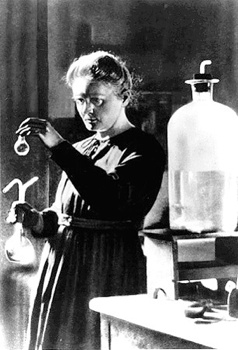
John Wayne squares off against Jim Hansen, Medium, Albert Bates, 11 Jan 2020 “…….. In 1896, Henri Becquerel discovered that uranium emitted rays that resembled X-rays. Marie Curie suspected that the radiation was not the outcome of some interaction but came from the atom itself. Her work with uranium disproved the conventional wisdom going back to ancient Greece that atoms were indivisible and set up the later discovery of subatomic particles. Curie discovered that thorium, radium, polonium and radioactive bismuth occurred naturally with uranium. Radium was known to glow in the dark, which made it useful for painting the hour and minute hands on watches and clocks. It was later discovered that radium “radiated” more than just neutrons, but also protons and electrons, becoming another unstable element, radon, and that element radiated its subatomic particles to become others, polonium and bismuth, until those eventually became a stable element, lead. Indeed, the radium Curie discovered was the progeny of another unstable element, thorium, which was the progeny of yet another unstable element, uranium.
Madame Curie was a physicist, not a medical doctor, so she did not recognize the health effects of handling uranium, thorium, radium and the other radionuclides. Indeed, she suspected the effects would be beneficial. One of the papers she and her husband published in the late 19th century announced that, when exposed to radium, diseased, tumor-forming cells were destroyed faster than healthy cells (the basis for today’s radio-chemotherapy). She carried test tubes containing radioactive isotopes in her pockets and stored them in her desk drawer. Although her many decades of exposure to radiation caused chronic illnesses (including near-blindness due to cataracts) and ultimately her death, she never acknowledged the inherent health risks. She likely did not recognize the symptoms when she began to feel weak and lose her hair. She died in 1934 from aplastic anemia without ever knowing that she fought the same mortal enemy as those who had painted the hands on watches and clocks, or those who had mined and processed the uranium on which she worked. After her death, and to this day, her papers and effects are too radioactive to be handled and her laboratory is unsafe to enter.also……..https://medium.com/@albertbates/john-wayne-squares-off-against-jim-hansen-42a258b2260d

 Captain Brett Crozier Takes A Stand James Fallows, April 3, 2020 2020 Time Capsule #11: ‘Captain Crozier’The Atlantic The episode I’m about to mention has been receiving saturation social-media attention for the past few hours, as I write. But because the accelerating torrent of news tends to blast away each day’s events and make them hard to register—even a moment like this, which I expect will be included in histories of our times—I think it is worth noting this episode while it is fresh.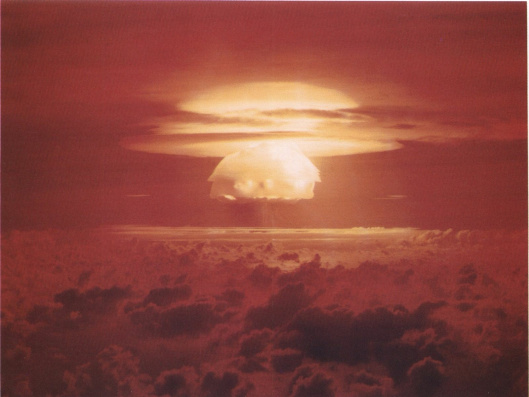

 activism, https://www.dw.com/en/meet-the-scientists-quitting-academia-for-climate-activism/a-51452337–12 Dec 2019, Emotional stress, burnout, and a sense of frustration at policy makers are driving some academics to take a different path in tackling climate change. DW spoke to three people to find out why they became activists.
 John Wayne squares off against Jim Hansen, Medium, Albert Bates, 11 Jan 2020 “…….. In 1896, Henri Becquerel discovered that uranium emitted rays that resembled X-rays. Marie Curie suspected that the radiation was not the outcome of some interaction but came from the atom itself. Her work with uranium disproved the conventional wisdom going back to ancient Greece that atoms were indivisible and set up the later discovery of subatomic particles. Curie discovered that thorium, radium, polonium and radioactive bismuth occurred naturally with uranium. Radium was known to glow in the dark, which made it useful for painting the hour and minute hands on watches and clocks. It was later discovered that radium “radiated” more than just neutrons, but also protons and electrons, becoming another unstable element, radon, and that element radiated its subatomic particles to become others, polonium and bismuth, until those eventually became a stable element, lead. Indeed, the radium Curie discovered was the progeny of another unstable element, thorium, which was the progeny of yet another unstable element, uranium.

 nuclear-news