Hegseth Vows Wartime Footing For U.S. Weapons Production.
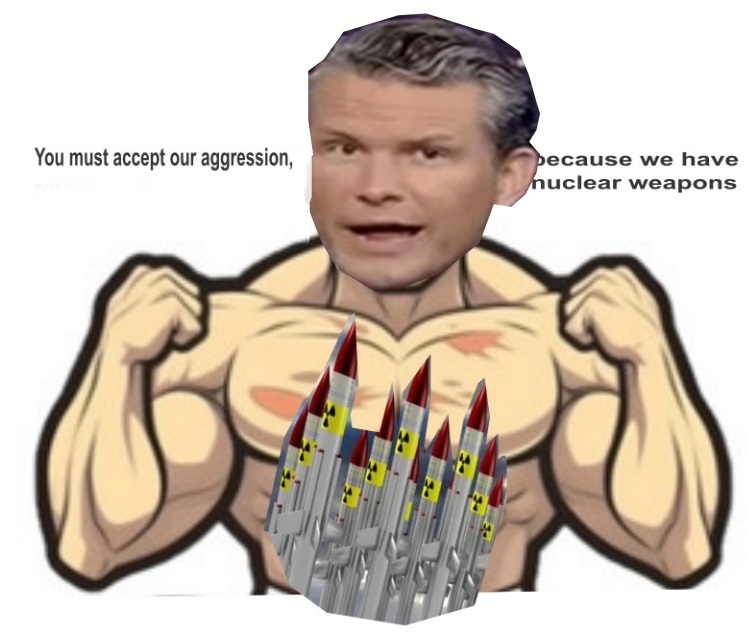
BY DREW FITZGERALD, Wall Street Journal 11/08/25
Pentagon leaders are putting their weapons suppliers in the crosshairs.
Defense Secretary Pete Hegseth said Friday that the U.S. military will shake up the way it buys weaponry, equipment and software by making purchases more quickly, and from a broader range of potential suppliers. The plan would streamline Pentagon program offices, develop incentives for new investments and potentially box out suppliers that miss deadlines.
Hegseth said decadelong weapons-development timelines have put the U.S. military at risk of falling behind rivals such as China. He said he would clear testing requirements that can slow purchasing and empower military officials to order commercial products when custom-made technology takes too long.
“We need to save the bureaucracy from itself,” Hegseth said Friday at an address to dozens of defense-industry executives in Washington.
The Trump administration aims to extend Pentagon efforts to bring into the fold more technology companies. The push has exposed ten-sions between the old-guard contractors such as Boeing and Lockheed Martin and a new crop of politically connected tech companies………………………………………………….
“We need to save the bureaucracy from itself,” Hegseth said Friday at an address to dozens of defense-industry executives in Washington.
The Trump administration aims to extend Pentagon efforts to bring into the fold more technology companies. The push has exposed ten-sions between the old-guard contractors such as Boeing and Lockheed Martin and a new crop of politically connected tech companies…………..
US Again Flies Heavy Bombers Near Venezuela’s Coast

The Senate on Thursday voted against a War Powers Resolution that would have prohibited the president from starting a war with Venezuela without congressional authorization.
The flight marked the fourth time since October 15 that the US has sent bombers into the Caribbean
by Dave DeCamp | November 6, 2025, https://news.antiwar.com/2025/11/06/us-again-flies-heavy-bombers-near-venezuelas-coast/
The US has once again flown heavy bombers over the Caribbean and near the coast of Venezuela, according to a report from Newsweek, which cited flight tracking data.
Two US Air Force B-52 Stratofortress aircraft made the provocative flight, marking the fourth time since October 15 that the US has sent bombers near Venezuela’s coast. The first flight also involved B-52s, and the second and third were conducted by B-1B Lancer bombers.
In each case, the US bombers kept their transponders on when flying near Venezuela, meaning they wanted to be seen. It’s been clear that one aspect of the US military activity in the region has been meant as a psychological operation against Venezuelan President Nicolas Maduro, as the Trump administration is hoping he decides to step down or someone in his inner circle turns on him, something that’s unlikely to happen.
The latest bomber flight comes as a US aircraft carrier, the USS Gerald Ford, is en route to the region. The Gerald Ford and its strike group will join eight US warships already deployed in the Caribbean.
According to a recent report from The New York Times, President Trump is considering several options for launching attacks on Venezuela, and he isn’t expected to decide until the Gerald Ford is in position. The report also said that the president was worried about failing or putting US troops at risk, and that he hadn’t made a final decision.
The Senate on Thursday voted against a War Powers Resolution that would have prohibited the president from starting a war with Venezuela without congressional authorization.
The US military has continued its bombing campaign against alleged drug-running boats in Latin America, which so far has involved the destruction of 17 vessels and the killing of 66 people. The Trump administration has not provided any evidence to back up its claims about what the boats are carrying and has admitted it doesn’t know the identities of the people it has been extra-judicially executing.
Ukraine accuses Russia of targeting its nuclear substations.
A large Russian missile and drone attack that overwhelmed Ukrainian air
defences overnight targeted substations that power two of Ukraine’s nuclear power plants, according to the country’s foreign minister and a person with knowledge of the barrage.
Andriy Sybiha, Ukraine’s top diplomat, said the
substations which power the Khmelnytskyi and Rivne nuclear power plants
were targeted in “well planned strikes”. “Russia is deliberately
endangering nuclear safety in Europe,” he said in a statement.
FT 9th Nov 2025, https://www.ft.com/content/474e7f27-87fb-4fb1-9899-d62778a611a4
Declassified cable reinforces proliferation concerns about high-assay low-enriched uranium fuel (HALEU)
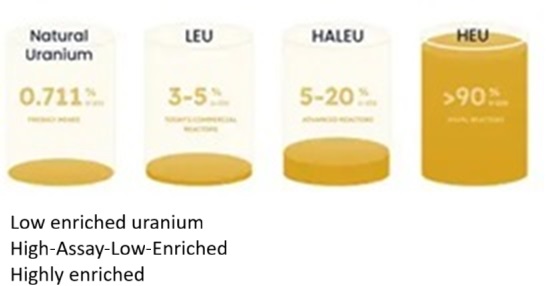
in 1977, the US government recommended to the IAEA that, contrary to its previous position, the agency should consider enriched uranium in the HALEU range to be a material “of direct utility in an … explosive device.” That is, the United States advised that HALEU should be treated similarly to HEU and be subject to stricter safeguards
Bulletin, By Edwin Lyman | November 7, 2025
A recently declassified document from nearly 50 years ago provides an important piece of the puzzle for open-source researchers seeking to understand the murky origins of the International Atomic Energy Agency (IAEA) system for safeguarding against the diversion of civil nuclear materials for weapons. The document also reinforces concerns about the proliferation potential of small modular reactors that require fuels using uranium enriched from 10 to less than 20 percent uranium 235—that is, fuels that contain the material known as high-assay low-enriched uranium (HALEU).[1]
HALEU is a subcategory of low-enriched uranium (LEU), which is uranium enriched to below 20 percent uranium 235, and the IAEA has long considered LEU, including HALEU, to be “indirect-use material.” For the agency, HALEU cannot be used to make a nuclear weapon without converting it to highly enriched uranium (HEU) by further enriching it to 20 percent or above—a significant technical barrier for all but a few countries. Consequently, HALEU is subject to far less stringent international safeguards than HEU.
But the newly uncovered document reveals that, in 1977, the US government recommended to the IAEA that, contrary to its previous position, the agency should consider enriched uranium in the HALEU range to be a material “of direct utility in an … explosive device.” That is, the United States advised that HALEU should be treated similarly to HEU and be subject to stricter safeguards—a recommendation that the IAEA apparently rejected. But given the current international push for rapid deployment of reactors that will need large quantities of HALEU fuel, it is time for the IAEA to reconsider that decision.
Proliferation risk of HALEU fuel. The Energy Department, with bipartisan support from Congress, is now vigorously promoting the global deployment of “advanced” nuclear power reactors that require HALEU-based fuels, as well as the facilities needed to enrich and fabricate those fuels. For example, nearly all of the 11 reactor designs selected by the Energy Department for its New Reactor Pilot Program will use HALEU fuel. And Russia, which has already deployed two barge-mounted small modular reactors (SMRs) using HALEU fuel, is planning to deploy others in Uzbekistan and elsewhere around the globe.
But without appropriate constraints, large-scale production and use of HALEU may greatly increase the risks of nuclear proliferation and terrorism…………………………………………………….
earlier this year, the late Richard Garwin and I—along with professors Scott Kemp of MIT, Mark Deinert of the Colorado School of Mines, and Frank von Hippel of Princeton— presented evidence in a letter to Science that HALEU may be used to make nuclear weapons without the need to enrich it further, and we called for further study of the issue by the US government. The concern is that a state or a terrorist group that illicitly obtained enough HALEU—typically, one reactor core’s worth or less, depending on the design—could have a far easier path to acquiring a bomb than if it only had access to conventional LWR fuel………………………………………………………………………………………
The document reveals that the United States apparently sought to lower the enrichment threshold that the IAEA had formerly used to define direct-use enriched uranium from 20 percent to 10 percent—thereby including the enrichment range now known as HALEU. To my knowledge, this information was not previously known to the public, and a cursory web search does not turn up any other mention of the new terms proposed in the cable………………………………………………………………………….
the cable strongly suggests that other US government agencies were concerned enough about the weapon usability of enriched uranium in the HALEU range to challenge the status quo and recommend that it be safeguarded as intensely as HEU. Such concerns should be even more salient today. An international review of HALEU’s proliferation risks is urgently needed before any more power reactors running on HALEU fuel are deployed. https://thebulletin.org/2025/11/declassified-cable-reinforces-proliferation-concerns-about-high-assay-low-enriched-uranium-fuel/?utm_source=ActiveCampaign&utm_medium=email&utm_content=Can%20Latin%20America%20find%20common%20ground%20at%20COP30%3F&utm_campaign=20251110%20Monday%20Newsletter
The ‘weird’ catch to Labour’s ‘national security threat’ attack on the Scottish National Party.

LABOUR’S “national security threat” attacks on the SNP reveal how deeply embedded support for nuclear weapons has become in UK politics, a leading security academic has said.
Nick Ritchie, a professor of international security at the University of York, said that by branding opposition to Trident as a danger to the nation, ministers risk “shutting down” democratic debate on defence.
Ritchie, who last year led research
on international nuclear security for the New Zealand government, spoke to
the Sunday National after Labour ministers ramped up their rhetoric against the Scottish Government, suggesting it poses a bigger danger to UK
interests than China.
In the past week, Deputy Prime Minister David Lammy,
Scottish Secretary Douglas Alexander, and Defence Secretary John Healey
have all described the SNP administration as a “threat” to UK national
security. The Labour ministers’ arguments hinge on the SNP’s opposition to
nuclear weaponry, which Ritchie said “really reduces how you can talk and
think about national security”.
He suggested that national security was
being “conflated with unequivocal support for nuclear weapons”. RITCHIE
said the “weird thing” is that the UK Government is technically legally
bound “under the Non-Proliferation Treaty to work towards the goal of
nuclear disarmament”. He went on: “Of course, the caveat is that the
time is not right now, it’ll be far too difficult and so on and so forth.
But the premise – that nuclear disarmament is where we need to end up – is a premise that is accepted, or has been accepted, by governments of all
stripes. “So there’s a tension there between accepting that on the one
hand and then chastising the SNP for a pretty legitimate position that
nuclear weapons are a security liability. This is the position that the
majority of countries in the world have taken.”
The National 9th Nov 2025, https://www.thenational.scot/news/25606016.weird-catch-labours-national-security-threat-attack-snp/
Brian Goodall says no to next stage of submarine dismantling
“Whichever way we deal with all seven of the subs currently at the dockyard I remain completely against any further nuclear submarines being brought to Rosyth.
By Ally McRoberts, Dunfermline Press, 8th Nov 2025
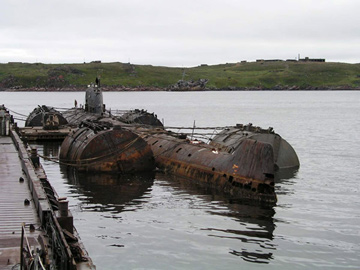
REMOVING the reactor from one of the laid-up nuclear submarines at Rosyth Dockyard is a “stage too far”.
Local SNP councillor Brian Goodall said there was “no need” to cut out the most radioactive parts left in HMS Swiftsure, which is being dismantled as part of an innovative recycling scheme.
He said there was nowhere to safely store the waste and it would also be cheaper to not go ahead – a stance that Labour MP Graeme Downie said was an “insult to the highly skilled team at Rosyth”.
Cllr Goodall said: “The next step will see Babcock cutting out the pressure vessel from the reactor compartment of the decommissioned nuclear submarine Swiftsure, in an experimental process that has never been done anywhere in the world before.
“This part of the submarine dismantling project has required Babcock to seek an increase in the limits to the levels of radioactivity they are allowed to discharge into the environment around the area.
“I believe there’s no clear justification for the cutting out of the pressure vessel, and that the removal for long term storage of the entire reactor compartment would be the more logical, proven, safer and cheaper approach to the next step in the dismantling process.”
There are currently seven old nuclear subs laid up at Rosyth and another 15 at the Devonport naval base in Plymouth.
A further five are due to come out of service.
The dismantling programme at the dockyard began in 2015 – Swiftsure is the first to be cut up – and in September yard bosses said Rosyth could become a “centre of excellence” for dealing with the UK’s old nuclear subs.
The project is doing what no-one else has attempted to do – removing the most radioactive parts left in the vessel, the reactor and steam generators, and recycling up to 90 per cent of the ship.
However, Cllr Goodall said: “The only justification ever given for cutting out the reactor pressure vessels in this way was to reduce the volume of the intermediate level radioactive waste that would be going into the UK’s deep geological radioactive waste facility.
“But such a facility does not exist and it looks like it never will, so long term, near surface storage at a nuclear licensed facility in England, like Capenhurst or Sellafield, is now the most likely outcome.
“And so there’s no need to take forward the experimental stage two part of the proposed procedure, with the increased radioactive discharges associated with it.”
He said he had made the same point at the consultation stage in 2012, before the dismantling of subs at Rosyth got the go ahead.
The councillor continued: “While I support the demonstrator project and, if it’s successful, I’d reluctantly back the on-site dismantling of the six other decommissioned submarines that are currently at Rosyth, I feel it’s not too late to rethink stage two of the process.
“Whichever way we deal with all seven of the subs currently at the dockyard I remain completely against any further nuclear submarines being brought to Rosyth.
“With homes within metres of the site and schools, shops and countless other businesses right next door, Rosyth should never have become a nuclear facility and radioactive waste store.
“We should now be doing all we can to create a long positive, clean, green future for the dockyard.”…………………https://www.dunfermlinepress.com/news/25606854.brian-goodall-says-no-next-stage-submarine-dismantling/
The US Empire Keeps Getting Creepier
Caitlin Johnstone, Nov 09, 2025, https://www.caitlinjohnst.one/p/the-us-empire-keeps-getting-creepier?utm_source=post-email-title&publication_id=82124&post_id=178388003&utm_campaign=email-post-title&isFreemail=true&r=1ise1&triedRedirect=true&utm_medium=email
Secretary of War™ Pete Hegseth said during a speech on Friday that the US is at “a 1939 moment” of “mounting urgency” in which “enemies gather, threats grow,” adding, “We are not building for peacetime. We are pivoting the Pentagon and our industrial base to a wartime footing.”
Everything’s getting darker and creepier in the shadow of the empire.
Nate Bear has a report out on his newsletter titled “The AI Drones Used In Gaza Now Surveilling American Cities” about a new company called Skydio which “in the last few years has gone from relative obscurity to quietly become a multi-billion dollar company and the largest drone manufacturer in the US.” Bear reports that Skydio now has contracts with police departments in almost every large US city to use these Gaza-tested drones for surveillance of American civilians.
Haaretz reports that Israel’s efforts to manipulate American minds back into supporting the Zionist entity include pouring millions into influence operations targeting Christian churchgoers and efforts to change responses to Palestine-related queries on popular AI services like ChatGPT. It’s crazy how you can literally just be minding your own business in your own church on a Sunday morning and then suddenly find yourself getting throat fucked by propaganda paid for by the state of Israel.
The Intercept reports that YouTube, which is owned by Google, quietly deleted more than 700 videos documenting Israel’s atrocities in Gaza in a purge of pro-Palestine human rights groups from the platform. Mass Silicon Valley deletions like this combined with the sudden influx of fake AI-generated video content polluting the information ecosystem could serve to erase and obfuscate the evidence of the Gaza holocaust for future generations.
A new report from Reuters says that last year the US had intelligence showing Israel’s own lawyers warning that the IDF’s mass atrocities in the Gaza Strip could result in war crimes charges. This is yet more evidence that the Biden administration knew it was backing a genocide the entire time, including during election season when left-leaning Americans were being told they needed to vote for then-Vice President Kamala Harris if they wanted to save Gaza.
In Italy a journalist was fired from the news agency Nova for asking an EU official if she thought Israel should be responsible for the reconstruction of Gaza in the same way she’s said Russia should have to fund the reconstruction of Ukraine. A Nova spokesperson confirmed to The Intercept that the journalist was indeed fired for asking the inconvenient question on the basis that “Russia had invaded a sovereign country unprovoked, whereas Israel was responding to an attack.”
Reuters reports that the US is preparing to establish a military base in Damascus. For years the empire waged a complex regime change operation in Syria to oust Assad, first by backing proxy forces to destroy the country and then via sanctions and US military occupation to prevent reconstruction. And it worked. The empire’s dirty war in Syria will be cited by warmongering swamp monsters for years to come as evidence that regime change interventionism can succeed if you just stick at it and do whatever evil things need to be done.
These are just a few of the disturbing stories from the last few days that I hadn’t had a chance to write about yet. This is the kind of world we are being offered by the US empire. There is nothing on the menu for us but more war, more genocide, more surveillance, more censorship, more tyranny, and more abuse.
Things are going to keep getting more and more dystopian for everyone who lives under the thumb of the imperial power structure until enough of us decide that the empire needs to end.
Artificial Intelligence Is Making Everything Dumber
Caitlin Johnstone, Nov 08, 2025, https://www.caitlinjohnst.one/p/artificial-intelligence-is-making?utm_source=post-email-title&publication_id=82124&post_id=178344210&utm_campaign=email-post-title&isFreemail=true&r=1ise1&triedRedirect=true&utm_medium=email
So it turns out Israel’s mistake was starting its genocide right after Palestinians gained the ability to quickly share video footage of what’s happening in Gaza, but right before the moment when any video footage shared online could easily be dismissed as AI.
Just today I saw two viral tweets that had received Community Notes from Twitter users warning that the posts featured AI-generated videos. Both were shared by right wing accounts with large followings, and both were used to spread Islamophobia.
The first was shared by Israeli-American pundit Emily Schrader, who has 194,000 followers on Twitter. The tweet features a fake CCTV video of a man in Muslim garb approaching a non-Muslim woman on the street in a way that’s meant to look intimidating before getting attacked by a house cat. As of this writing Schrader’s tweet has more than 612,000 views, and carries a Community Note that reads “AI generated. Time at top is a telltale sign. Also she starts off with a white and black bag then only black.”
The second was from a right wing British account called Basil the Great, which has over 210,000 followers. Their tweet features a fake video of an English-speaking teacher showing white children how to pray a Muslim prayer, captioned “I‘ve been sent this footage twice today. It shows a Muslim Teacher instructing British children in the ways of Islam in school. I hope it’s fake but it wouldn’t surprise me if it was real. In fact the left will probably say they don’t see anything wrong with this.”
It is not real. As of this writing the tweet carries a Community Note which reads “Video is AI generated. The teacher ‘sits’ on an invisible chair at the end of the video, which was not there at the beginning.” The video has had 1.7 million views.
This is Twitter, not Facebook, which had already been ravaged by fake AI content that’s been duping older users for nearly two years now.
Fake AI videos are now getting so good that they’re able to fool younger people who are much more aware of what’s out there. Australia’s ABC recently ran a segment where they showed different video clips to teens and asked them to determine which ones were real and which ones were AI, and they couldn’t do much better than randomly guessing.
For decades, video footage was the gold standard for evidence that something had occurred. For a few sweet years there was a period when anything significant that happened in public would usually be recorded on video, because in any group there was bound to be a few people with a smartphone in their pocket, and then those videos could be shared with the world as evidence that the significant thing had occurred. Now whenever there’s footage of a crime, or an act of government tyranny, or just a famous person doing something ridiculous in public, people aren’t going to believe it happened unless it’s corroborated by eyewitness testimony.
So in that sense we’ve sort of backslid to where we were before the invention of photography, when eyewitness reports were the only thing we had to go by. A video can help illustrate what the eyewitness is talking about, but without a physical witness willing to attest to its veracity, it’s often not going to be worth much in terms of proving that something happened.
Which of course serves the powerful just fine. Videos of genocidal atrocities, police brutality, and authoritarian abuses have been causing a lot of headaches for our rulers these past few years, so they’ll be happy to see the information ecosystem entering a new era where inconvenient video footage can be dismissed with a scoff.
Generative AI is making everything dumber. It’s crippling people’s ability to write, research, think critically and create art for themselves. It’s making it harder for us to discern truth from falsehood. It’s causing people to become divorced from their own humanity in weirder and weirder ways.
It’s getting harder and harder to know what’s real on the internet. That photo could be fake. That video could be fake. That song could have been made without any actual artist behind it. That essay could have been written by a chatbot. That social media account you’re interacting with could be a chatbot themselves. This is going to have a massively alienating effect on networking technologies whose initial promise was to help bring us all together.
When the internet first showed up people rejoiced at their ability to connect with others around the world who had the same interests and passions, saying “At long last, I’m not alone!” When AI showed up people started logging on to the internet and wondering, “Uhh… am I alone?”
Because you can’t be sure there’s anyone in there.
It reminds me of a passage from Charlotte Joko Beck’s “Everyday Zen”:
“Suppose we are out on a lake and it’s a bit foggy — not too foggy, but a bit foggy — and we’re rowing along in our little boat having a good time. And then, all of a sudden, coming out of the fog, there’s this other rowboat and it’s heading right at us. And…crash! Well, for a second we’re really angry — what is that fool doing? I just painted my boat! And here he comes — crash! — right into it. And then suddenly we notice that the rowboat is empty. What happens to our anger? Well, the anger collapses…I’ll just have to paint my boat again, that’s all. But if that rowboat that hit ours had another person in it, how would we react? You know what would happen!”
Beck is touching on the Buddhist doctrine of no-self here, which is a discussion for another day, but this parable has so many layers that say so much about humanity and human connection. The only reason we put so much mental energy and attention into our day-to-day interactions and relationships is because we assume we’re relating to other human beings like ourselves. We assume there’s somebody in the other rowboat.
Nearly all of the love, lust, anger, hatred, shame, guilt, passion, enthusiasm, attraction, aversion, delight and disgust we feel from moment to moment throughout this human adventure has to do with other humans. We don’t experience those big feelings toward inanimate objects like rowboats, cars or shopping carts, because we know there’s nobody in them. There’s no real connection to be had with them. Our big feelings come from our meetings with real people, real family, real lovers, real enemies, and real art from real artists.
AI is an empty rowboat, and the more it takes over the internet, the emptier it’s going to feel. People won’t feel like they can find the connection they’re craving in any of the areas that are dominated by artificial intelligence, and they’re going to go looking for it elsewhere. Maybe they’ll start going looking for it in places where there are physical people in physical bodies they can touch and make eye contact with, who they know for a fact are real people with real feelings and hopes and dreams like themselves.
And maybe that would be a good thing. Humanity is becoming too disconnected and dissociated as it is. We could all benefit from digging our roots into reality a bit deeper.
There are some technological developments where as an individual you have to draw a line for yourself. Modern civilization has made it possible to work from home and eat ten thousand calories a day without ever exercising or leaving your apartment, but most of us have the good sense not to do this because we know it would be very bad for our health. We’re going to have to start looking at AI the same way we look at McDonald’s: sure it’s there, but that doesn’t mean you have to consume it, because it’s really not good for you.
Australia is getting free electricity – will other countries follow?

As one of the most advanced solar nations in the world, Australia is well placed to experiment with giving people free power – and if it succeeds, other countries may look to copy its approach
By James Woodford, New Scientist 7th Nov 2025
Australians received a welcome surprise this week with the news that every household will soon receive 3 hours of free electricity every day, as part of a world-first initiative to share the benefits of solar power. If successful, it could be a model for other to follow in a future that will increasingly be powered by sunshine.
The Australian electricity grid is zinging with excess capacity during the day thanks to solar power, but it is strained at night when people return from work and use most of their appliances. To address this, the Australian government says its “Solar Sharer” scheme will be rolled out from July 2026 in three states – New South Wales, South Australia and the south-east corner of Queensland – with the rest of the country joining in 2027…………………..(Subscribers only)..…………………. https://www.newscientist.com/article/2503532-australia-is-getting-free-electricity-will-other-countries-follow/
Experts: Full nuclear weapons tests would backfire on US

Defense News, By Stephen Losey, 6 Nov 25,
Resuming full testing of nuclear weapons — as President Donald Trump called for last week — would be unnecessary, costly, undermine nonproliferation efforts, and empower the nation’s adversaries to use their own tests as intimidation, expertstold Defense News.
Trump’s unexpected announcement, which came in the form of an Oct. 29 social media post, surprised many nuclear specialists — and sparked concerns that the UnitedStates may end its 33-year moratorium on nuclear weapons testing.
“Because of other countries testing programs, I have instructed the Department of War to start testing our Nuclear Weapons on an equal basis,” Trump posted on TruthSocial.
“That process will begin immediately,” he wrote.
When asked for comment about nuclear testing plans, the Pentagon’s public affairs office pointed to an Oct. 31 video of Defense Secretary Pete Hegseth in Malaysia, in which he said testing nuclear weapons is a responsible way to ensure the country has “the strongest, most capable nuclear arsenal so that we maintain peace through strength.”
“The president was clear: We need to have a credible nuclear deterrent,” Hegseth said, “That is the baseline of our deterrence.
“Having understanding and resuming testing is a pretty responsible — very responsible — way to do that. I think it makes nuclear conflict less likely, if you know what you have and make sure it operates properly,” he said.
Hegseth also said the military would work with the Energy Department on this testing.
Energy Secretary Chris Wright said on Fox News Nov. 2 that tests focusing on the subsystems of new nuclear weapons are already in the works, but he said the tests would not result in a full nuclear detonation………………………………………………………………………………………………………………………………………………………………..
“The U.S. had conducted over 1,000 nuclear tests,” Erath said Monday in an interview with Defense News. “We had all the data necessary to know how nuclear weapons work, to verify that U.S. nuclear weapons would work, and other people didn’t. So by stopping testing when we did, we sort of locked in an advantage in knowledge that persists to this day.”
Since then, U.S. nuclear testing has relied on computer simulations designed to predict how a weapon would respond if triggered.
Wright said on Fox News that the United States’ advanced laboratories and computing power devoted to nuclear weapons provide a major advantage over other nations.
“We can simulate incredibly accurately exactly what will happen in a nuclear explosion,” Wright said. “And we can do that because in the ’60s, ‘70s and ‘80s, we did nuclear test explosions. We had them detailedly instrumented, and we measured exactly what happened. Now we simulate what were the conditions that delivered that, and as we change bomb designs, what will they deliver?”
Hans Kristensen, director of the nuclear information project at the Federation of American Scientists, speaking Monday to Defense News, pointed to the Lawrence Livermore National Laboratory’s National Ignition Facility in California as an example of the kind of state-of-the-art facilities that the U.S. developed for safe nuclear testing purposes……………………………………………………………………………
As the government modernizes and extends the life of aging weapons in its nuclear stockpile, through efforts such as the W80-4 life extension program, it uses experiments at places such as the NIF to determine whether the weapons will still react properly if used.
Those simulation capabilities obviate the need for any testing of existing, upgraded, or new weapons,Kristensen said.
“It’s just a fundamentally different situation for the United States,” he said.
The U.S. now is modernizing its nuclear forces by creating a new gravity bomb, the B61-13, and new warheads to go on the upcoming LGM-35A Sentinel intercontinental ballistic missile and the Trident II D5 missile.
Part of that work will involve tests of the warheads’ critical subsystems, Erath said.
He said, though, that is it not necessary to go through the entire process and trigger the nuclear reactions that create devastating blasts to know whether the weapon will work.
“What happens after the plutonium goes critical is well known,” Erath said, “So you don’t need to do an explosive mushroom cloud-and-crater kind of nuclear test.
“You can do the smaller-scale subcritical testing, and that has been happening.”
Rattling a house of dynamite?
If the United States shatters the taboo against nuclear tests it helped create, other nations are sure to follow with their own tests, Erath said. Once that happens and they start to gather more detailed information on their own nuclear devices, he said, they will start to catch up to America…………
In an interview with 60 Minutes that aired Sunday, Trump claimed without evidence that China and Russia have conducted clandestine nuclear weapons tests deep underground……………………………………………………………………………………………………
If the U.S. government were to proceed with full tests that explode nuclear weapons, Erath said, it would likely happen underground. That would minimize the environmental impact, he said, but not eliminate it entirely, because leaks can happen.
The diplomatic consequences and harm to nonproliferation efforts would be far more severe, Erath said. The United States would likely receive a storm of condemnation from other nations, he said.
With the global moratorium on nuclear weapons testing broken, Erath said, nations such as Russia, China, North Korea, India and Pakistan would likely follow Washington’s example…………………………………………………………..
“This kind of confusion and uncertainty undermines U.S. credibility with its allies,” Kristensen said. “They need to know if they can trust U.S. policies. … If the U.S. president now begins to signal that he’s interested in [nuclear testing] in some shape or form … it’s going to add to the pool of uncertainties [allies] have about what kind of partner the United States is now, and will be in the future.”…………………………………………………
Digging a hole deep enough for a nuclear bomb test would take months, Kristensen said — and finding the right digging equipment would be another challenge, since not many organizations have needed to dig such holes in the desert for a long time. Once the nuclear device is in there, it has to be sealed properly with materials such as gravel and concrete to keep radioactive materials from venting.
“They would have to build a whole tower over the hole in which they have this instrument package that would be lowered in there,” Kristensen said. “Those instruments would have to be designed by the nuclear laboratories to be able to do what it is that they want to record. There’s so many levels of this that have to fall into place.” https://www.defensenews.com/global/the-americas/2025/11/05/experts-full-nuclear-weapons-tests-would-backfire-on-us/
About Stephen Losey
Stephen Losey is the air warfare reporter for Defense News. He previously covered leadership and personnel issues at Air Force Times, and the Pentagon, special operations and air warfare at Military.com. He has traveled to the Middle East to cover U.S. Air Force operations.
The Deal That Never Was: Washington Proposed, Moscow Agreed – and Trump Blocked It

Russia no longer expects meaningful negotiations with Trump, having recognized the limits of his actual power within the American system, namely the permanent Deep State.
Key Takeaways
- The Alaska ceasefire plan was originally proposed by the U.S., not Russia.
- The plan collapsed due to U.S. indecision and Ukrainian-European rejection of territorial compromises.
- Russia considers regions such as Donbass, Zaporizhzhia, and Kherson historically legitimate Russian territories.
- Trump’s transactional style, evident in both South Korea and Anchorage, reflects a pattern of coercive, short-term deal-making.
- Moscow’s distrust of Washington has deepened; the U.S. is seen as unreliable, politically fragmented, and incapable of sustained diplomacy.
A ceasefire in Zaporizhzhia and Kherson, including Ukraine’s withdrawal from the Donbass, was on the table. Moscow was ready – but Washington pulled back at the last moment, letting the agreement collapse.
Felix Abt, Fri 07 Nov 2025 https://forumgeopolitica.com/article/the-deal-that-never-was-washington-proposed-moscow-agreed-and-trump-blocked-it
The Deal That Never Was reveals how Trump’s transactional diplomacy – from Seoul to Anchorage – turned a tangible opportunity for peace into yet another missed chance.
The proposed plan – something akin to an “Istanbul Plus” – was formulated by Washington and then abruptly abandoned. From Lavrov’s revealing interview, which we discuss below, to the collapse of the Alaska summit, the story shows how a U.S.-initiated ceasefire plan in Ukraine failed, leaving Russia skeptical, freezing diplomatic channels, and escalating military tensions.
It was a unique opportunity that could have altered the course of the war and strengthened Washington’s international credibility – but it went unused, serving as a lesson in how short-term political calculations can destroy long-term prospects for peace.
Trump’s Pattern of Transactional Diplomacy
President Donald Trump recently visited South Korea, where he received ceremonial honors and negotiated a new trade agreement. According to reports, Trump agreed to lower U.S. tariffs on South Korean exports in exchange for South Korea’s pledge to invest roughly $350 billion in the United States.
This deal illustrates Trump’s typical tactic: imposing crushing tariffs, extracting enormous investment pledges – and then rolling the tariffs back. He applied the same strategy to the EU, Japan, and others, while China resisted and retaliated. The approach resembles less a coherent protectionist policy than a 1920s-style protection racket, more akin to Mafia extortion than modern statecraft. Many doubt that the promised investments will ever materialize, and the U.S. Supreme Court is set to review the constitutionality of Trump’s tariff strategy, widely viewed as coercive diplomacy rather than sound economic policy.
This approach mirrors Trump’s methods in other areas, particularly in dealing with Russia. During the Anchorage summit, Trump’s envoy proposed a peace plan for Ukraine, which Moscow accepted. Yet Trump later withdrew, issued new demands, publicly disparaged Putin, and escalated tensions through threats of sanctions and missile deployments. The pattern – bluster, theatrical deal-making, and retreat – has become a defining feature of his foreign policy and has severely undermined U.S. credibility in the eyes of many international observers.
Russian analyst Dmitri Trenin, writing in Kommersant, a newspaper widely read in Russia’s business circles, described Moscow’s evolving perception of Trump, suggesting that meaningful business dealings between Russia and the U.S. are unlikely in the foreseeable future. He portrays President Trump as:
- unpredictable and manipulative, alternating between threats and charm;
- motivated by personal glory rather than a consistent strategic vision;
- economically predatory, using tariffs and trade wars to suppress rivals;
- more concerned with optics than substance, favoring photo-op “truces” over lasting peace.
Trenin concludes that Russia no longer expects meaningful negotiations with Trump, having recognized the limits of his actual power within the American system, namely the permanent Deep State. Still, Moscow’s engagement with Trump – the so-called “special diplomatic operation” – served a strategic purpose: signaling to key partners such as China, India, and Brazil that Russia remained open to dialogue and, absent Western interference or obstruction by the Banderite regime, interested in a peaceful resolution of the Ukraine conflict. At the same time, it reassured the Russian public of their leadership’s resolve and reinforced the belief that only military success – not U.S.-brokered, coercive “diplomacy” – can secure Russia’s long-term objectives in Ukraine.
Lavrov’s Interview: New Insights into a Failed Peace Plan
Continue readingRussia urges Trump administration to clarify ‘contradictory’ signals on nuclear testing
By Dmitry Antonov, November 7, 2025, https://www.reuters.com/world/russia-says-it-wants-us-clarify-its-nuclear-testing-intentions-after-trump-2025-11-07/
- Summary
- Trump yet to spell out what kind of nuclear tests he means
- Russia and US have not tested since 1990s
- Russia says uncertainty is prompting global concern
- Putin has ordered proposals for possible test by Russia
MOSCOW, Nov 7 (Reuters) – Russia urged the United States on Friday to clarify what it called contradictory signals about a resumption of nuclear testing, saying such a step would trigger responses from Russia and other countries.
President Donald Trump last week ordered the U.S. military to immediately restart the process for testing nuclear weapons. But he did not make clear if he meant flight-testing of nuclear-capable missiles or a resumption of tests involving nuclear explosions – something neither the U.S. nor Russia has done for more than three decades.
“If it is the latter, then this will create negative dynamics and trigger steps from other states, including Russia, in response,” Russian Foreign Ministry spokeswoman Maria Zakharova told reporters.
“For now, we note that the signals emanating from Washington, which are causing justified concern in all corners of the world, remain contradictory, and, of course, the real state of affairs must be clarified.”
Citing the lack of clarity around U.S. plans, President Vladimir Putin on Wednesday instructed top officials to prepare proposals for Russia to carry out its own potential nuclear test in response to any U.S. test.
Security analysts say a resumption of testing by any of the world’s nuclear powers would be a destabilising step at a time of acute geopolitical tension, notably over the war in Ukraine, and would likely prompt other countries to follow suit.
Russia and the U.S. possess the world’s largest nuclear arsenals.
The last remaining treaty between them that limits the number of strategic nuclear warheads on both sides is due to expire in three months, potentially fuelling an arms race that is already in progress.
Putin has proposed that both sides continue to observe the treaty limits for another year, but Trump has yet to respond formally to the idea.
British Nuclear Jets Programme Costs ‘Unrealistic’ – CND

“Just as we’ve seen the ‘blank cheque’ approach to the spiralling costs of replacing Britain’s nuclear submarines, so we see it again here with Britain’s new nuclear-capable jets.”
, by the Campaign for Nuclear Disarmament (CND), https://labouroutlook.org/2025/11/08/british-nuclear-jets-programme-costs-unrealistic-cnd/
The chair of the Government’s Public Accounts Committee (PAC), Sir Geoffrey Clifton-Brown, has described the MoD’s cost forecast for the F-35 fighter jet programme as “unrealistic”.
The report also shines a spotlight on the repeated and systematic failure of the MoD to demonstrate financial responsibility or accountability. Just as we’ve seen the ‘blank cheque’ approach to the spiralling costs of replacing Britain’s nuclear submarines, so we see it again here with Britain’s new nuclear-capable jets.
The Public Accounts Committee report states that the MoD ‘acknowledged that becoming certified for the NATO nuclear mission will add new requirements to training, personnel and possibly infrastructure.’ Yet, PAC reports that it was only once the Committee requested evidence about the F-35 programme that the MoD started discussions with ‘other partner nations’ to understand these requirements. Therefore ‘the Department [MoD] did not provide any indication of forecast costs.’
The MoD had argued that buying the F-35A nuclear-capable fighter jets would be 20% to 25% cheaper than the F-35B non-nuclear fighter jets. However, PAC’s report reveals that because the MoD had not familiarised itself with the technical implications of NATO integration before the decision was made to buy the F-35As, it had not allowed for additional costs associated with this. The report concludes ‘We believe it is a reasonable assumption that this may end up proving more expensive’.
This is the latest in a series of failures to forecast costs for the programme, resulting in substantially underestimating the scale of the spending needed. Back in 2013, when the decision was made to buy 138 F-35 fighter jets, the MoD set out the initial cost of £18.4 billion, which was only for the first 48 fighter jets. It was then discovered that the MoD had failed to update this figure following the extension of the programme from 2048 to 2069 – more than a 20 year extension. The MoD then revised this figure to £57 billion but did not include any of the far more costly sustainment expenditure such as personnel, infrastructure or fuel.
The National Audit Office calculates the full programme is likely to be £71 billion. However, this does not take into consideration the additional costs associated with the certification of the F-35A jets for NATO nuclear missions, so this figure will certainly increase. And there are still further questions about the purchases of an additional 63 F-35A jets, as whether these will also be part of NATO’s nuclear mission.
The committee also reveals the level of chaos, mis-manageable and lack of planning of the programme. For instance, the MoD underestimated the number of engineers it would need for the programme, failing to consider annual leave and staff working in other roles. Consequently staffing costs have had to be increased by 20%.
A delay in upgrading the accommodation at RAF Marham, which has been the main operating base for the F-35s since 2013, means not all the accommodation will be ready in time for the 2029 delivery of the new F-35A fighter jets, likely causing delays and further costs in the programme.
This mismanagement, lack of financial accountability resulting in spiralling costs is typical of Britain’s nuclear weapons industry. The replacement of Britain’s nuclear submarines has been repeatedly rated ‘unachievable’ by the government’s Infrastructure and Projects Authority, due to cost overruns and delays.
Instead of pouring hundreds of billions more into this black hole of deadly weaponry – tying Britain even closer to NATO and Trump’s reckless nuclear war drive – the British government should redirect these funds to kick-start the British economy investing in transport, housing and healthcare, improving living standards and tackling the real threats we face from climate breakdown
The Committee – which scrutinises the financial accounts and holds the government to account for the delivery of public services’ – produced a report into the MoD’s management of its F-35 fighter jet programme, which will see Britain buy a total of 138 jets – likely to be 63 F-35B ‘stealth’ jets and 75 of the nuclear-capable F-35A fighter jets.
Despite Prime Minister Keir Starmer’s announcement in June at the NATO summit that Britain, for the first time since the end of the Cold War, would be expanding its nuclear capability through the purchase of 12 F-35A jets, the Committee’s report reveals the Ministry of Defence had little understanding of the implications – both technical or financial – of NATO integration of its nuclear-capable fighter jets when this announcement was made.
Putin considers nuclear tests after Trump threat.
8 Nov 25 https://www.politico.eu/article/russian-president-vladimir-putin-nuclear-tests-donald-trump-weapons/
The Russian president has asked for a feasibility study on resuming nuclear testing following a surprise announcement by his American counterpart.
3Russian President Vladimir Putin on Wednesday ordered top officials to come up with proposals for the potential resumption of nuclear testing for the first time since the end of the Cold War more than three decades ago.
Last week, U.S. President Donald Trump instructed the Pentagon to “immediately” start testing nuclear weapons “on an equal basis” with nuclear testing programs in other nations.
Putin, speaking at Russia’s Security Council, told the country’s foreign and defense ministers, its special services and the relevant civilian agencies to study the matter and “submit coordinated proposals on the possible commencement of work to prepare for nuclear weapons testing.”
Defense Minister Andrei Belousov told Putin at the meeting that it would be “appropriate to immediately begin preparations for full-scale nuclear tests.”
Kremlin spokesperson Dmitry Peskov later clarified that “the president did not give the order to begin preparations for the test” but merely ordered a feasibility study.
Russia announced last week that it had successfully tested a nuclear-powered torpedo, dubbed Poseidon, that was capable of damaging entire coastal regions as well as a new cruise missile named the Burevestnik, prompting Trump to respond. The U.S. today launched an intercontinental ballistic missile, Minuteman III, in a routine test.
The Cold War was characterized by an intense nuclear arms race between the U.S. and the Soviet Union as the superpowers competed for superiority by stockpiling and developing nuclear weapons. It ended in 1991 with the collapse of the Soviet Union and the signing of nuclear treaties such as START, which aimed to reduce and control nuclear arsenals. The Soviet Union conducted its last test in 1990 and the U.S. in 1992.
A report this year by the SIPRI think tank warned that the global stockpile of nuclear weapons is increasing, with all nine nuclear-armed states — the U.S., U.K., Russia, France, China, Pakistan, India, Israel and North Korea — upgrading existing weapons and adding new versions to their stockpiles.
Radioactive waste from Canada would be buried in Utah under EnergySolutions proposal.

The company wants to import more than 1 million cubic yards of low-level radioactive waste from Canada to its facility in Utah’s West Desert.
Salt Lake Tribune, By Leia Larsen and Jordan Miller, Nov. 8, 2025
A Utah company wants to import massive amountsof Canadian radioactive waste to a facility less than 100 miles from the state’s largest population center.
EnergySolutions seeks to transport up to 1.3 million cubic yards of low-level radioactive and mixed waste — enough to fill roughly 400 Olympic-sized swimming pools — from Ontario, Canada, to its Clive facility in Tooele County,it confirmed in a statement Thursday. The international nuclear services company is headquartered in Salt Lake City.
Its proposal, if approved, would mark the first time Utah allows foreign radioactive waste to be stored within state boundaries.
The company currently accepts low-level radioactive and other hazardous waste from across the nation at the Clive site for burial, which opened in 1988.
The request is under consideration by the Northwest Interstate Compact on Low-Level Radioactive Waste Management, which manages the disposal of such waste in Utah and seven other states. At least six states must approve the proposal, and Utah can veto it.
EnergySolutions says it will ask Utah regulators for permission to expand its storage capacity to accept the waste from Canada and shipments from across the U.S. The company expects to pay $30 million under a new tax imposed by the state Legislature in order to generate money for Gov. Spencer Cox’s Operation Gigawatt — his initiative to double energy production in Utah over the next decade…………………………………………………………………..
What kind of radioactive waste could come to Utah?
……………………..Typical low-level radioactive materials include contaminatedprotective clothing, filters, cleaning rags, medical swabs and syringes, according to the NRC. However, a lobbyist for EnergySolutions told lawmakers this year, while discussing the proposed expansion, the waste could include components of decommissioned nuclear power plants.
The Canadian shipments would also include mixed waste, which is any type of radioactive material that is combined with hazardous waste.
The Clive facility currently holds Class A radioactive “soil, concrete rubble, demolition debris, large components and personal protective equipment,” a company spokesperson said. That waste comes from the federal government and domestic power plants.
EnergySolutions will only accept foreignwaste generated within the province of Ontario, it noted in a letter filed Sept. 9 seeking approval from the interstate compact. The materials cannot be shipped from other locations. No depleted uranium will travel from Canada to the landfill site, the company confirmed.
This case would mark the first time a state in the compact accepts foreign radioactive waste, confirmed Kristen Schwab, executive director of the Northwest Interstate Compact. And only two states in the compact accept low-level radioactive waste for disposal at all — Utah and Washington.
…………………………………… HEAL Utah, an environmental watchdog, said it has concerns about potential spills along the route.
“Historically, Utah residents have been concerned about waste coming through their communities to be dumped in our state,” said Carmen Valdez, a senior policy associate for the nonprofit.
EnergySolutions previously sought to ship parts of a dismantled nuclear plant from Italy to its Utah location in 2008. The state vetoed the plan with the backing of then-Gov. Jon Huntsman, who bristled at the idea of storing radioactive materials from other countries.
“As I have always emphatically declared,” Huntsman said at the time, “Utah should not be the world’s dumping ground.”
Cox did not directly respond Friday to a question about whether he supports EnergySolutions’ proposal.
In order to import the Canadian waste, EnergySolutions must get a license from the Nuclear Regulatory Commission and the Canadian Nuclear Safety Commission, the company confirmed.
The company also needs approval from the Utah Department of Environmental Quality to move forward with its facility expansion. The company estimates will keep the Clive site operational for another 45 years.
The Utah Legislature earlier this year passed Senate Bill 216, which streamlined the process for such expansions and added a new tax on facilities that plan to scale up. Revenue generated from that tax would go to the Utah Energy Research Fund.
EnergySolutions said it would apply for the expansion by Dec. 31, and DEQ confirmed it has not yet received an application.
The company wants compact officials to approve the Ontario deal ahead of that state process, EnergySolutions said in an Oct. 31 follow-up letter. Waiting until DEQ approves its expansion would cause delays, it said.
One member of the compact committee suggested imposing a 10-year deadline for EnergySolutions to import the 1.3 million cubic yards of waste from Ontario to the Clive site. The company opposed the timeline, saying it would jeopardize its ability to “reasonably recover its investment,” including the $30 million expansion tax………
Shipments from Ontario will account for a fraction of the waste ultimately stored in the planned expansion, the company and DEQ said.
……………………………….Environmental advocates at HEAL remain wary about importing waste from other countries.
“We do have to find solutions to storing that waste safely,” Valdez said, “but we want to really ensure that we have enough means to manage the waste that already exists in the United States before we start accepting international waste at the benefit and profit of a private company.”
Low-level radioactive waste generated in Utah — from facilities like medical labs or universities, for example — is not disposed of in the state. As a member of the compact, Utah sends its waste to a facility in Richland, Washington.
The compact committee plans to discuss EnergySolutions’ proposal again at a meeting on Nov. 25. https://www.sltrib.com/news/environment/2025/11/07/utahs-energysolutions-proposes/
1 This Month

of the week – Shut Down Drone Warfare!


Tell the Ukrainian Government to Drop Prosecution of Peace Activist Yurii Sheliazhenko

Petition to revoke the licensing of the Near Surface Nuclear Disposal Facility (NSDF) at Chalk River. https://www.ourcommons.ca/petitions/en/Petition/Details?Petition=e-7247
To see nuclear-related stories in greater depth and intensity – go to https://nuclearinformation.wordpress.com
-
Archives
- April 2026 (114)
- March 2026 (251)
- February 2026 (268)
- January 2026 (308)
- December 2025 (358)
- November 2025 (359)
- October 2025 (376)
- September 2025 (257)
- August 2025 (319)
- July 2025 (230)
- June 2025 (348)
- May 2025 (261)
-
Categories
- 1
- 1 NUCLEAR ISSUES
- business and costs
- climate change
- culture and arts
- ENERGY
- environment
- health
- history
- indigenous issues
- Legal
- marketing of nuclear
- media
- opposition to nuclear
- PERSONAL STORIES
- politics
- politics international
- Religion and ethics
- safety
- secrets,lies and civil liberties
- spinbuster
- technology
- Uranium
- wastes
- weapons and war
- Women
- 2 WORLD
- ACTION
- AFRICA
- Atrocities
- AUSTRALIA
- Christina's notes
- Christina's themes
- culture and arts
- Events
- Fuk 2022
- Fuk 2023
- Fukushima 2017
- Fukushima 2018
- fukushima 2019
- Fukushima 2020
- Fukushima 2021
- general
- global warming
- Humour (God we need it)
- Nuclear
- RARE EARTHS
- Reference
- resources – print
- Resources -audiovicual
- Weekly Newsletter
- World
- World Nuclear
- YouTube
-
RSS
Entries RSS
Comments RSS
 nuclear-news