COP30 won’t save us, but China might.

From Fix the News, 17 Nov 25
We’ve been writing about China’s renewable energy revolution here for years, so we know it’s not news to you. But it does feel like something has shifted in the last few weeks; that mainstream outlets seem to have finally woken up to what’s actually happening and more importantly, what it means. It’s not just that China is building lots of solar and wind. It’s that China might actually be the country that saves us from climate catastrophe.
This is a difficult thing for many of us in the West to get our heads around. China has been the world’s collective climate bogeyman for so long, the largest emitter, still pumping out coal, refusing to make the commitments everyone else has agreed to. But, as negotiations kick off in earnest at COP30 in Belém, the story has flipped. China’s emissions are plateauing and more crucially, they’re now supplying the technology for the energy transition to everyone else.
The Economist says China is “a new type of superpower: one which deploys clean electricity on a planetary scale;” already home to a terawatt of installed solar capacity, more than double what the United States and Europe have combined. It makes more money from exporting green technology than America (the world’s biggest petrostate) makes from exporting fossil fuels.
Reuters notes that China now dominates clean energy supply chains and files three times more clean-tech patents than the rest of the world combined. “China is now the main engine of the global clean energy transition.”
The New York Times reports that China’s overseas investments in clean energy have exceeded $225 billion since 2011, more than the Marshall Plan, adjusted for inflation. In Pakistan, a standalone panel costs farmers $125, and they never have to worry about buying diesel again. In Nepal, electric vehicles now make up 76% of new car sales because the Chinese Seres Mini EV sells for $10,000. These aren’t moral decisions. They’re economic ones.
But the journalist who captures it best is Ambrose Evans-Pritchard in The Telegraph. He starts with the grim reality that CO2 emissions hit record levels last year, oceans are the warmest ever recorded, and forests are burning at unprecedented rates. Then he introduces the idea of a “second derivative” – the early signs of an energy shift most people are missing.
Global fossil use in industry peaked in 2014. Sales of petrol and diesel cars peaked in 2017. Transport emissions are finally rolling over. China’s coal use appears to have peaked. Its emissions have fallen by 1% this year.
His conclusion is worth repeating: “We may or may not avert a scorching runaway world of two degrees plus, but whether we succeed will have nothing to do with anything said or agreed to by the 50,000 people descending on Belém. It will be decided by geopolitics, market prices and the tidal force of technological change.”
Try not to worry too much about the climate summits. What matters far more is that China is now playing midwife to a clean energy transition that makes economic sense for the 80% of humanity that lives in countries that import fossil fuels. Those 6.4 billion people have no reason to stay dependent on shipments from petrostates anymore, when they can import solar panels made by the world’s first electrostate.
This doesn’t mean the problem is solved, energy is too big and complicated for that. China and India are still building coal plants. Almost every country is building fossil gas. But the trajectory has changed. And it’s changed not because of international agreements or appeals to the better angels of our nature, but because national self-interest is finally aligning with climate action.
Lab Chromium Contamination Confirmed on San Ildefonso Pueblo Land.

Since chromium contamination was first reported in 2004, the Lab’s nuclear weapons budget has more than doubled to $5 billion (now 84% of LANL’s ~$6 billion annual budget). Cleanup is being cut to $278 million (less than 5% of the Lab’s total budget), as are virtually all non-nuclear weapons programs (research into renewable energies is being eliminated).[6]
Comprehensive Cleanup Needed Instead of More Nuclear Weapons
November 14, 2025, nuclear watch , New Mexico, nukewatch.org
| Santa Fe, NM – The New Mexico Environment Department has announced: “A toxic chromium plume from Los Alamos National Laboratory has spread beyond Lab boundaries onto Pueblo de San Ildefonso land for the first time, with contamination exceeding state groundwater standards… These new results are conclusive evidence that the U.S. Department of Energy’s efforts to contain the chromium plume have been inadequate.” In reality, chromium groundwater contamination probably migrated beyond the LANL/San Ildefonso Pueblo boundary long ago, with Lab maps of the plume “magically’ stopping at the border. In the past, tribal leadership has commented that it was fortunate that the contamination stopped there, but that any future indications of groundwater contamination on Pueblo land could have serious consequences. The San Ildefonso Pueblo is a sovereign Native American tribal government. |
| As late as the late 1990s the Lab was falsely claiming that groundwater contamination was impossible because underlying volcanic tuff is “impermeable.” [1] This ignored the obvious fact that the Parajito Plateau is heavily seismically fractured, providing ready pathways for contaminant migration to deep groundwater. By 2005 even LANL acknowledged that continuing increasing contamination of the regional aquifer is inevitable.[2] Some 300,000 northern New Mexicans rely upon the aquifer for safe drinking water. The potential serious human health effects (including cancer) caused by chromium contamination was the subject of the popular movie Erin Brockovich. LANL’s chromium contamination plume is at least one mile long, a half mile wide and 100 feet thick.[3] It is commonly regarded as the Lab’s most serious environmental threat. One drinking water supply well for Los Alamos County has already been shut down because of the plume. But even two decades after it was first reported, the Lab still doesn’t know how big the chromium plume is. On December 30, 2024, in the middle of the holiday season, the Lab posted the report Independent Review of the Chromium Interim Measures Remediation System to its largely unknown Legacy Cleanup Electronic Public Reading Room. The Report’s bottom line was: “…at this time the plume is not sufficiently characterized to design a final remedy… data gaps and uncertainties need to be addressed before committing to an alternative or final remedy.” From 1956 to 1972, water containing potassium dichromate was used to prevent corrosion in cooling towers, releasing as much as 160,000 pounds of potassium dichromate into the headwaters of Sandia Canyon.[4] Over a 3-year period ending in November 2022, the Department of Energy extracted, treated and reinjected more than 400 million gallons of groundwater. But the December 2024 chromium report stated that only ~680 pounds of chromium was actually removed.[5] At this rate it will take more than a century to treat and remediate the chromium plume. |
While failing to recommend a final remedy, the new chromium report did argue that extraction and treatment of groundwater should be continued. However, in order to speed up cleanup as part of any final remedy, Nuclear Watch New Mexico argues for pumping or trucking the treated groundwater uphill to flush out the chromium contamination at its source. In addition, more monitoring wells should be installed to finally determine the true depth and breadth of the chromium contamination that threatens northern New Mexico’s largest supply of drinking water.
Since chromium contamination was first reported in 2004, the Lab’s nuclear weapons budget has more than doubled to $5 billion (now 84% of LANL’s ~$6 billion annual budget). Cleanup is being cut to $278 million (less than 5% of the Lab’s total budget), as are virtually all non-nuclear weapons programs (research into renewable energies is being eliminated).[6]
According to the independent Government Accountability Office, expected completion of Lab cleanup has been repeatedly pushed back, most recently to 2043 with an estimated cost of $7 billion.[7] But even this is a false cleanup with the Lab planning to “cap and cover” some 800,000 cubic yards of radioactive and toxic wastes, leaving them permanently buried in unlined pits and shafts as a perpetual threat to groundwater. As the Lab becomes more and more a nuclear weapons production site for plutonium “pit” bomb cores, it remains woefully ignorant over the extent and depth of the contamination it has caused to the regional groundwater aquifer. At the same time, LANL continues to downplay widespread plutonium contamination in soil, water and plants.[8]
Jay Coghlan, Director of Nuclear Watch New Mexico, commented: “LANL’s expanding nuclear weapons programs are a two-fold threat. First, they fuel the new nuclear arms race that threatens all of humanity. At the same time, they rob funding from vitally needed cleanup that would permanently protect our irreplaceable groundwater. As is commonly said in northern New Mexico, “Aqua es Vida!” Nuclear weapons can destroy both.”
Could Small Modular Nuclear Reactors add supply-side grid flexibility?

It would make sense in the UK for SMRs to be load
following only if there were vast numbers of SMRs deployed,
13 Nov, 2025 By Tom Pashby New Civil Engineer
Small modular reactors (SMRs) could have the capability of providing the British electricity grid with flexible supplies, the government has said.
Supply-side grid flexibility is the ability of electricity sources to
adjust their output to match fluctuations in power demand in real-time. The
statement came in response to a question from an MP about whether SMRs
could be used as “load-following energy sources”.
Liberal Democrat spokesperson for energy security and net zero Pippa Heylings MP asked what assessment the Department for Energy Security and Net Zero (DESNZ) “has made of the potential merits of small modular reactors being made as load-following energy sources”.
Responding, DESNZ minister of state
Michael Shanks said: “The next generation of nuclear, including SMRs,
offers new possibilities, including faster deployment, lower capital costs
and greater flexibility. “Whilst nuclear energy has a unique role to play
in delivering stable, low-carbon baseload energy, SMRs may be able to serve the electricity grid more flexibly than traditional nuclear, as well as
unlock a range of additional applications in energy sectors beyond grid
electricity.”
It would only make sense in the UK for SMRs to be load
following if there were vast numbers of SMRs deployed, representing a
significant proportion of the electricity generation capacity on the
national electricity transmission system of Great Britain, for them to be
load-following.
University of Sussex professor of science and technology
policy Andy Stirling told NCE: “This parliamentary answer repeats a
longstanding malaise in UK energy policy. “For far too long,
eccentrically strong official nuclear attachments have been dominated by
reference to claimed ‘new possibilities’, to what nuclear ‘may be
able’ to do, and to an unsubstantiated ‘unique role’. “
Whichever side of these debates one is on, it is clear that what is needed most is what used to be routine – but has been lacking for more than a decade.
“Questions over cost, security or flexibility claims can only be settled
by detailed comparative analysis that includes balanced attention to
non-nuclear strategies as well as nuclear ‘possibilities’. “
When such a picture is looked at in a fair way, current trends are making it
impossible even for formerly nuclear-enthusiastic bodies (like the Royal
Society) to conclude – even when looking at UK Government data –
anything other than that there is no rational need for any nuclear
contribution.”
New Civil Engineer 13th Nov 2025,
https://www.newcivilengineer.com/latest/could-smrs-add-supply-side-grid-flexibility-13-11-2025/
Trump’s Ploy at the UN Is American Imperialism Masquerading as a Peace Process

Jeffrey D. SachsSybil Fares, Nov 13, 2025, https://www.commondreams.org/opinion/trump-s-ploy-at-the-un-is-american-imperialism-masquerading-as-a-peace-process
Palestine remains the endless victim of US and Israeli maneuvers. The results are not just devastating for Palestine, which has suffered an outright genocide, but for the Arab world and beyond.
The Trump administration is pushing an Israeli-crafted resolution at the UN Security Council (UNSC) this week aimed at eliminating the possibility of a State of Palestine. The resolution does three things. It establishes US political control over Gaza. It separates Gaza from the rest of Palestine. And it allows the US, and therefore Israel, to determine the timeline for Israel’s supposed withdrawal from Gaza–which would mean: never.
This is imperialism masquerading as a peace process. In and of itself it’s no surprise. Israel runs US foreign policy in the Middle East. What is a surprise is that the US and Israel might just get away with this travesty unless the world speaks up with urgency and indignation.
The draft UNSC resolution would establish a US-UK-dominated Board of Peace, chaired by none other than Donald Trump himself, and endowed with sweeping powers over Gaza’s governance, borders, reconstruction, and security. This resolution would sideline the State of Palestine and condition any transfer of authority to the Palestinians on the indulgence of the Board of Peace.
This would be an overt return to the British Mandate of 100 years ago, with the only change being that the US would hold the mandate rather than Britain. If it weren’t so utterly tragic, it would be laughable. As Marx said, history repeats itself, first as tragedy, then as farce. Yes, the proposal is farce, yet Israel’s genocide is not. It is tragedy of the first order.
Incredibly, according to the draft resolution, the Board of Peace would be granted sovereign powers in Gaza. Palestinian sovereignty is left to the discretion of the Board, which alone would decide when Palestinians are “ready” to govern themselves – perhaps in another 100 years? Even military security is subordinated to the Board, and the envisioned forces would answer not to the UN Security Council or to the Palestinian people, but to the Board’s “strategic guidance.”
The US-Israel resolution is being put forward precisely because the rest of the world—other than Israel and the US—has woken up to two facts. First, Israel is committing genocide, a reality witnessed every day in Gaza and the West Bank, where innocent Palestinians are murdered to the satisfaction of the Israel Defense Forces and the illegal Israeli settlers in the West Bank. Second, Palestine is a state, albeit one whose sovereignty remains obstructed by the US, which uses its veto in the UNSC to block Palestine’s permanent UN membership. At the UN this past July and then again in September, the UN General Assembly voted overwhelmingly for Palestine’s statehood, a fact that put the Israel-US Zionist lobby into overdrive, resulting in the current draft resolution.
For Israel to accomplish its goal of Greater Israel, the US is pursuing a classic divide-and-conquer strategy, squeezing Arab and Islamic states with threats and inducements. When other countries resist the US-Israel demands, they are cut off from critical technologies, lose access to World Bank and IMF financing, and suffer Israeli bombing, even in countries with US military bases present. The US offers no real protection; rather, it orchestrates a protection racket, extracting concessions from countries wherever US leverage exists. This extortion will continue until the global community stands up to such tactics and insists upon genuine Palestinian sovereignty and US and Israeli adherence to international law.
Palestine remains the endless victim of US and Israeli maneuvers. The results are not just devastating for Palestine, which has suffered an outright genocide, but for the Arab world and beyond. Israel and the US are currently at war, overtly or covertly, across the Horn of Africa (Libya, Sudan, Somalia), the Eastern Mediterranean (Lebanon, Syria), the Gulf region (Yemen), and Western Asia (Iraq, Iran).
If the UN Security Council is to provide true security in accordance with the UN Charter, it must not yield to US pressures and instead act decisively in line with international law. A resolution truly for peace should include four vital points. First, it should welcome the State of Palestine as a sovereign UN member state, with the US lifting its veto. Second, it should safeguard the territorial integrity of the State of Palestine and Israel, according to the 1967 borders. Third, it should establish a UNSC-mandated protection force drawn up from Muslim-majority states. Fourth, it should include the defunding and disarmament of all belligerent non-state entities, and it should ensure the mutual security of Israel and Palestine.
The two-state solution is about true peace—not about the politicide and genocide of Palestine, or the continued attacks by militants on Israel. It’s time for both Palestinians and Israelis to be safe, and for the US and Israel to give up the cruel delusion of permanently ruling over the Palestinian people.
One month in, the ‘ceasefire’ in Gaza exists only in name

Noor Alyacoubi, Mondoweiss, Thu, 13 Nov 2025
Palestinians hoped the Gaza ceasefire with Israel would offer a chance to recover from two years of genocide, but a month later, Israel continues to strike with impunity, the economic crisis remains, and nutritious food is nearly impossible to find.
When the ceasefire was declared in mid-October 2025, many in Gaza believed it might finally signal a return to peace — an end to the explosions, the airstrikes, and the constant buzzing of the Zannana (unmanned reconnaissance aircraft) overhead.
But the reality on the ground has been very different.
Almost every morning, the sounds of Israeli bombing can still be heard. Breaking news headlines continue to report rising numbers of martyrs and injured civilians. According to Gaza’s Ministry of Health, since the so-called end of the war, over 236 civilians have been killed and nearly 600 have been wounded. Israeli tanks continue to block access to large parts of the territory, restricting civilian movement through what is referred to as “the yellow line,” preventing thousands from returning to their homes. Surveillance drones still hover above. Bombs still fall — only now under the label of a “ceasefire.”
According to the Government Media office, Israel shot at civilians 88 times, raided residential areas beyond the “yellow line” 12 times, bombed Gaza 124 times, and demolished people’s properties on 52 occasions. It added that Israel also detained 23 Palestinians from Gaza over the past month.
Meanwhile, Israeli authorities continue to issue public threats about resuming full-scale military operations in Gaza. These threats, combined with ongoing violence, have raised a serious question among Palestinians: Is there really a ceasefire? And if there is, why are we still suffering? Why are we still deprived of food, medicine, and safety? Why are we still hungry?
and debris surround their shelters in Gaza City • November 5, 2025A life of displacement and debt
For the past 24 months, 29-year-old Raheel has lived in constant displacement — evacuating, relocating, and returning again and again, crossing Gaza from north to south and back. Her most recent displacement brought her to Al-Nusairat Camp in central Gaza, designated by Israeli authorities as a “safe zone.” There, she, her husband, and her in-laws lived in a single tent. For nearly 20 days, that fragile patch of fabric was their only shelter.
Their departure from Gaza City was not voluntary — it was a desperate decision taken under fire. As Israeli ground forces advanced and bombing intensified across the city in a systematic campaign to seize control, Raheel and her husband were forced to flee.
“We didn’t have the money to leave,” she recalled. “But we couldn’t afford to stay either.”
With no stable income, they borrowed what little they could — from some dear friends — and joined the hundreds of thousands of displaced people heading south in search of safety.
But safety was temporary.
“When the ceasefire was declared, I didn’t feel relief,” Raheel said. “I felt panic. I couldn’t think of anything but the debts we were carrying. We could barely afford the going, how would we afford now the coming back?”
Like many others, she and her family had to borrow again — this time to return to what remained of Gaza City. The pressure of surviving displacement was replaced by the pressure of returning to ruin. Just before they made it back, Raheel received the news that their home in eastern Gaza had been destroyed……………………………………………………………………………………………………………………… https://www.sott.net/article/502968-One-month-in-the-ceasefire-in-Gaza-exists-only-in-name
The Unseen Hand: From the War Room to the Ruins – A Cycle of Profit and Pain

15 November 2025, Andrew Klein. https://theaimn.net/the-unseen-hand-from-the-war-room-to-the-ruins-a-cycle-of-profit-and-pain/
In the corridors of power in Washington and the tech hubs of Silicon Valley, a term is well-known: the “military-industrial complex.” Sixty years ago, President Dwight D. Eisenhower warned his nation of its “unwarranted influence.” Today, this complex is not an American anomaly but a global blueprint of a system where war has been transformed from a last resort of statecraft into a first option for profit. This system, fueled by corruption and shielded by propaganda, now finds its most brutal testing ground in the lands of Palestine, where lives, futures, and the very environment are sacrificed in exchange for data and dividends.
The Anatomy of a War Machine: How the Iron Triangle Turns
The military-industrial complex is not a shadowy conspiracy, but a deeply entrenched “iron triangle” – a symbiotic relationship between three pillars: the defence industry, the military establishment, and the political class.
The Currency of Influence: The fuel for this machine is money. From 2001 to 2021, the top U.S. defence giants spent a staggering $1.1 billion on lobbying to ensure their weapons find a “battlefield application.” They target key congressional committees, with politicians who approve massive arms budgets seeing their campaign coffers swell by up to 40% more than their peers. This is not investment in security; it is a transaction for access and influence.

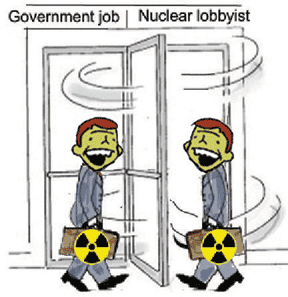
The “Revolving Door” of Power: A more insidious mechanism is the “revolving door,” where defense officials and senior military officers retire one day and walk into high-paid executive or lobbying roles at the very companies they once regulated or procured from. A 2018 report found 645 former senior government and military officials had been hired by the top 20 defence contractors, creating a culture where decisions made in office can be influenced by the promise of a lucrative “golden parachute.” This corrupts the very principle of impartial governance.
Manufacturing Consent through Propaganda: To sustain this cycle, the public must be convinced of the perpetual need for war. This is achieved through a sophisticated propaganda apparatus that controls the narrative. Threats are exaggerated, complex conflicts are reduced to simple good-versus-evil dramas, and civilian casualties are sanitised into the clinical term “collateral damage.” The goal is to manufacture a truth where endless war is framed as essential for safety, and questioning it is made to seem unpatriotic or naive.
Palestine: The Laboratory for the Future of Warfare
This global system requires a laboratory to test, refine, and market its latest technologies. For decades, the Palestinian territories have served this grim purpose, a captive population subjected to an endless experiment in digital control and automated violence.
AI as an Assassin: In the current conflict, the world is witnessing the first full-scale deployment of AI-powered warfare. The Israeli military uses systems with benign-sounding names like “The Gospel” and “Lavender” to generate targets at an industrial pace, producing hundreds of potential targets daily. Human oversight is minimal and accelerated, with reports of soldiers often rubber-stamping AI-generated targets in a matter of seconds. With admitted error rates of around 10%, the mathematical consequence is the condemnation of thousands of innocent civilians by algorithm.

The Panopticon of Surveillance: Every aspect of Palestinian life is data-mined. A vast network of drones, facial recognition cameras (codenamed “Red Wolf” and “Blue Wolf”), satellites, and digital monitoring creates a constant state of surveillance. As one investigative journalist noted, the occupied territories have become a showroom where “Israel’s military-industrial complex… exports advanced weapons and surveillance technology to the world.”
Weaponising Communication: The ultimate demonstration of this control was the hijacking of the entire Palestinian cellular network to force a political speech upon a captive audience. This act is a perfect metaphor for the system: seizing the very channels of human connection to broadcast its own uncompromising narrative, rendering dissent inaudible.
The True Cost: A Balance Sheet of Human and Planetary Suffering
The shareholders of defense corporations may indeed be “drooling” over the “combat-proven” credentials of their products. But the real balance sheet tells a different story.
Lives and Lost Futures: The cost is measured in the thousands of children who will never grow up, the students whose potential is buried under rubble, the families erased from the census. It is a cost of choices permanently denied – the choice to travel, to learn, to love, and to live in peace. This is not “collateral damage”; it is the central, brutal outcome of the system.
Economic Devastation: Beyond the immediate destruction of homes and infrastructure lies the long-term economic annihilation. The productive capacity of generations is wiped out, creating a cycle of dependency and despair that can last for decades.
A Scarred Planet: The environmental cost of war is a silent casualty. Unexploded munitions poison the soil and water for generations. The toxins released from destroyed buildings and industrial sites create a public health crisis. The carbon footprint of endless military conflict is a devastating contributor to planetary crisis, all while the war machine presents itself as a guardian of order.
Building Bridges of Peace: An Alternative Architecture
Confronted with this reality, we must actively choose to build an alternative architecture for human coexistence, one based on bridges, not bombs. This requires a fundamental reorientation.
- Understanding: The first step is to actively dismantle the propaganda that dehumanises “the other.” We must invest in cultural exchange, language learning, and people-to-people programs that allow us to see the full humanity in every face. When we understand the history, hopes, and fears of others, it becomes impossible to see them as mere targets.
- Embrace Self-Reflection in Foreign Policy: Nations, particularly powerful ones, must have the courage for honest self-criticism. Acknowledging past mistakes and the unintended consequences of our actions is not a sign of weakness, but a foundation for building genuine trust and finding a more just path forward.
- Forge New Frameworks for Cooperation: We must move beyond a zero-sum view of global politics. The greatest challenges of our time – climate change, pandemics, technological governance – are shared problems that require shared solutions. By creating robust international frameworks for cooperation on these issues, we build habits of collaboration and create tangible, shared interests that make conflict a less desirable option.
The road from the war room to a lasting peace is long and arduous. It requires us to see through the manufactured truths, to follow the money, and to hold to account the systems that profit from endless conflict. But it is the only road that leads away from the ruins. We must choose to be architects of the bridge, not suppliers for the battlefield.
Bechtel Chief Says U.S. Must Subsidize Trump’s Nuclear Revival.
By Leonard Hyman & William Tilles – Nov 153, 2025 https://oilprice.com/Alternative-Energy/Nuclear-Power/Bechtel-Chief-Says-US-Must-Subsidize-Trumps-Nuclear-Revival.html5,
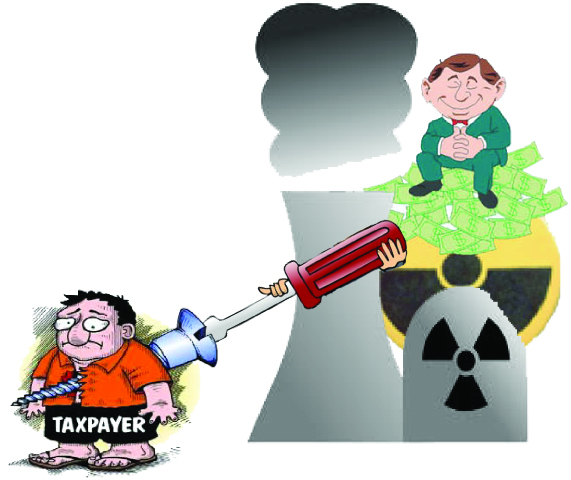
- Bechtel CEO Craig Albert said the U.S. government should help cover the costs of new nuclear plants under Trump’s proposed expansion.
- Nuclear power relies on layers of government subsidies for insurance, fuel, and waste disposal.
- If more reactors are truly needed, the government—not private firms—should build and operate them to lower capital costs
Well, someone important finally said it. Craig Albert, head of construction firm Bechtel, credited by the Financial Times for “rescuing” the Vogtle nuclear project in Georgia (we think “finishing“ it would be a better description), told that august paper that if the government wanted to get Donald Trump’s nuclear construction expansion going, it should be willing to pick up part of the costs. That is, subsidize the seemingly inevitable cost overruns? All the stories that followed talked about encouraging the “early movers” as if nobody had been building nuclear plants for the past seventy years, with cost overruns a common feature of construction in the US and Europe for at least 40 years.
We’ve said, and written in blogs and books, that building nuclear power plants in the USA (and a lot of other places) is not and has never been a commercial business venture. And maybe not a rational one, either. (The list of government subsidies for the industry like insurance, fuel procurement, nuclear waste disposal etc. go on and on.)
And Mr. Albert’s comments seem to bear that out. Just about every other electricity source is cheaper. If you don’t believe in climate change, then why not build more coal and gas? The USA has large domestic supplies of both. They run around the clock, too. If you believe in climate change, wind and solar assisted by batteries and better transmission can do the same job as a base load plant at about the same price points. And the wind and sun don’t have to be imported. But the Chinese control the rare earths that go into those facilities. Yes, but there are plenty of rare earths to be found elsewhere (“rare” being a misnomer). The problem is that the Chinese control the processing. So, would it take more time to build a nuclear plant or to build rare earth processing facilities in friendly places?
Or, if we really were worried about national security or the climate and were looking for an economical way out, we might want to do something about our outsize consumption of electricity, roughly 50-100% higher than in similarly developed countries in similar climates. For years, energy economists have argued that saving energy is a lot cheaper than producing it. A nonstarter nowadays. (Ever since 1977 when Jimmy Carter caused a controversy by turning down the thermostats and putting on a sweater in the White House to encourage energy conservation this has been a political nonstarter. Sad.)
Here’s the point. We need lots of electricity, but we don’t need nuclear power. So why should we subsidize the risk? This is not a new technology. Our first commercial reactor entered service in 1957. It’s an old, extremely complicated technology that never met its promised potential. A workable fusion reactor might change the world, but not more fission nukes. However, if the powers that be really want more nukes, we suggest that the government build and run them. It couldn’t do worse than the private generating companies. It would open the nuclear subsidy to public scrutiny and it would save a bundle on capital costs. (The government can always finance things much more cheaply than the private sector.) Our conclusion is that nuclear power is not a place for the private sector because it is not, and has never been, a commercially viable business.
Threats of nuclear testing ignore its terrifying history

Computer modeling has effectively made nuclear testing obsolete
By Stephen Mihm / Bloomberg Opinion, https://www.taipeitimes.com/News/editorials/archives/2025/11/16/2003847274
Should the US and Russia resume nuclear testing?
The answer to that question must be a resounding “No.” Yet US President Donald Trump and Russian President Vladimir Putin, eager to project strength, have raised fears that they might be moving to revive the dangerous practice. While the significance of testing nuclear weapons dwindled more than 60 years ago, the terrifying circumstances that brought that era to a close should remain top of mind, reminding leaders why using nuclear testing to gain a strategic advantage is a terrible idea.
Thanks to Hollywood, many audiences know something about the dawn of the nuclear age. Led by physicist Robert Oppenheimer, a crack team of eccentric geniuses housed at Los Alamos, New Mexico, built and tested the first atomic bomb in 1945. It led Oppenheimer to recall a line from the Hindu sacred text, the Bhagavad Gita: “Now I am become death, the destroyer of worlds.”
Although the atomic scientists who followed Oppenheimer lacked his literary sensibilities, they took world-destroying quite seriously. Teams in the US and the Soviet Union competed to build and test ever-larger bombs in a blatantly obvious effort at intimidating the other side.
The US went first, forcing the indigenous people of Bikini Atoll to relocate so that it could detonate bombs in the Marshall Islands in 1946. Radioactive debris rained down on the sailors sent to watch the tests. They absorbed dangerous doses of radiation, as did many of the native islanders living in the area, inaugurating a multigenerational legacy of cancers and birth defects.
NUCLEAR RACE
Nevada, where the US military began above-ground tests in 1951, was no better. There, too, the federal government confiscated land owned by indigenous peoples and placed soldiers far too close to the detonation sites. In subsequent decades, their bodies would be plagued by cancers and other maladies born of their fateful exposure.
Back in the Marshall Islands, the US began testing a new generation of nuclear weapons that used conventional fission bombs to detonate a much larger, “fusion,” or hydrogen bomb. These experiments went terribly awry during the infamous Castle Bravo test of 1954.
The bomb in question was supposed to generate the equivalent of 5 to 6 megatonnes of TNT. However, hanks to some serious miscalculations, the explosion clocked in at 15 megatonnes, or 1,000 times the size of the bomb dropped on Hiroshima, Japan. The explosion sucked up 10 million tonnes of sand and pulverized coral, creating a massive fallout cloud that fell on islanders, US military personnel and even Japanese fishing vessels 129km east of the test site.
This was what historian Alex Wellerstein has described as “the greatest single radiological disaster in American history.” It also holds the record of being the biggest nuclear test ever conducted by the US. It might have remained the biggest test ever had it not been for the Soviet Union.
After World War II, the communist nation worked desperately to build and test its own bomb, terrified of what might happen if it failed. Indeed, a Russian nuclear scientist who attended the Bikini test in 1946 claimed that the purpose of the demonstration had been “to frighten the Soviets.”
Thanks to atomic spy Klaus Fuchs, the Soviets managed to detonate their first atomic weapon in 1949. Still, they spent much of the next decade playing catch-up, countering progressively larger tests with their own demonstrations. Former Soviet premier Nikita Khrushchev, eager to pull ahead, approved a top-secret project to build the biggest nuclear weapon in human history. It was known as “Kuzma’s mother,” an allusion to a Russian idiom that basically means: “We’ll show you.”
Threats of nuclear testing ignore its terrifying history
Computer modeling has effectively made nuclear testing obsolete
Should the US and Russia resume nuclear testing?
The answer to that question must be a resounding “No.” Yet US President Donald Trump and Russian President Vladimir Putin, eager to project strength, have raised fears that they might be moving to revive the dangerous practice. While the significance of testing nuclear weapons dwindled more than 60 years ago, the terrifying circumstances that brought that era to a close should remain top of mind, reminding leaders why using nuclear testing to gain a strategic advantage is a terrible idea.
Thanks to Hollywood, many audiences know something about the dawn of the nuclear age. Led by physicist Robert Oppenheimer, a crack team of eccentric geniuses housed at Los Alamos, New Mexico, built and tested the first atomic bomb in 1945. It led Oppenheimer to recall a line from the Hindu sacred text, the Bhagavad Gita: “Now I am become death, the destroyer of worlds.”

Illustration: Kevin Sheu
Although the atomic scientists who followed Oppenheimer lacked his literary sensibilities, they took world-destroying quite seriously. Teams in the US and the Soviet Union competed to build and test ever-larger bombs in a blatantly obvious effort at intimidating the other side.
The US went first, forcing the indigenous people of Bikini Atoll to relocate so that it could detonate bombs in the Marshall Islands in 1946. Radioactive debris rained down on the sailors sent to watch the tests. They absorbed dangerous doses of radiation, as did many of the native islanders living in the area, inaugurating a multigenerational legacy of cancers and birth defects.
NUCLEAR RACE
Nevada, where the US military began above-ground tests in 1951, was no better. There, too, the federal government confiscated land owned by indigenous peoples and placed soldiers far too close to the detonation sites. In subsequent decades, their bodies would be plagued by cancers and other maladies born of their fateful exposure.
Back in the Marshall Islands, the US began testing a new generation of nuclear weapons that used conventional fission bombs to detonate a much larger, “fusion,” or hydrogen bomb. These experiments went terribly awry during the infamous Castle Bravo test of 1954.
The bomb in question was supposed to generate the equivalent of 5 to 6 megatonnes of TNT. However, hanks to some serious miscalculations, the explosion clocked in at 15 megatonnes, or 1,000 times the size of the bomb dropped on Hiroshima, Japan. The explosion sucked up 10 million tonnes of sand and pulverized coral, creating a massive fallout cloud that fell on islanders, US military personnel and even Japanese fishing vessels 129km east of the test site.
This was what historian Alex Wellerstein has described as “the greatest single radiological disaster in American history.” It also holds the record of being the biggest nuclear test ever conducted by the US. It might have remained the biggest test ever had it not been for the Soviet Union.
After World War II, the communist nation worked desperately to build and test its own bomb, terrified of what might happen if it failed. Indeed, a Russian nuclear scientist who attended the Bikini test in 1946 claimed that the purpose of the demonstration had been “to frighten the Soviets.”
Thanks to atomic spy Klaus Fuchs, the Soviets managed to detonate their first atomic weapon in 1949. Still, they spent much of the next decade playing catch-up, countering progressively larger tests with their own demonstrations. Former Soviet premier Nikita Khrushchev, eager to pull ahead, approved a top-secret project to build the biggest nuclear weapon in human history. It was known as “Kuzma’s mother,” an allusion to a Russian idiom that basically means: “We’ll show you.”
When completed in 1961, “Kuzma’s mother” — also known as the Tsar Bomba or the “King of Bombs” — was the size of a school bus and weighed 25 tonnes. It was too big to fit into any of the Soviet bomber aircraft, so the military removed the bomb bay doors on a Tupolev TU-95 and strapped it to the bottom of the plane.
MASSIVE BLAST
On Oct. 31, 1961, the TU-95 left a Russian airfield bound for Novaya Zemlya, a collection of islands above the Arctic Circle; a separate plane containing a film crew accompanied it. They departed not knowing if they would return home: Authorities had given the planes a 50/50 chance of surviving the shock wave.
When they reached the target location, the bomber dropped its lethal package. The bomb, fitted with a parachute to slow its descent and give the planes time to escape, floated downward until it reached 4,000m before exploding.
The blast, which could be seen more than 1,000km away, registered at 57 megatonnes, 10 times more powerful than all the bombs and ordnance used in World War II. Had any human been within 100km of the epicenter (there were not any), they would have been immediately vaporized or have sustained third-degree burns. The shock wave shattered windows 901km away.
The test inflamed Cold War tensions, and a year later, the world came dangerously close to complete annihilation during the Cuban Missile Crisis. In its wake, saner heads began to prevail, and the US and Soviet Union signed the Partial Nuclear Test Ban Treaty in 1963, which moved nuclear testing underground, where it became less of a provocation. A complete test ban followed 30 years later, aided by that computer modeling has effectively made nuclear testing obsolete.
Trump and Putin now seem inclined to take us back to the bad old days of nuclear testing out of some misguided belief that it is an effective way to assert dominance over adversaries. History already shows how that story ends.
Stephen Mihm, a professor of history at the University of Georgia, is coauthor of Crisis Economics: A Crash Course in the Future of Finance.
Why should Scotland pay billions for nuclear when renewables exist?

Dr Ian Fairlie: Why should Scotland pay billions for nuclear when
renewables exist?
Prime Minister Keir Starmer and Anas Sarwar this week
made further statements in support of more nuclear power in Scotland.
Scottish CND believe their claims about a “golden age of nuclear” are
pie in the sky and should be treated with a pinch (or more) of salt
A proper assessment of our energy situation requires us to look at what is
happening in the rest of the world. Last year, a record 582GW of renewable
energy generation capacity was added to the world’s supplies – but
there was almost no new nuclear. Indeed, each year, new renewables add
about 200 times more global electricity than new nuclear does.
Powerful economic arguments exist for renewables over nuclear. The main one is that the marginal (ie fuel) costs of renewable energy are next to zero, whereas nuclear fuel is extremely expensive. Nuclear costs – for both
construction and generation – are very high and rising, plus long delays
are the norm.
For example, the proposed Sizewell C nuclear station in
England is now predicted to cost £47 billion, with the UK Government and
independent experts acknowledging even this estimate may rise
significantly. And just this week, the Hinkley C station still under
construction in England added yet more costs to its anticipated huge bill.
Must Scotland follow these poor English examples? The reality is that new
nuclear power in Scotland would mean massive costs, a poisoned legacy to future generation and yet more radioactive pollution of our air and seas.
Given these manifest disadvantages, many independent commentators have questioned the UK Government’s seeming obsession with nuclear power.
The National 15th Nov 2025, https://www.thenational.scot/politics/25624042.scotland-pay-billions-nuclear-renewables-exist/
US Oil Executives Flock to COP30
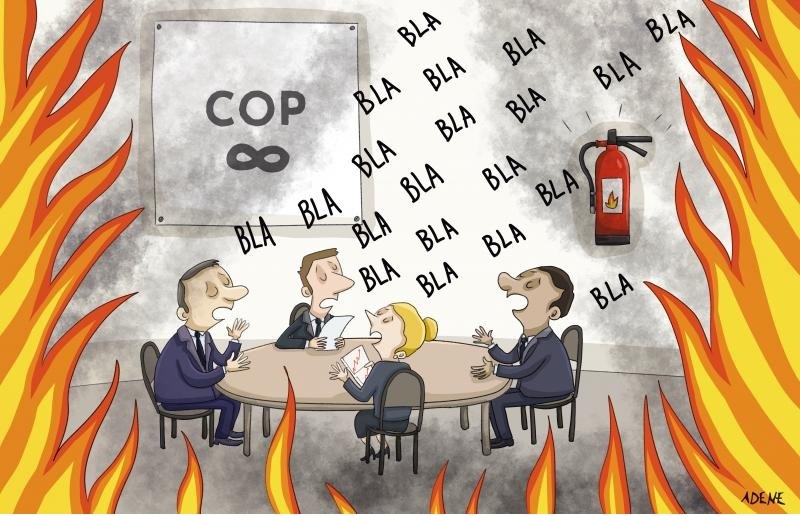
Top American oil and gas producers are using trade groups to gain access
to this year’s COP30 climate summit in the absence of an official U.S.
delegation, DeSmog can report. ExxonMobil and Chevron — which are among
the fossil fuel industry’s biggest greenhouse gas emitters — have sent
a combined total of 13 executives to the talks, while both companies have
either sponsored events or pavilions at the conference.
In addition, Exxon CEO Darren Woods spoke at a number of COP30 side events, including one in Sao Paolo on November 3, where he noted in an interview with Reuters that crude oil and hydrocarbons were “going to play a critical role in
everybody’s life for a long time to come”.
Desmog 14th Nov 2025,
https://www.desmog.com/2025/11/14/us-oil-executives-flock-to-cop30
Beyond Nuclear brings interim storage case back to Supreme Court.

Nov 14, 2025, https://www.ans.org/news/article-7537/beyond-nuclear-brings-interim-storage-case-back-to-supreme-court/
The U.S. Supreme Court may once again scrutinize the Nuclear Regulatory Commission’s authority to license consolidated interim storage facilities for commercial spent nuclear fuel. The antinuclear group Beyond Nuclear has filed a petition with the court for a writ of certiorari review of an August 2024 appeals court decision rejecting the group’s lawsuit against the licensing of Holtec International’s New Mexico storage facility, the HI-STORE CISF.
Beyond Nuclear is arguing that the NRC’s decision to license the HI-STORE CISF and deny the group’s hearing request violated the Nuclear Waste Policy Act (NWPA) and the Administrative Procedure Act, as well as the constitutional separation of powers doctrine. The group also contends that the NRC manipulated the hearing process to deny the group its right to a “day in court.”
The petition was filed on October 31 and docketed on November 4, with docket No. 25–540.
Litigating the merits: The U.S. Supreme Court in June ruled against Texas in its case regarding the licensing of Interim Storage Partners’ proposed CISF in Andrews County, Texas. The court found that plaintiffs Texas and Fasken Land and Minerals did not have standing as “parties aggrieved” to challenge the NRC license, sending the case back to the 5th Circuit Court of Appeals to be dismissed. As directed by the Supreme Court, the 5th Circuit dismissed the petitions against both the ISP and Holtec CISFs on October 20.
In NRC v. Texas, however, the Supreme Court did not weigh in on the NRC’s authority under the Atomic Energy Act and the NWPA to license private companies to store spent nuclear fuel at away-from-reactor sites.
In its petition to the Supreme Court, Beyond Nuclear claims that Holtec’s NRC license violates the NWPA, as the law prohibits the Department of Energy from taking any ownership of spent fuel until a deep geologic repository is licensed and operating.
Beyond Nuclear, together with Fasken, made similar arguments in their 2024 petition to the D.C. Circuit Court of Appeals. The court, however, rejected that argument, finding that because Holtec “sought a license for the lawful storage of privately owned spent fuel, and only the conditional storage of DOE-titled fuel if such storage became lawful, the Commission concluded that Beyond Nuclear had failed to raise a genuine dispute of law or fact.”
New Mexico pause: In October, Holtec canceled its agreement with the Eddy-Lea Energy Alliance, its partner in building the HI-STORE CISF. The company cited ongoing state resistance to the facility for the decision. In addition, Holtec said the canceled agreement would allow the company to work with other states that may be interested in interim storage projects.
Beyond Nuclear, however, has denigrated Holtec’s announcement as a “ruse,” claiming the company could be waiting until the political environment is more favorable to the project, or that Holtec may sell its license to another company for development in New Mexico.
Manchester launch for Labrats nuclear test education programme
Nuclear Free Local Authorities, 13th November 2025
Manchester was honoured to host nuclear test veterans, family members and former Councillors at a very special event held in the City Council Chamber on Friday 7 November. The event was organised by the NFLAs and LABRATS.
The event had two objectives – to mark the occasion of the 45th anniversary of the City Council passing a resolution declaring Manchester the world’s first nuclear-free city and to launch the latest education package recently published by Labrats, a group representing nuclear test veterans and family members in their continued campaign for recognition, access to medical records, and compensation.
The Lord Mayor of Manchester Councillor Carmine Grimshaw opened the event, with additional comments by Manchester City Council’s military veterans lead, Councillor Tommy Judge. NFLA Secretary Richard Outram then outlined the circumstances which led to the City Council’s historic declaration on 5 November 1980……………………………………… https://www.nuclearpolicy.info/news/manchester-launch-for-labrats-nuclear-test-education-programme/
Nuclear for Wylfa the wrong way to go

Nuclear Free Local Authorities, 13th November 2025
Responding to today’s news that the UK Government intends to impose several so called ‘small modular reactors’ upon Wylfa, the Welsh NFLAs believe that this is the wrong way to go.
The money would be better spent on insulating Welsh homes to make them warmer and cheaper to run or used to develop more capacity in renewable technologies that can generate electricity cheaper and far quicker. And Ynys Mon can play a big part in that by becoming a centre of excellence for renewable technologies and so truly Wales’ ‘green energy’ island.
The Government’s nuclear delivery agency, Great British Energy – Nuclear recently concluded a ‘competition’ amongst SMR developers to select a preferred design. Unsurprisingly Rolls-Royce, which had already received a Government hand-out of £210 million during an earlier development stage and a Government hand-up by being fast-tracked onto the Generic Design Assessment process, won the competition. This was the equivalent of running a race with superior sports footwear, and starting the race much earlier, than the other participants. The company will now be awarded a further £2.5 billion of hard-pressed taxpayers money to build three pilot SMRs.
13th November 2025
Nuclear for Wylfa the wrong way to go
Responding to today’s news that the UK Government intends to impose several so called ‘small modular reactors’ upon Wylfa, the Welsh NFLAs believe that this is the wrong way to go.
The money would be better spent on insulating Welsh homes to make them warmer and cheaper to run or used to develop more capacity in renewable technologies that can generate electricity cheaper and far quicker. And Ynys Mon can play a big part in that by becoming a centre of excellence for renewable technologies and so truly Wales’ ‘green energy’ island.
The Government’s nuclear delivery agency, Great British Energy – Nuclear recently concluded a ‘competition’ amongst SMR developers to select a preferred design. Unsurprisingly Rolls-Royce, which had already received a Government hand-out of £210 million during an earlier development stage and a Government hand-up by being fast-tracked onto the Generic Design Assessment process, won the competition. This was the equivalent of running a race with superior sports footwear, and starting the race much earlier, than the other participants. The company will now be awarded a further £2.5 billion of hard-pressed taxpayers money to build three pilot SMRs.
Great British Energy – Nuclear also purchased the Wylfa and Oldbury sites off Horizon for £160 million for reuse as locations for these new SMRs, almost certainly at nil or minimal cost to the developer, and GNE – N recently advertised for a site manager with proficiency in the Welsh language letting slip that Wylfa was the preferred site.
The Government’s announcement refers to Wylfa becoming Britain’s first SMR ‘power plant’ with reactors plural, suggesting that the three initial reactors will all be co-located on the island. SMRs are an uncertain and unproven nuclear technology. The Rolls-Royce SMR design has yet to secure all the required regulatory approvals, no Rolls-Royce SMR have yet been built, let alone operated, and there is no experience of SMR modular assembly. Any reactor will not even come on stream until the 2030’s and even then will only deliver electricity for customers that is vastly more expensive than that generated by renewables. Nor has any permanent solution to the intractible problem of managing high-level radioactive waste been found, but there has been some academic research which indicates that many SMR designs create more waste per kilowatt generated than traditional gigawatt plants. And as Ukraine has demonstrated, nuclear power plants are obvious targets in any future conflict.
Wylfa is a particularly problematic location. The Horizon bid was rejected in part because of the damage it would cause to nature and the beautiful environment of Ynys Mon and its impact on the island’s linguistic heritage. But the bid failed largely because the developer felt they were not receiving enough financial support from the taxpayer. How will this be different? The price tag for a single SMR is likely to be at least £4 billion. Will a public subsidy of £2.5 billion be deemed sufficient to Rolls Royce to incentivise them to proceed with buiding three? How will electricity be transmitted across and out of the island? It is very likely that we shall see a sea of new pylons spring up across the green fields of Ynys Mon and beyond. If parts for a modular reactor are made off-site, how will they be transported onto the island? And with ‘First of a Kind’ experimental SMRs at Wylfa, and a military neighbour at RAF Valley, surely the UK Government is making Ynys Mons an even higher-priority target for terrorists or a hostile power in time of war. How will islanders be evacuated quickly and safely should there be an attack or an accident?
The promised thousands of jobs ‘for the local community’ must also be questionable. ………………………………………………………………………………………………
The Welsh NFLAs would rather see the £2.5 billion dedicated to SMR development at Wylfa redirected by the UK Government to reduce the energy bills of Welsh citizens and move closer to making Wales a wholly renewable electricity nation. How? By funding an emergency programme of retrofitting insulation to Welsh homes and into supporting renewable energy projects……………………………………………………………………………………………………………………… https://www.nuclearpolicy.info/news/nuclear-for-wylfa-the-wrong-way-to-go/
Atom is prematurely split in the ‘golden age’ transatlantic partnership
Nils Pratley, 14 Nov 25 https://www.theguardian.com/business/2025/nov/13/atom-split-us-uk-golden-age-partnership-wylfe-smr
Britain was always going to prefer homegrown technology for the SMR reactors at Wylfe. The US would have done the same.
It had all been so harmonious two months ago. “Together with the US, we’re building a golden age of nuclear that puts both countries at the forefront of global innovation and investment,” purred the prime minister about the new “landmark” UK-US nuclear partnership.
Now there’s an atomic split over the first significant decision. The UK has allocated Wylfa on the island of Anglesey, or Ynys Môn, to host three small modular reactors (SMRs) to be built by the British developer Rolls-Royce SMR. The US ambassador, Warren Stephens, says his country is “extremely disappointed”: he wanted Westinghouse, a US company, to get the gig for a large-scale reactor.
This quarrel is easy to adjudicate. The US ambassador is living in dreamland if he seriously thought the UK wouldn’t show home bias at Wylfa. This is the coveted site for new nuclear power in the UK because the land is owned by the government, which ought to make the planning process easier and quicker, and the site hosted a Magnox reactor until 2015, so the locals are used to nuclear plants. Since Rolls-Royce’s kit is the best national hope of reviving the UK’s industry with homegrown technology, of course there was going to be preferential treatment.
None of which is to say the SMR experiment will definitely succeed in the sense of demonstrating cheapness (a relative measure in nuclear-land) versus mega-plants, such as Hinkley Point C, Sizewell C or the Westinghouse design. Rolls-Royce oozes confidence about the cost-saving advantages of prefabrication in factories, but these have yet to be demonstrated on the ground. The point, though, is that the only way to find out is to get on and build. Rolls-Royce SMR’s only other order currently is from the Czech Republic for six units.
Indeed, the criticism from some quarters is that the UK government has been too timid in ordering only three. If the batch-production is supposed to be the gamechanger on costs, goes the argument, then commit to a decent-sized batch at the outset.
The choice of Wylfa may help on that score in time, though. The site is reckoned to be big enough to hold an additional five SMR units eventually, on the top of the first three. Since each SMR is 470 megawatts, a full build-out would equate to more megawatts in total than the 3,200 from each of Hinkley and Sizewell.
The sop to the US is that Westinghouse gets to compete for future large-scale reactor projects in the UK. It would probably have been a good idea to tell the ambassador in advance before he blew a fuse. Reserving Wylfa for Rolls-Royce SMRs was the only sensible decision here.
Hopes that SMR technology will become a major export-earner for the UK eventually are best treated with extreme caution at this stage. The first electricity from Wylfa won’t be generated until the mid-2030s, and the demonstration of falling costs with each additional unit can only come after that. There is a long way to go. But a good way to maximise your chance of success is to give the top site to your pet project. The US would have done exactly the same.
Wales Green Party responds to new nuclear power plans
by Green Party, https://greenparty.org.uk/2025/11/13/wales-green-party-responds-to-new-nuclear-power-plans/
Responding to the announcement of plans for new nuclear power generation on Ynys Môn, leader of Wales Green Party Anthony Slaughter, said:
“It’s Groundhog Day yet again. Gordon Brown declared a bold future for nuclear power back in 2009, showing us nuclear is of no help in fighting the climate crisis.
“New nuclear power at Wylfa would be nothing but an expensive distraction from the clean, fast and cheap renewables already available to us. We need to cut emissions fast, but even the most optimistic backers admit it’ll take a decade for new nuclear to be up and running.
“And there is still no answer to the safe disposal of nuclear waste.
“What Wales needs is a fast, ambitious roll-out of solar, wind and wave energy that will create jobs and cut energy bills.”
1 This Month

of the week – Shut Down Drone Warfare!


Tell the Ukrainian Government to Drop Prosecution of Peace Activist Yurii Sheliazhenko

Petition to revoke the licensing of the Near Surface Nuclear Disposal Facility (NSDF) at Chalk River. https://www.ourcommons.ca/petitions/en/Petition/Details?Petition=e-7247
To see nuclear-related stories in greater depth and intensity – go to https://nuclearinformation.wordpress.com
-
Archives
- April 2026 (114)
- March 2026 (251)
- February 2026 (268)
- January 2026 (308)
- December 2025 (358)
- November 2025 (359)
- October 2025 (376)
- September 2025 (257)
- August 2025 (319)
- July 2025 (230)
- June 2025 (348)
- May 2025 (261)
-
Categories
- 1
- 1 NUCLEAR ISSUES
- business and costs
- climate change
- culture and arts
- ENERGY
- environment
- health
- history
- indigenous issues
- Legal
- marketing of nuclear
- media
- opposition to nuclear
- PERSONAL STORIES
- politics
- politics international
- Religion and ethics
- safety
- secrets,lies and civil liberties
- spinbuster
- technology
- Uranium
- wastes
- weapons and war
- Women
- 2 WORLD
- ACTION
- AFRICA
- Atrocities
- AUSTRALIA
- Christina's notes
- Christina's themes
- culture and arts
- Events
- Fuk 2022
- Fuk 2023
- Fukushima 2017
- Fukushima 2018
- fukushima 2019
- Fukushima 2020
- Fukushima 2021
- general
- global warming
- Humour (God we need it)
- Nuclear
- RARE EARTHS
- Reference
- resources – print
- Resources -audiovicual
- Weekly Newsletter
- World
- World Nuclear
- YouTube
-
RSS
Entries RSS
Comments RSS
 nuclear-news