IAEA warns of safety importance of substations

Tuesday, 18 November 2025,
https://www.world-nuclear-news.org/articles/iaea-warns-of-safety-importance-of-substations
The International Atomic Energy Agency has stressed the importance of electrical substations in ensuring off-site power supplies to nuclear power plants.
The International Atomic Energy Agency (IAEA) said such substations “are indispensable for maintaining off-site power supplies that support safety systems and cooling functions, making their integrity vital for nuclear safety and security”.
Grossi said: “Reliable off-site power is vital for the maintenance and operation of nuclear safety functions. To this end, Agency experts will, through dedicated expert missions, continue to assess the functionality of substations critical for nuclear safety and security.”
Meanwhile, Zaporizhzhia Nuclear Power Plant, which has been under Russian military control since early March 2022, has had its main external power line shut since Friday after the activation of a protection system. The IAEA said the cause was still being investigated and they were “engaging with both sides to assist in the timely restoration of the line”.
The loss of the 750 kV Dniprovska line means the plant is relying on its 330 kV backup Ferosplavna-1 line for external power at the moment. The plant recently went a month relying on emergency diesel generators for power, before IAEA-mediated local ceasefires allowed necessary repair work to take place to reconnect.
Meanwhile, Energoatom issued a statement explaining that Khmelnitsky unit 2 has “been operating with a damaged turbine since 2022 … currently, the power unit can produce up to 900 MW of electricity”. The company added that it is in the process of purchasing a new, modernised rotor which “will not only restore the design nominal capacity, but also increase it by 40 MW to 1,040 MW”.
Zionists Are Freaking Out About Losing Control Of The Narrative.
Hurwitz went on to say that Holocaust education has begun backfiring, because it has been giving young people the wrong impression that genocide is always bad.
Caitlin Johnstone. Nov 19, 2025, https://www.caitlinjohnst.one/p/zionists-are-freaking-out-about-losing?utm_source=post-email-title&publication_id=82124&post_id=179311938&utm_campaign=email-post-title&isFreemail=true&r=1ise1&triedRedirect=true&utm_medium=email
Former Obama speechwriter Sarah Hurwitz made some very revealing remarks during an appearance at the Jewish Federations of North America General Assembly on Sunday, expressing frustration with the way younger Jews are dismissing pro-Israel arguments because of the carnage they’ve seen in Gaza.
“We are now wrestling with a new I think generational divide here, and I think that’s particularly true in that social media is now our source of media,” Hurwitz said. “It used to be that the news you got in America was American media, and it was pretty mainstream; you know it generally didn’t express extreme anti-Israel views. You had to go to a pretty weird bookstore to find global media and fringe media. But today we have social media, which is the global medium; its algorithms are shaped by billions of people worldwide who don’t really love Jews. So while in the 1990s a young person probably wasn’t going to find Al Jazeera or someone like Nick Fuentes, today those media outlets find them; they find them on their phones.”
“It’s also this increasingly post-literate media; less and less text, more and more videos,” Hurwitz continued. “So you have TikTok just smashing our young people’s brains all day long with video of carnage in Gaza. And this is why so many of us cannot have a sane conversation with younger Jews, because anything that we try to say to them, they are hearing it through this wall of carnage. So I want to give data and information and facts and arguments, and they are just seeing in their minds: carnage. And I sound obscene.”
Hurwitz went on to say that Holocaust education has begun backfiring, because it has been giving young people the wrong impression that genocide is always bad.
“And you know I think unfortunately, the very smart bet that we made on Holocaust education to serve as anti-semitism education in this new media environment, I think that is beginning to break down a little bit because, you know, Holocaust education is absolutely essential, but I think it may be confusing some of our young people about antisemitism,” Hurwitz said. “Because they learn about big, strong Nazis hurting weak, emaciated Jews, and they think oh, antisemitism is like anti-black racism, right? Powerful white people against powerless black people. So, when on TikTok all day long, they see powerful Israelis hurting weak, skinny Palestinians, it’s not surprising that they think, Oh, I know the lesson of the Holocaust is you fight Israel. You fight the big powerful people hurting the weak people.”
Hoo boy. Lots to unpack here.
It’s just so fascinating to see a former White House speechwriter making so many of the points that anti-Zionists have been making for years, but taking the exact opposite meaning from them:
- The mainstream legacy media has always hidden anti-Israel views from the public — and that was a good thing.
- Social media has now given Palestinians the ability to expose the truth about Israel’s abuses — and that’s a bad thing.
- People aren’t falling for the Zionist spin and narrative-diddling anymore because they’ve seen the carnage in Gaza with their own eyes — and that’s a problem.
- People who learned from Holocaust education that genocide is wrong have been applying those same lessons to the genocide in Gaza — and this means they’re “confused”.
Hurwitz isn’t denying Israel’s abuses or framing its genocidal atrocities as the problem, she’s just coming right out and saying that people obtaining information and moral clarity about those abuses is the problem. The atrocities aren’t wrong, what’s wrong is people seeing those atrocities and calling them what they are.
I love the way she complains that she looks “obscene” for trying to lay out arguments and narratives justifying the Gaza holocaust for people who’ve seen the “wall of carnage” from the genocide. I mean, yes. Yes obviously you’re going to look obscene if you try to tell someone why raw video footage of massacres, mutilated children and emaciated bodies is actually showing something that is justifiable and acceptable.
You can’t stand in front of a pile of child corpses justifying their murder and then whine when people ignore your spinmeistering and keep staring at the tiny bodies. That’s like murdering an entire family and then telling the cops, “But you’re not listening to my reasons for killing them!” They’re doing the normal thing while you are being obscene.
There’s a viral clip of this tirade going around Twitter and I was curious if Hurwitz had said anything after the video segment ended which might have made what she said sound less horrible, so I went to check out the original video on the Jewish Federations of North America’s Youtube channel, and nope. It didn’t get any better.
Hurwitz went on to say that people are wrong to carry the lessons of Holocaust education into opposition to Israel’s genocidal atrocities because the Holocaust was Nazi Germany blaming Jews for all their problems in the same way people think Israel is the source of all the world’s problems today.
She then mourned the way western Jews “re-imagined Judaism as a Protestant-style religion” in order to integrate into western society rather than retaining a strong identity that is loyal to the state of Israel.
“The problem is, we’re not just a religion,” Hurwitz said. “We’re a nation. Civilization. Tribe. Peoplehood. But most of all we’re a family. And so if you are a young person raised in America who thinks Judaism is a Protestant-style religion, then the seven million Jews in Israel are merely your co-religionists. So my co-religionists, if I look at them and they’re not practicing my religion of social justice and certain prophetic values then what do I have to do with them?”
“But that’s a category error,” says Hurwitz. “The seven million people in Israel, they are not my co-religionists, they are my siblings. But I think if you think of them as merely your co-religionists, it’s easy to slide into anti-Zionism. You don’t necessarily have that connection to them.”
Hurwitz is saying here that Jews around the world should be loyal to Israel no matter what Israel does, not because that’s the moral or truthful position but because Israel is where their loyalties belong.
I don’t know about you, but if my siblings were murdering civilians I would immediately become their enemy. I wouldn’t defend my brother if he was going around shooting children in the head like IDF snipers have been doing in Gaza, in fact I would feel a special responsibility to stop him exactly because he is my brother. Genocide doesn’t magically become acceptable if the perpetrators are your “siblings”, unless you are a sociopath.
It’s just incredible how hard Zionists have been freaking out about the way Israel has lost control of the narrative these last two years. More and more often we’re seeing them say the quiet parts out loud as they frantically scramble to manage perceptions and manipulate minds around the world.
Many things which used to be hidden are finding their way into the light.
First Minister John Swinney absolutely rules out changing SNP’s no nuclear stance
the proposal to develop new nuclear energy was both “economic and environmental folly” that would lead to more expensive bills.
First Minister John Swinney absolutely rules out changing SNP’s no nuclear stance saying ‘there is no way on this planet that I am going to change that policy’
By Scott Maclennan, John O’Groat Journal 20th Nov 2025
First Minister John Swinney has absolutely ruled out any change to the SNP’s position against nuclear energy saying: “There is no way on this planet that I am going to change that policy.”
He was speaking at the weekend at the adoption night for the party’s candidate for Skye, Lochaber and Badenoch Eilidh Munro in Dingwall alongside Deputy First Minister Kate Forbes.
The First Minister reiterated the position after it was revealed that Anglesey in North Wales – which has many objective similarities with Caithness – is about to receive a £2.5 billion nuclear boost.
That sparked Caithness, Sutherland and Easter Ross MP Jamie Stone to reignite his argument that it is not too late for Dounreay – but the SNP must lift its ban on new nuclear power.
“This is an important announcement which demonstrates two things,” he said. “Firstly, that the UK government is serious about establishing ‘a network of small modular reactors across the UK’ – as the Energy Secretary put it.
‘It’s brilliant for a small town like Wick’ – local opticians celebrate award win
“The second point, which will be of enormous interest to the far north, is the specific reference from the UK government to ‘sites across the United Kingdom, including Scotland’.”
But Mr Swinney rebuffed all of those points arguing instead that the proposal to develop new nuclear energy was both “economic and environmental folly” that would lead to more expensive bills.
“I don’t think the position on nuclear power is exactly a surprise,” he said. “We have been around for a long time when we have won Caithness, Sutherland and Ross and there’s absolutely no way on the planet that I’m going to change that policy because I think it’s economic and environmental folly.
“These nuclear stations are hyper-expensive so if people are going to get nuclear power stations put onto their bills then they ain’t seen nothing yet because these projects always go way over budget.
“So we’ve got the opportunity for low cost renewable energy in Scotland in abundance and we should seize that opportunity to do the right thing, fiscally and environmentally and the nuclear argument will just saddle people with exorbitant fuel costs for the years to come.”…………………… https://www.johnogroat-journal.co.uk/news/first-minister-john-swinney-absolutely-rules-out-changing-sn-419801/
Wylfagasm! What does it tell us about Cymru?
18 Nov 2025, https://nation.cymru/opinion/wylfagasm-what-does-it-tell-us-about-cymru/
Some of the most unpopular politicians in the UK and Cymru, led by Starmer, rolled up to Ynys Môn on 13th November to announce that three Small Modular Reactors (SMR’s), to be designed by Rolls-Royce SMR are to be built at Wylfa by publicly owned Great British Nuclear, backed by £2.5 billion of public money.
Following the deferred gratification as the Hitachi project collapsed in 2019, the consequent media ballyhoo was euphoric, with the announcement being seen as at last confirming that nuclear is back on Ynys Môn, with up to 3,000 jobs expected during construction, and up to 900 jobs required to run the plant. The politicians of the UK, Cymru and Ynys Môn of almost all political colours welcomed the news. Starmer also announced that Cymru was to be an Artificial Intelligence (A.I.) zone, with 3,500 jobs to be created.
What’s not to like about nuclear at Wylfa?
A great deal, as I know from too many years of campaigning with PAWB (People Against Wylfa B)! Let’s be brief, though several volumes are needed to do justice to the objections.
The main argument used to justify nuclear by local politicians can be summarised in one word: JOBS! Jobs for Ynys Môn, which has haemorrhaged jobs for years, thus giving youngsters an opportunity to stay on the Island. Yes, Ynys Môn, like other economically bereft areas of Cymru, needs jobs to retain youngsters who have been drifting away in search of opportunities. But this has been a running sore for decades, and the chief focus on Ynys Môn has been to concentrate on the economic silver bullet of Wylfa since Blair’s Energy Review in 2006. So our youngsters have been let down for two decades, during which time a reliable job creation strategy could have been devised and implemented. The result is that jobs of any sort are accepted with very little robust questioning.
Poverty induces gratitude for a poisoned chalice.
Why is the chalice poisoned? The arguments against nuclear have been listed so many times that it is frankly staggering that mainstream politicians largely ignore them.
- No solution to the problem of radioactive waste which must be safe for millennia.
- Spiralling costs of every nuclear project, at the taxpayer’s expense.
- Too little, too late to mitigate climate change.
- The myth that nuclear is low carbon and safe.
- Huge long term environmental damage where uranium is mined.
- Risk of catastrophe as at Chernobyl, Fukushima, Windscale, Three Mile Island.
- Risk of malicious attacks by cyberwarfare or direct military attack in a dangerous world.
- Risk of nuclear proliferation
- Intrinsic link to military nuclear – the first Wylfa was built to produce plutonium.
Other issues can be added.
Continue readingKiev Coup Poker Update, 19 November 2025
Russian & Eurasian Politics, by Gordon hahn, November 19, 2025
Beleaguered Ukrainian President Volodomyr Zelenskiy is still on the road, having arrived in Turkey, where he had a meet and greet with of all people Mindichgate-incriminated Head of the Defense and Security Council of Ukraine Rustem Umerov supposedly to restart peace talks with Moscow. Umerov has recently been heard on the Mindichgate tapes discussing a corrupt deal on bulletproof vests. Zelenskiy needs the support of the military, but Umerov did not and certainly will not have now command or authority inside the military. That is the domain of Ukraine’s most popular political figure, Kiev’s ambassador to the UK, and former commander of the Armed Forces of Ukraine (UAF) Gen. Valeriy Zaluzhniy, fired by Zelenskiy last year.
Head of Zelenskiy’s Office of the President (OP) Andriy Yermak was reportedly in Washington speaking with the FBI, which has a hand in the opening of Mindichgate. He reportedly is now in London, where he is likely to meet with Zaluzhniy and British governmental figues, such as MI6’s new Ukrainian-British director (https://gordonhahn.substack.com/p/is-the-uk-readying-a-coup-option). With Zaluzhniy and the FBI, Yermak’s hand in the developing pre-coup or coup crisis is stronger than that of Zelenskiy, who is potentially isolated in Turkey with Umerov, a wholly unpopular figure in Ukraine and an ethnic Tatar to boot.
But the army is no longer Zaluzhniy’s to have without a fight. It is also the feifdom of the neofascists such as Azov and its founder Brig. Gen, Andriy Biletskiy, who heads a 20,000-strong Azov army corps as well as other Azov-dominated units.
There are also reports that the Secretary of the U.S. Army Dab Driscoll and Army Chief of Staff Randy George are in Kiev and are then scheduled to head to Moscow! They may be in Kiev to deliver an ultimatum to Zelenskiy in the form of the reported new U.S.-Russian peace plan he will be required to sign or face the consequences (arrest, removal from office by impeachment or coup, assassination), perhaps explaining why Zelenskiy remains away in Istanbul. However, this may prove a fatal mistake, as he has left door open to machinations.
Tonight Kiev stands empty without its president, its presidential chief of staff, its Security and Defense Council chief, its energy minister (with the country in an energy crisis), and perhaps who knows who else. Last night, Energy Minister Svetlana Grinchuk, who also is implicated in Mindichgate, fled Ukraine, joining a full cohort of Kievan wanderers – Zelenskiy, Yermak, Umerov, Mindich himself, and his sidekick Tsukerman. They are going faster than American politicians to Epstein island. Ruslan Stefanchuk, the speaker of the badly splintered Rada, rocked by Mindichgate, and head of the Cabinet of Ministers, Yuliya Svyrydenko, in her post for less than a year remain if talking about civilian leaders. Military Intelligence (HRU) chief Kyryll Budanov, a creature of the CIA remains, as presumably do at least some members of the UAF’s General Staff, including its chair Mikhail Gnatov, who just a week ago asserted military over civilian authority to Zelenskiy’s face.
This would be an excellent time for some of these figures, who remain in Kiev, to author a coup, it would seem, perhaps with the backing of those U.S. Army officials in town. It probably will not happen tonight, but who knows? Maybe tomorrow night, when Zelenskiy and Umerov can be arrested, as some official sources say they will be doing. At present a coup to replace Zelenskiy gives everyone among the present moment’s main players something of what they want. Zelenskiy remains a free (if likely hunted) man. The West’s Project Ukraine is rid of him and can be moved to its next course of action within the framework of Russian and American demands and ultimata. Russia achieves its special military operation’s goals at least for now. (Neofascist or others’ countercoups can turn over the chessboard and bring real chaos ala Ukraine’s 17th century Great Ruin or 1917-1920). At any rate, as an old American saying goes: “Get while the getting is good.”……………………………………………….. https://gordonhahn.com/2025/11/19/kiev-coup-poker-update-20-november-2025/
At Least 13 Palestinians, ‘Mostly Children,’ Killed by Israel in Lebanon Massacre
Despite a November 2024 truce between Israel and Hezbollah, Israeli forces have killed at least 121 civilians, including 21 women and 16 children, in Lebanon.
Brett Wilkins, 19 Nov 25, https://www.commondreams.org/news/israeli-airstrikes-lebanon
A series of Israeli airstrikes on targets in southern Lebanon have killed at least 17 people and wounded more than 100 others in recent days, including 13 people—mostly children, according to local officials—massacred Tuesday at a camp for Palestinian refugees.
Officials and residents said that the Israeli strike on Ain al-Hilweh near Sidon struck an area where children were playing soccer. Ain al-Hilweh is the largest camp in Lebanon housing refugees from the Nakba—the ethnic cleansing and terror campaign through which the modern Israeli state was founded—and their descendants.
The Israel Defense Forces said it targeted members of the Palestinian resistance group Hamas “operating in a training compound” in the camp.
Hamas rejected the IDF claim as “fabrication and lies.”
The strike was the deadliest IDF attack in Lebanon since Israeli troops shot and killed at least 24 people including 6 women and injured 134 others in January.
The IDF carried out subsequent attacks, including a Wednesday morning drone strike on a vehicle in Al-Tayri that reportedly killed two civilians including the town’s treasurer and wounded at least 10 university students. Israeli forces also bombed a residential area of the town of Tair Filsay in Tyre district. It is unknown if anyone was harmed in the strike.
Often overshadowed by its genocidal war on Gaza—which has left at least 249,600 people dead, maimed, or missing; millions more forcibly displaced, starved, or sickened; and the coastal strip in ruins—Israel’s bombardment and invasion of Lebanon has killed more than 4,000 people since October 2023, according to the Lebanese Ministry of Public Health. This figure includes at least 790 women and 316 children. More than 16,600 others have been wounded. Upward of 1.2 million Lebanese were also forcibly displaced by Israel’s attacks and invasion.
This, despite a November 2024 truce between Israel and Lebanon-based Hezbollah. Since then, Israeli forces have killed at least 121 civilians, including 21 women and 16 children, in its northern neighbor—which Israel has invaded or bombed numerous times since 1948, killing and wounding tens of thousands of Lebanese and Palestinians.
Israeli forces also bombed the Qizan an-Najjar area, south of Khan Younis in the Gaza Strip on Wednesday, killing at least one Palestinian and wounding a mother and her child, according to local officials, who said at least 280 Palestinians have been killed and 650 others wounded in nearly 400 Israeli violations of the October ceasefire with Hamas.
Zelensky remains a creature of the corruption plaguing Ukraine.

A small number of oligarchs still possess outsized power in all spheres of business and politics. But the truth is moving in mysterious ways.
Ian Proud, Nov 18, 2025, https://responsiblestatecraft.org/ukraine-corruption/?utm_source=substack&utm_medium=email
The $100 million corruption scandal around Ukraine’s energy system that broke this past week is critical to ordinary Ukrainians for its timing. Russia has been bombarding the country’s energy infrastructure on a daily basis to deny ordinary citizens heat and electricity during the cold and dark winter months.
In November 2024, a separate scandal broke that $1.6 billion set aside to build protective bunkers around electricity sub-stations had not led to any being built.
With this in mind, many have responded that the highly publicized nature of this latest scandal, which resulted in the resignations of both the energy and justice ministers, offers visible proof that progress is being made in tackling corruption in Ukraine. The National Anti-Corruption Bureau (NABU) of Ukraine, which is often at the spearhead of such investigations, was first established by Presidential Decree in April 2015. That it continues to function is indeed a positive sign.
It’s not possible, however, to claim that corruption has emerged as a specifically wartime phenomena. This energy scandal is hardly a one-off. In September 2021, with Zelensky having already been in power for two and a half years, the European Court of Auditors reported that state corruption and capture were still widespread in Ukraine. It pointed out that “tens of billions of Euros are lost annually as a result of corruption,” and that EU support delivered over 20 years had not delivered the desired results.
Since Russia invaded in 2022, Ukraine has been flooded with hundreds of billions of dollars of aid, of a much greater value than its yearly economic output. The United States has been unable to accurately account for the billions it has sent there. No country at this point would be able to assure itself that its funds have been spent well.
The scale of each new corruption scandal has seemingly grown over time. In August 2023, Zelensky sacked all the heads of the regional military recruitment offices following widespread complaints about kick-backs, often bribes to let potential recruits escape military service. In September 2023, Ukraine’s Defense Minister, Oleksii Reznikov, resigned following a procurement scandal related to the marking up the cost of purchased body armour and helmets by 4-5 times. In January 2024, Ukrainian defense officials were arrested over the theft of $40 million, related to an order for 100,000 artillery shells that were never delivered.
To date, President Volodymyr Zelensky has been able to keep Western donors off his back through a sacking here or a prosecution there. What has changed this year is that the erstwhile NABU investigators have been gradually nudging closer to his inner circle.
In July of this year, as the noose was closing around his close ally former Deputy Prime Minister Oleksiy Chernyshov because of a large-scale property fraud, Zelensky made a failed attempt to hobble NABU and bring it under his personal control. As it turns out, Chernyshov has also been implicated in the current $100m energy scandal, with NABU detectives documenting the transfer of an estimated $1.3 million in cash to him and an associate. On 14 November, NABU sought an order for pre-trial detention of Chernyshov.
Timur Mindich, the man at the centre of the current scandal, is a close ally of Zelensky and co-founded the TV company ‘Kvartal 95’ with him. He was allowed to flee the country before the NABU raids, which discovered duffel bags stuffed with cash and a golden toilet. It hasn’t been lost on some commentators that, in 2014, the ousted President Yanukovych was also alleged to have possessed a toilet made of gold.
Which provides another reminder that, stepping back from the canvas, not much has really changed in Ukraine over the past decade. I first met an anti-corruption activist in Kyiv in late 2015, at the foot of the postcard perfect Andriivsky descent in the quaint Lviv Handmade Chocolate Café. Approaching two years after the ouster of Yanukovych, she was visibly distressed that little progress had been made in tackling corruption. Within weeks, the government of Arseny Yatseniuk faced a no-confidence vote over a slew of corruption scandals involving figures close to him that led, ultimately, to his resignation in February 2016.
In the midst of that scandal, Vice President Joe Biden visited Kyiv in a bid to shore up the government, anxious that Ukraine might not be able to form a better coalition than the one in power. “Corruption siphons away resources from the people. It blunts economic growth, and it affronts human dignity. We know that. You know that. The Ukrainian people know that,” Biden said.
For many ordinary Ukrainians, who protested peacefully in the Maidan in late 2013, rooting out corruption was at the core of the so-called “revolution of dignity.” Biden’s 2015 visit was an attempt to paper over the cracks, and close down moves to unsettle the pro-western government. Yet the endemic corruption carried on.
When it released its recent report on EU accession states, the European Commission noted Ukraine’s remarkable commitment to its EU path. However, it downgraded its assessment to B grade, expressing concern about progress in tackling corruption. As with the 2015 Biden visit it was, I fear, another example of papering over the cracks of a much bigger problem.
The vertical of power in Ukraine, in which a small number of oligarchs possess outsized power in all spheres of business and politics, remains largely unchanged to this day. Zelensky has emerged as a creature of that system, having both clashed and aligned himself with different oligarchs at different times. With presidential elections paused, there are fewer constitutional checks and balances on his power than before the war. And for all its excellent work, NABU is not yet powerful enough to break the system.
There is a persuasive case to make that ending the war and turning off the gravy train would make it easier for Ukraine’s future leaders to refocus on the path to European membership. This would require real and measurable reform. It’s possibly for this reason that public support for an end to the war continues to grow along with outrage at every new case of graft by cronies close to Zelensky. But it may also help to explain why he is in no hurry to see the war end.
Big Loss for US Empire: Ecuador Votes To Reject Foreign Military Bases
Geopolitical Economy, By Ben Norton, November 19, 2025
Ecuador’s Trump-backed right-wing oligarch President Daniel Noboa tried to rewrite the constitution to allow US military bases in the country’s territory. 61% of Ecuadorians voted against it.
The Donald Trump administration is trying to expand the presence of the US military across Latin America, in an attempt to forcibly impose Washington’s hegemony in the region.
The people of Ecuador just delivered a major blow to Trump’s aggressive Latin America strategy.
More than three-fifths of Ecuadorians voted to reject a change to their progressive constitution, which would have allowed the Pentagon to establish US military bases in their territory……………………………. https://geopoliticaleconomy.com/2025/11/18/noboa-ecuador-vote-foreign-military-bases/
Energy Department loans $1B to help finance the restart of nuclear reactor on Three Mile Island.

The U.S. Department of Energy said Tuesday that it will loan $1 billion to
help finance the restart of the nuclear power plant on Pennsylvania’s
Three Mile Island that is under contract to supply power to data centers
for tech giant Microsoft. The loan is in line with the priorities of
President Donald Trump’s administration, including bolstering nuclear power
and artificial intelligence.For Constellation Energy, which owns Three Mile
Island’s lone functioning nuclear power reactor, the federal loan will
lower its financing cost to get the mothballed plant up and running again.
The 835-megawatt reactor can power the equivalent of approximately 800,000
homes, the Department of Energy said.
Daily Mail 18th Nov 2025, https://www.dailymail.co.uk/wires/ap/article-15304171/Energy-Department-loans-1B-help-finance-restart-nuclear-reactor-Three-Mile-Island.html
France’s EDF again sends spent uranium to state-owned Russian firm for recycling
France’s EDF again sends spent uranium to state-owned Russian firm for
recycling. A shipment of reprocessed uranium from French nuclear power
plants has left the Channel port of Dunkirk to be enriched at a specialised
Russian industrial plant run by the country’s nuclear energy group Rosatom,
before being in part returned to France for further use in civil reactors.
The shipment, loaded at the weekend on a Russian-operated,
Panama-registered cargo vessel, was described by Greenpeace as a “cargo of shame”, and “immoral”, while both French utility giant EDF, which
operates the country’s nuclear power plants, and the French economy
ministry, declined to comment. Jade Lindgaard reports.
Mediapart 18th Nov 2025, https://www.mediapart.fr/en/journal/ecologie/181125/frances-edf-again-sends-spent-uranium-state-owned-russian-firm-recycling
Israel’s unrelenting, underreported ethnic cleansing of West Bank Palestinians

Walt Zlotow, West Suburban Peace Coalition, Glen Ellyn IL , 20 Nov 25
Israel’s genocidal ethnic cleansing of Gaza is obvious to all with a moral conscious. Killing upwards of 100,000 Palestinians under 50,000 tons of US bombs obliterating Gaza’s 139 square miles is easy to process. Denying food, water, medicine causing degradation and death to the remaining 2,200,000 Palestinians reinforces that genocidal reality.
But many remain unaware of Israel’s relentless policy of ethnically cleansing the 3.3 million Palestinians in the West Bank and East Jerusalem annexed by Israel in 1967. Israel is positively gleeful about bringing the West Bank entirely into Greater Israel for Israelis only. In July the Israeli Knesset passed a symbolic motion that the West Bank is “an inseparable part of the Land of Israel, the historical, cultural and spiritual homeland of the Jewish people” and that “Israel has the natural, historical and legal right to all of the territories of the Land of Israel.”
Folding the West Bank and East Jerusalem into Greater Israel, with or without (preferably without) those pesky Palestinians, has been the Israeli dream since that illegal 1967 annexation. A decade later Prime Minister Began initiated an inexorable settlement policy to implement that dream. Jewish settlement rose from just a few thousand in the late 70’s, to over half a million by the October, 2023 Hamas attack in Gaza.
The now two year Gaza genocide coincided with accelerated settlements, attacks on Palestinians, their homes, villages, harvests making life horrendous for the West Bank and East Jerusalem’s 3,300,000 Palestinians. Israeli settlement now approaches 750,000. With the world fixated on the horror perpetrated in Gaza, West Bank ethnic cleaning proceeds under the radar.
Israel pretends to oppose Israeli settler violence when in fact they both ignore an encourage it. Case in point is Zvi Sukkot, former head of settler terrorist organization The Revolt who had been marginalized by the Israeli government. Sukkot was arrested in 2010 for possible involvement in a mosque arson in the West Bank but released. By early 2023 he joined the Israeli Knesset. After the Hamas attack Prime Minister Netanyahu appointed him chair of the Knesset Subcommittee for Judea and Samara (Israel’s name for the West Bank). The leap from heading up a terrorist group to heading up a governmental agency tasked with Palestinian removal tells you everything about Israel’s agenda for the West Bank.
Is Israel determined to drive out West Bank Palestinians to fold that Palestinian land into Greater Israel? With America’s unrelenting support you can bank on it.
Nuclear tests and a legacy of harm in the Asia-Pacific
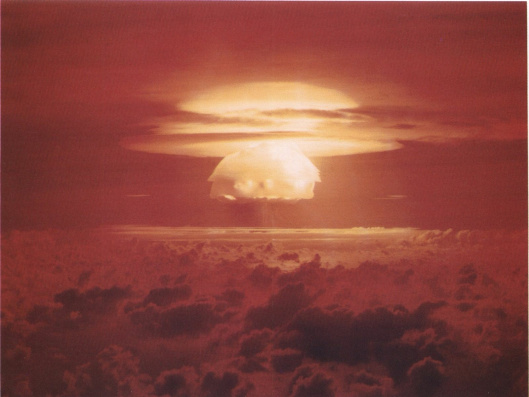
Nuclear “tests” are best conceptualized as environmental disasters with long-lasting consequences that are still felt nowadays, particularly in Oceania, as well as Central Asia.
nation states began to “export” nuclear testing to colonial areas, where vulnerable local populations faced the burden of contamination.
With weapons testing comes a history of global contamination and forgotten victims
Japan Times, By Maxime Polleri. The Diplomat, Nov 17, 2025
Recently, U.S. President Donald Trump made headlines when he told the Pentagon to resume testing of U.S. nuclear weapons, citing his concerns that countries like China or Russia had supposedly conducted secret underground nuclear weapons tests and that the United States was falling behind.
While the American president’s post created much controversy around the nature of such tests, the U.S. energy secretary later explained that Trump’s planned tests would not include any actual nuclear explosions, but would encompass “system tests” to verify the state of American nuclear arsenals.
While the fact that the United States does not plan to detonate nuclear weapons is reassuring, the country, as well as China and Russia, have a long history of experimenting with real nuclear weapons to measure the performance of their devastating arsenals.
Throughout the 20th century, nuclear testing has taken different forms, such as above-ground nuclear weapon tests, underwater tests and underground tests. The 1963 Partial Test Ban Treaty prohibited atmospheric, outer space and underwater tests, while some nation states later declared moratoria on underground tests.
Nowadays, nuclear “tests” are done via computers or laboratory scale experiments and do not include actual explosions. However, understanding former nuclear experiments as “tests” is highly misleading, since each atomic and thermonuclear explosion throughout the 20th century released a tremendous quantity of long-lasting radioactive pollutants. Nuclear “tests” are best conceptualized as environmental disasters with long-lasting consequences that are still felt nowadays, particularly in Oceania, as well as Central Asia.
In the early 1950s, the United States began to test numerous nuclear weapons at the Nevada Test Site, releasing large quantities of radioactive fallout that afflicted its own population. People exposed to such fallout became known as “downwinders” and faced a plethora of health problems.
Aware of the danger of bombing themselves, many nation states began to “export” nuclear testing to colonial areas, where vulnerable local populations faced the burden of contamination. Testing nuclear weapons in such locations was often a strategic choice, since many of the indigenous local population were already invisible from the public scrutiny or did not have the means to speak back to the dominant power that controlled their territories.
For instance, in March 1954, the U.S. tested a thermonuclear weapon, Castle Bravo, in the Bikini Atoll of the Marshall Islands, an archipelago in Micronesia that was turned into U.S. military bases after World War II. The nuclear fallout heavily impacted residents of the atolls, who were later forced to evacuate their beloved home.
In fact, the scope of the fallout was so powerful that a Japanese fishing boat, the Daigo Fukuryu Maru, was contaminated by the test, resulting in cases of acute radiation syndrome for the fishing crew and the death of its radioman.
Much like the United States, France also conducted atmospheric and underwater tests in French Polynesia, resulting in the contamination of many atolls, like Moruroa. Nuclear tests in the Asia-Pacific region created a tremendous legacy of harms, which included the destruction of coral reefs and the death of marine ecosystems, but also forced displacements, contamination of the food chain, destruction of the social fabric and health issues.
A similar pattern of exporting nuclear tests to vulnerable populations was also apparent in Central and East Asia. For instance, the Soviets repeatedly tested their nuclear weapons in the Semipalatinsk Test Site, a region that was historically dominated by ethnic Kazakhs. Nowadays, as anthropologist Magdalena Stawkowski highlights, Kazakhstan has inherited the remnants of one of the world’s most contaminated landscapes, dealing with contested health issues, precarious economy and marginalization.
Moreover, the People’s Republic of China has historically tested its nuclear weapons in the region of Lop Nur, leading Uyghurs, a Muslim minority ethnic group of northwestern China, to voice concerns about the long-term impact of residual radiation. In many of these instances, issues of national security — such as the health and well-being of local populations — were sacrificed for issues of international security.
Ironically, in each of these cases, humans tested nuclear weapons to prepare for a war that never came — globally contaminating ourselves in the process.
Far from being mere experiments, the detonations of nuclear weapons during such tests are best understood as a global catastrophe. And while a moratorium on nuclear testing ought to be applauded, many people are still grappling with the legacy of past nuclear tests.
The recent movie “A House of Dynamite” has brought up fresh fears of a nuclear war, as well as numerous discussions surrounding nuclear deterrence theories and mutually assured destruction. Instead of focusing our time, energy and resources on hypothetical strikes that happen in science fiction or game theory, we should delve deeper into the poisoned heritages of the real explosions that occurred in the 20th century and prompt efforts to revitalize communities that are still suffering from its harm.
Maxime Polleri is an assistant professor in the Department of Anthropology at Universite Laval and a member of the Graduate School of International Studies. Dr. Polleri is the author of “Radioactive Governance: The Politics of Revitalization in Post-Fukushima Japan” (New York University Press, 2026). © 2025, The Diplomat
Google Boss Says Trillion-Dollar AI Investment Boom Has ‘Elements of Irrationality’

November 18, 2025, BBC, Faisal Islam, economics editor and Rachel Clun, business reporter
Every company would be affected if the AI bubble were to burst, the head of Google’s parent firm Alphabet has told the BBC.
Speaking exclusively to BBC News, Sundar Pichai said while the growth of artificial intelligence (AI) investment had been an “extraordinary moment”, there was some “irrationality” in the current AI boom.
It comes amid fears in Silicon Valley and beyond of a bubble as the value of AI tech companies has soared in recent months and companies spend big on the burgeoning industry.
Asked whether Google would be immune to the impact of the AI bubble bursting, Mr Pichai said the tech giant could weather that potential storm, but also issued a warning.
“I think no company is going to be immune, including us,” he said…………..
The interview comes as scrutiny on the state of the AI market has never been more intense.
Alphabet shares have doubled in value in seven months to $3.5tn (£2.7tn) as markets have grown more confident in the search giant’s ability to fend off the threat from ChatGPT owner OpenAI.
A particular focus is Alphabet’s development of specialised superchips for AI that compete with Nvidia, run by Jensen Huang, which recently reached a world first $5tn valuation.
As valuations rise, some analysts have expressed scepticism about a complicated web of $1.4tn of deals being done around OpenAI, which is expected to have revenues this year of less than one thousandth of the planned investment.
It has raised fears stock markets are heading for a repeat of the dotcom boom and bust of the late 1990s. This saw the values of early internet companies surge amid a wave of optimism for what was then a new technology, before the bubble burst in early 2000 and many share prices collapsed.
This led to some companies going bust, resulting in job losses. A drop in share prices can also hit the value of people’s savings including their pension funds.
In comments echoing those made by US Federal Reserve chairman Alan Greenspan in 1996, warning of “irrational exuberance” in the market well ahead of the dotcom crash, Mr Pichai said the industry can “overshoot” in investment cycles like this………………….https://www.bbc.com/news/articles/cwy7vrd8k4eo
The Knesset and the ‘Post–9/11 Method’

On Monday, Nov. 10, the Knesset voted 39 to 16 in favor of a bill that will allow Israel to execute those it arrests as “terrorists”
The Zionist-nationalists who now determine Israel’s direction are on the way to passing a law that makes legal what is illegal according to the U.N. Charter, international law, and whatever else we count as the international framework that determines the conduct of nations.
November 18, 2025 By Patrick Lawrence ScheerPost
Maybe you saw the video that went public on Nov. 1 wherein Itamar Ben–Givr stands above a row of Palestinian prisoners lying face down with their heads in bags and their hands bound behind their backs. “Look at how they are today, the minimum of conditions,” the ultra–Zionist minister of national security in Bibi Netanyahu’s fanatic-filled cabinet, says as he turns to his entourage. “But there is another thing we need to do. The death penalty to terrorists.”
Those lying on their bellies were reportedly members of al–Nukhba, the special forces unit of al–Qassam, Hamas’s military wing. Ben–Givr, a militant settler who proves, time and again, utterly indifferent to international law, the laws of war, or any sort of accepted norms, wants the Zionist state to kill prisoners of war. This is what it comes down to.
If you haven’t seen the video (and here is a version with good English subtitles), maybe you heard the outrage that subsequently echoed around the world (except in the United States). The footage of the vulgar Ben–Givr has been all over digital media — on YouTube, Facebook, Instagram. Al Jazeera put it out on “X.” I took the version linked here from CNN, one of the few mainstream American media to cover it.
That was then, this is now: On Monday, Nov. 10, the Knesset voted 39 to 16 in favor of a bill that will allow Israel to execute those it arrests as “terrorists” — so long, this is to say, they are Palestinians and not Israeli settlers, who have been on an escalated rampage of terror in the West Bank for many months. “Any person who intentionally or through recklessness causes the death of an Israeli citizen, when motivated by racism, hatred, or intent to harm Israel, shall face the death penalty,” the bill reads in part. It disallows any reconsideration of a death sentence once it is imposed.
This vote was on the legislation’s first reading, of which there are to be three per Israeli parliamentary procedure. But Prime Minister Benjamin Netanyahu and his government support the bill, according to The Times of Israel and Haaretz. Gal Hirsch, a former IDF military commander and the man who oversaw all the negotiations that led to the recent release of captives on both sides, told Haaretz the bill is “a tool in the toolbox that allows us to fight terror.”
The media coverage was yet more extensive this time — although not, once again, in the United States — and I found it better than one might expect. The BBC had it, reporting that the bill covers “people Israel deems terrorists.” Reuters referred to “Palestinian militants” instead of “terrorists.” These are modest steps in the right direction — away from the Zionist state’s account of what it is doing, this is to say. Al Jazeera also covered the vote, as to be expected. Anadolu Ajansi, the Turkish wire service, reported that Ayman Odeh, an Arab member of the Knesset, got into an altercation with Ben–Givr that nearly came to fisticuffs. I wish it had, to be honest.
Anadolu then quoted Ben–Givr as bragging on social media: “Jewish Power is making history. We promised and delivered.” Jewish Power, Otzma Yehudit in Hebrew, is the party Ben–Givr heads, which counts the infamous Meir Kahane, madman of all Zionist madmen, among its inspirations.
On the NGO side, I was pleased to see Amnesty International step forward boldly. “There is no sugarcoating this,” Erika Guevara Rosas, Amnesty’s senior research director, stated. “A majority of 39 Israeli Knesset members approved in a first reading a bill that effectively mandates courts to impose the death penalty exclusively against Palestinians.” The headline on this report was just as good: “Israel must immediately halt legislation of discriminatory death penalty bill.”
Apartheid Israel will not halt anything, of course; the more indecent the proposition the more certainly this is so. And here we go. On Thursday and Friday, Nov. 13 and 14, the IDF made mass arrests in the West Bank, all arrestees detained as “terrorists.” The Times of Israel puts the number at 50, The Jerusalem Post 40. Just to complete the picture, on Thursday a pack of Israeli settlers descended on a mosque 18 km southwest of Nablus — this just before morning prayers were to begin — and, after scrawling racist graffiti on its walls and burning copies of the Quran, attempted to set the mosque ablaze.
Take a sec, as I did, to consider these events side-by-side, with the law now pending in the Knesset in mind. What are we in for here, 40 or more mass executions at some point not far down the road? And how many after that? And Israeli settlers will go on their terrorizing way?
I am right with Amnesty and all others condemning the racism implicit in legislation that makes the repulsive Ben–Givr so pleased. But I don’t quite get the reasoning. Would the Knesset bill be OK if it also extended to settler violence and, so, wasn’t discriminatory? Not sure I understand the point here.
No, I see a larger matter at issue in this bill. It is this: The Zionist-nationalists who now determine Israel’s direction are on the way to passing a law that makes legal what is illegal according to the U.N. Charter, international law, and whatever else we count as the international framework that determines the conduct of nations. The Knesset and the Netanyahu regime, in other words, implicitly argue that Israeli law supersedes what the jurists of international law may count as beyond the boundaries of legality.
We are going to make it legal to execute prisoners so long as we call them terrorists, and all we have to do to make this legal is say it is legal by ruling on our own conduct: This is the Israeli position, fairly stated.
This, the consecration of lawlessness in national law, tips us into another line of inquiry altogether. To put the case very simply, where does the Zionist state get off attempting this stunt? The bitter truth is that the United States, world leader in lawlessness for a long time now, has licensed the Israelis to go unabashedly down this road. We should be clear about this for the sake of our integrity: What the Israelis are about to do is nothing the Americans have not already done.
The most obvious case in point is the bundle of secret memoranda Justice Department attorneys wrote to construct the legality of the kidnappings, the detentions without charge, the torture, the offshore “black sites,” Guantánimo — the whole horrific schmear — after the 9/11 attacks. The commander-in-chief was acting legally in a time of war. The Geneva Conventions did not apply because all those people fighting on their own soil against American soldiers were “unlawful combatants,” and the United States had no obligation under the laws of war to afford them legal protections. The waterboarding, the beatings, the electrodes, the rectal feedings and all that wasn’t torture: It was “enhanced interrogation techniques,” which even got an acronym, EITs. The black sites were OK because they were beyond U.S. borders and the U.N. Convention Against Torture therefore did not apply.
The extent to which these lawyers twisted law and logic into pretzels was truly diabolic, as readers may recall. And the worst of these despicable punks, well-deserving to be named, was John Yoo, who drafted a number of the memos that “authorized” the CIA to torture human beings. Yoo is now 58 and holds an endowed chair as a professor of law at the University of California, Berkeley. I suppose it follows naturally, given what the late-phase imperium counts important.
Yoo and his colleagues at Justice had a job to do, making lawlessness lawful, and they got it done, at least at home and on paper. My argument is very simple: What goes around keeps going around. There is a straight line, I mean to say, between Washington’s post–9/11 abuses of international law and the vote in the Knesset last Monday.
Four years ago, a very fine correspondent named Vincent Bevins published a book called The Jakarta Method (Public Affairs, 2021), in which he made the case that the CIA–sponsored mass killings following the 1965 coup that brought Suharto to power in Indonesia reflected the modus operandi of the United States the whole of the Cold War. The book got all sorts of awards and across-the-board accolades, all deserved.
I’m looking for a similar name, a name for how the United States has conducted its business during the two dozen years since the 9/11 attacks. There must be one, surely, or there ought to be one in any case, because there is a method to all the madness, lawlessness its defining principle, and Israel is the nation most eagerly — or baldly, better put — adopting it.
After the events of September 2001 John Whitbeck, the international lawyer living in Paris, published an essay on the meaning and instrumentalized use of the word “terrorism” that has been republished many times since in many places. And after two dozen years it is still superbly pertinent. The Floutist, the Substack newsletter I co-edit, reprinted it last year under the headline, “‘Terrorism,’ this insidious word.” That version of Whitbeck’s piece is here. It begins:
The greatest threat to world peace and civil society today is clearly “terrorism” — not the behavior to which the word is applied but the word itself. Since the word “terrorism” (like the behavior to which the word is applied) can never be eradicated, it is imperative to expose it for what it is — a word.
No nation has made more profligate use of this term than the United States. Its list of Foreign Terrorist Organizations, FTOs, runs to several pages; President Trump has added 19 names to it so far this year and proposes to add more. Drug traffickers are terrorists; Nicolás Maduro, Venezuela’s president, is a terrorist with a $50 million bounty on his head; antifa protesters are terrorists; the immigrant population in the United States, legal and illegal, is infested with terrorists; so are those demonstrating against Israel’s brutalities in Gaza and the West Bank. Label some organization or someone a “terrorist” and all manner of extra-legal behavior is excused. I cannot say the Israelis learned the power of this word from the Americans, but it is from the Americans they have learned how effectively to use it — which is to say, incessantly.
So much of what “the Jewish state” is doing in its Zionist-nationalist phase derives from what the Americans have “legitimized” by doing it first. This is the point we ought not miss.
The Israeli military’s attacks on the Gaza aid flotillas this last summer — drones, fire bombs, eventually the boarding of these vessels and the arrests of their crew and passengers, all of this in international waters: It is sheer piracy on the open seas. Do you think the Israelis would have dared these breaches of law had the Americans not set the bar when it seized the cargo of four Iranian vessels en route to Venezuela four years ago? At the moment the Trump regime is in legal contortions worthy of John Yoo to justify its extrajudicial executions of fishermen sailing in the Caribbean and the eastern Pacific — claiming they are, but what else, “narco-terrorists.”
The U.S. imperium entered an era of desperation after 9/11, and in this condition it has led the world back to a state of lawlessness — flagrantly this time, with an assumption of collective impunity shared among the Western powers and their appendages — that humanity thought it had superseded after the 1945 victories. So has it licensed by its own example others to ignore international law and the institutions created by common effort to define and enforce it.
Israel is not alone in partaking aggressively of this march to chaos. There are terrorists, terrorists, terrorists everywhere, to listen to the Europeans tell of it. The European Union now debates how it will structure the theft of €140 billion, about $163 billion, from Russia’s frozen assets to keep the war going in Ukraine. No, there are others. But the Israelis are first in adopting — at last I have a name for it — let’s call it “the post–9/11 Method.” https://scheerpost.com/2025/11/18/patrick-lawrence-the-knesset-and-the-post-9-11-method/
A New Gold(en) Mine for Arms Contractors

Golden Dome seems like a marketing concept designed to enrich arms contractors and burnish Trump’s image rather than a carefully thought-out defense program.
William D. Hartung and Ashley Gate, November 16, 2025
“…………………………………………………………….as TomDispatch regulars Bill Hartung and Ashley Gate point out today, Trump has long been wildly in favor of building a “Golden Dome” nuclear defense system that would prove a remarkable (and remarkably costly) boon for the corporations of what still passes as the “defense” industry, even if it would do nothing whatsoever for the rest of us. Let them fill you in on that nightmare project of our moment and the president who seems intent on recreating a nuclear arms race globally on a planet that already has enough problems to deal with. What a nightmare! Tom
Doomed, Not Domed? The Wrath of the Con Man
By Ashley Gate and William D. Hartung
Kathryn Bigelow’s new nuclear thriller, A House of Dynamite, has been criticized by some experts for being unrealistic, most notably because it portrays an unlikely scenario in which an adversary chooses to attack the United States with just a single nuclear-armed missile. Such a move would, of course, leave the vast American nuclear arsenal largely intact and so invite a devastating response that would undoubtedly largely destroy the attacker’s nation. But the film is strikingly on target when it comes to one thing: its portrayal of the way one U.S. missile interceptor after another misses its target, despite the confidence of most American war planners that they would be able to destroy any incoming nuclear warhead and save the day.
At one point in the film, a junior official points out that U.S. interceptors have failed almost half their tests, and the secretary of defense responds by bellowing: “That’s what $50 billion buys us?”
In fact, the situation is far worse than that. We taxpayers, whether we know it or not, are betting on a house of dynamite, gambling on the idea that technology will save us in the event of a nuclear attack. The United States has, in fact, spent more than $350 billion on missile defenses since, more than four decades ago, President Ronald Reagan promised to create a leak-proof defense against incoming intercontinental ballistic missiles (ICBMs). Believe it or not, the Pentagon has yet to even conduct a realistic test of the system, which would involve attempting to intercept hundreds of warheads traveling at 1,500 miles per hour, surrounded by realistic decoys that would make it hard to even know which objects to target.
Laura Grego of the Union of Concerned Scientists has pointed out that the dream of a perfect missile defense — the very thing Donald Trump has promised that his cherished new “Golden Dome” system will be — is a “fantasy” of the first order, and that “missile defenses are not a useful or long-term strategy for defending the United States from nuclear weapons.”
Grego is hardly alone in her assessment. A March 2025 report by the American Physical Society found that “creating a reliable and effective defense against even [a] small number of relatively unsophisticated nuclear-armed ICBMs remains a daunting challenge.” Its report also notes that “few of the main challenges involved in developing and deploying a reliable and effective missile defense have been solved, and… many of the hard problems we identified are likely to remain so during and probably beyond” the 15-year time horizon envisioned in their study.
Despite the evidence that it will do next to nothing to defend us, President Trump remains all in on the Golden Dome project. Perhaps what he really has in mind, however, has little to do with actually defending us. So far, Golden Dome seems like a marketing concept designed to enrich arms contractors and burnish Trump’s image rather than a carefully thought-out defense program.
Contrary to both logic and history, Trump has claimed that his supposedly leak-proof system can be produced in a mere three years for $175 billion. While that’s a serious chunk of change, analysts in the field suggest that the cost is likely to be astronomically higher and that the president’s proposed timeline is, politely put, wildly optimistic. Todd Harrison, a respected Pentagon budget analyst currently based at the conservative American Enterprise Institute, estimates that such a system would cost somewhere between $252 billion and $3.6 trillion over 20 years, depending on its design. Harrison’s high-end estimate is more than 20 times the off-hand price tossed out by President Trump.
As for the president’s proposed timeline of three years, it’s wildly out of line with the Pentagon’s experience with other major systems it’s developed. More than three decades after it was proposed as a possible next-generation fighter jet (under the moniker Joint Strike Fighter, or JSF), for example, the F-35, once touted as a “revolution in military procurement,” is still plagued by hundreds of defects, and the planes spend almost half their time in hangars for repair and maintenance.
Proponents of the Golden Dome project argue that it’s now feasible because of new technologies being developed in Silicon Valley, from artificial intelligence to quantum computing. Those claims are, of course, unproven, and past experience suggests that there is no miracle technological solution to complex security threats. AI-driven weapons may be quicker to locate and destroy targets and capable of coordinating complex responses like swarms of drones. But there is no evidence that AI can help solve the problem of blocking hundreds of fast-flying warheads embedded in a cloud of decoys. Worse yet, a missile defense system needs to work perfectly each and every time if it is to provide leak-proof protection against a nuclear catastrophe, an inconceivable standard in the real world of weaponry and defensive systems.
Of course, the weapons contractors salivating at the prospect of a monstrous payday tied to the development of Golden Dome are well aware that the president’s timeline will be quite literally unmeetable. Lockheed Martin has optimistically suggested that it should be able to perform the first test of a space-based interceptor in 2028, three years from now. And such space-based interceptors have been suggested as a central element of the Golden Dome system. In other words, Trump’s pledge to fund contractors to build a viable Golden Dome system in three years is PR or perhaps PF (presidential fantasy), not realistic planning.
Who Will Benefit from the Golden Dome?
The major contractors for Golden Dome may not be revealed for a few months, but we already know enough to be able to take an educated guess about which companies are likely to play central roles in the program………………………………………………………………………………………………………………………………………………………………
Should the Golden Dome system indeed be launched (at a staggering cost to the American taxpayer), its “gold” would further enrich already well-heeled weapons contractors, give us a false sense of security, and let Donald Trump pose as this country’s greatest defender ever. Sadly, fantasies die hard, so job number one in rolling back the Golden Dome boondoggle is simply making it clear that no missile defense system will protect us in the event of a nuclear attack, a point made well by A House of Dynamite. The question is: Can our policymakers be as realistic in their assessment of missile defense as the makers of a major Hollywood movie? Or is that simply too much to ask? https://tomdispatch.com/doomed-not-domed/
1 This Month

of the week – Shut Down Drone Warfare!


Tell the Ukrainian Government to Drop Prosecution of Peace Activist Yurii Sheliazhenko

Petition to revoke the licensing of the Near Surface Nuclear Disposal Facility (NSDF) at Chalk River. https://www.ourcommons.ca/petitions/en/Petition/Details?Petition=e-7247
To see nuclear-related stories in greater depth and intensity – go to https://nuclearinformation.wordpress.com
-
Archives
- April 2026 (103)
- March 2026 (251)
- February 2026 (268)
- January 2026 (308)
- December 2025 (358)
- November 2025 (359)
- October 2025 (376)
- September 2025 (257)
- August 2025 (319)
- July 2025 (230)
- June 2025 (348)
- May 2025 (261)
-
Categories
- 1
- 1 NUCLEAR ISSUES
- business and costs
- climate change
- culture and arts
- ENERGY
- environment
- health
- history
- indigenous issues
- Legal
- marketing of nuclear
- media
- opposition to nuclear
- PERSONAL STORIES
- politics
- politics international
- Religion and ethics
- safety
- secrets,lies and civil liberties
- spinbuster
- technology
- Uranium
- wastes
- weapons and war
- Women
- 2 WORLD
- ACTION
- AFRICA
- Atrocities
- AUSTRALIA
- Christina's notes
- Christina's themes
- culture and arts
- Events
- Fuk 2022
- Fuk 2023
- Fukushima 2017
- Fukushima 2018
- fukushima 2019
- Fukushima 2020
- Fukushima 2021
- general
- global warming
- Humour (God we need it)
- Nuclear
- RARE EARTHS
- Reference
- resources – print
- Resources -audiovicual
- Weekly Newsletter
- World
- World Nuclear
- YouTube
-
RSS
Entries RSS
Comments RSS
 nuclear-news