THE UK Government’s nuclear levy is to blame for rising energy bills, according to a leading utilities company. Octopus Energy has said that Labour’s imposition of a tax on energy bills to pay for the construction of the Sizewell C nuclear power plant in Suffolk is forcing up household costs.
Rachel Fletcher, the company’s director for regulation, said: “The price cap is rising again, driven by costly subsidies for mega projects like Sizewell C and major network upgrades that are adding billions to consumer bills – with no end in sight.
“Let’s be clear: this isn’t about supplier profits, which are capped at around 2%, or renewables. The real issue is our inefficient electricity system burdened by ever-growing policy and network costs that keep stacking up on household bills.
“Instead of paying wind farms not to generate and locking the country into tens of billions of unnecessary grid spending, we need bold market reform. This would save billpayers at least £5 billion a year and finally unlock the full potential of our homegrown green energy.”
Speaking to Westminster’s Energy Committee earlier this month, Fletcher estimated that contrary to Labour’s pledge to cut energy bills by £300 a year, they were actually going up by that amount to fund improvements to the grid and transmission networks.
LSE Shefali Khanna, Stephen Jarvis, November 21 2025
Nuclear energy’s capacity to help Britain meet its net-zero targets makes it a potentially attractive part of the energy mix. But do the high cost and complicated logistics of building new plants, as well as the emergence of renewable alternatives, make the government’s plans unviable? Shefali Khanna and Stephen Jarvis analyse whether ambition can be realised through delivery.
After decades of stagnation, nuclear energy is staging a comeback. The British government has called its plans for nuclear power a “renaissance”, with a goal to quadruple nuclear capacity by 2050. Projects like Hinkley Point C, under construction in Somerset, and the proposed Sizewell C, in Suffolk, dominate headlines, while small modular reactors (SMRs) promise to make nuclear energy cheaper, faster to deploy and safer. But Britain’s nuclear revival raises questions about how old technologies fit into a rapidly changing energy landscape.
From decline to revival
Britain was a nuclear pioneer. Its first commercial reactor, Calder Hall, opened in 1956 and symbolised postwar scientific ambition. Yet by the 1990s, nuclear energy had lost political and public support………………………………
The nuclear policy push
The British Energy Security Strategy , published in 2022, set an ambitious target of up to 24 gigawatts of nuclear capacity by 2050, meeting roughly a quarter of projected electricity demand. To deliver this the government created Great British Nuclear, a body tasked with accelerating nuclear project approvals and supporting innovative technologies……………Much of the optimism centres on small modular reactors, nuclear units with capacities typically under 500 megawatts, compared with the large gigawatt scale reactors at traditional plants. SMRs can be factory built, reducing on site construction delays and costs that have plagued conventional reactors. In November 2025 a domestic firm, Rolls-Royce SMR, was chosen to build three SMRs in Wylfa, in Wales. And several foreign developers, including NuScale and GE Hitachi, based in America, are vying for contracts. If successful, Britain could become a global exporter of modular nuclear technology, a rare case of industrial strategy aligning with energy policy.
SMRs are still unproven at scale, however. While prototypes exist, none have yet achieved commercial operation in a liberalised electricity market. Cost estimates remain speculative and nuclear waste management challenges persist. The modular approach may simplify construction but not necessarily long-term decommissioning or waste storage.
Economics and financing are the biggest barrier
Despite renewed enthusiasm, nuclear power remains expensive. The cost of Hinkley Point C has risen from £18 billion ($23.6 billion) to over £35 billion ($45.9 billion), with completion delayed from 2025 until as late as 2031. Financing such large projects in a deregulated market is daunting, especially when renewables and battery-storage technologies have seen such rapid cost declines.
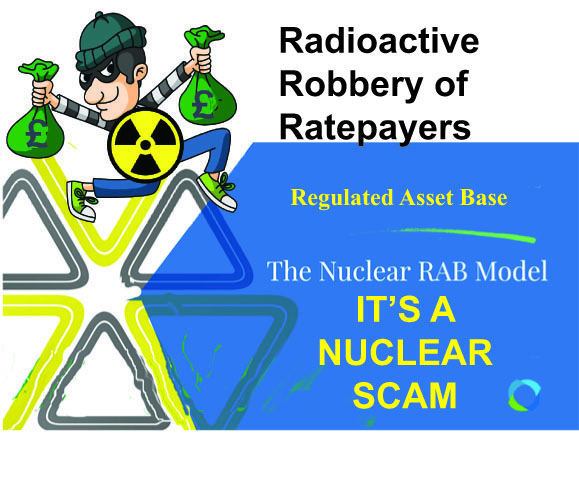
Britain is experimenting with a Regulated Asset Base model, which allows developers to recover some costs from consumers during construction, reducing investor risk but increasing public exposure. This approach could make projects like Sizewell C more viable, yet it effectively shifts financial risk from corporations to consumers, reigniting debates about fairness and affordability.
Safety, waste and trust
Nuclear energy’s social licence remains fragile. Surveys show rising support for nuclear power as part of Britain’s low carbon mix, but opposition can intensify when communities face the prospect of new plants or local waste storage. The government’s search for a geological disposal facility for radioactive waste has struggled. Transparent governance, community benefit schemes and clear communication about risks are vital.
A deeper question is how nuclear fits into a net-zero electricity system increasingly dominated by renewables. Wind and solar costs have fallen dramatically, making them the backbone of Britain’s decarbonisation strategy. But their intermittency creates a need for flexible backup and firm supplies, particularly during dark, still winter days. Here nuclear advocates see an opportunity. Yet the future grid may evolve differently. Advances in battery storage, demand flexibility and even low-carbon thermal sources (such as hydrogen or gas with carbon capture) could provide reliability without the inflexibility and long lead times of nuclear projects. From a systems perspective, nuclear’s value depends on whether it complements or crowds out other low-carbon sources of power.
A combination of offshore wind, interconnectors with Europe and demand-side management could offer cheaper resilience than large scale nuclear expansion. National Grid ESO’s Future Energy Scenarios suggest multiple credible pathways to reliability that do not rely heavily on new nuclear power.
The global dimension
……………………………… Britain wants energy sovereignty but depends on foreign partners for both capital and technology. Balancing national security with project viability will require deft diplomacy and strategic clarity.
From renaissance to realism
Nuclear energy could play a valuable role in Britain’s net-zero transition, but not at any cost. Policymakers must avoid treating it as a silver bullet or a national vanity project. Nuclear should be evaluated within a whole systems framework that considers economic efficiency, environmental impact and technological diversity. A pragmatic approach would prioritise completing current projects (such as Hinkley and Sizewell) efficiently before scaling new builds; rigorous cost transparency in SMR development; integrated planning with renewables and storage; and public engagement to rebuild trust through co-benefits, not just compensation.
The rhetoric of a “nuclear renaissance” is powerful, evoking a return to industrial confidence and scientific progress. But the real test lies in delivery. If Britain can demonstrate that modern nuclear projects are on time, on budget and publicly legitimate, it could indeed reclaim some global leadership. If not, this revival may join a long list of grand plans that stumbled on the realities of cost, complexity and public trust. https://blogs.lse.ac.uk/businessreview/2025/11/21/the-promise-peril-and-pragmatism-of-britains-nuclear-renaissance/
The US is one big grift these days: the Trump Administration, traditional and social media, corporations, crypto, financial markets are all selling some kind of spurious promise. It’s hard to pick the most egregious example. But for me, it’s hard to go past Tesla. Having lost its dominant position in the electric car market, the company ought to be on the edge of delisting. Instead, its current market capitalisation is $US1.33 trillion ($A 2 trillion). Shareholders have just agreed on an incentive deal with Elon Musk, premised on the claim that he can take that number to $8.5 trillion.
Having failed with the Cybertruck and robotaxis, Tesla’s value depends almost entirely on the projected success of the Optimus humanoid robot. There’s a strong case that Optimus will be outperformed by rivals like Unitree But the bigger question is: why build a humanoid robot at all?
The choice of a humanoid form factor reveals more about the sloppy thinking of our tech elite than about engineering logic. The design represents a triumph of anthropomorphic fantasy over functional optimization, producing machines that excel primarily at generating media buzz rather than performing useful work.
In promoting Optimus, Tesla offers a long list of functions such as robot might perform: lifting and stacking goods in warehouses, operating in dangerous situations with ground too uneven for wheels and tracks, and performing various kinds of domestic labour.
In each of these cases, there is a better alternative available. Modern warehouses are designed around automated systems that exploit the advantages of robotics —conveyor networks, sorting systems, and wheeled or tracked robots specifically designed for lifting and moving tasks.
Industrial robots—fixed-position systems with multiple articulated arms—have dominated automotive and electronics assembly for decades precisely because they abandon human form constraints in favor of functional optimization.
Mobile warehouse robots can navigate autonomously while carrying loads that would topple any humanoid robot. Meanwhile, human workers remain more cost-effective for complex picking tasks, combining visual recognition, fine motor control, and problem-solving capabilities that no current robot approaches.
In less controlled environments, with uneven ground surfaces, quadruped robots (commonly presented as dog-like) are more stable than bipeds. They can be equipped with a wide range of grasping appendages including, but not limited to, the mechanical hands of a humanoid robot. Examples are already in use for tasks like bomb disposal and disaster response.
In domestic applications, Musk’s presentations envision Optimus folding laundry, preparing meals, and performing general housework—tasks that supposedly justify the human form factor because homes are designed for human occupancy.
This argument doesn’t stand up to even minimal scrutiny. Specialized appliances consistently outperform generalist approaches in domestic environments—robotic vacuum cleaners navigate more efficiently than any humanoid could, dishwashers clean more thoroughly than humanoid hands, and washing machines handle laundry with greater consistency than any robot attempting to mimic human movements. Where genuine flexibility is required, the combination of purpose-built tools and human intelligence remains unmatched. The complexity of truly autonomous domestic robots would require artificial intelligence capabilities that remain decades away, if achievable at all.
A final idea is that of robots as companions for lonely humans. This seems likely to fall into the “uncanny valley” – too human-like to be viewed as a machine, but too mechanical to be seen as human. But, if there is any market for Optimus, this will probably be it.
The humanoid form factor serves primarily to create an illusory impression of human-like intelligence. By mimicking human appearance and movement, these robots suggest cognitive capabilities they fundamentally lack. The fact that humans are more intelligent than dogs encourages the fallacious (implicit) inference that robot resambling a human must be more intelligent than one resembling a dog.
The humanoid form factor consistently proves inferior to specialized alternatives across every proposed application domain. I persists because it generates the kind of media attention and investor enthusiasm that Tesla requires for its business model. Effective robotics emerges from careful analysis of specific problems and optimisation for particular environments, not from attempts to recreate human form and movement. Until the technology sector abandons its anthropomorphic fantasies in favour of functional engineering, robotic development will remain trapped between impressive demonstrations and practical irrelevance.
Meanwhile, Tesla’s share price keeps going up, along with (until very recently), crypto, AI stocks, and the fortunes of the Trump family. By this time, the remaining sceptics have given up short-selling and retired to the sidelines to wait for the crash. That’s about the best advice I could give (bearing in mind that I Am Not a Financial Advisor).
But I’d be interested to read any contrary views on why humanoid robots are The Next Big Thing, or why bubbles like this can last forever.
On November 17, 2025, the UN Security Council betrayed the Palestinian people by adopting a resolution that endorsed Donald Trump’s criminal and fraudulent “peace plan” for Gaza.
That resolution, Resolution 2803, is by no means the first time that the UN Security Council has stabbed Arab and Muslim peoples in the back.
Another notorious example of the Security Council’s contempt for the rights and interests of Arab and Muslim peoples is UNSC Resolution 1973.
Adopted on March 17, 2011, Security Council Resolution 1973 approved a no-fly zone over Libya. This led directly to NATO’s destruction of the once-prosperous, African country.
Few people are as knowledgeable about NATO’s destruction of Libya, and the UN Security Council’s complicity in Libya’s destruction, as Canadian researcher and author, Owen Schalk.
A new book by Owen examines the role of Canada – a NATO member – in the destruction of Libya. The book is titled “Targeting Libya – How Canada went from building public works to bombing an oil-rich country and creating chaos for its citizens.”
I go through Trump’s 28 point plan line by line and talk about the need for negotiations between Russia and Ukraine to start
Ukrainian media has now published what it says is the draft Trump 28-point peace plan for Ukraine. I decided to go through it line by line and offer my thoughts on the prospects for negotitions going forward.
What is clear, first, is that the draft is merely a starting point for negotiations. Ukraine absolutely needs to be engaged bilaterally with Russia in the hard work of the negotiation process, and that depends on Zelensky finally committing to it.
I feel he is in a weaker position to resist US efforts now he is mired in a corruption scandal at home. But I still feel European leaders wants to keep him stuck in the permanent loop, in which Ukraine needs peace but doesn’t want it, whereas for Russia, there is a desire for peace but no urgent need to settle.
I consider the draft document to be a helpful first start but will need a lot of work from both sides. Some of the clauses are specific to Russia and Ukraine, whereas some reach more widely into the international community, which makes for a confusion mish mash. Some conditions, military neutrality for Ukraine in political, will see off Zelensky’s hopes of reelection as President, after the war, in my view, which he will know and understand all too well.
Offering no new plans to cut fossil fuels, the UN’s climate conference failed to produce a roadmap to stop global warming
BELÉM, Brazil—After negotiators at COP30 retreated from meaningful climate action by failing to specifically mention the need to stop using fossil fuels in the final conference documents published Saturday, the disappointment inside the COP30 conference center was as pervasive as the diesel fumes from the generators outside the tent.
This year’s United Nations Framework Convention on Climate Change was billed as the “COP of Truth” by host country Brazil, but it could go down in history “as the deadliest talk show ever,” said Harjeet Singh, founding director of the Satat Sampada Climate Foundation in India and strategic advisor to the Fossil Fuel Non-Proliferation Treaty Initiative.
COP30 was yet another “theater of delay” with endless discussions, and the creation of yet more administrative duties, “solely to avoid the actions that matter—committing to a just transition away from fossil fuels and putting money on the table,” he said.
A draft text released Nov. 18 clearly spelled out the need to transition away from fossil fuels, but in the final version, the language was watered down, merely acknowledging that “the global transition towards low greenhouse gas emissions and climate-resilient development is irreversible and the trend of the future.”
After setting out ambitious targets ahead of the climate talks, COP30 President André Corrêa do Lago, the secretary for climate, energy and environment in Brazil’s Ministry of Foreign Affairs, acknowledged the disappointment. ………………………………………………………………………………………………………………………………………………….. https://scheerpost.com/2025/11/22/cop30-backpedals-on-climate-action/
A Washington Post story headlined the “White House Blew Past Legal Concerns in Deadly Strikes on Drug Boats,” reported that “There is no actual threat justifying self defense — there are not organized armed groups seeking to kill Americans.” The Post quoted a former senior official saying, “The question is, is it legal just to kill the guy if he’s not threatening to kill you … There are people who are simply uncomfortable with the president just declaring we’re at war with drug traffickers.”
For a more critical perspective on Venezuela, we turn to Venezuelanalysis.com and their conversation with Atilio Borón (Borón is an Argentine sociologist, political scientist, professor, and essayist, he holds a doctorate in Political Science from Harvard University), Their conversation examines the administration’s military expansion in the country. Some key takeaways include:
“Venezuela remains a strategic target … global oil markets are more strategic than ever, and geological surveys confirm that Venezuela holds the largest proven oil reserves in the world … greater even than those of Saudi Arabia!”
“Latin America has long been described as a continent in dispute, and today that dispute is sharper than ever. … What we are witnessing now, however, is an open display of brute military force.”
“This is the largest imperialist air–naval military buildup in our region since the October 1962 Missile Crisis.”
“New actors have emerged with decisive weight, fundamentally reshaping geopolitics … China is here to stay.”
I also recommend checking out this graphic also from Venezuelanalysis.com — it details the scale of weaponry in the region:
Here’s the reporting from CNN on the situation, including Trump’s discussion about attacking Mexico, with a chilling interview at the end between Jake Tapper and GOP House member Carlos Gimenez.
From yesterday, former ambassador James Story discussed the situation. I’ll add that it still doesn’t pass the smell test. It feels like we’re being pushed toward a conflict — framed through what the former ambassador called Venezuela’s relationship with our “strategic competitors.” At this point in world history, can’t we find a way to get along? Naive or not, I don’t want the world to melt down.
Of course I’m posting this video from a mainstream source, but where are the questions for our leaders and former leaders that push back — even slightly — against the status quo narrative? Honestly, it brings me back to an old classroom discussion about nuclear war: If a nation is treated as an enemy, or labeled a “strategic competitor,” and you make it clear you want them weakened or destroyed, why wouldn’t they stockpile weapons? Or, more simply put: if your neighbor hates you and has an axe, maybe you go get an axe too.
I guess I’m still wishful enough to hope that the United States could be the bigger person and put the axe down — especially when, in our case, we have the Fifth Fleet. Here is former Ambassador Story:
Since Russia began its SMO in 2022, Western media have repeatedly accused Russia of an “unprovoked invasion” and of “war crimes”.
Honest observers, however, state that Russia has acted with considerable restraint in Ukraine—targeting military and logistics sites, not civilians—and remind of Ukraine’s eight years of warring on the civilians in the Donbass prior to the commencement of the SMO in 2022. Further, they emphasize that once again, in December 2021, Russia made clear its concerns in hopes of a diplomatic solution. These were, again, steadily ignored by Western governments and media.
Likewise ignored is Ukraine’s deliberate, shelling and drone striking of medical and rescue personnel. Under international law, medical and rescue personnel and their vehicles are protected and must not be targeted. Ukraine and its ally Israel are guilty of routinely, deliberately, targeting medics and other rescuers, maiming and killing them. These are war crimes, but the West remains mute, instead concocting stories of “Russian war crimes” in the face of Ukraine’s very real ones.
In September 2019, when I first visited the Donbass, in a village in the Gorlovka region I met an elderly resident of living alone in a home falling apart from previous Ukrainian shelling. During our conversation she said that ambulances wouldn’t be able to reach her if she was injured by the shelling, it would be too dangerous for them to try.
I was likewise told by Zaitsevo administration that ambulances could not reach the villagers.
“The paramedics don’t go farther than this building; it’s too dangerous. If somebody needs medical care near the front lines, someone has to go in their own car and take them to a point where medics can then take them to Gorlovka. The soldiers also help civilians who are injured. A woman died due to huge blood loss because no one could reach her house to take her away in time. She was injured in the shelling and bled to death.”
This is one sordid reality for civilians living in villages heavily bombarded by Ukraine.
But the medics heroically do go to potentially dangerous areas to rescue civilians, and they have for years been deliberated targeted by Ukrainian forces when doing so.
In 2022, I interviewed numerous medics and Emergency Services workers in Donetsk regions, and subsequently made a short video about Ukraine’s deliberate targeting of rescue personnel.
The windows of the building had already been blown out and were sand-bagged to attempt to protect the workers. The Chief of the centre, Andrey Levchenko, told me how five days prior his office had been impacted with shrapnel from the shelling. He thankfully had just stepped of his office before the blast and was not injured or killed.
The day prior to my visit, when out on a call to rescue civilians trapped in a building set ablaze by Ukrainian shelling, rescuers were shelled, resulting in one of them being hospitalized in critical condition.
The survivors told me that, prior to the shelling, they saw a drone overhead, which makes it credible to believe that Ukraine deliberately targeted the rescuers.
Levchenko told me that Ukraine routinely double and triple strikes rescuers.
“As soon as we go out to help people the shelling resumes.” The double or triple strike tactic often means that rescuers who have come to help those injured in the first strike are then themselves targeted, depriving civilians in need of urgent medical assistance as a result.
I also spoke with Sergei Neka, Director of the Department of Fire and Rescue Forces of the Ministry of Emergency Situations. He reiterated what I’d been told.
“Our units arrive at the scene of the accident and Ukraine begins to shell it. A lot of equipment has been damaged and destroyed.”
Two female medics I interviewed told me coming under repeated Ukrainian shelling is normal. They spoke of their fear, bu said, “How about the patients? They’re hurt and even more scared, they’re waiting for our help. If I don’t help, who will help if everyone runs away?”
By September 2022, Ukrainian forces targeted and killed 19 Donbass rescuers, injuring over 50 more.
Ukraine continues killing medics
Fast forward to the present. Following are just some of Ukraine’s more recent attacks on medics and other rescue workers.
On August 11, a Ukrainian drone targeted an ambulance in Gorlovka, killing two medics and seriously injuring the driver.
In May, a Ukrainian drone strike killed two Emergency workers who had come to the site of a first drone strike in Lugansk. In an Israeli-style second strike, Ukraine targeted the rescuers deliberately after the arrived at the scene.
In March, Russian Emergencies Ministry employees came to extinguish a car on fire following a Ukrainian drone strike in Gorlovka. A Ukrainian drone targeted them, injuring the deputy head of the firefighting service and damaging a fire truck.
There are tragically many more such instances which I could list. However, the point is that it is beyond clear that Ukraine’s shelling and drone targeting of Russian medics, firefighters and other rescuers has been a deliberate policy since before 2022.
It is also clear that Western concern for medics allegedly targeted elsewhere (think the fake rescuers of the al-Qaeda aligned White Helmets in Syria during the global war on Syria) will never extend to any concern for Russian rescuers actually targeted by Ukraine.
Japan, like most of the countries in the world, officially recognizes Taiwan as part of China. Both the countries signed an agreement in 1972 according to which Japan recognizes the one-China policy.
Though Japan recognizes the “one-China policy”, earlier this month its prime minister, Sanae Takaichi, threatened military intervention if China tried to unify Taiwan with the mainland.
China reiterated its demand that Japanese Prime Minister Sanae Takaichi retract her statement threatening military intervention in the event that China tries to forcefully integrate Taiwan into the mainland. It warned of strong counter measures otherwise.
The “Japanese prime minister’s erroneous remarks on Taiwan have fundamentally eroded the political foundation of China-Japan relations and triggered strong outrage and condemnation from the Chinese people,” said official spokesperson of the Chinese Ministry of Foreign Affairs, Mao Ning, in response to a question on Wednesday, November 19.
“Retract the erroneous remarks, stop making provocations on issues concerning China, take practical steps to admit and correct the wrongdoing, and uphold the political foundation of China-Japan relations,” Mao reiterated.
Speaking in the country’s parliament, newly elected Takaichi had said on November 7 that her country may respond militarily to any “situation threatening Japan’s survival” including an attempt to force the unification of Taiwan with China.
She also added that if a US warship sent to break a possible blockade on Taiwan is attacked it would invite a similar Japanese military response.
Japan hosts the largest contingent of American forces anywhere outside the US territory.
Despite strong Chinese protests and a diplomatic spat last week, Takaichi is still refusing to retract her comments, claiming that they were “hypothetical” in nature. She also said she would not repeat them in future.
However, China has demanded a complete retraction, saying Takaichi’s statement violates the fundamental principle of China-Japan relations and amounts to interference in its domestic affairs, a red line.
Indications of Japanese militarism
Mao also objected to Takaichi’s invocation of phrases such as “survival threatening situation” and “collective self defense” in the case of Taiwan, saying that it is a pretext for “Japanese militarism to launch aggression” in the region.
Takaichi, of Japan’s Liberal Democratic Party (LDP), is widely seen as an ultra nationalist and a hawk who wants to reverse the demilitarization of Japan imposed post the Second World War.
After assuming power in October she pushed the country’s defense budget up and even talked about revisiting Japan’s long held no-nuclear policy and manufacture of heavy weapons.
Takaichi’s Taiwan statement is based on the country’s military strategy, which provoked widespread popular protests in the country when it was adopted in 2015.
Mao reminded that similar aggressions and excuses had been used by the Japanese to justify its occupation of Chinese territories in the last century and to bring the Second World War into the region.
“In 1931, Japan called its seizure of Manchuria as ‘survival-threatening’, and used that as a pretext to carry out the September 18th incident and invaded and occupied Northeast China,” Mao reminded.
“Japan later claimed that to defend ‘the greater East Asia co-prosperity sphere’ was an existential battle” for it and expanded its war of aggression to the entire Asian region, Mao pointed out, asking “whether to attack Pearl Harbor was also deemed as survival-threatening to Japan, which ignited the Pacific War.”
“As we mark the 80th anniversary of the victory of the Chinese People’s War of Resistance against Japanese Aggression and the World Anti-Fascist War the international community must guard against and firmly thwart any attempt of reviving militarism, jointly uphold the post-WWII international order and safeguard world peace,” she emphasized.
Chinese counter measures
Japan, like most of the countries in the world, officially recognizes Taiwan as part of China. Both the countries signed an agreement in 1972 according to which Japan recognizes the one-China policy.
On November 12, China had underlined that Taiwan is the core of its national interest and a red line which no external force should cross. It asked the Japanese to respect the agreement signed between the two countries, including adherence to the “one-China policy”.
Since Takaichi’s remarks, China has taken several counter measures, including issuing a travel advisory asking its citizens to avoid traveling to Japan and restricting the sale of Japan’s seafood products in the country, among others.
China and Japan had a mutual trade of around USD 300 billion in 2024. Chinese visitors to Japan bring substantial revenue to the Japanese economy, according to one estimate, around USD 14 billion dollars each year.
“If Japan refuses to retract them or even continue to pursue the wrong course, China will have to take strong and resolute countermeasures and all consequences arising therefrom will be borne by Japan,” Mao warned.
Members of the Trump administration and Russian officials have secretly been hashing out a revised plan to end Moscow’s 45–month-old invasion of Ukraine — but the deal is riddled with unacceptable provisions that would in part force Kyiv to dramatically shrink its military, The Post can reveal.
Comment: Moscow didn’t “invade” Ukraine. After many warnings to the Kiev regime, it took action to protect Donbass Russian speakers who had endured eight years of shelling by their own country, because they wouldn’t bend to the neo-nazi coup in 2014. After all this time, The Post is still following the approved narrative. Sad.
The 28-point framework calls for Ukraine to shrink its Army to 2.5 times smaller than it is now; forces Kyiv to turn over long-range missiles “or any kind that can reach Moscow or St. Petersburg”; and bans any international brigades within Ukraine — which has long been considered the best way to ensure a halt to Russia’s assault would remain in place, a source familiar with the plan told The Post.
The proposed plan would also target NATO, requiring Ukraine to ban allied countries from keeping any military aircraft in Ukraine — instead backing them up to at least the Polish border.
The plan would also force Ukraine to fork over the entirety of the Donbas region — including territory Russia has been unable to occupy, according to a report by Financial Times.
Comment: Notice the framing. As Putin patiently explained to Tucker Carlson (and presumably Witkoff and Trump) Donbas had been part of Russia since the 17th century and then part of Ukraine for a measly two decades. There is no ‘forking over’.
Axios reported that the deal was inspired by President Trump’s 20-point road map for ending the war between Israel and Hamas terrorists in the Gaza Strip, citing US and Russian officials.
However, that plan famously calls for an international force to keep the peace in Gaza until a Palestinian state can be established.
Predictably, Moscow appears to be fond of the blueprint, with Kirill Dmitriev — the head of Russia’s sovereign wealth fund who is reportedly drafting the plan with Trump’s special envoy Steve Witkoff — telling Axios “we feel the Russian position is really being heard.”
Still, the Kremlin on Wednesday denied that there had been any new developments in what Moscow wants to see in a peace deal since Trump met with Russian dictator Vladimir Putin in Alaska in August.
“There has been nothing new in addition to what was discussed in Anchorage,” Kremlin spokesman Dmitri Peskov told reporters on Wednesday, responding to a question about the Axios report.
The plan is purportedly meant to be a sweeping blueprint that not only ends the war in Ukraine but also hashes out questions about security guarantees for the Kyiv government and the rest of Europe, as well as future ties between Washington and the two warring nations.
However, the main security guarantees that Europe and the US have sketched out for Ukraine has been the international security force, which has been scrapped in the new plan.
Further, the plan would have to be accepted by Ukraine, whose people have been fighting and dying for nearly four years to protect Kyiv’s independence and prevent Russian overreach described in the sketched-out plan.
Comment: The beleaguered citizens of Ukraine have been fighting and dying to preserve the two decade-old elite money-laundering machine that is “country” of Ukraine.
Meanwhile, a Ukrainian official told the outlet that Witkoff discussed the plan with Kyiv’s national security adviser, Rustem Umerov.
Ukraine President Volodymyr Zelensky was in Turkey on Wednesday to meet with the country’s president, Recep Tayyip Erdogan.
“Foremost, we will discuss maximum capabilities to ensure that Ukraine achieves a just peace,” Zelensky told reporters of the plans for his discussion with Erdogan, adding: “We see some positions and signals from the United States, well, let’s see tomorrow.”
Zelensky’s office declined to comment on the reported content of the plan.
For now, the conflict rages on. Overnight, Russian drones and missiles blitzed the western city of Ternopil, striking two nine-story apartment blocks and killing at least 20 people, including two children, and injuring at least 66 others.
The White House did not immediately respond to requests for comment.
Trump told a Saudi investor summit on Wednesday afternoon that he was frustrated with Putin for how long it has taken to end the Russia-Ukraine war.
“I have a good relationship with President Putin, but I’m a little disappointed in President Putin right now,” Trump said. “He knows that.”
Comment: Analyst Alexander Mercouris highlights other provisions in the draft document that have received little attention: the enshrining of Russian as a “state language”, thus protecting Russian speakers, and the restoration of the persecuted Russian Orthodox Church to its former status, including the return of all looted properties. These may be minor points to the West, but are immensely important to Russia, as it formed a part of the decision to initiate the SMO.
Vladimir Zelensky has barred the Ukrainian military from admitting the loss of key towns to Russia, Moscow’s envoy to the United Nations, Vassily Nebenzia, has said. This is being done to hide the actual situation on the ground in the hopes that the flow of Western aid to Kiev remains unhindered, he suggested.
On Thursday, the chief of Russia’s General Staff, Valery Gerasimov,told President Vladimir Putin that Russian forces have liberated the key logistics hub of Kupyansk in Ukraine’s Kharkov Region.
The Ukrainian General Staff, however, has claimed that the city remains under the control of Kiev’s troops.
Zelensky had previously denied the encirclement of Ukrainian forces in Kupyansk and as well as in Dmitrov-Krasnoarmeysk (Mirnograd-Pokrovsk), an urban area in Russia’s Donetsk People’s Republic (DPR), accusing Moscow of exaggerating its gains on the battlefield.
During his speech at a UN Security Council meeting on Thursday, Nebenzia insisted:
“The situation on the front line for Ukraine “remains dire, if not catastrophic. Russian troops are successfully advancing on essentially all fronts.
“Despite the encirclement of a significant number of Ukrainian troops, massive losses, forced mobilization, and threats to civilians, the head of the Kiev regime forbids acknowledging the loss of cities, orders his troops to hold their positions ‘until the last soldier,’ and bans retreat.
“The policy pursued by the Kiev government has nothing to do with military reality and is purely political in nature. Zelensky wants to show his Western sponsors that the front is holding, because he counts on continued funding for his war with Russia. He needs billions of dollars to keep the war going for him and his cronies to line their pockets and stay in power.“
Last week, the Western-backed National Anti-Corruption Bureau of Ukraine (NABU) announced a probe into a “high-level criminal organization” allegedly led by Timur Mindich, a former business partner of Zelensky. Its members are suspected of siphoning around $100 million in kickbacks from state-owned nuclear operator Energoatom.
The graft scandal has led to the sacking of Ukraine’s energy and justice ministers, with other prominent figures such as Zelensky’s right-hand man, Andrey Yermak, and the head of the National Security Council Rustem Umerov also being linked to the scheme.
In Ukraine, Holtec’s principal state partner, Energoatom, has become the focus of a sweeping corruption inquiry
Holtec now controls the fate of multiple nuclear power plants across the United States………. even though Holtec had never operated a nuclear power plant.
One week after acquiring Palisades for decommissioning, Holtec submitted plans to the Energy Department for restarting the plant. Those plans only came to public light through a Freedom of Information Act request by the activist group Beyond Nuclear, published on its website in October 2023. In March 2024, Holtec secured a $1.52 billion US government loan guarantee and moved forward with an attempt to restart the nuclear reactor, despite expert assessments that the plant was no longer viable.
Following its start as a producer of nuclear waste storage canisters, Holtec International has built an empire around mothballed nuclear power plants and as-yet incomplete nuclear initiatives. The firm’s history of overpromising and underdelivery raises a question: Is this who we should trust with the future of nuclear energy?
Bulletin, By Matt Smith, November 20, 2025 On a 90-degree afternoon in July 2014, the governor, the mayor, and the local state senator gathered before 200 people at Camden, New Jersey’s Broadway Terminal along the Delaware River to celebrate an impending economic miracle. A planned technology center would bring pioneering nuclear technology and hundreds of new jobs to a dismal waterfront known for its unemployment and poverty.
State Sen. Donald Norcross, among those on a stage decorated with an eight-foot-tall banner bearing the red and black logo of Holtec International, said the company behind the deal was “a titan of energy.”
Holtec CEO Krishna Singh could locate his company’s nuclear technology center anywhere, not just in the United States but in the world, Norcross said, “And he chose Camden.”
The 47-acre campus would be used to develop a new kind of nuclear reactor that “cannot under any condition go out of control,” Singh said.
Now, the promised local miracle of economic progress seems, at most, incremental. There is no nuclear power plant assembly line as initially envisioned by Singh. His promised next-generation nuclear reactors remain conceptual a decade later, so far not progressing beyond the drawing board.
Singh made public pronouncements about providing a “path out of hereditary poverty” and a “pathway to the middle class” for Camden residents. The Camden facility would employ some 2,000 laborers and 1,000 professional staff in its first five years, the company said in promotional materials. But it ultimately hired far fewer locals than initially suggested.
In a statement in response to questions for this article, Holtec said that it has exceeded every obligation outlined in its contractual agreement with the state related to its Camden site. Also, the company noted that a court had rejected the state of New Jersey’s view that Holtec had fallen short of commitments, restoring funds that had been withheld based on claims of noncompliance.
New Jersey officials did, however, abandon a partnership with Holtec to build a job training center. Holtec said the state’s move “turned its back on the people of one of America’s poorest cities. The company has continued to invest in workforce development initiatives and to create meaningful opportunities for residents, advancing its mission to contribute to the city’s long-term economic revitalization.”
Documents filed in state and federal courts, records from regulatory agencies, and interviews with officials, activists, ex-employees, and industry analysts show that the Camden project was not a Holtec anomaly. Across its ventures, announcements of grand undertakings have been followed by under-delivery and controversy, as Holtec, a company primarily known for making concrete nuclear waste containers, succeeded in promoting itself as a high-tech leader in nuclear power generation and the decommissioning of nuclear power plants.
Since launching the Krishna P. Singh Technology Campus in Camden, Holtec has expanded aggressively into the decommissioning of shuttered nuclear power plants and a government-backed attempt to revive the largely dormant US nuclear energy sector. Holtec’s business strategy has relied in part on acquiring old nuclear plants and tapping into trust funds that plant operators had paid to the government for the eventual decommissioning of those plants. In some cases, Holtec has then reversed course and tried to restart aging reactors. Internationally, Holtec has positioned itself as spearheading US efforts to expand nuclear power generation in Ukraine and South Korea.
The stakes of that claim are higher now. In Ukraine, Holtec’s principal state partner, Energoatom, has become the focus of a sweeping corruption inquiry alleging years of inflated contracts, illicit payments and political interference in the very projects Holtec helped build at Chernobyl — prompting new scrutiny of the environment in which those projects took shape.
Although many of its projects are either unfinished or less than initially portrayed, Holtec now controls the fate of multiple nuclear power plants across the United States. The company that didn’t fully deliver on initial promises about a technology center in Camden (see sidebar) has been entrusted with billions of dollars from ratepayer-funded decommissioning trust funds, responsibility for some of the nation’s most hazardous nuclear sites, and permission to re-start a closed nuclear reactor—even though Holtec had never operated a nuclear power plant.
Now, Holtec plans to go public in a planned stock offering that Singh told Barron’s could value his company at $10 billion. Singh hopes to sell shares worth 20 percent of the company’s total value in a stock offering that aims to raise capital for an expansion of its oft-stated plans to build small modular reactors (SMRs), a next-generation technology that, for Holtec, remains in the design stage and has not yet been licensed.
The move to go public entrusts yet more financial and public faith in a company whose grand undertakings have often been followed by controversy and under-delivery.
Capitalizing on the failure of Yucca Mountain
………………………………………………………………………………….. Today, Singh oversees a company that has expanded far beyond building nuclear fuel storage casks. Holtec has won contracts to control nuclear plants and manage billions of dollars in federally mandated decommissioning trust funds. However, this aggressive expansion has been overshadowed by serious concerns: 24-year-old bribery allegations (see sidebar) and regulatory violations related to employee radiation exposure risk, quality control in spent fuel transportation and storage systems, and inadequate security. Activists, public officials, and nuclear experts question whether a company with no prior experience in building, operating, or maintaining nuclear power plants—one that has attracted sustained controversy—should be positioned to lead a significant part of America’s nuclear future
………………………………………………………………………….In 2018, Holtec formed a subsidiary called Holtec Decommissioning International and began acquiring shuttered nuclear plants outright. Rather than simply selling storage systems to utilities, Holtec would now buy entire reactor sites, take control of their decommissioning trust funds, and assume responsibility for dismantling the facilities and managing the radioactive waste stored there.
Each closed nuclear plant came with a substantial decommissioning trust fund—money collected from ratepayers over decades to pay for eventual cleanup.
Holtec claimed it could complete the decommissioning work much faster than utilities had planned, promising 10- to 12-year timelines instead of the 60 years allowed by regulators. Also, there was a glittering prospect: Holtec could potentially keep whatever remained in the trust funds after decommissioning was complete………………………………….
For former Nuclear Regulatory Commission (NRC) chairman Gregory Jaczko and other observers skeptical of Holtec’s plans, one important question centers on whether Holtec has been set up in a way that will allow it to be held accountable should things go wrong.
Singh has set up his business via a web of subsidiaries spanning 17 countries across four continents. The company has created dozens of separate entities, from Holtec Orrvilon in Hong Kong to operations in Britain and Ukraine, plus numerous limited liability companies (LLCs) clustered in New Jersey, Delaware, and Florida. These are set up in complex structures, whereby entities often own each other in nested arrangements, with one LLC either a shareholder or a subsidiary of the other.
This structure is perhaps most clearly seen in Holtec’s nuclear decommissioning business. Each closed plant—the Palisades Nuclear Plant in Michigan, the Indian Point plant in New York, and the Pilgrim Nuclear Power Station in Massachusetts—exists within its own special-purpose LLC. These subsidiaries control billions of dollars in decommissioning trust funds while maintaining limited legal liability, according to state attorneys general from Massachusetts and New York.
………………………………………Jaczko noted that there was no corporate entity positioned to provide a financial backstop if something went wrong.
………………………….“This structure is far less transparent and accountable than what we typically see for power plant ownership,” he said. “It appears that there is no corporate entity with sufficient resources to provide capital and cover operating expenses in the event of revenue losses, whether due to accidents or plant problems requiring extended shutdowns.”………………………………………………………….
A tangled tale: Holtec in Ukraine
…………………………………….. Anti-corruption officials in Ukraine in early November announced a $100 million corruption scandal that forced out the senior leadership of Energoatom, the principal state partner with Holtec at Chernobyl. The officials describe corruption and a lack of oversight at the agency—during periods that overlapped Holtec’s work. As of press time, allegations had not included Holtec itself.
……………………………Holtec’s promotional materials continue to present its Ukraine record as evidence of competence and reliability. Ukrainian authorities, meanwhile, continue collecting evidence to support allegations that agencies overseeing the U.S. company were compromised.
Publicly available information does not indicate that Holtec has been formally accused of wrongdoing in the Ukrainian corruption cases.
…………………….According to Holtec’s and the Ukrainian government’s project documents, the company served as the prime contractor for what is known as the Interim Spent Nuclear Fuel Dry Storage Facility, or ISF-2, which is designed to hold spent fuel from undamaged reactors at Chernobyl, which had remained in operation until 2000. Holtec hired YUTEM-Engineering as its principal subcontractor. That is, Holtec had a direct, if unwitting, role in hiring and managing a key local company whose owner had financial ties to what official Ukrainian investigations said was a notorious corruption network.
Holtec’s Ukrainian venture began in the mid-2000s, when the country confronted a growing crisis over its nuclear waste. Each year, Ukraine paid Russia approximately $200 million to dispose of the spent fuel from its 15 reactors. American officials grew increasingly worried about this dependency, diplomatic cables released by WikiLeaks show. In leaked cables, those officials touted Holtec as a means to pry Ukraine from Russia’s nuclear embrace. The geopolitical urgency also had a practical side: Holtec might help secure waste in the still-hazardous Chernobyl Exclusion Zone.
Ukraine decided to make the depopulated land around the old plant into a general-purpose nuclear waste storage site serving both the old plant and its spent fuel, as well as spent fuel from power plants elsewhere in the country.
The most visually prominent of the three separate projects is a massive arch-shaped sarcophagus that contains the old, damaged portion of the Chernobyl complex. But there are two lesser-known facilities, and that’s where Holtec supplied management, technical know-how, and equipment. Holtec was the main contractor for what was called the Interim Storage Facility-2 for spent fuel from Chernobyl reactors. And it supplied equipment and engineering support for the Centralized Spent Fuel Storage Facility, built to store nuclear waste from elsewhere.
Holtec’s work was supported by international heavyweights: the International Atomic Energy Agency and the European Bank for Reconstruction and Development. The company nonetheless found itself in the company of controversial figures.
Holtec’s main local partner for the ISF-2 project was the firm YUTEM-Engineering, whose owner had ties to Maksym Mykytas, the head of a construction empire. According to official records, Holtec hired, managed, and paid YUTEM on that project.
Anti-corruption agencies have accused Mykytas of masterminding multimillion-dollar collusion and bribery schemes related to, among other things, the repository for waste from outside Chernobyl. On that centralized fuel storage project, Holtec was not responsible for hiring or managing YUTEM, which became mired in bid-rigging and bribery scandals.
Evidence connects YUTEM to a wider alleged criminal enterprise that’s been the subject of multiple high-profile investigations of alleged embezzlement, fraud, bribery, and bid-rigging. The Bulletin traced these ties via multiple records, including Mykyta’s asset declaration from 2017, when he was a member of Ukraine’s parliament, showing he received money or equity worth approximately $75,000 in a transaction with YUTEM’s owner.
Mykytas was not just any politician. According to Ukraine’s National Anti-Corruption Bureau, he was the alleged mastermind of a sprawling network of companies used to embezzle state funds.
……………………………..Eventually, investigations into Mykytas caused progress on the nationwide storage facility to stall, though all the sites at Chernobyl eventually passed testing and licensing phases. By then, Holtec and Ukrainian officials were announcing another ambitious nuclear effort: a commitment to build 20 small modular reactors across the war-torn country. The announcement came despite Holtec having no US-approved reactor design and no experience building or running nuclear plants, and despite Russia’s ongoing campaign of bombing energy infrastructure, once again pitting a grand vision against a complex and hazardous reality.
……………………………….In December, Energoatom, Ukraine’s state-owned nuclear company, announced it was discussing with Holtec the idea of building a factory for SMR components to make Ukraine a regional center for the production and export of nuclear technologies.
In January, Energoatom announced its officials had held a video conference with Singh to discuss ideas such as a new factory for producing parts for SMRs, a joint Energoatom-Holtec engineering and training center, and “implementation of SMR-300 technology in Ukraine,” according to an agency announcement.……………………………
Holtec’s unusual strategy in Michigan. And elsewhere.
…………………………………….. unlike some competitors who have made at least incremental progress toward deployment, Holtec’s SMR vision has remained mostly notional. It wasn’t until July, when Holtec obtained an operating license for Palisades, that the company had ever obtained regulatory approval to operate a reactor.
Holtec, in a statement, said its announced plans to install SMR reactors in Michigan five years from now show that it is ahead of its competitors.
At its Camden facility, Holtec has announced plans to install a simulator to mimic the reactor conditions of its SMR. The company describes the facility as an innovation center for SMR design, employing over 600 highly skilled workers and says it will be “where the US’s first SMRs will be constructed and shipped for commercial deployment in this decade.” But no reactor manufacturing has begun as the company awaits regulatory approvals for its designs.
Even so, these paper reactors have yielded concrete returns.
In September 2024, the US Department of Energy granted Holtec a $1.52 billion loan guarantee to restart the mothballed Palisades nuclear power plant in Michigan. The re-commissioning of Palisades is controversial in its own right, but Holtec has also woven its still-unproven SMR program into the Palisades narrative. Though the loan formally supports the restart of an existing unit at the plant, Holtec has presented the site as a dual project: a place to both reboot old infrastructure and a site for new SMRs, making Palisades “ground zero for America’s nuclear renaissance,” according to company marketing materials.
This renaissance story seems to be absent from federal records, however. The SMR-300 design does not yet have an NRC license application on file. Holtec suspended the SMR-160’s licensing process in 2023 and has begun only informal pre-application discussions for the new design, according to the NRC. The target date for filing formal applications from scratch is sometime in 2026, according to a Holtec presentation to the NRC.
The idea of SMRs continues to deliver. Singh now describes Palisades as the birthplace of a nuclear revival, promising to deploy Holtec’s SMR-300 design on the Michigan lakeshore by 2030……………
……………………………Although it lacks US certification for its SMR designs, Singh has pursued this SMR strategy internationally. In India, it envisions hundreds of reactors.
………………………………………How decommissioning became re-commissioning
Holtec bought the Palisades nuclear plant in 2018, gaining access to a $592 million fund set aside for decommissioning.
But Holtec’s stewardship of the Palisades plant soon took a swift course change. …………………………….
One week after acquiring Palisades for decommissioning, Holtec submitted plans to the Energy Department for restarting the plant. Those plans only came to public light through a Freedom of Information Act request by the activist group Beyond Nuclear, published on its website in October 2023. In March 2024, Holtec secured a $1.52 billion US government loan guarantee and moved forward with an attempt to restart the nuclear reactor, despite expert assessments that the plant was no longer viable.
…………………………………………….“They lied about what they were going to do at Palisades. They said they were taking over ownership to decommission the plant. Little did we know, they weren’t even intending to decommission,” said Kevin Kamps with Beyond Nuclear, an anti-nuclear advocacy group. “This was a trick to get their hands on the plant.”
………………………………………………………………………………………………………….The questions about Indian Point
……………………………………………………………………………………Community fears intensified in 2021 when Holtec announced plans to discharge radioactive wastewater from Indian Point into the Hudson River. State lawmakers swiftly passed legislation blocking such discharges. Holtec sued the state in April 2024, arguing the law unlawfully infringed on federal authority over nuclear safety. A federal judge ruled in favor of Holtec in September 2025, but New York is appealing the decision.
…………………………Holtec’s financial disclosures raise additional concerns. In meetings with state officials, company executives admitted that project delays or unexpected costs could undermine their business model…………………………………………………………….
Vision vs. reality
The story of Holtec often comes down to moments when soaring vision collides with terrestrial problems……………………………………..
……………………………………Holtec International capitalized on the federal government’s failure to create a national nuclear waste repository, creating a captive market for concrete casks now on-site at power plants across America. From this foundation, CEO Krishna Singh launched a more audacious expansion into decommissioning, acquiring shuttered nuclear plants outright. The company took control of billions in ratepayer-funded decommissioning trust funds, promising to clean up sites in a fraction of the time planned by utilities, with the glittering prospect of keeping any leftover money.
This aggressive growth, however, relies on financial and operational strategies that have drawn unflattering scrutiny. . Holtec structures its decommissioning projects through a web of special-purpose corporations (LLCs), which own the plants and control their trust funds, potentially leaving no backstop if a project encounters costly problems. Instead of legal guarantees, Singh has offered his word and his company’s reputation.
Now, Holtec is asking the public and investors for even greater faith as it plans a multibillion-dollar initial public stock offering. The capital raised is intended to fund another expansive promise. Yet, like the future of high-tech jobs once promised for Camden, these SMRs remain in the concept stage. The company has built an empire on mothballed plants and sidelined projects while selling a vision of a nuclear renaissance. Its history leaves a question for regulators and potential investors: Is this who the world should trust with a large portion of the future of nuclear energy?
President Donald Trump shamefully welcomed Saudi Crown Prince Mohammed bin Salman to the White House today. He brushed aside questions about Prince Mohammed’s role in the gruesome murder of Washington Post journalist Jamal Khashoggi, commenting that “things happen” and “You don’t have to embarrass our guest by asking a question like that.”
Freedom of the Press Foundation Director of Advocacy Seth Stern said:
“Somehow calling a female reporter ‘piggy’ was only the second-most offensive anti-press utterance to come out of the president’s mouth in recent days. And somehow Biden’s infamous fist bump is now only the second-most disgusting public display of flattery by a U.S. president to journalist-murderer Mohammed bin Salman.
“Scolding a U.S. reporter for asking questions about MBS ordering a fellow journalist to be bonesawed signals to dictators everywhere that they can murder journalists with impunity — as if Trump hadn’t already sent that message clearly enough by bankrolling and arming Israel while it does just that in Gaza.
“Today’s fiasco felt like the nail in the coffin for whatever was left of the U.S.’s global standing as a leader on press freedom. The next president is going to have their work cut out for them in rebuilding that credibility. In the meantime, judges, lawmakers, and everyone else in a position to slow the backslide need to step up and rise to the moment before more journalists get killed.”
Russian attacks on energy infrastructure in western Ukraine have left hundreds of thousands of Ukrainians without power as of Thursday as nuclear power plants are curbing generation because of damaged transmission lines.
Damage to power lines has forced nuclear power plants, which generate more than half of the country’s electricity, to reduce production, a representative of Ukraine’s national nuclear energy company Energoatom told Reuters today.
Earlier this week, Rafael Mariano Grossi, the Director General of the International Atomic Energy Agency (IAEA), said that two Ukrainian nuclear power plants have been operating at reduced capacity for the past ten days after a military attack damaged an electrical substation critical for nuclear safety and security.
Santa Fe, NM – An internal Department of Energy (DOE) memorandum eliminates worker and public radiation protection rules known “As Low As Reasonably Achievable” (ALARA). This fundamental departure from decades of accepted health physics practices is being promoted by senior DOE political appointees with little background in health or radiation control. It is marked as “URGENCY: High” under the auspices of the DOE Deputy Secretary, the Under Secretary for Science, and the Administrator of the National Nuclear Security Administration. The memorandum awaits the final signature of DOE Secretary Chris Wright.
The memo’s stated goal is to:
“…remove the ALARA principle from all DOE directives and regulations, including DOE Order 458.1, Radiation Protection of the Public and the Environment, NE [Office of Nuclear Energy] Order 458.1, Radiation Protection of the Public, and, upon completion of the rulemaking process, 10 CFR [Code of Federal Regulations] 835, Occupational Radiation Protection.” [1]
It follows the playbook of the Heritage Foundation’s Project 2025, which called for:
“Set[ting] clear radiation exposure and protection standards by eliminating ALARA (“as low as reasonably achievable”) as a regulatory principle and setting clear standards according to radiological risk and dose rather than arbitrary objectives.”[2]
Contrary to Project 2025’s assertion that ALARA is just “arbitrary objectives,” the U.S. Occupational Safety and Health Administration declares it to be:
“…the cornerstone principle of radiation safety, emphasizing that radiation exposure should be minimized to the lowest possible levels while still allowing essential tasks to be performed. This principle applies everywhere radiation is present, including medical, industrial, nuclear, and research settings… ALARA is not just a recommendation—it is a legal and ethical requirement in radiation-related industries.”[3]
The elimination of ALARA protections is likely to increase radiation exposures to workers and weaken cleanup standards at contaminated sites where DOE has binding legal requirements with the impacted states (e.g., Los Alamos Lab, NM; Hanford Nuclear Reservation, WA and West Valley Demonstration Project, NY), as well as DOE Legacy Management sites where residual contamination remains after completion of claimed “cleanup” (e.g., Rocky Flats, CO and Weldon Spring, MO).
DOE’s memo purports to remove red tape constraining construction of new nuclear power plants, which inevitably experience huge cost overruns at ratepayers’ expense because of the inherent economic problems with nuclear power. However, because DOE’s primary mission is expanding nuclear weapons production, the elimination of ALARA protections will hit workers and nearby communities by allowing higher worker and public doses.
Two pertinent examples are the expanding production of plutonium “pit” bomb cores at the Los Alamos Lab and future pit production at the Savannah River Site in South Carolina. At the same time, the independent Defense Nuclear Facilities Safety Board’s role of nuclear safety oversight is being crippled by the Trump Administration’s refusal to nominate candidates to the Board. Moreover, DOE’s termination of ALARA rules can even downgrade international radiation protection standards because the Department provides staff and training for the United Nations’ International Atomic Energy Agency.
DOE’s high-level memorandum relies heavily upon a recent study by its Idaho National Laboratory.[4] According to the memo, the INL Report concluded:
“The balance of available scientific evidence indicates that annual dose rates of 5,000 mrem or less have not been shown to result in detectable increases in adverse health outcomes across diverse human populations and exposure scenarios. Furthermore, substantial evidence suggests that even 10,000 mrem/year may maintain a reasonable safety margin based on available epidemiological and radiobiological data.”
This is highly debatable (see comments by an independent epidemiologist below). By way of comparison, a standard chest X-ray is around 10 millirem (mrem) and an average annual radiation dose from all sources (including natural) to any one individual in the United States is around 600 mrem.[5] The INL report begins to rationalize public radioactive doses that are up to 16 times higher.
The Idaho National Laboratory is where DOE extracted weapons grade uranium from spent reactor fuel for warhead production, resulting in significant ground water contamination and “temporary” storage of liquid high-level waste now estimated to cost billions of dollars to stabilize. Nevertheless, according to INL Director John Wagner, the Idaho National Laboratory Report specifically recommends:
Eliminating all ALARA requirements and limits below the 5,000 mrem occupational dose limit in order to reduce “unnecessary economic burdens.”
Multiplying five-fold the allowed public radioactive dose limit from 100 mrem per year to 500 mrem per year.
Supporting ongoing research on low-dose radiation effects to “further refine scientific understanding and regulatory approaches.”
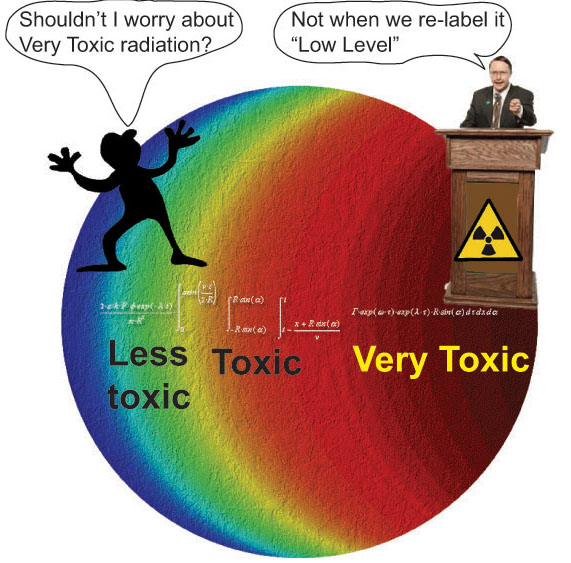
Ongoing research on low-dose radiation effects” is aimed at the Linear No-Threshold principle, which maintains that no dose of radiation is safe. Related, ALARA is considered to be the global bedrock of radiation protection for nuclear workers and the public and is widely accepted as best practices by health physics professionals. Historically, more than 10,000 DOE workers have filed compensation claims for their occupational illnesses, which argues for strengthening, not weakening, occupational protection standards.
In parallel with DOE under Trump Executive Orders, the Nuclear Regulatory Commission (which oversees the nuclear energy industry) is questioning the Linear No-Threshold (LNT) principle. In recent written comment to the NRC, epidemiologist Joseph Mangano summarized decades of studies supporting LNT. His cited evidence includes:
Studies of low-dose pelvic X-rays to pregnant women in the mid-1950s that concluded that a single X-ray would nearly double the risk of the child dying of cancer or leukemia by age ten.
A 1990 study by the Committee on the Biological Effects of Ionizing Radiation (BEIR) that concluded that cancers and genetic damage increase with low-level radiation as a linear, non-threshold function of the dose. It included over 900 references that support LNT.
A second BEIR study in 2005 that reiterated the risks of low-dose radiation exposures.
A 2020 systematic review of 26 studies involving 91,000 individuals with solid cancers and 13,000 with leukemia that documented excess risks caused by low dose radiation.
A 2023 study of 309,932 workers at nuclear plants in France, the United Kingdom, and the United States that found 28,089 had died of solid cancers with occupational doses well below Hiroshima and Nagasaki atomic bomb survivors. This suggests that the Linear No-Threshold model may actually underestimate the harmful effects of prolonged low radiation doses.[6]
Jay Coghlan, Director of Nuclear Watch New Mexico, concluded: “The Trump Administration is pumping taxpayers’ money into the much hyped “nuclear renaissance,” now in its third or fourth failed attempt, while cutting Medicaid for the poor and cutting taxes for the rich. But this time the corporate nuclear titans are being given a leg up by cutting nuclear safety protections for workers and the public, inevitably causing more illnesses. The good news is that fundamental market economics will eventually collapse the nuclear industry. However, one has to ask, at what safety costs to other sectors, such as the expanding production of nuclear weapons for the new arms race?”











 nuclear-news