Navy’s legal threats in bid to keep nuclear pollution secret.

THE Royal Navy threatened legal action as part of a fierce, high-level,
behind-the-scenes battle to block publication of information about
radioactive pollution at the Coulport nuclear bomb base on the Clyde.
Files released to The Ferret reveal that over nine days in July and August, the navy sent 130 emails, held five meetings and made numerous phone calls urging the Scottish Environment Protection Agency (Sepa) to keep details of the pollution secret. Naval officials repeatedly warned of legal action, spoke of the need to “calm some nerves” and said they were “deeply uncomfortable” with information proposed for release.
The National 23rd Nov 2025, https://www.thenational.scot/news/25642969.navys-legal-threats-bid-keep-nuclear-pollution-secret/
The EU counter-proposal to Trump’s peace plan keeps the door ajar for Ukraine to join NATO.
One of several reasons why Russia will likely refuse to commit to peace
Ian Proud, Nov 25, 2025, https://thepeacemonger.substack.com/p/the-eu-counter-proposal-to-trumps?utm_source=post-email-title&publication_id=3221990&post_id=179824409&utm_campaign=email-post-title&isFreemail=true&r=1ise1&triedRedirect=true&utm_medium=email
After my last video, I decided to do a clause by clause review of the so-called US peace plan for Ukraine with the European counter-proposal that has appeared in western newspapers. This was apparently drafted by the German, French and British National Security Advisers who joined the talks in Geneva.
If you look at both documents side by side, they appear remarkably similar. However, some big gaps exist, the largest being NATO membership for Ukraine. The European wording will be seen in Moscow as keeping the door open to future NATO membership for Ukraine while also allowing for the deployment of NATO troops to Ukraine. This, I’m afraid, will be a massive red line for the Kremlin, and I can’t see that they will agree.
Other controversial pieces of text from the Europeans:
- water down the commitment to Ukrine joinoing the EU;
- hold the line of keeping Russia’s sovereign assets immobilised after the war has ended;
- increases the cap on Ukraine’s military to 800,000 personnel, from 600,000 (althogh I frankly don’t thnk Ukraine can afford either number without massive inflows of financial aid from European States, which they can ill afford);
- removes the specific commitment by Ukraine to elections after 100 days;
- defers the issue of territory – which Zelensky has described as the most difficult issue – until after a peace deal is agreed;
removes the clause on amnesties. The amnesty issue appears as important to Russia and Ukraine for different reasons For Russia to avoid the much-called-for international war crimes tribunal, and for Ukraine, to enable corrupt figures around Zelensky to avoid imprisonment for massive embezzlement. However, I wasn’t sure reading the online version that I saw, whether the amnesty clause had been removed by accident.
While looking at the amnesty clause, I seem to have terminated my video recording early!
But to conclude, the European counter-proposal is helpful in that it engages with the US text as a starting point. Any final peace deal will look different to the versions we see today.
Yet, the European counter-proposal makes it almost impossible to Russia to get on board with peace, with NATO still very much on the table, and with the Europeans wanting to hold on to Russian afters after the fighting stops.
All that being said, US talks with Ukraine appear to have been positive so far. Right now, the emphasis is on Trump maintaining the focus and pressure on European leaders to get on board with compromises that will enable Putin to sue for peace, so that the fighting can end.
As of today, we still seem some way from that point.
I hope you find the video [on original] interesting.
Rise in nuclear incidents that could leak radioactivity
Rob Edwards, May 25 2025, https://www.theferret.scot/nuclear-incidents-radioactivity-faslane/#:~:text=The%20last%20category%20A%20incident,dropped%20from%20101%20to%2039
There have been 12 nuclear incidents that could have leaked radioactivity at the Faslane naval base since 2023, The Ferret can reveal.
According to the Ministry of Defence (MoD), the incidents at the Clyde nuclear submarine base had “actual or high potential for radioactive release to the environment”.
But the MoD has refused to say what actually happened in any of the incidents, or exactly when they occurred. There were five in 2023, four in 2024 and three in the first four months of 2025 – the highest for 17 years.
Campaigners warned that a “catastrophic” accident at Faslane could put lives at risk. The Trident submarines based there were a “chronic national security threat to Scotland” because they were “decrepit” and over-worked, they claimed.
New figures also revealed that the total number of nuclear incidents categorised by the MoD at Faslane, and the neighbouring nuclear bomb store at Coulport, more than doubled from 57 in 2019 to 136 in 2024. That includes incidents deemed less serious by the MoD.
The Scottish National Party (SNP) described the rising number of incidents as “deeply concerning”. It branded the secrecy surrounding the incidents as “unacceptable”.
The MoD, however, insisted that it took safety incidents “very seriously”. The incidents could include “equipment failures, human error, procedural failings, documentation shortcomings or near-misses”, it said.
The latest figures on “nuclear site event reports” at Faslane and Coulport were disclosed in a parliamentary answer to the SNP’s defence spokesperson, Dave Doogan MP. They show that a rising trend of more serious events – first reported by The Ferret in April 2024 – is continuing.
There was one incident at Faslane between 1 January and 22 April 2025 given the MoD’s worst risk rating of “category A”. There was another category A incident at Faslane in 2023.
The MoD has defined category A incidents as having an “actual or high potential for radioactive release to the environment” in breach of safety limits.
The last category A incident reported by the MoD was in 2008, when radioactive waste leaked from a barge at Faslane into the Clyde. There were spillages from nuclear submarines at the base in 2007 and 2006.
There were also four “category B” incidents at Faslane in 2023, another four in 2024 and two in the first four months of 2025. The last time that many category B incidents were reported in a year was 2006, when there were five.
According to the MoD, category B meant “actual or high potential for a contained release within building or submarine”, or “actual or high potential for radioactive release to the environment” below safety limits.
The MoD also categorised nuclear site events as “C” and “D”. C meant there was “moderate potential for future release to the environment”, or an “actual radioactive release to the environment” too low to detect. D meant there was “low potential for release but may contribute towards an adverse trend”.
The number of reported C incidents at Faslane and Coulport increased from six in 2019 to 38 in 2024, while the number of D incidents rose from 50 to 94.
At the same time the number of incidents described by the MoD as “below scale” and “of safety interest or concern” dropped from 101 to 39.
The SNP’s Dave Doogan MP, criticised the MoD in the House of Commons for the “veil of secrecy” which covered nuclear incidents. Previous governments had outlined what happened where there were “severe safety breaches”, he told The Ferret.
“The increased number of safety incidents at Coulport and Faslane is deeply concerning, especially so in an era of increased secrecy around nuclear weapons and skyrocketing costs,” Doogan added.
“As a bare minimum the Labour Government should be transparent about the nature of safety incidents at nuclear weapons facilities in Scotland, and the status of their nuclear weapons projects. That the Scottish Government, and the Scottish people, are kept in the dark about these events is unacceptable.”
Doogan highlighted that the government’s Infrastructure and Projects Authority had judged many of the MoD’s nuclear projects to have “significant issues”, as reported in February by The Ferret. The MoD nuclear programmes would cost an “eye-watering” £117.8bn over the next ten years, he claimed.
He said: “If the UK cannot afford to store nuclear weapons safely, then it cannot afford nuclear weapons.”
Anti-nuclear campaigners argued that the four Trident-armed Vanguard submarines based at Faslane were ageing and increasingly unreliable. They required more maintenance and their patrols were getting longer to ensure that there was always one at sea.
“The Vanguard-class submarines are already years past their shelf-life and undergoing record-length assignments in the Atlantic due to increased problems with the maintenance of replacement vessels,” said Samuel Rafanell-Williams, from the Scottish Campaign for Nuclear Disarmament.
“There is a crisis-level urgency to decommission the nuclear-capable submarines lurking in the Clyde. They constitute a chronic national security threat to Scotland, especially now given their worsening state of disrepair.”
He added: “The UK government is placing the people of Scotland at risk by continuing to operate these decrepit nuclear vessels until their replacements are built, which will likely take a decade or more.
“The Vanguards must be scrapped and the Trident replacement programme abandoned in favour of a proper industrial policy that could genuinely revitalise the Scottish economy and underpin our future security and prosperity.”
Nuclear accident could ‘kill our own’
Dr David Lowry, a veteran nuclear consultant and adviser, said: “Ministers tell us the purpose of Britain’s nuclear weapons is to keep us safe.
“But with this series of accidents involving nuclear weapons-carrying submarines, we are in danger of actually killing our own, if one of these accidents proves to be catastrophic.”
According to Janet Fenton from the campaign group, Secure Scotland, successive governments had hidden information about behaviour that “puts us in harm’s way” while preventing spending on health and welfare.
She said: “Doubling the number of incidents while not telling us the nature of them is making us all hostages to warmongers and the arms trade, while we pay for it.
The secretary of state for defence, John Healey, told the House of Commons that he rejected “any accusation of a veil of secrecy”. He promised the SNP MP, Dave Doogan, that he would look into the allegations and write to him.
When pressed by The Ferret, the MoD declined to outline what had happened in the three category A and B incidents at Faslane in 2025. It has also refused to give details of earlier incidents in response to a freedom of information request.
An MoD spokesperson said: “We have robust safety measures in place at all MoD nuclear sites and we take safety incidents very seriously. Our nuclear programmes are subject to regular independent scrutiny and reviews.
“In line with industry good practice and in common with other defence and civil nuclear sites, His Majesty’s Naval Base Clyde has a well-established system for raising nuclear site event reports.
“They are raised to foster a robust safety culture that learns from experience, whether that is of equipment failures, human error, procedural failings, documentation shortcomings or near-misses.”
In 2024 The Ferret revealed earlier MoD figures showing that the number of safety incidents that could have leaked radiation at Faslane had risen to the highest in 15 years. We have also reported on the risks of Trident-armed submarines being on patrol at sea for increasingly long periods.
Leavitt Says “All” Military Orders by Trump Must Be “Presumed to Be Legal”
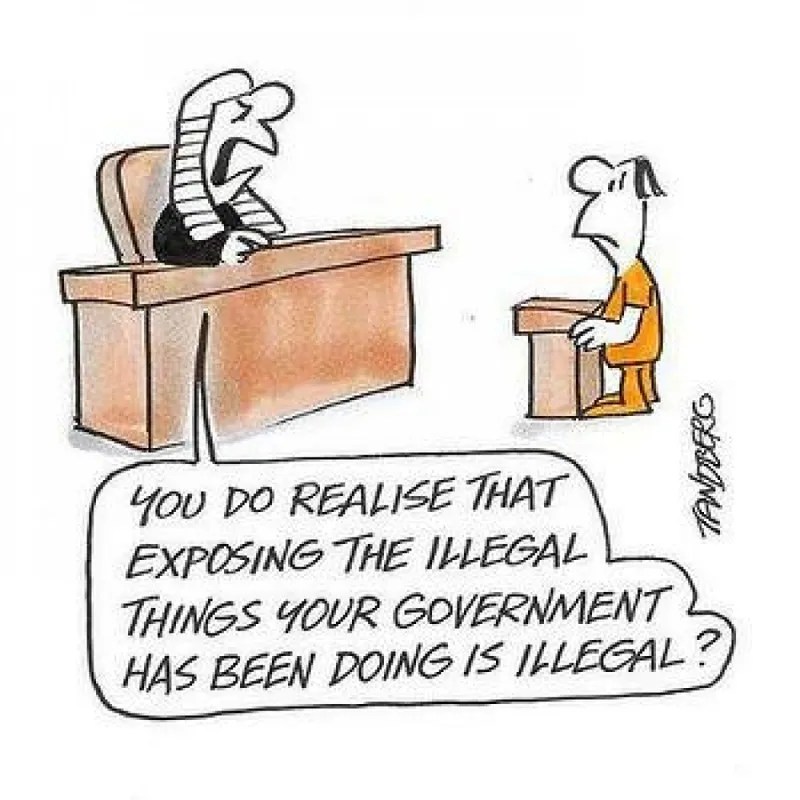
the use of military force to detain and deport immigrants could be considered illegal, as well as Trump’s boat strikes.
The dubious claim comes despite officials within the administration saying that the boat strike operation is unlawful.
By Sharon Zhang , Truthout, November 25, 2025, https://truthout.org/articles/leavitt-says-all-military-orders-by-trump-must-be-presumed-to-be-legal/?utm_source=Truthout&utm_campaign=bd2e9875e3-EMAIL_CAMPAIGN_2025_11_25_09_37&utm_medium=email&utm_term=0_bbb541a1db-bd2e9875e3-650192793
hite House Press Secretary Karoline Leavitt claimed on Monday that “all orders” by President Donald Trump should be “presumed” legal by the military, as she defended comments he made last week threatening Democratic lawmakers with “DEATH.”
Speaking to reporters outside of the White House on Monday, Leavitt claimed that Democrats were trying to create “chaos” within the military by reminding service members of their right to refuse to carry out illegal orders.
“All orders, lawful orders are presumed to be legal by our service members. You can’t have a functioning military if there is disorder and chaos within the ranks,” Leavitt said.
“And that’s what these Democrat members were encouraging. It’s very clear,” she went on, saying that none of them “can point to a single illegal order that this administration has given down, because it does not exist.”
Leavitt said that the White House backs the Department of Defense’s probe into Sen. Mark Kelly (D-Arizona) over a video he put out with fellow lawmakers reminding military members of their oath to “defend this Constitution.” A former Naval aviator, Sen. Kelly remains subject to military law despite retiring from the Navy in 2011.
“You can refuse illegal orders,” Kelly said in the video, alongside other ex-military and intelligence Democrats. “We need you to stand up for our laws. Our Constitution. And who we are as Americans.”
The lawmakers were referencing rights afforded to service members under the Uniform Code of Military Justice, which says that individuals in the military are not obligated to carry out orders that are illegal under U.S. law and known to be so by the service member. This summer, Truthout reported that a GI Rights Hotline saw an uptick in calls from members of the military seeking support for defying potentially illegal orders by Trump, like orders to carry out his immigration raids.
Leavitt’s assertion that all orders must be presumed to be legal is absurd on its face, regardless of who is handing down the orders. However, it echoes the twisted logic of a secretive Justice Department legal memo on the administration’s Latin American boat strike campaign, which reportedly suggests that Trump and his administration’s word alone is enough to establish legality for strikes. It also follows with the Trump administration’s relentless attempts to concentrate power within the executive branch, without oversight from Congress or other bodies.
The press secretary’s claim that there isn’t a “single illegal order” that has been passed down by the Trump administration is also patently false, experts have repeatedly said; as legal scholar Marjorie Cohn has noted for Truthout, the use of military force to detain and deport immigrants could be considered illegal, as well as Trump’s boat strikes.
Meanwhile, even officials within the military reportedly disagree. Last week, NBC reported that a senior judge advocate general, known as a JAG, raised concerns in August that the operations were unlawful. The man, a top military lawyer for the command that oversees the strikes, said that they could expose service members to legal action due to the illegality of the strikes, but his concerns were dismissed by more senior officials, sources said.
Hiroshima Declaration and Declaration on the Rights of Nuclear Victims 2025

October 2025, https://mp-nuclear-free.com/Nuclear/2025_WNVF_01.html
In 2025, Hiroshima and Nagasaki mark the 80th anniversary of the atomic bombings by the United States. The nuclear age began when the United States dropped atomic bombs on Hiroshima and Nagasaki and human beings gained the power to wipe humanity from the earth. The atomic bombings instantly slaughtered countless innocent people, bringing unprecedented inhuman misery to Hiroshima and Nagasaki. Those who survived the horrors of this hell are still suffering from the effects of radiation. Reparation for victims of indiscriminate genocide as a result of state-provoked wars is yet to be fulfilled.
For more than 80 years, the nuclear industry and countries that have promoted the use of the nuclear cycle have trivialized or concealed the health effects of radiation and have created nuclear victims all over the world, regardless of whether it is used for military purposes or “peaceful” uses. Much of the nuclear impacts have been inflicted on Indigenous and colonized peoples. Even after the devastating nuclear disasters in Chernobyl and Fukushima, these countries and the nuclear industry are trying to further expand their negative impact by parading nuclear energy as a climate solution.
We would like to create a place of international solidarity in Hiroshima for nuclear victims and their allies, aiming for the elimination of the nuclear cycle and a world in which no more hibakusha (nuclear victims) are created.
Full text of the declaration at https://mp-nuclear-free.com/Nuclear/WNVF2025_image/HiroshimaDeclaration-Declaration-Rights-WNV2025_EN.pdf
The 50-Year Wind Farm That Ended a Nuclear Myth
A Danish offshore project’s lifespan extension to half a century dismantles one of nuclear energy’s last standing arguments.
Michael Barnard, Medium Oct 21, 2025
One of the persistent claims made by nuclear energy advocates is that nuclear power plants hold a critical advantage over wind and solar facilities due to their significantly longer operational lifespans. This argument frequently serves as justification for continued investment in nuclear, often at the expense of renewable options. News of a 25 year extension to a Danish offshore wind farm, bringing its total life to 50 years, defangs yet another nuclear talking point.
It’s not the only example. Renewables, particularly wind energy, now routinely demonstrate operational lifetimes matching those of nuclear plants. The conventional wisdom that nuclear has a built-in longevity advantage is no longer supported by real-world evidence.
The nuclear industry’s standard operating lifespan is widely cited as between 40 and 60 years, with many reactors initially licensed for 40-year terms. These facilities routinely secure extensions from regulatory bodies, typically for an additional 20 years, bringing total projected lifetimes up to 60 years. In some cases, operators are now pursuing even longer extensions……………………………(Subscribers only0 https://medium.com/the-future-is-electric/the-50-year-wind-farm-that-ended-a-nuclear-myth-9da06d3b528c
Over 92 Percent of Homes in Gaza Are Rubble. How Do We Even Start Rebuilding?
To resurrect Gaza, the world must reckon with the genocide. Despite the ceasefire, Israel is blocking access to cement.
By Hend Salama Abo Helow , Truthout, November 22, 2025
n the wake of the United Nations Security Council rubber-stamping Donald Trump’s plans for Gaza — including the creation of a so-called “board of peace” and a militarized “international stabilization force” — the very notion of rebuilding is slipping through the cracks, overshadowed by what is framed as the more urgent need to keep the peace in place. But peace manufactured this way is nothing but an expansion and deepening of the humanitarian crisis already unfolding.
Gaza City was already in a perpetual state of destruction and rebuilding long before the current genocide erupted. It has endured relentless aggression that reduced residential homes to rubble, wiped out entire neighborhoods, and massacred civilians. Five wars — 2008, 2012, 2014, 2021, and May 2023 — brutally dismantled Gaza’s infrastructure, economy, agriculture, education, and culture, leaving behind a consumed cycle of devastation.
Yet each time, once the bombardment stopped, reconstruction began, even if it was in a slow rhythm. Gaza would rise again — recovering, thriving even, in forms more vibrantly echoing and picturesque than before. But this genocide has unleashed an unprecedented scale of destruction, so vast and unrelenting that stumbling upon an intact home today feels like witnessing one of life’s seven miracles………………………………………………………………………………………………………….. https://truthout.org/articles/over-92-percent-of-homes-in-gaza-are-rubble-how-do-we-even-start-rebuilding/
Poll Shows 70 Percent in US Disapprove of Striking Venezuela as Trump Mulls War
The US has built up the largest military presence in Latin America in decades off the coast of Venezuela.
By Sharon Zhang , Truthout, November 24, 2025
he vast majority of Americans say that the Trump administration hasn’t given proper explanation for potential military action in Venezuela and oppose the idea of strikes in the country, new polling finds as the U.S. builds up its military presence in the region.
New CBS/YouGov polling conducted late last week shows that 70 percent of Americans say that they would oppose the U.S. taking military action in Venezuela, with only 30 percent saying they support such an action.
Over three-quarters of Americans, 76 percent, say that the administration has not “clearly explained the U.S. position on military action in Venezuela.” The vast majority also say that President Donald Trump needs to provide an explanation, including 97 percent of Democrats, 86 percent of independents, and 64 percent of Republicans, the poll found……………………………………………………………………………………….https://truthout.org/articles/poll-shows-70-percent-in-us-disapprove-of-striking-venezuela-as-trump-mulls-war/?utm_source=Truthout&utm_campaign=eb51515458-EMAIL_CAMPAIGN_2025_11_24_10_25&utm_medium=email&utm_term=0_bbb541a1db-eb51515458-650192793
Thanks to US, in Gaza it’s death by a thousand planes
25 November 2025 AIMN Editorial, By Walt Zlotow, https://theaimn.net/thanks-to-us-in-gaza-its-death-by-a-thousand-planes/
In 1948 the US launched an airlift of food and supplies to keep Berliners fed and healthy during the Soviet blockade of allies from Berlin. During the airlift’s 15 months, US planes delivered over 1,800,000 tons of life sustaining material…a humanitarian gesture for the ages.
Twenty-six months ago the US embarked on another airlift. Alas, this one was not humanitarian. It was to further Israeli genocide that has largely obliterated Gaza’s 139 square miles. Even with the not so peaceful ceasefire, America keeps airlifting in supplies to keep killing and degrading hapless Palestinians trapped in the ruins. Over 300 slaughtered and 900 wounded since ceasefire began 45 days ago. Israel just received planeload number 1,000. Along with 150 cargo ships, the US air/sea lift has poured into Israel over 120,000 tons of advanced munitions, weapons, armored vehicles, medical equipment, communications systems, and personal protective equipment.
Besides destroying Gaza, US war material supports Israel’s destruction of Lebanon, Syria, Iran, Yemen, West Bank; even bombing imagined bad guys in US ally Qatar.
Whew! That takes a lot of US treasure that could be used to provide health care for all, end food insufficiency for 50 million sufferers, rebuild our crumbling infrastructure, convert to green energy, among other critically needed uplifting of the commons. How much treasure squandered on all that death and destruction? Over $21 Billion for Gaza alone with another $12 billion for Israel’s other bombing and terror campaigns.
Back in 1948 the beleaguered Berliners proclaimed the US Berlin airlift heaven sent. Seventy-seven years on, desperately starving and sick Palestinians not yet killed under American bombs dropped from US plans view the US genocidal airlift as arising from the lowest level of hell.
‘Elbows up’ means ‘lots of things,’ energy minister says after pressed on U.S.-based nuclear contract
Yahoo News, Catherine Lévesque, Wed, November 26, 2025
OTTAWA — Pressed on a Crown corporation’s decision to award a contract to a U.S.-based joint venture for the management of the country’s nuclear laboratories, Energy Minister Tim Hodgson suggested his government’s promise of “elbows up” can mean “lots of things.”
The National Post first revealed in June that critics were sounding the alarm on the recent decision by Atomic Energy of Canada Limited (AECL) to award a contract to sole bidder Nuclear Laboratory Partners of Canada Inc. (NLPC) — a joint venture led by U.S.-based BWXT — for the management and operation of Canadian Nuclear Laboratories (CNL).
CNL includes mainly Chalk River Laboratories, the birthplace of the CANDU reactor.
Critics raised national security concerns about giving access to Canada’s homegrown nuclear technology to companies involved with the U.S. Department of Defence at a time when Canada’s sovereignty was seemingly under attack by the Trump administration.
It appeared to be also contrary to Prime Minister Mark Carney’s “elbows up” campaign promise, even though AECL awarded the contract independently from the government.
NLPC is spearheaded by Virginia-based BWXT — an important supplier to the U.S. Defence Department. The other partners are Amentum — also based in Virginia — and Kinectrics Inc. — a company based in Toronto but bought by BWXT earlier this year.
Its key subcontractor, Ohio-based Batelle Memorial Institute, is the world’s largest research and development organization and manages national laboratories, including for the U.S. Department of Energy and the U.S. Department of Homeland Security…………………………………………………………………………………………………..
Are you against any American company operating in Canada?” the minister asked Tochor, adding that he does not think that view is “consistent” with Conservative thinking.
Tochor shot back: “I think it’s consistent with the ‘elbows up’ campaign you just ran.”
Hodgson replied that “‘elbows up’ means lots of things.”
“Elbows up means negotiating with all of the countries in the world, doubling our exports, creating alternatives to Americans. That’s what we’re doing,” he said.
Tochor also mentioned that the Competition Bureau announced last week it has expanded its investigation into BWXT’s acquisition of Kinetrics in determining whether the transaction is likely to prevent competition in Canada’s live-saving medical isotopes………………………………………………………………………………………….. https://ca.news.yahoo.com/elbows-means-lots-things-energy-202224637.html
Zelensky to Trump on US peace plan: ‘No peace with Russia till we win back all lost territory’.

Walt Zlotow, Nov 23, 2025, https://waltzlotow.substack.com/p/zelensky-to-trump-on-us-peace-plan
There are oodles of clueless, stupid leaders governing the world’s 193 countries. But likely none more clueless and stupid than Ukraine President Volodymyr Zelensky.
Zelensky did one smart thing in his public life. He campaigned for president in 2019 promising to implement the Minsk agreements to end the civil war in the Donbas. He also promised to maintain good relations with Russia. That resonated with beleaguered Donbas Ukrainians who carried him to overwhelming victory.
But once in office the Kyiv ultra-nationalists with the real power quickly disabused Zelensky of any thought of sane governance. They encouraged him to continue the Donbas civil war and seek NATO membership by hinting he may be removed from office, indeed life itself, should he persist in making peace in Donbas and with Russia.
Zelensky took the hint. He followed the Kyiv neonazi game plan to the letter…destroy Russian cultured Ukrainians there and bring Ukraine into NATO to weaken, isolate Russia from the West. Massing troops near Donbass in late 2021 to polish off Donbas Ukrainians, he triggered the Russian ‘Special Military Operation’ in February 2022 to stop both the civil war and prevent NATO membership in NATO.
As stupid as that was, Zelensky appeared smart enough to negotiate a quick end to the Russian invasion just 2 months in. It would require Ukraine to end the civil war by granting Donbas regional autonomy, give up NATO membership and pledge neutrality between Russia and the West. In return Ukraine would get back every square inch of Ukraine territory Russia had seized.
That was smart. But then Zelensky pivoted back to stupid. The US and UK sent Defense Secretary Lloyd Austin and Prime Minister Boris Johnson respectively, to Kyiv to fill Zelensky up with visions of grandeur. ‘Just keep fighting, Volodymyr. You can defeat Russia with our weaponry, technology, logistics and moral support. Trust us. We’ll will never let you fail.’
Austin and Johnson reeled in fool Zelensky. Forty-three months on Ukraine is a failed rump state of its former self. Economy shattered. Tens of millions fled. Over a million dead and wounded. Tens of thousands of troop deserters replaced by hapless souls shanghaied off the streets, terrified teens and aging grandfathers.
President Trump, seeking an out from his predecessor Biden’s folly, has offered a 28 point peace plan largely mirroring Russia’s sensible demands. But Zelensky keeps pushing back, claiming he just needs more tens of billions from the US and NATO to get back all that Ukraine land lost forever.
If you were writing an imaginary movie scrip about Zelensky, the producers would usher you to the door saying ‘Nobody could be that stupid.’ But Zelensky is real life. If they ever do make a movie about his destruction of his beloved homeland, a fitting title might be ‘Dumb, Dumber, Dumbest.’
Nuclear’s Costly Comeback Meets Harsh Market Reality.

By Leon Stille – Nov 21, 2025, https://oilprice.com/Alternative-Energy/Nuclear-Power/Nuclears-Costly-Comeback-Meets-Harsh-Market-Reality.html
- Nuclear power’s “cheap, clean, and secure” promise is breaking down.
- Small modular reactors (SMRs) remain largely theoretical, with the only advanced U.S. project cancelled over high costs.
- Renewables and storage now dominate energy economics, offering faster build times, flexibility, and lower prices.
I’ve followed the promise of small modular reactors (SMRs) and next-generation nuclear in several of my earlier pieces on OilPrice. The argument is familiar: nuclear provides low-carbon baseload, ensures energy security, and will one day deliver affordable, clean power. It sounds persuasive, until you look at the numbers. New nuclear remains slow, expensive, and deeply reliant on state support. In today’s European power markets, where renewables are already driving prices to record lows or even negative territory, the idea that nuclear can deliver “cheap and secure” power no longer holds up.
Expensive power disguised as security
Let’s start with the UK. Hinkley Point C, the flagship of the country’s nuclear revival, was only made possible through a 35-year Contract for Difference guaranteeing a strike price of £92.50 per MWh (in 2012 money). That’s roughly double the current wholesale market price, indexed to inflation, and fully guaranteed by taxpayers. It isn’t market competitiveness, it’s a subsidy designed to get the project financed.
Sizewell C will take the same path under a Regulated Asset Base model, transferring part of the construction risk directly to consumers through levies on electricity bills long before a single watt is produced. When “cheap” energy requires that level of public underwriting, something is fundamentally off.
A track record written in red ink
This pattern isn’t unique to Britain. France’s Flamanville reactor, long touted as the EPR showpiece, is over a decade late and has quadrupled in cost to more than €13 billion. Finland’s Olkiluoto 3 only began commercial operations after 17 years of delays and legal disputes. In the United States, Vogtle 3 and 4 finally came online after 15 years and around $36 billion in total costs, double initial projections, with ratepayers footing much of the bill through regulated recovery.
The nuclear industry’s narrative of reliability is at odds with its delivery record. Projects start with optimism and end with budget blowouts, political fallout, and consumer bailouts.
The SMR Illusion
Advocates often pivot to SMRs as the saviour, the “Tesla moment” for nuclear. I explored that hype in an earlier OilPrice article, noting that SMRs were being promoted as modular, factory-built, and inherently cheaper. Yet so far, reality looks familiar.
The most advanced U.S. SMR project, NuScale’s Carbon Free Power Project in Idaho, was cancelled in 2023 after projected costs rose to $89 per MWh, far above renewables and storage. Other designs remain on paper, heavily dependent on public subsidies or guaranteed offtake. The promise of small reactors may eventually prove out, but at the moment, SMRs are an idea with a press office, not a business case.
The market reality has shifted
Europe’s electricity markets tell the other half of the story. In 2024, countries like Germany, Denmark, and the Netherlands each recorded more than 450 hours of negative day-ahead prices. France saw nearly 360. Across the EU, negative or ultra-low price hours exceeded 9,000 in total.
For inflexible, capital-intensive baseload assets like nuclear, that’s disastrous. These plants can’t ramp down profitably when prices collapse. Their economics depend on constant, high utilization, and that world is disappearing. The more renewables come online, the more volatile the price pattern becomes, with long stretches of near-zero wholesale power. Nuclear simply doesn’t fit this market geometry.
Renewables and storage are doing what nuclear can’t
The contrast is striking. Renewables can be deployed modularly, financed privately, and built within 18–36 months. Utility-scale batteries, once dismissed as expensive, are now scaling at record speed. Europe installed nearly 22 GWh of new storage capacity in 2024, bringing total installed capacity above 60 GWh. Italy’s first grid-scale auction secured 10 GWh of storage at competitive prices, no decade-long delays, no multi-billion-euro risk exposure.
Each incremental gigawatt of storage turns volatile wind and solar into a more stable, dispatchable asset. In that environment, nuclear’s supposed advantage of “firm capacity” starts to look less like a virtue and more like an anchor.
Security means flexibility, not monoliths
Nuclear advocates still frame the argument in security terms, stable, domestic generation insulated from fossil-fuel geopolitics. But in modern energy systems, security no longer means “always-on baseload.” It means adaptability, diversification, and resilience.
A network built from distributed solar, wind, storage, and demand-side flexibility is inherently harder to disrupt. It can absorb shocks, balance local fluctuations, and restart quickly after failures. A multi-billion-euro single-site nuclear facility, by contrast, is a high-value target for cost escalation, technical failure, or even physical risk.
Energy security in the 2020s is about systems thinking, not megaproject symbolism.
The economics of opportunity cost
Every euro sunk into new nuclear is a euro not available for faster, cheaper solutions. A 10 billion-euro reactor might take 15 years to produce its first electrons. The same money could build tens of gigawatts of solar and wind, backed by large-scale storage, grid upgrades, and hydrogen electrolysers to absorb surplus power, all online before the nuclear project breaks ground.
The opportunity cost is immense. Renewable portfolios are now financeable at market rates; nuclear requires a bespoke government rescue package before it even begins.
A niche role, not a blueprint
To be clear, existing reactors that can be safely life-extended make sense. Extending France’s fleet, or upgrading proven units, delivers low-carbon energy at marginal cost. But that’s asset management, not a case for new construction.
Building a fresh wave of reactors on 20-year timelines, in a power market already defined by negative pricing and flexible storage, is a strategic mismatch. Nuclear can remain a niche contributor, but not the foundation of affordable or adaptable decarbonization.
Conclusion: The future has moved on
The myth of nuclear as “secure, clean, and cheap” collapses under scrutiny. It is clean once built, but rarely cheap, and often far from secure when you consider financing and policy risk. Meanwhile, renewables plus storage are delivering real, scalable, market-driven results right now.
We no longer live in a world where the problem is lack of technology. The challenge is choosing the right ones for the energy system we are actually building, a fast, flexible, decentralized grid where adaptability equals security.
Security Council Shamefully Grants Colonial Domination Over Palestine to the US.

The resolution incorporates Donald Trump’s “peace plan.” It grants control over Gaza to the U.S.-led “Board of Peace” and it orders the deployment of a U.S.-led occupation force called “International Stabilization Force (ISF).” Trump will oversee both colonial bodies, in collaboration with Israel. Palestinians will not be allowed to participate in their own governance.
“It is a brazen attempt to impose, by threat of continued force against a virtually defenseless population, U.S. and Israeli interests, plain and simple.”
A UN Special Rapporteur has decried the resolution as a violation of Palestinian people’s right to self-determination.
By Marjorie Cohn , Truthout, November 21, 2025
In 1947, the United Nations General Assembly committed the UN’s original sin when it partitioned Palestine to create Israel. This launched the Nakba, the ethnic cleansing of the Indigenous people, and the establishment of a settler colonial state.
Now, 78 years later, the UN Security Council has committed the UN’s second cardinal sin. It enshrined Israel’s illegal occupation of Palestinian lands, put its imprimatur on Israel’s genocide, and granted colonial control over the lives of the Palestinians to the United States, which has aided and abetted the genocide.
On November 17, 2025, the Council adopted Resolution 2803, by a vote of 13-0. Russia and China, both permanent members of the Security Council, could have vetoed it. But shamefully they abstained, ostensibly influenced by support for the resolution from several Arab and Muslim states, including Egypt, Qatar, Jordan, Saudi Arabia, and the United Arab Emirates, as well as Turkey, Indonesia, and Pakistan.
The resolution incorporates Donald Trump’s “peace plan.” It grants control over Gaza to the U.S.-led “Board of Peace” and it orders the deployment of a U.S.-led occupation force called “International Stabilization Force (ISF).” Trump will oversee both colonial bodies, in collaboration with Israel. Palestinians will not be allowed to participate in their own governance.
The Board of Peace is designed to function as a transitional administrator of Gaza. It will control all services and humanitarian aid, all ingress and egress into and out of Gaza, and will supervise the financing and reconstruction of Gaza. The resolution “underscores the importance” of humanitarian assistance but does not require the unimpeded provision of aid.
The ISF will not be a peacekeeping force. Since the Council authorized it “to use all necessary measures to carry out its mandate,” the ISF will have the power to disarm Palestinian groups, as Israel insists. There is no provision in the resolution for disarming the Israel Occupation Forces, the body that has been conducting the genocide.

“A military force answering to a so-called ‘Board of Peace’ chaired by the President of the United States, an active party to this conflict that has continually provided military, economic and diplomatic support to the illegal occupying Power, is not legal,” said Francesca Albanese, Special Rapporteur on the situation of human rights in the Palestinian territories occupied since 1967. “It is a brazen attempt to impose, by threat of continued force against a virtually defenseless population, U.S. and Israeli interests, plain and simple.”
“Essentially, it will leave Palestine in the hands of a puppet administration, assigning the United States, which shares complicity in the genocide, as the new manager of the open-air prison that Israel has already established,” Albanese added.
Since October 2023, Israel has killed nearly 70,000 Palestinians and wounded more than 170,000. Nearly everyone in Gaza has been displaced by Israel multiple times and Gaza has largely been reduced to rubble. Israel has violated the latest ceasefire at least 393 times and killed at least 312 Palestinians since it went into effect on October 10, 2025.
In three recent cases, the International Court of Justice (ICJ) found a plausible case of genocide by Israel, that Israel’s occupation of Palestinian territory is unlawful, and that Israel has illegally used starvation of civilians as a weapon of war. The International Criminal Court issued arrest warrants for Israeli Prime Minister Benjamin Netanyahu and former Defense Minister Yoav Gallant for war crimes and crimes against humanity.
The Resolution Violates the Palestinian People’s Right to Self-Determination
The Security Council resolution violates fundamental tenets of international law including the right of the Palestinian people to self-determination. “The ICJ was clear: self-determination is an inalienable right of the Palestinian people and the UN and all States have an obligation to assist in its realization,” Albanese said…………………………………………………..
Resolution 2803 “rewards the U.S., a co-perpetrator of genocide, with control over Gaza and its potentially lucrative reconstruction process, while simultaneously relieving the Israeli regime of all of its responsibilities as an illegally occupying force,” Yara Hawari wrote in Al-Shabaka, a Palestinian-led think tank. “Palestinian participation is expected to be tightly limited and heavily conditioned. Trump’s plan confines it to ‘technocratic’ and ‘apolitical’ roles, subject to continuous external supervision and effectively excluding any representatives with democratic legitimacy or political agency.”
Hamas and other Palestinian factions rejected the resolution. They wrote in a joint statement that ISF “will turn into a type of imposed guardianship or administration — reproducing a reality that restricts the Palestinian people’s right to self-determination and to managing their own affairs.”
“Assigning the international force with tasks and roles inside the Gaza Strip, including disarming the resistance, strips it of its neutrality, and turns it into a party to the conflict in favor of the occupation,” Hamas said…………………………………………………………………………
it won’t prevent Israel from carrying out its military operations or aerial bombardments of Gaza. It may even help Israel achieve its goals.”
Uniting for Peace
……………………………………………..In adopting Resolution 2803, the Security Council did not discharge its responsibilities under the Charter to act on behalf of Palestine, a permanent observer state, which is undergoing the first live-streamed genocide in history. Nor is the Council discharging its responsibility to maintain international peace and security by memorializing an illegal occupation and an ongoing genocide.
Colombian President Gustavo Petro has declared that he will introduce a Uniting for Peace resolution in the UN General Assembly to establish a multinational protection force for Palestinians and levy sanctions and an arms blockade to end the genocide and liberate Palestine from the unlawful Israeli occupation.
In retaliation, the U.S. government has revoked Petro’s visa, imposed sanctions against him, raised punitive tariffs on Colombia, and threatened the use of military force against Colombia.
People opposed to the U.S.’s colonial takeover of Palestine can join the Boycott, Divestment, and Sanctions Movement, lobby for arms embargoes, and support accountability for Israeli and U.S. leaders responsible for perpetrating the genocide.
We must do everything within our power to stop this atrocity and support the struggle of the Palestinian people for self-determination. https://truthout.org/articles/security-council-shamefully-grants-colonial-domination-over-palestine-to-the-us/?utm_source=Truthout&utm_campaign=7ccb24ce9d-EMAIL_CAMPAIGN_2025_11_21_07_46_COPY_01&utm_medium=email&utm_term=0_bbb541a1db-09cad751f9-650192793
ZELENSKY: CAUGHT BETWEEN A ROCK AND A HARD PLACE
This war could have been avoided. A diplomatic pathway to peace existed in 2015 and in 2022. If the West had done what was right and needful on both occasions things would have been very different.
Russia has prevailed against the collective might of the West. Those who still retain their illusions and self-blinding prejudices concerning this are now totally irrelevant and unable to influence events now occurring. This includes the entire political elite of Europe apart from those in Hungary, Slovakia and since the recent presidential election, the Czech Republic.
We now stand before events which could herald the end of a conflict Russia never wanted. The last three and three quarter years of bloody warfare became inevitable following a catastrophic failure by the western political elites. The Russian president and his team walked every last mile and for six long years to achieve a diplomatic solution to the situation in Ukraine’s eastern regions following the West-supported insurrection and coup in Ukraine. The ultraviolent insurrection removed the democratically-elected president and government with full U.S., EU and UK support in 2014. Following the outbreak of hostilities when the new coup government irresponsibly and recklessly sent the Ukrainian army to quell unrest in the Russian-speaking east of Ukraine a diplomatic initiative between Russia and Ukraine began. This also included the then leaders of Germany and France. This process, which came to be known as ‘The Minsk Accords’ began in 2015.
The Minsk Accords began due to things going badly wrong for the Ukrainian army in Ukraine’s south-eastern region of the Donbass. They were begun after a plea by Angela Merkel, Chancellor of Germany at the time, to Vladimir Putin. These accords were meant to find a diplomatic solution to the question of the Russian-speaking population retaining their right to retain their language and democratic rights in the face of the removal of the president and government they had elected being illegally removed from office. The population of the Donbass saw gaining a semi-autonomous status as the way to achieve this and this is the outcome Putin sought to achieve for them.
The process to find a peaceful way through to a good outcome for both sides through diplomacy stretched on through th next six years to 2021 without success. The coup government in Kiev through its parliament refused to implement the steps that would have ensured a peaceful outcome. Instead of being willing to agree the way forward to the peaceful outcome visualized in Minsk they actively sought a military outcome favorable to them. Back in Minsk and throughout this period western leaders constantly attempted to put pressure on Russia and exerted virtually none on the Ukrainian regime in Kiev. This failure to put pressure on Kiev was the crucial missing ingredient that brought about the ultimate failure of the Minsk process by 2021. The two Kiev regimes since 2015 having felt no significant pressure from its western allies to implement Minsk finally abandoned it completely by late 2021. This set the stage for war
The Ukrainian army and the fortifications built to contain and attack the Russian-speaking populations of the Donbass which lay siege to the Donbass region had been built up and equipped massively by the West from 2014 to 2021. And in the first months of 2022 the number of attacks on the Russian-speaking population by the Ukrainian army rose significantly. It was clear that a major military push by the Ukrainian army against the population there was imminent. All this and all that came thereafter from February 24th 2022 could have been prevented if the West had been willing to put pressure on presidents Poroshenko and subsequently Zelensky, to agree the diplomatic solution which arose from the negotiations in Minsk. All the years of horrendous bloodshed could have been avoided. The western leaders could have applied massive pressure on Kiev but failed to apply any discernible pressure at all
Only now, after these years where over a million have died and countless numbers have experienced grievous injuries do we at last see significant pressure being applied to the Ukrainian regime. The new, 28-point Trump peace plan has been supplied to Zelensky and he has been told in no uncertain terms that he must agree to it or lose U.S. support. He has until November 27th to do this.
The big question is this: Why did we wait all the way from 2015 to now for the western powers to apply pressure on Kiev to settle?
The political leadership of the West concentrated solely applying pressure on Russia during the entire time from 2015 to now. If pressure had been applied to the degree possible and necessary by the West on the Ukrainian authorities they would have had to agree to the diplomatic peace initiatives, first in Minsk and if not then, in Istanbul. In Minsk the western leaders utterly failed in their duty to pressure BOTH sides, choosing to put pressure on Russia alone. In Istanbul we saw Boris Johnson, UK prime minister of the time, arrive in Kiev to urge Zelensky to abandon the road to peace and instead to instead choose war.
It has been the western leaders and their failure to apply this pressure where it would have been most effective that has precipitated the start and continuance of the fighting. It i the western leadership of this period and their anti-Russian strategies that are primarily responsible for this conflict and all the deaths and injuries that have occurred since 2015.
Now, as Russia achieves ever greater success on the battlefield, with the Kiev regime locked within a huge corruption scandal and its military forces in dissaray, lacking manpower, suffering massive desertions and in retreat, with western financial support to Ukraine failing, now at last pressure is being put where it should have been all along, on the Kiev regime and on Zelensky in particular. He must no decide by November 27th whether to sign up to the 28-point peace plan or lose the U.S. as ally. At long last pressure is being applied where needed as it ought to have been done all the way back in Minsk in 2015 and once again in Istanbul in 2022. Zelensky must now put up or shut up. Agree to a peace where Russia achieves th preponderance of its goals or reject that peace, fight on, and lose even MORE lives and land in the future.
Nov 22, 2025
European Leaders Condemn Trump’s Military Escalation Against Venezuela.
the escalation that Trump claims is the latest battle in the “War on Drugs” comes two years after he explicitly announced his desire to take control of Venezuela’s oil,
War would deliver “not security but a torrent of bloodshed,” said a letter signed by dozens of political leaders.
By Julia Conley , CommonDreams, November 22, 2025, https://truthout.org/articles/european-leaders-condemn-trumps-military-escalation-against-venezuela/?utm_source=Truthout&utm_campaign=0b29afb75c-EMAIL_CAMPAIGN_2025_11_22_04_56&utm_medium=email&utm_term=0_bbb541a1db-0b29afb75c-650192793
ith thousands of US troops patrolling the Caribbean, at least eight warships deployed in the region, and the BBC reporting that it tracked four US military planes that flew near Venezuela Thursday night, lawmakers and other leaders from across Europe on Friday issued a unified demand for the Trump administration to deescalate the tensions it has ratcheted up in recent weeks.
The administration’s “show of force has already proved lethal,” said the leaders, with more than 80 people — including fishermen and an out-of-work bus driver — having been killed in the US military’s strikes on more than 20 boats, which the administration has insisted were trafficking drugs to the US. The White House has publicized no evidence of the claims.
President Donald Trump has not taken further military action against Venezuela since he was presented with “options” for potential strikes last week by officials including Defense Secretary Pete Hegseth, nor has he followed through with threats he’s made against Mexico and Colombia.
But the European leaders — including British Members of Parliament Zarah Sultana and Jeremy Corbyn, former Greek Finance Minister Yanis Varoufakis, and Spanish Member of European Parliament Irene Montero Gil — noted that Trump “severed diplomatic channels with Caracas and approved covert [Central Intelligence Agency] operations in Venezuela” as the military buildup continues in the region.
The Trump administration has insisted it is engaged in a legal “armed conflict” with drug cartels in Venezuela, which it has accused of trafficking fentanyl to the US — though experts say drug boats originating in Venezuela are “are mainly moving cocaine from South America to Europe,” and analysis by both the United Nations and US intelligence agencies have shown the South American country plays virtually no role in the production or transit of fentanyl.
The US Congress has not authorized any military action against drug cartels or Venezuela’s government, and lawmakers from both sides of the aisle have attempted to pass war powers resolutions blocking the US from striking more boats or targets on land in Venezuela, only to have the resolutions voted down.
In his second term, Trump has sought to tie Venezuelan President Nicolás Maduro to drug cartels — despite a declassified US intelligence memo showing officials rejected the claim — and designated Cartel de los Soles a foreign terrorist organization last week, giving the White House what Hegseth called “new options” to go after the group.
But the escalation that Trump claims is the latest battle in the “War on Drugs” comes two years after he explicitly announced his desire to take control of Venezuela’s oil, and following years of condemnation of Maduro’s socialist government from Secretary of State Marco Rubio.
The European leaders said the administration’s narrative about the threat Venezuela poses to the US and the escalation is simply the “latest attempt to threaten and undermine the sovereignty of Latin America and the Caribbean nations.”
“Declassified documents have confirmed the CIA’s hand in overthrowing democratically elected governments in Latin America, such as Salvador Allende’s Chile in 1973, João Goulart’s Brazil in 1964, and Jacobo Árbenz’s Guatemala in 1954. The human cost of these regime change operations was catastrophic, and their political legacy endures,” reads the letter, which was organized by Progressive International.
A military intervention by the US in Venezuela “would mark the first interstate war by the United States in South America,” the leaders said, yet “the pretext for intervention is as tired as it is familiar.”
“Under the banner of combating the ‘narco-terrorists,’ Trump celebrates lethal strikes against peaceful fishermen arbitrarily labeled as carrying drugs,” the leaders said.
As in the past, they added, moving the War on Drugs to Venezuela would deliver “not security but a torrent of bloodshed, dispossession, and destabilization.”
Therefore, we condemn in the strongest terms the military escalation against Venezuela,” they said. “Our demand is clear and our resolve is firm: No war on Venezuela.”
As Peoples Dispatch reported Thursday, many European leaders have “subordinated” themselves to Trump and have avoided speaking out against the US escalation with Venezuela, but left-wing political parties have led the way in denouncing the US deployment of soldiers and warships to the region.
The Workers’ Party of Belgium said recently that the world is “witnessing an unprecedented military escalation in 20 years, a multifaceted aggression that threatens not only Venezuela, but any project of sovereignty and social justice in Latin America.”
1 This Month

of the week – Shut Down Drone Warfare!


Tell the Ukrainian Government to Drop Prosecution of Peace Activist Yurii Sheliazhenko

Petition to revoke the licensing of the Near Surface Nuclear Disposal Facility (NSDF) at Chalk River. https://www.ourcommons.ca/petitions/en/Petition/Details?Petition=e-7247
To see nuclear-related stories in greater depth and intensity – go to https://nuclearinformation.wordpress.com
-
Archives
- April 2026 (103)
- March 2026 (251)
- February 2026 (268)
- January 2026 (308)
- December 2025 (358)
- November 2025 (359)
- October 2025 (376)
- September 2025 (257)
- August 2025 (319)
- July 2025 (230)
- June 2025 (348)
- May 2025 (261)
-
Categories
- 1
- 1 NUCLEAR ISSUES
- business and costs
- climate change
- culture and arts
- ENERGY
- environment
- health
- history
- indigenous issues
- Legal
- marketing of nuclear
- media
- opposition to nuclear
- PERSONAL STORIES
- politics
- politics international
- Religion and ethics
- safety
- secrets,lies and civil liberties
- spinbuster
- technology
- Uranium
- wastes
- weapons and war
- Women
- 2 WORLD
- ACTION
- AFRICA
- Atrocities
- AUSTRALIA
- Christina's notes
- Christina's themes
- culture and arts
- Events
- Fuk 2022
- Fuk 2023
- Fukushima 2017
- Fukushima 2018
- fukushima 2019
- Fukushima 2020
- Fukushima 2021
- general
- global warming
- Humour (God we need it)
- Nuclear
- RARE EARTHS
- Reference
- resources – print
- Resources -audiovicual
- Weekly Newsletter
- World
- World Nuclear
- YouTube
-
RSS
Entries RSS
Comments RSS
 nuclear-news