Oxfam reaction to Knesset decision
October 29, 2024, by: The AIM Network, https://theaimn.com/oxfam-reaction-to-knesset-decision/—
Oxfam Australia
In reaction to the Knesset passing bills banning UNRWA from operating in areas under Israel’s control, Sally Abi Khalil, Oxfam Regional Director in the Middle East and North Africa said:
“Israel has bombed Palestinians to death, maimed them, starved them, and is now ridding them of their biggest lifeline of aid. Piece by piece, Israel is systemically dismantling Gaza as a land that is autonomous and liveable for Palestinians. Its banning of UNRWA today is condemnable and another step in this crime.
“The decision will further undermine the ability of the international community to provide sufficient humanitarian aid and to save lives in any safe, independent and impartial way.
“UNRWA was not only the biggest and most established agency that has been delivering aid and sustenance to the people of Gaza for years, it was also a thread that connected them in some hope of solidarity and security to the United Nations.
“We are in no doubt that Israel and its allies are fully aware of the terrible consequences that this decision will have on Palestinians living in Gaza, many of whom are already starving. We join others in warning again that this will result in more death, more suffering, and more forced displacement of people from their besieged homeland. It is impossible not to believe that this is their aim.”
Biden to Bibi: ‘OK to continue Gaza genocide till after election’

Walt Zlotow, West Suburban Peace Coaliton, Glen Ellyn IL, 27 Oct 24
On October 14, President Biden sent a letter to Israeli Prime Minister Benjamin Netanyahu giving Israel 30 days to allow more aid of food, water and medicine into Gaza’s 139 square miles being utterly destroyed by Israel for the past year. It’s noteworthy that the 30 day time limit ends 9 days after the US election. Biden’s letter is brilliant politics and grotesque governance. Biden, who has been funding, supporting and enabling the yearlong genocide in Gaza, desperately needs to appear peace loving ahead of the election. He knows a majority of his Democratic voters are horrified by his genocide enabling. They want him to end the so far 50,000 tons of weapons he’s already given Israel to demolish Gaza.
The letter, designed to promote his concern for the devastation he’s enabled, will do nothing to end the genocide in Gaza. Netanyahu has ignored every one of Biden’s pleas for supplying life sustaining aid there. The letter doesn’t even state Biden will cut off aid to Israel. It merely implies that if US demands aren’t met, the US might consider enforcing foreign assistance laws. Those laws forbid the US from sending weapons to any nation committing wholesale destruction of civilian populations. But not one word about actually cutting off those weapons destroying Gaza.
Every day dozens, hundreds, even a thousand or more Palestinians die in Gaza, obliterated by Biden’s 2,000 lb. bombs, or killed more slowly from disease or starvation. Biden does not care. His toothless letter begging for more aid to the 2,300,000 Palestinians will do nothing to alleviate their suffering. But it may mollify his antiwar critics enough to help achieve Democratic victory Election Day.
Win or lose November 5, Biden is unlikely to do anything substantive to end the genocidal ethnic cleansing of Gaza. It goes against everything he’s believed in and supported about Israeli colonial domination of Palestine for his entire 52 year governmental career. But it will ensure he descends into historical infamy for enabling the worst genocide of the 21st century.
Media Hawks Make Case for War Against Iran

This depiction of Iran as an aggressor that has victimized the United States for 45 years, causing “suffering for thousands of Americans,” is a parody of history. The fact is that the US has imposed suffering on millions of Iranians for 71 years, starting with the overthrow of the country’s democratically elected Prime Minister Mohammad Mosaddegh in 1953. It propped up the brutal Pahlavi dictatorship until 1979, then backed Iraq’s invasion of Iran, helping Saddam Hussein use chemical weapons against Iranians (Foreign Policy, 8/26/13). It imposes murderous sanctions on Iran to this day (Canadian Dimension, 4/3/23).
What Stephens is deploying here is the tired and baseless propaganda strategy of hinting that World War II redux is impending if America doesn’t crush the Third World bad guy of the moment.
Gregory Shupak, FAIR, 25 Oct 24
The media hawks are flying high, pushing out bellicose rhetoric on the op-ed pages that seems calculated to whip the public into a war-ready frenzy.
Just as they have done with Hezbollah (FAIR.org, 10/10/24), prominent conservative media opinionators misrepresent Iran as the aggressor against an Israel that practices admirable restraint.
Under the headline, “Iran Opens the Door to Retaliation,” the Wall Street Journal editorial board (10/1/24) wrote that Iran’s October 1 operation against Israel “warrants a response targeting Iran’s military and nuclear assets. This is Iran’s second missile barrage since April, and no country can let this become a new normal.”
The editors wrote:
After April’s attack, the Biden administration pressured Israel for a token response, and President Biden said Israel should “take the win” since there was no great harm to Israel. Israel’s restraint has now yielded this escalation, and it is under no obligation to restrain its retaliation this time.
‘We need to escalate’
The New York Times‘ self-described “warmongering neocon” columnist Bret Stephens (10/1/24), in a piece headlined “We Absolutely Need to Escalate in Iran,” similarly filed Iran’s April and October strikes on Israel under “aggression” that requires a US/Israeli military “response.” And a Boston Globe editorial (10/3/24) wrote that Iran “launched a brazen attack,” arguing that the incident illustrated why US students are wrong to oppose American firms making or investing in Israeli weapons.
All of these pieces conveniently neglected to mention that Iran announced that its October 1 missile barrage was “a response to Israel’s recent assassinations of leaders of [Iran’s Islamic Revolutionary Guard Corps], Hezbollah and Hamas” (Responsible Statecraft, 10/1/24). One of these assassinations was carried out by a bombing in Tehran, the Iranian capital. But we can only guess as to whether the Globe thinks those killings are “brazen,” Stephens thinks they qualify as “aggression,” or if the Journal believes any country can let such assassinations “become a new normal.”
Likewise, Iran’s April strikes came after Israel’s attack on an Iranian consulate in Damascus that killed seven Islamic Revolutionary Guard Corps officers (CBS, 4/14/24). At the time, Iran reportedly said that it would refrain from striking back against Israel if the latter agreed to end its mass murder campaign in Gaza (Responsible Statecraft, 4/8/24).
‘Axis of Aggression’
A second Stephens piece (New York Times, 10/8/24) claimed that “the American people had better hope Israel wins” in its war against “the Axis of Aggression led from Tehran.” The latter is his term for the coalition of forces resisting the US and Israel from Palestine, Yemen, Lebanon and Iran, which refers to itself as the “axis of resistance.” Stephens’ reasoning is that, since Iran’s 1979 revolution, the country has meant suffering for thousands of Americans: the hostages at the US embassy in Tehran; the diplomatsand Marines in Beirut; the troops around Baghdad and Basra, killed by munitions built in Iran and supplied to proxies in Iraq; the American citizens routinely taken as prisoners in Iran; the Navy SEALs who perished in January trying to stop Iran from supplying Houthis with weapons used against commercial shipping.
The war Israelis are fighting now—the one the news media often mislabels the “Gaza war,” but is really between Israel and Iran—is fundamentally America’s war, too: a war against a shared enemy; an enemy that makes common cause with our totalitarian adversaries in Moscow and Beijing; an enemy that has been attacking us for 45 years. Americans should consider ourselves fortunate that Israel is bearing the brunt of the fighting; the least we can do is root for it.
This depiction of Iran as an aggressor that has victimized the United States for 45 years, causing “suffering for thousands of Americans,” is a parody of history. The fact is that the US has imposed suffering on millions of Iranians for 71 years, starting with the overthrow of the country’s democratically elected Prime Minister Mohammad Mosaddegh in 1953. It propped up the brutal Pahlavi dictatorship until 1979, then backed Iraq’s invasion of Iran, helping Saddam Hussein use chemical weapons against Iranians (Foreign Policy, 8/26/13). It imposes murderous sanctions on Iran to this day (Canadian Dimension, 4/3/23).
Given this background, suggesting—as the Journal, the Globe and Stephens do—that Iran is the aggressor against the US is not only untenable but laughable. Furthermore, as I’ve previously shown (FAIR.org, 1/21/20), it’s hardly a settled fact that Iran is responsible for Iraqi attacks on US occupation forces in the country. Stephens’ description of the Navy SEALs who died in the Red Sea is vague enough that one might be left with the impression that Iran or Ansar Allah killed them, but the SEALs died when one of them fell overboard and the other jumped into the water to try to save him (BBC, 1/22/24).
Stephens went on:
Those who care about the future of freedom had better hope Israel wins.
We are living in a world that increasingly resembles the 1930s, when cunning and aggressive dictatorships united against debilitated, inward-looking, risk-averse democracies. Today’s dictatorships also know how to smell weakness. We would all be safer if, in the Middle East, they finally learned the taste of defeat.
What Stephens is deploying here is the tired and baseless propaganda strategy of hinting that World War II redux is impending if America doesn’t crush the Third World bad guy of the moment. More realistically, the “future of freedom” is jeopardized by the US/Israeli alliance’s invading the lands of Palestinian and Lebanese people and massacring them. These crimes suggest that, in the Journal’s parlance, it’s the US/Israeli partnership that is the “regional and global menace.” Or, to borrow another phrase from the Journal’s editorial, it’s Israel and the US who are the “dangerous regime[s]” from which “the civilized world” must be defended.
‘A global menace’
Corporate media commentators didn’t stop at Iran’s direct strikes on Israel, casting Iran as, in the Journal‘s words (10/1/24), “a regional and global menace”:…………………………………………………………………
Painting Iran as the mastermind behind unprovoked worldwide aggression helps prop up the hawks’ demands for escalation. But the US State Department said there was “no direct evidence” that Iran was involved in the October 7, 2023, Hamas-led attack on Israel, “either in planning it or carrying it out” (NBC, 10/12/23)…………………………………………………………………………………..
Propaganda goes nuclear
As usual, those who are itching for a war on Iran invoke the specter of an Iranian nuclear weapon. Stephens (New York Times, 10/1/24) wrote:
This year, Secretary of State Antony Blinken warned that Iran was within a week or two of being able to produce enough weapons-grade uranium for a nuclear bomb. Even with the requisite fissile material, it takes time and expertise to fashion a nuclear weapon, particularly one small enough to be delivered by a missile. But a prime goal for Iran’s nuclear ambitions is plainly in sight, especially if it receives technical help from its new best friends in Russia, China and North Korea.
Now’s the time for someone to do something about it.
That someone will probably be Israel.
By “something,” Stephens said he also meant that “Biden should order” military strikes to destroy the “Isfahan missile complex.” “There is a uranium enrichment site near Isfahan, too,” Stephens wrote suggestively.
The LA Times published two guest op-eds in less than two weeks urging attacks on Iran based on its alleged nuclear threat. Yossi Klein Halevi (10/7/24) wrote:…………………………………..
‘Threshold’ is a ways away…………………………………………………….
Recent history shows that Iran has been willing to “stop itself” from acquiring nuclear weapons. Iran abided by the 2015 Joint Comprehensive Plan of Action (JCPOA), popularly known as the Iran nuclear deal, under which Iran limited its nuclear development in exchange for a partial easing of US sanctions. It stuck to the deal for some time even after the United States unilaterally abandoned it.
Just before President Donald Trump ripped up the agreement in 2018, the IAEA reported that Iran was “implementing its nuclear-related commitments” under the accord. The year after the US abrogated the agreement, Iran was still keeping up its end of the bargain.
‘Provocative actions’ from US/Israel
Iran subsequently stopped adhering to the by then nonexistent deal—often advancing its nuclear program, as Responsible Statecraft (5/7/24) noted, “in response to provocative actions from the US and Israel”:
In early 2020, the Trump administration killed Iranian Major General Qassem Soleimani, leader of the Islamic Revolutionary Guard Corps, and soon after Tehran announced that it would no longer abide by its enrichment commitments under the deal. But, even so, Tehran said it would return to compliance if the other parties did so and met their commitments on sanctions relief.
In late 2020, Iranian nuclear scientist Mohsen Fakhrizadeh was assassinated near Tehran, reportedly by Israel. Soon after, Iran’s Guardian Council approved a law to speed up the nuclear program by enriching uranium to 20%, increasing the rate of production, installing new centrifuges, suspending implementation of expanded safeguards agreements, and reducing monitoring and verification cooperation with the IAEA. The Agency has been unable to adequately monitor Iran’s nuclear activities under the deal since early 2021.
However, situating Iranian policies in relation to US/Israeli actions like these would get in the way of the Journal’s campaign, which it articulated in another editorial (10/2/24), to convince the public that “If Mr. Biden won’t take this opportunity to destroy Iran’s nuclear program, the least he can do is not stop Israel from doing the job for its own self-preservation.”
Of course, the crucial, unstated assumption in the articles by Stephens, Halevi, Heilman and the Journal’s editors is that Iran’s hypothetical nuclear weapons are emergencies that need to be immediately addressed by bombing the country—while Washington and Tel Aviv’s vast, actually existing nuclear arsenals warrant no concern. https://fair.org/home/media-hawks-make-case-for-war-against-iran/
‘You couldn’t make this up’: Expert pans Ontario nuclear option

SMH, By Bianca Hall and Nick O’Malley, October 28, 2024
Ontario subsidises its citizens’ electricity power bills by $7.3 billion a year from general revenue, an international energy expert has said, contradicting the Coalition’s claim that nuclear reactors would drive power prices down in Australia.
Opposition Leader Peter Dutton has repeatedly cited the Canadian province as a model for cheaper power prices from nuclear.
“In Ontario, that family is paying half of what the family is paying here in Perth for their electricity because of nuclear power,” Dutton said in March. “Why wouldn’t we consider it as a country?”
In July, Dutton said Canadian consumers paid about one-quarter of Australian prices for electricity.
Professor Mark Winfield, an academic from York University in Canada who specialises in energy and environment, on Monday said the reaction among people in Ontario to the comparison had ranged from disbelief to “you couldn’t make this up”.
Ontario embarked on a massive building spree between the 1960s and the 1990s, Winfield told a briefing hosted by the Climate Council and the Smart Energy Council.
In the process, he said, the provincial-owned utility building the generators “effectively bankrupted itself”. About $21 billion in debt had to be stranded to render the successor organisation Ontario Power Generation economically viable.
In 2015, the Canadian government approved a plan to refurbish 10 ageing reactors, but Winfield said the refurbishment program had also been beset by cost blowouts.
“The last one, [in] Darlington, east of Toronto, was supposed to cost $C4 billion and ended up costing $C14 [billion],” Winfield said.
“And that was fairly typical of what we saw, of a cost overrun in the range of about 2.5 times over estimate.”
In Melbourne, Dutton said while he respected new Queensland Premier David Crisafulli’s opposition to nuclear, he would work with “sensible” premiers in Queensland, South Australia and NSW on his plan, if he was elected………………………………………………..
Winfield said household bills were kept artificially low under the Ontario model, despite the high cost of refurbishing ageing nuclear facilities.
“There’s a legacy of that still in the system that we are effectively subsidising electricity bills to the tune of about $C7.3 billion a year out of general revenues. That constitutes most of the provincial deficit; that’s money that otherwise could be going on schools and hospitals.”
Dutton’s comments came as a parliamentary inquiry into the suitability of nuclear power for Australia continued in Canberra. Experts provided evidence on how long it would take to build a nuclear fleet, and the potential cost and impact on energy prices compared with the government’s plan to replace the ageing coal fleet with a system of renewables backed by storage and gas peakers.
……………………………………………………….. In its annual GenCost, CSIRO estimated earlier this year that a single large-scale nuclear reactor in Australia would cost $16 billion and take nearly two decades to build, too late for it to help meet Australia’s international climate change commitments, which requires it to cut emissions 43 per cent by 2030. It found renewables to be the cheapest option for Australia.
Dutton has so far refused to be drawn on the costs of his nuclear policy. Opposition energy spokesman Ted O’Brien said the Coalition would release costings before the next federal election, which must be held by May.
O’Brien told this masthead “expert after expert” had provided evidence that nuclear energy placed downward pressure on power prices around the world. ……………. https://www.smh.com.au/environment/climate-change/you-couldn-t-make-this-up-expert-pans-ontario-nuclear-option-20241028-p5klx1.html
Climate Goal “Will Be Dead Within a Few Years” Unless World Acts, UN Warns

The world is well on track to blow past a goal of limiting global warming to 1.5 degrees Celsius that many countries have put at the center of their climate efforts
By Sara Schonhardt & E&E News
Climate Goal “Will Be Dead Within a Few Years” Unless World Acts, UN
Warns. The world is well on track to blow past a goal of limiting global
warming to 1.5 degrees Celsius that many countries have put at the center
of their climate efforts. I
f current trends continue, “there is virtually
no chance” of limiting global warming over the past 170 years to 1.5
degrees, according to the latest emissions gap report from the United
Nations Environment Programme (UNEP). Even in the most optimistic
scenarios, where all countries deliver on their emission-cutting pledges,
“there remains about a 3-in-4 chance that warming will exceed 1.5C,” it
adds.
Scientific American 25th Oct 2024, https://www.scientificamerican.com/article/climate-goal-will-be-dead-within-a-few-years-unless-world-acts-un-warns/
Are Royal Navy nuclear deterrent submarines being re-supplied mid-patrol?
Navy Lookout 25th Oct 2024
A recent article in The Sun newspaper suggests that submariners were almost “starved’ while on an epic six-month patrol because the boat could not be resupplied with food as planned. Here, we briefly consider the implications of this report.
As we first reported, Vanguard-class submarines have been conducting increasingly lengthy Patrols with HMS Vigilant completing a record 195-day patrol in September 2023 and at least one other boat also came close to repeating the feat in 2024. This was due to a number of factors, including the delayed refit of HMS Vanguard and the unavailability of the shiplift in Faslane to conduct urgent maintenance.
The Sun may be dismissed by many as mostly disreputable rag but the journalists who wrote this piece have a good track record and this is a credible story. Under the superb headline “The Hunt for Bread October”, the tabloid reports that the boat ran so low on food that the crew were forced to ration meals. Personal supplies of sweets and nutty were handed in to be shared equally and the small tuckshop on board ran out of supplies and was closed. Of deeper concern, the report says medics on board feared a serious loss of life from fatigue and concentration lapses, although the RN denies there was any danger of starvation. The report does not reveal the kind of quality and frequency of meals being served towards the end of the patrol but does raise questions about the true endurance of nuclear boats.
Able to produce their own power, make freshwater, produce oxygen and remove excess CO2, nuclear submarine endurance is theoretically almost indefinite, only subject to machinery reliability. The limiting factor is the mental endurance of the people on board and their food supply. Even modern AIP conventional submarines will eventually have to return to port to take on diesel fuel so their chain of command do not have the option to extend patrols in the same way……………………………………………………………………..
The Vanguards were originally designed to conduct patrols of around three months, possibly extended to around four months at a push. The storerooms and freezers may have been subsequently modified to support even longer patrols but space is at a premium, even on a large SSBN. There is also the issue of waste disposal, SSBNs are not supposed to eject gash as it potentially could provide a clue to their presence. Imagine how much waste is generated by 130 people during six months at sea. There is also the mundane but important issue of toilet paper. Finding room for an adequate supply of bulky loo rolls can be a problem even on more spacious surface ships. It is difficult to believe that a Vanguard boat can stay at sea unsupported for 6 months, even if it began the patrol with extra food crammed into absolutely every available space.
The most critical line in the Sun article is that “plans to resupply at sea were scrapped”. It is speculation, but it would appear that in order to stay at sea for 6-months, the expectation is that the boats will be resupplied by a ship mid-patrol. This would mean surfacing somewhere and rapidly taking on food and offloading gash. This would need to be done as discreetly as possible, probably at night and in a sheltered location where the resupply can be done quickly and safely. The vessel involved may have been specially equipped for the task as coming alongside a submarine in open water is not easy. Alternatively, a helicopter could VERTREP supplies onto the casing. Either way, if this is the case, it would break a key principle of the nuclear deterrent that is never supposed to surface, potentially exposing it to detection.
With three boats back in the patrol cycle it is hoped that patrol lengths will fall slightly and these epic patrols can be avoided in future. The First Sea Lord, government ministers and His Majesty the King have all been to Faslane/Coulport in recent months to say a personal “thank you” to the crews of these boats who have clearly gone above and beyond in making personal sacrifices to maintain the continuous at-sea deterrent. The ‘super patrols’ might be tolerable on a couple of occasions but cannot be sustainable as it puts undue mental stress on people and risk the credibility and safety of the deterrent force. https://www.navylookout.com/are-royal-navy-nuclear-deterrent-submarines-being-re-supplied-mid-patrol/
MP seeks answers on Submarine Dismantling Project in Rosyth
26th October, By Ally McRoberts
THE UK Government have been asked what steps they’re taking to keep West Fife safe and mitigate the “potential risks” posed by the Submarine Dismantling Project.
Radioactive waste is being removed from old nuclear subs at Rosyth Dockyard and Babcock have just applied for permission for more hazardous material to be taken out in the next stage.
Christine Jardine, Lib Dem MP for Edinburgh West, submitted a question at Westminster: “To ask the Secretary of State for Defence (John Healey), what steps his department is taking to (a) ensure the safety of and (b) mitigate potential risks posed by the decommissioning of nuclear submarines at Rosyth Royal Dockyard for surrounding residential areas.”
On Mr Healey’s
behalf, Maria Eagle, Minister for Defence Procurement, replied: “All the
submarines currently stored at Rosyth have already been de-fuelled, which
has significantly reduced overall potential risk. “Further, steps include
contractual requirements with Babcock International around safety and
environmental factors. “These include regular sampling of surrounding
waters and beaches, and dismantling one boat as a demonstrator to determine
the safest methods before starting on other boats.
Dunfermline Press 26th Oct 2024, https://www.dunfermlinepress.com/news/24679595.mp-seeks-answers-submarine-dismantling-project-rosyth/
The non-proliferation considerations of nuclear-powered submarines
Alexander Hoppenbrouwers |Research Intern at the Vienna Center for Disarmament and Non-Proliferation (VCDNP) 28 Oct 24 https://europeanleadershipnetwork.org/commentary/the-non-proliferation-considerations-of-nuclear-powered-submarines/
Since its announcement in late 2021, the AUKUS security partnership has sparked heated debate about its impact on global security. Critics of the partnership argue that it would provide nuclear-powered submarines fuelled with high-enriched uranium to Australia, a non-nuclear weapon state under the Treaty on the Non-Proliferation of Nuclear Weapons (NPT). Non-nuclear weapon states can conclude a so-called Article 14 arrangement in such situations, which means that routine safeguard measures by the International Atomic Energy Agency (IAEA) to ensure that the fuel is not diverted for the production of nuclear material for a weapons programme would temporarily not be applied. Some states have called this a nuclear proliferation risk.
The political and legal considerations in Article 14 arrangements have been, and continue to be, extensively discussed. Relatively little attention has been paid to the technical factors related to the nuclear-powered submarine programme that would influence an Article 14 arrangement. Exploring technical issues shows that the main potential proliferation risks associated with an Article 14 arrangement are located outside of the actual use of nuclear material to fuel the submarine, and that the IAEA will need to ensure that classification concerns do not stand in the way of adequate verification measures during this period.
Article 14 and diversion
Article 14 refers to a standard part of the safeguards agreement that non-nuclear weapon states must conclude with the IAEA. Under an Article 14 arrangement, routine safeguards procedures are not applied to nuclear material to be used in non-proscribed military activities (as opposed to the proscribed use as nuclear explosives) since applying them would reveal classified military information. They are replaced by other measures that allow the IAEA to provide credible assurance that this nuclear material is not diverted. When evaluating the risk of diversion, much of the current literature focuses on the scenario where a state uses the non-application of safeguards as an opportunity to covertly remove the nuclear material from the submarine.
Looking at technical issues shows the challenge associated with such diversion. In the case of AUKUS, to remove nuclear material, the metal submarine hull designed to withstand tremendous water pressure would need to be cut open with heavy machinery. The submarine’s fuel would then be extracted from the reactor, requiring specialised facilities. Fuel for a nuclear submarine, however, cannot easily be used for the production of nuclear material for a weapons programme: it comes in the form of fuel rods surrounded by metal or ceramic cladding rather than the uranium or plutonium metal form used in weapons programmes. The uranium in this fuel would need to be chemically separated from other materials before it could be used to produce nuclear material for a weapons programme. All the above steps cannot be carried out quickly enough to outpace international reaction, so it would have to be done in covert facilities without alerting other states to the fact that a submarine worth billions of euros had disappeared and an underground weapons programme had been launched. Hatches in the hull can provide easier access to the nuclear material, but the fuel used by submarines with hatches consists of uranium that is lower enriched – and thus less proliferation-sensitive – than the uranium AUKUS submarines will use.
The main potential proliferation risks associated with an Article 14 arrangement are located outside of the actual use of nuclear material to fuel the submarine. Alexander Hoppenbrouwers
This suggests that two other technical issues will decide the diversion risks of an Article 14 arrangement. Firstly, how easy it is to use the fuel in question to produce nuclear material for a weapons programme. In addition to the ease of separating uranium from other materials mentioned above, this ease is determined by the enrichment of uranium. This refers to the percent of the total material that is fissile. Nuclear-powered submarines make use of uranium enriched to levels between around five and 97 percent, while weapons programmes generally require enrichment of 90 percent or higher. Secondly, how much access the state has to the type of nuclear facilities needed for the production of nuclear material for a weapons programme. Enrichment and reprocessing facilities play a key role in this regard.
The ability of the IAEA to carry out verification related to these two technical issues may be limited by classification concerns. Knowing the technical specifications of submarine fuel can help outsiders deduce what the submarine’s capacities, such as speed or operational range, might be. To avoid this, states may try to limit verification measures that could reveal technical specifications, such as routine safeguards. This could also apply to activities outside of the fuel’s use in the submarine, for example when the fuel is being fabricated.
What diversion risks should Article 14 discussions focus on?
Considering the above technical concerns, three main diversion risks present themselves. First, a state could use an excuse to remove nuclear fuel from the submarine when it returns to port. For instance, the state could claim that the submarine is undergoing maintenance unrelated to the nuclear material, which would reveal classified information if observed. A believable excuse may allow the state to gain a head start in the lengthy process of removing nuclear material described earlier by reducing international scrutiny.
Second, a state could attempt to divert nuclear material that is still in the fuel cycle. If it successfully argues that safeguards should not be applied to some nuclear facilities, reduced oversight offers an opportunity: for instance, the state could try to divert nuclear material being converted into fuel.
Third, a state could use the nuclear-powered submarine programme as an excuse to develop its nuclear capabilities. If a state domestically produces fuel for a submarine that requires high-enriched uranium, it has a chance to build a reserve of nuclear material—not yet converted into submarine fuel—that could be diverted before the international community has an opportunity to respond.
These diversion risks suggest that an Article 14 arrangement should pay close attention to four key measures:
- There should be minimal and ideally no non-application of safeguards outside of the use of fuel in the submarine.
- Oversight should be given over the transportation of nuclear material, and its presence in facilities should be verified, including in a classified form.
- Verification measures should be carried out when nuclear material is placed in and removed from the submarine.
- The nuclear material’s presence in the submarine should regularly be verified.
Furthermore, discussions on Article 14 arrangements should consider a submarine programme’s impact outside the arrangement itself. In this context, any potential increase in a state’s ability to produce nuclear material for a weapons programme should be met with increased international monitoring.
TThe negotiations of the document on which Article 14 is based gives the IAEA solid arguments to apply safeguards to nuclear material when it is not used as fuel in the submarine, including during transportation between facilities. Alexander Hoppenbrouwer
What could the IAEA’s approach to Article 14 negotiations be?
The closer verification measures get to the finished form of the fuel and to the submarine, the more a state will object to them due to their potential to reveal information about the submarine’s operational capacity. When the IAEA pursues its goal of providing credible assurance that nuclear material is not diverted, the main obstacle it will encounter is the need to balance its objective with Article 14’s enshrinement of the protection of classified knowledge.
The IAEA can insist on at least the first three of the four points laid out above. The negotiations of the document on which Article 14 is based clearly established that the non-application of safeguards does not extend to activities that are not intrinsically military, specifically naming enrichment and reprocessing. While the status of fuel fabrication activities is less clear, this gives the IAEA solid arguments to apply safeguards to nuclear material when it is not used as fuel in the submarine, including during transportation between facilities. It also suggests that the IAEA should be able to verify that fuel has entered an intrinsically military activity, namely when it is installed in the submarine. Regarding the fourth point, it is unlikely that the IAEA will regularly be able to carry out verification measures in or around the submarine. However, seeing the submarine in operational use would confirm the presence of nuclear material on board. The IAEA could, therefore, seek to ensure that it can carry out some verification measures whenever the submarine returns to port for longer-than-usual periods of time, adjusted based on how long the extraction of nuclear material from the submarine is estimated to take.
The European Leadership Network itself as an institution holds no formal policy positions. The opinions
Green jobs and green skills – the state of play

October 26, 2024, https://renewextraweekly.blogspot.com/2024/10/green-jobs-and-green-skills-state-of.html
In 2023, the global renewable energy sector witnessed a record increase in jobs, rising from 13.7 million in 2022 to 16.2 million. China led with an estimated 7.4 million renewable energy jobs, representing 46% of the global total. The EU followed with 1.8 million jobs, while Brazil had 1.56 million. The US and India each contributed nearly one million jobs. The strongest growth was seen in the solar photovoltaics sector, which accounted for 7.2 million jobs globally, with 4.6 million jobs located in China.
However, as I have reported in earlier posts, green skill shortages may slow progress and, exploring this issue in the UK context, an Imperial College Futures Lab briefing paper has investigated the Net-Zero job skills and training requirements in the UK’s energy system. It notes that the governments advisory Committee on Climate Change (CCC) estimates that between 135,000 and 725,000 net new jobs could be created in the UK by 2030 directly in low-carbon sectors, this wide range highlighting uncertainties in estimates about the number of workers required to support the transition to Net-Zero. The Futures Lab study identifies ongoing barriers and opportunities for expanding low-carbon job competencies, culminating in a set of policy recommendations to create clear, inclusive training pathways into low-carbon energy jobs.
Using three sectoral case studies, the paper investigates challenges and opportunities for improving skills and training. Firstly it shows how the building energy retrofit sector faces a significant shortage of skilled workers, particularly in heat pump installation, energy efficiency measures, retrofit coordination, and digital roles. Despite the potential to create 120,000–230,000 new jobs by 2030, it says ‘inconsistent policies and funding have hindered private investment in training’. Secondly, the offshore wind sector is forecast to employ over 100,000 workers in 2030, compared to 32,000 in 2022. But it says ‘offshore wind struggles with skills gaps in electrical, digital, consenting, and marine roles, relying on experienced workers and those from other industries to fill these gaps’. Thirdly, the paper claims the electric vehicles sector ‘could generate at least 80,000 new jobs over the next 10-15 years’ but says that this ‘is contingent on gigafactory development, with key skills needed in charging point installation, vehicle recycling, battery manufacturing, and electrification engineering.’
Most of these cases involve expanding training for specific green energy technologies and electrification, but the report says that ‘not all industrial decarbonisation can be achieved through direct electrification, and particularly across hard-to-abate industries, decarbonisation will depend on the development of hydrogen and CCUS sectors’. It notes that ‘growth of these sectors is considered highly conditional, subject to the competitiveness of international markets, the availability of skilled labour, and levels of investment,’ but reports that the CCC estimates that ‘these industries could create between 1,500 and 97,000 new jobs by 2030’. It adds that ‘the current offshore oil and gas workforce is expected to provide a large number of skills required in these sectors’.
That’s good news (arguably blue hydrogen/CCUS apart) but making it happen won’t be easy. It is interesting in this context that there has recently been a call for £1.9bn a year to help oil and gas workers move into clean energy, with the Green Jobs Taskforce also estimating that ‘the low-carbon transport sector could create 78,000 new jobs by 2040, including 24,500 in battery manufacturing, 43,500 in the battery supply chain, and 10,000 in EV manufacturing’.
Looking to the way ahead, the Future Lab identify a series of barriers facing this type of job transition. First come straight forward ‘skills transferability’ barriers. For example it notes that it has been estimated that 100,000 jobs in the UK’s offshore energy sector will be filled by workers transferring from oil and gas into offshore renewable roles, and by new entrants from outside the sector. But it says ‘there is debate about how transferable skills across high- and low-carbon sectors actually are, and whether a ‘topping up’ of skills or more rigorous retraining will be required for those transitioning’.
Then there are mobility barriers. ‘Whether or not workers are able to take low-carbon jobs will depend on where and when existing jobs are being lost and new jobs become available. It will also depend on the supply of and demand for relevant training, which is likely to be unevenly distributed in terms of quantity and quality. If green jobs or re-skilling opportunities do not appear in areas where jobs have been phased out, workers will either have to lose out on opportunities, seek employment in other high-carbon sectors, or relocate, which risks reinforcing existing regional inequalities.’
That links up to regional barriers. It says ‘UK regions with a higher concentration of energy-intensive industries, such as the North East, Yorkshire and the Humber, and the West Midlands, stand a higher chance of being negatively affected by the transition. These regions are often also those whose economies have seen the least growth in recent decades. They are also likely to have less capacity and resources to be able to provide adequate re-skilling support’.
And finally there are diversity barriers. The report notes that ‘the current energy sector is predominantly represented by white male workers. Available statistics suggest that only 5% of the workforce comes from BAME backgrounds. Unless active measures are taken to support underrepresented groups joining the Net-Zero energy workforce, occupational gender & ethnicity gaps are likely to persist’.
Some of the reports recommended actions are obvious enough from the foregoing analysis. For example green sectors should be ‘inclusive and respectful places to work, where underrepresented groups not liable to be discriminated against’, and we should build ‘closer links between high- and low-carbon energy sectors to create direct routes into new jobs.’
More specifically ‘current public financing mechanisms for skills, including the Apprenticeship Levy, the National Skills Fund, and the Adult Education Budget, should be reviewed to see how funding can be better directed towards the development of training for green jobs. Additional public funding should also be leveraged to support long-term development of skills for Net-Zero, specifically for FE colleges and training providers to be able to develop new, high-quality green courses and overcome low participation rates. There is also a case for targeted funding for SMEs who cannot afford to send staff to be trained or take on apprentices’. And more generally, ‘introduce a national Net-Zero Skills Commission to take on monitoring, research and advisory roles to support development of skills for the Net-Zero transition in England.’
Plenty of good ideas. Let’s hope some are implemented soon, and meantime, the UK government is pushing ahead with its ‘skills passport’ initiative. In parallel, we hope helpfully, OU Visiting Research Fellow Terry Cook and I are putting together a journal paper on this whole area, looking in particular at what governments can do at the strategic level, by making new energy technology funding/subsidies conditional on the provision of green skill training programmes.
Israel’s Iran reprisal, Middle East destabilized.

By Dan Steinbock, 27 Oct 24,
On Saturday, Israel’s retaliatory attack was framed as “carefully
calibrated.” But in the absence of ceasefire, regional turmoil is
simmering close to an edge, thanks to the escalation ladder.
Early on Saturday, Israel hit Iran with a set of airstrikes, stating it was targeting
military sites in retaliation for the 180 missiles that Iran fired into Israel over 3
weeks ago (which itself was a reprisal against a prior Israeli offensive).
Officially, it was a “carefully orchestrated, underwhelming retaliation” that was
preceded by Israel’s message to Iran ahead of the impending attack. But not
everything is what it seems to be in the Middle East.
The stories behind the stories
The Israeli retaliation was designed to be underwhelming; not by the
Netanyahu cabinet, but by the White House and the Pentagon.
Presumably, portions of Iranian military sites in three provinces – Tehran, Ilam
and Khuzestan – were hit. Iran said its air defenses successful and damage
was estimated as “limited.”
Yet later, Israel Defense Forces (IDF) stated Israel targeted “missile
manufacturing facilities used to produce the missiles that Iran fired at the state
of Israel over the last year.” It also hit surface-to-air missile sites and
“additional Iranian aerial capabilities.”
To stress that the retaliation was more effective, the Israeli Air Force later
claimed that these attacks had destroyed “the backbone of Iran’s missile
industry”, a critical component of its ballistic missile program. The targets
struck were sophisticated equipment that Iran could not produce on its own
and had to be purchased from China. Subsequent reports claim Israel
destroyed air defense systems near oil refineries in retaliatory strike on Iran.
If that’s the case, Netanyahu government was trying to minimize the damage
it caused in Iran, to appease the White House and defuse a potential Iranian
response. By the same token, Netanyahu struggled to deflect international
attention away from atrocities in northern Gaza and southern Lebanon.
The Netanyahu cabinet was playing with fire.
Retaliation scenarios and repercussions
Since early October, I had argued that there were basically three basic
scenarios for an Israeli retaliation:
- First, a proportionate Israeli retaliation would signal might without
causing widespread economic and human costs. - A disproportionate escalation would also target vulnerable
infrastructure. - Finally, if the aim is to seek regime change, the retaliation would
additionally target Iranian nuclear sites and critical military
infrastructure, hoping to destabilize Iran for a US-style regime change.
In the first case, Iran would likely contain its further response. In the second,
Iran would escalate. In the third, all bets would be off in the Middle East and
global reverberations would ensue.
Israel’s Saturday attack seems to have been positioned within the scenario 1
(unless critical infrastructure was, indeed, destroyed which takes us into
scenario 2 and more lethal consequences). This was a surprise to many who
expected a massive Israeli reprisal, as President Netanyahu and his defense
minister Gallant had pledged and the cabinet’s far-right had urged.
Reaction in Israel
The net effects in Israel? PM Netanyahu lost political capital. In part, he will
suffer heavy criticism by the Messianic far-right. It seeks a war with Iran and
would like to drag the U.S. administration into a regional conflict.
At the same time, the opposition blames Netanyahu for the failure to better
sync Israeli responses with Washington (the argument of center-right Benny
Gantz). Another part of the opposition says Israel should have deployed a
stronger response against Iran (the argument of the centrist Yair Lapid)
The fact that a pure scenario 2-like retaliation did not happen – if that proves
to be the case – is likely a direct outcome of hard American pressure. After all,
the initial Israeli retaliation plan was leaked, which undermined the expected
scenario 2 attack.
Most likely, Israel’s initial plans were far more aggressive and offensive. Most
probably, those plans were buried after U.S. pressure. If the Biden
administration and/or its stakeholders were behind the leak, it would not be
surprising.
A regionwide war in the Middle East is the last thing the Democratic White
House needs just two weeks before the U.S. presidential election –
particularly as the fragile lead of Vice-President Kamala Harris is softening.
Israel, Iran and US presidential race
The way the Israeli response was constrained may contain the ongoing
destabilization in the Middle East in the short-term; until the U.S. election day.
That, however, is predicated on the assumption that the impending attack by
Hezbollah against more than two dozen Jewish settlements in northern Israel
will not further escalate the status quo.
Nonetheless, during the U.S. presidential transition – between November and
mid-January – there is another vacuum when much can still happen.
It is not in the interest of Iran to attack. But it is very much in the interest of the
Netanyahu cabinet and particularly PM Netanyahu to retaliate harder. To
retain his immunity and avoid prosecution for corruption, Netanyahu depends on the far-right support.
The bottom line: If Harris wins the US election, Netanyahu will face some
constraints. If Trump emerges as the winner, Netanyahu is likely to see it as a
carte blanche for a broad-scale Iran attack.
Currently, both Israel and the U.S. share the strategic objective of
destabilizing Iran and undermining its government. As I show in my book The
Fall of Israel, these goals were developed in the US already two decades ago.
The question is not “what” and “why”, but “when” and “how.”
The Middle East crisis is far from over. Tragically, the future of the Middle East
is effectively a hostage of the U.S. presidential race.
Regional uncertainty
There are many possible scenarios, as long as Israel is able and willing to
execute offensive actions in multiple fronts, thanks to the incessant flow of
U.S. weapons to Israel, American bases in Israel and the region at large, and
massive financial inflows of U.S. military aid.
In the past, U.S. military aid to Israel amounted to $3.8 billion per year; last
year, it soared to $18 billion. It is not transparent aid. The Biden administration
has not disclosed its true extent. Financially, it contributes to the soaring U.S.
debt, which already exceeds the size of the American economy. In the Gaza
Strip and possibly in southern Lebanon, this aid has made U.S. complicit to
genocidal atrocities.
Thanks to the continued destabilization, the turmoil in the Middle East is
simmering close to an edge. Worse, the uncertainty is likely to prevail as long
as:
- Israel’s genocidal atrocities, backed by U.S. weapons and funds,
continue in the Gaza Strip and elsewhere in Israel’s proximate
neighborhood; - there is no ceasefire between Israel and Hamas;
- the Israeli hostages are ignored by the Netanyahu cabinet;
- the anti-Arab pogroms prevail in the West Bank which is effectively
being annexed into Israel; - the IDF keeps pushing deeper into southern Lebanon;
- Iran’s government and critical civilian and military infrastructure remain
Netanyahu cabinet’s ultimate targets, with intelligence and logistical
support by the United States.
The worst is not behind. It has only been deferred, for now.

On the new book, The Fall of Israel, see
https://www.claritypress.com/product/the-fall-of-israel/
Dr. Dan Steinbock is an internationally recognized strategist of the multipolar
world and the founder of Difference Group. He has served at the India, China
and America Institute (USA), Shanghai Institutes for International Studies (China) and the EU Center (Singapore). For more, see
https://www.differencegroup.net
Inside the radioactive island with mutant sharks that was used to test nuclear bombs

The water….remains undrinkable and sealife and plants cannot be eaten due to the radioactive water and soil.
The Defence Department concluded in the ’70s that the soil was so contained with cesium-137 and strontium-90 – both taking about three decades to decay, called a half-life – that the best course of action was to just let it rot.
Plutonium-239, however, takes a little longer; 24,000 years..…………………
Josh Milton, Oct 26, 2024,
https://metro.co.uk/2024/10/26/inside-radioactive-island-mutant-sharks-caused-nuclear-bombs-21376332/
Mutant sharks. White sand laced with plutonium. Water tainted with strontium. Hub cap-sized hermit crabs eating coconuts containing caesium. A dome ‘coffin’ crammed with radioactive material in plastic bags.
The Marshall Islands, a ring of coral reefs in the middle of the Pacific Ocean, looks like the perfect place to throw on a floppy sun hat and read a book below swaying palm trees.
But in the 1940s and ’50s, the US used two of the far-flung atolls, Bikini and Enewetak, to test out 67 nuclear bombs.
One was 1,000 times more powerful than the Hiroshima bomb, according to Hibakusha Worldwide, which tracks nuclear incidents.
This was part of Operation Crossroad, an atomic testing programme that came out of the anxiety of the Cold War.
With 52,000 Marshallese people calling the islands home at the time, the 20 islands are the remnants of ancient volcanoes halfway between Hawaii and Australia.
Yet entire islands were vaporized and craters gouged into its shallow lagoons, forcing hundreds of people out of their homes, never to return.
Bikini Atoll now has such a reputation for groovy wildlife it inspired the setting of Spongebob Squarepants.
While the islands are unlikely home to talking sponges, the radiation that lingers in its waters is impacting the wildlife.
Nurse sharks with just one dorsal fin swim around the Bikini Atoll and car-sized coral grows along the seafloor.
‘Popular belief is that radiation causes mutations, and you know what, it’s true,’ Steve Palumbi, a professor of marine sciences also at Stanford, told The Sun.
Even low levels of radiation can cause genetic mutations. Caesium, strontium and other radioactive isotopes break apart DNA, compressing thousands of years of evolution into a few decades in what one paper once described as ‘unnatural selection‘.
Marine life is on the rebound in Bikini. ‘The fact there is life there and the life there is trying to come back from the most violent thing we’ve ever done to it is pretty hopeful,’ said Steve Palumbi, a professor in marine sciences at Stanford University.
The water, though, remains undrinkable and sealife and plants cannot be eaten due to the radioactive water and soil.
People living on nearby islands, now part of the Republic of the Marshall Islands, during and after the testing show a higher risk of developing cancer – not one of the top two causes of death – and birth defects.
The list of woes for the Marshallese does not end there, with rising sea levels fuelled by climate change slowly swallowing up the habitable atolls.
The largest nuclear detonation was the hydrogen bomb Castle Bravo, fired on March 1, 1954, in Bikini. As the mushroom-shaped clast cast a shadow over the island, the radioactive fallout and debris spewed well beyond the shorelines.
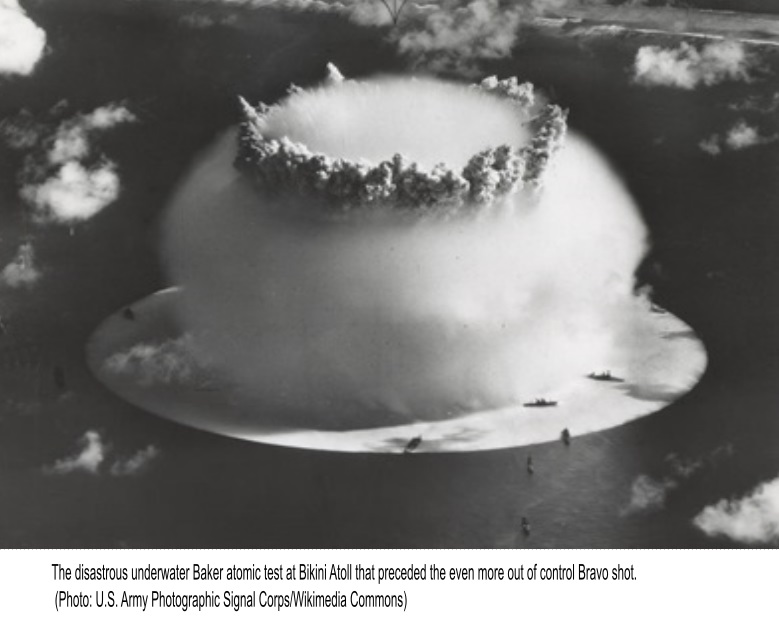
‘Traces of radioactive material were later found in parts of Japan, India, Australia, Europe, and the US,’ says the Atomic Heritage Foundation.
‘This was the worst radiological disaster in US history and caused worldwide backlash against atmospheric nuclear testing.’
Bikini, the colonial spelling of Pikinni, became so radioactive there’s little hope it’ll ever be habitable.
After the Limited Test Ban Treaty of 1963 put an end to atmospheric nuclear testing, this left American officials – and the islands’ displaced citizens – with one option: wait.
The Defence Department concluded in the ’70s that the soil was so contained with cesium-137 and strontium-90 – both taking about three decades to decay, called a half-life – that the best course of action was to just let it rot.
Plutonium-239, however, takes a little longer; 24,000 years. The US dumped 437 plastic bags filled with lumps of plutonium that had spewed after a bomb misfired into a 33-foot crater left behind in 1958 by a nuke on Runit Island.
That, and about 35 Olympic-sized swimming pools’ worth of radioactive soil and nuclear waste.
The crater was plugged up by a 350-foot-wide slab of concrete called the Runit Dome, which locals call ‘The Tomb’, in the ’70s. The dome almost looks like something from a science fiction movie, surrounded by a tropical paradise.
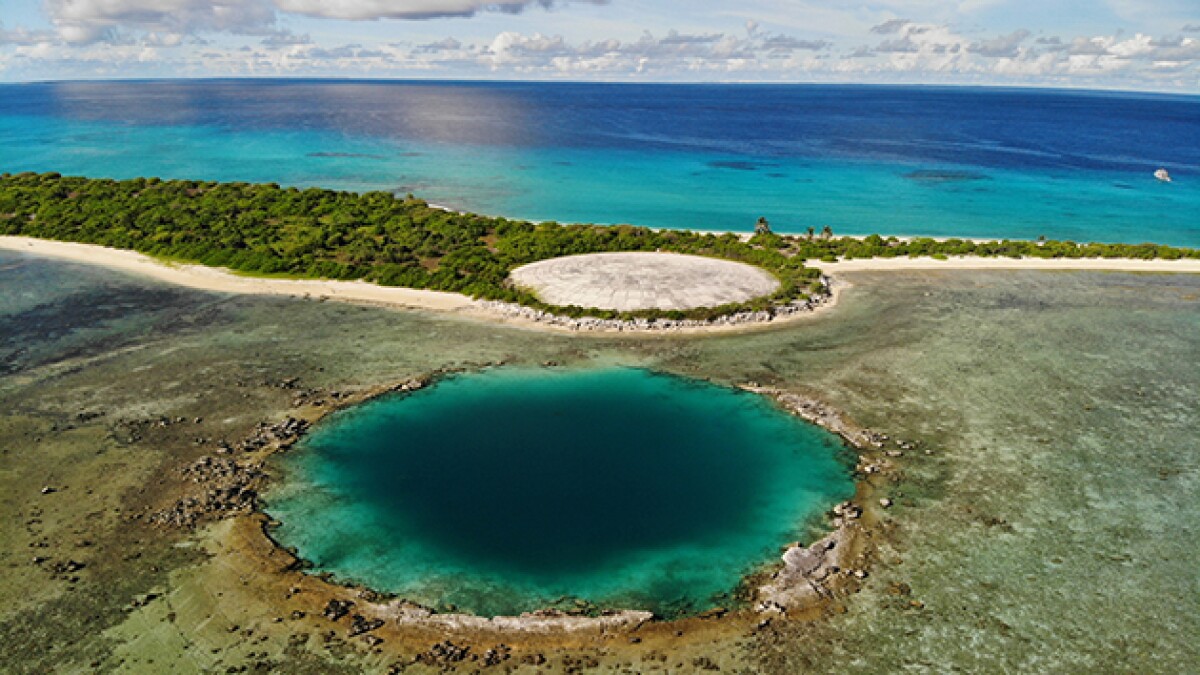
And the dome is leaking. ‘The dome is a significant visible scar on the landscape,’ Ken Buesseler, a marine radioactivity expert at the Woods Hole Oceanographic Institution (WHOI), told Oceans magazine in 2020.
But it’s a relatively small source of radioactivity.’
Overall, more than half of the 167 original inhabitants of Bikini Atoll have died. Some started showing cancers related to radiation exposure in the 1960s, while people living downwind of the explosions suffered burns and low blood counts.
Several generations later, about 5,400 Bikinians are still living in exile. Some live on a lone Pacific island called Kili, roughly 400 miles from Bikini, and others from Honolulu to the ‘Wheat Capital’ of Oklahoma, Enid.
Bikini Atoll largely remains uninhabited, with a tiny caretaker team taking care of the island infrastructure and divers pop in from time to time.
Bikinians continue to fight, however. Lobbying the US Congress for money to redevelop and clean up the place they once called home.
Scientists are hopeful. Remediation efforts include sprinkling affected areas with potassium fertilizer which reduces how much cesium-137 seeps into locally grown crops. How radioactive the soil is has also been decreasing.
The Marshall Islands Program advises that, once resettlement finally begins, a radiation monitoring programme be set up.
‘In this way, the Kili-Bikini-Ejit Local Government and the people of Bikini can be assured that radiological conditions on the islands remain at or below applicable safety standards, and the United States Government can avoid mistakes of the past,’ the programme says.
Ha ha. – Facebook removed my post AGAIN!

Hardly surprising ! –
“We removed your post” – We removed your post – Noel Christina Wauchope Oct 14, 2024
This was the post: FACEBOOK hits a new low – removing a post that congratulated the Nobel Peace Prize winners !
I didn’t read their “reasons”. But I guess, as usual, I have “offended community standards” by saying something negative about nuclear. https://www.nuclearpolicy.info/news/uk-and-ireland-partners-congratulate-2024-nobel-peace-prize-winner/
Oct 14, 2024 We removed your post Noel Christina Wauchope Oct 14, 2024 https://www.nuclearpolicy.info/news/uk-and-ireland-partners-congratulate-2024-nobel-peace-prize-winner/ You shared this on your profile
Literary Institutions Are Pressuring Authors to Remain Silent About Gaza

Requiring authors remain silent about war at the risk of losing their livelihoods is not only ironic but also sinister.
By Lisa Ko , Truthout, October 25, 2024
When writer and disability justice activist Alice Wong received a MacArthur Fellowship earlier this month, she shared a statement about accepting it “amidst the genocide happening in Gaza.” The backlash was swift, with a deluge of posts on X attacking Wong’s character and accusing her of antisemitism.
This conflation of opposition to Israel’s military action with hatred of Jewish people is only one part of a broader wave of political and social repression that is attempting to silence writers speaking out against the war. In the past month alone, authors who have criticized Israel’s ongoing bombardment of Gaza — which is funded largely by the U.S. — have been labeled extremists, been suspended and fired from faculty jobs, and targets of defamation and harassment.
I had my own recent experience with the latter following an incident with the New York State Writers Institute’s Albany Book Festival. ………………………………………………………………………………………………………………………………….. more https://truthout.org/articles/literary-institutions-are-pressuring-authors-to-remain-silent-about-gaza/
‘We have emotions too’: Climate scientists respond to attacks on objectivity
Climate scientists who were mocked and gaslighted after speaking up about
their fears for the future have said acknowledging strong emotions is vital
to their work. The researchers said these feelings should not be suppressed
in an attempt to reach supposed objectivity. Seeing climate experts’
fears and opinions about the climate crisis as irrelevant suggests science
is separate from society and ultimately weakens it, they said. The
researchers said they had been subject to ridicule by some scientists after
taking part in a large Guardian survey of experts in May, during which they
and many others expressed their feelings of extreme fear about future
temperature rises and the world’s failure to take sufficient action. They
said they had been told they were not qualified to take part in this broad
discussion of the climate crisis, were spreading doom and were not
impartial.
Guardian 25th Oct 2024,
https://www.theguardian.com/environment/2024/oct/25/we-have-emotions-too-climate-scientists-respond-to-attacks-on-objectivity
Nuclear Energy Firm Orano Halts Niger Uranium Production

By Boureima HAMA avec Nathalie ALONSO à Paris, October 24, 2024, https://www.barrons.com/news/nuclear-energy-firm-orano-halts-niger-uranium-production-ed2fd6b6
French nuclear fuel firm Orano said on Wednesday it was halting its uranium production in junta-ruled Niger from October 31, citing a “highly deteriorated” situation and its inability to operate.
The Nigerien government, whose leader Abdourahamane Tiani seized power in a July 2023 coup, has previously made clear it would overhaul rules regulating the mining of raw materials by foreign companies.
Orano-owned mining subsidiary “Somair’s worsening financial difficulties have compelled the company to suspend its operations,” in the Artlit region of north Niger where Orano has operated since 1971, the French group’s Paris spokeswoman told AFP on Wednesday.
The Sahel nation’s military rulers have turned their backs on Paris, ordering French troops deployed there to leave and instead forging ties with fellow juntas in Burkina Faso and Mali — as well as Iran and Russia.
Niger’s position as the world’s seventh-largest uranium producer plays an important role in the shifting relations.
Iran has significantly increased its stock of enriched uranium in recent months, while strengthening ties with Niger, according to the International Atomic Energy Agency.
The production of uranium concentrate will cease from October 31 as Orano was unable to export the commodity, in part due to landlocked Niger’s closed border with coastal Benin, the firm said.
“Despite all the efforts deployed” with the military regime “to try and resolve the situation” and obtain export licenses, “all of our proposals were left unanswered”, said the spokeswoman of the group, which specialises in nuclear fuel.
Nigerien authorities did not follow up on an Orano proposal to export uranium by air via Namibia.
“Maintenance will continue but there will be no more production,” she added.
Nigerien authorities did not comment on the matter.
Niamey in June rescinded Orano’s licence to operate in one of the largest deposits in the world, Imouraren, with estimated reserves of 200,000 metric tonnes (220,000 US tons).
Niger’s Council of Ministers on September 19 passed a draft decree proposing to create a state company named “Timersoi National Uranium Company”, without detailing the move.
1 This Month
23-25 October – on Zoom – World BEYOND War’s annual global conferenc


Shut down the radiation-damaged Heysham nuclear reactors now
To see nuclear-related stories in greater depth and intensity – go to https://nuclearinformation.wordpress.com

Say No to NASA’s Reckless Nuclear Reactor on the Moon
Say No to NASA’s Reckless Nuclear Reactor on the Moon
-
Archives
- October 2026 (170)
- September 2026 (339)
- August 2026 (330)
- July 2026 (355)
- June 2026 (287)
- May 2026 (306)
- April 2026 (356)
- March 2026 (251)
- February 2026 (267)
- January 2026 (308)
- December 2025 (358)
- November 2025 (359)
-
Categories
- 1
- 1 NUCLEAR ISSUES
- business and costs
- climate change
- culture and arts
- ENERGY
- environment
- health
- history
- indigenous issues
- Legal
- marketing of nuclear
- media
- opposition to nuclear
- PERSONAL STORIES
- politics
- politics international
- Religion and ethics
- safety
- secrets,lies and civil liberties
- spinbuster
- technology
- Uranium
- wastes
- weapons and war
- Women
- 2 WORLD
- ACTION
- AFRICA
- Atrocities
- AUSTRALIA
- Christina's notes
- Christina's themes
- culture and arts
- Events
- Fuk 2022
- Fuk 2023
- Fukushima 2017
- Fukushima 2018
- fukushima 2019
- Fukushima 2020
- Fukushima 2021
- general
- global warming
- Humour (God we need it)
- Nuclear
- RARE EARTHS
- Reference
- resources – print
- Resources -audiovicual
- Weekly Newsletter
- World
- World Nuclear
- YouTube
-
RSS
Entries RSS
Comments RSS

