Compelling Economics of Renewables Unmask Fossil Fuels and Nuclear
Posted to Energy November 07, 2024, by Francesco La Camera, Paul Dorfman,
https://dcjournal.com/compelling-economics-of-renewables-unmask-fossil-fuels-and-nuclear/
The renewable energy revolution is happening, but it is running too slow.
Renewables set a record in 2023 with 473 gigawatts added. Yet, we need to triple capacity by 2030 to stay aligned with the Paris Agreement.
While renewables are overtaking fossil fuels and nuclear as the primary choice for new power, the transition isn’t fast enough to limit global warming. In fact, renewable power capacity must triple by 2030, as recommended by International Renewable Energy Agency and agreed on by world leaders in the UAE Consensus at the last U.N. Climate Conference in Dubai.
Peaking fossil fuels is not enough; we need deep and rapid carbon dioxide cuts in the limited time we have to keep within our vanishingly small carbon budget.
The choices we make about the use of technologies will largely determine the success of our climate actions. We need low-carbon, or even no-carbon technologies. The concept of technology neutrality, understood as the capacity to cut carbon dioxide emissions, should also include the dimensions of costs and the time needed to reach the desired outcome.
Recently, nuclear energy has attracted attention as a technology to cut emissions and diversify energy supplies.
We are not challenging the choice of technology as a matter of national sovereignty. Instead, energy technologies (nuclear, renewables, fossil fuels) are compared in the context of the fight against climate change, where time is the most relevant variable.
According to the Intergovernmental Panel on Climate Change, accelerating renewables coupled with energy efficiency measures are the most realistic means to reduce global emissions by 43 percent by 2030 and at least 60 percent by 2035.
Due to lower cost and higher efficiency, the IPCC has stated that renewables, particularly solar and wind, are ten times more effective at cutting carbon dioxide emissions than nuclear.
Nuclear’s share of global electricity production has almost halved from 1996 to 2023, largely due to the high costs of, and delays to, building and operating nuclear reactors. Far from improving, the latest nuclear reactor designs offer the worst-ever record of delays and cost escalation.
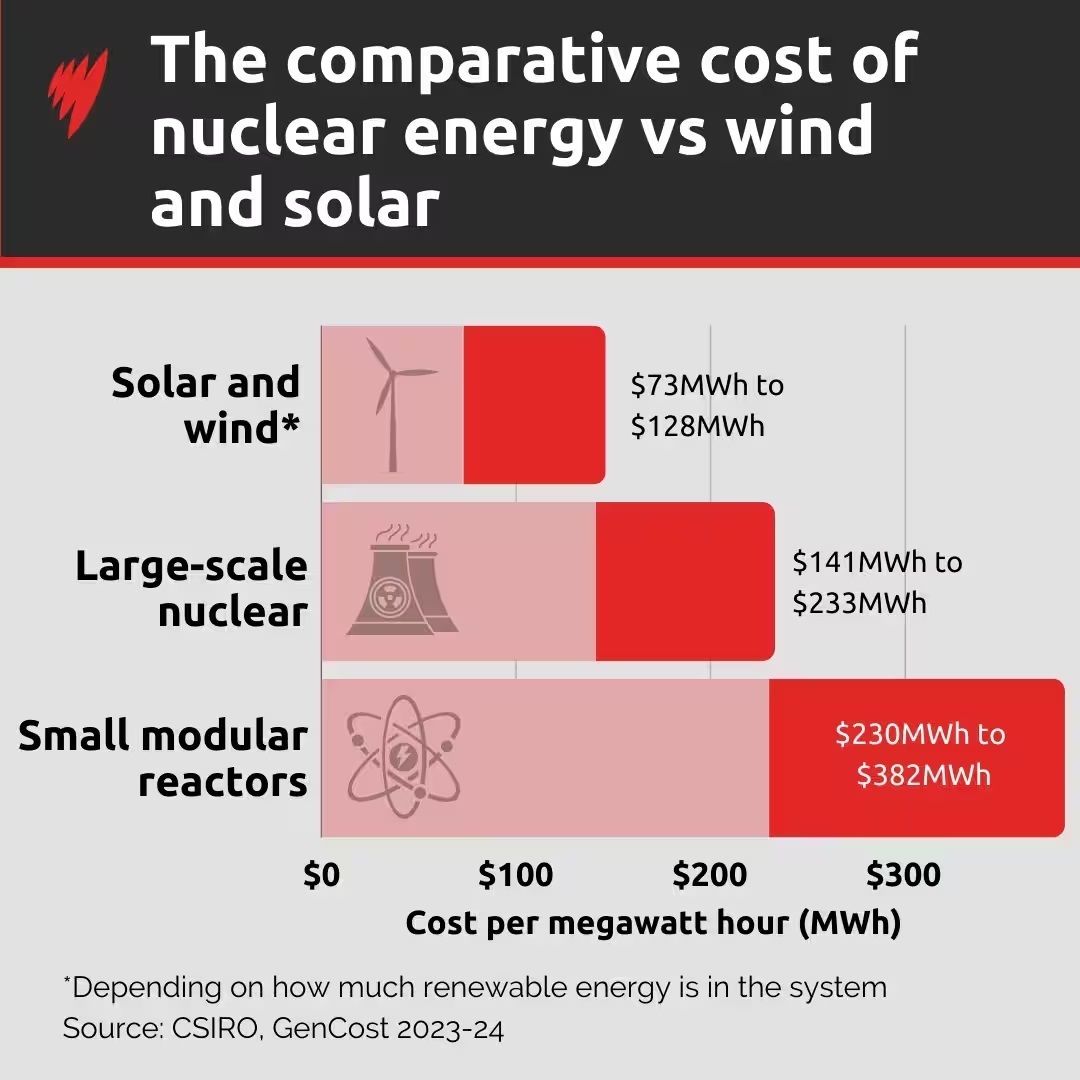
According to studies from Stanford University, new nuclear power plants cost 2.3 to 7.4 times those of onshore wind or solar per kilowatt-hour of electricity, take five to 17 years to deploy, and produce nine to 37 times the emissions per kilowatt-hour as wind.
New nuclear adds only as much electricity in a year as renewables add every few days. For example, China is now installing wind and solar capacity equivalent to five new nuclear reactors weekly.
Nuclear delivers far less power per dollar.
Because of significant costs and delays, the emphasis has moved to small modular reactors (SMRs). Their economics are costly and share the same significant security and waste problems. To date, several key SMR projects have fallen by the wayside.
Instead of wasting money on expensive non-renewable technologies, limited financial resources should be channeled into realistic solutions to climate change, including electrification; the expansion of renewables across all sectors; expansion and modernization of grids; storage, efficiency solutions and smart demand-side management.
The last decade represents a seismic shift in the balance of competitiveness between renewable technologies and incumbent fossil options.
The notion that renewables are expensive is outdated. According to IRENA data, 81 percent of the record renewable additions in 2023 were cheaper than fossil fuel and nuclear alternatives.
The total renewable power capacity deployed globally since 2000 has saved $409 billion in fuel costs in the power sector.
Factoring in the wider economic and environmental benefits of renewable power in reducing fossil fuel imports, improving a country’s balance of payments and enhancing security of affordable energy supply by reducing exposure to volatile fossil fuel prices in global markets makes it even more compelling.
The world is increasingly rallying behind renewables to do the heavy lifting for the net-zero energy transition. We have the knowledge, the technology and the means. We are fully equipped to adjust the trajectory of the transition and reduce the carbon footprint of the global energy system.
We must move faster.
Biden Team Wants To Rush Weapons Shipments to Ukraine Before Trump Inauguration

The administration wants to exhaust $6 billion in remaining military aid
by Dave DeCamp November 6, 2024. https://news.antiwar.com/2024/11/06/biden-team-wants-to-rush-weapons-shipments-to-ukraine-before-trump-inaguration/
—
The Biden administration is preparing to rush over $6 billion in military aid to Ukraine before Inauguration Day, POLITICO reported on Wednesday.
The report said the Biden team expects the incoming administration to end the weapons flow, as President-elect Donald Trump campaigned on ending the proxy war.
The Biden administration has $4.3 billion in military aid that can be pulled from existing US stockpiles, known as the Presidential Drawdown Authority. There is also $2.1 billion available in the Ukraine Security Assistance Initiative, which provides money to put weapons under contract, meaning it takes longer to deliver.
Biden officials are unsure if they’ll be able to rush all the aid to Ukraine before January 20 since any military equipment they send must be replaced, and it’s unclear if production levels are high enough to ship so many weapons in such a short period of time.
“We have been sending whatever industry can produce each month, but the problem is you can only send these things as they are produced,” Mark Cancian, a former Pentagon budget official, told POLITICO. “The administration could dip into the stockpiles and send equipment more quickly, but it’s unclear the Pentagon would want to do that since it would affect its own readiness.”
Even if the weapons are sent from US military stockpiles, the actual delivery time could still take months, and Biden officials are worried the next administration could cancel them before they arrive in Ukraine.
Can Trump 2.0 defuse the nuclear threat? These Washington heavyweights fear not

The concern about Trump rests on his chaotic and erratic method of decision-making and his personal preference for dictators over democrats – for America’s traditional enemies over its allies.
Peter Hartcher, November 9, 2024
Political and international editor
Bob Woodward is doing his best to remain optimistic in the face of an impending second Donald Trump presidency. “Don’t give up on America’s democracy!”
But when the topic turns to the president’s unique responsibility for US nuclear strategy, his sunny outlook grows dim.
“It’s frightening,” says the noted American journalist and close student of the last 10 US presidents. “We are all walking on eggshells,” Woodward tells me. “Trump is totally unpredictable, he never plans, he operates on instinct.”
Not necessarily because he fears that Trump will recklessly fire off atomic weapons but because he worries about Trump’s ability to deter other powers from doing so.
Woodward, whose initial fame was in breaking the Watergate stories with co-author Carl Bernstein, has interviewed Trump dozens of times over 35 years, and chronicled his political career in four books ripe with insider anecdotes.
Woodward was most impressed with Joe Biden’s management of the nuclear threat from Russia two years ago when Vladimir Putin was threatening to attack Ukraine with a tactical, or battlefield, nuclear weapon. He sets out in detail in his new book, War, how Biden’s administration confronted Moscow, including a phone call from the US Defence Secretary, Lloyd Austin, to his Russian counterpart, Sergei Shoigu:
“It wouldn’t matter how small the nuclear weapon is,” Austin told Shoigu, according to the transcript of the call that Woodward obtained. “If you do this, it would be the first use of nuclear weapons anywhere in the world in three-quarters of a century and it could set in motion events that you cannot control and we cannot control.”
The US would review all the self-imposed restraints it had imposed in supporting Ukraine’s war effort, Austin told him.
Separately, Biden called Xi Jinping to enlist his help. China’s economic support keeps Russia solvent through its war. So Xi’s opinion matters in the Kremlin.
“If Putin were to break the seal on nuclear use, that would be an enormous event for the world,” Biden told Xi, according to the book. China’s president agreed and undertook to warn Putin off. He did so publicly when he said: “Nuclear wars must not be fought.”
America’s Cold War-era plans for nuclear and conventional escalation with the Soviet Union were reworked and refitted for war with Putin’s Russia.
Woodward says he was shocked to learn that, during this episode, the US intelligence assessment of the risk that Putin would actually use a battlefield nuke had started at a 10 per cent chance but peaked at 50 per cent. Putin, of course, ultimately did not act on his threat.
The Biden administration showed “unique, steady, purposeful, informed leadership” in handling the risk from Russia, says Woodward. “It’s a road map for how you avoid a nuclear catastrophe.”
He adds: “There is nothing steady and there is nothing purposeful in Donald Trump’s leadership. He’s focused on himself and his own instinct.”
…………………………………………………………………………..The concern about Trump rests on his chaotic and erratic method of decision-making and his personal preference for dictators over democrats – for America’s traditional enemies over its allies.
But there is a new factor that Trump will have to confront. “All of US Cold War nuclear strategy was bipolar – it was the US and the USSR,” Woodward says. “With China’s rapid nuclear build-up, strategy will have to be tripolar.”
So a president given to simplistic plans and impulses must deal with a whole new level of nuclear complexity for which neither he nor the US system is yet equipped. Woodward need not fear contradiction on this point: “This is such a dangerous time.” https://www.theage.com.au/world/north-america/can-trump-2-0-defuse-the-nuclear-threat-these-washington-heavyweights-fear-not-20241108-p5kp0n.html
Robot Removes First Bit Of Fukushima’s Nuclear Fuel Debris – Just 880 Tons More To Go

The radioactive ruins are still far too dangerous for humans.
Tom Hale, IFL Science 6th Nov 2024, https://www.iflscience.com/robot-removes-first-bit-of-fukushimas-nuclear-fuel-debris-just-880-tons-more-to-go-76669
robot has delved into the radioactive ruins of Fukushima to retrieve a tiny chunk of spent nuclear fuel. It’s the first time solid fuel debris has been removed from the plant – but they’ve still got a hell of a long way to go: 880 tons of the stuff to be precise.
The remotely operated robotic arm, equipped with a telescopic camera, was able to grasp and retrieve a “small amount of fuel debris” from the floor of Unit 2’s reactor on October 30, according to the plant’s operator Tokyo Electric Power Company Holdings (TEPCO).
“From the results of primary containment vessel internal investigations, we have deduced that the accumulated debris on the surface of the floor inside the pedestal is solidified molten material that consists of fuel elements and also may contain a lot of metal,” TEPCO said in a statement.
The fuel debris will now be taken away from the Fukushima site where scientists will analyze it to gain further insight into how to remove the rest of the debris.
“By analyzing the attributes of the sampled fuel debris we will directly ascertain information such as the composition of debris at the sampling location and radioactivity density,” added TEPCO……………………………………………………………..
It’s estimated that the three impacted reactors contain an estimated total of 880 tons of melted fuel debris, all of which TEPCO hopes to remove during their decommissioning effort by the year 2031. The latest retrieval of a small chunk of radioactive debris is just the beginning of the mammoth feat ahead.
Along with solid debris, the decommissioning project has also had to deal with the colossal quantities of radioactive water that accumulated after being used to cool the damaged reactor cores. In August 2023, Japan began releasing some of the treated wastewater into the Pacific Ocean, much to the annoyance of their neighbors.
TEPCO has expressed hope the entire clean-up operation will be completed in 30 to 40 years, although some speculate the target is overly optimistic.
Senior Journalist
1
UK budget outlines nuclear power plans (new nuclear not a high priority)
Nuclear Engineering International 5th Nov 2024
The first budget of the UK Labour Government included decisions related to both the Sizewell C NPP and to plans for small modular reactors (SMRs). However, this was clearly not a high priority in the 170-page budget. The small eight paragraph section on the Department for Energy Security & Net Zero (DESNZ) included just two short paragraphs on nuclear.
DESNZ was allocated total funding of £14.1bn ($18.2bn) in 2025-26 up 22.0% from 2023-24. The main paragraph (4.75) notes that “Making Britain a clean energy superpower is one of the five missions of this government. Great British Energy (GBE) will be at the heart of the mission.” GBE is allocated £100m million capital funding in 2025-26 “for clean energy project development” and £25m to establish GBE as a company, headquartered in Aberdeen. Investment activity will be undertaken by the National Wealth Fund, “helping it to make initial investments as quickly as possible”.
The budget says “new nuclear will play an important role in helping the UK achieve energy security and clean power while securing thousands of good, skilled jobs” (para 4.80). It provides £2.7bn to continue development of Sizewell C through 2025-26. “The process to raise equity and debt for the project will shortly move to its final stages and will conclude in the Spring. As with other major multiyear commitments, a Final Investment Decision (FID) on whether to proceed with the project will be taken in Phase 2 of the Spending Review.” Phase 2 is expected in the Spring.
However, on 30 August DESNZ announced a Sizewell C Development Expenditure (Devex) Scheme that would benefit from up to £5.5bn in subsidies to get to a FID with support mainly comprising equity injections by the UK government. The £2.7bn announced in the budget is not new funding and would be taken either from £5.5bn already made available or through a separate subsidy scheme that would be established at the point of the FID.
Sizewell C, in Suffolk, is expected to host two EPR reactor units producing 3.2 GWe similar to the Hinkley Point C plant, under construction in Somerset. EDF Energy submitted a development consent order (planning application) for the plant in May 2020, which was granted in July 2022. In March 2023, the Environment Agency granted environmental permits for the plant.
The UK government in August 2023 made available a further £341m of previously allocated funding to help prepare the site for construction on top of the government’s existing £870m investment made available from the DESNZ Capital Budgets. EDF said in November 2022 that construction of Sizewell C remained subject to a FID that depended on the achievement of certain key stages, in particular the ability to raise the necessary financing. DESNZ said that, subject to receiving the relevant approvals, the government said then it was aiming to reach FID before the end of 2024. However, the FID will now be taken in Phase 2 of the Spending Review.
The decision was criticised by opponents of the Sizewell C project. Alison Downes from Stop Sizewell C noted: “For a government that criticised the opposition for playing fast and loose with the nation’s finances, the Chancellor is surprisingly happy to do the same, allocating another £2.7bn of taxpayers’ money on risky, expensive Sizewell C, without making any guarantee of a Final Investment Decision being taken.
Jenny Kirtley, Chair of Together Against Sizewell C described the decision as appalling. “It’s staggering that Labour, even though they cast doubt about the future of the project by stating, “a Final Investment Decision on whether to proceed with the project will be taken in Phase 2 of the Spending Review”, have increased the outlay of UK taxpayer funds on EDF’s Sizewell C white elephant by a further £2.7bn.”
On SMRs, the Budget said: “Great British Nuclear’s (GBN’s) Small Modular Reactor competition is ongoing and has entered the negotiation phase with shortlisted vendors.” (para 4.81). In September, GBN concluded the initial tender phase of the competition and down-selected four companies – GE-Hitachi Nuclear Energy International, Holtec Britain, Rolls-Royce SMR, and Westinghouse Electric Company UK. GBN then said it expected the final decision on the technologies to be supported would be taken by the end of the year. It had previously been set for summer 2024. The Budget has now deferred that decision until the Spring 2025………………
https://www.neimagazine.com/news/uk-budget-decision-on-sizewell-c-and-smrs/
Hinkley workers ‘unfair’ pay claim leads to action
Workers involved in the construction of the Hinkley Point nuclear power
plant have started industrial action after claiming they are being paid
unfairly. Employed by the firm Alten – a supplier for EDF’s Hinkley Point C
– the workers say they have not had a cost of living pay rise in four
years. They walked out of their Bristol office for 24 hours on Tuesday and
have now begun action which Prospect Union described as “short of a
strike”.
BBC 7th Nov 2024,
https://www.bbc.co.uk/news/articles/ckgdlg1ql5no
Report: Trump Plans UK-Style Attack on Israel Criticism

The Washington Post reported in May that Trump told donors in New York that he would deport foreign students if they demonstrate for Palestine. “One thing I do is, any student that protests, I throw them out of the country. You know, there are a lot of foreign students. As soon as they hear that, they’re going to behave,” Trump told the donors, the Post reported.
Their aim is to crush the anti-genocide movement within 12 to 24 months.
November 4, 2024, Consortium News. more https://consortiumnews.com/2024/11/04/report-trump-plans-uk-style-attack-on-israel-criticism/
Joe Lauria says the Heritage Foundation’s “Project Esther,” as covered by Drop Site News, replicates the U.K.’s use of a terrorism law to criminalize pro-Palestine speech and activism.
A second Trump administration could criminalize criticism of Israel’s genocide in Gaza as support for terrorism, along the lines of the British Terrorism Act, according to a report in Drop Site News.
The report says the plan is to “break the pro-Palestinian movement in the U.S.”
“The plan, dubbed ‘Project Esther,‘ casts pro-Palestinian activists in the U.S. as members of a global conspiracy aligned with designated terrorist organizations. As part of a so-called ‘Hamas Support Network,’ these protesters receive ‘indispensable support of a vast network of activists and funders with a much more ambitious, insidious goal — the destruction of capitalism and democracy,’ Project Esther’s authors allege.
This conspiratorial framing is part of a legal strategy to suppress speech favorable to Palestinians or critical of the U.S.-Israel relationship, by employing counterterrorism laws to suppress what would otherwise be protected speech, legal experts told Drop Site News.”
The authors of the plan are part of the right-wing Heritage Foundation’s Project 2025, Drop Site says. Former President Donald Trump has tried to distance himself from Project 2025 but he is a strong supporter of Israel, having moved the U.S. embassy to Jerusalem and accepted Israel’s annexation of Syria’s Golan Heights, considered illegal by the U.N. Security Council.
The Washington Post reported in May that Trump told donors in New York that he would deport foreign students if they demonstrate for Palestine. “One thing I do is, any student that protests, I throw them out of the country. You know, there are a lot of foreign students. As soon as they hear that, they’re going to behave,” Trump told the donors, the Post reported.
The report in Drop Site News, written by Ryan Grim and Murtaza Hussain, quotes an attorney at Palestine Legal as saying that
“concepts like the ‘Hamas Support Network’ or ‘Hamas Supporting Organizations,’ another term that the authors use to describe pro-Palestinian activist groups, is intended to construct a narrative justifying the use of counterterrorism and sanctions laws to suppress the First Amendment rights of individuals involved in the pro-Palestine movement …”
‘They need to make a claim that these organizations are being directed and controlled by Hamas, which they’re not,’ attorney Dylan Saba said. ‘So their claim now is that these organizations are effectively serving as a propaganda wing for designated terrorist organizations.’”
This is precisely what the British government has been doing.
2000 Terrorism Act
Using the 2000 Terrorism Act, authorities have been stopping journalists and activists at border entry points to interrogate them, sometimes arresting them, or conducting raids on their homes all because they dare expose and condemn Israel’s ongoing barbarism in Gaza and now Lebanon and misconstrue it as support for proscribed organizations, namely Hamas and Hezbollah.
Among those interrogated under the Terrorism Act for this purpose have been Craig Murray, writer, former British diplomat, new Consortium News board member; journalist Richard Medhurst who was held in a cell for 24 hours; and Asa Winstanley, an editor at Electronic Intifada whose home was raided by counterterrorism police.
[See: Police Escalate Britain’s War on Independent Journalism]
As Trump wins we could expect the same thing as is happening in the U.K. from his second administration, according to Drop Site News.
“To achieve its goals, Project Esther proposes the use of counterterrorism and hate speech laws, as well as immigration measures, including the deportation of students and other individuals,” Drop Site News reported.
The draconian measures being planned also include using racketeering laws “to help construct prosecutions against individuals and organizations in the movement,” the site reported.
[Related: Georgia Frames Cop-City Protest as Criminal Conspiracy]
The project would first attempt to purge “propaganda” from schools, then intimidate students not to take part in protests. This process is expected to lead to a point where “both the U.S. public and a preponderance of Jewish community perceives HSOs” — short for Hamas Support Organizations — “as a threat to their safety.”
Their aim is to crush the anti-genocide movement within 12 to 24 months.
As with most things in the duopoly, the Biden administration has given Trump a head start by designating a Palestinian prisoner support group named Samidoun a terrorist organization, the site says.
Israel has been accusing any critic of being pro-Hamas, such as how they smeared U.N. Secretary-General Antonio Guterres. Or they accuse you of being part of Hamas. What is even more disturbing is that Western governments have taken up these ludicrous claims to ensure Israel remains above criticism while it openly commits genocide.
It is one of the most transparent tricks going back millennia for a government to smear its legitimate critics as being card-carrying members of its most ardent enemies — and Western governments are willfully falling for it, criminalizing journalists who oppose the slaughter.
If Trump follows through with this plan he will be totally abrogating the First Amendment, which is supposed to separate the U.S. from the country it rebelled against a long time ago.
The Evil Warmongering Zionist Won (No Not That One, The Other One)
Caitlin Johnstone, Nov 06, 2024,https://www.caitlinjohnst.one/p/the-evil-warmongering-zionist-won?utm_source=post-email-title&publication_id=82124&post_id=151266086&utm_campaign=email-post-title&isFreemail=true&r=1ise1&triedRedirect=true&utm_medium=email
The Democratic Party has lost control of both the White House and the Senate. As of this writing it is still unclear which party will secure control of the House of Representatives. Turns out campaigning on the promise of continuing a genocide while courting endorsements from war criminals like Dick Cheney is not a great way to get progressives to vote for you.
One interesting point is that Donald Trump appears to have taken the battleground state of Michigan, where Kamala Harris was soundly rejected by the large Arab American population of Dearborn despite their voting overwhelmingly for Biden in 2020. Back in August, Harris famously shushed Muslim anti-genocide protesters at a campaign rally in Michigan by admonishing them with the words “I’m speaking”.
Well, who’s speaking now?
To be clear, this is not a good result. A good result was not possible this election. The warmongering Zionist genocide monster lost, which means the other warmongering Zionist genocide monster won.
Donald Trump is still bought and owned by Adelson cash, which means we can expect him to be just as much of a groveling simp for Israel as he was during his first term. The president elect has publicly admitted that when he was president the Zionist plutocrats Sheldon and Miriam Adelson were at the White House “probably almost more than anybody” asking him to do favors for Israel like moving the US embassy to Jerusalem and acknowledging Israel’s illegitimate claim to the Golan Heights, which he eagerly did.
Trump closed out his campaign tour alongside his former CIA director and secretary of state Mike Pompeo, which should be enough to dash the hopes of even the most naive Trump supporters that US foreign policy is headed in a positive direction in January. As CIA director, Pompeo led a plot to assassinate Julian Assange and cheerfully admitted that “we lied, we cheated, we stole” at the agency. This odious swamp creature has remained in Trump’s good graces for the last eight years, and is reportedly expected to have a position in Trump’s cabinet once again.
Speaking at a campaign event in Pittsburgh on Monday, Pompeo boasted that he has been called “the most loyal cabinet member to Donald J Trump” and said that when Trump is re-elected “we will take down the ring of fire; we will support our friends in Israel.” The “ring of fire” is think tank speak for Iran and the militias in Lebanon, Iraq, Syria, Yemen and Palestine who oppose Israel.
So things are probably going to get uglier and uglier. But they were getting uglier and uglier under Biden, and they would have gotten uglier and uglier under Harris as well. That’s just what it looks like when you’ve got a dying empire fighting to retain planetary control like a cornered animal. You don’t get to be the US president unless you are willing and eager to do ugly things.
Democrats exaggerate how destructive Trump is relative to their own bloodthirsty psychopath candidates. While we can expect Trump to inflict tyranny and abuse upon Americans, it will be nothing compared to the tyranny and abuse he’s going to inflict on people in other countries, and it will be nothing compared to the tyranny and abuse his predecessor has been inflicting on people in other countries. All the histrionic shrieking we see from US liberals about Trump only works inside a western supremacist worldview that does not see the victims of US warmongering as fully human, and therefore sees scorched earth genocidal atrocities as less significant than comparatively minor abuses concerning US domestic policy.
Abandon hope that any positive changes will come from this election result
Abandon hope that Trump will do good things.
Abandon hope that Democrats will learn any lessons from this loss.
Abandon hope that liberals will suddenly remember that genocide is bad and start protesting against the US-backed slaughter in Gaza.
Abandon hope in US election results, period.
US elections do not yield positive results. They are not designed to benefit ordinary human beings.
Nothing changes for those of us who are dedicated to fighting against the abuses of the US empire. It will be the same fight after January 20 as it was on January 19. We fight on.
With Trump back in White House, can Ukraine opt for nuclear deterrence?
Experts say Ukraine is capable of producing nuclear weapons as a deterrent against Russia within years, but the political costs would be too high
by Oleg Sukhov, November 6, 2024
With the looming risk that U.S. President-elect Donald Trump may pull the plug on Washington’s support for Ukraine, Kyiv has flirted with the option of nuclear deterrence.
The prospect of such a scenario was raised weeks earlier when President Volodymyr Zelensky in October said he had told Trump during a September meeting in New York City that Ukraine would either join NATO or develop nuclear weapons.
Zelensky claimed that Trump had heard him and said that “it was a fair argument.”
He later walked back that statement, saying that Ukraine was not pursuing nuclear weapons.
However, Zelensky’s statement prompted speculation on whether a Ukrainian nuclear weapons program is realistic from technological and political standpoints.
Experts say that Ukraine is capable of producing at least a primitive nuclear weapon within years, although it would require considerable investment.
What Netanyahu’s firing of Yoav Gallant means for Gaza, Israel’s regional war, and the US-Israel relationship
Benjamin Netanyahu’s firing of Defense Minister Yoav Gallant has removed the one minor restraint on expanding Israel’s regional war against Iran and the axis of resistance. International pressure to stop Israel is needed now more than ever.
Mondoweiss, By Mitchell Plitnick November 5, 2024
In a move that has been brewing for many months, Israeli Prime Minister Benjamin Netanyahu has fired his Defense Minister Yoav Gallant. He will be replaced as Minister of Defense by Foreign Minister Yisrael Katz, who will, in turn, be replaced as Foreign Minister by Gideon Sa’ar.
While Gallant has been on Netanyahu’s “hit list” for a long time, he has been reluctant to replace the Defense Minister while Israel is involved in so many significant military operations. So, why did he do it now?
Domestic considerations
Netanyahu’s decision has nothing to do with military concerns, but with domestic politics. His coalition is currently being rocked by controversy over a bill strongly supported by the United Torah Judaism party that would allow ultra-orthodox (referred to as Haredi) men who refuse to serve in the Israeli military to continue to receive childcare benefits. The underlying purpose of the bill is to get around new laws requiring that Haredim, who have long been exempt from compulsory military service, serve like other citizens.
Katz was transparently appointed so Netanyahu would effectively have full control over the Defense Ministry, while Gallant’s firing was retribution and a very loud warning to anyone from his governing coalition who might consider going against him on crucial legislation. ……………………………………………………………………………………..
What it means in the region
With Gallant out of the picture, and Netanyahu now surrounded by his people, the imperative for major international pressure is even more intense. Gallant, who has no problem slaughtering innocent Palestinians by the tens of thousands, still saw matters through a security lens, albeit a vicious and brutal one.
……………………………………………… Netanyahu will have successfully removed a “renegade” in Gallant and will face even less restraint than he did before, hard as that it is to imagine.
What it means in Washington
Yoav Gallant was the main point of communication between Joe Biden’s administration and the Netanyahu government. …………………………………………………………..
……..With Gallant gone, Netanyahu will be even less concerned about Biden’s feeble words of sympathy
…………………………………………………………………Netanyahu has routinely found ways to resolve issues like this over the past fifteen years. And if he does, it is likely that he will have further insulated himself from any possibility of American pressure to curb his aggression in Gaza, Lebanon, and beyond. https://mondoweiss.net/2024/11/what-netanyahus-firing-of-yoav-gallant-means-for-gaza-israels-regional-war-and-the-us-israel-relationship/
Is Israel using depleted uranium to bomb Lebanon?
Israel’s unprecedented use of a massive number of bunker-buster bombs in Lebanon has raised concerns that it is using depleted uranium in its ongoing bombardment. We need an impartial investigation given the potentially disastrous consequences.
By Anis Germani November 4, 2024, https://mondoweiss.net/2024/11/is-israel-using-depleted-uranium-to-bomb-lebanon/?ml_recipient=137165956795335710&ml_link=137165936887072401&fbclid=IwY2xjawGXei9leHRuA2FlbQIxMAABHeMNKVpn62nSWqD9WDPP1iK1N2YJzh9qBDM7m78ZRp5LF5KqhzhsYn_ILg_aem_EcuA81vJxztXtRoa8hJsGw
Following Israel’s violent bombing of the southern suburb of Beirut, the Syndicate of Chemists in Lebanon issued a statement on October 5 warning against Israel’s possible use of depleted uranium. The Syndicate cited the extensive urban destruction and the penetrative capacity of Israeli missiles, capable of burrowing through buildings and creating craters tens of meters deep as grounds for suspecting depleted uranium use.
The following day, the Lebanese Ministry of Public Health quickly warned against making assumptions without verified evidence, stating no solid proof had been collected so far. The Lebanese Atomic Energy Commission also urged caution, acknowledging the legitimacy of these concerns and planning field radiation surveys with the Lebanese army once security allowed. It was not until October 19 that the Atomic Energy Commission was able to extract two samples from the southern suburb of Beirut, one of them being from the site of the assassination of Hassan Nasrallah. Preliminary results were supposed to be announced on October 25, but to this day, no such announcement has been made.
The potential repercussions of depleted uranium (or DU) use for human health and the environment are so severe that any suspicion, however remote, must be thoroughly investigated. DU is typically suspected when bunker-buster or armor-piercing ammunition is deployed. Israel is particularly suspect given its historical record of using prohibited weapons — including during its current war on Lebanon — and its means to use DU. Although only a scientific investigation can conclusively confirm or refute Israel’s use of DU in Lebanon, how likely is it that Israel deployed DU in its recent attacks?
What is depleted uranium, and why is it dangerous?
Uranium is a rare, radioactive element found naturally in the crust of the earth requiring costly extraction. It consists of three isotopes (U-234, U-235, and U-238), only two of which are useful for producing nuclear energy and bombs. The third isotope, U-238, is unsuitable for nuclear fission, but because the former two are rare, raw uranium must be “enriched” by extracting these components, leaving U-238 as waste — uranium that has been depleted, or DU.
In the 1970s, DU properties were found useful for military use. Its high density (1.7 times that of lead) and low cost (since it is a byproduct of uranium enrichment) incentivized its use in tank armor and armor-piercing ammunition. Israel is thought to have tested DU on Egyptian forces during the 1973 October War, and the U.S. added it to its arsenal in 1977. DU rose to prominence in the military as well as public debates during the 1991 Gulf War and subsequent conflicts.
DU poses significant health and environmental risks. While not classified as a nuclear weapon, it emits alpha radiation, which can cause severe cancers, birth defects, and organ failure if ingested, inhaled, or embedded in the body through shrapnel. Radioactive particles from fired munitions disintegrate to dust on impact and contaminate the air, water, soil, and food chain, making radiation difficult to contain.
Small radioactive particles can be carried far from the battlefield. A 2006 study detected radioactive contamination in Europe following the use of DU in Iraq. DU has a half-life of 4.5 billion years, meaning its radioactivity persists indefinitely, making it a long-term environmental hazard.
Confirming Israel’s definitive use of DU in Lebanon can only be done through sample analysis. However, the likelihood of its use can still be gauged based on the strategies used by the anti-DU movement in the 1990s.
Israel’s arsenal
Assessing the likelihood of DU use starts by identifying the bombs deployed by Israel. This can be done through records of weapon shipments, images of bombs on fighter jets, and bomb patents.
The UN documented Israel’s use of GBU-31, GBU-32, and GBU-39 bunker-buster bombs in Gaza. In December 2023, the U.S. sent 100 BLU-109 warheads to Israel (having also sent DU munitions to Ukraine two months prior). Patents reveal that BLU-109 warheads are a component of GBU-31 bombs and can be made of DU or tungsten, the former being the cheaper option. An analysis of the footage of the F-15 jets that carried out the assassination of Hassan Nasrallah revealed they were carrying GBU-31 bombs.
War correspondent Elijah Magnier argues that Israel does not need to use DU, given its use of advanced cluster and thermobaric bombs, which can cause equivalent destruction. The economic motivations are also not there since the U.S. and other Western countries are supplying it with ample funds and weapons.
During the 2003 Iraq invasion, the U.S. dropped a total of 24 GBU bombs alongside 440-2,200 tons of DU. On the other hand, Israel dropped around 80 GBU bombs in its operation targeting Nasrallah alone. This suggests an inverse relationship: as the use of modern bunker-buster bombs increases, the need for DU bombs to achieve similar outcomes decreases.
Israel’s history with DU
Israel was among the first to use DU in 1973 and its nuclear program is an open secret. It was also suspected of using DU in the 2006 Lebanon War, though the evidence is murky. In 2006, experts also raised alarms about the extent of the destruction — which couldn’t be attributed to other bombs at the time — and detected elevated radiation levels around two bomb craters, though these were never officially documented.
The former director of the Pentagon’s DU program, Dr. Doug Rokke, who was later accused of promoting conspiracy theories in an attempt to discredit him, stated that all the evidence needed to convict Israel was there: from the U.S. sending DU weapons to Israel at the outbreak of the 2006 war, to its documented use in a photo taken of Israeli soldiers on the Lebanese border loading DU shells into a tank.
In response, the UN Environment Programme analyzed 32 samples from southern Lebanon and found no evidence of DU. However, Magnier argues that investigations into the use of prohibited weapons are often highly politicized, making it difficult to rely on these findings.
Iraq as a case study
Environmental expert and anti-DU activist, Dr. Rania Masri, stated that “in the case of Iraq, the challenge was not in confirming the use of DU in Iraq, but getting the U.S. administration to admit its catastrophic health and environmental impact.” Many U.S. veterans returned from Iraq with increased cancer rates and fathered children with birth defects, raising alarm bells about the long-term consequences of exposure to DU.
Studies confirmed that DU exposure increased miscarriage rates by 1.62 times and birth defects by 2.8 times among Iraq War veterans, with cancer cases in Iraq surging fivefold between 1990 and 2013. NATO attempted to dismiss these findings, attributing them to a psychiatric illness it dubbed “Gulf War Syndrome.” To this day, the NATO website states that “the scientific and medical research continues to disprove any link between Depleted Uranium and the reported negative health effects.”
Masri believes “it is not unlikely that Israel could have used DU weapons” since “its violations of international law and known possession of these weapons make it highly suspect.” Magnier agrees, citing Israel’s documented use of banned weapons such as white phosphorus and cluster bombs, adding that Israel’s army is “the least moral and most criminal army in the world. That is why we cannot disqualify its use of any banned weapon.
The way forward
Radiation contamination is extremely challenging to contain as atomic particles can contaminate vast areas. Countries like the U.S. and U.K. have often shirked responsibility for cleaning up after using DU, as seen in Iraq and Afghanistan. The precedent set by these nations raises concerns about accountability and justice for affected populations.
After the first Gulf War, Kuwait pressured the U.S. to clean contaminated sites, eventually leading to partial cleanup efforts 13 years later; 6,700 tons of contaminated sand, 25 tanks, and 22 tons of DU munitions were buried in Idaho despite local opposition. Some contaminated tanks were deemed too costly to remove and were simply wrapped in plastic and buried in the Kuwaiti desert.
A thorough and impartial investigation in Lebanon seems unlikely, considering the complete exposure of state authorities to foreign influence. Even if positive results were found, Lebanon would face significant challenges, including taking legal action against Israel and organizing a costly radiation cleanup. Consequently, Lebanese state neglect and Israel’s lack of accountability may find “common ground” in sweeping the matter under the rug, leaving the Lebanese population to fend for itself against this silent killer.
Biden, Zelensky ponder face saving off ramp from failed US proxy war against Russia
Tho they’re loath to admit, Biden and Zelensky are likely preparing a face saving response to the inevitable end to the war which will return no captured territory to Kyiv.
Walt Zlotow, West Suburban Peace Coalition, Glen Ellyn IL, 6 Nov 24
For 33 months the Biden administration and its sycophantic media have been portraying the war raging in Ukraine as unprovoked Russian aggression that would be repelled.
The US and NATO allies have poured over $200 billion in weaponry, but not a single fighting soldier, for Ukraine to regain the Crimea and roughly 20% of Donbas and neighboring oblasts Russia has captured.
The US government and media narrative endlessly proclaimed a weakened Russia and weaponized Ukraine would turn the war in Ukraine’s favor.
No more. The reality of Ukraine’s inevitable collapse as a defensive fighting force is too stark to ignore. This became clear last week when the New York Times, a staunch media supporter of US/ Ukraine prospects against Russia, abruptly pivoted to truth telling.
In an article titled “Russia’s Swift March Forward in Ukraine’s East” the Times reports Ukraine’s defensive lines “buckled” and that its Kursk offensive in Russia has “weakened” Ukraine’s defenses in the much more vital Donbas. Furthermore “Russia’s attacks gradually weakened the Ukrainian army to the point where its troops are so stretched that they can no longer hold some of their positions.” Serious personnel shortages” and stretched defensive lines allow “Russia to quickly advance whenever it finds a weak spot.”
Tho they’re loath to admit, Biden and Zelensky are likely preparing a face saving response to the inevitable end to the war which will return no captured territory to Kyiv.
Zelensky can claim his that the loss of territory is due to the US and NATO refusing to provide the weaponry and support needed to repel Russia. He will pretend that his valiant defense in the absence of all out US/NATO support prevented Russia from conquering all of Western Ukraine. He will never concede the lost territory is part of sovereign Russia which keeps alive the dream of eventually unifying all of Ukraine. Of course, ending up with a shattered country having lost a quarter of its population, 20% of its most fertile land, hundreds of thousands dead and disabled does not bode well for Zelensky’s political future.
Once Ukraine capitulates and withdraws from Donbas, Biden, or Trump might have a tougher face saving sell. They’ll likely claim the $200 billion was well spent because it insured most of Ukraine remained free and stopped Russian’s inexorable march into Western Europe to recreate the Soviet Union. Of course nobody with an iota of political savvy will buy into that preposterous delusion.
Just like everybody else knows, both Volodymyr and Joe know the war is over…...
Fifty two nations call for global arms embargo on Israel
Turkiye is leading the call for the embargo despite its ongoing trade with, and oil deliveries to, Israel
The Cradle, NOV 4, 2024
The Foreign Ministry of Turkiye sent the UN a letter signed by 52 nations and two organizations calling for a halt in military transfers to Israel, stating the Israeli army is committing genocide against Palestinians in Gaza.
Turkish Foreign Minister Hakan Fidan called for the arms embargo on Israel while speaking at a news conference in Djibouti on 1 November.
While attending the Turkiye–Africa collaboration meeting, Fidan announced that the group letter was sent to the UN and that it must be “repeated at every opportunity that selling arms to Israel means participating in its genocide.”
Ahmet Yildiz, Turkiye’s permanent ambassador to the UN, stated that Israel’s actions have pushed the region to the brink of war……………………………………………..more https://thecradle.co/articles/fifty-two-nations-call-for-global-arms-embargo-on-israel
TODAY. The Trump period and the use of language
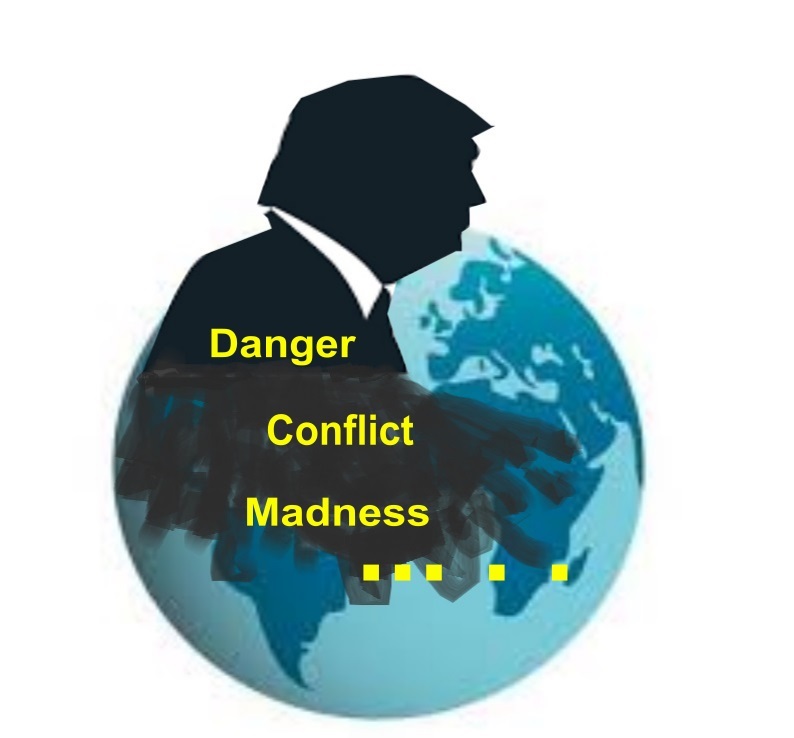
I struggle to think about what language to use.
Today, Caitlin Johnstone writes “The Evil Warmongering Zionist Won” – (No Not That One, The Other One)
I read her article, and agree with every word. But do some readers find this title a “turnoff”? I did, because I was brung up to believe that quieter, less emotive language was the way to go. Now, I’m not sure.
The people of world’s greatest power have elected a foul-mouthed, misogynist, deluded megalomaniac who is a convicted felon, strongly supported by another deluded billionaire megalomaniac the ketamine-and-Mars addled Elon Musk. Trump is surrounded by yes-mean of no integrity whatsoever, and promoted by billionaires of no integrity.
How did it happen?
How did they put it over not only the disgruntled poor of the USA, but many others – to believe that if times are bad now – this despicable sociopath could magically put things right?
By now, some of my very limited reading public will have turned away – because of my use of language. But I’m not as “bad” as Caitlin. Trouble is – we’re actually telling the truth.
It is going to be very hard now, for all of us to weave our way through all the commentaries – all made more difficult by the tsunami of social media, of the ‘respectable mainstream media’ and of AI.
I wish that I could give wonderful advice on how to assess the truth or otherwise, of what we read, see and hear. But there are people of integrity out there, and it is our job to find them and listen to them – and indeed , to avoid emotive language (when possible).
Trump has a strategic plan for the country: Gearing up for nuclear war.


The erosion of the arms control and non-proliferation regime is not a defect of the proposals; it is one of its central goals.
By Joe Cirincione | July 2, 2024, https://thebulletin.org/2024/07/trump-has-a-strategic-plan-for-the-country-gearing-up-for-nuclear-war/
President Joe Biden has a terrible nuclear policy. A re-elected President Donald Trump’s would be much worse.
Biden has authorized the largest nuclear weapons budgets since the Cold War, delayed then squandered his chance to contain Iran’s nuclear program, and apparently has no policy for containing North Korea’s missiles and weapons. But a re-elected Trump would put nuclear weapons programs on steroids, trash what remains of the global arms control regime, and likely trigger new nuclear weapons programs in more other nations than we have seen at any time since the early 1960s.
Trump’s nuclear policy is all spelled out in a new conservative manifesto by Project 2025, a coalition of over 100 far-right groups led by the Heritage Foundation, which is widely seen as the template for a possible Trump 2.0 administration. If readers of the Bulletin have heard of Project 2025, chances are that they did not go through its 900-page book “Mandate for Leadership.” They should. This policy agenda, dubbed the “Conservative Promise,” is a blueprint for the most dramatic take-over and transformation of the US democracy in history.
The Project 2025 coalition members are staffed by over 200 former officials of the first Trump administration. These sophisticated Trump-movement MAGA operatives now know how to work the levers of government and have learned from what they see as their main mistake during Trump’s first term: leaving the “deep state” intact. These conservatives proudly served Donald Trump through his administration and attempted insurrection. They are now ready to help him complete the job and their plan is here for everyone willing to see.
“Our goal is to assemble an army of aligned, vetted, trained and prepared conservatives to work on Day One to deconstruct the Administrative State,” writes Paul Dans, a former chief of staff of the Office of Personnel Management during the Trump administration and now the director of Project 2025, in his foreword to the report. Russ Vought, the chief of staff of the Office of Management and Budget under Trump and now the president of the conservative think tank Center for Renewing America, agrees: “We have to be thinking mechanically about how to take these institutions over.” Vought vows to be “ready on Day One of the next transition,” adding, “Whatever is necessary to seize control of the administrative state is really our task.”
In the nuclear realm, “seizing control” would mean implementing the most dramatic build up of nuclear weapons since the start of the Reagan administration, some four decades ago. If this hawkish political coalition gets its way in November, the scope, pace, and cost of US nuclear weapons programs would increase all at once. Their plan, which seeks to significantly increase budgets and deployments of nuclear weapons and related programs and destroy the remaining arms control agreements, would dramatically increase the risks of nuclear confrontation as a result.
Nuclear proposals. The nuclear proposals are a key part of the Project 2025 coalition’s recommendations to reshape the Defense Department. This chapter is led by Christopher Miller, a former US Army special forces colonel who served as Trump’s last defense secretary. As Michael Hirsch reports in Politico, the agenda “is far more ambitious than anything Ronald Reagan dreamed up.” (In 1980, President Reagan ordered a massive nuclear buildup, which scholars now consider to have greatly escalated the Cold War.)
In condensed and translated form, Project 2025 proposes that a second Trump administration:
- Prioritize nuclear weapons programs over other security programs.
- Accelerate the development and production of all nuclear weapons programs.
- Reject any congressional efforts to find more cost-effective alternatives to current plans.
- Increase funding for the development and production of new and modernized nuclear warheads, including the B61-12, W80-4, W87-1 Mod, and W88 Alt 370.
- Develop a new nuclear-armed, sea-launched cruise missile, even though neither the administration nor the Navy has requested such a weapon, and the Navy has not fielded this type of weapon since they were retired by President George H.W. Bush in 1991.
- Increase the number of nuclear weapons above current treaty limits and program goals, including buying more intercontinental ballistic missiles (ICBMs) than currently planned.
- Expand the capabilities of the National Nuclear Security Administration’s weapons production complex, including vastly increasing budgets, shedding non-nuclear weapons programs at the national laboratories (such as those devoted to the climate crisis) and accelerating production of the plutonium pits that are the cores of nuclear weapons.
- Prepare to test new nuclear weapons, even though the United States has signed the Comprehensive Nuclear Test Ban Treaty that prohibits such tests and has not tested a full-scale nuclear device since 1992.
- Reject current arms control treaties that the coalition considers being “contrary to the goal of bolstering nuclear deterrence” and “prepare to compete in order to secure US interests should arms control efforts continue to fail.”
- Dramatically expand the current national missile defense programs, including deploying as-yet-unproven directed energy and space-based weapons, or as the report puts it: “Abandon the existing policy of not defending the homeland against Russian and Chinese ballistic missiles.”
- Invest in a sweeping, untested “cruise missile defense of the homeland.”
- Accelerate all missile defense programs, national and regional.
These proposals would add unnecessary new weapons to an already expansive nuclear arsenal. If implemented, these new and expanded programs would accelerate the nuclear arms race the United States is already engaged in and encourage the expansion—or initiation—of new nuclear weapons programs in other nations around the globe.
It is not as if the United States needs to spend more on nuclear weapons.
At $70 billion, President Joe Biden’s Fiscal Year 2025 budget request is already the most the country will have spent on nuclear weapons since the Cold War. Under Trump and now Biden, the United States has engaged in a sweeping replacement of nearly all existing nuclear weapons systems, including a new generation of strategic bombers (the B-21), strategic missile submarines (the Columbia class), intercontinental ballistic missiles (the Sentinel), several new warhead programs, and the development of new nuclear weapons, including smaller, “more usable” nuclear warheads and air-launched cruise missiles.
The Congressional Budget Office estimates that the currently planned nuclear weapons programs will cost $750 billion over the next decade (2023-2032). And the costs will rise every year: Biden’s requested $70 billion for the next budget is a 22 percent increase from last year. The total cost of the programs will approach $2 trillion. And there is more. The Biden administration also requested $30 billion for Fiscal Year 2025 for missile defense programs, much of which will be devoted to weapons designed to intercept long-range, nuclear-armed missiles.
The policy recommendations made by the Project 2025 coalition would substantially increase these costs. Unlike other generalized calls for more weapons, these conservative authors have developed a detailed plan for how to implement their apocalyptic vision and minimize any opposition. It is a far more specific plan than any before it, and more developed than anything groups trying to save what remains of the global arms control regime have even attempted.
Implementation plan. In March, the Heritage Foundation detailed the steps necessary to implement these proposals in asking the president to “revitalize the US strategic arsenal.” The authors propose that the next US president—meaning Donald Trump, but never mentioning him—immediately upon assuming office:
- Make a major speech soon after inauguration to “make the case to the American people that nuclear weapons are the ultimate guarantor of their freedom and prosperity.”
- Direct the National Nuclear Security Administration (NNSA), which is charged with producing all nuclear weapons fissile materials and the manufacture of all warheads, to provide monthly briefings in the Oval Office and to submit its budgets separately from the Energy Department, within which department the agency resides.
- Direct the Office of Management and Budget to submit to Congress a supplemental budget request to accelerate key NNSA projects and Defense Department nuclear weapons delivery systems (missiles, bombers, and submarines).
- Increase the number of deployed nuclear warheads by directing the placement of multiple warheads on each of the currently deployed Minuteman III intercontinental ballistic missiles. (Each missile in the current fleet of 400 ICBMs holds one warhead. Under this plan, the next president would order each missile to deploy multiple warheads by 2026. The new, replacement ICBM, the Sentinel, would also be fielded with multiple warheads.)
- Direct the production and deployment of new nuclear weapon types, including the sea-launched cruise missile (SLCM-N) and putting nuclear warheads on Army ground-launched missiles. (Both capabilities were eliminated by President George H.W. Bush in 1991.)
- Add nuclear capabilities to several hypersonic systems currently under development as non-nuclear missiles.
- Direct the Air Force to examine a road-mobile version of the Sentinel ICBM. (President Reagan investigated such a program in the early 1980s and found it to be highly controversial, expensive, and impractical.)
- Direct the expansion and enhancement of US nuclear weapons capability across the globe, including by pre-positioning nuclear bombs and aircraft in Europe and Asia. (The United States currently deploys 100 nuclear bombs abroad at five bases in NATO Europe.)
- Direct the NNSA to “transition to a wartime footing,” including the expansion and construction of facilities to produce plutonium and plutonium cores for nuclear weapons.
Implications for national security. Should these recommendations be implemented, they will result in a sharp decline in the security of Americans and a dramatic increase in the risk of regional and global conflicts. At the very least, the proposed programs will explode the national debt. With the defense budget already at $850 billion for Fiscal Year 2025 and the budget for nuclear weapons and related programs at over $100 billion, these new projects could add hundreds of billions of dollars to weapons development, production, and deployment costs. The Heritage Foundation estimates that these additional programs will cost “tens of billions,” but this is a gross underestimate.
The existing US strategic arsenal already exceeds what is required for any conceivable nuclear mission. The United States currently maintains a stockpile of some 3,708 nuclear warheads for delivery by missiles and aircraft. Of those, approximately 1,770 warheads are deployed, ready for use within minutes of an order to launch. The rest of the operational stockpile (1,938 warheads) is held in reserve for potential use. In addition, the United States has approximately 1,336 retired, intact warheads in storage awaiting dismantlement. The explosive yields of most of these weapons are 10 to 30 times greater than the bombs that destroyed Hiroshima and Nagasaki.
To put the power of this arsenal in perspective, one city destroyed by just one nuclear weapon would be a level of destruction not seen since World War II. Ten weapons burning 10 cities would be a catastrophe unprecedented in human history. One hundred such weapons would destroy not only the targeted nation but likely unleash a nuclear winter and subsequent famine that could destroy virtually all human civilizations—even those far from the conflict.
Increasing the US arsenal at the scale recommended by the Project 2025 would likely compel rival nations—including Russia, China, Iran, and North Korea—to increase their defense budgets, warfighting plans, and nuclear weapons developments and deployments to match what they will see as an increasing threat from the United States. Allied nations will also be caught up in the competition, fueling an already existing nuclear arms race: Japan, South Korea, and even Germany could be pushed over the nuclear line.
This would be the unintended consequence of an unleashed nuclear modernization. While each nuclear-armed state sees its programs as defensive, their adversaries see them as offensive programs striving for a military advantage. Each move engenders a countermove; each nation believes it is responding to the other. That’s how the security dilemma has spiraled since World War II. But the Project 2025’s recommendations go one step further: They are based on the belief that the United States would win any arms contest through superior technology, resources, and political will.
In 2019, former President Trump’s arms control negotiator Marshall Billingslea said: “We know how to win these races and we know how to spend the adversary into oblivion. If we have to, we will.”
But such programs would further weaken nuclear guardrails that are already gutted by the withdrawals from major arms control agreements—including most significantly, Trump’s withdrawal from the Joint Comprehensive Plan of Action that reduced, contained, and controlled the Iranian nuclear program and his withdrawal again from Reagan’s Intermediate Nuclear Forces agreement that eliminated most nuclear weapons deployed by the United States and Russia in Europe.
The erosion of the arms control and non-proliferation regime is not a defect of the proposals; it is one of its central goals. The Project 2025 authors believe that arms control has failed, and that treaties negotiated with both allies and rivals weaken Americans, rather than are protecting them. These views are not shared by most US allies. Those allied nations committed to restraining or eliminating nuclear risks will, therefore, increasingly doubt US leadership in international relations, weakening the alliance system so essential to US national security since the end of World War II.
Importantly, these proposed programs and activities will almost certainly have the United States abandon its commitment not to test nuclear weapons under the 1996 Comprehensive Test Ban Treaty. Should the United States conduct new nuclear tests, other nations will almost immediately follow suit, adding more fuel to the nuclear fire.
Taken together, the policies and programs advocated by the Project 2025’s self-proclaimed “mandate for leadership” would push the United States onto the precipice of an expensive, dangerous, and destabilizing nuclear confrontation—something not seen since the darkest days of the Cold War.
1 This Month
23-25 October – on Zoom – World BEYOND War’s annual global conferenc


Shut down the radiation-damaged Heysham nuclear reactors now
To see nuclear-related stories in greater depth and intensity – go to https://nuclearinformation.wordpress.com

Say No to NASA’s Reckless Nuclear Reactor on the Moon
Say No to NASA’s Reckless Nuclear Reactor on the Moon
-
Archives
- October 2026 (170)
- September 2026 (339)
- August 2026 (330)
- July 2026 (355)
- June 2026 (287)
- May 2026 (306)
- April 2026 (356)
- March 2026 (251)
- February 2026 (267)
- January 2026 (308)
- December 2025 (358)
- November 2025 (359)
-
Categories
- 1
- 1 NUCLEAR ISSUES
- business and costs
- climate change
- culture and arts
- ENERGY
- environment
- health
- history
- indigenous issues
- Legal
- marketing of nuclear
- media
- opposition to nuclear
- PERSONAL STORIES
- politics
- politics international
- Religion and ethics
- safety
- secrets,lies and civil liberties
- spinbuster
- technology
- Uranium
- wastes
- weapons and war
- Women
- 2 WORLD
- ACTION
- AFRICA
- Atrocities
- AUSTRALIA
- Christina's notes
- Christina's themes
- culture and arts
- Events
- Fuk 2022
- Fuk 2023
- Fukushima 2017
- Fukushima 2018
- fukushima 2019
- Fukushima 2020
- Fukushima 2021
- general
- global warming
- Humour (God we need it)
- Nuclear
- RARE EARTHS
- Reference
- resources – print
- Resources -audiovicual
- Weekly Newsletter
- World
- World Nuclear
- YouTube
-
RSS
Entries RSS
Comments RSS

