The Guardian view on a race for missile supremacy: competition fuels a dangerous escalation

The INF treaty kept nuclear missiles off European soil and was a brake on a perilous arms buildup. Now it is gone
Five years ago, the collapse of a landmark cold war arms treaty opened a Pandora’s box, unleashing missile-shaped furies that have struck Ukraine. The 1987 Intermediate-Range Nuclear Forces (INF) Treaty ended when the US withdrew, citing Russian violations dating back to 2014 under Vladimir Putin. While abandoning the treaty aligned with the first Trump administration’s broader opposition to arms control, continuing to pressure Mr Putin into compliance would have been the wiser course.
Targeting Kyiv’s forces are the hypersonic Oreshnik missile and the ballistic Iskander missile. Both can carry a nuclear warhead and would have been barred under the INF treaty. These weapons signal an alarming return to cold war-style tit-for‑tat posturing, with great powers ramping up their military capabilities. Their use highlights Moscow’s accelerated missile development. But it also raises questions about the implications of a nuclear-tipped Oreshnik missile – capable of striking European capitals within 12 to 16 minutes – for Nato security.
The deployment of such missiles exposes the risks of abandoning arms control. The cold war INF treaty, banning ground-launched ballistic and cruise missiles with ranges of between 500km and 5,500km, curbed nuclear escalation in Europe. Its lapse, as the UN warned, removed “an invaluable brake on nuclear war”. History offers lessons. In 1983, US plans to station such missiles in Europe – including Britain – sparked mass protests. Tensions peaked that year during the “Able Archer” drill, misread by Moscow as nuclear war preparation. Alarmed, Ronald Reagan eased fears, leading to the INF treaty and broader arms reductions.
Unlike Mr Reagan, the US president-elect lacks interest in such statesmanship. Mr Putin, more insecure than his Soviet predecessors, embraces brinkmanship, recently lowering Russia’s threshold for nuclear use. Under Barack Obama, arms control advanced with Russia’s then leader Dmitry Medvedev, who signed the New Start treaty limiting deployed strategic nuclear warheads. But Mr Putin’s 2012 return to power froze progress on a follow-up deal.
One reason for American indifference to preserving the INF treaty was its irrelevance to China, which was not a signatory and had developed intermediate-range missiles. This may also explain why the Biden administration maintained Mr Trump’s approach, investing significantly in nuclear arms. This shift freed the US to develop weapons aimed at defending Taiwan from a potential Chinese invasion. In Europe, the US also announced plans to deploy long-range weapons in Germany by 2026, followed swiftly by continental powers unveiling plans for “deep-fire” capabilities.
The looming end of the New Start treaty in 2026 demands urgent cooperation between Moscow and Washington to prevent an arms race. Despite the US president-elect’s apparent rapport with Mr Putin, deep-rooted mistrust poses significant hurdles to new arms control talks. To avoid repeating history’s mistakes, western leaders should prioritise negotiations with both Russia and China. A nuclear weapons build-up, with its heightened risks of accidents and catastrophic conflict, is an existential threat of unparalleled immediacy. Without swift action, unchecked competition will overshadow any strategic gains from military posturing./
Just Don’t Mention (or Measure) the Pu (Plutonium)
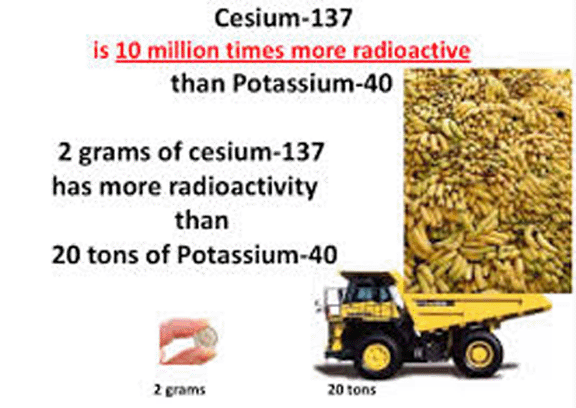
Cs-134 usually appears (at first) in similar amounts as Cs-137, as both are fission wastes………. With regard impact on human health cesium–134 (Cs-134) is extremely serious along with cesium-137 (Cs-137) the longer lived isotope which also present on Cumbrian beaches
By mariannewildart, Radiation Free Lakeland 30th Nov 2024, https://mariannewildart.wordpress.com/2024/11/30/just-dont-mention-or-measure-the-pu-plutonium/
Josh MacAlister MP for Sellafield (sorry Whitehaven and Workington) bigs up the “Good” status of Seascale and “Excellent” status of St Bees bathing water sites.
The bad news is that the criteria for bathing water quality in the UK does not include radioactive pollution – a bad case of the three wise monkeys “see no evil..”
Our own citizen science findings indicate radioactive wastes are a now an insidious and homogeneous part of West Cumbria’s beaches courtesy of the nuclear industry’s routine and accidental discharges to the Irish Sea.
Our own surveys and testing has shown that Caesium 134 is present along with Americium 241. Cs-134 has a short half life of only 2 years which is counter to the already disingenuous claims that the discharges (some very long lived) are “historic..” Cs-134 usually appears (at first) in similar amounts as Cs-137, as both are fission wastes. This implies that this Cs-134 was produced in a nuclear reactor about eight years ago. With regard impact on human health cesium–134 (Cs-134) is extremely serious along with cesium-137 (Cs-137) the longer lived isotope which also present on Cumbrian beaches. In nature, caesium exists only as a non-radioactive (or stable) isotope known as cesium-133. Americium 241 does not exist in nature and is a decay product of Plutonium.
The UK Health Security Agency have stated the risk of the public encountering a radioactive particle is “very low” but this is contested . In reality the ongoing risks are unacceptable and set to increase with new development plans such as proposed new nuclear and a Geological Disposal Facility for heat generating nuclear wastes both of which would cause likely disruption to the fragile Cumbrian Mud Patch through subsidence and induced earthquakes.
Campaigners point out that children and young women of childbearing age are most at risk of health impacts from encountering a radioactive particle. “Inadvertent ingestion of a particle will result in the absorption to blood of a small proportion of the radionuclide content of the particle. The subsequent retention of radionuclides in body organs and tissues presents a potential risk of the development of cancer.” Health risks from radioactive particles on Cumbrian beaches near the Sellafield nuclear site by John D Harrison et al 2023.
France postpones financing decision of 6 new reactors – report

the firm’s Flamanville latest European pressurised reactor project cost EUR 19bn, almost six times the initial cost and faced significant delays.
(Montel) The official body responsible for a financing decision regarding six French new generation reactors has postponed approval from December until early next year amid political uncertainty, French daily Les Echos reported on Thursday.
Reporting by: Muriel Boselli28 Nov 2024
The government was mulling a zero interest loan to help EDF finance the project, it added, though there was a current budget stand-off following a snap election this summer.
This loan option, considered quicker to implement, would cut financial risks due to a mechanism approved by the European Commission, already used in the Czech Republic for its new nuclear project, the daily reported.
The loan would include a zero interest rate for the duration of the works, before moving to a “reasonable” rate once the reactors had been commissioned, the sources said.
This financial package could reduce the total cost of the project, estimated at EUR 67.4bn.
EDF aims to build six and possibly 14 new reactors by 2050, with construction due to start at the Penly nuclear power plant on the Channel coast by 2027. The utility plans to take a final decision in 2026.
However, the firm’s Flamanville latest European pressurised reactor project cost EUR 19bn, almost six times the initial cost and faced significant delays.
The Technology for Autonomous Weapons Exists. What Now?
The hypothetical escalation that could result relates to another kind of weapon of mass destruction: the nuclear weapon. Some countries interested in autonomy are the same ones that have atomic arsenals. If two nuclear states are in a conflict, and start using autonomous weapons, “it just takes one algorithmic error, or one miscommunication within the same military, to cause an escalating scenario,” said Hehir. And escalation could lead to nuclear catastrophe.
In the future, humans may not be the only arbiters of who lives and dies in war, as weapons gain decision-making power.
UNDARK, By Sarah Scoles, 11.26.2024
One bluebird day in 2021, employees of Fortem Technologies traveled to a flat piece of Utah desert. The land was a good spot to try the company’s new innovation: an attachment for the DroneHunter — which, as the name halfway implies, is a drone that hunts other drones.
As the experiment began, DroneHunter, a sleek black and white rotored aircraft 2 feet tall and with a wingspan as wide as a grown man is tall, started receiving radar data on the ground which indicated an airplane-shaped drone was in the air — one that, in a different circumstance, might carry ammunition meant to harm humans.
“DroneHunter, go hunting,” said an unsettling AI voice, in a video of the event posted on YouTube. Its rotors spun up, and the view lifted above the desiccated ground.
The radar system automatically tracked the target drone, and software directed its chase, no driver required. Within seconds, the two aircrafts faced each other head-on. A net shot out of DroneHunter, wrapping itself around its enemy like something from Spiderman. A connected parachute — the new piece of technology, designed to down bigger aircraft — ballooned from the end of the net, lowering its prey to Earth.
Target: defeated, with no human required outside of authorizing the hunt. “We found that, without exception, our customers want a human in that loop,” said Adam Robertson, co-founder and chief technology officer at Fortem, a drone-focused defense company based in Pleasant Grove, Utah.
While Fortem is still a relatively small company, its counter-drone technology is already in use on the battlefield in Ukraine, and it represents a species of system that the U.S. Department of Defense is investing in: small, relatively inexpensive systems that can act independently once a human gives the okay. The United States doesn’t currently use fully autonomous weapons, meaning ones that make their own decisions about human life and death.
With many users requiring involvement of a human operator, Fortem’s DroneHunter would not quite meet the International Committee of the Red Cross’s definition of autonomous weapon — “any weapons that select and apply force to targets without human intervention,” perhaps the closest to a standard explanation that exists in this still-loose field — but it’s one small step removed from that capability, although it doesn’t target humans.
How autonomous and semi-autonomous technology will operate in the future is up in the air, and the U.S. government will have to decide what limitations to place on its development and use. Those decisions may come sooner rather than later—as the technology advances, global conflicts continue to rage, and other countries are faced with similar choices—meaning that the incoming Trump administration may add to or change existing American policy. But experts say autonomous innovations have the potential to fundamentally change how war is waged: In the future, humans may not be the only arbiters of who lives and dies, with decisions instead in the hands of algorithms.
For some experts, that’s a net-positive: It could reduce casualties and soldiers’ stress. But others claim that it could instead result in more indiscriminate death, with no direct accountability, as well as escalating conflicts between nuclear-armed nations. Peter Asaro, spokesperson for an anti-autonomy advocacy organization called Stop Killer Robots and vice chair of the International Committee for Robot Arms Control, worries about the innovations’ ultimate appearance on the battlefield. “How these systems actually wind up being used is not necessarily how they’re built,” he said.
Many American startups like Fortem aim to ultimately sell their technology to the U.S. Department of Defense because the U.S. has the best-funded military in the world — and so, ample money for contracts — and because it’s relatively simple to sell weapons to one’s own country, or to an ally. Selling their products to other nations does require some administrative work. For instance, in the case of the DroneHunters deployed in Ukraine, Fortem made an agreement with the country directly. The export of the technology, though, had to go through the U.S. Department of State, which is in charge of enforcing policies on what technology can be sold to whom abroad.
The company also markets the DroneHunter commercially — to, say, a cargo-ship operators who want to be safe in contested waters, or stadium owners who want to determine whether a drone flying near the big game belongs to a potential terrorist threat, or a kid who wants to take pictures.
Because Fortem’s technology doesn’t target people and maintains a human as part of the decision-making process, the ethical questions aren’t necessarily about life and death.
In a situation that involves humans, whether an autonomous weapon could accurately tell civilian from combatant, every time all the time, is still an open question. As is whether military leaders would program the weapons to act conservatively, and whether that programming would remain regardless of whose hands a weapon fell into.
A weapon’s makers, after all, aren’t always in control of their creation once it’s out in the world — something the Manhattan Project scientists, many of whom had reservations about the use of nuclear weapons after they developed the atomic bomb, learned the hard way.
………………………………………………………………………………………………………………………………………….. escalation could come from robots’ errors. Autonomous systems based on machine learning may develop false or misleading patterns.
…………………………………………………………………….The hypothetical escalation that could result relates to another kind of weapon of mass destruction: the nuclear weapon. Some countries interested in autonomy are the same ones that have atomic arsenals. If two nuclear states are in a conflict, and start using autonomous weapons, “it just takes one algorithmic error, or one miscommunication within the same military, to cause an escalating scenario,” said Hehir. And escalation could lead to nuclear catastrophe.
……………………………………………………………………………………………………………………..Hehir and the Future of Life Institute are working toward international agreements to regulate autonomous arms. The Future of Life Institute and the Campaign to Stop Killer Robots have been lobbying and presenting to the U.N. Future of Life has, for instance, largely pushed for inclusion of autonomous weapons in the Convention on Certain Conventional Weapons — an international agreement that entered into force in 1983 to restrict or ban particular kinds of weapons. But that path appears to have petered out. “This is a road to nowhere,” said Hehir. “No new international law has emerged from there for over 20 years.”
And so advocacy groups like hers have moved toward trying for an autonomy-specific treaty — like the ones that exist for chemical, biological, and nuclear weapons. This fall, that was a topic for the UN’s General Assembly.
Hehir and Future of Life aren’t advocating for a total ban on all autonomous weapons. “One arm will be prohibitions of the most unpredictable systems that target humans,” she said. “The other arm will be regulating those that can be used safely, with meaningful human control,” she said.
……………………………………… with the current lack of international regulation, nation-states are going ahead with their existing plans. And companies within their borders, like Fortem, are continuing to work on autonomous tech that may not be fully autonomous or lethal at the moment but could be in the future. …………………
Sarah Scoles is a science journalist based in Colorado, and a senior contributor to Undark. She is the author of “Making Contact,” “They Are Already Here,” and “Countdown: The Blinding Future of 21st Century Nuclear Weapons.” https://undark.org/2024/11/26/unleashed-autonomous-weapons/?utm_source=Undark%3A+News+%26+Updates&utm_campaign=c63b00e0ff-RSS_EMAIL_CAMPAIGN&utm_medium=email&utm_term=0_5cee408d66-185e4e09de-176033209
Hunterston ‘industrial revolution’ on our doorstep

Drew Cochrane, Largs & Millport Weekly News 29th Nov 2024
When politicians of every hue have been popping up in promotional photos in recent weeks to pronounce the pathway to thousands of jobs for Hunterston in the next five years you know it’s for real.
The bad news for those in Fairlie who are of a protesting disposition (God forbid) is that the projects, spearheading Scotland’s mission towards Net Zero, will not be stopped.
First Minister John Swinney risked a nose bleed by travelling way down south to London to welcome the Highview Power plans to create the world’s largest liquid air energy facility at Hunterston which will store as much as five times Scotland’s current operational battery capacity for locally produced renewable energy.
One thousand jobs in the construction phase and 650 jobs in the local supply chain by its completion in 2030 are the headlines.
Labour’s UK Energy Minister and Scottish MP Michael Shanks visited Hunterston this month to see the ‘Converter’ station at the site of the forthcoming XLCC sub-sea cable production factory which promises 900 permanent well-paid jobs, including, crucially, 200 apprentices. Again, contractors and suppliers will also number hundreds in support work.
Electricity is being supplied from the local site to Wales by sub-sea cable as a precursor to the XLCC plan to bring renewable energy from the Sahara, via Morocco, once the production factory bursts into action by 2029, work scheduled to start in March. We also carried the story and picture of the first apprentices being trained.
Local SNP MSP Kenneth Gibson visited Clydeport which has released 350 acres of the land, designated as National Development Status by the Scottish Government. He, like myself, does not buy the argument from some quarters, that the value of properties in Fairlie will fall; quite the reverse when staff move into the area.
It won’t entirely be a smooth transition, particularly, with heavy traffic on the A78 but as I’ve said before on this page this is our biggest industrial revolution since the decades of IBM and nuclear power on our proverbial doorstep……https://www.largsandmillportnews.com/news/fairlie/24745296.drew-cochrane-hunterston-industrial-revolution-doorstep/
Mass Desertions Over Radiation Could End the War in Ukraine
CounterPunch, Barbara G. Ellis, November 29, 2024
NATO leaders have been dithering about Russia’s recent retaliation against Ukraine’s lofting one of Lockheed’s long-range missiles deep into its interior. Their emergency huddle was about Putin’s new multi-missile (“Oreshnik “) which traveled 10 times the speed of sound (range: 310-3,400 miles) to hit a former ICBM factory . So far, either side seems to have considered the one factor that could end their planet-destroying, nuclear game of chicken.
It’s the real possibility of monumental mutiny and desertions by those boots-on-the-ground that both sides count on to do the heavy lifting in WWIII.
Most soldiers may be willing to risk death by bullets and bombs, but not radiation exposure. Despite recent official assurances by U.S. war planners that nuclear weapons would be used only on battlefields, radiation drifts for thousands of miles. It ignores borders and body protections—as proved by Hiroshima in 1945 and the Chernobyl disaster of 1986.
Russian president Putin claimed Oreshnik’s speed makes NATO’s current defense systems powerless and said its production was imminent. But while the West’s missile designers set up a crash program to counter this latest escalation, these warhawks and their counterparts evidently still ignore the ever-expanding deserter numbers or silent mutinies abuilding in Ukraine and Russia. However, troops usually know military officials traditionally underestimate or conceal death rates lest it demoralize both them and the public to begin questioning the worth of continuing a war.
Current desertion rates in Russia by August were 18,000 and increasing daily, Newsweek reported. Russia’s death rate by September was said to be 71,000 by its independent media outlet Mediazona. The Economist in July put total casualties—dead/wounded/ captured—at between 462,000 and 728,000.
Small wonder then why Putin “borrowed” nearly 12,000 combat troops from North Korea in October for front-line duty. Equally, NATO members have promised troops as well. Many now on site as “advisors” for their equipment—tanks and munitions to aircraft—and infantry training.
Ukrainian desertions have now become legendary, along with increasing populations of neighboring Romania, Poland, and Germany. The Kyiv Post just reported some 60,000 alone are facing criminal charges of desertion since the war’s start in 2022. Thousands of others have not been caught nor wooed or forced back to the ranks. The Eurasian Review also noted Ukrainians on the 629-mile frontline were poorly armed and often out of ammunition. It commented:
frontline were poorly armed and often out of ammunition. It commented:
“Ukraine’s military is now ‘Outgunned and Outnumbered’, struggling with low morale and high rate of desertions….This prolonged war nearing three years have near decimated many Ukrainian infantry battalions, making the situation grim on the battle limes. Reinforcements are few and difficult to be created, leaving soldiers exhausted, demoralized and desert [ing].”
Not to mention the 44,000 draft-age Ukainian males who by August had slipped through border-police lines of other nations. The Wall Street Journal says 15,000 fled to mountainous Romania in particular……………………………………………………………………………………………………………
……………………………………So when presidents Putin and Biden and NATO leaders assume those “boots-on-the-ground” will mindlessly obey orders to escalate the Russo-Ukrainian war from super-sonic missiles to nuclear warheads, they better think about the U.S. mutiny in Vietnam. It has furnished lessons and tools for all soldiers for all time so instead of “Do or die,” perhaps an overwhelming number will demand to know “Why?” https://www.counterpunch.org/2024/11/29/mass-desertions-over-radiation-could-end-the-war-in-ukraine/?fbclid=IwY2xjawG41V5leHRuA2FlbQIxMQABHcNhNoDwHnDD3OtHWQAgtAw4hnfdNGoSyFdDjYMiBciYjUiG08c1VGHdhw_aem__n-ZgkUj1nxhHZoxRJiKgg
Ukraine has lost almost 500,000 troops – Economist

29 Nov 24 https://www.rt.com/russia/608307-ukraine-losses-estimates-economist/
Vladimir Zelensky previously claimed that only some 31,000 Ukrainian servicemen had been killed.
Up to half a million Ukrainian troops have been killed or wounded in the ongoing conflict with Russia, according to new estimates provided by The Economist, which cited leaked intelligence reports, official statements and open sources.
In an article published on Tuesday, the outlet noted that it is difficult to calculate Kiev’s actual losses, given that Ukrainian officials and their allies are “reluctant to provide estimates.”
Ukraine’s Vladimir Zelensky claimed in February that only 31,000 troops had been killed since the conflict with Russia escalated in 2022. He refused to reveal how many had been wounded, arguing it would let Moscow know “how many people are left on the battlefield.”
However, The Economist noted that according to US officials, Kiev’s total casualty figure currently stands at more than 308,000 soldiers. According to the outlet’s analysis of other sources, the figure could be closer to half a million troops, of which “at least” 60,000-100,000 are believed to have been killed.
“Perhaps a further 400,000 are too injured to fight on,” the magazine wrote.
The Economist also cited the UALosses website, which tracks and catalogues the names and ages of the dead. According to its data, Ukraine has lost at least 60,435 troops, or more than 0.5% of its pre-war population of men of fighting age.
While the data from UALosses is not comprehensive and not all soldiers’ ages are known, The Economist suggested that the actual number of those killed in the fighting is higher and the amount of servicemen who are too injured to fight is even greater.
“Assuming that six to eight Ukrainian soldiers are severely wounded for every one who is killed in battle, nearly one in 20 men of fighting age is dead or too wounded to fight on,” the outlet estimated.
Earlier this year, the Russian Defense Ministry claimed that Ukraine’s military losses since February 2022 had reached almost 500,000, without specifying how many had been killed or injured.
According to the latest information from the ministry, Kiev has also lost over 35,000 servicemen since August in its incursion into Russia’s Kursk Region.
In June, Russian President Vladimir Putin said that his country’s personnel losses in the conflict were a fraction of those on the Ukrainian side, suggesting that the ratio of casualties was approximately one to five.
Israeli army pushes deeper into south Lebanon as ceasefire violations intensify
The Israeli military has pushed further into Khiam and Markaba in southern Lebanon while continuing to open fire at residents.
Israeli forces continued to violate the ceasefire with Lebanon on 29 November, advancing on the southern towns of Markaba and Khiam and opening fire at citizens during a funeral – following continuous violations since the agreement went into effect two days ago.
“Israeli forces advanced today to the town square of Markaba, which they were unable to enter during the days of the confrontations, and occupied it now during the ceasefire, and the [Israeli] army is carrying out bulldozing operations and destroying roads. Civilians were present in the town yesterday,” Al Manar correspondent Ali Shoeib reported.
Preliminary reports of two citizens being kidnapped by Israeli troops were later refuted.
Al Manar’s correspondent clarified that “no Lebanese citizens were abducted in Khiam; what happened is that Israeli forces opened fire at citizens during a funeral.”
The correspondent also reported that Israeli troops launched an operation on Friday to expand their presence towards the Khiam cemetery. He said the forces are “exploiting the ceasefire” to carry out bulldozing and demolition operations in areas they were unable to enter during the ground war against Hezbollah.
Israeli forces also uprooted olive trees at a grove in the southern town of Kfar Kila.
An Israeli airstrike targeted the Saida District of southern Lebanon on 28 November, marking the deepest attack on Lebanon since the ceasefire took effect early on Wednesday. The strike on Saida came after the Israeli army carried out several artillery and bombing attacks on the south of Lebanon.
A day earlier, the Israeli army opened fire on a group of Lebanese journalists in Khiam, and attacked displaced residents in other towns as they tried to return to their homes. Israel has threatened displaced Lebanese citizens and warned them against returning.
The Lebanese army has told residents, for their own safety, not to enter villages still occupied by Israeli troops.
Hezbollah MP Hassan Fadlallah said in an interview with MTV News on 28 November that the resistance will not “sit and watch” as Israel continues to violate the ceasefire. He added that “we are in an experiment now,” signaling that it is time to determine whether or not the Lebanese army is capable of repelling Israel and stopping its violations.
He stressed that there is no issue between Hezbollah and the Lebanese Armed Forces (LAF), adding that Hezbollah welcomes its deployment across all of south Lebanon.
He vowed that the resistance will confront Israel should it decide to go to war against Lebanon again.
IAEA warns of impact on nuclear safety of attacks on Ukraine’s energy infrastructure

World Nuclear News 29th Nov 2024, https://www.world-nuclear-news.org/articles/iaea-warns-of-impact-on-nuclear-safety-of-attacks-on-ukraines-energy-infrastructure
International Atomic Energy Agency Director General Rafael Mariano Grossi said that Ukraine’s three operating nuclear power plants have had to reduce their electricity generation as a result of attacks on the country’s energy infrastructure.
In the agency’s latest update it said that the nuclear power plants – Khmelnitsky, Rivne and South Ukraine – had to lower their power levels on Thursday for the second time in two weeks as a precautionary safety step. The three plants have a total of nine reactors between them. One reactor at Rivne was disconnected from the grid and all three plants continued to receive off-site power, although Khmelnitsky lost connection to two of its power lines.
Grossi said: “Ukraine’s energy infrastructure is extremely fragile and vulnerable, putting nuclear safety at great risk. Once again, I call for maximum military restraint in areas with major nuclear energy facilities and other sites on which they depend.”
IAEA teams visited seven substations located outside the nuclear power plants in Ukraine in September and October to assess the situation after strikes on the energy infrastructure in August. Grossi reported to the IAEA board of governors earlier this month that there had been “extensive damage” and concluded that the reliability of off-site supply to nuclear power plants had been “significantly reduced”.
In his statement issued on Thursday, he said: “The IAEA will continue to assess the extent of damage to facilities and power lines that are essential for nuclear safety and security. The IAEA will continue to do everything in its power to reduce the risk of a nuclear incident during this tragic war.”
The IAEA has had teams stationed at each of Ukraine’s nuclear power plants, and it said there had been no reports of direct damage to nuclear power plants.
Nuclear power plants need to have an electricity supply to ensure necessary safety functions can take place as well as reactor cooling, and they also need reliable connections to the grid to be able to distribute the electricity they produce. In addition to Ukraine’s three operating nuclear power plants, Zaporizhzhia nuclear power plant has been under Russian military control since early March 2022. Its reactors are all shut down and it has had to rely on emergency diesel generators on occasions when it has lost all access to off-site power.
The IAEA has set out its seven rules for nuclear safety and security during the Russian-Ukraine conflict, which have been adopted by the United Nations Security Council. They include the core principles that no-one should fire at, or from a nuclear power plant, or use a nuclear power plant as a military base.
Security planning for small modular reactors ‘not where it should be’, academic says.

28 Nov, 2024 By Tom Pashby
The security planning for the forthcoming wave of small modular reactor (SMR) developments in the UK is “not where it should be” according to an academic who supports the industry.
SMRs have risen up the agenda with Great British Nuclear’s (GBN) competition for developers to get access to government support for deployment making progress, as well as other novel
nuclear energy companies like Last Energy UK saying it will deploy
micro-reactors in Wales by 2027.
Big technology companies like Google,
Amazon and Oracle have said they want SMRs to power their AI data centres,
to overcome grid power constraints.
And in the UK, the Civil nuclear:
roadmap to 2050 stated: “To deliver energy security while driving down
costs our long-term ambition is the deployment of fleets of SMRs in the
UK.” Proponents of SMRs, such as big tech companies, want them because of
the additional flexibility they offer in location. They don’t need to be
built far away from people because of their size, or near water because
SMRs can be air-cooled.
This opens up questions about appropriate security
arrangements, because traditional gigawatt-scale nuclear sites in the UK
benefit from having long sight lines and layers of physical security such
as fences, patrol paths and armed guards.
New Civil Engineer 28th Nov 2024 https://www.newcivilengineer.com/latest/security-planning-for-small-modular-reactors-not-where-it-should-be-academic-says-28-11-2024/
South Bruce spared, but Ignace selected for Canadian nuclear waste dump
Nuclear Free Local Authorities, 29th November 2024
The Nuclear Waste Management Organisation – Canada’s equivalent to Britain’s Nuclear Waste Services – announced yesterday that they have selected Ignace in Ontario as their site for a Deep Geological Repository (DGR) into which Canada’s radioactive waste will be dumped.
The NWMO was established by the nuclear industry in 2002 charged with the disposal of the nation’s intermediate- and high-level radioactive waste.
The second candidate city of South Bruce, Ontario has been spared.
Both municipalities have recently held online public polls in which narrow, and contestable, results approved continued participation in the project. On 18 November, the Indigenous Wabigoon Lake Ojibway Nation, in whose Traditional Lands the DGR will be sited, also voted to continue their involvement in the process, which the NWMO took as a green light to select of Ignace. [i]
However, cynics might say one factor in the NWMO’s selection was the disparity in the money offer made to both municipalities for hosting the dump – Ignace was only promised $170 million over 81 years, whilst South Bruce stood to receive $418 million over 138.
The NFLAs, with other British activists opposed to nuclear waste dumps, have worked with Canadian colleagues in both municipalities and we are of course delighted for the people of South Bruce, but sad for those opposed to the plan in Ignace.
29th November 2024
South Bruce spared, but Ignace selected for Canadian nuclear waste dump
The Nuclear Waste Management Organisation – Canada’s equivalent to Britain’s Nuclear Waste Services – announced yesterday that they have selected Ignace in Ontario as their site for a Deep Geological Repository (DGR) into which Canada’s radioactive waste will be dumped.
The NWMO was established by the nuclear industry in 2002 charged with the disposal of the nation’s intermediate- and high-level radioactive waste.
The second candidate city of South Bruce, Ontario has been spared.
Both municipalities have recently held online public polls in which narrow, and contestable, results approved continued participation in the project. On 18 November, the Indigenous Wabigoon Lake Ojibway Nation, in whose Traditional Lands the DGR will be sited, also voted to continue their involvement in the process, which the NWMO took as a green light to select of Ignace. [i]
However, cynics might say one factor in the NWMO’s selection was the disparity in the money offer made to both municipalities for hosting the dump – Ignace was only promised $170 million over 81 years, whilst South Bruce stood to receive $418 million over 138.
The NFLAs, with other British activists opposed to nuclear waste dumps, have worked with Canadian colleagues in both municipalities and we are of course delighted for the people of South Bruce, but sad for those opposed to the plan in Ignace.
We, the Nuclear Free North, a campaign group has issued a statement condemning the lack of validity of the selection process, citing the fact that Ignace is not a willing community and asserting that the Indigenous vote did not represent specific consent for the project to go ahead. The statement appears below. [on original]……………………………………… more https://www.nuclearpolicy.info/news/south-bruce-spared-but-ignace-selected-for-canadian-nuclear-waste-dump/?fbclid=IwY2xjawG4gNxleHRuA2FlbQIxMAABHZkzDLWOe6FmGY3lN1ERTX5hB05PLvbrI4k9fdn3iTiAWPvxUq-VMQaXKg_aem_NRkVOPIrb11UCVLX85-G1g
Only 20% of Great British Nuclear staff employed permanently

Just 30 of 140 currently staff at Great British Nuclear (GBN) are employed
on permanent contracts, it has been revealed. GBN is the government body
running the competition for selecting SMRs to receive taxpayer support for
deployment.
However, its responsibilities in the wider UK nuclear picture
are unclear and criticism has been made about how it interfaces with Great
British Energy. GBN chair Simon Bowen was asked by House of Commons Energy
Security and Net Zero select committee chair Bill Esterson on 20 November
2024 about the proportion of permanent staff at GBN. Bowen said: “The
headcount currently runs at about 140, 30 of which are permanent
employees.”
Explaining why only roughly one-in-five (21%) of the staff
are permanent, he added: “It took us many, many months to get a pay
agreement through the various government processes, understandably, which
really slowed down our recruitment, but we’re now starting to accelerate
and to bring people into the organisation.”
New Civil Engineer 29th Nov 2024
https://www.newcivilengineer.com/latest/only-20-of-great-british-nuclear-staff-employed-permanently-29-11-2024/
Civil and military nuclear programmes: will they be derailed by skills shortages?

Because of the continuing problems, efforts are increasing to share resources and costs between the civilian and military nuclear programmes [11]. Rolls Royce is promoting ‘modular’ nuclear power stations with reactors similar to those used in submarines. Also the new industry recruitment website ‘DestinationNuclear.com’ abandons the old pretence that civil nuclear power is separate from the production of nuclear weapons:
It is time for a nuclear reality check.
it looks likely that in future the contribution of nuclear power to UK energy supplies will be small.
Scientists for Global Responsibility 27th Nov 2024, https://www.sgr.org.uk/resources/civil-and-military-nuclear-programmes-will-they-be-derailed-skills-shortages
Alasdair Beal takes a look at the UK nuclear industry – and finds that the proposed expansion has a workforce problem.
The incoming Labour government has inherited two major nuclear programmes – new power stations and new Trident missile submarines. Both are behind schedule and over-budget but the government says it wants them to continue. This article looks at the difficulties mobilising the skilled workforces required.
Nuclear programmes off-track
In 2010, the Conservative-led government announced its aim for work to be started on eight new nuclear power stations by 2025 [1]. Plans and timetables have been repeatedly revised since then but, currently, only one is actually under construction – Hinkley Point C (HPC) in Somerset. The 2024 ‘Civil Nuclear: Roadmap to 2050’ [2] stated that the aim is now to “secure investment decisions to deliver 3-7GW [gigawatts] every five years from 2030 to 2044, to meet our ambition to deploy up to 24GW of nuclear power by 2050.” This would amount to up to eight more plants the size of HPC. Even this appears unrealistic, given the serious problems building current reactor designs [3].
The military nuclear programme is also in trouble. Recently, Vanguard class submarines – armed with Trident nuclear missiles – have three times operated sea patrols lasting over 6 months, setting new Royal Navy records [4]. These occurred because two submarines were out of service for repairs, leaving only two in seaworthy condition. Numerous other problems have also been reported, including a faulty depth gauge leading to a nuclear-armed submarine taking a potentially catastrophic “unplanned dive” [5], and a major fire in the building used to assemble new submarines [6].
Construction of the Vanguard class submarines started in 1986 and they entered service between 1993 and 1999 with a design life of 25 years, later extended by 5 years. Construction of the replacement Dreadnought class began in 2016, with the first planned to enter service in 2028. However, this has now been delayed to “the early 2030s”, [7] which will require the existing submarines to operate until they are 40 years old, i.e. 15 years longer than their original design life and 10 years beyond their extended design life.
Major skills shortages
Skills shortages could also be a problem for both projects. In 2015, a government document [8] stated that to construct five or more new power stations by 2030, decommission existing power stations, and develop new nuclear missile submarines, “the workforce must grow by 4,700 people a year over the next 6 years. Over the same period 3,900 people are expected to leave the sector, mostly due to retirement. This means that the sector must recruit 8,600 people every year.”
Since then the schedule for new power stations has been delayed but there is now also a contract to construct new SSN-AUKUS nuclear-propelled ‘attack’ submarines. According to a House of Commons Science, Innovation and Technology Committee 2023 report [9]:
“If the UK is to achieve a contribution of 24GW of nuclear power by 2050 it will need to plan for, and achieve, a massive increase in the nuclear workforce … 50,000 full time equivalent employees would need to be recruited by 2040, even without an expansion of nuclear power … Under a scenario which envisages 19GW of nuclear capacity by 2050 … 180,000 workers will need to be recruited by 2050 – including an average of 7,234 recruits each year until 2028, compared to the current inflow of around 3,000 a year. Recently, vacancies in the nuclear sector are running at twice the rate of the general engineering and construction sector.”
With existing vacancies unfilled and recruitment insufficient to maintain present staff numbers, let alone those required for government expansion plans, the potential shortage of skilled staff is serious.
However, the situation is actually worse than the bare numbers suggest: those retiring will include many knowledgeable people with experience of designing and constructing previous nuclear submarines or power stations, or else of working with those who did. New recruits can fill the vacant seats but they cannot replace the loss of knowledge. Books, training courses and videos can help but in advanced engineering work nothing beats the passing on of accumulated knowledge and experience directly between generations of engineers.
Experience counts
I am a professional civil and structural engineer and after graduation I worked on long-span bridge design with the engineers who had designed and supervised construction of some of the biggest bridges in the world. I learned a lot from them – not only about stress calculations but also about the thinking required to produce a successful design. Much of this could not have been learned from courses or books.
The case of Rolls Royce in 1971 illustrates why this is important. Problems with their new RB211 jet engine had forced the company into liquidation and it had to be nationalised. To rescue the situation , the new directors had to persuade retired former senior engineers to return to work to lead the process of redesigning the engine to overcome the problems.
This issue may also be contributing to current problems at HPC. Existing UK nuclear engineers have only limited experience of Pressurised Water Reactor (PWR) construction and in any case they are likely to be fully occupied decommissioning the UK’s old AGR reactors and dealing with historic nuclear waste. Therefore construction of HPC depends heavily on French expertise.
French companies have constructed 58 nuclear power stations based on the Westinghouse PWR design, the last of these being ordered in 1990. No more were ordered for 15 years until Finland ordered a power station based on the new European Pressurised Water Reactor (EPR) design in 2005. By then many of the engineers and other workers who constructed France’s PWRs are likely to have retired or changed occupations, making it difficult to assemble teams with the necessary knowledge and experience to build a new power station to a new design. Maybe we should not be surprised that major problems have been encountered constructing the EPRs at Olkiluoto in Finland, at Flamanville in France – each of which has taken 17 years to build [10] – and at HPC.
Similar problems may also be affecting construction of the new Dreadnought submarines. By the time these were ordered in 2016, many of the engineers with experience of designing and constructing their predecessors would have retired or be close to retirement, taking their knowledge and experience with them.
Because of the continuing problems, efforts are increasing to share resources and costs between the civilian and military nuclear programmes [11]. Rolls Royce is promoting ‘modular’ nuclear power stations with reactors similar to those used in submarines. Also the new industry recruitment website ‘DestinationNuclear.com’ abandons the old pretence that civil nuclear power is separate from the production of nuclear weapons:
“Nuclear plays a vital role in shaping the UK’s future in broader ways. Nuclear power produces carbon-free electricity that lights homes, fuels businesses, and keeps the economy moving.
The impact of nuclear goes beyond power grids. The expertise within the sector plays a crucial role in ensuring the strength and effectiveness of the UK’s nuclear deterrent, contributing to global peace and security. Nuclear is not just an energy source; it’s a critical part in building a secure future for the UK.”
While the claims made in this statement can be criticised on many grounds, most relevant for this article is the apparent assumption that people who are concerned about climate change are also likely to be enthusiastic about nuclear weapons – which could trigger a catastrophic ‘nuclear winter’ if used [12]. If they are, then public acknowledgement of the link between the civil and military nuclear programmes is a clever move and will boost recruitment. However, if they are not, this strategy could backfire badly.
Time for a rethink
It is time for a nuclear reality check.
In 1994, the UK had 16 functioning nuclear power stations (total capacity 12.7GW) but in 2024 there were only 5 (total capacity 5.9GW) and by the end of 2028 there will be just one: Sizewell B (1.2GW) [13]. Completion of the HPC first unit (1.6GW) is now expected between 2029 and 2031, with its second unit following some years later [14]. When the effects of potential skills shortages are considered alongside the problems of current nuclear reactor designs, the idea of achieving anything like 24GW capacity by 2050 seems like a fantasy. Given the rapid growth of renewable energy and related technologies – which is set to continue – it looks likely that in future the contribution of nuclear power to UK energy supplies will be small.
Meanwhile, the programme for new Trident nuclear missile-armed submarines is a gamble based on two risky assumptions: (i) despite industry skills shortages, there will be no further delays in completing the new submarines; and (ii) the existing submarines will be able to continue operating for at least 10 years after the end of their design life. If either assumption proves incorrect then, after all the arguments over ‘unilateral’ or ‘multilateral’ nuclear disarmament, we could end up instead with a rather British outcome: ‘Unintentional Nuclear Disarmament’. At that point, the government would finally have to face up to the dangerous flaws in the idea of ‘nuclear deterrence’ and plan instead for a nuclear-free future.
The conclusion is clear: current plans for new nuclear power stations and new nuclear missile-carrying submarines should both be cancelled and the resources diverted to:
(a) reducing energy consumption and accelerating the development and deployment of alternative renewable energy supplies; and
(b) supporting international arms control and disarmament initiatives, such as the United Nations Treaty on the Prohibition of Nuclear Weapons.
Alasdair Beal BSc CEng FICE FIStructE is a chartered civil engineer, based in Leeds, and a former member of SGR’s National Co-ordinating Committee.
References : …………………………………………………………………………………………..
The Nuclear Waste Management Organization (NWMO) Siting Process Fails to Achieve its Goal.

Nuclear Company Announces Site Selection Despite Major Missing Piece: a Willing Host
WE THE NUCLEAR FREE NORTH. November 29, 2024
| Wabigoon, Ontario – First Nations and opposition groups are denouncing the Nuclear Waste Management Organization’s announcement that they have selected the Revell site in northwestern Ontario as their preferred location for a deep geological repository for all of Canada’s high-level nuclear fuel waste. “The NWMO announcement demonstrates the fickleness of the NWMO’s site selection process. It has allowed the NWMO to manufacture something they are calling consent, without actually gaining consent”, commented Charles Faust, a volunteer with We the Nuclear Free North and spokesperson for Nuclear Free Thunder Bay. “They were looking for consent for their project – the transportation, processing and burial of all of Canada’s high-level waste in the heart of Treaty 3 Territory. The closest they could get from Wabigoon Lake Ojibway Nation was consent to continue in the site characterization process. It’s a small victory which they are going to play big.” |
NWMO announced Thursday that they had selected Wabigoon Lake Ojibway Nation (WLON) and the Township of Ignace as the host communities for the future site for Canada’s deep geological repository for used nuclear fuel.
The two communities had been courted by the NWMO for over a decade as the nuclear waste company sought a declaration of “willingness” to have the Revell site used as a processing and burial site for the highly radioactive waste generated by nuclear power reactors. The Revell site is approximately equidistant between Ignace and Dryden and 20 km upstream from Wabigoon Lake Ojibway Nation, in the headwaters of both the Wabigoon and the Turtle-Rainy River watersheds.
NWMO has repeatedly said they would only proceed with an “informed and willing host”, which would have to make a “compelling demonstration of willingness”. In a statement released by Wabigoon Lake Ojibway Nation on November 18th following a community vote, WLON stated clearly that the referendum was to determine if WLON would progress into a site characterization process for NWMO’s project, and that “the yes vote does not signify approval of the project”.
Broad opposition to the project has been expressed by First Nations, municipalities and community organizations, including in a resolution passed by Grand Council Treaty #3 in October which affirmed an earlier declaration that made clear that a deep geological repository for nuclear waste would not be developed at any point in Treaty #3 Territory.
Opposition is expected to continue to grow following yesterday’s announcement, leading up to the start of a federal impact assessment process, which the NWMO says will get underway in 2028.
Iran says it could end ban on possessing nuclear weapons if sanctions reimposed
Comments made after nuclear inspectorate board passed motion censuring Iran for building uranium stockpile
Patrick Wintour in Lisbon, Guardian 28th Nov 2024, https://www.theguardian.com/world/2024/nov/28/iran-says-it-could-end-ban-on-possessing-nuclear-weapons-if-sanctions-reimposed
The nuclear debate inside Iran is likely to shift towards the possession of its own weapons if the west goes ahead with a threat to reimpose all UN sanctions, the country’s foreign minister has said.
Seyed Abbas Araghchi said in an interview that Iran already had the capability and knowledge to create nuclear weapons, but said they did not form part of its security strategy. He also said Tehran was prepared to keep supplying arms to Hezbollah in Lebanon.
Western officials will be concerned by Araghchi’s warning over the reimposition of sanctions, which were lifted when Iran signed the 2015 deal intended to limit its nuclear activities.
Araghchi was appointed foreign minister by Iran’s reformist president, Masoud Pezeshkian, who was elected this year on a promise to improve Iran’s economy by pursuing improved relations with the west.
He was speaking in Lisbon before a meeting between Iranian and European negotiators in Geneva on Friday, which he described as a brainstorming session to see if there was a way out of their impasse. He admitted he was pessimistic about the meeting, saying he was not sure Iran was speaking to the right party.
He said he believed European nations – chiefly the UK, Germany and France – were set on confrontation after a board meeting last week of the UN nuclear inspectorate, the International Atomic Energy Agency (IAEA), in which a European-tabled censure motion was passed saying Iran had failed to cooperate with inspectors and was building a uranium stockpile that had no peaceful civilian purpose.
Araghchi claimed the IAEA director general, Rafael Grossi, had promised to forestall the censure motion after Iran offered to cap its uranium enrichment at 60% purity, as well as permit four nuclear inspectors to visit its nuclear sites. “He failed because the Europeans had decided on the course of confrontation,” he said.
The foreign minister said Iran had subsequently “decided to introduce thousands of new, highly advanced machines into the system. And now they have started to feed them with gas. So this is the result of their pressure.”
Araghchi said Iran remained within the confines of the nuclear non-proliferation treaty, however, and still sought cooperation. “We have no intention to go further than 60% for the time being, and this is our determination right now,” he said. “I would like to re-emphasise that we have chosen the line of cooperation in order to come to a dignified resolution of this problem.”
But he suggested that Iranian engagement with the west on its nuclear programme was not guaranteed. “There is a debate right now in Iran that it was perhaps a wrong policy. Why? Because it proved we did whatever they wanted and when it was their turn to lift sanctions, in practice, they didn’t happen. So maybe something is wrong in our policy.
“So I can tell you, quite frankly, that there is this debate going on in Iran, and mostly among the elites – even among the ordinary people – whether we should change this policy or not, whether we should change our nuclear doctrine, as some say, or not, because it has proved insufficient in practice.”
He said if European countries did reimpose sanctions on Iran at the UN security council “then they [will] have convinced everybody in Iran that, yes, your doctrine has been wrong”.
He added: “And this is the result after 10 to 12 years of negotiation, and after 10 years of implementation and homework and all these things, now, Iran is back under chapter seven [of the UN charter], what for?
“If that happens, I think everybody will be convinced that we have gone in the wrong direction, so we have to change direction. So I think if the snapback happens we would have a crisis.”
But he said for the moment the fatwa against the possession of nuclear weapons could only be rescinded by the supreme leader. “Nuclear weapons have no place in our security calculations,” he said.
He also said that Iran had not supplied ballistic missiles to Russia, but that it is legitimate for Tehran to have close military cooperation with Moscow even though Iran supported the territorial integrity of Ukraine.
Aware that Iran’s supply of drones and other equipment to Russia for use in Ukraine has poisoned relations with Europe, Araghchi said: “They are not in any moral or political position to complain about our cooperation with Russia […] when at the same time they are selling themselves weapons, sophisticated weaponry to Israel to kill Palestinians.”
He added that Iran was prepared to continue supplying weapons to Hezbollah in Lebanon if requested by the group, adding Israel had agreed to a ceasefire only because it could not “finish the job”.
Giving his verdict on the outcome of the Lebanon confrontation, which many say has left Iran weakened, he said: “Why is Israel now ready for a ceasefire in Lebanon? Because they couldn’t finish the job, and they are not able to finish the job. Yes, Hezbollah has suffered, but it is mostly on its leadership and high level commanders, but the organisation is intact.”
He also ridiculed claims by the Israeli prime minister, Benjamin Netanyahu, that Israel had agreed to the Lebanon ceasefire partly because Israel wanted to focus its energies on preventing Iran from securing a nuclear weapon.
“A full-scale war with Iran and a ceasefire in Lebanon? It doesn’t sound logical or understandable,” he said.
He said it would be a disaster if Israel launched a full-scale war against Iran. “That doesn’t mean that we want war. Contrary to Israelis, we don’t want war, but we are fully prepared for that, and we are not scared of war. And if they want to try us, they can do that.”
He said it was up to Hezbollah to decide if it wanted to withdraw its weaponry north of the Litani River, as set out in the ceasefire agreement with Israel, and said the group was not an Iranian proxy. “Hezbollah and others are not our proxies,” he said. “We only support them as our friends, so we have never dictated on them or any other resistance group in the region. They decide by themselves, and they implement their decisions by themselves.”
He said he believed it was the right decision by Hezbollah to end its link between the wars in Lebanon and Gaza in accepting the ceasefire, but questioned whether it would be followed by a further ceasefire in Gaza. “Israel cannot go for a ceasefire with Hamas, because a ceasefire with Hamas would be a total defeat for Israelis,” he said. “They went there to destroy Hamas, and now they have to make a deal with Hamas, and that means that they have failed to reach their goals. So a ceasefire in Gaza has become a very complicated question.”
He said that Israel’s intention was “the colonial erasure” of Palestinians, and it was up to the new US administration to decide if they would support this.
Asked if Iran’s foreign policy was causing domestic misery, he accepted that Pezeshkian won the presidential election because he wanted to leave sanctions and engage with the rest of the world but questioned if he had been welcomed by the west. “The morning after his inauguration ceremony, Ismail Haniyeh [the Hamas political bureau leader] was assassinated in Tehran,” he said. “I have spent my first 100 days as foreign minister trying to prevent a full-scale war.”
1 This Month
23-25 October – on Zoom – World BEYOND War’s annual global conferenc

To see nuclear-related stories in greater depth and intensity – go to https://nuclearinformation.wordpress.com

Say No to NASA’s Reckless Nuclear Reactor on the Moon
Say No to NASA’s Reckless Nuclear Reactor on the Moon
-
Archives
- October 2026 (160)
- September 2026 (339)
- August 2026 (330)
- July 2026 (355)
- June 2026 (287)
- May 2026 (306)
- April 2026 (356)
- March 2026 (251)
- February 2026 (267)
- January 2026 (308)
- December 2025 (358)
- November 2025 (359)
-
Categories
- 1
- 1 NUCLEAR ISSUES
- business and costs
- climate change
- culture and arts
- ENERGY
- environment
- health
- history
- indigenous issues
- Legal
- marketing of nuclear
- media
- opposition to nuclear
- PERSONAL STORIES
- politics
- politics international
- Religion and ethics
- safety
- secrets,lies and civil liberties
- spinbuster
- technology
- Uranium
- wastes
- weapons and war
- Women
- 2 WORLD
- ACTION
- AFRICA
- Atrocities
- AUSTRALIA
- Christina's notes
- Christina's themes
- culture and arts
- Events
- Fuk 2022
- Fuk 2023
- Fukushima 2017
- Fukushima 2018
- fukushima 2019
- Fukushima 2020
- Fukushima 2021
- general
- global warming
- Humour (God we need it)
- Nuclear
- RARE EARTHS
- Reference
- resources – print
- Resources -audiovicual
- Weekly Newsletter
- World
- World Nuclear
- YouTube
-
RSS
Entries RSS
Comments RSS

