Philosophy Against Nuclear Power

It is now clear that the residents of Fukushima are far from some voluntarist subjects but rather a people who live under constant subjection. The installation of nuclear power plants was not democratically decided, neither did it bring any halt to the historical subjection. Rather, nuclear power plants worsened the subjection by reproducing subjection. It should be clear that the one who bears the responsibility is the “village” (TEPCO, the government, etc.) rather than the victims.
How many times we should suffer from this “blindness to nuclear apocalypse” in order to realize that nuclear power is just a technology against humanity?
New Bloom, Shen Yun-Yen, 12/29/2024
Yoshiyuki SATO and Takumi TAGUCHI, Datsugenpatsu no tetsugaku (Philosophy for Abandoning Nuclear Power), Jimbun Shoin, 2016.
THE NUCLEAR BOMB certainly posed a serious problem for contemporary philosophy. From Heidegger to Arendt to Marcuse, philosophy in the mid-20th century struggled to deal with this all-annihilating artificial production. Unfortunately, most of these philosophers did not analyze the complex relationships between nuclear technology, capital, state, etc.
………………………………………………………….. ……………….Fortunately, two philosophers, Yoshiyuki Sato and Takumi Taguchi, accept the difficult challenge of philosophizing nuclear power. In their joint work Datsugenpatsu no tetsugaku, they argue at the outset that neither “pure philosophy” nor “philosophy as usual” will ever constitute an effective critique of nuclear power (13-4). What we need, according to Sato and Taguchi, is a Datsugenpatsu no tetsugaku, which can be translated as either a philosophy of abandoning nuclear power, or simply philosophy for abandoning nuclear power…………………………………………………..
The book is divided into four parts, each with three chapters, and a conclusion. The first part deals with the identity of kaku (nuclear weapons) and genpatsu (nuclear power plants); the second an ideology critique; the third a historico-politico-economic critique of the development of nuclear power; the fourth part attempts to consider nuclear power a public hazard; lastly, the conclusion provides a vision for a society without nuclear power.
1.
Even after the Fukushima catastrophe, many philosophers continued to philosophize the phenomenon as usual, or, to borrow a phrase from Adorno, touting the “jargon of authenticity.” It’s just weak. Ontology alone will never constitute a critique of nuclear power. Rather than providing a sound critique, these sorts of philosophy books seemed to reaffirm the ontological inability of philosophy when faced with nuclear catastrophe.
Fortunately, two philosophers, Yoshiyuki Sato and Takumi Taguchi, accept the difficult challenge of philosophizing nuclear power. In their joint work Datsugenpatsu no tetsugaku, they argue at the outset that neither “pure philosophy” nor “philosophy as usual” will ever constitute an effective critique of nuclear power (13-4). What we need, according to Sato and Taguchi, is a Datsugenpatsu no tetsugaku, which can be translated as either a philosophy of abandoning nuclear power, or simply philosophy for abandoning nuclear power. Each translation carries different connotations. “A philosophy of abandoning nuclear power” seems to make philosophy a means for abandoning nuclear power, while the other seems to be a sublation of “philosophy as usual.” The logic is actually clear: nuclear power serves as a medium for philosophy to sublate itself.
Like Marx, who philosophically criticized philosophy by incorporating political economy and history into philosophy, Sato and Taguchi incorporate different fields of thought in order to critique nuclear technology and renew philosophy. They not only bring Günther Ander, Foucault, Judith Butler, Montesquieu, etc. together and interpret their th
2.
THE BOOK OPENS with a warning: our stubborn “blindness” to the repetition of nuclear catastrophes. In 1945, nuclear bombs were dropped in Hiroshima and Nagasaki, which made philosopher Günther Anders argue that “Hiroshima is everywhere,” that is, regardless of location, we were already living in an age where indiscriminate annihilation became possible, and irreversible. In 1954, the US conducted nuclear testing (H-Bomb) at Bikini Atoll, and the “ashes of death” fell all over the place, which led to the death of several Japanese fishermen fishing nearby. In the same year, Günther Anders lamented that, after Hiroshima and Nagasaki, we still suffered from the “apocalypse-blindness” to nuclear weapons. In 1979, the year of the Three Mile Island accident, Anders reasserted his arguments, and noted that nuclear plants served but a masquerade of nuclear weapons. And then there was Chernobyl (1986), which made Anders change his argument from “Hiroshima is everywhere” to “Chernobyl is everywhere.”
As Japanese philosophers, that is, philosophers from a country where nuclear tragedies happen most frequently (Hiroshima, Nagasaki, Bikini, Tokaimura, Fukushima), Sato and Taguchi clearly understand that Fukushima is not something “accidental” (sōteigai), as many commentators and government officials claim to be, but a repetition of the above-listed catastrophes (29). They also critique the fake distinction of the “civil use” and “military use” of nuclear power by drawing on the works of critical scientists such as Takagi Jinzaburo.
For Sato and Taguchi, the identity between nuclear weapons and nuclear power plants is established historically, that is, nuclear power plants share every feature of the Manhattan Project, from the principle of secrecy, the concentration of capital, the state-centrism, to its technical principles and, perhaps most importantly, the subordination of scientific development to the ends of the state.
Indeed, scientific knowledge is never innocent, which is why Sato and Taguchi employ a Foucauldian analysis of power-knowledge in order to critique the interrelationship between the two. The state decides who is allowed to participate the project, what to research, how much money an experiment needs, etc., without public scrutiny. This is why nuclear technology is a product of the “state-industrial-knowledge complex” (56).
3
IF IN THE context of the U.S., the symbol of the “state-industrial-knowledge complex” is the Manhattan Project, in Japan it’s the “nuclear village” (genshiryoku-mura). The “village” is not a physical location but a principle of exclusion (murahachibu), that is, whoever holds opinions different from them will be excluded. As an entity of highly concentrated power, its impact should not be underrated.
…………………………………………..This top-down, exploitative, discriminatory system exists throughout the history of modern Japan, that is, from Meiji to the present. It is true that in the post-war occupied period, the main condition of getting back Japan’s sovereignty is to democratize the state. However, it is also true that, under the shadow of the Cold War, both the US and the Japanese government did not care much about democratization. The result is that former Class A war criminal suspect Nobusuke Kishi not only became the Prime Minister of Japan (1957-60) and President of the LDP (1957-60), but also played an important role in supporting the “village.” It is no wonder that Sato and Taguchi repetitively argue that nuclear development in Japan serves both economic and military ends, and that as long as this system exists, claims about the “democracy” or democratization of Japan will never make sense.
4
THE VILLAGE DECIDES everything, including what’s to be done after the Fukushima catastrophe. First of all, given the identity of the “military use” and “civil use” of nuclear power, the authors argue quite convincingly that the impact of a nuclear catastrophe can only be compared to that of a war (34-7). That is, nuclear power plants’ disasters often produce effects analogous to those of war. From Chernobyl to Fukushima, whenever a nuclear disaster happens, there are always numerous refugees, lands that are no longer inhabitable, and almost unbearable economic costs.
After the catastrophe of Fukushima, there are many issues that remain unresolved even to today. However, the village’s attitude remains the same. The basic tone is denial and ideological. ………… In the case of the Fukushima catastrophe, the village (including scientists and doctors) decides to abandon certain populations in order to reduce economic costs (102). That is, because “electricity provision is necessary,” the village decides to make hundreds of thousands of residents (or refugees) continue to live under constant radioactive exposure (142).
The village has always been trying to promote an unscientific view of an “acceptable amount of radioactive exposure,” intentionally ignoring many scientists’ strong objections against this hypothesis. Hence, when there are lands still heavily polluted, the government policy asks many refugees to go back to their hometowns out of a deliberate calculation of cost-effectiveness. Without the intertwining of “scientific knowledge” and state power, this operation would not have been possible.
Sato and Taguchi go further to claim that, this sort of calculation is one of the reasons of the catastrophe. As a country where earthquakes happen extremely frequent, Japan’s earthquake studies have always been famous in the field. Long before the Fukushima tragedy took place, many specialists had already warned of a possible earthquake, tsunami, and nuclear disaster due to earthquake and tsunami. However, the village did not take action to prevent such a scenario from happening because the economic costs are just too high (138). It’s just not worth it.
After the Fukushima catastrophe, the village did not repent of its inaction. As for them, these warnings are not voiced from “specialists,” and this is the main reason why they will never take them seriously (134). As the authors point out, the so-called specialist is nothing but those who support the principle of the village (136).
5
……………………………………………………………………………..For the authors, the process of subjection begins with the above-mentioned policy, or the “long-distance electricity provision system.” The state chose certain regions to develop nuclear power plants because the regions were economically poor (as a result of systematic discrimination). The nuclear power plants, however, are more like drug addiction rather than hope. After conducting a rigorous economic analysis, Sato and Taguchi show that the more the regions attach to the nuclear economy, the more they become poorer, since this is nothing but a core-peripheral exploitative system (201-2)………………………………
It is now clear that the residents of Fukushima are far from some voluntarist subjects but rather a people who live under constant subjection. The installation of nuclear power plants was not democratically decided, neither did it bring any halt to the historical subjection. Rather, nuclear power plants worsened the subjection by reproducing subjection. It should be clear that the one who bears the responsibility is the “village” (TEPCO, the government, etc.) rather than the victims.
The Fukushima catastrophe makes the subjection clear, while also provides an opportunity to halt the subjection, according to the authors. That is, as an “event,” it changes the mindset of many of the residents and citizens. Many people chose to live without nuclear power (216), and one court decision even made clear that the lives of residents are above economic prosperity (87).
Seizing the opportunity to formulate a possible future against nuclear power, Sato and Taguchi argue that, firstly, nuclear power is entirely irresponsible for future generations, an idea they take from Hans Jonas (406). The reason is actually quite scientific: nuclear power cannot function without producing radioactive waste, which is inconceivable to be really “disposed.” The profit-seeking mindset of this generation will definitely do harm to next generations, if the world still exists.
Secondly, they argue that the government should formulate a system of referendum, as a way of practicing democracy (442-3). Given that the nuclear village almost always monopolizes any decisions regarding nuclear power, a referendum constitutes a way of abolishing the undemocratic structures of the state-industrial-knowledge complex.
Thirdly, the government, and every citizen, should take renewable energy seriously, and implement concrete policies to facilitate the transition from nuclear energy and highly polluting energies to renewable clean energy. They also go further to propose that energy provision should be taken as a common, rather than some private property monopolized by the “village” (448-50).
It is clear that, as for Sato and Taguchi, nuclear power is not just a feature of the Japanese state. Nuclear power, through its interconnections with capital, knowledge, science, etc., defines the state. A state defined by nuclear power, governed by the nuclear village, is necessarily unscientific, undemocratic, and irresponsible. Abandoning nuclear power, therefore, amounts to restructuring the state. If the Japanese government has always been touting its formal democracy, what the authors call for is a movement of democratizing democracy.
6
……………………………………………………………What I feel most bizarre is the fact that the Japanese government still tries to reopen the nuclear power plants, with little objection from the majority of the Japanese citizens. How many times we should suffer from this “blindness to nuclear apocalypse” in order to realize that nuclear power is just a technology against humanity?
Fukushima triggered a new round of anti-nuclear movements in Taiwan, with the final result of a zero-nuclear policy that will soon be implemented in 2025. When I discuss the recent development of the nuclear village with my Taiwanese friends who have all witnessed, through television, the Fukushima nuclear catastrophe, their reaction is always the same: What the fuck? Did the Japanese suffer from collective amnesia?
I would say yes.
But Sato and Taguchi demonstrate how this collective amnesia is produced rather than natural. Without the official ideology (the so-called “safety myth”) and the support from pseudo-scientific communities, this amnesia would not have been possible. Speaking of “collective amnesia,” one couldn’t help but think of issues regarding war responsibility and post-war responsibility. But, again, only a radical democratization can help the country to really face its past wrongs. https://newbloommag.net/2024/12/29/philosophy-nuclear-power/
Japan’s fishing town of Suttsu faces nuclear waste dilemma amid population decline

Residents of Suttsu worry that, despite potential economic benefits, a nuclear waste facility will harm the community and leave a legacy of radioactive waste
Jonathan Vit 29 Dec 24, https://www.scmp.com/week-asia/politics/article/3292482/japans-fishing-town-suttsu-faces-nuclear-waste-dilemma-amid-population-decline
It was a place Kyoko Tsuchiya could finally call home. As a child, her father was frequently transferred across Japan for his job at the national phone company. Later, as an adult, Kyoko fell in love with a man who worked for the post office. After they married, she continued to move around, rarely staying long enough in one place to truly feel at home.
Suttsu, with its unique charm, was different. This small town, nestled among scenic landscapes, is where Kyoko’s husband, Kazuyuki, grew up. Now in retirement, the couple decided to return to provide care and support for his elderly father.
Located on Hokkaido, Japan’s ruggedly beautiful northern island, the seaside fishing town hugs the windswept western coast. There, they opened a small inn called “Pension Mellow” which sits perched on a quiet hilltop overlooking the sea.
Kazuyuki could watch the fishing boats through binoculars from the kitchen window. When he spotted a friend’s boat, he would buy fresh seafood for his guests. One evening, he proudly served octopus sashimi made from a large octopus pulled from the frigid sea earlier that day.
“I was finally able to put down roots here,” Kyoko said. “I wanted a place where I could settle down and live a relaxed life. That’s how it was until 2020. Now, I don’t know …”
On Thursday, August 13, 2020, residents of this small town found themselves at the centre of a national controversy that attracted news helicopters and television crews to their usually sleepy streets.
Japan’s Nuclear Waste Management Organisation (Numo) was searching for a town willing to host a large underground facility to store the country’s nuclear waste.
However, there were stipulations: it could not be near a seismically active fault line or a volcano, could not contain valuable natural resources like coal or aquifers, and had to be within 20km (12.5 miles) of the coast for safe waste transport.
Any town meeting these requirements could volunteer to undergo studies to evaluate its suitability for the nuclear waste facility.
“In Japan, we have been using nuclear power for over half a century,” said Kenji Yamashita, a press officer with Numo. “As long as we have nuclear power plants, waste will always be produced. So, in every country, it is necessary to find a place to dispose of it.”
Japan currently sends its nuclear waste to a facility in Aomori, the prefecture just south of Hokkaido. The construction of that reprocessing and temporary storage centre has faced delays due to protests from local residents and anti-nuclear activists.
Finding a long-term storage site has been equally challenging. Some towns withdrew their interest due to local opposition before studies could start.
The study is non-binding, meaning a town can start the process without completing it. Additionally, the study is accompanied by substantial subsidies – up to 9 billion yen (US$57.6 million) paid out over the course of the investigation.
This offer was too attractive for Suttsu’s mayor, Haruo Kataoka, to ignore. Like many other towns across Japan, Suttsu has seen a dramatic population decline over the past half-century, having lost more than half of its residents since the 1970s. Nearly half of Suttsu’s population is 65 or older. The local junior school is so small that entire grades fit into a single classroom. A mere seven students make up the school’s first-grade class.
“There’s no doubt this is an ageing town,” Kazuyuki said.
Mayor Kataoka declined to speak with This Week in Asia for this story, but local residents said the six-term mayor has repeatedly tried to find new ways to revitalise the town’s shrinking economy.
Suttsu is home to a large wind energy farm – white windmills dot the landscape and are now featured on signs greeting visitors as they drive into town. It also built a modern town centre, a museum showcasing local history and an elderly care home on a bluff overlooking the town. Few projects delivered the promised financial returns for Suttsu, explained Takashi Saito, a former town council member and relative of the mayor.
“There are a lot of public buildings around town,” Saito said. “It costs a lot of money to maintain and manage them. When you pull back the lid on it, the town has a lot of debt.”
Saito explained that, although he opposes the construction of a nuclear waste facility in town, he understood the mayor’s reasons for pursuing the studies. Suttsu had changed greatly since his childhood, with empty streets and many businesses in the shopping district permanently closed.
“There’s no one walking around the town today,” Saito said. “The town feels lonely now.”
Labour donor Dale Vince urges ‘rigorous financial scrutiny’ of Sizewell C costs

Green energy entrepreneur voices concerns over project’s funding and ‘spiralling costs’ of UK’s other nuclear plants.
Michael Savage , Observer 28th Dec 2024
The government’s new value for money tsar has been challenged to examine the costs of a nuclear power station to be given final approval next year, as ministers attempt to shore up private investment for the project.
New nuclear plants are a key part of the government’s plan to have clean power by 2030. The Sizewell C reactor, billed as generating enough energy to power 6m homes, is expected to be given the final go ahead in June’s review of public spending. Its projected costs are in excess of £20bn.
However, Labour donor and green energy entrepreneur Dale Vince has written to the chair of the governments’ new Office for Value for Money (OVfM), David Goldstone, arguing that a nuclear plant already being built has seen spiralling costs. He also warns the construction of Sizewell C “will saddle consumers with higher bills long before it delivers a single unit of electricity”.
The government and the French state-owned company EDF will fund about 40% of the Sizewell C project, with ministers currently rounding up private investors to meet the rest of the costs. In his letter, Vince claims that billions have already been spent on the project, even “before a final investment decision has been made”. He also raises concerns about the ballooning costs and delays of Sizewell C’s sister project, Hinkley Point C, in Somerset.
“If Hinkley Point C is anything to go by, Sizewell C really should have rigorous financial scrutiny,” he writes. “Originally priced at £18bn, the cost of Hinkley has ballooned to £46bn and then there’s the delays. Back in 2007, the then EDF chief executive Vincent de Rivaz said that by Christmas 2017 we would be using electricity generated from atomic power at Hinkley. We’re now in Christmas 2024 and Hinkley isn’t due to be completed until 2031.
“Due to a novel funding method, a lengthy construction timeline for Sizewell will saddle consumers with higher bills long before it delivers a single unit of electricity at a time when there is clear evidence that we can secure a cleaner, cheaper energy future without nuclear.”
It comes after a similar warning by Citizens Advice earlier this year. The charity warned that the Suffolk project may offer “poor value for money” and called for greater clarity on its funding, in a letter to the Department for Energy Security and Net Zero. It has warned that the project’s funding model could expose households to cost overruns……………………………………… https://www.theguardian.com/business/2024/dec/28/labour-donor-dale-vince-urges-rigorous-financial-scrutiny-of-sizewell-c-costs
Skiing in France is slowly dying.

Skiing in France is slowly dying and many resorts are expected to close
down in a little over 20 years, industry experts have warned. Climate
change, ageing ski lifts and rising costs are driving smaller, mid-altitude
resorts out of business. Five shut down this year and 186 have gone out of
business since the 1950s, mostly in inexpensive ski areas with relatively
few runs that were popular with French families but never attracted large
numbers of foreign holidaymakers.
Times 29th Dec 2024 https://www.thetimes.com/world/europe/article/france-affordable-ski-slopes-shut-why-nqkb3qrk7
With successful Syrian regime change, will US set sights on Iran regime change 2.0?
Walt Zlotow, West Suburban Peace Coalition, Glen Ellyn IL 30 Dec 24.
Seventy-one years ago the US and UK launched Operation AJAX, a jointly planned coup that deposed Iran’s legitimate ruler Dr. Mohammed Mosaddeq in August, 1953.
The Brits conceived the coup in 1952 and presented it to ‘Give ‘Em Hell’ Harry Truman, who told the Brits to go to Hell. A year later newbie Prez Ike greenlighted AJAX to allow Britain to grab back its Iranian oil monopoly nationalized by Mosaddeq, seeking to break free from US, UK dominance. For Ike, it was a chance to make his bones as a bonafide anti-communist, due to Mosaddeq’s unwillingness to crush Iranian leftist influence. In McCarthyite America and forever more, leftist governments posed a danger to US exceptionalism.
Leading this first official CIA coup against a foreign leader who wouldn’t do our bidding was Teddy Roosevelt’s grandson Kermit Roosevelt Jr. Our hand-picked successor was Mohammad Reza Shah Pahlavi, son of the first Pahlavi monarch Reza Shah Pahlavi. His reluctance and indecision about being summoned as the US/UK puppet almost wrecked Uncle Sam’s best laid plans. But CIA coup leader Roosevelt disobeyed orders to shut down Ajax. He had his Iranian operatives masquerading as commies shed enough blood to turn the tide against Mosaddeq. Up in Warlovers Heaven, Grandpa Teddy beamed with pride.
The Shah ruled Iran for another 26 years, with his CIA trained secret police killing thousands who dared speak out against his tyrannical rule.
The CIA, emboldened by their success, toppled the Guatemalan government a year later and were on a roll till their delusional 1961 Bay of Pigs regime change operation failed spectacularly. This led to the Cuban Missile a year later that nearly got us all vaporized in nuclear war with Russia.
Seventy-one years later the US appears bent on Iran regime change 2.0. Goaded by Israel seeking to topple its only remaining rival for Middle East dominance, the incoming Trump administration is signaling a return to a belligerent anti Iran policy.
By withdrawing from the Iran nuclear agreement in 2018, Trump freed up Iran to start up a nuclear weapons program if it felt US/Israeli pressure posed an existential threat. Current warfare in Gaza, Lebanon and the Syrian regime change makes that more likely today. Trump’s return to power, staffing his foreign policy team with anti-Iran hardliners, s increases that likelihood. That could trigger implementation of a 21st century Operation Ajax with Israel replacing the UK as Uncle Sam’s co coup plotter against Iran. More ominous than the 1953 version, this one could lead to all out war posing extreme danger to 40,000 US troops in the region.
Iran is not now and never has been America’s enemy. But senselessly imagining a nuclear program that does not exist and plotting with Israel to topple its Middle East rival is a sure way to make Iran one.
All Of Western Civilization Owns This Genocide
Caitlin Johnstone, Dec 30, 2024, https://www.caitlinjohnst.one/p/all-of-western-civilization-owns?utm_source=post-email-title&publication_id=82124&post_id=153782822&utm_campaign=email-post-title&isFreemail=true&r=1ise1&triedRedirect=true&utm_medium=email
It’s wrong to blame the Gaza genocide on Jews. It isn’t wrong because antisemitism is a major danger in our society (it’s not), nor because there’s a risk that people will start loading Jews onto trains again (there isn’t), nor because Jewish Israelis and their supporters are blameless (they obviously are not).
It’s wrong to blame this whole thing on Jews because it lets the rest of us off the hook.
This is our genocide. This is our crime. To blame it all on the Jews is to say that our society is perfectly fine and healthy and that none of this would be happening if not for the Machiavellian manipulations of a small Abrahamic religion. It’s to deny the reality that the middle east is on fire right now because of everything this perverse civilization is and always has been.
It is not a coincidence that the tendency to blame all society’s ills on the Jews is much more prevalent on the far right than anywhere else. Rightists are ideologically inhibited from seeing western civilization as a uniquely pernicious blight on this world, and from seeing capitalism and imperialism as the driving force behind the injustices and abuses it inflicts. If you have an ideological need to view all those things as fine and good, then you need to come up with some other explanation for why everything is shitty and evil. So they buy into this infantile narrative that western civilization would be just peachy if it weren’t for those darn Jews.
But western civilization is not peachy. It is a profoundly sick dystopia built by genocide and slavery and fueled by human blood. This would be true with or without Israel, and with or without Judaism.
The genocide in Gaza is happening because the western empire wants it to happen. Biden could have ended this with a phone call at any time. Our leaders are not being reluctantly pushed into this. They’re slaughtering innocent human beings as casually as they slaughtered them in past western military interventions which had nothing to do with Israel, and for the same reasons.
The western empire is constantly working to bludgeon the world into obedience and submission, aggressively targeting any population which insists on its own sovereignty. We’ve seen it in Latin America, we’ve seen it throughout Europe and Asia, we’ve seen it in Africa, and we’ve seen it in the middle east in the same way. Israel is a member state of the western empire and plays a pivotal role in helping to beat down disobedient populations like Iran, Ansar Allah, Hezbollah and Hamas who don’t submit to the will of the empire. I used to list Syria among those who stand against the empire, but the west and Israel have succeeded in smashing it down and absorbing it into the imperial blob.
The empire uses Zionism as one of many tools for enacting its will in the middle east, but if it wasn’t Zionism it would be something else. The violence would play out in different ways under different narratives, but there would still be a continuous violent bludgeoning of disobedient populations in this crucial strategic region which is rich in resources and critical trade routes.
This is just what we are as a civilization. A murderous, thieving, tyrannical empire constantly bullying and abusing the earth’s population into obedience and submission. Some people try to make Jews into the problem because they don’t want to face reality. And the reality is that the problem is us.
Look at Gaza. Really look at it. Watch the videos. Listen to the screams. Read the harrowing stories. This is who we are. This is what we have become. Not because of the Jews. Because of us. The sooner we own this, the sooner we can move toward healing all the entirely home-grown illnesses within us which gave rise to it. And the sooner we can start becoming something better.
The rise and fall of Sweden’s nuclear disarmament advocacy
In the 2020s,…. it is Sweden and Finland that have arguably become the biggest advocates of US nuclear weapons.
By Naman Karl-Thomas Habtom | December 29, 2024, https://thebulletin.org/2024/12/the-rise-and-fall-of-swedens-nuclear-disarmament-advocacy/
In the nine months since joining NATO, Sweden has not wasted any time integrating itself tightly into the transatlantic alliance. On September 16, Sweden doubled down on its commitment to a nuclear weapons-based military alliance when Sweden and Finland agreed that Sweden would lead a new NATO defense base to be established in northern Finland.
While Denmark and Norway currently do not want to host nuclear weapons on their own soil, NATO’s new entrants have both signaled an openness to doing so. In June, the Swedish parliament ratified a Defense Cooperation Agreement granting the United States access to 17 Swedish military bases, and Prime Minister Ulf Kristersson did not rule out hosting nuclear weapons during wartime. Meanwhile, Finland’s President Alexander Stubb has advocated for a legislative change to allow the transportation of nuclear weapons.
With the benefit of historical hindsight, it is clear that this was not an inevitable outcome. Sweden was once a nuclear aspirant with an advanced weapons program, but just a few decades ago, Stockholm and Helsinki sought to keep nuclear weapons out of northern Europe. In the depths of the Cold War, Stockholm proved willing and capable of advancing ambitious, albeit inconsistent, goals when it came to nuclear weapons in Europe. Sweden’s history suggests that disarmament ideas—such as a Nordic nuclear weapon-free zone—were never completely written off, even if they are difficult to imagine in Europe today.
Pursuing Nordic disarmament. Calls for the establishment of a Nordic nuclear weapon-free zone (NWFZ) did not originate in Sweden but rather in neighboring Finland. Though Swedish Foreign Minister Östen Undén had, in 1961, already proposed the idea in a general manner, Finnish President Urho Kekkonen formally proposed it in 1963.
Earlier that year, Yugoslavia’s leader Josip Broz Tito had expressed his support for a Balkan NWFZ, which Kekkonen saw as strengthening the case for a Nordic zone. In an address on May 28, 1963, Kekkonen argued that the Nordic countries already constituted a de facto NWFZ, with no country officially pursuing or possessing any nuclear weapons.
While the Swedish government was officially supportive of nuclear disarmament and the creation of a Nordic zone, it was suspicious of Kekkonen’s proposal. Though Finns were more eager to join NATO than Swedes in 2022, during the Cold War Finland was in a delicate position and more likely to consider Moscow’s views than its Scandinavian neighbors were, due to its proximity to the Soviet Union. Initially, Sweden saw Kekkonen’s effort as a Soviet initiative, much to the surprise of Finnish civil servants. Swedish suspicions were not wholly unfounded; a year earlier, the Soviet ambassador to Finland visited the Finnish president’s residence and recommended such an undertaking. Though Sweden was not actively pursuing nuclear weapons, its leadership wished to preserve the freedom to acquire them later.
By the late 1970s, Swedish disarmament efforts became more wide-ranging. In November 1978, Swedish Foreign Minister (and future UN weapons inspector as well as head of the International Atomic Energy Agency) Hans Blix aimed to widen the scope of the proposed NWFZ by including the Baltic Sea. In January 1983, the Swedish government even went so far as to propose that the zone also include the border between the Western and socialist states, extending 150 kilometers on each side of the border.
While the suggestion of incorporating the Baltic Sea was rejected at the time, the Soviets accepted the idea of a buffer zone and even suggested that it be wider, in the range of 250 to 300 kilometers on each side. In the United States, however, the idea went nowhere. Joseph Nye, who served as Deputy Under Secretary of State for Security Assistance, Science, and Technology from 1977 to 1979, later noted that there wasn’t much discussion of a Nordic nuclear weapon-free zone. Fast forward a few decades, and the proposal is now beyond dead.
While Sweden had been supportive of a NWFZ in general, its support was inconsistent, especially in the 1980s. . For example, in June 1983, Prime Minister Olof Palme told the North Atlantic Assembly that adjacent areas (such as the Baltic Sea) should be included, but by December of that year, in a speech in Finland, Palme failed to mention that as a requirement. Similarly, in November 1983, Swedish Foreign Minister Lennart Bodström said that a zone could be created through a joint declaration by four Nordic countries accompanied by a pledge from outside powers not to use nuclear weapons against the Nordic states, only to revise this in December by requiring the denuclearization of the Baltic region as well. Support for a NWFZ was partially informed by extra-Nordic conduct, such as the deployment of intermediate-range nuclear missiles in the United Kingdom and West Germany in 1983.
The Soviet perspective. Though Swedish military concerns during the Cold War, such as the initial call for nuclear weapons, were primarily shaped by the potential threat from the East, advocacy for nuclear disarmament contributed to what can be described as a generally friendly relationship between Stockholm and Moscow, especially when compared with contemporary East-West ties.
The prospect for nuclear disarmament in Sweden’s adjacent areas improved throughout the 1980s, with the United States and the Soviet Union negotiating and ultimately signing the Strategic Arms Reduction Treaty and the Intermediate-Range Nuclear Forces Treaty. Whereas Moscow had previously rejected the proposal for the creation of a Baltic Sea NWFZ, it reversed itself by 1990. Early that year, Soviet Foreign Minister Eduard Shevardnadze sent a letter to his Swedish counterpart, Sten Andersson, calling for the establishment of a nuclear weapon-free Baltic Sea. In his letter Shevardnadze expressed his belief that “an agreement on this issue would be able to be worked out at a conference between diplomatic and military experts from the aforementioned states.”
The failure to establish such a NWFZ in the Baltic Sea region was likely outside Sweden’s control. According to Thomas Graham Jr., a senior diplomat who was part of the American delegation in every major nonproliferation and international arms control negotiation between 1970 and 1997, “America never thought it was very likely such a [Nordic Nuclear Weapon-Free] Zone would be negotiated,” which would have been a practical precondition before the establishment of a Baltic Sea NWFZ. Graham identified Norway as a hindrance, arguing that “[t]hough Norway is nuclear weapon-free it would not go against NATO on this.”
In the 2020s, however, it is Sweden and Finland that have arguably become the biggest advocates of US nuclear weapons.
Swedish marginalization. The middle of the Cold War was arguably the period during which Sweden had its most prominent role in advancing international nuclear arms control. However, by the 1980s the country was increasingly marginalized when it came to the reduction of global nuclear stockpiles. This was not a product of Sweden’s own doing but was due to the emergence of increasingly successful US-Soviet negotiations and treaties. The bilateral nature of the relationship between the two superpowers had the unintended effect of minimizing any potential influence that the Swedes could have.
According to Graham, “in the SALT/START negotiations on strategic arms between the United States and the Soviet Union, Sweden was simply not relevant.” The cause for this was the very factor that sparked Sweden’s interest in nuclear disarmament in the first place, namely its neutrality. “It was not a party to the negotiations nor an ally of one of the negotiating parties.”
This marginalization stands in contrast to international conferences within the framework of the United Nations, where American diplomats viewed Sweden as a disarmament activist state. Therefore, it is not surprising that Swedish officials made common cause with the Non-Aligned Movement of developing countries that existed outside the US-Soviet rivalry, despite not being a formal member of the organization. Swedish relevance depended on its ability to exert influence over other non-nuclear states, even after the Cold War ended.
The multilateral nature of the UN Conference of the Committee on Disarmament enhanced Swedish relevance. One way Sweden exerted its influence was by advocating for procedural reforms to improve the Conference’s effectiveness. Calls for the abolition of the co-chairmanship governing the Conference effectively aligned Sweden with countries such as Yugoslavia, Mexico, and Romania. Lennart Eckerberg, who led Sweden’s disarmament delegation in Geneva, remarked that “[t]he Swedish delegation, for one, favors several such [procedural] changes” and that this “is, of course, not primarily a procedural question but a political one.”
Swedish marginalization was not exclusively a result of the Soviet-American talks but also of the two Cold War camps. This was true of NATO more so than the Warsaw Pact, with the latter tending to be more supportive of Swedish disarmament efforts. Just a few months before the signing of SALT I, Eckerberg expressed his lack of hope that NATO members would push for a nuclear test ban ahead of a scheduled visit by the Swedish foreign minister to Moscow. In contrast to Western states, Eastern bloc states tended to sympathize with the Swedish position.
Fluctuating influence. Due to its small size, Sweden struggled to stay relevant. It did not have the diplomatic assets or clout that larger countries, especially the two superpowers, possessed. In a report to the foreign ministry, Swedish diplomat Gustaf Hamilton noted in a 1976 report while serving in Geneva as part of the delegation to the Conference on Disarmament: “A weakness in Sweden’s conduct is that we do not have sufficient personnel resources to produce working papers and proposals and don’t always have time in advance to ensure support for us among interested delegations. We lack, in other words, the capacity to plan long-term due to the personnel situation.”
This concern was ever-present throughout the Cold War, with Swedish officials forced to balance resources in a manner that optimized both Swedish contribution and overall effectiveness. This explains, in part, why there was a consistent preference for multilateral approaches, as opposed to lobbying individual countries in purely bilateral ways. It also explains Sweden’s focus on approaches such as the development of seismological counterproliferation technology.
As a frontier state between East and West, Sweden was able to use its geopolitical relevance to promote not only disarmament but also a broader program of tension reduction. But with Sweden now formally a member of NATO, the political will to play a role similar to the one Sweden played in the Cold War is largely absent and hard to muster in the absence of formal neutrality. Nevertheless, the country’s history suggests that ideas like nuclear weapon-free zones, which today are impossible to imagine in Europe, were once salient.
Big tech, bigger lies

by beyondnuclearinternational, https://beyondnuclearinternational.org/2024/11/10/big-tech-bigger-lies/

Microsoft, Google and Amazon are bragging they will use nuclear energy to power their energy needs, but it’s mainly hype or worse, writes M.V. Ramana.
In the last couple of months, Microsoft, Google, and Amazon, in that order, made announcements about using nuclear power for their energy needs. Describing nuclear energy using questionable adjectives like “reliable,” “safe,” “clean,” and “affordable,” all of which are belied by the technology’s seventy-year history, these tech behemoths were clearly interested in hyping up their environmental credentials and nuclear power, which is being kept alive mostly using public subsidies.
Both these business conglomerations—the nuclear industry and its friends and these ultra-wealthy corporations and their friends—have their own interests in such hype. In the aftermath of catastrophic accidents like Chernobyl and Fukushima, and in the face of its inability to demonstrate a safe solution to the radioactive wastes produced in all reactors, the nuclear industry has been using its political and economic clout to mount public relations campaigns to persuade the public that nuclear energy is an environmentally friendly source of power.
Tech giants like Microsoft, Amazon, and Google, too, have attempted to convince the public they genuinely cared for the environment and really wanted to do their bit to mitigate climate change. In 2020, for example, Amazon pledged to reach net zero by 2040. Google went one better when its CEO declared that “Google is aiming to run our business on carbon-free energy everywhere, at all times” by 2030. Not that they are on any actual trajectory to meeting these targets.
Why are they making such announcements?
Greenwashing environmental impacts
The reasons underlying these companies investing in such PR campaigns is not hard to discern. There is growing awareness of the tremendous environmental impacts of the insatiable appetite for data from these companies, as well as the threat they pose to already inadequate efforts to mitigate climate change.
Earlier this year, the Wall Street company Morgan Stanley estimated that data centers will “produce about 2.5 billion metric tons of carbon dioxide-equivalent emissions through the end of the decade”. Climate scientists have warned that unless global emissions decline sharply by 2030, we are unlikely to limit global temperature rise to 1.5 degrees Celsius, a widely shared target. Even without the additional carbon dioxide emitted into the air as a result of data centers and their energy demand, the gap between current emissions and what is required is yawning.

But it is not just the climate. As calculated by a group of academic researchers, the exorbitant amounts of water required in the United States “to operate data centers, both directly for liquid cooling and indirectly to produce electricity” contribute to water scarcity in many parts of the country. This is the case elsewhere, too, and communities in countries ranging from Ireland to Spain to Chile are fighting plans to site data centers.

Then, there are the indirect impacts on the climate. Greenpeace documented, for example, that “Microsoft, Google, and Amazon all have connections to some of the world’s dirtiest oil companies for the explicit purpose of getting more oil and gas out of the ground and onto the market faster and cheaper.” In other words, the business models adopted by these tech behemoths depend on fossil fuels being used for longer and in greater quantities.
In addition to the increasing awareness about the impacts of data centers, one more possible reason for cloud companies to become interested in nuclear power might be what happened to cryptocurrency companies. Earlier this decade, these companies, too, found themselves getting a lot of bad publicity due to their energy demands and resulting emissions. Even Elon Musk, not exactly known as an environmentalist, talked about the “great cost to the environment” from cryptocurrency.

The environmental impacts of cryptocurrency played some part in efforts to regulate these. In September 2022, the White House put out a fact sheet on the climate and energy implications of Crypto-assets, highlighting President Biden’s executive order that called on these companies to reduce harmful climate impacts and environmental pollution. China even went as far as to banning cryptocurrency, and its aspirations to reducing its carbon emissions was one factor in this decision.
Crypto bros, for their part, did what cloud companies are doing now: make announcements about using nuclear power. Amazon, Google, and Microsoft are now following that strategy to pretend to be good citizens. However, the nuclear industry has its reasons for welcoming these announcements and playing them up.
The state of nuclear power
Strange as it might seem to folks basing their perception of the health of the nuclear industry on mainstream media, that technology is actually in decline. The share of global electricity produced by nuclear reactors has decreased from 17.5% in 1996 to 9.15% in 2023, largely due to the high costs of and delays in building and operating nuclear reactors.
A good illustration is the Vogtle nuclear power plant in the state of Georgia. When the utility company building the reactor sought permission from the Nuclear Regulatory Commission in 2011, it projected a total cost of $14 billion, and “in-service dates of 2016 and 2017” for the two units. The plant became operational only this year, after the second unit came online in March 2024, at a total cost of at least $36.85 billion.
Given this record, it is not surprising that there are no orders for any more nuclear plants.
As it has been in the past, the nuclear industry’s answer to this predicament is to advance the argument that new nuclear reactor designs would address all these concerns. But that has, yet again, proved not to be the case. In November 2023, the flagship project of NuScale, the small modular reactor design promoted as the leading one of its kind, collapsed because of high costs.

Supporters of nuclear power are now using another time-tested tactic to promote the technology: projecting that energy demand will grow so much that no other source of power will be able to meet these needs. For example, UK energy secretary Ed Davey resorted to this gambit in 2013 when he said that the Hinkley Point C nuclear plant was essential to “keep the lights on” in the country.
Likewise, when South Carolina Electric & Gas Company made its case to the state’s Public Service Commission about the need to build two AP1000 reactors at its V.C. Summer site—this project was subsequently abandoned after over $9 billion was spent—it forecast in its “2006 Integrated Resource Plan” that the company’s energy sales would increase by 22 percent between 2006 and 2016, and by nearly 30 percent by 2019.
This is the argument that the growth in data centres, propped up in part by the hype about generative artificial intelligence, has allowed proponents of nuclear energy to put forward. It remains to be seen whether this hype about generative AI actually materializes into a long-term sustainable business: see, for example, Ed Zitron’s meticulously documented argument for why OpenAI and Microsoft are simply burning billions of dollars and why their business model might “simply not be viable”.
In the case of the V.C. Summer project, South Carolina Electric & Gas found that its energy sales actually declined by 3 percent compared to 2006 by the time 2016 rolled around. Of course, that did not matter, because shareholders had already received over $2.5 billion in dividends and company executives had received millions of dollars in compensation, according to Nuclear Intelligence Weekly, a trade publication.
One wonders which executives and shareholders are going to receive a bounty from this round of nuclear hype.
What about emissions?
Will the investments in nuclear power by companies like Google, Microsoft, and Amazon help reduce emissions anytime soon?
The project expected to have the shortest timeline is the restart of the Three Mile Island Unit 1 reactor, which Constellation Energy projects will be ready in 2028. But if the history of reactor commissioning is anything to go by, that deadline will come and go without any power flowing from it.
Restarting a nuclear plant that has been shutdown has never been done before. In the case of the Diablo Canyon nuclear plant in California, which hasn’t been shut down but was slated for decommissioning in 2024-25 till Governor Gavin Newsom did a volte-face, the Chair of the Diablo Canyon Independent Safety Committee explained why doing so was very difficult: “so many different programs and projects and so on have been put in place over the last half a dozen years predicated on that closure in 2024-25 and each one of those would have to be evaluated and some of them are okay, and some of them won’t be and some are going to be a real stretch and some are going to cost money and some of them aren’t going to be able to be done maybe”.

The cost of keeping Diablo Canyon open has been estimated by the plant’s owner at $8.3 billion and by independent environmental groups at nearly $12 billion. There are no reliable cost estimates for reopening Three Mile Island, but Constellation Energy, the plant’s owner, is already seeking a taxpayer-subsidized loan that would likely save the company $122 million in borrowing costs.

One must also remember that Microsoft already announced an agreement with Helion Energy, a company backed by billionaire Peter Thiele, to get nuclear fusion power by 2028. The chances of that happening are slim at best. In 2021, Helion announced that it had raised $500 million to build its fusion generation facility that would demonstrate “net electricity production” in three years, i.e., “in 2024”. That hasn’t happened so far. But going back further, one can see a similar and unfulfilled claim from 2014: then, the company’s chief executive had told the Wall Street Journal that the company hoped that its product would generate more energy than it would use “in the next three years” (i.e., in 2017). It is quite likely that Microsoft’s decision-makers knew of how unlikely it is that Helion will be able to supply nuclear fusion power by 2028. The publicity value is the most likely reason for announcing an agreement with Helion.
What about the small modular nuclear reactor designs—X-energy and Kairos—that Amazon and Google are betting on? Don’t hold your breath.
X-energy is an example of a high-temperature gas-cooled reactor design that dates back to the 1940s. There have been four reactors based on similar concepts that were operated commercially, two in Germany and two in the United States, respectively, and test reactors in the United Kingdom, Japan, and China. Each of these reactors proved problematic, suffering a variety of failures and unplanned shutdowns. The latest reactor with a similar design was built in China. Its performance leaves much to be desired: within about a year of being connected to the grid, its power output was reduced by 25 percent of the design power capacity, and even at this lowered capacity, it operated in 2023 with a load factor of just 8.5 percent.

Kairos, on the other hand, will be challenged by its choice of molten salts as coolant. These are chemically corrosive, and decades of search have identified no materials that can survive for long periods in such an environment without losing their integrity. The one empirical example of a reactor that used molten salts dates back to the 1960s, and this experience proved very problematic, both when the reactor operated and in the half-century thereafter, because managing the radioactive wastes produced before 1970 continued to be challenging.
Simply throwing money will not overcome these problems that have to do with fundamental physics and chemistry.
Just a dangerous distraction
Although Amazon, Google, and Microsoft claim to be investing in nuclear energy to meet the needs of AI, the evidence suggests that their real motive is to greenwash themselves.
Their investments are small and completely inadequate with relation to how much is needed to build a reactor. But their investments are also very small compared to the bloated revenues of these corporations. So, from the viewpoint of top executives, investing in nuclear power must seem a cheap way to reduce bad publicity about their environmental footprints. Unfortunately, “cheap” for them does not translate to cheap for the rest of us, not to mention the burden to future generations of human beings from worsening climate change and, possibly, increased production of radioactive waste that will stay hazardous for hundreds of thousands of years.
Because nuclear power has been portrayed as clean and a solution to climate change, announcements about it serve as a flashy distraction to focus public attention on. Meanwhile, these companies continue to expand their use of water and draw on coal and especially natural gas plants for their electricity. This is the magician’s strategy: misdirecting the audience’s attention while the real trick happens elsewhere. Their talk about investing in nuclear power also distracts from the conversations we should be having about whether these data centers and generative AI are socially desirable in the first place.
There are many reasons to oppose and organize against the wealth and power exercised by these massive corporations, such as their appropriation of user data to engage in what has been described as surveillance capitalism, their contracts with the Pentagon, and their support for Israel’s genocide and apartheid. Their investment into nuclear technology, and more importantly, hyping it up, offers one more reason. It is also a chance to establish coalitions between groups involved in very different fights.
M. V. Ramana is the Simons Chair in Disarmament, Global and Human Security at the School of Public Policy and Global Affairs, University of British Columbia. His latest book is Nuclear Is Not The Solution. The Folly of Atomic Power In The Age Of Climate Change, available from Verso Books.
Why tech giants such as Microsoft, Amazon, Google and Meta are betting big on nuclear power

Sat, Dec 28, Bradley Hoppenstein, CNBC
Data centers powering artificial intelligence and cloud computing are pushing energy demand and production to new limits. Global electricity use could rise as much as 75% by 2050, according to the U.S. Department of Energy, with the tech industry’s AI ambitions driving much of the surge.
Data centers powering AI and cloud computing could soon grow so large that they could use more electricity than entire cities.
As leaders in the AI race push for further technological advancements and deployment, many are finding their energy needs increasingly at odds with their sustainability goals.
“A new data center that needs the same amount of electricity as say, Chicago, cannot just build its way out of the problem unless they understand their power needs,” said Mark Nelson, managing director of Radiant Energy Group. “Those power needs. Steady, straight through, 100% power, 24 hours a day, 365,” he added.
After years of focusing on renewables, major tech companies are now turning to nuclear power for its ability to provide massive energy in a more efficient and sustainable fashion.
Google, Amazon, Microsoft and Meta are among the most recognizable names exploring or investing in nuclear power projects. Driven by the energy demands of their data centers and AI models, their announcements mark the beginning of an industrywide trend…………………. https://www.cnbc.com/2024/12/28/why-microsoft-amazon-google-and-meta-are-betting-on-nuclear-power.html
Gaza babies ‘freezing to death’ amid Israel’s inhumane blockade: UNRWA
Saturday, 28 December, https://www.presstv.ir/Detail/2024/12/28/739876/Gaza-babies-freezing-death-Gaza-Israel-blocakde
UNRWA is warning that more babies are losing their lives due to a severe temperature drop and lack of shelter in Gaza.
In the past week, at least four infants have died of hypothermia from low temperatures and a lack of warmth while living in tents in the besieged Strip.
On Friday, the head of the United Nations agency for Palestinian refugees, Philippe Lazzarini, said in a message on X that Gaza babies “are freezing to death due to cold weather and a lack of shelter.”
“Blankets, mattresses, and other winter supplies have been stuck in the region for months waiting for approval to get into Gaza.”
Lazzarini once again called for an immediate ceasefire, urging “an immediate flow of much-needed basic supplies, including for winter.”
Such calls are apparently of no use within the international community given Israel’s relentless campaign of genocide in Gaza since October 2023.
Gaza health officials said on December 26 that a newborn baby died from the cold in a tent encampment in the refugee camp of al-Mawasi in southern Gaza.
According to Ahmed al-Farra, the head of pediatrics and obstetrics at Nasser Hospital in Khan Younis, staff in the neonatal ICU see at least five cases of hypothermia per day.
45,300 and counting. That is the number of Palestinians Israel has massacred in Gaza since October 7, 2023. The regime remains emboldened by the rock-solid support it receives from Washington.
Of that figure, more than 17,600 are children, according to Gaza health officials. As many as 17,000 children have been left unaccompanied or separated from their parents and caregivers.
UNICEF has said that babies are being “delivered into hell” in Gaza.
What didn’t happen in 2024 – Success on the ground and in court for the nuclear-free movement.
from Beyond Nuclear 30 Dec 24
For the anti-nuclear movement, success is often measured by what didn’t happen; what got delayed or stopped. These wins don’t necessarily make for an exciting story, but they are no less important.
When we delay, derail or prevent yet another dangerous, expensive and unnecessary nuclear project, it’s a result not only of our own persistence but also your steadfast support. A few of those “wins” in 2024 include:
Still no sign of SMRs! The much hyped and subsidized small modular reactors remain idle boasts on paper, with none built and no hope of any answering the climate crisis effectively or in time. We continue to promote the safer, faster, cheaper renewable energy alternatives.
Still no dumps in W. Texas and New Mexico! Our court battles continue as we support besieged communities in the Southwest who don’t want the country’s high-level radioactive reactor waste dumped where they live, supposedly as an “interim” measure but more likely permanently.
NRC busted on climate! License extension proceedings for currently operating reactors — out to 60 and even 80 years — have stalled as even a US Nuclear Regulatory Commission judge sided with our view that the agency is failing to consider the impact of the worsening climate crisis on a technology unsafe at any age.
There is much more to do in 2025 when we will continue to support community resistance and to face battles in court
China sanctions US defense firms
https://www.rt.com/news/610080-china-sanctions-us-defense-firms/ 27 Dec 24
Beijing has placed restrictions on Washington’s military assistance to Taiwan, the foreign ministry has said.
Beijing has imposed sanctions on seven US defense companies and their executives in response to Washington’s sale of arms to Taiwan in violation of the One-China principle, the Chinese Foreign Ministry announced on Friday.
The move comes after outgoing US President Joe Biden last week authorized a $571.3 million military aid package to Taiwan.
Washington’s actions “interfere in China’s internal affairs, and undermine China’s sovereignty and territorial integrity,” the Chinese Foreign Ministry said as it announced the restrictions.
The companies targeted by the sanctions include Insitu Inc., Hudson Technologies Co., Saronic Technologies, Inc., Raytheon Canada, Raytheon Australia, Aerkomm Inc., and Oceaneering International Inc.
The ministry said “relevant senior executives” of the companies had also been blacklisted, without providing any names.
The sanctions will freeze “movable and immovable” assets belonging to US firms and their executives within China, and ban organizations and individuals in the country from trading or collaborating with them, the ministry stated.
The restrictions, which will contribute to already strained relations between Beijing and Washington, were announced after Biden approved a record $895 billion defense budget, which surpassed last year’s allocation by $9 billion.
The bill does not refer to Ukraine aid, however, it contains measures aimed at strengthening the US presence and defense capabilities in the Indo-Pacific region, primarily to “counter China.” Beijing has already condemned the bill, citing its “negative content on China” and attempts to play up the ‘China threat’ narrative.
Beijing has repeatedly stressed that it considers the self-governing island of Taiwan to be an inalienable part of the country under the One-China principle. It has denounced Washington’s arms sales to Taipei, accusing the US of fomenting tensions over Taiwan.
Iranian lawmaker warns Israeli strike could push Tehran toward nuclear weapons
https://www.iranintl.com/en/202412297185 29 De 24
An Iranian lawmaker backed Tehran’s plans to target Israel and warned that any Israeli attack on Iran’s nuclear facilities would legitimize Tehran advancing toward nuclear weapons development.
“If Israel conducts a military strike against Iran’s nuclear facilities, it effectively grants us the permission to move toward developing nuclear weapons,” Ahmad Bakhshayesh Ardestani, a member of the National Security and Foreign Policy Committee of Iran’s parliament, told Didban news website in Tehran.
High tide for Holtec
The study — Model-Based Study of Near-Surface Transport in and around Cape Cod Bay, Its Seasonal Variability, and Response to Wind — found that contrary to Holtec’s claims, the wastewater would not immediately disperse into the ocean, but would linger potentially for months, and wash up on the shores of area communities.
by beyondnuclearinternational, Linda Pentz Gunter
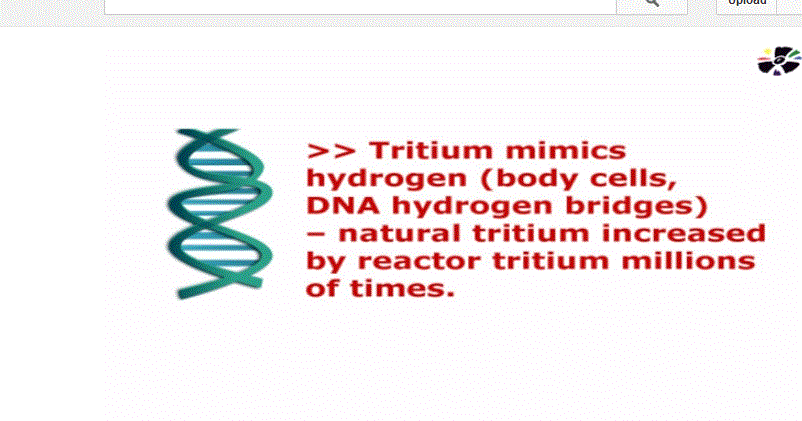
Tritium dumped into Cape Cod Bay will wash back onto community shores, says a new report
Holtec, the company that has purchased a number of permanently closed nuclear reactors in order to decommission them, has encountered yet another obstacle to its “dilution is the solution to pollution” plans.
One of the reactor sites Holtec has taken over is Pilgrim in Plymouth, Massachusetts, on the Cape Cod Bay, which closed permanently in 2019. Holtec’s not-so-little problem there is what do with what started out as at least 1.1 million gallons of radioactively contaminated wastewater stored at the site.
The company first suggested it would simply release the wastewater into Cape Cod Bay, assuring residents and the immediately alarmed fishing community not to worry because (a) the wastewater isn’t dangerous anyway (b) everyone does this all the time at reactor sites and no one has gotten sick so far and (c) it would quickly disperse into the wider ocean. Holtec chose this disposal method for one reason alone: it is the cheapest.
The proposal was vigorously fought by citizens, the state, and powerful Massachusetts Democrat, Senator Ed Markey. The state of Massachusetts effectively banned the discharge option, a decision Holtec is contesting.
That Final Determination to Deny Application to Modify a Massachusetts Permit to Discharge Pollutants to Surface Waters was issued by the Massachusetts Department of Environmental Protection Division of Watershed Management on July 18, 2024. A month later, Holtec launched its appeal to reverse the decision, something that could take months or longer to find its way to court.
In the meantime, help has come from a new quarter in the form of an in-depth study by the prestigious Woods Hole Oceanographic Institution, also, as it happens, based on the Massachusetts shoreline, near Falmouth.
The study — Model-Based Study of Near-Surface Transport in and around Cape Cod Bay, Its Seasonal Variability, and Response to Wind — found that contrary to Holtec’s claims, the wastewater would not immediately disperse into the ocean, but would linger potentially for months, and wash up on the shores of area communities.
“We found virtually no out-of-the-Bay transport in winter and fall and slightly larger, but still low, probability of some of the plume exiting the Bay in spring and summer,” said Woods Hole study leader and physical oceanographer, Irina Rypina.
The radioactively contaminated wastewater stored at Pilgrim is contaminated with what Holtec and the Massachusetts Department of Public Health have described as “four gamma emitters —Manganese-54, Cobalt-60, Zinc-65 and Cesium-137 along with Tritium, a beta radiation emitter”.
While the Woods Hole Study did not look at the health outcomes of releasing the radioactive water into Cape Cod Bay — only at the plume pathway — there are plenty of data that demonstrate the harmful effects of these radioisotopes on human health, especially women and children…………………………………………………….. https://beyondnuclearinternational.org/2024/12/29/high-tide-for-holtec/
1 This Month
23-25 October – on Zoom – World BEYOND War’s annual global conferenc

To see nuclear-related stories in greater depth and intensity – go to https://nuclearinformation.wordpress.com

Say No to NASA’s Reckless Nuclear Reactor on the Moon
Say No to NASA’s Reckless Nuclear Reactor on the Moon
-
Archives
- October 2026 (149)
- September 2026 (339)
- August 2026 (330)
- July 2026 (355)
- June 2026 (287)
- May 2026 (306)
- April 2026 (356)
- March 2026 (251)
- February 2026 (267)
- January 2026 (308)
- December 2025 (358)
- November 2025 (359)
-
Categories
- 1
- 1 NUCLEAR ISSUES
- business and costs
- climate change
- culture and arts
- ENERGY
- environment
- health
- history
- indigenous issues
- Legal
- marketing of nuclear
- media
- opposition to nuclear
- PERSONAL STORIES
- politics
- politics international
- Religion and ethics
- safety
- secrets,lies and civil liberties
- spinbuster
- technology
- Uranium
- wastes
- weapons and war
- Women
- 2 WORLD
- ACTION
- AFRICA
- Atrocities
- AUSTRALIA
- Christina's notes
- Christina's themes
- culture and arts
- Events
- Fuk 2022
- Fuk 2023
- Fukushima 2017
- Fukushima 2018
- fukushima 2019
- Fukushima 2020
- Fukushima 2021
- general
- global warming
- Humour (God we need it)
- Nuclear
- RARE EARTHS
- Reference
- resources – print
- Resources -audiovicual
- Weekly Newsletter
- World
- World Nuclear
- YouTube
-
RSS
Entries RSS
Comments RSS

