Trump Wants Greenland to Deploy Medium-Range Missiles Aimed at Russia
Since a few days ago US President-elect Trump reiterated his desire to want to buy Greenland
By Claudio Resta, January 1, 2025, https://www.vtforeignpolicy.com/2025/01/trump-wants-greenland-to-deploy-medium-range-missiles-aimed-at-russia/
As early as 1946, the US administration of Harry Truman declared that the island was “essential to the security of the United States” to counter the growing Soviet threat, and offered Denmark $100 million to purchase it.
But the first time that US authorities considered the idea of acquiring Greenland from Denmark along with Alaska from Russia dates back to 1867.
For Russia, the implementation of Trump’s plans regarding Greenland will have military consequences. The island, which already hosts the Thule base, will become the largest US military base with strategic bombers and P-8A Poseidon aircraft to monitor Russian submarines.
But also medium-range land-based missiles: a re-edition of the US “Ice Worm” project from the 1960s but with a different technical solution. The project involved the placement of 600 Minuteman missiles reduced to 2 stages in the tunnels of the Greenland ice sheet.
By deploying LRHW “Dark Eagle” missile systems on the east coast of Greenland with hypersonic warheads, the US would be able to strike the Russian Arctic regions, including Arkhangelsk, Tomsk, Krasnoyarsk, Omsk and Tiksi.
Greenland retains all raw material revenues for operations on the island; Denmark receives nothing and simply pays (starting in 2009 with an annual subsidy of approx. DKK 3,400 million, currently value approx. EUR 455 million).
And here’s the news: from 1 October 2023, the Greenlandic company Inuksuk has taken over the maintenance of the US space base Pituffik (formerly Thule Air Base), the largest US military facility on the island.
As part of the contract, Washington will allocate nearly DKK 28 billion to the island for the maintenance of the US space base alone until 2035, an amount comparable to all of Copenhagen’s grants.
The US interest in Greenland is strategic in nature, regardless of Trump’s statements. After all, this is where the North American Aerospace Defense Command intends to detect and intercept Russian missiles in the event of World War III.
Danish authorities announce new funding to defend the large island.
Since a few days ago US President-elect Trump reiterated his desire to want to buy Greenland The Danish government answer was the announce of a major plan to strengthen Greenland’s defense capacity, just hours after US President-elect Donald Trump publicly reiterated his desire to buy the Arctic country, home to just 56,000 people.
Without providing details, Danish Defense Minister Troels Lund Poulsen told Danish news outlet Jyllands-Posten that Copenhagen will invest “billions of Danish kroner to improve the country’s defenses.”
The unspecified defense spending could amount to between €1.34 billion and €13.27 billion.Trump said on his social media platform, Truth Social, on Sunday that the United States will seek possession and control of Greenland for “purposes of national security and freedom around the world.”
The comments came just days after the former US president suggested Washington wanted to seize neighboring Canada and retake the Panama Canal. PM Egede: “We are not for sale”
In response, Greenlandic Prime Minister Mute Egede said that “Greenland belongs to the Greenlandic people.”
He also said that his country “is not for sale and never will be. We must not lose our long struggle for freedom.”
Greenland has its own extensive local government, but is still affiliated with the Danish crown.
The country was a Danish colony until 1953, when it was reclassified as a district of Denmark.
Greenland was then fully integrated into the Danish state under the Constitution of Denmark, making its inhabitants Danish citizens. https://www.afjournal.ru/en/2024/1/global-and-regional-security/a-fight-for-the-icy-africa-greenland-caught-between-the-colonial-past-the-us-arctic-interests-and-the-eu-strategic-autonomy
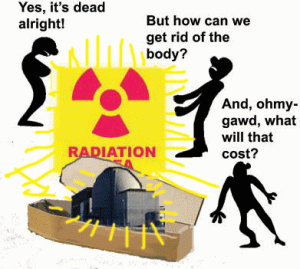
Pickering A nuclear power plant bites the dust!
Twitter: https://x.com/NoNukeBailouts/status/1874916809050357787
Good riddance! This dawg of a nuke station – 4 reactors at Pickering A – has been finally put to rest. The 2.2 million people that live within 30 km of the station can breathe a sigh of relief (though Pickering B is still open), though taxpayers will now be saddled with billions of dollars of decommissioning and waste expenses into eternity.
The Pickering Nuclear Station is one of the oldest and largest nuclear plants in the world. Designed to last 30 years, it’s now over 50. In 1998, Pickering A was completely shuttered due to safety concerns. Units 1 and 4 were rebuilt at such high public expense that they mothballed units 2 and 3.
The Pickering nuke station has a long history of accidents and safety concerns – learn more here:
https://www.cleanairalliance.org/pickering-safety/
Good by nukes – hello renewables!
https://www.world-nuclear-news.org/articles/opg-says-goodbye-to-pickering-4
US relaxes green hydrogen rules in race to boost nuclear sector

Joe Biden’s administration relaxed the criteria for green hydrogen
producers to claim tax credits on Friday as it raced to help the struggling
sector and secure its [?] clean energy legacy ahead of Donald Trump’s
inauguration. The Treasury department has delayed stricter requirements for
the sector by two years to 2030: from that year, green hydrogen developers
will need to prove that their production is powered by renewables hour by
hour instead of annually, in order to qualify for credits.
The Treasury is also allowing hydrogen produced using power from existing nuclear plants to
qualify in its final rules, as long as the project averts a nuclear
plant’s retirement. This expands from its draft rules that require
developers to produce hydrogen from new clean energy projects, like solar
or wind, that are connected to their regional grid.
FT 3rd Jan 2025
https://www.ft.com/content/38c519c3-1fe9-4d2c-9d8c-6dd158ab35aa
Protect your girls: We show that biological sex IS a factor in radiation outcomes, WIDELY

Mary Olson, GENDER AND RADIATION IMPACT PROJECT, 1 Jan 25
NEWS: We show in a new paper that the finding that girls and women suffer greater harm from radiation exposure compared to boys and men (who are also harmed) can be seen WIDELY in recent radiation research literature.
Dr Amanda Nichols, University of California at Santa Barbara, lead author, joins Mary Olson, founder of Gender and Radiation Impact Project in the new paper, entitled “Gender and Ionizing Radiation: Towards a New Research Agenda Addressing Disproportionate Harm.”
The paper is available to view or download at no charge, from the publisher: United Nations Institute for Disarmament Research .
The news here is the simple difference between standing on a relatively slender branch, and standing on a robust limb—apply this image to research and it is the difference between evidence found in a limited case, versus the same evidence being FOUND widely—beyond what could have been limited application.
In terms of radiation—a finding was made that radiation harms girls and women more than boys and men in one set of data as early as 2006. That data was in the National Academy of Science (NAS) watershed report called the Biological Effects of Ionizing Radiation VII (BEIR VII).
Now, thanks to the invitation by the UN Institute for Disarmament Research (UNIDIR), I and my co-author Dr Amanda Nichols have sampled the research literature since 2006 (post-BEIR VII) and find that in studies that report data on males and females separately (now common) the sex-based difference can be seen, and in all cases where it is seen, females are harmed more than males. ……………………………………………………………………………………………….. more https://www.genderandradiation.org/blog/2024/12/31/protect-your-girls-we-show-that-biological-sex-is-a-factor-in-radiation-outcome-widely
A Trump-Putin Deal Over Ukraine Does Not Look Good for Europe
New EasternOutlook , Ricardo Martins, December 30, 2024
“Stop pushing Zelensky into peace talks”, tells EU Foreign Affairs chief to European leaders. For the EU, a negotiated peace deal is a win for Putin and a defeat for Europe. Understand the reasons.
Europe has invested too much to settle for ‘just’ a peace deal: the goal was to crush Russia
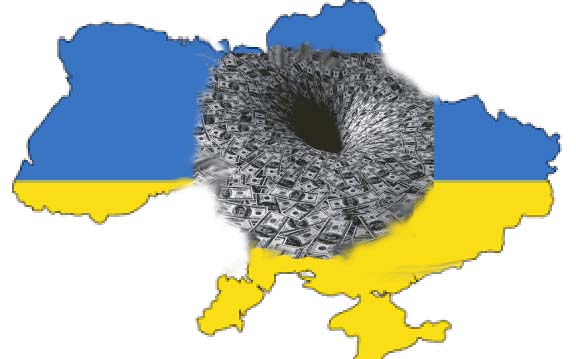
The total amount of military aid to Ukraine since the beginning of the conflict in February 2022 amounts to $119 billion, including 62 billion from the U.S., as confirmed by Pentagon chief Lloyd Austin. The amount allocated under the humanitarian label is more than double.
Europe has channelled significant resources into Ukraine, from financial aid packages, to military equipment, and training programmes. Great Britain, along with the U.S., has been crucial in intelligence support too. Beyond this, Europe has also invested heavily in influencing public opinion with narratives such as “Putin will invade Europe next.” The scale of these war-supporting efforts has been so extensive that many European countries have depleted both their arms stockpiles and public finances.
Annalena Baerbock, Germany’s Foreign Minister, has underscored the financial burden of ongoing support for Ukraine, revealing that the €37 billion allocated has necessitated cuts to social spending programs within Germany. The consequences of this financial obligation are staggering, according to the minister: crucial investments in early childhood programs and infrastructure modernization have been sidelined in favour of military assistance to Ukraine.
These efforts were designed to position Europe as a steady ally of Ukraine, committed to defending democratic values and regional stability. However, the looming possibility of an eventual Trump-Putin deal leaves Europe in a precarious position, grappling with the absence of a clear, face-saving strategy.
Therefore, the EU foreign affairs chief, Kaja Kallas, downplayed discussions about peace during her first meeting with EU foreign affairs ministers in Brussels, disregarding a Gallup poll showing that a majority of Ukrainians (52%) favour peace negotiations, while 38% support continuing the fighting. Kallas went further, admonishing EU heads of state at the latest EU summit: “Stop pushing Zelensky into peace talks.”
The most striking aspect of this statement is that it comes from someone holding the title of EU diplomacy chief—a role traditionally centred on fostering dialogue and negotiation. Yet, this very individual appears to dismiss the importance of diplomacy, even as Putin has repeatedly expressed willingness to engage in negotiations……………………………..
Such a deal could drastically shift the geopolitical landscape, potentially sidelining Europe in critical negotiations or undermining its investments and sacrifices. Europe’s commitment has been framed as a moral and strategic stand against aggression, but if Washington pivots toward reconciliation with Moscow, Europe could appear overextended and politically sidelined in its own European matters.
This situation is particularly uncomfortable given the EU’s reliance on the U.S. for broader security assurances. Zelensky understood it and bluntly stated: “Security guarantees without the US are not sufficient for Ukraine.”
Without a cohesive plan to address the fallout of a potential agreement between Trump and Putin, Europe risks losing credibility both within its borders and on the global stage.
Framing the Conflict as Putin’s Personal War: Simplistic Narratives Are More Convincing
The mantra “Russia must not win” has become a rallying cry across the EU, where any agreement is framed as a “victory for Putin.” This narrative conveniently reduces the war to a personal crusade by Vladimir Putin, dismissing the broader strategic and national interests driving Moscow’s actions.
. By personalizing the conflict, it becomes easier to frame it as a clear-cut battle of good versus evil, a narrative that is eagerly amplified by the media and political analysts. This portrayal has effectively stoked public fears with claims that “Europe is in danger,” galvanizing support for continued military engagement.
However, not everyone has embraced this oversimplified dichotomy. Independent analysts and critical observers have pushed back, pointing out the dangers of ignoring the complex geopolitical realities at play. They argue that viewing the conflict through a lens of rational strategic interests, rather than moral absolutism, could open avenues for meaningful dialogue and resolution—options currently sidelined in favour of escalation.
This refusal to consider alternative perspectives risks prolonging the conflict, leaving Europe increasingly strained by the economic and political costs of its unwavering commitment to a military solution. Meanwhile, voices calling for pragmatism and peace remain drowned out by the cacophony of war rhetoric.
In sum, Europe must urgently rethink its approach, prioritizing diplomatic agility and long-term strategies that enable it to assert its own influence, regardless of U.S. policy fluctuations. Meanwhile, Trump’s claim that he could end the war in 24 hours appears increasingly unrealistic. The so-called ‘Deep State’—comprising the informational, intelligence, and military apparatus—seems to have its own agenda, potentially signalling to Trump where the true power lies. Moreover, despite the immense human, infrastructural, and societal losses in Ukraine, the war remains highly profitable for certain entities.
Ricardo Martins ‒PhD in Sociology, specializing in policies, European and world politics and geopolitics, https://journal-neo.su/2024/12/30/a-trump-putin-deal-over-ukraine-does-not-look-good-for-europe/
Biden spending last month shoveling billions to get more Ukrainians killed for nothing
Walt Zlotow, West Suburban Peace Coalition, Glen Ellyn IL 2 Jan 25
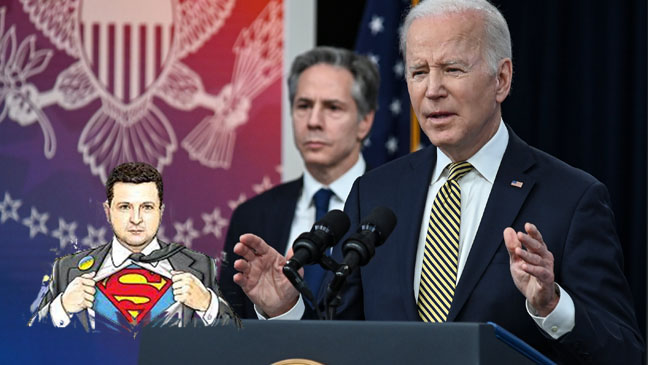
On Monday, President Biden released another $6 billion in precious US treasure to keep his proxy war against Russia killing Ukrainians till Trump arrives January 20.
Here’s what $6 billion will provide the decimated Ukrainian army being systematically destroyed in a war provoked and prolonged by President Biden
· Munitions for National Advanced Surface-to-Air Missile Systems (NASAMS)
· HAWK air defense munitions
· Stinger missiles
· Counter-Unmanned Aerial Systems (c-UAS) munitions
· Ammunition for High Mobility Artillery Rocket Systems
(HIMARS)
· 155mm and 105mm artillery ammunition
· Air-to-ground munitions
· High-speed Anti-radiation missiles (HARMs)
· Unmanned Aerials Systems (UAS)
· Javelin and AT-4 anti-armor systems
· Tube-launched, Optically guided, Wire-tracked (TOW) missiles
· Small arms and ammunition and grenades
· Demolitions equipment and munitions
· Secure communications equipment
· Commercial satellite imagery services
· Medical equipment
· Clothing and individual equipment
· Spare parts, maintenance and sustainment support, ancillary, services, training, and transportation
That’s the final treasure Biden can squander because House Speaker Mike Johnson nixed his last request for another $25 billion before his thankful departure January 20.
Biden’s $175 billion in 3 years of war is all for naught as Russia is pushing remaining Ukraine forces out of the Russian province of Kursk and extending their defensive perimeter around the 4 eastern Ukraine provinces captured. None of these provinces would be in Russian control had Biden not sabotaged the peace agreement Zelensky and Putin were about to complete back in March, 2022.
Biden will leave office mired in the echo chamber of US exceptionalism and world dominance. He will no doubt praise his bloody, wasteful and failed course he plunged Ukraine to follow in his Farwell Address. While he could be worse, successor Trump has ample opportunity to end Biden’s Ukraine madness. Regarding Ukraine, Joe Biden cannot leave the presidency soon enough.
BBC staffers reveal editor’s ‘entire job’ to whitewash Israeli war crimes

News editor Raffi Berg reportedly controls online coverage of genocide in Gaza to ensure Israeli crimes are ‘watered down’ or ignored
News Desk, DEC 28, 2024, https://thecradle.co/articles/bbc-staffers-reveal-editors-entire-job-to-whitewash-israeli-war-crimes
BBC editor Raffi Berg has almost complete control of the British broadcaster’s online coverage of Israel’s war on Gaza and is ensuring that all events are reported with a pro-Israel bias, according to a new report published on 28 December by Drop Site News.
“This guy’s entire job is to water down everything that’s too critical of Israel,” one former BBC journalist said.
Drop Site News spoke to 13 current and former staffers who stated that the BBC’s coverage consistently devalues Palestinian life, ignores Israeli atrocities, and creates a false equivalence in an entirely unbalanced conflict.
Another BBC journalist said Berg plays a key role in a broader BBC culture of “systematic Israeli propaganda.”
“How much power he has is wild,” said another journalist.
There was an extreme fear at the BBC, that if you ever wanted to do anything about Israel or Palestine, editors would say: ‘If you want to pitch something, you have to go through Raffi and get his signoff,” another journalist explained.
In one case, Berg downplayed Amnesty International’s accusation that Israel is committing genocide in Gaza.
Berg chose a headline that stated, “Israel rejects ‘fabricated’ claims of genocide,” to describe the Amnesty report and failed to post the story for 12 hours after it was written to suppress its online reach.
The journalists interviewed by Drop Site also noted that the Amnesty report was not covered on the BBC’s flagship news programs—BBC One’s News At One, News At Six, or News At Ten or its flagship current affairs program, BBC Two’s Newsnight.
“Anyone who writes on Gaza or Israel is asked: ‘Has it gone to edpol [editorial policy], lawyers, and has it gone to Raffi?'” another journalist said.
Raffi Berg, who wrote a book praising clandestine Mossad operations, wields great power to influence perceptions of Israel’s war on Gaza because the BBC news website is the most-visited news site on the internet, with over 1.1 billion visits in May alone.
Israel’s war on Gaza has killed over 45,000 Palestinians, the majority women and children, and flattened large swathes of the besieged enclave.
The pro-Israel bias imposed by Berg is evident in the language used to cover the war.
While stories “prominently” used words like “massacre,” “slaughter,” and “atrocities” to refer to Hamas, they “hardly, if at all,” used them “in reference to actions by Israel,” wrote Rami Ruhayem, a Beirut-based BBC Arabic correspondent.
In another case, the BBC published a story with a headline that hid Israel’s responsibility for killing an entire family in a missile strike.
“Israel Gaza: Father loses 11 family members in one blast,” the headline stated.
Drop Site notes that when the BBC does mention Israel as the perpetrator, it uses the caveat “reportedly.”
The BBC also uses euphemisms preferred by the Israeli army to hide its soldiers’ war crimes. For example, the BBC describes the forcible transfer or ethnic cleansing of Palestinian civilians as “evacuations.”
In one case, the BBC described Israel’s total siege on Gaza with a headline stating, “Israel aims to cut Gaza ties after war with Hamas.”
Defense minister Yoav Gallant’s public vow to impose a “full siege” on Gaza while calling Palestinians “human animals” received just one mention in any BBC online content.
The journalists speaking with Drop Site said they made specific requests to BBC management to balance its coverage, but their requests have been ignored.
“Many of us have raised concerns that Raffi has the power to reframe every story, and we are ignored,” one journalist said.
“Almost every correspondent you know has an issue with him,” one stated. “He has been named in multiple meetings, but [BBC management] just ignore it.”
The journalist said they demanded that stories should “emphasize that Israel had not granted the BBC access to Gaza, that the network should end the practice of presenting the official Israeli versions of events as fact, and that the BBC should do more to offer context about Israeli occupation and the fact that Gaza is overwhelmingly populated by descendants of refugees forcibly driven from their homes beginning in 1948.”
Armed with Canadian taxpayer support, AtkinsRéalis and Westinghouse are competing to export nuclear reactors. Which one will prevail?

One thing is certain: No vendor will get far without taxpayer support.
But some observers think that dwelling on the prospects of various reactor vendors entirely misses the point. Mr. Schneider said renewables, already considerably cheaper to build than nuclear plants, can now offer a steadier supply of electricity thanks to maturing battery storage technologies. In major markets such as the U.S., China and India, solar combined with storage is the cheapest option.
MATTHEW MCCLEARN, January 2, 2024, https://www.theglobeandmail.com/business/article-atkinsrealis-westinghouse-nuclear-reactors-exporting/
After a long absence, Canada is back in the business of exporting nuclear reactors.
In November, Montreal-based AtkinsRéalis Group Inc. (formerly SNC-Lavalin) announced it will participate in a four-company consortium that could resume construction of two 700-megawatt reactors at Cernavoda, Romania’s only nuclear power station. The new units, Cernavoda Units 3 and 4, would be the first Candus built anywhere since their sister, Unit 2, was completed in 2007. The deal was sealed by $3-billion in Canadian export financing, provided by the federal government and administered by Export Development Canada, a Crown corporation.
Mere weeks later, AtkinsRéalis’s Pennsylvania-based competitor, Westinghouse Electric Co., announced it had a “letter of interest” from EDC for just over $2-billion in financing to build three of its AP1000 reactors at what would be Poland’s first nuclear power plant. Westinghouse is now under Canadian ownership – just over a year ago it was purchased by Brookfield Asset Management and Cameco Corp.
These announcements represent notable victories for Western nuclear interests, which otherwise have greatly receded in importance globally in recent decades. Russian dominance has been near-total: According to Mycle Schneider Consulting’s annual report on the state of the nuclear industry, Russia is constructing 20 reactors abroad, including in China, Egypt, India and Turkey. Mr. Schneider said the only other international vendor is Électricité de France SA, which is building two reactors in Britain. Canada isnot even in the running because it hasn’t built a reactor in so long.
But Russia’s invasion of Ukraine, and growing concerns around its use of its energy clout to achieve geopolitical ends, has raised discomfort. This at a moment when nuclear power plants are again being considered worldwide. Suddenly, Western reactor vendors smell opportunity – and they’re scrambling to win contracts, recruit from the same limited pool of partners and suppliers, and secure the government loans that are crucial to these projects.
Home-court advantage
AtkinsRéalis is a large international engineering firm; last year its nuclear division accounted for 12per cent of its revenues. That division is growing rapidly, however, and now employs about 4,000 people, up from 3,000 in 2022. Much of its recent hiring is in preparation for anticipated new reactor sales, in Canada and abroad.
Cernavoda exemplifies the nuclear industry’s meandering fortunes. Conceived during the long reign of Communist dictator Nicolae Ceaușescu, it was built in fits and starts. The earliest design and procurement contracts for the first reactor were signed in 1978; within a decade, five Candu 6 reactors were under construction. But the first wasn’t even half-complete by the time of the Romanian revolution, in December, 1989, during which Mr. Ceaușescu was deposed and executed. Only two units were completed after lengthy delays. They now supply about 20 per cent of Romania’s electricity.
Units 3 and 4 are to be Enhanced Candu 6s, updated versions of the originals. During the initial phase, AtkinsRéalis will provide design, engineering and procurement services, and handle relations with the country’s nuclear regulator. The company said this work will earn revenues of $224-million. The other partners include the nuclear division of Italy’s Ansaldo Energia SpA, Texas-based engineering and construction firm Fluor Corp., and Sargent & Lundy, an architect engineering firm. The customer is Nuclearelectica, Romania’s nuclear power utility, which must ultimately decide whether to proceed with the rest of the €3.2-billion ($4.7-billion) project.
Joe St. Julian, president of AtkinsRéalis’s nuclear division, sees this as just the beginning.
He expects 1,000 new reactors will be built worldwide over the next 25 years, at a cost of up to US$15-billion each. As many as 100 could be Candus, he predicts. His reasoning is that 35 of the approximately 600 reactors built to date worldwide were Candus, about 5 per cent.
“In the next round, we’ll call it round two, we should be able to get more than 5 per cent, maybe as much as 10 per cent,” he said.
The Candu’s most important advantage, he contends, is that it runs on natural uranium. Most reactors require enriched uranium, which is expensive to produce, and Russia dominates international nuclear fuel supply chains. This does seem to have influenced Romania, where wariness over reliance on Russian nuclear technology dates back to Mr. Ceaușescu’s time.
Another advantage might be AtkinsRéalis’s relationships with the rest of the Canadian nuclear industry. This year, several other companies havejoined AtkinsRéalis’s Canadians for CANDU campaign, including nuclear industry giants such as BWX Technologies Inc. and Aecon Group Inc. Earlier this month, AtkinsRéalis boasted that its Canadian subsidiary, Candu Energy Inc., had issued more than $1-billion in orders across its supply chain. Unifor, a large private-sector trade unionthat represents many workers in the nuclear industry, recently issued an open letter calling on the Ontario government to prioritize the Candu.
But there’s a problem.
Reactors have trended ever-larger since the dawn of the nuclear age, and the average output of new ones is about 1,000 megawatts. AtkinsRéalis largely stayed out of the risky business of reactor development, a decision that anemic global reactor sales long seemed to vindicate. But now, as governments and utilities consider building large new reactors to meet surging power demand, AtkinsRéalis lacks a modern, large model to offer them.
So, last year it proposed the Monark, which at 1,000 megawatts would be the largest-ever Candu. The company plans to spend $50-million to $70-million annually to complete the design by the end of 2026 and has 250 employees working on it.
Mr. St. Julian said the Monark’s success depends entirely on selling it in Canada first, to utilities such as Bruce Power and Ontario Power Generation, which are in the early planning stages for potential new power plants in Ontario.
“If we cannot sell a Candu Monark in Canada, there is no export strategy,” he said.
Contenders
But gone are the days when Candus enjoyed exclusivity at home. Key legacy customers have already defected: OPG, which owns more Candus than any other utility, selected an American light water reactor for its next power plant in Ontario, Darlington B. It plans to construct four BWRX-300s from America’s GE Hitachi Nuclear Energy – a model the Ontario government is actively marketing in Eastern Europe, according to Stephen Lecce, its Energy Minister.
In the large reactor market, Westinghouse aims to steal the Candu’s lunch. Westinghouse has opened an office in Kitchener, Ont., and now employs 270 people in Canada. It’s courting many suppliers that are members of AtkinsRéalis’s Canadians for CANDU campaign, including BWX Technologies and Aecon, both of which entered agreements in December to work on AP1000 projects in Canada and worldwide.
“The not-so-secret secret is that we help them participate in the export markets to build up the diversification and strength in the Westinghouse technologies, and then we deliver here at home, domestically,” said John Gorman, president of Westinghouse Canada, who joined the company last month.
In Poland, Westinghouse markets itself as a “gold standard American” company. But Mr. Gorman emphasizes its Canadian ownership. “Let’s use our Canadian ownership, let’s use this very strong Canadian supply chain, to help service those export markets, to diversify our supply chain here at home,” he said.
Mr. Gorman is careful not to directly diss the Candu. (He previously served for six years as head of the Canadian Nuclear Association, the industry’s trade association.) AtkinsRéalis has the “ambition” to design a new reactor, he says, “that will be modern and be up to today’s requirements” – a quest he encourages.
But the AP1000, he notes, is “not only developed, but proven and recently being built out in multiple jurisdictions.” Two AP1000s have already been licensed and constructed in the United States. (Those reactors, at the Vogtle site in Georgia, were tremendously over-budget and behind schedule, which led to Westinghouse’s bankruptcy and its acquisition by Brookfield and Cameco.) Another four AP1000s have been built in China; eight are under construction worldwide, and more are under consideration in Europe, Britain and India, according to Westinghouse.
It’s a considerable head start, albeit one purchased at great expense.
Mr. St. Julian says he isn’t worried. He said the most important purchase consideration will be the levelized cost of electricity that reactors produce.
“Can we produce a megawatt hour of electricity at a lower cost than the AP1000? We absolutely believe we can.”
Watch your wallet
But some observers think that dwelling on the prospects of various reactor vendors entirely misses the point. Mr. Schneider said renewables, already considerably cheaper to build than nuclear plants, can now offer a steadier supply of electricity thanks to maturing battery storage technologies. In major markets such as the U.S., China and India, solar combined with storage is the cheapest option.
One thing is certain: No vendor will get far without taxpayer support.
Foreign reactor sales are invariably accompanied by generous and highly opaque government subsidies. Global Affairs Canada says the loan for the Cernavoda project is still being negotiated, but terms and conditions are considered “commercially confidential” and will never be disclosed. EDC wasn’t any more forthcoming about its proposed $2-billion loan in favour of Westinghouse.
“As per our Transparency and Disclosure policy, we cannot comment on prospective transactions or anything beyond what we’ve provided already and what the company announced,” wrote spokesperson Anil Handa in an e-mailed response to questions.
Biden Administration Announces Nearly $6 Billion in New Ukraine Aid
ANTIWAR.com, Dave DeCamp, 31 Dec 24
Ukraine is receiving about $2.5 billion in military aid and $3.4 billion in ‘budget support,’ which funds government salaries and servicesby Dave DeCamp December 30, 2024.
The Biden administration on Monday announced nearly $6 billion in new aid for Ukraine as it’s determined to escalate the proxy war as much as possible before President-elect Donald Trump is inaugurated on January 20, 2025.
The aid includes $3.4 billion in “direct budget support,” a form of assistance meant to pay for Ukrainian government services, salaries, pensions, and other types of spending. It has also been used to subsidize Ukrainian small businesses and farmers.……………………….
Ukraine is also receiving nearly $2.5 billion in military aid from the US, which includes $1.22 billion from the Ukraine Security Assistance Initiative, a program that allows the US to purchase weapons for Ukraine. The remaining military aid is in the form of the Presidential Drawdown Authority, which enables President Biden to ship weapons directly from US military stockpiles.
The Biden administration is dumping more weapons into Ukraine even though there’s no path to a Ukrainian victory on the battlefield as Russian forces continue to make gains in the Donbas and Ukraine’s invading force in Kursk is being pushed out. Biden officials are determined to keep the war going and are even pressuring Ukraine to begin conscripting 18-year-olds.
According to the Pentagon, the new military aid includes:
Spare parts, maintenance and sustainment support, ancillary equipment, services, training, and transportation
Munitions for National Advanced Surface-to-Air Missile Systems (NASAMS)
HAWK air defense munitions
Stinger missiles
Counter-Unmanned Aerial Systems (c-UAS) munitions
Ammunition for High Mobility Artillery Rocket Systems (HIMARS)
155mm and 105mm artillery ammunition
Air-to-ground munitions
High-speed Anti-radiation missiles (HARMs)
Unmanned Aerials Systems (UAS)
Javelin and AT-4 anti-armor systems
Tube-launched, Optically guided, Wire-tracked (TOW) missiles
Small arms and ammunition and grenades
Demolitions equipment and munitions
Secure communications equipment
Commercial satellite imagery services
Medical equipment
Clothing and individual equipment
In recent months, President Biden signed off on several significant escalations in the proxy war, including supporting long-range strikes on Russian territory and the provision of widely banned anti-personnel mines to Ukraine.
Biden asked Congress for an additional $24 billion to spend on Ukraine, but the request was rejected by House Speaker Mike Johnson (R-LA), who said any decisions on Ukraine aid would be up to Trump. https://news.antiwar.com/2024/12/30/biden-administration-announces-nearly-6-billion-in-new-ukraine-aid/
Sizewell C faces calls for more scrutiny of costs ahead of Final Investment Decision

New Civil Engineer, 02 Jan, 2025 By Tom Pashby
The cost of Sizewell C should face scrutiny from the government’s newly-formed Office for Value for Money (OVfM), according to concerned parties.
Ecotricity founder and CEO Dale Vince wrote a letter to the OVfM “formally” requesting it start “a process” for assessing Sizewell C’s value for money, while a member of the House of Lords and campaigners have also expressed concern over the cost.
The government has already committed billions towards the Suffolk nuclear power station, despite its intention for it to be privately funded. The final investment decision (FID) is the ultimate confirmation that the power station will move ahead, with details of who will pay for it and how. This has been continually pushed back, most recently because of the summer’s General Election.
It now expected that FID will be made at the conclusion of the government Spending Review in the spring………………………………………………………………………………………………………………..

- You are here:Latest
Sizewell C faces calls for more scrutiny of costs ahead of Final Investment Decision
02 Jan, 2025 By Tom Pashby
The cost of Sizewell C should face scrutiny from the government’s newly-formed Office for Value for Money (OVfM), according to concerned parties.
Ecotricity founder and CEO Dale Vince wrote a letter to the OVfM “formally” requesting it start “a process” for assessing Sizewell C’s value for money, while a member of the House of Lords and campaigners have also expressed concern over the cost.
The government has already committed billions towards the Suffolk nuclear power station, despite its intention for it to be privately funded. The final investment decision (FID) is the ultimate confirmation that the power station will move ahead, with details of who will pay for it and how. This has been continually pushed back, most recently because of the summer’s General Election.
It now expected that FID will be made at the conclusion of the government Spending Review in the spring.
Meanwhile, earthworks are underway at the site (pictured).
What is the Office for Value for Money?
The creation of the OVfM was announced in the new Labour government’s Autumn Budget 2024. It is a “time-limited HM Treasury Unit”, according to its website, with two roles.
Related questions you can explore with Ask NCE, our new AI search engine.

- What is the current status of the Sizewell C nuclear power project?
- How much has the UK government committed to the Sizewell C project so far?
- What are the concerns about the cost of the Sizewell C project?
- How does the regulated asset base funding method work for nuclear power projects?
- What is the expected timeline for the Final Investment Decision on Sizewell C?
If you would like to ask your own question you just need to login, register or subscribe.
Its first role is to “provide targeted interventions through the multi-year Spending Review, working with government departments.
“This will include conducting an assessment of where and how to root out waste and inefficiency, undertaking value for money studies in specific high-risk areas of cross-departmental spending, and scrutinising investment proposals to ensure they offer value for money,” the government said.
The second role it has responsibility for is to develop recommendations for “system reform” which will “underpin a ruthless focus within government on realising benefits from every pound of public spending”.
It is chaired by David Goldstone, a non-executive director (NED) at the Submarine Delivery Agency, as well as a NED at HS2 Ltd acting as a representative of the Treasury, and he is a member of the Projects & Programmes Committee of Great British Nuclear.
The UK Government characterises his role at OVfM as the “independent” chair.
Vince’s letter to the OVfM
Vince, who was awarded an OBE (Order of the British Empire) for services to the environment and to the electricity industry in 2004, wrote a letter to Goldstone requesting scrutiny of Sizewell C.
In the letter, Vince said: “Sizewell C has already cost UK taxpayers £3.7bn – that’s before a Final Investment Decision (FID) has been made and a further £2.7bn has been allocated for 2025- 26.”
Soon after the Autumn Budget, the Treasury told NCE that the £2.7bn mentioned in the Budget documents is not new funding but rather a sum that would be invested either via the previously announced £5.5bn Devex scheme, or through a separate FID subsidy scheme that would be established at the point of FID.
Vince continued: “If Hinkley Point C is anything to go by, Sizewell C really should have rigorous financial scrutiny.”
He warned that the cost of Hinkley had “ballooned” to £46bn and mentioned delays to the construction of the nuclear power plant.
“Due to a novel funding method (regulated asset base) a lengthy construction timeline for Sizewell will saddle consumers with higher bills long before it delivers a single unit of electricity at a time when there is clear evidence that we can secure a cleaner, cheaper energy future without nuclear,” he said.
Vince went on to ask if the remit of the OVfM covers Sizewell C and said: “I’d like to formally request you start a process and please let me know how we can take part.”
Peer says rumours swirl about government having ‘second thoughts’ about Sizewell
Backbench Conservative peer Lord Howell of Guildford asked the government on 7 October 2024 “whether a Final Investment Decision (FID) regarding Sizewell C will be scrutinised by the new Office of Value for Money, prior to the FID being taken”.
Howell was energy secretary in Margaret Thatcher’s government which supported the construction of nuclear power plants.
The government responded on 21 October saying: “The Office for Value for Money is in the process of being established and appointing an independent Chair”. The OfVM was officially launched on 30 October in the Budget.
On 31 October, NCE asked the Treasury under the Freedom of Information Act “what plans the Office for Value for Money has to evaluate the economic benefits of Sizewell C against public spending and whether the assessment is due to, or has started, before the final investment decision?”
The Treasury said it “does not hold information within the scope of [the] request”.
NCE asked Howell if he planned to ask the question again after Goldstone had been appointed.
Howell told NCE he didn’t plan to, adding: “I fear that direct questions will reveal little or nothing.
“Is the new government having second thoughts? Some say they are.”
Campaigners say lack of scrutiny ‘inexcusable’
Stop Sizewell C executive director Alison Downes said: “Billions of pounds of taxpayers’ money have already been spent on Sizewell C, and much more will certainly be required.
“Coupled with the fact that no project this risky has ever had its lengthy and unpredictable construction bankrolled by British energy bill payers, not submitting Sizewell C for detailed scrutiny by the Office of Value for Money would be completely inexcusable.”……………………………………………. more https://www.newcivilengineer.com/latest/sizewell-c-faces-calls-for-more-scrutiny-of-costs-ahead-of-final-investment-decision-02-01-2025/
A 12-year-old schoolgirl has designed a solar-powered blanket for the homeless
A 12-year-old schoolgirl has designed a solar-powered blanket for the
homeless, winning a prize in a UK engineering competition. Rebecca Young,
from Kelvinside Academy in Glasgow, said she thought of the invention after
seeing people sleeping on the city streets. Tasked with producing a design
to address a social issue, she began researching sleeping bags and
backpacks to see if there was a way to help protect those living rough from
the cold.
Times 1st Jan 2024 https://www.thetimes.com/uk/scotland/article/girl-12-designs-solar-powered-blanket-for-homeless-xxwwg2rrx
Is it realistic for Donald Trump to boast of a quick peace deal for Ukraine ?
AIMN Editorial, https://theaimn.net/is-it-realistic-for-donald-trump-to-boast-of-a-quick-peace-deal-for-ukraine/ 2 Jan 25
Donald Trump has made so many promises on what he will quickly achieve once he takes office as President. The one about ending the Ukraine war in 24 hours probably gained him support from quite a few normally left-leaning people, who understand that the history of this conflict is far more complicated than is portrayed by the Western media.
However, Trump made that statement in July 2023. By 2025, he has somewhat moderated that particular promise. He has had several conversations with Ukraine’s President Zelensky, . Zelensky praised their Paris meeting on 7 December as “productive and meaningful”, but there were no details discussed. Later, Trump opposed the sending of long-range missiles for Ukraine , but said he would not “abandon” Ukraine. He predicted “less aid” to Ukraine https://www.youtube.com/watch?v=E-R7Gi-uLiY. BY 21st December, it was reported that Trump would continue to supply military aid to Ukraine, provided that NATO members dramatically increase their defence spending.
So, peace in Ukraine is not going to happen in such a hurry, even with President Trump and his supposed great negotiating skills. Britain considers sending troops to Ukraine to train Ukrainian regiments. NATO is not prepared for any compromises, especially about giving up the plan for Ukraine’s NATO membership. With any peace deal, the Western allies agree with Zelensky – “Security guarantees without the US are not sufficient for Ukraine.”
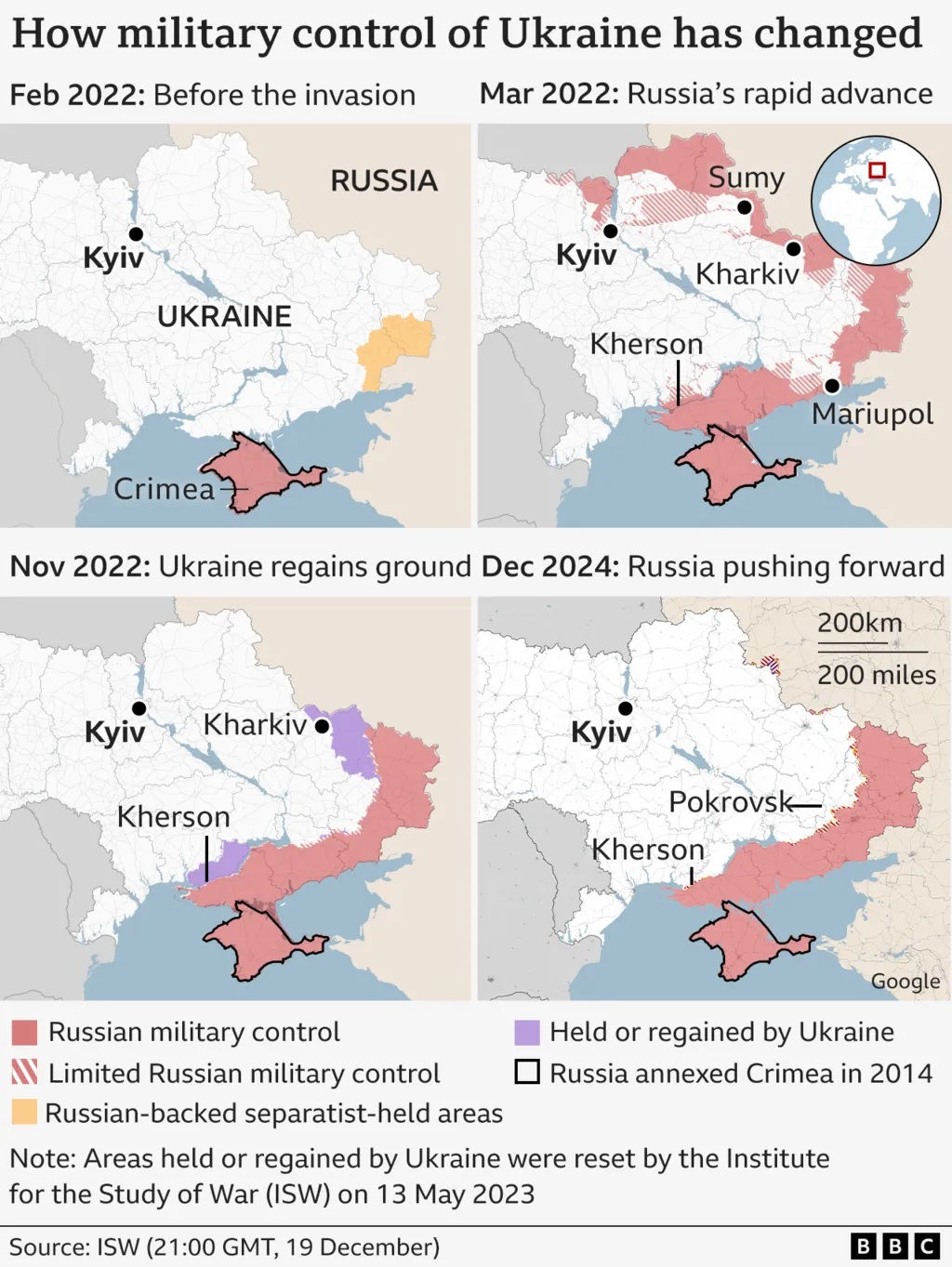
As well as European reluctance to a peace deal, there is the Russian point of view. Despite many set-backs, and a catastrophic loss of soldiers’ lives, Russia is now headed towards winning this war. Why make a deal now, before being in a more powerful position for demanding concessions?
Then we come to the USA. However much Donald Trump might want to end the carnage, and be seen as the peace hero, he is up against significant forces at home – making up what he calls the Deep State. This is a conspiracy theory that helped Trump to gain popularity – and I hate to agree with it, in its rather paranoid theme. BUT, war enthusiasts do exist – among the, military, intelligence, government officials, and wealthy industrialists, and they do exercise influence, and pressure politicians of both parties, to manipulate America’s defense policies. The war in Ukraine continues to be profitable to America’s weapons industries, and at no cost to American lives.
In the whole saga of the war in Ukraine, history has been forgotten. Of course Ukrainian-Russian relations have been tortuous and often terrible. In modern history it goes back to the 1930s, with Stalin’s starvation and genocide of Ukrainians. Then, following oppression from Russia, came in 1941, the short-lived moment of “liberation” by the German Nazis. That brought mass killings of Jews, slave labour, wholesale destruction, and the loss of up to 7 million lives. Russian control over Ukraine returned in 1944, and while the economy was restored, Stalin’s totalitarian rule was back again. In 1991 Ukraine gained independence from Russia.
Is it any wonder that Ukraine, with both Russian and Ukrainian languages still in common use, has been divided in attitudes and loyalties? Going even further back in history, Catherine the Great of Russia, in the 18th Century, made Kiev become Europe’s centre of art and culture, as well as making improvements in health, education, legal rights for Jews, improved conditions for serfs. Sure, she was an absolute monarch, – miles away from being democratic. Now her name and her statues are trashed in Kiev, which is a pity.
From 2014 to 2022, the Ukrainian government waged a war against the separatists in the Eastern, Donbass region. The war was about the 2014-2015 Minsk agreements which meant that the Donbass should have its autonomous government within Ukraine. Volodymyr Zelensky was elected on a platform that he would implement those agreements, but later he reneged on this promise. Russia’s President Putin in 2022 started what he called “a special military exercise” to support the separatists and uphold the Minsk agreement. That turned into the full-scale war against Ukraine.
European and USA support for Ukraine developed into a campaign, at enormous cost, to weaken Russia. The phrase “too big to fail” is used to describe financial crises. But it could apply to the Russia-Ukraine war. From the Western perspective the war is seen as a battle between good and evil – the evil giant Putin against the heroic little Zelensky. With NATO, with most European countries lined up against Russia, it is world democracy to be desperately defended, For Russia, it now is to prevent that last big nation on its border joining that threatening USA-armed line-up.
It was a mistake that Russia started a ‘special military enterprise’ -to evolve into a full-scale war. Some argue that by encouraging Zelensky to reneg on the Minsk agreement, the Western nations provoked the war.
Whatever started the war, the majority of Ukrainians, and especially those in the East, now just want it to end. The prevailing cry of Western leaders – “Putin must fail, Ukraine must prevail” expresses that simplistic view of good versus evil, and just ignores the complicated historic and local concerns of Eastern Ukraine. Diplomacy is jettisoned. As one writer puts it – voices calling for pragmatism and peace remain drowned out by the cacophony of war rhetoric.
Ultimately , every war ends in some sort of a diplomatic outcome. It is doubtful that Trump can make this one end quickly. It might be just one of the promises that he has to give up.
EU officials will claim ignorance of Israel’s war crimes. A leaked document shows what they knew.
Arthur Neslen, The Intercept, Mon, 23 Dec 2024
The internal EU document may strip European foreign ministers of “plausible deniability” in Israeli war crimes in Gaza, experts said.
European Union foreign ministers rebuffed a call to end arms sales to Israel last month, despite mounting evidence of war crimes — and, potentially, genocide — presented to them in an internal assessment obtained by The Intercept.
The contents of the previously unknown 35-page assessment could sway future war crimes trials of EU politicians for complicity in Israel’s assault against Gaza, according to lawyers, experts, and political leaders.
The appraisal was written by the EU’s special representative for human rights Olof Skoog and sent to EU ministers ahead of acouncil meetingonNovember 18, as part of a proposal by the head of the EU’s foreign policy to suspend political dialogue with Israel. The proposal was rejected by the council of foreign ministers from EU member states.
Skoog’s analysis laid out evidence from United Nations sources of war crimes by Israel, Hamas, and Hezbollah since October 7, 2023, when around 1,200 people were killed during a Hamas-led attack that prompted Israel’s assault on the Gaza Strip. The U.N. estimates some 45,000 people have died in Gaza since, with more than half estimated to be women and children.
Though the assessment did not spare Hamas and Hezbollah, much of its strongest language was reserved for the Israel Defense Forces.
“War has rules,” the paper says. “
Given the high level of civilian casualties and human suffering, allegations focus mainly on how duty bearers, including the Israeli Defence Forces (IDF), have seemingly failed to distinguish between civilians and combatants and to take all feasible precautions to protect civilians and civilian objects against the effects of the attacks, in violation of the fundamental principles of IHL” — international humanitarian law……………………………………………………………………………………………………………………………
In the wake of the assessment, some EU politicians will be at risk of complicity if Israel is found to have committed war crimes, said Tayab Ali, a partner in the U.K. law firm Bindmans, which recently took the British government to court over its arms exports to Israel.
“Lawyers across Europe are watching this closely and likely to initiate domestic and international accountability mechanisms. Economic interests are not a defence to complicity in war crimes,” Ali told The Intercept. “It is astounding that, following the contents of this report, countries like France and Germany might even remotely consider raising issues of immunity to protect wanted war criminals like Netahyahu and Gallant” — referring to Israeli Prime Minister Benjamin Netanyahu and former Defense Minister Yoav Gallant.
Diana Buttu, a former legal adviser and negotiator for the Palestinian Authority suggested that the rejection of the EU’s own analysis by its member states was political.
“Legally, we know where the dominoes should be falling,” Buttu said. “It was a question of whether the politics would match with the law, and unfortunately, they did not.”…………………………………………………………………………………………….
Skoog’s assessment says international law allows Israel “the right and indeed the duty to protect its population,” but that this can only be exercised in response to an armed attack or imminent attack and must be proportional. Because it is an occupying power, the assessment says, Israel also had an obligation to ensure safety and the health of those living under occupation.
Agnès Bertrand-Sanz, an Oxfam humanitarian expert, said the assessment “reinforces the case that EU governments have been acting in complicity with Israel’s crimes in Gaza.”
“Even when their own services presented them with the facts, they refused to act,” she said. “Those that continued exporting arms to Israel in defiance of the report’s clear advice, are involved in a blatant case of criminal collusion.” m https://www.sott.net/article/496948-EU-officials-will-claim-ignorance-of-Israels-war-crimes-A-leaked-document-shows-what-they-knew
Government urged to review Sizewell C nuclear plant over ballooning cost
Ecotricity founder Dale Vince, a Labour donor, has called for an urgent cost review of the Sizewell C nuclear power station and Net Zero Teesside carbon capture project.
By Jessica Mills Davies, Energy Voice, 30/12/2024,
Ecotricity founder Dale Vince has demanded a formal review of the Sizewell C nuclear power station, and a new carbon capture project, over concerns costs have “ballooned” by tens of billions of pounds.
He has written to David Goldstone, the chair of the Treasury’s new Office for Value for Money (OVfM), asking him to examine plans to develop a new nuclear power project in Suffolk that he warned “will saddle consumers with higher bills long before it delivers a single unit of electricity”.
“Due to a novel funding method (RAB) a lengthy construction timeline for Sizewell will saddle consumers with higher bills long before it delivers a single unit of electricity at a time when there is clear evidence that we can secure a cleaner, cheaper energy future without nuclear,” said the renewable energy entrepreneur, who has donated money to the Labour Party………………………………………………………………………………… https://www.energyvoice.com/renewables-energy-transition/564942/government-urged-to-review-sizewell-c-nuclear-plant-over-ballooning-cost/
Some Types of Pollution Are More Equal than Others
There is a BIG taboo around Radioactive Pollution. We published a report last June into acid mine pollution alongside radioactive pollution in Whitehaven Harbour – so far ignored by mainstream media.
Marianne Birkby, Oct 20, 2024, https://radiationfreelakeland.substack.com/p/some-types-of-pollution-are-more?fbclid=IwY2xjawHh0f1leHRuA2FlbQIxMAABHUnO_Vn81d2vI8K3TJv2FDpKMvMeozmDbga7z5mLwKNgZSE_7FT9wPa0pA_aem_5S_Vz4KQ2AgvtszsvnQJeQ
Whitehaven Mine Pollution
The Westmorland Gazette and other local press have today published a feel good article about beach cleans in Cumbria. So far so good but the beaches contain far more insidious and long lived pollution than plastic, in the form of radioactive wastes from decades of Sellafield’s operations.
In Whitehaven Harbour these radioactive wastes are literally magnified by the presence of the ongoing acid mine pollution pouring into the harbour. Instead of addressing this ongoing pollution event the local MP Josh MacAlister is greenwashing the ongoing devastation by bigging up Whitehaven as the West Coast Riviera and fizzingly pushing for a ferry service while boats are understandably leaving because of the visible acid mine pollution.
Less visible is the “historic” radioactive pollution still pouring out of Sellafield with more radioactive waste arriving almost daily.
………………………………….Dear Marine Conservation Society,
Thank you for highlighting pollution threats to our oceans.
We are a nuclear safety volunteer group in Cumbria increasingly worried about radioactive pollution alongside acid mine polllution flowing into Whitehaven harbour.
Our own investigations have found the highly radioactive isotope AM241 confirmed by a laboratory in the US at levels above 37 bq/kg. This is alongside the acid mine pollution with the presence of heavy metals which magnifies the impacts of radioactivity. Sellafield is funding a multi-million pound water sports centre encouraging people into the contaminated silt at Whitehaven and effectively greenwashing the ongoing pollution event.
Attached is our report and the report from Eberline Laboratory. The regulators and nuclear industry are brushing this pollution aside but clearly there is an ongoing issue that no-one is addressing.
What is the MSC position on this?
Marianne, Radiation Free Lakeland
1 This Month
23-25 October – on Zoom – World BEYOND War’s annual global conferenc

To see nuclear-related stories in greater depth and intensity – go to https://nuclearinformation.wordpress.com

Say No to NASA’s Reckless Nuclear Reactor on the Moon
Say No to NASA’s Reckless Nuclear Reactor on the Moon
-
Archives
- October 2026 (149)
- September 2026 (339)
- August 2026 (330)
- July 2026 (355)
- June 2026 (287)
- May 2026 (306)
- April 2026 (356)
- March 2026 (251)
- February 2026 (267)
- January 2026 (308)
- December 2025 (358)
- November 2025 (359)
-
Categories
- 1
- 1 NUCLEAR ISSUES
- business and costs
- climate change
- culture and arts
- ENERGY
- environment
- health
- history
- indigenous issues
- Legal
- marketing of nuclear
- media
- opposition to nuclear
- PERSONAL STORIES
- politics
- politics international
- Religion and ethics
- safety
- secrets,lies and civil liberties
- spinbuster
- technology
- Uranium
- wastes
- weapons and war
- Women
- 2 WORLD
- ACTION
- AFRICA
- Atrocities
- AUSTRALIA
- Christina's notes
- Christina's themes
- culture and arts
- Events
- Fuk 2022
- Fuk 2023
- Fukushima 2017
- Fukushima 2018
- fukushima 2019
- Fukushima 2020
- Fukushima 2021
- general
- global warming
- Humour (God we need it)
- Nuclear
- RARE EARTHS
- Reference
- resources – print
- Resources -audiovicual
- Weekly Newsletter
- World
- World Nuclear
- YouTube
-
RSS
Entries RSS
Comments RSS

