“We are no longer investing in nuclear.”

“We are focusing on what we agreed upon, namely the extension by 10 years.
That is already a gigantic job,” says Vincent Verbeke. According to him,
nuclear is no longer part of Engie’s “strategic ambition”.
The French energy giant focuses on renewable energy and flexibility. “We are no longer
investing in nuclear.” The plans to extend Doel 4 and Tihange 3 by another
10 years seem to fall flat on their face. “A 20-year extension is a
different project. It doesn’t exist,” says Verbeke. He thinks nuclear
energy is too expensive. “The cheapest option is to invest in renewables.”
VRT News 24th Jan 2025, https://www.vrt.be/vrtnws/nl/2025/01/24/bijkomende-verlenging-doel-4-en-tihange-3-ondenkbaar-zegt-eng/
Plutonium Disposition Strategy

Statement,
UK Parliament 24th Sept 2025, https://questions-statements.parliament.uk/written-statements/detail/2025-01-24/hcws388
The Department for Energy Security and Net Zero will work with the Nuclear Decommissioning Authority (NDA) to immobilise the UK-owned civil separated plutonium inventory at Sellafield.
Continued, indefinite, long-term storage leaves a burden of security risks and proliferation sensitivities for future generations to manage. It is the Government’s objective to put this material beyond reach, into a form which both reduces the long-term safety and security burden during storage and ensures it is suitable for disposal in a Geological Disposal Facility (GDF). Implementing a long-term solution for plutonium is essential to dealing with the UK’s nuclear legacy and leaving the environment safer for future generations.
Following a public consultation in 2011 the government at the time formed a preliminary policy view to pursue reuse of plutonium as mixed oxide fuel (MOX) but to remain open to any alternative proposals for plutonium management.
NDA have since carried out substantial technical, deliverability and economic analysis to identify a preferred option for a long-term disposition solution, including options for immobilisation and reuse. The outcome of this work recommended immobilisation as the preferred way forward to put the material beyond reach soonest and with greatest delivery confidence.
Following further development work the NDA will select a preferred technology for immobilisation of the plutonium as a product suitable for long-term storage and subsequently disposal in a GDF. Organisations involved in the delivery of this work will include the NDA, in particular Sellafield Ltd and Nuclear Waste Services, the UK National Nuclear Laboratory and the wider supply chain.
We expect that around the end of the decade following Government approval the NDA and Sellafield will begin delivery of the major build programme of plutonium disposition infrastructure. This programme is expected to support thousands of skilled jobs during the multidecade design, construction and operational period.
While work continues on long term immobilisation, the NDA is ensuring the continued safe and secure storage of plutonium in the UK. As part of this approach, new facilities are being built at Sellafield to repack the plutonium inventory for placement in a suite of modern stores.
Trump says he will approve power plants for AI through emergency declaration.

Spencer Kimball, https://www.cnbc.com/2025/01/23/trump-says-he-will-approve-ai-power-plants-using-emergency-declaration.html
- President Donald Trump said he will expedite the construction of power plants for artificial intelligence through an emergency declaration.
- Trump said the plants can use whatever fuel they want, including coal.
President Donald Trump said Thursday he will expedite the construction of power plants for artificial intelligence through an emergency declaration, as the U.S. races against China for dominance in the industry.
“We’re going to build electric generating facilities. I’m going to get the approval under emergency declaration. I can get the approvals done myself without having to go through years of waiting,” Trump said in a virtual address to the World Economic Forum in Davos, Switzerland.
The plants can use whatever fuel they want, the president said, making clear that his administration won’t hold the AI industry to any climate targets.
There are some companies in the U.S. that have coal sitting right by the plant so that if there’s an emergency, they can go to that,” the president said.
Trump declared a national energy emergency on his first day in office, directing federal agencies to use whatever emergency authorities they have at their disposal to expedite energy infrastructure projects.
One day later, Trump unveiled a joint venture with OpenAI, Oracle and SoftBank to invest billions of dollars in AI infrastructure through a project called Stargate.
Power demand from artificial intelligence data centers is forecast to surge in coming years. The tech companies building the centers that support AI have primarily focused on procuring renewable energy, though they have shown a growing interest in nuclear power to meet their growing electricity needs.
While the tech sector has invested in carbon-free power to meet its climate goals, analysts believe natural gas will play a pivotal role in powering AI because it’s plentiful, is more reliable than renewables and can be deployed faster than nuclear.
Trump said he wants power plants to connect directly to data centers rather than supplying electricity through the grid.
“You don’t have to hook into the grid, which is old and could be taken out,” Trump said. This arrangement, called co-location, has faced opposition from some utilities, who are worried about losing fees and have warned that taking power off the grid could lead to supply shortages.
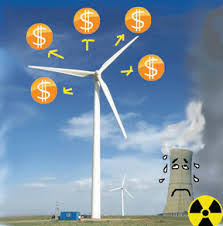
Wind, not nuclear, is the best way to meet Sweden’s climate goals, leading think tank says
By Reuters, January 24, 2025,
Reporting by Simon Johnson Editing by Frances Kerry
STOCKHOLM, Jan 23 (Reuters) – The cheapest way for Sweden to meet its expected rise in demand for electricity and goal of net zero emissions by 2045 is to build more onshore wind parks rather than increase the number of nuclear power plants, a leading think tank said on Thursday.
Sweden’s government has said it wants to build up to 10 new nuclear power plants by 2045 as transport and industry shift away from fossil fuels and demand for electricity is forecast to reach around 300 Terawatt hours (TWh) from 135 TWh in 2023.
The SNS think tank said that new nuclear power would be the most expensive solution, while more onshore wind and solar power combined with boosted production from hydropower plants and existing nuclear reactors would be able to meet increased demand without increasing Sweden’s low electricity prices.
“The high costs linked to nuclear power mean that these kinds of plants should primarily be built in countries with significantly higher electricity prices,” SNS said in a report on Sweden’s energy transition…………………………………………………………..
SNS said the government should focus on improving the electricity grid and regulatory framework to support private investment in new energy production. https://www.reuters.com/sustainability/wind-not-nuclear-is-best-way-meet-swedens-climate-goals-leading-think-tank-says-2025-01-23/
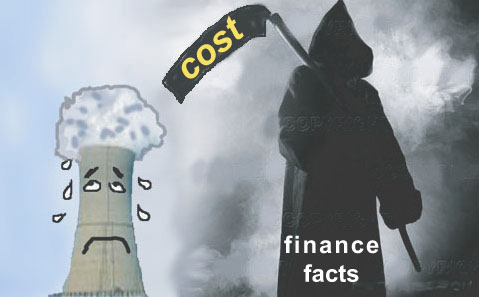
East Suffolk MP warned “billions worthlessly invested” in Sizewell C
Campaigners have written to Member of Parliament for Suffolk Coastal, Jenny
Riddell-Carpenter, about the billions spent on nuclear project Sizewell C,
after costs were speculated to end up spiralling to £40 billion.
The long-term expense of the project has come into question after it emerged
that spending on another nuclear power station that is being built by
French state-owned developer EDF is expected to be in excess of £40bn.
Cour des Comptes, the French state auditor, last week advised the energy
company to delay an investment decision on the nuclear power station in
Sizewell, after Hinkley Point C hit delays and refinancing difficulties.
It advised EDF to slash its financial exposure to the Hinkley Point C project
before making a final decision regarding its investment in Sizewell C.
Campaign group Together Against Sizewell C (TASC) said the auditor’s
advice “demonstrates there are external factors that are outside the
control of the UK government that mean the project might not be
completed”.
Energy Voice 23rd Jan 2025, https://www.energyvoice.com/renewables-energy-transition/nuclear/565933/east-suffolk-mp-warned-billions-worthlessly-invested-in-sizewell-c/
Hinkley Point C: EDF says fish issue could delay new plant operation
By Seth Dellow, Digital Reporter, Bridgwater Mercury 24th Jan 2025
EDF has stated that a “lengthy process” to identify acceptable compensation for the loss of fish stemming from Hinkley Point C could have “the potential to delay the operation of the power station.”
The French energy giant behind the nuclear project has welcomed government plans to stop delaying major infrastructure projects over ‘excessive’ environmental obligations.
The government is proposing to reduce the number of legal challenges a group can make in court, from three to just one attempt……………………………………………………….
EDF has warned that a “current lengthy process to identify and implement acceptable compensation for a small remaining assessed impact on fish has the potential to delay the operation of the power station.”
It follows the recent delay of a formal consultation over the proposed location of a new salt marsh, which would act as an environmental mitigation for the harm the project would bring to 44 tonnes of fish.
According to EDF, creating a salt marsh “is the only option currently likely to be accepted as a mitigation.” But local residents along the Severn, including landowners and farmers, have previously expressed their opposition to the plans. The initial proposal to create a saltmarsh at Pawlett Harms was opposed in Parliament, with Bridgwater’s MP Sir Ashley Fox branding the idea as a “disaster.” https://www.bridgwatermercury.co.uk/news/24878911.hinkley-point-c-edf-says-fish-issue-delay-new-plant-operation/
Trump calls North Korea a ‘nuclear power,’ drawing a rebuke from Seoul
Yahoo! News, Stella Kim, Wed, January 22, 2025
SEOUL, South Korea — Denuclearization of North Korea is a prerequisite for global stability, South Korea said Tuesday after President Donald Trump described the reclusive regime as a “nuclear power,” raising concern that the U.S. could be moving toward recognizing the North as a nuclear-armed state.
Since Trump was last in office, North Korean leader Kim Jong Un has vowed to “exponentially” boost his nuclear arsenal and ramped up weapons testing, including of missiles that could potentially strike the continental United States and overwhelm U.S. treaty ally South Korea.
The newly inaugurated Trump, who met with Kim three times during his first term to discuss North Korea’s U.N.-sanctioned weapons programs, spoke enthusiastically Monday about his past relationship with Kim, saying they liked each other.
“Now, he is a nuclear power,” Trump said while signing a series of executive orders in the Oval Office. “I think he’ll be happy to see I’m coming back.”
Trump’s defense secretary nominee, Pete Hegseth, also called North Korea a “nuclear power” during his Senate confirmation hearing last week.
While it is unclear what Trump and Hegseth meant by “nuclear power,” U.S. officials have long refrained from using the phrase as it could signal recognition of North Korea as a nuclear-armed state.
The Trump administration did not immediately respond to a request for comment Tuesday.
Though there is growing debate as to whether the international community should accept North Korea’s nuclear status, experts say doing so would significantly disrupt the geopolitical balance in the region and potentially set off an arms race, including the possible development of nuclear weapons by South Korea and Japan…………………………. https://www.yahoo.com/news/trump-calls-north-korea-nuclear-115137317.html
Indigenous group vows to stop nuclear waste shipments unless new deal struck

CTV News By Scott Miller, January 23, 2025
Leaders with the Saugeen Ojibway Nation (SON) say they are no longer willing to have their territory “exploited” for the production of nuclear energy and storage of radioactive waste.
“The nuclear issue has the biggest footprint in the Saugeen Ojibway Territory. It’s the biggest footprint bearing on the environmental imprint, so we need to start getting some of that stuff resolved,” said Chippewas of Nawash Unceded First Nation Coun. Paul Jones.
The SON is home to Bruce Power, the world’s largest operating nuclear station, as well as Ontario Power Generation’s (OPG) Western Waste Management Facility that houses most of Ontario’s nuclear waste.
That includes over one million used nuclear fuel bundles and approximately 100,000 cubic metres of low and intermediate level nuclear waste.
SON leadership say they didn’t agree to either nuclear facility being constructed in their territory, but they are left to deal with them on their traditional lands that stretch from Tobermory to Goderich.
“I believe there were some formal agreements with SON in 2018 and 2022. Since then, Ontario Power Generation has reneged (renegotiated) on some of those commitments, and it kind of put some of the talks on standstill for now,” said Saugeen First Nation Chief Conrad Ritchie.
To restart those talks about compensation for hosting a large portion of Ontario’s nuclear waste, SON has threatened to stop allowing shipments of nuclear waste into their territory unless “significant progress” is made “towards the resolution of nuclear legacy issues” within six months………………………………………………..
Although the plan is to eventually move the millions of used nuclear fuel bundles currently stored at the Western Waste Management Facility to a yet constructed underground facility in northern Ontario, the highly radioactive material will remain in Saugeen territory for many more decades, and that’s worth something, said SON leadership.
“We’re taking all the risk and there’s no benefits coming to SON,” said Jones.
“Hopefully we’ll come up with a good plan or a resolution that’s fair for all parties. And that Saugeen and Nawash get their equal share of operating within our traditional treaty territory,” said Ritchie.
The SON is comprised of the Saugeen First Nation and Chippewas of Nawash Unceded First Nation. Their traditional territories stretch from Tobermory east to Collingwood, and south to Arthur and Goderich. https://www.ctvnews.ca/london/article/indigenous-group-vows-to-stop-nuclear-waste-shipments-unless-new-deal-struck/
UK to dispose of, not re-use, radioactive plutonium stockpile
BBC 24th Jan 2025,
https://www.bbc.co.uk/news/articles/cjr8lzyg299o
The government says it will dispose of its 140 tonnes of radioactive plutonium – currently stored at a secure facility at Sellafield in Cumbria.
The UK has the world’s largest stockpile of the hazardous material, which is a product of nuclear fuel reprocessing.
It has been kept at the site and has been piling up for decades in a form that would allow it to be recycled into new nuclear fuel.
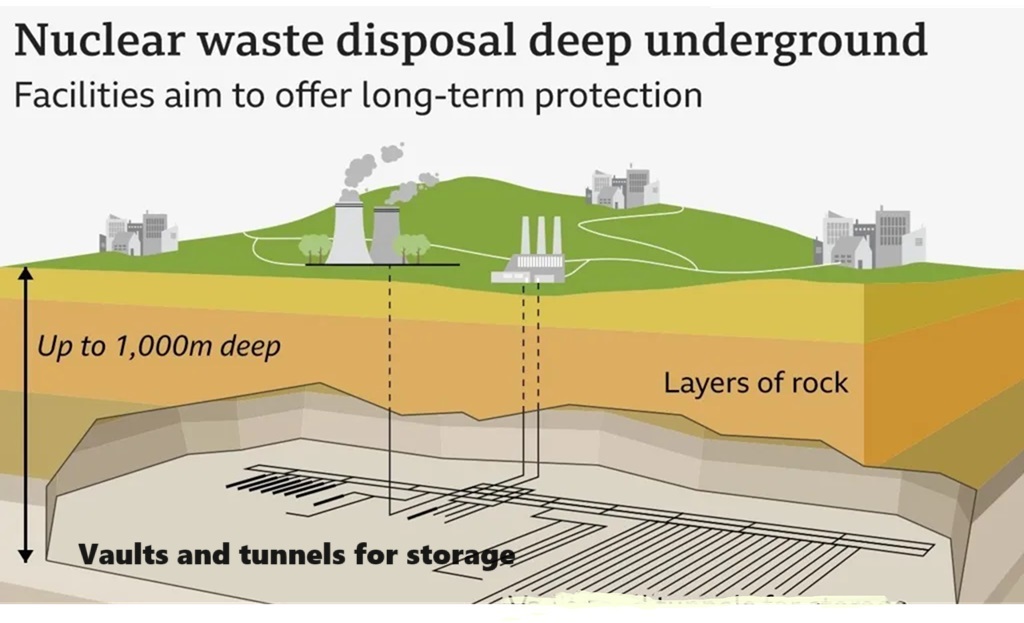
But the government has now decided that it will not be reused and instead says it wants to put the hazardous material “beyond reach” and made ready for permanent disposal deep underground.
That means that a facility will be built at Sellafield where the plutonium can be converted into a stable, rock-like material, which can eventually be disposed of deep underground.
In a statement, energy minister Michael Shanks said the objective was “to put this material beyond reach, into a form which both reduces the long-term safety and security burden during storage and ensures it is suitable for disposal”.
Nuclear materials scientist Dr Lewis Blackburn from the University of Sheffield said the plutonium would be “converted into a ceramic material” which, while still radioactive, is solid and stable so it is deemed safe to dispose of.
“The type of ceramic remains to be decided [and selecting the right material] is the subject of ongoing research.”
Nuclear waste expert Prof Claire Corkhill from the University of Bristol said the goverment’s decision was a “positive step”.
She told BBC News that it paved the way to removing the cost and hazard of storing plutonium at Sellafield “by transforming it and locking it away into a solid, durable material that will last for millions of years in a geological disposal facility”.
“These materials are based on those we find in nature – natural minerals, that we know have contained uranium for billions of years.”
The government is currently in the early stages of a long technical and political process of choosing a suitable site to build a deep geological facility that will eventually be the destination for all of the country’s most hazardous radioactive waste. That facility will not be operational until at least 2050.
America’s ‘zombie’ nuclear reactors to be revived to power Trump golden age

By ELLYN LAPOINTE FOR DAILYMAIL.COM, 24 January 2025 https://www.dailymail.co.uk/sciencetech/article-14317459/zombie-nuclear-reactors-revived-ai-demand-trump-stargate-south-carolina.html
A defunct nuclear power plant will be revived to power Donald Trump‘s new half-trillion-dollar project to make America the world’s artificial intelligence powerhouse.
The state-owned utility Santee Cooper — the largest power provider in South Carolina — said Wednesday that it is seeking buyers to complete construction on a partially-built project that was abandoned in 2017.
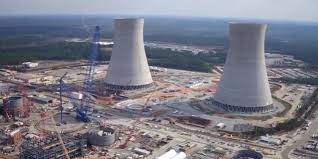
The VC Summer Nuclear Power Station, which houses two unfinished nuclear reactors, was scrapped following years of lengthy, costly delays and bankruptcy by its contractor, according to a company statement.
But now, the utility is hoping tech giants such as Amazon and Microsoft will be willing to finish the project, as they are seeking clean energy sources to fuel data centers for AI.
‘We are seeing renewed interest in nuclear energy, fueled by advanced manufacturing investments, AI-driven data center demand, and the tech industry’s zero-carbon targets,’ said Santee Cooper President and CEO Jimmy Staton.
This announcement came as President Donald Trump unveiled a $500bn AI project which he says will jumpstart America’s ‘golden age.’

The project, dubbed the ‘Stargate Initiative,’ is a massive private sector deal to expand the nation’s AI infrastructure, led by Big Tech companies such as OpenAI, SoftBank and Oracle. It is the largest AI infrastructure project in history.
Trump stated that Stargate will create over 100,000 new jobs ‘almost immediately.’
‘This monumental undertaking is a resounding declaration of confidence in America’s potential under a new president,’ he said during a Tuesday briefing.
Trump emphasized that the project aims to sharpen the country’s technological edge against competitors, notably China.
He held the briefing in the White House’s Roosevelt Room alongside SoftBank CEO Masayoshi Son, Oracle’s Larry Ellison and OpenAI’s Sam Altman.
The US AI industry has already grown rapidly in recent years, but one of the biggest hurdles to expansion is the energy cost of running data centers.
A recent Department of Energy (DOE) report found that total data center electricity usage more than tripled from from 2014 to 2023, rising from 58 TWh to 176 TWh.
The DOE estimates that by 2028, data center energy demand will increase between 325 to 580, consuming up to 12 percent of US electricity.
‘This monumental undertaking is a resounding declaration of confidence in America’s potential under a new president,’ he said during a Tuesday briefing.
Trump emphasized that the project aims to sharpen the country’s technological edge against competitors, notably China.
He held the briefing in the White House’s Roosevelt Room alongside SoftBank CEO Masayoshi Son, Oracle’s Larry Ellison and OpenAI’s Sam Altman.
The US AI industry has already grown rapidly in recent years, but one of the biggest hurdles to expansion is the energy cost of running data centers.
A recent Department of Energy (DOE) report found that total data center electricity usage more than tripled from from 2014 to 2023, rising from 58 TWh to 176 TWh.
The DOE estimates that by 2028, data center energy demand will increase between 325 to 580, consuming up to 12 percent of US electricity.
Santee Cooper said it was working with the investment firm Centerview Partners LLC to vet buyer proposals, which they will accept until May 5.
The exact asking price has not been publicly named, but the Wall Street Journal reported that completion of the reactors would cost the buyer billions of dollars over several years.
This would not be the first time that Big Tech bankrolled a nuclear energy project. Last September, Microsoft struck a deal with the New York utility Constellation Energy to restart the Three Mile Island nuclear plant in Pennsylvania.
This plant was the site of the worst nuclear power accident in US history, when its Unit 2 reactor partially melted down in 1979 and released radioactive gases and iodine into the environment.
Amazon, Meta and Google also sought or signed deals to back nuclear energy projects in 2024, similarly motivated by their AI endeavors.
The federal government has also shown support for the resurgence of nuclear power.
In September, the DOE finalized a $1.52 billion loan guarantee to help Holtec International, a New Jersey manufacturing company, recommission the Palisades nuclear plant in Michigan, marking the first-ever revival of a nuclear power plant in the US.
The Biden administration and Congress also offered billions of dollars in subsidies to maintain older nuclear plants and fund the construction of new reactors.
President Trump has largely opposed and sought to repeal the former president’s energy and climate policies, but has said he supports nuclear energy.
In its first actions this week, the new administration signed an executive order directing the heads of ‘all agencies’ to identify regulations that ‘impose an undue burden’ on domestic energy resources, including nuclear power.
It also instructs the US Geological Survey ‘to consider updating the Survey’s list of critical minerals, including for the potential of including uranium,’ which can be refined into nuclear fuel.
High likelihood of radioactive waste in smoldering landfill, Missouri officials say
MISSOURI INDEPENDENT, By: Allison Kite – January 22, 2025
Missouri officials are warning the U.S. Environmental Protection Agency of a “high likelihood” there is radioactive contamination in a smoldering landfill outside St. Louis.
In a letter last week, the Missouri Department of Natural Resources asked that the EPA assume oversight of the Bridgeton Landfill, arguing it may contain nuclear waste like the adjacent West Lake Landfill.
The two landfills, situated in the St. Louis suburb of Bridgeton, have received extensive attention from regulators over the years. The Bridgeton Landfill has been experiencing a “subsurface smoldering event” — a chemical reaction that heats and consumes waste like a fire but lacks oxygen — for more than 14 years, emitting noxious odors and raising concerns among residents that the “fire” might reach the radioactive waste in the West Lake Landfill next door.
The West Lake Landfill is subject to an EPA oversight and a cleanup to remove thousands of tons of uranium left over from World War II.
But, the state argued in its letter, there may be radioactive waste in the Bridgeton portion of the landfill far closer to the subsurface smolder than previously known……………………………………………………………………………………………………………………….
The St. Louis area has struggled for years with a radioactive waste problem.
During World War II, uranium was refined in downtown St. Louis for use in the Manhattan Project, the name given to the war-era effort to build the world’s first atomic bomb.
After the war, the waste was trucked to St. Louis County and dumped at the airport where it leaked into Coldwater Creek, polluting its banks and waters and subjecting generations of families to radiation exposure and an increased risk of certain cancers. The waste was sold and moved to a site in Hazlewood — still adjacent to the creek — where it continued to expose residents.
In 1973, after valuable metals were extracted from the pile, the remaining waste was illegally dumped in the West Lake Landfill, where it remains today.
The EPA is nearing the end of a process to plan an excavation of much of the radioactive waste from the landfill. Parts of the landfill with lower levels of contamination will be capped.
The U.S. Army Corps of Engineers is overseeing the cleanup of Coldwater Creek.
Last week, the EPA announced it would expand the excavation at the West Lake Landfill because it found additional radioactive contamination. Under the revised plan, another 40 acres of the landfill will be included in the cleanup. Crews will need to dig up another 20,000 cubic yards of contaminated soil and debris, and the price of the cleanup will climb to almost $400 million.
For years, the EPA thought the radioactive material was confined to two portions of the landfill, relying on findings from the Nuclear Regulatory Commission, which, in the late 1970s, flew a helicopter over the landfill to measure gamma radioactivity. That effort missed contamination in parts of the landfill.
The Missouri Department of Natural Resources’ letter came in response to the EPA’s announcement last week that it would expand the cleanup. The state agency said it supported the expanded cleanup and recommended that the EPA “considers being the lead agency for all the potentially affected properties.” https://missouriindependent.com/2025/01/22/high-likelihood-of-radioactive-waste-in-smoldering-landfill-missouri-officials-say/?fbclid=IwY2xjawIAOhZleHRuA2FlbQIxMQABHR0Eo5ucf2C5gyG0H9KX_GVfE9QfJMSf34RPNYlxK_bMz-QNu–VBSiyrA_aem_ijh3lKomduLQR0zVXkDaIQ
Anti nuclear activists celebrate fourth banniversary of nuclear weapons
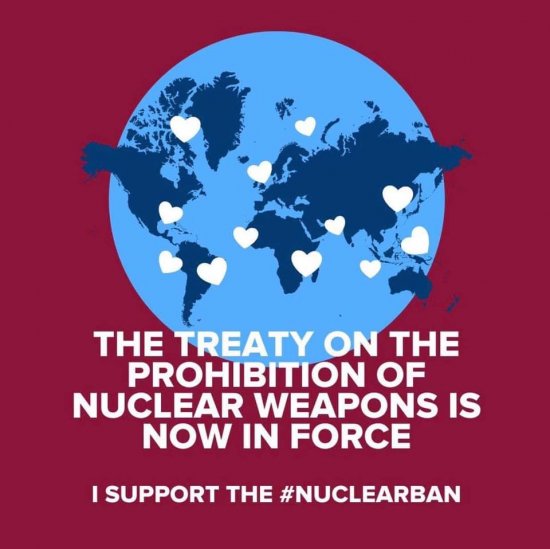
Half of the world’s nations, representing 2.5 billion people, have now signed and / or ratified the Ban Treaty. There are now 94 States Parties to the treaty and 73 have ratified their absolute adherence to it.
NFLA 22nd Jan 2025
Today (22nd January) is the banniversary, the fourth anniversary of the Treaty on the Prohibition of Nuclear Weapons[i] entering into international law at the UN.
This treaty, usually called the Ban Treaty, is the first piece of international legislation to outlaw the production, stockpiling, transfer, use or threat of use of nuclear weapons.
In the world today we have nine confirmed or acknowledged nuclear weapons states, the USA, Russia, United Kingdom, France, India, Pakistan, Israel and North Korea, with an estimated 12,121 nuclear weapons in January 2024[ii].
In 2023, these states were estimated to have spent $91.4 billion maintaining and enhancing their nuclear arsenals.
Nuclear proliferation has been restrained because of the Nuclear Non-Proliferation Treaty[iii] which was first signed by the USA, USSR and UK in 1968 and has almost universal acceptance in the world community. Signatory nations without nuclear weapons agree not to acquire them, whilst retaining the right to employ nuclear power for energy, whilst the five nuclear weapon states, the USA, Russia, UK, France and China, which have signed it have agreed not to deploy nuclear weapons against non-nuclear weapons states. Furthermore, under Article 6 they have committed to: pursue negotiations in good faith on effective measures relating to cessation of the nuclear arms race at an early date and to nuclear disarmament’.
The Ban Treaty came to pass because global civil society, particularly in nations whose people suffered greatly from post-war atomic and nuclear bomb testing, such as Australia, the Pacific Islands, Algeria, and Kazakhstan, became increasingly frustrated by the failure of these nuclear nations to conduct any negotiations in ‘good faith’, despite the passage of over 60 years. Civic society groups, scientists, physicians and the Hibakusha pushed back by establishing an International Campaign to Abolish Nuclear Weapons (ICAN) to bring about the world’s first definitive legislation to outlaw nuclear weapons.[iv]
In doing so they were following the example set by worldwide campaigners opposed to anti-personnel landmines, whose campaign led to the passage of the Ottawa Convention or the Anti-Personnel Land Mine Ban Convention.[v] This became law in 1997. Later that year the International Campaign to Ban Landmines won the Novel Peace Prize.
The new campaign aimed to bring in similar legislation to that which previously banned other weapons of mass destruction, namely chemical, biological and bacteriological weapons.
Lawyers from civil society groups and supportive nations drew up the legislation. Several years were spent by campaigners in international shuttle diplomacy, with private meetings and various regional conferences held across the world to build support amongst United Nations member states…………………………………………………………………………………………
Half of the world’s nations, representing 2.5 billion people, have now signed and / or ratified the Ban Treaty. There are now 94 States Parties to the treaty and 73 have ratified their absolute adherence to it.
……………………………………………………………………………………………………………………. The Nuclear Free Local Authorities and Mayors for Peace are both established partners in ICAN.
Interestingly in both organisations are member authorities in the Republic of Ireland and the UK. The Republic is a neutral and non-nuclear weapon state that has signed and ratified the Ban Treaty. The UK is a NATO and nuclear weapon state which is refusing to engage with the treaty. This creates a dichotomy.
What then will the UK/Ireland NFLAs and Mayors for Peace Chapter be doing in 2025 to build support for the treaty and the communities affected by nuclear weapons and testing?
Richard Outram, explains:
The big challenge here is getting any British Government, whatever its political persuasion, which remains wedded to nuclear weapons and is a member of a nuclear weapons alliance with a first use policy, to get on board with the Treaty.
“2025 will be an especially significant year in the history of nuclear weapons, being the 80th anniversary of the tragic atom bomb attacks on Hiroshima and Nagasaki, so it will be important to have a focused plan with positive actions.”
Richard intends to:
- Ask the Labour Government to send an official observer to the next conference of the Ban Treaty to join signatory states and civil society groups. This will be held in New York in March.
- Lobby the Government to acknowledge the moral imperative for the UK to provide reparations and practical support for the communities, generally Indigenous, impacted by British atomic and nuclear weapons, as per the provisions of Articles 6 and 7 in the Ban Treaty.
- Continue to work for justice and compensation for Britain’s atomic and nuclear test veteran community and their families. The NFLAs have been a major player in lobbying politicians at all levels in both Conservative and Labour governments, and has appointed a former British Army veteran, Councillor Tommy Judge, to be its spokesperson on these issues.
- Ask Mayors for Peace to follow Manchester’s example in passing resolutions in support of the ICAN Cities Appeal calling on the British Government to sign the Treaty.
- Write to parliamentarians at Holyrood in support of a resolution just tabled before the Scottish Government favouring nuclear disarmament and a nuclear free Scotland.
- Support any move to lobby local government pension funds to divest from nuclear weapons.
- Continue to work building up the number of our member authorities and to strengthen their capacity to act for peace in this 80th anniversary year of the atom bombings. https://www.nuclearpolicy.info/news/anti-nuclear-activists-celebrate-fourth-banniversary-of-nuclear-weapons/
Legal challenges to infrastructure plans to be blocked in Starmer growth push
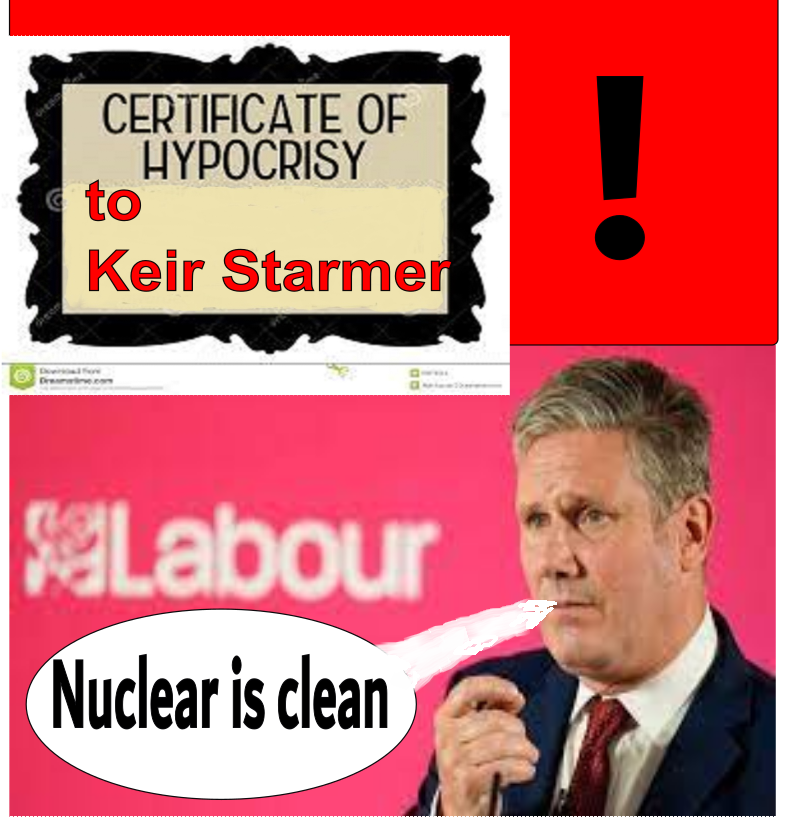
Dr Ruth Tingay, a prominent environmental campaigner and a co-director of Wild Justice, said: “It sounds like Starmer is auditioning for a role in Trump’s cabinet.
Prime minister hopes his plan to ‘take the brakes off Britain’ will send a message to business to build more
Pippa Crerar, Kiran Stacey, Sandra Laville and Patrick Barkham. Guardian 23rd Jan 2025
Legal challenges to infrastructure plans to be blocked in Starmer growth push
Prime minister hopes his plan to ‘take the brakes off Britain’ will send a message to business to build more
Pippa Crerar, Kiran Stacey, Sandra Laville and Patrick BarkhamThu 23 Jan 2025 11.01 AEDTShare
Campaigners will be blocked from “excessive” legal challenges to planning decisions for major infrastructure projects including airports, railways and nuclear power stations as part of the government’s drive for economic growth.
High court judges will be given the power to rule that judicial reviews on nationally significant projects that they regard as “totally without merit” – and which can currently be brought to the courts three times – will be unable to go to appeal.
Keir Starmer said the change would “take the brakes off Britain” by reforming the planning system, sending a message to business to build more national infrastructure, as ministers desperately pursue opportunities to improve the economy.
“For too long, blockers have had the upper hand in legal challenges – using our court processes to frustrate growth,” he said.
“We’re putting an end to this challenge culture by taking on the nimbys and a broken system that has slowed down our progress as a nation.”
It is one of a range of measures being considered by the government as part of an all-encompassing dash for growth, which has caused alarm among environmental groups.
With GDP figures barely moving since the election, Rachel Reeves is looking at proposals from airport expansion to widespread deregulation in an effort to improve the UK’s economic outlook.
Government sources said the chancellor was “deeply unimpressed” with the pro-growth ideas presented by a number of the country’s biggest regulators when she met them last week, and has since instructed them to improve their plans………………………………………………………………………….
However, some environmentalists have expressed unease with the government’s drive to curtail legal challenges to infrastructure projects, of which they have promised to deliver 150 this parliament………………….
In February 2020, Starmer tweeted “congratulations to the climate campaigners” when plans for a third runway at Heathrow airport were ruled illegal by the court of appeal after a judicial review.
“There is no more important challenge than the climate emergency. That is why I voted against Heathrow expansion,” he said then…………………………………
The current first attempt – known as the paper permission stage – will be scrapped. Primary legislation will be changed so that where a judge in an oral hearing at the high court deems the case “totally without merit”, it will not be possible to ask the court of appeal to reconsider. A request to appeal second attempt will be allowed for other cases………………………………….
Green groups also have voiced concerns over plans to overrule environmental protections to free up the planning system with a new Nature Restoration Fund which, the government said, would not allow protected species such as newts and bats to be deemed more important than homes or infrastructure.
Niall Toru, senior lawyer at Friends of the Earth, said: “No one is above the law, not even the government.
“Friends of the Earth only brings cases we think are strong and necessary to protect people and nature from unlawful harm – and considering our string of recent legal wins, so do the courts.
“It is deeply concerning that Labour is attempting to scapegoat claimants. If ministers don’t want to be challenged in the courts, they should act within the law, because already cases aren’t allowed to proceed unless they have merit.”
Dr Ruth Tingay, a prominent environmental campaigner and a co-director of Wild Justice, said: “It sounds like Starmer is auditioning for a role in Trump’s cabinet.
“This proposal doesn’t make any sense whichever way you look at it. First, campaigners can only take judicial reviews if their case does have merit, as judged by the high court.
“So to then allow another judge to block an appeal on the basis that the case is ‘totally without merit’ is nonsensical and will lead to problems of accountability and lack of scrutiny.
“Second, and more importantly, economic growth based on environmental and climate degradation is a loser’s game, and we’ll all be paying the price of that.” https://www.theguardian.com/politics/2025/jan/23/legal-challenges-to-infrastructure-projects-to-be-blocked-in-push-for-growth
1 This Month
15 October. Joint Appeal for Nuclear Abolition Day -presentation to the UN on October 15 will be live on UNWebTV
Endorse the Nuclear Abolition Day Appeal
23-25 October – on Zoom – World BEYOND War’s annual global conference

To see nuclear-related stories in greater depth and intensity – go to https://nuclearinformation.wordpress.com
-
Archives
- October 2026 (149)
- September 2026 (339)
- August 2026 (330)
- July 2026 (355)
- June 2026 (287)
- May 2026 (306)
- April 2026 (356)
- March 2026 (251)
- February 2026 (267)
- January 2026 (308)
- December 2025 (358)
- November 2025 (359)
-
Categories
- 1
- 1 NUCLEAR ISSUES
- business and costs
- climate change
- culture and arts
- ENERGY
- environment
- health
- history
- indigenous issues
- Legal
- marketing of nuclear
- media
- opposition to nuclear
- PERSONAL STORIES
- politics
- politics international
- Religion and ethics
- safety
- secrets,lies and civil liberties
- spinbuster
- technology
- Uranium
- wastes
- weapons and war
- Women
- 2 WORLD
- ACTION
- AFRICA
- Atrocities
- AUSTRALIA
- Christina's notes
- Christina's themes
- culture and arts
- Events
- Fuk 2022
- Fuk 2023
- Fukushima 2017
- Fukushima 2018
- fukushima 2019
- Fukushima 2020
- Fukushima 2021
- general
- global warming
- Humour (God we need it)
- Nuclear
- RARE EARTHS
- Reference
- resources – print
- Resources -audiovicual
- Weekly Newsletter
- World
- World Nuclear
- YouTube
-
RSS
Entries RSS
Comments RSS

