Expulsion and Occupation: Israel’s Proposed Gaza Plan
May 7, 2025 Dr Binoy Kampmark, https://theaimn.net/expulsion-and-occupation-israels-proposed-gaza-plan/
Killing civilians wholesale, starving them to convince those unaffected to change course, and shepherding whole populations like livestock into conditions of further misery would all qualify as heinous crimes in international law. When it comes to Israel’s war in Gaza, this approach is seen as necessary politics, unalloyed by the restraints of humanitarianism. When confronted with these harsh realities on the ground, unequivocal denials follow: This is not happening in Gaza; no one is starving. And if that were the case, blame those misguided savages in Hamas.
As the conflict chugs along in pools of blood and bountiful gore, the confused shape of Israel’s intentions continues in all its glorious nebulousness. Pretend moderation clouds murderous desire. There is no sense that those unfortunate Israeli hostages captured by Hamas in its assault on October 7, 2023 matter anymore, being merely decorative for the imminent slaughter. There is even less sense that Hamas will be cleansed and removed from the strip, however attractive this idea continues to be.
Such evident limits have not discouraged Prime Minister Benjamin Netanyahu and his cabinet, who have decided that more force, that old province of the unimaginative, is the answer. According to the PM, the cabinet had agreed on a “forceful operation” to eliminate Hamas and salvage what is left of the hostage situation.
A spokesperson for the Israel Defense Forces, Brigadier-General Effie Defrin, has explained on Israeli radio that the offensive will apparently ensure the return of the hostages. What follows will be “the collapse of the Hamas regime, its defeat, its submission.” Anywhere up to two million Palestinian civilians in Gaza will be herded into the ruins of the south. Humanitarian aid will be arranged by the Israeli forces, to be possibly distributed through approved contractors.
The IDF chief of staff, Lt. General Eyal Zamier, confirmed that the approved plan will involve “the capture of the Strip and holding the territories, moving the Gazan population south for its defence, denying Hamas and the ability to distribute humanitarian supplies, and powerful attacks against Hamas.”
Within the Israeli cabinet, ethnocentric and religious fires burn with bright fanaticism. The Israeli Finance Finister Bezalel Smotrich remains a figure who ignores floral subtlety in favour of the blood-stained sledgehammer. He remains that coherent link between cruel lawmaking and baffling violence. “Within a few months,” he boasts, “we will be able to declare that we have won. Gaza will be totally destroyed.” With pompous certitude, he also claimed that the next six months would see Hamas cease to exist.
Such opinions, expressed at the “Settlements Conference” organised by the Makor Rishon newspaper in Ofra, a West Bank settlement, gives a sense of the flavour. Palestinians are to be “concentrated” on land located between the Egyptian border and the arbitrarily designated Morag Corridor. As with any potential abuser keen to violate his vulnerable charges while justifying it, Smotrich tried to impress with the idea that this was a “humanitarian” zone that would be free of “Hamas and terrorism.”
The program here is clear in its chilling crudeness. Expulsion, relocation, transfer. These are the words famously used to move on populations of sizeable number in history, often at enormous cost. That this should involve lawmakers of the Jewish state adds a stunning, if perverse poignancy to this. They, the moved on in history, the expelled and the condemned wanderers, shall expel others and condemn them in turn. Smotrich also points the finger to desperation and hopelessness, the biting incentives that propel migration. The Palestinians will feel blessed in their banishment. “They will be totally despairing, understanding that there is no hope and nothing to look for in Gaza, and will be looking for relocation to begin a new life in other places.”
Impossible to ignore in Smotrich’s steaming bile against the Palestinians is the broader view that no Palestinian state can arise, necessitating urgent, preventative poisoning. In addition to the eventual depopulation of Gaza, plans to reconstitute the contours of the West Bank, ensuring that Israeli and Palestinian traffic are separated to enable building and construction for settlements as a prelude to annexation, are to be implemented.
The issue of twisting and mangling humanitarian aid in favour of Israel’s territorial lust has raised some tart commentary. A statement from the Humanitarian Country Team of the Occupied Palestinian Territory, a forum led by the UN Office for the Coordination of Humanitarian Affairs (OCHA), does not shy away from the realities on the ground. All supplies, including those vital to survival, have been blocked for nine weeks. Bakeries and community kitchens have closed, while warehouses are empty. Hunger, notably among children, is rampant. Israel’s plan, as presented, “will mean that large parts of Gaza, including the less mobile and most vulnerable people, will continue to go without supplies.”
The UN Secretary General and the Emergency Relief Coordinator have confirmed that they will not cooperate in the scheme, seeing that it “does not adhere to the global humanitarian principles of humanity, impartiality, independence and neutrality.”
The same point has been made by the foreign ministers of the United Kingdom, France and Germany. Despite all being solid allies of Israel, they have warned that violations of international law are taking place. “Humanitarian aid must never be used as a political tool and a Palestinian territory must not be reduced nor subjected to any demographic change.”
To date, a promise lingers that the offensive will only commence once US President Donald Trump’s visit to Saudi Arabia, the United Arab Emirates and Qatar takes place. But no ongoing savaging of Gaza with some crude effort at occupation will solve the historical vortex that continues to drag the Jewish state risk and oblivion.
Russian drone strike caused tens of millions worth of damage to Chornobyl
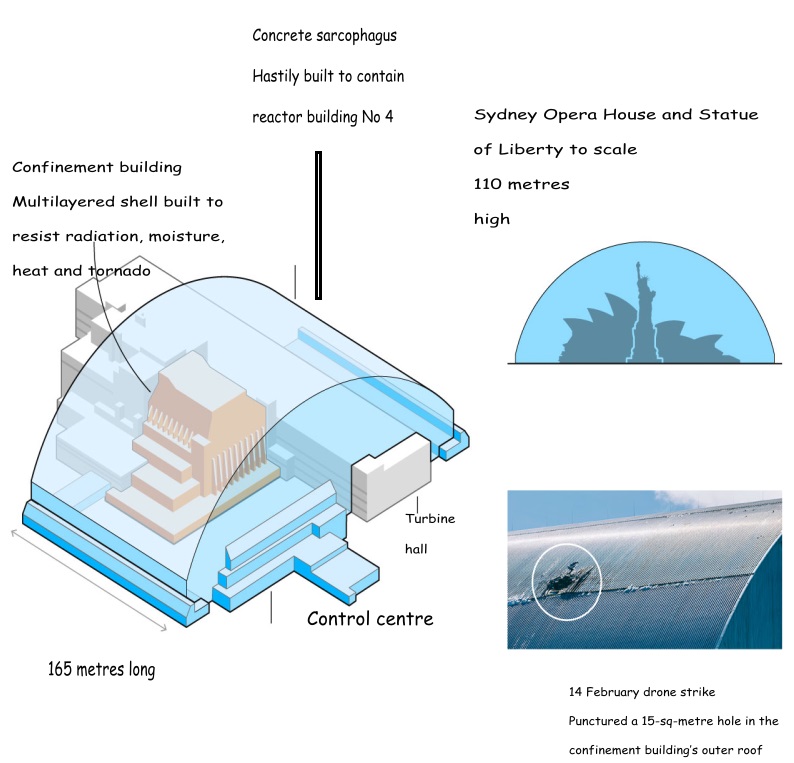
Attack damaged €1.5bn containment structure over nuclear reactor with repair costs likely to be borne by western governments
Russian drone strike caused tens of millions worth of damage to Chornobyl
Attack damaged €1.5bn containment structure over nuclear reactor with repair costs likely to be borne by western governments
Dan Sabbagh in Chornobyl. Photography by Julia KochetovaWed 7 May 2025
A Russian Shahed drone costing up to £75,000 is estimated to have inflicted tens of millions worth of damage to the site of the Chornobyl nuclear power plant, according to initial assessments and engineering experts.
The cost of a full fix is likely to be borne by western governments including the UK, because initial estimates are that a complete repair will cost more than the €25m available in a special international contingency fund.
The strike in mid February did not cause an immediate radiological risk, but it significantly damaged the €1.5bn containment structure built in 2017 to encase the destroyed reactor and is likely to take months if not years to completely repair.
The 110-metre high steel structure at Chornobyl was hit before 2am on 14 February, with sensors registering “something like a 6 to 7 magnitude earthquake,” according to Serhiy Bokov, the chief engineer on duty. “But we clearly understood it wasn’t that,” he said.
The attack – quickly concluded to be caused by a drone flying below at a level where it could not be detected by radar – punctured a 15-sq-metre hole in the outer roof. It also caused a particularly damaging, complex smouldering fire to the inner cladding of the structure that took over a fortnight to put out.
Consisting of two double arches and longer than two jumbo jets, the New Safe Confinement (NSC) was completed in 2017 to secure the hastily built, unstable Soviet-era sarcophagus, which covers over Chornobyl’s ill-fated reactor number four, the site of the world’s worst nuclear disaster in April 1986.
But the attack in February has rendered the sarcophagus open to the elements again, meaning that radioactive dust could get out and rainwater in, though the country’s environmental protection ministry says “the radiation background is currently within normal level and is under constant control”.
More significantly, the confinement structure is now more vulnerable in the longer term to rusting due to greater exposure to the elements and damage to the cladding. Two hundred small boreholes were also drilled into the structure in the effort to douse the cladding fire with water.
“Not fixing it is not an option,” said Eric Schmieman, an American engineer who worked on the design and build of the Chornobyl shelter for 15 years. A complete repair, he said would “cost a minimum of tens of millions of dollars and it could easily go to hundreds of millions” with the repairs taking “months to years,” he added.
Previously the shelter was intended to have a 100-year design life, allowing time to decommission the sarcophagus and nuclear waste below, but this is now in doubt without it being repaired, Schmieman added. Unlike other large metal structures, such as the Eiffel Tower, it was never possible to repaint it to prevent corrosion.
Below the sarcophagus lies a highly radioactive lava like mass, a mix of 200 tonnes of uranium from Chornobyl reactor number four and 5,000 tonnes of sand, lead and boric acid dropped on to the site by Soviet helicopters in the immediate aftermath of the disaster caused by the reactor going out of control.
A more detailed impact assessment is expected to be released in May, but the European Bank for Reconstruction and Development (EBRD), which funded the building of the shelter and is involved in the post bombing analysis, said “it is clear that the attack has caused significant damage”.
Other sources, familiar with the assessment exercise, told the Guardian that Schmieman’s estimates appeared correct. Though the EBRD holds €25m in funds to allow for emergency work, it said “significantly more funding is required” to tackle long-term decommissioning challenges thrown up by the incident…………………………………………………
Further cash for repairs is most likely to come from western governments. Twenty-six countries contributed to the cost of the original shelter, including the US, UK, France, Germany and even Russia – of which the vast steel arch structure cost €1.5bn out of a total €2.1bn fund. Others also made donations, including Turkey.
Home to the remains of a nuclear reactor that went out of control and exploded in April 1986, the Chornobyl site is seven miles from the border with Russia’s ally Belarus. It was occupied by Russian soldiers trying to capture Kyiv in February 2022, and has remained on the frontline after Ukraine regained it that April……………………………………………….
Remotely operated cranes hanging from the confinement shelter were intended to dismantle the sarcophagus and nuclear material below, and the strike hit a point near the maintenance garage Bokov said. That too may impair the plans to gradually dismantle and decommission the disaster site below……………………………….. https://www.theguardian.com/world/2025/may/07/russian-drone-strike-caused-tens-of-millions-worth-of-damage-to-chornobyl
Zaporizhzhia: Hurdle or catalyst for a peace deal in Ukraine?
May 6, 2025, Henry Sokolski , https://npolicy.org/zaporizhzhia-hurdle-or-catalyst-for-a-peace-deal-in-ukraine/
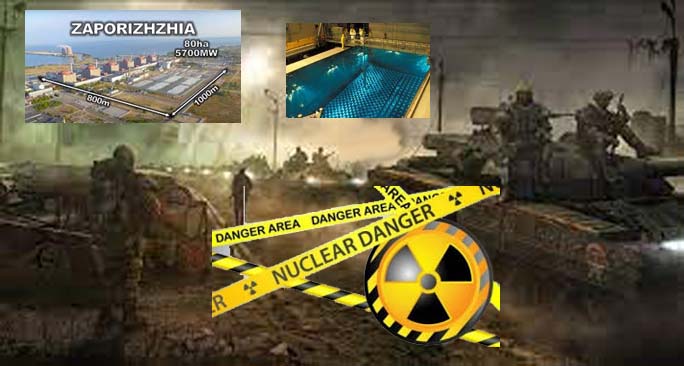
In all the peace proposals the United States, Russia, Europe, and Ukraine have made public, one item always shows up: the reopening of the damaged six-reactor Zaporizhzhia nuclear plant. Washington wants to rebuild and operate it, Moscow insists the plant is theirs, and Kyiv says that it must remain Ukrainian. But, it will be to restart the plant.
Russia insists it can get at least one of the reactors up and running within several months. The United States has no timeline. Ukraine says, even with a solid peace and full control over the plant, bringing all six reactors back online would still take two years or more. No one has ventured how much any of this would cost.
And, there are additional challenges. Russia destroyed the Kakhovka Dam upstream of the plant. Now, what would be required to assure a steady clean supply of cooling water for the reactors? The Russians also laid mines around the plant; the area is also laced with unexploded ordnance. How will these munitions be neutralized? Who will do it? The Russians have looted and damaged much of the plant’s control equipment. How will it be repaired and replaced? Who will certify that the work has been done properly? The U.S. Nuclear Regulatory Commission? The Ukrainian State Nuclear Regulatory Inspectorate? Rosatom?
More than 75 percent of Zaporizhzhia’s nuclear staff no longer work at the plant. Can they be replaced? Who will replace them? Then, there’s the challenge of rebuilding all of the damaged power lines and transformers necessary to export any electricity from the site. Where will the electricity be sent? Ukraine? The European Union? Russian territories? Who will pay for all of this work? Who will be held responsible if there are accidents? Who will defend the plant against future attacks? The United States? Ukraine? Russia? The EU?
There are even more questions than these. But as I make clear in the attached piece, we need to get the answers if we want the situation with Zaporizhzhia to be anything other than a hurdle to reaching any lasting peace.
……… Power for whom and at what cost? Even if the Zaporizhzhia reactors could be safely restarted, the problem of distributing the plant’s power remains. Before the war, Zaporizhzhia helped feed Ukraine’s electrical grid and exported surplus power to Europe. Now, the infrastructure connecting the plant to customers is shattered. Transmission lines must be rebuilt. Substations and transformers need replacement. Technical adjustments will need to be made and agreements negotiated over where the electricity will go and how: western Europe, southern Ukraine, or to Russian-controlled territories?
Another question is who will pay for all this work? Will seized Russian assets foot the bill? Or will it be European Reconstruction Bank funds? What of US investment, taxpayer funds, and any private entity potentially interested in chipping in? Once funds are allocated, who would receive the profits, if any, or be responsible for the losses? Who would assume responsibility for possible accidents and damage to property beyond the plant’s site? And, finally, who will bear the costs of ensuring the plant’s security so that its reactors do not become again the targets of future attacks? None of this is yet clear.
As Ukraine, the United States, and Russia have all made refurbishing and operating Zaporizhzhia a condition for peace, dodging these questions is a prescription for mischief. Without clear answers, resurrecting Zaporizhzhia could become more of an obstacle to than a catalyst for peace.
Henry Sokolski is executive director of the Nonproliferation Policy Education Center in Arlington, Virginia, served as Deputy for Nonproliferation Policy at the Pentagon (1989-93), and is author of China, Russia and the Coming Cool War (2024).
Who defeated the Nazis in World War 2 ? Thank God for Hollywood!

On the 8th May 1945, Germany surrendered unconditionally to the Allies. On the 9th May 2025, Russia is holding a grand commemoration – a “Victory Day” for the 80th anniversary of this event.
How dare they? I know, from my extensive cinema history, that the Americans won World War 2.
Many exciting and entertaining movies have been made, over the decades, glorifying the courage and success of the good soldiers on the good side – several allied nations, notably the British. But my favourites were always from Hollywood. There were so many, and of course, I haven’t seen them all.
From early on, there were movies like The Story of G.I. Joe, Dive Bomber, So Proudly We Hail! and Sahara . And During World War II, Disney made films for every branch of the United States Armed Forces and government.
Hollywood downplayed the efforts and contributions of the other Allies . But some films grudgingly acknowledged the United Kingdom, who kept the hopeless fight alive until the USA joined in and saved the day. Non-European Allies are mostly never even mentioned, especially China, with its pivotal role in the war against Japan. The Soviet-German war on the Eastern Front if mentioned at all, is sometimes portrayed as a sideshow .
Some movies based on real events, such as the film U571 are about real persons who were not American, depicted them as Americans. U571 (2000) is about American submariners. ‘Red Tails’ (2012)is a great exaggeration about American airmen. In some movies, we learn that WWII only began only on December 7, 1941, when the United States entered the war. Some movies are such fun, even if fictional, for example the Americans killing Hitler in Inglourious Basterds.
Many movies are about the overall war effort , but focus on America’s involvement. Some of these films include Saving Private Ryan (1998) Flags of Our Fathers (2006): Band of Brothers (2001). Films on the D Day landings give the impression that the American landing on Omaha Beach was the decisive turning point that led to Allied victory in Europe.
Now, I know that I’m pretty right, in claiming that the Americans won World war 2. In our democratic culture we accept the opinions of the many. The more common view is now that the Americans were the primary reason for the Nazi defeat, with 40-52% in America and Europe saying so. (But Britons think it was the UK).
In 1945, 57% of French citizens believed Moscow “contributed most to the defeat of Germany in 1945” – just 20% named the US, and 12% Britain. By 2015, less than a quarter of respondents recognised the Soviet role, with 54% believing the US to be Nazism’s ultimate vanquisher. Today only 17-28% of Europeans and Americans suggest that the USSR did the bulk of the work in bringing down Hitler.
If you go to Encyclopedia Britannica, or Wikipedia, or many history sites, you are told some extraordinary facts and figures about the role of the Soviet Union in World War 2, and they attribute the defeat of Nazi Germany as being mainly achieved by the Russians, with substantial input from Britain and the USA.
For example – “The Eastern Front was decisive in determining the outcome in the European theatre of operations in World War II, eventually serving as the main reason for the defeat of Nazi Germany The decisive battles were Stalingrad, Kursk, and the Battle of Berlin.”
You find this sort of information – ” The Soviet Union lost at least 26 million in World War II, Considerably more than any other country. Russian casualties were 60 times the number of American casualties…. .. More Russian died at Stalingrad than Americans and Britons died in the whole war.”
D Day 6 June 1944, was a big day in bringing the war towards the end. Approximately 156,000 Allied troops landed in Normandy, France, of which nearly half were from the USA. Additionally, smaller contingents of troops from other allied countries were also involved. So at least the various historical records agree that the USA was strongly involved in the eventual victory, even though they joined in the war effort only in December 1941.
But now, it’s time to correct the records on who defeated the Nazis. Britain and Europe are doing their best, holding VE Day celebrations, in which Russia is excluded. And now, Donald Trump has issued a proclamation designating Thursday as a day for the United States to celebrate its victory in World War II -” we did more than any other Country, by far, in producing a victorious result on World War II”
President Donald Trump is busily correcting historical records, taking over the National Archives, or as he puts it RESTORING TRUTH AND SANITY TO AMERICAN HISTORY
So, between the entertainment culture, the political views of the Western Powers, and finally, no less a history expert than Donald Trump himself, we can hope that all that nonsense about Russia winning WW2 can be put to bed.
80 years on, US still embattled in senseless Cold War with Russia

Walt Zlotow, West Suburban Peace Coalition, Glen Ellyn IL , 7 May 25, https://theaimn.net/80-years-on-us-still-embattled-in-a-cold-war-with-russia/#google_vignette
May 8 marks 80 years since Victory in Europe Day. That victory kicked off the 46 year long Cold War against our great WWII ally Soviet Union (now Russia).
Sadly, the 1991 end of the Soviet Union simply transferred the Cold War into a cool war against Russia which has since gone cold again.
We’ve spent the last 34 years ever expanding the Cold War NATO alliance to Russia’s borders to keep them out of the European political economy and guarantee a yearly trillion dollar defense budget to prop up American capitalism. What good is the world’s largest military if you do not have a monstrous enemy to justify it?
That could have been avoided except for arguably the worst vice presidential pick in American history.
Every American today knows who Harry Truman was but few have a clue about his predecessor. Henry Wallace was a 20th century American visionary shoved out of the vice presidency in 1944, denying him the presidency upon the death of FDR, and changing America and the world for the worse.
Henry Wallace has been largely written out of the American Story told to succeeding generations of Americans by the protectors of the American Super Power Myth.
Born in 1888 to an affluent Iowa Republican farm family, Wallace increased family wealth with his Hi-Bred Corn Company. But the Depression turned Wallace into a zealous champion of the common man, landing him the Secretary of Agriculture post in FDR’s first term. Possibly the most effective New Dealer, Wallace championed the broken American farmer using curtailed production and price supports to ameliorate rampant rural poverty. His unbridled Bernie Sanders like democratic socialism of the 30’s garnered him FDR’s reverence and the 1940 third term vice presidency.
Wallace transformed the vice presidency for the good, long before Dick Cheney transformed it for evil. FDR made him what journalists tabbed the ‘Assistant President’ in his role mobilizing war production during WWII and championing FDR’s vision for a truly peaceful post WWII world working in partnership with critical war ally Russia for a peaceful Europe and ending European colonialism in Asia and Africa.
In 1942 he gave his famous “Common Man” speech, declaring the 20th century must celebrate the common man, not just, as Time publisher Henry Luce postured, the American Century. In 1943, he joined with the black community following the Detroit race riot, arguing “We cannot crush Nazi brutality abroad and condone race riots at home.”
His near FDR like popularity made him a lock for VP again on the ’44 Democratic ticket. But with FDR fading mentally and physically, party leaders saw opportunity to dump him. His peace proclivities threatened their continuation of a war economy to combat their imaginary new Hitler in the form of Joseph Stalin.
They closed the late night convention session on the brink of re nominating Wallace for a second term. That garnered time to make deals with the other candidates to move the pliant Harry Truman from last to first in the final VP tally.
Three months into term four FDR died thrusting Truman into the White House. This set the stage for the Cold War due to Truman’s capitulation to the neo-conservatives of his day such as Jimmy Byrnes and Jimmy Forestall who demanded a fresh enemy to keep the emerging Military-Industrial Complex in business. A Wallace presidency would have sidelined these anti Russian hardliners. The chance for a truly peaceful post WWII world was irrevocably lost.
The post WWII neocons won out over Wallace, but undaunted he launched a 3rd party progressive campaign in 1948 to unseat Truman. McCarthyite red smears and personal attacks on his progressive philosophy doomed him to just 3% of the ’48 vote, ending his career. Also ended was any opportunity for America to retreat from senseless Cold War.
That leaves us to ponder if today’s new Cold War will rage on for another 80 years.
Westinghouse drops out of UK SMR competition
Nuclear Engineering International 30th April 2025, https://www.neimagazine.com/news/westinghouse-drops-out-of-uk-smr-competition/
S Westinghouse has pulled out of the UK’s small modular reactor (SMR) design competition, according to the UK The Telegraph.
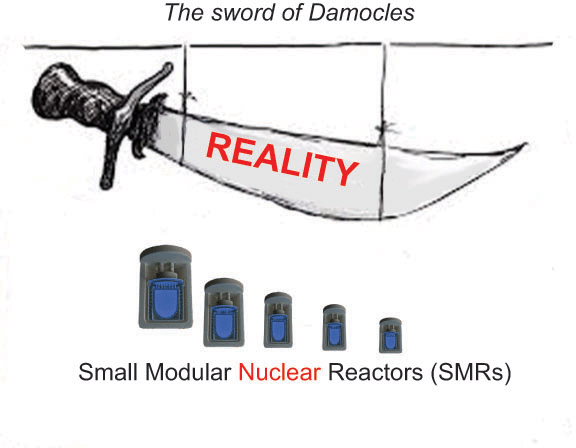
Earlier in April, three of the four competition finalists in Great British Nuclear’s (GBN’s) small modular reactor (SMR) competition submitted their final tenders. The four finalists received an Invitation to Submit Final Tender (ISFT) in February – GE-Hitachi Nuclear Energy International, Holtec Britain, Rolls-Royce SMR, and Westinghouse Electric Company.
GEH (part of GE Vernova) proposed its BWRX-300 boiling water reactor; Holtec proposed its SMR-300 – a 300 MWe pressurised water reactor (PWR); the Rolls-Royce SMR is a 470 MWe PWR; and the Westinghouse AP300 is a 300 MWe/900 MWt PWR. Westinghouse, however, failed to submit its final tender.
GBN was expected to announce two winners this summer with bidders told to prepare to build three to four mini reactors each. The winners will be awarded contracts to co-fund further design development as well as the necessary regulatory, environmental and site-approvals before a final investment decision is taken in 2029. The contracts are expected to total £20bn ($26.7bn) – £10bn each if two companies are selected.
However, The Telegraph reported in February that the Government was considering awarding only one contract as Rachel Reeves, the Chancellor “is struggling to balance the books as weak economic growth makes it harder to meet her self-imposed ‘fiscal rules’ for borrowing.
According to The Telegraph, Westinghouse did not deny it had withdrawn but declined to give its reasons. “One industry source suggested the company had baulked at the commercial offer made by the Government.”
A spokesman from the UK Energy Department said: “Great British Nuclear is driving forward its SMR competition for UK deployment. It has now received final tenders, which it will evaluate ahead of taking final decisions this spring.”
There is growing concern that the economics of SMRs could prove even hard to justify at the high costs for the initial four units. None of the bidders has built their designs which are still in development. All SMRs in the GBN competition will be first-of-a-kind units (FOAK), which will push up costs.
Commenting on the issue, Neutron Bytes noted: “Most estimates are that economies of scale based on factory production of SMRs, promised by all four vendors, only kick in when order books come in “fleet mode,” e.g. by the dozen or more. It follows that even £10bn could be insufficient to cover the costs of four units any of the three 300 MWe offerings based on their status as FOAK projects.”
It added: “Splitting the difference for the GBN competition, e.g. awarding one winner £10bn, keeps the SMR initiative alive, but does nothing to promote long-term “fleet mode” production of SMRs which the UK nuclear industry points out is the only way to achieve economies of scale with factory production of SMRs.”
Rooftop solar can be torn out of capital’s hands

Decentralised solar has the potential to support co-operative, municipal
and other forms of community ownership and control. Solar power is
expanding across the global south, growing faster in China, India and
Brazil than in older, richer solar developers like the US, Japan and
Germany.
Big, corporate-owned solar farms now account for most of the
world’s solar capacity, but decentralised rooftop solar comes a close
second. Rooftop panels are often owned by households, especially in rich
countries, but overall are more likely to be owned by businesses – energy
companies that lease the rooftops, or industrial firms that generate
electricity for their own use.
Nevertheless, I will argue here, because of
its scale and simplicity, decentralised solar has the potential to support
co-operative, municipal and other forms of community ownership and control.
It can play a role in struggles to supercede the domination of capital with
a socially just society, and to forestall disastrous climate change.
Ecologist 7th May 2025, https://theecologist.org/2025/may/07/rooftop-solar-can-be-torn-out-capitals-hands
Ohio EPA launches limited Luckey water testing after independent report shows high radiation in wells.

The Ohio Environmental Protection Agency, now under sharp scrutiny, will begin targeted water sampling in the village of Luckey on Wednesday, May 7. The move comes in response to independent testing conducted by The Toledo Blade, which uncovered elevated levels of radioactive contaminants in residential wells surrounding a former Cold War-era nuclear materials site.
The Ohio EPA said it will collect samples from Eastwood Local School buildings, Pemberville Public Library branches, and the Pemberville water treatment plants. The agency stated that certified laboratories will perform radiological analyses using “standard protocols,” though it has not clarified whether that includes specific isotope detection or testing for beta-emitting radionuclides.
Of the 38 samples tested for gamma radiation, 19 revealed bismuth-214 levels at least 10 times higher than the background thresholds established by the U.S. Army Corps of Engineers. The presence of bismuth-214 strongly indicates the presence of radon-222, a radioactive gas known to increase cancer risk. Some wells also tested positive for radium-226, radon-222, alpha and beta radiation, beryllium, and mercury.
https://googleads.g.doubleclick.net/pagead/ads?gdpr=0&gdpr_consent=tcunavailable&tcfe=3&client=ca-pub-2554767935405984&output=html&h=280&adk=3957413466&adf=830603344&pi=t.aa~a.3453247533~i.6~rp.4&w=634&abgtt=6&fwrn=4&fwrnh=100&lmt=1746683330&num_ads=1&rafmt=1&armr=3&sem=mc&pwprc=3568220565&ad_type=text_image&format=634×280&url=https%3A%2F%2Fappareport.com%2F2025%2F05%2F06%2Fohio-epa-launches-limited-luckey-water-testing-after-independent-report-shows-high-radiation-in-wells%2F%3Futm_source%3Dfacebook%26utm_medium%3Djetpack_social%26fbclid%3DIwY2xjawKH1O9leHRuA2FlbQIxMQBicmlkETFqODFPMTBmQTF5TEZicE1sAR7DD3WHCKFbMcsxONI6PwwU3BG179LZeDq1kHE5syHZgCdNvasXdjpfr-DjYw_aem_DfMkHt4eTpIDIAfrZFlmGQ&host=ca-host-pub-2644536267352236&fwr=0&pra=3&rh=159&rw=633&rpe=1&resp_fmts=3&wgl=1&fa=27&uach=WyJXaW5kb3dzIiwiMTUuMC4wIiwieDg2IiwiIiwiMTM1LjAuNzA0OS4xMTUiLG51bGwsMCxudWxsLCI2NCIsW1siR29vZ2xlIENocm9tZSIsIjEzNS4wLjcwNDkuMTE1Il0sWyJOb3QtQS5CcmFuZCIsIjguMC4wLjAiXSxbIkNocm9taXVtIiwiMTM1LjAuNzA0OS4xMTUiXV0sMF0.&dt=1746683047064&bpp=1&bdt=4365&idt=1&shv=r20250506&mjsv=m202505050101&ptt=9&saldr=aa&abxe=1&cookie=ID%3D64420eca75c0ed2b%3AT%3D1746229513%3ART%3D1746683048%3AS%3DALNI_MadpzcDidvM12j1XEfmCG_w3cmjYA&gpic=UID%3D000010171172a210%3AT%3D1746229513%3ART%3D1746683048%3AS%3DALNI_Ma3MjH8_Lx9G9s2ELouutptKcrFZQ&eo_id_str=ID%3Df70225faa56d1ddf%3AT%3D1746229513%3ART%3D1746683048%3AS%3DAA-AfjY3YWrttstp60Hpetggs1xY&prev_fmts=0x0%2C1265x585&nras=3&correlator=6082623994933&frm=20&pv=1&u_tz=600&u_his=2&u_h=720&u_w=1280&u_ah=672&u_aw=1280&u_cd=24&u_sd=1.5&dmc=8&adx=127&ady=3031&biw=1265&bih=585&scr_x=0&scr_y=699&eid=95358862%2C95358864%2C95354563%2C95359240%2C95359120%2C95359476&oid=2&pvsid=8479030565798310&tmod=1640054256&uas=3&nvt=1&fc=1408&brdim=0%2C0%2C0%2C0%2C1280%2C0%2C1280%2C672%2C1280%2C585&vis=1&rsz=%7C%7Cs%7C&abl=NS&fu=128&bc=31&bz=1&td=1&tdf=2&psd=W251bGwsbnVsbCxudWxsLDNd&nt=1&pgls=CAEQBBoHMS4xNTIuMQ..~CAEQBRoGMy4yOC40&ifi=3&uci=a!3&btvi=1&fsb=1&dtd=M
Beryllium, used at the Luckey site in the 1950s, was a focal point. Of 14 wells tested for it and other metals, multiple locations showed concerning levels. Several samples were also retested to look for specific contamination types.
Katie Boyer, spokesperson for the Ohio EPA, told investigative journalist Jason Salley during an earlier investigation into drinking water concerns in Pike County, that “Ohio public water systems are not required to monitor for gross beta radiation unless they are located near a known contamination source or are at risk of contamination. If initial tests show low or no beta radiation, no further testing is necessary. Gross beta monitoring is very rare in public water systems.”
https://googleads.g.doubleclick.net/pagead/ads?gdpr=0&gdpr_consent=tcunavailable&tcfe=3&client=ca-pub-2554767935405984&output=html&h=280&adk=3957413466&adf=1277231945&pi=t.aa~a.3453247533~i.8~rp.4&w=634&abgtt=6&fwrn=4&fwrnh=100&lmt=1746683332&num_ads=1&rafmt=1&armr=3&sem=mc&pwprc=3568220565&ad_type=text_image&format=634×280&url=https%3A%2F%2Fappareport.com%2F2025%2F05%2F06%2Fohio-epa-launches-limited-luckey-water-testing-after-independent-report-shows-high-radiation-in-wells%2F%3Futm_source%3Dfacebook%26utm_medium%3Djetpack_social%26fbclid%3DIwY2xjawKH1O9leHRuA2FlbQIxMQBicmlkETFqODFPMTBmQTF5TEZicE1sAR7DD3WHCKFbMcsxONI6PwwU3BG179LZeDq1kHE5syHZgCdNvasXdjpfr-DjYw_aem_DfMkHt4eTpIDIAfrZFlmGQ&host=ca-host-pub-2644536267352236&fwr=0&pra=3&rh=159&rw=633&rpe=1&resp_fmts=3&wgl=1&fa=27&uach=WyJXaW5kb3dzIiwiMTUuMC4wIiwieDg2IiwiIiwiMTM1LjAuNzA0OS4xMTUiLG51bGwsMCxudWxsLCI2NCIsW1siR29vZ2xlIENocm9tZSIsIjEzNS4wLjcwNDkuMTE1Il0sWyJOb3QtQS5CcmFuZCIsIjguMC4wLjAiXSxbIkNocm9taXVtIiwiMTM1LjAuNzA0OS4xMTUiXV0sMF0.&dt=1746683047068&bpp=3&bdt=4369&idt=3&shv=r20250506&mjsv=m202505050101&ptt=9&saldr=aa&abxe=1&cookie=ID%3D64420eca75c0ed2b%3AT%3D1746229513%3ART%3D1746683048%3AS%3DALNI_MadpzcDidvM12j1XEfmCG_w3cmjYA&gpic=UID%3D000010171172a210%3AT%3D1746229513%3ART%3D1746683048%3AS%3DALNI_Ma3MjH8_Lx9G9s2ELouutptKcrFZQ&eo_id_str=ID%3Df70225faa56d1ddf%3AT%3D1746229513%3ART%3D1746683048%3AS%3DAA-AfjY3YWrttstp60Hpetggs1xY&prev_fmts=0x0%2C1265x585%2C634x280&nras=4&correlator=6082623994933&frm=20&pv=1&u_tz=600&u_his=2&u_h=720&u_w=1280&u_ah=672&u_aw=1280&u_cd=24&u_sd=1.5&dmc=8&adx=127&ady=3428&biw=1265&bih=585&scr_x=0&scr_y=1123&eid=95358862%2C95358864%2C95354563%2C95359240%2C95359120%2C95359476&oid=2&pvsid=8479030565798310&tmod=1640054256&uas=3&nvt=1&fc=1408&brdim=0%2C0%2C0%2C0%2C1280%2C0%2C1280%2C672%2C1280%2C585&vis=1&rsz=%7C%7Cs%7C&abl=NS&cms=2&fu=128&bc=31&bz=1&td=1&tdf=2&psd=W251bGwsbnVsbCxudWxsLDNd&nt=1&pgls=CAEQBBoHMS4xNTIuMQ..~CAEQBRoGMy4yOC40&ifi=4&uci=a!4&btvi=2&fsb=1&dtd=M
This admission has further fueled public concern, given that Luckey sits adjacent to a federally managed cleanup site under the Formerly Utilized Sites Remedial Action Program (FUSRAP). Critics argue that limited testing of public buildings, rather than the private wells identified in The Blade’s report, leaves gaps in understanding potential exposure risks.
In response to the Ohio EPA’s vague testing plan, the Appalachian Press and Public Affairs Report (APPA Report) submitted a formal request to the agency, pressing for clarity on whether the upcoming analyses will include beta emitters or man-made radionuclides. As of publication, the agency has not responded.
https://googleads.g.doubleclick.net/pagead/ads?gdpr=0&gdpr_consent=tcunavailable&tcfe=3&client=ca-pub-2554767935405984&output=html&h=280&adk=3957413466&adf=3563305841&pi=t.aa~a.3453247533~i.10~rp.4&w=634&abgtt=6&fwrn=4&fwrnh=100&lmt=1746683332&num_ads=1&rafmt=1&armr=3&sem=mc&pwprc=3568220565&ad_type=text_image&format=634×280&url=https%3A%2F%2Fappareport.com%2F2025%2F05%2F06%2Fohio-epa-launches-limited-luckey-water-testing-after-independent-report-shows-high-radiation-in-wells%2F%3Futm_source%3Dfacebook%26utm_medium%3Djetpack_social%26fbclid%3DIwY2xjawKH1O9leHRuA2FlbQIxMQBicmlkETFqODFPMTBmQTF5TEZicE1sAR7DD3WHCKFbMcsxONI6PwwU3BG179LZeDq1kHE5syHZgCdNvasXdjpfr-DjYw_aem_DfMkHt4eTpIDIAfrZFlmGQ&host=ca-host-pub-2644536267352236&fwr=0&pra=3&rh=159&rw=633&rpe=1&resp_fmts=3&wgl=1&fa=27&uach=WyJXaW5kb3dzIiwiMTUuMC4wIiwieDg2IiwiIiwiMTM1LjAuNzA0OS4xMTUiLG51bGwsMCxudWxsLCI2NCIsW1siR29vZ2xlIENocm9tZSIsIjEzNS4wLjcwNDkuMTE1Il0sWyJOb3QtQS5CcmFuZCIsIjguMC4wLjAiXSxbIkNocm9taXVtIiwiMTM1LjAuNzA0OS4xMTUiXV0sMF0.&dt=1746683047074&bpp=1&bdt=4375&idt=1&shv=r20250506&mjsv=m202505050101&ptt=9&saldr=aa&abxe=1&cookie=ID%3D64420eca75c0ed2b%3AT%3D1746229513%3ART%3D1746683048%3AS%3DALNI_MadpzcDidvM12j1XEfmCG_w3cmjYA&gpic=UID%3D000010171172a210%3AT%3D1746229513%3ART%3D1746683048%3AS%3DALNI_Ma3MjH8_Lx9G9s2ELouutptKcrFZQ&eo_id_str=ID%3Df70225faa56d1ddf%3AT%3D1746229513%3ART%3D1746683048%3AS%3DAA-AfjY3YWrttstp60Hpetggs1xY&prev_fmts=0x0%2C1265x585%2C634x280%2C634x280&nras=5&correlator=6082623994933&frm=20&pv=1&u_tz=600&u_his=2&u_h=720&u_w=1280&u_ah=672&u_aw=1280&u_cd=24&u_sd=1.5&dmc=8&adx=127&ady=3794&biw=1265&bih=585&scr_x=0&scr_y=1493&eid=95358862%2C95358864%2C95354563%2C95359240%2C95359120%2C95359476&oid=2&pvsid=8479030565798310&tmod=1640054256&uas=3&nvt=1&fc=1408&brdim=0%2C0%2C0%2C0%2C1280%2C0%2C1280%2C672%2C1280%2C585&vis=1&rsz=%7C%7Cs%7C&abl=NS&fu=128&bc=31&bz=1&td=1&tdf=2&psd=W251bGwsbnVsbCxudWxsLDNd&nt=1&pgls=CAEQBBoHMS4xNTIuMQ..~CAEQBRoGMy4yOC40&ifi=5&uci=a!5&btvi=3&fsb=1&dtd=M
Sampling will begin at 1 p.m. on Wednesday at Basic Park in Luckey. Amy Klei, chief of Ohio EPA’s Division of Drinking and Ground Waters, will be available to address media questions about the scope and intent of the testing.
While state officials move forward with limited action, residents and environmental watchdogs continue to demand transparency and accountability, warning that failure to address the full scope of potential contamination could have long-term public health consequences.
Starmer ignored nuclear watchdog when he blamed regulations for delays.
Guardian, Rob Edwards, 6 May 25
Office for Nuclear Regulation told government that claims about reactor delays in press release were ‘not true’.
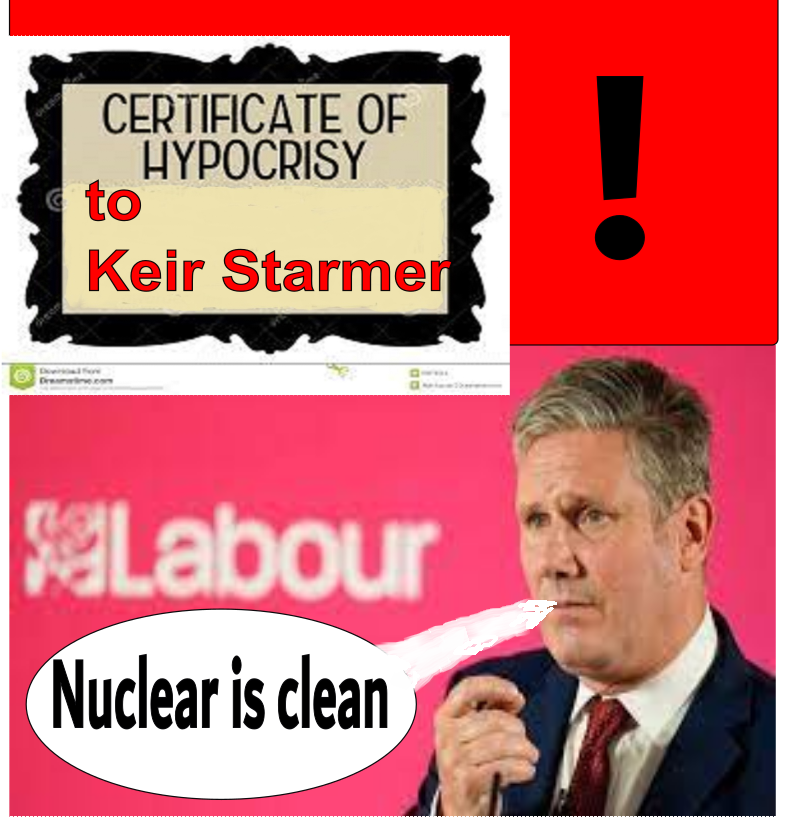
Keir Starmer ignored warnings from his nuclear safety watchdog that it was wrong to blame regulations for delays building new reactors when he launched a plan to revive the nuclear power industry.
The prime minister unveiled the nuclear renaissance strategy in February and said investment had slumped because the industry was “suffocated by regulations”.
However, a document released under freedom of information law reveals that the UK’s Office for Nuclear Regulation (ONR) told the government in the run-up to the launch that claims about delays to nuclear power in a draft press release were “not true”. Despite this, the claims were repeated in the final release.
ONR was asked to comment on a draft government announcement of a taskforce to speed up the regulation of nuclear power. It made four corrections to the draft, which was passed to the investigative journalism cooperative The Ferret, and shared with the Guardian.
But none of ONR’s corrections were implemented when Starmer made the announcement on 6 February, under the headline “Government rips up rules to fire up nuclear power”.
The attack on nuclear regulations was part of Labour’s attempt to prove its growth credentials and coincided with it clipping the wings of the competition watchdog and hauling in regulators to demand they do more to boost the economy.
The draft release stated that three European regulatory regimes had reached different assessments of the design of the reactors being built at Hinkley Point C in Somerset, “leading to delays and increased costs”.
ONR said this was “not accurate” and that it had refuted such claims before. “Our feeling is that linking regulatory factors into the increasing Hinkley Point C costs and timeframes isn’t true and the sentence doesn’t stand up,” it said.
ONR also suggested that the new taskforce should look at not the “approval” but the “deployment” of new reactor designs. “The reactor approval process has no bearing on the overall speed of delivery, but rather construction,” it said.
Neither amendment was made in Starmer’s announcement, which reiterated the disputed wording in the draft. Two other changes suggested by ONR were also rejected.
The energy company EDF predicted in 2007 that electricity from Hinkley Point C would be cooking Christmas turkeys in 2017. EDF said in January 2024 that the station might not be finished until 2031.
The estimated total cost of building the plant has risen from £18bn in 2016 to £35bn in 2024. This could increase to £46bn when inflation is taken into account.
According to ONR, its assessment of the reactor design was completed in 2012 but construction did not start until 2017. Its regulation had not delayed building since then, it said.
Dave Cullen, who co-chairs a forum for ONR and campaign groups, described Starmer’s announcement as misleading.
“I’m shocked by the cynical and unprofessional approach of the government to this announcement,” said Cullen, who is independent of ONR. “It seems as though it would rather attack an imaginary problem than seriously consider how to approach energy security.”……………………………………………………………………………………………………………….. https://www.theguardian.com/business/2025/may/06/starmer-nuclear-watchdog-regulations-delays-reactors
Sellafield’s massive water abstraction plan for its new construction work has no environmental impact assessment and inadequate monitoring
Sellafield blithely apply to the Environment Agency for new water abstraction and in the same application admit that they have already contaminated the freshwater aquifer beneath them
Lakes against Nuclear Dump and NFLA , Marianne Birkby, May 07, 2025
Campaigners concerned that Sellafield’s water abstraction plan has no environmental impact assessment and inadequate monitoring
In a recent response to an Environment Agency consultation on a application by Sellafield Limited to extract water to support construction work at the site, campaigners at Lakes against the Nuclear Dump [LAND], a campaign of Radiation Free Lakeland, and the UK/Ireland Nuclear Free Local Authorities have expressed concerns that no environmental impact assessment has been carried out and that plans to monitor contamination in discharges are inadequate.
Sellafield plans to extract an additional 350,000 cubic metres of water a year from the Lake District to support the construction of new facility to repackage radioactive waste, whilst proposing to discharge almost a million litres of contaminated water every day into the River Calder and out into the sea. This for an indefinite and uncertain period.
LAND and the NFLAs are concerned that this will be done without an Environmental Impact Assessment being carried out and with no proper plans in place to monitor the discharged water, adding to fears that the work will lead to yet more radioactive contamination in the already fragile local environment.
Sellafield may believe that the discharges are safe and within legal limits, but the two campaign groups do not subscribe to the view that there is a safe limit when it comes to radiation and in recent years there have been large research studies demonstrating the cumulative effects of low-level, but legal, radiation on human health.
Starmer prepares for attack by Russia
Officials asked to update 20-year-old contingency plans that would put UK on war footing after Kremlin threats
Tony Diver,Associate Political Editor, 05 May 2025
Britain is secretly preparing for a direct military attack by Russia amid fears that it is not ready for war…
Officials have been asked to update
20-year-old contingency plans that would put the country on a war footing
after threats of attack by the Kremlin. A classified dossier will set out
how the Government would respond to a declaration of war, including bunkers
to protect the Cabinet and the Royal family, public service broadcasts and
the stockpiling of resources. Experts have warned that the country is
vulnerable to an assault on its critical national infrastructure, including
gas terminals, undersea cables, nuclear power plants and transport hubs.
Telegraph 5th May 2025,
https://www.telegraph.co.uk/politics/2025/05/05/starmer-prepares-for-attack-by-russia/
Nuclear fallout: Coalition’s nuclear energy policy proved toxic to Australian voters

SMH, By Mike Foley, May 5, 2025
The Coalition’s nuclear energy policy was toxic to voters, delivering big swings against Peter Dutton’s candidates in electorates chosen to host reactors, while support for Labor grew in many places it chose for massive offshore wind farms.
Dutton’s energy policy was built on opposing Labor’s “reckless race to renewables”, which the Coalition claimed was trashing farmland in the path of transmission lines and solar panels, in favour of a nuclear and gas-led strategy.
“I’m very happy for the election to be a referendum on energy, on nuclear,” Dutton said on June 19, when he announced his planned nuclear plant locations.
Dutton had not visited any of his proposed nuclear sites by the time the election was over, while the party quietened its advertising for the policy.
In the NSW electorate of Hunter, which borders where the Coalition planned to build a reactor on the site of the old Liddell coal plant, Labor MP Dan Repacholi significantly increased his support.
Repacholi’s first-preference votes jumped from 39 per cent in 2022 to 44 per cent in 2025, while the Nationals fell from 27 per cent to 18 per cent.
The central west NSW seat of Calare was also slated for a reactor near Lithgow, and the election turned into a three-cornered contest between the pro-nuclear Nationals, their former member-turned-nuclear sceptic independent Andrew Gee, and nuclear opponent Kate Hook……………………………
south of the border in the electorate of Gippsland, where the Coalition planned to build a reactor at the Loy Yang A coal plant, Nationals MP Darren Chester defied the trend with his primary vote falling from 55.2 per cent in 2022 to 53.5 per cent in 2025.
The figures could change as the Australian Electoral Commission continues to tally ballots.
The nuclear vote also appears to have inflicted pain on Coalition seats where no nuclear plants were planned.
Chief architect and advocate for the policy, energy spokesman Ted O’Brien, the Liberal National Party MP for Fairfax in Queensland, dropped to 38 per cent on the primary vote from 44 per cent in 2022, while Labor ticked up 2 per cent and anti-nuclear independent candidate Francine Wiig captured 12 per cent.
Nationals leader David Littleproud’s primary vote dropped from 54 per cent in 2022 to 52 per cent.
On the day after the election, Littleproud said nuclear was not responsible for the Coalition’s historic loss.
“I think this was a schmick campaign by Labor destroying Peter Dutton’s character,” he told Sky News.
Dutton vigorously campaigned against wind farms, visiting electorates planned for development and claiming the industry would harm whales, commercial fishing and seascape views.
The Coalition pledged to ban four of Labor’s six offshore wind zones, and Dutton campaigned on this commitment in Paterson, north of Sydney, as well as Whitlam and Cunningham south of Sydney, and Forrest south of Perth.
In Forrest, the Liberal vote fell from 43 per cent in 2022 to 31.5 per cent. First-time independent candidate Sue Chapman, who backed assessment of offshore wind in the area “based on the evidence and [would] aim to bring the community along”, picked up 18.5 per cent of primary votes.
In Cunningham, Wollongong Labor MP Alison Byrnes increased her primary vote from 40.5 per cent in 2022 to 45 per cent.
Down the road in Shellharbour, part of the electorate of Whitlam, Labor’s Carol Berry maintained the 38 per cent primary vote from the past election (although, in terms of ……..the two-candidate preferred vote, Whitlam recorded a 2 per cent swing against Labor)……….https://www.smh.com.au/politics/federal/nuclear-fallout-coalition-s-energy-policy-proved-toxic-to-voters-20250504-p5lwcp.html
Israel Will Even Persecute Palestinians For Simply Talking To Journalists
Caitlin Johnstone, May 05, 2025, https://www.caitlinjohnst.one/p/israel-will-even-persecute-palestinians?utm_source=post-email-title&publication_id=82124&post_id=162858742&utm_campaign=email-post-title&isFreemail=true&r=1ise1&triedRedirect=true&utm_medium=email
Israeli soldiers have been harassing a Palestinian activist who appeared in Louis Theroux’s recent documentary The Settlers to talk about Israel’s apartheid abuses in the occupied West Bank. Issa Amro shared footage of IDF troops raiding his home over the weekend, days after Theroux’s film debuted on the BBC.
Israelis not only murder journalists, attack journalistic institutions and block journalists from entering the Gaza Strip, they also persecute Palestinian civilians who speak with journalists.
If you haven’t yet watched The Settlers, I highly recommend doing so. It’s so damning that I’ve seen people expressing astonishment that it made it past the BBC’s censors, but really, what’s to censor? It’s an hour of Israelis telling a video camera what Israelis think in their own words.
One of the best ways to tell the truth about the real Israel is to just point a camera at these freaks and let them tell it themselves. Theroux’s interviewing style lends itself particularly well to this type of exposure.
A ship trying to bring humanitarian aid to Gaza was drone bombed by Israel near Malta on Friday. Activist Greta Thunberg was preparing to board the ship to travel with it to its destination.
Which is just wild to think about. Things are so fucked up on this timeline that there is a non-zero probability that Israel ends up assassinating Greta Thunberg.
Imagine the western reaction if Iran had bombed a humanitarian aid ship trying to feed starving civilians.
Imagine the reaction if Chinese forces were caught massacring medical workers in ambulances.
Imagine the reaction if Russia bombed an international humanitarian aid convoy in clearly marked vehicles.
It would be all we’d hear about for weeks.
My social media feeds are filling up with footage of skeletal starving children in Gaza. If we had sane and responsible news media in the west, this would be the lead story in every outlet and publication. But we do not have sane and responsible news media. We have propaganda services disguised as news media.
People who continue to support Israel are only able to do so because they actively avoid watching the video footage the rest of us are watching.
If I built a home and then discovered that it could only remain standing if I constantly massacred children, I would simply change my living arrangements.
I would not claim my building “has a right to exist”.
I would not spend years explaining why my child massacres are okay.
I would not spend decades accusing anyone who criticized my child massacres of unfair discrimination against me and my family.
I would simply change my building so that its existence no longer required me to routinely massacre children. If I could not find a way to restructure my building in this way, I would move.
I would not do this because I am a remarkably kind and special person. I would do it because I am not a psychopath.
Only a psychopath would want to continue living in that kind of building. Only a psychopath would want that kind of building to remain standing.
I said the preceding on Twitter yesterday and Israel apologists immediately came in yelling at me for saying evil things about Israel, but what’s funny is that I never mentioned Israel once; I just talked about a building. They only knew I was actually talking about Israel because of all the stuff I said about constantly massacring civilians.
Gets ’em every time.
❖
It’s good that Trump’s “MAGA” base opposes war with Iran so forcefully, but it’s pretty revealing how absent they’ve been on Trump’s butchery in Yemen and Gaza. They’re not opposed to war or mass murder, they’re just opposed to fighting people who are strong enough to fight back.
Who are Britain Remade?

Britain Remade is a Tory think-tank and lobby group campaigning on behalf of nuclear power.
By Mike Small, https://bellacaledonia.org.uk/2025/05/01/who-are-britain-remade/
There’s a concerted attempt to attack Scotland’s long-standing commitment to no new nuclear power, alongside a full-scale assault on the idea of Net Zero, and the very basics of climate policy (however inadequate mainstream policy is).
This is being led by Nigel Farage who has called Net Zero ‘the New Brexit’, whatever that means. All this has been echoed by Tony Blair’s intervention this week where he argued that any attempt to limit fossil fuels in the short term or encourages people to limit consumption is “doomed to fail”. Alongside this we can see Scottish Labour’s recent commitment to the cause of new nuclear power in Scotland.
Today The Scotsman ran with a front-page splash all about how ‘SNP voters back nuclear power’ by Deputy Political Editor David Bol and Alexander Brown.
he article was replete with quotes from Labour MSP for East Lothian, Martin Whitfield, Scottish Conservative MP, John Lamont, who said the Scottish Government embracing nuclear power would be “basic common sense”. Then there’s a quote from Sam Richards, founder and campaign director for Britain Remade, who, it turns out commissioned the poll and was also enthusiastically pro-nuclear.
What The Scotsman didn’t explain though, was who ‘Britain Remade’ are? They’re presented as if they’re maybe pollsters or some independent think-tank.
But Britain Remade is a Tory think-tank and lobby group campaigning on behalf of nuclear power. Jason Brown is Head of Communications for Britain Remade, a former No. 10 media Special Adviser and Ben Houchen’s comms Adviser.
Jeremy Driver is the Head of Campaigns at Britain Remade, a former Lloyds Banker and Parliamentary Assistant to Ann Soubry. Sam Dumitriu is Head of Policy at Britain Remade who formerly worked at the Adam Smith Institute. These are Tory SPADS working on their own campaign to support new nuclear in Scotland: Lift The Ban On New Scottish Nuclear Power.
Britain Remade claimed they are not affiliated: “We’re an independent grassroots organisation. We are not affiliated with, or part of, any political party” their website says. They may not be officially affiliated to any party, but it’s very clear where their politics (and their staff) come from.
So here we have the Scotsman giving over its front-page to a Tory lobby group to promote their campaign. On the same day they published a similar piece in the Telegraph “SNP’s ‘senseless’ nuclear ban ‘damaging Scotland’” so it’s really working for them.
This is not just a question of client journalism, it’s a question of how far right-wing forces, often working with dark money, will attempt to derail even the most modest (and completely inadequate) environmental policies. Quite why Saudi-funded Tony Blair should jump on the anti Net Zero bandwagon is anybody’s guess, but it’s quite clear there is a coordinated pro-nuclear lobbying group in action in Scotland that pans across the Conservatives and Labour parties, and is supported by astroturf groups and pliant media friends. Watch this space for more on the new nuclear lobby.
Durbin successor must not be co opted by the Israel Lobby.
Walt Zlotow, West Suburban Peace Coalition, Glen Ellyn IL 5 May 25
My outgoing senator Dick Durbin spent his entire 29 year Senate career beholding to the Israel Lobby. In the past 25 years alone he’s received $1,131,900 in campaign cash to ignore Israel’s ethnic cleansing of Palestinians in Gaza, transformed into genocide after the October 7, 2023 Hamas attack. His support for a 2 state solution (Palestinian statehood) is worthless virtue signaling as he’s done nothing of substance to achieve that goal along with making America the 148th nation out of 193 to recognize Palestinian statehood.
We need to replace Durbin with a principled candidate not ensnared by Israel Lobby money. Alas, the 5 Illinois House members mentioned as possible successors are all in the tank to remain mum on truly promoting Palestinian statehood and seeking end to US enabling Israel’s genocidal ethnic cleansing of 2,300,000 Palestinians in Gaza.
Raja Krishnamoorthi (D-IL 8) $269,530
Nikki Budzinski (D-IL 13) $187660
Darin LaHood (R-IL 16) $112,687
Robin Kelly (D-IL 2) $187,272
Lauren Underwood (D-IL 14) $ 75,593,
Tho not mentioned as a possible candidate, we of peace should encourage Congresswoman Delia Ramirez (D-IL 3) to seek Durbin’s open seat next year.
Her take from the Israel Lobby since her election in November 2022? Zero, nada, zilch.
That allowed Ramirez to push back against US billions funding the Israeli genocide, saying this in March, 2024: “The death toll in Gaza continues to rise. Gazans are starving. Over 1.5 million people have been displaced. Hostilities between the U.S. and Iran are escalating. And just this morning, The New York Times reported that one-fifth of the hostages still in captivity since the start of the conflict have likely died. We must change course. Under no circumstances could I have voted for today’s H.R. 7217 to provide $17.6 billion in unconditioned military funding for Israel. The supplemental funding proposed, which includes no humanitarian aid for Gaza, supports weapons of war and destruction that further jeopardize Israeli hostages and Palestinian civilians. Each U.S.-made or funded bomb dropped in Gaza further jeopardizes the chances of long-lasting peace for Israelis and Palestinians. I’ve said it before, and I’ll say it now: I will only support actions that bring us closer to peace.”
Come on Krishnamoorthi, Budzinski, LaHood, Kelly, Underwood, either drop accepting Israel Lobby money to ignore the genocidal ethnic cleaning of Gaza, or drop any consideration of replacing the Lobby’s million dollar Senator Dick Durbin.
-
Archives
- October 2026 (112)
- September 2026 (339)
- August 2026 (330)
- July 2026 (355)
- June 2026 (287)
- May 2026 (306)
- April 2026 (356)
- March 2026 (251)
- February 2026 (267)
- January 2026 (308)
- December 2025 (358)
- November 2025 (359)
-
Categories
- 1
- 1 NUCLEAR ISSUES
- business and costs
- climate change
- culture and arts
- ENERGY
- environment
- health
- history
- indigenous issues
- Legal
- marketing of nuclear
- media
- opposition to nuclear
- PERSONAL STORIES
- politics
- politics international
- Religion and ethics
- safety
- secrets,lies and civil liberties
- spinbuster
- technology
- Uranium
- wastes
- weapons and war
- Women
- 2 WORLD
- ACTION
- AFRICA
- Atrocities
- AUSTRALIA
- Christina's notes
- Christina's themes
- culture and arts
- Events
- Fuk 2022
- Fuk 2023
- Fukushima 2017
- Fukushima 2018
- fukushima 2019
- Fukushima 2020
- Fukushima 2021
- general
- global warming
- Humour (God we need it)
- Nuclear
- RARE EARTHS
- Reference
- resources – print
- Resources -audiovicual
- Weekly Newsletter
- World
- World Nuclear
- YouTube
-
RSS
Entries RSS
Comments RSS

