How civilisation could end – an all-too-possible nuclear scenario

By Richard Broinowski, Sep 30, 2024, https://johnmenadue.com/how-civilisation-could-end-an-all-too-possible-nuclear-scenario/
On 12 September, Vladimir Putin threatened retaliation, not excluding nuclear, against NATO countries if Washington allows Ukraine to attack targets inside Russia with US missiles. President Joe Biden backed off – for the moment. But the doomsday clock of the Atomic Scientists now stands at 90 seconds to midnight, the closest it has ever been to signalling Armageddon.
In a chillingly relevant book Nuclear War – A Scenario, (Transworld Publishers 2024), New York Times journalist Annie Jacobsen predicts what could occur. Interviews with nearly 40 US authorities, all having held positions in the US Nuclear Command and Control structure, add authority to her narrative.
Jacobsen names North Korea as the ignition point of a nuclear war. Without warning, Kim Jong-un launches a Hwasong-17 ICBM at Washington. Within four minutes, it is identified and tracked in Washington. But contrary to repeated public assurances that an ICBM can be intercepted, it is almost impossible to do so after the initial boost phase.
There is massive confusion in Washington between protocol and speed of action. While a national security adviser tries unsuccessfully to get a North Korean official on the phone, the president, in the White House dining room, is hustled by his security detail to a bunker under the West Wing. After several panicked relocations, and only after he has authorised nuclear retaliation against Pyongyang, he ends up bleeding and broken in a field somewhere in Maryland after the electronics on his fleeing helicopter, Marine One, are fried by a massive electro-magnetic pulse from a nuclear device detonated on a North Korean geo-stationary satellite hovering over the US.
Meanwhile, the North Korean ICBM hits the Pentagon. The explosion creates soft X-ray light with a very short wavelength, superheating the air to millions of degrees, instantly carbonising most of Washington’s inhabitants. In the aftermath, just as in Hiroshima 79 years earlier, decomposing bodies soon choke Washington waterways and any hospital that still functions after the atomic blast is completely overwhelmed by burned supplicants seeking relief or merciful death.
Kim follows up with a second nuclear strike – on the existing nuclear power plant at Diablo Canyon on the Californian coast between Los Angeles and San Francisco. The strike melts down fuel rods in the twin 1100MW pressurised water reactors, rendering a vast area of California uninhabitable for the foreseeable future.
Things get rapidly out of control. Under America’s highly classified Operational Plan, 1,770 US nuclear weapons are cleared for launch, including single hydrogen bombs on land-based Minutemen missiles buried in silos around the US mid-west, multiple-headed sea-launched ballistic missiles aboard Ohio-class “boomer” submarines under the Pacific, and on piloted B-52 and B-2 bombers, the third leg of America’s nuclear triad.
A disproportionately extravagant nuclear salvo (use ‘em or lose ‘em) aimed at North Korea must fly over eastern Russia before entering Korean air space. It is mistakenly assumed by Moscow to be targeting Russia. In the absence of any urgent correcting phone call from Washington (which has ceased to exist), Russia launches its own onslaught against the US, as well as against NATO bases in Europe known to keep US nuclear weapons and delivery systems on standby. Too late for a pre-emptive strike, US commanders in military bases strung around the US mid-west give nuclear launching codes to commanding officers at all US nuclear bases including submarines, to strike hundreds of designated targets in Russia.
The dreadful situation worsens as China, seeing nuclear death and destruction engulf cities near its border with North Korea, launches its own nuclear weapons on the United States.
Jacobsen doesn’t spare us the details of what happens after the bombing stops. Across the northern hemisphere everything burns unchecked – cities, towns, suburbs, villages, roads and forests. Black powdery soot blocks the sun, first across the northern hemisphere, then the south. As predicted as early as October 1983 by Carl Sagan, one of the world’s most respected scientists, nuclear winter steps in. Crops can’t grow without sun. Nor can life. Mass extinction of humans and animals from radiation, and then starvation, follows.
Sagan’s theory was initially scorned as Soviet propaganda, but as computers developed, his theory gained validity, then acceptance. Sixty-six million years ago, an asteroid struck Earth and 70% of all species perished. Jacobsen correctly says that nuclear war would cause many of the same phenomena.
Where Jacobsen can be questioned, however, is on her assumptions that Kim Jong-un would ignite the war. Why he would do such a reckless and foolish thing, she claims she simply “doesn’t know”. But she apparently doesn’t remember how in 1945 the United States, without seeking any opinion from Koreans, divided Korea at the 38th parallel to stop the Soviet Union occupying the whole peninsula; and how General Curtis LeMay saturation bombed North Korea during the Korean War as revenge for Chinese troops comprehensively defeating panicking American forces and forcing them back across the 38th parallel in 1950. So the animus is there.
But Kim Jong-un is neither mad nor stupid. Why would he court certain nuclear destruction of his small country by the United States? A much more likely ignition point is currently unfurling in the Middle East, where Israel seems to be bent on provoking a war with Iran, into which US forces would inevitably be drawn with uncertain, but highly dangerous consequences.
Hurricane Helene Floods Closed Duke Nuclear Plant in Florida
By Ari Natter, September 28, 2024 , https://www.bnnbloomberg.ca/investing/2024/09/28/hurricane-helene-floods-retired-duke-nuclear-plant-in-florida/
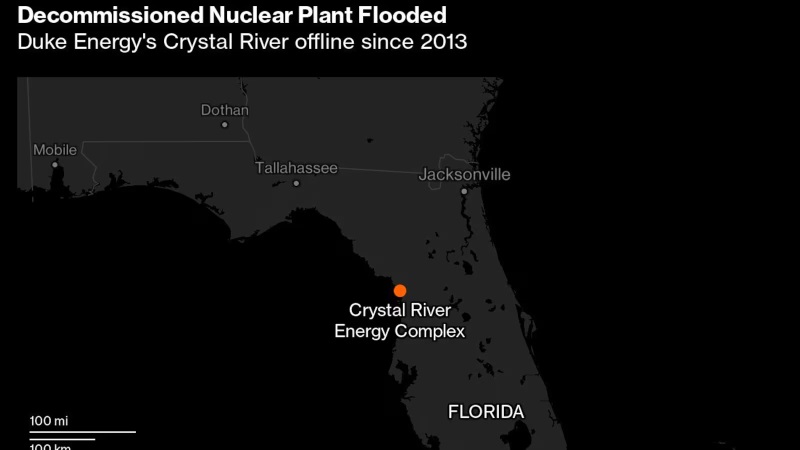
(Bloomberg) — Floodwaters from Hurricane Helene have swamped a retired Duke Energy Corp. nuclear power plant, according to a filing with the Florida Department of Environmental Protection, though an escape of contaminated fuel appears unlikely.
The Crystal River plant, which has been shuttered since 2013, experienced a storm surge of as much as 12 feet, according to the filing, which was posted online.
“The whole site was flooded, including buildings, sumps, and lift stations. Industrial Wastewater Pond #5 was observed overflowing to the ground due to the surge,” according to the report, which was filed Friday, the day after Helene roared ashore.
“We are still in the process of obtaining access and assessing the damage, but due to the nature of this event we anticipate difficulty with estimating the total discharge amount of wastewater, and impacts are unknown at this time,” the report said.
The used nuclear fuel at the site remains secure, Duke Energy said in a statement Sunday. “All radioactive material has been segmented and permanently packaged in shielded containers impervious to the effects of extreme weather,” the company said.
The facility, just south of Cedar Key, is still in the process of being dismantled. It’s likely that the spent fuel, which is kept onsite in dry storage, is safe, Edwin Lyman, a nuclear specialist with the Union of Concerned Scientists, said in an email before Duke Energy commented.
“There is probably still quite a bit of low-level radioactive waste awaiting shipment, and it’s likely the site wastewater has low levels of radioactive contamination,” Lyman said in an email. “Although anything is possible, based on the Fukushima experience, if the storage area were immersed in water for a short period of time, there is unlikely to be significant damage or leakage from the canisters.”
The site also flooded in 2023 after Hurricane Idalia made landfall, according to a report in Newsweek, that said spent fuel was scheduled to remain on site until 2037.
–With assistance from Tony Czuczka.
Australian Defence Minister Marles, with all pretension, flogging a dead seahorse

By Paul Keating, Sep 28, 2024, https://johnmenadue.com/marles-with-all-pretention-flogging-a-dead-seahorse/
Richard Marles and his mate, the US defence secretary, are beginning to wilt under the weight of sustained comment in Australia critical of the AUKUS arrangement.
Marles, unable to sustain a cogent argument himself, has his US friend propping him up in London to throw a 10,000-mile punch at me – and as usual, failing to materially respond to legitimate and particular criticisms made of the AUKUS arrangement.
The US Defence Secretary, Lloyd Austin, claims AUKUS would not compromise Australia’s ability to decide its own sovereign defence issues, a claim made earlier by Richard Marles and the prime minister.
But this would only be true until the prime minister and Marles got their phone call from the president, seeking to mobilise Australian military assets – wherein, both would click their heels in alacrity and agreement. The rest of us would read about it in some self-serving media statement afterwards. As my colleague, Gareth Evans, recently put it, “it defies credibility that Washington will ever go ahead with the sale of Virginias to us in the absence of an understanding that they will join the US in any fight in which it chooses to engage anywhere in our region, particularly over Taiwan”.
In London, Marles claimed that the logic behind AUKUS matched my policy as prime minister, in committing to the Collins class submarine program. This is completely untrue.
The Collins class submarine, at 3,400 tonnes, was designed specifically for the defence of Australia – in the shallow waters off the Australian continental shelf.
The US Virginia class boats at 10,000 tonnes, are attack submarines designed to stay and stand on far away station, in this case, principally to wait and sink Chinese nuclear weapon submarines as they exit the Chinese coast.
At 10,000 tonnes, the Virginias are too large for the shallow waters of the Australian coast – their facility is not in the defence of Australia, rather, it is to use their distance and stand-off capability to sink Chinese submarines. They are attack-class boats.
When Marles wilfully says “AUKUS matches the Collins class logic” during the Keating government years, he knows that statement to be utterly untrue. Factually untrue. The Collins is and was a “defensive” submarine – designed to keep an enemy off the Australian coast. It was never designed to operate as far away as China or to sit and lie in wait for submarine conquests.
And as Evans also recently made clear, eight Virginia class boats delivered in the 2040s-50s would only ever see two submarines at sea at any one time. Yet Marles argues that just two boats of this kind in the vast oceans surrounding us, materially alters our defensive capability and the military judgment of an enemy. This is argument unbecoming of any defence minister.
As I said at the National Press Club two years ago, two submarines aimed at China would be akin to throwing toothpicks at a mountain. That remains the position.
The fact is, the Albanese Government, through this program and the ambitious basing of American military forces on Australian soil, is doing nothing other than abrogating Australia’s sovereign right to command its own continent and its military forces.
Marles says “there has been demonstrable support for AUKUS within the Labor Party”. This may be true at some factionally, highly-managed national conference — like the last one — but it is utterly untrue of the Labor Party’s membership at large – which he knows.
The membership abhors AUKUS and everything that smacks of national sublimation. It does not expect these policies from a Labor Government.
Public scrutiny of UK-US nuclear pact is essential
“Rather than working together to get rid of their nuclear weapons, the UK and US are collaborating on further advancing their respective nuclear arsenals” – Carol Turner
The Agreement facilitates the development of Britain’s nuclear weapon technology and supports building the Trident replacement. This is in direct contradiction to Britain’s legal obligation under the NPT and CTBT to the disarm.
Vice Chair of CND, Carol Turner, writes on the UK-US Mutual Defence Agreement, and what it spells for the so-called independence of Britain’s foreign policy. 29 Sept 24
One of the Prime Minister’s first foreign policy initiatives after taking office in July was an amendment to the Agreement for Cooperation on the Uses of Atomic Energy for Mutual Defence Purposes. Never heard of it? That could be just what Labour is hoping for.
The Mutual Defence Agreement (MDA) is a bilateral nuclear pact between the USA and Britain. The United States provides the UK with nuclear technology and know-how in exchange for access to British intelligence facilities. Since it was first signed in secret in 1958, the MDA has been brought before parliament for approval every 10 years. This has been a formal process, with no vote and negligible scrutiny.
After the MDA is signed by the end of this year, not even the formality of approval will be required in future. Defence Secretary John Healey laid an amendment to the MDA before parliament on 25 July – three weeks after Labour took office, just five days before the summer recess – which removes all mentions of renewal. When the pact is signed this year, it becomes permanent. No parliamentary debate and no change in the law is needed for this. As CND General Secretary Kate Hudon observes ‘this spells farewell to even the smallest notion of parliamentary responsibility’ for Britain’s foreign policy.
What’s on offer for Britain and the US
The agreement enables both countries to exchange classified information allowing them to develop their respective nuclear weapon systems. The MDA is essential to the replacement of Britain’s Trident nuclear weapons system. The current UK warhead is a copy of the US warhead; some components are bought from the US. Inevitably, the United States leverage over Britain’s foreign and security policy will to be enhanced by the MDA amendment.
In an explanatory memorandum to parliament which accompanied the proposed changes to the agreement, Healey explained the MDA ‘provides the necessary requirements for the control and transmission of submarine nuclear propulsion technology, atomic information and material between the UK and US, and the transfer of non-nuclear components to the UK’.
Healey neglects to point out that control and transmission of Trident nuclear weapons is indispensable to Britain’s ability to use them. Being able to deliver a nuclear bomb to its target, is every bit as essential as the nuclear warhead itself. As Richard Norton Taylor rightly points out, the MDA ‘gives the lie to persistent claims by the Ministry of Defence that Britain’s submarine-launched nuclear arsenal is operationally independent’.
In exchange for this, Britain provides the US with intelligence facilities. The Menwith Hill listening post in Yorkshire makes signals intelligence available to the US from across the northern hemisphere, intercepting both military and commercial electronic communications. Fylingdales radar station, also in Yorkshire, is one of three bases that comprise the USA’s Ballistic Missile Early Warning System. Information from these bases initiates a nuclear response from the US or Britain to a perceived threat.
Agreement breaches Britain’s international obligations
Healey’s memorandum claims the MDA ‘is consistent with the UK’s obligations under the Nuclear Non-Proliferation Treaty and commitments under the Comprehensive Nuclear Test Ban Treaty’. It does not provide for ‘the transfer of nuclear weapons or other nuclear explosive devices, or control over such weapons or explosive devices’.
The Agreement facilitates the development of Britain’s nuclear weapon technology and supports building the Trident replacement. This is in direct contradiction to Britain’s legal obligation under the NPT and CTBT to the disarm. The NPT states that countries should undertake ‘to pursue negotiations in good faith on effective measures relating to… nuclear disarmament’. Rather than working together to get rid of their nuclear weapons, the UK and US are collaborating on further advancing their respective nuclear arsenals.
A 2004 legal advice paper from Rabinder Singh QC and Professor Christine Chinkin concluded it is ‘strongly arguable that the renewal of the Mutual Defence Agreement is in breach of the nuclear Non-Proliferation Treaty’. This is because it implies ‘continuation and indeed enhancement of the nuclear programme, not progress towards its discontinuation’.
What parliament can do
When the MDA was first introduced, parliament was powerless to oppose renewal. However, the Constitutional Reform and Governance Act of 2010, now provides an opportunity for parliament to oppose ratification. The House of Commons could block the MDA indefinitely if MPs so decided.
The government is not obliged to hold a debate or vote, however, the onus is on MPs. Before the MDA was renewed in 2014, Jeremy Corbyn MP tabled Early Day Motion 153 calling for a debate. It was supported by LibDem, SNP, Plaid Cymru, and Green, as well as Labour MPs.
The need for an open and transparent debate is crucial this year, before the Agreement becomes permanent. At the very least, Labour should be made to answer why they are they are contravening their legal obligation to work towards disarmament and instead renewing an agreement designed to maintain US and UK nuclear weapons production capabilities.
and why MPs should do it
The world is moving closer to war in Europe between nuclear armed antagonists. Extending the Mutual Defence Agreement indefinitely:
- is a further step in perpetuating Britain’s nuclear arsenal
- encourages nuclear proliferation, and
- makes Britain a key target in the event of war.
This change to the MDA should not be allowed to pass unnoticed. It’s time that MPs challenged the Agreement for Cooperation on the Uses of Atomic Energy for Mutual Defence Purposes.
Nuclear Weapons and the U.S. Presidential Elections

by beyondnuclearinternational, https://beyondnuclearinternational.org/2024/09/29/nuclear-weapons-and-the-u-s-presidential-elections/
Whoever becomes the next US president, we’ll need to redouble our efforts for nuclear abolition, writes Jackie Cabasso
Nuclear weapons policy is not an issue in the presidential election. In fact, U.S. foreign policy, with the exception of some controversy over ongoing U.S. arms provisions to Israel, is barely an issue. Even though nuclear weapons are in the media more than they have been for many years—due mainly to the Russian government’s nuclear threats, and to some extent, North Korea’s, there is basically no public discussion or political debate about nuclear weapons in the United States.
The political situation in the U.S. is more volatile and uncertain than at any time in my life. Predicting who is going to be elected president in November is impossible. In the short weeks since President Biden withdrew from the campaign and threw his support behind his vice president Kamala Harris, there has been an extraordinary outpouring of enthusiasm for her campaign, especially among young people and people of color, and a massive surge of financial support from a wide range of constituencies. But at this point, the outcome of the presidential election is too close to call.
What I can say is that U.S. national security policy has been remarkably consistent in the post-World War II and post-Cold War eras. “Deterrence” – the threatened use of nuclear weapons – has been reaffirmed as the “cornerstone” of U.S. national security policy by every president, Republican or Democrat, since 1945, when President Harry Truman, a Democrat, oversaw the atomic bombings of Hiroshima and Nagasaki.
If Kamala Harris is elected in 2024, we can expect more of the same. As confirmed in an August 20, 2024, New York Times story that attracted some notice, an initiative is quietly underway by the Biden administration to beef up the U.S. nuclear arsenal. As reported by the Times, in March, President Biden approved a highly classified “Nuclear Employment Guidance” plan that seeks to prepare the United States for possible coordinated nuclear challenges from China, Russia and North Korea. This comes as the Pentagon believes China’s nuclear arsenal will rival the size and diversity of the U.S.’ and Russia’s over the next decade.
This plan was hinted at by Vipin Narang, a top Department of Defense nuclear policy official, who recently stated that, while current modernization plans — estimated to cost at least $350 billion over the next two decades — are “necessary,” they “may well be insufficient” to meet current and future threats. According to Narang, in the face of growing threats from Russia, China and North Korea, “We have begun exploring options to increase future launcher capacity or additional deployed warheads on the land, sea and air legs that could offer national leadership increased flexibility, if desired, and executed.”
According to the head of the National Nuclear Security Administration, Jill Hruby, the U.S. is launching a new nuclear arms race to catch up with and outsmart Russia and China. “We now have seven systems that should be developed and put into production by the mid-2030s. This program is not only a major modernization of all three components of the nuclear triad, but also adds new deterrence capabilities that do not currently exist,” she said.
Donald Trump’s likely nuclear policy is spelled out in a manifesto by Project 2025, a coalition of far-right groups led by the Heritage Foundation. Its 900-page book, “Mandate for Leadership,” is a blueprint for the most dramatic takeover and transformation of U.S. democracy in history and is widely seen as the playbook for a possible second Trump administration.
Trump himself, and a number of Republican members of Congress, have attempted to distance themselves from Project 2025, in some cases, claiming they haven’t even heard of it. This is not plausible. Speaking at a 2022 Heritage Foundation event, Donald Trump declared, “[T]his is a great group. And they’re going to lay the groundwork and detail plans for exactly what our movement will do and what your movement will do when the American people give us a colossal mandate to save America and that’s coming.”
Project 2025 proposes that a second Trump administration prioritize nuclear weapons programs over other security programs, accelerate the development and production of all nuclear weapons programs, increase funding for the development and production of new and modernized nuclear warheads, and prepare to test new nuclear weapons.
Separately, Robert O’Brien, an ex-adviser to former President Trump, has written that in order to counter China and Russia’s continued investments in their nuclear arsenals, the U.S. should resume nuclear testing.
While she did not mention nuclear weapons in her presidential nomination acceptance speech, Kamala Harris chillingly pledged, “As Commander-in-Chief, I will ensure America always has the strongest, most lethal fighting force in the world.” A Harris administration would undoubtedly be far more progressive on domestic issues, but whoever wins the U.S. presidency, our redoubled efforts to press for nuclear abolition will remain an urgent necessity.
Japan’s new Prime Minister calls for deployment of US nuclear weapons
MILITARNYI 29 Sept 24
Japan’s new Prime Minister Shigeru Ishiba considers it necessary to discuss the prospect of deploying US nuclear weapons.
The deployment of nuclear weapons in the Asia-Pacific region should be discussed during the revision of the agreement on the status of the US contingent in Japan.
He also called for the creation of the country’s own nuclear arsenal to strengthen national security. According to Mr. Ishiba, the absence of a collective self-defense system similar to that of NATO in Asia creates a risk of new military conflicts in the region.
In particular, he expressed concern about China’s growing military activity around the Japanese islands…………………………….
The Asian version of NATO should specifically consider the joint use of nuclear weapons with the United States or the introduction of nuclear weapons into the region.
Officially, Shigeru Ishiba will become the new Prime Minister of Japan on October 1 after being approved by the parliament.
Since the 1990s, the politician has been actively involved in defense issues. He has consistently advocated for expanding the use of the Japan Self-Defense Forces and revising the pacifist provisions of the postwar Constitution………………..
In September, it was reported that the United States expressed an interest in deploying its MRC Typhon medium-range missile system with Tomahawk missiles to Japan…………………………….. more https://mil.in.ua/en/news/japan-s-new-prime-minister-calls-for-deployment-of-us-nuclear-weapons/
Ukraine army attacks nuclear plant substation: Russia
Canberra Times, September 30 2024
The management of the Russian-held Zaporizhzhia nuclear power station says Ukrainian forces have launched a new attack on a nearby electricity substation, destroying a transformer.
The Zaporizhzhia station, Europe’s largest with six reactors, was seized by Russian forces in the early days of Russia’s February 2022 invasion of Ukraine.
Each side regularly accuses the other of attacking or plotting to attack the plant.
The plant’s management, writing on Telegram, said an artillery strike had hit the transformer at the “Raduga” substation in the town of Enerhodar in southeastern Ukraine.
It described the incident as “yet another terrorist act aimed at destabilising the situation in the Zaporizhzhia nuclear plant’s satellite city”.
Also posted was a photograph showing smoke billowing from the top of a building.
It said power supplies to Enerhodar had not been interrupted.
The plant’s management accused the Ukrainian military on September 20 of attacking a second substation in Enerhodar.
The following day, Ukrainian Foreign Minister Andriy Sybiha accused Russia of planning strikes on Ukrainian nuclear facilities before the winter.
He provided no detailed explanation.
Power lines to the Zaporizhzia plant have been cut on several occasions, increasing the chance of a blackout that could cause a nuclear accident.
The United Nations nuclear watchdog, the International Atomic Energy Agency, has stationed monitors permanently at the plant and urged both sides to refrain from all attacks on it…………………………………………………………………………………. https://www.canberratimes.com.au/story/8777883/ukraine-army-attacks-nuclear-plant-substation-russia/
Charities call for greater transparency over Sizewell C
Bird Guides, 29 Sept 24
Suffolk Wildlife Trust and the RSPB have called for greater transparency from Sizewell C in relation to its wildlife compensation schemes.
Earlier this month, developers of the nuclear power station announced a new partnership with the nature-restoration movement WildEast to promote the return of land to nature across the region.
In announcing the partnership, Sizewell C flagged up how it had pledged to return a large part of the land to nature during the construction of the new power station.
Not doing enough
Its involvement in leading on a wildlife habitat scheme at Wild Aldhurst NR in Leiston was mentioned, along with plans for wetland habitat creation at three nature reserves at Benhall, Halesworth and Pakenham.
Planning consent obligations mean that the developers of the new power station, situated just to the south of the RSPB’s flagship Minsmere reserve, must offset damage caused by the construction by creating new areas for nature.
However, in a joint statement with the RSPB, Suffolk Wildlife Trust – which has long held concerns – spoke of its “real disappointment” that Sizewell C had included the work at the three nature reserves, which is part of its legal duty to compensate for the impacts of the power station’s construction on wildlife.
Misrepresented
The charities said the projects were a “minimum requirement,” but were being “misrepresented” as examples of the developers going the extra mile for nature.
A spokesperson for the trust said: “People have a right to expect far better transparency from Sizewell C when it comes to its wildlife compensation. Sizewell C must do better to be clear about the compensation they are required to deliver by law, versus what is truly ‘additional’ for nature.”………………………………………… https://www.birdguides.com/news/charities-call-for-greater-transparency-over-sizewell-c/
The Illusion of a Solution: Killing Hassan Nasrallah
Australian Independent Media, September 29, 2024, by: Dr Binoy Kampmark,
The ongoing Israeli operation against Hezbollah, the Iranian-backed militia group so dominant in Lebanon, is following a standard pattern. Ignore base causes. Ignore context. Target leaders, and target personnel. See matters in conventional terms of civilisational warrior against barbarian despot. Israel, the valiant and bold, fighting the forces of darkness.
The entire blood woven tapestry of the Middle East offers uncomfortable explanations. The region has seen false political boundaries sketched and pronounced by foreign powers, fictional countries proclaimed, and entities brought into being on the pure interests of powers in Europe. These empires produced shoddy cartography in the name of the nation state and plundering self-interest, leaving aside the complexities of ethnic belonging and tribal dispositions. Tragically, such cartographic fictions tended to keep company with crime, dispossession, displacement, ethnic cleansing and enthusiastic hatreds.
……………………………………………………… The Israeli strategy in this latest phase was made all too apparent by the number of military commanders and high-ranking operatives in Hezbollah the IDF has targeted. Added to this the pager-walkie talkie killings as a prelude to a likely ground invasion of Lebanon, it was clear that Hezbollah’s leader, Sayyed Hassan Nasrallah, figured as an exemplary target.
……………………..Israeli officials have been prematurely thrilled. Like deluded scientists obsessed with eliminating a symptom, they ignore the disease with habitual obsession. “Most of the senior leaders of Hezbollah have been eliminated,” claimed a triumphant Israeli military spokesman Lieutenant Colonel Nadav Shoshani.
Defence Minister Yoav Gallant called the measure “the most significant strike since the founding of the State of Israel.” Israeli Prime Minister Benjamin Netanyahu stated with simplicity that killing Nasrallah was necessary to “changing the balance of power in the region for years to come” and enable displaced Israelis to return to their homes in the north.
Various reports swallowed the Israeli narrative…………………………………………………………………………………..
Ibrahim Al-Marashi of California State University, San Marcos, summarises the efforts of Israel’s high-profile killing strategy as shortsighted feats of miscalculation. “History shows every single Israeli assassination of a high-profile political or military operator, even after being initially hailed as a game-changing victory, eventually led to the killed leader being replaced by someone more determined, adept and hawkish.” Another Nasrallah is bound to be in tow, with several others in incubation. https://theaimn.com/the-illusion-of-a-solution-killing-hassan-nasrallah/
After destroying Ukraine and Gaza, Biden seeks a destroyed nation trifecta in Lebanon

Walt Zlotow, West Suburban Peace Coalition, Glen Ellyn IL, 29 Sept 24
One might surmise that with 2 failed nations on his presidential resume, Joe Biden would cease nation destroying during his last 4 months in office.
But no, he has plunged pell-mell into full support of Israeli Prime Minister Netanyahu’s pager terrorist attack on Lebanese civilians and a massive bombing campaign also mainly killing civilians there.
Of course Biden pays lip service to peace, requesting Netanyahu immediately implement a 21 day ceasefire in his Lebanon bombing campaign. But Netanyahu essentially told Biden to go straight to Hell with his emphatic rejection.
“The report about a ceasefire is incorrect. This is an American-French proposal that the Prime Minister has not even responded to. The report about the purported directive to ease up on the fighting in the north is the opposite of the truth. The Prime Minister has directed the IDF to continue fighting with full force, according to the plan that was presented to him. The fighting in Gaza will also continue until all the objectives of the war have been achieved.”
But while once again trashing Biden’s latest peace proposal, Netanyahu was gobbling up another $8.7 billion in US military assistance to continue his devastating bombing of Lebanon along with his near total destruction of Gaza as a habitable land. Biden trotted out his Defense Secretary Lloyd Austin to defend US nation destroying with this doublespeak: “We’ve been committed from the very beginning to help Israel, provide the things that are necessary for them to be able to protect their sovereign territory and that hasn’t changed and won’t change in the future.”
Israel’s ‘sovereign territory’? Apparently Joe Biden believes Israeli sovereign territory includes all of Gaza, the West Bank and possibly even southern Lebanon as well.
The most plausible explanation of Israel’s self-destructive warfare in Gaza and Lebanon is expand the war to Iran which could draw in the US. Without direct US participation, Israel will fail to achieve any of its multi war objectives. If that occurs, President Biden may move beyond destroying 3 countries by adding Iran to his ignominious failed state hit list.
Say it ain’t so, Joe.
Green campaigners lambast UN climate summit hosts for clinging to fossil fuels

Hello from New York, where I spent yesterday evening at a lively
gathering hosted by the Fossil Fuel Non-Proliferation Treaty Initiative,
the campaign founded by Canadian activist Tzeporah Berman.
Among the speakers over dinner was Susana Muhamad, environment minister of Colombia,
which is one of 14 countries to have backed the drive for a legally binding
international treaty restricting fossil fuel extraction.
In the absence of such constraints, many countries are increasing their fossil fuel
production — including the hosts of last year’s, this year’s, and next
year’s UN climate COP summits, as our first item today highlights.
Yesterday, New York hosted a meeting of the COP “troika”, with
representatives of the host of last year’s UN climate summit (the United
Arab Emirates), this year’s (Azerbaijan) and next year’s (Brazil).
Cue a volley of criticism from environmental non-profit organisations, which
lambasted the three nations — all major oil and gas producers — over
their climate commitments.
FT 28th Sept 2024
https://www.ft.com/content/a48ad5b1-2175-4062-9caa-697b6541ff56
Chart: Solar power keeps beating expectations

Energy forecasters have long underestimated the speed at which solar power is growing around the world. It’s not the first time that’s happened. [charts on original]
By Carrie Klein, 27 September 2024, https://www.canarymedia.com/articles/solar/chart-solar-power-keeps-beating-expectations
Canary Media’s chart of the week translates crucial data about the clean energy transition into a visual format. Canary thanks Clean Energy Counsel for its support of the column.
Solar is becoming predictable in its unpredictability — time and time again, experts have underestimated how much the clean energy source will grow globally. This year is no different.
The price of panels has continued to plummet and their efficiency keeps rising, while deadlines for meeting climate laws creep closer. The result? The world is installing more solar than ever before — at a pace that even many top energy analysts didn’t see coming, according to a new analysis by think tank Ember.
So far this year, 29 percent more solar has been installed than was at this point last year, per Ember. By the end of 2024, Ember says the world will be on track to reach 593 gigawatts of solar installations — 200 GW more than the International Energy Agency (IEA) predicted at the start of the year. That’s a significant underestimate: Those extra gigawatts alone represent more solar than the entire world built in 2021.
This year’s record-breaking solar installations follow another peak year in 2023, when installations grew by 86 percent over 2022.
Five countries account for the majority of solar additions: China takes the top spot, followed by the United States, India, Germany, and Brazil. In the U.S., utility-scale solar is driving the industry’s growth. Policy changes in India have helped encourage solar; this year, the country has already installed more solar panels than it did in all of 2023. In Germany, small-scale solar has grown thanks to lower panel costs and incentives for rooftop solar. Solar is also taking off in new markets, particularly distributed solar in Pakistan and Saudi Arabia.
Cost is the main factor driving solar’s always-faster-than-expected ascension, says Kingsmill Bond, senior principal on the strategy team at RMI. As solar has become cheaper, it’s “not entirely surprising” that solar installations have spiked, Bond said.
“When technologies get cheap enough, they are like water flowing down a mountain. You don’t know exactly how the water will find a way down the mountain, but you know that it will find a way,” he said.
The solar industry’s success is putting the world’s climate pledges within reach. Annual solar installations will now have to show only “relatively modest levels of growth” to meet global goals, the Ember report notes. Recent BloombergNEF (BNEF) data sees a slight shortfall on the current trajectory but says 2030 goals are still entirely feasible.
Getting there, of course, won’t be simple. “Every single solar panel needs someone to put it up and needs planning permission in many countries,” Bond said. “Change is not easy, but it is nevertheless inexorable and driven by the internal logic of what happens when you get really cheap technologies available to 8,000 million people.”
Clean Energy Counsel is the only mission-driven law firm exclusively focused on renewable energy and clean technologies. From early-stage venture investment, offtake, site control, equipment supply, and EPC contracting, through project acquisitions, debt, and tax equity, we counsel clients through every stage of the project life cycle. Visit our website to explore how we can work together toward a sustainable future.
The Israeli nuclear risk no one is talking about

Israel’s ability to build and deploy nuclear weapons, while never officially acknowledged, remains at the heart of its security doctrine
September 27, 2024 https://inews.co.uk/news/world/what-happens-us-stops-supporting-israel-3296914
A tenuous and inherently unstable military stand-off between Israel and Hezbollah – has finally shattered.
The latest outbreak in fighting is certain to result in increasing civilian casualties as Israel and Hezbollah exchange fire across the border.
As Israel faces numerous threats its possession of nuclear bombs lurk behind the growing debate over arms supplies to the nation.
Israel’s use of US-supplied weapons in Gaza in the past year has already forced the Biden administration to address the option of limiting the supply of US arms if US officials determine that Israel has committed gross human rights violations or blocked the movement of humanitarian assistance.
In addition, Senator Bernie Sanders is preparing several resolutions that would affect more than $20bn (£15bn) in US arms sales to Israel.
There is no chance that such measures will pass, but that is not the point. As an AP report noted, “the move is designed to send a message to the Netanyahu regime that its war effort is eroding the US’s long-time bipartisan support for Israel.”
Indeed, Washington and Jerusalem must face the unwelcome fact that such actions by Congress or the White House, however symbolic, may well undermine the longstanding bargain that not only keeps Israel’s conventional arsenals full … but also ensures that its nuclear bombs stay in the basement – undeclared and shrouded in a veil of ambiguity.
The Jewish state has long enjoyed a nuclear weapons monopoly in the region, and its ability to build and deploy nuclear weapons, while never officially acknowledged, remains at the heart of its security doctrine.
In the first days of the October 1973 “Yom Kippur” War, for example, Israel is believed to have placed a small number of nuclear warheads on alert and may have considered their deployment to stop a Syrian tank advance into Israel’s heartland.
It is no accident that Israel has never acknowledged having nuclear weapons. US policies developed in the aftermath of the June 1967 Six Day War have played a critical role in shaping Israel’s conventional and nuclear superiority.
Washington did oppose Israel’s nuclear weapons activities in the 50s and 60s. In the wake of the June 1967 war, however, a quid pro quo with Israel was established.
In return for Israel maintaining a policy of nuclear weapons ambiguity, Washington would guarantee what was termed Israel’s “qualitative military edge” – QME. That is, Washington will ensure that as long as Israel keeps its “bombs in the basement” – undeclared, unacknowledged, and unused – Washington will guarantee Israel the conventional weapons arsenal necessary to defeat any combination of regional enemies.
In the decades since, every change in US political or defence policy, every diplomatic or military engagement with Israel, has featured a ritualistic reaffirmation of Washington’s commitment to maintain Israel’s QME. See for example, the Democrats’ election platform, which declares that “our commitment to Israel’s security, its qualitative military edge, its right to defend itself … is ironclad.”
Indeed, the State Department recently reaffirmed that “the US is by statute mandated … to guarantee that … Israel has a qualitative military edge over rivals in the region. It’s not a discretionary question. It is a statutory requirement, and it is one that we are committed to.,, There is also an important deterrent effect to the United States continuing to send a message to Israel’s adversaries that if they attack Israel, we will defend it. And that’s a message that we will continue to send loud and clear.”
Since Israel’s peace treaty with Egypt in 1979, Iran under the rule of the ayatollahs has been deemed the biggest challenge to Israel’s regional hegemony in both the conventional and nuclear realms. and the biggest test of “ironclad” US support for QME.
Notwithstanding an officially declared intention to refrain from creating a nuclear weapons option, Iran’s production of highly enriched uranium continues.
Iran’s stock of uranium in the form of uranium hexafluoride enriched to up to 60 per cent purity, close to the roughly 90 per cent of weapons grade, grew an estimated 22.6kg to 164.7kg, according to a confidential quarterly International Atomic Energy Agency report recently sent to member states. According to an IAEA yardstick, that is 2kg short of being enough, in theory, if enriched further, for four nuclear bombs.
US Secretary of State Antony Blinken observed in July that “instead of being at least a year away from having the breakout capacity of producing fissile material for a nuclear weapon, (Iran) is now probably one or two weeks away from doing that… what we’ve seen in the last weeks and months is an Iran that’s actually moving forward” with its nuclear programme.
One might think that the prospect of a nuclear stand-off in the Middle East might arouse an international chorus of concern, especially since Blinken’s plaintive warning about a nuclear Iran is part and parcel of the metastasizing failure of US led effort to stabilise the cascading crises already consuming the heart of the Middle East.
Iran has declared its opposition to the development of a nuclear weapons capability and has shown no progress in integrating such a capability as part of its strategic doctrine.
Nevertheless, as Blinken’s remarks illustrate, Iran is proceeding with developing critical constituent parts necessary to achieve a weapons capability while retaining a veil of ambiguity about its intentions.
In the wake of the demise of the JCPOA, Iran’s cultivation of nuclear ambiguity has established a new policy framework for its continuing nuclear programme and tested the continuing relevance of Washington’s commitment to QME.
The blowback from the Gaza war, has had an unexpected and unwelcome impact on this long-held policy.
National Security Memorandum, NSM-20 requires US military aid recipients to provide “credible and reliable assurances” that they will abide by international law when using the weapons or risk losing access to US arms. Israel, it is argued, has violated laws prohibiting the transfer of American military aid to governments that have committed gross human rights violations or blocked the movement of humanitarian assistance.
Prime Minister Benjamin Netanyahu wants Washington to swing the pendulum in the opposite direction. “Give us the tools faster,” he advised Congress, “and we’ll finish the job faster.”
A US decision to withhold arms for Gaza won’t affect the course of the war and it is in any scenario unlikely.
But any US action along such lines, however symbolic, will no doubt test Israel’s confidence in the continuing US commitment to the broader security assurances at the heart of QME, which, like it or not, has succeeded over the decades in restraining the nuclear weaponisation of the entire region and preserved Israel’s nuclear weapons monopoly.
Indeed, the current crisis creates an opportunity for Israel to exploit the relative freedom enabled by Washington’s ineffectual Gaza diplomacy and to test its support for QME to destroy two threats at the heart of Israel’s security doctrine – to destroy Iran’s nuclear and missile infrastructure and to defeat the Iran-led axis now active along Israel’s frontiers.
Should Washington fail the QME test in Israel’s eyes, it might well precipitate a dramatic change in Israel’s nuclear doctrine – ending the thin veil of ambiguity about Israel’s nuclear weapons arsenal and sparking a regional nuclear arms race.
Policies that make sense in Jerusalem, however, may not survive scrutiny in Washington. The Biden administration continues to give its “partner” Israel an unprecedented free hand in Gaza, the West Bank and now Lebanon.
And it is taking extraordinary pains to demonstrate its “ironclad” commitment to QME, and thus keep the lid on a potential slide towards the nuclearisation of the crisis and an explicit change in Israel’s nuclear deployment and war fighting doctrine.
President Biden strives to contain rather than confront. He has no interest in prompting a crisis of confidence between Washington and Jerusalem that raises questions about Washington’s commitment to QME and its unwritten support for Israel’s nuclear monopoly. So he is deploying unprecedented military and diplomatic resources, so far without success, to prevent a hot war that has the potential to define the region and perhaps beyond for generations.
Geoffrey Aronson writes about Middle East affairs. He consults with a variety of public and private institutions dealing with regional political, security, and development issues. He has advised the World Bank on Israel’s disengagement and has worked for the European Union Coordinating Office for the Palestinian Police Support mission to the West Bank and Gaza
Despite vastly different social and political contexts, Finland, Germany and France are all grappling with the question of safe nuclear waste disposal.
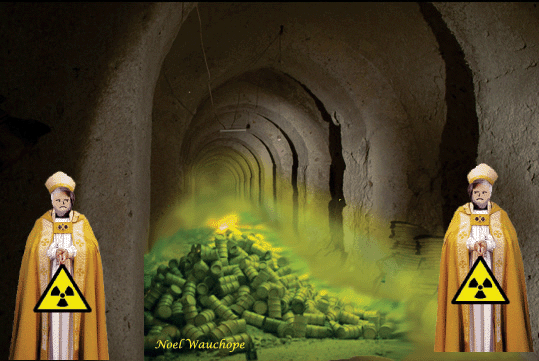
“At first, there was strong opposition to the reactors, but it eventually disappeared”,……… One explanation lies in the massive financial support provided by the nuclear power plant operator, TVO, to the municipality of Eurajoki. ……………………………..[Opponents] all share a common trait: they feel that they have been silenced, either by unspoken ostracisation or by more explicit confrontations.
The waste to be stored in Cigéo amounts to only 3 per cent of France’s waste, but 99 per cent of its radioactivity.
in a leaked document produced by a Land Operations Engineer of Andra, consulted by Equal Times, farmers of the region are listed and labelled according to whether they have been or can be “managed”.
By Guillaume Amouret, Michalina Kowol, Maxime Riché, 24 September 2024 https://www.equaltimes.org/despite-vastly-different-social?lang=en
“It looks just like wallpaper,” Jean-Pierre Simon says, pointing at the dark green line of trees that separate the fields, now glimmering in the setting sun. It is a landscape that he has admired for decades. “But soon, there will be a railway, and a train carrying nuclear waste on the horizon,” laments the farmer, his voice becoming bitter. His family has been living here, near Bure in the Meuse department of north-eastern France, for three generations. The question is, how many more generations will stay here to cultivate these fields in the future.
“Our goal is to reconcile the economy with our planet,” promised Ursula von der Leyen when she presented the adoption of the European Green Deal in 2019, shortly after she first assumed the presidency of the European Commission. Two years later, the European Parliament adopted the European Climate Law, which promised to turn the European Union climate-neutral by 2050. Another year later, in 2022, the European Parliament agreed to label both natural gas and nuclear power investments as climate-friendly sources of energy. In the latest European elections, held in June 2024, the centre-right European People’s Party, led by von der Leyen, again secured the majority of the seats.
But EU member states remain divided when it comes to investing in – and relying on – nuclear energy. On one hand, there’s France, which currently produces around 70 per cent of its electricity using nuclear power, and which recently passed a law to facilitate the construction of six (and up to 14) new reactors. In 2023, Finland’s first European Pressurised Water Reactor (EPR) in the country’s second nuclear power plant, Olkiluoto, started regular production; the country’s first nuclear power plant, Loviisa, began operating in 1977. And while some EU countries, like Poland, are planning to start building their first nuclear power plants in the coming years, others – like Germany – have opted out of nuclear energy production. The country’s last remaining nuclear power plants were closed in April 2023.
But it is not only the process of producing nuclear energy that sparks controversy, especially after the devastation caused by the accidents in Chernobyl (in Ukraine in 1986) and Fukushima (in Japan in 2011). Countries that have produced and relied on nuclear energy, like France, Germany and Finland, all face the same question: how to safely dispose of nuclear waste?
Finland: silenced detractors amid widespread support
Finland is considered one of the forerunners when it comes to nuclear energy. Roughly 20 years ago, the municipality of Eurajoki in western Finland not only accepted the erection of an EPR nuclear power generator but also the digging of Onkalo. Finnish for ‘cave’, it is a repository for spent nuclear fuel. It will become the first of its kind in the world at its opening, planned for 2025, after €900 million of construction costs. The overall cost is expected to reach €5 billion.
Finland: silenced detractors amid widespread support
Finland is considered one of the forerunners when it comes to nuclear energy. Roughly 20 years ago, the municipality of Eurajoki in western Finland not only accepted the erection of an EPR nuclear power generator but also the digging of Onkalo. Finnish for ‘cave’, it is a repository for spent nuclear fuel. It will become the first of its kind in the world at its opening, planned for 2025, after €900 million of construction costs. The overall cost is expected to reach €5 billion.
Run by the Finnish energy company Posiva Oy about 240 kilometres from Helsinki and situated 400 metres under the surface of the Earth, dug into the Finnish granite bedrock, Onkalo will become the final resting place for used nuclear fuel rods originating from the country’s five reactors: three on the island of Olkiluoto, right next door, and two in Loviisa in the south-east of the country.
The Onkalo project works according to the KBS-3 model, first developed in Sweden: spent fuel rods are inserted in copper cylinders, which offer the first barrier against the propagation of radioactive materials. The cylinders are then put in slots dug into granite. Finally, bentonite clay seals the copper capsules in their slots and fills in the deposition tunnels, and acts as a buffer between the copper and the granite.
One explanation lies in the massive financial support provided by the nuclear power plant operator, TVO, to the municipality of Eurajoki. In 2022, over a total of €57 million in tax revenues for the town, TVO would have paid €20 million in property taxes, according to Eurajoki’s mayor.
Sirkka supports the presence of TVO and the Onkalo, like most of the inhabitants of Eurajoki that Equal Times spoke to. Their trust could be considered as representative of the Finnish population nowadays. If acceptance of nuclear power was under 25 per cent back in 1983, it jumped to 61 per cent in 2024, according to a recent poll. And negative views decreased from 40 per cent to 9 per cent during the same time period.
But this does not mean that everyone agrees to the project.
We spoke to several residents – either historical opposition figures involved for decades in the protests against the construction of Onkalo or younger people, active until recently – who asked to remain anonymous. They all share a common trait: they feel that they have been silenced, either by unspoken ostracisation or by more explicit confrontations.
Some went as far as intimidating those against the plan, “sometimes walking under their windows with rifle guns”, as one person recalls. Another person we met had the feeling that because her opposition to the project was publicly known, she slowly lost her friends and had to search for work in other cities, further and further away from her hometown. She felt local employers would not want to hire her because of her opinions – although none explicitly gave this reason. Another opponent, after being involved in one of the marches organised against nuclear energy a few years ago, suffered from violent police repression and also decided to drop the fight, seeking refuge in a secluded property, far away from those painful memories.
On the other side of the Bothnia Gulf, work by researchers at the KTH Royal Institute of Technology in Stockholm, Sweden, questions the durability of copper containers in the long term. To offer protection from any radiation, the capsules would have to hold the nuclear waste safely for 100,000 years. But in a study published in January 2023, the corrosion scientist Jinshan Pan and his team point out the risks regarding embrittlements, cracks and corrosion due to sulphides in groundwater and called for “a comprehensive understanding of the corrosion mechanism […] to provide a solid scientific basis for the risk assessment of copper canisters in the final disposal of nuclear waste”. In a nutshell, he called for more studies on copper corrosion. The operator of Onkalo, Posiva, opposed these findings, arguing that sulphide levels are low enough to ignore this particular type of corrosion. It has not conducted any new research on the topic so far.
Germany’s nuclear phase-out
While Finland races ahead to be the first country to have a fully functioning spent nuclear fuel deposit, other countries like Germany seem to be far from even designing a location.
It all started on shaky ground in 1977, as a salt dome near Gorleben, right between Hamburg and Berlin, was designated to be the last resting place for spent nuclear fuel.
This decision sparked a massive opposition movement, which contributed to forming the ‘Anti-Atom-Bewegung’, the anti-nuclear-movement in Germany. Wolfgang Ehmke, spokesperson of the Bürgerinitiative Lüchow-Dannenberg, the anti-nuclear movement near Gorleben, is an activist of the first hour. To him, the nuclear phase-out in Germany is “not only due to our action, but also a series of lucky and unlucky events”.
The first phase of the new search terminated in 2020 and stated de facto that Gorleben is not suited for such an infrastructure. Its geological characteristics did not meet the conditions which the future disposal site should respond to.
The location analysis is currently making slow but steady progress. In a recent interview with the local newspaper Braunschweiger Zeitung, the president of the federal agency for nuclear wastes disposal (BGE), Iris Graffunder, explained that ten potential locations should be set for 2027. However, a final decision on the location will not be announced before 2046.
As for Gorleben, the federal agency for nuclear waste disposal announced its dismantlement last year. The salt that was dug out from the site for the construction and stored in a heap ever since, should be returned to the dome later this year. Observing every action and gesture of the agency, Bürgerinitiative Lüchow-Dannenberg remains critical concerning the date: “We are still waiting for the announced test run, before the final dismantlement,” explains Ehmke. Until then, its maintenance will have cost €20 million per year.
High tension over new waste repositories in France
Swallows fly in and out of Jean-Pierre’s barn, which provides shelter and shade on a hot June evening. JP, as everybody in Bure knows him, now armed with a rake, has been working since the early morning – like he does every day. A row of white and brown cows chew lazily on their hay. Only every now and then a low-pitched moo breaks the silence.
But Bure, in north-eastern France, about 300 km east of Paris, is far from quiet. The village, home to about 80 people, is the main stage of a political fight between the French state and anti-nuclear activists. Here, demonstrators have clashed with police on numerous occasions. In 2018, about 500 policemen were mobilised to evacuate protesters occupying a nearby forest. Even today, tensions are still palpable in Bure and the neighbouring villages. Police cars patrol the streets frequently, inhabitants denounce house searches and living under constant police supervision.
The reason? Bure’s underground is a construction site. France’s nuclear waste repository – named Cigéo for “industrial centre for geological deposit” – is supposed to store a total of 83,000m³ of high-level, long-life and medium-level nuclear waste. France produces around 70 per cent of its electricity from nuclear power.
Some of the demonstrators who came to Bure to support the local protest decided to stay and revive the countryside with sustainable farming. Like Mila and Jan, who hoped to start a new chapter in their lives here, far from the clamour of the city. Their dream is to raise goats: “We would like to produce our own goat cheese, to have just enough for ourselves and perhaps sell or exchange with others,” says the young couple who until recently, lived in an old house in a village next to Bure. However, this summer, they were forced out by the prefecture. While local authorities invoked the apparently ‘unsanitary conditions’ of the habitation, Jan and Mila’s landlord is convinced that the mayor of the village simply doesn’t want anyone who opposes Andra, the French national agency for nuclear waste management, to settle in the municipality. Since last year, Andra embarked on an unprecedented large-scale appropriation programme to acquire the land needed to construct the deposit.
Despite the nuclear waste’s high radioactivity levels, Andra has offered assurances that the location in Bure is safe: Cigéo is being constructed within a layer of Callovo-Oxfordian clay, deposited on-site about 160 million years ago. The conditioning of the waste and the protective layer of clay rock will help to avoid radioactive dispersion, the agency says. The storage is designed to remain safe during its operation for 100 years, as well as after its closure, for another 100,000 years. The deep storage project should enter its pilot phase in 2035.
But whether generations-old farmers like JP, or newcomers like Jan and Mila, will be able to continue their lives here is a different question. Andra plans to acquire an additional 550 plots to continue with the construction of its mega-project. Cigéo was declared of public interest in 2022, so the company now has the right to expropriate landowners. “I am 64, it is time for me to retire,” says JP. “My son applied to take over the farm, but Cigéo also covets some of my land parcels,” he laments. The agency recently asked for an extra strip of land alongside the former railway that will become the transportation channel for incoming spent nuclear fuel, and this further threatens the viability of JP’s plots, which would become much harder to work – or sell – if Andra’s request is granted.
In January 2023, Andra submitted an application to the national nuclear security agency, IRSN (Institute for Radiation Protection and Nuclear Safety), to authorise the construction of the final disposal in place of the current underground laboratory. After a reform of the nuclear security agency last year, and the termination of its previous president’s mandate, its new head was nominated in May 2024. And it is no less than the current president of Andra, Pierre-Marie Abadie, designated by President Emmanuel Macron. This choice raised doubts regarding the integrity of the entire project’s authorisation process, as critics pointed out conflict of interests.
“For now, we don’t see the bulldozers smashing the ground,” says JP. But he still remains sceptical: “I have doubts about my ability to stay here, should my farm be taken over. But I don’t have much time to reflect and think,” he says.
For now, JP must go back to work.
This article was developed with the support of Journalismfund.eu.
Scottish National Party blasts Labour for ‘frittering away’ money on nuclear plant instead of winter fuel payment
The party’s energy spokesperson Dave Doogan said Labour “is more concerned with funding needless nuclear projects… than it is with supporting hard-pressed pension
Andrew Quinn, Westminster Reporter, 28 SEP 2024.
https://www.dailyrecord.co.uk/news/politics/snp-blasts-labour-frittering-away-33767683
The SNP has claimed the Labour Government is “frittering away” £5 billion on a nuclear power plant while cutting the Winter Fuel Payment.
The party’s energy spokesperson Dave Doogan said the party is “more concerned with funding needless nuclear projects… than it is with supporting hard-pressed pensioners.”
The UK Government announced earlier this month that an extra £5.5bn is being made available to the Sizewell C nuclear power plant.
The plant is being built in Suffolk and the UK Government has said it will help secure the country’s energy independence. It will supply up to seven per cent of the UK’s energy needs but won’t start generating electricity until the 2030s.
t comes after the Labour Government decided to make the Winter Fuel Payment means-tested. Nearly 900,000 Scots pensioners will now miss out on the benefit.
Doogan said: “When Labour frittered away more than £5bn to the blackhole that is Sizewell C nuclear plant, what they did was fund a French owned company that will have no benefit to Scotland all the while picking the pockets of Scottish pensioners by robbing them of their Winter Fuel Payment.
“England’s Sizewell C will cost the tax payer some £30bn, yet just £1.4bn was deemed too high a price to keep 880,000 pensioners Scottish warm this winter – Sir Keir Starmer’s priorities are all wrong.
“The British Government is more concerned with funding needless nuclear projects and defending indefensible designer clothing funds than it is with supporting hard-pressed pensioners as the frost bites this winter and heating bills rise.
“Scotland is energy rich and our future is in renewables, but instead the Labour Government is choosing to pump money into English nuclear power plants and letting Scottish pensioners go cold – the SNP will always put Scotland’s interests first and that includes our pensioners in the face of swingeing Labour cuts.”
“Given the dire state of the public finances we have inherited, it’s right we target support to those who need it most. Over a million pensioners will still receive the Winter Fuel Payment, while many others will also benefit from the £150 Warm Home Discount to help with their energy bills over winter.
“We are also committed to helping the UK achieve energy security and net zero and new nuclear power stations such as Sizewell C will help us achieve that, while securing thousands of good, skilled jobs.”
1 This Month
To see nuclear-related stories in greater depth and intensity – go to https://nuclearinformation.wordpress.com/
Now until to February 10, 2026 Radioactive waste storage in France: the debate is finally open! How to participate?
-
Archives
- February 2026 (20)
- January 2026 (307)
- December 2025 (358)
- November 2025 (359)
- October 2025 (376)
- September 2025 (258)
- August 2025 (319)
- July 2025 (230)
- June 2025 (348)
- May 2025 (261)
- April 2025 (305)
- March 2025 (319)
-
Categories
- 1
- 1 NUCLEAR ISSUES
- business and costs
- climate change
- culture and arts
- ENERGY
- environment
- health
- history
- indigenous issues
- Legal
- marketing of nuclear
- media
- opposition to nuclear
- PERSONAL STORIES
- politics
- politics international
- Religion and ethics
- safety
- secrets,lies and civil liberties
- spinbuster
- technology
- Uranium
- wastes
- weapons and war
- Women
- 2 WORLD
- ACTION
- AFRICA
- Atrocities
- AUSTRALIA
- Christina's notes
- Christina's themes
- culture and arts
- Events
- Fuk 2022
- Fuk 2023
- Fukushima 2017
- Fukushima 2018
- fukushima 2019
- Fukushima 2020
- Fukushima 2021
- general
- global warming
- Humour (God we need it)
- Nuclear
- RARE EARTHS
- Reference
- resources – print
- Resources -audiovicual
- Weekly Newsletter
- World
- World Nuclear
- YouTube
-
RSS
Entries RSS
Comments RSS
 nuclear-news