Nuclear submarine shipyard fire at Barrow-in-Furness leaves two in hospital
Josh Halliday Hannah Al-Othman and Jasper Jolly Guardian, 31 Oct 24
Two people have been taken to hospital after a “significant” fire broke out at BAE Systems’ nuclear submarine shipyard in Cumbria.
Residents said they saw huge flames and smoke billowing from the complex in Barrow-in-Furness, where the UK’s new multi-billion-pound Dreadnought submarines are being built.
Cumbria police said there was no nuclear risk but two people were taken to hospital for suspected smoke inhalation. Police said: “At this time there are no other casualties and everyone else has been evacuated from the Devonshire Dock Hall and are accounted for.”
BAE said the two people taken to hospital were workers at the site and they have since been discharged. About 200 people were working on a night shift at the time the fire broke out.
…………………………………………………………….. Four nuclear submarines from the Dreadnought class are being built there as part of a £31bn programme, which is due to replace the Vanguard submarines in the early 2030s. The last of the Royal Navy’s seven new nuclear-powered submarines, part of the Astute class, is also being built at the site.
It is understood that the boat in the hall is HMS Agincourt, whose completion had already been delayed to 2026. The previous Astute class, HMS Agamemnon, was launched last month. It remains unclear whether any submarines were damaged by the fire.
The MoD has been contacted for comment. Cumbria fire and rescue service said an investigation into the cause of the fire was under way.
Police on Wednesday advised residents to keep doors and windows closed, having earlier instructed people to stay indoors. Motorists in the area have also been told to close their windows, air vents and sunroofs and turn off fans and air-conditioning units.
It is understood that the warning was because of the risk of particles, such as those from metals, being released in the air from the heavy industry site, where sophisticated extraction techniques are normally in place.
BAE Systems reportedly told non-essential staff working at Devonshire Dock Hall to work from home on Wednesday, while the BBC reported that staff turning up for their shifts were confused as to which parts of the 25,000 sq metre site was accessible.
Shares in BAE Systems fell as much as 2% in morning trading after news of the fire, making it one of the biggest fallers on the FTSE 100 index of blue-chip companies.
A BAE Systems spokesperson said: “The area around the Devonshire Dock Hall has been evacuated and everyone has been accounted for. Two colleagues were taken to hospital having suffered suspected smoke inhalation and have both since been released.”
It is understood that the company will launch an investigation into the cause of the fire. The rest of the site remains open and operating normally.
Additional reporting by Dan Sabbagh
https://www.theguardian.com/business/2024/oct/30/nuclear-submarine-shipyard-fire-at-barrow-in-furness-leaves-two-in-hospital
Entire northern Gaza population at risk of dying – UN

Ongoing Israeli military operations in the region disregard basic humanity and the laws of war, a top humanitarian official has said
27 Oct, 2024 , https://www.rt.com/news/606581-un-northern-gaza-dying-population/
What Israeli forces are doing in besieged Gaza during their ongoing war against Hamas cannot be allowed to continue, the United Nation’s top humanitarian official has said.
“The entire population of north Gaza is at risk of dying,” Joyce Msuya, acting Under-Secretary-General for Humanitarian Affairs and UN Emergency Relief Coordinator, warned on Saturday, in a post on X (formerly Twitter).
Israel has struck hospitals in the region, detained health workers and prevented first responders from rescuing people trapped under the rubble, according to the official.
“Shelters have been emptied and burned down…families have been separated, and men and boys taken away by the truckload,” she said, adding that “such blatant disregard for basic humanity and for the laws of war must stop.”
The head of the World Health Organization (WHO), Tedros Adhanom Ghebreyesus, echoed the warning, having voiced deep concerns over the “catastrophic” situation in Gaza. He also highlighted the severe impact of the ongoing hostilities on healthcare in the region.
“Intensive military operations unfolding around and within healthcare facilities and a critical shortage of medical supplies, compounded by severely limited access, are depriving people of life saving care,” Ghebreyesus wrote on X on Saturday.
The WHO Director-General added that Kamal Adwan Hospital in the city of Jabalia, one of the few functioning medical facilities in northern Gaza, has been severely impacted, with only a limited number of staff remaining to care for nearly 200 patients after the detention of 44 male personnel.
Earlier this week, the Health Ministry in the Palestinian enclave claimed that the Israel Defense Forces (IDF) stormed the hospital, detaining hundreds of staff, patients and displaced people.
The IDF insisted it was operating in and around the facility based on “intelligence information regarding the presence of terrorists and terrorist infrastructure in the area”.
“In the weeks preceding the operation, the IDF facilitated the evacuation of patients from the area while maintaining emergency services,” it added in a post on social media on Friday.
West Jerusalem has been repeatedly accused of indiscriminately targeting civilians in Gaza. According to the enclave’s health officials, over 42,000 Palestinians have been killed and nearly 97,000 wounded since the fighting between Hamas and Israel erupted in October 2023. The IDF has dismissed allegations of committing war crimes, arguing that Hamas is using Palestinian civilians as human shields.
More than a year into the conflict, around 90% of Gaza’s 2.3 million population has been displaced, most of them multiple times, according to UN estimates.
UN rapporteur: Israel carrying out ‘settler-colonial genocide’ against Palestinians

October 29, 2024, https://www.middleeastmonitor.com/20241029-un-rapporteur-israel-carrying-out-settler-colonial-genocide-against-palestinians/
The UN Special Rapporteur on Palestine issued a report late yesterday accusing Israel of a systematic campaign of forced displacement, destruction and acts of genocide against Palestinians in Gaza and the West Bank.
In the report, which was submitted to the UN General Assembly, Francesca Albanese described the “long-term, intentional, state-organised forced displacement and replacement” of Palestinians, particularly following 7 October, 2023.
The report focused on “genocidal intent, contextualising the situation within a decades-long process of territorial expansion and ethnic cleansing aimed at liquidating the Palestinian presence in Palestine.”
“The violence that Israel has unleashed against the Palestinians post-7 October is not happening in a vacuum, but is part of a long-term intentional, systematic, state-organised forced displacement and replacement of the Palestinians,” Francesca Albanese warned.
142Shares


The UN Special Rapporteur on Palestine issued a report late yesterday accusing Israel of a systematic campaign of forced displacement, destruction and acts of genocide against Palestinians in Gaza and the West Bank.
In the report, which was submitted to the UN General Assembly, Francesca Albanese described the “long-term, intentional, state-organised forced displacement and replacement” of Palestinians, particularly following 7 October, 2023.
The report focused on “genocidal intent, contextualising the situation within a decades-long process of territorial expansion and ethnic cleansing aimed at liquidating the Palestinian presence in Palestine.”
“The violence that Israel has unleashed against the Palestinians post-7 October is not happening in a vacuum, but is part of a long-term intentional, systematic, state-organised forced displacement and replacement of the Palestinians,” Albanese warned.
The report also accused Israel of obstructing international investigation efforts, including denying the entry of fact-finding teams from the UN and the International Criminal Court (ICC).
“The persistent denial of access to United Nations mechanisms and investigators of the International Criminal Court (ICC) may constitute obstruction of justice, in defiance of the International Court of Justice (ICJ) order that Israel allow international investigators to enter Gaza and take measures to ensure the preservation of evidence,” it said.
She noted that the ongoing “genocide is doubtlessly the consequence of the exceptional status and protracted impunity that has been afforded to Israel.”
“Israel has systematically and flagrantly violated international law, including (UN) Security Council resolutions and ICJ orders,” she said. “This has emboldened the hubris of Israel and its defiance of international law.”
“As the world watches the first live-streamed settler-colonial genocide, only justice can heal the wounds that political expedience has allowed to fester,” she added.
‘Gaza has been made unfit for human life’
The report also drew attention to the magnitude of destruction in Gaza, saying it has prompted allegations of “domicide, urbicide, scholasticide, medicide, cultural genocide and ecocide.”
It estimated that nearly 40 million tonnes of debris, including unexploded ordnance and human remains, contaminate the ecosystem.
Additionally, more than 140 temporary waste sites and 340,000 tonnes of untreated wastewater and sewage overflow have created breeding grounds for diseases such as hepatitis A, respiratory infections, diarrhoea and skin diseases.
“As Israeli leaders promised, Gaza has been made unfit for human life,” the report said.
The report also mentioned Israeli-imposed restrictions on resources essential for Palestinian survival, such as food, water and medical supplies.
“Systematic attacks on Gaza food sovereignty indicate an intent to destroy its population through starvation,” it said, recalling Israeli Finance Minister Bezalel Smotrich’s remarks in August stating that starving the entire Gaza population was “justified and moral.”
Escalating genocidal risk in West Bank
The report warned that violence and systematic targeting are spreading beyond Gaza, raising serious concerns of genocidal risk in the West Bank, including East Jerusalem.
Since October 2023, Israeli occupation forces have reportedly conducted over 5,500 raids in the West Bank, with hundreds of Palestinians killed and thousands injured.
Albanese noted that this surge in violence has been fuelled by violent settlers, often supported by Israeli forces, and said these patterns echo the severity of Gaza’s devastation.
She cited alarming instances of Palestinian children being systematically targeted, with at least 169 children killed since October 2023, nearly 80 per cent of whom were shot in the head or torso.
“The devastation inflicted on Gaza is now metastasising to the West Bank, including East Jerusalem,” she warned, adding that some officials, including Israel’s National Security Minister Itamar Ben-Gvir, have publicly supported harsh treatment and mass arrests of Palestinians, with 9,400 currently detained under severe conditions.
States ‘must intervene now’
Albanese called on the international community to act decisively, saying “member states must intervene now to prevent new atrocities that will further scar human history.”
She urged states to use all their political leverage – commencing with a full arms embargo and sanctions – so that Israel stops the assault against the Palestinians, accepts a cease-fire and fully withdraws from the occupied Palestinian territory in line with the ICJ advisory opinion of 19 July.
She asked them to formally recognise Israel as an “apartheid state and persistent violator of international law” while supporting independent and thorough investigations.
The rapporteur also called on states to ensure unhindered humanitarian assistance to Gaza and full financing and protection of UNRWA.
Lastly, she urged the ICC Prosecutor to investigate the commission of the crimes of genocide and apartheid by Israel.
BAE Systems fire: blaze at shipyard ‘could delay Aukus’
Building schedule of new fleet could be set back, experts warn, as two taken to
hospital after blaze breaks out at facility in Cumbria. Investigators are
still trying to determine the cause of a massive fire at a nuclear
submarine shipyard in Cumbria that analysts warned could delay the delivery
schedule of new boats for Australia as part of the Aukus pact.
Times 30th Oct 2024
Atomic Reaction – a highly recommended feature-length documentary film.
Atomic Reaction (90 minute documentary film)
Gordon Edwards. 30 Oct 24
This feature-length documentary film tells the story of how Canada supplied uranium for the World War II Atomic Bomb Project by using the leftovers from a radium mine on the shore of Great Bear Lake, just south of the arctic circle, and – of central importance – the radium refinery in Port Hope Ontario several thousand miles away. When uranium from the Congo entered the picture in December 1942, it too was refined at Port Hope for the Bomb program.
The film also tells the story of the most expensive and extensive environmental cleanup of any municipality in Canadian history, a cleanup of 1000 radioactively contaminated buildings (including homes and schools) in Port Hope that is costing 2 and a half billion dollars. The “cleanup” has been going on for forty years and just got a 10-year extension in 2023. The result of the cleanup will be an enormous engineered earthen mound of about one million tonnes of radioactive waste material that will remain dangerous for many thousands of years.
The gigantic “engineered mound” for Port Hope waste is situated in a marshy area just north of the town, on land that slopes down through the town to Lake Ontario. Incidentally, this small mountain of radioactive waste is not intended to be permanent but only good for the first 500 years, after which further decisions will have to be made. On the other hand the Chalk River mound (the so-called “Near Surface Disposal Facility”, which I call “the megadump”), although inspired by the Port Hope mound, is intended to be permanent. While the Port Hope mound is primarily built to hold highly dangerous naturally-occurring radioactive materials, associated with uranium ore processing, the Chalk River mound is designed to hold mainly human-made post-fission radioactive materials that were not found in nature before 1939. There are three court challenges to the CNSC 2022 approval of this “megadump” that are currently underway.
Atomic Reaction has been shown at the Uranium Film Festival in Rio de Janeiro, where it was given honourable mention, and more recently at the Durham Region International Film Festival in Ontario. On October 27 and 29 it was aired on the CBC Documentary TV Channel, where I saw it for the first time and was favourably impressed by how well the film-makers tell a complicated story in a clear and understandable way, with powerful visuals. The film will be available on GEM TV (streaming online) starting in January.
Look for it early in the New Year. It is well worth watching, once or even twice or more.
Australian Civil Society Statement for COP29 Baku, Azerbaijan

(from Scott Ludlam, on behalf of numerous, and increasing number of Australian civil groups)) 30 Oct 24
We, the undersigned Australian Civil Society organisations are united in support for the global clean energy transition and opposition to the nuclear industry playing a spoiling role in this transition.
Nuclear power is too slow, costly and inflexible to play any meaningful role in the global decarbonisation efforts. Nuclear also brings unique risks and long-lived wastes.
Given the environmental, economic and human urgency of addressing climate change and advancing the energy transition the nuclear industry must not be allowed to cause the global diplomatic community any further delay.
Australia is moving purposefully away from centralised fossil fuel combustion and toward distributed renewable energy generation and storage. In 2024, 40% of Australia’s electricity is generated from renewable energy. This capacity is proven, delivering and expanding rapidly.
We have been fortunate to learn from the world’s experience with nuclear power. We understand why its role in global energy systems and its contribution to global electricity production has been in decline for decades. Its legacy is one of underperformance, burgeoning cost, intractable health impacts and long-lived radioactive wastes.
Despite this, a coordinated campaign is currently being waged to undermine public support for this decarbonisation effort. The last thing Australia needs now is nuclear distraction and delay.
As the former Australian Chief Scientist Dr. Alan Finkel said, “Any call to go directly from coal to nuclear is effectively a call to delay decarbonisation of our electricity system by 20 years”.
Australia, and the world, cannot afford this delay. We stand resolute in our support for real climate action through the clean energy transition and in our opposition to false nuclear promises.
Record levels of heat-related deaths in 2023 due to climate crisis, report finds

Almost half of global land area saw extreme drought for at least one month, according to Lancet Countdown
Anna Bawden, https://www.theguardian.com/environment/2024/oct/30/record-levels-of-heat-related-deaths-in-2023-due-to-climate-crisis-report-finds
Heat-related deaths, food insecurity and the spread of infectious diseases caused by the climate crisis have reached record levels, according to a landmark report.
The Lancet Countdown’s ninth report on health and the climate breakdown reveals that people across the world face unprecedented threats to their health from the rapidly changing climate.
“This year’s stocktake of the imminent health threats of climate inaction reveals the most concerning findings yet,” warned Dr Marina Romanello, executive director of the Lancet Countdown at University College London.
“Once again, last year broke climate change records with extreme heatwaves, deadly weather events, and devastating wildfires affecting people around the world. No individual or economy on the planet is immune [to] the health threats of climate change.
The relentless expansion of fossil fuels and record-breaking greenhouse gas emissions compounds these dangerous health impacts, and is threatening to reverse the limited progress made so far and put a healthy future further out of reach.”
The report finds that in 2023, extreme drought lasting at least one month affected 48% of the global land area, while people had to cope with an unprecedented 50 more days of health-threatening temperatures than would have been expected without the climate crisis. As a result, 151 million more people faced moderate or severe food insecurity, risking malnutrition and other harm to their health.
Heat related deaths among the over-65s rocketed by 167% in 2023, compared with the 1990s. Without the climate crisis, an ageing global population means such deaths would have increased, but only by 65%. High temperatures also led to a record 6% more hours of lost sleep in 2023 than the 1986–2005 average. Poor sleep has a profound negative effect on physical and mental health.
Hotter and drier weather saw greater numbers of sand and dust storms, which contributed to a 31% increase in the number of people exposed to dangerously high particulate matter concentrations, while life-threatening diseases such as dengue, malaria and West Nile virus continue to spread into new areas as a result of higher temperatures.
But despite this, “governments and companies continue to invest in fossil fuels, resulting in all-time high greenhouse gas emissions and staggering tree loss, reducing the survival chances of people all around the globe”, the authors found.
In 2023, global energy-related carbon dioxide emissions reached an all-time high, 1.1% above 2022, and the proportion of fossil fuels in the global energy system increased for the first time in a decade during 2021, reaching 80.3% of all energy.
Responding to the findings, Dr Tedros Adhanom Ghebreyesus, director general of the World Health Organization, said: “The climate crisis is a health crisis. As the planet heats up, the frequency and intensity of climate-related disasters increase, leaving no region untouched.”
The report makes it clear, he added, that “climate change is not a distant threat, but an immediate risk to health”.
Cost of maintaining decommissioned nuclear submarines

UK Defence Journal 29th Oct 2024
Graeme Downie, Labour MP for Dunfermline and Dollar, recently raised a question regarding the financial burden of maintaining decommissioned nuclear submarines at two key UK facilities: Rosyth and Devonport. Specifically, he inquired about the annual costs associated with these sites.
In response, Defence Minister Maria Eagle provided the figures for the financial year 2023-24, explaining that “the annual cost for maintaining decommissioned submarines varies each year depending on the respective maintenance requirements.”
For the last financial year, £1.7 million was spent at Rosyth, while the maintenance costs at Devonport were significantly higher, totalling £7.1 million.
These figures highlight the ongoing financial commitment required to manage the UK’s decommissioned nuclear submarines, a task dependent on the maintenance needs of each vessel and the infrastructure of the respective facilities.
Additionally, during a recent exchange in the House of Lords, Lord Coaker expressed the urgency for the UK to expedite its nuclear submarine dismantling programme, addressing the slow progress in decommissioning and dismantling outdated submarines.
Responding to a question from Baroness Bryan of Partick, he outlined the current challenges and ongoing efforts to dismantle the aging fleet, currently spread across Scotland and Devonport, and acknowledged that, without significant changes, the timeline could stretch into decades.
Baroness Bryan highlighted widespread concerns, pointing out that many submarines have been out of service for years or even decades without being dismantled. She cited, for example, the case of a Dreadnought-class submarine stationed at Rosyth since 1980, a delay emblematic of the broader issue. “There remains real concern that not one of these submarines has yet been dismantled,” she noted, adding that with the rate of dismantling, “it will take decades to dismantle the boats remaining in both Scotland and Devonport.”……………………………………………………..
https://ukdefencejournal.org.uk/cost-of-maintaining-decommissioned-nuclear-submarines
The Rise and Fall of NuScale: a nuclear cautionary tale

Kelly Campbell, October 29, 2024 ,
https://oregoncapitalchronicle.com/2024/10/29/the-rise-and-fall-of-nuscale-a-nuclear-cautionary-tale/
A decade ago, NuScale, the Oregon-based small modular nuclear company born at Oregon State University, was on a roll. Promising a new era of nuclear reactors that were cheaper, easier to build and safer, their Star Wars-inspired artist renditions of a yet to be built reactor gleamed like a magic bullet.

As of last year, NuScale was the furthest along of any reactor design in obtaining Nuclear Regulatory Commission licensing and was planning to build the first small modular nuclear reactor in the United States. Its plan was to build it in Idaho to serve energy to a consortium of small public utility districts in Utah and elsewhere, known as UAMPS.
This home-grown Oregon company was lauded in local and national media. According to project backers, a high-tech solution to climate change was on the horizon, and an Oregon company was leading the way. It seemed almost too good to be true.
And it was.
image

Turns out, NuScale was a house of cards. The UAMPS project’s price tag more than doubled and the timeline was pushed back repeatedly until it was seven years behind schedule. Finally, UAMPS saw the writing on the wall and wisely backed out in November, 2023.
After losing their customer, NuScale’s stock plunged, it laid off nearly a third of its workforce, and it was sued by its investors and investigated for investor fraud. Then its CEO sold off most of his stock shares.
NuScale’s project is the latest in a long line of failed nuclear fantasies.

Why should you care? A different nuclear company, X-Energy, now in partnership with Amazon, wants to build and operate small modular nuclear reactors near the Columbia River, 250 miles upriver from Portland.
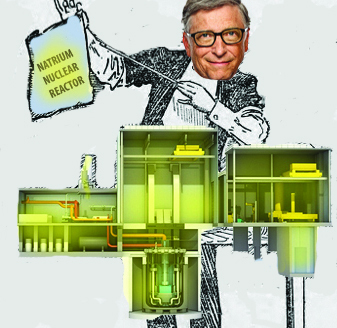
Bill Gates’s darling, the Natrium reactor in Wyoming is also plowing ahead. Both proposals are raking in the Inflation Reduction Act and other taxpayer funded subsidies. The danger: Money and time wasted on these false solutions to the climate crisis divert public resources from renewables, energy efficiency and other faster, more cost-efficient and safer ways to address the climate crisis.
A recent study from the Institute for Energy Economics and Financial Analysis concluded that small modular nuclear reactors are still too expensive, too slow to build and too risky to respond to the climate crisis.
While the nuclear industry tries to pass itself off as “clean,” it is an extremely dirty technology, beginning with uranium mining and milling which decimates Indigenous lands. Small modular nuclear reactors produce two to thirty times the radioactive waste of older nuclear designs, waste for which we have no safe, long-term disposal site. Any community that hosts a nuclear reactor will likely be saddled with its radioactive waste – forever. This harm falls disproportionately on Indigenous and low-income communities.

For those of us downriver, X-Energy’s plans to build at the Hanford Nuclear Site on the Columbia flies in the face of reason, as it would add more nuclear waste to the country’s largest nuclear cleanup site.
In Oregon, we have a state moratorium on building nuclear reactors until there is a vote of the people and a national waste repository. Every few years, the nuclear industry attempts to overturn this law at the Oregon Legislature, but so far it has been unsuccessful. This August, Umatilla County Commissioners announced they’ll attempt another legislative effort to overturn the moratorium. Keeping this moratorium is wise, given the dangerous distraction posed by the false solution of small modular nuclear reactors. Let’s learn from the NuScale debacle and keep our focus on a just transition to a clean energy future–one in which nuclear power clearly has no place.
Labour just railroaded a secretive US-UK nuclear treaty renewal deal
by The Canary, 30 October 2024
The Campaign for Nuclear Disarmament (CND) said it condemns the government’s outrageous railroading through parliament of the renewal of the US-UK Mutual Defence Agreement (MDA), the secretive treaty that underpins the nuclear ‘special relationship’ between London and Washington.
The MDA: under a cloak of secrecy
In force since 1958, the MDA allows for the transfer of key technologies, information, and nuclear materials to and from the US. Since its inception, the treaty has been amendable every ten years, also requiring parliamentary agreement on its extension.
But the government intends to make this treaty permanent by removing the clause that requires the treaty to be extended, and enables debate and amendment, including rejection. CND said:
n an open and democratic society, a major change like this should be given due consideration and debate in parliament. However, the government has disgracefully obstructed this by announcing its planned changes to the MDA just before parliament’s summer recess – guaranteeing six weeks of inaction.
Upon their return, MPs spent much of September and October engaged with party conferences. This shamefully left little time for parliament to debate the proposed changes before the deadline of 23 October.
Labour’s railroading of US nuclear co-operation: CND reacts
CND general secretary Kate Hudson said:
Thousands of CND supporters have contacted their MPs to raise the MDA as an issue for debate in Parliament before the 23 October deadline. Despite this outpouring of public concern, the limited time MPs have spent in Parliament since the election has left very little space for the open discussion this significant but little-known treaty deserves.
The railroading of the MDA by the government is typical of the policy that successive governments have been pursuing when it comes to Britain’s military policies and its possession of nuclear weapons.
This ‘special relationship’ tethers British military and foreign policy to Washington – and makes redundant the claim that Britain has an independent nuclear weapons system. Without US support, Britain would be unable to sustain its nuclear arsenal. Efforts to scrutinise this relationship are regularly deflected by the government under the guise of national security.
SO, CND will protest not only the MDA, but also the return of US nuclear weapons to Britain – ahead of the US presidential election.
CND protesting at Lakenheath on 2 November
The group and its supporters will mobilise at RAF Lakenheath on Saturday 2 November, to oppose plans to station US nuclear weapons in Britain for the first time since 2008.
This will be CND’s fourth national mobilisation at RAF Lakenheath since 2022, after US government budget documents revealed plans for upgrade works at the US-run air base for the storage of the new B61-12 guided nuclear bomb.
With the US presidential election to take place just days later, the protest aims to highlight the significant impact of US foreign and military policy on the British public, and the increased nuclear dangers brought by deploying its nuclear weapons in Britain – by whoever wins the White House.
Attendees will also witness an unofficial declaration of Lakenheath as a nuclear-free zone, and calls for both the UK and other nuclear weapons states to engage with the UN Treaty on the Prohibition of Nuclear Weapons.
CND will be joined by Melissa Parke ,executive director of the International Campaign to Abolish Nuclear Weapons (ICAN), the organisation that won the 2017 Nobel Peace Prize. Melissa will speak about nuclear dangers in Europe.
No US nuclear weapons on UK soil
Details of the protest are as follows:
- Saturday 2 November.
- 12 noon to 3pm.
- RAF Lakenheath Main Gate, Brandon Road, Lakenheath, Suffolk. More details on parking can be found on the CND website here.
…………………………………………………..
https://www.thecanary.co/uk/news/2024/10/30/cnd-nuclear-weapons-treaty/
Settlers prepare for ’resettlement in Gaza’

Voltaire Network | 25 October 2024, https://www.voltairenet.org/article221426.html
Israeli Minister of National Security Itamar Ben-Gvir took part in a two-day meeting on Israel’s southern border entitled “Preparing for our resettlement in Gaza” on the occasion of the Jewish holiday of Sukkot. He said: “What we have learned this year is that everything depends on us. We are the owners of this land. Yes, we have experienced a terrible catastrophe. But we must understand that a year later, so many Israelis have changed their mentality. They have changed their mindset. They understand that acting as the rightful owners of this land brings results.
Referring to the Palestinian prisoners, he went on: “We took their jelly sandwiches. We took their chocolate. We took their televisions. We took their ping-pong tables and practice time. You should see them crying and weeping in their cells. This is our proof: when we decide we can, we do succeed.”
“We will encourage the voluntary transfer of all citizens of Gaza. We will offer them the opportunity to move to other countries because this land belongs to us,” he concluded.
• Spokesperson for the “Mothers’ Parade” Sima Hasson said “I’m going to say something that not everyone here is ready to say, but I am, and I know many of you are, ready to say it: “Conquer, expel and resettle”. I’m not just talking about an area of Gaza. I’m not just talking about northern Gaza. I mean every area of land. This is the only way to prevent our boys from constantly going to war. To all those in Europe who have an opinion about what is going on here, I say: do not meddle. Your entire continent is invaded by radical Islam!”
Pasionaria of the settler movement Daniella Weiss said: “We came here with a clear objective: to occupy the entire Gaza Strip… Every inch from north to south. We are thousands of people and we are ready to go to Gaza. October 7 changed history. As a result of the brutal massacre, the Arabs of Gaza have lost their rights to be here forever, they will not stay here.
• Minister of the Negev, Galilee and National Resilience Yitzhak Wasserlauf said: “For 2,000 years, we dreamed of returning to our Jewish homeland. I know that those who disagree with us call it messianism. I call it Zionism. We are true Zionists. We love our land, we love our people, and we value life. And we have a responsibility to create a safe, Jewish nation on the land God has given us.
• Minister of Social Equality and the Advancement of Women May Golan said: “We will hit them where it hurts: their land. Whoever uses his plot of land to plan another holocaust will receive from us, with God’s help, another Nakba [catastrophe].
In February 2024, the settler movement had already organized a “Conference for Israel’s victory – settlements bring security: return to the Gaza Strip and northern Samaria” in Jerusalem in which they threatened the United States and the United Kingdom with resurrecting the Stern terrorist group [1].
This is the editorial from our paywalled “Voltaire, international newsletter”, n°105. For more information, do not hesitate to subscribe: 500€ per year.
Translation
Gregor Fröhlich
South Africa Files 750 Pages of ‘Overwhelming’ Evidence in ICJ Genocide Case Against Israel

“The glaring genocide in Gaza is there for all who are not blinded by prejudice to see.”
By Brett Wilkins / Common Dreams, 30 Oct 24
South Africa filed 750 pages of “overwhelming” proof that Israel is committing genocide in Gaza to the International Court of Justice in The Hague, Netherlands on Monday, the deadline for submitting final evidence in the ongoing trial.
South African Ambassador to the Netherlands Vusi Madonsela delivered the legal document—known as a memorial—to the ICJ headquarters in the Dutch city. Under the court’s rules, the contents of the memorial cannot be made public at this time.
According to a statement from the office of South African President Cyril Ramaphosa, the memorial is a “comprehensive presentation of the overwhelming evidence of genocide in Gaza.”
The office said the document “contains evidence which shows how the government of Israel has violated the Genocide Convention by promoting the destruction of Palestinians living in Gaza, physically killing them with an assortment of destructive weapons, depriving them access to humanitarian assistance, causing conditions of life which are aimed at their physical destruction, and ignoring and defying several provisional measures of the International Court of Justice, and using starvation as a weapon of war and to further Israel’s aims to depopulate Gaza through mass death and forced displacement of Palestinians.”
South Africa filed 750 pages of “overwhelming” proof that Israel is committing genocide in Gaza to the International Court of Justice in The Hague, Netherlands on Monday, the deadline for submitting final evidence in the ongoing trial.
South African Ambassador to the Netherlands Vusi Madonsela delivered the legal document—known as a memorial—to the ICJ headquarters in the Dutch city. Under the court’s rules, the contents of the memorial cannot be made public at this time.
According to a statement from the office of South African President Cyril Ramaphosa, the memorial is a “comprehensive presentation of the overwhelming evidence of genocide in Gaza.”
The office said the document “contains evidence which shows how the government of Israel has violated the Genocide Convention by promoting the destruction of Palestinians living in Gaza, physically killing them with an assortment of destructive weapons, depriving them access to humanitarian assistance, causing conditions of life which are aimed at their physical destruction, and ignoring and defying several provisional measures of the International Court of Justice, and using starvation as a weapon of war and to further Israel’s aims to depopulate Gaza through mass death and forced displacement of Palestinians.”
“The evidence will show that undergirding Israel’s genocidal acts is the special intent to commit genocide, a failure by Israel to prevent incitement to genocide, to prevent genocide itself, and its failure to punish those inciting and committing acts of genocide,” Ramaphosa’s office added.
South Africa’s filing comes amid Israel’s ongoing 387-day assault on Gaza, which according to Palestinian and international agencies has killed at least 43,020 people—most of them women and children. At least 101,110 others have been wounded and over 10,000 Gazans are missing and believed dead and buried beneath the rubble of hundreds of thousands of bombed homes and other structures. Millions more Palestinians have been forcibly displaced, starved, or sickened by Israel’s invasion and “complete siege” of Gaza.
The filing also comes one week after senior members of Israeli Prime Minister Benjamin Netanyahu’s far-right Cabinet and national lawmakers spoke at a conference advocating the ethnic cleansing and recolonization of Gaza.
Ramaphosa’s office lamented that “Israel has been granted unprecedented impunity to breach international law and norms for as long as the United Nations Charter has been in existence.”………………………………………………………………https://www.commondreams.org/news/south-africa-icj-genocide-israel
Sizewell C nuclear project proceeds by stealth – vast sums of public money spent, with no public disclosure about its true cost
1 The Autumn Budget includes a £14.1bn settlement for DESNZ in 2025/26,
which includes £2.7 bn for Sizewell C. This amounts to half the £5.5bn,
two year subsidy scheme published in August. The Chancellor chose not to
mention Sizewell C or nuclear energy in her speech to the House of Commons.
Stop Sizewell C said: “For a government that criticised the opposition
for playing fast and loose with the nation’s finances, the Chancellor is
surprisingly happy to do the same, allocating another £2.7 billion of
taxpayers’ money on risky, expensive Sizewell C, without making any
guarantee of a Final Investment Decision being taken.
Including £2.5 billion already spent, this means £5.2 billion of our money will be spent
on a project that cannot even help Labour achieve its energy mission, and
is looking increasingly toxic to private investors.”
The Chancellor also announced that David Goldstone has been appointed as the independent Chair of the “Office of Value for Money” within the Treasury. “Stop
Sizewell C urges David Goldstone to call in Sizewell C for immediate
scrutiny, as the project is currently proceeding by stealth. Despite almost
no public disclosure about its true cost or transparency about value for
money, vast sums of public money have already been spent on Sizewell C,
with the potential for billions more to be poured down the drain.”
Stop Sizewell C 30th Oct 2024
Ontario’s huge nuclear debt and other things Dutton doesn’t understand about cost of electricity

Unfortunately for us, Dutton and O’Brien are also in a hurry. They think they can deliver nuclear power plants far faster than what many experts believe is sensible and what many countries with far more nuclear experience than ourselves have been able to achieve.
Dutton and O’Brien also want to do this via a government-owned utility, instead of via a competitive market.
ReNewEconomy, Tristan Edis, Oct 30, 2024
All of this has left taxpayers with a massive budget and timeframe blow-out. This is what happens when we leave it to politicians in a hurry to hand pick power projects.
It seems our alternative Prime Minister Peter Dutton’s favourite topic is your electricity bill. Given how much he talks about electricity prices, you’d think he might know a fair bit about what makes up your electricity bill, wouldn’t you?
According to Dutton and his Shadow Energy Minister Ted O’Brien, the problem is all about too much renewable energy in the mix. And their answer to the problem is nuclear power, as well as more gas.
According to Peter Dutton, “We can’t continue a situation that Labor has us on of a renewables only policy because, as we know, your power prices are just going to keep going up under this Prime Minister.”
Instead, according to Dutton, “we could be like Ontario, where they’ve got 60 or 70 per cent nuclear in the mix, and they’re paying about a quarter of the price for electricity that we are here in Australia.”
O’Brien, elaborated on this point by saying:
“We will have plenty of time in due course to talk about the costings [for their nuclear plan] once we release them here in the Australian context. But I point to Ontario in Canada, there you have up to 60 per cent of their energy mix in the grid, coming from zero emissions, nuclear energy. Their households pay around about 14 cents kilowatt hour. There are parts in Australia that will be paying up to 56 cents a kilowatt hour from July 1 this year.”
Once you actually delve into these numbers it becomes apparent that O’Brien and Dutton don’t seem know much about electricity costs and pricing.
But even worse, they don’t know how badly Ontario’s taxpayers and electricity consumers were burnt by their utility racking up huge debt building nuclear power plants equal to $70 billion in current day Australian dollars.
Do Dutton and O’Brien understand your electricity bill?
You can actually look up what Ontario households pay for electricity via the Ontario Energy Board’s bill calculator website.
This provides you with a break down on the charges a typical household faces depending on the utility you choose…………………………………………………
But notice there’s also other very significant items in this bill separate to the kilowatt-hour charge? There’s a “delivery” charge which is the cost of paying for the distribution and transmission poles and wires. There’s also regulatory charges and also their sales tax is known as “HST” rather than GST for us.
So the Ontario 14 cents per kilowatt-hour charge that O’Brien and Dutton are referring to covers only the wholesale energy portion of their bill.
In Australia, we pay a majority of the costs of distribution and transmission in our cents per kilowatt-hour charge, in addition to wholesale energy costs, and then we get GST added on top. O’Brien and Dutton don’t seem to have appreciated this important aspect of electricity pricing in this country, which is different to Ontario.
But it actually gets worse.
I went digging on the official government energy retailer comparison sites- www.energymadeeasy.gov.au and www.energycompare.vic.gov.au and I initially couldn’t find a single Australian retailer selling electricity at 56 cents per kilowatt-hour.
This was based on looking at offers based on a single rate tariff. Then I had a brainwave and looked at time-of-use rates. In Queensland and Victoria I still couldn’t find anyone wanting to charge me 56 cents for the peak period.
But eventually I succeeded. Right at the bottom of the EnergyMadeEasy list of retailer offers – which were ordered from best to worst – sat EnergyAustralia as the worst offer, charging 57 cents for the peak period in South Australia (although with a compensating high solar feed-in tariff of 8.5 cents)…………………………………
To help out O’Brien and Dutton, I’ve prepared the table below which provides a proper apples versus apples comparison (as opposed to apples vs peak rate bananas) –[on original ]
…………………………………………….. Ontario’s nuclear debt debacle
Yet this comparison between Ontario and Australia misses a far more important part of the story that O’Brien and Dutton seem to be blissfully ignorant of.
That is the history of the Ontario’s state owned utility – Ontario Hydro – and the unsustainable level of debt that it racked up over the 1980’s and 1990’s as a result of an ambitious nuclear plant construction program that went wrong.
While this cost is no longer apparent in current electricity prices, Ontario businesses and households were stuck with paying back CAD$38.1 billion in debt (over $70 billion in Australian current day dollars) for more than 35 years after their public utility committed its last nuclear reactor to construction in 1981.
So what went wrong?
In anticipation of large growth in electricity demand, over the 1970’s and 1980’s Ontario Hydro committed to construction 12 nuclear reactors with 9,000 MW of generating capacity. To fund the projects the public utility accessed commercial debt markets anticipating that it could comfortably repay this debt from the increased electricity demand it forecast. However, several things went wrong.
The nuclear power stations took far longer to build and were around twice as expensive to build than had been planned
– Interest rates on debt rose to very high levels by historical standards over the 1980’s in order to contain the high levels of inflation that unfolded over the 1970’s and early 1980’s. With the nuclear power stations taking longer than expected to build, interest was accumulating on this debt with far less output from the plants to offset it.
– Lastly, Ontario Hydro’s estimate of large growth in electricity demand didn’t eventuate. A 1977 forecast projected a system peak of 57,000 MW by 1997. Actual peak demand in 1997 was 22,000 MW. This meant that the very large cost and associated debt of the large nuclear expansion had to be recovered from a much smaller volume of electricity sales than it had anticipated, making it much harder to pay off the debt without substantial increases in electricity prices.
……………………………………………………………………………………………………………… “On April 1, 1999, the Ministry of Finance determined that Ontario Hydro’s total debt and other liabilities stood at $38.1 billion, which greatly exceeded the estimated $17.2-billion market value of the assets being transferred to the new entities. The resulting shortfall of $20.9 billion was determined to be “stranded debt,” representing the total debt and other liabilities of Ontario Hydro that could not be serviced in a competitive environment.”
So the CAD$38.1 billion in debt was transferred out of the electricity companies and into a special purpose government entity called the Ontario Electricity Financial Corporation (OEFC). This debt management corporation was given the following revenues to service the debt:
– Both residential and business consumers were required to pay a special “Debt Retirement Charge”. This charge was introduced in 2002 and lasted until 2016 for residential consumers and 2018 for business customers.
– The Ontario government would forgo any corporate income and other taxes owed by the offshoot electricity companies from Ontario Hydro so they could be diverted to the OEFC to pay down debt.
– If the cumulative profits of two of the new state power companies exceeded the $520m annual interest cost on their debts, then this would go towards paying stranded debt rather than dividends to the Ontario government.
None of this is apparent on current bills, but the burden of repaying the nuclear debt left the Ontario government and its taxpayers far poorer than Dutton and O’Brien seem to appreciate.
More things O’Brien doesn’t want to understand about Ontario’s nuclear power program
Dutton and O’Brien like to claim that nuclear power plants last a very long time and so therefore the large upfront cost of these plants isn’t something we should be too worried about………………………..
It’s not as simple as this. Nuclear power plants involve a range of components which are exposed to severe heat and mechanical stress. These all need to be replaced well before you get to 60 years, and such refurbishment comes at a cost.
Ontario’s experience is that refurbishment comes at a very significant cost. Less than 25 years after the Darlington Nuclear Power Plant construction was completed, it needed to commence refurbishment. The total cost? $12.8 billion in Canadian dollars or $14 billion Australian dollars.
This is partly why, even though the original nuclear construction cost debt had been largely paid down and nuclear operating costs are lower than coal or gas plant, Ontario still pays more for its electricity than we do.
This is because the current owner of the nuclear power plants – Ontario Power Generation – operates under regulated return model where the regulator grants them the right to recover these refurbishment costs from electricity consumers.
Are O’Brien and Dutton about to commit to another Snowy 2.0 budget blow-out, but on steroids?
………………………………The problem here is that when you don’t know very much and you’re spending other people’s money, ego can easily cloud your judgement. Don’t get me wrong, ego will often cloud business leaders’ judgement too. But their ability to spend money to feed their ego can only so far before either competitors or shareholders intervene.
Ontario taxpayers on the other hand realised far too late that their public utility, in cahoots with their politicians, were pursuing a nuclear vanity project built upon a poor understanding of the future, and without any competitor to discipline their ego.
Australian taxpayers have seen a similar mistake unfold with the Snowy 2.0 pumped hydro plant whose cost now stands at five times greater than the original expectation, and double what was meant to be a fixed price construction contract.
Snowy 2.0 is a parable of what goes wrong when:
– Politicians rush things leading to inadequate planning and preparation;
– Politicians fail to objectively and thoroughly evaluate alternatives; and
– Politicians fail to employ open and competitive markets to deliver end consumer outcomes.
All of this has left taxpayers with a massive budget and timeframe blow-out. This is what happens when we leave it to politicians in a hurry to hand pick power projects.
Unfortunately for us, Dutton and O’Brien are also in a hurry. They think they can deliver nuclear power plants far faster than what many experts believe is sensible and what many countries with far more nuclear experience than ourselves have been able to achieve. Dutton and O’Brien also want to do this via a government-owned utility, instead of via a competitive market.
While the budget blowout of Snowy 2.0 is bad enough, it pales into comparison with the kind of cost blow-outs that can unfold with nuclear power projects. As an example, the budget for completion of UK’s Hinkley Point C nuclear project now stands at $89.7 billion which is three times higher than what was originally budgeted.
We’ve all seen this movie before, including in Ontario, and it doesn’t end well……………………………………………………………………………………………………………….. more https://reneweconomy.com.au/ontarios-huge-nuclear-debt-and-other-things-dutton-doesnt-understand-about-cost-of-electricity/
Israeli Knesset Passes Bill To Ban UN Palestinian Relief Agency
The collapse of UNRWA’s aid efforts in Gaza would ensure the starvation of more Palestinian civilians
by Dave DeCamp October 28, 2024 , https://news.antiwar.com/2024/10/28/israeli-knesset-passes-bill-to-ban-un-palestinian-relief-agency/#gsc.tab=0
The Israeli Knesset on Monday passed a bill banning the UN’s Palestinian relief agency, UNWRA, from operating inside Israel and another that will severely limit its ability to operate in Gaza and the West Bank. The legislation is expected to take effect in 90 days.
The first bill banning UNWRA in Israel passed in a vote of 92-10. The second bill aimed at ending UNWRA’s operations in the Israeli-occupied territories passed in a vote of 97-9.
The second bill prohibits Israeli authorities from having any contact with UNRWA, making it impossible for the relief agency to coordinate with the Israeli military on aid deliveries. The legislation does not outline any plan to replace UNRWA’s relief efforts in Gaza, which millions of Palestinian civilians rely on to survive.
Israel has waged war against UNWRA over the past year, killing over 200 of its staff members in Gaza. Israel has claimed a significant number of UNWRA’s staff are members of Hamas but has offered no evidence for the allegations, which have been strongly rejected by the UN agency.
The US took Israel’s claims at face value and cut off funding to UNWRA at the beginning of the year. Now, the US is warning Israel against implementing the bills banning UNRWA since it would starve Palestinian civilians.
“If UNRWA goes away, you will see civilians — including children, including babies — not be able to get access to food and water and medicine that they need to live. We find that unacceptable,” State Department spokesman Matt Miller said ahead of the Knesset vote.
“We continue to urge the government of Israel to pause the implementation of this legislation. We urge them not to pass it at all, and we will consider next steps based on what happens in the days ahead,” Miller added.
UNWRA was formed in 1949 to provide aid to about 750,000 Palestinians who were displaced when the state of Israel was founded in 1948, an ethnic cleansing known to the Palestinians as the “Nakba.” Today, Israeli ministers are calling for a new Nakba in Gaza to pave the way for Jewish settlements, and the Israeli military is currently imposing a starvation siege on northern Gaza to forcibly displace hundreds of thousands of civilians.
1 This Month
To see nuclear-related stories in greater depth and intensity – go to https://nuclearinformation.wordpress.com/
Now until to February 10, 2026 Radioactive waste storage in France: the debate is finally open! How to participate?

-
Archives
- January 2026 (307)
- December 2025 (358)
- November 2025 (359)
- October 2025 (376)
- September 2025 (258)
- August 2025 (319)
- July 2025 (230)
- June 2025 (348)
- May 2025 (261)
- April 2025 (305)
- March 2025 (319)
- February 2025 (234)
-
Categories
- 1
- 1 NUCLEAR ISSUES
- business and costs
- climate change
- culture and arts
- ENERGY
- environment
- health
- history
- indigenous issues
- Legal
- marketing of nuclear
- media
- opposition to nuclear
- PERSONAL STORIES
- politics
- politics international
- Religion and ethics
- safety
- secrets,lies and civil liberties
- spinbuster
- technology
- Uranium
- wastes
- weapons and war
- Women
- 2 WORLD
- ACTION
- AFRICA
- Atrocities
- AUSTRALIA
- Christina's notes
- Christina's themes
- culture and arts
- Events
- Fuk 2022
- Fuk 2023
- Fukushima 2017
- Fukushima 2018
- fukushima 2019
- Fukushima 2020
- Fukushima 2021
- general
- global warming
- Humour (God we need it)
- Nuclear
- RARE EARTHS
- Reference
- resources – print
- Resources -audiovicual
- Weekly Newsletter
- World
- World Nuclear
- YouTube
-
RSS
Entries RSS
Comments RSS
 nuclear-news