F-35 components sent to Israel from Royal Air Force base
Parts for Israel’s most advanced fighter jet have been secretly shipped from a British military base during the assault on Gaza.
Declassified UK JOHN McEVOY, 31 October 2024
- The shipments have continued under Keir Starmer’s Labour government
Reported in partnership with Irish news site The Ditch
F-35 fighter jet parts have been secretly transported to Israel from a British air force base in Norfolk, it can be revealed.
At least seven arms shipments have been sent from RAF Marham to Israel’s F-35 airbase at Nevatim since the Gaza bombing began.
Two of the deliveries took place this summer shortly after Keir Starmer became UK prime minister.
The information is contained within cargo documents reviewed by The Ditch and Declassified.
The documents show that the UK government has not only been approving F-35 export licences to Israel, but actively facilitating their transportation through British military sites.
F-35 supplies have become particularly controversial after it emerged that Israel used one of the planes to bomb a designated safe zone in Gaza, Al-Mawasi, killing 90 people.
Campaign Against Arms Trade’s Sam Perlo-Freeman told Declassified: “The F-35 plays a major part in Israel’s ongoing genocide in Gaza and brutal bombardment and invasion of Lebanon”.
He added that “the UK is not only licensing the supply of spare parts, but actively using UK military assets to facilitate their delivery. This makes UK ministers and potentially even military personnel complicit in war crimes”.
The International Criminal Court is currently considering arrest warrants for Israel’s prime minister Benjamin Netanyahu and defence minister Yoav Gallant. Human Rights Watch has warned that countries supplying Israel with arms could be complicit.
F-35 shipments
The seven shipments of F-35 parts from RAF Marham took place on 11 November 2023, 13 January, 21 January, 7 February, 28 April, 28 July, and 6 August 2024.
In six of those cases, the registered sender was the Lockheed Martin UK Integrated Systems office which is based in Havant, a town near Portsmouth.
Lockheed Martin is a major US arms corporation and the lead player in the international consortium that produces the F-35 fighter jets.
The Havant site is Lockheed Martin’s main headquarters in Britain, employing over 500 staff and working on the F-35 programme.
The components were transferred from RAF Marham to Heathrow Airport, and then transported to Tel Aviv on cargo flights operated by Israeli airline El Al……………………………………………………………………………………………………………………………………………
Munitions for Israel
Labour suspended some arms export licences to Israel last month but will continue to allow shipments of F-35 components to Israel through “global hubs”.
The UK Ministry of Defence did not dispute that F-35 parts had been supplied directly to Israel from RAF Marham on the dates found by The Ditch and Declassified………………………………………………………………..more https://www.declassifieduk.org/f-35-components-sent-to-israel-from-royal-air-force-base/?utm_source=drip&utm_medium=email&utm_campaign=ICYMI+-+Weekly+Roundup
South has raised risk of nuclear war, North Korea says
Canberra Times, By Josh Smith, 3 Nov 24
A white paper released by North Korean state media has accused South Korean President Yoon Suk-yeol of exposing his country to the danger of nuclear war through his policies toward the North.
The document, compiled by North Korea’s Institute of Enemy State Studies and released on Sunday by state news agency KCNA, criticised Yoon’s “reckless remarks” about war, abandoning elements of an inter-Korean agreement, engaging in nuclear war planning with the United States, and seeking closer ties with Japan and NATO.November 3 2024
“Its ever-worsening military moves resulted only in the paradoxical consequences of pushing (North Korea) to stockpile its nuclear weapons at an exponential rate and further develop its nuclear attack capability,” the paper said……………………………………………
The two Koreas have also clashed over balloons of trash floated since May from North Korea.
Pyongyang has said the launches are a response to balloons sent by anti-regime activists in the South…………………………..
Meanwhile, the US on Sunday deployed B-1B bombers for joint aerial drills with South Korea and Japan, in response to North Korea’s recent launch of an intercontinental ballistic missile, according to South Korea’s Joint Chiefs of Staff.
The military exercise showed the three countries’ strong commitment to responding to the North’s nuclear and missile threats through co-operation, the Joint Chiefs of Staff said in a statement.
This is the second time this year that the three countries conducted joint air drills and the fourth time in 2024 that the US deployed its strategic bombers on the Korean peninsula, the Joint Chiefs of Staff said. https://www.canberratimes.com.au/story/8809775/south-has-raised-risk-of-nuclear-war-north-korea-says/
Why Nimbys are wrong about solar farms

Opponents of solar farms often say that solar panels should be put on roofs and that fields should be left for agriculture so i asked the experts on whether they agreed
By Tom Bawden, Science & Environment , November 3, 2024 ,
https://inews.co.uk/news/environment/why-nimbys-are-wrong-about-solar-farms-3355702
Tory leadership loser Robert Jenrick said that solar panels are “for roofs not fields” when asked byi last month if he supported a proposed giant solar farm in his Nottinghamshire constituency.
He is by no means alone in that view, which is a common argument given by opponents of solar farms.
Those who protest against solar farm developments argue fields would be better used for growing food, while solar panels could and should be concentrated on roofs, of which there are quite literally millions in the UK.
“I’ve said that we must ban solar farms from prime agricultural land and I mean it. These facilities are despoiling our beautiful countryside and jeopardising our food security. We must end it,” Mr Jenrick added.
But since Labour came to power Energy Secretary Ed Miliband has approved four of the five biggest solar farms to be given planning permission in the UK.
Mr Miliband has vowed to take on “the blockers, the delayers, the obstructionists” who oppose large solar and onshore wind development to help the UK meet its ambitious targets to make the country’s energy supply virtually carbon neutral in just six years.
As the Government steps up its campaign to drive through new solar and wind projects, it is likely we will be seeing more projects of a similar scale too that opposed by Mr Jenrick in the coming years.
i asked experts whether it was feasible for the UK to do without new solar farms and instead confine new solar panel installations to the rooftops of households, offices and other business properties, and what effect this could have on food security.
The sale of the solar challenge
Experts were clear that there needs to be a huge and rapid increase in renewable energy generation if the UK is to have any chance of meeting its highly ambitious climate targets.
And, as the cheapest source of renewable energy – now costing less than onshore and offshore wind, according to government figures – solar will inevitably play a key role in the transformation of the UK’s energy supply.
The Conservative’s British Energy Strategy in April 2022 outlines the need for 70 gigawatts (GW) of solar power to be installed by 2035 – enough to power 20 million homes, according to National Grid.
As of June 2024, the UK only had about 17GW installed capacity (powering around 4.5million homes), meaning the country needs to quadruple its solar power generation in the next 11 years.
Two thirds of the current solar power is generated by solar farms with panels on the ground – known as “ground mount” – with the remaining third coming from the rooftops of businesses and over 1.5 million homes.
Meanwhile, government advisor the Climate Change Committee estimates that we will need 90GW of solar by 2050 (5.3 times current capacity) if we are to hit our legally binding target of becoming Net Zero.
Dr Simon Harrison, a member of the Government’s new advisory commission to help make the UK’s power generation virtually carbon neutral by 2030, told i the task is so great that it’s “going to require vastly more renewable energy generation” – meaning that “in practice both solar farms and roof top solar will be needed at scale to meet our needs”.
“There’s a significant role for both,” added Professor Rob Gross, who also sits on the commission.
What are the advantages of solar farms?
The first major advantage of solar farms is the sheer amount of energy they produce.
The 600 MW Cottam Solar farm that was granted planning permission in September would be the UK’s largest – supplying 180,000 homes, or 1,500 homes for every 5MW of energy generated.
By contrast, large solar rooftop installs, say over an airport or large of space, typically generate hundreds of kilowatts (kW) potentially up to a few megawatts (MW).
While the average solar rooftop installation size on someone’s home for their own use is typically 4kW.
So the Cottam Solar project would generate at least 200 times the electricity of the very largest commercial roof top installations and around 150,000 times as much as a typical household solar panel setup.
Tony Slade, technical director of Beaverbrook Energy, which designs, finances and builds low-carbon energy generators, told i: “Ground mounted solar farms also suffer from less ‘shading’ (blocking of direct sunlight through obstacles and obstructions) and ‘directional losses’ by being angled in the wrong direction.
“About 50 per cent of roofs face the wrong way and of those that face the right way about 25 per cent suffer from shading issues,” he said.
Are solar farms cheaper than roof panels?
Yes, in part because they benefit from economies of scale. In other words, the bigger the solar farm, the cheaper each unit of electricity will be, as more panels can benefit from the infrastructure.
Professor Gross, who is also director of the UK Energy Research Centre coalition of researchers, told i “the principal advantages are economic”.
“It is far cheaper to install each solar panel in a large array of thousands of panels than it is to install a handful of panels on a roof.
“Ground mounted is cheapest, followed by larger arrays on commercial units, followed by new build, followed by residential retrofit. All categories are getting cheaper but it is impossible to get away from the fundamentals – the cheapest solar will always be the simplest to install, in the largest arrays,” he said.
“And ground mounted developers building large schemes may also be able to negotiate the best deals for panels and equipment,” he added.
Mr Slade explains that greenfield ground mount solar panels on fields typically cost two thirds as much, per unit of energy, as large scale solar panel arrays on commercial buildings such as warehouses, shopping centres and factories – as well as new build domestic and commercial buildings, where the solar panels are fitted as part of the original construction.
Meanwhile, installing solar panels above car parks is typically twice as expensive as wind farms and retrofitting homes is about three times as expensive, he said.
What about food security?
Opponents of large solar farms often argue that the land would be better used for agriculture and that too many of them could impact food security.
But the Department for Energy Security and Net Zero firmly rebuts those suggestions, arguing the amount of agricultural land involved would make very little difference to the UK’s food production.
“Our plans to boost solar power do not risk the UK’s food security. The total area of agricultural land used for solar is very small and is often the lowest grade quality for food production.
“Even in the most ambitious scenarios, solar would still occupy less than 1 per cent of the UK’s agricultural land, while bringing huge benefits for the British public and our energy security,” the spokesperson added.
Meanwhile, in July, National Farmers’ Union boss Tom Bradshaw warned MPs against making “sensationalist” claims about food security.
“It’s a small amount of land which is being taken out of production,” he told the Politico Europe website.
The role of rooftop solar panels
“They can potentially play a very important role, accounting for perhaps 40 per cent of new installation of solar. But it’s important to be clear that rooftop and ground based are additive not competitive,” Professor Gross said.
Dr Harrison says “there are serious considerations to make on where solar is placed”, meaning that sometimes roof top solar power can be far more suitable than those in fields.
“In the simplest terms, there is more space in rural areas for solar panel installations and it is often easier to optimise their positioning for greater energy capture. But they are generally further from existing grid connections and with sometimes competing requirements for land use,” he said.
“On the other hand, rooftop solar, most commonly in urban settings, often avoids use of congested electricity networks, especially when combined with local batteries, and when used in homes tends to drive greater awareness and action by residents in other areas such as energy efficiency improvements, as well as reducing bills. In practice both will be needed at scale to meet our needs.”
The Government estimates there are 250,000 hectares of south-facing, industrial roof space across the country. That’s an area bigger than London and Manchester combined, with the potential for a vast amount of solar panels.
Even a very conservative estimate suggests that this commercial roof space could provide an area big enough to generate approximately 25GW of energy.
This amounts to nearly half the total amount recommended by the Climate Change Committee (CCC), according research by University College London for the Campaign to Protect Rural England (CPRE).
Mr Ramandani agrees that fields and rooftops can play different, complementary, roles in UK energy generation.
“We need about 18GW more of rooftop solar to hit 70GW by 2035 to keep us on the right path to Net Zero. So it will play a massive role,” he said.
“Rooftop solar can power people’s homes and business onsite without needing to pull from the grid, and excess generation can be stored or exported back to the grid, which supports the flexibility and security of the grid. And they operate at a smaller scale with some export to the overall grid system.
“Solar farms, meanwhile, are not onsite generation – they operate at a much bigger scale and power the grid with greater quantities of energy, which is used by the whole system and not specific to a home or business (before they export the excess generation that they don’t use or store).”
Is there a big role for household solar panels?
UK households are already waking up to solar panels, receiving record sums last year for the amount of excess energy they generated that they sold back to the grid, Ofgem said last week.
Homeowners received more than £30m for the energy they didn’t need in the year to March 2024, four times the £7.2m they made the previous year.
Although this amounted to a relatively small amount of energy – enough to power 88,000 homes – experts say there is considerable scope to increase this and they expect this to happen in the coming years.
“There is definite major role for rooftop solar in the UKs future energy mix,” said Mr Slade. “As installations become cheaper and the market for excess generation becomes fairer to the home owner rooftop domestic solar will continue to grow,” he said.
Mr Ramandani says: “Onsite solar rooftop generation takes money off consumer’s bills as they purchase less from the grid, and excess generation can be exported to the grid for income. This in turn creates a stable grid system with less demand side pressure, as well as supplementary energy generation from homes and businesses.
For a typical house, installing a PV system could lower bills by the equivalent of nearly 330 every year over the 30-year lifespan of the system, according to a study by Cambridge University and the Think Three property development company for Solar Energy UK.
Iran says it rejects nuclear weapons but will defend itself by all means
Iran International, 4 Nov 24
Iran’s Foreign Ministry said on Monday it remains committed to a peaceful nuclear program but asserted Tehran would prepare whatever it takes to defend itself against Israel.
“The official stance of Iran in rejecting weapons of mass destruction and regarding the peaceful nature of the Islamic Republic of Iran’s nuclear program is clear,” said Foreign Ministry spokesperson Esmail Baghaei.
“As emphasized in the recent speech by the Supreme Leader of the Islamic Revolution, we will equip ourselves to the extent necessary for the defense of Iran,” he added.
For weeks, Iranian officials have ramped up their narrative that Tehran possesses the capability to produce nuclear weapons, asserting that only Khamenei’s religious fatwa prevents it from doing so.
Baghaei also claimed that the country will use all its “material and spiritual resources to respond to the recent aggressions by the Zionist regime.”
This statement comes as Iran’s leadership intensifies its stance amid escalating tensions with the United States and Israel.
Khamenei has called on officials to make every necessary preparation to defend the country against the US and Israel…………………………………………………………………………… more https://www.iranintl.com/en/202411041034
Witnesses say the Israeli army is using facial recognition technology in its assault on north Gaza
Witnesses told Mondoweiss that after the army scans people’s faces, most people are detained for field interrogations. During these encounters, soldiers use what Ishaaq al-Daour describe as “psychological tactics” to unsettle the people being questioned, claiming that they know everything about their lives and that if they lie in their answers, “they will be killed.”
Witness testimony from northern Gaza shows that Israel is using facial recognition technology to organize how it conducts mass arrests and forcible displacement. Some Palestinians say the technology is also being used to carry out field executions.
By Tareq S. Hajjaj October 31, 2024
Ishaaq al-Daour, 32, was sheltering with his family at the UN-run Abu Hussein School in Jabalia refugee camp when the Israeli army stormed the shelter on October 20, forcing over 700 hundred people out of the school and leading them into a large ditch that had been dug in advance by the military.
“They made all of the men go down into the ditch first,” al-Daour told Mondoweiss from the Remal neighborhood in Gaza City. “Then they ordered us to climb out of the ditch one by one and stood each of us in front of a camera that had been installed nearby.”
The army made the men stand in front of the “camera” for at least three minutes per person, al-Daour said, long enough for the cameras to scan their faces and reveal personal data seemingly already stored in the Israeli military’s system. After the scans, al-Daour said the soldiers would reveal information about each individual, including their “name, age, work, family members and names, place of residence, and even their personal activities.”
“When they suspected someone, they took him away [to an unknown location” al-Daour said. As for those who had relatives who belonged to Palestinian resistance movements or who personally belonged to resistance factions, al-Daour speculated that “their fate was immediate death,” citing stories he had heard from others in Gaza, whose friends and relatives were taken at checkpoints and had not been seen again, or who returned to Gaza in body bags.
Al-Daour is one of the thousands of people who were expelled from the Jabalia refugee camp in northern Gaza and ordered to move south at gunpoint by the Israeli army. The forced exodus of thousands out of Jabalia is part of an Israeli offensive on northern Gaza that started on October 5. Its objective is to implement a proposal put forward by a group of senior Israeli generals that aims to empty northern Gaza of its inhabitants through starvation and bombardment, the so-called “Generals’ Plan.”
Survivors from Jabalia like al-Daour report that the Israeli army is using facial recognition technology to screen residents in the ongoing assault, often identifying people from long distances and picking them out from a crowd.
Witnesses say that the Israeli army has set up security checkpoints throughout northern Gaza where the facial recognition technology is being deployed. The military is also reportedly using this technology when it storms shelters for the displaced. Witnesses report that in these cases Israeli forces will corral people in enclosed places, usually ditches dug by military bulldozers, and process them individually.
Mondoweiss spoke to several survivors from Jabalia, who said that the Israeli army is using quadcopter drones to “identify people immediately from a distance,” and that soldiers are stopping people at checkpoints to conduct “camera scans” that lasts for several minutes. Witnesses say these were particularly unnerving as they stood awaiting an uncertain fate. Witnesses also report that the army picked people out of a crowd at checkpoints using what they described as a “red laser pointer” that was either mounted on a tank or on a soldier’s rifle.
Witnesses told Mondoweiss that after the army scans people’s faces, most people are detained for field interrogations. During these encounters, soldiers use what Ishaaq al-Daour describe as “psychological tactics” to unsettle the people being questioned, claiming that they know everything about their lives and that if they lie in their answers, “they will be killed.”
The questions are typically wide-ranging, al-Daour said. “They ask us about our relatives, our neighbors, the movements of the resistance fighters on the ground, who we know from them, and who they are. They convince us that they already know everything about us by mentioning intimate details about our lives, and then they threaten us with killing if we lie.”
Israel’s use of facial recognition throughout the war
While Mondoweiss could not independently verify the nature of the “cameras” being described by witnesses, the use of facial scanning and facial recognition technology by the Israeli army has been well documented.
Facial recognition technology used by Israel pulls from a database of information about Palestinians that has been built up over the years, including on Palestinians in the West Bank. One of those databases is called Wolf Pack, which according to Amnesty International, contains extensive information on Palestinians in the West Bank and Gaza, “including where they live, who their family members are, and whether they are wanted for questioning by Israeli authorities.”
In the old city of Hebron in the southern West Bank, Israeli surveillance cameras use a facial recognition system called Red Wolf on Palestinians who pass through checkpoints in the city. “Their face is scanned, without their knowledge or consent, and compared with biometric entries in databases which exclusively contain information about Palestinians,” Amnesty described in a May 2023 report.
It is unclear whether the facial recognition technology used throughout the ongoing assault on northern Gaza is the Red Wolf system or the other systems that the Israeli army has been reported to have used throughout the war on Gaza. In March, the New York Times reported that Israel’s cyber-intelligence division Unit 8200 used facial recognition technology developed by Corsight, an Israeli company, in combination with Google Photos. Together, these technologies enabled “Israel to pick faces out of crowds and grainy drone footage,” the Times said.
Likewise, it’s unclear whether these facial recognition systems are drawing upon data from Wolf Pack or another Israeli database, but media attention has recently focused on how that data is being processed and generated through a number of controversial AI programs to identify potential targets. Programs like “Lavender,” “The Gospel,” and “Where’s Daddy” have pushed Human Rights Watch to warn against their use of “faulty data and inexact approximations to inform military actions.” Several media exposés have also shown how some of these AI systems loosely identify civilians as targets for assassination or alert the Israeli army to target members of Hamas when they are with their families.
Testimonies gathered by Mondoweiss for this report and in previous reporting confirm that the brutal Israeli invasion in northern Gaza is utilizing these technologies as a means of organizing how it conducts mass arrests, field executions, and ethnic cleansing.
‘It was the most terrifying moment in my life’
Hiba al-Fram is one of the displaced people who passed through the army’s checkpoints during the Jabalia invasion. She says she was subjected to a facial and retinal scan, an experience she described as terrifying.
“Everyone was standing in the line, men and women, and everyone held up their IDs in their hands. Soldiers were using lasers to check our ID cards from a distance before we reached them,” she told Mondoweiss. Mondoweiss could not confirm what lasers the military was using.
Al-Fram said that the army picked people out of the queue using a “laser” pointer affixed to a tank. She described the army shining the laser on the ID cards and calling on people to advance towards the checkpoint, where the soldiers set up a camera.
“The soldiers arrested over 100 men in front of my eyes; they arrested them in front of their wives, and they were beating them, cursing them, and threatening to kill them and their families. Many wives saw their husbands in this situation.”
“The soldiers were telling the women: ‘We will kill you by a sniper bullet, we will run over your skulls with tanks, we will stone you to death, we will make you bleed to death,’” al-Fram continued. “The women were terrified and thought they would be killed.”
Then, the soldiers would gather five women at a time and walk them to a security check or a scan of the face or eye. “They arrested two women in front of me from the crowd based on their face scans. People later said they were relatives of people known to be members of armed factions, but they were women. They were carrying children.”
“The soldiers ordered them to give their children to other women. The mothers started to panic like crazy. They looked around frantically for any woman they knew to give their children to,” al-Fram continued.
“We would walk towards the face-scanning point in utter terror in our hearts, walking between dozens of tanks and soldiers pointing their weapons at us. And we would stand there for 3 or 5 minutes. They were the worst minutes of my life. A person’s fate was decided based on that scan: either arrest, beating and humiliation, or release them and force them to leave towards the south.”
After the soldiers take the face scan, the questions about neighbors and relatives begin. “They asked us where they are, where we can find them, when we last saw them. We did not know anything about these details, so we did not lie when we said we did not know. They would threaten us that if we lied, they would uncover the lie and shoot us immediately.”
Of all the terrifying moments experienced by residents of northern Gaza, many say that they experienced their most terrifying moments when they were stopped at an Israeli checkpoint.
“The most terrifying and frightening moments were the moments when you stand in front of the camera to get your face scanned,” Abdul Karim al-Zuwaidi, a journalist in northern Gaza, told Mondoweiss.
Before al-Zuwaidi reached the facial recognition point on his way toward Gaza City, he saw many young men being arrested by the army. As a Palestinian journalist working in the Gaza Strip, he like many of his colleagues is at particular risk of being targeted.
“The minutes we stand in front of the camera feel like years,” al-Zuwaidi said. “As a journalist conveying our message to the world, I was terrified.”
Al-Zuwaidi said that during their march south, many Jabalia residents would attempt to avoid upcoming checkpoints, often to no avail. “We had heard the stories about the checkpoints and how they were arresting people, so we tried in whatever way possible to avoid passing through them, but there was no way of escaping.”
“When we are examined, and the scan shows that one of us will be arrested, the soldiers start beating and cursing them before they take them away and they disappear. We saw this scene play out in front of us for dozens of young men.” Al-Zuwaidi did not see himself what information was revealed to the soldiers by the scans, but he said the soldiers would repeat aloud what details they were seeing on their screens, including peoples’ personal information, names, relatives, and more.
While people were waiting for the scan, al-Zuwaidi said that soldiers would curse at and beat the young men. The army severely beat al-Zuwaidi while he was standing and waiting for his turn. “They were dirty in their treatment of us,” he said. “But what can we say in response to a military armed with all these weapons and ready to kill?”
“They used every humiliating method against ordinary people,” he added.
Dangerous Hype: Big Tech’s Nuclear Lies

M.V. Ramana, November 1, 2024, https://www.counterpunch.org/2024/11/01/big-techs-nuclear-lies/
In the last couple of months, Microsoft, Google, and Amazon, in that order, made announcements about using nuclear power for their energy needs. Describing nuclear energy using questionable adjectives like “reliable,” “safe,” “clean,” and “affordable,” all of which are belied by the technology’s seventy-year history, these tech behemoths were clearly interested in hyping up their environmental credentials and nuclear power, which is being kept alive mostly using public subsidies.
Both these business conglomerations—the nuclear industry and its friends and these ultra-wealthy corporations and their friends—have their own interests in such hype. In the aftermath of catastrophic accidents like Chernobyl and Fukushima, and in the face of its inability to demonstrate a safe solution to the radioactive wastes produced in all reactors, the nuclear industry has been using its political and economic clout to mount public relations campaigns to persuade the public that nuclear energy is an environmentally friendly source of power.
Tech giants like Microsoft, Amazon, and Google, too, have attempted to convince the public they genuinely cared for the environment and really wanted to do their bit to mitigate climate change. In 2020, for example, Amazon pledged to reach net zero by 2040. Google went one better when its CEO declared that “Google is aiming to run our business on carbon-free energy everywhere, at all times” by 2030. Not that they are on any actual trajectory to meeting these targets.
Why are they making such announcements?
Greenwashing environmental impacts
The reasons underlying these companies investing in such PR campaigns is not hard to discern. There is growing awareness of the tremendous environmental impacts of the insatiable appetite for data from these companies, as well as the threat they pose to already inadequate efforts to mitigate climate change.

Earlier this year, the Wall Street company Morgan Stanley estimated that data centers will “produce about 2.5 billion metric tons of carbon dioxide-equivalent emissions through the end of the decade”. Climate scientists have warned that unless global emissions decline sharply by 2030, we are unlikely to limit global temperature rise to 1.5 degrees Celsius, a widely shared target. Even without the additional carbon dioxide emitted into the air as a result of data centers and their energy demand, the gap between current emissions and what is required is yawning.

But it is not just the climate. As calculated by a group of academic researchers, the exorbitant amounts of water required in the United States “to operate data centers, both directly for liquid cooling and indirectly to produce electricity” contribute to water scarcity in many parts of the country. This is the case elsewhere, too, and communities in countries ranging from Ireland to Spain to Chile are fighting plans to site data centers.
Then, there are the indirect impacts on the climate. Greenpeace documented, for example, that “Microsoft, Google, and Amazon all have connections to some of the world’s dirtiest oil companies for the explicit purpose of getting more oil and gas out of the ground and onto the market faster and cheaper.” In other words, the business models adopted by these tech behemoths depend on fossil fuels being used for longer and in greater quantities.

In addition to the increasing awareness about the impacts of data centers, one more possible reason for cloud companies to become interested in nuclear power might be what happened to cryptocurrency companies. Earlier this decade, these companies, too, found themselves getting a lot of bad publicity due to their energy demands and resulting emissions. Even Elon Musk, not exactly known as an environmentalist, talked about the “great cost to the environment” from cryptocurrency.
The environmental impacts of cryptocurrency played some part in efforts to regulate these. In September 2022, the White House put out a fact sheet on the climate and energy implications of Crypto-assets, highlighting President Biden’s executive order that called on these companies to reduce harmful climate impacts and environmental pollution. China even went as far as to banning cryptocurrency, and its aspirations to reducing its carbon emissions was one factor in this decision.
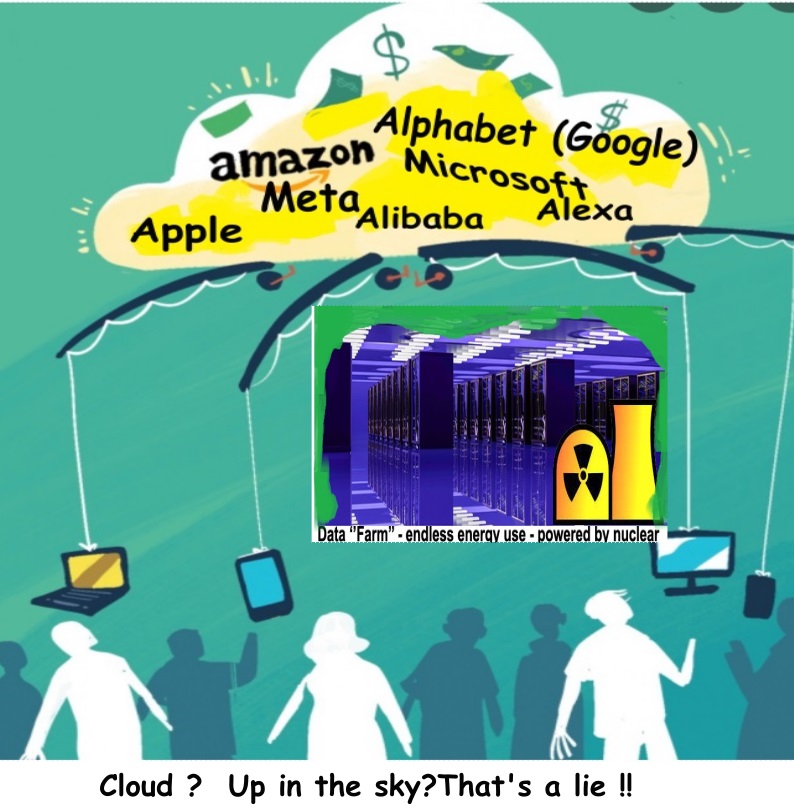
Crypto bros, for their part, did what cloud companies are doing now: make announcements about using nuclear power. Amazon, Google, and Microsoft are now following that strategy to pretend to be good citizens. However, the nuclear industry has its reasons for welcoming these announcements and playing them up.
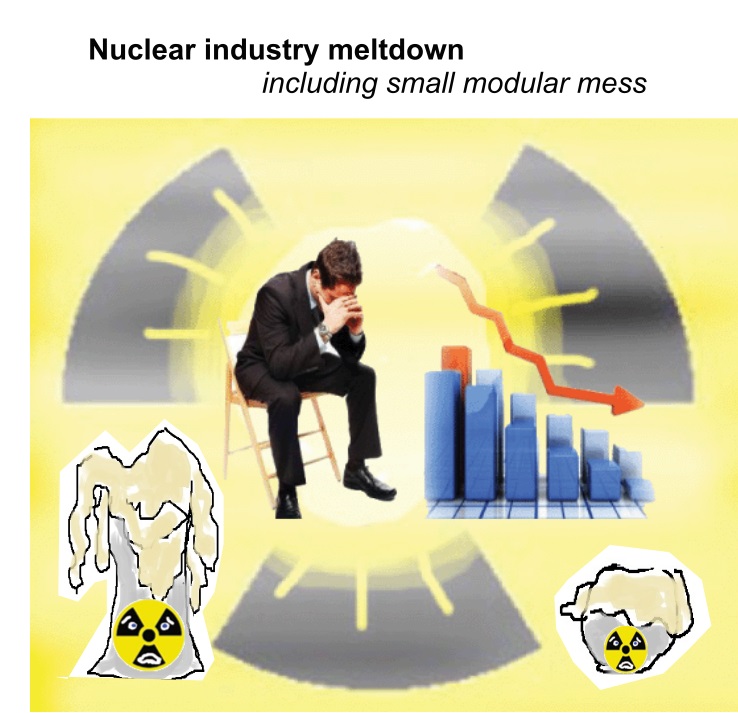
The state of nuclear power
Strange as it might seem to folks basing their perception of the health of the nuclear industry on mainstream media, that technology is actually in decline. The share of global electricity produced by nuclear reactors has decreased from 17.5% in 1996 to 9.15% in 2023, largely due to the high costs of and delays in building and operating nuclear reactors.
A good illustration is the Vogtle nuclear power plant in the state of Georgia. When the utility company building the reactor sought permission from the Nuclear Regulatory Commission in 2011, it projected a total cost of $14 billion, and “in-service dates of 2016 and 2017” for the two units. The plant became operational only this year, after the second unit came online in March 2024, at a total cost of at least $36.85 billion.
Given this record, it is not surprising that there are no orders for any more nuclear plants.

As it has been in the past, the nuclear industry’s answer to this predicament is to advance the argument that new nuclear reactor designs would address all these concerns. But that has, yet again, proved not to be the case. In November 2023, the flagship project of NuScale, the small modular reactor design promoted as the leading one of its kind, collapsed because of high costs.
Supporters of nuclear power are now using another time-tested tactic to promote the technology: projecting that energy demand will grow so much that no other source of power will be able to meet these needs. For example, UK energy secretary Ed Davey resorted to this gambit in 2013 when he said that the Hinkley Point C nuclear plant was essential to “keep the lights on” in the country.
Likewise, when South Carolina Electric & Gas Company made its case to the state’s Public Service Commission about the need to build two AP1000 reactors at its V.C. Summer site—this project was subsequently abandoned after over $9 billion was spent—it forecast in its “2006 Integrated Resource Plan” that the company’s energy sales would increase by 22 percent between 2006 and 2016, and by nearly 30 percent by 2019.
This is the argument that the growth in data centres, propped up in part by the hype about generative artificial intelligence, has allowed proponents of nuclear energy to put forward. It remains to be seen whether this hype about generative AI actually materializes into a long-term sustainable business: see, for example, Ed Zitron’s meticulously documented argument for why OpenAI and Microsoft are simply burning billions of dollars and why their business model might “simply not be viable”.

In the case of the V.C. Summer project, South Carolina Electric & Gas found that its energy sales actually declined by 3 percent compared to 2006 by the time 2016 rolled around. Of course, that did not matter, because shareholders had already received over $2.5 billion in dividends and company executives had received millions of dollars in compensation, according to Nuclear Intelligence Weekly, a trade publication.
One wonders which executives and shareholders are going to receive a bounty from this round of nuclear hype.
What about emissions?
Will the investments in nuclear power by companies like Google, Microsoft, and Amazon help reduce emissions anytime soon?

The project expected to have the shortest timeline is the restart of the Three Mile Island Unit 1 reactor, which Constellation Energy projects will be ready in 2028. But if the history of reactor commissioning is anything to go by, that deadline will come and go without any power flowing from it.
Restarting a nuclear plant that has been shutdown has never been done before. In the case of the Diablo Canyon nuclear plant in California, which hasn’t been shut down but was slated for decommissioning in 2024-25 till Governor Gavin Newsom did a volte-face, the Chair of the Diablo Canyon Independent Safety Committee explained why doing so was very difficult: “so many different programs and projects and so on have been put in place over the last half a dozen years predicated on that closure in 2024-25 and each one of those would have to be evaluated and some of them are okay, and some of them won’t be and some are going to be a real stretch and some are going to cost money and some of them aren’t going to be able to be done maybe”.

The cost of keeping Diablo Canyon open has been estimated by the plant’s owner at $8.3 billion and by independent environmental groups at nearly $12 billion. There are no reliable cost estimates for reopening Three Mile Island, but Constellation Energy, the plant’s owner, is already seeking a taxpayer-subsidized loan that would likely save the company $122 million in borrowing costs.
One must also remember that Microsoft already announced an agreement with Helion Energy, a company backed by billionaire Peter Thiele, to get nuclear fusion power by 2028. The chances of that happening are slim at best. In 2021, Helion announced that it had raised $500 million to build its fusion generation facility that would demonstrate “net electricity production” in three years, i.e., “in 2024”. That hasn’t happened so far. But going back further, one can see a similar and unfulfilled claim from 2014: then, the company’s chief executive had told the Wall Street Journal that the company hoped that its product would generate more energy than it would use “in the next three years” (i.e., in 2017). It is quite likely that Microsoft’s decision-makers knew of how unlikely it is that Helion will be able to supply nuclear fusion power by 2028. The publicity value is the most likely reason for announcing an agreement with Helion.
What about the small modular nuclear reactor designs—X-energy and Kairos—that Amazon and Google are betting on? Don’t hold your breath.
X-energy is an example of a high-temperature gas-cooled reactor design that dates back to the 1940s. There have been four reactors based on similar concepts that were operated commercially, two in Germany and two in the United States, respectively, and test reactors in the United Kingdom, Japan, and China. Each of these reactors proved problematic, suffering a variety of failures and unplanned shutdowns. The latest reactor with a similar design was built in China. Its performance leaves much to be desired: within about a year of being connected to the grid, its power output was reduced by 25 percent of the design power capacity, and even at this lowered capacity, it operated in 2023 with a load factor of just 8.5 percent.

Kairos, on the other hand, will be challenged by its choice of molten salts as coolant. These are chemically corrosive, and decades of search have identified no materials that can survive for long periods in such an environment without losing their integrity. The one empirical example of a reactor that used molten salts dates back to the 1960s, and this experience proved very problematic, both when the reactor operated and in the half-century thereafter, because managing the radioactive wastes produced before 1970 continued to be challenging.
Simply throwing money will not overcome these problems that have to do with fundamental physics and chemistry.
Just a dangerous distraction
Although Amazon, Google, and Microsoft claim to be investing in nuclear energy to meet the needs of AI, the evidence suggests that their real motive is to greenwash themselves.
Their investments are small and completely inadequate with relation to how much is needed to build a reactor. But their investments are also very small compared to the bloated revenues of these corporations. So, from the viewpoint of top executives, investing in nuclear power must seem a cheap way to reduce bad publicity about their environmental footprints. Unfortunately, “cheap” for them does not translate to cheap for the rest of us, not to mention the burden to future generations of human beings from worsening climate change and, possibly, increased production of radioactive waste that will stay hazardous for hundreds of thousands of years.
Because nuclear power has been portrayed as clean and a solution to climate change, announcements about it serve as a flashy distraction to focus public attention on. Meanwhile, these companies continue to expand their use of water and draw on coal and especially natural gas plants for their electricity. This is the magician’s strategy: misdirecting the audience’s attention while the real trick happens elsewhere. Their talk about investing in nuclear power also distracts from the conversations we should be having about whether these data centers and generative AI are socially desirable in the first place.
There are many reasons to oppose and organize against the wealth and power exercised by these massive corporations, such as their appropriation of user data to engage in what has been described as surveillance capitalism, their contracts with the Pentagon, and their support for Israel’s genocide and apartheid. Their investment into nuclear technology, and more importantly, hyping it up, offers one more reason. It is also a chance to establish coalitions between groups involved in very different fights.
M. V. Ramana is the Simons Chair in Disarmament, Global and Human Security at the School of Public Policy and Global Affairs, University of British Columbia and the author of The Power of Promise: Examining Nuclear Energy in India.
101 BBC journalists say it is biased against Palestine

Sat 2 Nov 2024, https://www.jewishvoiceforlabour.org.uk/article/101-bbc-journalists-say-it-is-biased-against-palestine/
JVL Introduction
The BBC has been accused of bias against Israel but here over 230 people, including 101 BBC journalists have argued that there is a strong bias towards Israel and certainly the Israeli narrative. The letter was sent to the Independent arguing that Broadcaster bias is failing to hold Israel to account.
It is noteworthy that only 72 of the 230 signatories felt able to sign openly and this included none of the BBC journalists. Distrust of mainstream media is growing but there is a real need for unbiased reporting. The BBC has previously claimed that the fact it receives complaints from those in support of Israel as well as those in support of Palestine shows its impartiality. This letter, and many other articles and letters before, show this to be nonsense.
LL
This article was originally published by Digi on Fri 1 Nov 2024. Read the original here.
Hundreds of journalists and personalities accuse BBC of bias in favor of Israel and call for a return to “fairness and impartiality”
More than 230 members of the media industry and personalities, including 101 BBC employees, accuse the British media outlet of providing favourable coverage of Israel and call on the public broadcaster to “recommit to fairness, accuracy and impartiality” in its reporting on the Gaza Strip.
Digi
In a letter sent to Tim Davie, signed by more than 230 members of the media industry, including 101 anonymous BBC employees, the corporation is criticized for failing to enforce its own editorial standards by lacking “fair evidence-based journalism in its coverage of Gaza.”
Seen exclusively by The Independent, the letter, which was also signed by Baroness Sayeeda Warsi and actress Juliet Stevenson, calls on the BBC to report “without fear or favour” and “to recommit to the highest editorial standards – with an emphasis on fairness, accuracy and due impartiality.”
The letter also calls on the broadcaster to implement a number of editorial commitments, including “reiterating that Israel does not offer foreign journalists access to Gaza; clarifying when there is insufficient evidence to support Israeli claims; clarifying where Israel is the perpetrator in article titles; including the usual historical context before October 2023; and firmly challenging the Israeli military and government in all interviews.”
The BBC denied these claims, insisting that it “strives to live up to our responsibility to provide the most reliable and impartial news”.
“When we make mistakes or have made changes in the way we report, we are transparent. We are also very clear with our audience about the limitations imposed on our reporting – including the lack of access to Gaza and restricted access to certain parts of Lebanon, as well as our continued efforts to attract reporters to those areas,” a spokesperson said.
Other signatories on the list include historian William Dalrymple, Dr. Catherine Happer, lecturer in sociology and director of media at the University of Glasgow, Rizwana Hamid, director of the Centre for Media Monitoring, and broadcaster John Nicolson.
This is not the first time the BBC has been criticised for bias during the Gaza war. In September, the BBC rejected claims that it had violated its own guidelines more than 1,500 times following a controversial report that claimed some BBC correspondents had excused or downplayed Hamas’ activities. A BBC spokesperson said at the time that it would “carefully consider” the complaint, but denied the allegations of bias.
However, the signatories of the letter insist that the BBC favors Israel. A current staff member who signed the letter told The Independent that some of their colleagues had left the institution because of its cover-up. “I have never witnessed, in my entire career, such low levels of confidence,” they said. “I have colleagues who have left the BBC in recent months because I simply don’t think our reporting on Israel and Palestine is sincere. Many of us feel paralyzed by fear.”
Another said they were “losing faith in the organisation they work for” after seeing a “huge difference” in the BBC’s approach to Israel. They added: “I really care about the future of the BBC and every day I see that we are losing the trust of audiences around the world. People change the channel to find the reality of what’s going on because we just don’t give it to them.”
Examples provided by staff include “dehumanizing and misleading headlines,” including the one given to an article about a six-year-old girl who was shot by the Israeli army in Gaza in January 2024. Speaking about the headline “Hind Rajab, 6, found dead in Gaza days after phone calls for help,” a signatory of the letter said: “This was not an act of God. The perpetrator, Israel, should have been on the front page and it should have been clear that she was killed.”
“Palestinians are always treated as an unreliable source and we consistently prioritise Israel’s version of events, despite the IDF’s well-documented history of lying,” says another BBC employee, speaking on condition of anonymity.
“It seems that we often prefer to drop Israel from the title, if possible, or question who might be to blame for the airstrikes. The level of verification expected for anything related to Gaza far exceeds what is the norm for other countries,” he said.
Other concerns raised by staff include coverage omissions, such as the failure to livestream the plea of South Africa’s genocide case against Israel to the International Court of Justice on January 11, but the choice to livestream Israel’s defense the next day.
Of the 237 signatories, 72 signed publicly, including former British Foreign Secretary and Baroness Warsi and actress Juliet Stevenson, as well as dozens of academics. The letter, while focusing on the BBC, also highlights the shortcomings of other media outlets, including ITV and Sky.
“This conflict is one of the most polarizing stories that people are reporting on, and we know that people feel very much about how it is presented, not only on the BBC, but in all media. The BBC holds itself to very high standards and we strive to fulfil our responsibility to provide the most reliable and unbiased news – weighing and measuring the words we use, fact-checking and seeking a wide range of interviews and expert opinions,” the BBC said.
While acknowledging that “the BBC does not and cannot reflect any worldview”, a spokesperson insisted that it receives an almost equal measure of complaints alleging bias against Israel. “This does not mean that we assume that we are doing something right and continue to listen to all criticism – from inside and outside the BBC and reflect on what we can do better,” the institution also said.
Launch of papers on UK’s unachievable nuclear programme
Today, Friday 1 November we are launching two papers:
- ‘It is time to expose the Great British Nuclear Fantasy once and for all’ (long paper);
- ‘New Nuclear – Unaffordable, Undesirable and Unachievable’ (short paper) (as Word doc).
In our view, these papers irrefutably demonstrate why the government’s proposed vast expansion of nuclear power in the UK is unnecessary, unjustifiable but also impossible.
We believe it is imperative that government reviews and reconsiders its nuclear policy and recognises that it cannot proceed.
The longer paper provides our considered and detailed analysis which reveals that nuclear is too costly, takes too long, is technologically challenged and leaves an expensive and unmanageable burden of wastes for future generations. More than that, there are no suitable sites for new power plants and those that are supposedly ‘potentially suitable’ will all be vulnerable to the impending ravages of Climate Change during their lifetimes.
The shorter paper (which is available for publication) presents our arguments concisely, presenting a fundamental challenge to current orthodoxy on the case for nuclear. At a time of pressure on public spending, nuclear does not represent good value for money, nor is it attractive against other more pressing social welfare priorities.
Biographical Notes:
Andrew Blowers, OBE, Emeritus Professor of Social Sciences, Open University. Former member of Committee on Radioactive Waste Management (CoRWM) and Radioactive Waste Management Advisory Committee (RWMAC); author The Legacy of Nuclear Power.
Stephen Thomas, Emeritus Professor of Energy Policy, University of Greenwich. Editor-in-Chief of the journal Energy Policy.
Biden’s Destructive Legacy

by Daniel Larison , , https://original.antiwar.com/Daniel_Larison/2024/10/31/bidens-destructive-legacy/
As President Biden’s term approaches its end, the US and several parts of the rest of the world are significantly worse off than they were when he took office. While the president is frequently lauded by members of the foreign policy establishment as a successful foreign policy leader, his tenure has been marked for the most part by deepening US involvement in foreign conflicts that show no signs of ending anytime soon. US policies under Biden have served only to stoke destabilizing conflict, and the president has shown no inclination to bring any of the wars currently backed by Washington to an end. Biden’s presidency showed the world just how extensive the rot in US foreign policy is, and most other nations will not soon forget what restored American “leadership” wrought.
Biden ran on the promise of ending America’s forever wars, but after the withdrawal from Afghanistan he then spent most of his presidency going out of his way to involve US in conflicts where no vital American interests were at stake. The risk of great power conflict has also risen under Biden as he has pursued a China policy of containment and rivalry that the US can ill afford while US-Russian relations have sunk to new lows over Ukraine. In the Middle East, Biden has enabled Israel’s genocidal campaign in Gaza, backed their invasion of Lebanon, and supported their attacks on Iran. He has helped Israel sow chaos across the region, and he committed the US to a new open-ended and illegal war in Yemen. The president’s extreme ideological attachment to Israel led him to pursue an indefensible policy of unconditional support that has fueled the slaughter of civilians and created one of the worst man-made famines in modern times.
The president’s aversion to serious diplomatic engagement meant that the US continued the disastrous economic wars against Iran, Venezuela, and North Korea that Trump had been waging. Biden’s refusal to reenter the nuclear deal with Iran ensured that there would be no progress in negotiations with Tehran. The administration’s efforts to secure a ceasefire in Gaza have been a face-saving exercise so that the US could claim to be doing something to end the war while it continued arming Netanyahu’s government to the teeth. The US hasn’t so much as pretended to be interested in a ceasefire in Ukraine. On almost every front, the Biden administration’s answer has been more militarism.
The Biden administration has brought the US close to direct conflict with Iran thanks to Washington’s backing for Israel. It is still possible that the US and Iran might be at war in the next few months. It would be bad enough to get into an unnecessary war to support a non-ally, but to do it when the client is also massacring and starving civilians is inexcusable. US backing for the wars in Gaza and Lebanon is a strategic and moral debacle, and Biden shouldn’t be let off the hook for putting the US in this position. Even if the US and Iran avoid war again, it is a measure of how dangerous administration policy has been that it was ever this close to happening.
There is never any real accountability in Washington for the outrages and crimes committed by our leaders. It is doubtful that officials in the Biden administration will face legal or personal consequences for their role in these horrors. Regardless, Americans should remember that Biden and his administration were willing accomplices to mass starvation and genocide. Their complicity should never be forgotten, and they deserve all the opprobrium that the world has to offer.
The result of Biden’s decisions is that our already heavily militarized foreign policy has become even worse than it was before. The administration’s limited diplomatic efforts have been consumed by the president’s obsession with giving Saudi Arabia a security guarantee. Biden has done extensive damage to the reputation and interests of the United States, and he will likely be remembered as one of the two worst foreign policy presidents of the last fifty years along with George W. Bush. Biden’s foreign policy legacy is mostly one of fanning the flames of war and the destruction of innocent lives.
Daniel Larison is a columnist for Responsible Statecraft. He is contributing editor at Antiwar.com and former senior editor at The American Conservative magazine. He has a Ph.D. in History from the University of Chicago. Follow him on Twitter @DanielLarison and at his blog, Eunomia, here.
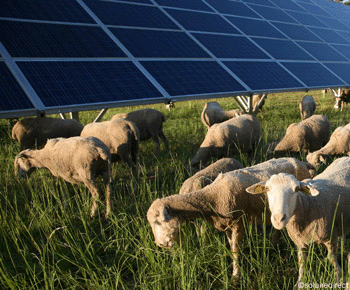
Grazing sheep among solar panels could produce higher quality wool, study finds
Sophie Vorrath, Nov 1, 2024,
https://reneweconomy.com.au/grazing-sheep-among-solar-panels-could-produce-higher-quality-wool-study-finds/
The co-location of solar farming with sheep grazing does not have a negative affect on wool production and could even improve the quality of the wool produced, a new study has found.
The study is based on the results of a second round of wool testing at the Wellington solar farm, south east of Dubbo in New South Wales, which has shared its site with 1,700 merino sheep for the past three years.
Legend has it that the decision to graze sheep at the solar farm came about when an employee of Lightsource bp, the owner of the Wellington project, complained to a local, sixth-generation wool farmer about the hassle and cost of mowing the solar farm six times a year.
According to Tony Inder, who heads up the Allendale Merino Stud, the effect on his sheep has been a lot better than he thought it would be – he says the wool quality they are producing has “increased significantly.”
But Lightsource bp – which is now wholly owned by the oil and gas giant BP, after completing the acquisition of the remaining 50.03% interest – has used the opportunity to gather some formal data.
The study, conducted by EMM Consulting with support from Elders Rural Services, compares two groups of merino sheep – one group grazed in a regular paddock and the other at the Wellington solar farm.
The latest findings show grazing sheep among solar panels does no harm to wool production, even in the case of pre-existing high-quality standards. And it says that some parameters even indicate an improvement in wool quality, although conclusive benefits require further long-term measurement.
Lightsource bp says that while the study at the Wellington solar farm is ongoing, it is another indication that solar farms can exist side-by-side with sheep farming, for the benefit of both enterprises.
“These results are very encouraging and highlight the potential for solar farms to complement agricultural practices,” says Emilien Simonot, Lightsource bp’s head of agrivoltaics.
“By integrating sheep farming with solar energy production, we can achieve dual benefits of sustainable energy together with agricultural output.” . By co-locating grazing with renewable energy, land can remain in agricultural use, offering farmers additional revenue while contributing to cleaner energy for the planet.
“Finding ways for agriculture and clean energy to work together is crucial for a more sustainable future,” says Brendan Clarke, interim head o environmental planning Australia and NZ at Lightsource bp.
“The promising results from this study indicate that we are on the right path, and working closely with farmers to grow our knowledge in this area is paramount.”
As for the sheep, Inder says they “just do really well” when grazing among the Wellington solar farm panels.
“I like to say that panel sheep are happy sheep.”
Sophie is editor of One Step Off The Grid and deputy editor of its sister site, Renew Economy. She is the co-host of the Solar Insiders Podcast. Sophie has been writing about clean energy for more than a decade.
France wrestles with the idea that nuclear wastes might be useful, “retrievable” for future generations

“measures likely to cause serious and lasting harm to the environment”
CIGEO: REVERSIBILITY AND RECOVERABILITY In the request for creation authorization (DAC)
Saturday, November 2, 2024, by Bernard Laponche
During the first decades of nuclear electricity production in France, the management of radioactive waste produced by this industry, from uranium mines to reprocessing products of irradiated fuel, was not a major concern of the governments and industrialists concerned.
The acceleration of the nuclear program in the early 1970s, particularly the “Messmer Plan” of 1974, made it necessary to take things seriously.
Since the work of the Castaing Commission in the early 1980s, the choice has been oriented towards deep geological storage, with the condition of reversibility, that is to say the possibility for future generations to reverse such a choice and therefore to easily recover any waste that may have already been buried.
This condition of reversibility was subsequently maintained by government decisions and legislative acts leading to the creation of a research laboratory on the Bure site, then to the Cigéo project for deep storage of the most dangerous waste on a site close to that of the laboratory.
Following the declaration of public utility (DUP) of the Cigéo project, the application for authorisation to create (DAC), filed by the organisation responsible for the management of radioactive materials and waste, ANDRA, is currently being examined by the nuclear safety organisations, IRSN and ASN, and should result in an authorisation for commissioning by 2026-27, after a series of consultations.
In 2023, the Constitutional Council, asked by the Council of State to rule on a
priority question of constitutionality (QPC) brought by a group of organizations and private individuals, concluded that “… the legislator, when adopting measures likely to cause serious and lasting harm to the environment, must ensure that choices intended for the needs of the present do not compromise the ability of future generations and other peoples to meet their own needs, while preserving their freedom of choice in this regard”. This decision of historic importance highlights the question of the reversibility of the Cigéo project, which, in its analysis, the Constitutional Council considered to be acquired.
In order to judge this, this report analyses the way in which the reversibility of storage is treated in the various parts of the DAC file to which the reader can refer.
This analysis leads to the following conclusion:
Reversibility, the possibility of removing all packages from storage due to a political decision, would be ensured for the duration of operation, therefore before final closure, if the cells and galleries were not “sealed” and therefore accessible. This situation may therefore arise for generations up to the date of closure of the site, planned by ANDRA towards the end of the 22nd century.
This condition must therefore be imposed as soon as the creation of Cigéo is authorized.
On the other hand, once the galleries, cells and all accesses to the storage are sealed at the end of the storage operation and at final closure, there is no longer any possible reversibility for future generations beyond this date.
Why ‘British’ nuclear weapons are really very American
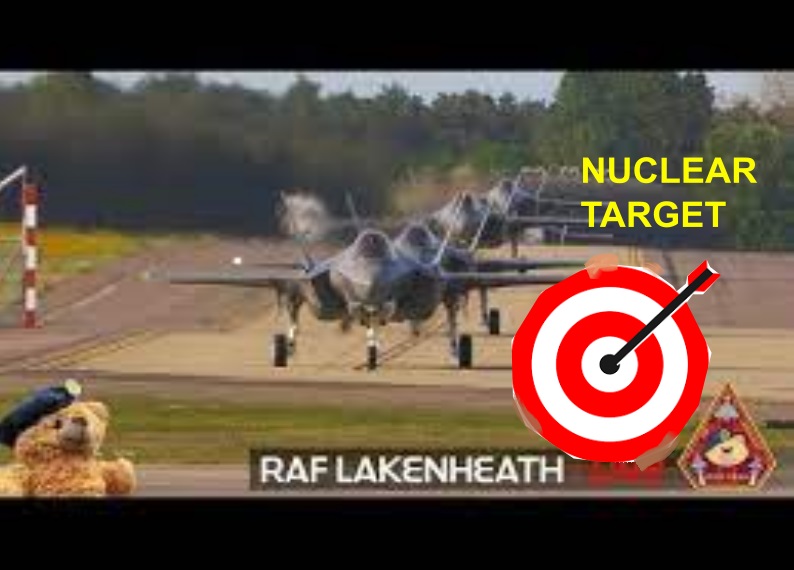
But the idea that this weapon system is “independent” involves just as much magical thinking and is more myth than fact. Unfortunately, such myths are not harmless but deadly dangerous for every one of us and for the future of our planet.
Lakenheath is RAF in name only as it is primarily populated by US personnel and equipment. US sources have revealed that permission has been given once again for Lakenheath to host US nuclear bombs without prior consultation with the population.
By Lynn Jamieson, Scottish CND, The National 3rd Nov 2024
THE approach of a US election is a good time to consider the reality of the so-called British nuclear weapon system – its integration with and dependence on the United States of America.
Since the first test and use of nuclear bombs in 1945, the heads of the UK Government have brushed aside efforts at international agreement to ban nuclear weapons.
After the Second World War, British prime ministers wanted Britain to have nuclear bombs to keep up with America. Now the British nuclear program can only exist because of “sharing” with America.
The UK Government ignores new efforts at banning nuclear weapons. This is despite knowing that any nuclear war will end comfortable liveable life across most of this planet and that the majority of non-nuclear countries in the world disagree with their viewpoint and support the UN Treaty on the Prohibition of Nuclear Weapons.
Deviating from this blinkered commitment to nuclear weapons would rupture the “special relationship” with the USA.
The so-called British nuclear weapon system includes four nuclear-powered submarines each ready to simultaneously launch at least 40 nuclear bombs in clusters, fanning out from eight independently targeted missiles. That is eight regions to be totally obliterated by five bombs each.
This is the system described by this government and governments before it as “Britain’s independent nuclear deterrent”. This name combines the idea that the UK Government alone controls the nuclear weapon system – hence “independent” – and that it will stop any aggressor ever attacking – hence “deterrent”. Both the independent and the deterrent ideas are deeply flawed.
Many things are written about the failures and problems of deterrence, including the possible catastrophic mistakes in games of bluff and counter-bluff, the tendency towards constant escalation in nuclear arms, the target it puts on our back, the absurd costs, and the very real risks created by nurturing mass death machines in your own back yard.
But the idea that this weapon system is “independent” involves just as much magical thinking and is more myth than fact. Unfortunately, such myths are not harmless but deadly dangerous for every one of us and for the future of our planet.
The United States is involved at every level of the so-called British nuclear weapon system, from design and procurement to operation and targeting.
The flow of knowledge, technology, materials and military personnel between the US and the UK is made possible by a number of treaties, most importantly the Mutual Defence Agreement treaty. It was first signed in 1958 and has been extended and expanded multiple times since.
Nuclear bombs assembled in Britain are based on a US design and have components shipped from the USA. The USA also builds, supplies, and maintains the missiles used to “deliver” the bombs to their targets……………………………………………..
Neither the US base nor the subsequent development of the Faslane Royal Navy into a nuclear-armed, nuclear-powered submarine base involved consultation or agreement with Scottish people, a situation that many have resisted ever since………………………………………………………………………………………………
Lakenheath is RAF in name only as it is primarily populated by US personnel and equipment. US sources have revealed that permission has been given once again for Lakenheath to host US nuclear bombs without prior consultation with the population…………………………………………………….. https://www.thenational.scot/politics/24696487.british-nuclear-weapons-really-american/
NGOs call for more secure interim storage facilities for Germany’s nuclear waste

29 Oct 2024, Jack McGovan, Germany, https://www.cleanenergywire.org/news/ngos-call-more-secure-interim-storage-facilities-germanys-nuclear-waste
Clean Energy Wire / Tagesspiegel Background
Many nuclear waste storage facilities in Germany are not up to safety standards with issues like rusting drums and interim sites being used without permits, found a report by anti-nuclear organisation Ausgestrahlt and the NGO Munich Environmental Institute. The organisations are calling on the German government to take the dangers of improper nuclear waste storage seriously and demand a comprehensive and safe nuclear policy.
“We don’t have a single interim storage facility that is sufficiently safe,” said nuclear waste expert Helge Bauer from Ausgestrahlt to Tagesspiegel Background.
29 Oct 2024, 13:22
|
Germany
NGOs call for more secure interim storage facilities for Germany’s nuclear waste
Clean Energy Wire / Tagesspiegel Background
Many nuclear waste storage facilities in Germany are not up to safety standards with issues like rusting drums and interim sites being used without permits, found a report by anti-nuclear organisation Ausgestrahlt and the NGO Munich Environmental Institute. The organisations are calling on the German government to take the dangers of improper nuclear waste storage seriously and demand a comprehensive and safe nuclear policy.
“We don’t have a single interim storage facility that is sufficiently safe,” said nuclear waste expert Helge Bauer from Ausgestrahlt to Tagesspiegel Background.
One issue the activists highlight is the transportation of nuclear waste, which they say is being moved back and forth because nobody wants to be responsible for storing it. The report found that this also makes Germany vulnerable to sabotage. In August, there were drone flights of unknown origin over Brunsbüttel where there is currently an interim storage facility for highly radioactive waste, reports Tagesspiegel Background.
The report looked at 216 nuclear facilities across 71 sites in the country, including 84 that were currently in operation and 56 that were decommissioned or already being dismantled. Other organisations have also shown support for the report, including BUND and Robin Wood.
The European Economic and Social Committee (EESC), which advises EU institutions like the Commission and the Parliament, adopted a firm stance after a plenary session in October that civil society groups should receive funding to be able to monitor the management of radioactive waste.
The discussion regarding what to do with nuclear waste has been a big topic in Germany recently as a report in August found that the hunt for a final repository could go on until the 2070s. Germany completed its nuclear phase-out last year and will now have to store around 1,900 large containers, or around 28,100 cubic metres, of high-level radioactive waste by 2080.
Climate Researchers Warn: Warmer Climate Could Lead To “Cold Waves Across Northern Europe”!

By P Gosselin on 2. November 2024, https://notrickszone.com/2024/11/02/climate-researchers-warn-warmer-climate-could-lead-to-cold-waves-across-northern-europe/
In a recent open letter, researchers warned that a warmer Arctic could lead to cold waves across Northern Europe – due to “complex feedback mechanisms”.
According to Forschung & Wissen here, an international group of renowned scientists recently published an open letter (PDF) stating that the melting of ice in the Arctic could disrupt ocean currents in the Atlantic, and thus have “devastating and irreversible impacts especially for Nordic countries, but also for other parts of the world.”
According to their publication in the journal Nature Communications, October 2024, doi: 10.1038/s41467-024-53401-3, melting of sea ice during the last interglacial significantly impacted the density and salinity of seawater, and thus led to significant changes in ocean currents and heat distribution in the oceans.
The researchers looked at sediment cores collected in the North Sea and reconstructed surface temperatures and salinity and found that these processes have led to a significant drop in temperature in northern Europe.
According to Mohamed Ezat: “Our discovery that the increased melting of Arctic sea ice in the Earth’s past probably led to significant cooling in northern Europe is alarming.”
He adds: “The impacts particularly on Nordic Countries would likely be catastrophic, including major cooling in the region while surrounding regions warm. This would be an enlargement and deepening of the ‘cold blob’ that already has developed over the subpolar Atlantic Ocean and likely lead to unprecedented extreme weather.”
Safety analysis is not yet approved for Sweden’s nuclear waste dump plan, despite the hype.

| Brennain Lloyd, 3 Nov 24 |
Sweden’s Land and Environmental Court has granted SKB an environmental permit to build and operate the DGR for nuclear fuel waste …. almost.
This is the last step in the licensing process, and while a political approval had already been issued, this permit from the Lands and Environment Court was still outstanding, and so we were still on sound ground saying that there was no “approved and operating deep geological repository anywhere in the world” (Finland has constructed the underground workings, but still is in the early or mid-stages of the review of their operating license).
Now SKB has “granted” the permit, but there are still two more steps: the Uppsala County administrative board has to approve a “control program”, which sounds from this article like it might be the rough equivalent of the CNSC “License to Prepare a Site” (but it might not be! that’s my speculation based on this description).
The larger point is that “Before SKB can start on the actual mining of the repository tunnels, an approved safety analysis report is required from the Swedish Radiation Safety Authority.”
So, in summary, it seems that the permit has been granted, but the safety analysis report has not been approved, so there is still – as of this moment – still no “approved and operating deep geological repository anywhere in the world”.
Given that the detail of the approval of the safety analysis report might not get media coverage (even nuclear industry media coverage) we’d probably be on sounder ground to now simply say that “there is no operating DGR anywhere in the world, and therefore no operating experience the nuclear industry can point to”.
1 This Month
To see nuclear-related stories in greater depth and intensity – go to https://nuclearinformation.wordpress.com/
31st January – Challenging the War Machine – a DECLASSIFIED UK SUMMIT





Website of the Week
Now until to February 10, 2026 Radioactive waste storage in France: the debate is finally open! How to participate?
-
Archives
- January 2026 (306)
- December 2025 (358)
- November 2025 (359)
- October 2025 (376)
- September 2025 (258)
- August 2025 (319)
- July 2025 (230)
- June 2025 (348)
- May 2025 (261)
- April 2025 (305)
- March 2025 (319)
- February 2025 (234)
-
Categories
- 1
- 1 NUCLEAR ISSUES
- business and costs
- climate change
- culture and arts
- ENERGY
- environment
- health
- history
- indigenous issues
- Legal
- marketing of nuclear
- media
- opposition to nuclear
- PERSONAL STORIES
- politics
- politics international
- Religion and ethics
- safety
- secrets,lies and civil liberties
- spinbuster
- technology
- Uranium
- wastes
- weapons and war
- Women
- 2 WORLD
- ACTION
- AFRICA
- Atrocities
- AUSTRALIA
- Christina's notes
- Christina's themes
- culture and arts
- Events
- Fuk 2022
- Fuk 2023
- Fukushima 2017
- Fukushima 2018
- fukushima 2019
- Fukushima 2020
- Fukushima 2021
- general
- global warming
- Humour (God we need it)
- Nuclear
- RARE EARTHS
- Reference
- resources – print
- Resources -audiovicual
- Weekly Newsletter
- World
- World Nuclear
- YouTube
-
RSS
Entries RSS
Comments RSS
 nuclear-news