After election, will progressives acknowledge and oppose US genocide in Gaza?

Walt Zlotow, West Suburban Peace Coalition, Glen Ellyn IL 4 Nov 24
During the current US election cycle, many progressives have recoiled from addressing the 13 month long US enabled Israeli genocide in Gaza.
They are singularly focused on pushing Kamala Harris to victory, saving democracy from the unhinged authoritarian Trump. As a result they’ve banished the word much less the reality of the genocide which the US enables.
That is deplorable. Every day dozens, hundreds, possibly a thousand Palestinian civilians die in the worst genocide this century. All financed, publicly supported and weaponized by their beloved Biden/Harris administration.
When the genocide in Gaza is brought up for discussion, too many progressives are ‘hear no evil, see no evil, speak no evil.’
When asked to push back against US weaponizing, publicly supporting, financing the genocide, progressives come up with the darnedest excuses
‘There is no genocide in Gaza, just a defensive war against Hamas.’
‘Don’t dare say anything that will jeopardize Harris’ chances.’
‘The destruction in Gaza will be much worse under Trump.’
‘The United States has no influence on the government of Israel.’
‘President Biden and Vice President Harris are working night and day to achieve ceasefire in Gaza.’
‘People have been fighting each other there for thousands of years and nothing will change that.’
Maybe these otherwise fine progressives will open their eyes and souls to ongoing destruction of Gaza once the election ends and decide to resist it passionately.
Alas, with both candidates locked in ironclad support for sending endless billions for Israel to ‘finish the job’, they just might shrug and continue ignoring the most greatest moral dilemma of their lifetime.
Israel’s attacks on Iran were an apocalyptic error by Netanyahu. Here’s why
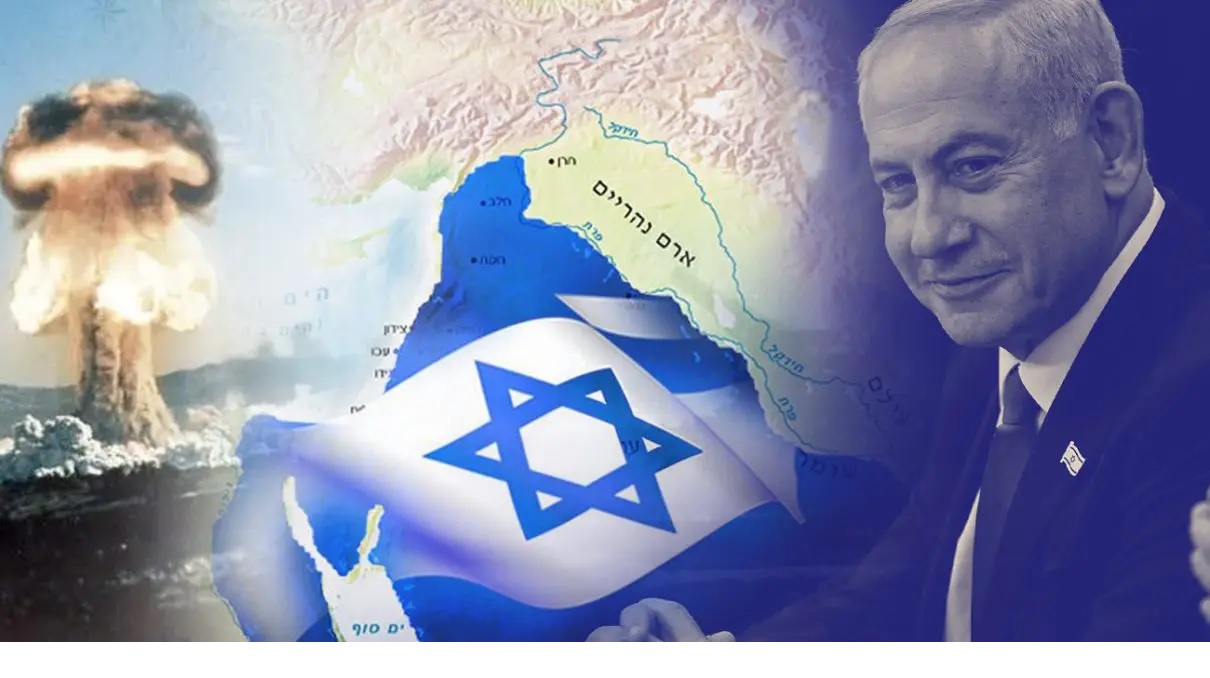
Martin Jay, Strategic Culture Foundation, Thu, 31 Oct 2024,
https://www.sott.net/article/495896-Israels-attacks-on-Iran-were-an-apocalyptic-error-by-Netanyahu-Heres-why
We see that Israel has no longer term military strategy, only short term excursions which will drain both its resources and the morale of its frontline soldiers.
While the whole world now waits with bated breath as to the result of the U.S. elections in only a matter of days, many are also waiting to see what are the implications for Israel’s recent strike on Iran. Despite being told by Joe Biden that it could not strike military installations it went against the advice of its chief sponsor and did precisely that. Perhaps there has never been a better example of western diplomacy failing than this incident, given that while Israel lies to its own people and the western world via news outlets more than happy to spin a yarn about the reality of the attacks, Iran now has to look at a number of options in how it will respond. But respond it surely will.
Yet this singular act is probably the most reckless to date from Netanyahu. Never before has the Israeli PM gone so far out on a limb and taken such a gambit which not only pushes the U.S. to the brink of a war with Iran but also throws a spotlight on the existential question of Israel itself. The next strike on Israel’s military infrastructure might be the final blow for Israel to function as a military entity forcing the U.S., or the next president, to intervene with Trump’s critics already pointing out that he owes a number of favours to the Zionists which they will certainly call in.
Netanyahu is desperate to keep wars on all fronts alive simply so he can remain relevant. But what is hardly talked about is the state of Israel itself, with an economy in pieces. Just how far will the next U.S. president go in supporting Israel’s new war with Iran, both in terms of military spending and breathing new life into the economy which has seen 40,000 businesses go under since October 7th 2023 and almost a million Israelis leave the country.
Netanyahu now is like a poker player who has used up all his IOUs at the table and is holding two pairs. How can he even believe he can take on Iran when even in Gaza and in Lebanon he is losing soldiers at a rate which should worry him and his generals. Yes, he has struck Hezbollah and reduced its capabilities but by no stretch of the imagination has he taken out the Iranian proxy which is still sending missiles and drones into Israel making the Israelis run to their air raid shelters even to this day.
The decision to strike Iran was surely out of an act of a gross political dilemma. However, the act itself has backfired on a level that neither he nor his entourage could imagine. Most of the targets were not even significantly damaged with a very low percentage of Israel’s missiles getting through Iran’s air defence which is so efficient that even Israel’s air force were too afraid actually fly into Iran’s airspace. Many in the west will be taken in by the spin from Israel’s lobby and impressive PR machine that it was a great victory and many sites were taken out, regardless of the fact that the IDF can’t provide one single shred of video evidence to back up such ludicrous claims, as it did previously in Gaza and Lebanon.
But the real defeat for Israel under Netanyahu is yet to come. Iran now has all the hard evidence it needs to strategize and hit Israel even harder than before. The erroneous strike on Iran by Netanyahu is not so much measured by the minor harm it did to a couple of weapons sites. It is by how now the myth of Israel’s military strength has been debunked once and for all. For decades Israel claimed superiority to everyone else, including Iran, and this was taken for granted by partisan western journalists who kept the dream alive. Remarkably, the strike on Israel by Iran on October 1st showed even Israelis that their air defence systems were hopelessly inadequate against Iran’s hypersonic missiles. That should have been enough to cool down the hot heads which straddle Netanyahu. At this point, the message he delivered at the UN, that there is “no place in Iran which Israel’s missiles cannot reach” should have been taken at face value and interpreted literally. Reaching Iranians sites is one thing. Actually taking them out is another.
Now, as the dust settles and Israel now waits for Iran’s response, the second myth that Israel’s strike capability was highly effective against Iran’s air defences is also blown. It seems like now Netanyahu’s folded as he has no more bluffs to play at the poker table. Unless of course he is deliberately coaxing his own country into a suicide strategy where Iran will completely desecrate Israel’s military leaving the U.S. little choice but to install itself on a grand scale. This so-called suicide strategy can’t be ruled out but seems hard to believe. The truth is that until Israel struck Iran, it didn’t know whether its own missiles and aircraft had the capability to penetrate Iran’s air defence system, supported heavily by Russia which sent it S-400 systems in August.
For the moment the Israeli press, as an act of desperate patriotism one can only assume, has indulged itself in a flurry of fake news stories about Iran’s air defence systems being destroyed as well as missile factories. But the jubilation will not last long. Oddly, the same media are becoming more pragmatic about Israel’s operations in Lebanon which has gone on for well over a month and in just two days managed to send over 80 body bags back to Israel, spurning a narrative which already is beginning to question the decision to cross the Lebanese border. The Jerusalem Post, in an oped, actually is admitting that the campaign is losing its credibility due to the number of lost lives of IDF soldiers. “The number of soldiers being killed in southern Lebanon also appears to be rising instead of falling over time” it opines. “The strikes against Hezbollah, such as the killing of Radwan commanders in September and the elimination of Hezbollah leader Hassan Nasrallah, should have weakened the group’s command and control”.
The article is a remarkable admission of Israel’s strategy being misconceived and poorly planned, just like the 2006 invasion. But getting IDF soldiers out of southern Lebanon will be much harder than sending them there as Netanyahu has pushed his arm into a hornet’s nest. Israel cannot consider a war of attrition against Hezbollah as even Netanyahu knows he cannot win. His only means to scoring points are assassinations and bombing civilians in southern Beirut, a strategy which many would call terrorism. His team of military goons have not learnt the lesson that aerial bombardment is not a deal breaker in a war against a disciplined guerrilla outfit. It failed in Iraq. It even failed in Vietnam. Again, we see that Israel has no longer term military strategy, only short term excursions which will drain both its resources and the morale of its frontline soldiers.
Iran says it can produce nuclear weapon if faced with existential threat
Nov 2, 2024, https://www.iranintl.com/en/202411011480
ran is capable of producing nuclear weapons and an existential threat could cause a rethink of the Supreme Leader’s injunction against them, one of his top foreign policy advisors told Lebanese news outlet Al Mayadeen.
“If the Islamic Republic of Iran faces an existential threat, we would have no choice but to adjust our military doctrine,” Former foreign minister Kamal Kharrazi said in an interview with the pro-Tehran channel.
“We already have the technical capabilities to produce weapons; only a religious decree forbidding nuclear weapons prevents us from doing so,” he added, referring to a religious decree by the country’s ultimate decision maker Ali Khamenei.
Kharrazi heads the Strategic Council on Foreign Relations and has hinted before that Iran could ditch its stated opposition to acquiring nuclear weapons but was offering his first public remarks since Israeli air strikes on Iran on Oct. 26.
Members of the body he leads are by handpicked by Khamenei and its reports and advisories have often presaged major policy shifts by the ruling system.
Iran has maintained that it will not pursue nuclear arms because the 2010 fatwa banned all weapons of mass destruction including nuclear bombs. The decree could potentially be interpreted by Iranian decision-makers as an advisory opinion lacking legal status, however.
Israel launched air strikes on military targets in Iran over the weekend in response to a missile barrage Tehran fired on the Jewish state on Oct. 1.
The attack hit missile facilities and air defense capabilities, killing four Iranian soldiers and a civilian.
Kharrazi told Al Mayadaeen that Iran would seek to expand the reach of weapons. “There’s a possibility that Iran may increase its missile range,” he said.
Upping Iran’s official rhetoric, all three top leaders of Iran’s Islamic Revolutionary Guard Corps on Thursday said a damaging counterstrike to Israel by Tehran was assured.
Regulators deliver successive blows to Amazon and Meta’s nuclear power ambitions
Amazon, Meta, and Microsoft have placed big bets on nuclear power to secure electricity for their data centers as AI and cloud computing have sent power use surging.
But as Amazon and Meta discovered last week, those bets are far from a sure thing. A series of recent rulings from regulators dashed their hopes of finding a quick fix for their electricity needs. For now, Microsoft’s plans to revive a reactor at Three Mile Island are moving ahead.
Perhaps unexpectedly, the roadblocks have nothing to do with nuclear power itself, illustrating the challenges of building massive data centers without first locking up new sources of electricity.
Meta, for example, is planning to build an AI data center next to an already operating nuclear power plant. But as the project progressed, regulatory hurdles began piling up. CEO Mark Zuckerberg told staff in an all-hands meeting that one hurdle was the sighting of a rare bee species on the land, according to a Financial Times report. (Many bee populations are currently fragile, at best, after decades of exposure to a new generation of pesticides, among other stressors.)
Amazon’s plans have also hit a snag. The company is planning to build a new hyperscale data center next to the nuclear power plant near Susquehanna, Pennsylvania, and use a significant portion of the plant’s electricity. The Federal Energy Regulatory Commission (FERC), which oversees the U.S. electricity and natural gas grids, voted 2-1 on November 1 to deny the expansion of an existing data center power agreement that would have allowed Amazon to connect directly to the power plant.
The concern in Amazon’s case was that other customers would potentially suffer lower reliability — brownouts or blackouts — and higher costs as the data center would divert a significant portion of the massive power plant away from the rest of the region’s electricity grid.
This likely won’t be the last time FERC wades into the power question for hyperscale data centers: The commission has at least another eight large co-location requests to review.
Amazon’s nuclear datacenter dreams stall as watchdog rejects power deal

Federal Energy Regulatory Commission cites grid stability concerns
The Register, Dan Robinson, Mon 4 Nov 2024
Amazon has hit a roadblock in its plans for nuclear-powered US datacenters. Federal regulators rejected a deal that would let it draw more power from a Susquehanna plant to supply new bit barns next to the site, on the grounds this would set a precedent which may affect grid reliability and increase energy costs.
The Federal Energy Regulatory Commission (FERC) issued an order on November 1 rejecting an amended Interconnection Service Agreement (ISA) that would have increased the amount of co-located load from 300 to 480 MW, and to “make revisions related to the treatment of this co-located load.”
Co-located load means the Cumulus datacenter complex that Talen Energy built next to the 2.5 GW Susquehanna nuclear plant in Pennsylvania which it operates, and which Amazon acquired in March via a deal worth $650 million.
The online megamart announced plans in May to expand the site with more than a dozen new datacenters for its Amazon Web Services (AWS) cloud subsidiary over the next decade.
Soon after that, official objections were filed by two utility companies, American Electric Power (AEP) and Exelon. They argued that the revised agreement between Talen and PJM Interconnection, the regional power grid operator, would give the Cumulus site preferential treatment and may result in less energy going to the grid in some circumstances.
Exelon and AEP also argued that the amended ISA should be subject to an official hearing because “it raises many factual questions,” and, in the absence of any such hearing, that FERC should reject the amended ISA. It seems a majority of the commissioners agreed.
Specifically, Exelon and AEP said the amended ISA had not been adequately supported, meaning no good reason was given as to why the amendments were necessary………………………………………………………………………………………………………………..
The move highlights the difficulties datacenter operators face in expanding their facilities to keep pace with the booming demand for training and operating the latest AI models, and the challenges that power companies face in delivering the energy required.
As The Register has covered recently, access to enough power has become a major issue in building or expanding those bit barns, with one major commercial property developer in the UK citing this as the single biggest constraint it faces.
Yet according to Bloomberg, the hyperscalers – Amazon, Alphabet, Meta, and Microsoft – are set to collectively splash out well over $200 billion this year chasing the AI dragon, despite increasing warnings the AI market is a bubble set to burst and many investors and enterprises are not seeing much return for all the cash they are throwing at it.
Amazon itself said in its recent earnings report it expects to spend $75 billion on capex this year and even more in 2025, largely due to rising demand for AWS services related to generative AI.
We asked the company to comment on the rejected Susquehanna power proposal.
The company has also recently pursued small modular reactors (SMRs) via a $500 million investment into three projects to develop these miniature nuclear plants. https://www.theregister.com/2024/11/04/aws_nuclear_datacenter_ferc/
The Mainstream Western Worldview Pretends The Global South Does Not Exist
Caitlin Johnstone, Nov 04, 2024
Mainstream western politics and culture pretend the rest of the world does not exist. The mainstream western worldview shrinks the earth down to US-aligned countries and acts as though the billions of people who live in the global south do not share a planet with us.
You really see this illustrated in US presidential election season, when debates will feature five or six minutes on “foreign policy” with the remaining two hours dedicated to “domestic policy” and culture war wedge issues despite the the White House’s relationship with foreign countries having orders of magnitude more significant real-world consequences. Americans discuss election results as though the whole thing revolves around them and their feelings and how much more convenient or inconvenient the next president might make their lives, while Europeans discuss what the results might mean for NATO expenses and trade agreements. The fact that the next US president will be committing genocide, starving people with economic sanctions and increasing Washington’s stranglehold on earth’s population by any amount of violence and tyranny necessary barely ever enters into the conversation.
Whenever you hear western officials talking about how “the international community” views a particular issue, they’re almost always talking about the US, Canada, Europe, Australia, and maybe a few US-aligned Asian countries like Japan and South Korea — while pretending the rest of the world just isn’t there.
You see it in politics, but you see it throughout our culture too. In our movies, our shows, our conversations, our thoughts. We don’t really think about all the exploitative imperialist extraction of resources and labor that makes our lifestyles possible, even though it directly affects damn near every waking moment of our lives. You wouldn’t be reading this sentence right now had not this exact dynamic led to a highly complex electronic device making its way into your field of vision.
We just conduct ourselves from moment to moment like this relationship isn’t happening. It’s as though we’re all walking around with living people strapped to our feet like slippers, but we’re just laughing and talking about the weather and celebrities and how we’re feeling about this and that without ever acknowledging the existence of the human beings we’re standing on top of.
The global south is omitted from our thinking and our conversations in this way all the time, leaving us in this fractured, redacted mental universe where we pretend we’re the only people living in this rapidly shrinking world. Our lives are no less significant or valuable than those of people in Africa or Asia, but we live as though they don’t exist, even when their labor may affect our moment to moment reality far more than the white-skinned person we’re paying attention to in this instant.
This is going to have to change if we’re to become a conscious species and create a healthy world together. Our perception of the world is going to have to reflect the actual world, not just the small cloistered segment which exists within the confines of western civilization. We’re going to have to start thinking about humanity as a whole and stop living the lie that we are not intimately interconnected with the lives on every populated continent.
Until we open up our worldview and begin taking into account the needs and struggles of our fellow human beings around the world, it will be like we’re at a dinner party that’s being waited on by slaves. We’re all looking at each other and talking about our lives and our families as the slaves clear our plates and refill our drinks, never acknowledging them or discussing the fact that they’re being kept as material property and forced to do what they’re doing to avoid punishment and torture. Until we demand their freedom and invite them to come and dine with us, we’re going to be in a highly dysfunctional and abusive relationship with them, and nothing will ever feel quite right — because it won’t be
Endangered Bees Halt Meta’s Nuclear-Powered AI Data Center Plans
Mark Zuckerberg is trying to find more renewable energy sources for his AI ambitions.
By Kate Irwin, Nov 05, 2024, https://au.pcmag.com/ai/108105/endangered-bees-halt-metas-nuclear-powered-ai-data-center-plans
Meta’s plans to set up a nuclear-powered AI data center in the US have been halted in part because a rare bee species was found on the land, the Financial Times reports.
Meta CEO Mark Zuckerberg told staff about the issue in an all-hands meeting, according to sources familiar with the situation. The project has also faced other environmental and regulatory hurdles, and Meta is now looking for other ways to access carbon-free energy for its AI data centers.
Zuckerberg previously said Meta would build bigger AI computing clusters if the company could get the electricity to do so, admitting that limited energy resources are the main bottleneck for AI expansion.
Because AI uses a lot of electricity (and water), energy is one of its biggest challenges. Because of existing rules, adding new sources to US grids can take years, and utility firms may not want to add large, new power plants to their systems because of the challenges associated with the additions, MIT researcher and energy council member Robert Stoner previously told PCMag.
A 2017 report from the Center for Biological Diversity found that there are 347 endangered bee species in North America and Hawaii. It noted that 90% of wild plants require pollinator activity in order to survive, meaning that disrupting bee habitats could result in not only extinct species but also a loss of plant life, which could further accelerate climate change.
The 1973 Endangered Species Act currently only protects one species of endangered bee in the continental US: the Rusty Patched Bumblebee. While it’s unclear which bee species has posed a challenge to Meta’s nuclear plans, according to a map from the US Fish and Wildlife Service, there are only about 471 Rusty Patched Bumblebees left, and most of them are in Minnesota, Wisconsin, Illinois, and around the Virginia-West Virginia border.
Meta’s website currently lists nearly two dozen data centers worldwide, with the majority concentrated in the US. A map shows 26 data centers either completed or being built in addition to 75 different solar power locations, 21 wind power locations, and 25 “Water Restoration” projects.
Meta isn’t the only big tech firm eyeing nuclear power, though. Google has ordered six or seven small modular nuclear reactors from Kairos Power, and Microsoft has made plans to reopen Three Mile Island in Pennsylvania to power its AI plans.
Israel Killed Over 50 Children in Jabalia in 48 Hours: UN

Four children were wounded by an Israeli strike on a vaccination center in northern Gaza
by Dave DeCamp November 3, 2024, https://news.antiwar.com/2024/11/03/israel-kills-over-50-children-in-jabalia-within-48-hours-un/
Israeli strikes in Jabalia, northern Gaza, killed over 50 children in just 48 hours, the UN’s child relief agency, UNICEF, said in a statement on Saturday.
“This has already been a deadly weekend of attacks in North Gaza. In the past 48 hours alone, over 50 children have reportedly been killed in Jabalia, where strikes leveled two residential buildings sheltering hundreds of people,” said UNICEF Executive Director Catherine Russell.
Jabalia has been the focus of an Israeli ethnic cleansing campaign in northern Gaza that began in early October. The campaign has involved a starvation blockade and massive strikes on civilians, and Israeli troops are preventing the approximately 50,000 Palestinians who have been forced out of Jabalia from returning.
Russell said Israeli strikes included an attack on UNICEF staff working on a polio vaccination campaign for children and an attack on a vaccination center. The World Health Organization said at least six people, including four children, were wounded in the Israeli strike on the vaccination center.
“The attacks on Jabalia, the vaccination clinic, and the UNICEF staff member are yet further examples of the grave consequences of the indiscriminate strikes on civilians in the Gaza strip,” Russell said. “Taken alongside the horrific level of child deaths in North Gaza from other attacks, these most recent events combine to write yet another dark chapter in one of the darkest periods of this terrible war.”
Israeli strikes continued to pound northern, central, and southern Gaza on Sunday. Medical sources told Al Jazeera that at least 35 Palestinians were killed, including 16 in the north. An Israeli attack on a residential building in the southern city of Khan Younis killed seven members of the same family, including four children.
Gaza’s Health Ministry said in its death toll update on Sunday that at least 27 Palestinians were killed and 86 were injured in the previous 24-hour period. The latest violence brought the ministry’s death toll since October 2023 to 43,341 and the number of wounded to 102,105.
The Health Ministry’s numbers are considered an undercount since they don’t account for Palestinians missing and presumed dead under the rubble or indirect deaths caused by the Israeli siege. A group of American healthcare workers who volunteered in Gaza have estimated the US-backed Israeli bombing campaign and siege has killed at least 118,908 Palestinians, including over 60,000 who have starved to death.
The genocidal slaughter would not be possible without US military aid, as Israeli officials have acknowledged they couldn’t sustain operations in Gaza for more than a few months without US support. The Israeli news site Calcalist has estimated the US has funded about 70% of Israel’s military operations over the past year.
Can quake-prone Japan ever embrace nuclear energy again?
Japan Times, By River Akira Davis and Hisako Ueno. The New York Times 4 Nov 24
A decade after one of the most devastating atomic energy disasters in history, Japan was finally getting closer to reviving nuclear power.
Around 2022, a majority of the public began to express support for restarting the nation’s nuclear plants, most of which have remained offline since an earthquake and tsunami caused a nuclear meltdown in Fukushima Prefecture in 2011. The governing Liberal Democratic Party pushed forward with plans to not only restart idled plants, but also build new ones.
The LDP made an urgent call to advance nuclear energy, which it said would help the heavily fossil-fuel-dependent country meet growing energy demands and fulfill its pledge to cut carbon emissions.
Then, this year, a series of disasters reminded many in Japan of their deep fears about nuclear energy, and the LDP lost their majority in the influential lower chamber of parliament. The fate of nuclear power in the country is again uncertain.
In January, the country’s deadliest earthquake in over a decade struck the Noto Peninsula. More than 400 people died, and many buildings were damaged, including an idled nuclear power plant.
In August, a tremor in southern Japan prompted experts to warn that the long-anticipated Nankai Trough megaquake, predicted to kill hundreds of thousands, could be imminent.
“With earthquakes erupting across the country, it is so clear that nuclear power is a harm to our safety,” said Hajime Matsukubo, secretary-general of the Citizens’ Nuclear Information Center in Tokyo. “This was made evident in 2011 and again during the Noto earthquake.”
A poll conducted by the Mainichi Shimbun newspaper a few months after the Noto earthquake revealed that 45% of respondents opposed restarting Japan’s nuclear plants, surpassing the 36% who supported it.
After the LDP’s losses in parliamentary elections Sunday, the party has less than a month to form a minority government or recruit other allies to regain a majority. The Constitutional Democratic Party of Japan, which won the second-most seats behind the LDP in the recent election, strongly opposes plans for Japan to build new nuclear reactors.
Within the next five months, Japan will release a revised energy plan that will define the nation’s target energy mix heading toward 2040. That means that the nascent government — in whatever shape it ultimately assumes — will be forced to confront two long-standing questions that have proved largely impossible to reconcile.
Is nuclear energy, widely considered [?] clean and [?] affordable, the best option for Japan — a nation heavily dependent on fossil fuels yet prone to frequent earthquakes and tsunamis? And if so, how can government leaders sell this to a populace still haunted by the memories of nuclear disaster?……………………………………………………………………………. https://www.japantimes.co.jp/news/2024/11/02/japan/society/nuclear-fears-quake-prone-japan/
US Bombers Arrive in Middle East as Part of New Deployment for Israel

The US has reportedly warned Iran not to respond to Israel’s attack
by Dave DeCamp November 3, 2024, https://news.antiwar.com/2024/11/03/us-bombers-arrive-in-middle-east-as-part-of-new-deployment-to-protect-israel/
US B-52 bombers arrived in the Middle East on Saturday as part of a new deployment to “defend” Israel amid speculation over whether or not Iran will respond to Israel’s October 26 attack.
“B-52 Stratofortress strategic bombers from Minot Air Force Base’s 5th Bomb Wing arrived in the US Central Command area of responsibility,” US Central Command wrote on X.
The Pentagon announced it was beefing up its military presence in the region on Friday, saying Secretary of Defense Lloyd Austin ordered the “deployment of additional ballistic missile defense destroyers, fighter squadron and tanker aircraft, and several US Air Force B-52 long-range strike bombers to the region.”
The Pentagon said the purpose of the deployment is the “protection of US citizens and forces in the Middle East, the defense of Israel, and de-escalation.” The US also recently deployed a THAAD missile defense system and about 100 troops to Israel.
Iranian officials have been vowing there will be a response to Israel’s attack, which killed four Iranian soldiers and one civilian. Israel launched the airstrikes on Iran in retaliation for the October 1 Iranian missile barrage that was fired into Israel in response to a string of Israeli escalations and assassinations in the region.
Axios has reported that Israeli intelligence suggests Iran is planning to launch a major attack from Iraqi territory and that it could happen before the US presidential election on November 5. However, a report published by The Wall Journal on Sunday said that Iran didn’t want to influence the US election and would likely wait until after.
The Journal report, which cited unnamed Arab and Iranian officials, said Iran has told Arab diplomats it’s planning a complex response against Israel that would involve more powerful warheads and other weapons not used in its previous attacks on Israeli territory. One source said Iran would likely target military facilities again “but much more aggressively than last time.”
Another Axios report said the US warned Iran that if it attacked, the US wouldn’t be able to restrain Israel. “We told the Iranians: We won’t be able to hold Israel back, and we won’t be able to make sure that the next attack will be calibrated and targeted as the previous one,” a US official told Axios.
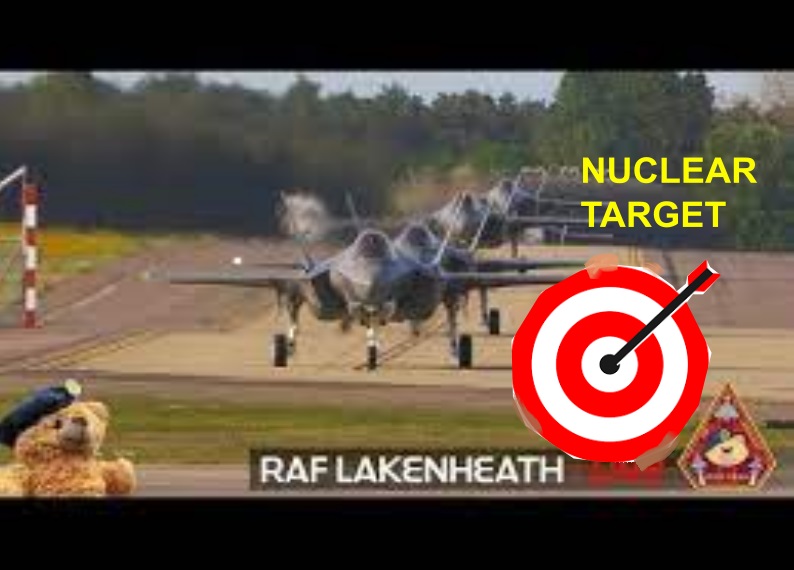
US nuclear weapons could be sited in RAF Lakenheath in spring, CND protest hears
“We are standing on the edge of the nuclear abyss. And our governments have the responsibility to keep us safe; and what are they doing? They are pushing us over the edge.”
US nuclear weapons could be sited at RAF Lakenheath as early as spring, the Campaign for Nuclear Disarmament (CND) has warned.
The CND’s new general secretary Sophie Bolt told dozens of protesters outside the Suffolk airbase on Saturday: “We are very very concerned about the threat of a nuclear escalation between nuclear-armed Nato and nuclear-armed Russia.
“What’s happening here at this base is absolutely central to this growing nuclear threat in eastern Europe.
“It’s also the horrific genocidal war we are seeing in the Middle East because again it’s F35-A jets here and fighter pilots based here that are involved in that war.
“This base completely ties the UK to the complicity of genocide that is being carried out against Palestinian people.”
Green Party peer Jenny Jones said it is “obviously incredibly dangerous” to site nuclear bombs in Britain due to its size and international importance.
She added: “If Russia decide to get really heavy not just with Ukraine but other countries, then we could be a target even if they just think we have nuclear weapons here.
“Secondly, it’s really undemocratic. We need a public debate about the common sense or the lack of it in siting nuclear weapons in Britain.
“We should have a debate in Parliament about this and it should be a free vote as well so we can see exactly what all MPs say about this issue.”
Former Australian minister Melissa Parke, executive director of the International Campaign to Abolish Nuclear Weapons, noted last month’s serious fire at BAE Systems nuclear submarine shipyard in Cumbria; Sellafield nuclear processing plant’s fines for cyber security failings; and maintenance issues on Britain’s nuclear fleet.
She said: “So fires, cyber security failings, maintenance problems on nuclear subs, I mean what could possibly go wrong?
“We are standing on the edge of the nuclear abyss. And our governments have the responsibility to keep us safe; and what are they doing? They are pushing us over the edge.”
Nuke Watch’s Peter Burt described detailed analysis of official documents by scientists, plane spotters and campaigners.
He said: “It’s very clear that we need to keep a close eye on what’s happening here.
“What there is no substitute for is eyes on the ground … in the same way we had in the 1980s we had the Cruise Watch Network, who kept tabs on what’s happening at Greenham Common.”
New Paper: Nuclear Weapons and Our Climate

Today, we are launching a new briefing paper: ‘Nuclear Weapons and Our Climate’ written by ICAN co-founder, A/Prof Tilman Ruff AO.
In the lead up to the climate COP29, this timely paper sharply lays out how the “two paramount human-made existential threats we confront—nuclear weapons and climate change—exacerbate each other and need to be addressed together—with utmost urgency,” writes A/Prof Ruff. “One harms us and our biosphere every day, the other could deplete it irrevocably and end human civilisation and many species in less than a day.”
The paper’s key findings are:
- Smoke from burning cities ignited by a nuclear war involving 2% of the global arsenal would suddenly plummet temperatures worldwide to ice age levels, decimate agriculture, disrupt ocean food chains and starve to death over two billion people.
- Militaries are large and mostly unconstrained greenhouse gas emitters. Growing conflicts and nuclear threats undermine international cooperation needed to address the climate crisis. Rising military spending and nuclear arsenals have huge opportunity costs and make conflicts more dangerous. An increased risk of war leading to nuclear escalation is the greatest danger of the climate crisis.
- Nuclear power inseparably creates the capacity to build nuclear weapons. In most nuclear-armed states, the infrastructure, personnel, expertise, industrial capacity and government investments in nuclear power are also key to their nuclear weapons programs.
- Nuclear reactors, spent fuel storage ponds and reprocessing plants are effectively pre-positioned large radiological weapons, vulnerable to direct attack or disruption of power and water for essential cooling. Russia’s invasion of Ukraine has seen, for the first time, multiple nuclear power plants attacked and weaponised in war, risking a radiological disaster.
| The paper is a call to action, as “everyone everywhere, everything we treasure and our living planet is threatened by nuclear weapons, this is everyone’s business.” Please share the report with your friends and networks and discuss how you can help prevent climate disruption and nuclear war in your work and daily lives. |
UK lobbyists accused of ‘greenwashing’ oil-rich Azerbaijan before Baku COP summit

Azerbaijan’s authoritarian regime has been accused of human rights abuses, including jailing climate activists on ‘bogus’ charges
By Ben Gartside, November 3, 2024
A lobbying firm with close links to a former Cabinet minister and the fossil fuels industry is being paid $4.7m to help oil-rich Azerbaijan enhance its image ahead of the crucial UN COP climate summit next month, the i Paper can reveal.
The lobbying giant Teneo, which employs Labour’s former Culture Secretary Ben Bradshaw as well as Boris Johnson’s former business chief Alex Hickman, has been awarded a seven-month contract which campaigners claim will help the state “greenwash” its reputation.
On 11 November, the UN will host its COP 29 climate change summit in Baku, the Azerbaijan capital. It will be the first major global climate meeting after the US presidential election and will set the tone for discussions for tackling global warming. The talks will involve world leaders, ministers and negotiators and have a particular focus on how to make finance available to developing countries for climate action.
The choice of Azerbaijan as a host for the summit has been controversial. Its economy is highly dependent on fossil fuels and campaigners have criticised the regime’s human rights record, including the imprisonment of climate activists
An investigation by the i, in conjunction with the newsletter Democracy for Sale and SourceMaterial, reveals that as part of the Teneo contract, one of its British consultants will be paid “a monthly fee of $25,000, plus bonuses totalling $50,000” while only working on a “part-time basis”.
According to US documents Teneo will provide “media training” and advise on “narrative development” for the hosts of the COP summit.
The lobbying firm’s work will be led by its Global Strategy President Geoff Morrell who is a former executive at oil giant BP, which is Azerbaijan’s biggest foreign investor.
While working for BP, Morrell chided “opportunistic” environmentalists for exaggerating the impact of the company’s Deepwater Horizon explosion, an oil rig explosion in the Gulf of Mexico that killed 11 people and discharged four million barrels of oil into the ocean.
Despite hosting the environmental summit, Azerbaijan is planning to ramp up oil and gas production over the next decade, according to a report from a German NGO.
The country, which earns 60% of its entire revenue from oil and gas, has also massively increased its gas exports to Europe since the Russian invasion of Ukraine.
Climate campaign groups have accused Teneo of helping Azerbaijan to “greenwash” its image.
Lela Stanley, senior investigator at Global Witness said: “Firms helping petrostates like Azerbaijan … are complicit in greenwashing.
“Instead of focusing on glossing up their image, Azerbaijan and its partners should be making fossil fuel companies pay in to the UN’s Loss and Damage Fund. Planet-wrecking polluters should pay for the devastation they’ve caused.”
In addition to its work for the Azerbajian regime, Teneo has also signed lucrative deals to work with major fossil fuel producers Saudi Arabia and the UAE on other contracts, according to i‘s analysis of US government filings. It also works for some of the world’s leading fossil fuel firms including British Gas owner Centrica and mining giant BHP.
Kathy Mulvey, campaigner at the Union of Concerned Scientists, said: “It’s a clear conflict of interest for a PR firm to be paid to serve both oil and gas company clients that are driving the climate crisis and the host country government charged with shepherding the upcoming international climate talks.”
According to the US documents, Teneo’s lobbying teamworking on the Azerbajian contract includes Boris Johnson’s former chief business adviser Alex Hickman.
Shortly after the general election, the firm sought to bolster their links to the Labour government by appointing former Labour Cabinet minister Ben Bradshaw as a senior advisor.
Although the US documents do not list Bradshaw as one of the individuals working on the Azerbajian COP contract, when he was hired by Teneo, the firm’s UK chief executive Nick Claydon said: “Ben’s deep insights and experience in helping to understand the priorities and approach of the new Labour administration will be of tremendous benefit to Teneo’s clients around the world.”
Teneo’s senior managing director is Patrick Loughlan, one of Tony’s Blair’s former Downing Street special advisors and Labour’s former director of policy and head of research.
The firm’s managing director Robert Fuller also spent six weeks volunteering to help Labour during the recent election campaign.
Azerbaijan’s fossil fuel expansion plans
Azerbaijan’s state-owned oil and gas company, Socar, and its partners are set to raise the country’s annual gas production by 2033, according to a report produced by Urgewald and CEE Bankwatch last month………………………………………………………………………
https://inews.co.uk/news/politics/uk-lobbyists-greenwashing-cop-3354835
‘Two sides of the same coin’: governments stress links between climate and nature collapse

Representatives at the Cop16 summit in Colombia negotiated against a backdrop of extreme weather and ecosystem collapse
Patrick Greenfield and Phoebe Weston in Cali, Guardian 4th Nov 2024
As world leaders gathered in Colombia this week, they also watched for news from home, where many of the headlines carried the catastrophic consequences of ecological breakdown. Across the Amazon rainforest and Brazil’s enormous wetlands, relentless fires had burned more than 22m hectares (55m acres). In Spain, the death toll in communities devastated by flooding passed 200. In the boreal forests that span Siberia, Scandinavia, Alaska and Canada, countries were recording alarming signs that their carbon sinks were collapsing under a combined weight of drought, tree death and logging. As Canada’s wildfire season crept to a close, scientists calculated it was the second worst in two decades – behind only last year’s burn, which released more carbon than some of the world’s largest emitting countries.
In global negotiations, climate and nature move along two independent tracks, and for years were broadly treated as distinct challenges. But as negotiations closed at the Cop16 biodiversity summit in Cali on Saturday, ministers from around the world underscored the crucial importance of nature to limiting damage from global heating, and vice versa – emphasising that climate and biodiversity could no longer be treated as independent issues if either crisis was to be resolved. Countries agreed a text on links between the climate and nature, but failed to include language on a phase out of fossil fuels.
The UK environment secretary, Steve Reed, said that attending the summit in Colombia had brought home the links between climate and biodiversity. “One of the other things that’s really struck me coming here and speaking to the Colombians in particular is how for them the nature crisis and the climate crisis are exactly the same thing. In the UK, perhaps more widely in the global north, we tend to talk a lot about climate and particularly net zero, and much less about nature – perhaps because we’re already more nature-depleted. But those two things connect entirely,” he said.
The Cop16 president, Susana Muhamad, Colombia’s environment minister, has sought to put nature on a level with global efforts to decarbonise the world economy during the summit, warning that slashes to greenhouse gas emissions must be accompanied by the protection and restoration of the natural world if they are to be effective. Her presidency has repeatedly described nature and climate as “two sides of the same coin”.
“There is a double movement humanity must make. The first one is to decarbonise and have a just energy transition. The other side of the coin is to restore nature and allow nature to take again its power over planet Earth so that we can really stabilise the climate,” she has said throughout Cop16 and during the buildup……………………………………………………………………………. https://www.theguardian.com/environment/2024/nov/04/two-sides-of-the-same-coin-governments-stress-links-between-climate-and-nature-collapse
Japanese nuclear reactor that restarted 13 years after Fukushima disaster is shut down again
A Japanese nuclear reactor that restarted last week for the first time in more than 13 years after it survived a massive earthquake and tsunami that badly damaged the nearby Fukushima nuclear plant has been shut down again due to an equipment problem
Mari Yamaguchi, 4 Nov 24, https://www.independent.co.uk/news/ap-japanese-tokyo-fukushima-b2640761.html
A Japanese nuclear reactor that restarted last week for the first time in more than 13 years after it had survived a massive 2011 earthquake and tsunami that badly damaged the nearby Fukushima nuclear plant was shut down again Monday due to an equipment problem, its operator said.
The No. 2 reactor at the Onagawa nuclear power plant on Japan’s northern coast was put back online on Oct. 29 and had been expected to start generating power in early November.
But it had to be shut down again five days after its restart due to a glitch that occurred Sunday in a device related to neutron data inside the reactor, plant operator Tohoku Electric Power Co. said.
The reactor was operating normally and there was no release of radiation into the environment, Tohoku Electric said. The utility said it decided to shut it down to re-examine equipment to address residents’ safety concerns. No new date for a restart was given.
The reactor is one of three at the Onagawa plant, which is 100 kilometers (62 miles) north of the Fukushima Daiichi plant where three reactors melted following a magnitude 9.0 earthquake and tsunami in March 2011, releasing large amounts of radiation.
1 This Month
To see nuclear-related stories in greater depth and intensity – go to https://nuclearinformation.wordpress.com/
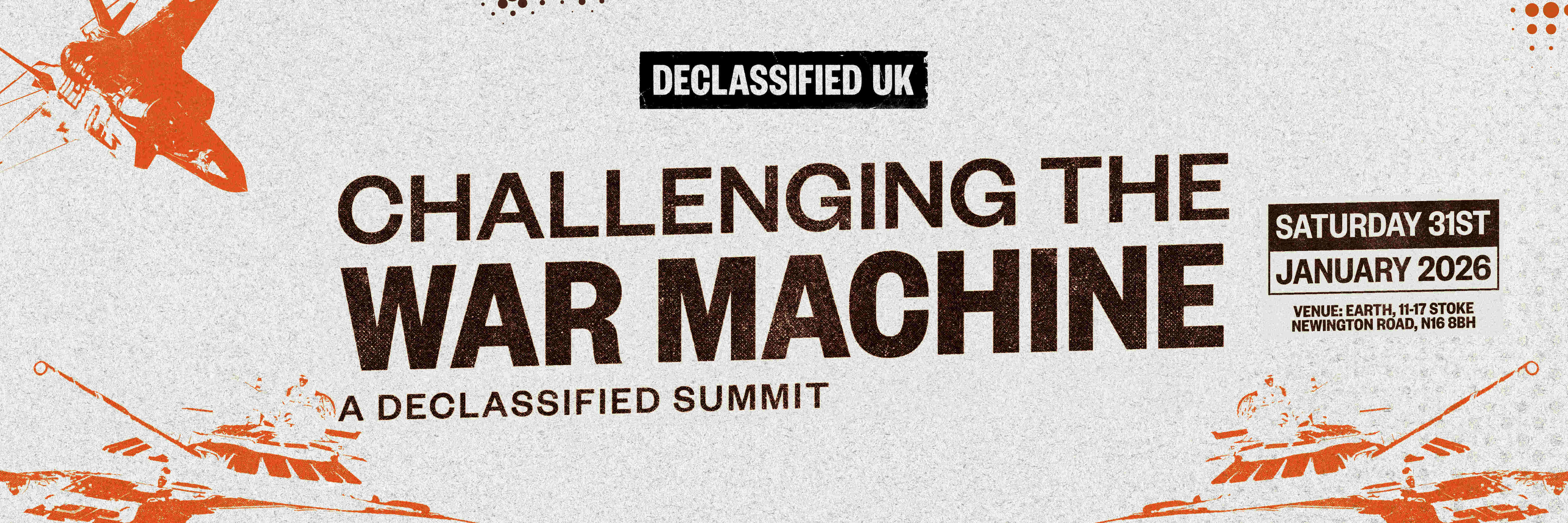
31st January – Challenging the War Machine – a DECLASSIFIED UK SUMMIT



Website of the Week
Now until to February 10, 2026 Radioactive waste storage in France: the debate is finally open! How to participate?
-
Archives
- January 2026 (306)
- December 2025 (358)
- November 2025 (359)
- October 2025 (376)
- September 2025 (258)
- August 2025 (319)
- July 2025 (230)
- June 2025 (348)
- May 2025 (261)
- April 2025 (305)
- March 2025 (319)
- February 2025 (234)
-
Categories
- 1
- 1 NUCLEAR ISSUES
- business and costs
- climate change
- culture and arts
- ENERGY
- environment
- health
- history
- indigenous issues
- Legal
- marketing of nuclear
- media
- opposition to nuclear
- PERSONAL STORIES
- politics
- politics international
- Religion and ethics
- safety
- secrets,lies and civil liberties
- spinbuster
- technology
- Uranium
- wastes
- weapons and war
- Women
- 2 WORLD
- ACTION
- AFRICA
- Atrocities
- AUSTRALIA
- Christina's notes
- Christina's themes
- culture and arts
- Events
- Fuk 2022
- Fuk 2023
- Fukushima 2017
- Fukushima 2018
- fukushima 2019
- Fukushima 2020
- Fukushima 2021
- general
- global warming
- Humour (God we need it)
- Nuclear
- RARE EARTHS
- Reference
- resources – print
- Resources -audiovicual
- Weekly Newsletter
- World
- World Nuclear
- YouTube
-
RSS
Entries RSS
Comments RSS
 nuclear-news